EP0449964B1 - Verteilter schaltungsaufbau für kommunikationsmodulredundanz - Google Patents
Verteilter schaltungsaufbau für kommunikationsmodulredundanz Download PDFInfo
- Publication number
- EP0449964B1 EP0449964B1 EP90901432A EP90901432A EP0449964B1 EP 0449964 B1 EP0449964 B1 EP 0449964B1 EP 90901432 A EP90901432 A EP 90901432A EP 90901432 A EP90901432 A EP 90901432A EP 0449964 B1 EP0449964 B1 EP 0449964B1
- Authority
- EP
- European Patent Office
- Prior art keywords
- module
- primary
- modules
- partner
- spare
- Prior art date
- Legal status (The legal status is an assumption and is not a legal conclusion. Google has not performed a legal analysis and makes no representation as to the accuracy of the status listed.)
- Expired - Lifetime
Links
Images


Classifications
-
- G—PHYSICS
- G06—COMPUTING OR CALCULATING; COUNTING
- G06F—ELECTRIC DIGITAL DATA PROCESSING
- G06F11/00—Error detection; Error correction; Monitoring
- G06F11/07—Responding to the occurrence of a fault, e.g. fault tolerance
- G06F11/16—Error detection or correction of the data by redundancy in hardware
- G06F11/20—Error detection or correction of the data by redundancy in hardware using active fault-masking, e.g. by switching out faulty elements or by switching in spare elements
- G06F11/2002—Error detection or correction of the data by redundancy in hardware using active fault-masking, e.g. by switching out faulty elements or by switching in spare elements where interconnections or communication control functionality are redundant
- G06F11/2005—Error detection or correction of the data by redundancy in hardware using active fault-masking, e.g. by switching out faulty elements or by switching in spare elements where interconnections or communication control functionality are redundant using redundant communication controllers
-
- G—PHYSICS
- G06—COMPUTING OR CALCULATING; COUNTING
- G06F—ELECTRIC DIGITAL DATA PROCESSING
- G06F11/00—Error detection; Error correction; Monitoring
- G06F11/22—Detection or location of defective computer hardware by testing during standby operation or during idle time, e.g. start-up testing
Definitions
- This invention relates to communications systems that provide a redundant module for interfacing with communication lines in case of failure of a primary interface module.
- Conventional communications systems typically include multiple communication lines that are connected to corresponding primary interface modules for receiving data on the lines.
- the interface modules are "field replaceable" for servicing and/or replacement in case of failure.
- the communications system also includes one or more spare (i.e., redundant) modules for connection to the appropriate communication lines in case of failure or servicing of a primary interface module.
- spare modules i.e., redundant modules for connection to the appropriate communication lines in case of failure or servicing of a primary interface module.
- One known scheme for providing this redundancy uses a dedicated switching module or subsystem to detect the failure of a primary module and connect the spare module in its place to the corresponding communication line.
- United States patent US4628508 discloses a redundant processor control system having a plurality of primary processing modules. Each primary module is assigned to a partner module which has circuitry for switching signals intended for its assigned primary to the partner module upon failure of the primary.
- apparatus for a communications system of the kind in which a plurality of primary communications modules receive signals on a corresponding plurality of communication lines, providing redundancy in case of a failure of one of said primary modules comprising: a spare communications module for receiving signals from the communication line corresponding to a failed primary module, a plurality of partner modules assigned to said plurality of primary modules, each partner module being adapted to route signals from the communication line of the primary module to which the partner module is assigned to said spare module in case of failure of said primary module; characterised in that: each partner module comprises circuitry for detecting whether the primary module with which it is partnered has failed; each partner module is adapted to periodically poll the primary module with which it is partnered, and to be periodically polled by said primary module, to detect whether said primary module has failed; and each partner module includes storage for operational configuration information for the primary module with which it is partnered and further comprises circuitry for notifying said spare module of said configuration information when said primary
- a method for use in a communications system of the kind in which a plurality of primary communications modules receive signals on a corresponding plurality of communication lines, of providing redundancy in case of a failure of one of said primary modules comprising: providing a spare communications module for receiving signals from the communication line corresponding to a failed primary module, assigning partner modules to said primary modules, and enabling each partner module to couple signals from the communication line of the primary module to which the partner module is assigned to said spare module in case of failure of said primary module.
- a general aspect of the invention regards assigning partner modules to a plurality of primary modules in a communications system, each partner module being adapted to route signals from the primary module to which it is assigned to a spare module in case the primary module fails.
- the partner modules preferably also serve as primary modules for receiving signals from their associated communication lines.
- redundancy for a failed primary module is provided by a signal routing architecture that is distributed throughout the communications system, eliminating the need for an additional dedicated switching mule or subsystem.
- the distributed nature of the routing architecture permits the redundancy to be implemented in the same way in both large communications systems (i.e., systems having many interface modules) and small systems.
- Preferred embodiments include the following features.
- the primary modules are arranged in pairs, and each module in each pair of modules serves as the partner module for the other module in the pair.
- Each primary module may be paired with another primary module.
- one of the primary modules may be paired with the spare module, which then serves as the partner module for that primary module.
- the primary modules and the spare module are arranged in a loop such that each one of the modules serves as the partner module for an adjacent module in the loop.
- Each partner module couples signals from the communication line of the associated primary module onto a signal bus if that primary module fails, and the spare module receives the signals from the signal bus.
- a primary module which also serves as a partner module has a first input coupled to its communication line, and has a second input coupled to the communication line of the primary module with which it is partnered for routing signals from the communication line of that primary module onto the signal bus if the primary module fails.
- the spare module When the spare module serves as the partner of one of the primary modules, the spare module has a first input coupled to the signal bus, and a second input of the spare is coupled to the communication line of the primary module with which the spare is partnered for routing signals from the communication line onto the signal bus (and back to the spare module) if the primary module fails.
- the primary modules also transmit signals on a second plurality of communication lines, and each partner module couples the spare module to the second communication line of the primary module to which the partner module is assigned in case such primary module fails.
- Each partner module also detects whether the primary module with which it is partnered has failed, such as by periodically polling, and being polled by, that primary module.
- Each partner module stores operational configuration information for the primary module with which it is partnered and notifies the spare module of the configuration information when the primary module fails. In response, the spare module assumes the configuration of the failed primary module.
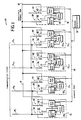
- FIG. 1 is a block diagram of a communications system according to a first embodiment of the invention.
- FIG. 2 is a block diagram of a communications system according to a second embodiment of the invention.
- FIG. 3 is a block diagram of a communications system according to a third embodiment of the invention.
- communications system 10 includes N replaceable primary interface modules 12 1 -12 N for receiving and processing signals (i.e., data) on N corresponding communication lines 14 1 -14 N .
- Spare (i.e., redundant) interface module 16 normally does not receive signals on any communication line 14 1 -14 N , but may be connected via auxiliary signal bus 18 in a manner described in detail below to any communication line 14 1 -14 N in case of failure (or removal) of the corresponding interface module 12 1 -12 N .
- Interface modules 12 1 -12 N include signal processors 20 1 -20 N , respectively, for processing the received signals.
- Module controllers 22 1 -22 N control the operation of respective signal processors 20 1 -20 N .
- Fault monitors 24 1 -24 N monitor the operation of respective signal processors 20 1 -20 N and module controllers 22 1 -22 N .
- Each fault monitor has a pass state and a fail state as discussed in detail below.
- Module controllers 22 1 -22 N operate with fault monitors 24 1 -24 N in a manner described in detail below to determine whether signal processors 20 1 -20 N are operating properly or have failed.
- Spare module 16 is identical to modules 12 1 -12 N and includes processor 26, module controller 28, and fault monitor 30.
- Module controllers 22 1 -22 N , 28 communicate with each other and with a system controller 32 over control bus 34.
- Each module 12 1 -12 N is assigned a partner module for detecting the failure or removal of the module 12 1 -12 N to which the partner is assigned and for diverting signals from the failed/removed module's communication line to spare interface module 16 via auxiliary signal bus 18.
- modules 12 1 -12 N are arranged in pairs.
- modules 12 1 , 12 2 comprise one pair, modules 12 N - 1 , 12 N another.
- Each module in each pair serves as the partner module for the other module in the pair.
- module 12 2 besides receiving and processing signals on communication line 14 2 , serves as the partner of module 12 1 .
- module 121 is assigned as the partner to module 12 2 .
- Each interface module 12 1 -12 N , 16 includes primary switch 36 for selectively coupling signals applied to primary module input 38 to that module's signal processor (e.g., signal processor 20 1 ) under the control of the fault monitor (e.g., fault monitor 24 1 ) of the module.
- a secondary switch 40 in each module 12 1 -12 N , 16 selectively couples signals present at the secondary input 42 of that module onto auxiliary bus 18 under the control of the module controller of the module (e.g., module controller 22 1 ).
- Primary switches 36 of modules 12 1 -12 N are normally closed to couple signals on communication lines 14 1 -14 N to respective signal processors 20 1 -20 N ; secondary switches 40 in modules 12 1 -12 N , on the other hand, are normally open for reasons explained below.
- Primary and secondary switches 36, 40 in spare module 16 are operated by fault monitor 30 and module controller 28, respectively, and both are normally open.
- modules 12 1 -12 N receive and process signals from communication lines 14 1 -14 N in a conventional manner as long as all modules 12 1 -12 N are functioning normally.
- spare module 16 is idle.
- Each module 12 1 -12 N periodically monitors (polls) its partner for faults via control bus 34 and is likewise periodically monitored (polled) for failure by its partner.
- odd-numbered modules e.g., modules 12 1 , 12 N-1 , where N is an even number
- are polled by their even-numbered partners e.g., modules 12 2 , 12 N
- An odd-numbered module determines that its even-numbered partner is operating correctly if the odd-numbered module receives a poll within predetermined time interval.
- the even-numbered module determines that its odd-numbered partner is operating properly if the even-numbered module receives a response to the poll within the predetermined time interval. This procedure is repeated periodically whenever system 10 is operating.
- module controller 22 1 in module 12 1 polls partner module 12 2 by transmitting a data sequence called a polling protocol to module controller 22 2 . If signal processor 20 2 and module controller 22 2 are operating properly, controller 22 2 sends a response indicating such proper operation to module controller 22 1 . Module controller 22 2 periodically sends a reset command to keep the fault monitor in the pass state.
- Module controller 22 1 analyzes the response to its poll from module controller 22 2 to determine whether the response indicates that module 12 2 is in the pass state. If so, module controller 12 1 repeats the cycle in the same manner described above. Note that the response from module 12 2 constitutes a "poll” of module 12 1 , the "response” to which is the next poll by module 12 1 of module 12 2 .
- Module failure can be detected in one of two ways during the polling procedure. Again using partner modules 12 1 , 12 2 as examples, module 12 2 is deemed to be malfunctioning if module controller 22 2 either completely fails to respond to the polling protocol from module 12 1 or responds with a fault status.
- fault monitor 24 2 detects this failure and sets its status to indicate that processor 20 2 is malfunctioning.
- Module controller 22 2 learns of the failure by reading the status of fault monitor 24 2 and sends a response to module controller 22 1 indicating a fault status.
- Module controller 22 2 also sends a set command to fault monitor 24 2 to change its state from pass to fail and cause fault monitor 24 2 to open primary switch 36 in module 12 2 .
- module controller 22 1 reads the response from controller 22 2 indicating the fault, it closes the secondary switch 40 in module 12 1 .
- signals on line 14 2 are diverted from failed module 12 2 , through secondary switch 40 in its partner module 12 1 , and onto auxiliary signal bus 18.
- module controller 22 2 fails to send a reset command to fault monitor 24 2 within a predetermined time, fault monitor 24 2 within a predetermined time, fault monitor 24 2 determines that controller 22 2 has failed and sets itself to the fault state, thereby preventing module 12 2 from responding to subsequent polls from module controller 22 1 .
- Fault monitor 24 2 then opens primary switch 36 in module 12 1 , decoupling signal processor 20 2 from communication line 14 2 .
- Module controller 22 1 upon failing to receive a response within a predetermined time interval, would determine that partner module 12 2 is missing or severely malfunctioning, and close secondary switch 40 in module 12 1 .
- module controller 22 1 in its partner module 12 1 notifies module controller 28 in spare module 16 and transmits data to module controller 28 that describes the "configuration" of signal processor 20 2 in failed module 12 2 .
- Each module controller 22 1 -22 N stores data that describe the configuration of the signal processor in its module and the configuration of the partner module's signal processor.
- module controller 22 1 stores configuration data for signal processor 20 1 and signal processor 20 2
- module controller 22 2 likewise stores data on the configurations of signal processors 20 1 , 20 2
- the configuration data for a given signal processor includes information identifying the interface with the module's communication line 14 2 , the type of process being run on signal processor 20 2 , and the destination in system 10 where the output of signal processor 20 2 is to be sent over line 14 2 .
- Spare module controller 28 responds to the configuration data from module controller 22 1 by causing spare signal processor 26 to assume the specified configuration and by resetting the response timer in spare fault monitor 30. Primary switch 36 in spare module 16 is then closed by fault monitor 36, thereby completing the rerouting of signals on communication line 142 to spare signal processor 26 via auxiliary system bus 18 without any interruption in service.
- module 12 N fails, fault monitor 24 N opens primary switch 36 in module 12 N , and module controller 22 N-1 closes secondary switch 40 in module 12 N-1 .
- Module controller 22 N-1 sends the configuration data of signal processor 20 N to spare module controller 28, which causes spare signal processor 26 to assume that configuration and causes spare fault monitor 30 to close primary switch 36.
- Data on line 14 N is thereby routed via partner module 12 N-1 and auxiliary signal bus 18 to signal processor 26 in spare module 16.
- spare module 16 would also serve as the partner module for the module not otherwise paired (e.g., module 12 N ).
- the secondary input 42 of spare module 16 is connected to communication line 14 N (see FIG. 2).
- Spare module 16 would poll partner module 12 N in the same manner as discussed above. If module controller 22 N , 28 determine that signal processor 20 N has failed, spare module controller 28 closes secondary switch 40 in spare module 16 and causes spare fault monitor 30 to close primary switch 36, and fault monitor 24 N causes primary switch 36 of failed module 12 N to open. Signals on line 14 N thus are coupled through switch 40 in spare module 16 onto auxiliary signal bus 18 to spare signal processor 26 via spare module switch 36.
- Module controller 22 N identifies module 12 N as the failed module, and spare module 16 assumes the configuration of module 12 N in response to the configuration data stored in spare module controller 28.
- modules 112 1 -112 N which receive signals on respective communications lines 114 1 -114 N , are connected in a "loop" configuration with spare module 116.
- each module is assigned to be the partner of the two modules (a "client” module and an “agent” module) disposed on each side of the partner module.
- An agent module controls the secondary switch 140 of its client module.
- module 112 2 controls secondary switch 140 of module 112 2
- module 112 2 is the agent of module 112 1 .
- the secondary switch 140 of module 112 2 is controlled by module 112 3 , and thus module 112 2 is the client of module 112 3 .
- module 112 N is the agent of module 112 N-1 (not shown).
- the secondary input 142 of each module applies signals to secondary switch 140 from the communication line of its client module.
- secondary switch 140 in module 112 2 receives signals from communication line 114 1 .
- the outputs of all secondary switches 140 are connected to auxiliary signal bus 118.
- the loop is closed by connecting the primary input 138 of spare module 116 and the secondary input 142 of the first module 112 1 in the loop to auxiliary signal bus 118.
- primary and secondary switches 136, 140 in modules 112 1 -112 N are normally closed and open, respectively, and both switches 136, 140 in spare module 116 are open.
- Each module's switches are controlled by that module's fault monitor (i.e., 124 1 -124 N , 130) and module controller (i.e., 122 1 -122 N , 128) in the same manner as described above, and the agent modules poll their client modules over control bus 134 using the same procedure as discussed above.
- module 112 1 In operation, when one of the modules (e.g., module 112 1 ) indicates its failure, either by not responding to the poll from its agent module (e.g., module 112 2 ) or responding with a fault status, the response timer in fault monitor 124 1 times out, causing fault monitor 124 1 to open primary switch 136 of module 112 1 .
- Module controller 122 2 closes secondary switch 140 of module 112 2 and sends the configuration data of signal processor 120 1 to module controller 128 in spare module 116.
- Spare module 126 configures spare signal processor 126 according to the configuration data and causes spare fault monitor 130 to close spare module primary switch 136. Secondary switch 128 in spare module 116 is maintained open.
- the data on communication line 1141 is thus routed through module 112 2 , onto auxiliary signal bus 118, and is applied to signal processor 126 in spare module 116.
- the distributed switching architecture of the invention can also be used in a communications system 200 in which interface modules 212 1 -212 N are connected between network 202 and equipment 204 1 -204 N via network lines 214 a1 -214 aN and equipment lines 214b 1 -214b N , respectively.
- the network side includes an auxiliary signal bus 218a, and a separate auxiliary signal bus 218b is provided for the equipment side of the system.
- Each module 212 1 -212 N includes a signal processor 200 1 -200 N and two sets of primary and secondary switches; primary switch 226a and secondary switch 228a on the network side, and primary and secondary switches 226b, 228b on the equipment side.
- the primary switches 226a, 226b of each module are controlled by the fault monitor (e.g., fault monitor 224 1 ) and the module controller (e.g., module controller 222 1 ), respectively, of that module.
- any one of interface modules 212 1 -212 N may be arbitrarily designated as the spare module.
- Module controller 222 N and fault monitor 224 N is designated spare module 212 N normally decouple module 212 N from lines 214a N , 214b N by placing its primary switches 226a, 226b in position "2".
- Primary switches 226a, 226b in the active modules e.g., modules 212 1 , 212 2
- Primary switches 226a, 226b in the active modules are normally in position "1" to couple signal processors 220 1 , 220 2 of such interface modules in series with their respective communication lines (e.g., lines 214a 1 , 214b 1 and 214a 2 , 214b 2 ).
- Secondary switches 228a, 228b in all modules 212 1 -212 N are all normally deactivated in position "1" by module controllers 222 1 -222 N , respectively.
- Modules 212 1 -212 N are connected in a "loop" configuration, with each module serving as the agent for one adjacent module and the client for the other adjacent module.
- module 212 2 is the agent for module 212 1 and is the client of module 212 3 (not shown).
- module 212 1 serves as the agent for module 212 N .
- the fault monitor in the malfunctioning module opens its pair of primary switches 226a, 226b, and the module controller in the failed module's agent closes the secondary switches 228a, 228b in its client module, thereby decoupling the failed client module from its equipment and network 202 and coupling the communication lines of the failed module onto auxiliary signal buses 218a, 218b.
- the module controller in the agent module also notifies module controller 222 N in spare module 212 N of the failure of its client and sends the configuration of the signal processor of the failed module to spare module controller 222 N via control bus 230.
- Module controller 222 N configures signal processor 220 N accordingly and causes fault monitor 224 N to change switches 226a, 226b to position "3", thereby coupling signal processor 220 N to auxiliary signal buses 218a, 218b so that spare module 212 N replaces the failed module in the system.
- module 212 1 fails, the response timer in fault monitor 224 1 times out and fault monitor 224 1 deactivates primary switches 226a, 226b in module 212 1 to position "2", decoupling module 212 1 from communication lines 214a 1 , 214b 1 .
- Module controller 222 2 actuates secondary switches 228a, 226b in module 212 2 to position "2", thereby coupling signals on communication lines 214a 1 , 214b 1 onto auxiliary signal buses 218a, 218b, respectively.
- Module controller 222 2 also sends the configuration of signal processor 220 1 to spare module controller 222 N via control bus 230.
- Module controller 222 N sets the configuration of spare signal processor 220 N to be the same as that of signal processor 220 1 and causes spare fault monitor 224 N to change primary switches 226a, 226b in spare module 212 N to position "3".
- the signals on auxiliary buses 218a, 218b are coupled to signal processor 220 N and spare module 212 N is inserted between network 202 and equipment 204 1 in place of failed module 212 1 .
Landscapes
- Engineering & Computer Science (AREA)
- Theoretical Computer Science (AREA)
- Quality & Reliability (AREA)
- Physics & Mathematics (AREA)
- General Engineering & Computer Science (AREA)
- General Physics & Mathematics (AREA)
- Hardware Redundancy (AREA)
- Computer And Data Communications (AREA)
- Detection And Prevention Of Errors In Transmission (AREA)
- Small-Scale Networks (AREA)
- Maintenance And Management Of Digital Transmission (AREA)
- Data Exchanges In Wide-Area Networks (AREA)
Claims (14)
- Gerät für ein Kommunikationssystem (10) der Art, in der eine Mehrzahl primärer Kommunikationsmodule (121-12N) Signale auf einer entsprechenden Mehrzahl von Kommunikationsleitungen (141-14N) empfangen, die eine Redundanz in dem Fall eines Fehlverhaltens eines der primären Module (122, 12N) liefern, wobei das Gerät aufweist:ein Reservekommunikationsmodul (16) zum Empfangen von Signalen von der Kommunikationsleitung entsprechend einem fehlerhaften, primären Modul (122, 12N),eine Mehrzahl Partnermodule (121, 12N-1), die der Mehrzahl primärer Module (122, 12N) zugeordnet ist, wobei jedes Partnermodul (121, 12N-1) dazu geeignet ist, Signale von der Kommunikationsleitung des primären Moduls (122, 12N), zu dem das Partnermodul (122, 12N-1) zugeordnet ist, zu dem Reservemodul (16) in dem Fall eines Fehlverhaltens des primären Moduls (122, 12N) zu führen; gekennzeichnet durch:jedes Partnermodul (121, 12N-1) weist einen Schaltkreis zum Erfassen auf, ob das primäre Modul (122, 12N), mit dem es verpartnert ist, fehlerhaft ist;jedes Partnermodul (121, 12N-1) ist dazu geeignet, periodisch das primäre Modul (122, 12N), mit dem es verpartnert ist, abzufragen und periodisch durch das primäre Modul (122, 12N) abgefragt zu werden, um zu erfassen, ob das primäre Modul (122, 12N) fehlerhaft ist;und jedes Partnermodul (121, 12N-1) umfaßt einen Speicher für operationsmäßige Konfigurationsinformationen für das primäre Modul (122, 12N), mit dem es verpartnert ist, und weist weiterhin einen Schaltkreis zum Hinweisen des Reservemoduls (16) auf die Konfigurationsinformationen, wenn das primäre Modul (122, 12N) fehlerhaft ist, auf; undeine Einrichtung zum Bewirken, daß das Reservemodul (16) die Konfiguration des fehlerhaften, primären Moduls (122, 12N) in Abhängigkeit der Konfigurationsinformationen annimmt.
- Gerät nach Anspruch 1, wobei mindestens eines der primären Module (122, 12N) auch als das Partnermodul eines anderen der primären Module (122, 12N) dient.
- Gerät nach Anspruch 2, wobei die primären Module (122, 12N) in Paaren angeordnet sind, wobei jedes Modul in jedem Paar Module als das Partnermodul für das andere Modul in dem Paar dient.
- Gerät nach Anspruch 3, wobei jedes der primären Module (122, 12N) mit einem anderen der primären Module (122, 12N) gepaart ist.
- Gerät nach Anspruch 3, wobei eines der primären Module (122, 12N) mit dem Reservemodul (16) gepaart ist, wobei das Reservemodul (16) als das Partnermodul dem einen primären Modul (122, 12N) zugeordnet ist.
- Gerät nach Anspruch 2, wobei die primären Module (122, 12N) und das Reservemodul (16) in einer Schleife derart angeordnet sind, daß jedes eine der Module als das Partnermodul für ein angrenzendes Modul in der Schleife dient.
- Gerät nach Anspruch 2, das weiterhin einen Signalbus (18) aufweist, wobei die Partnermodule (121, 12N-1) jeweils so angepaßt sind, um Signale von der Kommunikationsleitung des primären Moduls (122, 12N), zu dem das Partnermodul zugeordnet ist, auf den Signalbus zu koppeln, wenn das primäre Modul (122, 12N) fehlerhaft wird, und das Reservemodul (16) so angepaßt ist, um die Signale von dem Signalbus (18) zu empfangen.
- Gerät nach Anspruch 7, wobei mindestens eines der primären Module (122, 12N) einen ersten Eingang, der mit seiner Kommunikationsleitung gekoppelt ist, und einen zweiten Eingang, der mit der Kommunikationsleitung des primären Moduls (122, 12N), mit dem es verpartnert ist, gekoppelt ist, und zwar zum Führen von Signalen von der Kommunikationsleitung des primären Moduls (122, 12N) auf den Signalbus, falls das primäre Modul (122, 12N) fehlerhaft ist, besitzt.
- Gerät nach Anspruch 8, wobei das Reservemodul (16) als der Partner eines der primären Module (122, 12N) zugeordnet ist, wobei das Reservemodul (16) einen ersten Eingang, der mit dem Signalbus (18) gekoppelt ist, und einen zweiten Eingang, der mit der Kommunikationsleitung des einen primären Moduls (122, 12N) gekoppelt ist, und zwar zum Führen der Signale von der Kommunikationsleitung auf den Signalbus (18), falls das eine primäre Modul (122, 12N) fehlerhaft ist, besitzt.
- Gerät nach Anspruch 1, wobei die primären Module (122, 12N) weiterhin Signale auf einer zweiten Mehrzahl Kommunikationsleitungen übertragen, wobei das Reservemodul (16) so angepaßt ist, um Signale auf dem einen der zweiten Mehrzahl der Kommunikationsleitungen entsprechend des fehlerhaften, primären Moduls (122, 12N) zu übertragen,
wobei jedes Partnermodul (121, 12N-1) so angepaßt ist, um das Reservemodul (16) zu der zweiten Kommunikationsleitung des primären Moduls (122, 12N), zu dem das Partnermodul (121, 12N-1) zugeordnet ist, im Fall eines Fehlverhaltens des primären Moduls (122, 12N) zu koppeln. - Gerät nach Anspruch 1, das so konfiguriert ist, daß das Reservemodul (16) Kommunikationssignale nur von der Kommunikationsleitung entsprechend eines fehlerhaften, primären Moduls empfängt.
- Gerät nach Anspruch 1, das nur ein einzelnes der Reservekommunikationsmodule (16) für die Mehrzahl der primären Module (122, 12N) umfaßt.
- Verfahren zur Verwendung in einem Kommunikationssystem der Art, in dem eine Mehrzahl primärer Kommunikationsmodule (122, 12N) Signale auf einer entsprechenden Mehrzahl Kommunikationsleitungen empfängt, die im Falle eines Fehlverhaltens eines der primären Module (122, 12N) eine Redundanz liefern, wobei das Verfahren aufweist:Vorsehen eines Reservekommunikationsmoduls (16) zum Empfangen von Signalen von der Kommunikationsleitung entsprechend einem fehlerhaften, primären Modul (122, 12N);Zuordnen von Partnermodulen (121, 12N-1) zu den primären Modulen (122, 12N);Freigeben jedes Partnermoduls (121, 12N-1), um Signale von der Kommunikationsleitung des primären Moduls (122, 12N), zu dem das Partnermodul (121, 12N-1) zugeordnet ist, zu dem Reservemodul (16) im Fall eines Fehlverhaltens des primären Moduls (122, 12N) zu koppeln,wobei das Verfahren dadurch gekennzeichnet ist, daß es weiter die Schritte aufweist:Erfassen für jedes der Partnermodule (121, 12N-1), ob das primäre Modul (122, 12N), mit dem es verpartnert ist, fehlerhaft ist; wobei der Schritt einer Erfassung mittels eines gegenseitigen, periodischen Abfragens zwischen dem Partnermodul (121, 12N-1) und seinem verpartnerten, primären Modul (122, 12N) durchgeführt wird;Speichem im Speicher jedes des Partnermoduls (121, 12N-1) operationsmäßiger Konfigurationsinformationen für das primäre Modul (122, 12N), mit dem es verpartnert ist;Hinweisen, für jedes der Partnermodule, dieses Reservemoduls (16) über die operationsmäßigen Konfigurationsinformationen, wenn das primäre Modul (122, 12N) fehlerhaft ist, undBewirken, daß das Reservemodul (16) die Konfiguration des fehlerhaften, primären Moduls (122, 12N) in Abhängigkeit des Hinweisschrittes annimmt.
- Verfahren nach Anspruch 13, das weiterhin ein Zuordnen mindestens einer der primären Module (122, 12N), so, daß es das Partnermodul des anderen der primären Module (122, 12N) ist, aufweist.
Applications Claiming Priority (3)
| Application Number | Priority Date | Filing Date | Title |
|---|---|---|---|
| US288788 | 1988-12-22 | ||
| US07/288,788 US4984240A (en) | 1988-12-22 | 1988-12-22 | Distributed switching architecture for communication module redundancy |
| PCT/US1989/005728 WO1990007827A1 (en) | 1988-12-22 | 1989-12-21 | Distributed switching architecture for communication module redundancy |
Publications (3)
| Publication Number | Publication Date |
|---|---|
| EP0449964A1 EP0449964A1 (de) | 1991-10-09 |
| EP0449964A4 EP0449964A4 (en) | 1993-02-03 |
| EP0449964B1 true EP0449964B1 (de) | 1996-10-23 |
Family
ID=23108652
Family Applications (1)
| Application Number | Title | Priority Date | Filing Date |
|---|---|---|---|
| EP90901432A Expired - Lifetime EP0449964B1 (de) | 1988-12-22 | 1989-12-21 | Verteilter schaltungsaufbau für kommunikationsmodulredundanz |
Country Status (9)
| Country | Link |
|---|---|
| US (1) | US4984240A (de) |
| EP (1) | EP0449964B1 (de) |
| JP (1) | JP2519603B2 (de) |
| AT (1) | ATE144632T1 (de) |
| AU (1) | AU633865B2 (de) |
| CA (1) | CA2006489C (de) |
| DE (1) | DE68927385T2 (de) |
| HK (1) | HK1009318A1 (de) |
| WO (1) | WO1990007827A1 (de) |
Families Citing this family (78)
| Publication number | Priority date | Publication date | Assignee | Title |
|---|---|---|---|---|
| US5121486A (en) * | 1987-11-20 | 1992-06-09 | Hitachi, Ltd | Network control system for dynamically switching a logical connection between an identified terminal device and an indicated processing unit |
| NL193573C (nl) * | 1989-04-04 | 2000-02-02 | Yokogawa Electric Corp | Duplex-computerstelsel. |
| US5126730A (en) * | 1990-03-30 | 1992-06-30 | At&T Bell Laboratories | Multipoint TBOS interface including backup response unit |
| US5774642A (en) * | 1990-08-09 | 1998-06-30 | Bull S.A. | Architecture for dynamic service processor exchange providing multitasking environment where multiple processors have access to a system configuration table |
| US5202822A (en) * | 1990-09-26 | 1993-04-13 | Honeywell Inc. | Universal scheme of input/output redundancy in a process control system |
| US5229990A (en) * | 1990-10-03 | 1993-07-20 | At&T Bell Laboratories | N+K sparing in a telecommunications switching environment |
| US5278977A (en) * | 1991-03-19 | 1994-01-11 | Bull Hn Information Systems Inc. | Intelligent node resident failure test and response in a multi-node system |
| EP0537903A2 (de) * | 1991-10-02 | 1993-04-21 | International Business Machines Corporation | Verteiltes Kontrollsystem |
| US5781715A (en) * | 1992-10-13 | 1998-07-14 | International Business Machines Corporation | Fault-tolerant bridge/router with a distributed switch-over mechanism |
| US5446924A (en) * | 1993-05-03 | 1995-08-29 | Motorola, Inc. | Method for assuring data integrity during a repeater transition |
| US5448766A (en) * | 1993-05-10 | 1995-09-05 | Motorola, Inc. | Method and apparatus for automatically replacing a non-functioning transmitter in a radio communication system |
| US5835696A (en) * | 1995-11-22 | 1998-11-10 | Lucent Technologies Inc. | Data router backup feature |
| US5790518A (en) * | 1995-12-22 | 1998-08-04 | Hughes Electronics Corporation | 1-for-N redundancy implementation on midplane |
| US5805785A (en) * | 1996-02-27 | 1998-09-08 | International Business Machines Corporation | Method for monitoring and recovery of subsystems in a distributed/clustered system |
| FR2764094A1 (fr) * | 1997-06-02 | 1998-12-04 | Trt Lucent Technologies | Dispositif de sauvegarde de la configuration d'un systeme redondant |
| US6049545A (en) * | 1997-10-03 | 2000-04-11 | Alcatel Usa Sourcing, L.P. | System and method for message communications in a distributed telecommunications switch |
| US6748474B1 (en) * | 2000-02-25 | 2004-06-08 | Telica, Inc. | Midplane apparatus |
| US6538869B1 (en) * | 2000-04-22 | 2003-03-25 | Lucent Technologies Inc. | Protection switch architecture for digital cross-connect system |
| US6928584B2 (en) * | 2000-11-22 | 2005-08-09 | Tellabs Reston, Inc. | Segmented protection system and method |
| JP4596652B2 (ja) * | 2001-01-11 | 2010-12-08 | 富士通株式会社 | 通信制御システム |
| US6973024B1 (en) | 2001-02-28 | 2005-12-06 | Utstarcom, Inc. | Method for modem element switchover using multicast groups |
| US7370239B2 (en) * | 2001-05-31 | 2008-05-06 | Fisher-Rosemount Systems, Inc. | Input/output device with configuration, fault isolation and redundant fault assist functionality |
| DE10152339B4 (de) * | 2001-09-14 | 2005-03-17 | Siemens Ag | Verfahren und Kommunikationseinrichtung zur Realisierung zumindest einer ausfallsicheren Kommunikationsbeziehung durch eine in einem Kommunikationsnetz angeordnete Kommunikationseinrichtung |
| US7122143B2 (en) | 2001-09-28 | 2006-10-17 | Mcneil-Ppc, Inc. | Methods for manufacturing dosage forms |
| US20040253312A1 (en) * | 2001-09-28 | 2004-12-16 | Sowden Harry S. | Immediate release dosage form comprising shell having openings therein |
| US6837696B2 (en) * | 2001-09-28 | 2005-01-04 | Mcneil-Ppc, Inc. | Apparatus for manufacturing dosage forms |
| US20030228368A1 (en) * | 2001-09-28 | 2003-12-11 | David Wynn | Edible solid composition and dosage form |
| US7838026B2 (en) | 2001-09-28 | 2010-11-23 | Mcneil-Ppc, Inc. | Burst-release polymer composition and dosage forms comprising the same |
| NZ532096A (en) * | 2001-09-28 | 2006-10-27 | Mcneil Ppc Inc | Dosage forms having an inner core and outer shell with different shapes |
| US20040146559A1 (en) * | 2002-09-28 | 2004-07-29 | Sowden Harry S. | Dosage forms having an inner core and outer shell with different shapes |
| JP2003234825A (ja) * | 2002-02-06 | 2003-08-22 | Mitsubishi Electric Corp | デジタル信号伝送装置 |
| US7807197B2 (en) * | 2002-09-28 | 2010-10-05 | Mcneil-Ppc, Inc. | Composite dosage forms having an inlaid portion |
| US6879526B2 (en) * | 2002-10-31 | 2005-04-12 | Ring Technology Enterprises Llc | Methods and apparatus for improved memory access |
| US7197662B2 (en) * | 2002-10-31 | 2007-03-27 | Ring Technology Enterprises, Llc | Methods and systems for a storage system |
| ATE557349T1 (de) * | 2002-10-31 | 2012-05-15 | Parallel Iron Llc | Speichersystem und verfahren für ein speichersystem |
| US7415565B2 (en) * | 2002-10-31 | 2008-08-19 | Ring Technology Enterprises, Llc | Methods and systems for a storage system with a program-controlled switch for routing data |
| US7707351B2 (en) * | 2002-10-31 | 2010-04-27 | Ring Technology Enterprises Of Texas, Llc | Methods and systems for an identifier-based memory section |
| US7594002B1 (en) * | 2003-02-14 | 2009-09-22 | Istor Networks, Inc. | Hardware-accelerated high availability integrated networked storage system |
| US6941396B1 (en) * | 2003-02-19 | 2005-09-06 | Istor Networks, Inc. | Storage controller redundancy using bi-directional reflective memory channel |
| US7457234B1 (en) | 2003-05-14 | 2008-11-25 | Adtran, Inc. | System and method for protecting communication between a central office and a remote premises |
| US20040255186A1 (en) * | 2003-05-27 | 2004-12-16 | Lucent Technologies, Inc. | Methods and apparatus for failure detection and recovery in redundant systems |
| US20050069590A1 (en) * | 2003-09-30 | 2005-03-31 | Buehler Gail K. | Stable suspensions for medicinal dosages |
| US8067029B2 (en) | 2004-01-13 | 2011-11-29 | Mcneil-Ppc, Inc. | Rapidly disintegrating gelatinous coated tablets |
| US7879354B2 (en) * | 2004-01-13 | 2011-02-01 | Mcneil-Ppc, Inc. | Rapidly disintegrating gelatinous coated tablets |
| US20050196446A1 (en) * | 2004-03-05 | 2005-09-08 | Huang Hai Y. | Polymeric compositions and dosage forms comprising the same |
| US20050196442A1 (en) * | 2004-03-05 | 2005-09-08 | Huang Hai Y. | Polymeric compositions and dosage forms comprising the same |
| US20050196448A1 (en) * | 2004-03-05 | 2005-09-08 | Hai Yong Huang | Polymeric compositions and dosage forms comprising the same |
| US20050196447A1 (en) * | 2004-03-05 | 2005-09-08 | Huang Hai Y. | Polymeric compositions and dosage forms comprising the same |
| US20070190133A1 (en) * | 2004-10-27 | 2007-08-16 | Bunick Frank J | Dosage forms having a microreliefed surface and methods and apparatus for their production |
| US20060087051A1 (en) * | 2004-10-27 | 2006-04-27 | Bunick Frank J | Dosage forms having a microreliefed surface and methods and apparatus for their production |
| US8383159B2 (en) * | 2004-10-27 | 2013-02-26 | Mcneil-Ppc, Inc. | Dosage forms having a microreliefed surface and methods and apparatus for their production |
| US20070281022A1 (en) * | 2004-10-27 | 2007-12-06 | Bunick Frank J | Dosage forms having a microreliefed surface and methods and apparatus for their production |
| US20060088593A1 (en) * | 2004-10-27 | 2006-04-27 | Bunick Frank J | Dosage forms having a microreliefed surface and methods and apparatus for their production |
| US20060088586A1 (en) * | 2004-10-27 | 2006-04-27 | Bunick Frank J | Dosage forms having a microreliefed surface and methods and apparatus for their production |
| US20060088587A1 (en) * | 2004-10-27 | 2006-04-27 | Bunick Frank J | Dosage forms having a microreliefed surface and methods and apparatus for their production |
| US8673352B2 (en) * | 2005-04-15 | 2014-03-18 | Mcneil-Ppc, Inc. | Modified release dosage form |
| US20070077300A1 (en) | 2005-09-30 | 2007-04-05 | Wynn David W | Oral compositions containing a salivation inducing agent |
| CA2666582C (en) * | 2006-10-20 | 2014-09-09 | Mcneil-Ppc, Inc. | Acetaminophen / ibuprofen combinations |
| US20080317677A1 (en) * | 2007-06-22 | 2008-12-25 | Szymczak Christopher E | Laser Marked Dosage Forms |
| US20080317678A1 (en) * | 2007-06-22 | 2008-12-25 | Szymczak Christopher E | Laser Marked Dosage Forms |
| US20090060983A1 (en) * | 2007-08-30 | 2009-03-05 | Bunick Frank J | Method And Composition For Making An Orally Disintegrating Dosage Form |
| BRPI0819231B8 (pt) * | 2007-10-31 | 2021-05-25 | Mcneil Ppc Inc | processo para preparo de forma farmacêutica de desintegração rápida por moldagem a quente na presença de sal inorgânico hidratado |
| BRPI0821735A2 (pt) * | 2007-12-21 | 2015-06-16 | Mcneil Ppc Inc | Fabricação de tablete |
| WO2009132448A1 (en) * | 2008-05-01 | 2009-11-05 | Active Control Technology Inc. | A self-healing severable communication network and nodes |
| CN102119027A (zh) * | 2008-06-26 | 2011-07-06 | 麦克内尔-Ppc股份有限公司 | 含有药物活性剂的包衣颗粒 |
| US20100003322A1 (en) * | 2008-07-03 | 2010-01-07 | Lai Felix S | Enteric coated hydrophobic matrix formulation |
| EP2299983A4 (de) * | 2008-07-24 | 2012-10-10 | Handa Pharmaceuticals Llc | Stabilisierte atypische antipsychotische formulierung |
| US8858210B2 (en) | 2009-09-24 | 2014-10-14 | Mcneil-Ppc, Inc. | Manufacture of variable density dosage forms utilizing radiofrequency energy |
| US20110070286A1 (en) * | 2009-09-24 | 2011-03-24 | Andreas Hugerth | Process for the manufacture of nicotine-comprising chewing gum and nicotine-comprising chewing gum manufactured according to said process |
| US8313768B2 (en) | 2009-09-24 | 2012-11-20 | Mcneil-Ppc, Inc. | Manufacture of tablet having immediate release region and sustained release region |
| US8784781B2 (en) | 2009-09-24 | 2014-07-22 | Mcneil-Ppc, Inc. | Manufacture of chewing gum product with radiofrequency |
| US9233491B2 (en) | 2012-05-01 | 2016-01-12 | Johnson & Johnson Consumer Inc. | Machine for production of solid dosage forms |
| US9511028B2 (en) | 2012-05-01 | 2016-12-06 | Johnson & Johnson Consumer Inc. | Orally disintegrating tablet |
| US9445971B2 (en) | 2012-05-01 | 2016-09-20 | Johnson & Johnson Consumer Inc. | Method of manufacturing solid dosage form |
| US9618909B2 (en) * | 2013-12-20 | 2017-04-11 | Thales Canada Inc | Safety assurance of multiple redundant systems |
| BR112016015944A8 (pt) | 2014-01-10 | 2020-06-09 | Johnson & Johnson Consumer Inc | processo para produzir comprimido, que usa radiofrequência e partículas revestidas dissipadoras de energia |
| US10493026B2 (en) | 2017-03-20 | 2019-12-03 | Johnson & Johnson Consumer Inc. | Process for making tablet using radiofrequency and lossy coated particles |
| US20240078159A1 (en) * | 2022-09-02 | 2024-03-07 | Samsung Electronics Co., Ltd. | Multichannel apparatus for performing channel replacement and operation method of the same |
Family Cites Families (10)
| Publication number | Priority date | Publication date | Assignee | Title |
|---|---|---|---|---|
| US3252149A (en) * | 1963-03-28 | 1966-05-17 | Digitronics Corp | Data processing system |
| US4228496A (en) * | 1976-09-07 | 1980-10-14 | Tandem Computers Incorporated | Multiprocessor system |
| US4141066A (en) * | 1977-09-13 | 1979-02-20 | Honeywell Inc. | Process control system with backup process controller |
| US4356546A (en) * | 1980-02-05 | 1982-10-26 | The Bendix Corporation | Fault-tolerant multi-computer system |
| ZA821999B (en) * | 1981-03-31 | 1983-05-25 | British Telecomm | Computor or processor control systems |
| JPS57164636A (en) * | 1981-04-03 | 1982-10-09 | Hitachi Ltd | Control method for transmission system |
| US4623883A (en) * | 1984-12-10 | 1986-11-18 | Ncr Corporation | Automatic communications switch |
| DE3788532T2 (de) * | 1986-03-31 | 1994-04-21 | Nippon Electric Co | Funkübertragungssystem mit vereinfachter Fehlerkorrekturschaltung und schneller Kanalumschaltung. |
| US4774709A (en) * | 1986-10-02 | 1988-09-27 | United Technologies Corporation | Symmetrization for redundant channels |
| DE3642378A1 (de) * | 1986-12-11 | 1988-06-30 | Siemens Ag | System zur uebertragung von informationen mit ersatzschalteinrichtungen |
-
1988
- 1988-12-22 US US07/288,788 patent/US4984240A/en not_active Expired - Lifetime
-
1989
- 1989-12-21 AT AT90901432T patent/ATE144632T1/de not_active IP Right Cessation
- 1989-12-21 AU AU48272/90A patent/AU633865B2/en not_active Expired
- 1989-12-21 EP EP90901432A patent/EP0449964B1/de not_active Expired - Lifetime
- 1989-12-21 WO PCT/US1989/005728 patent/WO1990007827A1/en not_active Ceased
- 1989-12-21 JP JP2501895A patent/JP2519603B2/ja not_active Expired - Lifetime
- 1989-12-21 HK HK98107186A patent/HK1009318A1/en not_active IP Right Cessation
- 1989-12-21 DE DE68927385T patent/DE68927385T2/de not_active Expired - Lifetime
- 1989-12-22 CA CA002006489A patent/CA2006489C/en not_active Expired - Lifetime
Also Published As
| Publication number | Publication date |
|---|---|
| EP0449964A4 (en) | 1993-02-03 |
| DE68927385T2 (de) | 1997-06-26 |
| CA2006489A1 (en) | 1990-06-22 |
| CA2006489C (en) | 1998-09-29 |
| JP2519603B2 (ja) | 1996-07-31 |
| US4984240A (en) | 1991-01-08 |
| EP0449964A1 (de) | 1991-10-09 |
| DE68927385D1 (de) | 1996-11-28 |
| ATE144632T1 (de) | 1996-11-15 |
| JPH04502542A (ja) | 1992-05-07 |
| AU633865B2 (en) | 1993-02-11 |
| WO1990007827A1 (en) | 1990-07-12 |
| AU4827290A (en) | 1990-08-01 |
| HK1009318A1 (en) | 1999-05-28 |
Similar Documents
| Publication | Publication Date | Title |
|---|---|---|
| EP0449964B1 (de) | Verteilter schaltungsaufbau für kommunikationsmodulredundanz | |
| HK1009318B (en) | Distributed switching architecture for communication module redundancy | |
| US6466539B1 (en) | Bus system | |
| EP0239662B1 (de) | Zweirichtungsringverbindungssystem für Aufzugsgruppensteuerung | |
| US7210069B2 (en) | Failure recovery in a multiprocessor configuration | |
| JP4781696B2 (ja) | Ip電話システム | |
| JP2023004453A (ja) | 冗長化モジュール | |
| JP3733835B2 (ja) | エレベータの遠隔監視システム | |
| KR0152229B1 (ko) | 시스팀의 이중화를 위한 저가형 이중화 노드 | |
| US6882621B1 (en) | Method for equivalently connecting subassemblies in 1:N redundancy | |
| KR100442433B1 (ko) | 교환기의 공통 제어 프로세서 이중화 장치 | |
| JPH07336296A (ja) | 光伝送方式 | |
| JP3605294B2 (ja) | スイッチ装置 | |
| JP4628823B2 (ja) | Ip電話システム | |
| JP2563632B2 (ja) | 伝送路2重化バス型伝送システム | |
| KR100475280B1 (ko) | 결함허용 고속링형 통신망구축방법 | |
| JPH0837498A (ja) | 光ローカルエリアネットワーク | |
| JP4916670B2 (ja) | Ip電話システム | |
| JPS62175044A (ja) | 二重化ル−プ状伝送路 | |
| JPS6343445A (ja) | 光ル−プ伝送方式 | |
| JPH07298379A (ja) | 監視装置及び監視システム | |
| JPS62190536A (ja) | 冗長構成制御方式 | |
| JPS62281649A (ja) | パケツト情報転送方式 | |
| JP2002247142A (ja) | 多重系伝送システム | |
| JPH0983560A (ja) | 通信システム |
Legal Events
| Date | Code | Title | Description |
|---|---|---|---|
| PUAI | Public reference made under article 153(3) epc to a published international application that has entered the european phase |
Free format text: ORIGINAL CODE: 0009012 |
|
| 17P | Request for examination filed |
Effective date: 19910619 |
|
| AK | Designated contracting states |
Kind code of ref document: A1 Designated state(s): AT BE CH DE FR GB IT LI LU NL SE |
|
| A4 | Supplementary search report drawn up and despatched | ||
| AK | Designated contracting states |
Kind code of ref document: A4 Designated state(s): AT BE CH DE FR GB IT LI LU NL SE |
|
| 17Q | First examination report despatched |
Effective date: 19950510 |
|
| GRAG | Despatch of communication of intention to grant |
Free format text: ORIGINAL CODE: EPIDOS AGRA |
|
| GRAH | Despatch of communication of intention to grant a patent |
Free format text: ORIGINAL CODE: EPIDOS IGRA |
|
| GRAH | Despatch of communication of intention to grant a patent |
Free format text: ORIGINAL CODE: EPIDOS IGRA |
|
| GRAA | (expected) grant |
Free format text: ORIGINAL CODE: 0009210 |
|
| AK | Designated contracting states |
Kind code of ref document: B1 Designated state(s): AT BE CH DE FR GB IT LI LU NL SE |
|
| PG25 | Lapsed in a contracting state [announced via postgrant information from national office to epo] |
Ref country code: IT Free format text: LAPSE BECAUSE OF FAILURE TO SUBMIT A TRANSLATION OF THE DESCRIPTION OR TO PAY THE FEE WITHIN THE PRE;WARNING: LAPSES OF ITALIAN PATENTS WITH EFFECTIVE DATE BEFORE 2007 MAY HAVE OCCURRED AT ANY TIME BEFORE 2007. THE CORRECT EFFECTIVE DATE MAY BE DIFFERENT FROM THE ONE RECORDED.SCRIBED TIME-LIMIT Effective date: 19961023 Ref country code: BE Effective date: 19961023 Ref country code: AT Effective date: 19961023 Ref country code: CH Free format text: LAPSE BECAUSE OF FAILURE TO SUBMIT A TRANSLATION OF THE DESCRIPTION OR TO PAY THE FEE WITHIN THE PRESCRIBED TIME-LIMIT Effective date: 19961023 Ref country code: NL Free format text: LAPSE BECAUSE OF FAILURE TO SUBMIT A TRANSLATION OF THE DESCRIPTION OR TO PAY THE FEE WITHIN THE PRESCRIBED TIME-LIMIT Effective date: 19961023 Ref country code: LI Free format text: LAPSE BECAUSE OF FAILURE TO SUBMIT A TRANSLATION OF THE DESCRIPTION OR TO PAY THE FEE WITHIN THE PRESCRIBED TIME-LIMIT Effective date: 19961023 |
|
| REF | Corresponds to: |
Ref document number: 144632 Country of ref document: AT Date of ref document: 19961115 Kind code of ref document: T |
|
| ET | Fr: translation filed | ||
| REF | Corresponds to: |
Ref document number: 68927385 Country of ref document: DE Date of ref document: 19961128 |
|
| PG25 | Lapsed in a contracting state [announced via postgrant information from national office to epo] |
Ref country code: LU Free format text: LAPSE BECAUSE OF NON-PAYMENT OF DUE FEES Effective date: 19961231 |
|
| PG25 | Lapsed in a contracting state [announced via postgrant information from national office to epo] |
Ref country code: SE Effective date: 19970123 |
|
| NLV1 | Nl: lapsed or annulled due to failure to fulfill the requirements of art. 29p and 29m of the patents act | ||
| REG | Reference to a national code |
Ref country code: CH Ref legal event code: PL |
|
| PLBE | No opposition filed within time limit |
Free format text: ORIGINAL CODE: 0009261 |
|
| STAA | Information on the status of an ep patent application or granted ep patent |
Free format text: STATUS: NO OPPOSITION FILED WITHIN TIME LIMIT |
|
| 26N | No opposition filed | ||
| REG | Reference to a national code |
Ref country code: GB Ref legal event code: IF02 |
|
| PGFP | Annual fee paid to national office [announced via postgrant information from national office to epo] |
Ref country code: FR Payment date: 20081205 Year of fee payment: 20 |
|
| PGFP | Annual fee paid to national office [announced via postgrant information from national office to epo] |
Ref country code: DE Payment date: 20081230 Year of fee payment: 20 |
|
| PGFP | Annual fee paid to national office [announced via postgrant information from national office to epo] |
Ref country code: GB Payment date: 20081110 Year of fee payment: 20 |
|
| REG | Reference to a national code |
Ref country code: GB Ref legal event code: PE20 Expiry date: 20091220 |
|
| PG25 | Lapsed in a contracting state [announced via postgrant information from national office to epo] |
Ref country code: GB Free format text: LAPSE BECAUSE OF EXPIRATION OF PROTECTION Effective date: 20091220 |
|
| P01 | Opt-out of the competence of the unified patent court (upc) registered |
Effective date: 20230520 |