EP0451213B1 - Derivate von polyhydroxylierten molekülen, welche die einführung von mindestens einer verzweigung in ein oligonukleotid erlauben - Google Patents
Derivate von polyhydroxylierten molekülen, welche die einführung von mindestens einer verzweigung in ein oligonukleotid erlauben Download PDFInfo
- Publication number
- EP0451213B1 EP0451213B1 EP90902270A EP90902270A EP0451213B1 EP 0451213 B1 EP0451213 B1 EP 0451213B1 EP 90902270 A EP90902270 A EP 90902270A EP 90902270 A EP90902270 A EP 90902270A EP 0451213 B1 EP0451213 B1 EP 0451213B1
- Authority
- EP
- European Patent Office
- Prior art keywords
- radical
- molecule
- molecules
- oligonucleotide
- formula
- Prior art date
- Legal status (The legal status is an assumption and is not a legal conclusion. Google has not performed a legal analysis and makes no representation as to the accuracy of the status listed.)
- Expired - Lifetime
Links
- 0 CC(C)CN(C(C)C)P(*)OC(C1)C(CO)OC1N(C1C)C=N[C@]1C(N)=NC=N Chemical compound CC(C)CN(C(C)C)P(*)OC(C1)C(CO)OC1N(C1C)C=N[C@]1C(N)=NC=N 0.000 description 3
- PKGOMFIMCIOFRU-UHFFFAOYSA-N CC(C(C)OC1CO)C1O Chemical compound CC(C(C)OC1CO)C1O PKGOMFIMCIOFRU-UHFFFAOYSA-N 0.000 description 1
Classifications
-
- C—CHEMISTRY; METALLURGY
- C07—ORGANIC CHEMISTRY
- C07H—SUGARS; DERIVATIVES THEREOF; NUCLEOSIDES; NUCLEOTIDES; NUCLEIC ACIDS
- C07H19/00—Compounds containing a hetero ring sharing one ring hetero atom with a saccharide radical; Nucleosides; Mononucleotides; Anhydro-derivatives thereof
- C07H19/02—Compounds containing a hetero ring sharing one ring hetero atom with a saccharide radical; Nucleosides; Mononucleotides; Anhydro-derivatives thereof sharing nitrogen
- C07H19/04—Heterocyclic radicals containing only nitrogen atoms as ring hetero atom
- C07H19/06—Pyrimidine radicals
-
- C—CHEMISTRY; METALLURGY
- C07—ORGANIC CHEMISTRY
- C07F—ACYCLIC, CARBOCYCLIC OR HETEROCYCLIC COMPOUNDS CONTAINING ELEMENTS OTHER THAN CARBON, HYDROGEN, HALOGEN, OXYGEN, NITROGEN, SULFUR, SELENIUM OR TELLURIUM
- C07F9/00—Compounds containing elements of Groups 5 or 15 of the Periodic Table
- C07F9/02—Phosphorus compounds
- C07F9/547—Heterocyclic compounds, e.g. containing phosphorus as a ring hetero atom
- C07F9/6558—Heterocyclic compounds, e.g. containing phosphorus as a ring hetero atom containing at least two different or differently substituted hetero rings neither condensed among themselves nor condensed with a common carbocyclic ring or ring system
- C07F9/65586—Heterocyclic compounds, e.g. containing phosphorus as a ring hetero atom containing at least two different or differently substituted hetero rings neither condensed among themselves nor condensed with a common carbocyclic ring or ring system at least one of the hetero rings does not contain nitrogen as ring hetero atom
-
- C—CHEMISTRY; METALLURGY
- C07—ORGANIC CHEMISTRY
- C07F—ACYCLIC, CARBOCYCLIC OR HETEROCYCLIC COMPOUNDS CONTAINING ELEMENTS OTHER THAN CARBON, HYDROGEN, HALOGEN, OXYGEN, NITROGEN, SULFUR, SELENIUM OR TELLURIUM
- C07F9/00—Compounds containing elements of Groups 5 or 15 of the Periodic Table
- C07F9/02—Phosphorus compounds
- C07F9/547—Heterocyclic compounds, e.g. containing phosphorus as a ring hetero atom
- C07F9/6561—Heterocyclic compounds, e.g. containing phosphorus as a ring hetero atom containing systems of two or more relevant hetero rings condensed among themselves or condensed with a common carbocyclic ring or ring system, with or without other non-condensed hetero rings
- C07F9/65616—Heterocyclic compounds, e.g. containing phosphorus as a ring hetero atom containing systems of two or more relevant hetero rings condensed among themselves or condensed with a common carbocyclic ring or ring system, with or without other non-condensed hetero rings containing the ring system having three or more than three double bonds between ring members or between ring members and non-ring members, e.g. purine or analogs
-
- C—CHEMISTRY; METALLURGY
- C07—ORGANIC CHEMISTRY
- C07H—SUGARS; DERIVATIVES THEREOF; NUCLEOSIDES; NUCLEOTIDES; NUCLEIC ACIDS
- C07H19/00—Compounds containing a hetero ring sharing one ring hetero atom with a saccharide radical; Nucleosides; Mononucleotides; Anhydro-derivatives thereof
- C07H19/02—Compounds containing a hetero ring sharing one ring hetero atom with a saccharide radical; Nucleosides; Mononucleotides; Anhydro-derivatives thereof sharing nitrogen
- C07H19/04—Heterocyclic radicals containing only nitrogen atoms as ring hetero atom
- C07H19/16—Purine radicals
-
- C—CHEMISTRY; METALLURGY
- C07—ORGANIC CHEMISTRY
- C07H—SUGARS; DERIVATIVES THEREOF; NUCLEOSIDES; NUCLEOTIDES; NUCLEIC ACIDS
- C07H21/00—Compounds containing two or more mononucleotide units having separate phosphate or polyphosphate groups linked by saccharide radicals of nucleoside groups, e.g. nucleic acids
Definitions
- the subject of the invention is derivatives of polyhydroxylated molecules, for example of nucleosides or of polyols, which can be used in oligonucleotide synthesis to form oligonucleotides comprising at least one branching which can be used for example for labeling the oligonucleotide.
- Labeled oligonucleotides for example nucleic acid probes, constitute a very interesting diagnostic tool in various fields such as genetic diseases, infectious diseases, cancer and cell typing.
- an oligonucleotide probe is used having a sequence complementary to that of the target, that is to say of the biological sample to be determined.
- These diagnostic techniques are based on the use of hybridization, that is to say the association by hydrogen bonds of two strands of nucleic acids (DNA or RNA), one of which is the probe and the other targets it.
- This reaction can thus involve two DNA chains, a DNA chain and an RNA chain, or even two RNA chains.
- the latter comprises an appropriate marker element capable of being detected by methods such as radioactive, immunoenzymatic, colorimetric, fluorimetric or luminescent methods.
- Synthetic oligonucleotide probes are prepared by linking together, by methods chemicals, nucleosides via a phosphate group to form a DNA (or RNA) chain. This results in the formation of a synthetic polymer in which the internucleotide phosphates always link the secondary alcohol function in position 3 'of a nucleoside derivative to the primary alcohol function in position 5' of another derivative of nucleoside.
- a synthetic polymer in which the internucleotide phosphates always link the secondary alcohol function in position 3 'of a nucleoside derivative to the primary alcohol function in position 5' of another derivative of nucleoside.
- the labeled oligonucleotides are prepared according to the same principle, the label generally being attached to the heterocyclic base of a nucleoside derivative.
- the markers can be introduced differently either at the 5 ′ end, or at the 3 ′ end, or inside an oligonucleotide. But in all cases the chain obtained will be linear.
- the labeled nucleotide probes can be prepared directly, long before their use, by biochemical or chemical methods.
- the present invention specifically relates to new derivatives of polyhydroxylated molecules, usable in oligonucleotide synthesis, which allow the introduction at the end of the oligonucleotide a large number of molecules, for example labeling molecules to thereby increase sensitivity.
- nucleoside derivative of the invention comprises several R4s, these can be identical or different.
- radicals R4 are substituted or unsubstituted hydrocarbon radicals which can additionally comprise various groups.
- the substituents used can in particular be aryl, cycloalkyl, cyano, halo, nitro and acyl radicals.
- R4 comprises from 1 to 20 carbon atoms, preferably from 3 to 10 carbon atoms.
- radicals of formula: - (CH2) n - - (CH2) n -X- (CH2) p - - NH (CH2) n -X- (CH2) p - - O (CH2) n -X- (CH2) p - - S (CH2) n -X- (CH2) p - - NHCO (CH2) n -X- (CH2) p - - NHSO2 (CH2) n -X- (CH2) p - - CO (CH2) n -X- (CH2) p - - SO2 (CH2) n -X- (CH2) p - where n is an integer from 1 to 6, p is an integer from 1 to 6, and X is a single bond or represents CH2, NHCO, O, S, NH, N (CH2) n -X- (CH2) p
- R8 can also represent a hydrocarbon radical comprising various substituents and various groups.
- the substituents used can be of the same type as those described above.
- R8 generally comprises from 1 to 20, preferably 3 to 10 carbon atoms.
- radicals of formula - (CH2) n - -NH (CH2) n -Y- (CH2) q - -NH- (CH2) n -Y- (CH2) q -NH- -O- (CH2) n -Y- (CH2) q - -O- (CH2) n -Y- (CH2) q -NH- -S- (CH2) n -Y- (CH2) q - -S- (CH2) n -Y- (CH2) q -NH- -NHCO- (CH2) n -Y- (CH2) q - -NHCO- (CH2) n -Y- (CH2) q - -NHCO- (CH2) n -Y- (CH2) q -NHCO- (CH2) n -Y- (CH2) q -NH-NHSO2- (CH2) n -Y- (CH2) q - -NHSO2- (CH2) n -Y
- R3 represents a protected hydroxyl radical
- the groups usually used in the synthesis of ribonucleotides are used as the protecting group for this hydroxyl.
- R3 represents a hydrogen atom.
- the R4OR1 function is arranged on part B of the nucleoside derivative, that is to say on the radical derived from the purine or pyrimide base.
- the base comprises an exocyclic NH2 group
- this exocyclic NH2 group can in particular be substituted by R4OR1.
- B can represent:
- the radical R4 can be chosen from the radicals of formulas: - (CH2) n -X (CH2) p - - O (CH2) n -X- (CH2) p - S (CH2) n -X- (CH2) p - - CO (CH2) n -X- (CH2) p - - SO2 (CH2) n -X- (CH2) p - in which n, p and X have the meaning given above.
- Rtechnischr can represent - (CH2) n -NH- (CH2) p with n and p being for example equal to 2.
- B is a radical derived from a purine or pyrimidine base such as uracil, thymine, cytosine, adenine and guanine.
- This radical B may contain different substituents which are either the radical R4OR1 used to effect branching, or a radical protecting the NH2 groups exocyclic of these bases, or a radical R8Z comprising a labeling molecule or a molecule of a marker precursor.
- the protective groups of the exocyclic NH2 groups can be of different types and are well known in the art.
- benzoyl or anisoyl groups can be used in the case where B is derived from adenine and cytosine, the isobutyryl group in the case where B is derived from guanine as well as the protective groups described in the European patent EP-A- 0 241 363.
- a phenylpropionyl, isobutyryl or benzoyl group is used for the radical of formula (II), a phenoxyacetyl or benzoyl group for the radical of formula (IV) and a phenoxy acetyl or isobutyryl group for the radical of formula (V).
- B comprises a group R8Z with Z representing a labeling molecule or a molecule of a marker precursor
- a directly detectable labeling molecule for example molecules capable of associating with avidin or streptavidin, molecules which can give rise to an antigen-antibody type reaction or molecules having fluorescent or luminescent properties.
- a labeling molecule capable of being subsequently labeled with a radioactive element, for example with radioactive iodine.
- nucleoside derivative of the invention it is of course possible to use in the nucleoside derivative of the invention other labeling molecules, in particular those usually used for the detection of antigens, antibodies or haptens in immunology.
- Z represents a molecule capable of associating with other molecules
- it may be a molecule capable of associating with another molecule fixed for example on a solid support to allow the attachment of the oligonucleotide on this support.
- a solid support to allow the attachment of the oligonucleotide on this support.
- It may also be a molecule capable of associating with another molecule having a therapeutic activity to confer on the oligonucleotide a therapeutic activity.
- nucleoside derivatives of the invention can be prepared by conventional methods such as those described in Organic Chemistry of Nucleic Acids. Part BNK Kochetkov and EI Budovski, 1972 (Plenum New York). Generally, we start from nucleoside derivatives corresponding to the formula : in which R1 and R2 represent hydrogen, R3 represents H or OH and B is a radical corresponding to formulas II, III, IV or V given above with R6, and R7 representing a hydrogen atom, and R5 representing a hydrogen atom or methyl radical. The desired radicals are then fixed on these derivatives by conventional methods.
- radical B of the nucleoside derivative to be prepared is a radical of formula (II)
- this derivative can also be prepared starting from protected or unprotected 4-thiothymidine or 4-thiodeoxyuridine, by reaction with a diamine, an amino alcohol , a monosubstituted derivative of diamine or of aminoalcohol such as H2N-R8Z or H2NR4OR ', Z possibly being a labeling molecule in the case where it can be coupled to a primary friend function.
- R5 generally represents H or CH3 and R13 and / or R14, which may be identical or different, represent H or a protective radical.
- the nucleoside derivative can be treated to make it suitable for nucleotide synthesis and add one or more R4OR1 functions to it as well as possibly labeling molecules of the R8Z type.
- the two R4s can be identical or different, and can represent the same radicals as those described with regard to the formula (Ia).
- Rtechnischr can represent - (CH2) n - with n being an integer from 1 to 6, for example 3.
- the polyol derivatives of formula Ib can be prepared by reduction of the diester of a ketodicarboxylic acid, preferably symmetrical. This criterion of symmetry is not absolute but it avoids the formation of diastereoisomers and thus facilitates the purification and the analysis by NMR of the derivatives of formula Ib functionalized with a view to their use for nucleotide synthesis.
- the starting compound is for example a derivative of ⁇ -oxopimelic acid.
- R1 is a protective radical from an OH group suitable for nucleotide synthesis.
- radicals R1 which may be used, mention may in particular be made of phenyl-9-xanthenyl radicals and trityl radicals of formula: in which R9, R10 and R11 which may be the same or different, represent a hydrogen atom, an alkyl, alkoxy or amino radical.
- R9, R10 and R11 which may be the same or different, represent a hydrogen atom, an alkyl, alkoxy or amino radical.
- the t-butyl dimethyl silyl radical can also be used for R1.
- R1 is the methoxy or dimethoxy trityl radical, that is to say the radical corresponding to the abovementioned formula VII in which R9 or R9 and R10 represent methoxy groups, R11 and optionally R10 representing a hydrogen atom.
- the radical R2 is a functional radical suitable for nucleotide synthesis, for example a phosphorus radical optionally comprising a substituent of formula R10.
- R 'and R' 'are taken separately they represent lower alkyl groups such as isopropyl, t-butyl, isobutyl, sec-butyl, neopentyl, tert-pentyl, isopentyl, sec-pentyl radicals.
- this heterocycle is pyrrolidine, morpholine or piperidine.
- R2 represents the radical of formula:
- the derivatives of polyhydroxylated molecules of formulas Ia and Ib of the invention are very advantageous to use in an oligonucleotide synthesis because they make it possible to create, at the desired location in the oligonucleotide, branches which can be formed from one or more molecules of very varied types.
- the attached molecules can be of different types.
- nucleosides As examples of such molecules, mention may be made of nucleosides, labeled nucleosides, molecules which can serve as spacers, labeling molecules, molecules capable of being labeled, and molecules capable of associating with d other molecules to give the oligonucleotide special properties, for example attach it to a solid support or make it therapeutically active. It is also possible to use derivatives of polyhydroxylated molecules in accordance with the invention to carry out other ramifications.
- a molecule serving as a spacer is fixed on the oligonucleotide, then the derivative of the invention is fixed on this molecule serving as a spacer and then this is fixed on this derived from molecules capable of reacting with the OH functions generated by cutting OR1.
- the molecules attached to the derivative of the invention can be of different types as long as they have a function capable of reacting with the OH functions obtained by cleavage of the OR1s of the derivative of the invention.
- these molecules can be nucleosides, labeled nucleosides, molecules which can serve as spacers (molecules which comprise not only a function capable of reacting with the OH function obtained by cleavage of OR1, but also a function allowing the attachment of another molecule, for example a nucleoside), labeling molecules, molecules which can be labeled, molecules capable of associating with other molecules or other derivatives of polyhydroxylated molecules in accordance with 'invention.
- N 'molecules serving as spacers can also consist of derivatives of nucleosides, for example deoxythymidine.
- N 'nucleoside derivatives which only serve as spacers, makes it possible to improve the solubility in water and the biological medium of the oligonucleotide obtained, to remove the markers from the hybridization sequence ( linear oligonucleotide), and thus ensuring better accessibility of the markers possibly fixed at the end of the branches.
- the labeling molecules M can also be of different types.
- a directly detectable labeling molecule for example fluorescent or phosphorescent markers, antigenic molecules or derivatives having a strong affinity for other molecules.
- the directly detectable labeling molecules can be molecules capable of associating with avidin or streptavidin, molecules which can give rise to a reaction of the antigen-antibody type or molecules having fluorescent properties or luminescent.
- labeling molecules capable of receiving a radioactive element it is difficult to introduce these elements well before use because of their period and the radiolysis reactions they induce.
- a labeling molecule capable of being subsequently labeled with a radioactive element for example with radioactive iodine.
- labeling molecules can be introduced directly or via a nucleoside derivative comprising them, for example a nucleoside derivative of formula (Ia) comprising a radical R8Z and one or more OR1 functions.
- molecule M capable of being labeled a natural nucleoside derivative which is then marked with a radioactive element such as 32P, for example by reacting the hydroxyl function of this nucleoside derivative with a radioactive phosphate. , for example by action of ⁇ 32P ATP and the polynucleotide kinase.
- a radioactive element such as 32P
- oligonucleotide structures obtained according to the invention it is possible to have a high density of marker molecules at the end of the oligonucleotide and to obtain a very sensitive signal by labeling with phosphorus 32.
- oligonucleotides having the desired properties for example labeled oligonucleotides having a high sensitivity.
- the molecule M can also be a molecule capable of associating with other molecules, for example to carry out the attachment of the oligonucleotide on a solid support or to make it therapeutically active, as we have seen previously.
- oligonucleotide synthesis poses no problem because they can be used directly like other synthons in automatic oligonucleotide synthesis apparatuses, and they can undergo without alteration all the operations of oligonucleotide synthesis. In addition, they have reactivities close to those of the commercial synthons currently used.
- the synthesis can be carried out either by solution methods or by methods of synthesis on a support.
- the methods of synthesis on a support which currently give the best results are used.
- the present invention also relates to the oligonucleotides obtained by the method described above.
- This compound No. 1 is a nucleoside derivative of formula (Ia) in which R1 represents the dimethoxytrityl radical (dmt), R2 and R3 represent a hydrogen atom, B represents the radical of formula (II) with R5 representing CH3, R7 representing a hydrogen atom and R6 representing the radical R4OR1 with R4 representing (CH2) 2NH (CH2) 2 and R1 representing H.
- R1 represents the dimethoxytrityl radical (dmt)
- R2 and R3 represent a hydrogen atom
- B represents the radical of formula (II) with R5 representing CH3, R7 representing a hydrogen atom
- R6 representing the radical R4OR1 with R4 representing (CH2) 2NH (CH2) 2 and R1 representing H.
- Example 3 Preparation of compound n ° 3 of formula: It is dried by coevaporation in a mixture of dichloromethane and anhydrous acetonitrile 472 mg (0.5 mmol) of compound No. 2, then it is redissolved in 5 ml of anhydrous dichloromethane. 0.25 mmol of diisopropylammonium tetrazolate and 0.6 mmol of bis-diisopropylaminocyanoethoxyphosphine are added. The reaction is allowed to continue for 2 h at room temperature. The reaction mixture is diluted to 25 ml, then washed 3 times with 25 ml of NaHCO3 in saturated aqueous solution.
- This compound is prepared from compound No. 6 as follows.
- the residue is taken up in dichloromethane and is purified by chromatography on silica gel (Merck gel 60) using for the elution a methanol gradient in dichloromethane.
- the organic phase is evaporated under vacuum, the residue is taken up in 5ml of dichloromethane and precipitated in 100ml of hexane cooled to -78 ° C. The precipitate is collected and dried under vacuum.
- Example 5 Preparation of a branched oligonucleotide.
- This example illustrates the preparation of a branched biotin-labeled oligonucleotide using compounds 3 and 4.
- the oligonucleotide has the following sequence: In this sequence, A represents the nucleotide formed by adenine, C represents the nucleotide formed by cytosine, G represents the nucleotide formed by guanine, T represents the nucleotide formed with thymine, N represents the nucleotide formed from the compound No. 3 in accordance with the invention, and M represents the nucleotide formed from compound No. 4.
- the compound No. 3 is used as the synthon corresponding to N and the compound No. 4 as the synthon corresponding to M.
- the other synthons used are synthons corresponding to adenine, cytosine, guanine and to thymine which are obtained from the corresponding nucleosides by protecting the 5 'hydroxyl function with the dmt radical and by functionalizing the 3' hydroxyl function with the radical of formula:
- the exocyclic amino function is protected by a benzoyl group.
- the nucleotides corresponding to guanine it is protected by the isobutyrile group.
- the condensation cycle is the standard cycle "0.2 ⁇ mol cyanoethylphosphoramidite" of the Applied Biosystems 381 A device which includes a preliminary step of detritylation, that is to say of cutting the OR1 bonds to transform them into OH.
- the protected linear oligonucleotide is obtained covalently bonded to the support via the succinylated spacer arm.
- the nucleotide corresponding to the synthon formed by compound 3 is fixed on the linear oligonucleotide using also 10 mg of compound 3, or 40 eq., Then the first branching cycle is carried out using 20 mg, ie 80 meq. of compound No. 3, then in the second branching cycle, using 40 mg, ie 160 eq. of compound 3.
- the condensing agent used is tetrazole.
- the reaction time is 3 min for the couplings involving compound No. 3 and compound No. 4.
- the oligonucleotide is cut from the support by treatment with 28% ammonia for 2 h, then the ammonia solution obtained is heated 5 to 16 h at 60 ° C to remove the protective groups.
- the ammonia is evaporated, the residue is taken up in 500 ⁇ l of distilled water and filtered through a column of Sephadex G25 (diameter 1 cm, height 7 cm), the fractions corresponding to the first peak are lyophilized.
- the product is separated by agarose gel electrophoresis.
- An oligonucleotide the sequence of which is as follows, is prepared in the same manner as in Example 5: using the same synthons. An oligonucleotide is thus obtained comprising at the chain end 20 biotynilated nucleotides at its 5 ′ end.
- An oligonucleotide the sequence of which is as follows, is prepared in the same manner as in Example 5: An oligonucleotide is thus obtained comprising 40 nucleotides labeled at the end of the sequence.
- oligo nucleotide comprising the following sequence is prepared in the same manner as in Example 5: wherein T represents thymidine, three thymidines being inserted in the branches between two nucleoside derivatives of the invention to serve as a spacer.
- oligonucleotide comprising 80 derivatives of nucleosides labeled with biotin at its 5 ′ end.
- 250 mg of double lithium aluminum hydride are added to ethyl 3-ketopimelate such as that described by Rabjohn, N, Org. Synth, col. flight. 4 (1963) 302 (500mg, 2.2mmol) in anhydrous tetrahydrofuran (40ml) cooled to 0 ° C. After 15 min, the mixture is brought to reflux for 15 to 20 min and then allowed to cool gradually. Cool to 0 ° C and add about 5ml of a 10% solution of water in tetrahydrofuran.
- Compound No. 9 is treated with bis-diisopropylaminocyanoethoxyphosphine according to the method described in Example 3.
- the product is purified by chromatography on a short column with a gradient of dichloromethane in hexane, followed by precipitation in hexane at -78 ° C.
- This compound No. 11 is a derivative of the nucleoside of formula (Ia) in which R1, R2 and R3 represent a hydrogen atom, B represents the radical of formula (III) with R5 representing R4OR1 with R4 representing (CH2) 6 and R1 representing a hydrogen atom and R7 represents a hydrogen atom.
- a solution (0.1M) of lithium tetrachloropalladate (11ml) in methanol is added to a suspension of 0.5g of 5-chloromercuri-2'-deoxyuridine in methanol (10ml). 0.33 ml of hexene-5-ol-1 is added and the mixture is brought to reflux for 16 h.
- the reaction mixture is cooled then saturated with H2S and filtered through celite.
- the filtrate is evaporated and adsorbed on silica gel (0.2-0.5mm) by coevaporation with a chloroform-methanol mixture.
- the silica gel is deposited on a short column of silica gel G (Merk). The product is eluted with a gradient of methanol in chloroform (0 to 20%).
- Compound No. 13 is phosphitylated using the process described in Example 3 for the preparation of Compound No. 3.
- This compound No. 15 is a derivative of the nucleoside of formula (Ia) in which R1, R2 and R3 represent hydrogen atoms, B represents the radical of formula (IV) with R7 representing a hydrogen atom, R6 represents the radical R4OR1 with R4 representing (CH2) 6 and R1 representing a hydrogen atom.
- 6-chloro-9- (2'-deoxyribofuranosyl) -purine is prepared according to Z. Kazimierczuk et al. J. Am. Chem. Soc., 106 , 6379 (1984).
- the 6-chloronucleoside (500mg) is treated with amino-6-hexanol-1 (300mg, 2.5 eq). We wear 3h at reflux then evaporated to dryness and taken up in 15ml of water. The aqueous phase is extracted with 5 ⁇ 20 ml of chloroform then with 20 ml of ether, then evaporated to dryness. The residue is triturated with 2 ml of water, the precipitate obtained is collected by filtration. 370 mg of compound no. 15 are thus obtained (yield 72%).
- This compound is prepared from compound n ° 15 by following the protocol described for the preparation of compounds n ° 2 and 13 in examples 2 and 13.
- the product is purified by column chromatography by the process described in example n ° 2.
- This compound is prepared from compound No. 16 using the phosphitylation method described for compounds 3 and 14.
- Example 18 Preparation of a branched oligonucleotide.
- Example 5 the same method is used as in Example 5 to prepare a branched oligonucleotide corresponding to the following sequence: in which A represents the nucleotide formed by adenine, C represents the nucleotide formed by cytosine, G represents the nucleotide formed by guanine, T represents the nucleotide formed with thymine, and B represents the branch formed from the compound n ° 10 described in example n ° 11.
- the compound No. 10 is dissolved in acetonitrile (at a concentration of 0.15 to 0.2 mol / l) and this solution is used in the standard cycle: "0.2 ⁇ mol cyanoethylphosphoramidic" of the Applied Biosystems device used in Example 5.
- the coupling yield estimated by measuring the dimethoxytrityl cation is 94% for the introduction of compound No. 10.
- oligonucleotide complementary to a sequence of phage M13 is prepared in the same way as in example 18. using the same synthons and compound No. 10 of Example No. 11 in solution in acetonitrile (0.2 mol / l) on an Applied Biosystem synthesizer using the procedure indicated in Example 5. Up to on the 17th base, the standard cycle "0.2 ⁇ mol" is used. For the following couplings corresponding to 3 connections designated by B below, as well as for the introduction of thymidine, the standard cycle "1 ⁇ mol" is used.
- a branched oligonucleotide labeled with the dinitrophenyl group is used.
- An oligonucleotide is prepared in the same manner as in Example 5: For this preparation, the nucleotides formed respectively by adenine and guanine protected on their group are used for A and G NH2 exocyclic by phenoxyacetyl groups and for C the nucleotide formed from cytosine in which the NH2 exocyclic group is protected by the isobutyryl group as described by Schulhof et al in Nucleic Acids Res. 1987, 15, p. 397-416.
- compound No. 10 is used in solution in acetonitrile at 0.2 mol / l.
- the synthesis is carried out using the standard cycle "0.2 ⁇ mol" after the connection point obtained with the compound No. 10 introduced in position 21, a cytosine residue serving as a spacer is incorporated, then a labeled nucleotide using as synthon the phosphoramidite derivative of 5'-O- (4,4'-dimethoxytrityl) -4-N- (6-N (2,4-dinitrophenyl) -aminohexyl) -5-methyl-2'-deoxycitidine described in WO 89/12642.
- the oligonucleotide was stored in its tritylated form, then it was subjected to a deprotection step in ammonia (at 28%) for 16 h at 20 ° C.
- the oligonucleotide binds effectively to anti DNP antibodies and shows an A260 / A360 absorbance ratio of around 8.7, which is compatible with the presence of two DNP groups in the molecule.
Landscapes
- Chemical & Material Sciences (AREA)
- Organic Chemistry (AREA)
- Health & Medical Sciences (AREA)
- Life Sciences & Earth Sciences (AREA)
- Biochemistry (AREA)
- Molecular Biology (AREA)
- General Health & Medical Sciences (AREA)
- Engineering & Computer Science (AREA)
- Biotechnology (AREA)
- Genetics & Genomics (AREA)
- Saccharide Compounds (AREA)
Claims (21)
- Derivat eines polyhydroxylierten Moleküls entsprechend der Formel
 - R¹ eine zur Oligonucleotidsynthese geeignete Schutzgruppe für die OH-Gruppe ist,- R² ein der Oligonucleotidsynthese angepaßter, phosphorhaltiger, unsubstituierter oder mit OR¹ substituierter Rest ist,- R³ ein Wasserstoffatom, die Hydroxylgruppe, eine geschützte Hydroxylgruppe oder den Rest R⁴OR¹ bedeutet, wobei R¹ die oben gegebene Bedeutung hat und R⁴ einen zweiwertigen, linearen oder verzweigten, substituierten oder unsubstituierten Kohlenwasserstoffrest bedeutet, der gegebenenfalls in seiner Kette eine oder mehrere Gruppierungen aufweist, die unter O, S, NH, NHCO, NHSO₂, SO₂, CO, -C≡C-, CH=CH,

 - B einen von einer Purin- oder Pyrimidinbase abgeleiteten Rest entsprechend den folgenden Formeln bedeutet:
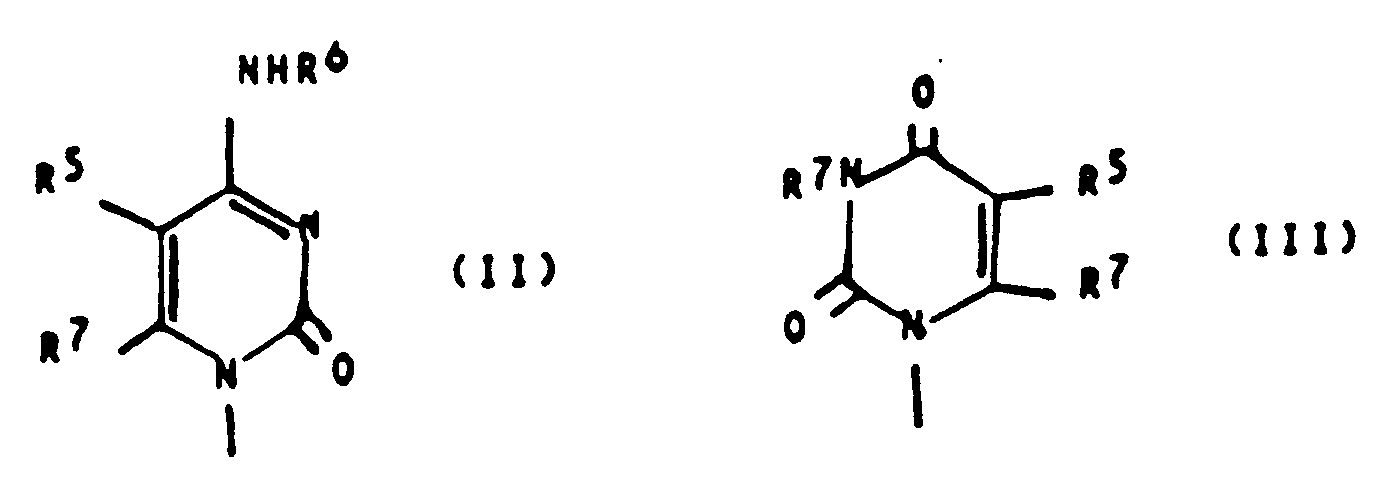
 - R⁴ einen zweiwertigen, linearen oder verzweigten, substituierten oder unsubstituierten Kohlenwasserstoffrest bedeutet, der gegebenenfalls in seiner Kette eine oder mehrere Gruppierungen aufweist, die unter O, S, NH, NHCO, NHSO₂, SO₂, CO, -C≡C-, CH=CH,

 - R⁸ eine einfache Bindung oder ein linearer oder verzweigter, substituierter oder unsubstituierter Kohlenwasserstoffrest ist, der gegebenenfalls in seiner Kette und/oder in seinen Verzweigungen eine oder mehrere Gruppierungen aufweist, die unter O, S, NH, NHCO, NHSO₂, SO₂, CO, -C≡C-, CH=CH,
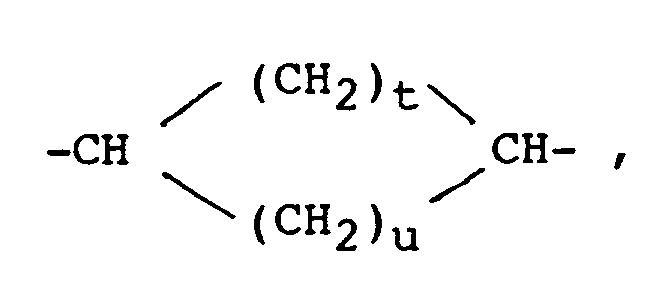
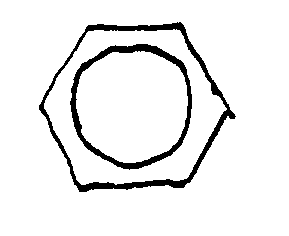 - Z ein von einem Markierungsmolekül, von einem Marker-Vorläufermolekül oder von einem Molekül, das imstande ist, sich mit anderen Molekülen zu assoziieren, abgeleiteter Rest ist, unter der Bedingung, daß, wenn B den Rest der Formel (II) bedeutet, worin R⁴OR¹ bedeutet, R⁴ nicht (CH₂)n bedeutet, worin n eine ganze Zahl von 1 bis 6 ist.
- Derivat eines polyhydroxylierten Moleküls entsprechend der Formel
 - R¹ eine für die Oligonucleotidsynthese geeignete Schutzgruppe für die OH-Gruppe ist,- R² ein der Oligonucleotidsynthese angepaßter, phosphorhaltiger, unsubstituierter oder mit OR¹ substituierter Rest ist,- R⁴ einen zweiwertigen, linearen oder verzweigten, substituierten oder unsubstituierten Kohlenwasserstoffrest bedeutet, der gegebenenfalls in seiner Kette eine oder mehrere Gruppierungen aufweist, die unter O, S, NH, NHCO, NHSO₂, SO₂, CO, -C≡C-, CH=CH,


- Derivat nach einem der Ansprüche 1 und 2, dadurch gekennzeichnet, daß R¹ einen Tritylrest der Formel

- Derivat nach einem der Ansprüche 1 und 2, dadurch gekennzeichnet, daß R² ein phosphorhaltiger Rest ist, der unter den Resten der Formeln

- Derivat nach Anspruch 4, dadurch gekennzeichnet, daß R² den Rest der Formel
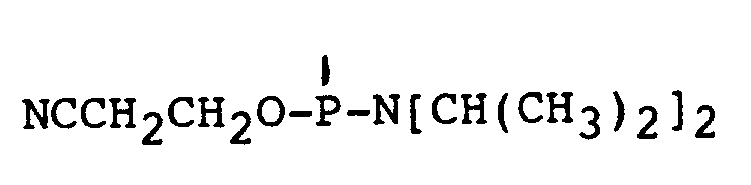
- Derivat nach Anspruch 5, dadurch gekennzeichnet, daß R¹ der Dimethoxytritylrest ist.
- Nucleosidderivat der Formel (Ia) nach Anspruch 1, dadurch gekennzeichnet, daß B

- Nucleosidderivat nach Anspruch 7, dadurch gekennzeichnet, daß R⁴ für -(CH₂)n-NH-(CH₂)p steht, worin n und p ganze Zahlen von 1 bis 6 sind.
- Derivat nach Anspruch 8, dadurch gekennzeichnet, daß n und p gleich 2 sind.
- Derivat nach einem der Ansprüche 1, 7, 8 und 9, dadurch gekennzeichnet, daß R³ ein Wasserstoffatom bedeutet.
- Derivat nach Anspruch 2, dadurch gekennzeichnet, daß R⁴ für -(CH₂)n- steht, wobei n eine ganze Zahl von 1 bis 6 ist.
- Derivat nach Anspruch 11, dadurch gekennzeichnet, daß n gleich 3 ist.
- Verfahren zur Bildung wenigstens einer Verzweigung in einem Oligonucleotid, dadurch gekennzeichnet, daß es nacheinander die folgenden Schritte umfaßt:a) Fixieren eines Derivats des polyhydroxylierten Moleküls der Formel
 b) Reaktion der OH-Gruppen des fixierten Derivats mit Molekülen, die imstande sind, mit den durch Trennen der OR¹-Bindungen erhaltenen OH-Gruppen zu reagieren.
- Verfahren zur Bildung wenigstens einer Verzweigung in einem linearen Oligonucleotid, dadurch gekennzeichnet, daß es nacheinander die folgenden Schritte umfaßt:a) Fixieren eines als Abstandshalter dienenden Moleküls an diesem Oligonucleotid,b) Fixieren eines Derivats des polyhydroxylierten Moleküls der Formel
 c) Reaktion der OH-Gruppen des fixierten Derivats mit Molekülen, die imstande sind, mit den durch Trennen der OR¹-Bindungen erhaltenen OH-Gruppen zu reagieren.
- Verfahren zur Bildung wenigstens einer Verzweigung in einem linearen Oligonucleotid, dadurch gekennzeichnet, daß es nacheinander die folgenden Schritte umfaßt:a) Fixieren eines als Abstandshalter dienenden Moleküls an diesem linearen Oligonucleotid,b) Fixieren eines Derivats eines polyhydroxylierten Moleküls der Formel
 c) Reaktion der OH-Gruppen des fixierten Derivats mit Molekülen, die imstande sind, mit den durch Trennen der OR¹-Bindungen erhaltenen OH-Gruppen zu reagieren.
- Verfahren nach einem der Ansprüche 13 bis 16, dadurch gekennzeichnet, daß die Moleküle, die imstande sind, mit den durch Trennen der OR¹ erhaltenen OH-Gruppen zu reagieren, unter den Nucleosiden, den markierten Nucleosiden, den Molekülen, die als Abstandshalter dienen können, den Markierungsmolekülen, den Molekülen, die markiert werden können, den Derivaten der polyhydroxylierten Moleküle der Formel (Ia) oder (Ib) und den Molekülen, die sich mit anderen Moleküle assoziieren können, ausgewählt werden.
- Verfahren nach Anspruch 17, dadurch gekennzeichnet, daß das Molekül, das markiert werden kann, ein Nucleosidderivat ist, das man dann mit Phosphor-32 markiert.
- Verfahren nach Anspruch 17, dadurch gekennzeichnet, daß das Markierungsmolekül ein Molekül ist, das sich mit Avidin oder Streptavidin assoziieren kann.
- Verfahren nach Anspruch 17, dadurch gekennzeichnet, daß das Markierungsmolekül ein Molekül ist, das Fluoreszenz- oder Lumineszenzeigenschaften besitzt.
- Oligonucleotid entsprechend der Formel
An1-N'a-N-C ,
worin- n1 eine ganze Zahl größer als 1 ist,- die A gleiche oder verschiedene Nucleotide sind,- N' ein als Abstandshalter dienendes Molekül ist,- a gleich 0 oder eine ganze Zahl ist,- N ein Derivat eines polyhydroxylierten Moleküls nach Anspruch 1 oder 2 ist und- C das Ende des Oligonucleotids ist, das wenigstens zwei gleiche oder verschiedene Verzweigungen umfaßt, die jeweils aus einem oder mehreren, gleichen oder verschiedenen Molekülen gebildet sind, die unter N', N, M und A ausgewählt sind, wobei M ein markiertes Nucleotid, ein Markierungsmolekül oder ein Marker-Vorläufermolekül oder ein Molekül, das sich mit anderen Molekülen assoziieren kann, bedeutet.
Priority Applications (1)
| Application Number | Priority Date | Filing Date | Title |
|---|---|---|---|
| AT90902270T ATE103928T1 (de) | 1989-01-20 | 1990-01-19 | Derivate von polyhydroxylierten molekuelen, welche die einfuehrung von mindestens einer verzweigung in ein oligonukleotid erlauben. |
Applications Claiming Priority (3)
| Application Number | Priority Date | Filing Date | Title |
|---|---|---|---|
| FR8900655A FR2642074B1 (fr) | 1989-01-20 | 1989-01-20 | Derives de molecules polyhydroxylees permettant l'introduction d'au moins une ramification dans un oligonucleotide |
| FR8900655 | 1989-01-20 | ||
| PCT/FR1990/000043 WO1990008156A1 (fr) | 1989-01-20 | 1990-01-19 | Derives de molecules polyhydroxylees permettant l'introduction d'au moins une ramification dans un oligonucleotide |
Publications (2)
| Publication Number | Publication Date |
|---|---|
| EP0451213A1 EP0451213A1 (de) | 1991-10-16 |
| EP0451213B1 true EP0451213B1 (de) | 1994-04-06 |
Family
ID=9377902
Family Applications (1)
| Application Number | Title | Priority Date | Filing Date |
|---|---|---|---|
| EP90902270A Expired - Lifetime EP0451213B1 (de) | 1989-01-20 | 1990-01-19 | Derivate von polyhydroxylierten molekülen, welche die einführung von mindestens einer verzweigung in ein oligonukleotid erlauben |
Country Status (4)
| Country | Link |
|---|---|
| EP (1) | EP0451213B1 (de) |
| DE (1) | DE69007968T2 (de) |
| FR (1) | FR2642074B1 (de) |
| WO (1) | WO1990008156A1 (de) |
Families Citing this family (26)
| Publication number | Priority date | Publication date | Assignee | Title |
|---|---|---|---|---|
| WO1991006556A1 (en) * | 1989-10-24 | 1991-05-16 | Gilead Sciences, Inc. | 2' modified oligonucleotides |
| US5914396A (en) * | 1990-01-11 | 1999-06-22 | Isis Pharmaceuticals, Inc. | 2'-O-modified nucleosides and phosphoramidites |
| US5610289A (en) * | 1990-07-27 | 1997-03-11 | Isis Pharmaceuticals, Inc. | Backbone modified oligonucleotide analogues |
| US5378825A (en) * | 1990-07-27 | 1995-01-03 | Isis Pharmaceuticals, Inc. | Backbone modified oligonucleotide analogs |
| US5792844A (en) * | 1990-07-27 | 1998-08-11 | Isis Pharmaceuticals, Inc. | Oligonucleoside linkages containing adjacent nitrogen atoms |
| US5623070A (en) * | 1990-07-27 | 1997-04-22 | Isis Pharmaceuticals, Inc. | Heteroatomic oligonucleoside linkages |
| US5618704A (en) * | 1990-07-27 | 1997-04-08 | Isis Pharmacueticals, Inc. | Backbone-modified oligonucleotide analogs and preparation thereof through radical coupling |
| NZ239250A (en) * | 1990-08-09 | 1993-12-23 | Genta Inc | Chirally pure non-nucleotide reagents for use in preparing |
| US5965722A (en) * | 1991-05-21 | 1999-10-12 | Isis Pharmaceuticals, Inc. | Antisense inhibition of ras gene with chimeric and alternating oligonucleotides |
| US6277570B1 (en) | 1993-04-13 | 2001-08-21 | Naxcor | Nucleic acid sequence detection employing probes comprising non-nucleosidic coumarin derivatives as polynucleotide-crosslinking agents |
| US5767259A (en) | 1994-12-27 | 1998-06-16 | Naxcor | Oligonucleotides containing base-free linking groups with photoactivatable side chains |
| DK0693065T3 (da) * | 1993-04-13 | 2002-03-04 | Naxcor | Ikke-nucleosidiske cumarinderivater som reagenser til tværbinding af polynucleotider |
| US6495676B1 (en) * | 1993-04-13 | 2002-12-17 | Naxcor | Nucleic acid sequence detection employing probes comprising non-nucleosidic coumarin derivatives as polynucleotide-crosslinking agents |
| CN1181078A (zh) * | 1995-03-09 | 1998-05-06 | 纳克斯科公司 | 作为多核苷酸交联剂的非核苷的香豆素衍生物 |
| CN102712696A (zh) | 2009-09-16 | 2012-10-03 | 弗·哈夫曼-拉罗切有限公司 | 包含卷曲螺旋和/或系链的蛋白质复合体及其用途 |
| TW201138821A (en) | 2010-03-26 | 2011-11-16 | Roche Glycart Ag | Bispecific antibodies |
| EP2659269B1 (de) | 2010-12-23 | 2016-10-26 | Roche Diagniostics GmbH | Erkennung von posttranslational modifiziertem polypeptid durch ein bivalentes bindungsmolekül |
| EP2655413B1 (de) | 2010-12-23 | 2019-01-16 | F.Hoffmann-La Roche Ag | Polypeptid-polynukleotid-komplex und verwendung bei der gezielten effektorrest-bereitstellung |
| CN103384681B (zh) | 2010-12-23 | 2018-05-18 | 霍夫曼-拉罗奇有限公司 | 结合剂 |
| KR102072041B1 (ko) | 2011-12-22 | 2020-01-31 | 앨리오스 바이오파마 인크. | 치환된 뉴클레오사이드, 뉴클레오타이드 및 그의 유사체 |
| MX2014009565A (es) | 2012-02-10 | 2014-11-10 | Genentech Inc | Anticuerpos monocatenarios y otros heteromultimeros. |
| USRE48171E1 (en) | 2012-03-21 | 2020-08-25 | Janssen Biopharma, Inc. | Substituted nucleosides, nucleotides and analogs thereof |
| US9441007B2 (en) | 2012-03-21 | 2016-09-13 | Alios Biopharma, Inc. | Substituted nucleosides, nucleotides and analogs thereof |
| KR20150030744A (ko) | 2012-06-27 | 2015-03-20 | 에프. 호프만-라 로슈 아게 | 표적에 특이적으로 결합하는 하나 이상의 결합 단위를 포함하는 항체 Fc-영역 접합체의 제조 방법 및 그의 용도 |
| ES2597228T3 (es) | 2012-06-27 | 2017-01-17 | F. Hoffmann-La Roche Ag | Procedimiento para la selección y la producción de entidades de objetivación, como dianas, altamente selectivas y multiespecíficas, personalizadas, las cuales contienen por lo menos dos entidades de unión diferentes, y utilización de éstas |
| WO2016087416A1 (en) | 2014-12-03 | 2016-06-09 | F. Hoffmann-La Roche Ag | Multispecific antibodies |
Family Cites Families (5)
| Publication number | Priority date | Publication date | Assignee | Title |
|---|---|---|---|---|
| US4616003A (en) * | 1984-10-26 | 1986-10-07 | Warner-Lambert Company | N6 -dihydroxypropyladenosines |
| US4828979A (en) * | 1984-11-08 | 1989-05-09 | Life Technologies, Inc. | Nucleotide analogs for nucleic acid labeling and detection |
| DE3689223T2 (de) * | 1985-05-15 | 1994-03-03 | Amoco Corp | Cytidinanaloga. |
| US4868105A (en) * | 1985-12-11 | 1989-09-19 | Chiron Corporation | Solution phase nucleic acid sandwich assay |
| EP0366685B1 (de) * | 1987-06-24 | 1994-10-19 | Howard Florey Institute Of Experimental Physiology And Medicine | Nukleosid-derivate |
-
1989
- 1989-01-20 FR FR8900655A patent/FR2642074B1/fr not_active Expired - Fee Related
-
1990
- 1990-01-19 WO PCT/FR1990/000043 patent/WO1990008156A1/fr not_active Ceased
- 1990-01-19 EP EP90902270A patent/EP0451213B1/de not_active Expired - Lifetime
- 1990-01-19 DE DE69007968T patent/DE69007968T2/de not_active Expired - Fee Related
Non-Patent Citations (1)
| Title |
|---|
| Necloesides & Nucleotides, Vol. & (1&2), 1987, Marcel Dekker, Inc., J.-P. Roduit et al.: "Synthesis of oligodeoxyribonucleotides containing an aliphatic amino liker arm at selected adenine bases and derivatization with biotin", pages 349-352, see the whole document * |
Also Published As
| Publication number | Publication date |
|---|---|
| FR2642074B1 (fr) | 1994-04-29 |
| EP0451213A1 (de) | 1991-10-16 |
| DE69007968D1 (de) | 1994-05-11 |
| FR2642074A1 (fr) | 1990-07-27 |
| WO1990008156A1 (fr) | 1990-07-26 |
| DE69007968T2 (de) | 1994-10-20 |
Similar Documents
| Publication | Publication Date | Title |
|---|---|---|
| WO1990008156A1 (fr) | Derives de molecules polyhydroxylees permettant l'introduction d'au moins une ramification dans un oligonucleotide | |
| EP0241363B1 (de) | Nukleosid-Derivate und ihre Verwendung in der Oligonukleosid-Synthese | |
| CA1317207C (en) | Solution phase nucleic acid sandwich assay and polynucleotide probes useful therein | |
| US5272250A (en) | Boronated phosphoramidate compounds | |
| JP3488435B2 (ja) | 5’−修飾オリゴヌクレオチド | |
| EP0090789A1 (de) | Chemische DNA-Synthese | |
| JPS62116593A (ja) | インビトロにおけるオリゴヌクレオチド合成法並びにそれに用いる試薬 | |
| AU3369100A (en) | Methods and compositions for synthesis of labelled oligonucleotides and analogs on solid-supports | |
| WO1992002528A1 (en) | Incorporation of selectably clevable and/or abasic sites into oligonucleotide chains and reagents therefor | |
| FR2607507A1 (fr) | Nouveaux derives a-d-oligonucleotides, leur preparation et leur emploi | |
| FR2679255A1 (fr) | Procede d'immobilisation d'un fragment nucleique par fixation passive sur un support solide, support solide ainsi obtenu et son utilisation. | |
| EP0422090B1 (de) | Nukleoside derivate, nützlich für die synthese von markierten oligonukleotiden, mit diesen derivaten hergestellte oligonukleotide und ihre synthese | |
| WO1988004301A1 (fr) | OLIGONUCLEOTIDES alpha | |
| FR2824323A1 (fr) | Reactif de marquage et procede de detection de molecules biologiques | |
| FR2707296A1 (fr) | Procédé de synthèse d'acides nucléiques sur support solide et composés utiles notamment comme support solide dans ledit procédé. | |
| CA2305811A1 (fr) | Nouveaux conjugues fluorescents de nucleosides ou de nucleotides, leur procede de preparation et leurs utilisations | |
| HK1000191A1 (en) | Modified oligodeoxyribonucleotides, their preparation and their therapeutic use | |
| EP0174879B1 (de) | Mit einem festen Träger kovalent gebundene Polynukleotide und Verfahren zu ihrer Herstellung | |
| CA1300532C (en) | Covalent oligonucleotide-horseradish peroxidase conjugate | |
| WO1997029116A1 (en) | Sulphur containing dinucleotide phosphoramidites | |
| JPS59502025A (ja) | オリゴヌクレオシドホスホネ−トの製造法 | |
| JPH06511236A (ja) | シリルアルコールの合成方法 | |
| FR2627590A1 (fr) | Sonde d'acides nucleiques comportant un nucleotide terminal modifie chimiquement en 5(prime) (oh) en vue de son marquage non radioactif et procedes de preparation | |
| EP0684954B1 (de) | 5'(oh) und/oder 3'(oh) zur einführung von einem oder mehreren nichtradioaktivmarkierten markern chemisch modifizierte nukleinsäuresonden, und verfahren zu ihrer herstellung | |
| EP0315499B1 (de) | Nukleosid-Derivate, insbesondere von 2'-Deoxycytidin, und ihre Anwendung in der Synthese von Oligonukleotiden |
Legal Events
| Date | Code | Title | Description |
|---|---|---|---|
| PUAI | Public reference made under article 153(3) epc to a published international application that has entered the european phase |
Free format text: ORIGINAL CODE: 0009012 |
|
| 17P | Request for examination filed |
Effective date: 19910702 |
|
| AK | Designated contracting states |
Kind code of ref document: A1 Designated state(s): AT BE CH DE DK ES FR GB IT LI LU NL SE |
|
| 17Q | First examination report despatched |
Effective date: 19930427 |
|
| GRAA | (expected) grant |
Free format text: ORIGINAL CODE: 0009210 |
|
| AK | Designated contracting states |
Kind code of ref document: B1 Designated state(s): AT BE CH DE DK ES FR GB IT LI LU NL SE |
|
| PG25 | Lapsed in a contracting state [announced via postgrant information from national office to epo] |
Ref country code: IT Free format text: LAPSE BECAUSE OF FAILURE TO SUBMIT A TRANSLATION OF THE DESCRIPTION OR TO PAY THE FEE WITHIN THE PRE;WARNING: LAPSES OF ITALIAN PATENTS WITH EFFECTIVE DATE BEFORE 2007 MAY HAVE OCCURRED AT ANY TIME BEFORE 2007. THE CORRECT EFFECTIVE DATE MAY BE DIFFERENT FROM THE ONE RECORDED.SCRIBED TIME-LIMIT Effective date: 19940406 Ref country code: ES Free format text: THE PATENT HAS BEEN ANNULLED BY A DECISION OF A NATIONAL AUTHORITY Effective date: 19940406 Ref country code: AT Effective date: 19940406 Ref country code: DK Effective date: 19940406 Ref country code: NL Effective date: 19940406 Ref country code: SE Free format text: THE PATENT HAS BEEN ANNULLED BY A DECISION OF A NATIONAL AUTHORITY Effective date: 19940406 |
|
| REF | Corresponds to: |
Ref document number: 103928 Country of ref document: AT Date of ref document: 19940415 Kind code of ref document: T |
|
| REF | Corresponds to: |
Ref document number: 69007968 Country of ref document: DE Date of ref document: 19940511 |
|
| GBT | Gb: translation of ep patent filed (gb section 77(6)(a)/1977) |
Effective date: 19940503 |
|
| NLV1 | Nl: lapsed or annulled due to failure to fulfill the requirements of art. 29p and 29m of the patents act | ||
| PG25 | Lapsed in a contracting state [announced via postgrant information from national office to epo] |
Ref country code: LU Free format text: LAPSE BECAUSE OF NON-PAYMENT OF DUE FEES Effective date: 19950131 |
|
| PLBE | No opposition filed within time limit |
Free format text: ORIGINAL CODE: 0009261 |
|
| STAA | Information on the status of an ep patent application or granted ep patent |
Free format text: STATUS: NO OPPOSITION FILED WITHIN TIME LIMIT |
|
| 26N | No opposition filed | ||
| REG | Reference to a national code |
Ref country code: GB Ref legal event code: IF02 |
|
| PGFP | Annual fee paid to national office [announced via postgrant information from national office to epo] |
Ref country code: GB Payment date: 20030115 Year of fee payment: 14 |
|
| PGFP | Annual fee paid to national office [announced via postgrant information from national office to epo] |
Ref country code: CH Payment date: 20030124 Year of fee payment: 14 |
|
| PGFP | Annual fee paid to national office [announced via postgrant information from national office to epo] |
Ref country code: FR Payment date: 20030127 Year of fee payment: 14 |
|
| PGFP | Annual fee paid to national office [announced via postgrant information from national office to epo] |
Ref country code: DE Payment date: 20030201 Year of fee payment: 14 |
|
| PGFP | Annual fee paid to national office [announced via postgrant information from national office to epo] |
Ref country code: BE Payment date: 20030312 Year of fee payment: 14 |
|
| PG25 | Lapsed in a contracting state [announced via postgrant information from national office to epo] |
Ref country code: GB Free format text: LAPSE BECAUSE OF NON-PAYMENT OF DUE FEES Effective date: 20040119 |
|
| PG25 | Lapsed in a contracting state [announced via postgrant information from national office to epo] |
Ref country code: LI Free format text: LAPSE BECAUSE OF NON-PAYMENT OF DUE FEES Effective date: 20040131 Ref country code: CH Free format text: LAPSE BECAUSE OF NON-PAYMENT OF DUE FEES Effective date: 20040131 Ref country code: BE Free format text: LAPSE BECAUSE OF NON-PAYMENT OF DUE FEES Effective date: 20040131 |
|
| BERE | Be: lapsed |
Owner name: *CIS BIO INTERNATIONAL Effective date: 20040131 |
|
| PG25 | Lapsed in a contracting state [announced via postgrant information from national office to epo] |
Ref country code: DE Free format text: LAPSE BECAUSE OF NON-PAYMENT OF DUE FEES Effective date: 20040803 |
|
| GBPC | Gb: european patent ceased through non-payment of renewal fee |
Effective date: 20040119 |
|
| REG | Reference to a national code |
Ref country code: CH Ref legal event code: PL |
|
| PG25 | Lapsed in a contracting state [announced via postgrant information from national office to epo] |
Ref country code: FR Free format text: LAPSE BECAUSE OF NON-PAYMENT OF DUE FEES Effective date: 20040930 |
|
| REG | Reference to a national code |
Ref country code: FR Ref legal event code: ST |