EP0241363B1 - Nukleosid-Derivate und ihre Verwendung in der Oligonukleosid-Synthese - Google Patents
Nukleosid-Derivate und ihre Verwendung in der Oligonukleosid-Synthese Download PDFInfo
- Publication number
- EP0241363B1 EP0241363B1 EP87400739A EP87400739A EP0241363B1 EP 0241363 B1 EP0241363 B1 EP 0241363B1 EP 87400739 A EP87400739 A EP 87400739A EP 87400739 A EP87400739 A EP 87400739A EP 0241363 B1 EP0241363 B1 EP 0241363B1
- Authority
- EP
- European Patent Office
- Prior art keywords
- radical
- hydrogen atom
- formula
- compound
- nucleoside derivative
- Prior art date
- Legal status (The legal status is an assumption and is not a legal conclusion. Google has not performed a legal analysis and makes no representation as to the accuracy of the status listed.)
- Expired - Lifetime
Links
- 0 C*1=CCCCC1 Chemical compound C*1=CCCCC1 0.000 description 8
- ORVYGYWUQQBRNT-UHFFFAOYSA-N CC(C)N(C(C#N)C#N)P(C)O Chemical compound CC(C)N(C(C#N)C#N)P(C)O ORVYGYWUQQBRNT-UHFFFAOYSA-N 0.000 description 1
- FNYXEECHWQHVNT-UHFFFAOYSA-N CC(CC1OC(C)C(C)C1C)N Chemical compound CC(CC1OC(C)C(C)C1C)N FNYXEECHWQHVNT-UHFFFAOYSA-N 0.000 description 1
- UPCZAVJXIZBHQG-UHFFFAOYSA-N CC(CO)C(C(C)C(C)[IH]C(F)(F)F)I Chemical compound CC(CO)C(C(C)C(C)[IH]C(F)(F)F)I UPCZAVJXIZBHQG-UHFFFAOYSA-N 0.000 description 1
- DQIYRXFRCITPTE-UHFFFAOYSA-N CNc(nccc1N)c1N=C Chemical compound CNc(nccc1N)c1N=C DQIYRXFRCITPTE-UHFFFAOYSA-N 0.000 description 1
Classifications
-
- C—CHEMISTRY; METALLURGY
- C07—ORGANIC CHEMISTRY
- C07H—SUGARS; DERIVATIVES THEREOF; NUCLEOSIDES; NUCLEOTIDES; NUCLEIC ACIDS
- C07H19/00—Compounds containing a hetero ring sharing one ring hetero atom with a saccharide radical; Nucleosides; Mononucleotides; Anhydro-derivatives thereof
- C07H19/02—Compounds containing a hetero ring sharing one ring hetero atom with a saccharide radical; Nucleosides; Mononucleotides; Anhydro-derivatives thereof sharing nitrogen
- C07H19/04—Heterocyclic radicals containing only nitrogen atoms as ring hetero atom
- C07H19/06—Pyrimidine radicals
- C07H19/10—Pyrimidine radicals with the saccharide radical esterified by phosphoric or polyphosphoric acids
-
- C—CHEMISTRY; METALLURGY
- C07—ORGANIC CHEMISTRY
- C07H—SUGARS; DERIVATIVES THEREOF; NUCLEOSIDES; NUCLEOTIDES; NUCLEIC ACIDS
- C07H19/00—Compounds containing a hetero ring sharing one ring hetero atom with a saccharide radical; Nucleosides; Mononucleotides; Anhydro-derivatives thereof
- C07H19/02—Compounds containing a hetero ring sharing one ring hetero atom with a saccharide radical; Nucleosides; Mononucleotides; Anhydro-derivatives thereof sharing nitrogen
- C07H19/04—Heterocyclic radicals containing only nitrogen atoms as ring hetero atom
- C07H19/16—Purine radicals
- C07H19/20—Purine radicals with the saccharide radical esterified by phosphoric or polyphosphoric acids
-
- C—CHEMISTRY; METALLURGY
- C07—ORGANIC CHEMISTRY
- C07H—SUGARS; DERIVATIVES THEREOF; NUCLEOSIDES; NUCLEOTIDES; NUCLEIC ACIDS
- C07H21/00—Compounds containing two or more mononucleotide units having separate phosphate or polyphosphate groups linked by saccharide radicals of nucleoside groups, e.g. nucleic acids
Definitions
- the subject of the present invention is new nucleoside derivatives and their use for the synthesis of oligonucleotides.
- nucleoside derivatives formed from pyrimidine or purine bases comprising exocyclic NH 2 groups that is to say nucleosides formed from adenine, guanine or cytosine, which are usable in particular for the synthesis of oligonucleotides-.
- oligonucleotides consist in binding together nucleosides by a phosphate group to form a chain of DNA (deoxyribonucleic acid) or RNA (ribonucleic acid).
- the internucleotide phosphate groups always link the hydroxyl function in position 3 'of a nucleoside to the hydroxyl function in position 5' of another nucleoside.
- the nucleic base purine or pyrimide
- exocyclic NH 2 groups of nucleosides have most often been protected in the form of amides, for example by means of benzoyl or anisoyl groups in the case of adenine and cytosine as described by M. SCHALLER et al in J. Amer. Chem. Soc. (1963), vol. 85, p. 3821-3827, and by means of the isobutyryl group in the case of guanine as described by H. BÜCHI and M. KHORANA in J. Mol. Biol. (1972), vol. 72, p. 251-288.
- This method of removing protective groups is a drawback because the conditions used are not mild enough to be able to be used with modified nucleosides which are not very stable in an alkaline medium, as is the case for example with 5-dihydro , 6 thymidine.
- acyl groups which are easier to eliminate usable in particular for the synthesis of oligonucleotides from labile nucleosides by the methodology of synthesis on a support which consists in fixing the first nucleoside of the chain on a support, generally made of silica, and then successively carrying out condensation cycles in order to fix the other nucleosides in the desired order on the first nucleoside.
- the use of acyl groups which are easier to remove also makes it possible to obtain a better deprotection yield. This point is very important because the presence of incompletely deprotected bases has a drawback for the use of the products obtained.
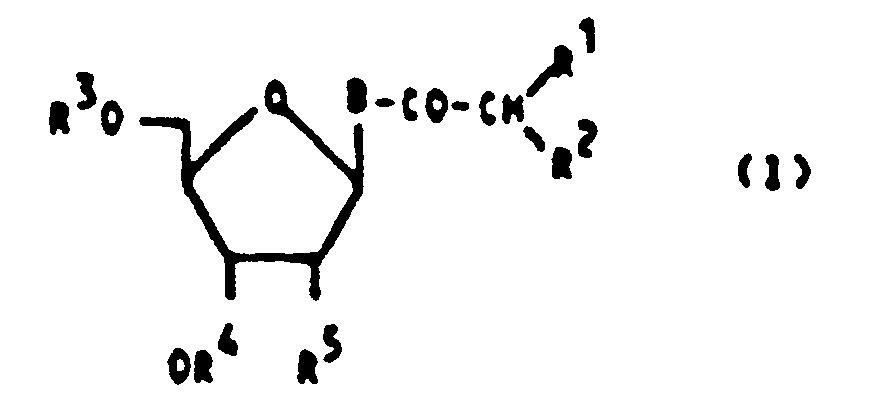
- the present invention specifically relates to new derivatives of nucleosides comprising protective groups of the acyl type, capable of being easily eliminated.
- the phosphorus radicals capable of being used to form R 4 in the compound of formula (I) are also radicals which can be used in oligonucleotide synthesis such as the radical of formula: the radical of formula: the phosphonate radical of formula:
- R 5 represents the protected OH radical
- the groups usually used in the synthesis of ribonucleotides are used as the OH protective group.
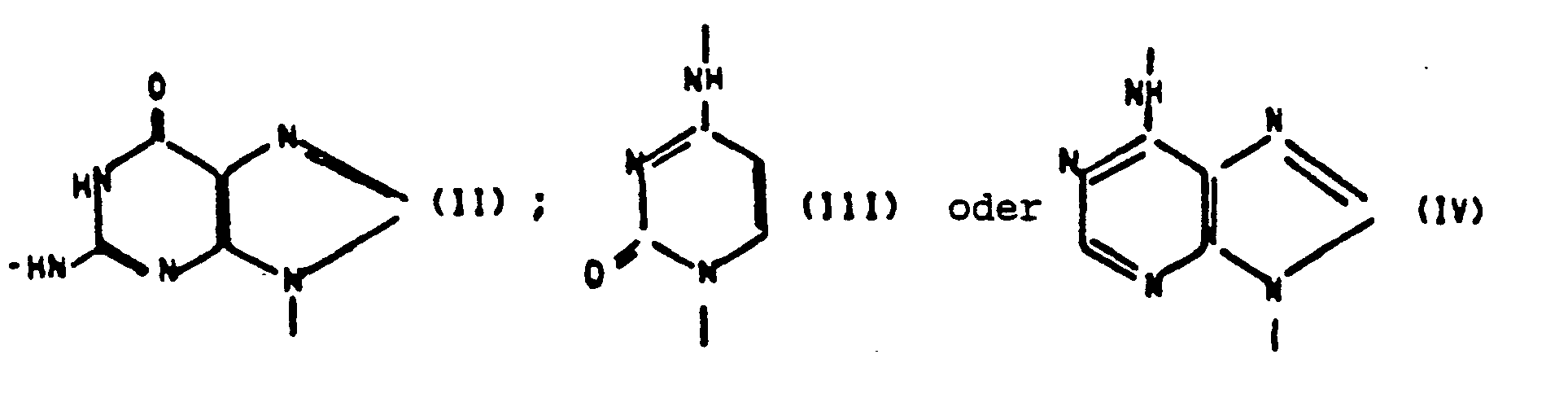
- the nucleoside derivatives of the invention are thus the products of the union 1 °) of a base formed by guanine, cytosine or adenine and 2 °) of ribose or deoxyribose, the nucleosides being modified at least on the exocyclic NH 2 group of their base by a group They can also be modified by this same group at the 3 'and 5' positions of deoxyribose or 2 ', 3' and 5 'of ribose, or the 3' and 5 'positions of ribose or deoxyribose can be modified by other groups which are the labile groups R 3 for the 5 ′ position and the phosphorus group R 4 at the 3 ′ position of ribose or deoxyribose.
- acyl groups of formula used in the invention are particularly advantageous for the synthesis of nucleotides because they can be easily eliminated at the end of the operation, for example by treatment with ammonia for 2 to 8 h depending on the group used, at room temperature, which allows the polynucleotide to be released simultaneously from the support on which it has been synthesized, when the method of synthesis on support is used.
- R ′ may have a hydrogen atom or a methyl or ethyl radical and R 2 may represent a methoxy or a phenoxy radical optionally substituted by different groups.
- the protective group of the exocyclic NH 2 groups is chosen according to the base used in order to obtain the resistance to the desired alkaline treatment.
- R ' represents a hydrogen atom and R 2 is a methoxy radical or an optionally substituted phenoxy radical.
- the radical R 2 can be the phenoxy radical, the methoxy radical or the 2-chloro-phenoxy radical.
- R ′ preferably represents a hydrogen atom and R 2 represents an optionally substituted phenoxy radical, for example the phenoxy radical.
- the use of the protective groups mentioned above makes it possible to obtain a reduction in the deprotection time of the oligonucleotides obtained by assembling the nucleosides of the invention, since this time can be only 2 to 8 h depending on the group used, instead of the 17 72 hours previously required. It is also possible to operate under milder reaction conditions since deprotection is carried out at ambient temperature when it was previously necessary to heat to 60 C.
- the use of these protective groups which can be more easily eliminated makes it possible to incorporate during the synthesis of oligonucleotides of the modified nucleic bases sensitive to more violent alkaline conditions, for example to synthesize DNA fragments carrying ligands sensitive to antibodies.
- nucleosides derived from ribose and to nucleosides derived from deoxyribose, it is preferably used for nucleosides derived from deoxyribose, that is to say to derivatives of formula (I) in which R 5 is a hydrogen atom.
- nucleoside derivatives of the invention can be prepared by conventional methods, analogous to those used to fix the benzoyl and anisoyl groups on nucleosides based on adenine or cytosine.
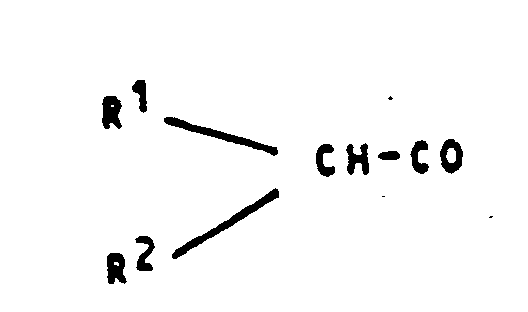
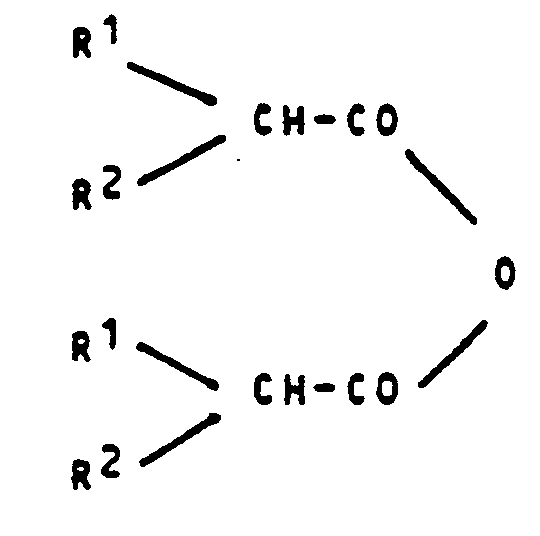
- the starting point is the nucleoside of guanine, cytosine or adenine, which is reacted with the acid chloride of formula: or the acid anhydride of formula:
- the anhydride or the chloride of acid also reacts with the hydroxyl groups in position 3 'and 5' of the ribose or deoxyribose and one thus obtains the derivative of the triprotected nucleoside is the derivative of formula (I ) in which R 3 and R 4 both represent the radical:
- radicals can be removed in the 3 ′ and 5 ′ position by selective hydrolysis, which makes it possible to obtain the nucleoside derivatives of formula (I) in which R 3 and R 4 represent hydrogen atoms.
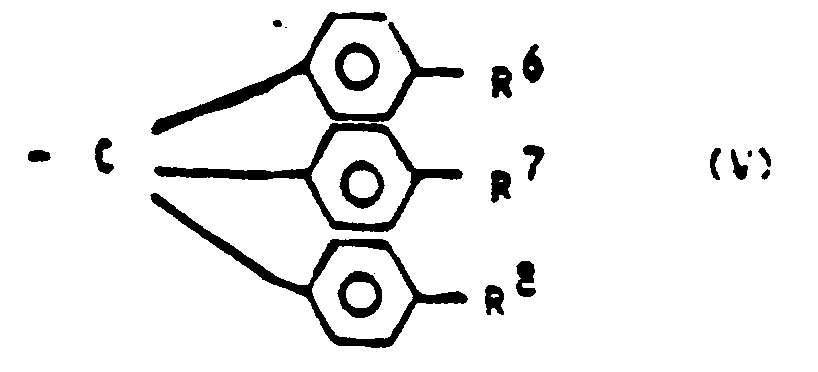
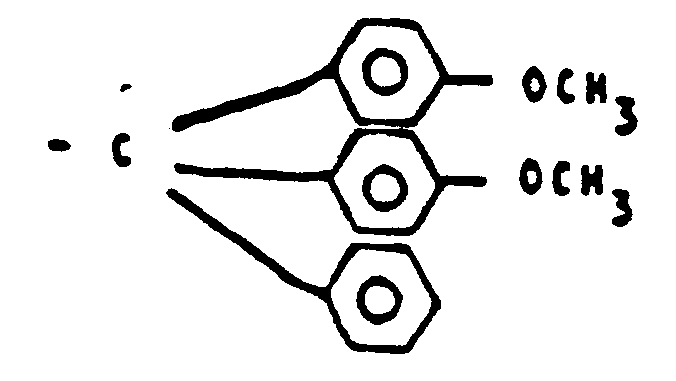
- nucleoside derivatives of formula (I) in which R 3 represents a trityl radical of formula (V), for example the dimethoxytrityl group, and R 4 represents a hydrogen atom by reacting the derivatives of the nucleosides obtained previously with the corresponding trityl chloride in an appropriate solvent.
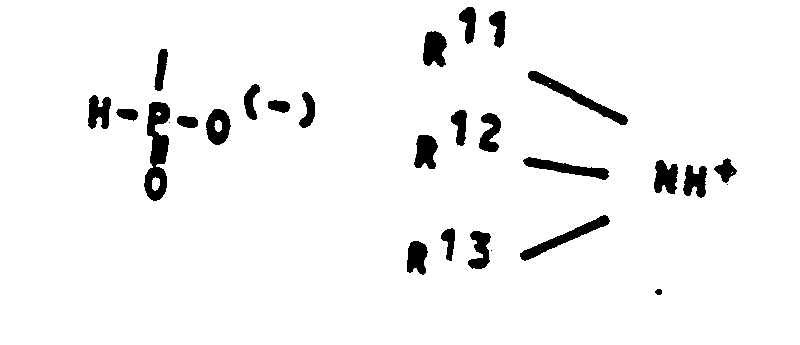
- nucleoside derivatives corresponding to formula (I) in which R 3 represents a trityl group and R 4 represents either the radical of formula (VI), or the radical of formula (VII), or a radical of formula: in which R ", R 12 and R 13 which may be the same or different, are alkyl radicals, for example ethyl, can be prepared by conventional methods from the nucleoside derivatives of formula (I) in which R 3 represents a trityl radical and R 4 represents a hydrogen atom.
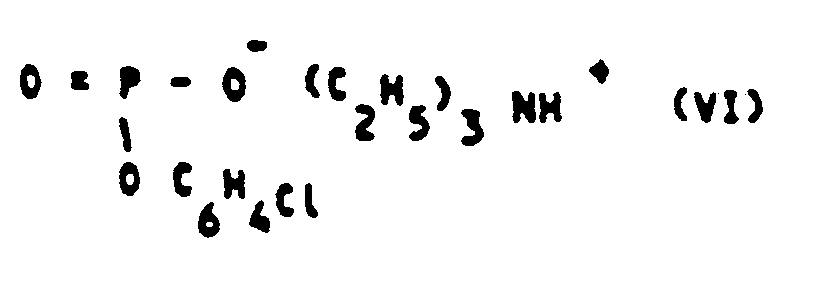
- R represents, for example, the radical of formula (VI)
- this nucleoside derivative is reacted with 4-chlorophenylphosphoryl bistriazolidate in an appropriate solvent.
- 4-chloro-phenylphosphoryl bistriazolidate can be prepared by adding 4-chloro-phenyl dichlorophosphate to a suspension of triazole and triethylamine in dioxane.
- R 4 represents, for example, the radical of formula (VII)
- the nucleoside derivative can be reacted with ⁇ -cyanoethyl-monochloro N, N-diisopropyl amino phosphoramidite in an appropriate solvent in the presence of diisopropylethylamine.
- R 4 represents, for example, the radical of formula: in which R 11 , R 12 and R 13 which may be the same or different, are alkyl radicals
- the nucleoside derivative can be reacted with 2-chloro benzo (5,6-a) [1,3-dioxo phosphor-2 inone-4] then with a trialkyl ammonium salt such as triethyl ammonium acetate.
- nucleoside derivatives obtained by these three methods can be used for the synthesis of oligonucleotides either by phosphotriester synthesis in the case where R is the radical of formula (VI), or by phosphoramidite synthesis in the case where R is the radical of formula (VII), or by H-phosphonate synthesis in the case where R is the radical of formula: also using for the assembly of the oligonucleotide chains of other nucleosides, for example those corresponding to thymidine and 2-deoxy-uridine, or alternatively nucleosides comprising labile bases in alkaline medium or other labile nucleosides in medium alkaline.
- the oligonucleotide synthesis can be carried out either by solution methods or by methods of synthesis on a support.
- the methods of synthesis on a support are preferably used because these are better suited to the use of more labile nucleosides, without there being a loss of yield during assembly.
- the nucleosides of the invention can therefore find interesting applications as basic products intended for the synthesis of DNA or RNA fragments. They may also be suitable for incorporating into modified oligonucleotides fragile modified bases, which may relate in particular to gamma radiolysis products of DNA as well as to photolysis products.
- the nucleosides of the invention can also allow access to new molecules with antiviral activity and to new DNA probes.
- N 2 -phenoxyacetyl-deoxy-2 'guanosine then formed is isolated by chromatography on a silica column (3 cm in diameter, 15 cm in height) which is eluted by a gradient of chloroform-methanol. Evaporation of the fractions containing the desired product makes it possible to collect 250 mg of N 2 - phenoxyacetyl-deoxy-2 'guanosine, which corresponds to a yield of 15%.
- the purity of the product is confirmed by analysis by nuclear magnetic resonance at 250 MHz.
- the derivative is purified by chromatography on a silica column (diameter 4 cm, length 10 cm) using a chloroform-methanol gradient. 7 g of triprotected derivative are thus collected, which corresponds to a yield of 73%.
- the excess acid anhydride is then destroyed at 0 ° C. by adding 3 ml of distilled water, then the reaction medium is diluted with 100 ml of chloroform.
- the chloroform phase is washed 4 times with 50 ml of a 5% aqueous solution of sodium bicarbonate, and the solvent is evaporated, which leads to a yellow residue.
- This is dissolved in 100 ml of pyridine and, after placing the solution in an ice-water bath, 100 ml of 0.2 N sodium hydroxide is added at 0 ° C to selectively hydrolyze the 3 'and 5' positions of adenosine in 15 min.
- the Dowex 50W-X8 cation exchange resin is then neutralized in the pyridinium form used in Example 1. The resin is filtered and rinsed, then the filtrate is evaporated to dryness.
- the excess acid chloride is destroyed at 0 ° C. with 2 ml of double-distilled water and the reaction medium is diluted with 100 ml of chloroform.
- the chloroform phase is washed 4 times with 50 ml of 5% sodium bicarbonate solution to remove the isobutyric acid formed, dried over sodium sulfate and evaporated to dryness.
- An orange residue is obtained which is dissolved in 5 ml of pyridine cooled to 0 ° C. 100 ml of 0.2 N sodium hydroxide are then added at 0 ° C. and the selective hydrolysis reaction of the ester functions in 3 'and 5' of the deoxyribose is allowed to continue for 30 min.
- the medium is then neutralized with the Dowex 50W-X8 ion exchange resin in the pyridinium form used in Example 1. The resin is then filtered and rinsed, then the filtrate is evaporated to dryness.
- This example illustrates the preparation of a phosphorylated derivative of compound No. 8 intended for the phosphotriester synthesis of polynucleotides.
- the reaction is allowed to continue for 20 min and is then stopped by adding 6 ml of an H 2 O-triethylamine mixture (1/1 by volume), then the volume of the reaction medium is reduced to 5 ml by evaporation. It is taken up in 100 ml of chloroform and washed 3 times with 50 ml of aqueous NaHCO 3 solution and then with 100 ml of water. The chloroform phase is dried over sodium sulfate, then evaporated to dryness. The desired compound is isolated by chromatography on silica gel. The product obtained is then checked by mass spectrometry and by nuclear magnetic resonance. The reaction yield and the results obtained are given in the attached Table 2.
- Compound No. 9 thus obtained is the nucleoside derivative of formula (I) in which B represents the radical derived from guanine of formula (II), R 1 represents a hydrogen atom, R 2 represents the methoxy radical, R 3 represents the dimethoxy-4,4 'trityl radical, R 4 represents the radical of formula (VI) and R 5 represents a hydrogen atom.
- Example 9 the same procedure is followed as in Example 9 to prepare the phosphorylated derivative of compound No. 6 intended for the phosphotriester synthesis using 3 mmol of compound No. 6 instead of 3 mmol of compound No. 8 .
- the reaction is allowed to continue for 35 min and the precipitate is filtered at the end of the reaction, then the filtrate is evaporated to dryness and it is taken up in 150 ml of ethyl acetate. Washing is carried out with an ice-cold aqueous solution containing 10% Na 2 CO 3 . The organic phase is then dried over sodium sulfate and evaporated to dryness.
- the compound obtained is purified by low pressure chromatography on a MERCK "LOBAR" column of size B using for the elution a CH 2 CI 2 -hexane-triethylamine mixture (70/20/10 by volume).
- the compound obtained is taken up with a minimum of dichloromethane or ethyl acetate and precipitated in hexane at -80 ° C.
- the product is analyzed by nuclear magnetic resonance. The results obtained and the yield of the reaction are given in the attached Table 3.
- the phosphorylated derivative of compound no. 7 intended for phosphoramidite synthesis is prepared by using 3 mmol of compound no. 7 instead of 3 mmol of compound no. 8.
- the product obtained by nuclear magnetic resonance is also analyzed. The performance of the reaction and the results are given in table 3 appended.
- Example 12 the phosphorylated derivative of compound No. 6 intended for phosphoramidite synthesis is prepared by using 3 mmol of compound No. 6 instead of 3 mmol of compound No. 8.
- the product obtained by nuclear magnetic resonance is also analyzed.
- the reaction yield and the results obtained are given in the attached Table 3.
- the reaction yield is 70%.
- the Rf of this compound in the Chloroform / Methanol mixture (90:10) is 0.40.
- the chemical shifts of the main protons of this molecule in deuterated methanol have the following values: H8. 8.07 ppm, H1 ': 6.45 ppm (t), H3': 4.75 ppm (m), H CH3 of dimethoxy trityl: 3.86 ppm (s), H CH2 of phenoxyacetyl: 5.05 ppm (s).
- the phosphorylated derivative of compound No. 15 is prepared, intended for phosphoramidite synthesis, using 3 mmol of compound No. 15 instead of 3 mmol of compound No. 8.
- the yield of final product is 50%.
- the product is characterized by a 31 P NMR doublet located at 146 and 146.2 ppm in deuterated pyridine.
- the main proton NMR peaks in deuterated acetonitrile are located at: 8.12 ppm (s, H8), 6.45 ppm (t, H1 '), 5.05 ppm (s, phenoxyacetyl CH2) and 4, 88 ppm (m, H3 ').
- Examples 17 to 19 which follow illustrate the preparation of fully protected mononucleotides intended for the synthesis of oligonucleotides according to the H-phosphonate method.
- compound No. 17 is prepared for the synthesis of oligonucleotides according to the H-Phosphonate method.
- the product is eluted with solutions with increasing concentration of methanol in a mixture of 2% triethylamine in chloroform (0% methanol: 250 ml; 1% methanol: 250 ml; 2% methanol: 250 ml; 3% methanol: 250 ml; 5% methanol: 250 ml; 7% methanol: 500 ml).
- the fractions containing the desired product are combined and the solvent is evaporated to obtain a product in the form of a white foam.
- the yield of product No. 17 is 55%.
- the product is analyzed by nuclear magnetic resonance, the results obtained are collated in Table IV.
- the phosphorylated derivative of compound no. 15 intended for the synthesis of oligonucleotides is prepared according to the H-phosphonate method using 5 mmol of compound no. 15 instead of 5 mmol of compound no. ° 7.
- the reaction yield is 48% and the product obtained is analyzed by nuclear magnetic resonance. The results obtained are presented in Table IV.
- the phosphorylated derivative of compound no. 5 intended for the synthesis of oligonucleotides is prepared according to the H-phosphonate method using 5 mmol of compound no. 5 instead of 5 mmol of compound no. ° 7.
- A represents the nucleotide formed with adenine
- C represents the nucleotide formed with cytosine
- G represents the nucleotide formed with guanine
- T represents the nucleotide formed with thymine
- U represents the nucleotide formed with uracil.
- the compounds No. 9, No. 10 and No. 11 are used as synthons corresponding respectively to guanine, adenine, and cytosine and synthons corresponding to thymine and uracil. These are obtained from the corresponding nucleosides by protecting the hydroxyl functions in 5 ′ and 3 ′ respectively by the radical dimethoxy-4,4 'trityl and the radical of formula VI) using the same procedure as in the examples 6 to 11.
- a silica gel is thus obtained comprising the oligonucleotide covalently linked.
- the whole is then transferred to a pyrex bulb, 28% ammonia is added, and it is left for 8 h at room temperature.
- the oligonucleotide is thus freed from the support, also eliminating the protective groups which are the subject of the invention.
- the supernatant is then removed and the silica is rinsed with 3 times 1 ml of double-distilled water.
- the solvent is evaporated off and the residue is taken up in 0.5 ml of water, then it is fractionated on a column of Sephadex G 25 (diameter 1 cm, H 7 cm), the fractions which exhibit absorption in the medium are collected ultraviolet at 254 nm and they are lyophilized.
- the correct length of the synthetic DNA fragment obtained is verified by labeling with phosphorus 32 using T4-polynucleotide kinase and by electrophoresis on polyacrylamide gel. Cutting the corresponding strip and eluting the compound make it possible to purify the product for biological use.
- oligonucleotides the sequences of which are as follows, are prepared in the same way:
- compounds No. 12, No. 13 and No. 14 are used to synthesize homopolymers of 15 nucleotides in length using phosphoramidite synthesis.
- the support comprising the product synthesized is transferred to a pyrex bulb and 2 ml of 28% ammonia are added.
- the ampoules are kept for 8 h at room temperature, which makes it possible to remove the protective groups which are the subject of the invention.
- the supernatant is then removed and the silica is rinsed with 3 times 1 ml of double-distilled water, then the solvent is removed on a rotary evaporator.
- the crude residue is taken up in 0.5 ml of water and purified by chromatography on Sephadex G 25 gel.
- the absorbent fractions are collected at 254 nm and their content is analyzed by electrophoresis on polyacrylamide gel after labeling with phosphorus 32 by T4-polynucleotide kinase.
- EXAMPLE 22 Preparation of an oligonucleotide by the H-phosphonate method.
- A, G, C and T represent the same nucleotides as in the sequence of Example 20.
- compounds No. 17, No. 18 and No. 19 are used as synthons corresponding respectively to adenine, guanine and cytosine and a synthon corresponding to thymine.
- the latter is obtained from thymidine by protecting the 5 'function with a 4,4' dimethoxy trityl group and the 3 'function with the phosphorus group of formula using the same procedure as that reported previously for the H-phosphonate derivative of adenine.
- the internucleotide phosphors are oxidized by passing a 2% iodine solution in a 98/2 pyridine / water mixture (3 ml). Washing is then carried out with the mixture of pyridine and acetonirile (5 ml), with acetonitrile (3 ml) and detritylation is carried out as described above.
- a silica gel is then obtained comprising the covalently linked polynucleotide.
- the whole is transferred to a pyrex bulb, 2 ml of 28% ammonia is added and it is left for 2 hours at room temperature.
- the oligonucleotide is thus released from the support, also eliminating the protective groups which are the subject of the invention.
- the supernatant is then removed, the silica is rinsed with 3 times 1 ml of double-distilled water, the solvent is evaporated and the residue is taken up in 0.5 ml of water. It is then fractionated on a column of Sephadex G25 (diameter 1 cm, height 7 cm), the fractions showing absorption in the ultraviolet at 254 nm are combined and lyophilized.
- the correct length of the product synthesized is verified by radioactive labeling with phosphorus 32 by means of T4-polynucleotide kinase followed by electrophoresis on polyacrylamide gel.
Landscapes
- Chemical & Material Sciences (AREA)
- Organic Chemistry (AREA)
- Health & Medical Sciences (AREA)
- Life Sciences & Earth Sciences (AREA)
- Biochemistry (AREA)
- Molecular Biology (AREA)
- Engineering & Computer Science (AREA)
- Biotechnology (AREA)
- General Health & Medical Sciences (AREA)
- Genetics & Genomics (AREA)
- Saccharide Compounds (AREA)
Claims (13)


Methyl, Ethyl oder Phenyl, substituiert oder unsubstituiert, SR, worin R einen Methyl-, Ethyl- oder Phenylrest darstellt; R3 ein Wasserstoffatom, einen in saurem Milieu labilen Rest oder den Rest der Formel

dadurch gekennzeichnet, daß man ein Nucleosid, ausgewählt aus den Nucleosiden von Guanin, Cytosin und Adenin, mit einem Säurechlorid der Formel



dadurch gekennzeichnet, daß es die folgenden aufeinanderfolgenden Stufen umfaßt:


unter Bildung eines Nucleosidderivats der Formel (I), worin R3 und R4 den Rest der Formel darstellen:


unter Bildung des Nucleosidderivats der Formel (I), worin R3 einen Tritylrest darstellt;



an ein Nucleosidderivat oder an ein Oligonucleotid ankondensiert und







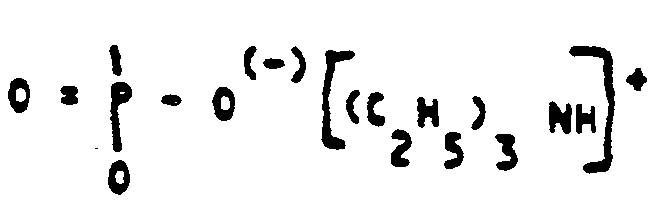
Priority Applications (2)
| Application Number | Priority Date | Filing Date | Title |
|---|---|---|---|
| EP91200556A EP0438203B1 (de) | 1986-04-08 | 1987-04-03 | Nucleosidderivate und ihre Verwendung in der Oligonucleotid-Synthese |
| AT87400739T ATE67768T1 (de) | 1986-04-08 | 1987-04-03 | Nukleosid-derivate und ihre verwendung in der oligonukleosid-synthese. |
Applications Claiming Priority (2)
| Application Number | Priority Date | Filing Date | Title |
|---|---|---|---|
| FR8604990A FR2596761B1 (fr) | 1986-04-08 | 1986-04-08 | Derives de nucleosides et leur utilisation pour la synthese d'oligonucleotides |
| FR8604990 | 1986-04-08 |
Related Child Applications (1)
| Application Number | Title | Priority Date | Filing Date |
|---|---|---|---|
| EP91200556A Division-Into EP0438203B1 (de) | 1986-04-08 | 1987-04-03 | Nucleosidderivate und ihre Verwendung in der Oligonucleotid-Synthese |
Publications (2)
| Publication Number | Publication Date |
|---|---|
| EP0241363A1 EP0241363A1 (de) | 1987-10-14 |
| EP0241363B1 true EP0241363B1 (de) | 1991-09-25 |
Family
ID=9334007
Family Applications (2)
| Application Number | Title | Priority Date | Filing Date |
|---|---|---|---|
| EP87400739A Expired - Lifetime EP0241363B1 (de) | 1986-04-08 | 1987-04-03 | Nukleosid-Derivate und ihre Verwendung in der Oligonukleosid-Synthese |
| EP91200556A Expired - Lifetime EP0438203B1 (de) | 1986-04-08 | 1987-04-03 | Nucleosidderivate und ihre Verwendung in der Oligonucleotid-Synthese |
Family Applications After (1)
| Application Number | Title | Priority Date | Filing Date |
|---|---|---|---|
| EP91200556A Expired - Lifetime EP0438203B1 (de) | 1986-04-08 | 1987-04-03 | Nucleosidderivate und ihre Verwendung in der Oligonucleotid-Synthese |
Country Status (8)
| Country | Link |
|---|---|
| US (1) | US4980460A (de) |
| EP (2) | EP0241363B1 (de) |
| JP (2) | JPH0631305B2 (de) |
| AT (1) | ATE67768T1 (de) |
| DE (3) | DE3773245D1 (de) |
| ES (1) | ES2001000A4 (de) |
| FR (1) | FR2596761B1 (de) |
| GR (1) | GR880300040T1 (de) |
Families Citing this family (79)
| Publication number | Priority date | Publication date | Assignee | Title |
|---|---|---|---|---|
| US5204456A (en) * | 1986-04-08 | 1993-04-20 | Commissariat A L'energie Atomique | Derivatives of nucleosides and their use for the synthesis of oligonucleotides |
| FR2621591B1 (fr) * | 1987-10-08 | 1990-01-12 | Commissariat Energie Atomique | Derives de nucleosides, notamment de desoxy-2' cytidine et leur utilisation pour la synthese d'oligonucleotides |
| GB8822228D0 (en) * | 1988-09-21 | 1988-10-26 | Southern E M | Support-bound oligonucleotides |
| US5047524A (en) * | 1988-12-21 | 1991-09-10 | Applied Biosystems, Inc. | Automated system for polynucleotide synthesis and purification |
| US5262530A (en) * | 1988-12-21 | 1993-11-16 | Applied Biosystems, Inc. | Automated system for polynucleotide synthesis and purification |
| GB9009980D0 (en) * | 1990-05-03 | 1990-06-27 | Amersham Int Plc | Phosphoramidite derivatives,their preparation and the use thereof in the incorporation of reporter groups on synthetic oligonucleotides |
| US5616700A (en) * | 1992-04-24 | 1997-04-01 | Beckman Instruments, Inc. | Processes for synthesizing nucleotides and modified nucleotides using N.sub. |
| US5348868A (en) * | 1992-04-24 | 1994-09-20 | Beckman Instruments, Inc. | Methods and reagents for cleaving and deprotecting oligonucleotides |
| US5428148A (en) * | 1992-04-24 | 1995-06-27 | Beckman Instruments, Inc. | N4 - acylated cytidinyl compounds useful in oligonucleotide synthesis |
| ATE150464T1 (de) * | 1993-01-08 | 1997-04-15 | Hybridon Inc | Synthese von dimer-blöcken und ihre verwendung bei der zusammensetzung von oligonukleotiden |
| US6087491A (en) | 1993-01-08 | 2000-07-11 | Hybridon, Inc. | Extremely high purity oligonucleotides and methods of synthesizing them using dimer blocks |
| US5623068A (en) * | 1994-03-07 | 1997-04-22 | Beckman Instruments, Inc. | Synthesis of DNA using substituted phenylacetyl-protected nucleotides |
| DE4418691A1 (de) * | 1994-05-28 | 1996-02-22 | Boehringer Mannheim Gmbh | 3'-(4'-) nicht-radioaktiv markierte Nukleoside und Nukleotide mit Aminocarbonsäure-, Peptid- oder Carbonsäure-Spacer |
| US6232465B1 (en) | 1994-09-02 | 2001-05-15 | Andrew C. Hiatt | Compositions for enzyme catalyzed template-independent creation of phosphodiester bonds using protected nucleotides |
| US5808045A (en) * | 1994-09-02 | 1998-09-15 | Andrew C. Hiatt | Compositions for enzyme catalyzed template-independent creation of phosphodiester bonds using protected nucleotides |
| US5763594A (en) * | 1994-09-02 | 1998-06-09 | Andrew C. Hiatt | 3' protected nucleotides for enzyme catalyzed template-independent creation of phosphodiester bonds |
| US6214987B1 (en) | 1994-09-02 | 2001-04-10 | Andrew C. Hiatt | Compositions for enzyme catalyzed template-independent formation of phosphodiester bonds using protected nucleotides |
| US5872244A (en) * | 1994-09-02 | 1999-02-16 | Andrew C. Hiatt | 3' protected nucleotides for enzyme catalyzed template-independent creation of phosphodiester bonds |
| US5990300A (en) * | 1994-09-02 | 1999-11-23 | Andrew C. Hiatt | Enzyme catalyzed template-independent creation of phosphodiester bonds using protected nucleotides |
| US5604097A (en) | 1994-10-13 | 1997-02-18 | Spectragen, Inc. | Methods for sorting polynucleotides using oligonucleotide tags |
| USRE43097E1 (en) | 1994-10-13 | 2012-01-10 | Illumina, Inc. | Massively parallel signature sequencing by ligation of encoded adaptors |
| US5750341A (en) | 1995-04-17 | 1998-05-12 | Lynx Therapeutics, Inc. | DNA sequencing by parallel oligonucleotide extensions |
| CZ392697A3 (cs) | 1995-06-07 | 1998-06-17 | Lynx Therapeutics, Inc. | Oligonukleotidové značky pro stanovení druhu a identifikaci |
| WO1997014706A1 (en) | 1995-10-19 | 1997-04-24 | Nexstar Pharmaceuticals, Inc. | Method for solution phase synthesis of oligonucleotides |
| CA2250923A1 (en) * | 1996-03-26 | 1997-10-02 | Gabriella Zupi | Oligonucleotide treatments and compositions for human melanoma |
| US6060240A (en) * | 1996-12-13 | 2000-05-09 | Arcaris, Inc. | Methods for measuring relative amounts of nucleic acids in a complex mixture and retrieval of specific sequences therefrom |
| US6326479B1 (en) | 1998-01-27 | 2001-12-04 | Boston Probes, Inc. | Synthetic polymers and methods, kits or compositions for modulating the solubility of same |
| US6153411A (en) * | 1998-10-30 | 2000-11-28 | American Water Works Company, Inc. | Methods and kits for detection of Cryptosporidium parvum using immunomagnetic separation and amplification |
| US6184347B1 (en) | 1998-11-19 | 2001-02-06 | Agilent Technologies Inc. | Minimization of blooming in high-density arrays by using reactive wash reagents |
| EP1163251A1 (de) | 1999-03-24 | 2001-12-19 | THE GOVERNMENT OF THE UNITED STATES OF AMERICA, as represented by THE SECRETARY, DEPARTMENT OF HEALTH AND HUMAN SERVICES | N-acylphosphoramiditen und ihre verwendung in oligonukleotidsynthesen |
| US6221635B1 (en) | 1999-05-06 | 2001-04-24 | The Wistar Institute | Methods for solid-phase amplification of DNA template (SPADT) using multiarrays |
| US20070059752A1 (en) * | 1999-06-09 | 2007-03-15 | Biosearch Technologies, Inc. | Fluorescence energy transfer probes with stabilized conformations |
| US7019129B1 (en) | 2000-05-09 | 2006-03-28 | Biosearch Technologies, Inc. | Dark quenchers for donor-acceptor energy transfer |
| US6936702B2 (en) * | 2000-06-07 | 2005-08-30 | Li-Cor, Inc. | Charge-switch nucleotides |
| EP1287154A4 (de) | 2000-06-07 | 2010-12-15 | Pacific Biosciences California | Ladungswechsel-nukleotide |
| EP1176151B1 (de) | 2000-07-28 | 2014-08-20 | Agilent Technologies, Inc. | Synthese von Polynukleotiden unter Gebrauch von kombinierter Oxidations- und Entschützungschemie |
| EP1349958B1 (de) | 2000-09-26 | 2009-06-03 | Boston Probes, Inc. | Sonden, sondensätzen,verfahren und kits zur nachweis, identifizierung und/oder die zählung von bakterien |
| US6794141B2 (en) | 2000-12-22 | 2004-09-21 | Arcturus Bioscience, Inc. | Nucleic acid amplification |
| CZ20033143A3 (en) | 2001-05-21 | 2004-04-14 | Aclara Biosciences, Inc. | Methods and compositions for analyzing proteins |
| US7118907B2 (en) * | 2001-06-06 | 2006-10-10 | Li-Cor, Inc. | Single molecule detection systems and methods |
| CA2452690C (en) * | 2001-06-29 | 2016-08-16 | Veri-Q, Inc. | Methods and compositions for determining the purity of and purifying chemically synthesized nucleic acids |
| AU2002353001A1 (en) * | 2001-12-03 | 2003-06-17 | The Government Of The United States Of America, Represented By The Secretary Of The Department Of He | Thermolabile hydroxyl protecting groups and methods of use |
| US7255874B1 (en) | 2001-12-21 | 2007-08-14 | Closure Medical Corporation | Biocompatible polymers and adhesives: compositions, methods of making and uses related thereto |
| GB0200526D0 (en) * | 2002-01-11 | 2002-02-27 | Science And Technology The | Methods |
| CA2477670A1 (en) * | 2002-03-15 | 2003-09-25 | Arcturus Bioscience, Inc. | Improved nucleic acid amplification |
| US7291460B2 (en) * | 2002-05-31 | 2007-11-06 | Verenium Corporation | Multiplexed systems for nucleic acid sequencing |
| ATE449103T1 (de) * | 2002-09-08 | 2009-12-15 | Applera Corp | Festphasengebundene pna-dimere und deren synthese |
| US7745116B2 (en) * | 2003-04-08 | 2010-06-29 | Pacific Biosciences Of California, Inc. | Composition and method for nucleic acid sequencing |
| US7417139B2 (en) | 2003-08-30 | 2008-08-26 | Agilent Technologies, Inc. | Method for polynucleotide synthesis |
| US7385050B2 (en) | 2003-08-30 | 2008-06-10 | Agilent Technologies, Inc. | Cleavable linker for polynucleotide synthesis |
| US7427679B2 (en) | 2003-08-30 | 2008-09-23 | Agilent Technologies, Inc. | Precursors for two-step polynucleotide synthesis |
| US7193077B2 (en) | 2003-08-30 | 2007-03-20 | Agilent Technologies, Inc. | Exocyclic amine triaryl methyl protecting groups in two-step polynucleotide synthesis |
| WO2006065751A2 (en) * | 2004-12-13 | 2006-06-22 | Government Of The United States Of America, Represented By The Secretary, Department Of Health And Human Services | Cpg oligonucleotide prodrugs, compositions thereof and associated therapeutic methods |
| US7608433B2 (en) | 2005-02-09 | 2009-10-27 | Idexx Laboratories | Method of detection of classical swine fever |
| WO2007008252A1 (en) * | 2005-07-12 | 2007-01-18 | Temple University - Of The Commonwealth Systems Of Higher Education | Genetic and epigenetic alterations in the diagnosis and treatment of cancer |
| WO2007047408A2 (en) * | 2005-10-12 | 2007-04-26 | Pathologica, Llc. | Promac signature application |
| EP2389452A2 (de) | 2009-01-21 | 2011-11-30 | Vertex Pharmaceuticals Incorporated | Verfahren zur amplifikation von hepatitis-c-virus-nukleinsäuren |
| AR084358A1 (es) | 2010-12-27 | 2013-05-08 | Lilly Co Eli | Composiciones y metodos para identificar y diferenciar componentes virales de vacunas multivalentes de la “fiebre de embarque” (complejo de enfermedad respiratoria bovina (brdc)) |
| PT2658570T (pt) | 2010-12-27 | 2019-02-08 | Elanco Us Inc | Composições e métodos vacinais contra o vírus da diarreia viral bovina tipo 1b |
| WO2012092573A2 (en) | 2010-12-30 | 2012-07-05 | Dow Agrosciences Llc | Nucleic acid molecules that target the vacuolar atpase c subunit and confer resistance to coleopteran pests |
| BRPI1107329A2 (pt) | 2010-12-30 | 2019-11-19 | Dow Agrosciences Llc | moléculas de ácido nucléico que direcionadas à subunidade h de atpase vacuolar que conferem resistência a pragas de coleópteros, vetor de transformação de planta, célula transformada, bem como métodos para controlar uma população de praga de coleóptero, controlar uma infestação pela dita praga, melhorar o rendimento de uma safra e para produzir uma célula transgênica |
| KR20130130806A (ko) | 2010-12-30 | 2013-12-02 | 다우 아그로사이언시즈 엘엘씨 | 딱정벌레목 해충에 대한 저항성을 부여하는 핵산 분자 |
| AU2011351969A1 (en) | 2010-12-30 | 2013-07-25 | Dow Agrosciences Llc | Nucleic acid molecules that target the RHO1 small GTP-binding protein and confer resistance to coleopteran pests |
| WO2013166303A1 (en) | 2012-05-02 | 2013-11-07 | Ibis Biosciences, Inc. | Dna sequencing |
| WO2013166304A1 (en) | 2012-05-02 | 2013-11-07 | Ibis Biosciences, Inc. | Dna sequencing |
| WO2013173844A1 (en) | 2012-05-18 | 2013-11-21 | Pacific Biosciences Of California, Inc. | Heteroarylcyanine dyes |
| EP3415638B1 (de) | 2012-10-18 | 2025-10-08 | IDEXX Laboratories, Inc. | Nukleinsäureamplifikationssteuerungen sowie -kits und verfahren zur verwendung davon |
| WO2014072832A2 (en) | 2012-10-18 | 2014-05-15 | Oslo Universitetstssykehus Hf | Biomarkers for cervical cancer |
| MX2016008263A (es) | 2013-12-20 | 2017-05-09 | Dow Agrosciences Llc | Moleculas de acido nucleico rnapii 140 que confieren resistencia a plagas de coleopteros. |
| BR102014031844A2 (pt) | 2013-12-20 | 2015-10-06 | Dow Agrosciences Llc | ras oposto (rop) e moléculas de ácido nucleico relacionadas que conferem resistência a pragas de coleópteros e hemípteros |
| AU2015255995B2 (en) | 2014-05-07 | 2018-05-10 | Dow Agrosciences Llc | Dre4 nucleic acid molecules that confer resistance to coleopteran pests |
| US10093967B2 (en) | 2014-08-12 | 2018-10-09 | The Regents Of The University Of Michigan | Detection of nucleic acids |
| EP3037432B1 (de) | 2014-12-22 | 2020-06-17 | Dow AgroSciences LLC | Nucampholin-nukleinsäure-moleküle zur bekämpfung von käferinsektenschädlingen |
| US20160264991A1 (en) | 2015-03-13 | 2016-09-15 | Dow Agrosciences Llc | Rna polymerase i1 nucleic acid molecules to control insect pests |
| BR102016012010A2 (pt) | 2015-05-29 | 2020-03-24 | Dow Agrosciences Llc | Molécula de ácido nucleico, de ácido ribonucleico (rna) e de ácido ribonucleico de filamento duplo (dsrna), usos de célula, planta e semente, produto primário, bem como métodos para controlar uma população de pragas coleópteras e/ou hemípteras, para melhorar o rendimento de uma cultura, e para produzir uma célula vegetal transgênica e uma planta transgênica |
| GB201511470D0 (en) | 2015-06-30 | 2015-08-12 | Cellcall Kft | HPV detection method |
| WO2018089237A1 (en) | 2016-11-10 | 2018-05-17 | Dow Agrosciences Llc | Cytochrome b (cytb) nucleic acid molecules that control pathogens |
| EP3342780A1 (de) | 2016-12-30 | 2018-07-04 | Dow AgroSciences LLC | Nukleinsäuremoleküle mit prä-mrna-verarbeitungsfaktor 8 (prp8) zur kontrolle von insektenschädlingen |
| EP3592768B1 (de) | 2017-03-08 | 2024-12-25 | The Regents of The University of Michigan | Analytnachweis |
Family Cites Families (5)
| Publication number | Priority date | Publication date | Assignee | Title |
|---|---|---|---|---|
| AU550148B2 (en) * | 1980-02-29 | 1986-03-06 | University Patents Inc. | Supports for use in preparation of polynucleotides |
| US4500707A (en) * | 1980-02-29 | 1985-02-19 | University Patents, Inc. | Nucleosides useful in the preparation of polynucleotides |
| EP0090789A1 (de) * | 1982-03-26 | 1983-10-05 | Monsanto Company | Chemische DNA-Synthese |
| EP0196101B1 (de) * | 1985-03-28 | 1991-05-02 | Chiron Corporation | Reinigung von synthetischen Oligomeren |
| US4959463A (en) * | 1985-10-15 | 1990-09-25 | Genentech, Inc. | Intermediates |
-
1986
- 1986-04-08 FR FR8604990A patent/FR2596761B1/fr not_active Expired
-
1987
- 1987-03-30 US US07/031,781 patent/US4980460A/en not_active Expired - Lifetime
- 1987-04-03 EP EP87400739A patent/EP0241363B1/de not_active Expired - Lifetime
- 1987-04-03 DE DE8787400739T patent/DE3773245D1/de not_active Expired - Lifetime
- 1987-04-03 AT AT87400739T patent/ATE67768T1/de not_active IP Right Cessation
- 1987-04-03 DE DE3751947T patent/DE3751947T2/de not_active Expired - Lifetime
- 1987-04-03 EP EP91200556A patent/EP0438203B1/de not_active Expired - Lifetime
- 1987-04-03 DE DE198787400739T patent/DE241363T1/de active Pending
- 1987-04-03 ES ES87400739T patent/ES2001000A4/es active Pending
- 1987-04-07 JP JP62085615A patent/JPH0631305B2/ja not_active Expired - Lifetime
-
1988
- 1988-05-20 GR GR88300040T patent/GR880300040T1/el unknown
-
1993
- 1993-06-08 JP JP5137606A patent/JPH0694475B2/ja not_active Expired - Lifetime
Non-Patent Citations (2)
| Title |
|---|
| Nucleic Acid Research, vol 15 (2), 1987, 397 ff * |
| Tetrahedron (1981), vol. 37, pp 363-369 * |
Also Published As
| Publication number | Publication date |
|---|---|
| DE3773245D1 (de) | 1991-10-31 |
| EP0438203A2 (de) | 1991-07-24 |
| FR2596761A1 (fr) | 1987-10-09 |
| EP0438203B1 (de) | 1996-11-06 |
| DE3751947T2 (de) | 1997-05-07 |
| EP0241363A1 (de) | 1987-10-14 |
| JPH0631305B2 (ja) | 1994-04-27 |
| US4980460A (en) | 1990-12-25 |
| JPH06199888A (ja) | 1994-07-19 |
| DE3751947D1 (de) | 1996-12-12 |
| FR2596761B1 (fr) | 1988-05-20 |
| JPH0694475B2 (ja) | 1994-11-24 |
| ES2001000A4 (es) | 1988-04-16 |
| GR880300040T1 (en) | 1988-10-18 |
| EP0438203A3 (en) | 1991-09-25 |
| JPS62294692A (ja) | 1987-12-22 |
| ATE67768T1 (de) | 1991-10-15 |
| DE241363T1 (de) | 1988-06-30 |
Similar Documents
| Publication | Publication Date | Title |
|---|---|---|
| EP0438203B1 (de) | Nucleosidderivate und ihre Verwendung in der Oligonucleotid-Synthese | |
| US5869696A (en) | Universal solid supports and methods for their use | |
| WO1992002528A1 (en) | Incorporation of selectably clevable and/or abasic sites into oligonucleotide chains and reagents therefor | |
| JPWO1993024512A1 (ja) | 核酸同族体 | |
| EP0090789A1 (de) | Chemische DNA-Synthese | |
| US5281701A (en) | Process and compounds for RNA synthesis | |
| US5623068A (en) | Synthesis of DNA using substituted phenylacetyl-protected nucleotides | |
| RU2111971C1 (ru) | Модифицированные олигодезоксирибонуклеотиды, композиция на их основе и промежуточные соединения | |
| EP0422090B1 (de) | Nukleoside derivate, nützlich für die synthese von markierten oligonukleotiden, mit diesen derivaten hergestellte oligonukleotide und ihre synthese | |
| HK1000191B (en) | Modified oligodeoxyribonucleotides, their preparation and their therapeutic use | |
| WO1997029116A1 (en) | Sulphur containing dinucleotide phosphoramidites | |
| EP0315499B1 (de) | Nukleosid-Derivate, insbesondere von 2'-Deoxycytidin, und ihre Anwendung in der Synthese von Oligonukleotiden | |
| CN100484949C (zh) | 用于rna寡核苷酸合成中的核苷亚磷酰胺及其合成方法 | |
| US5204456A (en) | Derivatives of nucleosides and their use for the synthesis of oligonucleotides | |
| JPS5993099A (ja) | オリゴヌクレオチド誘導体およびその製造法 | |
| US6486313B1 (en) | Oligonucleotides having alkylphosphonate linkages and methods for their preparation | |
| JP2003292499A (ja) | オリゴヌクレオチドの化学的合成法 | |
| JPH069682A (ja) | レトロウイルス感染用治療薬としてのポリヌクレオチドホスホロジチオエート | |
| JPH0374239B2 (de) | ||
| US20060135759A1 (en) | Reusable universal polymer support for repetitive oligonucleotide synthesis | |
| JPS6360993A (ja) | リン酸エステル結合の形成方法 |
Legal Events
| Date | Code | Title | Description |
|---|---|---|---|
| PUAI | Public reference made under article 153(3) epc to a published international application that has entered the european phase |
Free format text: ORIGINAL CODE: 0009012 |
|
| AK | Designated contracting states |
Kind code of ref document: A1 Designated state(s): AT BE CH DE ES FR GB GR IT LI LU NL SE |
|
| 17P | Request for examination filed |
Effective date: 19880210 |
|
| TCAT | At: translation of patent claims filed | ||
| TCNL | Nl: translation of patent claims filed | ||
| GBC | Gb: translation of claims filed (gb section 78(7)/1977) | ||
| DET | De: translation of patent claims | ||
| 17Q | First examination report despatched |
Effective date: 19890216 |
|
| GRAA | (expected) grant |
Free format text: ORIGINAL CODE: 0009210 |
|
| AK | Designated contracting states |
Kind code of ref document: B1 Designated state(s): AT BE CH DE ES FR GB GR IT LI LU NL SE |
|
| PG25 | Lapsed in a contracting state [announced via postgrant information from national office to epo] |
Ref country code: GR Free format text: LAPSE BECAUSE OF FAILURE TO SUBMIT A TRANSLATION OF THE DESCRIPTION OR TO PAY THE FEE WITHIN THE PRESCRIBED TIME-LIMIT Effective date: 19910925 Ref country code: AT Effective date: 19910925 Ref country code: NL Effective date: 19910925 |
|
| REF | Corresponds to: |
Ref document number: 67768 Country of ref document: AT Date of ref document: 19911015 Kind code of ref document: T |
|
| XX | Miscellaneous (additional remarks) |
Free format text: TEILANMELDUNG 91200556.8 EINGEREICHT AM 03/04/87. |
|
| REF | Corresponds to: |
Ref document number: 3773245 Country of ref document: DE Date of ref document: 19911031 |
|
| ITF | It: translation for a ep patent filed | ||
| GBT | Gb: translation of ep patent filed (gb section 77(6)(a)/1977) | ||
| NLV1 | Nl: lapsed or annulled due to failure to fulfill the requirements of art. 29p and 29m of the patents act | ||
| PG25 | Lapsed in a contracting state [announced via postgrant information from national office to epo] |
Ref country code: ES Free format text: THE PATENT HAS BEEN ANNULLED BY A DECISION OF A NATIONAL AUTHORITY Effective date: 19920404 |
|
| PG25 | Lapsed in a contracting state [announced via postgrant information from national office to epo] |
Ref country code: LU Free format text: LAPSE BECAUSE OF NON-PAYMENT OF DUE FEES Effective date: 19920430 |
|
| PLBE | No opposition filed within time limit |
Free format text: ORIGINAL CODE: 0009261 |
|
| STAA | Information on the status of an ep patent application or granted ep patent |
Free format text: STATUS: NO OPPOSITION FILED WITHIN TIME LIMIT |
|
| 26N | No opposition filed | ||
| EAL | Se: european patent in force in sweden |
Ref document number: 87400739.6 |
|
| REG | Reference to a national code |
Ref country code: GB Ref legal event code: IF02 |
|
| REG | Reference to a national code |
Ref country code: ES Ref legal event code: FD2A Effective date: 20020204 |
|
| PGFP | Annual fee paid to national office [announced via postgrant information from national office to epo] |
Ref country code: FR Payment date: 20060313 Year of fee payment: 20 |
|
| PGFP | Annual fee paid to national office [announced via postgrant information from national office to epo] |
Ref country code: GB Payment date: 20060316 Year of fee payment: 20 |
|
| PGFP | Annual fee paid to national office [announced via postgrant information from national office to epo] |
Ref country code: DE Payment date: 20060317 Year of fee payment: 20 Ref country code: CH Payment date: 20060317 Year of fee payment: 20 |
|
| PGFP | Annual fee paid to national office [announced via postgrant information from national office to epo] |
Ref country code: BE Payment date: 20060331 Year of fee payment: 20 |
|
| PGFP | Annual fee paid to national office [announced via postgrant information from national office to epo] |
Ref country code: IT Payment date: 20060430 Year of fee payment: 20 |
|
| PG25 | Lapsed in a contracting state [announced via postgrant information from national office to epo] |
Ref country code: GB Free format text: LAPSE BECAUSE OF EXPIRATION OF PROTECTION Effective date: 20070402 |
|
| REG | Reference to a national code |
Ref country code: GB Ref legal event code: PE20 |
|
| REG | Reference to a national code |
Ref country code: CH Ref legal event code: PL |
|
| EUG | Se: european patent has lapsed | ||
| BE20 | Be: patent expired |
Owner name: *COMMISSARIAT A L'ENERGIE ATOMIQUE ETABLISSEMENT D Effective date: 20070403 |
|
| PGFP | Annual fee paid to national office [announced via postgrant information from national office to epo] |
Ref country code: SE Payment date: 20060323 Year of fee payment: 20 |