EP0451447A1 - Procédé de fabrication d'articles formés en résine synthétique - Google Patents
Procédé de fabrication d'articles formés en résine synthétique Download PDFInfo
- Publication number
- EP0451447A1 EP0451447A1 EP91101233A EP91101233A EP0451447A1 EP 0451447 A1 EP0451447 A1 EP 0451447A1 EP 91101233 A EP91101233 A EP 91101233A EP 91101233 A EP91101233 A EP 91101233A EP 0451447 A1 EP0451447 A1 EP 0451447A1
- Authority
- EP
- European Patent Office
- Prior art keywords
- die
- forming
- covering portion
- formed article
- setting
- Prior art date
- Legal status (The legal status is an assumption and is not a legal conclusion. Google has not performed a legal analysis and makes no representation as to the accuracy of the status listed.)
- Granted
Links
- 238000000034 method Methods 0.000 title claims abstract description 47
- 229920003002 synthetic resin Polymers 0.000 title claims abstract description 15
- 239000000057 synthetic resin Substances 0.000 title claims abstract description 15
- 239000000463 material Substances 0.000 claims abstract description 74
- 229920005989 resin Polymers 0.000 claims abstract description 34
- 239000011347 resin Substances 0.000 claims abstract description 34
- 238000007666 vacuum forming Methods 0.000 claims abstract description 12
- 238000009966 trimming Methods 0.000 claims abstract description 9
- 230000002093 peripheral effect Effects 0.000 claims description 17
- 239000006260 foam Substances 0.000 claims description 12
- 238000007789 sealing Methods 0.000 claims description 5
- 238000002347 injection Methods 0.000 claims description 4
- 239000007924 injection Substances 0.000 claims description 4
- 238000010438 heat treatment Methods 0.000 claims description 3
- 229920005992 thermoplastic resin Polymers 0.000 claims description 3
- 239000010410 layer Substances 0.000 claims 7
- 238000001125 extrusion Methods 0.000 claims 2
- 239000002344 surface layer Substances 0.000 claims 2
- 230000015572 biosynthetic process Effects 0.000 description 10
- 239000004743 Polypropylene Substances 0.000 description 8
- 229920001155 polypropylene Polymers 0.000 description 8
- 230000037303 wrinkles Effects 0.000 description 4
- 239000002131 composite material Substances 0.000 description 3
- 238000007796 conventional method Methods 0.000 description 3
- 238000005520 cutting process Methods 0.000 description 3
- 239000000853 adhesive Substances 0.000 description 2
- 230000001070 adhesive effect Effects 0.000 description 2
- 238000003490 calendering Methods 0.000 description 2
- 239000000919 ceramic Substances 0.000 description 2
- 230000006835 compression Effects 0.000 description 2
- 238000007906 compression Methods 0.000 description 2
- 238000001746 injection moulding Methods 0.000 description 2
- 238000004519 manufacturing process Methods 0.000 description 2
- -1 polypropylene Polymers 0.000 description 2
- 239000004800 polyvinyl chloride Substances 0.000 description 2
- 238000002360 preparation method Methods 0.000 description 2
- XAGFODPZIPBFFR-UHFFFAOYSA-N aluminium Chemical compound [Al] XAGFODPZIPBFFR-UHFFFAOYSA-N 0.000 description 1
- 229910052782 aluminium Inorganic materials 0.000 description 1
- 230000010485 coping Effects 0.000 description 1
- 230000002542 deteriorative effect Effects 0.000 description 1
- 230000000694 effects Effects 0.000 description 1
- 238000010030 laminating Methods 0.000 description 1
- 238000000465 moulding Methods 0.000 description 1
- 239000002245 particle Substances 0.000 description 1
- 229920000915 polyvinyl chloride Polymers 0.000 description 1
- 239000004590 silicone sealant Substances 0.000 description 1
Images





Classifications
-
- B—PERFORMING OPERATIONS; TRANSPORTING
- B29—WORKING OF PLASTICS; WORKING OF SUBSTANCES IN A PLASTIC STATE IN GENERAL
- B29C—SHAPING OR JOINING OF PLASTICS; SHAPING OF MATERIAL IN A PLASTIC STATE, NOT OTHERWISE PROVIDED FOR; AFTER-TREATMENT OF THE SHAPED PRODUCTS, e.g. REPAIRING
- B29C43/00—Compression moulding, i.e. applying external pressure to flow the moulding material; Apparatus therefor
- B29C43/02—Compression moulding, i.e. applying external pressure to flow the moulding material; Apparatus therefor of articles of definite length, i.e. discrete articles
- B29C43/18—Compression moulding, i.e. applying external pressure to flow the moulding material; Apparatus therefor of articles of definite length, i.e. discrete articles incorporating preformed parts or layers, e.g. compression moulding around inserts or for coating articles
- B29C43/183—Compression moulding, i.e. applying external pressure to flow the moulding material; Apparatus therefor of articles of definite length, i.e. discrete articles incorporating preformed parts or layers, e.g. compression moulding around inserts or for coating articles the preformed layer being a lining, e.g. shaped in the mould before compression moulding, or a preformed shell adapted to the shape of the mould
-
- B—PERFORMING OPERATIONS; TRANSPORTING
- B29—WORKING OF PLASTICS; WORKING OF SUBSTANCES IN A PLASTIC STATE IN GENERAL
- B29C—SHAPING OR JOINING OF PLASTICS; SHAPING OF MATERIAL IN A PLASTIC STATE, NOT OTHERWISE PROVIDED FOR; AFTER-TREATMENT OF THE SHAPED PRODUCTS, e.g. REPAIRING
- B29C70/00—Shaping composites, i.e. plastics material comprising reinforcements, fillers or preformed parts, e.g. inserts
- B29C70/68—Shaping composites, i.e. plastics material comprising reinforcements, fillers or preformed parts, e.g. inserts by incorporating or moulding on preformed parts, e.g. inserts or layers, e.g. foam blocks
- B29C70/681—Component parts, details or accessories; Auxiliary operations
- B29C70/683—Pretreatment of the preformed part, e.g. insert
-
- B—PERFORMING OPERATIONS; TRANSPORTING
- B29—WORKING OF PLASTICS; WORKING OF SUBSTANCES IN A PLASTIC STATE IN GENERAL
- B29C—SHAPING OR JOINING OF PLASTICS; SHAPING OF MATERIAL IN A PLASTIC STATE, NOT OTHERWISE PROVIDED FOR; AFTER-TREATMENT OF THE SHAPED PRODUCTS, e.g. REPAIRING
- B29C70/00—Shaping composites, i.e. plastics material comprising reinforcements, fillers or preformed parts, e.g. inserts
- B29C70/68—Shaping composites, i.e. plastics material comprising reinforcements, fillers or preformed parts, e.g. inserts by incorporating or moulding on preformed parts, e.g. inserts or layers, e.g. foam blocks
- B29C70/78—Moulding material on one side only of the preformed part
-
- B—PERFORMING OPERATIONS; TRANSPORTING
- B29—WORKING OF PLASTICS; WORKING OF SUBSTANCES IN A PLASTIC STATE IN GENERAL
- B29C—SHAPING OR JOINING OF PLASTICS; SHAPING OF MATERIAL IN A PLASTIC STATE, NOT OTHERWISE PROVIDED FOR; AFTER-TREATMENT OF THE SHAPED PRODUCTS, e.g. REPAIRING
- B29C2791/00—Shaping characteristics in general
- B29C2791/004—Shaping under special conditions
- B29C2791/006—Using vacuum
-
- B—PERFORMING OPERATIONS; TRANSPORTING
- B29—WORKING OF PLASTICS; WORKING OF SUBSTANCES IN A PLASTIC STATE IN GENERAL
- B29C—SHAPING OR JOINING OF PLASTICS; SHAPING OF MATERIAL IN A PLASTIC STATE, NOT OTHERWISE PROVIDED FOR; AFTER-TREATMENT OF THE SHAPED PRODUCTS, e.g. REPAIRING
- B29C2791/00—Shaping characteristics in general
- B29C2791/004—Shaping under special conditions
- B29C2791/007—Using fluid under pressure
-
- B—PERFORMING OPERATIONS; TRANSPORTING
- B29—WORKING OF PLASTICS; WORKING OF SUBSTANCES IN A PLASTIC STATE IN GENERAL
- B29C—SHAPING OR JOINING OF PLASTICS; SHAPING OF MATERIAL IN A PLASTIC STATE, NOT OTHERWISE PROVIDED FOR; AFTER-TREATMENT OF THE SHAPED PRODUCTS, e.g. REPAIRING
- B29C2793/00—Shaping techniques involving a cutting or machining operation
-
- B—PERFORMING OPERATIONS; TRANSPORTING
- B29—WORKING OF PLASTICS; WORKING OF SUBSTANCES IN A PLASTIC STATE IN GENERAL
- B29C—SHAPING OR JOINING OF PLASTICS; SHAPING OF MATERIAL IN A PLASTIC STATE, NOT OTHERWISE PROVIDED FOR; AFTER-TREATMENT OF THE SHAPED PRODUCTS, e.g. REPAIRING
- B29C31/00—Handling, e.g. feeding of the material to be shaped, storage of plastics material before moulding; Automation, i.e. automated handling lines in plastics processing plants, e.g. using manipulators or robots
- B29C31/04—Feeding of the material to be moulded, e.g. into a mould cavity
-
- B—PERFORMING OPERATIONS; TRANSPORTING
- B29—WORKING OF PLASTICS; WORKING OF SUBSTANCES IN A PLASTIC STATE IN GENERAL
- B29C—SHAPING OR JOINING OF PLASTICS; SHAPING OF MATERIAL IN A PLASTIC STATE, NOT OTHERWISE PROVIDED FOR; AFTER-TREATMENT OF THE SHAPED PRODUCTS, e.g. REPAIRING
- B29C51/00—Shaping by thermoforming, i.e. shaping sheets or sheet like preforms after heating, e.g. shaping sheets in matched moulds or by deep-drawing; Apparatus therefor
-
- B—PERFORMING OPERATIONS; TRANSPORTING
- B29—WORKING OF PLASTICS; WORKING OF SUBSTANCES IN A PLASTIC STATE IN GENERAL
- B29C—SHAPING OR JOINING OF PLASTICS; SHAPING OF MATERIAL IN A PLASTIC STATE, NOT OTHERWISE PROVIDED FOR; AFTER-TREATMENT OF THE SHAPED PRODUCTS, e.g. REPAIRING
- B29C51/00—Shaping by thermoforming, i.e. shaping sheets or sheet like preforms after heating, e.g. shaping sheets in matched moulds or by deep-drawing; Apparatus therefor
- B29C51/08—Deep drawing or matched-mould forming, i.e. using mechanical means only
- B29C51/082—Deep drawing or matched-mould forming, i.e. using mechanical means only by shaping between complementary mould parts
Definitions
- the present invention relates to a method of forming synthetic resin formed articles, i.e., a method of in-mold forming synthetic resin formed articles. More particularly, the present invention pertains to a method of in-mold forming synthetic resin formed articles having a double-layer structure consisting of a base portion and a covering portion for covering the outer periphery of the base material including the end portion thereof, such as instrument panels, console boxes, undercovers, or glove doors for automobiles.
- Japanese Patent Unexamined No. 58-171921 discloses the injection molding method of in-mold molding synthetic resin molded articles having a double-layer structure consisting of a base portion and a covering portion which covers the outer periphery of the base portion and which has an inwardly curved portion for covering an end portion of the base portion.
- the present invention is made on the basis of such a matter that, in a case where a formed article such as that shown in Fig. 15 in which an end portion 6b of the base portion is covered by a curved portion 6a of the covering portion is in-mold formed by the conventional press type forming method, it is necessary for clamping to be conducted in a state in which a slide core 24 is set at the forefront (as shown by the solid line in Fig. 15), wherein the following matters are taken into consideration.
- a molten resin M which is a forming material of the base portion placed on a lower die 23 leaks from a gap between the slide core 24 during the clamping, thereby allowing burrs to be generated, false products to be generated due to shortage of the volume of the base portion caused by the leakage of the molten resin M, and the working of the forming to be made complicated.
- clamping conducted in a state in which the slide core 24 is set at the forefront causes the curved portion 6a of the covering portion to be readily interfered by the lower die 23, thereby allowing breakage or shift of the covering portion 6 to be generated and yield of the products to be deteriorated.
- the covering portion 6 is set on an upper die 22, and the molten resin M is supplied on the lower die 23 from a die 29 of an extruding head 28.
- an object of the present invention is to provide a synthetic resin formed article forming method which is capable of forming synthetic resin formed articles without generating burrs or breakage or shift of a covering portion and which allows yield of the products to be improved.
- the present invention provides a method of forming synthetic resin formed articles having a double-layer structure consisting of a base portion and a covering portion which covers an outer periphery of the base portion and which has an inwardly curved portion for covering an end portion of the base portion.
- the method includes the steps of: forming a sheet-like material into a predetermined shape by the vacuum forming to obtain a preliminary covering portion; tirmming an end portion of the preliminary covering portion obtained in the previous step to obtain the covering portion of the formed article; setting the covering portion of the formed article on one of a pair of dies which constitute a press-type forming die with the curved portion of the covering portion being obtained by the timing step and supported by a slide core located at a forefront position; setting a molten resin which is a forming material of the base portion into a gap between the one die and the other die in a state in which the covering portion of the formed article is being set on the one die; clamping the press-type forming die in a state wherein the slide core is in contact with the other die at the forefront position immediately after or in synchronism with the molten resin setting step and causing the molten resin to set to form it into the formed particle; and opening the press-type forming die and then removing the formed article obtained in the clamping step from the
- the trimming step which is conducted between the forming step and the clamping step involves formation of the covering portion which is to be set on one of the dies which constitute the press-type forming die in a subsequent setting step.
- the end portion of the covering portion is not interfered by the other die during the clamping which is conducted in a state in which the slide core is located at the forefront position. In consequence, breakage or shift of the covering portion, caused by the interference of the other die, can be eliminated, thereby enabling manufacture of formed articles which have no wrinkles with an improved yield.
- clamping is conducted in a state in which the slide core is in contact with the other die at the forefront position, leakage of the molten resin is eliminated, thereby preventing generation of burrs.
- the trimming process is not the final process but is conducted on the formed covering portion. In consequence, the trimming operation is simplified as compared with that conducted in the conventional method.
- a formed article 6 manufactured in this embodiment is an instrument panel for an automobile having a double-layer structure consisting of a base portion 27 and a covering portion 6 whose surface has irregularities, e.g., is crept, and which covers the surface of the base portion 27, as shown in Figs. 9 and 13.
- the base portion 27 is formed of polypropylene (PP).
- the covering portion 6 is manufactured by vacuum forming a sheet-like material 15 shown in Figs. 6 and 12.
- the sheet-like material 15 is a composite sheet composed of a foamed layer made of a thermoplastic resin which may be polypropylene foam, and a covering layer made of soft polyvinyl chloride (PVC).
- the sheet-like material 15 is prepared by cutting this composite sheet laminated by adhesive into predetermined shapes.
- the covering portion 6 has a box-like shape whose depth is large and which is made up of a horizontal wall portion 7 and a verticla wall portion 8 which extends downward from the periphery of the horizontal wall portion 7.
- the vertical wall portion 8 includes a long portion 8a and a short portion 8b which are positioned in opposed relation.
- the short portion 8b has an undercut portion 8c.
- the horizontal wall portion 7 includes an upper stage portion 7a and a lower stage portion 7b each of which has a recessed portion 7c which is to be cut out after the stamping which will be described later.
- the covering portion 6 is manufactured in advance in the manner described below.
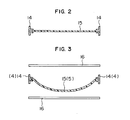
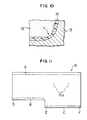
- the flat sheet-like material 15 such as that shown in fig. 11, which corresponds to the formed article 6, is prepared, and portions A to F of the peripheral edge thereof is gripped by a clamp 14 (see Fig. 2).
- the sheet-like material 15 is prepared by cutting a composite sheet material adhesively laminating PP foam on PVC sheet sheeted by calendering into predetermined shapes. At that time, slits 15a (see Fig. 11) may be formed at positions of the sheet-like material 15 where the recessed portions 7c of the upper stage portion 7a are to be formed later in such a manner that they protrude upward and at the same time are recessed to further reduce elongation of the sheet-like material 15 which will occur during the clamping of a vacuum die 11 which will be described later.
- the clamp 14 which is used in this process is constructed such that it can hold a plurality of predetermined positions of the peripheral edge of the sheet-like material 15, such that it can release gripping partially, and such that it can shift the gripped portions.
- the sheet-like material 15 is gripped and in that state softened by heating it to a temperature from 160 to 210°C by means of a ceramic heater 16 (see Fig. 3).
- the softened sheet-like material 15 is placed on a lower die 13 (see Fig. 4) by releasing gripping of the portions A to C of the sheet-like material 15 by the clamp 14, by shifting rightward the clamp which grips the portions D and E and then by shifting leftward the clamp which grips the portion F in Fig. 11.
- the portion of the sheet-like material 15 which stretches is supplemented by the portion thereof whose peripheral edge is not gripped by the clamp and variations in the thickness of the sheet-like material can thus be suppressed.
- the peripheral edge of the sheet-like material 15 are partially gripped by the clamp 14 at positions which allow wrinkles of the sheet-like material 15 to be eliminated when the sheet is placed on the lower die 13.
- the positions are appropriately set in accordance with the shape of the formed article. In the case of a formed article having a shape which does not allow the sheet to be wrinkled readily, the clamp for gripping the peripheral edge of the sheet-like material 15 may be released entirely when the sheet-like material is placed on the lower die.
- the vacuum forming die 11 used to form the sheet-like material 15 into the formed article 6 consists of an upper die 12, such as a porous ceramic die having a large number of air holes of electroformed mould, and the lower die 13, such as an assist plug die formed by a synthetic resin or aluminum, as shown in Fig. 1.
- the upper die 12 has a cavity forming die surface 12a which can form creping pattern on a surface of the sheet-like material 15 to form it in a predetermined shape.
- a sealing surface 12b on which a silicone sealant is coated is formed around the cavity forming die surface 12a to seal the gap between the surface 12a and the sheet-like material 15 when it is gripped between the upper die 12 and the lower die 13 during the clamping.
- a covering member 12c is disposed in such a manner that it surrounds the upper die 12 to hermetically cover it. The interior of the covering-member 12c located above the upper die 12 is connected to an evacuation means which is not shown.
- the lower die 13 has a cavity forming die surface 13a in a predetermined shape to press the sheet-like material 15 against the cavity forming die surface 12a of the upper die 12.
- a gripping projection surface 13b is formed around the cavity forming die surface 13a to, together with the sealing surface 12b of the upper die 12, grip the peripheral edge of the sheet-like material 15 during the clamping.
- the cavity forming die surface 13a also has a recessed portion 13d with forming and parting of the undercut portion 8c of the formed article 6 taken into consideration.
- Air holes 13c are opened onto the recessed portion 13d to press the sheet-like material 15 against the cavity forming die surface 12a of the upper die 12 due to the air pressure.
- the air holes 13c are connected to a pressurization means (not shown).
- a cavity 11a should also be designed with compression of the recessed portion Y of the formed article, during clamping taken into consideration. This is necessary to prevent generation of wrinkles of the recessed portion due to the spring back which will occur after formation (see Fig. 10).
- the vacuum die 11 is clamped and the overall peripheral edge of the sheet-like material 15 is thereby gripped to be sealed by the sealing surface 12b of the upper die 12 and the gripping surface 13b of the lower die 13 (see Fig. 5).
- the peripheral edge of the sheet-like material 15 is gripped by the upper and lower dies 12 and 13 and the sheet-like material 15 is thereby fixed in position. So, remaining grip of the sheet-like material by the clamp 14 is released.
- the foamed layer in the recessed portion Y of the formed article 6 must be compressed. This is achieved by reducing the space between the upper and lower dies corresponding to the recessed portion Y since the foamed layer is in a heated condition.
- the sheet-like material 15 is pressed against the cavity forming die surface 12a of the upper die 12 to thereby form creping pattern on the surface of the sheet-like material and formed in a predetermined form by operating the pressurization means (not shown) and the evacuation means, such as a vacuum pump 32, under a pressure at which the PP foam is not compressed (see Fig. 1).
- the sealing surface 12b is formed such that it closes the air hole through which the air is evacuated to form a vacuum. In consequence, leakage of air from the peripheral edge of the sheet-like material 15 is prevented, and forming can thus be conducted without any trouble.
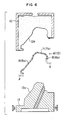
- the vacuum die is opened and the resultant preliminary formed article 6 is removed from the upper die 12 of the vacuum die (see Fig. 6).
- an unnecessary end portion of the preliminary formed article 6 is trimmed off to form the covering portion 6.
- the vertical and horizontal portions are cut off from the preliminary covering portion to form the covering portion 6.
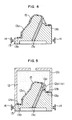
- the covering portion 6 is set on an upper die 22 of a stamping die 21 (see Fig. 7).
- the upper die 22 has at its lower end a slide core 24 which is movable in a horizontal direction.
- the covering portion 6 is set on the upper die 22 with a curved portion 6a thereof being supported by the upper end surface of the slide core 24 without falling thereof.
- the upper die 22 is pivoted downward beforehand and pivoted back upward after the setting. In this way, setting of the covering portion 6 is facilitated. Further, if the covering portion 6 have irregularities which are at least 3 mm in depth, alignment of the position is facilitated to the upper die 22.
- a die 29 of an extruding head 29 which is a part of an extruder is disposed above a lower die 23 of the stamping die 21, and a molten forming material M which is formed of PP is then caused to flow out of the die 29 and placed on the lower die 23 (see Fig. 7).
- the lower die 23 is preferably heated to a temperature from 40 to 100°C.
- clamping is conducted by moving the upper die 22 downward (at that time, the clamping pressure is between 50 to 150 ton), and the forming material M is then cooled to cause it to set by adjusting the temperature of the stamping die 21 (see Fig. 8).
- the forming material M made of PP is the same in guality as that of the backside of the covering portion 6 and located on the lower die 23 of the stamping die 21 in a melted state, the PP foam on the backside of the covering portion 6 is melted due to the heat of the forming material M, thereby allowing the covering portion 6 to be adhered to the base portion 27 without the use of an adhesive. Furthermore, since the forming material M sets and is formed into a predetermined shape by means of the stamping die 21, the use of a base material 27 which is conventionally formed beforehand is not necessary. During the clamping, the foam layer of the covering portion 6 is made compressed by the pressure of the forming material M.
- a pin 22a engaged with the covering portion 6 may be inserted into each of holes formed in the portions of the covering portion 6 which have the possibility of being shifted from the upper die 22 or lower die 23 (see Figs. 7, 8 and 12).
- the stamping die 21 is moved in a state wherein the lower die 23 is in contact with the slide core 24 located at the forefront. In consequence, leakage of a molten resin 20 from a gap between the lower die 23 and the slide core 24 and, hence, formation of burrs can be avoided. Furthermore, as shown in Figs. 8 and 9, the curved portion of the covering portion 6 is rarely interfered by the lower die 23 during the movement of the die 21. In consequence, breakage or shift of the covering portion 6, caused by the interference thereof by the lower die 23 in a conventional method, can be eliminated.
- the stamping die 21 is opened while the slide core 24 is being moved, and the formed article 26 is removed from the die. Thereafter, the end portion of the article 26 is treated such that trimming of the peripheral edge thereof and curving of the covering portion 6 are conducted (see Fig. 9).
- the foam layer compressed during the clamping restores its original shape.
- holes 30 and 31 are formed by cutting open the recessed portions 7c of the covering portion 6 by means of a die cutter or the like, as shown in Fig. 13.
- the holes 30 and 31 can receive instruments or the like.
- an instrument panel 1, which is a synthetic resin formed article 26 having a double-layer structure consisting of the covering portion 6 and the base portion 27, is obtained.
- Fig. 14 shows the essential process of the in-mold forming method by so-called SPM method, showing a second embodiment of the present invention.
- the process shown in Fig. 14 corresponds to the molten resin setting process and the clamping process in the above-described stamping forming method.
- the process shown in Fig. 14 is characterized by synchronization of the clamping of the die and the molten resin setting.
- Setting of the molten resin M is effected such that the molten resin M is caused to flow out from an injection nozzle 33 and then passed through a hot runner 34 formed in the lower die 23 into a cavity formed by the die which is in the midst of being clamped.
- Other processes are the same as those in the above-described first embodiment, description being therefore omitted.
- the method includes the steps of: forming a sheet-like material (15) into a predetermined shape by the vacuum forming to obtain a preliminary covering portion; trimming an end portion of the preliminary covering portion obtained in the previous step to obtain the covering portion of the formed article (6); setting the covering portion of the formed article on one of a pair of dies (12, 13, 22, 23) which constitute a press-type forming die (11, 21) with the curved portion of the covering portion being supported by a slide core (24) located at a forefront position; setting a molten resin (M) which is forming material of the base portion (27) into a gap between the one die and the other die in a state in which the covering portion of the formed article (6) is being set on the one die; clamping the press-type forming die in a state wherein the slide core (24) is in contact with the other die at the forefront position immediately after or in synchronism with the molten resin setting step and causing the molten resin (M) to set to form it; and opening the forming die and then
Landscapes
- Engineering & Computer Science (AREA)
- Mechanical Engineering (AREA)
- Chemical & Material Sciences (AREA)
- Composite Materials (AREA)
- Moulds For Moulding Plastics Or The Like (AREA)
- Casting Or Compression Moulding Of Plastics Or The Like (AREA)
- Blow-Moulding Or Thermoforming Of Plastics Or The Like (AREA)
Applications Claiming Priority (2)
| Application Number | Priority Date | Filing Date | Title |
|---|---|---|---|
| JP85375/90 | 1990-03-30 | ||
| JP8537590A JPH0745135B2 (ja) | 1990-03-30 | 1990-03-30 | インモールド成形方法 |
Publications (2)
| Publication Number | Publication Date |
|---|---|
| EP0451447A1 true EP0451447A1 (fr) | 1991-10-16 |
| EP0451447B1 EP0451447B1 (fr) | 1995-04-26 |
Family
ID=13856976
Family Applications (1)
| Application Number | Title | Priority Date | Filing Date |
|---|---|---|---|
| EP19910101233 Expired - Lifetime EP0451447B1 (fr) | 1990-03-30 | 1991-01-30 | Procédé de fabrication d'articles formés en résine synthétique |
Country Status (3)
| Country | Link |
|---|---|
| EP (1) | EP0451447B1 (fr) |
| JP (1) | JPH0745135B2 (fr) |
| DE (1) | DE69109171T2 (fr) |
Cited By (6)
| Publication number | Priority date | Publication date | Assignee | Title |
|---|---|---|---|---|
| DE4401266A1 (de) * | 1994-01-18 | 1995-07-20 | Branson Ultraschall | Verfahren und Vorrichtung zum Herstellen eines mit einer textilen Auflage versehenen Kunststoffteiles |
| FR2717116A1 (fr) * | 1994-03-12 | 1995-09-15 | Otto Deuschle Modell Formenbau | Pièce moulée en matière plastique doublée d'une feuille, ainsi que procédé et dispositif pour sa fabrication. |
| EP0655304A4 (fr) * | 1993-02-16 | 1996-02-28 | Sumitomo Chemical Co | Procede de production d'un stratifie integre a une peau et moule utilise avec ce procede. |
| EP0732182A3 (fr) * | 1995-03-15 | 1997-12-10 | Kasai Kogyo Co., Ltd. | Procédé de moulage d'un ensemble stratifié |
| WO2006005110A1 (fr) * | 2004-07-08 | 2006-01-19 | Transtech Research Pty Ltd | Systeme de distribution par infusion de resine |
| AU2005262263B2 (en) * | 2004-07-08 | 2009-07-30 | Transtech Research Pty Ltd | Resin infusion distribution system |
Citations (5)
| Publication number | Priority date | Publication date | Assignee | Title |
|---|---|---|---|---|
| JPS58171921A (ja) * | 1982-04-02 | 1983-10-08 | Honda Motor Co Ltd | 表皮を形成した発泡樹脂成形体の製造方法 |
| JPS60212312A (ja) * | 1984-04-06 | 1985-10-24 | Toyota Motor Corp | 積層成形品の製造方法 |
| EP0186016A2 (fr) * | 1984-12-07 | 1986-07-02 | Sumitomo Chemical Company, Limited | Procédé et appareil pour fabriquer un corps laminé |
| GB2206835A (en) * | 1987-07-14 | 1989-01-18 | Kasai Kogyo Kk | Automotive interior components |
| EP0343245A1 (fr) * | 1987-12-04 | 1989-11-29 | Meiwa Industry Co. Ltd. | Procede de production d'objets moules stratifies comportant une feuille decorative |
-
1990
- 1990-03-30 JP JP8537590A patent/JPH0745135B2/ja not_active Expired - Lifetime
-
1991
- 1991-01-30 EP EP19910101233 patent/EP0451447B1/fr not_active Expired - Lifetime
- 1991-01-30 DE DE1991609171 patent/DE69109171T2/de not_active Expired - Fee Related
Patent Citations (5)
| Publication number | Priority date | Publication date | Assignee | Title |
|---|---|---|---|---|
| JPS58171921A (ja) * | 1982-04-02 | 1983-10-08 | Honda Motor Co Ltd | 表皮を形成した発泡樹脂成形体の製造方法 |
| JPS60212312A (ja) * | 1984-04-06 | 1985-10-24 | Toyota Motor Corp | 積層成形品の製造方法 |
| EP0186016A2 (fr) * | 1984-12-07 | 1986-07-02 | Sumitomo Chemical Company, Limited | Procédé et appareil pour fabriquer un corps laminé |
| GB2206835A (en) * | 1987-07-14 | 1989-01-18 | Kasai Kogyo Kk | Automotive interior components |
| EP0343245A1 (fr) * | 1987-12-04 | 1989-11-29 | Meiwa Industry Co. Ltd. | Procede de production d'objets moules stratifies comportant une feuille decorative |
Non-Patent Citations (1)
| Title |
|---|
| PATENT ABSTRACTS OF JAPAN, vol. 11, no. 255 (M-609)[2672], 22nd July 1987; & JP-A-62 039 218 (YUKIKAZU KASUGA) 22-02-1987 * |
Cited By (10)
| Publication number | Priority date | Publication date | Assignee | Title |
|---|---|---|---|---|
| EP0655304A4 (fr) * | 1993-02-16 | 1996-02-28 | Sumitomo Chemical Co | Procede de production d'un stratifie integre a une peau et moule utilise avec ce procede. |
| US5622667A (en) * | 1993-02-16 | 1997-04-22 | Sumitomo Chemical Company, Limited | Process for producing skin-integrated laminate |
| DE4401266A1 (de) * | 1994-01-18 | 1995-07-20 | Branson Ultraschall | Verfahren und Vorrichtung zum Herstellen eines mit einer textilen Auflage versehenen Kunststoffteiles |
| FR2717116A1 (fr) * | 1994-03-12 | 1995-09-15 | Otto Deuschle Modell Formenbau | Pièce moulée en matière plastique doublée d'une feuille, ainsi que procédé et dispositif pour sa fabrication. |
| US5928464A (en) * | 1994-03-12 | 1999-07-27 | Otto Deuschle Modell-Und Formenabau Gmbh & Co. | Film laminated plastic moulding as well as process and device for its manufacture |
| US6126769A (en) * | 1994-03-12 | 2000-10-03 | Otto Deuschle Modell-Und Formenbau Gmbh & Co. | Film laminated plastic moulding as well as process and device for its manufacture |
| EP0732182A3 (fr) * | 1995-03-15 | 1997-12-10 | Kasai Kogyo Co., Ltd. | Procédé de moulage d'un ensemble stratifié |
| US5811053A (en) * | 1995-03-15 | 1998-09-22 | Kasai Kogyo Co., Ltd. | Method for molding a laminated assembly |
| WO2006005110A1 (fr) * | 2004-07-08 | 2006-01-19 | Transtech Research Pty Ltd | Systeme de distribution par infusion de resine |
| AU2005262263B2 (en) * | 2004-07-08 | 2009-07-30 | Transtech Research Pty Ltd | Resin infusion distribution system |
Also Published As
| Publication number | Publication date |
|---|---|
| DE69109171T2 (de) | 1995-09-21 |
| JPH0745135B2 (ja) | 1995-05-17 |
| EP0451447B1 (fr) | 1995-04-26 |
| JPH03281317A (ja) | 1991-12-12 |
| DE69109171D1 (de) | 1995-06-01 |
Similar Documents
| Publication | Publication Date | Title |
|---|---|---|
| CA2130925C (fr) | Piece moulee par insertion, appareil et procede de fabrication connexes | |
| JP3313336B2 (ja) | ソフトタッチ発泡層を有する車両内装トリム構成要素の製造方法 | |
| JPH02292019A (ja) | 剛性のある変形可能な支持体と可撓性のある装飾カバーとを金型成形により組み立てる方法 | |
| US4555380A (en) | Air-pressure method | |
| JPH08267501A (ja) | 積層成形体の成形方法並びに成形型装置 | |
| EP0655304B1 (fr) | Procede de production d'un stratifie integre a une peau et moule utilise avec ce procede | |
| US5972278A (en) | Method of forming synthetic resin formed articles | |
| EP0296750A2 (fr) | Procédé pour la fabrication d'un article moulé à paroi mince ayant des protubérances et moule pour sa mise en forme | |
| EP0451447B1 (fr) | Procédé de fabrication d'articles formés en résine synthétique | |
| JPH07285149A (ja) | 予備成形法のバックエンボスにより成形品を製造する方法 | |
| US6251333B1 (en) | Method for manufacturing a film-covered article | |
| JP2005125736A (ja) | 発泡層付き内装品 | |
| JPH05301243A (ja) | 表皮付き樹脂成形品の製造方法 | |
| US5194194A (en) | Method for molding soft sheet material | |
| US7067082B2 (en) | Method for producing a molded resin laminate | |
| JP2781925B2 (ja) | スタンピング成形品の製造方法 | |
| JP2001138389A (ja) | 真空成形方法 | |
| JP3031453B2 (ja) | 自動車用インシュレータダッシュの製造方法 | |
| JP4478806B2 (ja) | フィルム付き成形品製造用金型とフィルム付き成形品製造方法 | |
| JPH0957844A (ja) | 合成樹脂製中空成形体の製造方法およびその装置 | |
| JP3830658B2 (ja) | 成形品の製造方法及びその方法に用いる切離工具 | |
| JPH04298323A (ja) | 真空成形方法 | |
| JP3406731B2 (ja) | 加飾表皮材により部分的に加飾されたシート状樹脂成形体の製造方法 | |
| JP3314979B2 (ja) | スタンピング成形用型およびスタンピング成形方法 | |
| JPH0474613A (ja) | 複合成形体の製造方法およびそのプレス型 |
Legal Events
| Date | Code | Title | Description |
|---|---|---|---|
| PUAI | Public reference made under article 153(3) epc to a published international application that has entered the european phase |
Free format text: ORIGINAL CODE: 0009012 |
|
| AK | Designated contracting states |
Kind code of ref document: A1 Designated state(s): DE FR GB IT |
|
| 17P | Request for examination filed |
Effective date: 19920225 |
|
| 17Q | First examination report despatched |
Effective date: 19930810 |
|
| GRAA | (expected) grant |
Free format text: ORIGINAL CODE: 0009210 |
|
| AK | Designated contracting states |
Kind code of ref document: B1 Designated state(s): DE FR GB IT |
|
| REF | Corresponds to: |
Ref document number: 69109171 Country of ref document: DE Date of ref document: 19950601 |
|
| ITF | It: translation for a ep patent filed | ||
| ET | Fr: translation filed | ||
| PLBE | No opposition filed within time limit |
Free format text: ORIGINAL CODE: 0009261 |
|
| STAA | Information on the status of an ep patent application or granted ep patent |
Free format text: STATUS: NO OPPOSITION FILED WITHIN TIME LIMIT |
|
| 26N | No opposition filed | ||
| REG | Reference to a national code |
Ref country code: GB Ref legal event code: IF02 |
|
| PGFP | Annual fee paid to national office [announced via postgrant information from national office to epo] |
Ref country code: FR Payment date: 20050110 Year of fee payment: 15 |
|
| PGFP | Annual fee paid to national office [announced via postgrant information from national office to epo] |
Ref country code: GB Payment date: 20050126 Year of fee payment: 15 |
|
| PG25 | Lapsed in a contracting state [announced via postgrant information from national office to epo] |
Ref country code: IT Free format text: LAPSE BECAUSE OF NON-PAYMENT OF DUE FEES;WARNING: LAPSES OF ITALIAN PATENTS WITH EFFECTIVE DATE BEFORE 2007 MAY HAVE OCCURRED AT ANY TIME BEFORE 2007. THE CORRECT EFFECTIVE DATE MAY BE DIFFERENT FROM THE ONE RECORDED. Effective date: 20050130 |
|
| PGFP | Annual fee paid to national office [announced via postgrant information from national office to epo] |
Ref country code: DE Payment date: 20060126 Year of fee payment: 16 |
|
| PG25 | Lapsed in a contracting state [announced via postgrant information from national office to epo] |
Ref country code: GB Free format text: LAPSE BECAUSE OF NON-PAYMENT OF DUE FEES Effective date: 20060130 |
|
| PG25 | Lapsed in a contracting state [announced via postgrant information from national office to epo] |
Ref country code: FR Free format text: LAPSE BECAUSE OF NON-PAYMENT OF DUE FEES Effective date: 20060131 |
|
| GBPC | Gb: european patent ceased through non-payment of renewal fee |
Effective date: 20060130 |
|
| REG | Reference to a national code |
Ref country code: FR Ref legal event code: ST Effective date: 20060929 |
|
| PG25 | Lapsed in a contracting state [announced via postgrant information from national office to epo] |
Ref country code: DE Free format text: LAPSE BECAUSE OF NON-PAYMENT OF DUE FEES Effective date: 20070801 |