EP0451950B1 - Procédé pour la fabrication d'un matériau supraconducteur à base d'oxyde par cuisson et appareillage à cet effet - Google Patents
Procédé pour la fabrication d'un matériau supraconducteur à base d'oxyde par cuisson et appareillage à cet effet Download PDFInfo
- Publication number
- EP0451950B1 EP0451950B1 EP91302012A EP91302012A EP0451950B1 EP 0451950 B1 EP0451950 B1 EP 0451950B1 EP 91302012 A EP91302012 A EP 91302012A EP 91302012 A EP91302012 A EP 91302012A EP 0451950 B1 EP0451950 B1 EP 0451950B1
- Authority
- EP
- European Patent Office
- Prior art keywords
- firing
- layer
- oxide superconductive
- bottomed cylindrical
- fired
- Prior art date
- Legal status (The legal status is an assumption and is not a legal conclusion. Google has not performed a legal analysis and makes no representation as to the accuracy of the status listed.)
- Expired - Lifetime
Links
Images



Classifications
-
- C—CHEMISTRY; METALLURGY
- C04—CEMENTS; CONCRETE; ARTIFICIAL STONE; CERAMICS; REFRACTORIES
- C04B—LIME, MAGNESIA; SLAG; CEMENTS; COMPOSITIONS THEREOF, e.g. MORTARS, CONCRETE OR LIKE BUILDING MATERIALS; ARTIFICIAL STONE; CERAMICS; REFRACTORIES; TREATMENT OF NATURAL STONE
- C04B35/00—Shaped ceramic products characterised by their composition; Ceramics compositions; Processing powders of inorganic compounds preparatory to the manufacturing of ceramic products
- C04B35/01—Shaped ceramic products characterised by their composition; Ceramics compositions; Processing powders of inorganic compounds preparatory to the manufacturing of ceramic products based on oxide ceramics
- C04B35/45—Shaped ceramic products characterised by their composition; Ceramics compositions; Processing powders of inorganic compounds preparatory to the manufacturing of ceramic products based on oxide ceramics based on copper oxide or solid solutions thereof with other oxides
-
- C—CHEMISTRY; METALLURGY
- C04—CEMENTS; CONCRETE; ARTIFICIAL STONE; CERAMICS; REFRACTORIES
- C04B—LIME, MAGNESIA; SLAG; CEMENTS; COMPOSITIONS THEREOF, e.g. MORTARS, CONCRETE OR LIKE BUILDING MATERIALS; ARTIFICIAL STONE; CERAMICS; REFRACTORIES; TREATMENT OF NATURAL STONE
- C04B35/00—Shaped ceramic products characterised by their composition; Ceramics compositions; Processing powders of inorganic compounds preparatory to the manufacturing of ceramic products
- C04B35/01—Shaped ceramic products characterised by their composition; Ceramics compositions; Processing powders of inorganic compounds preparatory to the manufacturing of ceramic products based on oxide ceramics
- C04B35/45—Shaped ceramic products characterised by their composition; Ceramics compositions; Processing powders of inorganic compounds preparatory to the manufacturing of ceramic products based on oxide ceramics based on copper oxide or solid solutions thereof with other oxides
- C04B35/4504—Shaped ceramic products characterised by their composition; Ceramics compositions; Processing powders of inorganic compounds preparatory to the manufacturing of ceramic products based on oxide ceramics based on copper oxide or solid solutions thereof with other oxides containing rare earth oxides
-
- C—CHEMISTRY; METALLURGY
- C04—CEMENTS; CONCRETE; ARTIFICIAL STONE; CERAMICS; REFRACTORIES
- C04B—LIME, MAGNESIA; SLAG; CEMENTS; COMPOSITIONS THEREOF, e.g. MORTARS, CONCRETE OR LIKE BUILDING MATERIALS; ARTIFICIAL STONE; CERAMICS; REFRACTORIES; TREATMENT OF NATURAL STONE
- C04B35/00—Shaped ceramic products characterised by their composition; Ceramics compositions; Processing powders of inorganic compounds preparatory to the manufacturing of ceramic products
- C04B35/01—Shaped ceramic products characterised by their composition; Ceramics compositions; Processing powders of inorganic compounds preparatory to the manufacturing of ceramic products based on oxide ceramics
- C04B35/45—Shaped ceramic products characterised by their composition; Ceramics compositions; Processing powders of inorganic compounds preparatory to the manufacturing of ceramic products based on oxide ceramics based on copper oxide or solid solutions thereof with other oxides
- C04B35/4521—Shaped ceramic products characterised by their composition; Ceramics compositions; Processing powders of inorganic compounds preparatory to the manufacturing of ceramic products based on oxide ceramics based on copper oxide or solid solutions thereof with other oxides containing bismuth oxide
-
- F—MECHANICAL ENGINEERING; LIGHTING; HEATING; WEAPONS; BLASTING
- F27—FURNACES; KILNS; OVENS; RETORTS
- F27B—FURNACES, KILNS, OVENS OR RETORTS IN GENERAL; OPEN SINTERING OR LIKE APPARATUS
- F27B17/00—Furnaces of a kind not covered by any of groups F27B1/00 - F27B15/00
- F27B17/0016—Chamber type furnaces
- F27B17/0083—Chamber type furnaces with means for circulating the atmosphere
-
- H—ELECTRICITY
- H10—SEMICONDUCTOR DEVICES; ELECTRIC SOLID-STATE DEVICES NOT OTHERWISE PROVIDED FOR
- H10N—ELECTRIC SOLID-STATE DEVICES NOT OTHERWISE PROVIDED FOR
- H10N60/00—Superconducting devices
- H10N60/01—Manufacture or treatment
- H10N60/0268—Manufacture or treatment of devices comprising copper oxide
-
- Y—GENERAL TAGGING OF NEW TECHNOLOGICAL DEVELOPMENTS; GENERAL TAGGING OF CROSS-SECTIONAL TECHNOLOGIES SPANNING OVER SEVERAL SECTIONS OF THE IPC; TECHNICAL SUBJECTS COVERED BY FORMER USPC CROSS-REFERENCE ART COLLECTIONS [XRACs] AND DIGESTS
- Y10—TECHNICAL SUBJECTS COVERED BY FORMER USPC
- Y10S—TECHNICAL SUBJECTS COVERED BY FORMER USPC CROSS-REFERENCE ART COLLECTIONS [XRACs] AND DIGESTS
- Y10S505/00—Superconductor technology: apparatus, material, process
- Y10S505/725—Process of making or treating high tc, above 30 k, superconducting shaped material, article, or device
- Y10S505/742—Annealing
Definitions
- the present invention relates to a process for producing an oxide superconductive material by firing as well as to an apparatus therefor. More particularly, the present invention relates to a process for producing an oxide superconductive material by firing, which process can suitably carry out complete firing and oxidation of a ceramic superconductive powder, etc., as well as to an apparatus therefor.
- the present invention further relates to a process for producing a bottomed cylindrical oxide superconductive material by firing, in an atmosphere enabling uniform firing, a bottomed cylindrical material comprising at least two layers of (a) a bottomed cylindrical substrate layer and (b) a layer to become an oxide superconductive layer when fired, formed on the substrate layer (a).
- Oxide superconductive materials have drawn attention in recent years because they exhibit high critical temperatures, and their application in fields such as electric power, magnetic resonance imaging, magnetic shielding and the like is expected.
- magnetic shielding apparatuses in particular, use of a bottomed (one end-closed) cylindrical superconductive material is being tried for measurement of the very weak magnetism of living body.
- Cylindrical oxide superconductive materials can generally be obtained in an integral form of (a) a cylindrical substrate and (b) an oxide superconductive layer provided thereon, by forming, on a cylindrical substrate made of a metal or the like, a layer to become an oxide superconductive layer and then subjecting them to firing.
- An electric furnace is often used for the firing of a special ceramic which can be made at a high temperature and which must be made at a precisely controlled temperature.
- a firing apparatus As the firing furnace used for the above-mentioned purpose, there is known, for example, a firing apparatus [conventional apparatus (1)] as shown in Fig. 8.
- a material 4 to be fired and become an oxide superconductive material is placed on a setter 7 provided in a firing furnace 2; an oxygen-rich gas is introduced into the furnace 2 through a gas inlet 1 to fire the mateiral 4; the gas after firing is exhausted through a gas outlet 8.
- a firing apparatus [conventional apparatus (2)] as shown in Fig. 9.
- an oxygen-rich gas is introduced into a firing furnace 2 through a gas passage 9 provided outside a muffle of the furnace 2; the gas after firing is exhausted through a gas outlet 8.
- This bell-shaped furnace is the same as generally used for uniform heating of wire material (e.g. steel wire) or thin tube coil or for heat treatment of said linear material or thin tube in a particular atmosphere or under vacuum in a state isolated from the outside.
- wire material e.g. steel wire
- the oxygen-rich gas introduced through the gas inlet 1 gives rise to a stream X which proceeds to the upper portion of the firing furnace 2 owing to the gas speed at the inlet 1 and a stream Y which stays at the lower portion of the firing furnace 2 owing to its temperature lower than that inside the furnace and then is heated by a heating element and rises to the upper portion of the furnace.
- the proportion of the stream X increases and, when the flow rate is decreased, the proportion of the stream Y increases.
- the stream X and the stream Y collide with each other above the material 4 to be fired, whereby turbulence in gas flow is generated, making it impossible to produce unidirectional gas flow in the vicinity of the material to be fired.
- a turbulent flow even when the discharge gas from the gas outlet 8 contains oxygen in a high concentration of 80 ⁇ % or more, an oxygen-lean gas layer is present at the surface of the material 4 to be fired, as a result of an oxygen absorption reaction, as shown in Fig. 10; consequently, there remains, in the sintered material obtained, unreacted carbon derived from binder, etc. which are an organic substance or a carbonate, and the sintered material inevitably has low superconductivity.
- a gas of unidirectional flow is generated in a firing furnace at the material surface, so that no oxygen-lean gas layer is present on the surface of a material to be fired,
- the present invention provides a process for producing a bottomed cylindrical body comprising oxide superconductive material by firing, which comprises (i) providing a cylindrical inorganic material body open at both ends in the firing zone of a muffle of a bell-shaped furnace, (ii) providing, inside the inorganic material body, a bottomed cylindrical body comprising (a) a bottomed cylindrical substrate and (b) a layer adapted to become an oxide superconductive layer when fired, formed on the outer surface of the bottomed cylindrical substrate, with the bottom of the cylindrical body directed upward, and (iii) passing a firing gas first along the outer surface of the inorganic material body and then along its inner surface or first along its inner surface and then along its outer surface to maintain the whole of the layer in an atmosphere enabling uniform firing and effect firing of the layer under this condition.
- the present invention also provides a process for producing a bottomed cylindrical body comprising oxide superconductive material by firing, which comprises (i) providing a cylindrical inorganic material body open at both ends, (ii) providing, outside and surrounding the inorganic material body, a bottomed cylindrical body comprising (a) a bottomed cylindrical substrate and (b) a layer adapted to become an oxide superconductive layer when fired, formed on the inner surface of the bottomed cylindrical substrate, with the bottom of the cylindrical body directed upward and with the bottomed cylindrical body located in the firing zone of a muffle of a bell-shaped furnace or itself forming the muffle of such a furnace, and (iii) passing a firing gas first along the outer surface of the inorganic material body and then along its inner surface or first along its inner surface and then along its outer surface to maintain the whole of the layer in an atmosphere enabling uniform firing and effect firing of the layer under this condition.
- the average flow rate of gas along the layer is in the range 0.1-3.0 m/sec.
- the layer to become an oxide superconductive layer is fired in a gas atmosphere of given temperature and composition, and the resulting bottomed cylindrical superconductive material can express excellent superconductivity and excellent magnetic shielding property and can be used as a magnetic shielding material enabling measurement of the very weak magnetism of living body, etc.
- the oxide superconductive material used in the present invention is preferably a Y-Ba-Cu-O type compound or a Bi-Sr-Ca-Cu-O type compound each having a multi-layered perovskite structure.
- Figs. 5 to 7 each shows a sectional view of a firing furnace used for firing of a cylindrical material.
- a fan 43 is provided at the bottom of a bearer 42 in a muffle 41 of a bell-shaped furnace 50 ⁇ ; a both ends-opened cylindrical material 44 to be fired is placed on the bearer 42; and an atmosphere in the muffle 41 is forcibly stirred by heat convection and the action of the fan to uniformize the atmosphere in the muffle 41.
- the atmosphere in the muffle 41 is circulated from the outer surface of the cylindrical material 44 to its inner surface in the order of C ⁇ D ⁇ E, whereby the firing atmosphere is substantially uniformized and uniform firing can be effected.
- the cylindrical material 44 to be fired is closed in one end and consists of a cylindrical substrate 44 and a layer 45 to become an oxide superconductive layer when fired, formed on the outer surface of the substrate 44 as shown in Fig. 6 or consists of a cylindrical substrate 44 and a layer 45 to become an oxide superconductive layer when fired, formed on the inner surface of the substrate 44 as shown in Fig. 7, the atmosphere in the muffle cannot be made substantially uniform even by the action of a fan and becomes turbulent when a conventional bell-shaped furnace is used; therefore, the layer to become an oxide superconductive layer when fired, formed on the cylindrical substrate cannot be fired in a uniform atmosphere and the cylindrical oxide superconductive material obtained cannot express excellent superconductivity.
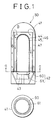
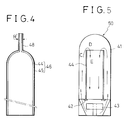
- Figs. 1 to 4 show examples of the present invention for firing bottomed cylindrical materials.
- Fig. 1 shows an example of a firing furnace used for firing a bottomed cylindrical material.
- a bearer 42 consisting of a ring-shaped plate 60 ⁇ and a circular plate 61 is provided in a muffle 41; a fan 43 is provided below the bearer 42; a both ends-opened cylindrical inorganic material 47 is placed on the ring-shaped plate 60 ⁇ provided with a gap kept against the inner wall of the muffle 41; a material 46 to be fired, consisting of (a) a bottomed cylindrical substrate 44 and (b) a layer 45 to become an oxide superconductive layer when fired, formed on the outer surface of the substrate 44, is placed on the circular plate 61 provided with a gap kept against the ring-shaped plate 60 ⁇ .
- the furnace 10 ⁇ is heated and the fan 43 is actuated to allow the atmosphere gas in the muffle 41 to produce a gas flow of A ⁇ B ⁇ C in the A, B and C zones defined by the muffle 41, the cylindrical inorganic material 47 and the material 46 to be fired.
- the flow rate of the gas flow of A ⁇ B ⁇ C is preferably 0 ⁇ .1-3.0 ⁇ m/sec.
- the surface area of the material to be fired or the inside volume of the furnace and the sectional area of the gas passage are large, a large amount of a gas must be introduced in order for the introduced gas to have a sufficiently high velocity; this requires the use of a very large amount of a gas and the installation of a very large preheating chamber, which are not preferable in industrial application.
- the atmosphere inside the furnace is circulated by the fan provided inside the furnace, as in the case of the bell-shaped furnace, the amount of gas introduced can be small.
- the distribution of gas flow rate varies depending upon the thickness, composition and shape of the layer to become an oxide superconductive layer when fired and the type of atmosphere used for firing, but it is preferably controlled so as to fall usually in a range of 50 ⁇ -150 ⁇ % of the average flow rate by appropriately selecting the sizes of cylindrical inorganic material 47 and material 46 to be fired, the gaps between muffle 41 and cylindrical inorganic material 47 and between cylindrical inorganic mateiral 47 and material 46 to be fired, the type and gas-blowing capacity of fan 43, etc.
- the distribution of gas flow rate deviates from 50 ⁇ -150 ⁇ % of the average flow rate, the atmosphere in the muffle tends to become nonuniform and the distribution of superconductivity becomes nonuniform.
- the same operation applies also to a bottomed cylindrical material as shown in Fig. 2, having an inlet 48 for introducing a sensor or the like.
- a material 46 to be fired consisting of a bottomed cylindrical substrate 44 and a layer 45 to become an oxide superconductive layer when fired, formed on the inner surface of the substrate 44.
- a bearer 42 is provided in a muffle 41, the bearer 42 consisting of (a) a ring-shaped plate 62 contacting with the inner wall of the muffle 41 and (b) a ring-shaped plate 63 provided with a gap kept against the ring-shaped plate 62, a fan 43 is provided below the bearer 42, a both ends-opened cylindrical inorganic material 47 is placed on the ring-shaped plate 63 of the bearer 42, and a material 46 to be fired, consisting of a bottomed cylindrical substrate 44 and a layer 45 to become an oxide superconductive layer when fired, formed on the inner surface of the substrate 44 is placed on the ring-shaped plate 62.
- the gas in the muffle 41 is allowed to produce a gas flow of A' ⁇ B' ⁇ C' in the zones A', B' and C' defined by the cylindrical inorganic material 47 and the material 46 to be fired, whereby the composition and temperature of the gas contacting with the layer 45 to become an oxide superconductive layer when fired are made uniform.
- the distribution of gas flow rate in the zones A', B' and C' is controlled to be in a range of 50 ⁇ -150 ⁇ % of the average gas flow rate.
- the same operation applies also to a bottomed cylindrical material as shown in Fig. 4, having an inlet 48 for introducing a sensor or the like.
- the muffle 41 may be omitted.
- a material 46 to be fired consisting of a bottomed cylindrical substrate 44 and a layer 45 to become an oxide superconductive layer when fired is allowed to act also as a muffle;
- a cylindrical inorganic material 47 is provided inside the material 46 to be fired;
- the gas in the material 46 is allowed to produce a gas flow of A' ⁇ B' ⁇ C'; whereby the composition and temperature of the gas contacting with the layer 45 to become an oxide superconductive layer when fired are made uniform.
- the muffle of bell-shaped furnace can be usually made of a stainless steel (e.g. SUS 310 ⁇ S, SUS 430 ⁇ ) or a metal (e.g. Inconel).
- the both ends-opened cylindrical inorganic material is preferably constituted generally by a ceramic (e.g. zirconia ZrO2, alumina Al2O3) , a metal (e.g. Inconel, stainless steel), an emameled metal, an inorganic fiber board or their combination; and there is selected a material which is not deteriorated at the firing temperature used or by the firing gas employed.
- the layer to become an oxide superconductive layer when fired can be formed using materials selected so as to be able to give an oxide superconductive material, according to a known method such as spray coating, doctor blade coating, dip coating or the like.
- the oxide superconductive material is not particularly restricted and can be, for example, any of (a) rare earth element-containing oxide superconductive materials of M-Ba-Cu-O type having a perovskite structure wherein M is at least one rare earth element selected from Sc, Y and lanthanides such as La, Eu, Gd, Er, Yb, Lu and the like, and (b) bismuth -containing oxide superconductive materials having a composition represented by Bi2Sr2Ca1Cu2O x or Bi2Sr2 Ca2Cu3O x .
- the substrate can be any as long as it can keep the mechanical strength of the above oxide superconductive material.
- the substrate can be any as long as it can keep the mechanical strength of the above oxide superconductive material.
- ceramics such as ZrO2, titania (TiO2) and the like, as well as metals such as SUS 430 ⁇ , SUS 310 ⁇ , SUS 30 ⁇ 4, Inconel, Incolloy, Hastelloy and the like.
- an intermediate layer acting as a protective material and an adhesive made of a glass or a nobel metal (e.g. Au, Ag, Pt).
- the type, thickness, etc. of the intermediate layer can be selected depending upon the use purpose, etc. of the oxide superconductive material obtained.
- firing is generally effected by using an oxygen-containing gas and allowing the gas to produce a desired gas flow.
- the firing temperature can be appropriately selected depending upon the type, etc. of the oxide superconductive material used.
- the firing of a bismuth -containing oxide superconductive material can be generally effected by partially melting the material at 875-90 ⁇ 0 ⁇ °C in a uniform oxygen-containing atmosphere, annealing the partial melt at a temperature of 850 ⁇ °C or less to give rise to crystallization, converting the atmosphere gas to nitrogen and heat-treating the crystal at a temperature of 70 ⁇ 0 ⁇ °C or less in a uniform nitrogen atmosphere.
- Powders of Bi2O3 , SrCO3 and CuO each as a starting material for Bi-containing oxide superconductive material were mixed in amounts giving a composition of Bi2Sr2CaCu2O x and then calcinated.
- the calcinated product was ground by a trommel together with ZrO2 flint pebbles using isopropyl alcohol as a solvent, to obtain a starting material powder for Bi-containing oxide superconductive material.
- a cylindrical substrate having a shape as shown in Table 3 was prepared using Inconel 625, SUS 430 ⁇ or SUS 310 ⁇ S each of 1.98 mm in thickness.
- an intermediate layer consisting of a glass layer and a noble metal (Ag) layer or of the latter layer alone.
- Au noble metal
- On the intermediate layer was spray-coated or brush-coated the above-obtained powder, whereby a layer to become a Bi-containing oxide superconductive material when fired was formed so that the layer thickness after firing became about 30 ⁇ 0 ⁇ »m.
- Table 1 The details of the constitution and formation method of each cylindrical material are shown in Table 1.
- the fired product was annealed to about 80 ⁇ 0 ⁇ °C at a cooling rate of 0 ⁇ .5°C/min to crystallize it.
- the lengths of the sensor inlets in Examples 16-18 and Comparative Examples 9-11 were 10 ⁇ 0 ⁇ mm (Example 16 and Comparative Example 9), 320 ⁇ mm (Example 17 and Comparative Examples 10 and 11) and 60 ⁇ mm (Example 18).
- the atmosphere gas was converted to an oxygen-lean gas and the crystal was heat-treated at 450 ⁇ -70 ⁇ 0 ⁇ ° C to obtain cylindrical oxide superconductive materials containing Bi.
- bottomed cylindrical mateirals consisting of (a) a bottomed cylindrical substrate and (b) a layer to become a Bi-containing oxide superconductive layer when fired, formed on either surface (outer or inner) of the cylindrical substrate, give uniform oxide superconductive materials.
Landscapes
- Engineering & Computer Science (AREA)
- Chemical & Material Sciences (AREA)
- Ceramic Engineering (AREA)
- Manufacturing & Machinery (AREA)
- Materials Engineering (AREA)
- Structural Engineering (AREA)
- Organic Chemistry (AREA)
- Mechanical Engineering (AREA)
- General Engineering & Computer Science (AREA)
- Inorganic Compounds Of Heavy Metals (AREA)
- Compositions Of Oxide Ceramics (AREA)
- Superconductors And Manufacturing Methods Therefor (AREA)
Claims (3)
- Procédé pour la fabrication par cuisson d'un élément cylindrique (46), avec un fond, comprenant un matériau supraconducteur à base d'oxyde, qui comprend (i) la présentation d'un élément en matériau inorganique cylindrique (47) ouvert aux deux extrémités dans la zone de cuisson d'un moufle (41) d'un fourneau en forme de cloche, (ii) la présentation, à l'intérieur de l'élément en matériau inorganique (47), d'un élément cylindrique avec un fond (46) comprenant (a) un substrat cylindrique avec un fond (44) et (b) une couche (45) adaptée à se transformer en une couche supraconductrice à base d'oxyde lors de la cuisson, formée sur la surface externe du substrat cylindrique avec un fond (44), le fond de l'élément cylindrique (46) étant dirigé vers le haut, et (iii) le passage d'un gaz de cuisson d'abord le long de la surface externe de l'élément en matériau inorganique (47) et ensuite le long de sa surface interne ou d'abord le long de sa surface interne et ensuite le long de sa surface externe pour maintenir la totalité de la couche (45) dans une atmosphère capable de cuisson uniforme et d'effectuer la cuisson de la couche (45) dans cette condition.
- Procédé pour la fabrication par cuisson d'un élément cylindrique (46), avec un fond, comprenant un matériau supraconducteur à base d'oxyde, qui comprend (i) la présentation d'un élément en matériau inorganique cylindrique (47) ouvert aux deux extrémités, (ii) la présentation, à l'extérieur et autour de l'élément en matériau inorganique (47), d'un élément cylindrique avec un fond (46) comprenant (a) un substrat cylindrique avec un fond (44) et (b) une couche (45) adaptée à se transformer en une couche supraconductrice à base d'oxyde lors de la cuisson, formée sur la surface interne du substrat cylindrique avec un fond (44), le fond de l'élément cylindrique (46) étant dirigé vers le haut et l'élément cylindrique (46) avec un fond étant localisé dans la zone de cuisson d'un moufle (41) d'un fourneau en forme de cloche ou formant lui-même le moufle d'un tel fourneau, et (iii) le passage d'un gaz de cuisson d'abord le long de la surface externe de l'élément en matériau inorganique (47) et ensuite le long de sa surface interne ou d'abord le long de sa surface interne et ensuite le long de sa surface externe pour maintenir la totalité de la couche (45) dans une atmosphère capable de cuisson uniforme et d'effectuer la cuisson de la couche (45) dans cette condition.
- Procédé pour la fabrication par cuisson d'un matériau supraconducteur, à base d'oxyde, cylindrique avec un fond, conformément à la revendication 1 ou 2, dans lequel la vitesse moyenne de flux du gaz le long de la couche (45) est dans l'intervalle de 0,1-3,0 m/sec.
Applications Claiming Priority (4)
| Application Number | Priority Date | Filing Date | Title |
|---|---|---|---|
| JP2060616A JPH03261668A (ja) | 1990-03-12 | 1990-03-12 | 酸化物超電導体の焼成方法及びその装置 |
| JP60616/90 | 1990-03-12 | ||
| JP2411178A JPH0796467B2 (ja) | 1990-12-17 | 1990-12-17 | 底付筒状酸化物超電導体の焼成方法 |
| JP411178/90 | 1990-12-17 |
Publications (2)
| Publication Number | Publication Date |
|---|---|
| EP0451950A1 EP0451950A1 (fr) | 1991-10-16 |
| EP0451950B1 true EP0451950B1 (fr) | 1995-05-31 |
Family
ID=26401694
Family Applications (1)
| Application Number | Title | Priority Date | Filing Date |
|---|---|---|---|
| EP91302012A Expired - Lifetime EP0451950B1 (fr) | 1990-03-12 | 1991-03-11 | Procédé pour la fabrication d'un matériau supraconducteur à base d'oxyde par cuisson et appareillage à cet effet |
Country Status (4)
| Country | Link |
|---|---|
| US (1) | US5173478A (fr) |
| EP (1) | EP0451950B1 (fr) |
| CA (1) | CA2037765C (fr) |
| DE (1) | DE69110078T2 (fr) |
Families Citing this family (2)
| Publication number | Priority date | Publication date | Assignee | Title |
|---|---|---|---|---|
| JP2601069B2 (ja) * | 1991-08-08 | 1997-04-16 | 株式会社村田製作所 | セラミック成形体の焼成方法及び焼成装置 |
| FR3046555B1 (fr) * | 2016-01-07 | 2021-04-16 | Snecma | Procede de traitement thermique d'une preforme en poudre, et outillage permettant de le mettre en oeuvre |
Family Cites Families (5)
| Publication number | Priority date | Publication date | Assignee | Title |
|---|---|---|---|---|
| US1336762A (en) * | 1920-01-15 | 1920-04-13 | American Dressler Tunnel Kilns | Ware-support for ceramic firing |
| US2789808A (en) * | 1954-11-05 | 1957-04-23 | Lee Wilson | Method of and apparatus for controlling circulation of furnace atmosphere |
| JPS62104049A (ja) * | 1985-10-30 | 1987-05-14 | Mitsubishi Electric Corp | ベ−キング炉装置 |
| US4854860A (en) * | 1987-12-02 | 1989-08-08 | Gas Research Institute | Convective heat transfer within an industrial heat treating furnace |
| JPH0259048A (ja) * | 1988-08-24 | 1990-02-28 | Yokohama Rubber Co Ltd:The | 酸素濃度調整装置を備えた熱風恒温槽 |
-
1991
- 1991-03-07 CA CA002037765A patent/CA2037765C/fr not_active Expired - Fee Related
- 1991-03-11 EP EP91302012A patent/EP0451950B1/fr not_active Expired - Lifetime
- 1991-03-11 DE DE69110078T patent/DE69110078T2/de not_active Expired - Fee Related
- 1991-03-11 US US07/667,925 patent/US5173478A/en not_active Expired - Fee Related
Non-Patent Citations (2)
| Title |
|---|
| DERWENT ACCESSION NO. 90-072 443 (10), Questel Telesystems WPI DERWENT PUBLICATIONS LTD., London and JP A 2 26 825 * |
| DERWENT ACCESSION NO. 90-118 443 (16), Questel Telesystems WPI DERWENT PUBLICATIONS LTD., London and JP A 2 64 023 * |
Also Published As
| Publication number | Publication date |
|---|---|
| DE69110078T2 (de) | 1996-01-11 |
| EP0451950A1 (fr) | 1991-10-16 |
| DE69110078D1 (de) | 1995-07-06 |
| CA2037765C (fr) | 1995-02-07 |
| US5173478A (en) | 1992-12-22 |
Similar Documents
| Publication | Publication Date | Title |
|---|---|---|
| EP0401461B1 (fr) | Oxyde supraconducteur et méthode pour fabrication | |
| EP0720244B1 (fr) | Composites oxyde-métal supra-conducteurs | |
| US6291402B1 (en) | Method of making a superconductive oxide body | |
| EP0290331A2 (fr) | Composite supraconducteur | |
| CA1326467C (fr) | Procede de production d'articles supraconducteurs | |
| EP0476876A2 (fr) | Procédé pour le traitement thermique non-destructif d'un supraconducteur enroulé recouvert l'une couche d'argent à haute temperature | |
| EP0305820A2 (fr) | Méthode de fabrication d'un supraconducteur | |
| US5140004A (en) | Method for preparing a high Tc superconducting fiber | |
| EP0451950B1 (fr) | Procédé pour la fabrication d'un matériau supraconducteur à base d'oxyde par cuisson et appareillage à cet effet | |
| EP0657949A1 (fr) | Corps en céramique supraconductrice de forme allongée et procédé pour sa fabrication | |
| US5304534A (en) | Method and apparatus for forming high-critical-temperature superconducting layers on flat and/or elongated substrates | |
| EP0495677A1 (fr) | Matériau d'oxyde supraconducteur et procédé de sa production | |
| US5093311A (en) | Oxide superconductor cable and method of producing the same | |
| US5079218A (en) | Superconducting fiber and a method for preparing the same | |
| EP0393932B1 (fr) | Structure supraconductrice pour blindage magnétique | |
| EP0308326B1 (fr) | Procédé de production d'un supraconducteur oblong | |
| KR890011126A (ko) | 복합 산화물 초전도박막 또는 선재와 그 제작방법 | |
| EP0447198A2 (fr) | Laminages d'oxyde supraconducteur et procédé pour leurs fabrications | |
| Sandhage | The Preparation of Superconducting YBa2Cu3 O 7− y/Ag Microlaminates by an Oscillating Oxidation Scheme | |
| US5273959A (en) | Alloy for HTSC composite conductors made of Au-Ag-Pd | |
| JPH04219360A (ja) | 底付筒状酸化物超電導体の焼成方法 | |
| EP0558268A1 (fr) | Supraconducteur à oxyde de thallium-calcium-baryum-cuivre avec argent et méthode | |
| US5049539A (en) | Low cost, formable, high TC superconducting wire | |
| JPS63276820A (ja) | 酸化物超伝導体の製造方法 | |
| JPH0339458A (ja) | 金属一酸化物超電導複合体及びその製造方法 |
Legal Events
| Date | Code | Title | Description |
|---|---|---|---|
| PUAI | Public reference made under article 153(3) epc to a published international application that has entered the european phase |
Free format text: ORIGINAL CODE: 0009012 |
|
| AK | Designated contracting states |
Kind code of ref document: A1 Designated state(s): BE DE FR GB SE |
|
| 17P | Request for examination filed |
Effective date: 19910909 |
|
| 17Q | First examination report despatched |
Effective date: 19930730 |
|
| GRAA | (expected) grant |
Free format text: ORIGINAL CODE: 0009210 |
|
| AK | Designated contracting states |
Kind code of ref document: B1 Designated state(s): BE DE FR GB SE |
|
| REF | Corresponds to: |
Ref document number: 69110078 Country of ref document: DE Date of ref document: 19950706 |
|
| ET | Fr: translation filed | ||
| PGFP | Annual fee paid to national office [announced via postgrant information from national office to epo] |
Ref country code: GB Payment date: 19960229 Year of fee payment: 6 |
|
| PGFP | Annual fee paid to national office [announced via postgrant information from national office to epo] |
Ref country code: FR Payment date: 19960315 Year of fee payment: 6 |
|
| PGFP | Annual fee paid to national office [announced via postgrant information from national office to epo] |
Ref country code: SE Payment date: 19960318 Year of fee payment: 6 |
|
| PGFP | Annual fee paid to national office [announced via postgrant information from national office to epo] |
Ref country code: DE Payment date: 19960320 Year of fee payment: 6 Ref country code: BE Payment date: 19960320 Year of fee payment: 6 |
|
| PLBE | No opposition filed within time limit |
Free format text: ORIGINAL CODE: 0009261 |
|
| STAA | Information on the status of an ep patent application or granted ep patent |
Free format text: STATUS: NO OPPOSITION FILED WITHIN TIME LIMIT |
|
| 26N | No opposition filed | ||
| PG25 | Lapsed in a contracting state [announced via postgrant information from national office to epo] |
Ref country code: GB Effective date: 19970311 |
|
| PG25 | Lapsed in a contracting state [announced via postgrant information from national office to epo] |
Ref country code: SE Effective date: 19970312 |
|
| PG25 | Lapsed in a contracting state [announced via postgrant information from national office to epo] |
Ref country code: BE Effective date: 19970331 |
|
| BERE | Be: lapsed |
Owner name: NGK INSULATORS LTD Effective date: 19970331 |
|
| GBPC | Gb: european patent ceased through non-payment of renewal fee |
Effective date: 19970311 |
|
| PG25 | Lapsed in a contracting state [announced via postgrant information from national office to epo] |
Ref country code: FR Free format text: LAPSE BECAUSE OF NON-PAYMENT OF DUE FEES Effective date: 19971128 |
|
| PG25 | Lapsed in a contracting state [announced via postgrant information from national office to epo] |
Ref country code: DE Effective date: 19971202 |
|
| EUG | Se: european patent has lapsed |
Ref document number: 91302012.9 |
|
| REG | Reference to a national code |
Ref country code: FR Ref legal event code: ST |