EP0452153A2 - Procédé pour la production de tôles d'acier électriques à double orientation ayant une haute densité de flux magnétique - Google Patents
Procédé pour la production de tôles d'acier électriques à double orientation ayant une haute densité de flux magnétique Download PDFInfo
- Publication number
- EP0452153A2 EP0452153A2 EP91303278A EP91303278A EP0452153A2 EP 0452153 A2 EP0452153 A2 EP 0452153A2 EP 91303278 A EP91303278 A EP 91303278A EP 91303278 A EP91303278 A EP 91303278A EP 0452153 A2 EP0452153 A2 EP 0452153A2
- Authority
- EP
- European Patent Office
- Prior art keywords
- rolling
- hot
- cold
- sheet
- steel sheet
- Prior art date
- Legal status (The legal status is an assumption and is not a legal conclusion. Google has not performed a legal analysis and makes no representation as to the accuracy of the status listed.)
- Granted
Links
Images




Classifications
-
- C—CHEMISTRY; METALLURGY
- C21—METALLURGY OF IRON
- C21D—MODIFYING THE PHYSICAL STRUCTURE OF FERROUS METALS; GENERAL DEVICES FOR HEAT TREATMENT OF FERROUS OR NON-FERROUS METALS OR ALLOYS; MAKING METAL MALLEABLE, e.g. BY DECARBURISATION OR TEMPERING
- C21D8/00—Modifying the physical properties of ferrous metals or ferrous alloys by deformation combined with, or followed by, heat treatment
- C21D8/12—Modifying the physical properties of ferrous metals or ferrous alloys by deformation combined with, or followed by, heat treatment during manufacturing of articles with special electromagnetic properties
- C21D8/1216—Modifying the physical properties of ferrous metals or ferrous alloys by deformation combined with, or followed by, heat treatment during manufacturing of articles with special electromagnetic properties characterised by the working steps
- C21D8/1233—Cold rolling
-
- C—CHEMISTRY; METALLURGY
- C21—METALLURGY OF IRON
- C21D—MODIFYING THE PHYSICAL STRUCTURE OF FERROUS METALS; GENERAL DEVICES FOR HEAT TREATMENT OF FERROUS OR NON-FERROUS METALS OR ALLOYS; MAKING METAL MALLEABLE, e.g. BY DECARBURISATION OR TEMPERING
- C21D8/00—Modifying the physical properties of ferrous metals or ferrous alloys by deformation combined with, or followed by, heat treatment
- C21D8/12—Modifying the physical properties of ferrous metals or ferrous alloys by deformation combined with, or followed by, heat treatment during manufacturing of articles with special electromagnetic properties
- C21D8/1277—Modifying the physical properties of ferrous metals or ferrous alloys by deformation combined with, or followed by, heat treatment during manufacturing of articles with special electromagnetic properties involving a particular surface treatment
Definitions
- This invention relates to a process for manufacturing a double oriented electrical steel sheet including recrystallized grains whose easy axis ⁇ 001> of magnetization is oriented both in the longitudinal orientation and in the direction vertical thereto, together with the rolled surfaces exhibiting ⁇ 100 ⁇ planes (those crystallographic orientations can be represented as ⁇ 100 ⁇ ⁇ 001> in the Miller indices).
- the double oriented electrical steel sheet Since the double oriented electrical steel sheet has excellent magnetic properties in two different directions, because of its easy axis ( ⁇ 001> axis) in the rolled direction and in the direction vertical thereto, it can be more advantageously used for a magnetic core material of a specific apparatus, e.g., a large-scale rotating machine, where the magnetic flux flows in two different directions in comparison with a grain oriented electrical steel sheet which exhibits excellent magnetic properties in only one rolled direction.
- Non-oriented magnetic steel sheet whose easy axis is not densely accumulated, are generally used for a small stationary machine or installation. The use of double oriented electrical steel sheet, however makesit possible to miniaturize the machine with an increased efficienty.
- the double oriented electrical steel sheet which has excellent magnetic properties as described above, has long been expected to be put into mass production, but the general use of such a type of sheet as an industrial product is still limited at present.
- the magnetic flux density (B8) of the grain oriented electrical steel sheet has steadily improved, since the techniques disclosed in Japanese Examined Patent Publication No.40-15644 and Japanese Examined Patent Publication No. 51-13469 were disclosed. At present, the magnetic flux density (B8) of the commercially available products is as high as 1.92 T.
- An object of this invention is to provide a process for stably manufacturing a double oriented electrical steel sheet having a high magnetic flux density.
- the object of this invention is to suppress the growth of ⁇ 110 ⁇ ⁇ uvw> oriented grains which are initiated from the surface of the steel sheet due to the secondary recrystallization, since these grains deteriorate the magnetic properties of the double oriented electrical steel sheet.
- the concrete means of suppression are as follows:
- the present invention is intended to provide a process for manufacturing a double oriented electrical steel sheet having a high flux density by suppressing the growth of the secondary recrystallization of ⁇ 110 ⁇ ⁇ uvw> oriented grains from the surface of the steel sheet in the hot-rolling stage or cold-rolling stage, which process is characterized by a process which comprises subjecting a hot-rolled sheet comprised of 0.8-6.7% by weight of Si, 0.008-0.048% by weight of acid soluble Al, 0.010% or less by weight of N, and the balance being Fe and unavoidable impurities to a cold-rolling at a reduction rate of 40-80%, and then subjecting the resulting sheet to another cold-rolling in the direction vertical to the above cold-rolled direction at the reduction rate of 30-70% in the final thickness, followed by annealing for the primary recrystallization, applying an annealing separator, and applying finishing annealing for the secondary recrystallization and steel purification, wherein the rolling in the finishing hot-rolling stage is carried
- the inventors studied products of double oriented electrical steel sheet manufactured by the cross cold-rolling method, and found the following.
- the crystalline orientation optimal for a double oriented electrical steel sheet is of ⁇ 100 ⁇ ⁇ 001>.
- ⁇ 110 ⁇ ⁇ uvw> oriented grains exist together with the above-mentioned grains of ⁇ 100 ⁇ ⁇ 001>, and the former lowers the magnetic density. Accordingly, ⁇ 110 ⁇ ⁇ uvw> oriented grains after the secondary recrystallization must be suppressed to obtain a high magnetic flux density.
- a hot-rolled 1.8 mm thickness sheet comprised of 0.055% of C, 3.3% of Si, 0.028% of acid soluble Al, 0.007% of N, and the balance being Fe and unavoidable impurities was annealed at 1125°C for 2 minutes, and then cold-rolled at a reduction rate of 55% in the same direction as in the hot-rolled direction, and further, cold cross-rolled at a reduction rate of 55% in the direction vertical to the above rolled direction to form a sheet having a final thickness of 0.35 mm.
- the sheet thus cold rolled was annealed for the primary recrystallization at 810°C for 210 seconds in a wet hydrogen atmosphere; this heat treatment also served for a decarburization of the sheet.
- test pieces were selectively prepared by cutting same from the hot-rolled sheet at the surface and central portions, respectively. These pieces were primarily recrystallized under the same conditions of the primary recrystallization as mentioned above, and then annealed in the finishing stage after an annealing separator containing MgO as a main component was applied.
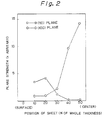
- Fig.3 shows the orientation distribution of the secondary recrystallized grains of the respective test pieces thus prepared. From Fig.3, it can be seen that grains having ⁇ 110 ⁇ ⁇ uvw> orientations grow from the surface of the hot-rolled sheet, whereas grains having ⁇ 100 ⁇ ⁇ 001> orientations grow from the central area. Therefore, it is considered that ⁇ 110 ⁇ ⁇ uvw> oriented grains resulting in a decreased magnetic flux density may be successfully suppressed by reducing the ⁇ 110 ⁇ texture in the hot-rolled sheet during the course of the primary recrystallization.
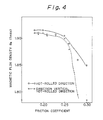
- Fig.4 shows the relationship between the friction coefficient employed and the magnetic flux density (B8) of the product obtained at an accumulated reduction rate of 50% in the finishing rolling process of the hot rolling. It can be seen from Fig.4 that a product having a high magnetic flux density of more than 1.90 Tesla can be obtained when the friction coefficient is less than 0.25.
- the coefficient may be adjusted at the final stage, i.e.,the finishing rolling stage at which difference in the texture is clarified.
- a 40 mm-thick slab having the same components as described previously was hot-rolled into a 2.0 mm thickness sheet, using six passes with a varied pass schedule.
- the temperature in the final hot-rolling was 900-950°C.
- the sheet was then annealed for 2 minutes at 1050°C. Subsequently, the sheet was cold-rolled at a reduction rate of 50% in the same direction as the hot-rolled direction, and further cold cross-rolled at a reduction rate of 50% in the direction vertical to the above rolled direction.
- the sheet was annealed for the primary recrystallization and the decarbonization at 800°C for 90 seconds in a wet hydrogen atmosphere. Finally, the sheet was annealed for finishing after applying an annealing separator.
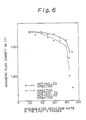
- Fig.6 shows the relationship between the accumulated reduction rate in the final three passes of the hot-rolling and the magnetic property (B8 value) of the product obtained. From this diagram, it can be seen that a product having a high magnetic flux density of more than 1.90 Tesla at an accumulated reduction rate of less than 80% was obtained.
- the state of the metal flow at the surfaces of a hot-rolled sheet can be varied to suppress the growth of ⁇ 110 ⁇ ⁇ uvw> grains from the surface in the secondary recrystallization, thereby ensuring the stable manufacture of a double oriented electrical steel sheet having a high magnetic flux density.
- a slab containing the same components as described previously was hot-rolled and cold cross-rolled under the same conditions as described above to obtain a cold-rolled sheet having a final thickness of 0.35 mm.
- Five different work rolls having a diameter of 60 mm, 100 mm, 150 mm, 270 mm, or 490 mm were used in the cold-rolling.
- the sheets thus cold-rolled were annealed for 210 seconds in a wet hydrogen for both decarburization and primary recrystallization. Thereafter, the sheets were finally annealed after applying an annealing separator containing MgO as a main ingredient.
- Fig.8 shows the relationship between the diameter of work roll used and the magnetic flux density (B8) of a product. It can been seen from Fig.8 that a product having a high magnetic flux density (B8) value of more than 1.90 Tesla, when the diameter of the work rolls in the cold-rolling was more than 150 mm. This effect becomes saturated at a diameter of more than 270 mm.
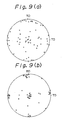
- Fig.9 shows the distribution of crystal grain orientations of the products in the secondary recrystallization where the work roll diameter in the cold-rolling is 60 mm (a) or 490 mm (b). From both pole figures, it can be seen that the growth of ⁇ 110 ⁇ ⁇ uvw> oriented grains can be successfully suppressed by an increased diameter of the work rolls. The reasons for this are probably as follows:
- the work roll diameter in the cold-rolling exerts a significant influence on the metal flow in the thickness direction, and the rotation of crystals in the vicinity of the surface promotes an increased growth of ⁇ 110 ⁇ ⁇ uvw> oriented grains in the recrystallization as the diameter of the work rolls becomes larger.
- a molten sheet used in the present invention may be prepared in any manner, such as in a revolving furnace or electric furnace, and must contain the following components in the following contents:
- a high content of Si improves iron loss properties, but decreases the magnetic flux density inevitably.
- Watt loss is minimum at an Si content of approximately 6.5%, while no improvement can be obtained with the further increase of the content.
- the upper limit of Si content should, therefore, be specified to be 6.7%.
- An increased content of Si makes the product brittle, and cold cracks appear at an Si content of more than 4.5%, but worm-rolling can be principally applied to solve this problem.
- a lower content of Si provides an increased transformation of ⁇ into ⁇ , thereby deteriorating the crystal orientation.
- the lower limit of the Si content should be determined at 0.8%, which has no substantial influence.
- Acid soluble Al forms a nitride such as AlN, (Al,Si)N, which acts as an inhibitor.
- the Al content is restricted to be 0.008-0.048%, preferably 0.018-0.036%, where the magnetic flux density of the product increases.
- the content of N exceeds 0.010%, gaps called blisters appear, and thus the upper limit is defined as 0.010%.
- the content of N can be adjusted via nitriding in intermediate process steps, and thus it need not be specified.
- inhibitor constitution elements such as Mn, S, Se, B, B1, Nb, Sn, Ti, and Cr may be added.
- the molten steel comprised of the above-mentioned components can be used in the present invention as a hot-rolled sheet in the usual manner or to produce a thin cast strip in a continuous casting manner.
- the hot-rolled sheet or cast strip is cold-rolled directly or after a short time annealing.
- This annealing is usually carried out at 750-1200°C for 30 seconds to 30 minutes, and effectively enhances the magnetic flux density of products. Therefore, this annealing should be adopted in accordance with the desired level of the magnetic flux density.
- the successive reduction rates in the cold-rolling can be selected in the same manner as disclosed in Japanese Examined Patent Publication No 35-2675 or Japanese Examined Patent Publication No. 38-8213.
- the material after being cold-rolled is annealed for the primary recrystallization at a temperature of 750-1000°C for a short time of 30 seconds to 10 minutes. Usually, this annealing serves for decarburization of the steel under a controlled dew point in the atmosphere.
- the sheet is applied with an annealing separator containing MgO as a main component and for annealing finishing.
- This finishing annealing effects the secondary recrystallization and purification.
- the sheet is controlled to be secondarily recrystallized at a temperature of 950-1100°C, and then heated to a temperature of more than 1100°C for purification.
- a slab containing 0.05% by weight of C, 3.2% by weight of Si, 0.1% by weight of Mn, 0.03% by weight of acid soluble Al, 0.008% by weight of N was heated to 1150°C, and reduced into a 25 mm thickness by coarse rolling, and subsequently, was rolled for finishing into a 1.8 mm thick sheet.
- a lubricant was applied at the time of the finishing rolling, to reduce friction coefficient. Thereafter, the sheet was annealed at 1100°C for 2 minutes, was cold-rolled at a reduction rate of 55% in the same direction as the hot-rolled direction, and then cold cross-rolled in the direction vertical to the above-mentioned cold-rolled direction at a reduction rate of 50%.
- annealing for the primary crystallization which also served for the decarburization, was carried out at 800°C for 210 seconds in a wet hydrogen atmosphere, an annealing separator was applied, and then annealed for finishing.
- the finishing annealing was carried out by heating to 1200 °C at a heating rate of 15°C/hr in an atmosphere of 50% N2 + 50% H2, and then annealed with the atmosphere being changed to 100% H2.
- the properties of the resulting products are as follows.
- Example 3 The same slab as in Example 2 was hot-rolled at the initial hot rolling temperature of (1) 1100°C, (2) 1000°C, or (3) 900°C via the following six passes, i.e., 26 ⁇ 15 ⁇ 6 ⁇ 3.2 ⁇ 2.8 ⁇ 2.4 ⁇ 2 (mm) to prepare a sheet having a 2 mm thickness. The sheet was then annealed for finishing under the same conditions as in Example 2. The magnetic properties of the resulting products are shown in Table 3.
- Example A Two samples, i.e. the hot rolled steel sheets as in Example 4 in which both surfaces had been ground down to 1/4 of the total thickness, by a grinder (sample A), and the hot-rolled sheet, which had not been ground (sample B), were prepared. These samples were annealed at 1070°C for 2 minutes, followed by the same treatments in the same stages as in Example 4.
- a molten steel comprising 0.04% by weight of C, 3.0% by weight of Si, 0.1% by weight of Mn, 0.025% by weight of acid soluble Al, and the balance being Fe and unavoidable impurities was coagulated by suddenly cooling to prepare a thin cast strip having a 1.0 mm thickness.
- the cast strip was annealed at 1050°C for 2 minutes, then cold rolled at a reduction rate of 50%, and cold cross rolled in the direction vertical to the cold-rolled direction at a reduce rate of 50%.
- the diameters of the work rolls in this cold-rolling were 50 mm and 270 mm, respectively.
- a hot rolled sheet having a 1.6 mm thickness, comprised of 0.05% by weight of C, 3.3% by weight of Si, 0.15% by weight of Mn, 0.027% by weight of acid soluble Al, and the balance being Fe and unavoidable impurities was annealed at 1120°C for 2 minutes. Subsequently, the sheet was cold-rolled in the rolled direction mentioned above at a reduction rate of 50%, and then cold cross-rolled in the direction vertical to the cold-rolled direction at a reduction rate of 50%. Thereafter, the sheet was annealed at 800° for 210 seconds in a wet hydrogen atmosphere, which also served for decarburization, an annealing separator was applied thereto, and then a finishing annealing was carried out.
- the schedule of cold rolling was changed by using work roll for the cold-rolling having a deameter of 50 mm or 270 mm.
- the magnetic properties of these products are as shown in Table 7. From the results, it can be understood that the use of the working rolls having a larger diameter in at least one of two cold rolling steps is most effective.
Landscapes
- Chemical & Material Sciences (AREA)
- Engineering & Computer Science (AREA)
- Physics & Mathematics (AREA)
- Crystallography & Structural Chemistry (AREA)
- Thermal Sciences (AREA)
- Manufacturing & Machinery (AREA)
- Electromagnetism (AREA)
- Mechanical Engineering (AREA)
- Materials Engineering (AREA)
- Metallurgy (AREA)
- Organic Chemistry (AREA)
- Manufacturing Of Steel Electrode Plates (AREA)
- Soft Magnetic Materials (AREA)
Applications Claiming Priority (8)
| Application Number | Priority Date | Filing Date | Title |
|---|---|---|---|
| JP95126/90 | 1990-04-12 | ||
| JP2095126A JPH0733545B2 (ja) | 1990-04-12 | 1990-04-12 | 高磁束密度の二方向性電磁鋼板の製造方法 |
| JP97718/90 | 1990-04-16 | ||
| JP2097718A JPH0733546B2 (ja) | 1990-04-16 | 1990-04-16 | 高磁束密度二方向性電磁鋼板の製造方法 |
| JP103180/90 | 1990-04-20 | ||
| JP2103181A JPH0774387B2 (ja) | 1990-04-20 | 1990-04-20 | 磁束密度の高い二方向性電磁鋼板の製造方法 |
| JP103181/90 | 1990-04-20 | ||
| JP2103180A JPH0733547B2 (ja) | 1990-04-20 | 1990-04-20 | 磁束密度の高い二方向性電磁鋼板の製造方法 |
Publications (3)
| Publication Number | Publication Date |
|---|---|
| EP0452153A2 true EP0452153A2 (fr) | 1991-10-16 |
| EP0452153A3 EP0452153A3 (fr) | 1992-12-30 |
| EP0452153B1 EP0452153B1 (fr) | 1998-03-25 |
Family
ID=27468305
Family Applications (1)
| Application Number | Title | Priority Date | Filing Date |
|---|---|---|---|
| EP91303278A Expired - Lifetime EP0452153B1 (fr) | 1990-04-12 | 1991-04-12 | Procédé pour la production de tÔles d'acier électriques à double orientation ayant une haute densité de flux magnétique |
Country Status (4)
| Country | Link |
|---|---|
| US (1) | US5346559A (fr) |
| EP (1) | EP0452153B1 (fr) |
| KR (1) | KR930010323B1 (fr) |
| DE (1) | DE69129130T2 (fr) |
Cited By (3)
| Publication number | Priority date | Publication date | Assignee | Title |
|---|---|---|---|---|
| EP1108794A1 (fr) * | 1999-12-03 | 2001-06-20 | Kawasaki Steel Corporation | Tôle d'acier électrique pour noyaux de fer compacts et procédé de sa fabrication |
| EP0897993B1 (fr) * | 1997-08-15 | 2004-10-27 | JFE Steel Corporation | Tôle d'acier électromagnétique à propriétés magnétiques élevées et procédé de fabrication |
| US11802319B2 (en) | 2017-12-26 | 2023-10-31 | Posco Co., Ltd | Double oriented electrical steel sheet and method for manufacturing same |
Families Citing this family (7)
| Publication number | Priority date | Publication date | Assignee | Title |
|---|---|---|---|---|
| US5643370A (en) * | 1995-05-16 | 1997-07-01 | Armco Inc. | Grain oriented electrical steel having high volume resistivity and method for producing same |
| EP2107130B1 (fr) * | 2000-08-08 | 2013-10-09 | Nippon Steel & Sumitomo Metal Corporation | Procédé de production de tôle électrique magnétique à grains orientés dotée d'une densité de flux hautement magnétique |
| CN101668596B (zh) * | 2007-04-24 | 2012-09-26 | 新日本制铁株式会社 | 单向性电磁钢板的制造方法 |
| JP6729679B2 (ja) * | 2016-03-09 | 2020-07-22 | 日立金属株式会社 | マルテンサイト系ステンレス鋼箔およびその製造方法 |
| KR102260531B1 (ko) * | 2016-07-29 | 2021-06-03 | 제이에프이 스틸 가부시키가이샤 | 방향성 전기 강판용 열연 강판 및 그 제조 방법, 그리고 방향성 전기 강판의 제조 방법 |
| WO2020217604A1 (fr) * | 2019-04-22 | 2020-10-29 | Jfeスチール株式会社 | Procédé de production de tôles d'acier électriques non orientées |
| KR102323332B1 (ko) * | 2019-12-20 | 2021-11-05 | 주식회사 포스코 | 이방향성 전기강판 및 그의 제조방법 |
Family Cites Families (12)
| Publication number | Priority date | Publication date | Assignee | Title |
|---|---|---|---|---|
| US2046717A (en) * | 1934-09-18 | 1936-07-07 | Westinghouse Electric & Mfg Co | Magnetic material and process for producing same |
| GB917282A (en) * | 1958-03-18 | 1963-01-30 | Yawata Iron & Steel Co | Method of producing cube oriented silicon steel sheet and strip |
| US3130095A (en) * | 1959-05-14 | 1964-04-21 | Armco Steel Corp | Production of oriented silicon-iron sheets by secondary recrystallization |
| US3136666A (en) * | 1960-01-27 | 1964-06-09 | Yawata Iron & Steel Co | Method for producing secondary recrystallization grain of cube texture |
| US3130093A (en) * | 1960-11-08 | 1964-04-21 | Armco Steel Corp | Production of silicon-iron sheets having cubic texture |
| AT329358B (de) * | 1974-06-04 | 1976-05-10 | Voest Ag | Schwingmuhle zum zerkleinern von mahlgut |
| US4204891A (en) * | 1978-11-27 | 1980-05-27 | Nippon Steel Corporation | Method for preventing the edge crack in a grain oriented silicon steel sheet produced from a continuously cast steel slab |
| JPS5850294B2 (ja) * | 1980-04-26 | 1983-11-09 | 新日本製鐵株式会社 | 磁性の優れた一方向性電磁鋼板の製造方法 |
| JPS597768B2 (ja) * | 1981-05-30 | 1984-02-21 | 新日本製鐵株式会社 | 磁性の優れた一方向性電磁鋼板の製造法 |
| JPH0674460B2 (ja) * | 1985-06-26 | 1994-09-21 | 日新製鋼株式会社 | 電磁鋼板の製造法 |
| JPS6372824A (ja) * | 1987-07-28 | 1988-04-02 | Kawasaki Steel Corp | 高けい素鋼急冷薄帯の磁気特性を改善する圧延処理方法 |
| EP0318051B1 (fr) * | 1987-11-27 | 1995-05-24 | Nippon Steel Corporation | Procédé pour la production de tôles d'acier électriques à doubles orientation ayant une haute densité de flux |
-
1991
- 1991-04-12 EP EP91303278A patent/EP0452153B1/fr not_active Expired - Lifetime
- 1991-04-12 DE DE69129130T patent/DE69129130T2/de not_active Expired - Fee Related
- 1991-04-12 KR KR1019910005878A patent/KR930010323B1/ko not_active Expired - Fee Related
-
1993
- 1993-03-19 US US08/034,615 patent/US5346559A/en not_active Expired - Fee Related
Cited By (4)
| Publication number | Priority date | Publication date | Assignee | Title |
|---|---|---|---|---|
| EP0897993B1 (fr) * | 1997-08-15 | 2004-10-27 | JFE Steel Corporation | Tôle d'acier électromagnétique à propriétés magnétiques élevées et procédé de fabrication |
| EP1108794A1 (fr) * | 1999-12-03 | 2001-06-20 | Kawasaki Steel Corporation | Tôle d'acier électrique pour noyaux de fer compacts et procédé de sa fabrication |
| US6562473B1 (en) | 1999-12-03 | 2003-05-13 | Kawasaki Steel Corporation | Electrical steel sheet suitable for compact iron core and manufacturing method therefor |
| US11802319B2 (en) | 2017-12-26 | 2023-10-31 | Posco Co., Ltd | Double oriented electrical steel sheet and method for manufacturing same |
Also Published As
| Publication number | Publication date |
|---|---|
| DE69129130D1 (de) | 1998-04-30 |
| EP0452153A3 (fr) | 1992-12-30 |
| US5346559A (en) | 1994-09-13 |
| EP0452153B1 (fr) | 1998-03-25 |
| KR930010323B1 (ko) | 1993-10-16 |
| DE69129130T2 (de) | 1998-10-22 |
Similar Documents
| Publication | Publication Date | Title |
|---|---|---|
| EP0229846B1 (fr) | Procede de production de toles d'acier au silicium a faible magnetisme | |
| EP0326912B1 (fr) | Procédé de fabrication d'une tôle en acier électrique à grain orienté présentant une haute densité de flux | |
| EP0234443B1 (fr) | Procédé de fabrication d'une tôle d'acier électrique à grain orienté possédant des caractéristiques magnétiques améliorées | |
| US5346559A (en) | Process for manufacturing double oriented electrical steel sheet having high magnetic flux density | |
| JPH0686630B2 (ja) | 磁束密度の高い一方向性珪素鋼板の製造方法 | |
| EP0076109B2 (fr) | Procédé de fabrication de tôles d'acier au silicium à grains orientés ayant de propriétés magnétiques excellentes | |
| EP0307905B1 (fr) | Procédé pour la fabrication de tôles d'acier électrique à grains orientés et à densité de flux magnétique très élevée | |
| EP0453284B1 (fr) | Procédé de fabrication de tÔles d'acier électriques à double orientation ayant une densité de flux magnétique élevée | |
| JP7269527B2 (ja) | 無方向性電磁鋼板およびその製造方法 | |
| EP0468819B1 (fr) | Procédé pour la fabrication de tôles d'acier au silicium à grains orientés et à densité de flux magnétique améliorée | |
| EP0551141A1 (fr) | Tôles d'acier magnétique orienté et procédé pour leur fabrication | |
| JP4013262B2 (ja) | 無方向性電磁鋼板およびその製造方法 | |
| JP3290446B2 (ja) | 磁気特性が優れかつ表面外観の良い無方向性電磁鋼板の製造方法 | |
| JPH0657332A (ja) | 磁束密度が高くかつ鉄損が低い無方向性電磁鋼板の製造方法 | |
| JP2688146B2 (ja) | 高い磁束密度を有する一方向性電磁鋼板の製造方法 | |
| JPH0776729A (ja) | Goss方位に集積した結晶方位を有する方向性珪素鋼板の製造方法 | |
| JPH0733547B2 (ja) | 磁束密度の高い二方向性電磁鋼板の製造方法 | |
| JPH04224624A (ja) | 磁気特性に優れた電磁鋼板の製造方法 | |
| JP2712913B2 (ja) | 方向性電磁鋼板およびその製造方法 | |
| JPH07110974B2 (ja) | 方向性珪素鉄合金薄帯の製造法 | |
| JPH07197126A (ja) | 磁束密度の高い方向性珪素鋼板の製造方法 | |
| JP3326083B2 (ja) | 高磁場鉄損特性に比較して低磁場鉄損特性に優れた方向性電磁鋼板の製造方法 | |
| JPH05186829A (ja) | Goss方位に集積した結晶方位を有する方向性珪素鋼板の製造方法 | |
| JPS5855209B2 (ja) | 時効劣化が少くかつ表面性状の良好な無方向性珪素鋼板の製造方法 | |
| JPH0257125B2 (fr) |
Legal Events
| Date | Code | Title | Description |
|---|---|---|---|
| PUAI | Public reference made under article 153(3) epc to a published international application that has entered the european phase |
Free format text: ORIGINAL CODE: 0009012 |
|
| AK | Designated contracting states |
Kind code of ref document: A2 Designated state(s): DE FR GB IT |
|
| PUAL | Search report despatched |
Free format text: ORIGINAL CODE: 0009013 |
|
| AK | Designated contracting states |
Kind code of ref document: A3 Designated state(s): DE FR GB IT |
|
| 17P | Request for examination filed |
Effective date: 19930202 |
|
| 17Q | First examination report despatched |
Effective date: 19940816 |
|
| GRAG | Despatch of communication of intention to grant |
Free format text: ORIGINAL CODE: EPIDOS AGRA |
|
| GRAG | Despatch of communication of intention to grant |
Free format text: ORIGINAL CODE: EPIDOS AGRA |
|
| GRAH | Despatch of communication of intention to grant a patent |
Free format text: ORIGINAL CODE: EPIDOS IGRA |
|
| GRAH | Despatch of communication of intention to grant a patent |
Free format text: ORIGINAL CODE: EPIDOS IGRA |
|
| GRAA | (expected) grant |
Free format text: ORIGINAL CODE: 0009210 |
|
| AK | Designated contracting states |
Kind code of ref document: B1 Designated state(s): DE FR GB IT |
|
| ITF | It: translation for a ep patent filed | ||
| REF | Corresponds to: |
Ref document number: 69129130 Country of ref document: DE Date of ref document: 19980430 |
|
| ET | Fr: translation filed | ||
| PLBE | No opposition filed within time limit |
Free format text: ORIGINAL CODE: 0009261 |
|
| STAA | Information on the status of an ep patent application or granted ep patent |
Free format text: STATUS: NO OPPOSITION FILED WITHIN TIME LIMIT |
|
| 26N | No opposition filed | ||
| REG | Reference to a national code |
Ref country code: GB Ref legal event code: IF02 |
|
| PGFP | Annual fee paid to national office [announced via postgrant information from national office to epo] |
Ref country code: FR Payment date: 20030408 Year of fee payment: 13 |
|
| PGFP | Annual fee paid to national office [announced via postgrant information from national office to epo] |
Ref country code: GB Payment date: 20030409 Year of fee payment: 13 |
|
| PGFP | Annual fee paid to national office [announced via postgrant information from national office to epo] |
Ref country code: DE Payment date: 20030424 Year of fee payment: 13 |
|
| PG25 | Lapsed in a contracting state [announced via postgrant information from national office to epo] |
Ref country code: GB Free format text: LAPSE BECAUSE OF NON-PAYMENT OF DUE FEES Effective date: 20040412 |
|
| PG25 | Lapsed in a contracting state [announced via postgrant information from national office to epo] |
Ref country code: DE Free format text: LAPSE BECAUSE OF NON-PAYMENT OF DUE FEES Effective date: 20041103 |
|
| GBPC | Gb: european patent ceased through non-payment of renewal fee |
Effective date: 20040412 |
|
| PG25 | Lapsed in a contracting state [announced via postgrant information from national office to epo] |
Ref country code: FR Free format text: LAPSE BECAUSE OF NON-PAYMENT OF DUE FEES Effective date: 20041231 |
|
| REG | Reference to a national code |
Ref country code: FR Ref legal event code: ST |
|
| PG25 | Lapsed in a contracting state [announced via postgrant information from national office to epo] |
Ref country code: IT Free format text: LAPSE BECAUSE OF NON-PAYMENT OF DUE FEES Effective date: 20050412 |