EP0452936A2 - Procédé pour la fabrication d'un objet en céramique et dispositif pour le pressage d'une ébauche en céramique - Google Patents
Procédé pour la fabrication d'un objet en céramique et dispositif pour le pressage d'une ébauche en céramique Download PDFInfo
- Publication number
- EP0452936A2 EP0452936A2 EP19910106242 EP91106242A EP0452936A2 EP 0452936 A2 EP0452936 A2 EP 0452936A2 EP 19910106242 EP19910106242 EP 19910106242 EP 91106242 A EP91106242 A EP 91106242A EP 0452936 A2 EP0452936 A2 EP 0452936A2
- Authority
- EP
- European Patent Office
- Prior art keywords
- preform
- pressure
- molding
- pressing
- membranes
- Prior art date
- Legal status (The legal status is an assumption and is not a legal conclusion. Google has not performed a legal analysis and makes no representation as to the accuracy of the status listed.)
- Granted
Links
Images


Classifications
-
- B—PERFORMING OPERATIONS; TRANSPORTING
- B28—WORKING CEMENT, CLAY, OR STONE
- B28B—SHAPING CLAY OR OTHER CERAMIC COMPOSITIONS; SHAPING SLAG; SHAPING MIXTURES CONTAINING CEMENTITIOUS MATERIAL, e.g. PLASTER
- B28B3/00—Producing shaped articles from the material by using presses; Presses specially adapted therefor
- B28B3/003—Pressing by means acting upon the material via flexible mould wall parts, e.g. by means of inflatable cores, isostatic presses
-
- B—PERFORMING OPERATIONS; TRANSPORTING
- B28—WORKING CEMENT, CLAY, OR STONE
- B28B—SHAPING CLAY OR OTHER CERAMIC COMPOSITIONS; SHAPING SLAG; SHAPING MIXTURES CONTAINING CEMENTITIOUS MATERIAL, e.g. PLASTER
- B28B11/00—Apparatus or processes for treating or working the shaped or preshaped articles
- B28B11/003—Apparatus or processes for treating or working the shaped or preshaped articles the shaping of preshaped articles, e.g. by bending
-
- B—PERFORMING OPERATIONS; TRANSPORTING
- B28—WORKING CEMENT, CLAY, OR STONE
- B28B—SHAPING CLAY OR OTHER CERAMIC COMPOSITIONS; SHAPING SLAG; SHAPING MIXTURES CONTAINING CEMENTITIOUS MATERIAL, e.g. PLASTER
- B28B11/00—Apparatus or processes for treating or working the shaped or preshaped articles
- B28B11/04—Apparatus or processes for treating or working the shaped or preshaped articles for coating or applying engobing layers
- B28B11/044—Apparatus or processes for treating or working the shaped or preshaped articles for coating or applying engobing layers with glaze or engobe or enamel or varnish
-
- B—PERFORMING OPERATIONS; TRANSPORTING
- B28—WORKING CEMENT, CLAY, OR STONE
- B28B—SHAPING CLAY OR OTHER CERAMIC COMPOSITIONS; SHAPING SLAG; SHAPING MIXTURES CONTAINING CEMENTITIOUS MATERIAL, e.g. PLASTER
- B28B13/00—Feeding the unshaped material to moulds or apparatus for producing shaped articles; Discharging shaped articles from such moulds or apparatus
- B28B13/02—Feeding the unshaped material to moulds or apparatus for producing shaped articles
- B28B13/021—Feeding the unshaped material to moulds or apparatus for producing shaped articles by fluid pressure acting directly on the material, e.g. using vacuum, air pressure
-
- B—PERFORMING OPERATIONS; TRANSPORTING
- B28—WORKING CEMENT, CLAY, OR STONE
- B28B—SHAPING CLAY OR OTHER CERAMIC COMPOSITIONS; SHAPING SLAG; SHAPING MIXTURES CONTAINING CEMENTITIOUS MATERIAL, e.g. PLASTER
- B28B3/00—Producing shaped articles from the material by using presses; Presses specially adapted therefor
-
- B—PERFORMING OPERATIONS; TRANSPORTING
- B28—WORKING CEMENT, CLAY, OR STONE
- B28B—SHAPING CLAY OR OTHER CERAMIC COMPOSITIONS; SHAPING SLAG; SHAPING MIXTURES CONTAINING CEMENTITIOUS MATERIAL, e.g. PLASTER
- B28B3/00—Producing shaped articles from the material by using presses; Presses specially adapted therefor
- B28B3/02—Producing shaped articles from the material by using presses; Presses specially adapted therefor wherein a ram exerts pressure on the material in a moulding space; Ram heads of special form
- B28B3/021—Ram heads of special form
-
- B—PERFORMING OPERATIONS; TRANSPORTING
- B30—PRESSES
- B30B—PRESSES IN GENERAL
- B30B11/00—Presses specially adapted for forming shaped articles from material in particulate or plastic state, e.g. briquetting presses, tabletting presses
- B30B11/001—Presses specially adapted for forming shaped articles from material in particulate or plastic state, e.g. briquetting presses, tabletting presses using a flexible element, e.g. diaphragm, urged by fluid pressure; Isostatic presses
Definitions
- the invention relates to a method for producing a ceramic molded body by molding a ceramic molding compound into a dimensionally stable molded body and then firing a molded body.
- ceramic molding compound should be understood in the broadest sense. It encompasses all fine-ceramic and coarse-ceramic molding compounds, such as earthenware, stoneware, Vitreous China, bone china and in particular porcelain, as well as technical ceramic compounds, for example based on silicon carbide, silicon nitride, aluminum oxide and zirconium oxide.
- ceramic moldings this term is also to be understood in the broadest sense regardless of the shape, but in particular thin-shelled moldings are used, such as those found in eating utensils in the form of plates, bowls, bowls and jugs.
- the invention is of particular importance for the production of plates, dishes and bowls, which can conventionally be produced by pressing powdered ceramic molding compositions, for example from granulated Porcelain grain. In principle, the invention is applicable to the processing of all technical dusts, including those of powder metallurgy.
- So-called isostatic pressing is known for the production of ceramic moldings.
- pulverulent ceramic molding compound is subjected to its final pressing prior to firing into the molding in that this molding compound is filled into a mold cavity, which is partially lined with a membrane, the mass being pressed into the mold cavity after the filling of the powdered ceramic mass by exerting hydrostatic pressure on the back of the membrane against a rigid mold surface which, so to speak, is the reference surface for the pressing process forms and imprints the shape precisely in its optically or technically most important surface areas.
- the pressures which have hitherto been used for the isostatic pressing of tableware in the ceramic industry are in the range from 200 to 300 bar.
- the invention has for its object to produce ceramic moldings with the most exact surface shape possible and in particular to reduce the shrinkage and the deformation phenomena that occur as a result of the shrinkage during firing.
- the molding compound is shaped in a molding process in contact with at least one essentially rigid molding surface to form a dimensionally stable, preform that is geometrically similar to the molded body to be obtained, and that this preform is formed in a shaping-neutral protective skin system that encloses it on all sides without pressure is pressed against rigid shaping surfaces by pressing on all sides by means of a press fluid acting on the outside of the protective skin system while reducing the volume while maintaining geometric similarity to the molding.
- the protective skin system When it is said with regard to the protective skin system that it should be shaping-neutral, it means that the existence of the protective skin system should have no influence on the surface design of the molded part, that is to say the pressure distribution on the surface of the molded part from the press fluid should be as if the protective skin system would not exist at all.
- This shaping neutrality is achieved by means of correspondingly thin, smooth and flat protective skin materials, the skin thickness to be used of course depending on the respective protective skin material and the particular application.
- the shrinkage during the subsequent firing is reduced and the extent of the deformation occurring during the firing is significantly reduced compared to the previously known methods. While one had to reckon with the burning of unsupported surfaces within the base when firing moldings produced by known methods, such as plates or plates, and has tried to reduce these bulges by shaping the molding accordingly to compensate, such deformation phenomena occur only to a much lesser extent - if at all - in the production of moldings by the process according to the invention.
- edge impact resistance which is of particular importance in the case of crockery parts for the household and catering trade. It has been shown that this edge impact resistance is significantly improved when using the method according to the invention. For example, it was found that the edge impact strength of plates produced by the process according to the invention under a pressing pressure of 1000 bar is higher by a factor of 2 than the edge impact strength of plates which are otherwise the same as those used in the usual isostatic pressing method, for example according to DE-PS 31 01 236 , have been manufactured.
- Another advantage of the method according to the invention is that, thanks to the all-round pressing imparted to them when introduced into a kiln, the moldings already have considerably smaller dimensions, in all directions, than in the previous production of the moldings.
- a pressing pressure of 1000 bar on a flat plate which was previously formed in an isostatic pressing process in a conventional manner at 250 bar, with a diameter reduction of 6%.
- the pressures to be used also depend on how the preform was produced, for example by isostatic pressing, quasi-isostatic pressing, static pressing, slip molding, injection molding and pottery.
- the aforementioned values apply in particular to the case that the preforms have been obtained by isostatic pressing.
- the all-round pressing takes place while the preform contains water.
- the water content at all sides Pressing can be between approximately 2% by weight and approximately 15% by weight and is preferably approximately 3.5% by weight to approximately 10% by weight.
- the maintenance of the volume compression after the pressure has been released can also be brought about in that the preform is given a high-molecular organic binder, for example carboxymethyl cellulose or a liquid plastic, during the all-round pressing.
- the presence of the contents of water and / or high molecular weight organic binder indicated above is desirable, particularly in the case of porcelain compositions, even during the manufacture of the preform, in particular if the preform is produced from dry granules.
- water or organic binder is to be contained in the preform during post-injection, the water or organic binder can still be present from the preforming. If a longer storage period is switched on between the formation of the preform and the all-round repressing, and during this storage period the water content from the preforming can escape through evaporation, it is also conceivable to again add water to the preform to be repressed. For example, this water addition can also be carried out by applying a water-containing glaze if it is intended to apply a glaze before the re-pressing.
- the liquid plastic available in particular under the trade name "Vienapas" comes into question.
- the production of the dimensionally stable molding is not tied to the production processes identified above by references.
- an improvement can be achieved in all known manufacturing processes for the preform by the subsequent application of the process according to the invention.
- the application of the method according to the invention is advantageous if it later becomes the all-round pressure the preform to be exposed has been formed in a mold cavity with at least partial surface contact with rigid shaping surfaces and has thus been given an exact shape in the optically and technically most important surface areas.
- the method according to the invention can result in the preform having to be at least partially separated from it after it has been shaped by rigid shaping surfaces in order to be able to be provided with the protective skin.
- This is an essential difference compared to the previously identified known methods of isostatic pressing, in which the shaping takes place in contact with the isostatic membrane until it is ready for firing and in the final phase of the pressing there is still a rigid shaping surface on the resulting molding.
- the use of the method according to the invention is particularly advantageous if the shaping of the dimensionally stable preform in surface contact with rigid shaping surfaces has been carried out using powdered molding compound and under pressure against the rigid shaping surfaces, as is not only the case with the isostatic pressing method of the conventional type, but also with Pressing method, for example according to DE-OS 31 44 678 or DE-OS 33 39 487. If it is found that the molding process of the preform takes place in contact with at least one essentially rigid molding surface, this should include the possibility that the Forming surface is formed by an elastic membrane, provided that this elastic membrane is supported by a rigid support surface.
- the quality of the moldings is significantly improved by the use of the method according to the invention and reaches a level , if not exceeds that, the quality level of molded articles produced in the slip casting process, in the injection molding process or in the rolling process corresponds, it should be noted that the ceramic moldings pressed from powder have not always reached the quality level of the moldings produced by the processes mentioned after firing in their shape consistency, in their edge impact strength and in their surface structure.
- the preform is pressed from free-flowing ceramic mass, for example in the isostatic pressing process with an essentially uniaxial pressing direction, it is recommended to raise the pressing pressure to be used in the subsequent all-sided pressing according to the invention above the pressure that was used in the previous isostatic pressing of the preform.
- a pressure of approx. 100 bar to 300 bar is used to obtain the preform to be subsequently pressed on all sides in an isostatic pressing process, the values from 350 bar to 1200 bar specified above are correct.
- the all-round isostatic pressing which follows the shaping of the preform is carried out with essentially the same pressures which were previously used in isostatic uniaxial pressing. This can be explained by the fact that, in any case, volume compression occurs in those directions in which compression has not previously taken place, that is to say in particular in the radial direction.
- the preform is produced by pouring a flowable slip into a hollow mold formed by liquid-absorbing shaping parts and then removing liquid from the slip through the shaping parts.
- the moldings produced using this classic process are rarely objectionable in quality if the process is carried out carefully. Nevertheless, it has been found that by applying the all-round pressing to preforms produced in this way, further quality improvements or - in other words - constant quality less careful process management is achieved.
- the method according to the invention can also be used if the dimensionally stable preform is molded from a plastic molding compound by another classic method (rolling method or potter's wheel).
- the preform can be printed with a decor before the all-round pressing, possibly even during the formation of the preform (see, for example, DE-OS 32 07 565), without the decor being damaged or distorted by the all-round pressing becomes.
- the decoration can be applied to the preform after the preform has been formed, but also during the formation of the preform; the latter method is known from DE-OS 32 07 565, to which reference is made for details.
- the rigid molding surface is provided with the decorative application, if necessary with compensating distortion, and then becomes one between the membrane and when pressed transfer the rigid shaping surface of the ceramic powder dose to the preform.
- the method according to the invention can also be used if the molded body is decorated after the all-round isostatic pressing before firing or, if appropriate, after a first firing.
- the improvement in quality lies in particular in the fact that in the process according to the invention with the glaze application before the all-round pressing, a molded body with a glaze which is completely uniform for the unarmed eye is obtained, this in contrast to a process in which the glaze is applied to one by conventional isostatic pressing molding produced according to DE-OS 31 28 347 is applied before the ONCE rapid firing process; in the latter case the glaze occasionally shows pores and "snake skin structure".
- the glaze mass can be applied after the formation of the dimensionally stable preform, for example by spraying.
- Dimensional stability in this case means that the preform must be at least so structurally strong that it can withstand the spraying and the associated handling processes without deformation and without destruction.
- the molded article initially rises from approx. 450 ° C. to approx. 1450 ° C. during a temperature rise phase of approx. 3 - 4 hours is then exposed to an approximately constant temperature of approximately 1450 ° C. during a temperature maintenance phase of approximately 1 hour and then during a temperature reduction phase from about 2 1/2 hours to a temperature dropping from about 1450 ° C to about 100 ° C.
- the drop in temperature during the drop in temperature which may have a plateau in the middle of the fall phase, is typical of the ONCE rapid fire process.
- the protective skin can be formed in various ways, for example by introducing the preform into a bag made of film material, in particular flat synthetic plastic film, which forms the protective skin system and is closed on all sides.
- a sack made of elastomer film, for example rubber film or synthetic rubber film is advantageous for reasons of the osculation properties. Wrinkles that could lead to impressions in the preform are excluded.
- the bags can be closed by welding or vulcanization, it being advisable to evacuate the bag enclosing the preform for the reasons given above before sealing.
- Conventional film packaging machines are available for enclosing the preforms in film bags, for example those from the food industry, so that the advantages of the method according to the invention are not substantially diminished overall by this additional operation. It should be mentioned that shrinking of the film bags can also be used.
- the packaging in the foil sack will be used especially when it comes to so-called flatware parts, i.e. plates, bowls and bowls. If, on the other hand, hollowware parts such as cans are to be subjected to the method according to the invention, it is easier to form the protective skin by applying a coating compound to the preform on all sides; the requirement for evacuation of the interior of the protective skin can be met, for example, by applying the coating composition to the preform in the evacuated space.
- the protective skin can be formed from a thermoplastic material, such as wax.
- the protective skin it is also possible for the protective skin to be formed from a solution or suspension of a film-forming composition, the solvent or suspending agent being expelled from this liquid layer after application of a liquid layer of the solution or suspension, or for the formation of the protective skin a liquid through chemical Reaction hardenable mass is applied to the preform and after application is hardened.
- the all-round pressure can be applied in the simplest way by introducing the preform enclosed by the protective skin system into a pressure vessel, closing this pressure vessel and pressurizing a fluid received in the pressure vessel.
- Several preforms can also be introduced into the pressure vessel and possibly even stacked directly on top of one another, as long as the weight of the preforms on top of the stack does not lead to a deformation of the preforms below the stack. It has been shown that with the very high pressing pressures used, the application from all sides is ensured even if the respective preform is on a rigid support surface or is loaded by further preforms on top of the stack.
- the support on a support surface is not to be understood as "pressure against rigid contact surfaces" in the sense of the invention.
- the preform is inserted between two membranes forming the protective skin and the membranes are then exposed to the pressurized fluid on their side remote from the preform.
- the membranes can be made of flat films made of synthetic plastic or elastomeric material.
- elastomer films especially rubber and synthetic rubber films, deserves preference.
- a method variant which is particularly gentle on the preform consists in that at least one of the membranes on its side remote from the preform is backfilled with a support mass which forms a support surface for the preform approximately following the surface profile of the preform before the all-round pressing begins.
- the respective membrane can be vacuumed against the support surface before the preform is placed on it are sucked in, so that the optimal positioning of the molding can be found easily.
- a foam mass can be used as the support mass. It should be noted that the supporting mass should not come into contact with the preform surface when pressing on all sides. Rather, this contact is removed when the respective press fluid is applied.
- the invention further provides a process for the production of moldings in such a way that the ceramic molding compound is pressed into at least two rigid molding surfaces, each covered with a membrane, to form the preform in that pressure fluid on the side away from the molding compound only has a first rigid mold surface associated with it.
- Membrane is brought into action and the molding compound is thereby pressed against the second membrane rigidly supported on the second rigid molding surface and that then, with simultaneous removal or after removal of the second rigid molding surface from the preform, both membranes completely enclosing the preform at the same time on all sides with fluid pressure be applied that the preform enclosed between the two membranes is pressed without contact with rigid mold surfaces to the molding.
- This variant of the method shows that the method according to the invention is not fundamentally bound to completely remove the preform formed from the molding space in which it was created in order to then subject it to all-round pressing; it is sufficient to release the contact of the preform with the rigid shaping surfaces.
- Pressure fluids in particular water and pressure gases, are fundamentally possible as the press fluid.
- the protective skin must be adapted to the respective medium in accordance with the requirement for sealing.
- the method according to the invention is particularly applicable to the production of thin-shell molded articles in which the edge impact strength plays a special role.
- the quality improvement achieved compared to conventional hydrostatic pressing was not to be expected, especially with such thin-shelled shaped bodies.
- the invention further relates to devices for pressing a ceramic molding.
- such a device is characterized by a pressure container provided with a detachable cover part for receiving at least one preform provided with a protective skin and a pressure booster connected to the interior of the pressure container for pressurizing a fluid contained in the pressure container.
- the device consists of at least and preferably two pressure pots, each with a cavity and a sealing edge surface surrounding the respective cavity.
- the sealing edge surfaces face each other and are each covered with a membrane covering the respective cavity.
- the pressure pots can be pressed with their sealing edge surfaces against one another by pressing the two membranes together, so that the respective preform is enclosed between the mutually facing side surfaces of the membranes within the sealing edge surfaces.
- the foils then lie on all sides of the preform, even where the membranes are in contact with one another, at least from the moment the press fluid is applied by appropriate pressure boosters.
- a suction device may be provided to extract air from the space between the two membranes.
- the respective cavity In order to accelerate the work cycle, it is essential that as little pressing fluid as possible has to be moved during the respective pressing. For this reason, it is advisable to provide a support mass in at least one of the cavities, which may also only be effective as a volume displacement mass and may be fluid permeable. If you want to evacuate the cavities before inserting the preform in order to suck the respective membrane onto a support surface, the respective cavity will be provided with an air suction.
- Another alternative for a device according to the invention is characterized by at least two interacting molds with mutually facing rigid mold surfaces forming a mold cavity, each with a membrane in contact with the two rigid mold surfaces, a clamping device for clamping membrane edges of the two membranes in the area surrounding the rigid mold surfaces, each a fluid supply to the side of the two membranes remote from the mold cavity, a fluid inflow control which selectively permits the application of one or both membranes and an adjusting device for changing the distance between the two mold surfaces while maintaining the clamping of the membrane edges.
- the molding compound can in principle be filled in by applying a vacuum, for example by applying a vacuum at a first peripheral point between the two membranes and feeding the porcelain granulate at another peripheral point.
- a vacuum for example by applying a vacuum at a first peripheral point between the two membranes and feeding the porcelain granulate at another peripheral point.
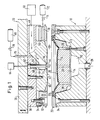
- An isostatic pressure pot is designated by 10 in FIG. 1.
- a pressure chamber which is designated by 12, is formed in this isostatic pressure pot 10.
- a support plate 14 is immovably inserted into the pressure chamber 12.
- the support plate 14 has a shaped surface 16 on its upper side.
- a compression membrane 18 made of an elastically deformable material rests on this molding surface 16 and conforms to the molding surface 16.
- the profile edge 20 of the press membrane 18 encompasses the edge of the support plate 14 and is fastened to the upper edge 24 of the pressure pot 10 by a fastening ring 22.
- a hydraulic high-pressure line 26 is connected to the pressure chamber 12, through which a high-pressure fluid, for example hydraulic oil, can be let into the pressure chamber 12. The pressure of this High-pressure fluids are distributed through bores 28 of the support plate 14 over the underside of the press membrane 18 in order to be able to press them upwards during isostatic pressing.
- the isostatic pressing tool 10 cooperates with a shooting head arranged above it, which is generally designated 30.
- a shooting head namely on an intermediate plate 38, which is firmly connected to a pressure plate 36, a locking ring 32 is axially movably suspended, which is fixed at its greatest distance from the intermediate plate 38 by bolt sleeve combinations 34.
- a die 40 is attached to the intermediate plate 38, the underside of which forms a rigid molding surface 42.
- the molding surface 42 is cut by a mass feed opening 44, which forms the lower outlet of an annular chamber 46 formed in the molding die 40.
- the annular chamber 46 is connected to a mass supply line 48 running laterally towards it, which runs through the form punch 40 and the intermediate plate 38 to a mass storage container 50.
- the mass supply opening 44 is associated with a downwardly flared closure piece 52 which is supported with its support surface 54 against a counter support surface 56 when the closure piece 52 is in the closed position shown in FIG. 1. The underside of the closure piece 52 is then flush with the molding surface 42 of the molding die 40.
- the closure piece 52 is provided with a shaft 58, which is guided in a bore 60 of the die 40 and the intermediate plate 38 and upwards by a helical compression spring 62, i.e. is locked in the locked position.
- the closure piece 52 can be moved downwards into the open position by a control device 64.
- the control device 64 operates in the machine cycle.
- annular gap 66 is defined, which opens into the shooting chamber 68 defined between the molding surface 42 and the pressing membrane 18.
- the annular gap 66 is connected to a through the locking ring 32
- Vacuum line 70 connected, which leads to a vacuum generator 72.
- a line-controlled valve 74 is located in line 70.
- a fluidization air line 76 is connected to the mass supply line 48 and is connected to the atmosphere or a pressure supply 80 via a machine clock-controlled valve 78.
- the shooting head 30 is in the raised position shown in FIG. 1, but out of alignment with the pressure pot 10, so that a decor can be transferred to the rigid shaping surface 42 by means of an elastic decor transfer surface.
- the shooting head 30 is brought into alignment with the pressure pot 10.
- the shooting head 30 is then lowered onto the isostatic pressing tool 10 under machine cycle control.
- the locking ring 32 is placed on the profile edge 20 of the pressing membrane 18 and the fastening ring 22.
- the locking ring 32 then lies against the intermediate plate 38 and finally the shaping surface 42 reaches its lower end position.
- the pressure acting on the pressure plate 30 is first transmitted to the holder ring 22 solely via the locking ring 32.
- the shooting chamber 68 is now closed. Vacuum is now applied to the shooting chamber 68 by opening the valve 74, it also being possible to start applying the vacuum already during the lowering process of the shooting head 30.
- negative pressure is likewise applied to the underside of the isostatic membrane 18 via the line 26, so that the isostatic membrane 18 remains in contact with the surface 16.
- the closure piece 52 is moved downward into its open position by the control device 64. Now, by means of the negative pressure in the shooting chamber 68, powdered ceramic molding compound can be made from the Molding material container 50 are sucked.
- Spray-dried granular porcelain is particularly suitable as the molding material.
- the suction takes place in such a way that at the beginning of the filling of the firing chamber 68 there are no densified accumulations of molding compound at the mouth of the annular gap 66 in the firing chamber 68, which could hinder the further suction of air.
- Due to the fluidizing air which is supplied via line 76, the molding compound entering the shooting chamber 68 is fluidized in such a way that there is an even distribution in the entire shooting chamber in the sense that the spectrum of the granule size is approximately the same at every location within the shooting chamber same thing.
- the closure piece 52 After filling of the firing chamber 68, the closure piece 52 is raised into the closed position and rests with the support surface 54 against the counter-support surface 56, so that the molding surface 42 passes smoothly through the molding compound supply opening 44. However, the vacuum applied to the shooting chamber 68 is maintained.
- the high-pressure fluid is then permitted at 26, so that the pressure membrane 18 is raised and the molding compound is pressed under a pressure of approximately 300 bar. Since there has been a negative pressure in the firing chamber 68 since the beginning of the introduction of the molding compound, there is no risk of inclusion of air spaces in the resulting molding.
- the shooting chamber 68 is separated from the vacuum suction device 72. Now the shooting head 30 can be raised again and swiveled sideways so that the finally pressed preform can now be removed from the isostatic pressing tool 10 and fed to its further processing, while a decor can again be printed on the rigid shaping surface 42.
- the preform can also be produced by the method and device according to DE-OS 31 44 678.
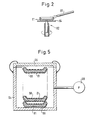
- the dimensionally stable preform 81 thus formed is now, as shown in FIG. 2, placed in a glaze application device 82. It is placed on a turntable 84 and splashed by a glaze nozzle 86 while rotating. After the glaze has dried, the preform 81, as shown in FIG. 3, is placed in a film bag 88 consisting of two flat films 88a and 88b, whereupon the film bag is welded along an edge 90. The welding takes place in a vacuum chamber, not shown, so that the interior of the sack is evacuated and any air pockets in the preform are also removed. After the vacuum has been released, the film bag 88 lies closely against the preform 81, as shown in FIG. 3 at 88 '.
- the preform thus coated with a protective skin 88 'on all sides is now placed in a pressure vessel 94 according to FIG. 5, possibly together with further preforms.
- the pressure vessel 94 is closed with a pressure-resistant cover 96.
- Pressure fluid is then pumped into the pressure vessel 94 by means of a pump or a pressure piston 98 and placed under a pressure of between 350 bar and 1200 bar. This pressure is maintained for 0.5 seconds.
- the pressure is then released again, the cover 96 is removed and the molded articles 81 are removed. It is found that when a pressure of 1000 bar is used, the diameter of the preform has decreased by approximately 6%.
- the molding is now ready to burn.
- the film bag 88 is removed and the molding is fired in a one-time rapid firing process in a firing furnace of a known type, with a temperature profile as shown in FIG. 8.
- FIG. 4 shows an alternative for the design of the protective skin.
- a can-like preform 181 can be seen, which is completely enclosed by a protective skin 188.
- the protective skin 188 is applied from a film-forming latex by dipping and then hardened. If degassing of the preform 181 is desired, the protective skin 188 can be applied under vacuum.
- the preform 181 is a molding which is usually produced in a gypsum mold using the slip casting process, the liquid content of the slip being absorbed by the gypsum mold at elevated temperature after the preform is cast in the gypsum mold.
- the preform 181 which is then removed from the plaster mold is dimensionally stable in the sense of the invention and can be coated with the protective skin 188.
- the preform 181 with the protective skin 188 can be pressed on all sides in the pressure container 94 under a pressure of approximately 350 bar to 1200 bar.
- the protective skin 188 is then removed, detached or brushed off.
- the molding is then ready for firing with a temperature program, as shown in Fig. 8.
- the press device here comprises a lower press pot 209 and an upper press pot 211, which have cavities 209a and 211a, respectively.
- the cavities 209a and 211a are each covered by a shaping-neutral elastomer membrane 288x or 288y, which extends over the respective edge surface 209b or 211b.
- the preform 281 is inserted between the two membranes 288x and 288y after removal from the isostatic shaping device, for example according to FIG. 1 and, if appropriate, after decor printing and glazing.
- the preform 281 is placed on the lower membrane 288x. Before the preform 281 is placed on the membrane 288x, the latter can be sucked down against a support mass 215 by a suction device 213, so that it lies against a support surface 217 which is shaped in accordance with the preform profile.
- the upper pressure pot 211 is then lowered vertically onto the lower pressure pot 209, so that the two membranes 288x and 288y are clamped between the edge surfaces 209b and 211b.
- a suction probe 219 By means of a suction probe 219, the intermediate space between the membranes 288x and 288y placed against one another and receiving the molded article between them is suctioned off.
- the suction probe 219 is then withdrawn in the direction of the arrow 221.
- the cavities 209a and 211a are filled with pressure fluid, in particular pressure fluid, by pressure boost lines 223 and 225 and pressurized.
- the pressure is introduced in such a way that the preform 281 is always kept in a floating state and outside contact with the boundary surfaces of the cavities 209a and 211a when pressure is applied.
- Contact with the support mass 215 is also avoided, at least when the support mass consists of a rigid or hard-elastic material. If the support mass 215 consists of a soft-elastic plastic, contact with the support mass 215 is harmless depending on its degree of softness.
- the support mass 215 also and possibly only fulfills the function of a volume displacement mass, which ensures that the smallest possible amount of fluid has to be transported into the cavity 217 during the pressing process. From this point of view, the cavity 211a could also be filled with a volume displacement mass.
- the membranes 288x and 288y consist of a shaping-neutral thin rubber or synthetic rubber film which, without any wrinkles, fits all around the molding 281 as soon as the suction probe 219 has sucked out the air.
- a pressure of about 350 bar to about 1200 bar is introduced. This pressure is maintained for 0.5 seconds.
- the preform 281 undergoes a 6% diameter reduction in the all-round pressing according to FIG. 6 if the preform has been produced as explained in connection with FIG. 1 and the pressure in the cavities 209a, 211a is brought to 1000 bar .
- the fired shaped body 281 has a geometrically similar shape in the strict sense to that of the preform removed from the press according to FIG. 1, the visible surface in particular maintaining its exact profile and the base maintaining its flat base. Downward bulges have not occurred.
- the glaze is free of pores and free of scale structure and appears completely smooth when viewed with the unarmed eye. It should not be excluded that the decor and / or the glaze is also applied after the pressing process according to FIG. 3 or 6. It should also not be ruled out that the decor and / or the glaze are only applied after a first firing of the molding pressed on all sides and then another firing takes place.
- This device comprises a lower clamping frame 331 which is fixedly connected to a lower mold 333.
- the lower mold 333 has a lower rigid molding surface 335.
- This lower rigid molded surface 335 is covered with a lower membrane 337, which is anchored in the lower clamping frame 331.
- An upper clamping frame 339 can also be seen, which can be clamped to the lower clamping frame 331 by a clamping press 341.
- An upper mold 343 is guided vertically displaceably in the upper clamping frame 339 and is height-adjustable by an adjusting device 345.
- the upper mold 343 has an upper mold surface 347 on which an upper membrane 349 bears.
- the upper membrane 349 is anchored in the upper clamping frame 339.
- a cavity 351 is formed between them.
- vacuum can be applied through a suction line (not shown) and ceramic flowable mass can be filled in through a filling line (also not shown).
- the membranes 337 u. 349 held in contact with the respective membrane by negative pressure applied to the rear.
- pressure is first applied to the underside of the lower membrane 337 via a fluid control device 353 and a line 355, so that the molding compound, as shown in the right half of FIG. 7, against that of the upper Form surface 347 rigidly supported upper membrane 349 is pressed and thus the preform is formed, the top of which takes over the shape of the molding surface 347 exactly. This preform is then hydrostatically pressed on all sides.
- the upper mold 343 is raised slightly by means of the setting device 345, for example by 10 mm.
- the fluid control device 353 and the two lines 355 u. 357 the two membranes 337 u. 349 both on the back evenly pressurized with fluid pressure, so that the two membranes 337 u. 349 preform enclosed as a protective skin system now between the two molding surfaces 335 u. 347 is suspended from all sides evenly by the fluid pressure.
- the one membrane 337 which acts as an isostatic pressure membrane during the formation of the preform, can simultaneously be used as part of the protective skin during the all-round pressing.
- the inventive method and the inventive device are particularly suitable for the production of thin-shell workpieces, for. B. cups, plates, plates and bowls of household and catering dishes, in which a high edge impact resistance is particularly desirable.
Landscapes
- Engineering & Computer Science (AREA)
- Mechanical Engineering (AREA)
- Chemical & Material Sciences (AREA)
- Ceramic Engineering (AREA)
- Manufacturing & Machinery (AREA)
- Structural Engineering (AREA)
- Physics & Mathematics (AREA)
- Fluid Mechanics (AREA)
- Press-Shaping Or Shaping Using Conveyers (AREA)
- Devices For Post-Treatments, Processing, Supply, Discharge, And Other Processes (AREA)
Applications Claiming Priority (2)
| Application Number | Priority Date | Filing Date | Title |
|---|---|---|---|
| DE4012700 | 1990-04-20 | ||
| DE4012700A DE4012700A1 (de) | 1990-04-20 | 1990-04-20 | Verfahren zur herstellung eines keramischen formkoerpers und einrichtung zum pressen eines keramischen formlings |
Publications (3)
| Publication Number | Publication Date |
|---|---|
| EP0452936A2 true EP0452936A2 (fr) | 1991-10-23 |
| EP0452936A3 EP0452936A3 (en) | 1992-04-15 |
| EP0452936B1 EP0452936B1 (fr) | 1997-10-15 |
Family
ID=6404781
Family Applications (1)
| Application Number | Title | Priority Date | Filing Date |
|---|---|---|---|
| EP91106242A Expired - Lifetime EP0452936B1 (fr) | 1990-04-20 | 1991-04-18 | Procédé pour la fabrication d'un objet en céramique et dispositif pour le pressage d'une ébauche en céramique |
Country Status (6)
| Country | Link |
|---|---|
| US (1) | US5314646A (fr) |
| EP (1) | EP0452936B1 (fr) |
| JP (1) | JPH05131419A (fr) |
| AT (1) | ATE159197T1 (fr) |
| DE (2) | DE4012700A1 (fr) |
| ES (1) | ES2111544T3 (fr) |
Cited By (3)
| Publication number | Priority date | Publication date | Assignee | Title |
|---|---|---|---|---|
| EP0674959A1 (fr) * | 1994-03-31 | 1995-10-04 | Ngk Insulators, Ltd. | Méthode pour soumettre à un pressage isostatique un élément moulé à partir d'un matériau en poudre |
| EP0689914A1 (fr) * | 1994-06-29 | 1996-01-03 | WILHELM SÖNDGEN GmbH | Procédé pour la fabrication en série de récipients en céramique |
| DE102006026971A1 (de) * | 2006-06-09 | 2007-12-13 | Dorst Technologies Gmbh & Co. Kg | Isostatische Pressenform bzw. Verfahren zum Herstellen und/oder Betreiben einer isostatischen Pressenform |
Families Citing this family (24)
| Publication number | Priority date | Publication date | Assignee | Title |
|---|---|---|---|---|
| DE4124198A1 (de) * | 1991-07-20 | 1993-01-21 | Sinterstahl Gmbh | Verfahren zur herstellung von sinterformteilen mittels kaltisostatischen pulverpressens in einmal verwendbaren pressformen |
| US5665625A (en) * | 1995-05-19 | 1997-09-09 | Micron Technology, Inc. | Method of forming capacitors having an amorphous electrically conductive layer |
| DE19629413A1 (de) * | 1996-07-22 | 1998-01-29 | Erlus Baustoffwerke | Keramischer Falzdachziegel |
| IT1294945B1 (it) * | 1997-08-01 | 1999-04-23 | Sacmi | Procedimento ed impianto per la formatura a secco di stoviglie in genere, particolarmente per piatti |
| US5882455A (en) * | 1997-09-25 | 1999-03-16 | International Business Machines Corporation | Apparatus and method for forming isotropic multilayer ceramic substrates |
| US6533986B1 (en) | 2000-02-16 | 2003-03-18 | Howmet Research Corporation | Method and apparatus for making ceramic cores and other articles |
| EP1166983B1 (fr) * | 2000-06-21 | 2006-03-08 | Westerwälder Blumentopffabrik Spang GmbH & Co. KG | Procédé de fabrication de récipients en céramique avec un revêtement décoratif et dispositif de mise en oeuvre d'un tel procédé |
| ES2188391B1 (es) * | 2001-08-17 | 2004-10-16 | Esmalglass, S.A. | Procedimiento para fabricar baldosas ceramicas. |
| ITFI20010178A1 (it) * | 2001-10-01 | 2003-04-01 | Decoraterre S A S Di Mari Giul | Pressa e metodo di stampaggio |
| US7972129B2 (en) * | 2005-09-16 | 2011-07-05 | O'donoghue Joseph | Compound tooling system for molding applications |
| JP5458463B2 (ja) * | 2006-07-03 | 2014-04-02 | 住友電気工業株式会社 | セラミックス光学部品の製造方法 |
| DE102008059719A1 (de) * | 2008-11-29 | 2010-06-02 | Bayerische Motoren Werke Aktiengesellschaft | Verfahren zur Herstellung eines Dekorelements, insbesondere für den Fahrgastraum eines Fahrzeugs |
| US20130300030A1 (en) * | 2011-01-27 | 2013-11-14 | Sumitomo Chemical Company, Limited | Sealing device and method for producing honeycomb structure |
| US9211660B2 (en) * | 2012-12-21 | 2015-12-15 | John Borland | Adjustable support for preformed mold |
| US20140182947A1 (en) * | 2012-12-28 | 2014-07-03 | Smith International, Inc. | Cutting insert for percussion drill bit |
| CN106103013B (zh) * | 2014-04-02 | 2019-06-18 | 麦格纳国际公司 | 臂端工具 |
| GB201503785D0 (en) * | 2015-03-06 | 2015-04-22 | Rolls Royce Plc | Firing process and method |
| TWI594291B (zh) * | 2016-08-17 | 2017-08-01 | 鴻創應用科技有限公司 | 陶瓷晶圓片及其製造方法 |
| KR102130702B1 (ko) * | 2018-08-13 | 2020-07-06 | 이향구 | 도자기 성형용 물레를 이용한 도자기의 성형 방법, 서버 및 컴퓨터-판독 가능 매체 |
| CN114728854A (zh) | 2019-09-30 | 2022-07-08 | 康宁股份有限公司 | 流动反应器模块的制造和所生产的模块 |
| CN112847764A (zh) * | 2021-03-16 | 2021-05-28 | 湖南华联瓷业股份有限公司 | 一种等静压模具陶瓷粉上料装置 |
| CN114249589A (zh) * | 2022-01-17 | 2022-03-29 | 江西富利高新材料有限公司 | 一种亲肤釉陶瓷板的制备方法 |
| KR102774384B1 (ko) * | 2022-09-14 | 2025-02-26 | 동아대학교 산학협력단 | 항공기 부품의 등방 가압장치 |
| CN119039055B (zh) * | 2024-10-30 | 2025-01-24 | 内蒙古电力(集团)有限责任公司内蒙古超高压供电分公司 | 一种含莫来石强韧层的套管及制备方法 |
Family Cites Families (32)
| Publication number | Priority date | Publication date | Assignee | Title |
|---|---|---|---|---|
| USRE20460E (en) * | 1937-08-03 | Method of and apparatus for shaping | ||
| US1699502A (en) * | 1927-01-11 | 1929-01-15 | Isolantite Company Of America | Method of molding ceramic materials |
| FR970450A (fr) * | 1949-03-25 | 1951-01-04 | Procédé perfectionné pour la fabrication, par voie sèche, des carreaux et revêtements céramiques vernissés ou émaillés sans engobage liquide et sans biscuitage | |
| FR1098571A (fr) * | 1954-01-18 | 1955-08-08 | Csf | Perfectionnements aux dispositifs de moulage |
| US3664799A (en) * | 1969-11-04 | 1972-05-23 | American Standard Inc | Powder compacting press |
| US3737276A (en) * | 1971-09-17 | 1973-06-05 | Carborundum Co | Molding of powdered or granular material |
| CH569561A5 (fr) * | 1972-06-12 | 1975-11-28 | Roessler Ag | |
| CA1062866A (fr) * | 1975-08-22 | 1979-09-25 | Raymond L. Straw | Methode pour comprimer un article dans un moule et materiau de support utilise a cette fin |
| FR2343571A1 (fr) * | 1976-03-11 | 1977-10-07 | Chronberg Sten | Procede et dispositif de decoupage et de mise en forme d'une feuille ou plaque d'une pate, notamment a base d'argiles pour la fabrication de pieces ceramiques |
| DE2939134A1 (de) * | 1978-10-02 | 1980-04-17 | Keramik Wtb Veb | Verfahren und vorrichtung zum isostatischen pressen von keramischen gegenstaenden |
| US4473526A (en) * | 1980-01-23 | 1984-09-25 | Eugen Buhler | Method of manufacturing dry-pressed molded articles |
| DE3128348A1 (de) * | 1981-07-17 | 1983-02-03 | Bühler, Eugen, Dipl.-Ing., 8871 Burtenbach | Einrichtung zur herstellung von formlingen aus einer rieselfaehigen masse stichwort: "vorverdichtung im schiesskopf" |
| JPS57146607A (en) * | 1981-03-09 | 1982-09-10 | Mitsubishi Electric Corp | Method of molding ceramic |
| DE3128347A1 (de) * | 1981-07-17 | 1983-02-03 | Eugen Dipl.-Ing. 8871 Burtenbach Bühler | Verfahren und einrichtung zur herstellung von formlingen aus rieselfaehiger masse stichwort: "beibehaltung des fuellvakuums beim isostatischen pressen" |
| DE3144678A1 (de) * | 1981-11-10 | 1983-05-19 | Eugen Dipl.-Ing. 8871 Burtenbach Bühler | Verfahren und einrichtung zur herstellung von formlingen aus einer rieselfaehigen masse |
| DE3207565C2 (de) * | 1982-03-02 | 1985-11-21 | Hutschenreuther Ag, 8672 Selb | Verfahren und Einrichtung zur Herstellung eines mit Dekorelementen an seiner Oberfläche versehenen Formlings aus keramischer Masse, insbesondere aus Porzellanmasse |
| BE896207A (fr) * | 1983-03-18 | 1983-07-18 | Ct De Rech S De L Ind Belge De | Procede et dispositif de moulage d'une piece creuse par compactage d'une poudre |
| DE3325533A1 (de) * | 1983-07-15 | 1985-01-31 | Peter Dr. 5206 Neunkirchen-Seelscheid 1 Wecht | Verfahren zur herstellung gebrannter, keramischer dekorationsplatten |
| DE3339487A1 (de) * | 1983-10-31 | 1985-05-15 | Bühler, Eugen, Dipl.-Ing., 8877 Burtenbach | Verfahren zur herstellung eines trockengepressten formlings aus trockener, rieselfaehiger formmasse, insbesondere keramischer formmasse |
| DE3341959C1 (de) * | 1983-11-21 | 1985-04-18 | Eugen Dipl.-Ing. 8877 Burtenbach Bühler | Vorrichtung zur Herstellung von Formlingen aus trockener,rieselfaehiger Formmasse,insbesondere keramischer Formmasse Stichwort:Kombiniertes Fuell-,Press- und Entnahmewerkzeug |
| JPS6164801A (ja) * | 1984-09-04 | 1986-04-03 | Nippon Kokan Kk <Nkk> | 金属、セラミツクス等の粉体の成形方法 |
| DE3517494A1 (de) * | 1985-05-15 | 1986-11-20 | MTU Motoren- und Turbinen-Union München GmbH, 8000 München | Verfahren zum konturnahen isostatpressen |
| JPS621505A (ja) * | 1985-06-27 | 1987-01-07 | トヨタ自動車株式会社 | 複雑形状粉末成形体の静水圧加圧用被膜の形成方法 |
| DE3524779A1 (de) * | 1985-07-11 | 1987-01-15 | Laeis Gmbh | Presse zum herstellen von tellern oder dergleichen |
| JPS62273809A (ja) * | 1986-05-23 | 1987-11-27 | 株式会社日立製作所 | 薄肉グリ−ンセラミツク管の製造方法 |
| JPS62278004A (ja) * | 1986-05-26 | 1987-12-02 | 古河電気工業株式会社 | セラミツクス焼結体の製造方法 |
| JPH0714606B2 (ja) * | 1987-03-25 | 1995-02-22 | 日本碍子株式会社 | セラミツクス製坏土の調製方法 |
| JPS63252702A (ja) * | 1987-04-09 | 1988-10-19 | 日立造船株式会社 | セラミツクス成形体の成形法 |
| DE3734876A1 (de) * | 1987-10-15 | 1989-04-27 | Martin Siebert | Verfahren zum kalt-isostatischen nachpressen von formkoerpern |
| DE3807853C1 (fr) * | 1988-03-10 | 1989-08-10 | Nukem Gmbh, 6450 Hanau, De | |
| GB8813440D0 (en) * | 1988-06-07 | 1988-07-13 | Smiths Industries Plc | Manufacture of ceramic articles |
| DE3823393C1 (en) * | 1988-07-09 | 1990-01-04 | Deutsche Forschungs- Und Versuchsanstalt Fuer Luft- Und Raumfahrt Ev, 5000 Koeln, De | Single-layer process for densifying porous ceramic components of complicated shape by hot isostatic pressing |
-
1990
- 1990-04-20 DE DE4012700A patent/DE4012700A1/de not_active Ceased
-
1991
- 1991-04-18 ES ES91106242T patent/ES2111544T3/es not_active Expired - Lifetime
- 1991-04-18 EP EP91106242A patent/EP0452936B1/fr not_active Expired - Lifetime
- 1991-04-18 DE DE59108873T patent/DE59108873D1/de not_active Expired - Fee Related
- 1991-04-18 AT AT91106242T patent/ATE159197T1/de active
- 1991-04-19 JP JP3088233A patent/JPH05131419A/ja active Pending
- 1991-04-19 US US07/688,166 patent/US5314646A/en not_active Expired - Lifetime
Cited By (4)
| Publication number | Priority date | Publication date | Assignee | Title |
|---|---|---|---|---|
| EP0674959A1 (fr) * | 1994-03-31 | 1995-10-04 | Ngk Insulators, Ltd. | Méthode pour soumettre à un pressage isostatique un élément moulé à partir d'un matériau en poudre |
| US5828942A (en) * | 1994-03-31 | 1998-10-27 | Ngk Insulators, Ltd. | Method for subjecting molded article to isostatic pressing |
| EP0689914A1 (fr) * | 1994-06-29 | 1996-01-03 | WILHELM SÖNDGEN GmbH | Procédé pour la fabrication en série de récipients en céramique |
| DE102006026971A1 (de) * | 2006-06-09 | 2007-12-13 | Dorst Technologies Gmbh & Co. Kg | Isostatische Pressenform bzw. Verfahren zum Herstellen und/oder Betreiben einer isostatischen Pressenform |
Also Published As
| Publication number | Publication date |
|---|---|
| EP0452936B1 (fr) | 1997-10-15 |
| US5314646A (en) | 1994-05-24 |
| ES2111544T3 (es) | 1998-03-16 |
| ATE159197T1 (de) | 1997-11-15 |
| JPH05131419A (ja) | 1993-05-28 |
| DE59108873D1 (de) | 1997-11-20 |
| DE4012700A1 (de) | 1991-10-31 |
| EP0452936A3 (en) | 1992-04-15 |
Similar Documents
| Publication | Publication Date | Title |
|---|---|---|
| EP0452936B1 (fr) | Procédé pour la fabrication d'un objet en céramique et dispositif pour le pressage d'une ébauche en céramique | |
| DE3101236C2 (de) | Verfahren und Einrichtung zur Herstellung trockengepreßter Formlinge aus trockener und rieselfähiger Formmasse | |
| DE3128347C2 (fr) | ||
| DE1961586A1 (de) | Presswerkzeug | |
| DE3207565C2 (de) | Verfahren und Einrichtung zur Herstellung eines mit Dekorelementen an seiner Oberfläche versehenen Formlings aus keramischer Masse, insbesondere aus Porzellanmasse | |
| DD228209A5 (de) | Verfahren zur herstellung eines trockengepressten formlings aus trockener, rieselfaehiger formmasse, insbesondere keramischer formmasse | |
| EP0228538B1 (fr) | Procédé et dispositif pour fabriquer des pièces de moulées munies conduits et en poudre moulable, notamment en matière moulable céramique, dénomination typique: honeycomb | |
| DE2728630A1 (de) | Presswerkzeug zum herstellen keramischer formlinge aus pulverfoermiger masse | |
| DE7034269U (de) | Isostatische presse zum pressen von pulver in geformte gegenstaende. | |
| DE3341959C1 (de) | Vorrichtung zur Herstellung von Formlingen aus trockener,rieselfaehiger Formmasse,insbesondere keramischer Formmasse Stichwort:Kombiniertes Fuell-,Press- und Entnahmewerkzeug | |
| EP0255719B1 (fr) | Dispositif et procédé pour fabriquer des pièces moulées creuses de forme conique ou cylindrique, en particulier tasses avec une anse | |
| DE3502348A1 (de) | Verfahren und einrichtung zum druckgiessen fluessigkeitshaltiger masse | |
| DD157083A5 (de) | Verfahren zur herstellung trockengepresster formlinge und vorrichtung zur durchfuehrung dieses verfahrens | |
| DE3143550C2 (fr) | ||
| DE3028296C2 (fr) | ||
| EP0221224A1 (fr) | Presse pour l'obtention d'objets exigeant pour leur fabrication industrielle, une étape de préformage avec faible dépense d'effort, et une pression finale élevée | |
| DE2630355C3 (de) | Preßwerkzeug zum Herstellen keramischer Formlinge aus pulverförmiger Masse | |
| EP0480430B1 (fr) | Procédé et dispositif pour la fabrication d'objets creux en céramique avec appendice latéral, en particulier de tasses avec anse | |
| DE2657993A1 (de) | Presswerkzeug zum herstellen keramischer formlinge aus pulverfoermiger masse | |
| DE2001649A1 (de) | Verfahren und Vorrichtung zum Formen pulverfoermigen oder granulatfoermigen Materials | |
| DE19600185A1 (de) | Vorrichtung zur Herstellung trockengepreßter Formlinge | |
| DE1066473B (de) | Verfahren und Vorrichtung zur Herstellung von Porzellantellern und ähnlichen runden keramischen Erzeugnissen | |
| DE3517494C2 (fr) | ||
| EP1306177B1 (fr) | Dispositif de pressage, en particulier pour le pressage de pièces moulées en matière céramique | |
| DE19936734C1 (de) | Verfahren zur Herstellung eines Metall- oder Keramikwerkstücks |
Legal Events
| Date | Code | Title | Description |
|---|---|---|---|
| PUAI | Public reference made under article 153(3) epc to a published international application that has entered the european phase |
Free format text: ORIGINAL CODE: 0009012 |
|
| AK | Designated contracting states |
Kind code of ref document: A2 Designated state(s): AT BE CH DE DK ES FR GB GR IT LI LU NL SE |
|
| RIN1 | Information on inventor provided before grant (corrected) |
Inventor name: STROBEL, KLAUS Inventor name: SCHWARZMEIER, KARL |
|
| PUAL | Search report despatched |
Free format text: ORIGINAL CODE: 0009013 |
|
| AK | Designated contracting states |
Kind code of ref document: A3 Designated state(s): AT BE CH DE DK ES FR GB GR IT LI LU NL SE |
|
| 17P | Request for examination filed |
Effective date: 19920708 |
|
| 17Q | First examination report despatched |
Effective date: 19930628 |
|
| GRAG | Despatch of communication of intention to grant |
Free format text: ORIGINAL CODE: EPIDOS AGRA |
|
| GRAH | Despatch of communication of intention to grant a patent |
Free format text: ORIGINAL CODE: EPIDOS IGRA |
|
| GRAH | Despatch of communication of intention to grant a patent |
Free format text: ORIGINAL CODE: EPIDOS IGRA |
|
| GRAA | (expected) grant |
Free format text: ORIGINAL CODE: 0009210 |
|
| AK | Designated contracting states |
Kind code of ref document: B1 Designated state(s): AT BE CH DE DK ES FR GB GR IT LI LU NL SE |
|
| PG25 | Lapsed in a contracting state [announced via postgrant information from national office to epo] |
Ref country code: IT Free format text: LAPSE BECAUSE OF FAILURE TO SUBMIT A TRANSLATION OF THE DESCRIPTION OR TO PAY THE FEE WITHIN THE PRE;WARNING: LAPSES OF ITALIAN PATENTS WITH EFFECTIVE DATE BEFORE 2007 MAY HAVE OCCURRED AT ANY TIME BEFORE 2007. THE CORRECT EFFECTIVE DATE MAY BE DIFFERENT FROM THE ONE RECORDED.SCRIBED TIME-LIMIT Effective date: 19971015 Ref country code: GR Free format text: LAPSE BECAUSE OF FAILURE TO SUBMIT A TRANSLATION OF THE DESCRIPTION OR TO PAY THE FEE WITHIN THE PRESCRIBED TIME-LIMIT Effective date: 19971015 Ref country code: DK Free format text: LAPSE BECAUSE OF NON-PAYMENT OF DUE FEES Effective date: 19971015 Ref country code: NL Free format text: LAPSE BECAUSE OF FAILURE TO SUBMIT A TRANSLATION OF THE DESCRIPTION OR TO PAY THE FEE WITHIN THE PRESCRIBED TIME-LIMIT Effective date: 19971015 |
|
| REF | Corresponds to: |
Ref document number: 159197 Country of ref document: AT Date of ref document: 19971115 Kind code of ref document: T |
|
| REG | Reference to a national code |
Ref country code: CH Ref legal event code: EP |
|
| REF | Corresponds to: |
Ref document number: 59108873 Country of ref document: DE Date of ref document: 19971120 |
|
| PG25 | Lapsed in a contracting state [announced via postgrant information from national office to epo] |
Ref country code: SE Effective date: 19980115 |
|
| GBT | Gb: translation of ep patent filed (gb section 77(6)(a)/1977) |
Effective date: 19980114 |
|
| ET | Fr: translation filed | ||
| NLV1 | Nl: lapsed or annulled due to failure to fulfill the requirements of art. 29p and 29m of the patents act | ||
| REG | Reference to a national code |
Ref country code: ES Ref legal event code: FG2A Ref document number: 2111544 Country of ref document: ES Kind code of ref document: T3 |
|
| PG25 | Lapsed in a contracting state [announced via postgrant information from national office to epo] |
Ref country code: AT Free format text: LAPSE BECAUSE OF NON-PAYMENT OF DUE FEES Effective date: 19980418 Ref country code: LU Free format text: LAPSE BECAUSE OF NON-PAYMENT OF DUE FEES Effective date: 19980418 |
|
| PG25 | Lapsed in a contracting state [announced via postgrant information from national office to epo] |
Ref country code: LI Free format text: LAPSE BECAUSE OF NON-PAYMENT OF DUE FEES Effective date: 19980430 Ref country code: BE Free format text: LAPSE BECAUSE OF NON-PAYMENT OF DUE FEES Effective date: 19980430 Ref country code: CH Free format text: LAPSE BECAUSE OF NON-PAYMENT OF DUE FEES Effective date: 19980430 |
|
| PLBE | No opposition filed within time limit |
Free format text: ORIGINAL CODE: 0009261 |
|
| STAA | Information on the status of an ep patent application or granted ep patent |
Free format text: STATUS: NO OPPOSITION FILED WITHIN TIME LIMIT |
|
| 26N | No opposition filed | ||
| BERE | Be: lapsed |
Owner name: HUTSCHENREUTHER A.G. Effective date: 19980430 |
|
| REG | Reference to a national code |
Ref country code: CH Ref legal event code: PL |
|
| REG | Reference to a national code |
Ref country code: GB Ref legal event code: IF02 |
|
| PGFP | Annual fee paid to national office [announced via postgrant information from national office to epo] |
Ref country code: ES Payment date: 20080429 Year of fee payment: 18 Ref country code: DE Payment date: 20080131 Year of fee payment: 18 |
|
| PGFP | Annual fee paid to national office [announced via postgrant information from national office to epo] |
Ref country code: FR Payment date: 20080412 Year of fee payment: 18 |
|
| PGFP | Annual fee paid to national office [announced via postgrant information from national office to epo] |
Ref country code: GB Payment date: 20080421 Year of fee payment: 18 |
|
| GBPC | Gb: european patent ceased through non-payment of renewal fee |
Effective date: 20090418 |
|
| REG | Reference to a national code |
Ref country code: FR Ref legal event code: ST Effective date: 20091231 |
|
| PG25 | Lapsed in a contracting state [announced via postgrant information from national office to epo] |
Ref country code: DE Free format text: LAPSE BECAUSE OF NON-PAYMENT OF DUE FEES Effective date: 20091103 |
|
| PG25 | Lapsed in a contracting state [announced via postgrant information from national office to epo] |
Ref country code: FR Free format text: LAPSE BECAUSE OF NON-PAYMENT OF DUE FEES Effective date: 20091222 Ref country code: GB Free format text: LAPSE BECAUSE OF NON-PAYMENT OF DUE FEES Effective date: 20090418 |
|
| REG | Reference to a national code |
Ref country code: ES Ref legal event code: FD2A Effective date: 20090420 |
|
| PG25 | Lapsed in a contracting state [announced via postgrant information from national office to epo] |
Ref country code: ES Free format text: LAPSE BECAUSE OF NON-PAYMENT OF DUE FEES Effective date: 20090420 |