EP0452947B1 - Procédé pour la fabrication en continu d'un matériau à base de polyoléfine - Google Patents
Procédé pour la fabrication en continu d'un matériau à base de polyoléfine Download PDFInfo
- Publication number
- EP0452947B1 EP0452947B1 EP91106270A EP91106270A EP0452947B1 EP 0452947 B1 EP0452947 B1 EP 0452947B1 EP 91106270 A EP91106270 A EP 91106270A EP 91106270 A EP91106270 A EP 91106270A EP 0452947 B1 EP0452947 B1 EP 0452947B1
- Authority
- EP
- European Patent Office
- Prior art keywords
- polyolefin
- process according
- rollers
- powder
- endless belts
- Prior art date
- Legal status (The legal status is an assumption and is not a legal conclusion. Google has not performed a legal analysis and makes no representation as to the accuracy of the status listed.)
- Expired - Lifetime
Links
Images
Classifications
-
- B—PERFORMING OPERATIONS; TRANSPORTING
- B30—PRESSES
- B30B—PRESSES IN GENERAL
- B30B5/00—Presses characterised by the use of pressing means other than those mentioned in the preceding groups
- B30B5/04—Presses characterised by the use of pressing means other than those mentioned in the preceding groups wherein the pressing means is in the form of an endless band
- B30B5/06—Presses characterised by the use of pressing means other than those mentioned in the preceding groups wherein the pressing means is in the form of an endless band co-operating with another endless band
- B30B5/065—Presses characterised by the use of pressing means other than those mentioned in the preceding groups wherein the pressing means is in the form of an endless band co-operating with another endless band using anti-friction means for the pressing band
- B30B5/067—Presses characterised by the use of pressing means other than those mentioned in the preceding groups wherein the pressing means is in the form of an endless band co-operating with another endless band using anti-friction means for the pressing band using anti-friction roller means
-
- B—PERFORMING OPERATIONS; TRANSPORTING
- B29—WORKING OF PLASTICS; WORKING OF SUBSTANCES IN A PLASTIC STATE IN GENERAL
- B29C—SHAPING OR JOINING OF PLASTICS; SHAPING OF MATERIAL IN A PLASTIC STATE, NOT OTHERWISE PROVIDED FOR; AFTER-TREATMENT OF THE SHAPED PRODUCTS, e.g. REPAIRING
- B29C43/00—Compression moulding, i.e. applying external pressure to flow the moulding material; Apparatus therefor
- B29C43/22—Compression moulding, i.e. applying external pressure to flow the moulding material; Apparatus therefor of articles of indefinite length
- B29C43/228—Compression moulding, i.e. applying external pressure to flow the moulding material; Apparatus therefor of articles of indefinite length using endless belts feeding the material between non-rotating pressure members, e.g. vibrating pressure members
-
- B—PERFORMING OPERATIONS; TRANSPORTING
- B29—WORKING OF PLASTICS; WORKING OF SUBSTANCES IN A PLASTIC STATE IN GENERAL
- B29C—SHAPING OR JOINING OF PLASTICS; SHAPING OF MATERIAL IN A PLASTIC STATE, NOT OTHERWISE PROVIDED FOR; AFTER-TREATMENT OF THE SHAPED PRODUCTS, e.g. REPAIRING
- B29C55/00—Shaping by stretching, e.g. drawing through a die; Apparatus therefor
- B29C55/02—Shaping by stretching, e.g. drawing through a die; Apparatus therefor of plates or sheets
- B29C55/18—Shaping by stretching, e.g. drawing through a die; Apparatus therefor of plates or sheets by squeezing between surfaces, e.g. rollers
-
- B—PERFORMING OPERATIONS; TRANSPORTING
- B29—WORKING OF PLASTICS; WORKING OF SUBSTANCES IN A PLASTIC STATE IN GENERAL
- B29C—SHAPING OR JOINING OF PLASTICS; SHAPING OF MATERIAL IN A PLASTIC STATE, NOT OTHERWISE PROVIDED FOR; AFTER-TREATMENT OF THE SHAPED PRODUCTS, e.g. REPAIRING
- B29C43/00—Compression moulding, i.e. applying external pressure to flow the moulding material; Apparatus therefor
- B29C43/32—Component parts, details or accessories; Auxiliary operations
- B29C43/44—Compression means for making articles of indefinite length
- B29C43/48—Endless belts
- B29C2043/483—Endless belts cooperating with a second endless belt, i.e. double band presses
-
- B—PERFORMING OPERATIONS; TRANSPORTING
- B29—WORKING OF PLASTICS; WORKING OF SUBSTANCES IN A PLASTIC STATE IN GENERAL
- B29K—INDEXING SCHEME ASSOCIATED WITH SUBCLASSES B29B, B29C OR B29D, RELATING TO MOULDING MATERIALS OR TO MATERIALS FOR MOULDS, REINFORCEMENTS, FILLERS OR PREFORMED PARTS, e.g. INSERTS
- B29K2023/00—Use of polyalkenes or derivatives thereof as moulding material
Definitions
- the present invention relates to a process for continuously producing a polyolefin material having a high strength and a high modulus by continuously compression-molding a polyolefin powder at a temperature lower than the melting point and then rolling and stretching the resultant compression-molded polyolefin.
- ultra-high-molecular-weight polyolefins having a significantly high molecular weight have excellent impact resistance, excellent abrasion resistance, self-lubricating property, etc. and are an engineering plastic having a number of features. They can be made into a molded product of high strength and high modulus if they can be oriented to a high degree by an easy method. Therefore, development of such an easy method is highly expected.
- the present inventors further proposed a process comprising feeding a polyolefin powder between a pair of upper and lower endless belts facing each other, conveying the polyolefin powder between the endless belts under compression to continuously compression-mold the polyolefin powder, the compression being effected by a pressing means comprising pressing platens and corresponding sets of rollers, the pressing platens being arranged within the endless belts, said sets of rollers being arranged between the pressing platens and the endless belts, the rollers of each set being connected in a series and each arranged rotatably, and then rolling and stretching the resultant compression-molded polyolefin [corresponding to EP 0374785 A1 (1990)].
- the present inventors and the co-worker provided a process comprising processing a polyethylene powder by mixing it with a liquid organic compound having a boiling point not lower than the melting point of the polyethylene [EP 0396 061 A1 (1990)] and a process comprising concurrently processing an ultra-high-molecular-weight polyethylene powder and an olefinic polymer having a molecular weight lower than that of the polyethylene powder [corresponding to EP 0410384 A2 (1991)].
- the “pressing means comprising pressing platens and corresponding sets of rollers, the pressing platens being arranged within the endless belts, said sets of rollers being arranged between the pressing platens and the endless belts, the rollers of each set being connected in a series and each arranged rotatably" employed in the continuous and efficient process provided by the present inventors, substantially discloses a process wherein each roller of each roller set is fixed at the two ends by chains and these chains are meshed with sprockets arranged at the both ends of the associated platen to allow the set of rollers to travel at an appropriate speed corresponding to the running speed of the associated endless belt.
- each set of rollers may be arranged fixedly between the endless belt and the associated pressing platen but, in this case, a frictional force is generated by slip between the rollers and the endless belts and between the rollers and the pressing platens, giving rise to the durability problems of the apparatus.
- the present inventors made study on simplification of the pressing means employed in the conventional process and materialization of a simplified pressing means, and repeated the trial manufacture of an experimental apparatus and the test operation of the trially manufactured apparatus. As a result, the present inventors found that a high-strength and high-modulus polyolefin material can be continuously produced by compression-molding a material polyolefin powder at a temperature lower than the melting point of the powder using a particular pressing means and then rolling and stretching the resultant compression-molded polyolefin.
- the present invention resides in a process for continuously producing a high-strength and high-modulus polyolefin material, which comprises: feeding a polyolefin powder between a pair of upper and lower endless belts opposed to each other, conveying the polyolefin powder between the endless belts under compression to compression-mold the polyolefin powder at a temperature lower than the melting point of the polyolefin powder, the compression being effected, via the endless belts, by a pressing means comprising two sets of rollers which are arranged at the back sides of the endless belts so that each one roller of the two sets faces each other and each of which rollers is rotatably supported at the shaft ends by a frame, and then rolling and stretching the resultant compression-molded polyolefin in this order.
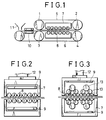
- Fig. 1 is a schematic illustration showing the outline of an apparatus used in the practice of the production process of the present invention.
- Fig. 2 is a schematic illustration showing the pressing section of the apparatus of Fig. 1.
- Fig. 3 is a schematic illustration showing the pressing section of an apparatus comprising the apparatus of Fig. 1 and back-up rolls annexed thereto.
- the process of the present invention enables compression molding of a polyolefin at a lower pressure than in the conventional processes, by the use of a particular pressing means, without employing troublesome operations such as melting of the polyolefin or dissolution of the polyolefin in a solvent, in the polyolefin molding steps including polymerization, compression molding, rolling and stretching.
- the present process can produce a high-strength and high-modulus polyolefin material of excellent properties at a lower pressure and easily.
- Examples of the polyolefin usable in the process of the present invention for the continuous production of a high-strength and high-modulus polyolefin material include homopolymers of ⁇ -olefins having 2-8, preferably 2-6 carbon atoms, for exmaple, low-density polyethylene, medium-density polyethylene, high-density polyethylene, polypropylene, polybutene-1 and poly-4-methylpentene-1; and copolymers of ⁇ -olefins of different carbon atoms, for example, copolymers of ethylene and ⁇ -olefins having 3-12, preferably 3-8 carbon atoms and copolymers of propylene and ⁇ -olefins having 4-12, preferably 4-8 carbon atoms.
- polyethylene, polypropylene and the like used in the present invention refer not only to homopollymers of ethylene, propylene and the like but also to copoymers of ethylene and small amounts of ⁇ -olefins of 3-12 carbon atoms (the content of ⁇ -olefins is not particularly limited but is generally 10 mole % or less, preferably 0.01-5 mole %), copolymers of propylene and small amounts of ⁇ -olefins of 4-12 carbon atoms (the content of ⁇ -olefins is not particularly limited but is generally 10 mole % or less, preferably 0.01-5 mole %), etc.
- polyolefins usable in the process of the present invention, those having a higher molecular weight are generally preferred because they can provide materials having higher strength and modulus.
- polyethylene for example, desired are those having a viscosity-average molecular weight of 500,000-12,000,000, preferably 900,000-9,000,000, more preferably 1,200,000-6,000,000, or when expressed in terms of intrinsic viscosity at 135 o C in decalin, those having an intrinsic viscosity of 5-50 dl/g, preferably 8-40 dl/g, most preferably 10-30 dl/g, in other words, so-called ultra-high-molecular-weight polyethylenes.
- polypropylene those having a molecular weight of at least 1,000,000 are preferred.
- polyethylene for example, desired are those having a particle size not greater than 2,000 ⁇ m, preferably not greater than 1,000 ⁇ m. A narrower particle size distribution can afford a better sheet.
- a polyolefin powder is firstly compression-molded continuously to form a compression-molded sheet.
- Fig. 1 illustrates a specific example of the apparatus.
- the apparatus is basically constructed of two key components, i.e. a pair of upper and lower endless belts 5,6 opposed to each other, to which a pulling force is applied by rolls 1-4, and a pressing means.
- the pressing means is to compress the polyolefin powder fed, via the endless belts, and comprises two sets (upper and lower) of rollers 8 (each roller is rotatable and is supported by bearings, etc. and a frame 7 at the shaft ends).
- the number of the rollers 8 is appropriately at least three per each endless belt.
- the outside diameter of the rolls 1-4 has not particular limitation as long as the endless belts are driven smoothly.
- the endless belts it is suitable to use those having a thickness of about 0.1-1.5 mm and a surface polished in a mirror-finished state on the side which is brought into contact with a polyolefin powder to be compression-molded.
- the endless belts have an unduly small thickness, the endless belts are prone to deformation and damage (e.g. breakage). Meanwhile, an excessivly large thickness leads to the need for enlarging the outside diameter of the rolls 1-4 which pull the endless belts, which makes the apparatus large as a whole. Such an unduly small or large thickness is, therefore, not preferred.
- Stainless steel can be mentioned as a representative material for the endless belts.
- Other suitable metal belts can also be used either as they are or by coating them with a resin such as fluorine-contained resin or the like.
- the pressing means comprises two opposing sets (upper and lower) of rollers which are rotatably arranged at the sides of the endless belts oposite to the working sides and which are supported by bearings, etc. and frames at the shaft ends.
- each pair of rollers 8 are arranged so as to face each other in a vertical plane intersecting the travelling direction of the endless belts.
- the belts undergo bending stress repeatedly, which tends to shorten the durability of the belts.
- the upper and lower two rollers in pair are not always arranged so as to face with each other in a vertical plane; their arrangement deviating from precise facing not only gives an adverse effect on the durability of the belts but also imparts delicately differing pressures to the polyolefin sheet, giving products varying in packing density.
- the rollers in each set are arranged in a large number in such a way that they are close to each other but without mutual contact.
- a smaller diameter specifically, about 10-50 mm is preferred.
- the rollers have an unduly large outside diameter, it is necessary to make longer the pressing section functioning as a pressing platen for endless belts. If the pressing section is short, the pressing section cannot contain rollers as many as needed to provide a good compression-molded sheet.
- rollers When the rollers have a small diameter, it is preferable to annex back-up rolls 13 as seen in Fig. 3, to each set of rollers, in order to prevent the rollers from being deflected.
- the appropriate number of the rollers in other words, the appropriate total length of the rollers in the travelling direction of the endless belts is generally about 100-5,000 mm, preferably about 500-2,000 mm.
- the powder When an ultra-high-molecular weight polyolefin powder to be compression-molded is passed under compression between the upper and lower belts pressed by the upper and lower rollers 8, the powder receives a linear pressure.
- the powder receives an average pressure of generally 0.1-100 kgf/cm2, preferably 0.5-50 kgf/cm2, more preferably 1-20 kgf/cm2.
- the rollers 8 have a primary role of compressing a polyolefin powder via the endless belts but may also be used as a heating means for the powder to be compression-molded.
- practice of the compression-molding step at a temperature lower than the melting point of the polyolefin powder as a material to be compressed is very important for obtaining a high-strength and high-modulus polyolefin material through the subsequent rolling and stretching steps.
- the temperature employed in compression molding be not only below the melting point but also fall within a particular range.
- the temperature can be, for example, generally at least 50 o C, preferably at least 90 o C for polyethylene polymers and generally at least 90 o C, preferably at least 130 o C for polypropylene polymers, but must be lower than the respective melting points.
- the heating means for the polyolefin powder to be compression-molded it is most suitable to directly heat the endless belts in the pressing section. However, it is convenient in practising the present invention to provide heating means 9 in the vicinity of the rollers as shown in Fig. 2, or to provide preheaters 10 in the vicinity of the endless belts at the place right before the endless belts advance between the rollers.
- a polyolefin powder which has been fed and stored in a hopper 11 is fed downwardly through a hopper outlet, which has a desired cross-sectional shape, onto a lower endless belt which is running.
- the running speed of the endless belt is determined by the amount of powder fed, the total length of the pressing section constituted by rollers, compression conditions, etc., but an appropriate running speed is generally about 10-5,000 mm/min, preferably about 100-3,000 mm/min, more preferably about 500-2,000 mm/min.
- the polyolefin powder fed onto the endless belt is optionally preheated to a predetermined temperature by means of preheaters 10 and is then brought to a squeezing section constructed of upper and lower endless belts 5,6, followed by further travelling to a pressing section where two sets of rollers are arranged.
- pressures from hydraulic cylinders are transmitted by hydraulic pistons 12 shown in Fig. 2 and 3, to frames supporting and fixing the rollers and further transmitted, by way of the rollers and the endless belts to the polyolefin powder to be compressed.
- heats from the heating means 9 are also transmitted to the polyolefin powder by way of the rollers and the endless belts, whereby the polyolefin powder is maintained at a predetermined temperature.
- the compression-molded sheet thus obtained is passed through the compression section comprising the rollers and are caused to leave the endless belts. In this manner, the continuous production of compression-molded sheet is performed.
- a high-strength and high-modulus polyolefin material is obtained by rolling and then stretching the compression-molded sheet obtained as above.
- any known method can be used. It is, however, suitable to obtain a rolled sheet or film by passing the compression-molded sheet between two reversely rotating rolls while maintaining the polyolefin in the state of solid phase without causing it to melt.
- the deformation ratio of the material by the rolling operation can be selected from a wide range.
- the rolling temperature it is desirable to conduct the rolling operation at a temperature of at least 20 o C but lower than the melting point, preferably at a temperature of at least 90 o C but lower than the melting point.
- the above rolling operation may be effected in multiple steps, namely, in two or more steps.
- the stretching which is conducted following the rolling, can be performed in various ways. Depending on differences in heating means, there are hot-air stretching, cylinder stretching, roll stretching, hot-plate stretching, etc. Whichever method is employed, stretching is performed by driving a pair of nip rolls or crowbar rolls at different speeds.
- the stretching temperature is maintained at temperatures lower than the melting point of the polyolefin, generally at 20-160 o C, preferably 50-150 o C, more preferably 90-145 o C, particularly preferably 90-140 o C.
- the stretching can be condcuted not only in a single step but also in multiple steps. When it is conducted in multiple steps, it is preferable to conduct the stretching at a higher temperature in the second step than in the first step.
- the stretching speed can be selected suitably. It is in the range of generally 0.01-500 m/min, preferably 0.1-200 m/min, more preferably 1-200 m/min. A higher speed is preferred from the standpoint of economy and a speed of 5 m/min or more is particularly preferred.
- the draw ratio is, for example, at least 20-fold when an ultra-high-molecular-weight polyethylene is used and generally at least 60-fold.
- polyolefin materials of very high strength and high modulus can be obtained as typified by the provision of a polyethylene material having a tensile modulus of at least 120 GPa and a tensile strength of at least 2 GPa when a polyethylene is used as a polyolefin by way of Example.
- the present invention has made it possible for the first time to provide a process for continuously and easily providing a high-strength and high-modulus polyolefin sheet, film, tape or fiber from an ultra-high-molecular-weight polyolefin powder at a low pressure, using an apparatus which is smooth in driving and low in power requirement and which has good durability and reliability.
- the sheet was then fed, at a speed of 1 m/min, between a pair of upper and lower rolls opposed to each other, maintained at a surface temperature of 140 o C, driven in opposite direction at the same peripheral speed, having a diameter of 150 mm and a surface length of 300 mm and disposed at an interval of 50 ⁇ m, whereby the sheet was rolled into a film having a draw ratio of 6-fold.
- the thus obtained rolled film was slit at a width of 5 mm and then stretched at a draw ratio of 20-fold by means of a hot-roll type stretching apparatus having a roll diameter of 250 mm while controlling the roll temperature at 135 o C and the peripheral speed at 1.5 m/min for the lower speed roll and at 30 m/min for the higher speed roll.
- the resulting fiber had a tensile modulus of 130 GPa and a tensile strength of 3.1 GPa.
- the modulus of elasticity and strength of the sample obtained above were measured at 23 o C by using "STROGRAPH R".
- the sample held between clamps had a length of 150 mm. It was stretched at a pulling speed of 100 mm/min.
- the modulus of elasticity was calculated using a stress at 0.1% strain.
- the cross-sectional area of the sample, which was required for the calculation, was determined by measuring the weight and length of the sample while assuming that the density of the polyethylene was 1 g/cm3.
Landscapes
- Engineering & Computer Science (AREA)
- Mechanical Engineering (AREA)
- Casting Or Compression Moulding Of Plastics Or The Like (AREA)
- Shaping By String And By Release Of Stress In Plastics And The Like (AREA)
Claims (15)
- Procédé de production en continu d'un matériau de résistance élevée et à haut module à base d'une polyoléfine, qui comprend les étapes selon lesquelles:
on charge une poudre de polyoléfine entre deux courroies sans fin, supérieure et inférieure, opposées l'une à l'autre,
on transporte la poudre de polyoléfine entre les courroies sans fin en procédant à une compression pour mouler par compression la poudre de polyoléfine à une température inférieure au point de fusion de la poudre de polyoléfine, la compression étant effectuée, par l'intermédiaire des courroies sans fin, par des moyens de pression comprenant deux ensembles de rouleaux qui sont disposés derrière les courroies sans fin de façon que les rouleaux des deux ensembles soient chacun en face les uns des autres et que chacun de ces rouleaux soit supporté, de manière à pouvoir tourner, par un châssis aux extrémités de l'axe, puis
on procède au laminage et à l'étirement dans cet ordre de la polyoléfine moulée par compression obtenue. - Procédé selon la revendication 1, dans lequel chaque ensemble de rouleaux disposé derrière chaque courroie sans fin est constitué de trois ou de plus de trois rouleaux.
- Procédé selon la revendication 1, dans lequel les rouleaux 8 des deux ensembles de rouleaux disposés derrière les courroies sans fin sont disposés de façon à se faire face deux à deux dans un plan vertical coupant la direction de déplacement des courroies sans fin.
- Procédé selon la revendication 1, dans lequel des rouleaux d'appui 13 sont annexés à chaque ensemble de rouleaux disposés derrière chaque courroie sans fin.
- Procédé selon la revendication 1, dans lequel la poudre de polyoléfine est soumise à une pression moyenne de 0,1 à 100 kgf/cm² lorsqu'elle passe entre les deux courroies sans fin en subissant une compression par les deux corps de rouleaux opposés.
- Procédé selon la revendication 1, dans lequel des moyens de chauffage sont disposés à proximité de chaque ensemble de rouleaux.
- Procédé selon la revendication 1, dans lequel on dispose un préchauffeur à proximité de chaque courroie sans fin pour chauffer chaque courroie sans fin juste avant que chaque courroie sans fin n'avance entre les deux ensembles de rouleaux.
- Procédé selon la revendication 1, dans lequel on dispose des moyens de chauffage à proximité de chaque ensemble de rouleaux et on dispose en outre un préchauffeur à proximité de chaque courroie sans fin pour chauffer chaque courroie sans fin juste avant que chaque courroie sans fin n'avance entre les deux ensembles de rouleaux.
- Procédé selon la revendication 1, dans lequel la courroie sans fin est actionnée à une vitesse de 0,01 à 500 m/minute.
- Procédé selon la revendication 1, dans lequel on lamine la polyoléfine par des rouleaux ayant des sens de rotation différents, tout en maintenant la polyoléfine à l'état solide sans la faire fondre.
- Procédé selon la revendication 1, dans lequel on effectue le laminage à un rapport d'étirage de 1,2 à 20, exprimé en tant que longueur après laminage/longueur avant laminage.
- Procédé selon la revendication 1, dans lequel on effectue le laminage à une température allant de 20°C à une température inférieure au point de fusion de la polyoléfine.
- Procédé selon la revendication 1, dans lequel la poudre de polyoléfine est une poudre d'un homopolymère ou d'un copolymère d'une α-oléfine de 2 à 8 atomes de carbone.
- Procédé selon la revendication 1, dans lequel la poudre de polyoléfine est une poudre d'un polyéthylène ayant une masse moléculaire moyenne en viscosité de 500 000 à 12 000 000.
- Procédé selon la revendication 1, dans lequel la polyoléfine est une poudre d'un polypropylène ayant une masse moléculaire moyenne en nombre supérieure ou égale à 1 000 000.
Applications Claiming Priority (2)
| Application Number | Priority Date | Filing Date | Title |
|---|---|---|---|
| JP102928/90 | 1990-04-20 | ||
| JP2102928A JP2603353B2 (ja) | 1990-04-20 | 1990-04-20 | ポリオレフィン材料の連続的製造方法 |
Publications (3)
| Publication Number | Publication Date |
|---|---|
| EP0452947A2 EP0452947A2 (fr) | 1991-10-23 |
| EP0452947A3 EP0452947A3 (en) | 1992-12-09 |
| EP0452947B1 true EP0452947B1 (fr) | 1995-11-02 |
Family
ID=14340508
Family Applications (1)
| Application Number | Title | Priority Date | Filing Date |
|---|---|---|---|
| EP91106270A Expired - Lifetime EP0452947B1 (fr) | 1990-04-20 | 1991-04-19 | Procédé pour la fabrication en continu d'un matériau à base de polyoléfine |
Country Status (5)
| Country | Link |
|---|---|
| US (1) | US5200129A (fr) |
| EP (1) | EP0452947B1 (fr) |
| JP (1) | JP2603353B2 (fr) |
| CA (1) | CA2040627C (fr) |
| DE (1) | DE69114174T2 (fr) |
Cited By (1)
| Publication number | Priority date | Publication date | Assignee | Title |
|---|---|---|---|---|
| CN111016040A (zh) * | 2019-12-31 | 2020-04-17 | 叶挺伟 | 一种薄膜成型装置 |
Families Citing this family (33)
| Publication number | Priority date | Publication date | Assignee | Title |
|---|---|---|---|---|
| US5578373A (en) * | 1990-11-01 | 1996-11-26 | Nippon Oil Co., Ltd. | Split polyethylene stretched material and process for producing the same |
| DE4341497A1 (de) * | 1993-12-06 | 1995-06-08 | Hoechst Ag | Verfahren zur Herstellung poröser Formkörper |
| US5702657A (en) * | 1994-12-27 | 1997-12-30 | Nippon Oil Co., Ltd. | Method for the continuous production of a polyethylene material having high strength and high modulus of elasticity |
| JP3664195B2 (ja) * | 1996-03-22 | 2005-06-22 | 新日本石油株式会社 | ポリオレフィン材料の製造方法 |
| DE19615771A1 (de) * | 1996-04-20 | 1997-10-23 | Hymmen Theodor Gmbh | Doppelbandpresse zum Herstellen und/oder zum Beschichten von bahn- oder plattenförmigen Werkstücken aller Art |
| JP3775612B2 (ja) * | 1996-12-24 | 2006-05-17 | 株式会社ジェイエスピー | 発泡成形体の製造方法及び製造装置 |
| SE513201C2 (sv) * | 1997-07-03 | 2000-07-31 | Sca Hygiene Prod Ab | Anordning för luftläggning av fiber- eller granulatmaterial |
| US6316075B1 (en) | 1998-02-04 | 2001-11-13 | Mannington Mills, Inc. | Surface coverings containing fused recycled material and processes of making the same |
| DE19845652C2 (de) * | 1998-10-05 | 2002-11-14 | Adolf Seide | Vorrichtung zum Glätten und Kühlen bzw. Kühlen einer extrudierten Materialbahn |
| US6454978B1 (en) | 2000-06-16 | 2002-09-24 | Avery Dennison Corporation | Process for making fuel cell plates |
| US20030168077A1 (en) * | 2002-02-11 | 2003-09-11 | Brown Dale G. | Coated micromesh dental devices overcoated with imbedded particulate |
| US7025986B2 (en) * | 2002-02-11 | 2006-04-11 | International Tape Partners Llc | Micromesh interproximal devices |
| US20060243297A1 (en) * | 2005-04-29 | 2006-11-02 | Brown Dale G | Coated monofilament oriented HDPE dental tapes |
| IL167566A (en) | 2004-08-16 | 2010-12-30 | Dsm Ip Assets Bv | Methods of preparation of monolayers and bilayers comprising ultra high molecular weight polyethylene and ballistic resistant articles manufactured therefrom |
| US8262976B2 (en) * | 2004-10-07 | 2012-09-11 | Biomet Manufacturing Corp. | Solid state deformation processing of crosslinked high molecular weight polymeric materials |
| US7344672B2 (en) | 2004-10-07 | 2008-03-18 | Biomet Manufacturing Corp. | Solid state deformation processing of crosslinked high molecular weight polymeric materials |
| US7740779B2 (en) | 2007-04-13 | 2010-06-22 | Bae Systems Tensylon H.P.M., Inc | Multiple calender process for forming non-fibrous high modulus ultra high molecular weight polyethylene tape |
| US7923094B1 (en) | 2007-04-13 | 2011-04-12 | Bae Systems Tensylon High Performance Materials, Inc. | Laminated ballistic sheet |
| US7976930B2 (en) | 2007-06-25 | 2011-07-12 | Bae Systems Tensylon H.P.M., Inc. | Non-fibrous high modulus ultra high molecular weight polyethylene tape for ballistic applications |
| US9365953B2 (en) | 2007-06-08 | 2016-06-14 | Honeywell International Inc. | Ultra-high strength UHMWPE fibers and products |
| US8747715B2 (en) | 2007-06-08 | 2014-06-10 | Honeywell International Inc | Ultra-high strength UHMW PE fibers and products |
| US7858004B2 (en) * | 2008-04-01 | 2010-12-28 | Bae Systems Tensylon H.P.M., Inc. | Method and apparatus for the production of high tenacity polyolefin sheet |
| US7854870B2 (en) * | 2008-04-01 | 2010-12-21 | BAE Systems Tensy Lon H.P.M., Inc. | Method and apparatus for the production of high tenacity polyolefin sheet |
| US8641959B2 (en) * | 2007-07-27 | 2014-02-04 | Biomet Manufacturing, Llc | Antioxidant doping of crosslinked polymers to form non-eluting bearing components |
| RU2487798C2 (ru) * | 2008-06-19 | 2013-07-20 | Тейджин Арамид Б.В. | Способ получения полиолефиновых пленок |
| US8697220B2 (en) | 2009-08-11 | 2014-04-15 | Honeywell International, Inc. | High strength tape articles from ultra-high molecular weight polyethylene |
| US8236119B2 (en) | 2009-08-11 | 2012-08-07 | Honeywell International Inc. | High strength ultra-high molecular weight polyethylene tape articles |
| WO2013004640A1 (fr) | 2011-07-07 | 2013-01-10 | Dsm Ip Assets B.V. | Procédé de fabrication d'un film polymère |
| US9138961B2 (en) | 2011-10-19 | 2015-09-22 | Honeywell International Inc. | High performance laminated tapes and related products for ballistic applications |
| BR112015002637B1 (pt) | 2012-08-06 | 2021-10-05 | Honeywell International Inc | Fita polimérica, laminado não tecido, pano tecido, processo para formar uma camada, e processo para formar um artigo de múltiplas camadas |
| US9586370B2 (en) | 2013-08-15 | 2017-03-07 | Biomet Manufacturing, Llc | Method for making ultra high molecular weight polyethylene |
| CN103538261B (zh) * | 2013-09-26 | 2016-04-13 | 剑乔科技江苏有限公司 | 超高分子量聚乙烯薄片的生产方法 |
| CN117048082A (zh) * | 2023-08-04 | 2023-11-14 | 罗程双 | 一种超高分子量聚乙烯纤维拼压装置 |
Family Cites Families (16)
| Publication number | Priority date | Publication date | Assignee | Title |
|---|---|---|---|---|
| US1862318A (en) * | 1930-01-06 | 1932-06-07 | George H A Ruby | Plaster board machine |
| US2742951A (en) * | 1951-03-26 | 1956-04-24 | American Pad & Textile Co | Art of curling or kinking stretched filaments and forming pads therefrom |
| US3942929A (en) * | 1972-03-08 | 1976-03-09 | Bison-Werke Bahre & Greten Gmbh & Co. Kg | Continuously operating press |
| AT356364B (de) * | 1977-12-13 | 1980-04-25 | Hymmen Kg Theodor | Vorrichtung zum aufbringen einer flaechen- pressung auf fortschreitende werkstuecke mit mindestens einem umlaufenden pressband |
| JPS5577525A (en) * | 1978-12-04 | 1980-06-11 | Ppg Industries Inc | Method of laminating glass fiber reinforcing thermal plastic resin |
| US4563320A (en) * | 1983-01-20 | 1986-01-07 | Hummor, Inc. | Making thermoplastic items |
| US4820466A (en) * | 1985-01-31 | 1989-04-11 | Zachariades Anagnostis E | Process for obtaining ultra-high modulus products |
| US4789514A (en) * | 1985-12-09 | 1988-12-06 | Aluminum Company Of America | Methods of producing biaxially oriented polymer sheet |
| US4879076A (en) * | 1986-06-17 | 1989-11-07 | Nippon Oil Co., Ltd. | Process for the production of polyethylene materials |
| JPH07673B2 (ja) * | 1986-08-07 | 1995-01-11 | 日本石油株式会社 | 高強度・高弾性率ポリエチレン材料の製造方法 |
| JPH0776246B2 (ja) * | 1987-10-01 | 1995-08-16 | 日本石油株式会社 | 高強度・高弾性率ポリエチレン材料の製造方法 |
| JPH0761687B2 (ja) * | 1988-07-09 | 1995-07-05 | 日本石油株式会社 | 高強度・高弾性率ポリエチレン材料の製造方法 |
| EP0374785B1 (fr) * | 1988-12-21 | 1993-09-22 | Nippon Oil Co., Ltd. | Procédé continu pour fabriquer des matières polyoléfines à haute solidité et à haute élasticité |
| JPH0764015B2 (ja) * | 1988-12-27 | 1995-07-12 | 日本石油株式会社 | 高配向ポリエチレン材料の製造方法 |
| DE69018332T2 (de) * | 1989-07-28 | 1995-10-26 | Nippon Oil Co Ltd | Verfahren zur kontinuierlichen Herstellung eines Polyethylenmaterials mit hoher Festigkeit und hohem Modul. |
| US5039462A (en) * | 1990-01-08 | 1991-08-13 | Aluminum Company Of America | Method and apparatus for producing biaxially oriented polymer sheet |
-
1990
- 1990-04-20 JP JP2102928A patent/JP2603353B2/ja not_active Expired - Lifetime
-
1991
- 1991-04-17 CA CA002040627A patent/CA2040627C/fr not_active Expired - Lifetime
- 1991-04-19 EP EP91106270A patent/EP0452947B1/fr not_active Expired - Lifetime
- 1991-04-19 US US07/687,501 patent/US5200129A/en not_active Expired - Lifetime
- 1991-04-19 DE DE69114174T patent/DE69114174T2/de not_active Expired - Fee Related
Cited By (2)
| Publication number | Priority date | Publication date | Assignee | Title |
|---|---|---|---|---|
| CN111016040A (zh) * | 2019-12-31 | 2020-04-17 | 叶挺伟 | 一种薄膜成型装置 |
| CN111016040B (zh) * | 2019-12-31 | 2022-01-25 | 叶挺伟 | 一种薄膜成型装置 |
Also Published As
| Publication number | Publication date |
|---|---|
| JPH044113A (ja) | 1992-01-08 |
| CA2040627C (fr) | 1995-07-18 |
| CA2040627A1 (fr) | 1991-10-21 |
| US5200129A (en) | 1993-04-06 |
| DE69114174D1 (de) | 1995-12-07 |
| EP0452947A3 (en) | 1992-12-09 |
| JP2603353B2 (ja) | 1997-04-23 |
| DE69114174T2 (de) | 1996-06-27 |
| EP0452947A2 (fr) | 1991-10-23 |
Similar Documents
| Publication | Publication Date | Title |
|---|---|---|
| EP0452947B1 (fr) | Procédé pour la fabrication en continu d'un matériau à base de polyoléfine | |
| EP0374785B1 (fr) | Procédé continu pour fabriquer des matières polyoléfines à haute solidité et à haute élasticité | |
| EP0410384B1 (fr) | Procédé pour la fabrication en continu d'un matériau en polyéthylène à haute résistance et à haut module | |
| US6017480A (en) | Process for producing polyolefin materials | |
| EP2155937B1 (fr) | Procédé à calandres multiples destiné à former une bande de polyéthylène à poids moléculaire ultra-élevé, non fibreuse, à module élevé | |
| EP0276100B1 (fr) | Procédé et dispositif pour l'étirage transversal par compression de matière polymère en feuille | |
| US8142699B2 (en) | Method and apparatus for the production of high tenacity polyolefin sheet | |
| US5053180A (en) | Process for deformation of amorphous polymers | |
| CA2195580C (fr) | Production de plastiques orientes par laminage-etirage | |
| US20090243138A1 (en) | Method and apparatus for the production of high tenacity polyolefin sheet | |
| JPH02258237A (ja) | 高強度・高弾性率ポリオレフィン材料の連続的製造方法 | |
| US5133922A (en) | Process for the production of panels, webs, and profiles from plastic materials | |
| JP2672188B2 (ja) | フィブリル化ポリオレフィン材料の製造方法 | |
| JP2589400B2 (ja) | 高強度・高弾性率ポリオレフィン材料の連続的製造方法 | |
| JPH07156175A (ja) | 高強度・高弾性率ポリオレフィン材料の連続的製造方法 | |
| IL29220A (en) | Process for preparing a strip of plastic material and a strip prepared thereby | |
| KR100274792B1 (ko) | 고강도, 고탄성 폴리에틸렌 재료의 제조공정 | |
| JPH08174657A (ja) | 高強度・高弾性率ポリエチレン材料の連続的製造方法 | |
| JPH08174681A (ja) | 高強度・高弾性率ポリエチレン材料の連続的製造方法 | |
| JPH07156174A (ja) | 高強度・高弾性率ポリエチレン材料の連続的製造方法 | |
| HK1007535B (en) | Process and apparatus for compressive transverse stretching of polymeric sheet material |
Legal Events
| Date | Code | Title | Description |
|---|---|---|---|
| PUAI | Public reference made under article 153(3) epc to a published international application that has entered the european phase |
Free format text: ORIGINAL CODE: 0009012 |
|
| AK | Designated contracting states |
Kind code of ref document: A2 Designated state(s): DE FR GB NL |
|
| PUAL | Search report despatched |
Free format text: ORIGINAL CODE: 0009013 |
|
| AK | Designated contracting states |
Kind code of ref document: A3 Designated state(s): DE FR GB NL |
|
| 17P | Request for examination filed |
Effective date: 19930220 |
|
| 17Q | First examination report despatched |
Effective date: 19941212 |
|
| GRAA | (expected) grant |
Free format text: ORIGINAL CODE: 0009210 |
|
| RAP1 | Party data changed (applicant data changed or rights of an application transferred) |
Owner name: NIPPON OIL CO., LTD. |
|
| AK | Designated contracting states |
Kind code of ref document: B1 Designated state(s): DE FR GB NL |
|
| REF | Corresponds to: |
Ref document number: 69114174 Country of ref document: DE Date of ref document: 19951207 |
|
| ET | Fr: translation filed | ||
| PLBE | No opposition filed within time limit |
Free format text: ORIGINAL CODE: 0009261 |
|
| STAA | Information on the status of an ep patent application or granted ep patent |
Free format text: STATUS: NO OPPOSITION FILED WITHIN TIME LIMIT |
|
| 26N | No opposition filed | ||
| PGFP | Annual fee paid to national office [announced via postgrant information from national office to epo] |
Ref country code: GB Payment date: 19970410 Year of fee payment: 7 |
|
| PGFP | Annual fee paid to national office [announced via postgrant information from national office to epo] |
Ref country code: FR Payment date: 19970418 Year of fee payment: 7 |
|
| PGFP | Annual fee paid to national office [announced via postgrant information from national office to epo] |
Ref country code: DE Payment date: 19970505 Year of fee payment: 7 |
|
| PG25 | Lapsed in a contracting state [announced via postgrant information from national office to epo] |
Ref country code: GB Free format text: LAPSE BECAUSE OF NON-PAYMENT OF DUE FEES Effective date: 19980419 |
|
| PG25 | Lapsed in a contracting state [announced via postgrant information from national office to epo] |
Ref country code: FR Free format text: THE PATENT HAS BEEN ANNULLED BY A DECISION OF A NATIONAL AUTHORITY Effective date: 19980430 |
|
| GBPC | Gb: european patent ceased through non-payment of renewal fee |
Effective date: 19980419 |
|
| PG25 | Lapsed in a contracting state [announced via postgrant information from national office to epo] |
Ref country code: DE Free format text: LAPSE BECAUSE OF NON-PAYMENT OF DUE FEES Effective date: 19990202 |
|
| REG | Reference to a national code |
Ref country code: FR Ref legal event code: ST |
|
| NLT1 | Nl: modifications of names registered in virtue of documents presented to the patent office pursuant to art. 16 a, paragraph 1 |
Owner name: NIPPON MITSUBISHI OIL CORPORATION |
|
| PGFP | Annual fee paid to national office [announced via postgrant information from national office to epo] |
Ref country code: NL Payment date: 20010430 Year of fee payment: 11 |
|
| PG25 | Lapsed in a contracting state [announced via postgrant information from national office to epo] |
Ref country code: NL Free format text: LAPSE BECAUSE OF NON-PAYMENT OF DUE FEES Effective date: 20021101 |
|
| NLV4 | Nl: lapsed or anulled due to non-payment of the annual fee |
Effective date: 20021101 |