EP0453020B1 - Elément donateur noir pour la sublimation thermique de colorants par transfert - Google Patents
Elément donateur noir pour la sublimation thermique de colorants par transfert Download PDFInfo
- Publication number
- EP0453020B1 EP0453020B1 EP91200791A EP91200791A EP0453020B1 EP 0453020 B1 EP0453020 B1 EP 0453020B1 EP 91200791 A EP91200791 A EP 91200791A EP 91200791 A EP91200791 A EP 91200791A EP 0453020 B1 EP0453020 B1 EP 0453020B1
- Authority
- EP
- European Patent Office
- Prior art keywords
- substituted
- unsubstituted
- group
- dye
- donor element
- Prior art date
- Legal status (The legal status is an assumption and is not a legal conclusion. Google has not performed a legal analysis and makes no representation as to the accuracy of the status listed.)
- Revoked
Links
- 238000000859 sublimation Methods 0.000 title claims description 17
- 230000008022 sublimation Effects 0.000 title claims description 17
- 239000000975 dye Substances 0.000 claims description 166
- 239000001043 yellow dye Substances 0.000 claims description 30
- 125000000217 alkyl group Chemical group 0.000 claims description 22
- 125000003118 aryl group Chemical group 0.000 claims description 20
- 229910052757 nitrogen Inorganic materials 0.000 claims description 16
- IJGRMHOSHXDMSA-UHFFFAOYSA-N nitrogen Substances N#N IJGRMHOSHXDMSA-UHFFFAOYSA-N 0.000 claims description 16
- QJGQUHMNIGDVPM-UHFFFAOYSA-N nitrogen group Chemical group [N] QJGQUHMNIGDVPM-UHFFFAOYSA-N 0.000 claims description 16
- -1 polyethylene terephthalate Polymers 0.000 claims description 16
- ZUTJXEXNELFCRT-UHFFFAOYSA-N 4-chloro-2-(n-(2-phenyliminohydrazinyl)anilino)-1,3-thiazole-5-carbaldehyde Chemical compound S1C(C=O)=C(Cl)N=C1N(C=1C=CC=CC=1)NN=NC1=CC=CC=C1 ZUTJXEXNELFCRT-UHFFFAOYSA-N 0.000 claims description 15
- 125000004429 atom Chemical group 0.000 claims description 15
- 125000002373 5 membered heterocyclic group Chemical group 0.000 claims description 14
- 125000004070 6 membered heterocyclic group Chemical group 0.000 claims description 14
- 125000000753 cycloalkyl group Chemical group 0.000 claims description 14
- 125000003806 alkyl carbonyl amino group Chemical group 0.000 claims description 13
- 239000011230 binding agent Substances 0.000 claims description 13
- AJDUTMFFZHIJEM-UHFFFAOYSA-N n-(9,10-dioxoanthracen-1-yl)-4-[4-[[4-[4-[(9,10-dioxoanthracen-1-yl)carbamoyl]phenyl]phenyl]diazenyl]phenyl]benzamide Chemical compound O=C1C2=CC=CC=C2C(=O)C2=C1C=CC=C2NC(=O)C(C=C1)=CC=C1C(C=C1)=CC=C1N=NC(C=C1)=CC=C1C(C=C1)=CC=C1C(=O)NC1=CC=CC2=C1C(=O)C1=CC=CC=C1C2=O AJDUTMFFZHIJEM-UHFFFAOYSA-N 0.000 claims description 12
- 125000003545 alkoxy group Chemical group 0.000 claims description 10
- 125000004656 alkyl sulfonylamino group Chemical group 0.000 claims description 10
- 125000004093 cyano group Chemical group *C#N 0.000 claims description 10
- 125000000623 heterocyclic group Chemical group 0.000 claims description 10
- 125000001997 phenyl group Chemical group [H]C1=C([H])C([H])=C(*)C([H])=C1[H] 0.000 claims description 9
- 125000004414 alkyl thio group Chemical group 0.000 claims description 8
- 125000004657 aryl sulfonyl amino group Chemical group 0.000 claims description 8
- 229910052739 hydrogen Inorganic materials 0.000 claims description 8
- 239000001257 hydrogen Substances 0.000 claims description 8
- 125000004435 hydrogen atom Chemical class [H]* 0.000 claims description 8
- 125000001424 substituent group Chemical group 0.000 claims description 8
- 125000005843 halogen group Chemical group 0.000 claims description 7
- 229920000139 polyethylene terephthalate Polymers 0.000 claims description 7
- 239000005020 polyethylene terephthalate Substances 0.000 claims description 7
- 125000004169 (C1-C6) alkyl group Chemical group 0.000 claims description 6
- 125000003903 2-propenyl group Chemical group [H]C([*])([H])C([H])=C([H])[H] 0.000 claims description 6
- 125000003342 alkenyl group Chemical group 0.000 claims description 6
- 125000004453 alkoxycarbonyl group Chemical group 0.000 claims description 6
- 125000004466 alkoxycarbonylamino group Chemical group 0.000 claims description 6
- 125000003277 amino group Chemical group 0.000 claims description 6
- 125000004658 aryl carbonyl amino group Chemical group 0.000 claims description 6
- 125000005162 aryl oxy carbonyl amino group Chemical group 0.000 claims description 6
- 125000005110 aryl thio group Chemical group 0.000 claims description 6
- 125000004104 aryloxy group Chemical group 0.000 claims description 6
- 125000004432 carbon atom Chemical group C* 0.000 claims description 6
- 125000002887 hydroxy group Chemical group [H]O* 0.000 claims description 6
- 125000004433 nitrogen atom Chemical group N* 0.000 claims description 6
- 229920008347 Cellulose acetate propionate Polymers 0.000 claims description 5
- 238000010521 absorption reaction Methods 0.000 claims description 5
- 125000004457 alkyl amino carbonyl group Chemical group 0.000 claims description 5
- 238000013329 compounding Methods 0.000 claims description 5
- 125000002723 alicyclic group Chemical group 0.000 claims description 4
- 125000004448 alkyl carbonyl group Chemical group 0.000 claims description 4
- 125000004390 alkyl sulfonyl group Chemical group 0.000 claims description 4
- 125000005100 aryl amino carbonyl group Chemical group 0.000 claims description 4
- 125000004391 aryl sulfonyl group Chemical group 0.000 claims description 4
- 229920006217 cellulose acetate butyrate Polymers 0.000 claims description 4
- 125000002924 primary amino group Chemical group [H]N([H])* 0.000 claims description 4
- 239000000020 Nitrocellulose Substances 0.000 claims description 3
- 229910052799 carbon Inorganic materials 0.000 claims description 3
- 229920001220 nitrocellulos Polymers 0.000 claims description 3
- 125000000843 phenylene group Chemical group C1(=C(C=CC=C1)*)* 0.000 claims description 3
- HCXJFMDOHDNDCC-UHFFFAOYSA-N 5-$l^{1}-oxidanyl-3,4-dihydropyrrol-2-one Chemical group O=C1CCC(=O)[N]1 HCXJFMDOHDNDCC-UHFFFAOYSA-N 0.000 claims description 2
- OKTJSMMVPCPJKN-UHFFFAOYSA-N Carbon Chemical group [C] OKTJSMMVPCPJKN-UHFFFAOYSA-N 0.000 claims description 2
- 229920001893 acrylonitrile styrene Polymers 0.000 claims description 2
- 125000001931 aliphatic group Chemical group 0.000 claims description 2
- 125000005092 alkenyloxycarbonyl group Chemical group 0.000 claims description 2
- 125000005129 aryl carbonyl group Chemical group 0.000 claims description 2
- 125000005161 aryl oxy carbonyl group Chemical group 0.000 claims description 2
- 229940117958 vinyl acetate Drugs 0.000 claims description 2
- 239000010410 layer Substances 0.000 description 54
- 239000000203 mixture Substances 0.000 description 29
- 238000000034 method Methods 0.000 description 10
- 230000015572 biosynthetic process Effects 0.000 description 7
- 239000003795 chemical substances by application Substances 0.000 description 7
- 238000001514 detection method Methods 0.000 description 7
- 239000000463 material Substances 0.000 description 7
- 238000007639 printing Methods 0.000 description 7
- OKKJLVBELUTLKV-UHFFFAOYSA-N Methanol Chemical compound OC OKKJLVBELUTLKV-UHFFFAOYSA-N 0.000 description 6
- 229920002678 cellulose Polymers 0.000 description 6
- 239000002904 solvent Substances 0.000 description 6
- 229920002301 cellulose acetate Polymers 0.000 description 5
- 238000009792 diffusion process Methods 0.000 description 5
- 229920000728 polyester Polymers 0.000 description 5
- 108010010803 Gelatin Proteins 0.000 description 4
- 239000004372 Polyvinyl alcohol Substances 0.000 description 4
- 229920002125 Sokalan® Polymers 0.000 description 4
- 239000000853 adhesive Substances 0.000 description 4
- 230000001070 adhesive effect Effects 0.000 description 4
- 239000001913 cellulose Substances 0.000 description 4
- 235000010980 cellulose Nutrition 0.000 description 4
- 230000000052 comparative effect Effects 0.000 description 4
- 229920000159 gelatin Polymers 0.000 description 4
- 239000008273 gelatin Substances 0.000 description 4
- 235000019322 gelatine Nutrition 0.000 description 4
- 235000011852 gelatine desserts Nutrition 0.000 description 4
- 239000004584 polyacrylic acid Substances 0.000 description 4
- 229920000515 polycarbonate Polymers 0.000 description 4
- 239000004417 polycarbonate Substances 0.000 description 4
- 229920002451 polyvinyl alcohol Polymers 0.000 description 4
- 238000007651 thermal printing Methods 0.000 description 4
- 150000001875 compounds Chemical class 0.000 description 3
- 229920001577 copolymer Polymers 0.000 description 3
- 235000014113 dietary fatty acids Nutrition 0.000 description 3
- 238000002474 experimental method Methods 0.000 description 3
- 239000000194 fatty acid Substances 0.000 description 3
- 229930195729 fatty acid Natural products 0.000 description 3
- 238000010438 heat treatment Methods 0.000 description 3
- 229920001477 hydrophilic polymer Polymers 0.000 description 3
- 239000000314 lubricant Substances 0.000 description 3
- 239000000123 paper Substances 0.000 description 3
- 238000001454 recorded image Methods 0.000 description 3
- 239000007787 solid Substances 0.000 description 3
- 239000004094 surface-active agent Substances 0.000 description 3
- 229920002554 vinyl polymer Polymers 0.000 description 3
- 230000000007 visual effect Effects 0.000 description 3
- ZWEHNKRNPOVVGH-UHFFFAOYSA-N 2-Butanone Chemical compound CCC(C)=O ZWEHNKRNPOVVGH-UHFFFAOYSA-N 0.000 description 2
- QTBSBXVTEAMEQO-UHFFFAOYSA-M Acetate Chemical compound CC([O-])=O QTBSBXVTEAMEQO-UHFFFAOYSA-M 0.000 description 2
- SOGAXMICEFXMKE-UHFFFAOYSA-N Butylmethacrylate Chemical compound CCCCOC(=O)C(C)=C SOGAXMICEFXMKE-UHFFFAOYSA-N 0.000 description 2
- 229910019142 PO4 Inorganic materials 0.000 description 2
- 239000004952 Polyamide Substances 0.000 description 2
- 239000004642 Polyimide Substances 0.000 description 2
- 239000004721 Polyphenylene oxide Substances 0.000 description 2
- 150000001252 acrylic acid derivatives Chemical class 0.000 description 2
- 230000004888 barrier function Effects 0.000 description 2
- 230000008033 biological extinction Effects 0.000 description 2
- 239000006229 carbon black Substances 0.000 description 2
- 238000005516 engineering process Methods 0.000 description 2
- 230000008020 evaporation Effects 0.000 description 2
- 238000001704 evaporation Methods 0.000 description 2
- 239000004615 ingredient Substances 0.000 description 2
- 239000010687 lubricating oil Substances 0.000 description 2
- 229920000609 methyl cellulose Polymers 0.000 description 2
- 239000001923 methylcellulose Substances 0.000 description 2
- 235000010981 methylcellulose Nutrition 0.000 description 2
- GLDOVTGHNKAZLK-UHFFFAOYSA-N octadecan-1-ol Chemical compound CCCCCCCCCCCCCCCCCCO GLDOVTGHNKAZLK-UHFFFAOYSA-N 0.000 description 2
- 235000021317 phosphate Nutrition 0.000 description 2
- 229920002401 polyacrylamide Polymers 0.000 description 2
- 229920002647 polyamide Polymers 0.000 description 2
- 229920000570 polyether Polymers 0.000 description 2
- 229920001721 polyimide Polymers 0.000 description 2
- 229920002689 polyvinyl acetate Polymers 0.000 description 2
- 239000011118 polyvinyl acetate Substances 0.000 description 2
- 102200145452 rs121908580 Human genes 0.000 description 2
- 230000035945 sensitivity Effects 0.000 description 2
- 229920002545 silicone oil Polymers 0.000 description 2
- DLKYIRGQBBRWPL-UHFFFAOYSA-N 2-(4-aminophenyl)ethene-1,1,2-tricarbonitrile Chemical compound NC1=CC=C(C(C#N)=C(C#N)C#N)C=C1 DLKYIRGQBBRWPL-UHFFFAOYSA-N 0.000 description 1
- HRPVXLWXLXDGHG-UHFFFAOYSA-N Acrylamide Chemical compound NC(=O)C=C HRPVXLWXLXDGHG-UHFFFAOYSA-N 0.000 description 1
- 229920002284 Cellulose triacetate Polymers 0.000 description 1
- MYMOFIZGZYHOMD-UHFFFAOYSA-N Dioxygen Chemical compound O=O MYMOFIZGZYHOMD-UHFFFAOYSA-N 0.000 description 1
- 229920000896 Ethulose Polymers 0.000 description 1
- JIGUQPWFLRLWPJ-UHFFFAOYSA-N Ethyl acrylate Chemical compound CCOC(=O)C=C JIGUQPWFLRLWPJ-UHFFFAOYSA-N 0.000 description 1
- 239000001856 Ethyl cellulose Substances 0.000 description 1
- ZZSNKZQZMQGXPY-UHFFFAOYSA-N Ethyl cellulose Chemical compound CCOCC1OC(OC)C(OCC)C(OCC)C1OC1C(O)C(O)C(OC)C(CO)O1 ZZSNKZQZMQGXPY-UHFFFAOYSA-N 0.000 description 1
- 239000001859 Ethyl hydroxyethyl cellulose Substances 0.000 description 1
- 229920000084 Gum arabic Polymers 0.000 description 1
- 229920000663 Hydroxyethyl cellulose Polymers 0.000 description 1
- 239000004354 Hydroxyethyl cellulose Substances 0.000 description 1
- 229920002153 Hydroxypropyl cellulose Polymers 0.000 description 1
- 229920003171 Poly (ethylene oxide) Polymers 0.000 description 1
- 239000004695 Polyether sulfone Substances 0.000 description 1
- 239000004698 Polyethylene Substances 0.000 description 1
- 239000002202 Polyethylene glycol Substances 0.000 description 1
- 229920002873 Polyethylenimine Polymers 0.000 description 1
- 241000978776 Senegalia senegal Species 0.000 description 1
- NNLVGZFZQQXQNW-ADJNRHBOSA-N [(2r,3r,4s,5r,6s)-4,5-diacetyloxy-3-[(2s,3r,4s,5r,6r)-3,4,5-triacetyloxy-6-(acetyloxymethyl)oxan-2-yl]oxy-6-[(2r,3r,4s,5r,6s)-4,5,6-triacetyloxy-2-(acetyloxymethyl)oxan-3-yl]oxyoxan-2-yl]methyl acetate Chemical compound O([C@@H]1O[C@@H]([C@H]([C@H](OC(C)=O)[C@H]1OC(C)=O)O[C@H]1[C@@H]([C@@H](OC(C)=O)[C@H](OC(C)=O)[C@@H](COC(C)=O)O1)OC(C)=O)COC(=O)C)[C@@H]1[C@@H](COC(C)=O)O[C@@H](OC(C)=O)[C@H](OC(C)=O)[C@H]1OC(C)=O NNLVGZFZQQXQNW-ADJNRHBOSA-N 0.000 description 1
- 238000005299 abrasion Methods 0.000 description 1
- 239000006096 absorbing agent Substances 0.000 description 1
- 238000000862 absorption spectrum Methods 0.000 description 1
- 239000000205 acacia gum Substances 0.000 description 1
- 235000010489 acacia gum Nutrition 0.000 description 1
- DRFCSTAUJQILHC-UHFFFAOYSA-N acetic acid;benzoic acid Chemical compound CC(O)=O.OC(=O)C1=CC=CC=C1 DRFCSTAUJQILHC-UHFFFAOYSA-N 0.000 description 1
- ZMZINYUKVRMNTG-UHFFFAOYSA-N acetic acid;formic acid Chemical compound OC=O.CC(O)=O ZMZINYUKVRMNTG-UHFFFAOYSA-N 0.000 description 1
- ASRPLWIDQZYBQK-UHFFFAOYSA-N acetic acid;pentanoic acid Chemical compound CC(O)=O.CCCCC(O)=O ASRPLWIDQZYBQK-UHFFFAOYSA-N 0.000 description 1
- GAMPNQJDUFQVQO-UHFFFAOYSA-N acetic acid;phthalic acid Chemical compound CC(O)=O.OC(=O)C1=CC=CC=C1C(O)=O GAMPNQJDUFQVQO-UHFFFAOYSA-N 0.000 description 1
- 239000000654 additive Substances 0.000 description 1
- 239000012790 adhesive layer Substances 0.000 description 1
- 150000001298 alcohols Chemical class 0.000 description 1
- 150000005215 alkyl ethers Chemical class 0.000 description 1
- XAGFODPZIPBFFR-UHFFFAOYSA-N aluminium Chemical compound [Al] XAGFODPZIPBFFR-UHFFFAOYSA-N 0.000 description 1
- 229910052782 aluminium Inorganic materials 0.000 description 1
- 150000001412 amines Chemical class 0.000 description 1
- 239000002518 antifoaming agent Substances 0.000 description 1
- 239000003963 antioxidant agent Substances 0.000 description 1
- 239000002216 antistatic agent Substances 0.000 description 1
- QVQLCTNNEUAWMS-UHFFFAOYSA-N barium oxide Chemical compound [Ba]=O QVQLCTNNEUAWMS-UHFFFAOYSA-N 0.000 description 1
- 229910001864 baryta Inorganic materials 0.000 description 1
- 150000001721 carbon Chemical class 0.000 description 1
- 150000007942 carboxylates Chemical class 0.000 description 1
- 239000011248 coating agent Substances 0.000 description 1
- 239000008199 coating composition Substances 0.000 description 1
- 239000011247 coating layer Substances 0.000 description 1
- 238000000576 coating method Methods 0.000 description 1
- 239000003086 colorant Substances 0.000 description 1
- 239000000470 constituent Substances 0.000 description 1
- INSRQEMEVAMETL-UHFFFAOYSA-N decane-1,1-diol Chemical compound CCCCCCCCCC(O)O INSRQEMEVAMETL-UHFFFAOYSA-N 0.000 description 1
- PXBRQCKWGAHEHS-UHFFFAOYSA-N dichlorodifluoromethane Chemical compound FC(F)(Cl)Cl PXBRQCKWGAHEHS-UHFFFAOYSA-N 0.000 description 1
- ZBCBWPMODOFKDW-UHFFFAOYSA-N diethanolamine Chemical class OCCNCCO ZBCBWPMODOFKDW-UHFFFAOYSA-N 0.000 description 1
- 239000002270 dispersing agent Substances 0.000 description 1
- 230000009977 dual effect Effects 0.000 description 1
- 230000000694 effects Effects 0.000 description 1
- 239000003822 epoxy resin Substances 0.000 description 1
- 235000019441 ethanol Nutrition 0.000 description 1
- SUPCQIBBMFXVTL-UHFFFAOYSA-N ethyl 2-methylprop-2-enoate Chemical compound CCOC(=O)C(C)=C SUPCQIBBMFXVTL-UHFFFAOYSA-N 0.000 description 1
- 229920001249 ethyl cellulose Polymers 0.000 description 1
- 235000019325 ethyl cellulose Nutrition 0.000 description 1
- 235000019326 ethyl hydroxyethyl cellulose Nutrition 0.000 description 1
- 150000004665 fatty acids Chemical class 0.000 description 1
- 239000010419 fine particle Substances 0.000 description 1
- 125000003709 fluoroalkyl group Chemical group 0.000 description 1
- 229920002313 fluoropolymer Polymers 0.000 description 1
- 125000002485 formyl group Chemical group [H]C(*)=O 0.000 description 1
- 239000011086 glassine Substances 0.000 description 1
- 150000002334 glycols Chemical class 0.000 description 1
- 238000007646 gravure printing Methods 0.000 description 1
- LNEPOXFFQSENCJ-UHFFFAOYSA-N haloperidol Chemical compound C1CC(O)(C=2C=CC(Cl)=CC=2)CCN1CCCC(=O)C1=CC=C(F)C=C1 LNEPOXFFQSENCJ-UHFFFAOYSA-N 0.000 description 1
- 235000019447 hydroxyethyl cellulose Nutrition 0.000 description 1
- 239000001863 hydroxypropyl cellulose Substances 0.000 description 1
- 235000010977 hydroxypropyl cellulose Nutrition 0.000 description 1
- 239000004611 light stabiliser Substances 0.000 description 1
- 230000001050 lubricating effect Effects 0.000 description 1
- 125000000325 methylidene group Chemical group [H]C([H])=* 0.000 description 1
- GOQYKNQRPGWPLP-UHFFFAOYSA-N n-heptadecyl alcohol Natural products CCCCCCCCCCCCCCCCCO GOQYKNQRPGWPLP-UHFFFAOYSA-N 0.000 description 1
- 239000000025 natural resin Substances 0.000 description 1
- 239000003921 oil Substances 0.000 description 1
- 230000003287 optical effect Effects 0.000 description 1
- PNJWIWWMYCMZRO-UHFFFAOYSA-N pent‐4‐en‐2‐one Natural products CC(=O)CC=C PNJWIWWMYCMZRO-UHFFFAOYSA-N 0.000 description 1
- NBIIXXVUZAFLBC-UHFFFAOYSA-K phosphate Chemical compound [O-]P([O-])([O-])=O NBIIXXVUZAFLBC-UHFFFAOYSA-K 0.000 description 1
- 239000010452 phosphate Substances 0.000 description 1
- 150000003013 phosphoric acid derivatives Chemical class 0.000 description 1
- 229920003229 poly(methyl methacrylate) Polymers 0.000 description 1
- 229920002285 poly(styrene-co-acrylonitrile) Polymers 0.000 description 1
- 229920002492 poly(sulfone) Polymers 0.000 description 1
- 229920002037 poly(vinyl butyral) polymer Polymers 0.000 description 1
- 229920000058 polyacrylate Polymers 0.000 description 1
- 229920001610 polycaprolactone Polymers 0.000 description 1
- 239000004632 polycaprolactone Substances 0.000 description 1
- 229920000647 polyepoxide Polymers 0.000 description 1
- 229920001225 polyester resin Polymers 0.000 description 1
- 239000004645 polyester resin Substances 0.000 description 1
- 229920006393 polyether sulfone Polymers 0.000 description 1
- 229920000573 polyethylene Polymers 0.000 description 1
- 229920001223 polyethylene glycol Polymers 0.000 description 1
- 229920000642 polymer Polymers 0.000 description 1
- 239000004926 polymethyl methacrylate Substances 0.000 description 1
- 229920000098 polyolefin Polymers 0.000 description 1
- 229920006324 polyoxymethylene Polymers 0.000 description 1
- 229920006380 polyphenylene oxide Polymers 0.000 description 1
- 229920001296 polysiloxane Polymers 0.000 description 1
- 229920001343 polytetrafluoroethylene Polymers 0.000 description 1
- 239000004810 polytetrafluoroethylene Substances 0.000 description 1
- 229920002635 polyurethane Polymers 0.000 description 1
- 239000004814 polyurethane Substances 0.000 description 1
- 239000004800 polyvinyl chloride Substances 0.000 description 1
- 229920000915 polyvinyl chloride Polymers 0.000 description 1
- 229920000036 polyvinylpyrrolidone Polymers 0.000 description 1
- 239000001267 polyvinylpyrrolidone Substances 0.000 description 1
- 235000013855 polyvinylpyrrolidone Nutrition 0.000 description 1
- 238000002360 preparation method Methods 0.000 description 1
- 239000003755 preservative agent Substances 0.000 description 1
- 239000011347 resin Substances 0.000 description 1
- 229920005989 resin Polymers 0.000 description 1
- 229930195734 saturated hydrocarbon Natural products 0.000 description 1
- 239000002356 single layer Substances 0.000 description 1
- 239000011877 solvent mixture Substances 0.000 description 1
- 238000001179 sorption measurement Methods 0.000 description 1
- 230000003595 spectral effect Effects 0.000 description 1
- 229920000638 styrene acrylonitrile Polymers 0.000 description 1
- 150000003871 sulfonates Chemical class 0.000 description 1
- CYRMSUTZVYGINF-UHFFFAOYSA-N trichlorofluoromethane Chemical compound FC(Cl)(Cl)Cl CYRMSUTZVYGINF-UHFFFAOYSA-N 0.000 description 1
- 238000001429 visible spectrum Methods 0.000 description 1
- 239000001993 wax Substances 0.000 description 1
Classifications
-
- B—PERFORMING OPERATIONS; TRANSPORTING
- B41—PRINTING; LINING MACHINES; TYPEWRITERS; STAMPS
- B41M—PRINTING, DUPLICATING, MARKING, OR COPYING PROCESSES; COLOUR PRINTING
- B41M5/00—Duplicating or marking methods; Sheet materials for use therein
- B41M5/26—Thermography ; Marking by high energetic means, e.g. laser otherwise than by burning, and characterised by the material used
- B41M5/382—Contact thermal transfer or sublimation processes
- B41M5/385—Contact thermal transfer or sublimation processes characterised by the transferable dyes or pigments
- B41M5/3858—Mixtures of dyes, at least one being a dye classifiable in one of groups B41M5/385 - B41M5/39
-
- B—PERFORMING OPERATIONS; TRANSPORTING
- B41—PRINTING; LINING MACHINES; TYPEWRITERS; STAMPS
- B41M—PRINTING, DUPLICATING, MARKING, OR COPYING PROCESSES; COLOUR PRINTING
- B41M2205/00—Printing methods or features related to printing methods; Location or type of the layers
- B41M2205/02—Dye diffusion thermal transfer printing (D2T2)
-
- B—PERFORMING OPERATIONS; TRANSPORTING
- B41—PRINTING; LINING MACHINES; TYPEWRITERS; STAMPS
- B41M—PRINTING, DUPLICATING, MARKING, OR COPYING PROCESSES; COLOUR PRINTING
- B41M5/00—Duplicating or marking methods; Sheet materials for use therein
- B41M5/26—Thermography ; Marking by high energetic means, e.g. laser otherwise than by burning, and characterised by the material used
- B41M5/382—Contact thermal transfer or sublimation processes
- B41M5/385—Contact thermal transfer or sublimation processes characterised by the transferable dyes or pigments
- B41M5/3854—Dyes containing one or more acyclic carbon-to-carbon double bonds, e.g., di- or tri-cyanovinyl, methine
-
- B—PERFORMING OPERATIONS; TRANSPORTING
- B41—PRINTING; LINING MACHINES; TYPEWRITERS; STAMPS
- B41M—PRINTING, DUPLICATING, MARKING, OR COPYING PROCESSES; COLOUR PRINTING
- B41M5/00—Duplicating or marking methods; Sheet materials for use therein
- B41M5/26—Thermography ; Marking by high energetic means, e.g. laser otherwise than by burning, and characterised by the material used
- B41M5/382—Contact thermal transfer or sublimation processes
- B41M5/385—Contact thermal transfer or sublimation processes characterised by the transferable dyes or pigments
- B41M5/388—Azo dyes
-
- B—PERFORMING OPERATIONS; TRANSPORTING
- B41—PRINTING; LINING MACHINES; TYPEWRITERS; STAMPS
- B41M—PRINTING, DUPLICATING, MARKING, OR COPYING PROCESSES; COLOUR PRINTING
- B41M5/00—Duplicating or marking methods; Sheet materials for use therein
- B41M5/26—Thermography ; Marking by high energetic means, e.g. laser otherwise than by burning, and characterised by the material used
- B41M5/382—Contact thermal transfer or sublimation processes
- B41M5/385—Contact thermal transfer or sublimation processes characterised by the transferable dyes or pigments
- B41M5/39—Dyes containing one or more carbon-to-nitrogen double bonds, e.g. azomethine
-
- B—PERFORMING OPERATIONS; TRANSPORTING
- B41—PRINTING; LINING MACHINES; TYPEWRITERS; STAMPS
- B41M—PRINTING, DUPLICATING, MARKING, OR COPYING PROCESSES; COLOUR PRINTING
- B41M5/00—Duplicating or marking methods; Sheet materials for use therein
- B41M5/26—Thermography ; Marking by high energetic means, e.g. laser otherwise than by burning, and characterised by the material used
- B41M5/40—Thermography ; Marking by high energetic means, e.g. laser otherwise than by burning, and characterised by the material used characterised by the base backcoat, intermediate, or covering layers, e.g. for thermal transfer dye-donor or dye-receiver sheets; Heat, radiation filtering or absorbing means or layers; combined with other image registration layers or compositions; Special originals for reproduction by thermography
- B41M5/41—Base layers supports or substrates
-
- Y—GENERAL TAGGING OF NEW TECHNOLOGICAL DEVELOPMENTS; GENERAL TAGGING OF CROSS-SECTIONAL TECHNOLOGIES SPANNING OVER SEVERAL SECTIONS OF THE IPC; TECHNICAL SUBJECTS COVERED BY FORMER USPC CROSS-REFERENCE ART COLLECTIONS [XRACs] AND DIGESTS
- Y10—TECHNICAL SUBJECTS COVERED BY FORMER USPC
- Y10S—TECHNICAL SUBJECTS COVERED BY FORMER USPC CROSS-REFERENCE ART COLLECTIONS [XRACs] AND DIGESTS
- Y10S428/00—Stock material or miscellaneous articles
- Y10S428/913—Material designed to be responsive to temperature, light, moisture
-
- Y—GENERAL TAGGING OF NEW TECHNOLOGICAL DEVELOPMENTS; GENERAL TAGGING OF CROSS-SECTIONAL TECHNOLOGIES SPANNING OVER SEVERAL SECTIONS OF THE IPC; TECHNICAL SUBJECTS COVERED BY FORMER USPC CROSS-REFERENCE ART COLLECTIONS [XRACs] AND DIGESTS
- Y10—TECHNICAL SUBJECTS COVERED BY FORMER USPC
- Y10S—TECHNICAL SUBJECTS COVERED BY FORMER USPC CROSS-REFERENCE ART COLLECTIONS [XRACs] AND DIGESTS
- Y10S428/00—Stock material or miscellaneous articles
- Y10S428/914—Transfer or decalcomania
-
- Y—GENERAL TAGGING OF NEW TECHNOLOGICAL DEVELOPMENTS; GENERAL TAGGING OF CROSS-SECTIONAL TECHNOLOGIES SPANNING OVER SEVERAL SECTIONS OF THE IPC; TECHNICAL SUBJECTS COVERED BY FORMER USPC CROSS-REFERENCE ART COLLECTIONS [XRACs] AND DIGESTS
- Y10—TECHNICAL SUBJECTS COVERED BY FORMER USPC
- Y10T—TECHNICAL SUBJECTS COVERED BY FORMER US CLASSIFICATION
- Y10T428/00—Stock material or miscellaneous articles
- Y10T428/31504—Composite [nonstructural laminate]
- Y10T428/31786—Of polyester [e.g., alkyd, etc.]
Definitions
- the present invention relates to black colored dye-donor elements for use according to thermal dye sublimation transfer.
- Thermal dye sublimation transfer also called thermal dye diffusion transfer is a recording method in which a dye-donor element provided with a dye layer containing sublimable dyes having heat transferability is brought into contact with a receiver sheet and selectively, in accordance with a pattern information signal, heated with a thermal printing head provided with a plurality of juxtaposed heat-generating resistors, whereby dye from the selectively heated regions of the dye-donor element is transferred to the receiver sheet and forms a pattern thereon, the shape and density of which is in accordance with the pattern and intensity of heat applied to the dye-donor element.
- a dye-donor element for use according to thermal dye sublimation transfer usually comprises a very thin support e.g. a polyester support, one side of which is covered with a dye layer, which contains the printing dyes.
- a dye layer which contains the printing dyes.
- an adhesive or subbing layer is provided between the support and the dye layer.
- the opposite side is covered with a slipping layer that provides a lubricated surface against which the thermal printing head can pass without suffering abrasion.
- An adhesive layer may be provided between the support and the slipping layer.
- the dye layer can be a monochrome dye layer or it may comprise sequential repeating areas of different colored dyes like e.g. of cyan, magenta, yellow and optionally black hue.
- a dye-donor element containing three or more primary color dyes is used, a multicolor image can be obtained by sequentially performing the dye transfer process steps for each color.
- transfer is performed using a dye-donor element having a black colored layer usually containing a mixture of yellow, magenta and cyan colored image dyes.
- a dye-donor element having a black colored layer usually containing a mixture of yellow, magenta and cyan colored image dyes.
- Mixtures of yellow, magenta and cyan dyes for the formation of a black colored layer are described in e.g. US 4816435 and JP 01/136787.
- a black colored dye-donor element for use according to thermal dye sublimation transfer, said black colored dye-donor element comprising a support having thereon a dye layer containing a dye capable of being transferred to a receiving element, the densities of a transferred pixel of said dye satisfying the following equations: wherein D max is the density at the wavelength of maximum density, D1 is the density at 595 nm (i.e. the wavelength of maximum eye sensitivity for green) and D2 is the density at 555 nm (i.e. the wavelength of maximum eye sensitivity for red).
- (D1 + D2)/D max is at least 1.6 and more preferably at least 1.8.
- the black dye donor element By using in the black dye donor element a dye that satisfies the above equations it may be possible depending upon the shape of the shoulders of the absorption curve of said dye to obtain a visual black image by using a mixture of only two dyes, namely said dye and a yellow dye. Alternatively it may be necessary to add a third dye (magenta or cyan) but in a much lower concentration than in the known mixtures for black dye-donor elements.
- the black colored dye layer of the dye-donor element of this invention is obtained by compounding the dye satisfying the above equations, a yellow dye and possibly also a cyan or magenta dye at a ratio such that a substantially uniform density over the whole visible spectrum range is obtained for the recorded image.
- the diffusion coefficients of each of the dyes that are used in a mixture for formation of a black image are preferably between 0.7 and 1.3 and more preferably between 0.9 and 1.1 times the diffusion coefficient of each of the other dyes of said mixture; the diffusion coefficients being measured as described in EP 386250.
- dyes that satisfy the above equations include: as described in EP 394563; as described in EP 400706; as described in GB 1392433; as described in GB 1392433; as described in EP 279467; as described in GB 1392433; as described in EP 400706; as described in US 4839336; as described in JP 59/184339; as described in EP 400706; as described in EP 400706; as described in EP 400706; as described in EP 400706; as described in EP 400706; as described in EP 400706; as described in EP 400706; as described in EP 216483; as described in EP 216483; as described in EP 384040; as described in EP 384040; as described in EP 384040; as described in EP 384040; as described in EP 384040; as described in EP 384040; as described in EP 384040; as described in EP 384040; as described in EP 384040; as described in EP 384040; as described in EP 384040; as described
- R1 and R2 each independently represent hydrogen, a substituted or unsubstituted alkyl group, a substituted or unsubstituted cycloalkyl group, a substituted or unsubstituted aryl group, a substituted or unsubstituted allyl group, a substituted or unsubstituted alkenyl group, or R1 and R2 together with the nitrogen to which they are attached form the necessary atoms to close a 5- or 6-membered heterocyclic ring, or R1 and/or R2 together with the nitrogen to which they are attached and either or both carbon atoms of the phenyl ring ortho to said nitrogen atom form a 5- or 6-membered heterocyclic ring; R3 represents a halogen atom, a hydroxy group, a cyano group, a substituted or unsub
- R1 and R2 represent a C1-C6 alkyl group and n represents 0 or 1; in case n is 1
- R3 is preferably alkyl or alkoxy or amino or alkylcarbonylamino preferably in ortho position to the azo link.
- Magenta 4-chloro,5-formylthiazol-2-ylazoaniline dyes have been described for use in the magenta colored thermal dye sublimation transfer donor element (e.g. in EP 216483 and in EP 258856). However they have not been described for use in a black colored donor element.
- magenta 4-chloro,5-formylthiazol-2-ylazoaniline dyes for use according to the present invention are listed in table 1 below.
- magenta dyes of the present invention have absorption maxima mostly in the range of from 520 to 600 nm.
- Magenta 4-chloro,5-formylthiazol-2-ylazoaniline dyes according to the present invention are prepared along the lines described in US 4395544 and US 4505857.
- the compounding ratio of the magenta 4-chloro,5-formylthiazol-2-ylazoaniline dye, cyan and yellow dyes in the black mixture is properly from 20 to 80 % by weight for the magenta dye, from 10 to 40 % by weight for the cyan dye and from 10 to 40 % by weight for the yellow dye, and more preferably from 30 to 60 % by weight for the magenta dye, from 20 to 40 % by weight for the cyan dye and from 10 to 30 % by weight for the yellow dye.
- Suitable cyan dyes for use together with the magenta 4-chloro,5-formylthiazol-2-ylazoaniline dye in the formation of the black colored layer include the cyan dyes described in EP 400706, the cyan dyes described in US 4816435 and the cyan dyes obtained by chain elongation of the formyl substituent of the magenta 4-chloro,5-formylthiazol-2-ylazoaniline dye used in the present invention with an active methylene function such as described in EP 352006.
- cyan dyes are particularly preferred. They can be represented by the following formula wherein: R4, R5, R6 and m can each have any of the significances given to respectively R1, R2, R3 and n above; R7 and R 7' each independently represent a cyano group, a substituted or unsubstituted alkoxycarbonyl group, a substituted or unsubstituted alkenyloxycarbonyl group, a substituted or unsubstituted aryloxycarbonyl group, a substituted or unsubstituted alkylaminocarbonyl group, a substituted or unsubstituted arylaminocarbonyl group, a substituted or unsubstituted alkylcarbonyl group, a substituted or unsubstituted arylcarbonyl group, a substituted or unsubstituted alkylsulfonyl group, a substituted or unsubstituted arylsulfonyl group, or R7
- R7 and R 7' each represent a cyano group and R4 and R5 (same or different) represent a C1-C6 alkyl group and m represents 0 or 1 with R6 being alkyl or amino or alkoxy or alkylcarbonylamino.
- R8, R9, R10 and p each can have any of the significances given to respectively R1, R2, R3 and n above;
- R11 and R12 each independently represent hydrogen, alkyl, cycloalkyl, aryl, alkylsulfonyl, arylsulfonyl, alkylsulfonylamino, arylsulfonylamino, alkylcarbonyl, alkoxycarbonyl, alkylthio, or R 11 and R12 together with the nitrogen to which they are attached represent the necessary atoms to close a heterocyclic nucleus or substituted heterocyclic nucleus, including a heterocyclic nucleus with an aliphatic or aromatic ring fused-on.
- R11 and R12 each represent alkoxycarbonyl or alkylsulfonylamino or R11 and R12 together with the nitrogen to which they are attached represent succinimido and R8 and R9 (same or different) represent a C1-C6 alkyl group and p represents 0 or 1 with R10 being alkyl or alkylcarbonylamino.
- R14 represents a halogen atom, a hydroxy group, a cyano group, a substituted or unsubstituted alkyl group, a substituted or unsubstituted cycloalkyl group, a substituted or unsubstituted aryl group, a substituted or unsubstituted alkoxy group, a substituted or unsubstituted aryloxy group, a substituted or unsubstituted alkylthio group, a substituted or unsubstituted arylthio group, a substituted or unsubstituted amino group, a substituted or unsubstituted alkylcarbonylamino group, a substituted or unsubstituted arylcarbonylamino group, a substituted or unsubstituted alkylsulfonylamino group, a substituted or un
- Yellow dyes for use together with the magenta 4-chloro,5-formylthiazol-2-ylazoaniline dye in the formation of the black colored layer include the yellow dyes described in EP 400706, the yellow dyes described in European Patent Application no. 89203158.4, the yellow dyes described in European Patent Application no. 89203156.8, the yellow dyes described in European Patent Application no. 89203157.6 and the yellow dyes described in US 4816435 and US 4833123.
- Preferred yellow dyes are arylazoaniline dyes.
- the dyes it is necessary to compound at least one magenta 4-chloro,5-formylthiazol-2-ylazoaniline dye, at least one cyan dye and at least one yellow dye.
- a single magenta, cyan and yellow dye may be used in the formation of the black colored layer or a mixture of one or more magenta dyes with one or more cyan dyes and with one or more yellow dyes may be used.
- magenta 4-chloro,5-formylthiazol-2-ylazoaniline dye of the present invention can be used in admixture with a p-tricyanovinylaniline type magenta dye.
- the black colored layer is composed of the following combination of dyes: M11, C14 and Y2 or M11, C17 and Y15.
- the present magenta 4-chloro,5-formylthiazol-2-yl dyes can be used in admixture with cyan and yellow dyes in the formation of a black colored dye-donor element for use in melt transfer. Preferably they are used in the black colored dye-donor element for use according to sublimation or diffusion transfer.
- the black colored dye layer of such a thermal dye sublimation transfer donor element is formed preferably by adding the dyes, the polymeric binder medium, and other optional components to a suitable solvent or solvent mixture, dissolving or dispersing the ingredients to form a coating composition that is applied to a support, which may have been provided first with an adhesive or subbing layer, and dried.
- the dye layer thus formed has a thickness of about 0.2 to 5.0 ⁇ m, preferably 0.4 to 2.0 ⁇ m, and the amount ratio of dye to binder is between 9:1 and 1:3 by weight, preferably between 2:1 and 1:2 by weight.
- polymeric binder As polymeric binder the following can be used: cellulose derivatives, such as ethyl cellulose, hydroxyethyl cellulose, ethylhydroxy cellulose, ethylhydroxyethyl cellulose, hydroxypropyl cellulose, methyl cellulose, nitrocellulose, cellulose acetate formate, cellulose acetate hydrogen phthalate, cellulose acetate, cellulose acetate propionate, cellulose acetate butyrate, cellulose acetate pentanoate, cellulose acetate benzoate, cellulose triacetate; vinyl-type resins and derivatives, such as polyvinyl alcohol, polyvinyl acetate, polyvinyl butyral, copolyvinyl butyral-vinyl acetal-vinyl alcohol, polyvinyl pyrrolidone, polyvinyl acetoacetal, polyacrylamide; polymers and copolymers derived from acrylates and acrylate derivatives, such as polyacrylic acid, poly
- the black colored dye donor element of the present invention can be used for the recording of a black and white image. It can also be used for the recording of a colored image together with primary color dye-donor elements comprising respectively a magenta dye or a mixture of magenta dyes, a cyan dye or a mixture of cyan dyes and a yellow dye or a mixture of yellow dyes.
- Any dye can be used in such a primary color dye layer provided it is easily transferable to the dye-image-receiving layer of the receiver sheet by the action of heat.
- Particularly preferred dyes or dye mixtures for use in the primary color dye-donor elements are for yellow a mixture of a dye corresponding to the formula and a dye corresponding to the formula in a ratio of 1:10 to 10:1, for magenta a mixture of a dye corresponding to the formula and a dye corresponding to the formula in a ratio of 1:10 to 10:1, or a mixture of a dye corresponding to the formula and a dye corresponding to the formula in a ratio of 1:10 to 10:1, and for cyan a mixture of a dye corresponding to the formula and a dye corresponding to the formula in a ratio of 1:10 to 10:1.
- the binder that is preferably used in said primary color dye layers is a mixture of co-styrene-acrylonitrile and co-styrene-acrylonitrile-butadieen in a ratio ranging from 0 to 100 % of either of the constituents.
- the binder/dye ratio is between 5:1 and 1:5.
- the coating layer may also contain other additives, such as curing agents, preservatives, organic or inorganic fine particles, dispersing agents, antistatic agents, defoaming agents, viscosity controlling agents, etc., these and other ingredients being described more fully in EP 133011, EP 133012, EP 111004 and EP 279467.
- additives such as curing agents, preservatives, organic or inorganic fine particles, dispersing agents, antistatic agents, defoaming agents, viscosity controlling agents, etc.
- any material can be used as the support for the dye-donor element provided it is dimensionally stable and capable of withstanding the temperatures involved, up to 400°C over a period of up to 20 msec, and is yet thin enough to transmit heat applied on one side through to the dye on the other side to effect transfer to the receiver sheet within such short periods, typically from 1 to 10 msec.
- Such materials include polyesters such as polyethylene terephthalate, polyamides, polyacrylates, polycarbonates, cellulose esters, fluorinated polymers, polyethers, polyacetals, polyolefins, polyimides, glassine paper and condenser paper.
- Preference is given to a support comprising polyethylene terephthalate. In general, the support has a thickness of 2 to 30 ⁇ m.
- the support may also be coated with an adhesive or subbing layer, if desired.
- the dye layer of the dye-donor element may be coated on the support or printed thereon by a printing technique such as a gravure process.
- a dye-barrier layer comprising a hydrophilic polymer may also be employed in the dye-donor element between its support and the dye layer to improve the dye transfer densities by preventing wrong-way transfer of dye towards the support.
- the dye barrier layer may contain any hydrophilic material which is useful for the intended purpose.
- gelatin polyacryl amide, polyisopropyl acrylamide, butyl methacrylate grafted gelatin, ethyl methacrylate grafted gelatin, ethyl acrylate grafted gelatin, cellulose monoacetate, methyl cellulose, polyvinyl alcohol, polyethylene imine, polyacrylic acid, a mixture of polyvinyl alcohol and polyvinyl acetate, a mixture of polyvinyl alcohol and polyacrylic acid or a mixture of cellulose monoacetate and polyacrylic acid.
- Suitable dye barrier layers have been described in e.g. EP 227091 and EP 228065.
- hydrophilic polymers for example those described in EP 227091, also have an adequate adhesion to the support and the dye layer, thus eliminating the need for a separate adhesive or subbing layer.
- These particular hydrophilic polymers used in a single layer in the donor element thus perform a dual function, hence are referred to as dye-barrier/subbing layers.
- the reverse side of the dye-donor element can be coated with a slipping layer to prevent the printing head from sticking to the dye-donor element.
- a slipping layer would comprise a lubricating material such as a surface active agent, a liquid lubricant, a solid lubricant or mixtures thereof, with or without a polymeric binder.
- the surface active agents may be any agents known in the art such as carboxylates, sulfonates, phosphates, aliphatic amine salts, aliphatic quaternary ammonium salts, polyoxyethylene alkyl ethers, polyethylene glycol fatty acid esters, fluoroalkyl C2-C20 aliphatic acids.
- liquid lubricants include silicone oils, synthetic oils, saturated hydrocarbons and glycols.
- solid lubricants include various higher alcohols such as stearyl alcohol, fatty acids and fatty acid esters. Suitable slipping layers are described in e.g. EP 138483, EP 227090, US 4567113, US 4572860, US 4717711.
- the slipping layer comprises as binder a styrene-acrylonitrile copolymer or a styrene-acrylonitrile-butadiene copolymer or a mixture hereof and as lubricant in an amount of 0.1 to 10 % by weight of the binder (mixture) a polysiloxane-polyether copolymer or polytetrafluoroethylene or a mixture hereof.
- the support for the receiver sheet that is used with the dye-donor element may be a transparant film of e.g. polyethylene terephthalate, a polyether sulfone, a polyimide, a cellulose ester or a polyvinyl alcohol-co-acetal.
- the support may also be a reflective one such as baryta-coated paper, polyethylene-coated paper or white polyester i.e. white-pigmented polyester. Blue-colored polyethylene terephthalate film can also be used as support.
- the dye-image-receiving layer may comprise, for example, a polycarbonate, a polyurethane, a polyester, a polyamide, polyvinyl chloride, polystyrene-co-acrylonitrile, polycaprolactone or mixtures thereof.
- Suitable dye-receiving layers have been described in e.g. EP 133011, EP 133012, EP 144247, EP 227094, EP 228066.
- UV absorbers In order to improve the light resistance and other stabilities of recorded images, UV absorbers, singlet oxygen quenchers such as HALS-compounds (Hindered Amine Light Stabilizers) and/or antioxidants may be incorporated into the receiving layer.
- HALS-compounds Hindered Amine Light Stabilizers
- the dye layer of the dye-donor element or the dye-image-receiving layer of the receiver sheet may also contain a releasing agent that aids in separating the dye-donor element from the dye-receiving element after transfer.
- the releasing agents can also be applied in a separate layer on at least part of the dye layer or of the receiving layer.
- solid waxes fluorine- or phosphate-containing surfactants and silicone oils are used. Suitable releasing agents are described in e.g. EP 133012, JP 85/19138, EP 227092.
- the dye-donor elements according to the invention are used to form a dye transfer image.
- Such a process comprises placing the dye layer of the donor element in face-to-face relation with the dye-receiving layer of the receiver sheet and imagewise heating from the back of the donor element.
- the transfer of the dye is accomplished by heating for about several milliseconds at a temperature of 400°C.
- a monochrome dye transfer image is obtained.
- a multicolor image can be obtained by using a donor element containing three or more primary color dyes and sequentially performing the process steps described above for each color.
- the above sandwich of donor element and receiver sheet is formed on three occasions during the time when heat is applied by the thermal printing head. After the first dye has been transferred, the elements are peeled apart.
- a second dye-donor element (or another area of the donor element with a different dye area) is then brought in register with the dye-receiving element and the process repeated.
- the third color and optionally further colors are obtained in the same manner.
- detection marks are commonly provided on one surface of the donor element.
- optically detectable marks are used that can be detected by a light source and a photo sensor; detection be done by measuring the light transmitted through the detection mark or reflected from said mark.
- the marks being in the form of a light-absorbing or light-reflecting coating are formed in a preassigned position on the donor element by e.g. gravure printing.
- the detection marks can comprise an infrared shielding compound such as carbon black.
- the detection mark can also comprise one of the image dyes that are used for the image formation, with the detection being in the visible range.
- the receiving element can also have detection marks provided on one surface, preferably the back surface so that the receiving element can be accurately set at a desired position during transfer, whereby the image can be formed always at a correct desired position.
- thermal heads In addition to thermal heads, laser light, infrared flash or heated pens can be used as the heat source for supplying heat energy.
- Thermal printing heads that can be used to transfer dye from the dye-donor elements of the present invention to a receiver sheet are commercially available.
- the dye layer or another layer of the dye element has to contain a compound that absorbs the light emitted by the laser and converts it into heat, e.g. carbon black.
- the support of the dye-donor element may be an electrically resistive ribbon consisting of, for example, a multi-layer structure of a carbon loaded polycarbonate coated with a thin aluminum film.
- Current is injected into the resistive ribbon by electrically addresssing a print head electrode resulting in highly localized heating of the ribbon beneath the relevant electrode.
- the fact that in this case the heat is generated directly in the resistive ribbon and that it is thus the ribbon that gets hot leads to an inherent advantage in printing speed using the resistive ribbon/electrode head technology compared to the thermal head technology where the various elements of the thermal head get hot and must cool down before the head can move to the next printing position.
- the black dye-donor elements according to the present invention are preferably used in a monochrome black thermal sublimation transfer process for obtaining a hard copy of a medical diagnostic image preferably on a transparant or blue-colored support.
- a dye-donor element for use according to thermal dye sublimation transfer was prepared as follows: A solution comprising 50 mg of dye as identified below and 50 mg of cellulose acetate propionate as binder in 10 ml of 2-butanone as solvent was prepared. From this solution a layer having a wet thickness of 100 ⁇ m was coated on 6 ⁇ m thick polyethylene terephthalate film. The resulting layer was dried by evaporation of the solvent.
- a commercially available Hitachi material type VY T50A (transparant film) was used as receiving element.
- the dye-donor element was printed in combination with the receiving element in a Hitachi color video printer VY-100A.
- the receiver sheet was separated from the dye-donor element and the color density of the recorded image on the receiving sheet was measured at the wavelength of maximum density (D max ), at 595 nm (D1) and at 555 nm (D2) by means of a Match-Scan Recording spectrophotometer.
- a black colored dye-donor element for use according to thermal dye sublimation transfer was prepared as follows: A solution comprising 40 mg of 4-chloro,5-formylthiazol-2-ylazoaniline magenta dye according to the present invention, 25 mg of cyan dye, 25 mg of yellow dye (the nature of the magenta, cyan and yellow dye being defined below), 30 mg of decanediol as thermal solvent and 50 mg of cellulose acetate propionate as binder in 10 ml of 2-butanone as solvent was prepared. From this solution a layer having a wet thickness of 100 ⁇ m was coated on 6 ⁇ m thick polyethylene terephthalate film. The resulting layer was dried by evaporation of the solvent.
- a commercially available Hitachi material type VY T50A (transparant film) was used as receiving element.
- the dye-donor element was printed in combination with the receiving element in a Hitachi color video printer VY-100A.
- the receiver sheet was separated from the dye-donor element and the color density of the recorded black image on the receiving sheet in the red (D r ), green (D g ) and blue (D b ) region was measured by means of a Macbeth Quanta Log densitometer.
- binders can be used: co-vinyl-n-butyral-vinylacetal-vinylalcohol (a), co-acrylonitrile-styrene (b), cellulose acetate butyrate (c), polyvinylchloride-vinylacetate (d), nitrocellulose (e).
- black colored dye-donor elements were practiced in the same manner as in examples 1-31 above using magenta dyes of the type shown below in place of the magenta 4-chloro,5-formylthiazol-2-ylazoaniline dyes of the present invention used in examples 1-31.
- black colored dye-donor elements were prepared as described in examples 1-31 with the exception that a mixture of magenta, cyan and yellow dyes as described in US 4816435 was used. The measured color densities are listed below in table 8.
- a black colored dye-donor element containing the mixture of magenta, cyan and yellow dyes comprised in the commercially available black colored dye-donor element CK100BS supplied by Mitsubishi was prepared as described above in examples 1-31 and printed on Mitsubishi CK100TS transparant film receiver in a Mitsubishi CP100E printer.
- the color densities obtained are listed in table 9.
Landscapes
- Physics & Mathematics (AREA)
- Optics & Photonics (AREA)
- Thermal Transfer Or Thermal Recording In General (AREA)
Claims (20)
- Élément donneur de colorant, coloré en noir, pour les procédés de transfert par sublimation thermique de colorant comportant un support avec y-dessus une couche de colorant contenant un colorant transférable sur un élément récepteur, les densités d'un élément d'image transféré de ce colorant satisfaisant les équations suivantes :

- Élément donneur de colorant, coloré en noir, suivant la revendication 1, caractérisé en ce que
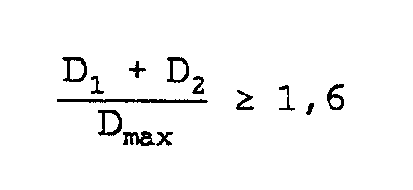
- Élément donneur de colorant, coloré en noir, suivant la revendication 1 ou 2, caractérisé en ce que le colorant est un colorant 4-chloro-5-formylthiazol-2-ylazoaniline magenta.
- Élément donneur de colorant, coloré en noir, suivant la revendication 3, caractérisé en ce que le colorant 4-chloro-5-formylthiazol-2-ylazoaniline répond à la formule suivante :

R¹ et R² représentent chacun l'hydrogène, un groupe alkyle substitué ou non substitué, un groupe cycloalkyle substitué ou non substitué, un groupe aryle substitué ou non substitué, un groupe allyle substitué ou non substitué, un groupe alcényle substitué ou non substitué, ou R¹ et R² avec l'azote auquel ils sont liés, représentent les atomes nécessaires pour fermer un noyau hétérocyclique pentagonal ou hexagonal, ou R¹ et/ou R² avec l'azote auquel ils sont liés et l'un des atomes de carbone ou les deux atomes de carbone du noyau de phényle en position ortho par rapport à cet atome d'azote constituent un noyau hétérocyclique pentagonal ou hexagonal;
R³ représente un atome d'halogène, un groupe hydroxyle, un groupe cyano, un groupe alkyle substitué ou non substitué, un groupe cycloalkyle substitué ou non substitué, un groupe aryle substitué ou non substitué, un groupe alcoxy substitué ou non substitué, un groupe aryloxy substitué ou non substitué, un groupe alkylthio substitué ou non substitué, un groupe arylthio substitué ou non substitué, un groupe amino substitué ou non substitué, un groupe alkylcarbonylamino substitué ou non substitué, un groupe arylcarbonylamino substitué ou non substitué, un groupe alkylsulfonylamino substitué ou non substitué, un groupe arylsulfonylamino substitué ou non substitué, un groupe alcoxycarbonylamino substitué ou non substitué, un groupe aryloxycarbonylamino substitué ou non substitué, un groupe alkylthiocarbonylamino substitué ou non substitué, un groupe arylthiocarbonylamino substitué ou non substitué, un groupe alkylphosphoramidate substitué ou non substitué, un groupe arylphosphoramidate substitué ou non substitué, un groupe alkylphosphonamidate substitué ou non substitué, un groupe arylphosphonamidate substitué ou non substitué;
n représente 0, 1, 2, 3 ou 4; les substituants de R³ peuvent être identiques ou différents si n est supérieur à 1. - Élément donneur de colorant, coloré en noir, suivant la revendication 4, caractérisé en ce que R¹ et R² (identiques ou différents) représentent un groupe alkyle en C₁-C₆ et n représente 0 ou 1, R³ représentant l'alkyle ou l'alcoxy ou l'amino ou l'alkylcarbonylamino en position ortho par rapport à la liaison azoïque.
- Élément donneur de colorant, coloré en noir, suivant l'une quelconque des revendications 3 à 5, caractérisé en ce que le colorant magenta présente une valeur maximale d'absorption comprise entre 520 et 600 nm.
- Élément donneur de colorant, coloré en noir, suivant l'une quelconque des revendications 3 à 6, caractérisé en ce que la couche de colorant contient en outre au moins un colorant jaune et au moins un colorant bleu-vert.
- Élément donneur de colorant, coloré en noir, suivant la revendication 7, caractérisé en ce que le rapport de mélange des colorants est de 20 à 80 % en poids pour le colorant magenta, 10 à 40 % en poids pour le colorant bleu-vert et 10 à 40 % en poids pour le colorant jaune.
- Élément donneur de colorant, coloré en noir, suivant la revendication 8, caractérisé en ce que le rapport de mélange des colorants est de 30 à 60 % en poids pour le colorant magenta, 20 à 40 % en poids pour le colorant bleu-vert et 10 à 30 % en poids pour le colorant jaune.
- Élément donneur de colorant, coloré en noir, suivant la revendication 7, 8 ou 9, caractérisé en ce qu'au moins un des colorants bleu-vert répond à la formule suivante :

R⁴ et R⁵ représentent chacun l'hydrogène, un groupe alkyle substitué ou non substitué, un groupe cycloalkyle substitué ou non substitué, un groupe aryle substitué ou non substitué, un groupe allyle substitué ou non substitué, un groupe alcényle substitué ou non substitué, ou R⁴ et R⁵ avec l'azote auquel ils sont liés, représentent les atomes nécessaires pour fermer un noyau hétérocyclique pentagonal ou hexagonal, ou R⁴ et/ou R⁵ avec l'azote auquel ils sont liés et l'un des atomes de carbone ou les deux atomes de carbone du noyau de phényle en position ortho par rapport à cet atome d'azote constituent un noyau hétérocyclique pentagonal ou hexagonal;
R⁶ représente un atome d'halogène, un groupe hydroxyle, un groupe cyano, un groupe alkyle substitué ou non substitué, un groupe cycloalkyle substitué ou non substitué, un groupe aryle substitué ou non substitué, un groupe alcoxy substitué ou non substitué, un groupe aryloxy substitué ou non substitué, un groupe alkylthio substitué ou non substitué, un groupe arylthio substitué ou non substitué, un groupe amino substitué ou non substitué, un groupe alkylcarbonylamino substitué ou non substitué, un groupe arylcarbonylamino substitué ou non substitué, un groupe alkylsulfonylamino substitué ou non substitué, un groupe arylsulfonylamino substitué ou non substitué, un groupe alcoxycarbonylamino substitué ou non substitué, un groupe aryloxycarbonylamino substitué ou non substitué, un groupe alkylthiocarbonylamino substitué ou non substitué, un groupe arylthiocarbonylamino substitué ou non substitué, un groupe alkylphosphoramidate substitué ou non substitué, un groupe arylphosphoramidate substitué ou non substitué, un groupe alkylphosphonamidate substitué ou non substitué, un groupe arylphosphonamidate substitué ou non substitué;
m représente 0, 1, 2, 3 ou 4; les substituants de R⁶ peuvent être identiques ou différents si m est supérieur à 1;
R⁷ et R7' représentent chacun un groupe cyano, un groupe alcoxycarbonyle substitué ou non substitué, un groupe alcényloxycarbonyle substitué ou non substitué, un groupe aryloxycarbonyle substitué ou non substitué, un groupe alkylaminocarbonyle substitué ou non substitué, un groupe arylaminocarbonyle substitué ou non substitué, un groupe alkylcarbonyle substitué ou non substitué, un groupe arylcarbonyle substitué ou non substitué, un groupe alkylsulfonyle substitué ou non substitué, un groupe arylsulfonyle substitué ou non substitué, ou R⁷ et R7' avec le carbone auquel ils sont liés, représentent les atomes nécessaires pour fermer un noyau pentagonal ou hexagonal, y compris un noyau pentagonal ou hexagonal hétérocyclique. - Élément donneur de colorant, coloré en noir, suivant la revendication 10, caractérisé en ce que R⁷ et R7' représentent chacun un groupe cyano et R⁴ et R⁵ (identiques ou différents) représentent un groupe alkyle en C₁-C₆ et m représente 0 ou 1, R⁶ étant l'alkyle ou l'alcoxy ou l'amino ou l'alkylcarbonylamino.
- Élément donneur de colorant, coloré en noir, suivant la revendication 7, 8 ou 9, caractérisé en ce cu'au moins un des colorants bleu-vert répond à la formule suivante :

R⁸ et R⁹ représentent chacun l'hydrogène, un groupe alkyle substitué ou non substitué, un groupe cycloalkyle substitué ou non substitué, un groupe aryle substitué ou non substitué, un groupe allyle substitué ou non substitué, un groupe alcényle substitué ou non substitué, ou R⁸ et R⁹ avec l'azote auquel ils sont liés, représentent les atomes nécessaires pour fermer un noyau hétérocyclique pentagonal ou hexagonal, ou R⁸ et/ou R⁹ avec l'azote auquel ils sont liés et l'un des atomes de carbone ou les deux atomes de carbone du noyau de phényle en position ortho par rapport à cet atome d'azote constituent un noyau hétérocyclique pentagonal ou hexagonal;
R¹⁰ représente un atome d'halogène, un groupe hydroxyle, un groupe cyano, un groupe alkyle substitué ou non substitué, un groupe cycloalkyle substitué ou non substitué, un groupe aryle substitué ou non substitué, un groupe alcoxy substitué ou non substitué, un groupe aryloxy substitué ou non substitué, un groupe alkylthio substitué ou non substitué, un groupe arylthio substitué ou non substitué, un groupe amino substitué ou non substitué, un groupe alkylcarbonylamino substitué ou non substitué, un groupe arylcarbonylamino substitué ou non substitué, un groupe alkylsulfonylamino substitué ou non substitué, un groupe arylsulfonylamino substitué ou non substitué, un groupe alcoxycarbonylamino substitué ou non substitué, un groupe aryloxycarbonylamino substitué ou non substitué, un groupe alkylthiocarbonylamino substitué ou non substitué, un groupe arylthiocarbonylamino substitué ou non substitué, un groupe alkylphosphoramidate substitué ou non substitué, un groupe arylphosphoramidate substitué ou non substitué, un groupe alkylphosphonamidate substitué ou non substitué, un groupe arylphosphonamidate substitué ou non substitué;
p représente 0, 1, 2, 3 ou 4; les substituants de R¹⁰ peuvent être identiques ou différents si p est supérieur à 1;
R¹¹ et R¹² représentent chacun l'hydrogène, l'alkyle substitué ou non substitué, le cycloalkyle substitué ou non substitué, l'aryle substitué ou non substitué, l'alkylsulfonyle substitué ou non substitué, l'arylsulfonyle substitué ou non substitué, l'alkylsulfonylamino substitué ou non substitué, l'arylsulfonylamino substitué ou non substitué, l'alkylcarbonyle substitué ou non substitué, l'alcoxycarbonyle substitué ou non substitué, l'alkylthio substitué ou non substitué, ou R¹¹ et R¹² avec l'azote auquel ils sont liés, représentent les atomes nécessaires pour fermer un noyau hétérocyclique ou un noyau hétérocyclique substitué, y compris un noyau hétérocyclique avec un noyau aliphatique ou aromatique condensé. - Élément donneur de colorant, coloré en noir, suivant la revendication 12, caractérisé en ce que R¹¹ et R¹² représentent chacun l'alcoxycarbonyle ou l'alkylsulfonylamino, ou R¹¹ et R¹² avec l'azote auquel ils sont liés, représentent le succinimido, et R⁸ et R⁹ (identiques ou différents) représentent un groupe alkyle en C₁-C₆ et p représente 0 ou 1, R¹⁰ étant l'alkylcarbonylamino ou l'alkyle.
- Élément donneur de colorant, coloré en noir, suivant la revendication 7, 8 ou 9, caractérisé en ce qu'au moins un des colorants bleu-vert répond à la formule suivante :

R¹⁴ représente un atome d'halogène, un groupe hydroxyle, un groupe cyano, un groupe alkyle substitué ou non substitué, un groupe cycloalkyle substitué ou non substitué, un groupe aryle substitué ou non substitué, un groupe alcoxy substitué ou non substitué, un groupe aryloxy substitué ou non substitué, un groupe alkylthio substitué ou non substitué, un groupe arylthio substitué ou non substitué, un groupe amino substitué ou non substitué, un groupe alkylcarbonylamino substitué ou non substitué, un groupe arylcarbonylamino substitué ou non substitué, un groupe alkylsulfonylamino substitué ou non substitué, un groupe arylsulfonylamino substitué ou non substitué, un groupe alcoxycarbonylamino substitué ou non substitué, un groupe aryloxycarbonylamino substitué ou non substitué, un groupe alkylthiocarbonylamino substitué ou non substitué, un groupe arylthiocarbonylamino substitué ou non substitué, un groupe alkylphosphoramidate substitué ou non substitué, un groupe arylphosphoramidate substitué ou non substitué, un groupe alkylphosphonamidate substitué ou non substitué, un groupe arylphosphonamidate substitué ou non substitué, un groupe alkylaminocarbonyle substitué ou non substitué, un groupe arylaminocarbonyle substitué ou non substitué, ou R¹⁴ représente les atomes nécessaires pour fermer un noyau alicyclique ou aromatique ou hétérocyclique condensé sur le noyau de phényle;
r représente 0, 1, 2, 3 ou 4; les substituants de R¹⁴ peuvent être identiques ou différents si r est supérieur à 1;
R¹³ peut avoir l'une des significations attachées à R¹⁴ ou peut représenter les atomes nécessaires pour fermer un noyau alicyclique ou aromatique ou hétérocyclique condensé sur le noyau de phénylène;
q représente 0, 1, 2, 3 ou 4; les substituants de R¹³ peuvent être identiques ou différents si q est supérieur à 1;
R¹⁵ et R¹⁶ représentent chacun l'hydrogène, un groupe alkyle substitué ou non substitué, un groupe cycloalkyle substitué ou non substitué, un groupe aryle substitué ou non substitué, un groupe allyle substitué ou non substitué, un groupe alcényle substitué ou non substitué, ou R¹⁵ et R¹⁶ avec l'azote auquel ils sont liés, représentent les atomes nécessaires pour fermer un noyau hétérocyclique pentagonal ou hexagonal, ou R¹⁵ et/ou R¹⁶ avec l'azote auquel ils sont liés et l'un des atomes de carbone ou les deux atomes de carbone du noyau de phényle en position ortho par rapport à cet atome d' azote constituent un noyau hétérocyclique pentagonal ou hexagonal. - Élément donneur de colorant, coloré en noir, suivant la revendication 14, caractérisé en ce que R¹⁵ et R¹⁶ (identiques ou différents) représentent chacun un groupe alkyle et en ce que r est égal à 0 ou 1, R¹⁴ étant un groupe alkyle si r est égal à 1, et en ce que R¹³ représente un atome d'halogène ou un groupe alkylcarbonylamino ou un groupe alkylaminocarbonyle et/ou R¹³ représente les atomes nécessaires pour fermer un noyau benzénique condensé sur le noyau de phénylène.
- Élément donneur de colorant, coloré en noir, suivant l'une quelconque des revendications 7 à 15, caractérisé en ce qu'au moins un des colorants jaunes est un colorant arylazoaniline.
- Élément donneur de colorant, coloré en noir, suivant l'une quelconque des revendications précédentes, caractérisé en ce que la couche de colorant comprend un liant choisi parmi l'acétate-propionate de cellulose, l'acétate-butyrate de cellulose, le copolymère de n-butyral de vinyle, d' acétal de vinyle et d'alcool vinylique, le copolymère de chlorure de vinyle et d'acétate de vinyle, le copolymère d'acrylonitrile et de styrène, et la nitrocellulose.
- Élément récepteur coloré comprenant des colorants répartis sous forme d'image, formé suivant un procédé de transfert par sublimation thermique de colorant à l'aide d'un élément donneur de colorant, coloré en noir, conforme à l'une quelconque des revendications précédentes.
- Élément récepteur coloré suivant la revendication 18, caractérisé en ce que le support de l'élément récepteur est transparent.
- Élément récepteur coloré suivant la revendication 18, caractérisé en ce que le support de l'élément récepteur est le polytéréphtalate d'éthylène coloré en bleu.
Applications Claiming Priority (2)
| Application Number | Priority Date | Filing Date | Title |
|---|---|---|---|
| EP90200991 | 1990-04-20 | ||
| EP90200991 | 1990-04-20 |
Publications (2)
| Publication Number | Publication Date |
|---|---|
| EP0453020A1 EP0453020A1 (fr) | 1991-10-23 |
| EP0453020B1 true EP0453020B1 (fr) | 1995-01-18 |
Family
ID=8204999
Family Applications (1)
| Application Number | Title | Priority Date | Filing Date |
|---|---|---|---|
| EP91200791A Revoked EP0453020B1 (fr) | 1990-04-20 | 1991-04-05 | Elément donateur noir pour la sublimation thermique de colorants par transfert |
Country Status (5)
| Country | Link |
|---|---|
| US (1) | US5169828A (fr) |
| EP (1) | EP0453020B1 (fr) |
| JP (1) | JPH04226393A (fr) |
| CA (1) | CA2040839A1 (fr) |
| DE (1) | DE69106759T2 (fr) |
Families Citing this family (35)
| Publication number | Priority date | Publication date | Assignee | Title |
|---|---|---|---|---|
| JP2893131B2 (ja) * | 1990-08-02 | 1999-05-17 | 富士写真フイルム株式会社 | 熱転写色素供与材料 |
| EP0522207B1 (fr) * | 1991-07-12 | 1995-10-18 | Agfa-Gevaert N.V. | Méthode pour l'impression par le transfert thermique de colorant et élément donneur de colorant pour utilisation avec cette méthode |
| EP0617670A1 (fr) * | 1991-12-20 | 1994-10-05 | E.I. Du Pont De Nemours And Company | Procede de thermographie utilisant un laser a infrarouge et des colorants d'azamethine |
| EP0567172B1 (fr) * | 1992-04-21 | 1996-09-18 | Agfa-Gevaert N.V. | Elément donneur de colorant pour utilisation dans le transfert thermique de colorants par sublimation |
| ATE147018T1 (de) * | 1992-07-14 | 1997-01-15 | Agfa Gevaert Nv | Farbstoffdonorelement zur anwendung in der thermischen farbstoffsublimationsübertragung |
| EP0578870B1 (fr) * | 1992-07-14 | 1996-12-11 | Agfa-Gevaert N.V. | Colorants thiazolylazoanilines pour utilisation dans le transfert thermique de colorants par sublimation |
| EP0579297B1 (fr) * | 1992-07-14 | 1997-01-02 | Agfa-Gevaert N.V. | Elément donneur de colorant pour le transfert thermique de colorants par sublimation |
| EP0579299B1 (fr) * | 1992-07-14 | 1997-01-02 | Agfa-Gevaert N.V. | Mélange de colorants noir pour le transfert thermique de colorants par sublimation |
| EP0581342B1 (fr) * | 1992-07-14 | 1997-01-02 | Agfa-Gevaert N.V. | Elément donneur de colorant pour le transfert thermique de colorants par sublimation |
| DE69307036T2 (de) * | 1992-07-14 | 1997-06-26 | Agfa Gevaert Nv | Farbstoffdonorelement zur Anwendung in der thermischen Farbstoffsublimationsübertragung |
| DE69307037T2 (de) * | 1992-07-14 | 1997-06-26 | Agfa Gevaert Nv | Schwarzgefärbte Farbstoffmischung zur Anwendung in der thermischen Farbstoffsublimationsübertragung |
| GB9218126D0 (en) * | 1992-08-26 | 1992-10-14 | Ici Plc | Thermal transfer printing dye-sheet |
| US5468258A (en) * | 1993-01-20 | 1995-11-21 | Agfa-Gevaert N.V. | Thermal dye transfer methods utilizing heterocyclic hydrazono dyes |
| EP0611663B1 (fr) * | 1993-01-20 | 1997-09-17 | Agfa-Gevaert N.V. | Eléments donneurs de colorant contenant colorants hétérocycliques hydrazones pour le transfert thermique de colorant |
| JPH071784A (ja) * | 1993-04-14 | 1995-01-06 | Agfa Gevaert Nv | 熱印刷装置における染料供与体材料の種類の検知 |
| EP0628427A1 (fr) * | 1993-06-03 | 1994-12-14 | Agfa-Gevaert N.V. | Eléments donneurs de colorants pour l'enregistrement par le transfert thermique de colorants |
| US5422334A (en) * | 1993-06-03 | 1995-06-06 | Agfa-Gevaert N.V. | Dye-donor elements for thermal dye transfer recording |
| US5503956A (en) * | 1993-07-30 | 1996-04-02 | Eastman Kodak Company | Mixture of dyes for black laser ablative recording element |
| US5571765A (en) * | 1994-01-31 | 1996-11-05 | Agfa-Gevaert N.V. | Thermal dye transfer image with improved light-fastness |
| EP0665117A1 (fr) * | 1994-01-31 | 1995-08-02 | Agfa-Gevaert N.V. | Image produite par transfert thermique de colorant, ayant une stabilité à la lumière améliorée |
| EP0691213A1 (fr) * | 1994-07-04 | 1996-01-10 | Agfa-Gevaert N.V. | Elément donneur de colorant pour utilisation dans impression par transfert thermique |
| EP0701907A1 (fr) | 1994-09-13 | 1996-03-20 | Agfa-Gevaert N.V. | Elément donneur de colorant pour utilisation dans un procédé de transfert thermique de colorant |
| EP0701906B1 (fr) * | 1994-09-13 | 1997-12-29 | Agfa-Gevaert N.V. | Colorants et éléments donneurs de colorant pour l'enregistrement par transfer thermique de colorant |
| JPH08224966A (ja) * | 1995-02-22 | 1996-09-03 | Konica Corp | 色素受容材料及びそれを用いる画像形成方法 |
| DE19611351A1 (de) | 1996-03-22 | 1997-09-25 | Basf Ag | Farbstoffmischungen, enthaltend Thienyl- und/oder Thiazolazofarbstoffe |
| US5747217A (en) * | 1996-04-03 | 1998-05-05 | Minnesota Mining And Manufacturing Company | Laser-induced mass transfer imaging materials and methods utilizing colorless sublimable compounds |
| US5725989A (en) * | 1996-04-15 | 1998-03-10 | Chang; Jeffrey C. | Laser addressable thermal transfer imaging element with an interlayer |
| US6387846B1 (en) * | 1998-09-10 | 2002-05-14 | Dai Nippon Printing Co., Ltd. | Thermal transfer sheet, thermal transfer recording method, and thermal transfer recording system |
| DE102007037524A1 (de) | 2007-08-09 | 2009-02-12 | Dystar Textilfarben Gmbh & Co. Deutschland Kg | 1, 3-Thiazolyl-Azofarbstoffe, deren Herstellung und Verwendung |
| JP5945905B2 (ja) | 2009-08-24 | 2016-07-05 | 国立研究開発法人情報通信研究機構 | 2次非線形光学化合物及びそれを含む非線形光学素子 |
| JP2013202846A (ja) * | 2012-03-27 | 2013-10-07 | Dainippon Printing Co Ltd | 熱転写シート |
| CN105733302B (zh) * | 2014-12-10 | 2019-05-03 | 浙江名毅新能源股份有限公司 | 蓝色分散染料组合物的制备方法 |
| CN105733305B (zh) * | 2014-12-10 | 2019-03-15 | 上海安诺其集团股份有限公司 | 蓝色分散染料组合物 |
| CN105733304B (zh) * | 2014-12-10 | 2019-01-08 | 浙江名毅新能源股份有限公司 | 蓝色分散染料组合物的应用 |
| CN118725604A (zh) * | 2024-06-21 | 2024-10-01 | 绍兴文理学院 | 一种耐碱性分散染料及其合成方法与应用 |
Citations (1)
| Publication number | Priority date | Publication date | Assignee | Title |
|---|---|---|---|---|
| EP0235939A2 (fr) * | 1986-02-28 | 1987-09-09 | Zeneca Limited | Impression par transfert thermique |
Family Cites Families (6)
| Publication number | Priority date | Publication date | Assignee | Title |
|---|---|---|---|---|
| JPS59184339A (ja) * | 1983-04-01 | 1984-10-19 | Konishiroku Photo Ind Co Ltd | 熱転写用受像要素 |
| JPH0811466B2 (ja) * | 1984-12-24 | 1996-02-07 | 三菱化学株式会社 | 転写シ−ト |
| DE3630279A1 (de) * | 1986-09-05 | 1988-03-17 | Basf Ag | Verfahren zur uebertragung von farbstoffen |
| JP2681781B2 (ja) * | 1987-12-30 | 1997-11-26 | 大日本印刷株式会社 | 熱転写シート |
| JPS6412392A (en) * | 1987-07-06 | 1989-01-17 | Matsushita Refrigeration | Sales memory for vending machine |
| JPH0815820B2 (ja) * | 1987-11-25 | 1996-02-21 | 松下電器産業株式会社 | 黒色系感熱転写シート |
-
1991
- 1991-04-05 EP EP91200791A patent/EP0453020B1/fr not_active Revoked
- 1991-04-05 DE DE69106759T patent/DE69106759T2/de not_active Revoked
- 1991-04-09 US US07/682,389 patent/US5169828A/en not_active Expired - Fee Related
- 1991-04-19 CA CA002040839A patent/CA2040839A1/fr not_active Abandoned
- 1991-04-19 JP JP3116984A patent/JPH04226393A/ja active Pending
Patent Citations (1)
| Publication number | Priority date | Publication date | Assignee | Title |
|---|---|---|---|---|
| EP0235939A2 (fr) * | 1986-02-28 | 1987-09-09 | Zeneca Limited | Impression par transfert thermique |
Non-Patent Citations (1)
| Title |
|---|
| The Chemistry and Application of Dyes, ISBN 0306432781 Ed. by Waring and Hallas, Plenum Press, Febr 1990, p. 155 * |
Also Published As
| Publication number | Publication date |
|---|---|
| EP0453020A1 (fr) | 1991-10-23 |
| JPH04226393A (ja) | 1992-08-17 |
| DE69106759D1 (de) | 1995-03-02 |
| US5169828A (en) | 1992-12-08 |
| DE69106759T2 (de) | 1995-07-06 |
| CA2040839A1 (fr) | 1991-10-21 |
Similar Documents
| Publication | Publication Date | Title |
|---|---|---|
| EP0453020A1 (fr) | Elément donateur noir pour la sublimation thermique de colorants par transfert | |
| EP0788890A1 (fr) | Colorants et éléments donneur de colorant pour l'enregistrement par transfert thermique de colorant | |
| US5229353A (en) | Thermal transfer printing with ultra-violet absorbing compound | |
| EP0432314B1 (fr) | Méthode de transfert thermique de colorants par sublimation | |
| EP0432829B1 (fr) | Elément donateur de colorant pour utilisation dans le transfert thermique de colorants par sublimation | |
| EP0530799B1 (fr) | Mélange de colorants pour donneur de colorants noirs pour épreuves colorées obtenues par le procédé thermique | |
| EP0579299B1 (fr) | Mélange de colorants noir pour le transfert thermique de colorants par sublimation | |
| EP0522207B1 (fr) | Méthode pour l'impression par le transfert thermique de colorant et élément donneur de colorant pour utilisation avec cette méthode | |
| EP0532008B1 (fr) | Mélange de colorants pour donneur de colorants noirs pour épreuves colorées obtenues par le procédé thermique | |
| EP0792757A1 (fr) | Elément donneur de colorant pour utilisation dans un procédé pour l'impression par le transfert thermique | |
| US5510225A (en) | Thermal dye sublimation transfer donor element | |
| EP0581342B1 (fr) | Elément donneur de colorant pour le transfert thermique de colorants par sublimation | |
| EP0567172B1 (fr) | Elément donneur de colorant pour utilisation dans le transfert thermique de colorants par sublimation | |
| US5326666A (en) | Dye-donor element for use in thermal dye sublimation transfer | |
| US5422334A (en) | Dye-donor elements for thermal dye transfer recording | |
| EP0532006B1 (fr) | Mélange de colorants pour donneur de colorants noirs pour épreuves colorées obtenues par le procédé thermique | |
| EP0579297B1 (fr) | Elément donneur de colorant pour le transfert thermique de colorants par sublimation | |
| EP0594238B1 (fr) | Elément donneur de colorant comprenant des colorants magenta de type tricyanovinylaniline | |
| EP0619191A2 (fr) | Colorants et éléments donneur de colorants pour l'enregistrement par le transfert thermique de colorant | |
| EP0530802B1 (fr) | Mélange de colorants pour donneur de colorants noirs pour épreuves colorées obtenues par le procédé thermique | |
| US5595574A (en) | Dyes and dye-donor elements for use in thermal dye transfer | |
| EP0532009B1 (fr) | Mélange de colorants pour donneur de colorants noirs pour épreuves colorées obtenues par le procédé thermique | |
| EP0598437B1 (fr) | Elément donneur de colorant contenant des colorants de type dicyanovinylaniline | |
| JPH0672056A (ja) | 熱染料昇華転写により使用するための染料供与体材料 | |
| EP0785087A1 (fr) | Procédé pour transfert thermique de colorant par sublimation |
Legal Events
| Date | Code | Title | Description |
|---|---|---|---|
| PUAI | Public reference made under article 153(3) epc to a published international application that has entered the european phase |
Free format text: ORIGINAL CODE: 0009012 |
|
| AK | Designated contracting states |
Kind code of ref document: A1 Designated state(s): BE CH DE ES FR GB IT LI NL SE |
|
| 17P | Request for examination filed |
Effective date: 19920316 |
|
| 17Q | First examination report despatched |
Effective date: 19940415 |
|
| GRAA | (expected) grant |
Free format text: ORIGINAL CODE: 0009210 |
|
| AK | Designated contracting states |
Kind code of ref document: B1 Designated state(s): BE CH DE ES FR GB IT LI NL SE |
|
| PG25 | Lapsed in a contracting state [announced via postgrant information from national office to epo] |
Ref country code: IT Free format text: LAPSE BECAUSE OF FAILURE TO SUBMIT A TRANSLATION OF THE DESCRIPTION OR TO PAY THE FEE WITHIN THE PRE;WARNING: LAPSES OF ITALIAN PATENTS WITH EFFECTIVE DATE BEFORE 2007 MAY HAVE OCCURRED AT ANY TIME BEFORE 2007. THE CORRECT EFFECTIVE DATE MAY BE DIFFERENT FROM THE ONE RECORDED.SCRIBED TIME-LIMIT Effective date: 19950118 Ref country code: LI Effective date: 19950118 Ref country code: CH Effective date: 19950118 |
|
| REF | Corresponds to: |
Ref document number: 69106759 Country of ref document: DE Date of ref document: 19950302 |
|
| ET | Fr: translation filed | ||
| PG25 | Lapsed in a contracting state [announced via postgrant information from national office to epo] |
Ref country code: SE Effective date: 19950418 |
|
| PG25 | Lapsed in a contracting state [announced via postgrant information from national office to epo] |
Ref country code: ES Free format text: LAPSE BECAUSE OF FAILURE TO SUBMIT A TRANSLATION OF THE DESCRIPTION OR TO PAY THE FEE WITHIN THE PRESCRIBED TIME-LIMIT Effective date: 19950419 |
|
| REG | Reference to a national code |
Ref country code: CH Ref legal event code: PL |
|
| PLBI | Opposition filed |
Free format text: ORIGINAL CODE: 0009260 |
|
| PLBI | Opposition filed |
Free format text: ORIGINAL CODE: 0009260 |
|
| 26 | Opposition filed |
Opponent name: IMPERIAL CHEMICAL INDUSTRIES PLC Effective date: 19951016 |
|
| 26 | Opposition filed |
Opponent name: DAI NIPPON PRINTING CO., LTD. Effective date: 19951018 Opponent name: IMPERIAL CHEMICAL INDUSTRIES PLC Effective date: 19951016 |
|
| NLR1 | Nl: opposition has been filed with the epo |
Opponent name: DAI NIPPON PRINTING CO., LTD. Opponent name: IMPERIAL CHEMICAL INDUSTRIES PLC |
|
| PGFP | Annual fee paid to national office [announced via postgrant information from national office to epo] |
Ref country code: BE Payment date: 19960304 Year of fee payment: 6 |
|
| PGFP | Annual fee paid to national office [announced via postgrant information from national office to epo] |
Ref country code: NL Payment date: 19960430 Year of fee payment: 6 |
|
| PLBF | Reply of patent proprietor to notice(s) of opposition |
Free format text: ORIGINAL CODE: EPIDOS OBSO |
|
| PGFP | Annual fee paid to national office [announced via postgrant information from national office to epo] |
Ref country code: GB Payment date: 19970221 Year of fee payment: 7 |
|
| PGFP | Annual fee paid to national office [announced via postgrant information from national office to epo] |
Ref country code: FR Payment date: 19970320 Year of fee payment: 7 |
|
| PG25 | Lapsed in a contracting state [announced via postgrant information from national office to epo] |
Ref country code: BE Effective date: 19970430 |
|
| REG | Reference to a national code |
Ref country code: GB Ref legal event code: 746 Effective date: 19970418 |
|
| REG | Reference to a national code |
Ref country code: FR Ref legal event code: D6 |
|
| BERE | Be: lapsed |
Owner name: AGFA-GEVAERT N.V. Effective date: 19970430 |
|
| PG25 | Lapsed in a contracting state [announced via postgrant information from national office to epo] |
Ref country code: NL Effective date: 19971101 |
|
| NLV4 | Nl: lapsed or anulled due to non-payment of the annual fee |
Effective date: 19971101 |
|
| PLBQ | Unpublished change to opponent data |
Free format text: ORIGINAL CODE: EPIDOS OPPO |
|
| PLAB | Opposition data, opponent's data or that of the opponent's representative modified |
Free format text: ORIGINAL CODE: 0009299OPPO |
|
| PG25 | Lapsed in a contracting state [announced via postgrant information from national office to epo] |
Ref country code: GB Free format text: LAPSE BECAUSE OF NON-PAYMENT OF DUE FEES Effective date: 19980405 |
|
| R26 | Opposition filed (corrected) |
Opponent name: IMPERIAL CHEMICAL INDUSTRIES PLC * 951018 DAI NIPP Effective date: 19951016 |
|
| PLAW | Interlocutory decision in opposition |
Free format text: ORIGINAL CODE: EPIDOS IDOP |
|
| GBPC | Gb: european patent ceased through non-payment of renewal fee |
Effective date: 19980405 |
|
| PLAW | Interlocutory decision in opposition |
Free format text: ORIGINAL CODE: EPIDOS IDOP |
|
| REG | Reference to a national code |
Ref country code: FR Ref legal event code: ST |
|
| PGFP | Annual fee paid to national office [announced via postgrant information from national office to epo] |
Ref country code: DE Payment date: 19990301 Year of fee payment: 9 |
|
| RDAH | Patent revoked |
Free format text: ORIGINAL CODE: EPIDOS REVO |
|
| RDAG | Patent revoked |
Free format text: ORIGINAL CODE: 0009271 |
|
| STAA | Information on the status of an ep patent application or granted ep patent |
Free format text: STATUS: PATENT REVOKED |
|
| 27W | Patent revoked |
Effective date: 20000224 |
|
| PG25 | Lapsed in a contracting state [announced via postgrant information from national office to epo] |
Ref country code: FR Free format text: LAPSE BECAUSE OF NON-PAYMENT OF DUE FEES Effective date: 19980430 |