EP0453442B1 - Bandes transporteuses plastiques modulaires et modules destines a celles-ci - Google Patents
Bandes transporteuses plastiques modulaires et modules destines a celles-ci Download PDFInfo
- Publication number
- EP0453442B1 EP0453442B1 EP89909344A EP89909344A EP0453442B1 EP 0453442 B1 EP0453442 B1 EP 0453442B1 EP 89909344 A EP89909344 A EP 89909344A EP 89909344 A EP89909344 A EP 89909344A EP 0453442 B1 EP0453442 B1 EP 0453442B1
- Authority
- EP
- European Patent Office
- Prior art keywords
- modules
- link
- belt
- rod
- link ends
- Prior art date
- Legal status (The legal status is an assumption and is not a legal conclusion. Google has not performed a legal analysis and makes no representation as to the accuracy of the status listed.)
- Expired - Lifetime
Links
- 230000000903 blocking effect Effects 0.000 claims abstract description 45
- 238000003780 insertion Methods 0.000 claims description 6
- 230000037431 insertion Effects 0.000 claims description 6
- 239000007787 solid Substances 0.000 claims description 6
- 238000000605 extraction Methods 0.000 claims description 2
- 230000002441 reversible effect Effects 0.000 abstract description 2
- 230000000712 assembly Effects 0.000 abstract 1
- 238000000429 assembly Methods 0.000 abstract 1
- 238000009434 installation Methods 0.000 description 6
- 230000000694 effects Effects 0.000 description 5
- 238000010276 construction Methods 0.000 description 4
- 208000002925 dental caries Diseases 0.000 description 4
- 238000000034 method Methods 0.000 description 4
- 238000004519 manufacturing process Methods 0.000 description 3
- 239000011324 bead Substances 0.000 description 2
- 238000012423 maintenance Methods 0.000 description 2
- 239000000463 material Substances 0.000 description 2
- 230000005489 elastic deformation Effects 0.000 description 1
- 238000002844 melting Methods 0.000 description 1
- 230000008018 melting Effects 0.000 description 1
- 238000000465 moulding Methods 0.000 description 1
Images


Classifications
-
- B—PERFORMING OPERATIONS; TRANSPORTING
- B65—CONVEYING; PACKING; STORING; HANDLING THIN OR FILAMENTARY MATERIAL
- B65G—TRANSPORT OR STORAGE DEVICES, e.g. CONVEYORS FOR LOADING OR TIPPING, SHOP CONVEYOR SYSTEMS OR PNEUMATIC TUBE CONVEYORS
- B65G17/00—Conveyors having an endless traction element, e.g. a chain, transmitting movement to a continuous or substantially-continuous load-carrying surface or to a series of individual load-carriers; Endless-chain conveyors in which the chains form the load-carrying surface
- B65G17/06—Conveyors having an endless traction element, e.g. a chain, transmitting movement to a continuous or substantially-continuous load-carrying surface or to a series of individual load-carriers; Endless-chain conveyors in which the chains form the load-carrying surface having a load-carrying surface formed by a series of interconnected, e.g. longitudinal, links, plates, or platforms
- B65G17/08—Conveyors having an endless traction element, e.g. a chain, transmitting movement to a continuous or substantially-continuous load-carrying surface or to a series of individual load-carriers; Endless-chain conveyors in which the chains form the load-carrying surface having a load-carrying surface formed by a series of interconnected, e.g. longitudinal, links, plates, or platforms the surface being formed by the traction element
-
- B—PERFORMING OPERATIONS; TRANSPORTING
- B65—CONVEYING; PACKING; STORING; HANDLING THIN OR FILAMENTARY MATERIAL
- B65G—TRANSPORT OR STORAGE DEVICES, e.g. CONVEYORS FOR LOADING OR TIPPING, SHOP CONVEYOR SYSTEMS OR PNEUMATIC TUBE CONVEYORS
- B65G2201/00—Indexing codes relating to handling devices, e.g. conveyors, characterised by the type of product or load being conveyed or handled
- B65G2201/02—Articles
-
- B—PERFORMING OPERATIONS; TRANSPORTING
- B65—CONVEYING; PACKING; STORING; HANDLING THIN OR FILAMENTARY MATERIAL
- B65G—TRANSPORT OR STORAGE DEVICES, e.g. CONVEYORS FOR LOADING OR TIPPING, SHOP CONVEYOR SYSTEMS OR PNEUMATIC TUBE CONVEYORS
- B65G2207/00—Indexing codes relating to constructional details, configuration and additional features of a handling device, e.g. Conveyors
- B65G2207/12—Chain pin retainers
Definitions
- This invention relates to improvements in plastic conveyor belts of the type having a plurality of links or modules connected together to form a continuous belt with connecting rods or pins, and in particular to a unique improvement for capturing the connecting rods and an innovative construction of different modules which are assembled to make the conveyor.
- the heads are exposed on the edges of the belt in a vulnerable location since any protuberance on a conveyor can either wear or knock the heads of the rods thus allowing the rods to fall out of the belt.
- the Poisson effect i.e., when a material undergoes a change in dimension due to an elastic deformation along one axis an opposite change in dimension or deformation occurs along a perpendicular axis. The amount of this opposite deformation is determined by Poisson's ratio.
- the rods are subjected to compressive forces perpendicular to the axis of the rod. These compressive forces can deform the rod making the diameter of the rod smaller in accordance with the theory of elasticity.
- the rod then elongates along its axis; in effect, the rod becomes longer than its original length. This in turn causes the rod to protrude further beyond the edge of the belt causing further problems of interference with conveyor structure which can result in significant belt damage and possible down time.
- Another known method of capturing the rod is a snap-fitting end cap installed axially into the module rod hole or transversely into the module blocking off the rod hole.
- the general design requirement for snap-fit assembly as currently known requires that the plug or end cap be flexible so that its snap projection can deform during installation. This flexibility, which is normally accomplished by placing the snap fit projection at the ends of two flexible arms, also weakens the plug or cap and reduces its ability to resist rod elongation forces.
- end caps which are installed axially into the rod hole place the entire rod elongation force caused by the Poisson effect on relatively small snap-fit projections. This results in the rods "popping" the end caps off of the end modules.
- EP-A-0288409 discloses a conveyor chain assembly which is made of multiple rows of pivotally connected link modules. Each module has spaced link ends which project between the link ends of the module in the adjacent row. The joint between modules in a row is straddled or bridged by a module in the adjacent row to give a bricked lay-up. Each of the modules on the left side of the conveyor has a solid link end so the pivot rod abuts the inside of the link end. The other end of the pivot rod lies just inside of a spring plug mounted in the arm or link end on the right side module.
- one common design of plastic conveyors includes modules having a plurality of spaced inter-fitting link ends with intermediate members connecting opposed link ends, and one or more transverse members between the link ends connecting the intermediate members. See, for example U.S. Patents 4,557,374 granted December 10, 1985; 4,556,142 granted December 3, 1985; 4,438,838 granted March 27, 1984; 4,159,763 granted July 3, 1979; 4,080,842 granted March 28, 1978; 3,870,141 granted March 11, 1975; and German Patent No. 113,669 granted November 19, 1899.
- the link ends are all of substantially the same width, the modules are reversible and they are assembled in a "brick-lay" pattern so that the ends of one row of modules don't align with the ends of the adjacent row of modules. It is well known that this contributes further strength.
- the sprocket teeth which drive the belt are either necessarily small, or enlarged sprocket tooth cavities (for permitting larger sprocket teeth) are formed between two transverse members and two intermediate members. It is desirable to have a modular design which permits large sprocket teeth, both in length and depth since sprocket tooth size is a key factor in determining both the wear resistance and strength of the sprocket.
- a large sprocket tooth cavity results in the placement of a link end between two intermediate members.
- the stress flow of the link ends located in the sprocket tooth cavity area must flow down the link end around the cross member and then to intermediate members connecting to link ends on the opposite side of the modules.
- the link end which is located between the two intermediate members cannot carry the same load as link ends on opposite sides of the module that are directly connected by an intermediate member.
- the present invention provides a conveyor belt constructed of a plurality of moduels having inter-fitting link ends connected by pivot rods extending through aligned holes in the link ends, the belt being assembled from: (a) internal modules having a plurality of spaced link ends on both sides thereof, wherein some of the link ends are of unequal width so as to provide a plurality of narrow link ends and a plurality of wide link ends arranged to allow the modules to be assembled in a brick-lay pattern while preventing assemblage of the conveyor belt with an interior module in an orientation reversed from that of other interior modules in the belt; and (b) end modules with a hole blocking means for maintaining the pivot rod captive in the belt, the hole blocking means including a solid rod movement blocking member; characterised in that the internal modules comprise intermediate members connecting the link ends, transverse members connecting the intermediate members, wherein the transverse members and some of the intermediate members form sprocket holes to allow the belt to be driven by a sprocket wheel and each link end is connected to an intermediate member by a shank portion
- This invention is preferably in the setting of a plastic conveyor belt composed of a pluraltiy of modules with inter-fitting link ends in which modules are held together by elongated rods extending through holes in the link ends.
- the rods are captured by specially constructed outer link ends of uniquely shaped end modules.
- the outermost module is preferably relatively wide and has a slot therethrough perpendicular to the axis of the rod hole.
- a blocking member is insertable into the hole perpendicular to the rod to block the movement of the rod.
- the blocking member may have a flat surface facing the rod end and a projection for fitting into the rod hole on an opposite surface.
- the shape of the blocking member is configured so as to be assembled in only one position and preferably to be flush with the surface of the link end.
- the projection has ramps for insertion and removal and the assembly may be configured so that the blocking member can be snapped in and out of the outermost link end in case the belt needs to be disassembled or repaired.
- the belt is composed of internal modules and four different end modules (there are two different size end modules for each side of the belt).
- the end modules on each end are reversed.
- the end modules may have the widest link end on the outside and the next widest link end adjacent the outside.
- one of the end modules has only one link on one side and two link ends on the other side.
- the widest end module and the internal module are preferably configured such that the narrowest link ends are offset in a direction toward an adjacent intermediate member in order to balance the module from the standpoint of location of maximum and minimum width link ends versus maximum and minimum module section rigidities in order to achieve the goal of providing a module and belt of minimum weight and minimum average section thickness for a given design strength and requirement.
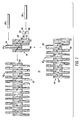
- a plastic conveyor belt 10 is of the type formed by a plurality of plastic modules linked together with connecting rods and having spaced inter-fitting link ends.
- the belt of this invention is constructed of an internal module or modules 12 and end modules such as wide-end module 14 and narrow-end module 16. Other width internal modules could also be used.
- Each of the modules have inter-fitting spaced link ends 18 which are varying in number and width as illustrated in the drawings and as will be explained.
- the link ends are connected by intermediate members 20 and transverse members 22.
- the transverse members and selected ones of the intermediate members form sprocket pockets 24 for teeth of driving sprockets.
- Each of the link ends 18 of each of the modules has a rod hole 26 extending transversely therethrough of a suitable diameter to accommodate the connecting or pivot rods 28 as is known in the art.
- the modules are assembled as illustrated in Fig. 1 to create an assembly (not shown) with end modules at each end and with the rods 28 inserted through the rod holes 26.
- a rod capturing means which includes a wide link end 30 on the outermost edge of end modules 14 and 16.
- a slot 32 extends through the link end 30 from the top to the bottom thereof intersecting the rod hole 26.
- the slot is configured to accommodate a blocking member 34 as shown in Figs. 1, 2, and 3.
- Blocking member 34 has a flat side 36 against which the rod end abuts and a projection 38 on the outer side.
- Projection 38 has an insert ramp portion 40, a dwell or hold portion 42 which is less than the width of the hole, and an exit ramp portion 44. These portions allow for pop-in insertion and removal of the blocking member.
- the blocking member has a head extension 46 which fits within a recess 48 in link end 30 in order that the blocking member must always be assembled in the correct position.
- the top surface 50 of the blocking member is configured with the surface 52 of the link end so that the top of the blocking member is flush therewith.
- the flat side 36 of the blocking member 34 provides a solid high contact area for absorbing rod elongation pressure from the end of rod 28.
- the projection 38 is configured such that it can be easily inserted into the link end 30 during assembly or installation while solidly retaining the member in place during operation. Once installed the projection 38 rests in the rod hole 26 of link end 30.
- the upper section of link end 30 which forms the perimeter of the rod hole is dimensioned such that it will deform to allow entry of the blocking member yet recover to its original form after insertion of the blocking member. With this invention any connecting rod elongation and the forces therefrom push against a solid blocking member which distributes the forces to rigid sections of the wide link end 30 of the end modules 14 and 16.
- the projection 38 is oriented such that rod elongation forces more securely lock the blocking member 34 in place. Therefore the rod elongation forces make the blocking member more secure and prevent the rod from leaving the belt.
- the solid blocking member is essentially non-deformable while the outer portion of the link end is deformable to permit insertion and extraction of the blocking member.
- Each of the end modules 14 and 16 are configured with a series of three graduated width link ends to properly absorb the rod elongation forces and transmit them to the internal structure of the belt.
- the outermost link end 30 is the widest since it must accommodate the blocking member and transmit the entire belt rod elongation forces to the belt.
- the next adjacent link end 54 is dimensioned somewhat smaller but still sufficient to absorb the high shear forces in the belt created by the outside link end.
- the next link end 56 is somewhat narrower than link end 54, but larger than any of the link ends 18 of the internal module 12.
- a significant advantage of this invention is that the end modules 14 and 16, and the blocking member 34 contain the rods 28 on both edges of the belt 10. This permits free access to the belt rod from either side of the belt and such is of critical importance in installation and maintenance. For example, often due to conveyor structure only one side of the belt is accessible. With conventionally designed belts having one side accessible and the other side closed (or with a small hole for a drift pin), installation and maintenance can be extremely difficult. Additionally, a common practice when replacing damaged belt modules is to progressively remove the two existing connecting rods by pushing in new rods. When the damaged module is approached, the two existing connecting rods are pulled back just far enough to insert a new module. Once inserted the replacement rods are used to push the old rods out. In this manner damaged sections can be replaced without completely disassembling the belt. Such a method is impossible to utilize with a construction that does not permit free access to the connecting rods 28 from both edges of the conveyor belt 10.
- the sprocket pockets 24 cause some of the intermediate members 20 to be less than full thickness. In some of the places this occurs the link ends are narrower so that they don't put as much strain on the module.
- the link ends numbered 1 in Fig. 4 do not connect with an intermediate member 20 and the same applies to some of the link ends numbered 3 and 4.
- the other link ends being wider are connected through a full size intermediate member.
- the narrower link ends are offset and the direction of offset is toward the closest intermediate member as shown in the drawing in Fig. 4.
Landscapes
- Engineering & Computer Science (AREA)
- Mechanical Engineering (AREA)
- Chain Conveyers (AREA)
- Belt Conveyors (AREA)
- Structure Of Belt Conveyors (AREA)
Abstract
Claims (4)
- Bande transporteuse (10) réalisée à partir d'un ensemble de modules (12, 14, 16) comprenant des extrémités de liaison coopérantes (18) connectées par des tiges formant pivot (28) s'étendant à travers des trous alignés (26) prévus dans des extrémités de liaison (18), la bande (10) étant assemblée à partir :(a) des modules internes (12) comportant un ensemble d'extrémités de liaison espacées (18) sur leurs deur côtés, dans lesquels certaines extrémités de liaison (18) ont une largeur différentes de façon à constituer un ensemble d'extrémités de liaison étroites et un ensemble d'extrémités de liaison larges disposées pour permettre aux modules (12, 14, 16) d'être assemblés à la façon d'un mur de briques tout en empêchant un assemblage de la bande transporteuse (10) avec un module interne (12) dans un sens inverse de celui des autres modules internes (12) de la bande (10) ; et(b) des modules d'extrémité (14, 16) avec un moyen de blocage de trou pour maintenir les tiges formant pivot (28) captives dans la bande (16), le moyen de blocage de trou comportant un élément solide bloquant le mouvement de la tige (34) ;caractérisée en ce que les modules internes (12) comprennent des éléments intermédiaires (20) connectant les extrémités de liaison (18), des éléments transversaux (22) connectant les éléments intermédiaires (20), les éléments transversaux (22) et certains des éléments intermédiaires (20) y forment des trous pour roue dentée (24) pour permettre à la bande (10) d'être entrainée par une roue dentée et chaque extrémité de liaison (18) est connectée à un élément intermédiaire (20) par une partie formant queue qui est plus étroite que l'extrémité de liaison qui lui correspond (18), une certaine quantité des extrémités de liaison étroites étant décalées par rapport à leurs parties formant queue correspondantes dans un sens allant vers les éléments intermédiaires (20) au voisinage des extrémités de liaison décalées, le moyen de blocage de trou comporte en outre une extrémité de liaison de bord extérieur (30) comportant une fente (32) ayant une section en coupe présentant une certaine configuration et s'étendant perpendiculairement par rapport à l'axe longitudinal de la tige (28), la fente (32) s'étendant au-delà du trou de tige (26) dans l'extrémité de liaison (30) qui se trouve le plus à l'extérieur et l'élément de blocage de mouvement de tige (34) n'est pas élastique et est formé dans un plan de façon similaire à la section en coupe configurée de la fente (32) pour être ainsi inséré de façon amovible par coulissement à l'intérieur de la fente, ledit élément de blocage du mouvement de la tige (34) comportant un moyen de retenue sur l'élément de blocage (34) faisant saillie vers l'extérieur par rapport à celui-ci et coopérant avec le trou de tige (26) pour maintenir l'élément de blocage (34) en place au cours du fonctionnement pour permettre un démontage manuel.
- Bande transporteuse (10) telle que définie à la revendication 1, dans laquelle le moyen de retenue (34) fonctionne comme un ressort et l'extrémité de liaison (30) est susceptible d'être déformée pour permettre l'insertion et l'extraction de l'élément de blocage non déformable (34).
- Bande transporteuse (10) telle que définie à la revendication 2, dans laquelle le moyen de retenue à action à ressort comporte une saillie (38) sur la face latérale extérieure de l'élément de blocage (34) laquelle se trouve en alignement avec le trou de tige (26) lorsque l'élément (34) est mis en place.
- Bande transporteuse (10) telle que définie à la revendication 3, dans laquelle la saillie (38) comporte une surface externe plane (42) avec une rampe (40) qui va de la surface extérieure vers le côté lateral de l'élément (34) dans le sens de l'insertion de l'élément (34).
Priority Applications (1)
| Application Number | Priority Date | Filing Date | Title |
|---|---|---|---|
| AT89909344T ATE102576T1 (de) | 1989-01-13 | 1989-08-02 | Kunststoff-foerderbaender und module dafuer. |
Applications Claiming Priority (2)
| Application Number | Priority Date | Filing Date | Title |
|---|---|---|---|
| US07/296,792 US4893710A (en) | 1989-01-13 | 1989-01-13 | Plastic modular conveyor belts and modules therefor |
| US296792 | 1989-01-13 |
Publications (3)
| Publication Number | Publication Date |
|---|---|
| EP0453442A1 EP0453442A1 (fr) | 1991-10-30 |
| EP0453442A4 EP0453442A4 (en) | 1992-04-15 |
| EP0453442B1 true EP0453442B1 (fr) | 1994-03-09 |
Family
ID=23143578
Family Applications (1)
| Application Number | Title | Priority Date | Filing Date |
|---|---|---|---|
| EP89909344A Expired - Lifetime EP0453442B1 (fr) | 1989-01-13 | 1989-08-02 | Bandes transporteuses plastiques modulaires et modules destines a celles-ci |
Country Status (7)
| Country | Link |
|---|---|
| US (1) | US4893710A (fr) |
| EP (1) | EP0453442B1 (fr) |
| JP (1) | JP2644603B2 (fr) |
| AU (1) | AU623826B2 (fr) |
| CA (1) | CA1308055C (fr) |
| DE (1) | DE68913765T2 (fr) |
| WO (1) | WO1990008079A1 (fr) |
Families Citing this family (39)
| Publication number | Priority date | Publication date | Assignee | Title |
|---|---|---|---|---|
| US5123524A (en) * | 1980-08-19 | 1992-06-23 | The Laitram Corporation | Modular center drive conveyor belt |
| US5031757A (en) * | 1989-12-26 | 1991-07-16 | Span Tech Corporation | Modular link conveyor system with narrow chain |
| US5004097A (en) * | 1990-01-30 | 1991-04-02 | Ashworth Bros., Inc. | Replaceable snap-on modular overlay for rod and link turn-curve conveyor belts |
| CA2042942C (fr) * | 1990-05-21 | 1996-11-19 | David R. Gruettner | Courroie transporteuse modulaire |
| US5197591A (en) * | 1992-02-11 | 1993-03-30 | Ashworth Bros., Inc. | Replaceable snap-on modular overlay for rod and link turn-curve conveyor belts |
| US5174439A (en) * | 1991-07-03 | 1992-12-29 | Cambridge Wire Cloth Company | Modular plastic turn belt conveyor system, module, belt and drive therefor |
| US5217110A (en) * | 1992-04-23 | 1993-06-08 | Cambridge Wire Cloth Company | Modular plastic turn belt conveyor system, module, belt and drive therefor |
| IT226681Z2 (it) * | 1992-06-10 | 1997-07-01 | Regina Sud | Maglia di trasportatore a catena con dispositivo di blocco del perno |
| US5320478A (en) * | 1992-09-15 | 1994-06-14 | Simplimatic Engineering Company | Palletizing apparatus and method for packaged containers |
| NL9201999A (nl) * | 1992-11-16 | 1994-06-16 | Mcc Nederland | Uit kunststof modules opgebouwde transportmat en modules voor een dergelijke transportmat. |
| DK132993A (da) * | 1993-01-21 | 1994-07-22 | Baeltix Maskinfabrikken As | Kædeledstransportør |
| US5634550A (en) * | 1993-03-12 | 1997-06-03 | Rexnord Corporation | Direction changing mechanism for transferring articles between transverse conveyors |
| US5335768A (en) * | 1993-03-12 | 1994-08-09 | Rexnord Corporation | Conveyor chain assembly |
| JP2551150Y2 (ja) * | 1993-07-13 | 1997-10-22 | 株式会社椿本チエイン | 増長並びに拡巾可能なコンベヤベルト |
| US5423416A (en) * | 1993-09-03 | 1995-06-13 | Ashworth Brothers, Inc. | Conveyor belts with spiral overlay |
| US5899322A (en) * | 1996-08-22 | 1999-05-04 | Regina-Emerson Company | Retention clip for conveyor belts |
| US5904241A (en) * | 1996-09-05 | 1999-05-18 | The Laitram Corporation | Shuttle plugs for retaining headless pivot rods in conveyor belts |
| US6073756A (en) * | 1998-01-23 | 2000-06-13 | Uni-Chains A/S | Side-flexing conveyor belt |
| NL1010040C2 (nl) * | 1998-09-09 | 2000-03-10 | Mcc Nederland | Uit kunststofmodules opgebouwde transportmat en een module voor een dergelijke transportmat. |
| US6345715B2 (en) | 1998-11-03 | 2002-02-12 | Kvp Falcon Plastic Belting, Inc. | Rod retention system for modular plastic conveyor belt |
| IT246710Y1 (it) | 1999-05-06 | 2002-04-09 | Regina Sud Spa | Trasportatore a catena con guida a canale |
| US6330941B1 (en) * | 2000-05-25 | 2001-12-18 | Habasit Ag | Radius conveyor belt |
| US6305530B1 (en) | 2000-05-30 | 2001-10-23 | Habasit Ag | Module for a modular conveying belt |
| US6357581B1 (en) | 2000-07-19 | 2002-03-19 | Habasit Ag | Modular radius conveyor belt |
| US6499587B1 (en) | 2000-08-21 | 2002-12-31 | The Laitram Corporation | Plastic modules, conveyor belts and methods for assembling and disassembling pivotably connected plastic modules |
| ITMI20010599U1 (it) | 2001-11-13 | 2003-05-13 | System Plast Spa | Convogliatore a catena |
| US6814223B1 (en) | 2003-09-25 | 2004-11-09 | Laitram, L.L.C. | Self-closing hinge rod retention in modular plastic conveyor belts |
| US6857516B1 (en) | 2003-11-05 | 2005-02-22 | Laitram, L.L.C. | Hinge rod retention clips in modular plastic conveyor belt edges |
| US7255227B2 (en) * | 2005-04-04 | 2007-08-14 | Laitram, L.L.C. | Hinge rod retention in modular conveyor belt edges by means of resilient blocking elements |
| US7624858B2 (en) * | 2007-12-21 | 2009-12-01 | Habasit Ag | Modular plastic conveyor belt for spiral conversion |
| EP2222578B1 (fr) * | 2007-12-27 | 2016-08-17 | Laitram, LLC | Module pour une courroie de transport modulaire |
| KR101040609B1 (ko) * | 2011-01-28 | 2011-06-13 | 에스디씨엔에스(주) | 피봇로드 지지구조 |
| DK177377B1 (en) * | 2011-07-05 | 2013-02-25 | Ammeraal Beltech Modular As | Modular belt module |
| MX2015004619A (es) | 2012-10-25 | 2016-01-12 | Solus Ind Innovations Llc | Dispositivos y metodos de indicación de desgaste del sistema de banda transportadora. |
| US9751694B2 (en) | 2012-11-29 | 2017-09-05 | Solus Industrial Innovations, Llc | Side-flexing conveyors |
| EP3015405B1 (fr) * | 2013-06-28 | 2021-09-01 | Tsubakimoto Chain Co. | Courroie transporteuse et maillon de chaîne |
| CN109878983B (zh) * | 2019-01-10 | 2024-12-13 | 南通拓新自动化设备科技有限公司 | 一种模块式塑料输送网带的抗延展连接结构 |
| FR3092970B1 (fr) | 2019-02-26 | 2021-02-12 | Republic Tech Na Llc | Réceptacle repliable pour du tabac en vrac et carnet repliable qui l'intègre |
| IT202200008567A1 (it) * | 2022-04-29 | 2023-10-29 | Movex S P A | Modulo per un tappeto convogliatore modulare e tappeto convogliatore comprendente detti moduli |
Family Cites Families (29)
| Publication number | Priority date | Publication date | Assignee | Title |
|---|---|---|---|---|
| DE113669C (fr) * | ||||
| US1335673A (en) * | 1920-03-30 | Conveyer-chain and link thereof | ||
| US2359745A (en) * | 1941-05-15 | 1944-10-10 | American Can Co | Conveyer |
| US2649812A (en) * | 1951-04-02 | 1953-08-25 | Howard W Wylie | Conveyer chain |
| US2911091A (en) * | 1955-04-07 | 1959-11-03 | Chain Belt Co | Plastic flat top conveyer |
| US3066549A (en) * | 1960-10-24 | 1962-12-04 | Cherry Burrell Corp | Conveyor chain |
| US3309864A (en) * | 1964-11-06 | 1967-03-21 | Westinghouse Air Brake Co | Flexible link connection |
| US3352407A (en) * | 1966-11-10 | 1967-11-14 | Customline Control Products In | Conveyor medium |
| US3870141A (en) * | 1970-08-13 | 1975-03-11 | Laitram Corp | Modular belt |
| US3726569A (en) * | 1971-08-18 | 1973-04-10 | Stevens & Co Inc J P | Pin fastening for segmented snowmobile tracks |
| CA952466A (en) * | 1971-10-08 | 1974-08-06 | Fernand S. Lapeyre | Modular belt |
| US4006817A (en) * | 1972-07-07 | 1977-02-08 | Incom International Inc. | Conveyor chain |
| DE2321036C3 (de) * | 1973-04-26 | 1984-07-19 | Draadindustrie Jonge Poerink B.V., 7620 Borne | Plattenband aus Kunststoff |
| US3977514A (en) * | 1973-08-01 | 1976-08-31 | Clarkson Industries, Inc. | Butterfly conveyor clip for flat bed filter |
| JPS51119751A (en) * | 1975-04-15 | 1976-10-20 | Daicel Chem Ind Ltd | Aliphatic polyether polymer compositions |
| US4051949A (en) * | 1976-05-17 | 1977-10-04 | The Laitram Corporation | Conveyor system |
| US4153152A (en) * | 1977-02-14 | 1979-05-08 | The Laitram Corporation | Bi-directional hinged conveyor belt |
| US4159763A (en) * | 1977-08-02 | 1979-07-03 | The Laitram Corporation | Inspectable modular conveyor |
| US4832187A (en) * | 1980-08-19 | 1989-05-23 | The Laitram Corporation | Modular center drive conveyor belt |
| JPS5757365A (en) * | 1980-09-25 | 1982-04-06 | Canon Inc | Picture processor |
| US4438838A (en) * | 1981-05-01 | 1984-03-27 | Rexnord Inc. | Conveyor chain for use with fingered transfer plate |
| JPS5812161A (ja) * | 1981-07-14 | 1983-01-24 | Toshiba Corp | カセツト自動装填装置 |
| US4557374A (en) * | 1982-02-23 | 1985-12-10 | The Cambridge Wire Cloth Company | Modular conveyor belting with cam-slotted links for maintaining transverse distribution of tension while negotiating horizontal curves and for facilitating cleaning |
| US4682687A (en) * | 1982-05-14 | 1987-07-28 | Rexnord Inc. | Pintle chain including self-retaining pin |
| US4742907A (en) * | 1982-06-01 | 1988-05-10 | Kvp Systems, Inc. | Plastic conveyor belt |
| DE3241632C2 (de) * | 1982-11-11 | 1986-09-25 | Draadindustrie Jonge Poerink B.V., Borne | Aus Kunststoff-Gliedern bestehendes Förderband mit eingeschobenen Querstäben |
| US4556142A (en) * | 1983-01-12 | 1985-12-03 | The Laitram Corporation | Lightweight modular conveyor belt |
| NL189245C (nl) * | 1983-01-14 | 1993-02-16 | Tsubakimoto Chain Co | Transportketting met plat bovenvlak. |
| CA1309054C (fr) * | 1987-04-15 | 1992-10-20 | William G. Hodlewsky | Chaine de transporteur |
-
1989
- 1989-01-13 US US07/296,792 patent/US4893710A/en not_active Expired - Lifetime
- 1989-08-02 DE DE68913765T patent/DE68913765T2/de not_active Expired - Lifetime
- 1989-08-02 EP EP89909344A patent/EP0453442B1/fr not_active Expired - Lifetime
- 1989-08-02 WO PCT/US1989/003342 patent/WO1990008079A1/fr not_active Ceased
- 1989-08-02 JP JP1508815A patent/JP2644603B2/ja not_active Expired - Fee Related
- 1989-08-02 AU AU40593/89A patent/AU623826B2/en not_active Ceased
- 1989-08-03 CA CA000607531A patent/CA1308055C/fr not_active Expired - Lifetime
Also Published As
| Publication number | Publication date |
|---|---|
| DE68913765D1 (de) | 1994-04-14 |
| US4893710A (en) | 1990-01-16 |
| EP0453442A1 (fr) | 1991-10-30 |
| JPH04502605A (ja) | 1992-05-14 |
| WO1990008079A1 (fr) | 1990-07-26 |
| JP2644603B2 (ja) | 1997-08-25 |
| DE68913765T2 (de) | 1994-09-15 |
| CA1308055C (fr) | 1992-09-29 |
| AU4059389A (en) | 1990-08-13 |
| AU623826B2 (en) | 1992-05-21 |
| EP0453442A4 (en) | 1992-04-15 |
Similar Documents
| Publication | Publication Date | Title |
|---|---|---|
| EP0453442B1 (fr) | Bandes transporteuses plastiques modulaires et modules destines a celles-ci | |
| US4993544A (en) | Plastic modular conveyor belts and modules therefor | |
| EP0567337B1 (fr) | Module et bande d'un système à bande transporteuse modulaire en matière plastique | |
| EP0521506B1 (fr) | Bande transporteuse modulaire en matière plastique | |
| US5215185A (en) | Breakable molded plastic links for forming conveyor chain | |
| EP0787663B1 (fr) | Chaíne transporteuse modulaire contenant des pivots têtés | |
| US5156264A (en) | Non-destructive pivot rod retention apparatus for modular plastic conveyor belts | |
| EP0652169B1 (fr) | Maillon de chaíne avec dispositif de verrouillage pour chaínes transporteuses et courroies de transport | |
| US6662938B2 (en) | Locking arrangement for releasably locking a transverse rod to a chain link | |
| AU708352B2 (en) | Conveyor chain with sealed plug hinge pin retention system | |
| US5439099A (en) | Conveyor mat built up of synthetic modules and modules for such conveyor | |
| KR100433726B1 (ko) | 편심개구부를사용한컨베이어핀유지시스템 | |
| AU617619B2 (en) | Chain and flight conveyor | |
| US20060054472A1 (en) | End protector link for conveyor chain | |
| EP0333309A1 (fr) | Convoyeur à chaîne large | |
| EP2214986B1 (fr) | Fixation interchangeable et support de fixation pour courroies modulaires | |
| US4329818A (en) | Belt for a trough belt cleaning apparatus | |
| GB2221887A (en) | Conveyor belt scraper assembly | |
| EP0380202B1 (fr) | Dispositif et procédé pour démonter, sans les détériorer, des tiges articulées sur des courroies de transport en matière plastique modulaire | |
| US20210054906A1 (en) | Junction device for conveyor belts | |
| CA1304711C (fr) | Appareil et methode d'enlevement non-destructif des tiges d'articulation de courroie transporteuse modulaire a elements en plastique | |
| GB1603403A (en) | Belt conveyors | |
| JPH02209307A (ja) | コンベヤベルトモジュール | |
| PL58896Y1 (en) | Segmented base of a scraper conveyor driving unit |
Legal Events
| Date | Code | Title | Description |
|---|---|---|---|
| PUAI | Public reference made under article 153(3) epc to a published international application that has entered the european phase |
Free format text: ORIGINAL CODE: 0009012 |
|
| 17P | Request for examination filed |
Effective date: 19910628 |
|
| AK | Designated contracting states |
Kind code of ref document: A1 Designated state(s): AT BE CH DE FR GB IT LI LU NL SE |
|
| A4 | Supplementary search report drawn up and despatched |
Effective date: 19920227 |
|
| AK | Designated contracting states |
Kind code of ref document: A4 Designated state(s): AT BE CH DE FR GB IT LI LU NL SE |
|
| 17Q | First examination report despatched |
Effective date: 19921105 |
|
| GRAA | (expected) grant |
Free format text: ORIGINAL CODE: 0009210 |
|
| AK | Designated contracting states |
Kind code of ref document: B1 Designated state(s): AT BE CH DE FR GB IT LI LU NL SE |
|
| PG25 | Lapsed in a contracting state [announced via postgrant information from national office to epo] |
Ref country code: LI Effective date: 19940309 Ref country code: CH Effective date: 19940309 Ref country code: AT Effective date: 19940309 Ref country code: SE Free format text: THE PATENT HAS BEEN ANNULLED BY A DECISION OF A NATIONAL AUTHORITY Effective date: 19940309 Ref country code: BE Effective date: 19940309 |
|
| REF | Corresponds to: |
Ref document number: 102576 Country of ref document: AT Date of ref document: 19940315 Kind code of ref document: T |
|
| ITF | It: translation for a ep patent filed | ||
| REF | Corresponds to: |
Ref document number: 68913765 Country of ref document: DE Date of ref document: 19940414 |
|
| ET | Fr: translation filed | ||
| REG | Reference to a national code |
Ref country code: CH Ref legal event code: PL |
|
| PG25 | Lapsed in a contracting state [announced via postgrant information from national office to epo] |
Ref country code: LU Free format text: LAPSE BECAUSE OF NON-PAYMENT OF DUE FEES Effective date: 19940831 |
|
| PLBE | No opposition filed within time limit |
Free format text: ORIGINAL CODE: 0009261 |
|
| STAA | Information on the status of an ep patent application or granted ep patent |
Free format text: STATUS: NO OPPOSITION FILED WITHIN TIME LIMIT |
|
| 26N | No opposition filed | ||
| NLS | Nl: assignments of ep-patents |
Owner name: REGINA-EMERSON COMPANY |
|
| NLT1 | Nl: modifications of names registered in virtue of documents presented to the patent office pursuant to art. 16 a, paragraph 1 |
Owner name: CAMBRIDGE, INC. |
|
| REG | Reference to a national code |
Ref country code: FR Ref legal event code: TP |
|
| REG | Reference to a national code |
Ref country code: GB Ref legal event code: 732E |
|
| REG | Reference to a national code |
Ref country code: GB Ref legal event code: IF02 |
|
| PGFP | Annual fee paid to national office [announced via postgrant information from national office to epo] |
Ref country code: NL Payment date: 20080824 Year of fee payment: 20 |
|
| PGFP | Annual fee paid to national office [announced via postgrant information from national office to epo] |
Ref country code: IT Payment date: 20080827 Year of fee payment: 20 Ref country code: FR Payment date: 20080818 Year of fee payment: 20 |
|
| PGFP | Annual fee paid to national office [announced via postgrant information from national office to epo] |
Ref country code: GB Payment date: 20080827 Year of fee payment: 20 |
|
| PGFP | Annual fee paid to national office [announced via postgrant information from national office to epo] |
Ref country code: DE Payment date: 20080930 Year of fee payment: 20 |
|
| REG | Reference to a national code |
Ref country code: GB Ref legal event code: PE20 Expiry date: 20090801 |
|
| NLV7 | Nl: ceased due to reaching the maximum lifetime of a patent |
Effective date: 20090802 |
|
| PG25 | Lapsed in a contracting state [announced via postgrant information from national office to epo] |
Ref country code: NL Free format text: LAPSE BECAUSE OF EXPIRATION OF PROTECTION Effective date: 20090802 Ref country code: GB Free format text: LAPSE BECAUSE OF EXPIRATION OF PROTECTION Effective date: 20090801 |