EP0453630A1 - Procédé et installation de traitement de tissus à poils - Google Patents
Procédé et installation de traitement de tissus à poils Download PDFInfo
- Publication number
- EP0453630A1 EP0453630A1 EP90120659A EP90120659A EP0453630A1 EP 0453630 A1 EP0453630 A1 EP 0453630A1 EP 90120659 A EP90120659 A EP 90120659A EP 90120659 A EP90120659 A EP 90120659A EP 0453630 A1 EP0453630 A1 EP 0453630A1
- Authority
- EP
- European Patent Office
- Prior art keywords
- pile
- fabric
- bearing
- transport
- roller
- Prior art date
- Legal status (The legal status is an assumption and is not a legal conclusion. Google has not performed a legal analysis and makes no representation as to the accuracy of the status listed.)
- Granted
Links
Images
Classifications
-
- D—TEXTILES; PAPER
- D06—TREATMENT OF TEXTILES OR THE LIKE; LAUNDERING; FLEXIBLE MATERIALS NOT OTHERWISE PROVIDED FOR
- D06C—FINISHING, DRESSING, TENTERING OR STRETCHING TEXTILE FABRICS
- D06C17/00—Fulling
- D06C17/02—Fulling by rollers
Definitions
- the invention relates to a method for finishing pile fabrics, in particular carpet pile, for cleaning, stretching, glossing and possibly permanent fixing of the pile, the pile side of the fabric being subjected to repeated repeating brushing and walking stresses and an edge moving on a web and a device for performing the method for finishing pile-bearing fabrics.
- calenders are known in finishing technology for pile-bearing fabrics which improve the surface of pile-bearing fabrics.
- Masking of the pile fiber with polymers is known in particular for animal pile. The scale layer of the animal fiber is thus embedded and the willingness to felt is reduced or avoided.
- cross-bridging i.e. sticking between individual pile fibers cannot be avoided.
- This formation of cross bridges affects the quality of the pile-bearing fabrics, especially in the case of knotted carpets.
- the invention has for its object to provide a method and an apparatus for finishing pile-bearing fabrics, wherein a cross-bridge formation, that is, a sticking of the pile fibers is avoided and the fibers, in particular knotted carpets, are cleaned and the wastewater pollution that has previously occurred when finishing carpets is reduced becomes.
- the procedural task is solved in that the pile-bearing tissue is moved on a curved path, the radius of curvature of which is opposite to the curvature of the path of the card.
- the pile-bearing fabric follows the curvature of the transport roller, the pile, in particular the individual rows of a carpet that are knotted, being opened such that they protrude radially from the transport roller in the radial direction.
- the edge of the work roll can rip into these gaps and mechanically clean the pile thread and smooth the surface when brushing past the pile-side surface of the fabric.
- the processed fabric then reflects the light in such a way that it shines. At the same time, the fabric is protected from further soiling.
- the advantageous effect on the fabric can be further enhanced if the edge is moved on a circular path and the pile-bearing fabric is brought into contact with the track of the edge on a track that changes the curvature several times and / or the pile-carrying fabric is heated.
- Heating is particularly advantageous if the pile is also wetted with a liquid before it is stressed by the edge.
- Wetting with a suitable polymer protects the fiber from dyeing under the influence of various reagents, makes the fiber durable, dirt-repellent and long-lasting.
- a flush preferably with air, frees the tissue from loose fibers and supports the masking of the fibers.
- a device is suitable for carrying out the method, which preferably has a plurality of transport rollers resting on the work roller and the pile-bearing fabric has a curvature in the contact area corresponding to the transport roller.
- one roller is arranged with its axis fixed in space and the other is designed to be movably attached under force.
- the movable roller can then deflect, so that overloading of the roller drive or excessive stress on the pile-bearing fabric is advantageously avoided.
- the walking stress of the pile-bearing fabric is supported if the transport rollers have the same diameter and / or the surfaces of the transport rollers are designed to be elastic with a high coefficient of friction, in particular to have a felt-like padding.
- This configuration not only serves to improve the advance of the fabric, but also prevents overloading of the roller drives and excessive stress on the fabric.
- At least one, preferably smooth, introduction roller and / or a roller for metered wetting of the pile-bearing surface in the transport direction of the pile-bearing fabric before the first line of contact between the work roller and the first conveyor roller of the fabric is arranged.
- a brush roller has proven to be particularly effective for wetting the pile-bearing surface, which, if necessary, removes the wetting liquid from a metering roller immersed in the wetting liquid. The individual bristles of the brush make it possible to work the liquid into the pile threads.
- the productivity of the machine increases if the work roll is heated and / or consists of a metallic material with a smooth surface.
- the smooth surface prevents the wetting liquid from sticking to the work roll.
- the edge is worked into the work roll as a groove.
- the stress on the device is advantageously reduced by a spiral groove.
- the guidance of the pile-bearing fabric is improved if at least two grooves are machined into the work roll, the pitch angles of which in the longitudinal direction are identical and opposite to the circumferential direction.
- the advantages achieved by the invention consist in particular in that the arrangement of the work roll with the adjacent transport roll exerts a flexing effect on the pile-bearing fabric located therebetween. With this flexing effect in connection with the curvature of the pile-bearing fabric, a mechanical separation of the individual pile fibers is achieved, at the same time the pile-carrying fabric is cleaned and loose fibers are removed. Immediately afterwards, the pile fiber masking hardens as it passes the work roll.
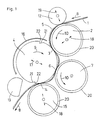
- FIG. 1 shows a schematic side view of the device according to the invention for sealing pile-bearing tissues.
- the pile-bearing fabric 1 encloses a first transport roller 2 over part of the circumference with the fabric side.
- a brush roller is arranged - not recognizable in the drawing - which takes a liquid from a metering roller, also not shown.
- the brush roller impregnated with a chemical liquid transfers the liquid, which is used to mask the pile fibers, in doses to the fabric.
- the pile-carrying fabric is inserted into the gap between the introduction roller 12 and the transport roller 2 and moved by the first conveyor roller 2 in the transport direction 8, so that the pile-carrying fabric 1 reaches a first flex zone, which is extends along the line of contact 3 between the work roll 4 and the first transport roll 2.
- the pile-bearing fabric 1 is subjected to a flexing effect.
- the work roll 4 rotating at high speed in the direction of rotation 9 supports the transport of the pile-bearing fabric 1 in the direction 8.
- grooves 11 incorporated in the work roll 4 increase the flexing effect and thus support mechanical separation and cleaning of the schematically indicated pile fibers 5 at the first contact line 3
- the peripheral speed of the work roll exceeds the transport speed of the fabric by more than a hundred times.
- the fabric is therefore swept over 200 times from the edge of the groove during its contact with the work roll.
- the convex curvature of the material fed in towards the pile side fans out the individual fibers and thus additionally facilitates the mechanical separation and cleaning of the fibers.
- the pile-bearing fabric 1 comes into contact with the work roll 4 with its pile side.
- a rise in temperature of the pile fibers is forced by the friction effect and / or heating.
- Chemical finishing reagents applied beforehand for example with the brush roller (not shown), can thereby begin their curing process.
- the pile-bearing fabric 1 emerges from the processing zone in which it is in contact with the work roll 4.
- the end moves tension-free towards the transport roller 7, where it is gripped by the transport roller 7 and forms a relief zone a second contact zone 6 between the work roll 4 and a second transport roll 7 is supplied.
- the relief zone remains intact because the transport rollers are driven synchronously.
- a flexing effect is exerted once more in the flexing zone 6 and the mechanical separation and cleaning of the pile fibers 5 is thus achieved.
- the free circumference of the work roll 4 is shielded from thermal insulation 16.
- the transport roller 7 is spatially fixed.
- the work roll 4 is designed to be movable in the direction of the arrow 17 and can be locked in its free end position.
- the work roll 4 bears against the transport roll 7 with a preselectable force. This force can either be a component of gravity resulting from a corresponding preloaded spring. In this way, pile-bearing fabrics of different thicknesses can be processed without overloading the roller drives or stressing the fabric excessively.
- the distance between the rollers adjusts itself automatically to the fabric to be processed.
- transport roller 2 is designed to be movable in the direction of arrow 18. It also bears against work roll 4 with a preselectable force.
- the insertion roller 12 is designed to be movable in the direction of the arrow 19.
- the transport rollers 2, 7, 15 have an approx. 5 mm. strong felt-like coating, while the work roll 4, and preferably also the feed roller 12, are equipped with a smooth surface, preferably made of metal.
- a smooth surface preferably made of metal.
- two grooves 21 are incorporated, the edges 22 of which exert the effect described on the pile fibers 5 in. If the grooves 21 are made in a helical fit with the opposite angle of inclination, then it is evened out; Working moment advantageous. Overall, however, this also results in a reduced sound emission and less vibration in the operation of the entire device
- Dust and loose pile fibers are removed directly by the suction device 13.
- the fabric In the suction flow, the fabric is flushed with air, which additionally supports a cross-bridge-free masking of the fibers.
Landscapes
- Engineering & Computer Science (AREA)
- Mechanical Engineering (AREA)
- Textile Engineering (AREA)
- Treatment Of Fiber Materials (AREA)
Applications Claiming Priority (4)
| Application Number | Priority Date | Filing Date | Title |
|---|---|---|---|
| DE9004593U DE9004593U1 (de) | 1990-04-24 | 1990-04-24 | Vorrichtung zum Veredeln von flortragenden Geweben |
| DE9004593U | 1990-04-24 | ||
| EP90118279 | 1990-09-24 | ||
| EP90118279 | 1990-09-24 |
Publications (2)
| Publication Number | Publication Date |
|---|---|
| EP0453630A1 true EP0453630A1 (fr) | 1991-10-30 |
| EP0453630B1 EP0453630B1 (fr) | 1994-07-13 |
Family
ID=25956544
Family Applications (1)
| Application Number | Title | Priority Date | Filing Date |
|---|---|---|---|
| EP90120659A Expired - Lifetime EP0453630B1 (fr) | 1990-04-24 | 1990-10-28 | Procédé et installation de traitement de tissus à poils |
Country Status (3)
| Country | Link |
|---|---|
| EP (1) | EP0453630B1 (fr) |
| AT (1) | ATE108498T1 (fr) |
| DE (1) | DE59006442D1 (fr) |
Cited By (1)
| Publication number | Priority date | Publication date | Assignee | Title |
|---|---|---|---|---|
| US6941623B2 (en) * | 2000-03-10 | 2005-09-13 | Wool Research Organisation Of New Zealand, Inc. | Finishing treatment for pile carpets |
Citations (4)
| Publication number | Priority date | Publication date | Assignee | Title |
|---|---|---|---|---|
| US3586228A (en) * | 1969-10-17 | 1971-06-22 | Polrotor Inc | Fabric conveyor for use in conjunction with electrifier cylinders |
| FR2277923A1 (fr) * | 1974-07-12 | 1976-02-06 | Krafft Gobel Kg Textilmaschine | Dispositif pour l'ourdissage et le compactage de fibres, notamment de feutres |
| GB1592151A (en) * | 1977-09-20 | 1981-07-01 | Iws Nominee Co Ltd | Fabric treatment |
| DE3205918A1 (de) * | 1982-02-19 | 1983-09-08 | Schoeller, geb. Breidenbend, Astrid, 5100 Aachen | Verfahren und vorrichtung zum walken und/oder waschen von im strang gefuehrten textilen flaechengebilden |
-
1990
- 1990-10-28 EP EP90120659A patent/EP0453630B1/fr not_active Expired - Lifetime
- 1990-10-28 DE DE59006442T patent/DE59006442D1/de not_active Expired - Fee Related
- 1990-10-28 AT AT90120659T patent/ATE108498T1/de active
Patent Citations (4)
| Publication number | Priority date | Publication date | Assignee | Title |
|---|---|---|---|---|
| US3586228A (en) * | 1969-10-17 | 1971-06-22 | Polrotor Inc | Fabric conveyor for use in conjunction with electrifier cylinders |
| FR2277923A1 (fr) * | 1974-07-12 | 1976-02-06 | Krafft Gobel Kg Textilmaschine | Dispositif pour l'ourdissage et le compactage de fibres, notamment de feutres |
| GB1592151A (en) * | 1977-09-20 | 1981-07-01 | Iws Nominee Co Ltd | Fabric treatment |
| DE3205918A1 (de) * | 1982-02-19 | 1983-09-08 | Schoeller, geb. Breidenbend, Astrid, 5100 Aachen | Verfahren und vorrichtung zum walken und/oder waschen von im strang gefuehrten textilen flaechengebilden |
Cited By (1)
| Publication number | Priority date | Publication date | Assignee | Title |
|---|---|---|---|---|
| US6941623B2 (en) * | 2000-03-10 | 2005-09-13 | Wool Research Organisation Of New Zealand, Inc. | Finishing treatment for pile carpets |
Also Published As
| Publication number | Publication date |
|---|---|
| DE59006442D1 (de) | 1994-08-18 |
| EP0453630B1 (fr) | 1994-07-13 |
| ATE108498T1 (de) | 1994-07-15 |
Similar Documents
| Publication | Publication Date | Title |
|---|---|---|
| DE10232148B4 (de) | Verfahren zum flüssigkeitsdurchlässigen Perforieren eines Vlieses | |
| DE69409648T2 (de) | Vorrichtung zur Abnahme und zum Transportieren mit hoher Geschwindigkeit eines Faservlieses am Ende einer Karde | |
| EP0775777A3 (fr) | Calandre pour machine à papier ou machine de couchage | |
| DE3018373C2 (de) | Verfahren zum Schären von Kettfäden für Web- und Wirkmaschinen sowie Schäranlage zur Durchführung des Verfahrens | |
| DE4419540C2 (de) | Verfahren und Vorrichtung zur Reinigung einer umlaufenden Sieb- oder Filzbahn | |
| DE69833301T2 (de) | Verfahren und Vorrichtung zur Oberflächenbehandlung von Textilbahnen mittels beschichteten Drähten | |
| WO2012098223A1 (fr) | Dispositif et procédé pour la fabrication d'un tissu composite non-tisse | |
| DE2530872C3 (de) | Vorrichtung zum Nadeln bahnförmigen Textilmaterials | |
| DE2433602C3 (de) | Vorrichtung zum Walken | |
| CH672324A5 (fr) | ||
| EP0453630B1 (fr) | Procédé et installation de traitement de tissus à poils | |
| DE2249740B2 (de) | Verfahren und vorrichtung zum kontinuierlichen reinigen von schnellaufenden folienbahnen | |
| DE1810790C3 (de) | Verfahren und Vorrichtung zum Entfernen von Verunreinigungen aus einer kontinuierlichen Textilfaser bahn | |
| EP0424421B1 (fr) | Procede et dispositif de reunion de voiles de carde en fibres, notamment en fibres textiles | |
| AT395025B (de) | Verfahren und vorrichtung zum nadeln einer warenbahn fuer die papiermaschinenfilzherstellung | |
| DE2855153A1 (de) | Benadeltes element fuer textilmaschinen und -verfahren | |
| DE9004593U1 (de) | Vorrichtung zum Veredeln von flortragenden Geweben | |
| DE2613844A1 (de) | Vorrichtung zum zwischentransport von fasermaterial in einer tandem-karde | |
| DE3037445C2 (de) | Nadelstabstreckwerk für Faserbänder | |
| DE3729647C2 (fr) | ||
| DE4418801A1 (de) | Reinigungsvorrichtung für Walzen und/oder Zylinder in Papiermaschinen | |
| EP3536841B1 (fr) | Installation et procédé de production d'un velours textile | |
| DE11273C (de) | Quer cirkulirende Decken für Baumwollkrempeln | |
| DE3929490A1 (de) | Verfahren und vorrichtung zum taktweisen abheben eines an einer bewegbar gelagerten putzleiste angeordneten abstreifelements | |
| DD149095A1 (de) | Verfahren und anlage zur musterung von textilen flaechengebilden |
Legal Events
| Date | Code | Title | Description |
|---|---|---|---|
| PUAI | Public reference made under article 153(3) epc to a published international application that has entered the european phase |
Free format text: ORIGINAL CODE: 0009012 |
|
| AK | Designated contracting states |
Kind code of ref document: A1 Designated state(s): AT BE CH DE FR GB IT LI LU NL |
|
| 17P | Request for examination filed |
Effective date: 19910907 |
|
| 17Q | First examination report despatched |
Effective date: 19931210 |
|
| GRAA | (expected) grant |
Free format text: ORIGINAL CODE: 0009210 |
|
| ITF | It: translation for a ep patent filed | ||
| AK | Designated contracting states |
Kind code of ref document: B1 Designated state(s): AT BE CH DE FR GB IT LI LU NL |
|
| PG25 | Lapsed in a contracting state [announced via postgrant information from national office to epo] |
Ref country code: NL Effective date: 19940713 |
|
| REF | Corresponds to: |
Ref document number: 108498 Country of ref document: AT Date of ref document: 19940715 Kind code of ref document: T |
|
| ET | Fr: translation filed | ||
| GBT | Gb: translation of ep patent filed (gb section 77(6)(a)/1977) |
Effective date: 19940714 |
|
| REF | Corresponds to: |
Ref document number: 59006442 Country of ref document: DE Date of ref document: 19940818 |
|
| PG25 | Lapsed in a contracting state [announced via postgrant information from national office to epo] |
Ref country code: AT Effective date: 19941028 |
|
| PG25 | Lapsed in a contracting state [announced via postgrant information from national office to epo] |
Ref country code: LU Free format text: LAPSE BECAUSE OF NON-PAYMENT OF DUE FEES Effective date: 19941031 |
|
| PGFP | Annual fee paid to national office [announced via postgrant information from national office to epo] |
Ref country code: BE Payment date: 19941031 Year of fee payment: 5 |
|
| NLV1 | Nl: lapsed or annulled due to failure to fulfill the requirements of art. 29p and 29m of the patents act | ||
| PLBE | No opposition filed within time limit |
Free format text: ORIGINAL CODE: 0009261 |
|
| STAA | Information on the status of an ep patent application or granted ep patent |
Free format text: STATUS: NO OPPOSITION FILED WITHIN TIME LIMIT |
|
| PG25 | Lapsed in a contracting state [announced via postgrant information from national office to epo] |
Ref country code: FR Effective date: 19950630 |
|
| 26N | No opposition filed | ||
| REG | Reference to a national code |
Ref country code: FR Ref legal event code: ST |
|
| PGFP | Annual fee paid to national office [announced via postgrant information from national office to epo] |
Ref country code: GB Payment date: 19951018 Year of fee payment: 6 |
|
| PG25 | Lapsed in a contracting state [announced via postgrant information from national office to epo] |
Ref country code: BE Effective date: 19951031 |
|
| BERE | Be: lapsed |
Owner name: KISKAN DIGRAN Effective date: 19951031 |
|
| PG25 | Lapsed in a contracting state [announced via postgrant information from national office to epo] |
Ref country code: GB Effective date: 19961028 |
|
| GBPC | Gb: european patent ceased through non-payment of renewal fee |
Effective date: 19961028 |
|
| PGFP | Annual fee paid to national office [announced via postgrant information from national office to epo] |
Ref country code: CH Payment date: 20041125 Year of fee payment: 15 |
|
| PGFP | Annual fee paid to national office [announced via postgrant information from national office to epo] |
Ref country code: DE Payment date: 20041215 Year of fee payment: 15 |
|
| PG25 | Lapsed in a contracting state [announced via postgrant information from national office to epo] |
Ref country code: IT Free format text: LAPSE BECAUSE OF NON-PAYMENT OF DUE FEES Effective date: 20051028 |
|
| PG25 | Lapsed in a contracting state [announced via postgrant information from national office to epo] |
Ref country code: LI Free format text: LAPSE BECAUSE OF NON-PAYMENT OF DUE FEES Effective date: 20051031 Ref country code: CH Free format text: LAPSE BECAUSE OF NON-PAYMENT OF DUE FEES Effective date: 20051031 |
|
| PG25 | Lapsed in a contracting state [announced via postgrant information from national office to epo] |
Ref country code: DE Free format text: LAPSE BECAUSE OF NON-PAYMENT OF DUE FEES Effective date: 20060503 |
|
| REG | Reference to a national code |
Ref country code: CH Ref legal event code: PL |