EP0453665A1 - Apparat zum Abgleich der Bildgeometrie von Bildwiedergabegeräten mit einer Kathodenstrahlröhre - Google Patents
Apparat zum Abgleich der Bildgeometrie von Bildwiedergabegeräten mit einer Kathodenstrahlröhre Download PDFInfo
- Publication number
- EP0453665A1 EP0453665A1 EP90304324A EP90304324A EP0453665A1 EP 0453665 A1 EP0453665 A1 EP 0453665A1 EP 90304324 A EP90304324 A EP 90304324A EP 90304324 A EP90304324 A EP 90304324A EP 0453665 A1 EP0453665 A1 EP 0453665A1
- Authority
- EP
- European Patent Office
- Prior art keywords
- ray tube
- cathode ray
- image
- display device
- tube display
- Prior art date
- Legal status (The legal status is an assumption and is not a legal conclusion. Google has not performed a legal analysis and makes no representation as to the accuracy of the status listed.)
- Withdrawn
Links
- 238000000034 method Methods 0.000 claims description 24
- 238000012360 testing method Methods 0.000 claims description 13
- 238000004519 manufacturing process Methods 0.000 description 5
- 238000010586 diagram Methods 0.000 description 4
- 230000007704 transition Effects 0.000 description 4
- 238000012545 processing Methods 0.000 description 3
- 238000003491 array Methods 0.000 description 2
- 241000226585 Antennaria plantaginifolia Species 0.000 description 1
- 241000826860 Trapezium Species 0.000 description 1
- 230000005540 biological transmission Effects 0.000 description 1
- 238000007796 conventional method Methods 0.000 description 1
- 230000000694 effects Effects 0.000 description 1
- 239000000463 material Substances 0.000 description 1
- 238000005259 measurement Methods 0.000 description 1
- 230000003287 optical effect Effects 0.000 description 1
- 239000013307 optical fiber Substances 0.000 description 1
- 239000012780 transparent material Substances 0.000 description 1
Images


Classifications
-
- H—ELECTRICITY
- H04—ELECTRIC COMMUNICATION TECHNIQUE
- H04N—PICTORIAL COMMUNICATION, e.g. TELEVISION
- H04N17/00—Diagnosis, testing or measuring for television systems or their details
- H04N17/04—Diagnosis, testing or measuring for television systems or their details for receivers
Definitions
- the invention relates to apparatus for image alignment in cathode ray tube display devices.
- the conventional method of image alignment in cathode ray tube display devices comprises generating a test pattern on the cathode ray tube screen, including at least one image feature, overlaying a mask on the screen and manually adjusting the image until the image feature falls within specified limits for its correct position marked on the overlay mask.
- This manual adjustment has the disadvantages firstly of being subjective and secondly of being a difficult, time-consuming task. It is therefore an object of the present invention to provide a method by which this process may be made objective, rather than subjective, thereby allowing the process to be wholly or partly automated.
- apparatus for image alignment in cathode ray tube display devices comprising; at least one light detector; support structure for locating each light detector such that light from a corresponding predetermined screen location is incident thereon; each light detector producing a signal indicative of an image feature when the image feature is displayed at the predetermined screen location corresponding to the light detector.
- Such apparatus provides objective, electronic data regarding the position of image features on the screen.
- the apparatus includes a plurality of light detectors arranged to receive light from at least one linear array of predetermined screen locations, the linear array of screen locations being substantially perpendicular to an edge of the screen. In this way the apparatus may be used to detect features located at the edges of the image.
- the apparatus includes a plurality of light detectors arranged to receive light from at least one two-dimensional array of predetermined screen locations at or adjacent a corner of the screen. The apparatus may thereby be used to detect features located at the corners of the image.
- the support structure comprises a sheet carrying said light detectors and means for locating the sheet in a predetermined disposition with respect to the cathode ray tube screen.
- the apparatus thereby forms a mask which may be mounted over the cathode ray tube screen with the light detectors receiving light directly from the screen.
- the sheet is transparent and partially reflective thereby allowing an operator to see the image features, but reducing interference from ambient light.
- the sheet further has marks thereon for initial approximate alignment of said image feature. In this way an approximate manual pre-alignment may be performed.
- the apparatus further comprises; means for controlling said cathode ray tube display device to display image features which image features are intended for display at specific screen locations; means for receiving and responding to the signals given by the light detectors to determine from the signals screen location information for the displayed image features.
- a pattern is displayed which should, on a correctly aligned cathode ray tube display device, be displayed at the specific locations. The actual position of the pattern is measured by the light detectors.
- the apparatus further comprises: means for comparing the location information with the intended specific screen locations to determine whether the image features are displayed sufficiently closely to their intended specific screen locations; means for deriving adjustment information from the location information indicative of adjustments to the cathode ray tube display device causing the features of the image to be displayed more closely to their intended specific screen locations.
- the objective data is interpreted and may be employed to adjust the image if adjustments are necessary.
- the invention further comprises a display device, allowing either the image feature location information or the adjustment information to be displayed to an operator, who may then manually adjust the cathode ray tube display device aided by the objective image location information or the adjustment information.
- the apparatus comprises means responsive to the adjustment information, for automated adjustment of the cathode ray tube display device.
- the entire alignment procedure may thereby be automated.
- the specific screen locations follow the edges of the screen.
- the extremities of the image are adjusted thus assuring alignment of the image over the whole screen area.
- a method for aligning the image in a cathode ray tube display device comprising the steps of:
- the step of making the adjustments to the cathode ray tube display device includes the step of displaying location and/or adjustment information on a display device to an operator.
- the operator may either use the location information directly and make the adjustments to the cathode ray tube display device, for example on a trial and error basis, or he may use the adjustment information to determine the precise adjustments necessary. If the operator uses the location information directly then the invention still has the advantage that an objective basis is given for the end point of the alignment process.
- the step of making the adjustments to the cathode ray tube display device comprises the step of making automated adjustments.
- the method comprises the prior step of adjusting the cathode ray tube display device so that the features of the image are approximately located at the locations indicated by marks on the sheet.
- the image alignment apparatus may form part of a test rig in a production line for manufacturing cathode ray tube monitors.
- the monitor is brought onto the test rig, the mask is placed in front of each monitor unit, and data given by the mask is interpreted by software, either to give assistance to an operator in adjusting the cathode ray tube monitor or, alternatively to allow an automated, closed-loop adjustment system to be employed which directly utilises the data provided by the mask to make the necessary adjustments to the cathode ray tube. In either case an objective indication is given as to when criteria for correct alignment of the image are met.
- test rig for image alignment of cathode ray tube display devices, the test rig comprising: apparatus according to the invention; means for bringing together the apparatus and the display device such that the sheet is disposed with respect to the cathode ray tube screen such that light from the corresponding predetermined screen locations is incident on each light detector.
- cathode ray tube display devices referred to in this specification could be, for example, monitors for use in data processing systems or could equally well be television receivers or monitors for use in video applications or any other kind of cathode ray tube display device.
- light detectors are mounted on a transparent sheet material to form a mask which is then mounted over the cathode ray tube screen.
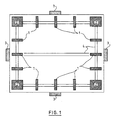
- the arrangement of the light detectors on the mask in the embodiments of the invention is shown schematically in figure 1.
- the mask is fabricated from a transparent material to which are attached 12 light sensitive linear arrays (1) arranged around the nominal image periphery.
- the array axes are vertical at the top and bottom of the image and horizontal at the left and right edges of the image.
- Two-dimensional arrays of light detectors are placed at the four corners of the image (2) in order to provide both horizontal and vertical image position data.
- This arrangement of the mask is used to detect a feature, such as a line, located near the edge of an image. It allows each array to detect the image edge feature over a range of positions.
- this arrangement of the light detectors is only one of many possibilities within the scope of the invention. It is not necessary for the light detectors to be mounted directly on the screen itself so long as they are mounted on a support structure such that light from predetermined locations on the screen may impinge upon them. It is possible, for example, that optical means, such as optical fibre transmission cable, may be used to guide the light from the screen locations to the light detectors. This is within the scope of the invention.
- the mask is mounted to cover the entire cathode ray tube screen using the mounting points (3). Light from the screen falls directly on the light detectors. It is advantageous, therefore, in these embodiments for the mask to be as close as possible to the screen surface to avoid parallax effects.
- the mask is also marked with tramlines (4) to define tolerances for an approximate manual pre-alignment of the monitor. These are also shown in figure 1.
- the mask is half-silvered on its front surface to reflect ambient light whilst transmitting light emitted from the screen. This improves the signal to noise ratio by reducing the interference from ambient light.
- FIG. 1 is a block diagram of the arrangement of the electronics in the interface for the embodiments described here.
- Each array of detectors has a serial data shift connected to one input of a multiplexor (5), the software selects which array to sample via select lines (6) depending on the current measurement requirements.
- Data from the selected array is clocked through the multiplexor (5) into a transition detector (7), the clock line (8) is also used to increment a position counter (9).
- the position counter (9) corresponds to the address (within the array) of the current data.
- the image features to be detected by the mask consist of bright lines on a dark background.
- the position counter (9) is incremented by the data clock (8) allowing the transition detector output to be used as a load pulse for the "on” address register (10).
- the data will continue to be sampled until the next change is detected. This will be "on” (bright line) to "off” (dark) and the corresponding address will be loaded into the "off” address register (10).
- the point midway between the "on” and “off” addresses is used as the line position.
- These address registers (10) may be accessed by the computer interface (12) via a data bus (13), which is a simple bus allowing the control computer to read the contents of the "on” and "off” address registers.
- the light detectors are at known positions on the mask, therefore the position of the image edge is known and the distortion of the image edge can be approximated.
- the threshold register (11) contains a value loaded by the software which is used by the transition detector (7) to determine when to consider the detector data as a logical 1.
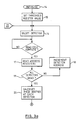
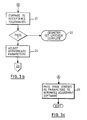
- FIGS 3a, 3b, and 3c are flow charts showing the alignment process used in embodiments of the invention.
- a detector is selected, 16.
- the control means reads the "on" and "off" address registers, 17. This cycle is repeated for all the detectors by incrementing the detector address, 18, until all the detectors have been read, 19.
- the image centre is calculated for each detector, 20.
- the image parameters are used by an operator to adjust the image. Adjustment may be made of parameters such as width, height, tilt, trapezium distortion, horizontal and vertical centring, horizontal pincushion or barrelling. How these adjustments are made by the operator depends in detail upon the cathode ray tube display device being aligned and will not be discussed herein.
- the image parameters are compared, 21, with acceptance tolerances. If the image parameters are acceptable the geometry set-up is deemed to be complete. If the parameters are not acceptable the operator adjusts, 24, appropriate parameters and the process returns to point 25 in figure 3a. The image position is then redetermined. The process is repeated until the image position is correct.
- the image parameters are passed, 23, to image adjustment software which calculates the adjustments necessary and makes them.
- image adjustment software which calculates the adjustments necessary and makes them.
- the nature of the image adjustment software and how it calculates the adjustment information from the image location information supplied by the mask depends in detail upon the cathode ray tube display device concerned.
- the adjustment information may be in the form of adjustments to analogue potentiometers which may be achieved by the use of robot means.
- the adjustments may be to digital potentiometers and may be achieved by sending a suitable signal to the driver circuitry of the display device.
- the mask and interface are used in a test rig for standard image alignment as part of a manufacturing process.
- This is illustrated schematically in figure 4.
- a monitor unit immediately after being fabricated on a production line (32), is brought onto the test rig (30) so that the mask (34) may be placed in front of the cathode ray tube screen.
- the monitor is powered up and an image displayed on the screen so that the edge of the image is visible.
- the mask is employed to give data regarding the location of the edge of the image with respect to the desired position for the image. These data are used to calculate the necessary adjustments to the monitor which cause the image to be nearer to its desired position. These adjustments are then made either manually by an operator or by automatic means.
- the process is repeated until the actual image position is sufficiently close to its desired position. When one monitor has been adjusted it is moved off the test rig and the next one is brought on and the process is repeated.
- figure 4 is only a schematic representation of a test rig according to the invention with the monitors shown for clarity with their screens facing in the direction of the line. In practice it is more likely that the monitors be placed on the line with the screens facing outwards in order to minimise the movement of the mask.
- the invention has the advantages over the prior art of low-cost and of reproducibility by the provision of objective data for monitor alignment. It enables a computer to be used to calculate the necessary adjustments to the display device. The invention provides for full automation of the alignment process, thereby allowing further cost and time savings.
Landscapes
- Engineering & Computer Science (AREA)
- Health & Medical Sciences (AREA)
- Biomedical Technology (AREA)
- General Health & Medical Sciences (AREA)
- Multimedia (AREA)
- Signal Processing (AREA)
- Testing, Inspecting, Measuring Of Stereoscopic Televisions And Televisions (AREA)
Priority Applications (3)
| Application Number | Priority Date | Filing Date | Title |
|---|---|---|---|
| EP90304324A EP0453665A1 (de) | 1990-04-23 | 1990-04-23 | Apparat zum Abgleich der Bildgeometrie von Bildwiedergabegeräten mit einer Kathodenstrahlröhre |
| JP5921591A JPH0595570A (ja) | 1990-04-23 | 1991-03-22 | イメージ整合装置 |
| CA 2039352 CA2039352A1 (en) | 1990-04-23 | 1991-03-28 | Image alignment apparatus |
Applications Claiming Priority (1)
| Application Number | Priority Date | Filing Date | Title |
|---|---|---|---|
| EP90304324A EP0453665A1 (de) | 1990-04-23 | 1990-04-23 | Apparat zum Abgleich der Bildgeometrie von Bildwiedergabegeräten mit einer Kathodenstrahlröhre |
Publications (1)
| Publication Number | Publication Date |
|---|---|
| EP0453665A1 true EP0453665A1 (de) | 1991-10-30 |
Family
ID=8205388
Family Applications (1)
| Application Number | Title | Priority Date | Filing Date |
|---|---|---|---|
| EP90304324A Withdrawn EP0453665A1 (de) | 1990-04-23 | 1990-04-23 | Apparat zum Abgleich der Bildgeometrie von Bildwiedergabegeräten mit einer Kathodenstrahlröhre |
Country Status (3)
| Country | Link |
|---|---|
| EP (1) | EP0453665A1 (de) |
| JP (1) | JPH0595570A (de) |
| CA (1) | CA2039352A1 (de) |
Cited By (1)
| Publication number | Priority date | Publication date | Assignee | Title |
|---|---|---|---|---|
| GB2300550A (en) * | 1994-11-23 | 1996-11-06 | Lite On Technology Corp | Automatic video display testing and adjustment system |
Citations (5)
| Publication number | Priority date | Publication date | Assignee | Title |
|---|---|---|---|---|
| EP0135642A1 (de) * | 1983-08-05 | 1985-04-03 | Deutsche ITT Industries GmbH | Sensorsystem für Fernsehbildröhren |
| EP0204112A2 (de) * | 1985-06-03 | 1986-12-10 | International Business Machines Corporation | Verfahren und System zur automatischen Einstellung und Prüfung der Vorderseite eines Bildschirmes |
| US4649324A (en) * | 1984-12-03 | 1987-03-10 | Polaroid Corporation | Method and apparatus for adjusting CRT geometry |
| US4684982A (en) * | 1986-02-28 | 1987-08-04 | Rca Corporation | Multiple array panel matrix measurement system |
| US4897721A (en) * | 1988-05-16 | 1990-01-30 | Apple Computer | Automated testing apparatus for screen alignment |
Family Cites Families (2)
| Publication number | Priority date | Publication date | Assignee | Title |
|---|---|---|---|---|
| JPS5599882A (en) * | 1979-01-23 | 1980-07-30 | Toshiba Corp | Automatic adjustment method of dynamic convergence and its unit |
| FR2611083B1 (fr) * | 1987-02-13 | 1989-05-05 | Videocolor | Procede de mesure automatique de convergence et de determination des corrections a apporter a des deviateurs pour tubes cathodiques trichromes, et machine de mise en oeuvre |
-
1990
- 1990-04-23 EP EP90304324A patent/EP0453665A1/de not_active Withdrawn
-
1991
- 1991-03-22 JP JP5921591A patent/JPH0595570A/ja active Pending
- 1991-03-28 CA CA 2039352 patent/CA2039352A1/en not_active Abandoned
Patent Citations (5)
| Publication number | Priority date | Publication date | Assignee | Title |
|---|---|---|---|---|
| EP0135642A1 (de) * | 1983-08-05 | 1985-04-03 | Deutsche ITT Industries GmbH | Sensorsystem für Fernsehbildröhren |
| US4649324A (en) * | 1984-12-03 | 1987-03-10 | Polaroid Corporation | Method and apparatus for adjusting CRT geometry |
| EP0204112A2 (de) * | 1985-06-03 | 1986-12-10 | International Business Machines Corporation | Verfahren und System zur automatischen Einstellung und Prüfung der Vorderseite eines Bildschirmes |
| US4684982A (en) * | 1986-02-28 | 1987-08-04 | Rca Corporation | Multiple array panel matrix measurement system |
| US4897721A (en) * | 1988-05-16 | 1990-01-30 | Apple Computer | Automated testing apparatus for screen alignment |
Cited By (2)
| Publication number | Priority date | Publication date | Assignee | Title |
|---|---|---|---|---|
| GB2300550A (en) * | 1994-11-23 | 1996-11-06 | Lite On Technology Corp | Automatic video display testing and adjustment system |
| GB2300550B (en) * | 1994-11-23 | 1999-03-24 | Lite On Technology Corp | Automatic video display testing and adjusting system |
Also Published As
| Publication number | Publication date |
|---|---|
| JPH0595570A (ja) | 1993-04-16 |
| CA2039352A1 (en) | 1991-10-24 |
Similar Documents
| Publication | Publication Date | Title |
|---|---|---|
| US5638461A (en) | Stereoscopic electro-optical system for automated inspection and/or alignment of imaging devices on a production assembly line | |
| EP0204112B1 (de) | Verfahren und System zur automatischen Einstellung und Prüfung der Vorderseite eines Bildschirmes | |
| KR0167843B1 (ko) | 액정 디스플레이 패널 화질 검사 장치 및 액정 디스플레이 화상 프리샘플링 방법 | |
| AU693234B2 (en) | Method and apparatus for transforming coordinate systems in an automated video monitor alignment system | |
| JP3129245B2 (ja) | 撮像装置 | |
| JP2004260785A (ja) | 画像歪み補正機能を備えたプロジェクタ装置 | |
| KR20000022184A (ko) | 전자 디스플레이 장치용 테스트와 정렬 시스템 및 그 테스트기구 | |
| US5426500A (en) | Illuminance measurement of vehicle lamp | |
| US4330779A (en) | Display analyzer having angular degrees of freedom | |
| CA2039352A1 (en) | Image alignment apparatus | |
| EP2105790B1 (de) | Automatisches Geometriekorrektursystem für Rückprojektionssystem | |
| FI88095C (fi) | Automatisk reglering av bildskaorpa i bildroer | |
| US6124884A (en) | Apparatus for and method of measuring image qualities of color display unit | |
| JPH0728166A (ja) | ビデオプロジェクター装置 | |
| US4794462A (en) | Method and system for patching an original at a desired angular orientation on a scanner input drum or an original patching sheet and extracting original trimming data | |
| US6879412B1 (en) | Method for optimizing the best resolution of an optical scanning system and apparatus for the same | |
| KR19990086296A (ko) | 영상표시기의 화면출력 검사 및 조정 장치와 그 방법 | |
| JP3350244B2 (ja) | 透過歪の測定方法及びその装置 | |
| JPH085460A (ja) | デイスプレイモニタの輝度/色度の検出方法とその装置 | |
| JPH04100094A (ja) | 表示試験装置 | |
| KR100407953B1 (ko) | 티브이의 편향 조정시스템 및 그 방법 | |
| JPS6348987A (ja) | 投写型デイスプレイのコンバ−ゼンス誤差補正装置 | |
| KR960016430B1 (ko) | 음극선관(crt)화면조정시스템 | |
| KR100299493B1 (ko) | 음극선관또는그와유사한제품의검사방법및시스템 | |
| KR980011041A (ko) | 헤드 드럼 조립체의 헤드 자세 측정장치 |
Legal Events
| Date | Code | Title | Description |
|---|---|---|---|
| PUAI | Public reference made under article 153(3) epc to a published international application that has entered the european phase |
Free format text: ORIGINAL CODE: 0009012 |
|
| AK | Designated contracting states |
Kind code of ref document: A1 Designated state(s): DE FR GB IT |
|
| 17P | Request for examination filed |
Effective date: 19911219 |
|
| 17Q | First examination report despatched |
Effective date: 19931208 |
|
| STAA | Information on the status of an ep patent application or granted ep patent |
Free format text: STATUS: THE APPLICATION IS DEEMED TO BE WITHDRAWN |
|
| 18D | Application deemed to be withdrawn |
Effective date: 19940419 |