EP0453719B1 - Peptide dérivé d'une bactériocine - Google Patents
Peptide dérivé d'une bactériocine Download PDFInfo
- Publication number
- EP0453719B1 EP0453719B1 EP91101895A EP91101895A EP0453719B1 EP 0453719 B1 EP0453719 B1 EP 0453719B1 EP 91101895 A EP91101895 A EP 91101895A EP 91101895 A EP91101895 A EP 91101895A EP 0453719 B1 EP0453719 B1 EP 0453719B1
- Authority
- EP
- European Patent Office
- Prior art keywords
- bacteriocin
- peptide
- amino acid
- cys
- activity
- Prior art date
- Legal status (The legal status is an assumption and is not a legal conclusion. Google has not performed a legal analysis and makes no representation as to the accuracy of the status listed.)
- Expired - Lifetime
Links
Images

Classifications
-
- C—CHEMISTRY; METALLURGY
- C07—ORGANIC CHEMISTRY
- C07K—PEPTIDES
- C07K14/00—Peptides having more than 20 amino acids; Gastrins; Somatostatins; Melanotropins; Derivatives thereof
-
- C—CHEMISTRY; METALLURGY
- C07—ORGANIC CHEMISTRY
- C07K—PEPTIDES
- C07K14/00—Peptides having more than 20 amino acids; Gastrins; Somatostatins; Melanotropins; Derivatives thereof
- C07K14/195—Peptides having more than 20 amino acids; Gastrins; Somatostatins; Melanotropins; Derivatives thereof from bacteria
Definitions
- the present invention relates to a peptide which is a bacteriocin.
- the present invention relates to the peptide in chemically pure form having a specific identified amino acid sequence and which is derived from a bacteriocin isolated from Pediococcus acidilactici NRRL-B-18050.
- Bhunia, et al (Bhunia, A. K., et al, J. Indust. Micro. 2 319-322 (1987); and Bhunia, A. K., et al., J. Appl. Bact. 65 261-268 (1988)) reported that Pediococcus acidilactici strain H produced a bacteriocin, pediocin H with a molecular weight estimated by SDS-PAGE to be about 2700 Da (Bhunia, 1988). The reported spectrum of activity, however, includes Staphylococcus aureus which is not a characteristic of the bacteriocin of the present invention.
- Tagg et al classify bacteriocins (Tagg, J. R., et al, Bacteriol. Rev. 40 , 722-756 (1976)).
- the lantibiotics are a category of bacteriocins of gram-positive bacteria. They are characterized by the presence of lanthionine bridges and dehydroalanine residues. They are also small, basic proteins.
- the bacteriocin of the present invention isolated from culture medium shows no evidence of post-translational modification of any of the amino acid side chains and therefore cannot be classified as a lantibiotic although the size and charge are characteristic of lantibiotic proteins. Also the amino acid sequence of some of the lantibiotics is known and is not similar to the bacteriocin of the present invention.
- Hoover, et al (Hoover, D. G., et al., J. Food Prot. 51 29-31, (1988)) reported bacterocin activity associated with a 5.5 MDa plasmid in several strains of Pediococcus isolated from fermented sausage including Pediococcus acidilactici NRRL-B-5627 which is essentially the same strain as NRRL-B-18050 described hereinafter.
- Graham and McKay (Graham, D. C. et al., Appl. Env. Micro. 50 , 532-534, (1985)) linked bacteriocin production to a 10.5 MDa plasmid in Pediococcus pentosaceus FBB-63.
- Daeschel and Klaenhammer reported that bacteriocin production in Pediococcus pentosaceus FBB-61 and L7230 was encoded by a 13.6 MDa plasmid. None of the bacteriocins were purified and sequenced. Purification is difficult since the bacteriocins are sensitive to structural changes caused by the purification.
- Bacteriocins from Pediococcus acidilactici NRRL-B-18050 is known as described in U.S. Patent No. 4,883,673 to Gonzalez .
- the bacteriocin produced was an impure form in a growth medium or derived from the growth medium by ammonium sulfate precipitation.
- the purified bacteriocin had an activity of up to about 32,000 Au per ml. This bacteriocin was determined not to be pure. Also it was determined that the bacteriocin had an apparent molecular weight of about 16,500 as described in U.S patent application Serial No. 07/148,044 filed January 25, 1988 by Vandenbergh .
- the problem was that since the bacteriocin was still impure it could not be synthesized by synthetic chemical means. The presence of the impurities produced variable results in use of impure bacteriocin.
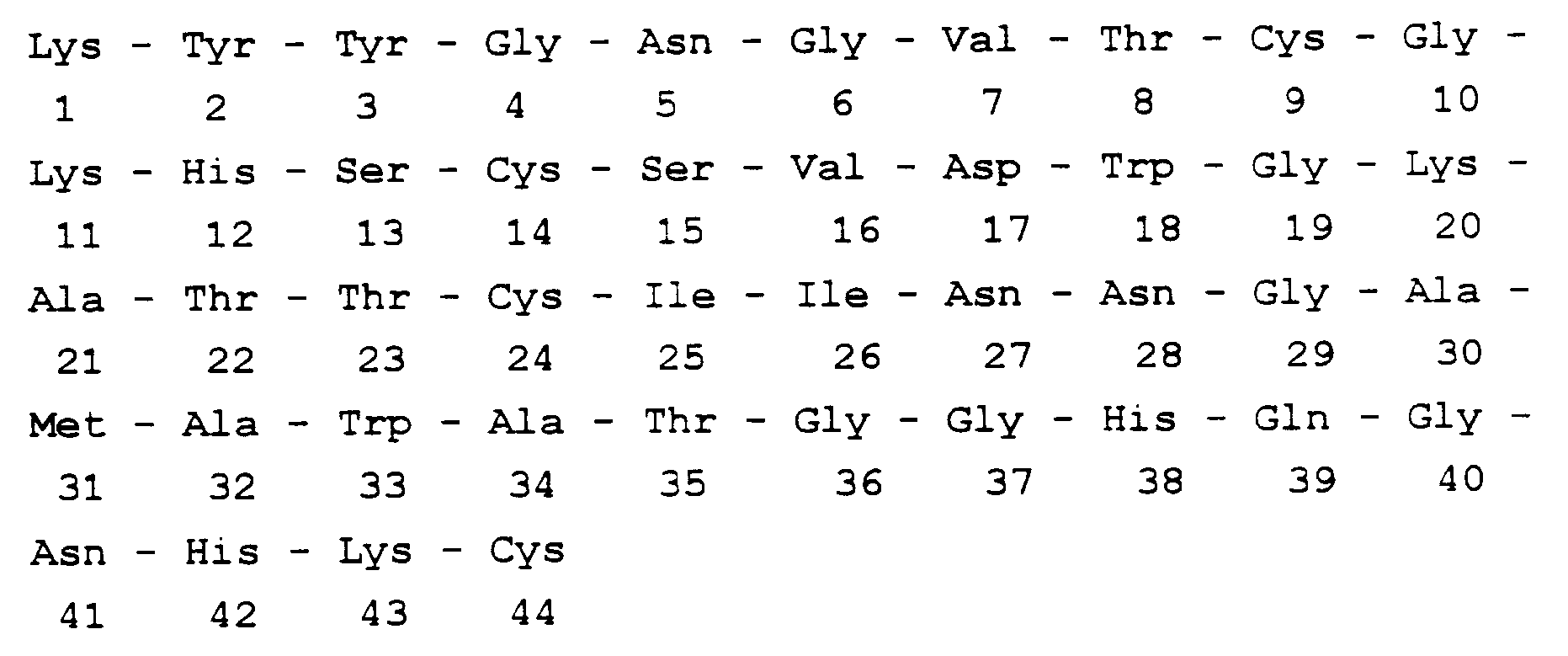
- Figure 1 shows the amino acid sequence of the tryptic fragments of the peptide of the present invention.
- the present invention relates to a peptide consisting of an amino acid sequence and disulfide bonds between Cys 9 and Cys 14 and between Cys 24 and Cys 44.
- the peptide of the present invention has a molecular weight of 4629 daltons which is about 1/3rd the apparent molecular weight of the impure bacteriocin as it is derived from the growth medium.
- the bacteriocin exhibits an Au of about 50,000 Au per ml, which is significantly higher than the Au of the impure bacteriocin.
- the peptide of the present invention can be synthesized by chemical means.
- Solid phase peptide synthesis is a method of preparing peptides by chemically coupling the individual amino acids in a specified sequence. It is described in Chem. Anal. Solid Phase Biochem; Chapter 101, pages 507-534 (1983). Synthesis begins at the C-terminal amino acid which is covalently attached to a solid support. The next amino acid is activated at the C-terminal and is blocked from reactivity at the N-terminal; therefore covalent coupling (formation of a peptide bond) occurs between the C-terminal of the second amino acid and the N-terminal of the first amino acid.
- SPPS Solid phase peptide synthesis
- the N-terminal of the second amino acid is deprotected and the cycle is begun again with the third amino acid.
- the peptide is cleaved from the solid support and the various side chain protecting groups are removed.
- the solid support is typically a chloromethylated copolymer of styrene and divinylbenzene. Cleavage from this support gives a free acid group at the C-terminus.
- a 4-methyl-benzylhydramine resin is used for the production of peptide amides. N-terminal protection during coupling is provided by a t-butoxycarbonyl (tBOC) group. The protecting group is removed with anhydrous hydrochloric acid and the resulting amine hydrochloride is neutralized with triethylamine.
- next t-BOC amino acid is activated with dicyclohexylcarbodiimide or diisopropylcarbodiimide and coupled to the prior amino acid.
- the cycle is repeated for each subsequent amino acid.
- Peptide-resin cleavage and side chain deprotection is performed simultaneously with anhydrous hydrofluoric acid to give the peptide or peptide amide.
- Improvements to the Merrifield method deal with solutions to specific problems which may result in reduced yield. Insufficient yield is a primary limiting factor in the production of long sequences.
- An example of such an improvement is the use of the 9-fluorenylmethoxycarbonyl(Fmoc) protecting group.
- the Fmoc protectant provides an acid stable group which is removed by treatment with an amine such as piperidine.
- the use of Fmoc can improve yield since it provides for the use of base for deprotection rather than acid.
- the use of acid deprotectant in the original Merrifield procedure has been associated with premature cleavage of the peptide-resin bond resulting in lowered yield.
- the bacteriocin PA-1 was purified to homogeneity by gel filtration and ion exchange chromatography, and reversed-phase liquid chromatography after considerable effort and numerous failures.
- the amino acid sequence of PA-1 was found to correspond to an open reading frame of the DNA sequence of a 6.2 megaldalton plasmid associated with bacteriocin activity in Pediococcus acidilactici PAC 1.0. From the sequence data, the conclusion was made that PA-1 was a basic protein with a molecular mass of 4629 daltons. The presence of four cysteine residues gave rise to the possibility of two disulfide bridges.
- Bacteriocin production was assayed by spotting 5 ul of a serial twofold dilution series onto MRS plates overlaid with soft agar seeded with Pediococcus pentosaceus FBB63 indicator cells.
- One AU is defined as the highest dilution yielding a definite zone on the indicator lawn.
- Active fractions were pooled and applied to a 2.5 cm x 90 cm CM-SepharoseTM column (Pharmacia, Piscataway, NJ) re-equilibrated against 0.05 M MES, PH 6.0. Activity was eluted with a linear gradient to 0.05 M MES containing 1 M sodium chloride, pH 6.0. Active fractions were pooled and dialyzed against a 10 fold excess of water using 1000 Da molecular weight cut-off dialysis tubing (Spectra-Por 6TM, Spectrum, Los Angeles, CA).
- Dialysate volume was reduced 12 fold by applying the dialysis tubing directly to solid 20 KDa polyethylene glycol (Carbowax, Union Carbide) and was then further reduced 3.5 fold by vacuum centrifugation (Speed-VacTM, Savant, Farmingdale, NY).
- Concentrated PA-1 was applied to a 1.0cm x 25cm C18 reversed-phase column (VydacTM, Hesperia, CA) equilibrated with 0.1% trifluoroacetic acid.
- Activity was eluted with a linear gradient to 45% acetonitrile over 30 minutes at 1.5 ml/min.
- Active fractions were determined by directly spotting aliquots of column effluent on MRS plates overlaid with soft agar containing Pediococcus pentosaceus FBB63 cells. Active fractions were dried by vacuum centrifugation and stored at -20°C.
- Phenyl isothiocyanate (PITC) derivatives were made using the directions supplied with a Pico-Tag derivatization system (Waters, division of Millipore, Milford, MA) and the PITC derivatives were detected at 254 nm using the suggested Pico-Tag protocol except that the reversed-phase column was a 0.45cm x 25cm C18 column (Vydac, Hesperia, CA) instead of the proprietary Pico-Tag column.
- Amino Acid Sequencing Sequence information was obtained with a gas phase sequencer ABI 475A using protocols supplied by ABI (Applied Biosystems, Inc., Foster City, California).
- the protein was first cleaved at Met-31 by mising with a 2 mg/ml solution of cyanogen bromide in 88% formic acid overnight at room temperature. Sequence information was then obtained simultaneously beginning with residues 1 and 32.
- SDS Polyacrylamide Gel Electrophoresis Gels were prepared at either a fixed acrylamide concentration of 12.5% or as a linear gradient from 10% to 25%.
- the crosslinking agent was piperazine diacrylamide (BioRad, Richmond, CA).
- the distribution of lysine residues in the PA-1 sequence is such that a tryptic digest will provide three peptide fragments containing a single cysteine residue. Disulfide bonded peptides produced by tryptic digestion are reduced to give rise to the component fragments. Amino acid analysis of each fragment is compared to calculated values from sequence data to identify the fragment with its tryptic peptide. In this manner, an unambiguous assignment of the disulfide bonding arrangement is possible.
- Tryptic cleavage of PA-1 is expected to give rise to three peptide chains and two single amino acids (see also Figure 1) as shown in Table 1: Tryptic digestion was done by reaction of 50 ug of purified PA-1 with 1% by weight trypsin (TPCK, Sigma) overnight at 37°C in 50 ul pH 8 ammonium bicarbonate buffer containing 0.1 mM calcium chloride. The reaction mix was applied to a 4.5 x 25 cm C-18 reversed phase column (Vydac, Hesperia, CA). Peaks were detected by monitoring absorbence at 220 nanometers.
- a second disulfide bond must then exist between Cys-24 and Cys-44. Reduction of this second bond would yield only a single peak in the chromatogram since the peptide bond to Cys-44 was disrupted by tryptic cleavage. Detection at 220 nm is sensitive to peptide bonds, not single amino acids. Peak 10 was reduced and rechromatographed, giving rise to a single peak. Amino acid analysis indicated a strong similarity to tryptic fragment T3. Since fragment T3 contains Cys-24, a disulfide bond to Cys-9 or Cys-14 would have been detected by the appearance of multiple peaks upon reduction of this fragment. Since a single peak was obtained after reduction, Cys-24 is presumed disulfide bonded to Cys-44.
- Peptide 7a corresponding to T1 contains an excess over the one lysine residue predicted. Unreduced peptide 7 also displays this apparent anomaly, with 2.6 moles lysine instead of 2.
- An explanation of these results is that the N-terminal lysine residue is resistant to the action of trypsin. This is not a really surprising result since the N-terminal is often a freely mobile region although folding might hinder mobility. The N-terminal lysine residue might present difficulty in binding to trypsin due to this mobility. In addition, the amino terminal amino group might be somewhat positively charged at pH 8 and might also interfere with trypsin binding.
- PA-1 activity elutes much later from the AC202 column.
- Table 3 shows the activity of the various fractions. Characterization .
- An amino acid analysis of PA-1 is shown in Table 4 along with the amino acid content obtained by sequencing.
- a titration of free cysteine residues with Ellman's reagent (DTNB, Sigma) reveals no free titratable sulfhydryl groups.
- the purified bacteriocin is derived from the gene product of plasmid-borne bacteriocin activity expressed in Pediococcus acidilactici strain NRRL-B-18050.
- a DNA sequence corresponding to the amino acid sequence reported here lies in an open reading frame of a 7.5 MDa plasmid in an area of the plasmid which has been shown necessary for expression of bacteriocin activity. From the sequence data, a molecular weight of 4629 was calculated. This value is lower than the apparent molecular weight calculated by using standard proteins with a mobility versus log molecular weight curve from the SDS gel.
- the bacteriocin was effective in inhibiting the bacterial strains listed in Table 5. TABLE 5 Inhibitory spectrum of purified bacteriocin in PA-1. Strain Inhibition Lactobacillus bifermentum 35409 Positive Lactobacillus casei subsp. casei NCIB 4114 Positive Lactobacillus casei 842 Positive Lactobacillus plantarum WSO Positive Lactobacillus plantarum 8014 Positive Leuconostoc dextranicum Lde 1.0 Positive Pediococcus acidilactici 25742 Positive Pediococcus pentosaceus PMR 25 Positive Pediococcus spp. (Isolated from radish) Positive Pediococcus spp. (Isolated from mushroom) Positive Enterococci (Isolated from cabbage) Positive Listeria monocytogenes Positive Lactococcus lactis ML 3 Negative
Landscapes
- Chemical & Material Sciences (AREA)
- Organic Chemistry (AREA)
- Health & Medical Sciences (AREA)
- General Health & Medical Sciences (AREA)
- Biochemistry (AREA)
- Biophysics (AREA)
- Life Sciences & Earth Sciences (AREA)
- Genetics & Genomics (AREA)
- Medicinal Chemistry (AREA)
- Molecular Biology (AREA)
- Proteomics, Peptides & Aminoacids (AREA)
- Gastroenterology & Hepatology (AREA)
- Preparation Of Compounds By Using Micro-Organisms (AREA)
- Peptides Or Proteins (AREA)
Claims (1)
- Peptide purifié, jusqu'à homogénéité, consistant en une séquence d'acides aminéset des ponts disulfures entre Cys 9 et Cys 14 et entre Cys 24 et Cys 44.
Applications Claiming Priority (2)
| Application Number | Priority Date | Filing Date | Title |
|---|---|---|---|
| US51410290A | 1990-04-25 | 1990-04-25 | |
| US514102 | 1990-04-25 |
Publications (3)
| Publication Number | Publication Date |
|---|---|
| EP0453719A2 EP0453719A2 (fr) | 1991-10-30 |
| EP0453719A3 EP0453719A3 (en) | 1992-01-02 |
| EP0453719B1 true EP0453719B1 (fr) | 1994-12-28 |
Family
ID=24045795
Family Applications (1)
| Application Number | Title | Priority Date | Filing Date |
|---|---|---|---|
| EP91101895A Expired - Lifetime EP0453719B1 (fr) | 1990-04-25 | 1991-02-11 | Peptide dérivé d'une bactériocine |
Country Status (11)
| Country | Link |
|---|---|
| EP (1) | EP0453719B1 (fr) |
| JP (1) | JPH0739437B2 (fr) |
| KR (1) | KR940005543B1 (fr) |
| AT (1) | ATE116336T1 (fr) |
| AU (1) | AU631302B2 (fr) |
| CA (1) | CA2035389C (fr) |
| DE (2) | DE453719T1 (fr) |
| DK (1) | DK0453719T3 (fr) |
| ES (1) | ES2039312T3 (fr) |
| GR (1) | GR920300016T1 (fr) |
| NZ (1) | NZ237028A (fr) |
Families Citing this family (4)
| Publication number | Priority date | Publication date | Assignee | Title |
|---|---|---|---|---|
| US5260212A (en) * | 1987-02-09 | 1993-11-09 | Quest International Flavors & Food Ingredients Co., Division Of Indopco | Cloned gene encoding for bacteriocin from Pediococcus acidilactici |
| WO1993018179A1 (fr) * | 1992-03-05 | 1993-09-16 | Gist-Brocades N.V. | Bacteriocine de pediococcus cerevisiae |
| FR2724664B1 (fr) * | 1994-09-20 | 1997-01-17 | Fromagerie Siffert Freres Sa | Souche bacterienne inhibitrice d'une bacterie listeria dans le munster |
| US7247306B2 (en) | 2004-04-30 | 2007-07-24 | Universite Laval | Bacteria strain and bacteriocin produced therefrom |
Family Cites Families (1)
| Publication number | Priority date | Publication date | Assignee | Title |
|---|---|---|---|---|
| US4883673A (en) * | 1987-02-09 | 1989-11-28 | Microlife Technics, Inc. | Method for inhibiting bacterial spoilage and resulting compositions |
-
1991
- 1991-01-31 CA CA002035389A patent/CA2035389C/fr not_active Expired - Fee Related
- 1991-02-05 NZ NZ237028A patent/NZ237028A/en unknown
- 1991-02-11 EP EP91101895A patent/EP0453719B1/fr not_active Expired - Lifetime
- 1991-02-11 DE DE199191101895T patent/DE453719T1/de active Pending
- 1991-02-11 DK DK91101895.0T patent/DK0453719T3/da active
- 1991-02-11 ES ES91101895T patent/ES2039312T3/es not_active Expired - Lifetime
- 1991-02-11 AT AT91101895T patent/ATE116336T1/de not_active IP Right Cessation
- 1991-02-11 DE DE69106201T patent/DE69106201T2/de not_active Expired - Fee Related
- 1991-03-18 AU AU72978/91A patent/AU631302B2/en not_active Ceased
- 1991-04-02 KR KR1019910005278A patent/KR940005543B1/ko not_active Expired - Fee Related
- 1991-04-18 JP JP3135415A patent/JPH0739437B2/ja not_active Expired - Lifetime
-
1992
- 1992-08-25 GR GR92300016T patent/GR920300016T1/el unknown
Also Published As
| Publication number | Publication date |
|---|---|
| JPH06239890A (ja) | 1994-08-30 |
| DE453719T1 (de) | 1992-04-30 |
| ES2039312T3 (es) | 1995-04-01 |
| AU7297891A (en) | 1991-11-07 |
| GR920300016T1 (en) | 1992-08-25 |
| JPH0739437B2 (ja) | 1995-05-01 |
| ES2039312T1 (es) | 1993-10-01 |
| ATE116336T1 (de) | 1995-01-15 |
| KR940005543B1 (ko) | 1994-06-20 |
| NZ237028A (en) | 1992-06-25 |
| DE69106201T2 (de) | 1995-05-11 |
| EP0453719A2 (fr) | 1991-10-30 |
| CA2035389C (fr) | 1994-12-13 |
| DE69106201D1 (de) | 1995-02-09 |
| DK0453719T3 (da) | 1995-05-29 |
| EP0453719A3 (en) | 1992-01-02 |
| AU631302B2 (en) | 1992-11-19 |
| KR910018553A (ko) | 1991-11-30 |
Similar Documents
| Publication | Publication Date | Title |
|---|---|---|
| WEIL et al. | Biosynthesis of the lantibiotic Pep5: isolation and characterization of a prepeptide containing dehydroamino acids | |
| Kuipers et al. | Biosynthesis and secretion of a precursor of nisin Z by Lactococcus lactis, directed by the leader peptide of the homologous lantibiotic subtilin from Bacillus subtilis | |
| Stoffel et al. | Structure and molecular arrangement of proteolipid protein of central nervous system myelin. | |
| Henderson et al. | Purification and primary structure of pediocin PA-1 produced by Pediococcus acidilactici PAC-1.0 | |
| Gibbons et al. | Delineation of a segment of adsorbed salivary acidic proline-rich proteins which promotes adhesion of Streptococcus gordonii to apatitic surfaces | |
| Nagamatsu et al. | A toxic fragment from the entomocidal crystal protein of Bacillus thuringiensis | |
| CA1230069A (fr) | Inhibiteurs de protease modifies, procede de preparation et composes pharmaceutiques prepares a partir de ces produits | |
| Callaway et al. | Modification of the C terminus of cecropin is essential for broad-spectrum antimicrobial activity | |
| CN103242431B (zh) | 一种比伐卢定的制备方法 | |
| CA2032153A1 (fr) | Application de nouveaux fragments d'adn en tant que sequence codant pour un peptide signal pour la secretion de proteines matures par des levures recombinantes, cassettes d'expression, levures transformees et procede de preparation de proteines correspondant | |
| Ambler | The amino acid sequence of cytochrome c′ from Alcaligenes sp. NCIB 11015 | |
| Schleifer et al. | The Immunochemistry of Peptidoglycan: I. THE IMMUNODOMINANT SITE OF THE PEPTIDE SUBUNIT AND THE CONTRIBUTION OF EACH OF THE AMINO ACIDS TO THE BINDING PROPERTIES OF THE PEPTIDES | |
| Ohyama et al. | Characterization of nontoxic-nonhemagglutinin component of the two types of progenitor toxin (M and L) produced by Clostridium botulinum type D CB-16 | |
| IE61809B1 (en) | Novel polypeptides with an anticoagulant activity | |
| EP0453719B1 (fr) | Peptide dérivé d'une bactériocine | |
| US6218362B1 (en) | Lantibiotic from Streptococcus mutans and uses thereof | |
| JPH0665291A (ja) | 環状ペプチドの合成方法 | |
| CA2250630A1 (fr) | Lantibiotique nouveau relie a l'actagardine, et procedes de preparation et utilisation du lantibiotique | |
| Milne et al. | The amino acid sequence of plastocyanin from French bean (Phaseolus vulgaris) | |
| Funakoshi et al. | Affinity purification method using a reversible biotinylating reagent for peptides synthesized by the solid-phase technique | |
| Schleifer et al. | The Immunochemistry of Peptidoglycan: Antibodies against a Synthetic Immunogen Cross‐Reacting with Peptidoglycan | |
| Ikemura et al. | Heat-stable enterotoxin (STh) of human enterotoxigenic Escherichia coli (strain SK-1). Structure-activity relationship. | |
| EP0665239A1 (fr) | Dérivés peptidiques du bactenecin contenant l'activité antibacterienne | |
| Ikemura et al. | Synthesis of a heat-stable enterotoxin (STh) produced by a human strain SK-1 of enterotoxigenic Escherichia coli. | |
| JPH0873499A (ja) | 新規ペプチドおよび免疫賦活剤 |
Legal Events
| Date | Code | Title | Description |
|---|---|---|---|
| PUAI | Public reference made under article 153(3) epc to a published international application that has entered the european phase |
Free format text: ORIGINAL CODE: 0009012 |
|
| 17P | Request for examination filed |
Effective date: 19910211 |
|
| AK | Designated contracting states |
Kind code of ref document: A2 Designated state(s): AT BE CH DE DK ES FR GB GR IT LI LU NL SE |
|
| PUAL | Search report despatched |
Free format text: ORIGINAL CODE: 0009013 |
|
| AK | Designated contracting states |
Kind code of ref document: A3 Designated state(s): AT BE CH DE DK ES FR GB GR IT LI LU NL SE |
|
| ITCL | It: translation for ep claims filed |
Representative=s name: JACOBACCI CASETTA & PERANI S.P.A. |
|
| EL | Fr: translation of claims filed | ||
| TCAT | At: translation of patent claims filed | ||
| DET | De: translation of patent claims | ||
| 17Q | First examination report despatched |
Effective date: 19940208 |
|
| GRAA | (expected) grant |
Free format text: ORIGINAL CODE: 0009210 |
|
| AK | Designated contracting states |
Kind code of ref document: B1 Designated state(s): AT BE CH DE DK ES FR GB GR IT LI LU NL SE |
|
| PG25 | Lapsed in a contracting state [announced via postgrant information from national office to epo] |
Ref country code: GR Free format text: LAPSE BECAUSE OF FAILURE TO SUBMIT A TRANSLATION OF THE DESCRIPTION OR TO PAY THE FEE WITHIN THE PRESCRIBED TIME-LIMIT Effective date: 19941228 Ref country code: AT Effective date: 19941228 |
|
| REF | Corresponds to: |
Ref document number: 116336 Country of ref document: AT Date of ref document: 19950115 Kind code of ref document: T |
|
| REF | Corresponds to: |
Ref document number: 69106201 Country of ref document: DE Date of ref document: 19950209 |
|
| ITF | It: translation for a ep patent filed | ||
| PG25 | Lapsed in a contracting state [announced via postgrant information from national office to epo] |
Ref country code: LU Free format text: LAPSE BECAUSE OF NON-PAYMENT OF DUE FEES Effective date: 19950228 |
|
| ET | Fr: translation filed | ||
| PG25 | Lapsed in a contracting state [announced via postgrant information from national office to epo] |
Ref country code: SE Effective date: 19950328 |
|
| REG | Reference to a national code |
Ref country code: ES Ref legal event code: FG2A Ref document number: 2039312 Country of ref document: ES Kind code of ref document: T3 |
|
| REG | Reference to a national code |
Ref country code: DK Ref legal event code: T3 |
|
| PLBE | No opposition filed within time limit |
Free format text: ORIGINAL CODE: 0009261 |
|
| STAA | Information on the status of an ep patent application or granted ep patent |
Free format text: STATUS: NO OPPOSITION FILED WITHIN TIME LIMIT |
|
| 26N | No opposition filed | ||
| PGFP | Annual fee paid to national office [announced via postgrant information from national office to epo] |
Ref country code: GB Payment date: 20000810 Year of fee payment: 10 |
|
| PGFP | Annual fee paid to national office [announced via postgrant information from national office to epo] |
Ref country code: CH Payment date: 20000822 Year of fee payment: 10 |
|
| PGFP | Annual fee paid to national office [announced via postgrant information from national office to epo] |
Ref country code: NL Payment date: 20000824 Year of fee payment: 11 Ref country code: DE Payment date: 20000824 Year of fee payment: 10 |
|
| PGFP | Annual fee paid to national office [announced via postgrant information from national office to epo] |
Ref country code: ES Payment date: 20000825 Year of fee payment: 10 |
|
| PGFP | Annual fee paid to national office [announced via postgrant information from national office to epo] |
Ref country code: FR Payment date: 20000828 Year of fee payment: 10 |
|
| PGFP | Annual fee paid to national office [announced via postgrant information from national office to epo] |
Ref country code: BE Payment date: 20000911 Year of fee payment: 10 |
|
| PGFP | Annual fee paid to national office [announced via postgrant information from national office to epo] |
Ref country code: DK Payment date: 20001201 Year of fee payment: 11 |
|
| PG25 | Lapsed in a contracting state [announced via postgrant information from national office to epo] |
Ref country code: GB Free format text: LAPSE BECAUSE OF NON-PAYMENT OF DUE FEES Effective date: 20010211 Ref country code: DK Free format text: LAPSE BECAUSE OF NON-PAYMENT OF DUE FEES Effective date: 20010211 |
|
| PG25 | Lapsed in a contracting state [announced via postgrant information from national office to epo] |
Ref country code: ES Free format text: LAPSE BECAUSE OF NON-PAYMENT OF DUE FEES Effective date: 20010212 |
|
| PG25 | Lapsed in a contracting state [announced via postgrant information from national office to epo] |
Ref country code: NL Free format text: LAPSE BECAUSE OF NON-PAYMENT OF DUE FEES Effective date: 20010228 Ref country code: LI Free format text: LAPSE BECAUSE OF NON-PAYMENT OF DUE FEES Effective date: 20010228 Ref country code: CH Free format text: LAPSE BECAUSE OF NON-PAYMENT OF DUE FEES Effective date: 20010228 Ref country code: BE Free format text: LAPSE BECAUSE OF NON-PAYMENT OF DUE FEES Effective date: 20010228 |
|
| BERE | Be: lapsed |
Owner name: MICROLIFE TECHNICS INC. Effective date: 20010228 |
|
| REG | Reference to a national code |
Ref country code: CH Ref legal event code: PL |
|
| GBPC | Gb: european patent ceased through non-payment of renewal fee |
Effective date: 20010211 |
|
| PG25 | Lapsed in a contracting state [announced via postgrant information from national office to epo] |
Ref country code: FR Free format text: LAPSE BECAUSE OF NON-PAYMENT OF DUE FEES Effective date: 20011031 |
|
| NLV4 | Nl: lapsed or anulled due to non-payment of the annual fee |
Effective date: 20010901 |
|
| REG | Reference to a national code |
Ref country code: FR Ref legal event code: ST |
|
| PG25 | Lapsed in a contracting state [announced via postgrant information from national office to epo] |
Ref country code: DE Free format text: LAPSE BECAUSE OF NON-PAYMENT OF DUE FEES Effective date: 20011201 |
|
| REG | Reference to a national code |
Ref country code: DK Ref legal event code: EBP |
|
| REG | Reference to a national code |
Ref country code: ES Ref legal event code: FD2A Effective date: 20021016 |
|
| PG25 | Lapsed in a contracting state [announced via postgrant information from national office to epo] |
Ref country code: IT Free format text: LAPSE BECAUSE OF NON-PAYMENT OF DUE FEES;WARNING: LAPSES OF ITALIAN PATENTS WITH EFFECTIVE DATE BEFORE 2007 MAY HAVE OCCURRED AT ANY TIME BEFORE 2007. THE CORRECT EFFECTIVE DATE MAY BE DIFFERENT FROM THE ONE RECORDED. Effective date: 20050211 |