EP0454071A2 - Wellenlängenumwandlung durch quasi Phasenanpassung und Herstellung und Verwendung einer Vorrichtung hierfür - Google Patents
Wellenlängenumwandlung durch quasi Phasenanpassung und Herstellung und Verwendung einer Vorrichtung hierfür Download PDFInfo
- Publication number
- EP0454071A2 EP0454071A2 EP91106547A EP91106547A EP0454071A2 EP 0454071 A2 EP0454071 A2 EP 0454071A2 EP 91106547 A EP91106547 A EP 91106547A EP 91106547 A EP91106547 A EP 91106547A EP 0454071 A2 EP0454071 A2 EP 0454071A2
- Authority
- EP
- European Patent Office
- Prior art keywords
- section
- optical
- wavelength conversion
- waveguide
- waves
- Prior art date
- Legal status (The legal status is an assumption and is not a legal conclusion. Google has not performed a legal analysis and makes no representation as to the accuracy of the status listed.)
- Granted
Links
- 230000003287 optical effect Effects 0.000 title claims abstract description 199
- 238000006243 chemical reaction Methods 0.000 title claims abstract description 113
- 238000004519 manufacturing process Methods 0.000 title claims abstract description 7
- 239000000463 material Substances 0.000 claims abstract description 81
- 239000000758 substrate Substances 0.000 claims abstract description 57
- 150000001768 cations Chemical class 0.000 claims abstract description 55
- 238000000034 method Methods 0.000 claims abstract description 53
- 239000013078 crystal Substances 0.000 claims abstract description 49
- 230000008569 process Effects 0.000 claims abstract description 26
- 150000003839 salts Chemical class 0.000 claims abstract description 21
- 230000008859 change Effects 0.000 claims abstract description 15
- 230000010287 polarization Effects 0.000 claims description 14
- 230000000873 masking effect Effects 0.000 claims description 11
- 230000000737 periodic effect Effects 0.000 claims description 6
- 230000006872 improvement Effects 0.000 claims description 2
- 238000007654 immersion Methods 0.000 abstract 1
- 239000012071 phase Substances 0.000 description 37
- 239000010936 titanium Substances 0.000 description 16
- 229920002120 photoresistant polymer Polymers 0.000 description 10
- 230000004907 flux Effects 0.000 description 6
- 230000003993 interaction Effects 0.000 description 6
- 229910003327 LiNbO3 Inorganic materials 0.000 description 4
- 238000013459 approach Methods 0.000 description 4
- 230000008901 benefit Effects 0.000 description 4
- 230000001066 destructive effect Effects 0.000 description 4
- 150000002500 ions Chemical class 0.000 description 4
- 238000012545 processing Methods 0.000 description 4
- PNEYBMLMFCGWSK-UHFFFAOYSA-N aluminium oxide Inorganic materials [O-2].[O-2].[O-2].[Al+3].[Al+3] PNEYBMLMFCGWSK-UHFFFAOYSA-N 0.000 description 3
- 238000005341 cation exchange Methods 0.000 description 3
- 229910052593 corundum Inorganic materials 0.000 description 3
- 238000013461 design Methods 0.000 description 3
- 238000005516 engineering process Methods 0.000 description 3
- 239000000203 mixture Substances 0.000 description 3
- RTHYXYOJKHGZJT-UHFFFAOYSA-N rubidium nitrate Inorganic materials [Rb+].[O-][N+]([O-])=O RTHYXYOJKHGZJT-UHFFFAOYSA-N 0.000 description 3
- 229910001845 yogo sapphire Inorganic materials 0.000 description 3
- KCXVZYZYPLLWCC-UHFFFAOYSA-N EDTA Chemical compound OC(=O)CN(CC(O)=O)CCN(CC(O)=O)CC(O)=O KCXVZYZYPLLWCC-UHFFFAOYSA-N 0.000 description 2
- 241000274177 Juniperus sabina Species 0.000 description 2
- 229910010278 TiOPO4 Inorganic materials 0.000 description 2
- GWEVSGVZZGPLCZ-UHFFFAOYSA-N Titan oxide Chemical compound O=[Ti]=O GWEVSGVZZGPLCZ-UHFFFAOYSA-N 0.000 description 2
- 239000013590 bulk material Substances 0.000 description 2
- 238000004364 calculation method Methods 0.000 description 2
- 239000002131 composite material Substances 0.000 description 2
- 229960001484 edetic acid Drugs 0.000 description 2
- 230000000694 effects Effects 0.000 description 2
- 238000005530 etching Methods 0.000 description 2
- 239000004519 grease Substances 0.000 description 2
- 238000010438 heat treatment Methods 0.000 description 2
- 238000001027 hydrothermal synthesis Methods 0.000 description 2
- 238000005342 ion exchange Methods 0.000 description 2
- 238000002360 preparation method Methods 0.000 description 2
- 230000001681 protective effect Effects 0.000 description 2
- 235000001520 savin Nutrition 0.000 description 2
- 239000007787 solid Substances 0.000 description 2
- 239000000243 solution Substances 0.000 description 2
- VHUUQVKOLVNVRT-UHFFFAOYSA-N Ammonium hydroxide Chemical compound [NH4+].[OH-] VHUUQVKOLVNVRT-UHFFFAOYSA-N 0.000 description 1
- VYPSYNLAJGMNEJ-UHFFFAOYSA-N Silicium dioxide Chemical compound O=[Si]=O VYPSYNLAJGMNEJ-UHFFFAOYSA-N 0.000 description 1
- RTAQQCXQSZGOHL-UHFFFAOYSA-N Titanium Chemical compound [Ti] RTAQQCXQSZGOHL-UHFFFAOYSA-N 0.000 description 1
- 235000011114 ammonium hydroxide Nutrition 0.000 description 1
- 239000007864 aqueous solution Substances 0.000 description 1
- IWOUKMZUPDVPGQ-UHFFFAOYSA-N barium nitrate Inorganic materials [Ba+2].[O-][N+]([O-])=O.[O-][N+]([O-])=O IWOUKMZUPDVPGQ-UHFFFAOYSA-N 0.000 description 1
- 238000010009 beating Methods 0.000 description 1
- 230000015572 biosynthetic process Effects 0.000 description 1
- RBHJBMIOOPYDBQ-UHFFFAOYSA-N carbon dioxide;propan-2-one Chemical compound O=C=O.CC(C)=O RBHJBMIOOPYDBQ-UHFFFAOYSA-N 0.000 description 1
- 239000011248 coating agent Substances 0.000 description 1
- 238000000576 coating method Methods 0.000 description 1
- 238000004891 communication Methods 0.000 description 1
- 238000001816 cooling Methods 0.000 description 1
- 230000008878 coupling Effects 0.000 description 1
- 238000010168 coupling process Methods 0.000 description 1
- 238000005859 coupling reaction Methods 0.000 description 1
- 239000002178 crystalline material Substances 0.000 description 1
- 238000005520 cutting process Methods 0.000 description 1
- 238000010586 diagram Methods 0.000 description 1
- 230000005520 electrodynamics Effects 0.000 description 1
- 238000009472 formulation Methods 0.000 description 1
- 239000011521 glass Substances 0.000 description 1
- 239000004615 ingredient Substances 0.000 description 1
- 230000002401 inhibitory effect Effects 0.000 description 1
- 230000000670 limiting effect Effects 0.000 description 1
- 239000007788 liquid Substances 0.000 description 1
- 230000001089 mineralizing effect Effects 0.000 description 1
- 238000012986 modification Methods 0.000 description 1
- 230000004048 modification Effects 0.000 description 1
- NJPPVKZQTLUDBO-UHFFFAOYSA-N novaluron Chemical compound C1=C(Cl)C(OC(F)(F)C(OC(F)(F)F)F)=CC=C1NC(=O)NC(=O)C1=C(F)C=CC=C1F NJPPVKZQTLUDBO-UHFFFAOYSA-N 0.000 description 1
- 238000005457 optimization Methods 0.000 description 1
- 239000002245 particle Substances 0.000 description 1
- 238000010587 phase diagram Methods 0.000 description 1
- 238000005498 polishing Methods 0.000 description 1
- 230000005855 radiation Effects 0.000 description 1
- 229910052814 silicon oxide Inorganic materials 0.000 description 1
- 239000007790 solid phase Substances 0.000 description 1
- 238000003860 storage Methods 0.000 description 1
- 238000006467 substitution reaction Methods 0.000 description 1
- 238000002207 thermal evaporation Methods 0.000 description 1
- 239000010409 thin film Substances 0.000 description 1
- 229910052719 titanium Inorganic materials 0.000 description 1
Images


Classifications
-
- G—PHYSICS
- G02—OPTICS
- G02F—OPTICAL DEVICES OR ARRANGEMENTS FOR THE CONTROL OF LIGHT BY MODIFICATION OF THE OPTICAL PROPERTIES OF THE MEDIA OF THE ELEMENTS INVOLVED THEREIN; NON-LINEAR OPTICS; FREQUENCY-CHANGING OF LIGHT; OPTICAL LOGIC ELEMENTS; OPTICAL ANALOGUE/DIGITAL CONVERTERS
- G02F1/00—Devices or arrangements for the control of the intensity, colour, phase, polarisation or direction of light arriving from an independent light source, e.g. switching, gating or modulating; Non-linear optics
- G02F1/35—Non-linear optics
- G02F1/37—Non-linear optics for second-harmonic generation
- G02F1/377—Non-linear optics for second-harmonic generation in an optical waveguide structure
- G02F1/3775—Non-linear optics for second-harmonic generation in an optical waveguide structure with a periodic structure, e.g. domain inversion, for quasi-phase-matching [QPM]
-
- G—PHYSICS
- G02—OPTICS
- G02B—OPTICAL ELEMENTS, SYSTEMS OR APPARATUS
- G02B6/00—Light guides; Structural details of arrangements comprising light guides and other optical elements, e.g. couplings
-
- G—PHYSICS
- G02—OPTICS
- G02F—OPTICAL DEVICES OR ARRANGEMENTS FOR THE CONTROL OF LIGHT BY MODIFICATION OF THE OPTICAL PROPERTIES OF THE MEDIA OF THE ELEMENTS INVOLVED THEREIN; NON-LINEAR OPTICS; FREQUENCY-CHANGING OF LIGHT; OPTICAL LOGIC ELEMENTS; OPTICAL ANALOGUE/DIGITAL CONVERTERS
- G02F1/00—Devices or arrangements for the control of the intensity, colour, phase, polarisation or direction of light arriving from an independent light source, e.g. switching, gating or modulating; Non-linear optics
- G02F1/35—Non-linear optics
- G02F1/37—Non-linear optics for second-harmonic generation
-
- G—PHYSICS
- G02—OPTICS
- G02F—OPTICAL DEVICES OR ARRANGEMENTS FOR THE CONTROL OF LIGHT BY MODIFICATION OF THE OPTICAL PROPERTIES OF THE MEDIA OF THE ELEMENTS INVOLVED THEREIN; NON-LINEAR OPTICS; FREQUENCY-CHANGING OF LIGHT; OPTICAL LOGIC ELEMENTS; OPTICAL ANALOGUE/DIGITAL CONVERTERS
- G02F1/00—Devices or arrangements for the control of the intensity, colour, phase, polarisation or direction of light arriving from an independent light source, e.g. switching, gating or modulating; Non-linear optics
- G02F1/35—Non-linear optics
- G02F1/353—Frequency conversion, i.e. wherein a light beam is generated with frequency components different from those of the incident light beams
- G02F1/3544—Particular phase matching techniques
- G02F1/3548—Quasi phase matching [QPM], e.g. using a periodic domain inverted structure
-
- G—PHYSICS
- G02—OPTICS
- G02F—OPTICAL DEVICES OR ARRANGEMENTS FOR THE CONTROL OF LIGHT BY MODIFICATION OF THE OPTICAL PROPERTIES OF THE MEDIA OF THE ELEMENTS INVOLVED THEREIN; NON-LINEAR OPTICS; FREQUENCY-CHANGING OF LIGHT; OPTICAL LOGIC ELEMENTS; OPTICAL ANALOGUE/DIGITAL CONVERTERS
- G02F1/00—Devices or arrangements for the control of the intensity, colour, phase, polarisation or direction of light arriving from an independent light source, e.g. switching, gating or modulating; Non-linear optics
- G02F1/35—Non-linear optics
- G02F1/355—Non-linear optics characterised by the materials used
- G02F1/3551—Crystals
- G02F1/3553—Crystals having the formula MTiOYO4, where M=K, Rb, TI, NH4 or Cs and Y=P or As, e.g. KTP
Definitions
- This invention relates to optical articles and more particularly to optical articles useful for wavelength conversion.
- optical systems for communications, optical storage and other applications has spurred the search for optical mediums with high nonlinearity, good optical quality, and the ability to phase match to increase the frequency of incident laser light.
- a challenge often encountered in the design of such systems is the efficient generation of optical waves with wavelengths which are particularly suitable for use in such systems. For example, while efficient laser generating of infrared waves is commonly available, the direct generation of certain more desirable waves having shorter wavelengths is often considerably more difficult.
- One approach to providing waves with more desirable wavelengths has been wavelength conversion whereby articles containing an optical medium are used to at least partially convert optical waves incident to the medium to exiting optical waves having a different wavelength.
- a frequently used wavelength conversion process involves second harmonic generation where the frequency of waves generated is doubled with respect to the incident waves.
- incident optical waves are directed through a medium (e.g., an inorganic nonlinear crystal) in which optical waves having wavelengths corresponding to the second harmonic of the wavelength of the incident optical wave are generated by interaction between the medium and the optical waves and exit the medium.
- wavelength conversion systems may be generally addressed in terms of a propagation constant k for each of the interacting optical waves in the conversion medium.
- k for each optical wave may be defined as equal to 2 ⁇ n/ ⁇ , where n is the refractive index of the medium and ⁇ is the wavelength of the wave.
- the propagation constant for each of the interacting optical waves in the conversion medium can clearly be different.
- the sum of frequencies of the interacting incident waves is equal to the sum of the frequencies of the waves generated by the interaction.
- the sum of the propagation constants of the interacting incident waves also closely approximate the sum of the propagation constants of the waves generated by the interaction.
- the difference between the total propagation constants for the incident waves in the medium and the total propagation constants for the waves generated in the medium i.e., the ⁇ k for the medium
- the ⁇ k for the medium be about zero. Adjusting a wavelength conversion system to a condition where ⁇ k is about zero is known as phase matching.
- coh An optical parameter of some interest in wavelength conversion systems for a particular medium is the coherence length, coh, which is generally defined as 2 ⁇ ⁇ k .
- coh coherence length
- a medium e.g., a crystal or a composite material
- n( ⁇ ) which varies as a function of the optical wave frequency
- a beam propagation constant k is defined for each wave beam as equal to 2 ⁇ n( ⁇ )/ ⁇
- a ⁇ k for the optical medium is represented by the relationship:
- the maximum output intensity occurs in such a system when under conditions where the phase system is matched (i.e., ⁇ k is zero).
- the intensity of output for a phase matched system generally increases in proportion to h2, the square of the length, h, of the optical medium (e.g., the crystal).
- the frequencies ⁇ 1 and ⁇ 2 are taken as equal and as one half of the frequency ⁇ 3. Accordingly, the wavelengths ⁇ 1 and ⁇ 2 are twice the wavelength ⁇ 3 and ⁇ k for second harmonic generation systems may be represented in terms of the above example, by the relationship:
- the coherence length for such second harmonic generation systems may thus be represented by the relationship:
- An alternate example of a wave conversion scheme involves generating two waves with wavelengths ⁇ 5 and ⁇ 6 from a single input wave of wavelengths ⁇ 4.
- Temperature tuning relies on the temperature dependence of the birefringence of the material and may be used for waveguides as well as bulk material.
- the temperature dependence of the birefringence is large and, although temperature tuning is possible for waveguides in these materials, a high degree of temperature control must be provided (e.g., +/- 1°C).
- a high degree of temperature control must be provided in optical materials where the temperature dependence of the birefringence is small (e.g. KTiOPO4), although a high degree of temperature control is not necessary, the range of wavelengths over which temperature tuning is possible for waveguides is small.
- Phase matching for second harmonic generation using periodic variations in the refractive index to correct for the fact that ⁇ k is not equal to 0, can be accomplished by reflecting back both the fundamental and second harmonic beams in such a way that the reflected beams are phase matched (see, for example, S. Somekh, "Phase-Interchangeable Nonlinear Optical Interactions in Periodic Thin Films," Appl. Phys. Lett., 21, 140 (1972)).
- the intensity of the second harmonic output increases with the square of the length of the material used.
- the overall efficiency of this method is even less than the methods discussed above.
- This technique is based on the discovery that wavelength conversion can be accomplished by using a series of sections of optical materials wherein the differences in the refractive indices and the section lengths are balanced to control the effects of destructive interference through the series such that the optical waves are phase matched at the end of the series even though they are not phase matched in the individual sections. (See U.S. Patent Application No. 07/449,616.)
- Quasi phase matching in optical waveguides has been described using periodically modulated LiNbO3 which achieve phase matching by periodically reversing the sign of the nonlinear optical coefficient with a period length such that the product of ⁇ k and period length of the waveguide is about equal to 2N ⁇ , where N is an odd integer.
- Periodically domain-inverted channel waveguides utilizing LiNbO3 are described by J. Webjorn, F. Laurell, and G.
- This invention makes use of the well known advantages of KTiOMO4-type materials (where M is P or As), such as high nonlinearity and resistance to damage, as well as quasi phase matching, and provides for changing the sign and/or magnitude of the nonlinear optical coefficient (i.e., "d") to achieve wavelength conversion.
- a series of sections of optical materials is used in accordance with this invention to accomplish wavelength conversion by quasi phase matching.
- the series of sections is characterized such that the nonlinear optical coefficient for at least one section is changed relative to the nonlinear optical coefficient for at least one adjacent section; and such that the sum for the series of the product of the length (i.e., h i ) and ⁇ k for each section (i.e., ⁇ k i ) is equal to about 2N ⁇ where N is an integer other than zero.
- a preferred method of changing the nonlinear optical coefficient includes reversing the axis of polarization for at least one section relative to the axis of polarization for at least one adjacent section.
- a process for wavelength conversion comprises the step of directing the incident optical waves for wavelength conversion through a single crystal containing a series of aligned sections of optical materials selected from (a) materials having the formula K 1-x Rb x TiOMO4 where x is from 0 to 1 and M is selected from the group consisting of P and As and (b) materials of said formula wherein the cations of said formula are partially replaced by at least one of Rb+, Tl+, Cs+ and at least one of Ba++, Sr++ and Ca++ (with the provisos that at least one section is of optical materials selected from (b) and that for optical materials selected from (b) wherein x is greater than 0.8, the cations of said formula are partially replaced by at least one of Tl+ and Cs+ and at least one of Ba++, Sr++ and Ca++), said sections being selected such that the sum for the series of sections of the product of the length of each section in the direction of alignment (i.e., h i ) and
- the ⁇ k for each section is the difference between the sum of the propagation constants for the incident waves for the wavelength conversion system in that section and the sum of the propagation constant for the generated waves for the wavelength conversion system in that section.
- the process may be used to generate beams having a certain wavelength from two incident beams. Alternatively, the process may be used to generate two beams from one incident beam.
- a preferred use of the wavelength conversion process, however, is for second harmonic generation, wherein the generated waves have a wavelength which is one-half the wavelength of the incident beams.
- Optical articles are provided in accordance with this invention for use in a wavelength conversion system.
- the articles comprise at least one optical conversion segment consisting of a single crystal containing a series of aligned sections of optical materials selected from (a) materials having the formula K 1-x Rb x TiOMO4 and (b) materials of said formula wherein the cations of said formula have been partially replaced by at least one of Rb+, Tl+, and Cs+, and at least one of Ba++, Sr++ and Ca++ (with the provisos that at least one section is of optical materials selected from (b) and that for optical materials selected from (b) wherein x is greater than 0.8, the cations of said formula are partially replaced by at least one of Tl+ and Cs+ and at least one of Ba++, Sr++ and Ca++), wherein said sections are selected so that the sum of the product of the length of each section (i.e., h i ) and the ⁇ k for that section (i.e., ⁇ k i
- a ⁇ k is provided for each section which corresponds to the difference between the total propagation constants for the incident waves for the wavelength conversion system in the section and the total propagation constants for the generated waves for the wavelength conversion system in the section.
- the sections for each segment are selected so that the sum ⁇ k1h1 + ⁇ k2h2 + ... ⁇ k i h i + ... ⁇ k p h p for the segment is equal to about 2 ⁇ N, and the nonlinear optical coefficient of at least one section is changed relative to the nonlinear optical coefficient of at least one adjacent section.
- a preferred embodiment involves second harmonic generation.
- the invention further provides for improved optical devices which comprise at least one optical article, means to couple an incoming optical wave into said optical article and means to couple an outgoing wave out of said optical article, wherein the improvement comprises using an optical article constructed in accordance with this invention.
- channel waveguides constructed in accordance with this invention can be used to improve optical waveguide devices which comprise at least one channel waveguide, means to couple an incoming optical wave into said channel waveguide and means to couple an outgoing wave out of said channel waveguide.
- This invention further provides a process for preparing an optical article.
- One process for preparing a channel waveguide having a series of aligned sections wherein the nonlinear optical coefficient of at least one section is changed relative to the nonlinear optical coefficient of at least one adjacent section for a wavelength conversion system in accordance with this invention comprises the steps of: (1) providing the z-surface of a z-cut substrate of single crystal material having the formula K 1-x Rb x TiOMO4 wherein x is from zero to one and M is P or As, with an optically smooth surface; (2) providing a molten salt containing cations selected from the group consisting of Rb+, Cs+ and Tl+ and cations selected from the group consisting of Ba++, Sr++ and Ca++ (with the proviso that when x is greater than 0.8, the molten salt contains cations selected from Cs+ and Tl+) in an amount effective to provide upon exposure to said optically smooth surface at a selected temperature for a selected time, sufficient cation replacement to
- the lengths of the masked and unmasked areas are selected such that after cation replacement in the unmasked areas, a waveguide which comprises at least one optical conversion segment consisting of a series of aligned sections of optical materials for wavelength conversion in accordance with this invention is provided.
- the invention is considered particularly useful for the generation of blue light using modified KTiOPO4 single crystals.
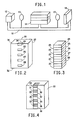
- FIG. 1 is a schematic drawing of an apparatus for wavelength conversion in accordance with this invention.
- Figure 2 is a perspective view of a waveguide for wavelength conversion in accordance with this invention.
- Figure 3 is a perspective view of the aligned sections of nonlinear optical material provided by the waveguide of Figure 2.
- Figure 4 is a perspective view of another embodiment of a waveguide for wavelength conversion in accordance with this invention.
- Figure 5 is an illustrative plot of a calculated relationship between depth and refractive index mismatch for different waveguide widths.
- Figure 6 illustrates the correlation of second harmonic wavelength with the period of the waveguide.
- means are provided which are suitable for at least partially converting optical waves having one wavelength, into optical waves of a different wavelength.
- the sum of the frequencies of the incident waves and the sum of the frequencies of the generated waves is equal. Accordingly, for wavelength conversion systems where waves of frequency ⁇ 1 and wavelength ⁇ 1 are used along with waves of frequency ⁇ 2 and wavelength ⁇ 2 to generate waves of frequency ⁇ 3 and wavelength ⁇ 3, ⁇ 3 is equal to the sum of ⁇ 1 and ⁇ 2; and for wavelength conversion systems where waves of frequency ⁇ 4 and wavelength ⁇ 4 are used to generate waves of frequency ⁇ 5 and wavelength ⁇ 5 along with waves of frequency ⁇ 6 and wavelength ⁇ 6, ⁇ 4 is equal to the sum of ⁇ 5 and ⁇ 6.
- a process for wavelength conversion comprises the step of directing the incident optical waves for wavelength conversion through a single crystal containing a series of aligned sections of optical materials for wavelength conversion, said sections being selected such that the sum for the series of sections of the product of the length of each section in the direction of alignment and the ⁇ k for that section is equal to about 2N ⁇ where N is an integer other than zero, and the nonlinear optical coefficient for a least one section is changed relative to the nonlinear optical coefficient of at least one adjacent section.
- ⁇ k for each section is the difference between the sum of the propagation constants for the incident waves for the wavelength conversion system in that section and the sum of the propagation constants for the generated waves for the wavelength conversion system in that section.
- the crystalline optical materials used in this invention are single crystal materials having the formula K 1-x Rb x TiOMO4 where x is from 0 to 1 and M is selected from the group consisting of P and As and single crystal material of said formula wherein the cations of said formula have been partially replaced by at least one of Rb+, Tl+ and Cs+, and at least one of Ba++, Sr++ and Ca++. At least one of the aligned sections in the series should be of an optical material of said formula wherein the cations have been partially replaced by at least one of Ba++, Sr++ and Ca++.
- the monovalent replacement cations should include Cs+, Tl+ or both Cs+ and Tl+.
- the sections are preferably aligned on the z surface of the crystal.
- the process may be used to generate beams having a certain wavelength from two incidental beams.
- the process may be used to generate two beams from one incident beam.
- a preferred use of the wavelength conversion process, however, is for second harmonic generation, wherein the generated waves have a wavelength which is one-half the wavelength of the incident beams.
- the optical articles of this invention for use in a wavelength conversion system comprise at least one optical conversion segment consisting of a single crystal containing a series of aligned sections of optical materials for wavelength conversion.
- the sections are preferably aligned on the z surface of the crystal.
- the series may be represented as a plurality of p aligned adjacent sections of optical materials, m1, m2, ...m i , ...m p , each having a composition within the formula K 1-x Rb x TiOMO4 and composition where the cations of said formula have been replaced as defined above.
- Each section is characterized by a length h i in the direction of alignment and a refractive index n i ( ⁇ ) which varies as a function of frequency ⁇ of the optical waves passing therethrough.
- the difference between the total propagation constant of the incident waves for each aligned section and the total propagation constants for the waves generated for each of the aligned sections defines a ⁇ k i for the section.
- the sections for each of said segments are selected so that the sum of the product of ⁇ k for a section and the length h for said section over the segment (i.e., ⁇ k1h1 + ⁇ k2h2 + ... ⁇ k i h i + ... ⁇ k p h p ) is equal to about 2 ⁇ N where N is an integer other than 0; and the nonlinear optical coefficient of at least one section is changed relative to the nonlinear optical coefficient of at least one adjacent section.
- the length of each section can in general be any length, other than zero, consistent with the condition that the sum of the product of the length of each section, h i , and the ⁇ k i for that section is equal to about 2N ⁇ over the length of the optical conversion segment, i.e., for an optical conversion segment containing p sections (i.e., i is from l to p),
- An approach to designing wavelength conversion paths to achieve this balance is to actually calculate the ⁇ k and section length for each section. In this approach, an advantageous balance is considered to occur when the sum over the entire wavelength conversion path of the products of the ⁇ k of each section with the length for that section is about 2 ⁇ N.
- the resulting total of said product is between 2 ⁇ N+1.5 ⁇ /M and 2 ⁇ N-1.5 ⁇ /M, and most preferably is between 2 ⁇ N+ ⁇ /M and 2 ⁇ N- ⁇ /M.
- a beam propagation constant k is defined for each wave beam as equal to 2 ⁇ n( ⁇ )/ ⁇ and a ⁇ k i for the section is represented by the relationship:
- the incident optical waves of such wavelength conversion systems (having frequencies ⁇ 1 and ⁇ 2) are directed through a series of sections selected such that the sum of h i ⁇ k i for the series is equal to about 2 ⁇ N where N is an integer other than zero.
- the optical conversion segments for optical articles using such wavelength conversion systems consisting of a series of sections selected such that the sum of h i ⁇ k i for the series is about 2 ⁇ N.
- ⁇ 1 and ⁇ 2 are equal and are each one-half of ⁇ 3. Accordingly, for second harmonic generation, the ⁇ k i for each section may be represented by the relationship:
- n i ( ⁇ ) which varies as a function of the optical wave frequency
- the incident optical waves of such wavelength conversion systems (having frequency ⁇ 4) are directed through a series of sections such that the sum of h i ⁇ k i for the series is equal to about 2 ⁇ N where N is an integer other than zero.
- the optical conversion segments for optical articles using such wavelength conversion systems consist of a series of sections selected such that the sum of h i ⁇ k i for the series is about 2 ⁇ N.
- the nonlinear optical coefficient of at least one section in the series must be changed relative to the nonlinear optical coefficient of an adjacent section.
- the lengths, h i can each be different and are each in the range of 0.25 ⁇ m to 50 ⁇ m.
- the ratio of adjacent section length, (i.e., h i-1 :h i ) is usually in the range of 1:20 to 20:1.
- each section can range from 0.2 ⁇ m to 50 ⁇ m and is preferably within the range of from 1 ⁇ m to 20 ⁇ m, and most preferably within the range of from 2 ⁇ m to 10 ⁇ m.
- the depth of each section can range from 0.1 ⁇ m to 50 ⁇ m and is preferably within the range of from 1 ⁇ m to 20 ⁇ m, and most preferably within the range of from 2 ⁇ m to 10 ⁇ m.
- Preferred substrate materials are single crystal materials having the formula KTiOMO4 where M is P or As.
- Single crystal material of the formula KTiOMO4 which is considered useful as a substrate material in the practice of this invention can be prepared by any method which provides a crystal of optical quality. Common methods of crystal growth include hydrothermal processes and flux processes.
- U.S. Patent No. 4,305,778 discloses a suitable hydrothermal process for growing single crystals of KTiOMO4 which involves using as a mineralizing solution an aqueous solution of a glass defined by specified portions of the ternary diagrams for the selected K2O/M2O5/(TiO2)2 system.
- 4,231,838 discloses a suitable flux growth process for growing single crystals of KTiOMO4 comprising heating selected starting ingredients, chosen to be within the region of a ternary phase diagram in which the desired crystal product is the only stable solid phase, and then controllably cooling to crystallize the desired product.
- a suitable flux growth process for growing single crystals of KTiOMO4 comprising heating selected starting ingredients, chosen to be within the region of a ternary phase diagram in which the desired crystal product is the only stable solid phase, and then controllably cooling to crystallize the desired product.
- phase matching is of two types: Type I, where the two incident optical waves have the same polarizations; and Type II where the two incident optical waves have orthogonal polarizations.
- Type I phase matching gives low conversion efficiencies compared to Type II.
- phase matching can only be achieved for input wavelengths greater than about 1 ⁇ m.
- Utilizing an optical article constructed in accordance with this invention allows for a Type I phase matching where the input and output waves are polarized along the polar or c-axis of the crystal and where the nonlinear optical coefficient is about 2 times that of the conventionally used Type II process. Since the second harmonic conversion efficiency is proportional to the square of the nonlinear optical coefficient, the use of the instant invention will provide optical articles that have conversion efficiencies that are about 4 times those for the conventional Type II process. In some Type I embodiments, however, the input polarization is normal to the polar or c-axis and the output polarization is along the polar or c-axis.
- both Type I and Type II phase matching can be achieved over the entire transparency range in KTiOPO4 (350 nm to 4.5 ⁇ m) and in KTiOAsO4 (350 nm to 5.5 ⁇ m).
- the number of sections provided can depend on such factors as the optical materials used and the waveguide length. A range of about 400 to 1000 sections can be provided in a typical 5.0 mm long waveguide. Longer waveguides can have up to 10,000 sections, or even more. However, articles comprising optical conversion segments of only two sections are also considered to be within the scope of this invention.
- the invention may be employed for waveguide structures, and for mixed guided and unguided wave systems.
- each unguided length in the wave propagation direction should be less than the defocusing length of the wave in the material to minimize radiation losses between the guide sections.
- the instant invention may be used to improve an optical waveguide device comprising at least one channel waveguide, means to couple an incoming optical wave into said channel waveguide and means to couple an optical outgoing optical wave out of said channel waveguide.
- the device is improved by using an article in accordance with this invention as the waveguide therein.
- optical waves emitted by laser (12) at one wavelength may be used to generate waves at another wavelength.
- Lens (13) is used to focus the optical waves emitted by laser (12) into a waveguide (14) constructed in accordance with this invention. Wavelength conversion occurs within the waveguide (14) and a second lens (17) is provided to collimate the optical waves emerging from the waveguide.
- a filter (18) is provided in the arrangement shown to filter out the remaining optical waves which have the wavelength of the emitted incident waves, while allowing the optical waves of the desired wavelength which were generated within the waveguide (14) to pass through.
- laser (12) is a Ti:Al2O3 laser used to generate polarized light at wavelength 0.8 ⁇ m
- the waveguide (14) is constructed in accordance with this invention for second harmonic generation using such incident light
- the filter (18) would be adapted to allow optical waves of wavelength 0.4 ⁇ m to pass through while optical waves of wavelength 0.8 ⁇ m are filtered from the collimated beam which emerges from the waveguide.
- a device incorporating the apparatus of Figure 1 i.e. the laser (12), the waveguide (14), the filter (18), and the lenses (13) and (17) is considered to be an article within the scope of this invention.
- waveguides such as waveguide (14) are themselves considered to be articles within the scope of the invention.
- the waveguide (20) as shown comprises a block (22) of single crystal KTiOMO4 (M is P or As) having sections (24), (25), (26), (27) and (28), all of another crystalline material of the formula K 1-x Rb x TiOMO4 where x is from 0 to 1 wherein the cations of said formula have been partially replaced by at least one of Rb+, Tl+ and Cs+ and at least one of Ba++, Sr++ and Ca++.
- the sections (24), (25), (26), (27) and (28) are aligned between the top of the article (30) and the bottom of the article (32), such that said sections along with the portions of block (22) aligned therewith comprise a waveguide.
- the waveguide is designed so that during operation, incident beams of optical waves enter the waveguide at the upper surface (34) of section (24) at the top (30) of the article (20).
- the incident beams are aligned so that optical waves pass through each of the sections (24), (25), (26), (27) and (28) as well as sections represented by the portions of block (22) in alignment with said sections, and then exit from the bottom (32) of block (22).
- the waveguide embodied by Figure 2 is designed so that beams passing therethrough, pass through a number of sections comprised of one material represented by blocks (24), (25), (26), (27) and (28), and an equal number of sections comprised of another material represented by (23), the portions at block (22) in alignment therewith.
- a means of preparing a channel waveguide of the type illustrated in Figures 2 and 3 in accordance with this invention is to modify the single crystal substrate of the formula K 1-x Rb x TiOMO4, wherein X is from 0 to 1 and M is P or As.
- Use of these substrates for producing channel waveguides is well known in the art, and reference is made to U.S. Patent No. 4,766,954 which is hereby incorporated herein in its entirety.
- a typical substrate for use in producing waveguides is a crystal of KTiOPO4 (i.e., "KTP").
- the use of substrate masking allows replacement of cations of one optically smooth surface by ions selected from at least one of Rb+ and Cs+ and Tl+ and a resulting change in the surface index of refraction with respect to the index at refraction of the starting substrate.
- the cations are also partially replaced by ions selected from at least one of Ba++, Sr++ and Ca++, and the areas along the portion of the crystal substrate surface used for forming the desired channel may be alternately masked and unmasked during cation replacement so that the resulting channel consists of a series of aligned sections which alternate between original substrate and substrate material in which cations have been replaced by at least one of Rb+, Tl+ and Cs+ and by at least one of Ba++, Sr++ and Ca++ (with the proviso that when x is greater than 0.8, cations have been replaced by at least one of Tl+ and Cs+ and at least one of Ba++, Sr++ and Ca++).
- the cations of the substrate are replaced by Ba++ and at least one of Tl+ and Rb+ to insure change in nonlinear optical coefficient in adjacent sections.
- Standard photolithographic techniques may be used to provide the desired masking.
- a mask of protective material e.g., Ti
- Ti may be applied over the z-surface of the crystal substrate with a pattern generated therein to allow, upon suitable exposure to a molten salt, formation of sections of a second optical material by cation exchange. After cation replacement the remaining protective material may be removed.
- the substrate of choice is KTiOMO4, where M is P or As, and preferably P, and the substrate is masked on the z-surface thereof, which can be determined by conventional x-ray crystallographic techniques.
- M is P or As, and preferably P
- the substrate is masked on the z-surface thereof, which can be determined by conventional x-ray crystallographic techniques.
- One process for preparing a channel waveguide for a wavelength conversion system in accordance with this invention comprises the steps of: (1) providing the z-surface of a z-cut substrate of single crystal material having the formula K 1-x Rb x TiOMO4 wherein x is from zero to one and M is P or As, with an optically smooth surface; (2) providing a molten salt containing cations selected from the group consisting of Rb+, Cs+ and Tl+ and cations selected from the group consisting of Ba++, Sr++ and Ca++ (with the proviso that when x is greater than 0.8, the molten salt contains cations selected from Tl+ and Cs+), in an amount effective to provide upon exposure to said optically smooth surface at a selected temerature for a selected time, sufficient cation replacement to change the index of refraction with respect to the index of refraction of said substrate and to provide a nonlinear optical coefficient which is changed with respect to the nonlinear optical coefficient of the substrate; (3) applying a masking material
- the length of said masked and unmasked areas is selected such that after said cation replacement in the unmasked areas, a channel waveguide is provided at said portion of the optically smooth surface which comprises at least one optical conversion segment consisting of a series of aligned sections of nonlinear optical materials within a crystal; and such that the sum for the series of section of the product of the length of each section and the ⁇ k for that section is equal to about 2 ⁇ N where N is an integer other than zero; wherein the ⁇ k for each section is the difference between the sum of the propagation constants for the incident waves for the wavelength conversion system in that section and the sum of the propagation constant for the generated waves for said wavelength conversion system in that section.
- the divalent cations and the monovalent cations can alternatively be exchanged in separate steps.
- KTP substrates may be provided in accordance with step (1) by cutting the substrate into z plates and polishing a 1 mm thick z-cut substrate.
- the molten salt provided in step (2) contains Ba++ together with Tl+, Rb+ or both Tl+ and Rb+.
- a masking of Ti may be provided in accordance with step (3) in conformance with standard photolithographic techniques by sequentially applying Ti on the substrate; applying a photoresist material over the Ti and curing the photoresist; providing a photomask having the desired pattern and contact exposing the photoresist through the photomask; removing the exposed portion of the photoresist; and etching away the Ti beneath the removed photoresist; and removing the unexposed photoresist, so that the patterned Ti masking remains.
- the substrate will be end polished before it is immersed in the molten salt; and washed after removal of the salt.
- the waveguide may be suitably mounted so that a laser beam may be directed therein.
- the cation exchange provides a change in the surface index at refraction so that there is at least about 0.00025 difference between the surface index of refraction of at least one section (e.g., the cation exchanged sections) and the surface index of refraction of at least one adjacent section (e.g., the substrate).
- the ⁇ k for each section in which cations have been exchanged in accordance with this process for waveguide preparation can be varied somewhat by changing the section width and/or depth, and may also vary somewhat as a function of replacement ion type and concentration. Accordingly, one may wish to prepare a number of waveguides having various widths, etc. to determine optimum design for a particular wavelength conversion system using particular materials.
- ⁇ n the refractive index mismatch
- KTP KTiOPO4
- n z ( ⁇ ) and n z (2 ⁇ ) are respectively the effective refractive indexes of the incident and generated optical wave of frequency and ⁇ and 2 ⁇ for z polarization
- the result of the calculation is shown in Figure 5.
- the ⁇ n equals the bulk KTP substrate value.
- the corresponding coherence length is 4 ⁇ m.
- the ⁇ n would correspond to that for bulk RbT i OPO4 (RTP).
- RTP bulk RbT i OPO4
- Figure 5 illustrates the practical advantage of using waveguides segmented in accordance with the teachings of this invention relative to uniform waveguides for achieving phase matching for second harmonic generation. Since a minimum occurs in the ⁇ n vs. depth curve, near this minimum very little change in ⁇ n is expected with changes in processing conditions, such as exchange time or temperature, which change guide depth. Selecting this minimum, phase matching is achieved by adjusting the length of each section of the optical conversion segment such that h1 ⁇ n1 + h2 ⁇ n2 is about equal to N2 ⁇ . In contrast, for other waveguide depths, a small processing change affecting waveguide depth will give a larger change in ⁇ n and, hence, processing latitude will be narrower.
- the z-surface of the single crystal substrate of choice is KTiOPO4, and cation replacement using Ba++ together with Tl+, Rb+ or both Tl+ and Rb+ are preferable in the practice of this invention to enhance the achievement of a change in nonlinear optical coefficient of adjacent sections.
- the z-surface of the single crystal substrate Prior to masking and cation exchange thereon, can be determined by conventional x-ray crystallographic techniques, as stated above. Where the change in nonlinear optical coefficient is attributable to reversed polarization, observation of reversed polarization can be made by etching the optical article, or more particularly, the optical conversion segment or segments thereof, or by surface SHG (second harmonic generation) technologies.
- liquid electrostatic toner may be used to preferentially tone either the cation exchanged section of the optical conversion segment or the unexchanged section.
- a further embodiment of an optical article in accordance with the instant invention in the form of a waveguide is illustrated in Figure 4.
- a single crystal of KTiOPO4 (22) has a plurality of aligned sections (29), (31), (33), (35) and (37) of the formula K 1-x Rb x TiOPO4, wherein x is less than 1 and greater than 0, alternating with a plurality of aligned sections (30), (32), (34), (36) and (38) of the formula K 1-x Rb x TiOPO4, wherein x is less than 1 and greater than or equal to 0 and wherein the cations are partially substituted with Tl+ and partially substituted with Ba++.
- the cation substitution in the KTiOPO4 substrate in the manner shown insures substantially complete guidance of the wave on the optical path through the waveguide.
- each waveguide was secured to the bottom of a petri dish using a commercially available grease (Apiezon N grease). The dish was then dipped into a dry ice-acetone bath for about 4 seconds, and a few drops of high resolution electrostatic toner was applied to the waveguide.
- the toners used are electrically charged micron sized particles suspended in isopar.
- a suitable positively charged commercially available toner is James River Graphics T8718.
- a suitable negatively charged commercially available toner is Savin black toner, commonly used in the Savin 7300 copier. In either case the solids content of the toner was adjusted to approximately 0.1 to 1% by weight, based on the total weight of solids and isopar.
- a hydrothermally grown crystal of KTiOPO4 was first cut into approximately 1 mm thick z-plates. Then the z-surface was polished and coated with about 1000 ⁇ of Ti by thermal evaporation. A photoresist was then contact exposed through a photomask containing the desired waveguide patterns. The exposed photoresist was removed and the Ti coating revealed beneath the removed photoresist was chemically etched using a solution of ethylene diamine tetraacetic acid (EDTA), H2O2 and NH4OH so that the KTiOPO4 substrate was selectively revealed. The remaining photoresist was then removed and the Ti-masked substrates were end polished.
- EDTA ethylene diamine tetraacetic acid
- a series of waveguide patterns were generated in the Ti mask for the purposes of allowing preparation of Rb/Tl/Ba-exchanged waveguide sections alternatively with section of bulk KTiOPO4.
- the masked substrates provided 36 different waveguide patterns having in the order about 400 to 1000 sections. These patterns consisted of open areas with widths that vary in 1 ⁇ m step from 4 to 9 ⁇ m and, in the beam propagation direction, again in 1 ⁇ m step lengths ranging from 3 to 6 ⁇ m.
- the waveguides were oriented for x propagation in the KTiOPO4.
- the masked substrates were polished to give a total guide length of approximately 5 mm and ion exchanged in a molten salt bath consisting of 1 mole % BaNO3, 95 mole % RbNO3, and 4 mole % TlNO3, at a temperature of 360°C for an exchange time of 1 hour. After the exchange time had elapsed, the substrate was cooled to room temperature and the Ti mask was removed.
- the second harmonic generation conversion efficiency was measured using endfire coupling of a dye laser through a microscope objective. The wavelength of this laser was varied from about 850 nm to 970 nm and the second harmonic output observed.
- Type I phase matched second harmonic generation output i.e., phase matching wherein the two incident waves have the same polarization
- phase matching wherein the two incident waves have the same polarization
- 0.407 ⁇ m was observed for a guide period of 4 ⁇ m and a guide width of 5 ⁇ m and for a guide period of 5 ⁇ m the phase matched output was at 0.43 ⁇ m.
- a second harmonic conversion efficiency of about 0.02%/W-cm2 was observed.
- Example 1 The procedure of Example 1 was followed except that the crystal of KTiOPO4 was flux grown and a Ti:Al2O3 laser was used to measure the second harmonic generation conversion efficiencies.
- Type I phase matched second harmonic generation output (i.e., phase matching wherein the two incident waves have the same polarization) at 0.43 ⁇ m was observed for a guide period of 4 ⁇ m and a guide width of 5 ⁇ m having a second harmonic conversion efficiency of about 50%/W-cm2.
- the phase matched output was at 0.45 ⁇ m and for a guide of 6 ⁇ m the phase matched output was at 0.48 ⁇ m, both with a second harmonic conversion efficiency of about 50%/W-cm2.
- a flux grown crystal of KTiOPO4 was cut, polished, masked, processed and evaluated using a procedure generally in accordance with the procedure of Example 2, except that the exchange time was 45 minutes.
- Type I phase matched second harmonic generation of 0.85 ⁇ m input was observed for a guide width of 5 ⁇ m and a guide period of 4 ⁇ m with a second harmonic conversion efficiency of about 50%/W-cm2.
- Example 1 The procedure of Example 1 was followed except that a molten salt bath consisting of 5 mole % BaNO3 and 95 mole % RbNO3 was utilized; the waveguides were oriented for y propagation in the KTiOPO4; and a diode laser at a wavelength of 850 nm was used to measure the second harmonic conversion efficiency.
- a molten salt bath consisting of 5 mole % BaNO3 and 95 mole % RbNO3 was utilized; the waveguides were oriented for y propagation in the KTiOPO4; and a diode laser at a wavelength of 850 nm was used to measure the second harmonic conversion efficiency.
- Type I phase matched second harmonic generation output at 0.425 ⁇ m was observed for a guide width of 6 ⁇ m and a guide period of 4 ⁇ m with a second harmonic conversion efficiency of about 3%/W-cm2.
- Figure 6 illustrates the correlation between the wavelength of the light that is to be converted and the period of the Rb, Tl doped KTP waveguide.
- the tested waveguide was supplied with channels of varying periods and widths.
- the top row represents the period in microns ( ⁇ ) of the gratings/segments.
- the left hand column shows the wavelength in nanometers (nm) of the input (top figure) and the output (bottom figure) light.
- the second row indicates the width of the channels tested.
- the row label # indicates the sequential number of the channel tested.
- the solid lines indicate strong second harmonic generation and the dotted lines indicate weak second harmonic generation.
- the 4 ⁇ period channels were effective to generate 425 nm light from 850 nm input light.
- the 5 ⁇ period channels were effective at generating 462 nm light from 924 nm input light and the 6 ⁇ period channels generated 475 nm output light, from 950 nm input light.
- the efficiency of the guides may be further increased by a variety of techniques including optimization of the index step, geometry profile, and orientation of the unit cells making up the waveguide structure. Other factors in this consideration include mode beating in multimode configurations and Fabry-Perot like resonances in the unit cells.
Landscapes
- Physics & Mathematics (AREA)
- Nonlinear Science (AREA)
- General Physics & Mathematics (AREA)
- Optics & Photonics (AREA)
- Optical Integrated Circuits (AREA)
- Optical Modulation, Optical Deflection, Nonlinear Optics, Optical Demodulation, Optical Logic Elements (AREA)
- Crystals, And After-Treatments Of Crystals (AREA)
Applications Claiming Priority (4)
| Application Number | Priority Date | Filing Date | Title |
|---|---|---|---|
| US51478790A | 1990-04-25 | 1990-04-25 | |
| US514787 | 1990-04-25 | ||
| US51482290A | 1990-04-26 | 1990-04-26 | |
| US514822 | 1990-04-26 |
Publications (3)
| Publication Number | Publication Date |
|---|---|
| EP0454071A2 true EP0454071A2 (de) | 1991-10-30 |
| EP0454071A3 EP0454071A3 (en) | 1992-09-23 |
| EP0454071B1 EP0454071B1 (de) | 1996-08-14 |
Family
ID=27058315
Family Applications (1)
| Application Number | Title | Priority Date | Filing Date |
|---|---|---|---|
| EP91106547A Expired - Lifetime EP0454071B1 (de) | 1990-04-25 | 1991-04-23 | Wellenlängenumwandlung durch quasi Phasenanpassung und Herstellung und Verwendung einer Vorrichtung hierfür |
Country Status (10)
| Country | Link |
|---|---|
| EP (1) | EP0454071B1 (de) |
| JP (1) | JP2972375B2 (de) |
| KR (1) | KR100226385B1 (de) |
| CN (3) | CN1031903C (de) |
| AU (1) | AU641999B2 (de) |
| CA (1) | CA2040629A1 (de) |
| DE (1) | DE69121281T2 (de) |
| DK (1) | DK0454071T3 (de) |
| ES (1) | ES2102372T3 (de) |
| NO (1) | NO911621L (de) |
Cited By (4)
| Publication number | Priority date | Publication date | Assignee | Title |
|---|---|---|---|---|
| WO1993006519A1 (en) * | 1991-09-19 | 1993-04-01 | E.I. Du Pont De Nemours And Company | Segmented waveguides having selected bragg reflection characteristics |
| WO1994015248A1 (en) * | 1992-12-23 | 1994-07-07 | E.I. Du Pont De Nemours And Company | Doped ktp and its isomorphs with increased birefringence for type ii phase matching |
| US5350961A (en) * | 1992-07-31 | 1994-09-27 | E. I. Du Pont De Nemours And Company | Acoustic wave devices for controlling high frequency signals |
| DE102009028819A1 (de) | 2009-08-21 | 2011-02-24 | Forschungsverbund Berlin E.V. | Vorrichtung und Verfahren zur Verstärkung oder Frequenzwandlung von Laserstrahlung mithilfe der Quasi-Phasenanpassung bei der Vierwellenmischung |
Families Citing this family (1)
| Publication number | Priority date | Publication date | Assignee | Title |
|---|---|---|---|---|
| US5157674A (en) * | 1991-06-27 | 1992-10-20 | Intellectual Property Development Associates Of Connecticut, Incorporated | Second harmonic generation and self frequency doubling laser materials comprised of bulk germanosilicate and aluminosilicate glasses |
Family Cites Families (11)
| Publication number | Priority date | Publication date | Assignee | Title |
|---|---|---|---|---|
| JPS53462A (en) * | 1976-06-23 | 1978-01-06 | Hitachi Ltd | Cooling device with mixed refrigerand |
| JPS61290426A (ja) * | 1985-06-18 | 1986-12-20 | Sharp Corp | 高調波発生器 |
| JPH01295231A (ja) * | 1988-05-23 | 1989-11-28 | Seiko Instr Inc | レーザー光源の高次高調波発生機構 |
| JPH025032A (ja) * | 1988-06-24 | 1990-01-09 | Nippon Telegr & Teleph Corp <Ntt> | 波長変換素子およびその製造方法 |
| US4896931A (en) * | 1988-08-18 | 1990-01-30 | North American Philips Corp. | Frequency doubling device |
| JPH0280928A (ja) * | 1988-09-16 | 1990-03-22 | Seiko Instr Inc | 赤外線イメージセンサ |
| JPH03100630A (ja) * | 1989-09-14 | 1991-04-25 | Nippon Telegr & Teleph Corp <Ntt> | 波長変換装置 |
| US5046803A (en) * | 1989-12-08 | 1991-09-10 | North American Philips Corp. | Actively phased matched frequency doubling optical waveguide |
| US5028107A (en) * | 1989-12-12 | 1991-07-02 | E. I. Du Pont De Nemours And Company | Optical articles for wavelength conversion and their manufacture and use |
| JPH03251826A (ja) * | 1990-01-25 | 1991-11-11 | Oki Electric Ind Co Ltd | 第2高調波発生素子 |
| JP2689184B2 (ja) * | 1990-10-18 | 1997-12-10 | パイオニア株式会社 | 光波長変換装置 |
-
1991
- 1991-04-17 CA CA002040629A patent/CA2040629A1/en not_active Abandoned
- 1991-04-22 AU AU75188/91A patent/AU641999B2/en not_active Ceased
- 1991-04-23 DE DE69121281T patent/DE69121281T2/de not_active Expired - Fee Related
- 1991-04-23 DK DK91106547.2T patent/DK0454071T3/da active
- 1991-04-23 ES ES91106547T patent/ES2102372T3/es not_active Expired - Lifetime
- 1991-04-23 EP EP91106547A patent/EP0454071B1/de not_active Expired - Lifetime
- 1991-04-24 NO NO91911621A patent/NO911621L/no unknown
- 1991-04-25 KR KR1019910006631A patent/KR100226385B1/ko not_active Expired - Fee Related
- 1991-04-25 CN CN91102591A patent/CN1031903C/zh not_active Expired - Fee Related
- 1991-04-25 JP JP3095865A patent/JP2972375B2/ja not_active Expired - Fee Related
-
1994
- 1994-11-09 CN CN94118216A patent/CN1035842C/zh not_active Expired - Fee Related
- 1994-11-09 CN CN94118215A patent/CN1038619C/zh not_active Expired - Fee Related
Non-Patent Citations (3)
| Title |
|---|
| APPLIED PHYSICS LETTERS, vol. 57, no. 20, 12 November 1990, New York US, pp. 2074-2076; C.J. VAN DER POEL et al.: "Efficient type I blue second-harmonic generation in periodically segmented KTiOPO(4) waveguides" * |
| APPLIED PHYSICS LETTERS. vol. 57, no. 20, 12 November 1990, NEW YORK US pages 2074 - 2076; J.D.BIERLEIN: 'EFFICIENT TYPE I BLUE SECOND HARMONIC....' * |
| JOURNAL OF THE OPTICAL SOCIETY OF AMERICA. vol. B6, no. 4, April 1990, NEW YORK US pages 622 - 633; J.D.BIERLEIN: 'POTASSIUM TITANYL PHOSPHATE:...' * |
Cited By (6)
| Publication number | Priority date | Publication date | Assignee | Title |
|---|---|---|---|---|
| WO1993006519A1 (en) * | 1991-09-19 | 1993-04-01 | E.I. Du Pont De Nemours And Company | Segmented waveguides having selected bragg reflection characteristics |
| US5243676A (en) * | 1991-09-19 | 1993-09-07 | E. I. Du Pont De Nemours And Company | Segmented waveguides having selected Bragg reflection characteristics |
| US5393561A (en) * | 1991-09-19 | 1995-02-28 | E. I. Du Pont De Nemours And Company | Segmented waveguides having selected bragg reflection characteristics |
| US5350961A (en) * | 1992-07-31 | 1994-09-27 | E. I. Du Pont De Nemours And Company | Acoustic wave devices for controlling high frequency signals |
| WO1994015248A1 (en) * | 1992-12-23 | 1994-07-07 | E.I. Du Pont De Nemours And Company | Doped ktp and its isomorphs with increased birefringence for type ii phase matching |
| DE102009028819A1 (de) | 2009-08-21 | 2011-02-24 | Forschungsverbund Berlin E.V. | Vorrichtung und Verfahren zur Verstärkung oder Frequenzwandlung von Laserstrahlung mithilfe der Quasi-Phasenanpassung bei der Vierwellenmischung |
Also Published As
| Publication number | Publication date |
|---|---|
| NO911621D0 (no) | 1991-04-24 |
| CN1057722A (zh) | 1992-01-08 |
| DK0454071T3 (da) | 1997-01-06 |
| CN1031903C (zh) | 1996-05-29 |
| EP0454071A3 (en) | 1992-09-23 |
| DE69121281T2 (de) | 1997-04-03 |
| JPH04226431A (ja) | 1992-08-17 |
| CN1038619C (zh) | 1998-06-03 |
| JP2972375B2 (ja) | 1999-11-08 |
| KR100226385B1 (ko) | 1999-11-01 |
| CN1035842C (zh) | 1997-09-10 |
| AU641999B2 (en) | 1993-10-07 |
| CA2040629A1 (en) | 1991-10-26 |
| ES2102372T3 (es) | 1997-08-01 |
| CN1118449A (zh) | 1996-03-13 |
| KR910018822A (ko) | 1991-11-30 |
| NO911621L (no) | 1991-10-28 |
| AU7518891A (en) | 1991-11-07 |
| EP0454071B1 (de) | 1996-08-14 |
| DE69121281D1 (de) | 1996-09-19 |
| CN1116724A (zh) | 1996-02-14 |
Similar Documents
| Publication | Publication Date | Title |
|---|---|---|
| US5157754A (en) | Wavelength conversion by quasi phase matching and the manufacture and use of optical articles therefor | |
| US5036220A (en) | Nonlinear optical radiation generator and method of controlling regions of ferroelectric polarization domains in solid state bodies | |
| EP0505453B1 (de) | Optischer gegenstand für wellenlängenwandlung und seine herstellung und anwendung | |
| AU733846B2 (en) | Method and arrangement for poling of optical crystals | |
| EP0604541B1 (de) | Segmentaere wellenleiter mit ausgewaehlten bragg reflexionscharakteristika | |
| Katz et al. | Refractive dispersion curve measurement of KTiOPO 4 using periodically segmented waveguides and periodically poled crystals | |
| EP0454071B1 (de) | Wellenlängenumwandlung durch quasi Phasenanpassung und Herstellung und Verwendung einer Vorrichtung hierfür | |
| US5426717A (en) | Line-width insensitive segmented wave reflectors having selected Bragg reflection characteristics | |
| JPH043128A (ja) | 部分的分極反転領域の形成方法 | |
| Kajal | Design and implementation of novel nonlinear processes in bulk and waveguide periodic structures | |
| JPH05142608A (ja) | 広波長帯域第2高調波発生装置とその製造方法 | |
| Kang | Fabrication and characterization of the optical waveguide for integrated optics and nonlinear optics | |
| JPH07281225A (ja) | 光導波路型第二高調波発生素子 | |
| JPH07281226A (ja) | 光導波路型第二高調波発生素子 |
Legal Events
| Date | Code | Title | Description |
|---|---|---|---|
| PUAI | Public reference made under article 153(3) epc to a published international application that has entered the european phase |
Free format text: ORIGINAL CODE: 0009012 |
|
| AK | Designated contracting states |
Kind code of ref document: A2 Designated state(s): BE CH DE DK ES FR GB IT LI NL SE |
|
| PUAL | Search report despatched |
Free format text: ORIGINAL CODE: 0009013 |
|
| AK | Designated contracting states |
Kind code of ref document: A3 Designated state(s): BE CH DE DK ES FR GB IT LI NL SE |
|
| 17P | Request for examination filed |
Effective date: 19921113 |
|
| 17Q | First examination report despatched |
Effective date: 19941007 |
|
| GRAH | Despatch of communication of intention to grant a patent |
Free format text: ORIGINAL CODE: EPIDOS IGRA |
|
| GRAH | Despatch of communication of intention to grant a patent |
Free format text: ORIGINAL CODE: EPIDOS IGRA |
|
| GRAA | (expected) grant |
Free format text: ORIGINAL CODE: 0009210 |
|
| AK | Designated contracting states |
Kind code of ref document: B1 Designated state(s): BE CH DE DK ES FR GB IT LI NL SE |
|
| REF | Corresponds to: |
Ref document number: 69121281 Country of ref document: DE Date of ref document: 19960919 |
|
| ITF | It: translation for a ep patent filed | ||
| ET | Fr: translation filed | ||
| REG | Reference to a national code |
Ref country code: DK Ref legal event code: T3 |
|
| REG | Reference to a national code |
Ref country code: CH Ref legal event code: NV Representative=s name: ISLER & PEDRAZZINI AG Ref country code: CH Ref legal event code: PFA Free format text: E.I. DU PONT DE NEMOURS AND COMPANY;NORTH AMERICAN PHILIPS CORPORATION TRANSFER- E.I. DU PONT DE NEMOURS AND COMPANY;PHILIPS ELECTRONICS NORTH AMERICA CORPORATION;PHILIPS ELECTRONICS NORTH AMERICA CORPORATION |
|
| NLT1 | Nl: modifications of names registered in virtue of documents presented to the patent office pursuant to art. 16 a, paragraph 1 |
Owner name: PHILIPS ELECTRONICS NORTH AMERICA CORPORATION;E.I. |
|
| PLBE | No opposition filed within time limit |
Free format text: ORIGINAL CODE: 0009261 |
|
| STAA | Information on the status of an ep patent application or granted ep patent |
Free format text: STATUS: NO OPPOSITION FILED WITHIN TIME LIMIT |
|
| REG | Reference to a national code |
Ref country code: ES Ref legal event code: PC2A |
|
| REG | Reference to a national code |
Ref country code: ES Ref legal event code: FG2A Ref document number: 2102372 Country of ref document: ES Kind code of ref document: T3 |
|
| 26N | No opposition filed | ||
| REG | Reference to a national code |
Ref country code: GB Ref legal event code: IF02 |
|
| PGFP | Annual fee paid to national office [announced via postgrant information from national office to epo] |
Ref country code: IT Payment date: 20060430 Year of fee payment: 16 |
|
| PGFP | Annual fee paid to national office [announced via postgrant information from national office to epo] |
Ref country code: DE Payment date: 20060531 Year of fee payment: 16 |
|
| PGFP | Annual fee paid to national office [announced via postgrant information from national office to epo] |
Ref country code: NL Payment date: 20070403 Year of fee payment: 17 |
|
| PGFP | Annual fee paid to national office [announced via postgrant information from national office to epo] |
Ref country code: SE Payment date: 20070404 Year of fee payment: 17 |
|
| PGFP | Annual fee paid to national office [announced via postgrant information from national office to epo] |
Ref country code: CH Payment date: 20070413 Year of fee payment: 17 |
|
| PGFP | Annual fee paid to national office [announced via postgrant information from national office to epo] |
Ref country code: DK Payment date: 20070416 Year of fee payment: 17 |
|
| PGFP | Annual fee paid to national office [announced via postgrant information from national office to epo] |
Ref country code: ES Payment date: 20070521 Year of fee payment: 17 |
|
| PGFP | Annual fee paid to national office [announced via postgrant information from national office to epo] |
Ref country code: BE Payment date: 20070612 Year of fee payment: 17 |
|
| REG | Reference to a national code |
Ref country code: CH Ref legal event code: PCAR Free format text: ISLER & PEDRAZZINI AG;POSTFACH 1772;8027 ZUERICH (CH) |
|
| PGFP | Annual fee paid to national office [announced via postgrant information from national office to epo] |
Ref country code: GB Payment date: 20070425 Year of fee payment: 17 |
|
| PG25 | Lapsed in a contracting state [announced via postgrant information from national office to epo] |
Ref country code: DE Free format text: LAPSE BECAUSE OF NON-PAYMENT OF DUE FEES Effective date: 20071101 |
|
| PGFP | Annual fee paid to national office [announced via postgrant information from national office to epo] |
Ref country code: FR Payment date: 20070417 Year of fee payment: 17 |
|
| BERE | Be: lapsed |
Owner name: *PHILIPS ELECTRONICS NORTH AMERICA CORP. Effective date: 20080430 Owner name: E.I. *DU PONT DE NEMOURS AND CY Effective date: 20080430 |
|
| REG | Reference to a national code |
Ref country code: CH Ref legal event code: PL |
|
| REG | Reference to a national code |
Ref country code: DK Ref legal event code: EBP |
|
| EUG | Se: european patent has lapsed | ||
| GBPC | Gb: european patent ceased through non-payment of renewal fee |
Effective date: 20080423 |
|
| NLV4 | Nl: lapsed or anulled due to non-payment of the annual fee |
Effective date: 20081101 |
|
| PG25 | Lapsed in a contracting state [announced via postgrant information from national office to epo] |
Ref country code: LI Free format text: LAPSE BECAUSE OF NON-PAYMENT OF DUE FEES Effective date: 20080430 Ref country code: CH Free format text: LAPSE BECAUSE OF NON-PAYMENT OF DUE FEES Effective date: 20080430 Ref country code: NL Free format text: LAPSE BECAUSE OF NON-PAYMENT OF DUE FEES Effective date: 20081101 |
|
| REG | Reference to a national code |
Ref country code: FR Ref legal event code: ST Effective date: 20081231 |
|
| PG25 | Lapsed in a contracting state [announced via postgrant information from national office to epo] |
Ref country code: BE Free format text: LAPSE BECAUSE OF NON-PAYMENT OF DUE FEES Effective date: 20080430 |
|
| PG25 | Lapsed in a contracting state [announced via postgrant information from national office to epo] |
Ref country code: FR Free format text: LAPSE BECAUSE OF NON-PAYMENT OF DUE FEES Effective date: 20080430 Ref country code: DK Free format text: LAPSE BECAUSE OF NON-PAYMENT OF DUE FEES Effective date: 20080430 |
|
| REG | Reference to a national code |
Ref country code: ES Ref legal event code: FD2A Effective date: 20080424 |
|
| PG25 | Lapsed in a contracting state [announced via postgrant information from national office to epo] |
Ref country code: GB Free format text: LAPSE BECAUSE OF NON-PAYMENT OF DUE FEES Effective date: 20080423 |
|
| PG25 | Lapsed in a contracting state [announced via postgrant information from national office to epo] |
Ref country code: ES Free format text: LAPSE BECAUSE OF NON-PAYMENT OF DUE FEES Effective date: 20080424 |
|
| PG25 | Lapsed in a contracting state [announced via postgrant information from national office to epo] |
Ref country code: IT Free format text: LAPSE BECAUSE OF NON-PAYMENT OF DUE FEES Effective date: 20070423 |
|
| PG25 | Lapsed in a contracting state [announced via postgrant information from national office to epo] |
Ref country code: SE Free format text: LAPSE BECAUSE OF NON-PAYMENT OF DUE FEES Effective date: 20080424 |