EP0454399B1 - Monofrequenter Laser - Google Patents
Monofrequenter Laser Download PDFInfo
- Publication number
- EP0454399B1 EP0454399B1 EP91303601A EP91303601A EP0454399B1 EP 0454399 B1 EP0454399 B1 EP 0454399B1 EP 91303601 A EP91303601 A EP 91303601A EP 91303601 A EP91303601 A EP 91303601A EP 0454399 B1 EP0454399 B1 EP 0454399B1
- Authority
- EP
- European Patent Office
- Prior art keywords
- etalon
- laser
- frequency
- temperature
- peak
- Prior art date
- Legal status (The legal status is an assumption and is not a legal conclusion. Google has not performed a legal analysis and makes no representation as to the accuracy of the status listed.)
- Expired - Lifetime
Links
Images


Classifications
-
- H—ELECTRICITY
- H01—ELECTRIC ELEMENTS
- H01S—DEVICES USING THE PROCESS OF LIGHT AMPLIFICATION BY STIMULATED EMISSION OF RADIATION [LASER] TO AMPLIFY OR GENERATE LIGHT; DEVICES USING STIMULATED EMISSION OF ELECTROMAGNETIC RADIATION IN WAVE RANGES OTHER THAN OPTICAL
- H01S3/00—Lasers, i.e. devices using stimulated emission of electromagnetic radiation in the infrared, visible or ultraviolet wave range
- H01S3/10—Controlling the intensity, frequency, phase, polarisation or direction of the emitted radiation, e.g. switching, gating, modulating or demodulating
- H01S3/13—Stabilisation of laser output parameters, e.g. frequency or amplitude
- H01S3/136—Stabilisation of laser output parameters, e.g. frequency or amplitude by controlling devices placed within the cavity
- H01S3/137—Stabilisation of laser output parameters, e.g. frequency or amplitude by controlling devices placed within the cavity for stabilising of frequency
-
- H—ELECTRICITY
- H01—ELECTRIC ELEMENTS
- H01S—DEVICES USING THE PROCESS OF LIGHT AMPLIFICATION BY STIMULATED EMISSION OF RADIATION [LASER] TO AMPLIFY OR GENERATE LIGHT; DEVICES USING STIMULATED EMISSION OF ELECTROMAGNETIC RADIATION IN WAVE RANGES OTHER THAN OPTICAL
- H01S3/00—Lasers, i.e. devices using stimulated emission of electromagnetic radiation in the infrared, visible or ultraviolet wave range
- H01S3/05—Construction or shape of optical resonators; Accommodation of active medium therein; Shape of active medium
- H01S3/08—Construction or shape of optical resonators or components thereof
- H01S3/08018—Mode suppression
- H01S3/08022—Longitudinal modes
- H01S3/08031—Single-mode emission
- H01S3/08036—Single-mode emission using intracavity dispersive, polarising or birefringent elements
Definitions
- This invention relates to a method of operating a laser having a resonator with an etalon mounted therein to permit single frequency operation, said method comprising changing the temperature of the etalon in order to vary the peak of its temperature frequency curve, and to such a laser.
- the energy output over the gain curve is not continuous but occurs at discrete, closely space frequencies.
- the output frequencies are based upon the number of discrete longitudinal modes that are supported by the laser cavity.
- the longitudinal modes will occur at wavelengths such that an integral number of half wavelengths equals the length between the mirrors of the resonator.
- the calculated separation in frequency between these modes is quite small, on the order of 150 MHz.
- Laser oscillation can occur only at frequencies where the gain curve exceeds the losses in the optical path of the resonator.
- the broadened laser gain curve exceeds the cavity losses over a large frequency range, on the order of 8 to 10 GHz. As noted above, there will be a number of discrete, closely spaced modes oscillating within this range.
- an etalon consists of a quartz glass plate with parallel surfaces that is placed in the laser resonator at a non-normal angle. Internal reflections give rise to interference effects which cause the etalon to behave as a frequency selective transmission filter, passing with minimum loss frequencies close to a transmission peak and rejecting by destructive interference other frequencies.
- the transmission peak of the etalon is set to coincide with a particular longitudinal mode resulting in single frequency operation of the laser.
- the transmission peak of the latter type of etalon can be tuned by adjusting the angle of the etalon in the cavity or by varying the temperature. Tuning by adjustment of angle is somewhat limited since this approach tends to increase power losses. Therefore, the etalon is typically set at the minimum angle which will produce frequency selection while still maximizing power.
- the peak of the transmission curve of the etalon is adjusted by varying its temperature. In practice, the etalon is tuned so that its transmission peak is in alignment with a particular longitudinal mode and then held at a fixed temperature during operation.
- the particular modes oscillating in a laser are directly related to the length of the resonator.
- the frequency of any given mode and hence the frequency of the output of the laser
- the frequency of the selected mode will also drift.
- the frequency of the selected mode will move out of alignment with the peak of the transmission curve of the etalon.
- the power output of the laser will drop as the mode drifts to lower and lower etalon transmission levels. If the length of the resonator continues to change, there will come a point where the next adjacent longitudinal mode will be transmitted by the etalon to a greater extent than the initially selected mode and the output of the laser will abruptly shift to the new frequency of the adjacent mode. This phenomena is called mode hopping. In practice, the laser power will often drop on the order of twenty percent between each mode hop.
- the most straightforward method of minimizing mode hopping found in the prior art is to create a highly stabilized resonator where length changes are minimized. Length changes as small as 0.25 microns can cause a mode hop. Stability can be maximized if the laser optics are mounted to a SuperInvar rod that has a very low coefficient of thermal expansion.
- US-A-3987373 describes a method and a laser which are of the kind defined hereinbefore at the beginning and in which the resonator is defined by a pair of mirrors each of which is secured by a manually operable mechanical adjustment arrangement to a respective reference plate.
- the two reference plates are held at a distance apart by three parallel rods of Invar. These rods have their ends rigidly secured to the reference plates and lie parallel to the longitudinal axis of the resonator.
- An etalon of the solid type which may be of fused silica, is provided in an assembly that is secured to one of the reference plates by a mechanical adjustment arrangement similar to that for the mirrors.
- the etalon assembly includes a heater-oven in the form of a collar on a casing that encircles the etalon coaxially with the optical axis of the resonator.
- the collar contains an electrical resistance wire heating coil that is supplied heating current by a temperature control circuit.
- the temperature of the etalon is sensed by a transducer, such as a thermistor, embedded in the casing.
- a set point temperature is defined by an adjustable temperature reference device such as a rheostat, and the temperature control circuit compares the set and sensed temperatures and supplies a heating current to maintain the etalon at the set temperature.
- Another approach for minimizing mode hopping is to actively stabilize the length of the resonator.
- the positions of the resonator mirrors are varied to maintain a selected resonator length even though the mounting structures are expanding or contracting due to temperature variations.
- this approach is both complex and expensive.
- Active stabilization systems are also found in tunable dye lasers.
- a tunable dye laser a plurality of components are used to scan the output of the laser over a large frequency range. These components typically include a birefringent filter, a tipping Brewster plate and one or more etalons.
- a very fast and accurate.method is needed to control the etalon so that the peak of the transmission curve follows the scanned frequency.
- a method of the kind defined hereinbefore at the beginning is characterised by the steps of: monitoring a parameter of the laser that is indicative of the variation in the alignment of the peak of the transmission frequency curve of the etalon with the frequency of the selected longitudinal output mode of the laser, said variations arising from the drift in the frequency of the selected longitudinal mode cause by changes in the length of the resonator; and changing the temperature of the etalon based upon the detected variations in said parameter to vary the peak of the transmission frequency curve of the etalon so that the frequency of said peak tracks the drift in frequency of the selected longitudinal mode in the laser.
- a laser of the kind defined hereinbefore at the beginning is characterised by a detector means for measuring a parameter of the laser that is indicative of the variation in the alignment of the peak of the transmission frequency curve of the etalon with the frequency of the selected longitudinal output mode of the laser, said variations arising from the drift in the frequency of the selected longitudinal mode caused by changes in the length of the resonator, and a processor means for controlling the means for changing the temperature of the etalon based upon the detected variations in said parameter to vary the peak of the transmission frequency curve of the etalon so that the frequency of said peak tracks the drift in frequency of the selected longitudinal mode in the laser.
- the etalon is located in an oven whose temperature can be controlled by commands from a processor.
- One preferred embodiment of the invention provides a laser system wherein the variations in power are monitored in order to actively adjust the temperature of an etalon to prevent mode hopping.
- Another preferred embodiment of the invention provides a laser system with an output power stabilization loop wherein the variations in current are monitored in order to actively adjust the temperature of an etalon to prevent mode hopping.
- the temperature of the etalon is adjusted and fixed to maximise transmission and output power from a selected longitudinal mode.
- the latter approach did not compensate for changes in the length of the resonator during operation.
- the temperature of the etalon is actively adjusted by the processor during operation to prevent mode hopping.
- at least one parameter of the laser must be measured that would be indicative of the changes in the resonator length. Since the change in the resonator length will cause the output frequency to drift, a means could be provided to monitor frequency. This information could be used to adjust the etalon temperature.
- One drawback to this approach is that it would require an extra detection mechanism and would therefore be more costly.
- Another drawback to this approach is that it would be difficult to maximize performance.
- changes in output power are measured to give an indication of the amount of drift between the frequency of the selected longitudinal mode and the peak of the transmission curve of the etalon.
- changes in the current supplied to the laser are monitored. The latter approach is used if the laser system has been constrained to operate at a fixed power by adjusting the current supplied thereto.
- the parameter measured gives a direct indication of the performance of the laser so that performance can be maximized while the single frequency output can be stabilized.
- both laser power and current are typically monitored for other reasons so that no additional hardware is necessary.
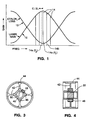
- Figure 1 is a graph illustrating the relationship between laser gain and the loss introduced by an etalon.
- Figure 2 is a schematic diagram of a single frequency laser system employing an etalon and operating with the method of the subject invention.
- Figure 3 is an end view, partially in section of the oven in which the etalon is mounted.
- Figure 4 is a cross sectional view of the oven shown in Figure 3.
- Figure 5 is a schematic diagram of the temperature control circuit for the etalon.
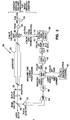
- Figures 6a through 6c are a composite flow chart of the algorithm used by the processor to carry out the active adjustment of the temperature of the etalon in accordance with the subject invention.
- FIG 1 there is illustrated a graph which demonstrates the interaction between the gain curve 10 in a laser with the transmission losses (curve 12) created by an etalon introduced into the laser resonator.
- the gain curve for a particular laser transition tends to be relatively broad due to a number of factors. Within that broad bandwidth, there will be a number of discrete, closely spaced longitudinal modes 14. The spacing between the modes is based on the length L of the resonator and is given by C/2L, where C is the speed of light. In the laser shown in Figure 2, this separation is on the order of 129 MHz.
- the minimum of the loss (or the peak of the transmission) of the etalon is shown aligned with one of the longitudinal modes, 14a. This alignment is typically fixed by the laser operator so that a single frequency, F1, is selected.
- the shifted frequency F2 is no longer aligned with the peak of the transmission curve of the etalon. This misalignment will result in a drop in power of the output of the laser since the transmission of the etalon is lower away from the peak. Clearly, it would be desirable to maintain the alignment between the selected mode and the peak of the transmission curve of the etalon during operation.
- a more serious problem occurs as the length of the resonator continues to drift. More specifically, at some point, the next adjacent longitudinal mode 14b will drift to a point closer to the peak of the transmission curve of the etalon than mode 14a. At this point, the losses in the laser will favor longitudinal mode 14b and the output will jump abruptly from mode 14a to mode 14b. In the illustrated laser this corresponds to a mode hop of 129 MHz. In accordance with the subject invention, this effect is controlled by adjusting the position of the peak of the etalon transmission curve to follow the frequency drift of the selected longitudinal mode 14a.
- FIG 2 there is illustrated a schematic diagram of a stabilized, single frequency laser system.
- the laser system 20 shown herein is a modification of the INNOVA 300 ion laser manufactured by Coherent, Inc. It should be understood however, that the subject invention can be employed in any system which utilizes a temperature adjustable etalon for frequency selection.
- Laser 20 includes a plasma tube 22 for containing the gas discharge.
- Plasma tube 22 is formed in accordance with the disclosure in United States Patent No. 4,378,600, issued March 29, 1983.
- the plasma tube 22 sits within a resonator defined by high reflecting end mirror 24 and a partially transmissive output coupler 26.
- An aperture 28 is provided to control the transverse mode output of the laser.
- the resonator components are mounted on a SuperInvar rod to passively stabilize the resonator to the maximum extent.
- a prism 30 is also placed in the cavity.
- Prism 30 is used for gross wavelength selection and isolates particular broadband transitions.
- the tilt angle of the prism is adjusted for wavelength selection.
- etalon 32 is also located in the cavity to select a single frequency (ie. longitudinal mode) from the multiple adjacent modes 14 shown in Figure 1.
- etalon 32 is a plate of fused silica with highly parallel surfaces. This type of etalon is available from Coherent Components Division under part no. 0502-908-XX. This etalon comes in one version that is uncoated and is suitable for ultraviolet and low-gain visible wavelengths. Another version is available with a twenty percent reflective coating and is designed for use with high-gain visible wavelengths. The latter type of etalon is preferred since it is low in cost and can be controlled in a relatively simple manner.
- the peak of the transmission curve of the etalon can be adjusted by tilting the etalon.
- the etalon 32 is installed at the factory with a tilt angle of about two mrad, which is just enough for wavelength selection and yet minimizes losses.
- the peak of the transmission curve of the etalon is controlled by adjusting the temperature of the etalon.
- the etalon temperature is adjusted, the index of refraction of the material is varied, changing the effective path lengths within the material and thereby changing the interference effects.
- a 1°C change in temperature will tune the peak of the transmission curve by about 5 GHz at 514.5nm wavelength.
- this means includes an oven 34, into which the etalon 32 is mounted.
- FIGS 3 and 4 illustrate a suitable oven design.
- This design includes a central cylindrical sleeve 40 for receiving the etalon 32.
- Four arms 42 extend radially outward from the sleeve 40.
- Outer cylinder 44 supports the arms.
- This design has a relatively low thermal mass and a relatively high thermal conductivity. By this arrangement, the oven can react quickly to commands to vary the temperature of the etalon. The oven can be accurately adjusted and stabilized to within .004° C.
- the etalon is heated by four resistive elements 46 mounted in bores formed in sleeve 40.
- a temperature transducer 48 is also mounted in sleeve 40 to monitor the temperature of the etalon.
- the resistors and transducer are wired to the etalon control circuit discussed below with reference to Figure 5.
- the oven 34 is mounted in a separate fixture (not shown) to provide the etalon tilt angle discussed above.
- the etalon and oven package described above is presently being used by Coherent in its existing single frequency ion laser systems.
- the etalon temperature was optimized and then fixed during operation.
- the temperature is continuously adjusted to compensate for changes in the length of the resonator.
- the feedback control loop of the subject invention is illustrated in Figure 2. More specifically, in the first embodiment of the subject invention, a portion of the laser light emitted from the laser is picked off by a beam splitter 50 and directed to a photodetector 52. The photodetector generates a current which is proportional to the output power of the laser. As noted above, this power will drop as the frequency of the selected longitudinal mode drifts away from the peak in the transmission curve of the etalon.
- the output from the photodetector 52 is amplified by amplifier 54 and then converted to a digital signal by A/D converter 56. This digital value is supplied to the main processor 58 handling all the operating parameters of the laser.
- the measured power value is supplied to an internal etalon tracking program 60 discussed below with reference to Figure 6.
- the tracking program will be stored in an EPROM connected to the main processor.
- the output of the tracking program will be an instruction to set the etalon at a given temperature to maximize performance.
- the laser head ie. plasma tube and resonator components
- the laser head has some functions controlled by a separate processor 62.
- the etalon temperature setting instruction will be sent through the latter processor and then converted to an analog voltage signal by a D/A converter 64.
- the output from converter 64 will be a voltage from 0 to 5 volts. This spread will cover a temperature range of four degrees in the etalon, between 51.5 and 55.5° C. This voltage is supplied to the etalon temperature control circuit 66.
- Figure 5 illustrates the temperature control circuit 66.
- Line 70 receives an input from the transducer 48 affixed in the oven 34. The transducer conducts one microamp per degree kelvin. A five volt reference across a resistor 76 is also supplied to line 70 to bias the circuit to 51.5° C which is above the maximum ambient air temperature.
- Line 72 receives the voltage signal from D/A converter 64.
- the zero to 5 volts to line 72 drives a current through resistor 74 of zero to 4 microamps.
- the five volt reference drives a current through resistor 76 of 324.6 microamps (51.5 + 273.1).
- the sum of these two currents minus the current conducted by the transducer 48 is conducted through resister 78. This generates an error signal voltage at the output of the amplifier 80 that is proportional to the difference between the temperature set by the signal from the D/A converter 64 and the temperature measured by the transducer 48.
- Amplifier 82 drives a pair of transistors 84, 86 that supply voltage to the heater resistors 46 in the oven.
- the voltage supplied is proportional to the error signal input to amplifier 82 and acts to reduce the error signal by heating the oven or allowing the oven to cool.
- Amplifier 82 is compensated to match the thermal time constant of the oven design ( Figures 3 and 4) to provide a stable control loop design. This control loop maintains the error signal at zero volts to stabilize the oven temperature to the temperature requested by the processor 62 to within .004° C.
- the alternate preferred embodiment will be reviewed.
- the customer has choice of two primary modes of operation, namely, current regulation or light regulation.
- the current regulation mode the current to the laser is fixed and the laser output power is allowed to vary.
- One reason the power varies is due to the changes in alignment of the frequency of the selected longitudinal mode with the peak of the transmission curve of the etalon caused by a length change in the resonator.
- the variations in the output power can be monitored to maintain optimal alignment conditions.
- the control system in the light regulation mode, is constrained to maintain a selected power.
- the current to the plasma tube must be varied. Since the control electronics are set to maintain a given power level, this latter parameter cannot be used to monitor variations which are indicative of changes in the length of the resonator. However, the tube current will be varying to make up for power losses.
- the variations in current are monitored and used in a feedback loop to control the etalon temperature.
- Figure 2 shows that the input to the etalon tracking program will include both the laser power and tube current.
- the hardware and software for tracking these parameters typically exists in more sophisticated laser systems so that the added costs needed to implement the subject invention are minimal.
- the parameter utilized by the tracking program will depend on the operating mode selected by the customer. As will be seen below with respect to Figure 6, there are only minor differences in the tracking program for each of the operating modes.
- FIG. 6a to 6c there is illustrated a flow chart of the etalon tracking program of the subject invention.
- the temperature of the etalon is received from the CPU in step 102.
- the CPU knows what set temperature it is currently commanding of the etalon oven circuit. This temperature may initially be set manually by the user via a command from the laser remote control in a manner similar to the prior art method of setting and fixing the etalon temperature. Internal flags are then set in step 104.
- One of the flags that is set relates to the direction of the next temperature change of the etalon. It should be appreciated that in operation, when a change in an operating parameter is detected, it will not be known whether the frequency of the selected mode is increasing or decreasing. Thus, the program cannot know in which direction the etalon temperature should be adjusted. As will be seen below, the program deals with this ambiguity by adjusting the temperature in a first, random direction, and then observing whether the monitored operating parameter improves or deteriorates. If the monitored parameter has improved, the program will assume that the adjustment was in the correct direction. If the monitored parameter has deteriorated, the program will assume that the direction of the temperature change must be reversed to compensate for the error.
- the flag which sets the direction of the next temperature adjustment is set to increase temperature of the etalon.
- the flag is set to increase temperature since during the warm up phase of the system (which can take several hours), it is almost certain that the etalon temperature will have to be increased because the length of the resonator will be increasing and the frequency of the selected mode will decrease.
- step 106 the parameters to be measured are set to zero.
- step 108 the selected parameter is measured. In the preferred embodiment, in order to increase accuracy and smooth operation, this measurement actually consists of an average of a number of measurements taken over a ten second period. This averaging routine is set forth in subroutine ⁇ and will be discussed below with respect to Figure 6b.
- the program will determine if any action needs to be taken. Assuming the laser is in the current regulation mode and power is being measured (step 110), the program will test to see if power has dropped more than four percent of a previously recorded maximum power level (step 112). If so, this spread will be considered too large to be handled by a small adjustment in the etalon temperature. Such a large drift will often occur during the very early stages of laser warm up or when other large perturbations occur.
- the program will determine if the temperature direction flag is properly set.
- the program first determines if the measured power has dropped since the last measurement, provided the last measurement resulted in a command to adjust the etalon temperature. If so, the program will assume that the last command to change the etalon temperature shifted the temperature of the etalon in the wrong direction to correct the problem. In that case, the temperature direction flag is changed in step 116 and a new temperature change is calculated in step 118.
- step 120 If the calculated change is less than .001° C, then no actual change is possible and the parameters will not be adjusted (step 120). If the calculated change is greater than .001°C, then the internal variable maximum power will be set to be equal to the previous maximum power (step 122). This step will function to cancel step 142 of subroutine ⁇ (discussed below) which had previously changed the etalon temperature in the wrong direction.
- step 140 a determination is made if the calculated change is greater than .001°C and if it is not, no command will be generated. If the calculated change is greater than .001°C, then the previous maximum value is set to the current maximum power in step 142 and the last value is set to power in step 144. The last value is the power before the etalon temperature is changed and is used in step 114 to determine if the change to the etalon temperature caused a power drop which would indicate that the change was in the wrong direction. If the previous change was in the wrong direction, the previous maximum will be used in step 118 to calculate the corrected change so that the maximum used in step 118 is the same that was used previously in step 130.
- step 146 the program determines in which direction the direction flag has been set and derives a new etalon temperature based on the calculated change previously generated in either step 118 or 130 (either step 148 or 150). If the new derived temperature is above or below the maximums or minimums of the oven, the maximums or minimums are used (steps 152 to 158). In the preferred embodiment, the user will be signaled that the temperature has gone out of range. Assuming the derived temperature is within the operating range of the oven, the new temperature is set by sending a digital signal to the main processor 58 in step 160. As noted above, this signal is ultimately supplied as a voltage to the temperature control circuit 66.
- the feedback cycle is suppressed so that the change can take place and its effect monitored.
- the cycle is suppressed by setting a 15 second timer in steps 162 and 164. With the low thermal mass and highly heat conductive oven, the effect of the temperature change should be observed after 15 seconds.
- the active monitoring of the power can be restarted.
- the effect of the subject method is to insure that as the measured power drops, the peak of the transmission curve of the etalon is shifted to be aligned with the frequency of the selected mode. While this will allow some drift in frequency, it will prevent mode hopping wherein the output frequency abruptly shifts to another frequency.
- the measurement of the selected parameter in step 108 consists of an averaging of multiple measurements.
- the measurement subroutine a is set forth in Figure 6b.
- the various counters are initialized to zero in step 202.
- Minimum sample is initialized to a value guaranteed to be larger than any sample measured and maximum sample is initialized to zero.
- the program determines which operating mode has been selected by the user based on an input from the main processor (step 204) The program then makes sure the internal mode program flag is set to the same selection (ie. the user did not manually change the mode during the measurements), and if not, resets it and restarts the entire measurement process (steps 206, 208 and 210).
- the program detects the present setting for the laser current (step 212). This information is received from the processor. If the present setting is different from the previous setting (ie. a manual change from the user), the program values must be reset again (steps 212 and 214)
- the first laser power reading is taken in step 216. If the power is less than .01 watts, then it can assumed that the laser is not operating and the routine is repeated (step 218). If the laser power is greater than .01 watts, then the sample counter is incremented (step 220) and the average power is calculated (step 222).
- the average power is calculated by taking the last calculated average power, multiplying that value by the number of samples that went into making that average (N-1), then adding the latest measurement and dividing by the present number of samples given by the counter (N). These sampling and averaging steps are repeated continuously for 10 seconds (step 224) during which time it is expected that roughly fifteen to twenty measurements will be taken. The calculated average power is then used as the output of step 108 in Figure 6a.
- step 226, 228, 230 and 232 the routine keeps track of both the maximum and minimum measured power levels (steps 226, 228, 230 and 232). The deviation between these two extremes over time (ie. the slope) is calculated in step 234. If this slope is greater than three percent, the entire sample is discarded and the measurements are begun again (step 236) If the slope is less than three percent, then the average power calculated in step 222 can be used.
- the blocks on the right hand side of the flow chart of Figure 6b illustrate the steps that occur when the laser is set in the light regulation mode.
- the variation in the amperes being supplied to the plasma tube (which forces the laser to operate at a fixed output power), is monitored.
- the steps are the same as in the current regulation mode except that different thresholds are necessary.
- the current measurement will only be considered valid if it is between 8 and 45 amps (the minimum and maximum for the illustrated laser).
- the only other difference occurs in step 236a wherein a slope of up to four percent is tolerated.
- the subject method provides for continuous, rapid analysis of changes in either the power or current of the laser. These changes will be indicative of a change in the length of the resonator which causes a shift in the frequency of the selected mode. This frequency shift will displace the selected output from the peak of the transmission curve of the etalon.
- the subject method tracks this misalignment and actively changes the temperature of the etalon to bring the selected longitudinal mode back into alignment with the peak of the transmission curve of the etalon. In this way, the performance of the laser can be maximized. More importantly, mode hopping, which occurs when the peak of the transmission curve of the etalon favors a neighboring and different longitudinal mode is substantially reduced.
Landscapes
- Physics & Mathematics (AREA)
- Electromagnetism (AREA)
- Engineering & Computer Science (AREA)
- Plasma & Fusion (AREA)
- Optics & Photonics (AREA)
- Lasers (AREA)
Claims (12)
- Betriebsverfahren eines Lasers, der einen Resonator (24, 26) mit eingebautem Etalon (32) aufweist, um einen Einfrequenzbetrieb zu ermöglichen, wobei das Verfahren ein Ändern der Temperatur des Etalons umfaßt, um die Spitze seiner Transmissionsfrequenzkurve zu verändern,
gekennzeichnet durch die folgenden Schritte:
Überwachen (52) eines Parameters des Lasers (20), der kennzeichnend für die Änderung in der Ausrichtung der Spitze der Transmissionsfrequenzkurve des Etalons (32) mit der Frequenz des ausgewählten Longitudinalausgangsmodes des Lasers (20) ist, wobei die Änderungen aus der Frequenzdrift des ausgewählten Longitudinalmodes entstehen, die durch Änderungen in der Länge des Resonators (24, 26) verursacht wird; und
Ändern der Temperatur des Etalons (32) auf der Grundlage der erfaßten Änderungen des Parameters, um die Spitze der Transmissionsfrequenzkurve des Etalons (32) derart zu verändern, daß die Frequenz dieser Spitze der Frequenzdrift des ausgewählten Longitudinalmodes im Laser (20) nachfolgt. - Verfahren nach Anspruch 1, gekennzeichnet durch
einen Bewertungsschritt, ob der überwachte Parameter sich unmittelbar nach dem Einstellen der Temperatur des Etalons (32) verbessert hat, um zu bestimmen, ob die Temperatureinstellung in der richtigen Richtung erfolgte. - Verfahren nach Anspruch 1 oder 2, dadurch gekennzeichnet, daß
die Temperatur des Etalons (32) am Anfang so eingestellt wird, daß sie sich während der Aufwärmstufen des Betriebs des Lasers vergrößert. - Verfahren nach einem der vorhergehenden Ansprüche, dadurch gekennzeichnet, daß
während des Überwachungsschrittes der Parameter während einer vorgegebenen Zeitspanne mehrere Male gemessen wird und daß die Messungen gemittelt werden, um eine genauere Angabe der Änderung in der Ausrichtung der Spitze der Transmissionsfrequenzkurve des Etalons (32) und der Frequenz des ausgewählten Longitudinalausgangsmodes des Lasers (20) zu erhalten. - Verfahren nach einem der vorhergehenden Ansprüche, dadurch gekennzeichnet, daß der überwachte Parameter die Leistung ist.
- Verfahren nach einem der Ansprüche 1 bis 4, dadurch gekennzeichnet, daß der überwachte Parameter der Strom ist.
- Verfahren nach Anspruch 1, dadurch gekennzeichnet, daß der überwachte Parameter die Frequenz ist.
- Laser, der einen Resonator (24, 26) mit einem eingebauten Etalon (32) aufweist, um einen Einfrequenzbetrieb zu ermöglichen sowie eine Einrichtung (34, 66) zum Ändern der Temperatur des Etalons (32), um die Spitze der Transmissionsfrequenzkurve zu verändern,
gekennzeichnet durch eine Erfassungseinrichtung (52) zum Messen eines Parameters des Lasers (20), der kennzeichend für die Änderung in der Ausrichtung der Spitze der Transmissionsfrequenzkurve des Etalons (32) mit der Frequenz des ausgewählten Longitudinalausgangsmodes des Lasers (20) ist, wobei die Änderungen aus der Frequenzdrift des ausgewählten Longitudinalmodes entstehen, die durch Längenänderungen des Resonators (24, 26) verursacht werden, ferner durch einen Prozessor (58) zum Steuern der Einrichtung (34, 66) für die Temperaturänderung des Etalons (32) auf der Grundlage der erfaßten Änderungen in dem Parameter zum Ändern der Spitze der Transmissionskurve des Etalons (32) derart, daß die Frequenz dieser Spitze der Frequenzdrift des ausgewählten Longitudinalmodes in dem Laser (20) nachfolgt. - Laser nach Anspruch 8, dadurch gekennzeichnet, daß die Einrichtung zum Ändern der Temperatur des Etalons (32) einen Ofen (34) umfaßt.
- Laser nach Anspruch 8 oder 9, dadurch gekennzeichnet, daß der erfaßte Parameter die Leistung ist.
- Laser nach Anspruch 8 oder 9, dadurch gekennzeichnet, daß der erfaßte Parameter der Strom ist.
- Laser nach Anspruch 8, dadurch gekennzeichnet, daß der erfaßte Parameter die Frequenz ist.
Applications Claiming Priority (2)
| Application Number | Priority Date | Filing Date | Title |
|---|---|---|---|
| US512846 | 1990-04-23 | ||
| US07/512,846 US5048031A (en) | 1990-04-23 | 1990-04-23 | Laser with actively stabilized etalon for single frequency operation |
Publications (3)
| Publication Number | Publication Date |
|---|---|
| EP0454399A2 EP0454399A2 (de) | 1991-10-30 |
| EP0454399A3 EP0454399A3 (en) | 1992-11-25 |
| EP0454399B1 true EP0454399B1 (de) | 1995-09-20 |
Family
ID=24040826
Family Applications (1)
| Application Number | Title | Priority Date | Filing Date |
|---|---|---|---|
| EP91303601A Expired - Lifetime EP0454399B1 (de) | 1990-04-23 | 1991-04-22 | Monofrequenter Laser |
Country Status (4)
| Country | Link |
|---|---|
| US (1) | US5048031A (de) |
| EP (1) | EP0454399B1 (de) |
| JP (1) | JP3320747B2 (de) |
| DE (1) | DE69113100T2 (de) |
Cited By (7)
| Publication number | Priority date | Publication date | Assignee | Title |
|---|---|---|---|---|
| US6580517B2 (en) | 2000-03-01 | 2003-06-17 | Lambda Physik Ag | Absolute wavelength calibration of lithography laser using multiple element or tandem see through hollow cathode lamp |
| US6597462B2 (en) | 2000-03-01 | 2003-07-22 | Lambda Physik Ag | Laser wavelength and bandwidth monitor |
| US6608848B2 (en) | 1998-06-01 | 2003-08-19 | Lambda Physik Ag | Method and apparatus for wavelength calibration |
| US6667804B1 (en) | 1999-10-12 | 2003-12-23 | Lambda Physik Ag | Temperature compensation method for wavemeters |
| US6747741B1 (en) | 2000-10-12 | 2004-06-08 | Lambda Physik Ag | Multiple-pass interferometric device |
| US6807205B1 (en) | 2000-07-14 | 2004-10-19 | Lambda Physik Ag | Precise monitor etalon calibration technique |
| US7006541B2 (en) | 1998-06-01 | 2006-02-28 | Lambda Physik Ag | Absolute wavelength calibration of lithography laser using multiple element or tandem see through hollow cathode lamp |
Families Citing this family (14)
| Publication number | Priority date | Publication date | Assignee | Title |
|---|---|---|---|---|
| DE4002162C1 (de) * | 1990-01-25 | 1991-04-18 | Lambda Physik Forschungs- Und Entwicklungsgesellschaft Mbh, 3400 Goettingen, De | |
| DE69200586T2 (de) * | 1992-01-24 | 1995-05-24 | Hewlett Packard Gmbh | Verfahren und Apparat zum Abstimmen der Wellenlänge in einer optischen Vorrichtung und deren Anwendung in einem Laser. |
| US5457706A (en) * | 1993-03-30 | 1995-10-10 | The United States Of America As Represented By The Administrator Of The National Aeronautics And Space Administration | Tunable CW diode-pumped Tm,Ho:YLiF4 laser operating at or near room temperature |
| DE19620594A1 (de) * | 1996-05-22 | 1997-11-27 | Sel Alcatel Ag | Resonator für elektromagnetische Wellen mit einer Stabilisierungseinrichtung und Verfahren zum Stabilisieren der Resonatorlänge |
| DE19646073C1 (de) * | 1996-11-08 | 1998-04-16 | Daimler Benz Ag | Verfahren zur Minderung des Amplitudenrauschens von Festkörperlasern mit resonatorinterner Frequenzverdopplung |
| US6175579B1 (en) | 1998-10-27 | 2001-01-16 | Precision Light L.L.C. | Apparatus and method for laser frequency control |
| US6243401B1 (en) * | 1999-02-10 | 2001-06-05 | National Science Council | Methods and apparatus for wavelength measurement and tracking using a semiconductor laser amplifier |
| US6671296B2 (en) * | 2000-10-10 | 2003-12-30 | Spectrasensors, Inc. | Wavelength locker on optical bench and method of manufacture |
| EP1393418B1 (de) * | 2001-04-12 | 2005-06-22 | Finisar Corporation | Verfahren und vorrichtung zur regelung der mittenwellenlänge eines lasers, insbesondere eines halbleiterlasers |
| US20060176916A1 (en) * | 2003-01-23 | 2006-08-10 | Eckhard Zanger | Laser resonator and frequency-converted laser |
| GB201409504D0 (en) * | 2014-05-29 | 2014-07-16 | Bae Systems Plc | A beamsplitter and frequency monitoring system |
| US9583135B1 (en) | 2016-04-27 | 2017-02-28 | Seagate Technology Llc | Laser mode hopping detection method and apparatus for a heat-assisted magnetic recording device |
| US9595288B1 (en) | 2016-05-16 | 2017-03-14 | Seagate Technology Llc | Laser mode hopping detection in a heat-assisted magnetic recording drive |
| CN113097860B (zh) * | 2021-03-10 | 2022-09-13 | 浙江大学 | 半导体激光器驱动电流电路及输出频率实时反馈方法 |
Family Cites Families (8)
| Publication number | Priority date | Publication date | Assignee | Title |
|---|---|---|---|---|
| US3967211A (en) * | 1974-01-17 | 1976-06-29 | Jersey Nuclear-Avco Isotopes, Inc. | Laser wavelength stabilization |
| US3987373A (en) * | 1975-03-19 | 1976-10-19 | Lexel Corporation | Laser having etalon assembly |
| US4081760A (en) * | 1976-06-03 | 1978-03-28 | Coherent, Inc. | Etalon laser mode selector |
| US4097818A (en) * | 1976-09-03 | 1978-06-27 | Coherent, Inc. | Adjustable etalon laser mode selector and method of adjustment |
| US4782492A (en) * | 1986-05-05 | 1988-11-01 | Polaroid Corporation | Thermally controllable optical devices and system |
| KR910006307B1 (ko) * | 1987-09-26 | 1991-08-19 | 미쓰비시덴기 가부시기가이샤 | 레이저 파장의 안정화 방법 및 파장 안정화 장치 |
| JPS6484681A (en) * | 1987-09-26 | 1989-03-29 | Mitsubishi Electric Corp | Laser apparatus |
| JPH01181485A (ja) * | 1988-01-08 | 1989-07-19 | Toshiba Corp | 色素レーザ装置 |
-
1990
- 1990-04-23 US US07/512,846 patent/US5048031A/en not_active Expired - Lifetime
-
1991
- 1991-04-16 JP JP11090291A patent/JP3320747B2/ja not_active Expired - Fee Related
- 1991-04-22 EP EP91303601A patent/EP0454399B1/de not_active Expired - Lifetime
- 1991-04-22 DE DE69113100T patent/DE69113100T2/de not_active Expired - Fee Related
Cited By (7)
| Publication number | Priority date | Publication date | Assignee | Title |
|---|---|---|---|---|
| US6608848B2 (en) | 1998-06-01 | 2003-08-19 | Lambda Physik Ag | Method and apparatus for wavelength calibration |
| US7006541B2 (en) | 1998-06-01 | 2006-02-28 | Lambda Physik Ag | Absolute wavelength calibration of lithography laser using multiple element or tandem see through hollow cathode lamp |
| US6667804B1 (en) | 1999-10-12 | 2003-12-23 | Lambda Physik Ag | Temperature compensation method for wavemeters |
| US6580517B2 (en) | 2000-03-01 | 2003-06-17 | Lambda Physik Ag | Absolute wavelength calibration of lithography laser using multiple element or tandem see through hollow cathode lamp |
| US6597462B2 (en) | 2000-03-01 | 2003-07-22 | Lambda Physik Ag | Laser wavelength and bandwidth monitor |
| US6807205B1 (en) | 2000-07-14 | 2004-10-19 | Lambda Physik Ag | Precise monitor etalon calibration technique |
| US6747741B1 (en) | 2000-10-12 | 2004-06-08 | Lambda Physik Ag | Multiple-pass interferometric device |
Also Published As
| Publication number | Publication date |
|---|---|
| EP0454399A2 (de) | 1991-10-30 |
| US5048031A (en) | 1991-09-10 |
| DE69113100D1 (de) | 1995-10-26 |
| JP3320747B2 (ja) | 2002-09-03 |
| EP0454399A3 (en) | 1992-11-25 |
| DE69113100T2 (de) | 1996-06-20 |
| JPH04250678A (ja) | 1992-09-07 |
Similar Documents
| Publication | Publication Date | Title |
|---|---|---|
| US5144632A (en) | Laser with actively stabilized etalon for single frequency operation | |
| EP0454399B1 (de) | Monofrequenter Laser | |
| US6516010B1 (en) | Method and apparatus for active numeric temperature compensation of an etalon in a wavelength stabilized laser | |
| US5438579A (en) | Wavelength stabilizing apparatus | |
| KR100733172B1 (ko) | 튜닝가능 레이저용 제어기와 제어 방법 및 레이저 시스템 | |
| US6804278B2 (en) | Evaluation and adjustment of laser losses according to voltage across gain medium | |
| EP2058907B1 (de) | Frequenzstabilisierte Laservorrichtung, Laserfrequenzstabilisierungsverfahren und Laserfrequenzstabilisierungsprogramm | |
| US7978737B2 (en) | Laser device, control device of laser device, method of controlling laser device, method of tuning wavelength of laser device and control data of laser device | |
| US20060072634A1 (en) | Calibration methods for tunable lasers | |
| US7356055B2 (en) | Method and device for regulating the average wavelength of a laser, especially a semiconductor laser | |
| US10522972B2 (en) | Tuneable DBR laser without external frequency locker | |
| JPH09260792A (ja) | 外部共振器型波長可変ld光源 | |
| JP3466441B2 (ja) | レーザ装置の波長安定化装置 | |
| US7529285B2 (en) | Frequency stabilised gas laser | |
| JP2611264B2 (ja) | 波長安定化レーザ | |
| KR102878212B1 (ko) | 파장 훑음 레이저의 출력 안정화 시스템 및 그 방법 | |
| JPH0513862A (ja) | レーザー装置 | |
| JP2000228552A (ja) | 固体レーザ装置 | |
| JP7573429B2 (ja) | レーザ装置、及び波長異常検出方法 | |
| JPH1187826A (ja) | 高調波発振装置の制御方法 | |
| JPH1022585A (ja) | 可変波長光源 | |
| JPH09162477A (ja) | 波長安定化装置 | |
| HK1063693B (en) | Evaluation and adjustment of laser losses according to voltage across gain medium |
Legal Events
| Date | Code | Title | Description |
|---|---|---|---|
| PUAI | Public reference made under article 153(3) epc to a published international application that has entered the european phase |
Free format text: ORIGINAL CODE: 0009012 |
|
| AK | Designated contracting states |
Kind code of ref document: A2 Designated state(s): CH DE FR GB IT LI |
|
| PUAL | Search report despatched |
Free format text: ORIGINAL CODE: 0009013 |
|
| AK | Designated contracting states |
Kind code of ref document: A3 Designated state(s): CH DE FR GB IT LI |
|
| 17P | Request for examination filed |
Effective date: 19930317 |
|
| 17Q | First examination report despatched |
Effective date: 19940304 |
|
| GRAA | (expected) grant |
Free format text: ORIGINAL CODE: 0009210 |
|
| RAP1 | Party data changed (applicant data changed or rights of an application transferred) |
Owner name: COHERENT, INC. |
|
| AK | Designated contracting states |
Kind code of ref document: B1 Designated state(s): CH DE FR GB IT LI |
|
| PG25 | Lapsed in a contracting state [announced via postgrant information from national office to epo] |
Ref country code: IT Free format text: LAPSE BECAUSE OF FAILURE TO SUBMIT A TRANSLATION OF THE DESCRIPTION OR TO PAY THE FEE WITHIN THE PRE;WARNING: LAPSES OF ITALIAN PATENTS WITH EFFECTIVE DATE BEFORE 2007 MAY HAVE OCCURRED AT ANY TIME BEFORE 2007. THE CORRECT EFFECTIVE DATE MAY BE DIFFERENT FROM THE ONE RECORDED.SCRIBED TIME-LIMIT Effective date: 19950920 Ref country code: CH Effective date: 19950920 Ref country code: LI Effective date: 19950920 |
|
| REF | Corresponds to: |
Ref document number: 69113100 Country of ref document: DE Date of ref document: 19951026 |
|
| ET | Fr: translation filed | ||
| REG | Reference to a national code |
Ref country code: CH Ref legal event code: PL |
|
| PLBE | No opposition filed within time limit |
Free format text: ORIGINAL CODE: 0009261 |
|
| STAA | Information on the status of an ep patent application or granted ep patent |
Free format text: STATUS: NO OPPOSITION FILED WITHIN TIME LIMIT |
|
| 26N | No opposition filed | ||
| REG | Reference to a national code |
Ref country code: GB Ref legal event code: IF02 |
|
| PGFP | Annual fee paid to national office [announced via postgrant information from national office to epo] |
Ref country code: FR Payment date: 20020410 Year of fee payment: 12 |
|
| PGFP | Annual fee paid to national office [announced via postgrant information from national office to epo] |
Ref country code: GB Payment date: 20020417 Year of fee payment: 12 |
|
| PGFP | Annual fee paid to national office [announced via postgrant information from national office to epo] |
Ref country code: DE Payment date: 20020502 Year of fee payment: 12 |
|
| PG25 | Lapsed in a contracting state [announced via postgrant information from national office to epo] |
Ref country code: GB Free format text: LAPSE BECAUSE OF NON-PAYMENT OF DUE FEES Effective date: 20030422 |
|
| PG25 | Lapsed in a contracting state [announced via postgrant information from national office to epo] |
Ref country code: DE Free format text: LAPSE BECAUSE OF NON-PAYMENT OF DUE FEES Effective date: 20031101 |
|
| GBPC | Gb: european patent ceased through non-payment of renewal fee |
Effective date: 20030422 |
|
| PG25 | Lapsed in a contracting state [announced via postgrant information from national office to epo] |
Ref country code: FR Free format text: LAPSE BECAUSE OF NON-PAYMENT OF DUE FEES Effective date: 20031231 |
|
| REG | Reference to a national code |
Ref country code: FR Ref legal event code: ST |