EP0454844B1 - Materiaux photographiques precipites a activite amelioree - Google Patents
Materiaux photographiques precipites a activite amelioree Download PDFInfo
- Publication number
- EP0454844B1 EP0454844B1 EP91902470A EP91902470A EP0454844B1 EP 0454844 B1 EP0454844 B1 EP 0454844B1 EP 91902470 A EP91902470 A EP 91902470A EP 91902470 A EP91902470 A EP 91902470A EP 0454844 B1 EP0454844 B1 EP 0454844B1
- Authority
- EP
- European Patent Office
- Prior art keywords
- dispersion
- coupler
- solvent
- photographic
- latex
- Prior art date
- Legal status (The legal status is an assumption and is not a legal conclusion. Google has not performed a legal analysis and makes no representation as to the accuracy of the status listed.)
- Expired - Lifetime
Links
- 239000000463 material Substances 0.000 title description 17
- 230000000694 effects Effects 0.000 title description 6
- 239000006185 dispersion Substances 0.000 claims description 147
- 239000002904 solvent Substances 0.000 claims description 95
- 238000000034 method Methods 0.000 claims description 47
- 239000004816 latex Substances 0.000 claims description 37
- 229920000126 latex Polymers 0.000 claims description 37
- 239000000203 mixture Substances 0.000 claims description 25
- 239000004094 surface-active agent Substances 0.000 claims description 22
- 239000000839 emulsion Substances 0.000 claims description 21
- 108010010803 Gelatin Proteins 0.000 claims description 19
- 239000008273 gelatin Substances 0.000 claims description 19
- 229920000159 gelatin Polymers 0.000 claims description 19
- 235000019322 gelatine Nutrition 0.000 claims description 19
- 235000011852 gelatine desserts Nutrition 0.000 claims description 19
- 238000000576 coating method Methods 0.000 claims description 16
- 239000000084 colloidal system Substances 0.000 claims description 15
- 229910052709 silver Inorganic materials 0.000 claims description 15
- 239000004332 silver Substances 0.000 claims description 15
- 239000002245 particle Substances 0.000 claims description 13
- 239000011248 coating agent Substances 0.000 claims description 11
- -1 silver halide Chemical class 0.000 claims description 11
- NIXOWILDQLNWCW-UHFFFAOYSA-N acrylic acid group Chemical group C(C=C)(=O)O NIXOWILDQLNWCW-UHFFFAOYSA-N 0.000 claims description 10
- DOIRQSBPFJWKBE-UHFFFAOYSA-N dibutyl phthalate Chemical compound CCCCOC(=O)C1=CC=CC=C1C(=O)OCCCC DOIRQSBPFJWKBE-UHFFFAOYSA-N 0.000 claims description 10
- 229920001577 copolymer Polymers 0.000 claims description 9
- 238000002156 mixing Methods 0.000 claims description 8
- 238000001556 precipitation Methods 0.000 claims description 8
- KJWMCPYEODZESQ-UHFFFAOYSA-N 4-Dodecylphenol Chemical compound CCCCCCCCCCCCC1=CC=C(O)C=C1 KJWMCPYEODZESQ-UHFFFAOYSA-N 0.000 claims description 7
- 230000003213 activating effect Effects 0.000 claims description 7
- SMZOUWXMTYCWNB-UHFFFAOYSA-N 2-(2-methoxy-5-methylphenyl)ethanamine Chemical compound COC1=CC=C(C)C=C1CCN SMZOUWXMTYCWNB-UHFFFAOYSA-N 0.000 claims description 6
- QAOWNCQODCNURD-UHFFFAOYSA-L Sulfate Chemical compound [O-]S([O-])(=O)=O QAOWNCQODCNURD-UHFFFAOYSA-L 0.000 claims description 5
- DBMJMQXJHONAFJ-UHFFFAOYSA-M Sodium laurylsulphate Chemical compound [Na+].CCCCCCCCCCCCOS([O-])(=O)=O DBMJMQXJHONAFJ-UHFFFAOYSA-M 0.000 claims description 4
- JIGUQPWFLRLWPJ-UHFFFAOYSA-N Ethyl acrylate Chemical compound CCOC(=O)C=C JIGUQPWFLRLWPJ-UHFFFAOYSA-N 0.000 claims description 3
- YSMRWXYRXBRSND-UHFFFAOYSA-N TOTP Chemical compound CC1=CC=CC=C1OP(=O)(OC=1C(=CC=CC=1)C)OC1=CC=CC=C1C YSMRWXYRXBRSND-UHFFFAOYSA-N 0.000 claims description 3
- 125000001449 isopropyl group Chemical group [H]C([H])([H])C([H])(*)C([H])([H])[H] 0.000 claims description 3
- PNJWIWWMYCMZRO-UHFFFAOYSA-N pent‐4‐en‐2‐one Natural products CC(=O)CC=C PNJWIWWMYCMZRO-UHFFFAOYSA-N 0.000 claims description 3
- FWFUWXVFYKCSQA-UHFFFAOYSA-M sodium;2-methyl-2-(prop-2-enoylamino)propane-1-sulfonate Chemical compound [Na+].[O-]S(=O)(=O)CC(C)(C)NC(=O)C=C FWFUWXVFYKCSQA-UHFFFAOYSA-M 0.000 claims description 3
- BDHFUVZGWQCTTF-UHFFFAOYSA-M sulfonate Chemical compound [O-]S(=O)=O BDHFUVZGWQCTTF-UHFFFAOYSA-M 0.000 claims description 3
- 125000001273 sulfonato group Chemical group [O-]S(*)(=O)=O 0.000 claims description 3
- 125000001183 hydrocarbyl group Chemical group 0.000 claims description 2
- ZKBBQUFQDGOTBZ-UHFFFAOYSA-N sodium;1,2,3-tri(propan-2-yl)naphthalene Chemical compound [Na].C1=CC=C2C(C(C)C)=C(C(C)C)C(C(C)C)=CC2=C1 ZKBBQUFQDGOTBZ-UHFFFAOYSA-N 0.000 claims description 2
- 229920000800 acrylic rubber Polymers 0.000 claims 4
- 125000005395 methacrylic acid group Chemical group 0.000 claims 4
- MNUDYACCZUEJCW-UHFFFAOYSA-L disodium;1,2,3-tri(propan-2-yl)naphthalene;sulfate Chemical compound [Na+].[Na+].[O-]S([O-])(=O)=O.C1=CC=C2C(C(C)C)=C(C(C)C)C(C(C)C)=CC2=C1 MNUDYACCZUEJCW-UHFFFAOYSA-L 0.000 claims 1
- 239000000758 substrate Substances 0.000 claims 1
- XLYOFNOQVPJJNP-UHFFFAOYSA-N water Substances O XLYOFNOQVPJJNP-UHFFFAOYSA-N 0.000 description 37
- 239000000243 solution Substances 0.000 description 32
- HEMHJVSKTPXQMS-UHFFFAOYSA-M Sodium hydroxide Chemical compound [OH-].[Na+] HEMHJVSKTPXQMS-UHFFFAOYSA-M 0.000 description 21
- QTBSBXVTEAMEQO-UHFFFAOYSA-N Acetic acid Chemical compound CC(O)=O QTBSBXVTEAMEQO-UHFFFAOYSA-N 0.000 description 17
- BDERNNFJNOPAEC-UHFFFAOYSA-N propan-1-ol Chemical compound CCCO BDERNNFJNOPAEC-UHFFFAOYSA-N 0.000 description 16
- 229920000642 polymer Polymers 0.000 description 15
- 230000008569 process Effects 0.000 description 13
- 239000012153 distilled water Substances 0.000 description 10
- 230000002209 hydrophobic effect Effects 0.000 description 9
- 238000003756 stirring Methods 0.000 description 9
- 230000009257 reactivity Effects 0.000 description 8
- 239000000725 suspension Substances 0.000 description 8
- BQCADISMDOOEFD-UHFFFAOYSA-N Silver Chemical compound [Ag] BQCADISMDOOEFD-UHFFFAOYSA-N 0.000 description 7
- 238000009835 boiling Methods 0.000 description 7
- 238000003801 milling Methods 0.000 description 7
- OKKJLVBELUTLKV-UHFFFAOYSA-N Methanol Chemical compound OC OKKJLVBELUTLKV-UHFFFAOYSA-N 0.000 description 6
- 229960000583 acetic acid Drugs 0.000 description 6
- 230000015572 biosynthetic process Effects 0.000 description 6
- 238000000502 dialysis Methods 0.000 description 6
- 238000002360 preparation method Methods 0.000 description 5
- 238000003860 storage Methods 0.000 description 5
- IJGRMHOSHXDMSA-UHFFFAOYSA-N Atomic nitrogen Chemical compound N#N IJGRMHOSHXDMSA-UHFFFAOYSA-N 0.000 description 4
- 239000007864 aqueous solution Substances 0.000 description 4
- 150000001875 compounds Chemical class 0.000 description 4
- XBDQKXXYIPTUBI-UHFFFAOYSA-N dimethylselenoniopropionate Natural products CCC(O)=O XBDQKXXYIPTUBI-UHFFFAOYSA-N 0.000 description 4
- 238000000265 homogenisation Methods 0.000 description 4
- 238000004519 manufacturing process Methods 0.000 description 4
- 238000005057 refrigeration Methods 0.000 description 4
- KFZMGEQAYNKOFK-UHFFFAOYSA-N Isopropanol Chemical compound CC(C)O KFZMGEQAYNKOFK-UHFFFAOYSA-N 0.000 description 3
- 239000003513 alkali Substances 0.000 description 3
- 239000007900 aqueous suspension Substances 0.000 description 3
- 229920002301 cellulose acetate Polymers 0.000 description 3
- CBEQRNSPHCCXSH-UHFFFAOYSA-N iodine monobromide Chemical compound IBr CBEQRNSPHCCXSH-UHFFFAOYSA-N 0.000 description 3
- 239000000178 monomer Substances 0.000 description 3
- 239000004848 polyfunctional curative Substances 0.000 description 3
- 229920000036 polyvinylpyrrolidone Polymers 0.000 description 3
- 239000001267 polyvinylpyrrolidone Substances 0.000 description 3
- 235000013855 polyvinylpyrrolidone Nutrition 0.000 description 3
- CERQOIWHTDAKMF-UHFFFAOYSA-N Methacrylic acid Chemical compound CC(=C)C(O)=O CERQOIWHTDAKMF-UHFFFAOYSA-N 0.000 description 2
- LRHPLDYGYMQRHN-UHFFFAOYSA-N N-Butanol Chemical compound CCCCO LRHPLDYGYMQRHN-UHFFFAOYSA-N 0.000 description 2
- 125000005250 alkyl acrylate group Chemical group 0.000 description 2
- 239000003945 anionic surfactant Substances 0.000 description 2
- 239000012736 aqueous medium Substances 0.000 description 2
- 239000002585 base Substances 0.000 description 2
- 239000007844 bleaching agent Substances 0.000 description 2
- 230000015271 coagulation Effects 0.000 description 2
- 238000005345 coagulation Methods 0.000 description 2
- 238000001246 colloidal dispersion Methods 0.000 description 2
- 238000002425 crystallisation Methods 0.000 description 2
- 230000008025 crystallization Effects 0.000 description 2
- 239000010419 fine particle Substances 0.000 description 2
- 235000015110 jellies Nutrition 0.000 description 2
- 239000008274 jelly Substances 0.000 description 2
- 238000011068 loading method Methods 0.000 description 2
- 239000012528 membrane Substances 0.000 description 2
- 229910052757 nitrogen Inorganic materials 0.000 description 2
- 239000003960 organic solvent Substances 0.000 description 2
- 238000012545 processing Methods 0.000 description 2
- 235000019260 propionic acid Nutrition 0.000 description 2
- IUVKMZGDUIUOCP-BTNSXGMBSA-N quinbolone Chemical compound O([C@H]1CC[C@H]2[C@H]3[C@@H]([C@]4(C=CC(=O)C=C4CC3)C)CC[C@@]21C)C1=CCCC1 IUVKMZGDUIUOCP-BTNSXGMBSA-N 0.000 description 2
- 239000003381 stabilizer Substances 0.000 description 2
- 239000000126 substance Substances 0.000 description 2
- 125000000542 sulfonic acid group Chemical group 0.000 description 2
- 238000012360 testing method Methods 0.000 description 2
- 229920002554 vinyl polymer Polymers 0.000 description 2
- 238000005406 washing Methods 0.000 description 2
- DGAQECJNVWCQMB-PUAWFVPOSA-M Ilexoside XXIX Chemical group C[C@@H]1CC[C@@]2(CC[C@@]3(C(=CC[C@H]4[C@]3(CC[C@@H]5[C@@]4(CC[C@@H](C5(C)C)OS(=O)(=O)[O-])C)C)[C@@H]2[C@]1(C)O)C)C(=O)O[C@H]6[C@@H]([C@H]([C@@H]([C@H](O6)CO)O)O)O.[Na+] DGAQECJNVWCQMB-PUAWFVPOSA-M 0.000 description 1
- 239000004721 Polyphenylene oxide Substances 0.000 description 1
- 239000002253 acid Substances 0.000 description 1
- 230000002378 acidificating effect Effects 0.000 description 1
- 239000000654 additive Substances 0.000 description 1
- 125000002877 alkyl aryl group Chemical group 0.000 description 1
- 239000011260 aqueous acid Substances 0.000 description 1
- 125000003178 carboxy group Chemical group [H]OC(*)=O 0.000 description 1
- 150000001732 carboxylic acid derivatives Chemical class 0.000 description 1
- 150000001768 cations Chemical class 0.000 description 1
- 230000008859 change Effects 0.000 description 1
- 238000006243 chemical reaction Methods 0.000 description 1
- 239000008199 coating composition Substances 0.000 description 1
- 238000009833 condensation Methods 0.000 description 1
- 230000005494 condensation Effects 0.000 description 1
- 238000007796 conventional method Methods 0.000 description 1
- 230000003247 decreasing effect Effects 0.000 description 1
- 238000011161 development Methods 0.000 description 1
- 239000002270 dispersing agent Substances 0.000 description 1
- 238000001704 evaporation Methods 0.000 description 1
- 230000008020 evaporation Effects 0.000 description 1
- 238000005562 fading Methods 0.000 description 1
- 238000009472 formulation Methods 0.000 description 1
- 239000012362 glacial acetic acid Substances 0.000 description 1
- 238000010438 heat treatment Methods 0.000 description 1
- 125000001165 hydrophobic group Chemical group 0.000 description 1
- 239000002609 medium Substances 0.000 description 1
- 229920000570 polyether Polymers 0.000 description 1
- USHAGKDGDHPEEY-UHFFFAOYSA-L potassium persulfate Chemical compound [K+].[K+].[O-]S(=O)(=O)OOS([O-])(=O)=O USHAGKDGDHPEEY-UHFFFAOYSA-L 0.000 description 1
- 239000002244 precipitate Substances 0.000 description 1
- 230000001376 precipitating effect Effects 0.000 description 1
- 230000001681 protective effect Effects 0.000 description 1
- 238000011160 research Methods 0.000 description 1
- 238000010008 shearing Methods 0.000 description 1
- 238000005549 size reduction Methods 0.000 description 1
- 239000011734 sodium Substances 0.000 description 1
- 229910052708 sodium Inorganic materials 0.000 description 1
- HRZFUMHJMZEROT-UHFFFAOYSA-L sodium disulfite Chemical compound [Na+].[Na+].[O-]S(=O)S([O-])(=O)=O HRZFUMHJMZEROT-UHFFFAOYSA-L 0.000 description 1
- APSBXTVYXVQYAB-UHFFFAOYSA-M sodium docusate Chemical group [Na+].CCCCC(CC)COC(=O)CC(S([O-])(=O)=O)C(=O)OCC(CC)CCCC APSBXTVYXVQYAB-UHFFFAOYSA-M 0.000 description 1
- 229940001584 sodium metabisulfite Drugs 0.000 description 1
- 235000010262 sodium metabisulphite Nutrition 0.000 description 1
- 159000000000 sodium salts Chemical class 0.000 description 1
- DAJSVUQLFFJUSX-UHFFFAOYSA-M sodium;dodecane-1-sulfonate Chemical compound [Na+].CCCCCCCCCCCCS([O-])(=O)=O DAJSVUQLFFJUSX-UHFFFAOYSA-M 0.000 description 1
- 238000001179 sorption measurement Methods 0.000 description 1
- 239000012089 stop solution Substances 0.000 description 1
- 229940124530 sulfonamide Drugs 0.000 description 1
- 150000003456 sulfonamides Chemical class 0.000 description 1
- GPRLSGONYQIRFK-MNYXATJNSA-N triton Chemical compound [3H+] GPRLSGONYQIRFK-MNYXATJNSA-N 0.000 description 1
- WFKWXMTUELFFGS-UHFFFAOYSA-N tungsten Chemical compound [W] WFKWXMTUELFFGS-UHFFFAOYSA-N 0.000 description 1
- 229910052721 tungsten Inorganic materials 0.000 description 1
- 239000010937 tungsten Substances 0.000 description 1
- NLVXSWCKKBEXTG-UHFFFAOYSA-N vinylsulfonic acid Chemical compound OS(=O)(=O)C=C NLVXSWCKKBEXTG-UHFFFAOYSA-N 0.000 description 1
- 229920003169 water-soluble polymer Polymers 0.000 description 1
- 238000009736 wetting Methods 0.000 description 1
- 239000000080 wetting agent Substances 0.000 description 1
Images


Classifications
-
- G—PHYSICS
- G03—PHOTOGRAPHY; CINEMATOGRAPHY; ANALOGOUS TECHNIQUES USING WAVES OTHER THAN OPTICAL WAVES; ELECTROGRAPHY; HOLOGRAPHY
- G03C—PHOTOSENSITIVE MATERIALS FOR PHOTOGRAPHIC PURPOSES; PHOTOGRAPHIC PROCESSES, e.g. CINE, X-RAY, COLOUR, STEREO-PHOTOGRAPHIC PROCESSES; AUXILIARY PROCESSES IN PHOTOGRAPHY
- G03C7/00—Multicolour photographic processes or agents therefor; Regeneration of such processing agents; Photosensitive materials for multicolour processes
- G03C7/30—Colour processes using colour-coupling substances; Materials therefor; Preparing or processing such materials
- G03C7/388—Processes for the incorporation in the emulsion of substances liberating photographically active agents or colour-coupling substances; Solvents therefor
-
- Y—GENERAL TAGGING OF NEW TECHNOLOGICAL DEVELOPMENTS; GENERAL TAGGING OF CROSS-SECTIONAL TECHNOLOGIES SPANNING OVER SEVERAL SECTIONS OF THE IPC; TECHNICAL SUBJECTS COVERED BY FORMER USPC CROSS-REFERENCE ART COLLECTIONS [XRACs] AND DIGESTS
- Y10—TECHNICAL SUBJECTS COVERED BY FORMER USPC
- Y10S—TECHNICAL SUBJECTS COVERED BY FORMER USPC CROSS-REFERENCE ART COLLECTIONS [XRACs] AND DIGESTS
- Y10S430/00—Radiation imagery chemistry: process, composition, or product thereof
- Y10S430/136—Coating process making radiation sensitive element
Definitions
- the present invention concerns a method for forming stable finely dispersed particles of photographic components and incorporating such dispersions in photographic systems. It particularly relates to the preparation of stable dispersions of photographic coupler materials.
- the combination of coupler and solvent has to be heated to a high temperature in order to dissolve the coupler.
- the coupler may crystallize subsequently upon chill setting and storage of the dispersion.
- considerable effort has to be made to select a coupler solvent so that the coupler does not crystallize.
- the process also suffers from the disadvantage that a large amount of energy has to be expended to generate the high shearing forces needed in milling or homogenization.
- U.S. 4,199,363 by Chen describes latex loading as a method.
- the coupler is loaded into a latex polymer by mixing a solution of the coupler in a low boiling water miscible organic solvent with an aqueous suspension of the latex.
- the solvent is then removed by evaporation or washing, and the latex suspension is mixed with aqueous gelatin. It has been observed that coagulation of the latex may occur while loading the coupler into the latex or subsequently while mixing the loaded latex with gelatin.
- U.S. 2,801,170 - Vittum et al discloses preparing separate dispersions of a coupler and a high boiling point solvent and mixing the two dispersions with a silver halide emulsion.
- U.S. 2,787,544 - Godowsky et al discloses a method of making mixed packet photographic systems. A dispersion of high boiling point solvent is mixed with a dispersion of coupler.
- U. S. Patent 2,870,012 - Godowsky et al disclosed formation of a finely divided suspension of a coupler by precipitation caused by solvent shift. Also disclosed is utilization of a surfactant that is a dioctyl ester of sodium sulfosuccinic acid as a wetting or dispersing agent. It is indicated in Godowsky et al that the materials are stable for a long period of time after removal of the solvent.
- U.S. 4,419,441 - Nittel et al - describes a two-stage process for preparing dispersions of describes a two-stage process for preparing dispersions of hydrophobic photographic additives such as color couplers.
- the main dispersion stage the total quantity of hydrophobic substance is dispersed in the aqueous medium without any high boiling water immiscible solvent (permanent coupler solvent) or only a part of the total quantity of permanent coupler solvent.
- the residual portion of permanent solvent is dispersed in the aqueous medium without hydrophobic substance (coupler) in at least one further dispersion stage preceding or following the main dispersion stage.
- the dispersion of the coupler (main dispersion stage) is prepared by dissolving the coupler and the low boiling solvent which is substantially immiscible with water,
- An object of the invention is to overcome difficulties with the prior processes of forming dispersions of photographic materials.
- a further object is to provide precipitated coupler dispersions of improved photographic activity.
- Another object of the invention is to provide a method of forming dispersions of photographic coupler materials that are stable during storage without refrigeration.
- a further object of the invention is to provide a method of forming photographic materials with improved dye stability.
- a further object of the invention is to provide dispersions of photographic coupler materials without the use of mechanical operations, such as milling or homogenization.
- an aqueous dispersion of photographic coupler providing an aqueous dispersion of activating permanent solvent incorporated in a latex, combining said dispersion of photographic coupler and said dispersion of permanent solvent to form a combined dispersion, and mixing said combined dispersion with silver halide emulsion, wherein said dispersion of photographic coupler is prepared without using a colloid mill or homogenizer.
- the activating solvent is incorporated into a dispersion of latex particles prior to being combined with the dispersion of photographic coupler, and the dispersion of photographic coupler is provided by precipitation from auxiliary solvent solution by pH or solvent shift.
- Fig. 1 is a flow sheet illustrating the steps of the invention process.
- Figs. 2-7 illustrate sensitometric data of the Examples.
- the invention has numerous advantages over prior processes.
- the invention allows the formation of stable coupler dispersions that can be kept without refrigeration.
- the invention provides dispersions formed by pH or solvent shift having photographic activity at least equal to that of the previous milled dispersions of couplers.
- the invention provides dispersions wherein the dispersion of photographic coupler is prepared without using a colloid mill or homogenizer.
- Preferably said dispersion of photographic coupler and said dispersion of activating permanent solvent are prepared without using a colloid mill or homogenizer.
- the invention provides photographic elements of higher dye stability than elements formed by prior milling processes for the same coupler materials.
- a flow sheet of the process of the invention is illustrated in Fig. 1.
- the invention is generally performed by combining a permanent solvent and water to form a dispersion of the permanent solvent in water.
- a permanent solvent and water to form a dispersion of the permanent solvent in water.
- surfactants and polymers present.
- Latex is present and combines with the permanent solvent to form the particles of the dispersion with the permanent water immiscible solvent.
- the permanent water immiscible solvent is a solvent for the coupler.
- a second dispersion of coupler, water, and surfactant is prepared by dissolving the coupler in an auxiliary solvent and surfactant, precipitating the coupler by addition of water and/or change of pH to form the dispersion, and then washing to remove the auxiliary solvent.
- These two dispersions one containing the permanent water immiscible solvent and the other the coupler particles, are mixed, preferably shortly before use.
- the combined dispersions may comprise particles comprised of a mixture of latex, permanent solvent, and coupler.
- These dispersions are then combined with a silver halide emulsion formed by any conventional means and then, after addition of water and gelatin as needed to form the proper coating emulsion, are coated to form a photographic element.
- the photographic elements used in the invention have been found to be more light stable than photographic materials formed in conventional manner utilizing milling instead of the invention process of formation of couplers in small particles by pH or solvent shift from solutions. As the permanent solvent and coupler do not come into contact until immediately prior to use, difficulties with crystallization of the coupler during storage are eliminated.
- the dispersions that contain only the permanent solvent are preferably prepared by mixing the permanent solvent with a low boiling auxiliary solvent such as methanol in the presence of surface active agents and then mixing the composition with an aqueous suspension of polymer latex. The suspension of latex particles with permanent solvent is then washed to remove the auxiliary solvent. It is preferred that the polymer latex is soluble in water at pH 7 or higher.
- the dispersions of coupler are generally performed by combining the coupler with a solvent, such as propanol, and heating and stirring until the coupler is dissolved. To the dissolved coupler is added additional water, surfactant, and an acid to lower the pH to form particles.
- the solvent may have had a base such as sodium hydroxide added to aid in dissolving of the coupler.
- the dispersion after pH and solvent shift is then washed to remove the solvent.
- the washed coupler dispersion is storage stable without refrigeration.
- the separate dispersions of permanent water immiscible solvent and precipitated coupler are preferably mixed shortly prior to use.
- the combined dispersion is then mixed with a silver halide emulsion and other materials as needed to form photographic film.
- the US-A-5 015 564 is referred to for detailed disclosure of formation of the preferred coupler dispersions.
- the latex as suitable for the invention may be any latex that is water immiscible below pH 7 and will combine with the permanent solvents.
- the polymer advantageously used as the latex there may be included polymeric compounds, such as vinyl polymers having pendant carboxyl groups or sulfonic acid groups. Alternatively, condensation type polymeric compounds may also be used.
- Vinyl polymers may include copolymers of monomers having pendant carboxylic groups or sulfonic acid groups, such as methacrylic acid, acrylic acid, and vinyl sulfonic acid with monomers, such as alkyl acrylates or alkyl methacrylates.
- Preferred materials have been found to be copolymers of acrylic acid or methacrylic acid, and alkyl acrylate or alkyl methacrylate, as they are insoluble in water at low pH and soluble at high pH.
- copolymers containing 15 to 30% by weight of acrylic acid are most preferred.
- the couplers suitable for the invention may be any couplers that may be precipitated by solvent and/or pH shift and whose activity after precipitation has increased by use of a water immisible permanent solvent.
- Typical of such compounds are yellow, magenta, or cyan dye forming ballasted photographic couplers that do not contain low pKa ionizable groups, such as carboxylic acid or sulfonamides in the ballast portion of the molecule.
- Preferred couplers are listed below.
- the permanent solvents may be any solvent that is compatible with the couplers and latex utilized, serves to activate the coupler, and is water immiscible. Typical of such permanent solvents are: Preferred permanent solvents are the tricresyl phosphate, di-n-butyl phthalate, and p-dodecylphenol illustrated above as S-1, S-2, and S-3.
- the water miscible auxiliary solvent for dissolving the hydrophobic coupler may be any solvent capable of dissolving the coupler without decomposing the coupler. Suitable solvents include methanol, propanol, isopropyl alcohol, and butyl alcohol.
- the surfactants for the invention are any anionic surfactant having a sulfate or sulfonate head group.
- the head group is the group on the surfactant that extends away from the particle into the water in which the particles disperse.
- the other portion of the surfactant is a hydrophobic group of 8 to 20 carbons that will lie on the surface of the coupler particle.
- the sulfate or sulfonate group may be represented as an SO 3 M or OSO 3 M moiety where M represents a cation. M most commonly is sodium.
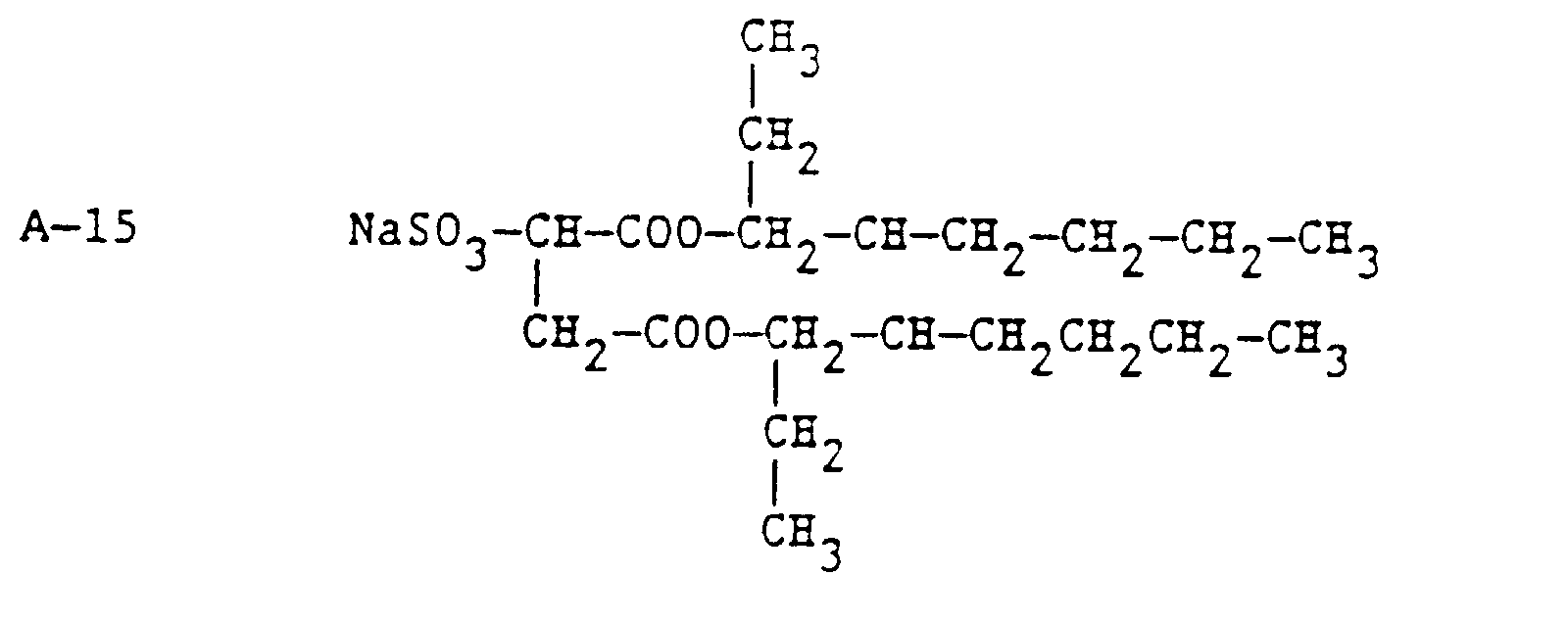
- Typical of surfactants suitable for the invention are those as follows: A-2 C 14 H 29 OSO 3 Na A-3 C 12 H 25 CONHCH 2 CH 2 OSO 3 Na A-4 C 12 H 25 SO 3 Na A-5 C 14 H 29 SO 3 Na Ro represents
- Example and Example 2 illustrate the influence of permanent solvent on the reactivity of a precipitated dispersion of the DIR coupler C2.
- the permanent solvent is shown to cause an increase in reactivity.
- a precipitated dispersion of C2 was prepared using the following procedure: 4.0 grams of the compound was mixed with 10.0 grams of n-propanol and heated to 40°C. 1.3 grams of a 20% w/w sodium hydroxide solution was then added, and the mixture was stirred until the coupler dissolved completely. A surfactant solution containing 3.75 grams of 30% A-13 in 175 grams of water was then added to the dissolved coupler at room temperature. A 15% w/w solution of acetic acid was added to lower the pH to 6. The dispersion was poured into a dialysis bag and washed with distilled water for four hours. The washed dispersion contained 1.9% w/w of the coupler.
- a precipitated dispersion of the image magenta coupler C1 was prepared in the following manner: 9.0 ml of n-propanol was added to 4.3 grams of the coupler, and the mixture was heated to 60°C with stirring. 6.0 ml of one molar sodium hydroxide solution was added, and the stirring was continued until the coupler dissolved. The solution was allowed to cool to room temperature. Then 2.16 grams of polyvinylpyrrolidone (40000 mw) was dissolved in 150 ml of a 0.01M aqueous solution of sodium dodecyl sulfate. The surfactant solution was added to the dissolved coupler.
- the contents were heated to 80°C under nitrogen, and the contents of a header flask containing 100 ml of degassed water, 4 ml of a 30% solution of TritonTM 770, 75.0 grams of ethylacrylate, 20.0 grams of acrylic acid, and 5.0 grams of 2-acrylamido-2-methyl propane sulfonic acid sodium salt was added over a period of 30 minutes.
- the contents of the reaction flask were stirred at 80°C under nitrogen for one hour and cooled to give a white suspension. 300 ml of water was added, and the suspension was concentrated on a rotary evaporator to remove residual monomer.
- the resulting latex contained 22.85 w/w polymer.
- a dispersion of the permanent solvent S-1 was prepared in the following manner: 20 ml of an aqueous suspension of the polymer latex A containing 22.8% w/w polymer was mixed with 10 ml of n-propanol and 20 ml of distilled water. 2 ml of S-1 was mixed with 40 ml of n-propanol and 1 gram of A-15. This was added to the suspension of polymer latex with stirring. The latex suspension was then poured into a dialysis bag and washed with distilled water for one hour. The washed sample contained 1.4% w/w of S-1.
- the dispersions were mixed with gelatin and coated on a cellulose acetate support along with a green sensitized iodobromide emulsion at laydowns of 45 mg/ft 2 Cl, 5 mg/ft 2 C2, 30 mg/ft 2 S-1, 150 mg/ft 2 silver and 250 mg/ft 2 gelatin.
- An overcoat containing hardener was coated above the emulsion layer.
- the samples were exposed to a 2850 K tungsten lamp with daylight V and Wratten 99 filters for 0.5 seconds using a 21-step tablet (0-4 chart). Processing was at 100°F with the standard C41 sequence except that a stop (2 min) and wash (3 min) was used between the development and bleach steps.
- the composition of the stop solution is given below: Glacial acetic acid 30.0 ml 50% Sodium hydroxide solution 0.4 ml Distilled Water 969.6 ml
- the amount of developed silver as a function of exposure was determined by eliminating the bleach step during processing.
- Example 1 The procedure of Example 1 is repeated except that the dispersion of S-1 was prepared using a colloid mill instead of using a polymer latex.
- 80 grams of S-1 was mixed with 40 grams of auxiliary solvent SA-1 and heated to 71°C.
- a mixture of 218 grams of a 12.5% solution of gelatin, 54 grams of distilled water, and 27.2 grams of a 10% solution of A-12 was treated with 5.5 ml of 2N propionic acid and then added to the heated oil phase with stirring.
- the composition was passed through a colloid mill for five passes.
- the dispersion was chilled, noodled, and washed for four hours.
- This Example illustrates the effect of permanent solvent on the light stability of the image dye obtained from a precipitated dispersion of the cyan coupler C3.
- the permanent solvent increases the dye stability.
- a precipitated dispersion of the cyan coupler C3 was prepared in the following manner: Four grams of the coupler was dissolved in a mixture of 10.6 ml of n-propanol and 8 ml of 4% sodium hydroxide solution. 200 ml of an aqueous solution containing 0.8 grams of sodium dodecyl sulfate and 2 grams of polyvinylpyrrolidone was added to the dissolved coupler with stirring. A 15% solution of acetic acid was then added to lower the pH of the composition to 6 and form a finely divided suspension of the coupler. The dispersion was washed with distilled water for two hours using dialysis membrane tubing. The washed dispersion contained 1.6% w/w C3. The dispersion remained stable even at room temperature for over two months.
- a dispersion of di-butyl phthalate was prepared in the following manner: Eighty grams of di-butyl phthalate (S-2) was mixed with 40 grams of SA-1 and heated to 71°C. A mixture of 218 grams of a 12.5% gelatin solution, 54 grams of distilled water, and 27 grams of a 10% solution of A-12 was treated with 5.5 ml of 2N propionic acid and then added to the heated oil phase with stirring. The composition was passed five times through a colloid mill. The dispersion was chilled, noodled, and washed for four hours. The washed dispersion contained 14.2% w/w di-butyl phthalate.
- a dispersion of p-dodecylphenol was prepared in the following manner: Ninety grams of p-dodecylphenol was heated to 60°C. Thirty grams of a 10% A-12 aqueous solution was mixed with 240 grams of a 12.5% gelatin solution and 120 grams of distilled water and then heated to 45°C, then gelatin solution was added to the oil with stirring. The composition was passed three times through a colloid mill and then chill set. The final dispersion contained 16.8% p-dodecylphenol.
- a portion of the precipitated dispersion was mixed with portions of the solvent dispersions A and B.
- the resulting composition was mixed with the emulsion and coated on a paper support.
- a UV light absorbing layer was coated above the emulsion layer.
- the laydowns of silver and coupler were 16 and 50 mg/sq ft respectively.
- the amounts and proportions of A and B were varied to obtain different levels of solvent in the coatings.
- the coatings were exposed to white light for 0.1s through a 21 step 0.15 logE increment tablet and processed in standard RA-4 chemistry.
- the reflection density of the processed strips was measured before and after a two-week 50 Klux sunshine fading test. The results are reported in Table 1 below, as a percentage loss in dye density from an initial density of 1.0.
- This Example illustrates the effect of permanent solvent on the reactivity of a precipitated dispersion of the image coupler C3. The reactivity is shown to be increased.
- a precipitated dispersion of C3 was prepared in the same manner as described in Example 3.
- a dispersion containing the permanent solvent S-1 in the Latex A latex was prepared in the same manner as described in Example 1.
- the dispersions were mixed with gelatin and coated on a cellulose acetate support along with a green sensitized iodobromide emulsion at laydowns of 45 mg/ft 2 C3, 45 mg/ft 2 S-1, 150 mg/ft 2 silver, and 250 mg/ft 2 gelatin.
- An overcoat containing hardener was coated above the emulsion layer.
- a second coating containing the same laydown of coupler, emulsion, and gelatin but no permanent solvent S-1 was formed as the control. The coatings were exposed and processed in the same manner as described in Example 1.
- This Example illustrates the permanent coupler solvent acting to increase the light stability of the image dye obtained from a precipitated dispersion of the cyan coupler C4 and also the increased reactivity of the dispersion.
- a precipitated dispersion of the cyan coupler C4 was prepared in the following manner: 30.0 grams of C4 was dissolved in mixture of 60.0 ml of n-propanol and 60.0 ml of 1M sodium hydroxide.
- a surfactant solution was prepared by dissolving 15 grams of polyvinylpyrrolidone (40000 mw) in 750 ml 0.02M sodium dodecyl sulfate in water. The surfactant solution was added to the dissolved coupler with stirring. A 15% solution of acetic acid was then added to lower the pH of the composition to 6 and form a dispersion of the coupler. The dispersion was poured into a dialysis bag and washed with distilled water for four hours. The coupler content in the washed dispersion was 2.8%.
- a dispersion of the permanent solvent S-2 was prepared in the same manner as described in Example 3 (dispersion A).
- the precipitated dispersion was mixed with the dispersion of the permanent solvent.
- the resulting composition was mixed with gelatin and coated on a paper support.
- a UV light absorbing layer was coated above the emulsion layer.
- the laydowns of silver, coupler, and the permanent solvent S-2 were 18, 39.3, and 19.6 mg/ft 2 respectively.
- a second coating was made containing the same laydowns of silver and coupler but with no coupler solvent. This was used as the control.
- the coatings were exposed to white light for 0.1s through a 21-step 0.15 logE increment tablet and processed in standard RA-4 chemistry.
- the reflection density of the processed strips was measured before and after a two-week and four-week 50 Klux sunshine fade test. The results are reported as a percentage loss in dye density from an initial density of 1.0 and illustrate the decreased fade of the solvent containing materials of the invention. % Dye Fade 2-Week 50 Klux Fade 4-Week 50 Klux Fade Control 37 75 Invention 12 26
- the fresh sensitometry from the invention coating had a contrast of 2.42, whereas the fresh sensitometry from the control coating had a contrast of 1.94 illustrating the increased reactivity of the invention materials.
- Example and Example 7 illustrate the influence of permanent solvent on the reactivity of a precipitated dispersion of the coupler C9.
- the permanent solvent is shown to cause an increase in reactivity.
- a precipitated dispersion of C9 was prepared using the following procedure: 4.0 grams of the compound was mixed with 10.0 grams of n-propanol and heated to 60°C. 1.3 grams of a 20% w/w solution of sodium hydroxide was then added, and the mixture was stirred until the coupler dissolved completely. A surfactant solution containing 3.8 grams of 30% w/w A-14 in 100 grams of water was then added to the dissolved coupler at room temperature. A 15% w/w solution of acetic acid was added to lower the pH to 6. The dispersion was washed for four hours using a dialysis membrane tubing.
- a dispersion containing the permanent solvent S-1 in the Latex A latex was prepared in the same manner as described in Example 1.
- the dispersions were mixed with gelatin and coated on a cellulose acetate support along with a green sensitized iodobromide emulsion at laydowns of 30 mg/ft 2 C9, 30 mg/ft 2 S-1, 150 mg/ft 2 silver, and 250 mg/ft 2 gelatin.
- An overcoat containing hardener was coated on top of the emulsion layer.
- the coatings were exposed and processed in the same manner as described in Example 1 except that the time of contact with the color developer solution was one minute and fifteen seconds. The results are shown in Fig. 6.
- Example 6 The procedure of Example 6 is repeated except that the dispersion of S-1 was prepared using a colloid mill instead of using a polymer latex as described in Example 2.
Landscapes
- Physics & Mathematics (AREA)
- General Physics & Mathematics (AREA)
- Silver Salt Photography Or Processing Solution Therefor (AREA)
Claims (22)
- Procédé de formation de dispersions photographiques comprenantla formation d'une dispersion aqueuse de coupleur photographique, dans lequel ladite dispersion de coupleur photographique est préparée sans utiliser ni broyeur à colloïdes ni homogénéisateur ;la formation d'une dispersion aqueuse d'un solvant permanent activant incorporé dans un latex ;la combinaison de ladite dispersion de coupleur photographique et de ladite dispersion de solvant permanent pour former une dispersion combinée ; etle mélange de ladite dispersion combinée avec une émulsion aux halogénures d'argent.
- Procédé selon la revendication 1, dans lequel ladite dispersion de coupleur photographique est formée par précipitation à partir d'une solution de solvant auxiliaire par changement du pH ou du solvant.
- Procédé selon la revendication 1, dans lequel ledit latex comprend au moins un élément choisi dans le groupe essentiellement constitué de copolymères de l'acide acrylique et d'acrylate d'alkyle, de copolymères de l'acide méthacrylique et d'acrylate d'alkyle, des copolymères de l'acide acrylique et de méthacrylate d'alkyle et de copolymères de l'acide méthacrylique et de méthacrylate d'alkyle.
- Procédé selon la revendication 1, dans lequel ladite dispersion de coupleur photographique comporte, en outre, un agent tensio-actif.
- Procédé selon la revendication 1, dans lequel ladite dispersion de coupleur photographique comprend, en outre, un agent tensio-actif contenant 8 à 20 atomes de carbone dans la chaíne hydrocarbonée et un radical sulfate ou sulfonate.
- Procédé selon la revendication 1, dans lequel ladite dispersion combinée comprend des particules constituées d'un mélange de latex, de solvant permanent et de coupleur.
- Procédé selon la revendication 1, dans lequel la dispersion de coupleur comporte au moins l'un de
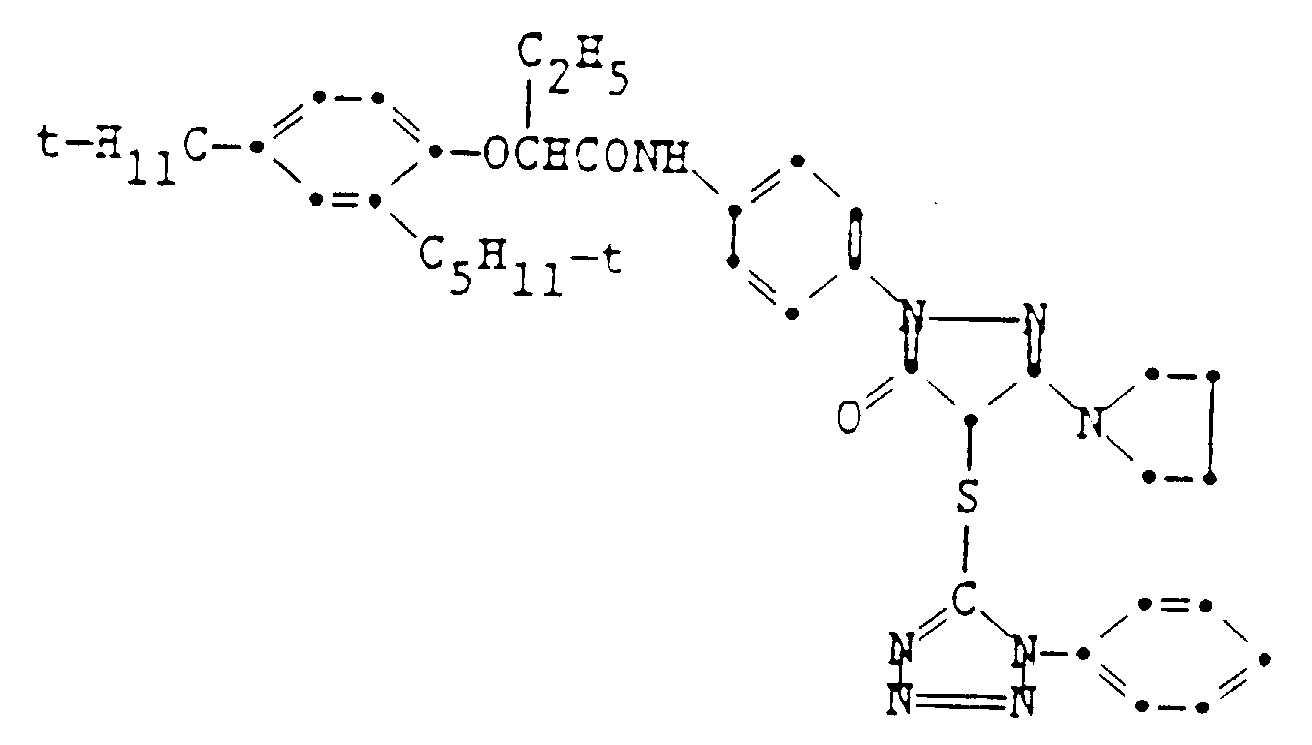

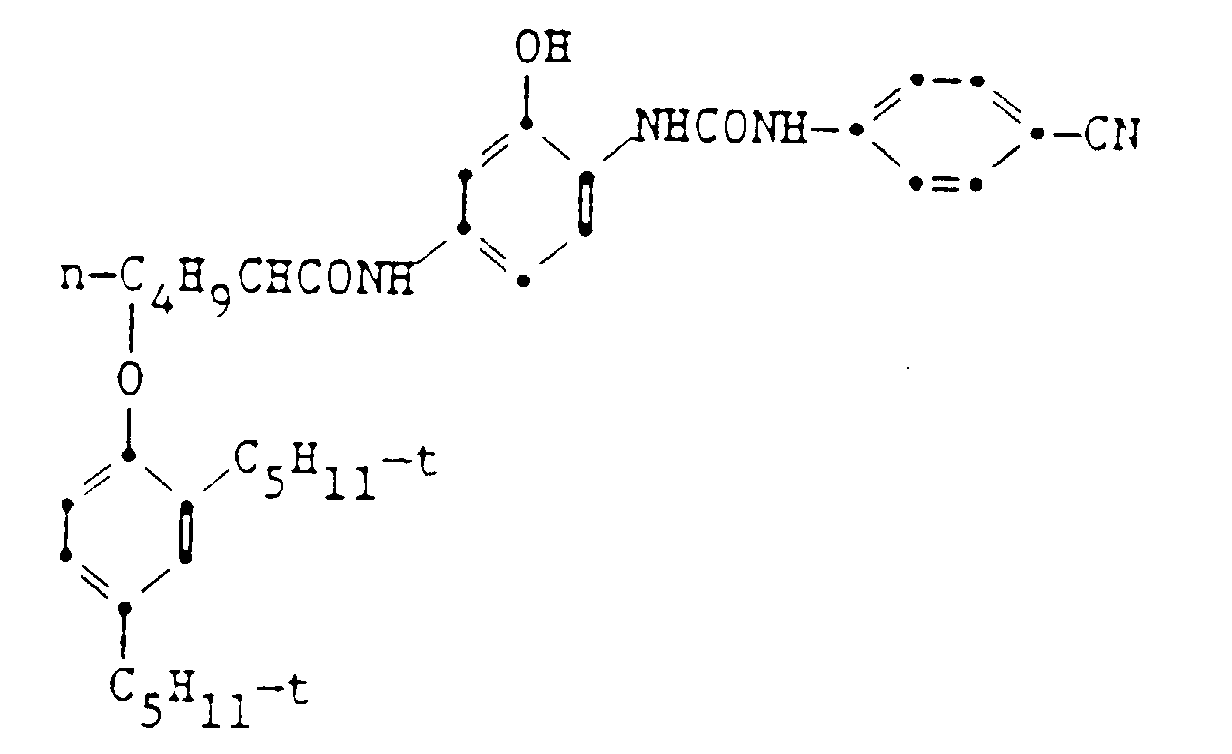

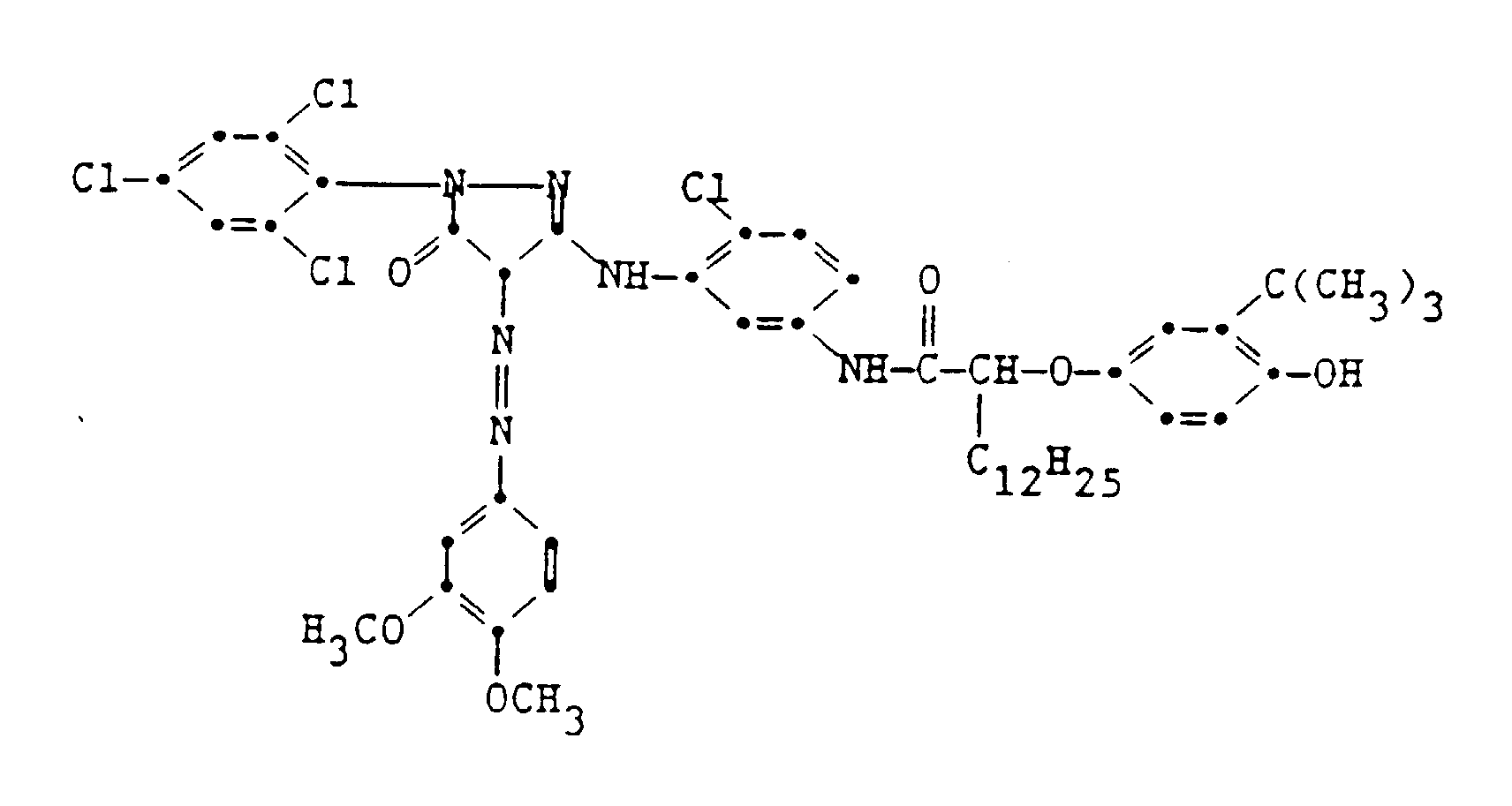
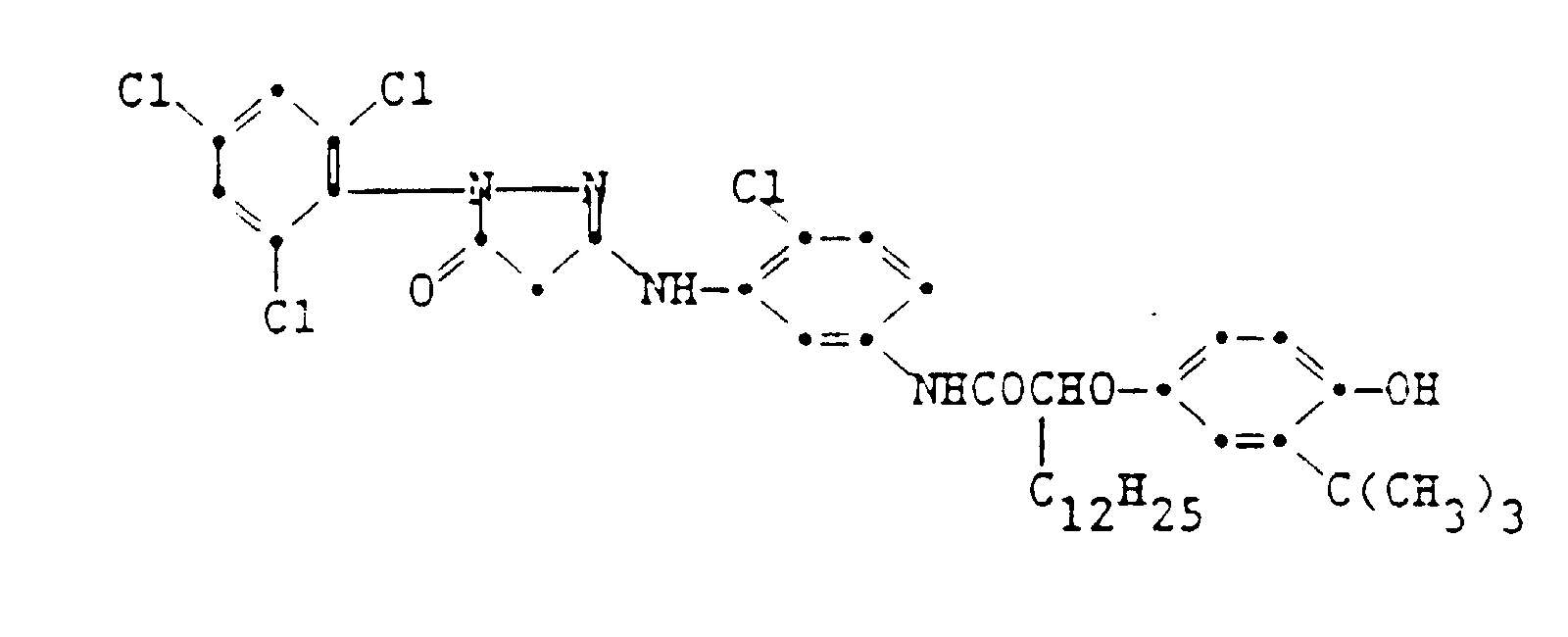
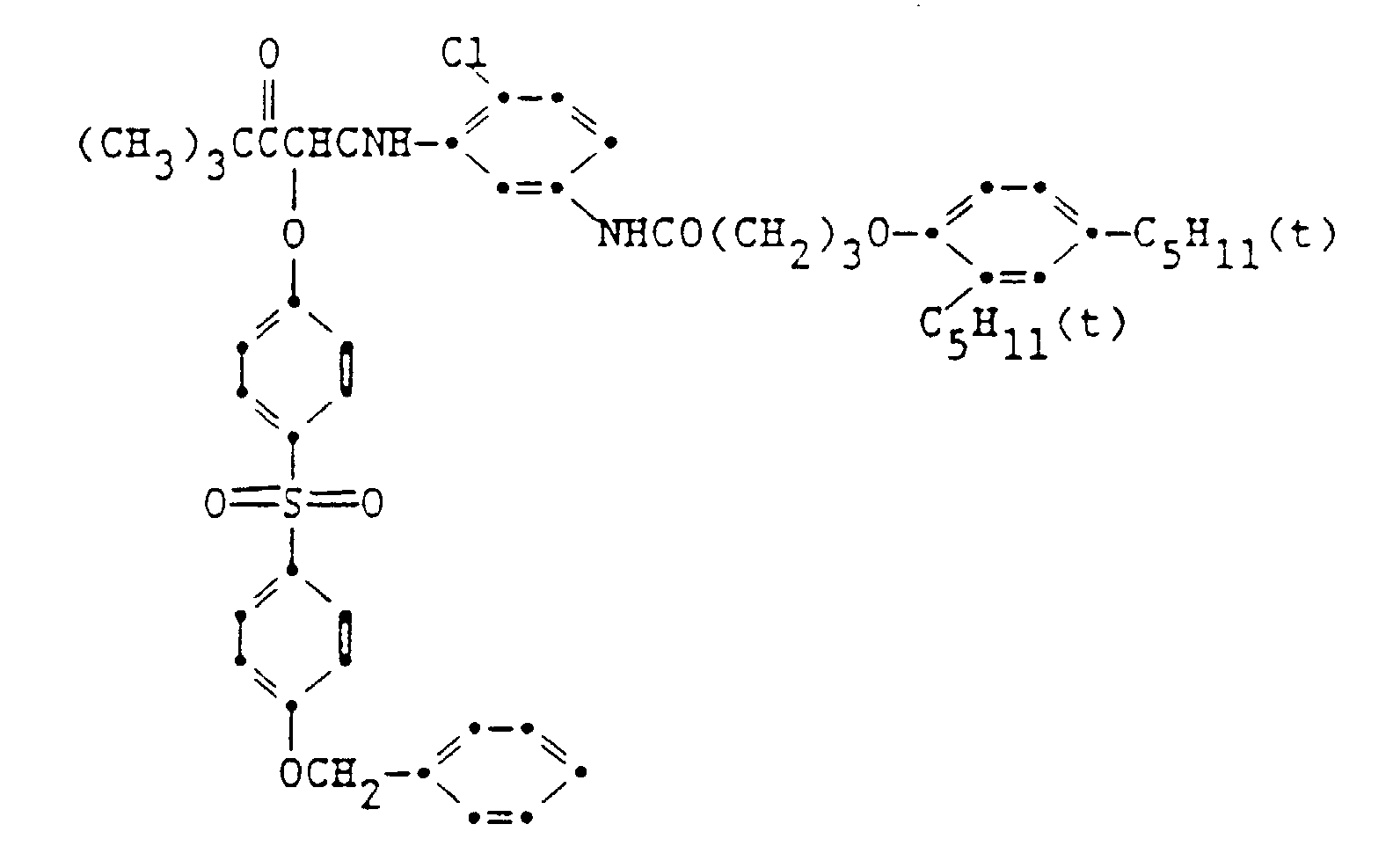
- Procédé selon la revendication 1, dans lequel ledit solvant permanent comprend au moins l'un du phosphate de tri-crésyle, du phtalate de di-n-butyle et du p-dodécylphénol.
- Procédé selon la revendication 1, dans lequel ladite dispersion de solvant permanent et ladite dispersion de coupleur photographique sont combinées immédiatement avant couchage.
- Procédé selon la revendication 1, dans lequel ladite dispersion de solvant permanent activant est préparée sans utiliser ni moulin à colloïdes ni homogénéisateur.
- Procédé selon la revendication 1, dans lequel ledit latex est un copolymère d'acrylate d'éthyle, d'acide acrylique et du sel de sodium de l'acide 2-acrylamido-2-méthylpropanesulfonique au rapport de 75:20:5 en poids.
- Procédé selon la revendication 4, dans lequel ledit agent tensio-actif est choisi dans le groupe constitué d'au moins l'un du dodécylsulfate de sodium, d'un mélange de sulfate de sodium du di-isopropyl- et tri-isopropylnaphtalène
 et
et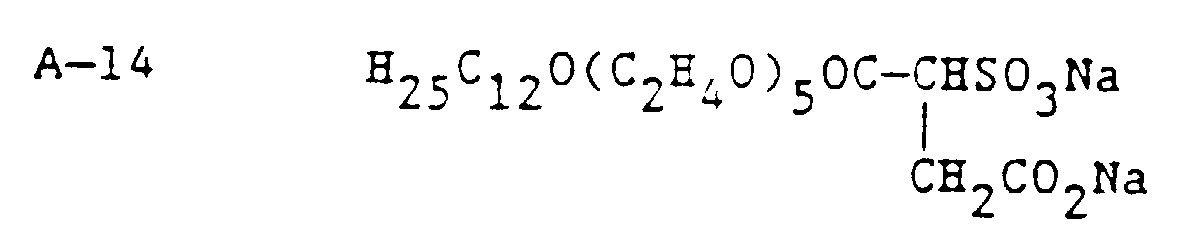
- Procédé selon la revendication 12, dans lequel ladite dispersion de solvant permanent activant comporte, en outre, de la gélatine.
- Procédé de formation d'un élément photographique ayant une stabilité de colorant améliorée comprenantla formation d'une dispersion aqueuse de coupleur photographique, dans lequel ladite dispersion de coupleur photographique est préparée sans utiliser ni moulin à colloïdes ni homogénéisateur,la formation d'une dispersion aqueuse d'un solvant permanent activant incorporé dans un latex ;la combinaison de ladite dispersion de coupleur photographique et de ladite dispersion de solvant permanent pour former une dispersion combinée ;le mélange de ladite dispersion combinée avec une émulsion aux halogénures d'argent ; etle couchage du mélange de ladite dispersion combinée et de ladite émulsion aux halogénures d'argent sur un substrat.
- Procédé selon la revendication 14, dans lequel ladite dispersion de coupleur photographique est formée par précipitation d'une solution de solvant auxiliaire par changement du pH ou changement du solvant.
- Procédé selon la revendication 14, dans lequel ledit latex comprend au moins un élément choisi dans le groupe essentiellement constitué de copolymères de l'acide acrylique et d'acrylate d'alkyle, de copolymères de l'acide méthacrylique et d'acrylate d'alkyle, de copolymères de l'acide acrylique et de méthacrylate d'alkyle et de copolymères de l'acide méthacrylique et de méthacrylate d'alkyle.
- Procédé selon la revendication 14, dans lequel ladite dispersion de coupleur photographique comporte, en outre, un agent tensio-actif.
- Procédé selon la revendication 14, dans lequel ladite dispersion de coupleur photographique comporte, en outre, un agent tensio-actif comprenant au moins l'un d'un mélange de sulfonate de sodium du di-isopropyl- et tri-isopropylnaphtalène et

- Procédé selon la revendication 14, dans lequel ladite dispersion de coupleur comprend au moins l'un de
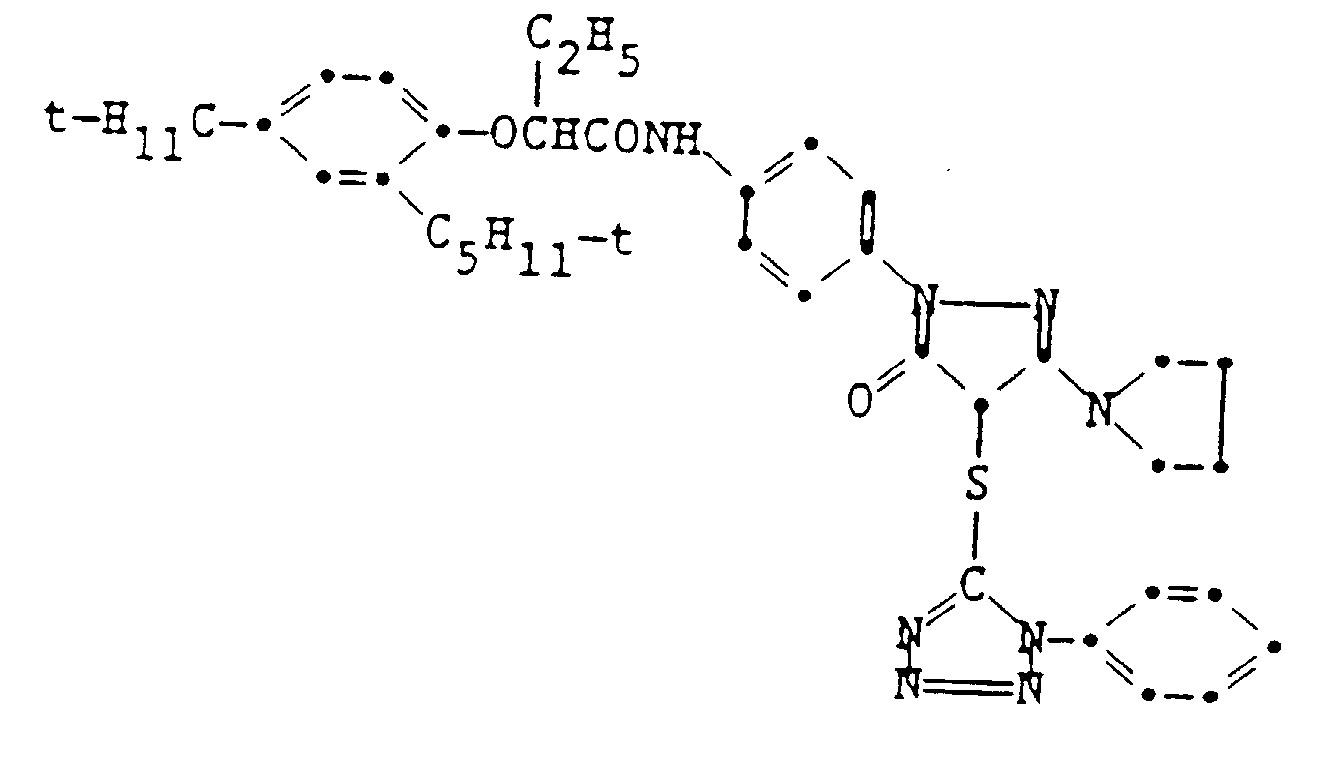
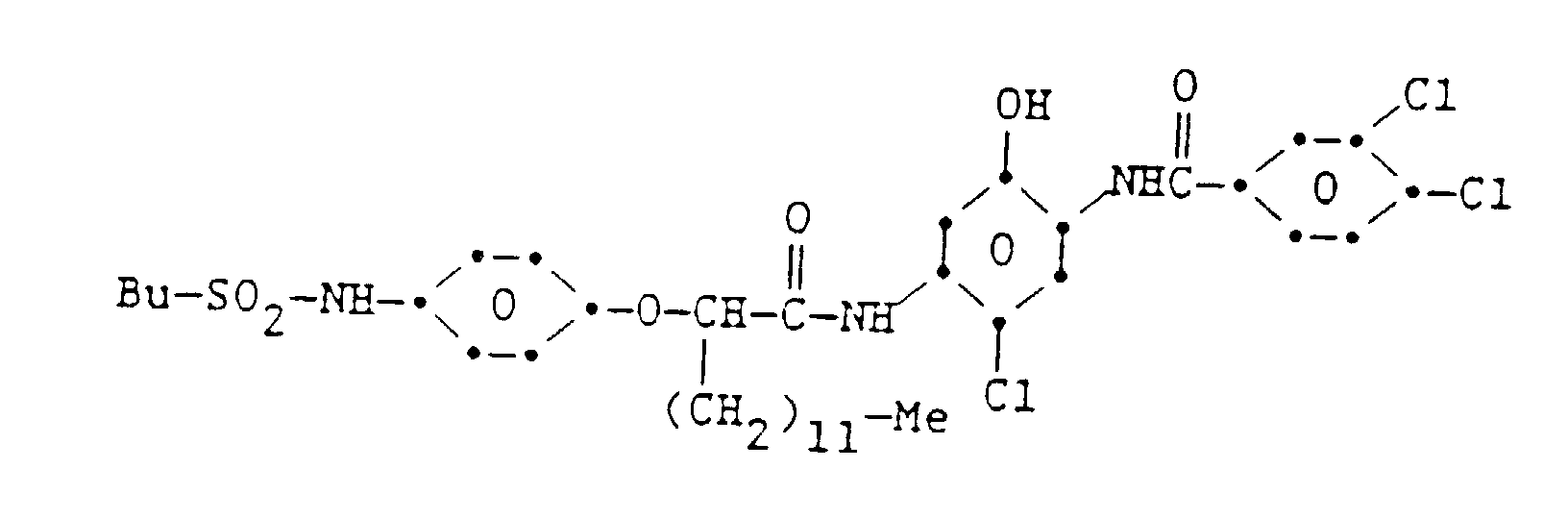
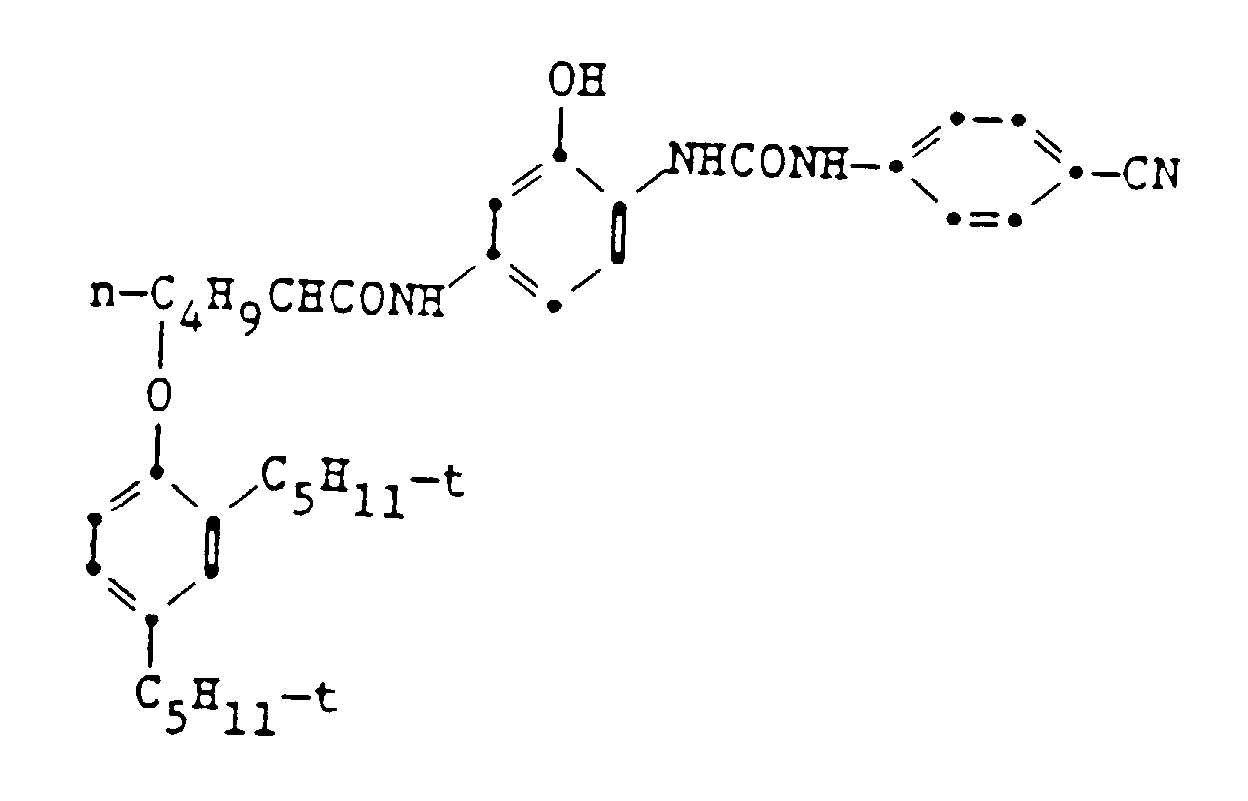

- Procédé selon la revendication 14, dans lequel ledit solvant permanent comporte au moins l'un du phosphate de tri-crésyle, du phtalate de di-n-butyle et du p-dodécylphénol.
- Procédé selon la revendication 14, dans lequel ladite dispersion de solvant permanent et ladite dispersion de coupleur photographique sont combinées immédiatement avant couchage.
- Procédé selon la revendication 14, dans lequel ledit latex est un copolymère d'acrylate d'éthyle, d'acide acrylique et du sel de sodium de l'acide 2-acrylamido-2-méthylpropanesulfonique au rapport de 75:20:5 en poids.
Applications Claiming Priority (3)
| Application Number | Priority Date | Filing Date | Title |
|---|---|---|---|
| US440160 | 1989-11-22 | ||
| US07/440,160 US5008179A (en) | 1989-11-22 | 1989-11-22 | Increased activity precipitated photographic materials |
| PCT/US1990/006491 WO1991008516A1 (fr) | 1989-11-22 | 1990-11-14 | Materiaux photographiques precipites a activite amelioree |
Publications (2)
| Publication Number | Publication Date |
|---|---|
| EP0454844A1 EP0454844A1 (fr) | 1991-11-06 |
| EP0454844B1 true EP0454844B1 (fr) | 1998-02-04 |
Family
ID=23747694
Family Applications (1)
| Application Number | Title | Priority Date | Filing Date |
|---|---|---|---|
| EP91902470A Expired - Lifetime EP0454844B1 (fr) | 1989-11-22 | 1990-11-14 | Materiaux photographiques precipites a activite amelioree |
Country Status (5)
| Country | Link |
|---|---|
| US (1) | US5008179A (fr) |
| EP (1) | EP0454844B1 (fr) |
| JP (1) | JP3092715B2 (fr) |
| DE (1) | DE69032024T2 (fr) |
| WO (1) | WO1991008516A1 (fr) |
Families Citing this family (19)
| Publication number | Priority date | Publication date | Assignee | Title |
|---|---|---|---|---|
| US5182189A (en) * | 1989-11-29 | 1993-01-26 | Eastman Kodak Company | Increased photographic activity precipitated coupler dispersions prepared by coprecipitation with liquid carboxylic acids |
| US5256527A (en) * | 1990-06-27 | 1993-10-26 | Eastman Kodak Company | Stabilization of precipitated dispersions of hydrophobic couplers |
| DE69130354T2 (de) * | 1990-11-13 | 1999-03-11 | Eastman Kodak Co., Rochester, N.Y. | Photographische Kuppler-Zusammensetzungen, die Ballastgruppen aufweisende Alkohole enthalten, sowie Verfahren |
| US5358831A (en) * | 1990-12-13 | 1994-10-25 | Eastman Kodak Company | High dye stability, high activity, low stain and low viscosity small particle yellow dispersion melt for color paper and other photographic systems |
| JP2673073B2 (ja) * | 1991-04-19 | 1997-11-05 | 富士写真フイルム株式会社 | ハロゲン化銀写真感光材料 |
| US5298368A (en) * | 1991-04-23 | 1994-03-29 | Eastman Kodak Company | Photographic coupler compositions and methods for reducing continued coupling |
| US6277537B1 (en) * | 1991-12-06 | 2001-08-21 | Eastman Kodak Company | Dye diffusion image separation systems with thermal solvents |
| US5624467A (en) * | 1991-12-20 | 1997-04-29 | Eastman Kodak Company | Microprecipitation process for dispersing photographic filter dyes |
| GB9201235D0 (en) * | 1992-01-21 | 1992-03-11 | Kodak Ltd | Improvements in dye stability |
| US5401623A (en) * | 1992-10-05 | 1995-03-28 | Eastman Kodak Company | Reactivity control in microcrystalline coupler dispersions |
| US5468604A (en) * | 1992-11-18 | 1995-11-21 | Eastman Kodak Company | Photographic dispersion |
| US5594047A (en) * | 1995-02-17 | 1997-01-14 | Eastman Kodak Company | Method for forming photographic dispersions comprising loaded latex polymers |
| US5582957A (en) | 1995-03-28 | 1996-12-10 | Eastman Kodak Company | Resuspension optimization for photographic nanosuspensions |
| US5605785A (en) * | 1995-03-28 | 1997-02-25 | Eastman Kodak Company | Annealing processes for nanocrystallization of amorphous dispersions |
| US5750323A (en) * | 1995-08-31 | 1998-05-12 | Eastman Kodak Company | Solid particle dispersions for imaging elements |
| US5663434A (en) * | 1996-01-29 | 1997-09-02 | Eastman Chemical Company | Process for preparing N-(3-amino-4-chlorophenyl) acylamides |
| US5770352A (en) * | 1996-04-18 | 1998-06-23 | Eastman Kodak Company | High activity photographic dispersions with ultra low levels of permanent solvent |
| US5726003A (en) * | 1996-08-15 | 1998-03-10 | Eastman Kodak Company | Cyan coupler dispersion with increased activity |
| US5830632A (en) * | 1996-10-31 | 1998-11-03 | Eastman Kodak Company | Photographic element containing dispersions of high dye-yield couplers having improved photographic activity |
Citations (1)
| Publication number | Priority date | Publication date | Assignee | Title |
|---|---|---|---|---|
| US2801170A (en) * | 1954-12-20 | 1957-07-30 | Eastman Kodak Co | Preparation of color former dispersions |
Family Cites Families (17)
| Publication number | Priority date | Publication date | Assignee | Title |
|---|---|---|---|---|
| US2698794A (en) * | 1950-04-15 | 1955-01-04 | Eastman Kodak Co | Mixed packet photographic emulsions |
| BE543745A (fr) * | 1954-12-20 | |||
| US2870012A (en) * | 1955-12-23 | 1959-01-20 | Eastman Kodak Co | Microdispersions of photographic color couplers |
| US2949360A (en) * | 1956-08-31 | 1960-08-16 | Eastman Kodak Co | Photographic color former dispersions |
| GB1141275A (en) * | 1966-01-21 | 1969-01-29 | Fuji Photo Film Co Ltd | Improvements in and relating to light sensitive materials containing yellow couplers |
| GB1193349A (en) * | 1967-10-30 | 1970-05-28 | Ilford Ltd | Dispersing Colour Couplers |
| US3619195A (en) * | 1968-11-01 | 1971-11-09 | Eastman Kodak Co | Photographic coupler dispersions |
| BE833512A (fr) * | 1974-09-17 | 1976-03-17 | Nouvelle composition de latex charge par un compose hydrophobe, sa preparation et son application photographique | |
| GB1579481A (en) * | 1977-02-18 | 1980-11-19 | Ciba Geigy Ag | Preparation of photographic material |
| DD138581A1 (de) * | 1977-05-17 | 1979-11-07 | Walter Kroha | Verfahren zum einbringen fotografischer zusaetze in hydrophile kolloidschichten |
| JPS5432552A (en) * | 1977-08-17 | 1979-03-09 | Konishiroku Photo Ind | Method of making impregnating polymer latex composition |
| DE3024881A1 (de) * | 1980-07-01 | 1982-01-28 | Agfa-Gevaert Ag, 5090 Leverkusen | Dispergierverfahren |
| DE3031404A1 (de) * | 1980-08-20 | 1982-04-01 | Agfa-Gevaert Ag, 5090 Leverkusen | Verfahren zur herstellung von dispersionen und fotografische materialien |
| GB8429678D0 (en) * | 1984-11-23 | 1985-01-03 | Kodak Ltd | Water-insoluble photographic addenda |
| US4766061A (en) * | 1985-11-21 | 1988-08-23 | Eastman Kodak Company | Photographic coupler dispersions |
| JPH0766165B2 (ja) * | 1986-01-20 | 1995-07-19 | コニカ株式会社 | ハロゲン化銀カラ−写真感光材料 |
| US4970139A (en) * | 1989-10-02 | 1990-11-13 | Eastman Kodak Company | Methods of preparation of precipitated coupler dispersions with increased photographic activity |
-
1989
- 1989-11-22 US US07/440,160 patent/US5008179A/en not_active Expired - Lifetime
-
1990
- 1990-11-14 WO PCT/US1990/006491 patent/WO1991008516A1/fr not_active Ceased
- 1990-11-14 EP EP91902470A patent/EP0454844B1/fr not_active Expired - Lifetime
- 1990-11-14 JP JP03502654A patent/JP3092715B2/ja not_active Expired - Fee Related
- 1990-11-14 DE DE69032024T patent/DE69032024T2/de not_active Expired - Fee Related
Patent Citations (1)
| Publication number | Priority date | Publication date | Assignee | Title |
|---|---|---|---|---|
| US2801170A (en) * | 1954-12-20 | 1957-07-30 | Eastman Kodak Co | Preparation of color former dispersions |
Also Published As
| Publication number | Publication date |
|---|---|
| WO1991008516A1 (fr) | 1991-06-13 |
| DE69032024D1 (de) | 1998-03-12 |
| DE69032024T2 (de) | 1998-08-13 |
| EP0454844A1 (fr) | 1991-11-06 |
| US5008179A (en) | 1991-04-16 |
| JPH04503269A (ja) | 1992-06-11 |
| JP3092715B2 (ja) | 2000-09-25 |
Similar Documents
| Publication | Publication Date | Title |
|---|---|---|
| US5008179A (en) | Increased activity precipitated photographic materials | |
| JPS643250B2 (fr) | ||
| US5279931A (en) | Polymer co-precipitated coupler dispersion | |
| JPS6137609B2 (fr) | ||
| US4275145A (en) | Method for dispersing oil-soluble photographic additives | |
| US5015564A (en) | Stabilizatin of precipitated dispersions of hydrophobic couplers, surfactants and polymers | |
| US4960687A (en) | Process of making photographic silver halide element with backing layers with improved coating properties | |
| US4497929A (en) | Latex compositions comprising loadable polymeric particles | |
| US4716099A (en) | Dispersions of water-insoluble photographic addenda using petroleum sulfonate | |
| US4252894A (en) | Hydrophilic color coupler composition containing diepoxide | |
| US5393650A (en) | Pressure sensitivity relief for photographic products | |
| JPS58149038A (ja) | 写真用添加剤の分散方法 | |
| EP0555458B1 (fr) | Dispersions de particules de copulants photographiques enrobees d'une barriere empechant le passage d'oxygene afin d'ameliorer la stabilite des colorants | |
| US5789146A (en) | Blends of couplers with homologous ballasts | |
| US4608424A (en) | Latex compositions comprising loadable polymeric particles | |
| US5264317A (en) | Oxygen barrier coated photographic coupler dispersion particles for enhanced dye-stability | |
| EP0609878B1 (fr) | Dispersion de particules d'agent photographique moulu enrobées d'une barrière empêchant le passage d'oxygène afin d'améliorer la stabilité des colorants | |
| US4684608A (en) | Latex compositions comprising loadable polymeric particles | |
| JP2613384B2 (ja) | 新規な界面活性剤を含有するハロゲン化銀写真感光材料 | |
| JPH0451817B2 (fr) | ||
| JPH05265152A (ja) | ハロゲン化銀写真感光材料の処理方法 | |
| JPH06295006A (ja) | ゼラチン化した微小沈殿分散溶融物の連続製造方法 | |
| JPH021836A (ja) | ハロゲン化銀写真印画紙 | |
| JPH04352151A (ja) | ハロゲン化銀写真感光材料 | |
| JPH0713283A (ja) | ハロゲン化銀写真感光材料 |
Legal Events
| Date | Code | Title | Description |
|---|---|---|---|
| PUAI | Public reference made under article 153(3) epc to a published international application that has entered the european phase |
Free format text: ORIGINAL CODE: 0009012 |
|
| 17P | Request for examination filed |
Effective date: 19910708 |
|
| AK | Designated contracting states |
Kind code of ref document: A1 Designated state(s): AT BE CH DE DK ES FR GB GR IT LI LU NL SE |
|
| 17Q | First examination report despatched |
Effective date: 19950111 |
|
| GRAG | Despatch of communication of intention to grant |
Free format text: ORIGINAL CODE: EPIDOS AGRA |
|
| GRAH | Despatch of communication of intention to grant a patent |
Free format text: ORIGINAL CODE: EPIDOS IGRA |
|
| RBV | Designated contracting states (corrected) |
Designated state(s): DE FR GB |
|
| GRAH | Despatch of communication of intention to grant a patent |
Free format text: ORIGINAL CODE: EPIDOS IGRA |
|
| GRAA | (expected) grant |
Free format text: ORIGINAL CODE: 0009210 |
|
| AK | Designated contracting states |
Kind code of ref document: B1 Designated state(s): DE FR GB |
|
| REF | Corresponds to: |
Ref document number: 69032024 Country of ref document: DE Date of ref document: 19980312 |
|
| ET | Fr: translation filed | ||
| PLBE | No opposition filed within time limit |
Free format text: ORIGINAL CODE: 0009261 |
|
| STAA | Information on the status of an ep patent application or granted ep patent |
Free format text: STATUS: NO OPPOSITION FILED WITHIN TIME LIMIT |
|
| 26N | No opposition filed | ||
| PGFP | Annual fee paid to national office [announced via postgrant information from national office to epo] |
Ref country code: FR Payment date: 20011105 Year of fee payment: 12 |
|
| PGFP | Annual fee paid to national office [announced via postgrant information from national office to epo] |
Ref country code: DE Payment date: 20011130 Year of fee payment: 12 |
|
| REG | Reference to a national code |
Ref country code: GB Ref legal event code: IF02 |
|
| PGFP | Annual fee paid to national office [announced via postgrant information from national office to epo] |
Ref country code: GB Payment date: 20021002 Year of fee payment: 13 |
|
| PG25 | Lapsed in a contracting state [announced via postgrant information from national office to epo] |
Ref country code: DE Free format text: LAPSE BECAUSE OF NON-PAYMENT OF DUE FEES Effective date: 20030603 |
|
| PG25 | Lapsed in a contracting state [announced via postgrant information from national office to epo] |
Ref country code: FR Free format text: LAPSE BECAUSE OF NON-PAYMENT OF DUE FEES Effective date: 20030731 |
|
| REG | Reference to a national code |
Ref country code: FR Ref legal event code: ST |
|
| PG25 | Lapsed in a contracting state [announced via postgrant information from national office to epo] |
Ref country code: GB Free format text: LAPSE BECAUSE OF NON-PAYMENT OF DUE FEES Effective date: 20031114 |
|
| GBPC | Gb: european patent ceased through non-payment of renewal fee |
Effective date: 20031114 |