EP0454911B1 - Procédé de préparation pour la coextrusion de billettes à plusieurs couches métalliques cylindriques - Google Patents
Procédé de préparation pour la coextrusion de billettes à plusieurs couches métalliques cylindriques Download PDFInfo
- Publication number
- EP0454911B1 EP0454911B1 EP90304425A EP90304425A EP0454911B1 EP 0454911 B1 EP0454911 B1 EP 0454911B1 EP 90304425 A EP90304425 A EP 90304425A EP 90304425 A EP90304425 A EP 90304425A EP 0454911 B1 EP0454911 B1 EP 0454911B1
- Authority
- EP
- European Patent Office
- Prior art keywords
- degrees
- billet
- bondline
- temperature
- hot isostatic
- Prior art date
- Legal status (The legal status is an assumption and is not a legal conclusion. Google has not performed a legal analysis and makes no representation as to the accuracy of the status listed.)
- Revoked
Links
Images




Classifications
-
- C—CHEMISTRY; METALLURGY
- C22—METALLURGY; FERROUS OR NON-FERROUS ALLOYS; TREATMENT OF ALLOYS OR NON-FERROUS METALS
- C22F—CHANGING THE PHYSICAL STRUCTURE OF NON-FERROUS METALS AND NON-FERROUS ALLOYS
- C22F1/00—Changing the physical structure of non-ferrous metals or alloys by heat treatment or by hot or cold working
- C22F1/16—Changing the physical structure of non-ferrous metals or alloys by heat treatment or by hot or cold working of other metals or alloys based thereon
- C22F1/18—High-melting or refractory metals or alloys based thereon
- C22F1/186—High-melting or refractory metals or alloys based thereon of zirconium or alloys based thereon
-
- B—PERFORMING OPERATIONS; TRANSPORTING
- B21—MECHANICAL METAL-WORKING WITHOUT ESSENTIALLY REMOVING MATERIAL; PUNCHING METAL
- B21C—MANUFACTURE OF METAL SHEETS, WIRE, RODS, TUBES, PROFILES OR LIKE SEMI-MANUFACTURED PRODUCTS OTHERWISE THAN BY ROLLING; AUXILIARY OPERATIONS USED IN CONNECTION WITH METAL-WORKING WITHOUT ESSENTIALLY REMOVING MATERIAL
- B21C23/00—Extruding metal; Impact extrusion
- B21C23/22—Making metal-coated products; Making products from two or more metals
-
- B—PERFORMING OPERATIONS; TRANSPORTING
- B21—MECHANICAL METAL-WORKING WITHOUT ESSENTIALLY REMOVING MATERIAL; PUNCHING METAL
- B21C—MANUFACTURE OF METAL SHEETS, WIRE, RODS, TUBES, PROFILES OR LIKE SEMI-MANUFACTURED PRODUCTS OTHERWISE THAN BY ROLLING; AUXILIARY OPERATIONS USED IN CONNECTION WITH METAL-WORKING WITHOUT ESSENTIALLY REMOVING MATERIAL
- B21C37/00—Manufacture of metal sheets, rods, wire, tubes, profiles or like semi-manufactured products, not otherwise provided for; Manufacture of tubes of special shape
- B21C37/06—Manufacture of metal sheets, rods, wire, tubes, profiles or like semi-manufactured products, not otherwise provided for; Manufacture of tubes of special shape of tubes or metal hoses; Combined procedures for making tubes, e.g. for making multi-wall tubes
-
- B—PERFORMING OPERATIONS; TRANSPORTING
- B23—MACHINE TOOLS; METAL-WORKING NOT OTHERWISE PROVIDED FOR
- B23K—SOLDERING OR UNSOLDERING; WELDING; CLADDING OR PLATING BY SOLDERING OR WELDING; CUTTING BY APPLYING HEAT LOCALLY, e.g. FLAME CUTTING; WORKING BY LASER BEAM
- B23K20/00—Non-electric welding by applying impact or other pressure, with or without the application of heat, e.g. cladding or plating
- B23K20/02—Non-electric welding by applying impact or other pressure, with or without the application of heat, e.g. cladding or plating by means of a press ; Diffusion bonding
- B23K20/021—Isostatic pressure welding
-
- G—PHYSICS
- G21—NUCLEAR PHYSICS; NUCLEAR ENGINEERING
- G21C—NUCLEAR REACTORS
- G21C3/00—Reactor fuel elements and their assemblies; Selection of substances for use as reactor fuel elements
- G21C3/02—Fuel elements
- G21C3/04—Constructional details
- G21C3/06—Casings; Jackets
-
- Y—GENERAL TAGGING OF NEW TECHNOLOGICAL DEVELOPMENTS; GENERAL TAGGING OF CROSS-SECTIONAL TECHNOLOGIES SPANNING OVER SEVERAL SECTIONS OF THE IPC; TECHNICAL SUBJECTS COVERED BY FORMER USPC CROSS-REFERENCE ART COLLECTIONS [XRACs] AND DIGESTS
- Y02—TECHNOLOGIES OR APPLICATIONS FOR MITIGATION OR ADAPTATION AGAINST CLIMATE CHANGE
- Y02E—REDUCTION OF GREENHOUSE GAS [GHG] EMISSIONS, RELATED TO ENERGY GENERATION, TRANSMISSION OR DISTRIBUTION
- Y02E30/00—Energy generation of nuclear origin
- Y02E30/30—Nuclear fission reactors
Definitions
- This invention relates to an improved method of fabricating multi-layered tubing suitable for nuclear, chemical processing and other industrial applications.
- the extrusion billet is assembled with multiple layers of metallic cylinders one inside the other concentrically.
- the annular opening at each end of the assembly is sealed by vacuum welding.
- the billet assembly is preheated to a proper temperature and extruded, forming a metallurgical bond between adjacent layers.
- the bondline defects are occasionally detected at the as-extruded stage or after the tube is further reduced. The main cause for this problem is due to insufficient time at temperature to effect bonding and diffusion across the bondline during extrusion.
- the outer zirconium alloy cylindrical part is first subjected to beta heat treatment by heating at 980 degrees C to 1200 degrees C range and water quenching in order to improve corrosion resistance and to achieve fine grain structure for the final tube product.
- beta heat treatment by heating at 980 degrees C to 1200 degrees C range and water quenching in order to improve corrosion resistance and to achieve fine grain structure for the final tube product.
- the billet is assembled with an inner zirconium liner, it is extruded to a tubeshell and further reduced by tube reducers to final size suitable for nuclear fuel cladding applications.
- a stringent inspection such as ultrasonic technique is used for bondline defects which may be as small as a few thousands of an inch in dimension.
- Figure 1 is a photomicrograph at 180x showing a typical bondline defect between the upper Zircaloy-2 and the lower zirconium materials which had been coextruded from an assembled billet by conventional process described herein, the sample being stain etched.
- Figure 2 is a cross sectional view of an assembled two-layered metallic billet.
- the outer layer is Zircaloy-2 and the inside liner is zirconium.
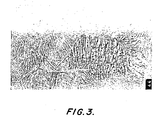
- Figure 3 is a photomicrograph at 180x of a stain etched diffused bondline between upper zirconium and lower Zircaloy-2 materials prepared by HIP (Hot Isostatic Pressing) and quenching according to the present invention.
- Figure 4a and 4b are photomicrographs of a stain etched diffused bondline between upper zirconium and lower Zircaloy-2 materials prepared according to the present invention after the billet assembly is extruded at (a) 180x and (b) 750x.
- Figures 5a and 5b are photomicrographs of non-diffused bondline between upper zirconium and lower Zircaloy-2 materials from a conventional extrusion at (a) 180x and (b) 750x.
- Figures 6a and 6b are photomicrographs respectively at 750x of the same materials of 4(b) and 5(b) with the specimens etched with HNO3-HF-H2O to show grain structure.
- the bonding at the interface between concentric cylindrical tubes is achieved by hot isostatic pressing of the billet assembly at a relative low temperature with a high pressure which are sufficient to cause bonding at the interface.
- the billet assembly is further heat treated at a higher temperature and ambient pressure in order to cause diffusion across the bondline, and thus further strengthen the bonding between the mating metallic layers.
- both cylindrical parts are cleaned, assembled and vacuum welded so that there are no detectable amounts of gases or other foreign materials present between the different metallic layers.
- the temperature for the subsequent hot isostatic pressing ranges from 600 degrees C to 800 degrees C, and the argon pressure ranges from 103.42 MPa to 310.26 MPa (15,000 to 45,000 psi), as is generally commercially available in the industry.
- the billet is heated in the temperature range of from 1000 degrees C to 1200 degrees C (1832 degrees F to 2192 degrees F) for a short period of time so that diffusion occurs across the bondline, but not to allow the diffusion on a scale, which could alter the properties of the metal on either side of the bond zone.
- the billet is then quenched in a quenchant which is preferrably a fast cooling medium.
- a quenchant which is preferrably a fast cooling medium.
- water is selected as the quench medium although brine or other quenchant agents may be used if desired.
- the preheating and quenching conditions are selected to that there will also be a precipitation of fine second phase particles which serve as the nucleation sites for recrystallization, and also impart improved corrosion resistance of one or all of the metallic layers.
- Figure 1 shows a typical bondline defect obtained from the conventional practice described herein and is shown for comparison purposes with the product produced by the practice of the present invention.
- a zirconium-Zircaloy 2 (Zrl-1.5%Sn-0.2%Fe-.1Cr-.05Ni) billet 15,24 cm (6.0'') OD x 4,191 cm (1.650'') ID x length (as shown in Figure 2), was treated in a hot isostatic pressing vessel, under 103.42 MPa (15,000 psi) argon pressure and at 740 degrees C for 2 hours. After removing from the vessel, the billet was preheated, in an induction furnace, and held at 1150 degrees C for 3 minutes, and then quenched in 20 degrees C water.
- FIG. 3 A photograph of the transformed beta microstructure at 12,7 cm (5'') above the bottom end of the quenched billet, longitudinal view, is shown in Figure 3.
- the sample was stain etched so that Zircaloy-2 exhibited a dark grey color, while the zirconium was bright.
- the lack of a sharp bondline indicates that the desired degree of diffusion between the bonded components has occurred.
- Figures 5a and 5b are photomicrographs of a bondline of a coextruded tube of the same dimensions with similar processing for billet preparation, except that no hot isostatic pressing and quenching steps were taken. It is apparent that no diffusion across the bondline occurred for this sample.
- Figures 6a and 6b are corresponding views of the diffused and non-diffused bondlines showing the difference in grain structure present in the vicinity of the bondlines.
Landscapes
- Engineering & Computer Science (AREA)
- Mechanical Engineering (AREA)
- Chemical & Material Sciences (AREA)
- Physics & Mathematics (AREA)
- General Engineering & Computer Science (AREA)
- High Energy & Nuclear Physics (AREA)
- Thermal Sciences (AREA)
- Crystallography & Structural Chemistry (AREA)
- Materials Engineering (AREA)
- Plasma & Fusion (AREA)
- Metallurgy (AREA)
- Organic Chemistry (AREA)
- Extrusion Of Metal (AREA)
- Metal Extraction Processes (AREA)
- Pressure Welding/Diffusion-Bonding (AREA)
Claims (6)
- Procédé de fabrication d'articles unitaires tubulaires sans soudure comprenant au moins deux couches métalliques concentriques, dans lequel on emmanche l'une dans l'autre au moins deux pièces cylindriques concentriques pour former un ensemble formant billette d'extrusion , comprenant les étapes suivantes :- un traitement de compression isostatique à chaud de l'ensemble formant billette sous une pression suffisante et à une température convenable pour former une liaison entre les couches métalliques ; et- un chauffage de ladite billette à une température suffisamment élevée pendant une période de temps suffisante pour favoriser une diffusion à travers la ligne de liaison par laquelle la force de liaison est augmentée et la présence de défauts sur la ligne de liaison dans le tube fini est réduite.
- Procédé selon la revendication 1, dans lequel la billette consiste en au moins une des parties cylindriques qui est en zirconium ou en alliage de zirconium.
- Procédé selon la revendication 1, dans lequel l'étape de compression isostatique à chaud est réalisée à une pression comprise entre environ 103.42 MPa et environ 310.26 MPa (15000 psi et environ 45000 psi) .
- Procédé selon la revendication 3, dans lequel la compression isostatique à chaud est conduite à une température comprise entre environ 450 degrés C et environ 1250 degrés C.
- Procédé selon la revendication 2 ou 3, dans lequel ledit article est chauffé après compression à une température comprise entre 450 degrés C et environ 1250 degrés C.
- Procédé selon la revendication 5, dans lequel ledit article , après l'étape de chauffage, est trempé par immersion dans un milieu de trempe maintenu à une température comprise entre environ 0 degrés C et environ 100 degrés C.
Priority Applications (3)
| Application Number | Priority Date | Filing Date | Title |
|---|---|---|---|
| DE90304425T DE69004077T2 (de) | 1990-04-25 | 1990-04-25 | Vorbereitungsverfahren für die Koextrusion von Metallbarren mit mehreren zylindrischen Schichten. |
| EP90304425A EP0454911B1 (fr) | 1990-04-25 | 1990-04-25 | Procédé de préparation pour la coextrusion de billettes à plusieurs couches métalliques cylindriques |
| AT90304425T ATE96061T1 (de) | 1990-04-25 | 1990-04-25 | Vorbereitungsverfahren fuer die koextrusion von metallbarren mit mehreren zylindrischen schichten. |
Applications Claiming Priority (1)
| Application Number | Priority Date | Filing Date | Title |
|---|---|---|---|
| EP90304425A EP0454911B1 (fr) | 1990-04-25 | 1990-04-25 | Procédé de préparation pour la coextrusion de billettes à plusieurs couches métalliques cylindriques |
Publications (2)
| Publication Number | Publication Date |
|---|---|
| EP0454911A1 EP0454911A1 (fr) | 1991-11-06 |
| EP0454911B1 true EP0454911B1 (fr) | 1993-10-20 |
Family
ID=8205392
Family Applications (1)
| Application Number | Title | Priority Date | Filing Date |
|---|---|---|---|
| EP90304425A Revoked EP0454911B1 (fr) | 1990-04-25 | 1990-04-25 | Procédé de préparation pour la coextrusion de billettes à plusieurs couches métalliques cylindriques |
Country Status (3)
| Country | Link |
|---|---|
| EP (1) | EP0454911B1 (fr) |
| AT (1) | ATE96061T1 (fr) |
| DE (1) | DE69004077T2 (fr) |
Families Citing this family (3)
| Publication number | Priority date | Publication date | Assignee | Title |
|---|---|---|---|---|
| FR2732911B1 (fr) * | 1995-04-13 | 1997-07-04 | Axon Cable Sa | Procede de fabrication d'un conducteur en aluminium argente |
| GB9818757D0 (en) * | 1998-08-27 | 1998-10-21 | Forth Tool And Valve Limited | Process for manufacturing pipes |
| US6955288B2 (en) * | 2001-01-31 | 2005-10-18 | E. I. Du Pont De Nemours And Company | Metallurgically bonded layered article having a curved surface |
Family Cites Families (4)
| Publication number | Priority date | Publication date | Assignee | Title |
|---|---|---|---|---|
| BE663036A (fr) * | ||||
| GB924754A (en) * | 1960-05-25 | 1963-05-01 | Atomic Energy Commission | Process and product of metallurgically joining zirconium to ferrous metal |
| SE338294B (fr) * | 1968-01-03 | 1971-09-06 | Cnen | |
| IT961083B (it) * | 1971-12-28 | 1973-12-10 | Cnen | Procedimento per l ottenimento di corpi bi polimetallici a simmetria cilindrica i sui metalli componenti sono uniti tra loro per legame metallurgico |
-
1990
- 1990-04-25 EP EP90304425A patent/EP0454911B1/fr not_active Revoked
- 1990-04-25 AT AT90304425T patent/ATE96061T1/de not_active IP Right Cessation
- 1990-04-25 DE DE90304425T patent/DE69004077T2/de not_active Revoked
Non-Patent Citations (4)
| Title |
|---|
| Metall, special print, excerpt from no. 3, vol. 44, 1990, page 300, "Bauteile aus PM/HIP-Werkstoffen", by S. Friborg and K. Torssell * |
| Report of Kernforschungsanlage Jülich, January 1985, "Das heissisostatische Pressen (HIP) - Technik, Anwendungsmöglichkeiten und Wirtschaftlichkeit" by H. Bousack * |
| wt Zeitschrift für industrielle Fertigung, vol. 75, no. 5, 1985, pages 305 - 308, "Stand und Anwendungsmöglichkeiten isostatischer Pressverfahren", by R. Balbach * |
| Z. Metallkunde, vol. 60, no. 8, 1969, pages 619 - 622, "Die Herstellung von Stangen, Rohren und Profilen durch Verbundstrangpressen", by H. Richter * |
Also Published As
| Publication number | Publication date |
|---|---|
| DE69004077T2 (de) | 1994-04-21 |
| ATE96061T1 (de) | 1993-11-15 |
| EP0454911A1 (fr) | 1991-11-06 |
| DE69004077D1 (de) | 1993-11-25 |
Similar Documents
| Publication | Publication Date | Title |
|---|---|---|
| EP0283877B1 (fr) | Procédé pour la fabrication de tubes de métal enrobé. | |
| Ghosh et al. | Characterization of transition joints of commercially pure titanium to 304 stainless steel | |
| EP0071193B1 (fr) | Procédé de fabrication d'un alliage à base de zirconium | |
| US4966748A (en) | Methods of producing clad metals | |
| EP0372999B1 (fr) | Procédé de fabrication d'un tube métallique plaqué | |
| US4690716A (en) | Process for forming seamless tubing of zirconium or titanium alloys from welded precursors | |
| US4995548A (en) | Preparation process for coextrusion billets with multiple metallic cylindrical layers | |
| US4977034A (en) | Process for coextrusion billets with multiple metallic cylindrical layers by hot isostatic pressing and product | |
| EP1515075A2 (fr) | Tube composite pour fourneau de la pyrolyse d'éthylène et ses procédés de fabrication | |
| CA1214978A (fr) | Produits en alliage de zirconium et procedes de fabrication connexes | |
| JPH07159566A (ja) | ジルコニウム隔壁層および内部ライナを有する核燃料被覆管の製造方法 | |
| JPH06158204A (ja) | ジルロ合金及びその製法 | |
| EP0454911B1 (fr) | Procédé de préparation pour la coextrusion de billettes à plusieurs couches métalliques cylindriques | |
| US5242102A (en) | Method for forming and diffusion bonding titanium alloys in a contaminant-free liquid retort | |
| JPS61213362A (ja) | 核燃料用複合被覆管の製法及びその製品 | |
| Bhanumurthy et al. | Development of tubular transition joints of aluminium/stainless steel by deformation diffusion bonding | |
| EP1025919B1 (fr) | Procédé de fabrication d'un soufflet multicouche à paroi mince | |
| JPH07144215A (ja) | 単一シームレスチューブの製造方法 | |
| KR102787583B1 (ko) | 바나듐 합금과 강철을 기반으로 하는 복합 재료의 제조 방법 | |
| JPH0417917A (ja) | 単一シームレスチューブの製造方法 | |
| JPH01202A (ja) | 表面被覆金属の製造方法 | |
| JPH0375601B2 (fr) | ||
| JPS63169307A (ja) | W又はW合金/Mo又はMo合金張り合わせ材料の製造方法 | |
| JPH0790329A (ja) | 表面被覆金属の製造方法 | |
| JPH0397805A (ja) | クラッド管製造用ビレット |
Legal Events
| Date | Code | Title | Description |
|---|---|---|---|
| PUAI | Public reference made under article 153(3) epc to a published international application that has entered the european phase |
Free format text: ORIGINAL CODE: 0009012 |
|
| AK | Designated contracting states |
Kind code of ref document: A1 Designated state(s): AT BE CH DE DK ES FR GB GR IT LI LU NL SE |
|
| 17P | Request for examination filed |
Effective date: 19920320 |
|
| 17Q | First examination report despatched |
Effective date: 19930219 |
|
| GRAA | (expected) grant |
Free format text: ORIGINAL CODE: 0009210 |
|
| AK | Designated contracting states |
Kind code of ref document: B1 Designated state(s): AT BE CH DE DK ES FR GB GR IT LI LU NL SE |
|
| PG25 | Lapsed in a contracting state [announced via postgrant information from national office to epo] |
Ref country code: IT Free format text: LAPSE BECAUSE OF FAILURE TO SUBMIT A TRANSLATION OF THE DESCRIPTION OR TO PAY THE FEE WITHIN THE PRESCRIBED TIME-LIMIT;WARNING: LAPSES OF ITALIAN PATENTS WITH EFFECTIVE DATE BEFORE 2007 MAY HAVE OCCURRED AT ANY TIME BEFORE 2007. THE CORRECT EFFECTIVE DATE MAY BE DIFFERENT FROM THE ONE RECORDED. Effective date: 19931020 Ref country code: SE Effective date: 19931020 Ref country code: NL Effective date: 19931020 Ref country code: LI Effective date: 19931020 Ref country code: DK Effective date: 19931020 Ref country code: BE Effective date: 19931020 Ref country code: AT Effective date: 19931020 Ref country code: CH Effective date: 19931020 |
|
| REF | Corresponds to: |
Ref document number: 96061 Country of ref document: AT Date of ref document: 19931115 Kind code of ref document: T |
|
| REF | Corresponds to: |
Ref document number: 69004077 Country of ref document: DE Date of ref document: 19931125 |
|
| K2C2 | Correction of patent specification (partial reprint) published |
Effective date: 19931020 |
|
| PG25 | Lapsed in a contracting state [announced via postgrant information from national office to epo] |
Ref country code: GR Free format text: LAPSE BECAUSE OF FAILURE TO SUBMIT A TRANSLATION OF THE DESCRIPTION OR TO PAY THE FEE WITHIN THE PRESCRIBED TIME-LIMIT Effective date: 19940121 Ref country code: ES Free format text: LAPSE BECAUSE OF FAILURE TO SUBMIT A TRANSLATION OF THE DESCRIPTION OR TO PAY THE FEE WITHIN THE PRESCRIBED TIME-LIMIT Effective date: 19940121 |
|
| REG | Reference to a national code |
Ref country code: CH Ref legal event code: PL |
|
| ET | Fr: translation filed | ||
| NLV1 | Nl: lapsed or annulled due to failure to fulfill the requirements of art. 29p and 29m of the patents act | ||
| PG25 | Lapsed in a contracting state [announced via postgrant information from national office to epo] |
Ref country code: GB Effective date: 19940425 |
|
| PG25 | Lapsed in a contracting state [announced via postgrant information from national office to epo] |
Ref country code: LU Free format text: LAPSE BECAUSE OF NON-PAYMENT OF DUE FEES Effective date: 19940430 |
|
| PLBI | Opposition filed |
Free format text: ORIGINAL CODE: 0009260 |
|
| 26 | Opposition filed |
Opponent name: MANNESMANN AG Effective date: 19940629 |
|
| GBPC | Gb: european patent ceased through non-payment of renewal fee |
Effective date: 19940425 |
|
| PGFP | Annual fee paid to national office [announced via postgrant information from national office to epo] |
Ref country code: DE Payment date: 19950427 Year of fee payment: 6 Ref country code: FR Payment date: 19950427 Year of fee payment: 6 |
|
| PLAW | Interlocutory decision in opposition |
Free format text: ORIGINAL CODE: EPIDOS IDOP |
|
| PLAW | Interlocutory decision in opposition |
Free format text: ORIGINAL CODE: EPIDOS IDOP |
|
| RDAH | Patent revoked |
Free format text: ORIGINAL CODE: EPIDOS REVO |
|
| REG | Reference to a national code |
Ref country code: FR Ref legal event code: ST |
|
| RDAG | Patent revoked |
Free format text: ORIGINAL CODE: 0009271 |
|
| STAA | Information on the status of an ep patent application or granted ep patent |
Free format text: STATUS: PATENT REVOKED |
|
| 27W | Patent revoked |
Effective date: 19961222 |