EP0455311A2 - Dispositif capteur d'images - Google Patents
Dispositif capteur d'images Download PDFInfo
- Publication number
- EP0455311A2 EP0455311A2 EP91201327A EP91201327A EP0455311A2 EP 0455311 A2 EP0455311 A2 EP 0455311A2 EP 91201327 A EP91201327 A EP 91201327A EP 91201327 A EP91201327 A EP 91201327A EP 0455311 A2 EP0455311 A2 EP 0455311A2
- Authority
- EP
- European Patent Office
- Prior art keywords
- output
- phototransistors
- signals
- photosensor
- image sensor
- Prior art date
- Legal status (The legal status is an assumption and is not a legal conclusion. Google has not performed a legal analysis and makes no representation as to the accuracy of the status listed.)
- Granted
Links
Images





Classifications
-
- H—ELECTRICITY
- H10—SEMICONDUCTOR DEVICES; ELECTRIC SOLID-STATE DEVICES NOT OTHERWISE PROVIDED FOR
- H10F—INORGANIC SEMICONDUCTOR DEVICES SENSITIVE TO INFRARED RADIATION, LIGHT, ELECTROMAGNETIC RADIATION OF SHORTER WAVELENGTH OR CORPUSCULAR RADIATION
- H10F39/00—Integrated devices, or assemblies of multiple devices, comprising at least one element covered by group H10F30/00, e.g. radiation detectors comprising photodiode arrays
- H10F39/10—Integrated devices
- H10F39/12—Image sensors
- H10F39/197—Bipolar transistor image sensors
-
- H—ELECTRICITY
- H04—ELECTRIC COMMUNICATION TECHNIQUE
- H04N—PICTORIAL COMMUNICATION, e.g. TELEVISION
- H04N25/00—Circuitry of solid-state image sensors [SSIS]; Control thereof
- H04N25/60—Noise processing, e.g. detecting, correcting, reducing or removing noise
- H04N25/62—Detection or reduction of noise due to excess charges produced by the exposure, e.g. smear, blooming, ghost image, crosstalk or leakage between pixels
- H04N25/621—Detection or reduction of noise due to excess charges produced by the exposure, e.g. smear, blooming, ghost image, crosstalk or leakage between pixels for the control of blooming
- H04N25/622—Detection or reduction of noise due to excess charges produced by the exposure, e.g. smear, blooming, ghost image, crosstalk or leakage between pixels for the control of blooming by controlling anti-blooming drains
-
- H—ELECTRICITY
- H04—ELECTRIC COMMUNICATION TECHNIQUE
- H04N—PICTORIAL COMMUNICATION, e.g. TELEVISION
- H04N25/00—Circuitry of solid-state image sensors [SSIS]; Control thereof
- H04N25/60—Noise processing, e.g. detecting, correcting, reducing or removing noise
- H04N25/62—Detection or reduction of noise due to excess charges produced by the exposure, e.g. smear, blooming, ghost image, crosstalk or leakage between pixels
- H04N25/625—Detection or reduction of noise due to excess charges produced by the exposure, e.g. smear, blooming, ghost image, crosstalk or leakage between pixels for the control of smear
-
- H—ELECTRICITY
- H04—ELECTRIC COMMUNICATION TECHNIQUE
- H04N—PICTORIAL COMMUNICATION, e.g. TELEVISION
- H04N25/00—Circuitry of solid-state image sensors [SSIS]; Control thereof
- H04N25/70—SSIS architectures; Circuits associated therewith
- H04N25/701—Line sensors
-
- H—ELECTRICITY
- H04—ELECTRIC COMMUNICATION TECHNIQUE
- H04N—PICTORIAL COMMUNICATION, e.g. TELEVISION
- H04N25/00—Circuitry of solid-state image sensors [SSIS]; Control thereof
- H04N25/70—SSIS architectures; Circuits associated therewith
- H04N25/76—Addressed sensors, e.g. MOS or CMOS sensors
Definitions
- the present invention relates to an image sensor device in which arranged one- or two-dimensionally are photoelectric converting elements (hereinafter called photosensor cells) each having a capacitor on the control electrode area of a semiconductor transistor.
- photosensor cells photoelectric converting elements
- the CCD image sensor device is based on a principle that potential wells are formed under MOS capacitor electrodes for accumulating electric charges generated by the entering light, and, in signal reading, said potential wells are moved in succession by pulses supplied to the electrodes thereby transferring the accumulated charges to an output amplifier.
- the MOS image sensor device is based on a principle that electric charges generated by the entering light are accumulated in photodiodes constituting a light-receiving area and each comprising a p-n junction, and, in signal reading, MOS switching transistors respectively connected to said photodiodes are turned on in succession to transfer the accumulated charges to an output amplifier.
- the CCD image sensor devices have drawbacks that (l) the MOS output amplifier formed on a same chip tends to generate, from the interface between silicon and a silicon oxide layer, l/f noises which are easily noticeable on the image. (2) the maximum charge that can be accumulated in a potential well is reduced and the dynamic range becomes smaller if the number of cells are increased with a higher density in order to achieve a higher resolving power, and (3) the sequential charge transfer is interrupted if only one cell is defective.
- the MOS image sensor devices have drawbacks that (l) a large drop in the signal voltage occurs at the signal reading since a wiring capacitance is connected to each photodiode, (2) a large wiring capacitance tends to generate random noises, and (3) noises of a fixed pattern are present because of fluctuation in the parasite capacitances of the MOS switching transistors.
- image taking under a low illumination becomes difficult, and a size reduction of the cells for achieving a higher density deteriorates the S/N ratio since the wiring capacitance is not significantly reduced while the accumulated charge becomes smaller.
- each cell is basically composed of a conventional MOS cell combined with an amplifying element such as a bipolar transistor or a SIT transistor.
- an amplifying element such as a bipolar transistor or a SIT transistor.
- a high-speed function is difficult to achieve because shift registers for reading the output signals become complicated. Besides, the S/N ratio becomes lower though the output impedance becomes higher.
- Fig. l is a circuit diagram of a conventional one-dimentional image sensor device containing an array of plural photosensor cells, in which electric charges are accumulated in capacitors electrically connected to control electrode areas.
- said photosensor cells l0l are linearly arranged, and output terminals thereof are connected, through MOS transistors 5 l - 5 n , to a common output line 20.
- Said common output line 20 is connected to an output terminal 22 through an output amplifier 2l, and is also grounded through a line-refreshing MOS transistor 24.
- the gates of the MOS transistors 5 l - 5 n are respectively connected to terminals 7 l - 7 n of a logic circuit l9.
- the optical information signals of the photosensor cells l0l are serially released through the common output line 20 and the output amplifier 2l by serial activation of the MOS transistors 5 l - 5 n .
- the time required for signal reading from a photosensor cell l0l is proportional to the floating capacity of the common output line 20. Consequently, the total time required for signal reading rapidly increases with an increase in the number n of the photosensor cells l0l.
- the high-speed signal reading operation becomes difficult to achieve, when the number n of the photosensor cells is increased in order to achieve a high resolving power.
- the accumulated charge has to be dissipated for refreshing, after the signal reading is completed. Since such refreshing operation has been conducted at a time for all the photosensor cells l0l, so that, particularly in a two-dimensional image sensor device, the time from said refreshing operation to the start of signal reading is different for all photosensor cells l0l, and for this reason it has been difficult to achieve a high-speed operation and a uniform photoelectric converting property.
- an object of the present invention is to provide a novel image sensor device which is no longer associated with the drawbacks of the conventional image sensor devices.
- Another object of the present invention is to provide an image sensor device which can easily provide a high output level, a high sensitivity, a low noise level and a high resolving power.
- Still another object of the present invention is to provide an image sensor device capable of high-speed signal reading even when the number of the photosensor cells is increased.
- Still another object of the present invention is to provide an image sensor device which is provided with a stable photoelectric converting property and provides a high output level, a resolving power and a high-speed signal reading operation.
- Still another object of the present invention is to provide a solid-state image sensor device which allows to easily attain a high cell density and to obtain a wide dynamic range combined with significantly reduced blooming and smear.
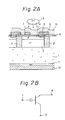
- Fig. 2A is a cross-sectional view of a photosensor cell in a first embodiment of a line image sensor device of the present invention
- Fig. 2B is an equivalent circuit diagram of said photosensor cell.
- a silicon substrate l which is rendered n or n+ type by doping with an impurity such as phosphor (P), antimony (Sb) or arsenic (As)
- an impurity such as phosphor (P), antimony (Sb) or arsenic (As)
- photosensor cells each of which is electrically insulated from the neighboring ones by means of separating areas 2 composed of SiO2, Si3N4 or polysilicon.
- a passivation layer l3 composed for example of a PSG layer.
- each photosensor cell is as follows. On an n ⁇ -type area 3 of a low impurity concentration formed for example by epitaxy, a p-type area 4 is formed by doping with a p-type impurity, and, in a part of said p-type area 4 there is formed an n+-type area 5 by impurity diffusion or by ion implantation. Said p-type area 4 and n+-type area 5 respectively constitute the base and emitter of a bipolar transistor.
- n ⁇ -type area 3 there is formed an oxide layer 6, on which formed is a capacitor electrode 7 of a determined area. Said capacitor electrode 7 faces said p-type area 4 across an oxide layer 8, whereby the potential of the floating p-type area 4 can be controlled by pulse voltages applied to the capacitor electrode 7.
- an emitter electrode 8 connected to the n+-type area 5; an unrepresented wiring for releasing the signals to the exterior from said emitter electrode 8; an unrepresented wiring connected to the capacitor electrode 7; an n+-type area ll of a high impurity concentration formed on the rear face of the substrate l; and an electrode l2 for supplying a potential to the collector of the bipolar transistor.
- the accumulated holes shift the base potential to positive.
- a positive signal reading voltage Vr is applied to the capacitor electrode 7 to bias the p-type area 4 positively, whereby the p-type area 4 in which the holes are accumulated is biased in forward direction with respect to the n+-type area 5.
- a current by electrons flows from the n+-type area 5 to the n-type area 3, so that the n+-type area 5 and the emitter electrode 8 in the floating state shows an increase in the potential.
- an electric signal corresponding to the amount of incident light can be obtained by reading said change in the potential of the emitter electrode 8 (signal reading operation).
- the charge accumulated in the p-type area 4 can be eliminated by grounding the emitter electrode 8 and applying a positive pulse of a positive voltage Vf to the capacitor electrode 7, whereby the p-type area 4 is biased in the forward direction with respect to the n+-type area 5 and the accumulated charge is dissipated (refreshing operation). Thereafter the above-mentioned steps of accumulation, readout and refreshing are repeated.
- the above-explained photosensor cell is based on a principle that the electric charge generated by the incident light is accumulated in the p-type area 4 constituting the base, and the current from the emitter 8 to the collector l2 is controlled by thus accumulated charge. Consequently the charge is read after an amplification by the amplifying function of each cell.
- This process provides a high output level, a high sensitivity and a low noise level and is promising for a higher resolving power in the future.
- Fig. 3 is a circuit diagram of a line image sensor constituting a first embodiment of the present invention.
- photosensor cells SCl - SCn of the structure shown in Fig. lA have mutually connected collector electrodes l2.
- Capacitor electrodes 7 are connected, respectively through switching transistors Trl - Trn, to output terminals Srl - Srn for signal readout of a shift register l0l, and further connected, respectively through switching transistors Tfl - Tfn, to output terminals Sfl - Sfn for refreshing of said shift register l0l.
- the gates of the switching transistors Trl - Trn are commonly connected to a terminal l02, while those of the switching transistors Tfl - Tfn are commonly connected to a terminal l03. Said terminals l02 and l03 respectively receive two-phase clocks ⁇ l and ⁇ 2 to turn on and off said switching transistors in synchronization with said clock signals.
- the shift register l0l is connected with terminals l02, l03 and l04 to receive the above-mentioned clock signals ⁇ l and ⁇ 2 and to receive a start pulse PS from the terminal l04.
- the output terminals Srl - Srn of the shift register l0l in succession release signal reading pulses of a voltage Vr while the output terminals Sfl - Sfn release refreshing pulses of a voltage Vf as will be explained later.
- the emitter electrodes 8 of the photosensor cells SCl - SCn are commonly connected to a signal readout line l05, which is connected to an input terminal of an output amplifier l06 and is grounded through a switching transistor l07.
- Said switching transistor l07 is provided to dissipate the charge on the signal readout line, and receives, through the gate thereof, a clock signal ⁇ r determining the timing of charge dissipation.
- a start pulse PS is supplied to the shift register l0l, and a clock signal ⁇ l is supplied to said shift register l0l and to the gate of the switching transistor Trl.
- the clock ⁇ l turns on the switching transistor Trl, and, in synchronization with said clock ⁇ l a signal readout pulse of a voltage Vr is released from the terminal Srl of the shift register l0l.
- Said signal readout pulse is transmitted through the switching transistor Trl in the on-state and is supplied to the capacitor electrode 7 of the photosensor cell SCl.
- a signal readout operation as explained before whereby the emitter 8 of the photosensor cell SCl releases a signal representing optical information, which is supplied through the line l05 to the output terminal after amplification in the output amplifier l06.
- the switching transistor l07 Upon completion of signal readout from the photosensor cell SCl, the switching transistor l07 is turned on by the clock ⁇ r to ground the signal readout line l05, thus dissipating the charge accumulated in the wiring capacity. Simultaneously, in response to the clock ⁇ 2, the terminal Sfl of the shift register l0l releases a refreshing pulse of a voltage Vf, which is transmitted through the switching transistor Tfl turned on by said clock ⁇ 2 and supplied to the capacitor electrode 7. In this manner the charges accumulated in the photosensor cell SCl and in the signal readout line l05 are eliminated.
- the terminal Sr2 supplies a pulse of the voltage Vr to the capacitor electrode of the photosensor cell SC2, thus effecting the signal readout thereform.
- the photosensor cell SC2 is refreshed by a clock ⁇ 2, while the signal readout line l05 is refreshed by a clock ⁇ r.
- the optical information of all the photosensor cells SCl - SCn can be serially read by effecting the signal readout and refreshing for each photosensor cell in synchronization with the clocks ⁇ l and ⁇ 2. Since each photosensor cell is refreshed at the completion of the signal readout operation, the photosensor cells can collectively enter the accumulating operation when the signal readout and refreshing for the last cell SCn are completed. Thereafter the above-explained steps are repeated.
- Fig. 5A is a cross-sectional view of a photosensor cell constituting a second embodiment of the present invention
- Fig. 5B is an equivalent circuit diagram of said photosensor cell.
- the p-type area 4 is set at a determined potential by a MOS transistor to achieve complete refreshing.
- the refreshing MOS transistor is composed of main electrode areas consisting of a p-type area 4 and a p-type area 4l formed on an n ⁇ -type epitaxial layer 3, and the capacitor electrode 7 positioned across an oxide layer 6 serves as the gate.
- the MOS transistor is turned off when a positive voltage is supplied to the capacitor electrode 7 but is turned on to connect the electrode 42 with the p-type area 4 when a negative voltage exceeding a determined threshold value is supplied.
- Fig. 6 is a circuit diagram of an image sensor device constituting the second embodiment of the present invention.
- photosensor cells SCl - SCn are respectively provided with refreshing MOS transistors Tl - Tn.
- the capacitor electrodes 7 of the photosensor cells are connected, respectively through switching transistors Trfl - Trfn, to output terminals Sl - Sn of a shift register 20l, and the gates of said transistors Trfl - Trfn are commonly connected to a terminal 202 for effecting on-off operations by clocks ⁇ rf .
- the shift register 20l releases a signal readout pulse of a positive voltage Vr and a succeeding refreshing pulse of a negative voltage -Vf, in succession, from the terminals Sl - Sn.
- Electrodes 42 of the photosensor cells SCl - SCn are commonly connected to a terminal 203, receiving a determined refreshing voltage Vrf.
- Other components same as those in the first embodiments are represented by same numbers and will not be explained further.
- the terminal Sl of the shift register 20l releases a signal readout pulse of a positive voltage Vr, which is supplied, through said switching transistor Trfl, to the capacitor electrode 7 of the photosensor cell SCl. Because of said positive voltage Vr the MOS transistor Tl remains turned off, and the photosensor cell SCl effects a signal readout operation explained above.
- the terminal Sl supplies a refreshing pulse of a negative voltage -Vf to the capacitor electrode 7 of said photosensor cell SCl to turn on the MOS transistor Tl, whereby the base area 4 releases the charge accumulated therein through the electrode 42 and is set at a determined potential Vrf.
- the switching transistor l07 is turned on to refresh the signal readout line l05.
- the present embodiment allows to arbitrarily select the potential of the base area 4 and to achieve complete refreshing by suitably selecting the refreshing voltage Vrf.
- MOS transistors Tl - Tn are formed in the photosensor cells, they may also be formed on the separating areas 2. It is also possible to form said separating area 2 with a semiconductor of the same conductive type as the base area 4 to achieve insulation by a p-n junction and to form a refreshing MOS transistor by maintaining said separating area at a potential Vrf.
- FIG. 8 there are shown phototransistors 80l l - 80l n ; capacitors 802 l - 802 n for respectively transmitting control signals to said phototransistors; sample-hold circuits 806 l - 806 n composed of MOS transistors 803 l - 803 n for on-off controlling the output signals from the emitters of the phototransistors 80l l - 80l n , capacitors 804 l - 804 n for accumulating said output signals, and MOS transistors 805 l - 805 n for controlling the readout of the output signals from said capacitors; a logic circuit 8l9 for controlling the on/off state of the MOS transistors 805 l - 805 n ; an amplifier 82l for output signal reading; a common output line; a MOS transistor 824 for dissipating the charge accumulated in the common output line 820; a positive voltage input terminal 8l8; a power supply input terminal 8l5; an output terminal
- MOS transistors 803 l - 803 n , 805 l - 805 n and 824 are of n-channel type.
- the MOS transistors 803 l - 803 n are turned on by an H-level signal supplied to the control signal input terminal 8l6, while the MOS transistors 805 l - 805 n are turned on by H-level signals released from all the output terminals 807 l - 807 n of the logic circuit 8l9, and the MOS transistor 824 is turned on by an H-level signal entered from the input terminal 823, whereby all the emitters of the phototransistors 80l l - 80l n are grounded. Also a positive bias voltage is entered from the positive voltage input terminal 8l8 to positively bias all the collectors of the phototransistors 80l l - 80l n .
- the MOS transistors 803 l - 803 n are turned on by an H-level signal supplied to the control signal input terminal 8l6 while the MOS transistors 805 l - 805 n are turned off by L-level signals released from all the output terminals 807 l - 807 n of the logic circuit 8l9, whereby the emitters of the phototransistors 80l l - 80l n are connected with the capacitors 804 l - 804 n . Also all the collectors of the phototransistors 80l l - 80l n are positively biased by a positive bias voltage supplied to the input terminal 8l8.
- the MOS transistors 803 l - 803 n are turned off by entering an L-level signal from the input terminal 8l6 and H-level signals are released in succession from the output terminals 807 l - 807 n of the logic circuit thereby turning on the MOS transistors 805 l - 805 n in succession.
- an H-level signal is entered through the input terminal 823 to turn on the MOS transistor 824, thereby discharging the capacitor after signal readout, and then the input terminal 823 is shifted again to the L-level to turn off the MOS transistor 824. In this manner the signal readout of a line can be achieved by effecting the signal readout operation from the sample hold circuits 806 l - 806 n to the output terminal 822 in succession.
- the time required for signal readout of a line is represented by t REl + n(t RE2 + t RE3 ), wherein t REl represents a time required for signal readout from a phototransistor 80l i to the sample hold circuit 806 i , t RE2 is a time required for reading the voltage accumulated in the sample hold circuit 806 i through the output terminal 822, and t RE3 is a time required for discharging the capacitor 804 i of the sample hold circuit 806 i .
- Said readout time t RE2 from the capacitor 804 i to the output terminal 822 and said discharge time t RE3 are small because the MOS transistors 805 l - 805 n constituting the sample hold circuit 806 l - 806 n can be composed of high-speed switching MOS transistors.
- the phototransistors 80l l - 80l n have a certain amplifying function, but the emitter current is limited, if the photosensor cells are arranged at a high density, since the amount of carriers generated in the base area decreases due to a smaller size of the cell. Consequently the signal readout time t REl from the phototransistors is relatively large, compared to t RE2 and t RE3 .
- the readout time t REl from the phototransistors depends on the capacities of the capacitors 804 l - 804 n , which in turn are determined by the floating capacity of the common output line 820.
- the signal readout time for a line is represented by n(t REl + t RE3 ) since the signal readout time from a photosensor cell l0l to the output terminal 22 is equal to the aforementioned time t REl for signal accumulating time in the capacitor 804 i , and the discharge time from the common output line 20 is likewise equal to t RE3 .
- t REl >> t RE3 .
- the MOS transistors 803 l - 803 n are turned by an H-level signal supplied to the input terminal 8l6, while the MOS transistors 805 l - 805 n are also turned by H-level signals released from all the output terminals 807 l - 807 n of the logic circuit 8l9, and the MOS transistor 824 is also turned on by an H-level signal entered from the input terminal 823, whereby all the emitters of the phototransistors 80l l - 80l n are grounded.
- a positive bias voltage is entered from the positive voltage input terminal 8l8 to positively bias all the collectors of the phototransistors 80l l - 80l n .
- the refreshing operation is conducted by entering, in this state, a pulse of a positive voltage V RF through the control signal input terminal 8l7, whereby the base potential returns to the initial negative potential -aV RF .
- the function of the image line sensor is effected by repeating the above-explained steps of accumulation, readout and refreshing.
- the MOS transistors 803 l - 803 n , 805 l - 805 n and 824 are assumed to be of n-channel type, it is also possible to employ p-channel transistors or complementary transistors in which p-channel and n-channel transistors are combined.
- Fig. 9 is a circuit diagram of the fourth embodiment of the present invention, in which shown are phototransistors 90l ll - 90l mn and capacitors 902 ll - 902 mn for transmitting control signals to said phototransistors, both two-dimensionally arranged in n columns and m rows; and sample hold circuits 906 l - 906 n composed of MOS transistors 903 l - 903 n for controlling the output signals from the emitters of the phototransistors 90l ll - 90l mn , capacitors 904 l - 904 n connecting main electrodes of said MOS transistors 903 l - 903 n with a power input terminal 9l5, MOS transistors 909 l - 909 n of which gates are connected to the main electrodes of said MOS transistors 903 l - 903 n , MOS transistors 905 l - 905 n of which main electrodes are respectively connected to the MOS transistors 909 l
- control signal input terminal 9l7 for supplying control signals to the photosensor cells
- control signal input terminal 9l6 for supplying control signals to the MOS transistors 903 l - 903 n
- a positive voltage input terminal 9l8 for supplying control signals to the MOS transistors 9l0 l - 9l0 n
- a power input terminal 927 for supplying control signals to the MOS transistors 9l0 l - 9l0 n ; and a power input terminal 927.
- the phototransistors 90l ll - 90l mn of the present invention achieve photoelectric conversion by a basic function consisting of an accumulation step, a signal readout step and a refreshing step.
- Fig. 9 it is assumed that all the MOS transistors are of n-channel type, that the positive voltage input terminal 9l8 and the power input terminal 925 receive positive voltages, and that the input terminals 9l5 and 927 are grounded.
- an H-level signal is supplied to the control input terminal 926 to turn on the MOS transistors 9l0 l - 9l0 n , thereby grounding all the emitters of the phototransistors 90l ll - 90l mn .
- a positive voltage is supplied to the input terminal 9l8 to positively bias all the collectors of said phototransistors, and a pulse of a positive voltage V RF is supplied from arbitrary one of the control signal input terminals 9l7 l - 9l7 n to bias the bases of the phototransistors 90l ll - 90l mn at a determined negative potential.
- the photosensor cells are irradiated with light to accumulate holes in the base areas.
- the pulse for negatively biasing the bases of the phototransistors 90l ll - 90l mn may be given to a row or plural rows at a time.
- an H-level signal is supplied to the control signal input terminal 9l6 to turn on the MOS transistors 903 l - 903 n and an L-level signal is supplied to the control signal input terminal 926 to turn off the MOS transistors 9l0 l - 9l0 n , whereby all the emitters of the phototransistors 90l ll - 90l mn are left open, and a positive bias voltage is supplied through the positive voltage input terminal 9l8 to positively bias all the collectors of the phototransistors 90l ll - 90l mn .
- pulses of a positive voltage V RE are supplied in an arbitrary or sequential order to the control signal input terminals 9l7 l - 9l7 m .
- the signal readout from the sample hold circuits 906 l - 906 n to the output terminal 922 is effected by supplying an L-level signal through the control input terminal 9l6 to turn off the MOS transistors 903 l - 903 n and releasing H-level signals in succession from the output terminals 907 l - 907 n of the logic circuit 9l9, thereby turning on the MOS transistors 905 l - 905 n in succession.
- the MOS transistor 905 l is turned on to apply the positive voltage at the terminal 925 to the MOS transistor 909 l . Consequently a current corresponding to the voltage applied to the gate is generated between the main electrodes of the MOS transistor 909 l , thus generating a voltage, across the resistor 908 l , corresponding to the accumulated voltage in the capacitor 904 l , and said voltage is released from the output terminal 922 as an optical information signal. Thereafter the voltages accumulated in the capacitors 904 l - 904 n are released in succession through the output terminal 922.
- the phototransistors 90l il - 90l in and the capacitors 904 l - 904 n are refreshed by entering an H-level signal to the control input terminal 9l6 to turn on the MOS transistors 903 l - 903 n and entering an H-level signal through the control input terminal 926 to turn on the MOS transistors 9l0 l - 9l0 n , whereby the capacitors 904 l - 904 n are discharged through the MOS transistors 903 l - 903 n and 9l0 l - 9l0 n .
- the phototransistors 90l il - 90l in are refreshed by applying a positive voltage to the input terminal 9l7 i .
- the phototransistors 90l il - 90l in initiate the accumulating operation. Simultaneously the signal readout and refreshing are effected in the above-explained manner for the phototransistors 90l jl - 90l jn of a j-th row.
- optical information signals of each row are collectively held in the capacitors 904 l - 904 n and then are serially released, it is possible to simultaneously effect the signal readout and refreshing of a row and the accumulation for other plural rows.
- the signal readout and refreshing need not necessarily be effected for each row but may be effected for plural rows at a time.
- the above-explained circuit of Fig. 9, constituting the fourth embodiment of the present invention is characterized by a fact that the refreshing and accumulation for different rows and the signal readout from the sample hold circuits can be simultaneously conducted. Consequently the photoelectric conversion can be achieved in a sequence in which the time from the refreshing to the signal readout is maintained constant in any row.
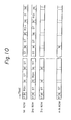
- Fig. l0 is a chart showing the operating sequence, for further clarifying the function of said fourth embodiment.
- R indicates the signal readout operation from the phototransistors to the sample hold circuits 906 l - 906 n ;
- RSH indicates a period of signal readout from the sample hold circuits 906 l - 906 n to the output terminal 922 and refreshing of the phototransistors;
- ST indicates the accumulating period;
- W indicates that the signal readout is conducted on certain phototransistors outside the row of said symbol W. More specifically, in the period W, the base of the phototransistor is maintained negative to effect the accumulating operation, but the emitter is shifted to a positive potential because the signal readout is conducted from the emitter of phototransistors of another row to the sample hold circuits.
- the MOS transistors in the fourth embodiment shown in Fig. 9 are composed of N-channel MOS transistors, it is also possible to employ P-channel MOS transistors or complementary circuits in which N- and P-channel MOS transistors are combined. Also the cathode-follower amplifiers employed in the sample-hold circuits may be replaced by other amplifiers such as differential amplifiers.
- Figs. ll and l2 illustrate the basic structure and function of a photosensor cell to be employed in the ensuing embodiments.
- Fig. llA is a plan view of said photosensor cell
- Fig. llB is a cross-sectional view thereof along a line A-A′
- Fig. l2 is an equivalent circuit thereof, wherein same components are always represented by same numbers.
- Fig. ll there is shown an arrangement in rows and columns, but there may naturally be employed a staggered arrangement of pixels in order to improve the resolving power in the horizontal direction.
- Said photosensor cell is provided with a structure as explained in the following.
- a structure as explained in the following.
- a passivation layer ll02 there are provided, on an n-type silicon substrate ll02; a passivation layer ll02; an insulating oxide layer ll03 composed of silicon oxide; a separating area ll04 composed of an insulating layer or a polysilicon layer for electrically separating the neighboring photosensor cells; an n ⁇ -type area ll05 of a low impurity concentration formed for example by epitaxy; a p-type area ll06 formed thereon to constitute a base of a bipolar transistor; an n+-type area ll07 constituting an emitter of said bipolar transistor; a wiring ll08 composed of a conductive material such as aluminum for signal readout to the exterior; a capacitor electrode ll09 opposed to the p-type area ll06 across the insulator ll03 for applying pulses to said p-type area ll06 in the floating state;
- a capacitor C ox lll3 is composed, in a MOS structure, of the electrode ll09, insulating layer ll03 and p-type area ll06, while a bipolar transistor lll4 is composed of the n+-type area ll07 functioning as the emitter, p-type area ll06 functioning as the base and n ⁇ -type area ll05 and area ll0l functioning as the collector. Also as will be understood from these drawings, the p-type area ll06 is maintained in the float-state.
- the bipolar transistor lll4 is represented by a junction capacity Cbe lll5 of the base and emitter; a p-n junction diode Dbe lll6 between the base and emitter; a junction capacity Cbc lll7 between the base and collector; and a p-n junction diode Dbc lll8 between the base and collector.
- the basic function of said photosensor cell is composed, as already explained before, of a charge accumulation step in response to the incident light, a signal readout step and a refreshing step.
- the emitter is grounded through the wiring ll08, while the collector is positively biased through the wiring lll2.
- the base is in advance biased inversely to the emitter ll07.
- the potential Vp generated by the incident light remains almost constant even when the photosensor cell size is reduced to achieve a higher resolving power, since the amount of accumulated charge Q decreases with the decrease in the amount of light per cell while the junction capacity decreases proportional to the cell size.
- the photosensor cell of the present invention can have a very large effective light-receiving area, because of the very simple structure as shown in Fig. ll.
- the emitter and the wiring ll08 are maintained in the floating state, while the collector is maintained at a positive potential Vcc.
- the base potential is equal to -Vb + Vp, wherein -Vb is a negative bias potential of the base ll06 prior to light irradiation, and Vp is the accumulated voltage generated by said irradiation. Then a positive voltage Vr for signal reading is applied to the electrode ll09 through the wiring lll0.
- Said voltage is divided by the oxide layer capacity Cox lll3, base-emitter junction capacity Cbe lll5 and base-collector junction capacity Cbc lll7, so that the base potential is shifted to: -Vb + Vp + Cox Cox + Cbe + Cbc Vr
- Vb s -Vb + Cox Cox + Cbe + Cbc Vr
- the base potential is further biased in the forward direction, in comparison with the voltage Vp accumulated by the light irradiation. Consequently the electrons are injected from the emitter to the base, and reach the collector through acceleration by the drift electric field, because of the positive collector potential.
- the accumulated voltage Vp and the signal readout voltage are linearly proportional over a range in excess of l0,000 times, so that a high-speed signal readout is ensured if the readout time, in which the readout voltage Vr is applied to the capacitor electrode ll09, is selected longer than ca. l00 nsec.
- the wiring ll08 has a capacity of 4 pF while the junction capacity Cbe + Cbc is equal to 0.0l pF, with a ratio of ca. 300 times.
- the accumulated voltage Vp generated in the p-type area ll06 is not influenced, and an extremely speedy signal readout is rendered possible by the effect of the bias voltage Vbs. This is due to an effective contribution of the amplifying function of the photosensor cells. In comparison with such high output voltage, the fixed pattern noises and random noises resulting from the output capacity are relatively small, so that an extremely high S/N ratio can be obtained.
- Fig. l3B allows to know the signal readout time required by the readout voltage to reach a desired percentage of the accumulated voltage, at a given bias voltage Bvs. Consequently the chart shown in Fig. l3B allows to determine the required bias voltage Vbs, once the signal readout time and the linearity required for the overall design of the image sensor device are determined.
- Another advantage of the photosensor cell of the present invention is the possibility of non-destructive readout because the probability of recombination of electron and hole in the p-type area ll06 is quite low. This fact indicates the possibility of a new function in case said photosensor cells are constructed as an image sensor device.
- the p-type area ll06 can maintain the voltage Vp for an extremely long time, and the maximum holding time is rather limited by a dark current thermally generated in the depletion layer of the junction.
- the depletion layer is present in the n ⁇ -type area ll05 with a very low impurity concentration with a high crystallinity, so that few pairs of electrons and holes are thermally generated.
- the charge accumulated in the p-type area ll06 is not dissipated in the signal readout operation as already explained before. For this reason, in order to enter new optical information, the previously accumulated charge has to be dissipated in a refreshing operation. It is at the same time necessary to maintain the p-type area ll06 in the floating state at a determined negative potential.
- the refreshing operation is effected, just like the signal readout, by applying a positive voltage to the electrode ll09 through the wiring lll0. At the same time the emitter is grounded through the wiring ll08. The collector is grounded or maintained at a positive potential through the electrode lll2.
- Fig. l4A shows an equivalent circuit for refreshing operation, wherein the collector is grounded.
- Said voltage forms a forward bias in the base-emitter junction diode Dbe lll6 and the base-collector junction diode Dbc lll8, thus generating currents therein, whereby the base potential is gradually lowered.
- Fig. l4B shows the result of calculation of change in the potential of floating base, as an example of time dependence of the base potential, wherein the abscissa indicates the refreshing time or the time after the application of the refreshing voltage Vrh to the electrode ll09, while the ordinate indicates the base potential, indicating various initial base potentials.
- the initial base potential is the potential of the floating base when the refreshing voltage Vrh is applied, and is determined by Vrh, Cox, Cbe, Cbe and the charge accumulated in the base.
- Fig. l4B indicates that the base potential is not determined by the initial potential but shows a linear change in logarithmic scale after the lapse of a determined time.
- the p-type area ll06 can be biased to a negative potential in two ways, by applying a positive voltage through the MOS capacitor Cox for a determined period and then removing said voltage. In one method, a negative charge is accumulated by the flow of positively charged holes from the p-type area ll06 to the n-type area ll0l in grounded state.
- the solid-state solid image sensor device employing the above-explained photosensor cells has a complete refreshing mode, in which the base potential of all the photosensor cells is brought to zero (requiring l0 seconds in the example shown in Fig. l4B), and a transient refreshing mode, in which a variable component resulting from the accumulated voltage Vp is dissipated though a certain base potential remains (requiring l0 ⁇ sec to l0 sec in the example shown in Fig. l4B.
- the complete refreshing mode or the transient refreshing mode is selected according to the purpose of use of the image sensor device.
- the photosensor cell explained above disclosed in the aforementioned European Patent Application Laid-open No. 0l30276, is much simpler in structure than conventional photosensors thus providing an ample possibility for a higher resolving power in the future, and retains the advantages of a low noise level, a high output level, a wide dynamic range and a non-destructive signal readout resulting from the amplifying function.
- Fig. l5 is a circuit diagram of an embodiment of a solid-state image sensor device, composed of a one-dimensional array of the above-explained photosensor cells.
- Fig. l5 there are provided three photosensor cells l530 of which collectors l5l2 are commonly connected.
- Capacitor electrodes l5l0 of said photosensor cells l530 are connected to a horizontal line l53l for supplying readout pulses and refreshing pulses.
- Said horizontal line l53l is connected, through a buffer MOS transistor l532, to a terminal l533 for supplying refreshing pulses, and the gate of said buffer MOS transistor l532 is connected to a terminal l534.
- the horizontal line l53l is connected, through a buffer MOS transistor l535, to a terminal l536 for supplying readout pulses, and the gate of said transistor is connected to a terminal l537.
- Emitters l508 of the photosensor cells l530 are respectively connected to vertical lines l538, l538′, l538 ⁇ for signal readout for each column, and said vertical lines are connected, respectively through gate MOS transistors l539, l539′, l539 ⁇ , to the input terminal of a P-type CCD register l540.
- the gates of said gate MOS transistors l539, l539′, l539 ⁇ are connected to a terminal l54l for generating pulses for controlling the vertical lines.
- the output terminal of the CCD register l540 is connected to an output signal line l542, which is grounded through a refreshing transistor l543, whose gate is connected to a terminal l544.
- Said output signal line l542 is further connected to the gate of a signal amplifying transistor l545, of which drain is connected to a load resistor l546 and an output terminal l547 for releasing the amplified output signals.
- the vertical lines l538, l538′, l538 ⁇ are grounded through refreshing MOS transistors l548, l548′, l548 ⁇ , of which gates are commonly connected to a terminal l549.
- the terminal l549 is maintained at an H-level to turn on the MOS transistors l548, l548′, l548 ⁇ whereby the photosensor cells are grounded through the vertical lines l538, l538′, l538 ⁇ .
- An H-level signal is also supplied to the terminal l534 to turn on the refreshing MOS transistor l532.
- a refreshing pulse supplied to the terminal l533 is transmitted through the horizontal line l53l to provide the bases of the photosensor cells with a voltage Vrh, whereby the refreshing operation is initiated to dissipate the accumulated charges according to the complete refreshing mode or the transient refreshing mode.
- the bases of the transistors of the photosensor cells are inversely biased with respect to the emitters, thus initiating a succeeding accumulation.
- all other pulses are maintained at an L-level state as will be understood from the drawing.
- the electrons of the election-hole pairs generated by light irradiation can be rapidly dissipated into the collector since the substrate, or the collector of transistor, is maintained at a positive potential.
- the terminal l549 is maintained at an H-level state as in the refreshing step to maintain the MOS transistors l548, l548′, l548 ⁇ in the conductive state, whereby the emitters of the photosensor cells are grounded through the vertical lines l538, l538′, l538 ⁇ . If the base is saturated with holes under a strong light irradiation, or, if the base becomes biased in forward direction with respect to the grounded emitter potential, the holes flow through the vertical lines l538, l538′, l538 ⁇ , so that the base potential no longer moves and is clipped in this state. Consequently the blooming phenomenon can be avoided by the grounding of the vertical lines, even though the emitters of vertically neighboring photosensor cells are commonly connected to the vertical lines l538, l538′, l538 ⁇ .
- the signal readout period starts from a time t3, when the terminal l549 is shifted to an L-level state, and terminal l537 is shifted to an H-level state, thereby turning off the MOS transistors l548, l548′, l548 ⁇ and turning on the MOS transistor l535.
- a readout pulse of a voltage Vr is supplied to the terminal l536, whereby the signal readout from three photosensor cells connected to the horizontal line l53l is effected through the MOS transistor l535.
- an H-level signal is supplied to the terminal l54l to turn on the MOS transistors l539, l539′, l539 ⁇ , whereby the output signals of the photosensor cells are simultaneously supplied to the CCD registor l540.
- Said output signals stored in the CCD register l540 are transferred in succession, after the completion of the signal readout period, to the output signal line l542, then amplified by the transistor l545 and released through the output terminal l547. After the transfer of each output signal, a charge remains in the output signal lines l542, due to a wiring capacity.
- an H-level signal is supplied to the terminal l544 in synchronization with the transfer timing of the CCD register l540, so that the output signals are transferred, in separated state, to the transistor l545.
- the final amplifier can be made simpler in comparison with the MOS image sensor device since a high output voltage can be obtained by the amplifying function of each photosensor cell.
- the MOS transistor employed as the signal amplifier l545 in the present embodiment can be naturally replaced by other amplifying means such as a bipolar transistor.
- an n-type CCD register may also be employed if the output charge from each photosensor cell is subtracted from a charge accumulated in advance in the register.
- the image sensor device of the present invention provides a higher output voltage, a higher sensitivity and a lower noise level, thus enabling to achieve a higher resolving power, in comparison with conventional MOS or CCD image sensor devices.
- the image sensor device of the present invention is capable of a high-speed signal readout operation even for an increased number of photosensor cells, thus providing a high-speed operation combined with a high resolving power, since the signals from plural photosensor cells are temporarily retained in holding means and then released sequentially.
- the photosensor cells can have a uniform accumulation time, thus ensuring a stable photoelectric converting characteristic, because each photosensor cell can be refreshed immediately after the signal readout operation. Also a high-speed operation is rendered possible because of the absence of idle time after the completion of signal readout as in the conventional structure.
- the image sensor device of the present invention can achieve a higher packing density because a pixel is composed of a single transistor, and still shows significantly reduced blooming and smear phenomena. It also provides a higher sensitivity and a wider dynamic range.
- the amplifying function of the photosensor cells themselves allows to obtain a high signal voltage without relying on the wiring capacity, to achieve a low noise level and facilitates the designing of peripheral circuits.
- the transfer of the output signals from the photosensor cells with a CCD register allows to achieve a higher packing density in comparison with the conventional structure involving complex shift registers, and easily achieves a transfer frequency in excess of l00 MHz required in high-speed signal processing.
Landscapes
- Engineering & Computer Science (AREA)
- Multimedia (AREA)
- Signal Processing (AREA)
- Solid State Image Pick-Up Elements (AREA)
- Transforming Light Signals Into Electric Signals (AREA)
Applications Claiming Priority (10)
| Application Number | Priority Date | Filing Date | Title |
|---|---|---|---|
| JP273382/84 | 1984-12-26 | ||
| JP59273382A JPS61152066A (ja) | 1984-12-26 | 1984-12-26 | 固体撮像装置 |
| JP27338284 | 1984-12-26 | ||
| JP27395384 | 1984-12-27 | ||
| JP27395784 | 1984-12-27 | ||
| JP273953/84 | 1984-12-27 | ||
| JP59273953A JPS61154353A (ja) | 1984-12-27 | 1984-12-27 | ラインセンサ |
| JP59273957A JPS61154371A (ja) | 1984-12-27 | 1984-12-27 | 光電変換装置 |
| JP273957/84 | 1984-12-27 | ||
| EP85309496A EP0187047B1 (fr) | 1984-12-26 | 1985-12-24 | Dispositif capteur d'images |
Related Parent Applications (2)
| Application Number | Title | Priority Date | Filing Date |
|---|---|---|---|
| EP85309496A Division EP0187047B1 (fr) | 1984-12-26 | 1985-12-24 | Dispositif capteur d'images |
| EP85309496.9 Division | 1985-12-24 |
Publications (3)
| Publication Number | Publication Date |
|---|---|
| EP0455311A2 true EP0455311A2 (fr) | 1991-11-06 |
| EP0455311A3 EP0455311A3 (en) | 1992-01-02 |
| EP0455311B1 EP0455311B1 (fr) | 2001-03-14 |
Family
ID=27336091
Family Applications (2)
| Application Number | Title | Priority Date | Filing Date |
|---|---|---|---|
| EP91201327A Expired - Lifetime EP0455311B1 (fr) | 1984-12-26 | 1985-12-24 | Dispositif capteur d'images |
| EP85309496A Expired - Lifetime EP0187047B1 (fr) | 1984-12-26 | 1985-12-24 | Dispositif capteur d'images |
Family Applications After (1)
| Application Number | Title | Priority Date | Filing Date |
|---|---|---|---|
| EP85309496A Expired - Lifetime EP0187047B1 (fr) | 1984-12-26 | 1985-12-24 | Dispositif capteur d'images |
Country Status (3)
| Country | Link |
|---|---|
| US (1) | US4831454A (fr) |
| EP (2) | EP0455311B1 (fr) |
| DE (2) | DE3585516D1 (fr) |
Cited By (3)
| Publication number | Priority date | Publication date | Assignee | Title |
|---|---|---|---|---|
| EP0665685A3 (fr) * | 1994-01-31 | 1996-02-07 | Sony Corp | Capteur d'image à l'état solide avec phototransistors à effet de champ et condensateurs de stockage. |
| EP0588131A3 (en) * | 1992-09-17 | 1997-07-09 | Honda Motor Co Ltd | Sensor voltage reading circuit |
| WO2000002379A1 (fr) * | 1998-07-01 | 2000-01-13 | Cmos Sensor, Inc. | Puce formant détecteur d'images à contact en silicium a structure de transfert de lignes et de presentation de pixels |
Families Citing this family (27)
| Publication number | Priority date | Publication date | Assignee | Title |
|---|---|---|---|---|
| JPH084127B2 (ja) * | 1986-09-30 | 1996-01-17 | キヤノン株式会社 | 光電変換装置 |
| US5737016A (en) * | 1985-11-15 | 1998-04-07 | Canon Kabushiki Kaisha | Solid state image pickup apparatus for reducing noise |
| US5771070A (en) * | 1985-11-15 | 1998-06-23 | Canon Kabushiki Kaisha | Solid state image pickup apparatus removing noise from the photoelectric converted signal |
| US4914519A (en) * | 1986-09-19 | 1990-04-03 | Canon Kabushiki Kaisha | Apparatus for eliminating noise in a solid-state image pickup device |
| US4835404A (en) * | 1986-09-19 | 1989-05-30 | Canon Kabushiki Kaisha | Photoelectric converting apparatus with a switching circuit and a resetting circuit for reading and resetting a plurality of lines sensors |
| US5122881A (en) * | 1988-08-10 | 1992-06-16 | Hitachi, Ltd. | Solid-state imaging device with an amplifying FET in each pixel and an output capacitor in each row |
| FR2638042A1 (fr) * | 1988-10-14 | 1990-04-20 | Thomson Csf | Procede pour reduire la remanence d'un phototransistor, notamment de type nipin |
| JP2678062B2 (ja) * | 1989-06-14 | 1997-11-17 | キヤノン株式会社 | 光電変換装置 |
| US5272345A (en) * | 1989-09-22 | 1993-12-21 | Ada Technologies, Inc. | Calibration method and apparatus for measuring the concentration of components in a fluid |
| JP2810526B2 (ja) * | 1989-11-21 | 1998-10-15 | キヤノン株式会社 | 光電変換装置及び該装置を搭載した装置 |
| US5146339A (en) * | 1989-11-21 | 1992-09-08 | Canon Kabushiki Kaisha | Photoelectric converting apparatus employing Darlington transistor readout |
| US5241169A (en) * | 1989-11-21 | 1993-08-31 | Canon Kabushiki Kaisha | Photoelectric conversion device having an improved control electrode structure and apparatus equipped with same |
| US5288988A (en) * | 1990-08-07 | 1994-02-22 | Canon Kabushiki Kaisha | Photoconversion device having reset control circuitry |
| JP2991354B2 (ja) * | 1990-11-07 | 1999-12-20 | キヤノン株式会社 | 画像読取装置およびそれを備えた画像情報処理装置 |
| US5182647A (en) * | 1990-12-13 | 1993-01-26 | Eastman Kodak Company | High resolution charge-coupled device (ccd) camera system |
| US5406332A (en) * | 1992-03-06 | 1995-04-11 | Canon Kabushiki Kaisha | Photoelectric converting device |
| EP0563846A1 (fr) * | 1992-03-30 | 1993-10-06 | Matsushita Electric Industrial Co., Ltd. | Correction d'ouverture à accentuation dynamique pour usage dans une caméra CCD |
| US5315393A (en) * | 1992-04-01 | 1994-05-24 | Amoco Corporation | Robust pixel array scanning with image signal isolation |
| JP3774499B2 (ja) | 1996-01-24 | 2006-05-17 | キヤノン株式会社 | 光電変換装置 |
| US5784178A (en) * | 1996-03-06 | 1998-07-21 | Dyna Image Corporation | High performance contact image sensor |
| US5838176A (en) * | 1996-07-11 | 1998-11-17 | Foveonics, Inc. | Correlated double sampling circuit |
| US5844265A (en) * | 1996-07-11 | 1998-12-01 | Synaptics, Incorporated | Sense amplifier for high-density imaging array |
| JP3667186B2 (ja) | 2000-02-29 | 2005-07-06 | キヤノン株式会社 | 信号転送装置及びそれを用いた固体撮像装置 |
| TW462180B (en) * | 2000-03-29 | 2001-11-01 | Avision Inc | CCD image sensor device and method to sense image quickly |
| WO2002027763A2 (fr) | 2000-09-25 | 2002-04-04 | Foveon, Inc. | Detecteur actif de pixels a annulation du bruit |
| US10876636B2 (en) | 2015-12-03 | 2020-12-29 | Engineered Controls International, Llc | Leak resistant and serviceable receptacle |
| CN107041151B (zh) * | 2015-12-03 | 2019-07-30 | 国际工程控制公司 | 防渗漏且耐用接受器 |
Family Cites Families (13)
| Publication number | Priority date | Publication date | Assignee | Title |
|---|---|---|---|---|
| US3624428A (en) * | 1970-03-20 | 1971-11-30 | Rca Corp | Electric signal processing circuit employing capacitively scanned phototransistor array |
| JPS568968A (en) * | 1979-07-05 | 1981-01-29 | Matsushita Electric Ind Co Ltd | Solid-state image pickup unit |
| DE2936703A1 (de) * | 1979-09-11 | 1981-03-26 | Siemens AG, 1000 Berlin und 8000 München | Monolithisch integrierte schaltung mit einem zweidimensionalen bildsensor |
| DE2939490A1 (de) * | 1979-09-28 | 1981-04-16 | Siemens AG, 1000 Berlin und 8000 München | Monolithisch integrierter zweidimensionaler bildsensor mit einer differenzbildenden stufe |
| JPS6030151B2 (ja) * | 1979-10-19 | 1985-07-15 | 松下電子工業株式会社 | 固体撮像装置 |
| JPS57100361U (fr) * | 1980-12-12 | 1982-06-21 | ||
| JPS59107569A (ja) * | 1982-12-13 | 1984-06-21 | Fuji Photo Film Co Ltd | 一次元半導体撮像装置 |
| JPH0744661B2 (ja) * | 1982-12-14 | 1995-05-15 | オリンパス光学工業株式会社 | 固体撮像装置 |
| JPS59108463A (ja) * | 1982-12-14 | 1984-06-22 | Olympus Optical Co Ltd | 固体撮像装置 |
| JPS59108476A (ja) * | 1982-12-14 | 1984-06-22 | Junichi Nishizawa | 2次元固体撮像装置及びその読出し方法 |
| JPS59108457A (ja) * | 1982-12-14 | 1984-06-22 | Olympus Optical Co Ltd | 固体撮像素子 |
| US4686554A (en) * | 1983-07-02 | 1987-08-11 | Canon Kabushiki Kaisha | Photoelectric converter |
| GB2170675B (en) * | 1984-12-28 | 1989-12-13 | Canon Kk | Image sensing apparatus |
-
1985
- 1985-12-24 DE DE8585309496T patent/DE3585516D1/de not_active Expired - Lifetime
- 1985-12-24 EP EP91201327A patent/EP0455311B1/fr not_active Expired - Lifetime
- 1985-12-24 EP EP85309496A patent/EP0187047B1/fr not_active Expired - Lifetime
- 1985-12-24 DE DE3588227T patent/DE3588227T2/de not_active Expired - Fee Related
-
1987
- 1987-03-05 US US07/022,605 patent/US4831454A/en not_active Ceased
Cited By (4)
| Publication number | Priority date | Publication date | Assignee | Title |
|---|---|---|---|---|
| EP0588131A3 (en) * | 1992-09-17 | 1997-07-09 | Honda Motor Co Ltd | Sensor voltage reading circuit |
| EP0665685A3 (fr) * | 1994-01-31 | 1996-02-07 | Sony Corp | Capteur d'image à l'état solide avec phototransistors à effet de champ et condensateurs de stockage. |
| US5808677A (en) * | 1994-01-31 | 1998-09-15 | Sony Corporation | Solid-state imaging device having a reset switch for resetting potential of capacitor |
| WO2000002379A1 (fr) * | 1998-07-01 | 2000-01-13 | Cmos Sensor, Inc. | Puce formant détecteur d'images à contact en silicium a structure de transfert de lignes et de presentation de pixels |
Also Published As
| Publication number | Publication date |
|---|---|
| EP0187047B1 (fr) | 1992-03-04 |
| EP0187047A2 (fr) | 1986-07-09 |
| DE3588227D1 (de) | 2001-04-19 |
| EP0455311A3 (en) | 1992-01-02 |
| DE3585516D1 (de) | 1992-04-09 |
| EP0187047A3 (en) | 1987-03-04 |
| DE3588227T2 (de) | 2001-08-09 |
| EP0455311B1 (fr) | 2001-03-14 |
| US4831454A (en) | 1989-05-16 |
Similar Documents
| Publication | Publication Date | Title |
|---|---|---|
| EP0455311A2 (fr) | Dispositif capteur d'images | |
| USRE34309E (en) | Image sensor device having plural photoelectric converting elements | |
| US5060042A (en) | Photoelectric conversion apparatus with reresh voltage | |
| US4847668A (en) | Device and method of photoelectrically converting light into electrical signal | |
| KR0155017B1 (ko) | 고체촬상장치 | |
| US4942474A (en) | Solid-state imaging device having photo-electric conversion elements and other circuit elements arranged to provide improved photo-sensitivity | |
| EP0253678B1 (fr) | Dispositif de conversion photo-électrique | |
| US5933188A (en) | Photoelectric conversion apparatus and method with reset | |
| EP0593139A2 (fr) | Appareil de conversion photo-électrique | |
| US6674471B1 (en) | Solid-state imaging device and method for driving the same | |
| US5274459A (en) | Solid state image sensing device with a feedback gate transistor at each photo-sensing section | |
| EP0559207A1 (fr) | Dispositif de conversion photoélectrique | |
| EP0576022B1 (fr) | Dispositif de conversion photo-électrique et son procédé de commande | |
| US4712138A (en) | Low-noise apparatus for image pickup and combination of light and electric signals | |
| US4055836A (en) | Charge transfer readout circuits | |
| US4450464A (en) | Solid state area imaging apparatus having a charge transfer arrangement | |
| US4737832A (en) | Optical signal processor | |
| US5166800A (en) | Solid-state imaging device having a widened dynamic range | |
| US4577231A (en) | High sensitivity solid-state imaging device | |
| US4752829A (en) | Multipacket charge transfer image sensor and method | |
| US3679826A (en) | Solid state image sensing device | |
| JPH0523548B2 (fr) | ||
| JPH09116817A (ja) | 固体撮像装置及びその駆動方法 | |
| JPH0746839B2 (ja) | 光電変換装置 | |
| JPH0562868B2 (fr) |
Legal Events
| Date | Code | Title | Description |
|---|---|---|---|
| PUAI | Public reference made under article 153(3) epc to a published international application that has entered the european phase |
Free format text: ORIGINAL CODE: 0009012 |
|
| 17P | Request for examination filed |
Effective date: 19910617 |
|
| AC | Divisional application: reference to earlier application |
Ref document number: 187047 Country of ref document: EP |
|
| AK | Designated contracting states |
Kind code of ref document: A2 Designated state(s): DE FR GB NL |
|
| PUAL | Search report despatched |
Free format text: ORIGINAL CODE: 0009013 |
|
| AK | Designated contracting states |
Kind code of ref document: A3 Designated state(s): DE FR GB NL |
|
| RIN1 | Information on inventor provided before grant (corrected) |
Inventor name: SHINOHARA, MAHITO Inventor name: OZAKI, MASAHARU Inventor name: SUZUKI, TSUNEO Inventor name: SUZUKI. TOSHIJI Inventor name: TANAKA, NOBUYOSHI Inventor name: SUGAWA, SHIGETOSHI |
|
| 17Q | First examination report despatched |
Effective date: 19941031 |
|
| GRAG | Despatch of communication of intention to grant |
Free format text: ORIGINAL CODE: EPIDOS AGRA |
|
| GRAG | Despatch of communication of intention to grant |
Free format text: ORIGINAL CODE: EPIDOS AGRA |
|
| GRAG | Despatch of communication of intention to grant |
Free format text: ORIGINAL CODE: EPIDOS AGRA |
|
| GRAH | Despatch of communication of intention to grant a patent |
Free format text: ORIGINAL CODE: EPIDOS IGRA |
|
| RIC1 | Information provided on ipc code assigned before grant |
Free format text: 7H 01L 27/146 A |
|
| GRAH | Despatch of communication of intention to grant a patent |
Free format text: ORIGINAL CODE: EPIDOS IGRA |
|
| GRAA | (expected) grant |
Free format text: ORIGINAL CODE: 0009210 |
|
| AC | Divisional application: reference to earlier application |
Ref document number: 187047 Country of ref document: EP |
|
| AK | Designated contracting states |
Kind code of ref document: B1 Designated state(s): DE FR GB NL |
|
| PG25 | Lapsed in a contracting state [announced via postgrant information from national office to epo] |
Ref country code: NL Free format text: LAPSE BECAUSE OF FAILURE TO SUBMIT A TRANSLATION OF THE DESCRIPTION OR TO PAY THE FEE WITHIN THE PRESCRIBED TIME-LIMIT Effective date: 20010314 |
|
| REF | Corresponds to: |
Ref document number: 3588227 Country of ref document: DE Date of ref document: 20010419 |
|
| ET | Fr: translation filed | ||
| NLV1 | Nl: lapsed or annulled due to failure to fulfill the requirements of art. 29p and 29m of the patents act | ||
| REG | Reference to a national code |
Ref country code: GB Ref legal event code: IF02 |
|
| PLBE | No opposition filed within time limit |
Free format text: ORIGINAL CODE: 0009261 |
|
| STAA | Information on the status of an ep patent application or granted ep patent |
Free format text: STATUS: NO OPPOSITION FILED WITHIN TIME LIMIT |
|
| 26N | No opposition filed | ||
| PGFP | Annual fee paid to national office [announced via postgrant information from national office to epo] |
Ref country code: GB Payment date: 20031210 Year of fee payment: 19 |
|
| PGFP | Annual fee paid to national office [announced via postgrant information from national office to epo] |
Ref country code: FR Payment date: 20031222 Year of fee payment: 19 |
|
| PGFP | Annual fee paid to national office [announced via postgrant information from national office to epo] |
Ref country code: DE Payment date: 20031223 Year of fee payment: 19 |
|
| PG25 | Lapsed in a contracting state [announced via postgrant information from national office to epo] |
Ref country code: GB Free format text: LAPSE BECAUSE OF NON-PAYMENT OF DUE FEES Effective date: 20041224 |
|
| PG25 | Lapsed in a contracting state [announced via postgrant information from national office to epo] |
Ref country code: DE Free format text: LAPSE BECAUSE OF NON-PAYMENT OF DUE FEES Effective date: 20050701 |
|
| GBPC | Gb: european patent ceased through non-payment of renewal fee |
Effective date: 20041224 |
|
| PG25 | Lapsed in a contracting state [announced via postgrant information from national office to epo] |
Ref country code: FR Free format text: LAPSE BECAUSE OF NON-PAYMENT OF DUE FEES Effective date: 20050831 |
|
| REG | Reference to a national code |
Ref country code: FR Ref legal event code: ST |