EP0455585B1 - Polysiloxanes urée insaturés - Google Patents
Polysiloxanes urée insaturés Download PDFInfo
- Publication number
- EP0455585B1 EP0455585B1 EP91810291A EP91810291A EP0455585B1 EP 0455585 B1 EP0455585 B1 EP 0455585B1 EP 91810291 A EP91810291 A EP 91810291A EP 91810291 A EP91810291 A EP 91810291A EP 0455585 B1 EP0455585 B1 EP 0455585B1
- Authority
- EP
- European Patent Office
- Prior art keywords
- weight
- methacrylate
- methyl
- mixture
- macromer
- Prior art date
- Legal status (The legal status is an assumption and is not a legal conclusion. Google has not performed a legal analysis and makes no representation as to the accuracy of the status listed.)
- Expired - Lifetime
Links
- 0 CC(C)C(*)(C(*)(*)[N+](C(*)(*)[N+](C(*)(*)C(*)(*)N)[O-])[O-])[N+](C(*)(*)N=O)[O-] Chemical compound CC(C)C(*)(C(*)(*)[N+](C(*)(*)[N+](C(*)(*)C(*)(*)N)[O-])[O-])[N+](C(*)(*)N=O)[O-] 0.000 description 4
Classifications
-
- C—CHEMISTRY; METALLURGY
- C08—ORGANIC MACROMOLECULAR COMPOUNDS; THEIR PREPARATION OR CHEMICAL WORKING-UP; COMPOSITIONS BASED THEREON
- C08G—MACROMOLECULAR COMPOUNDS OBTAINED OTHERWISE THAN BY REACTIONS ONLY INVOLVING UNSATURATED CARBON-TO-CARBON BONDS
- C08G77/00—Macromolecular compounds obtained by reactions forming a linkage containing silicon with or without sulfur, nitrogen, oxygen or carbon in the main chain of the macromolecule
- C08G77/04—Polysiloxanes
- C08G77/22—Polysiloxanes containing silicon bound to organic groups containing atoms other than carbon, hydrogen and oxygen
-
- C—CHEMISTRY; METALLURGY
- C08—ORGANIC MACROMOLECULAR COMPOUNDS; THEIR PREPARATION OR CHEMICAL WORKING-UP; COMPOSITIONS BASED THEREON
- C08G—MACROMOLECULAR COMPOUNDS OBTAINED OTHERWISE THAN BY REACTIONS ONLY INVOLVING UNSATURATED CARBON-TO-CARBON BONDS
- C08G77/00—Macromolecular compounds obtained by reactions forming a linkage containing silicon with or without sulfur, nitrogen, oxygen or carbon in the main chain of the macromolecule
- C08G77/48—Macromolecular compounds obtained by reactions forming a linkage containing silicon with or without sulfur, nitrogen, oxygen or carbon in the main chain of the macromolecule in which at least two but not all the silicon atoms are connected by linkages other than oxygen atoms
- C08G77/54—Nitrogen-containing linkages
-
- C—CHEMISTRY; METALLURGY
- C08—ORGANIC MACROMOLECULAR COMPOUNDS; THEIR PREPARATION OR CHEMICAL WORKING-UP; COMPOSITIONS BASED THEREON
- C08F—MACROMOLECULAR COMPOUNDS OBTAINED BY REACTIONS ONLY INVOLVING CARBON-TO-CARBON UNSATURATED BONDS
- C08F290/00—Macromolecular compounds obtained by polymerising monomers on to polymers modified by introduction of aliphatic unsaturated end or side groups
- C08F290/02—Macromolecular compounds obtained by polymerising monomers on to polymers modified by introduction of aliphatic unsaturated end or side groups on to polymers modified by introduction of unsaturated end groups
- C08F290/06—Polymers provided for in subclass C08G
- C08F290/068—Polysiloxanes
-
- C—CHEMISTRY; METALLURGY
- C08—ORGANIC MACROMOLECULAR COMPOUNDS; THEIR PREPARATION OR CHEMICAL WORKING-UP; COMPOSITIONS BASED THEREON
- C08F—MACROMOLECULAR COMPOUNDS OBTAINED BY REACTIONS ONLY INVOLVING CARBON-TO-CARBON UNSATURATED BONDS
- C08F290/00—Macromolecular compounds obtained by polymerising monomers on to polymers modified by introduction of aliphatic unsaturated end or side groups
- C08F290/08—Macromolecular compounds obtained by polymerising monomers on to polymers modified by introduction of aliphatic unsaturated end or side groups on to polymers modified by introduction of unsaturated side groups
- C08F290/14—Polymers provided for in subclass C08G
- C08F290/148—Polysiloxanes
-
- C—CHEMISTRY; METALLURGY
- C08—ORGANIC MACROMOLECULAR COMPOUNDS; THEIR PREPARATION OR CHEMICAL WORKING-UP; COMPOSITIONS BASED THEREON
- C08F—MACROMOLECULAR COMPOUNDS OBTAINED BY REACTIONS ONLY INVOLVING CARBON-TO-CARBON UNSATURATED BONDS
- C08F299/00—Macromolecular compounds obtained by interreacting polymers involving only carbon-to-carbon unsaturated bond reactions, in the absence of non-macromolecular monomers
- C08F299/02—Macromolecular compounds obtained by interreacting polymers involving only carbon-to-carbon unsaturated bond reactions, in the absence of non-macromolecular monomers from unsaturated polycondensates
- C08F299/08—Macromolecular compounds obtained by interreacting polymers involving only carbon-to-carbon unsaturated bond reactions, in the absence of non-macromolecular monomers from unsaturated polycondensates from polysiloxanes
-
- C—CHEMISTRY; METALLURGY
- C08—ORGANIC MACROMOLECULAR COMPOUNDS; THEIR PREPARATION OR CHEMICAL WORKING-UP; COMPOSITIONS BASED THEREON
- C08G—MACROMOLECULAR COMPOUNDS OBTAINED OTHERWISE THAN BY REACTIONS ONLY INVOLVING UNSATURATED CARBON-TO-CARBON BONDS
- C08G18/00—Polymeric products of isocyanates or isothiocyanates
- C08G18/06—Polymeric products of isocyanates or isothiocyanates with compounds having active hydrogen
- C08G18/28—Polymeric products of isocyanates or isothiocyanates with compounds having active hydrogen characterised by the compounds used containing active hydrogen
- C08G18/40—High-molecular-weight compounds
- C08G18/61—Polysiloxanes
-
- C—CHEMISTRY; METALLURGY
- C08—ORGANIC MACROMOLECULAR COMPOUNDS; THEIR PREPARATION OR CHEMICAL WORKING-UP; COMPOSITIONS BASED THEREON
- C08G—MACROMOLECULAR COMPOUNDS OBTAINED OTHERWISE THAN BY REACTIONS ONLY INVOLVING UNSATURATED CARBON-TO-CARBON BONDS
- C08G18/00—Polymeric products of isocyanates or isothiocyanates
- C08G18/06—Polymeric products of isocyanates or isothiocyanates with compounds having active hydrogen
- C08G18/70—Polymeric products of isocyanates or isothiocyanates with compounds having active hydrogen characterised by the isocyanates or isothiocyanates used
- C08G18/81—Unsaturated isocyanates or isothiocyanates
- C08G18/8108—Unsaturated isocyanates or isothiocyanates having only one isocyanate or isothiocyanate group
-
- C—CHEMISTRY; METALLURGY
- C08—ORGANIC MACROMOLECULAR COMPOUNDS; THEIR PREPARATION OR CHEMICAL WORKING-UP; COMPOSITIONS BASED THEREON
- C08G—MACROMOLECULAR COMPOUNDS OBTAINED OTHERWISE THAN BY REACTIONS ONLY INVOLVING UNSATURATED CARBON-TO-CARBON BONDS
- C08G77/00—Macromolecular compounds obtained by reactions forming a linkage containing silicon with or without sulfur, nitrogen, oxygen or carbon in the main chain of the macromolecule
- C08G77/04—Polysiloxanes
- C08G77/38—Polysiloxanes modified by chemical after-treatment
- C08G77/382—Polysiloxanes modified by chemical after-treatment containing atoms other than carbon, hydrogen, oxygen or silicon
- C08G77/388—Polysiloxanes modified by chemical after-treatment containing atoms other than carbon, hydrogen, oxygen or silicon containing nitrogen
-
- G—PHYSICS
- G02—OPTICS
- G02B—OPTICAL ELEMENTS, SYSTEMS OR APPARATUS
- G02B1/00—Optical elements characterised by the material of which they are made; Optical coatings for optical elements
- G02B1/04—Optical elements characterised by the material of which they are made; Optical coatings for optical elements made of organic materials, e.g. plastics
- G02B1/041—Lenses
- G02B1/043—Contact lenses
Definitions
- Di- or poly-vinyl functional polymeric compounds of about 400 to about 10,000 MW, hereinafter called macromers, are known for a long time and are widely used to make UV-curable coatings, films or crosslinked polymeric articles.
- macromers are known for a long time and are widely used to make UV-curable coatings, films or crosslinked polymeric articles.
- these compounds are prepared from low molecular weight polyester- or polyether diols by esterification with acrylic or methacrylic acid, or maleic anhydride; alternatively, they can be more easily prepared by first reacting those polyester- or polyether diols with 2 equivalents of a diisocyanate followed by endcapping with, for instance, 2-hydroxyethyl-methacrylate; such poly-urethane-macromers are described, for instance in US-A-3,509,234 and US-A-4, 192,827.
- the linking group between the PDMS-chain and the easily polymerizable vinyl group contains an ester linkage, contributed either by the hydroxyalkyl- or aminoalkyl methacrylate used in the capping reaction, or by 2-isocyanatoethyl methacrylate.
- this ester linkage constitutes a weakness, if great hydrophilic stability is a requirement, as for example in a PDMS-containing hydrogel.
- TMI m-isopropenyl- ⁇ , ⁇ -dimethyl-benzylisocyanate
- novel polysiloxane-urea styrenic macromers are of the general structures A1 or A2: wherein, independently of each other, R1 is methyl, phenyl or 3,3,3-trifluoropropyl, R2 is a divalent saturated linear or branched hydrocarbon radical having 1 to 6 carbon atoms, R3 is a direct bond or has the same definition as R2, R5 is hydrogen or methyl, R6 is the divalent residue of an aliphatic, cycloaliphatic or aromatic diisocyanate of structure OCN-R6-NCO, n1 and n2 are integers from 2 to 250, preferably 10 to 50, more preferred 10 to 20, with the proviso that the sum n1 + n2 is not greater than 250, m1 and m2 are integers from 2 to 200, preferably 5 to 100, with the proviso that the sum m1 + m2 is not greater than 250, y is 0 to 2, p has a value of 1 to 10, preferably
- a divalent saturated linear or branched hydrocarbon radical of from 1-6 carbon atoms is C1-C6 alkylene, such as methylene, ethylene, propylene, or butylene, e.g. 1,3-propylene or 2,2-propylene.
- the divalent residue of an aliphatic, cycloaliphatic or aromatic diisocyanate preferably is an aliphatic or aromatic divalent residue with 6 to 12 carbon atoms.
- these residues are divalent phenylene-C1-C4-alkylene residues unsubstituted or substituted by C1-C4-alkyl, phenylene unsubstituted or substituted by C1-C4-alkyl or C1-C7-alkylene unsubstituted or substituted by C1-C4-alkyl.
- macromers of structure A1 in which most or all of R1 are methyl, R2 is trimethylene, R3 is -C(CH3)2- R5 is methyl, y is 1, n1 + n2 is 10 to 20, and R6 is an aliphatic or aromatic divalent residue with 6 to 12 carbon atoms.
- macromers of structure A2 wherein most or all of R1 are methyl, R2 is trimethylene, R3 is -C(CH3)2- R5 is methyl, X is of structure E, R4 is ethylene, m1 and m2 are 5 to 100, with the sum m1 + m2 not greater than 150, and p is 1 to 3.
- n1 10 to 50.
- the macromers of the present invention are made by mixing together an aminoalkyl-functional polysiloxane of either structure or wherein Y is hydrogen or -R4NH2, with a styrene-isocyanate of structure preferably in equivalent amounts, but less or more of the equivalent amount of the styrene-isocyanate may also be used.
- the reaction proceeds smoothly, with or without catalyst, and is complete when no NCO-groups are detectable by IR-analysis.
- Aminoalkyl substituted polysiloxanes are well known and many are commercially available, both, of structures C1 and C2.
- Exemplary polysiloxanes of structure C1 are those wherein R2 is trimethylene and which have molecular weights of 400 to 8000.
- Exemplary polysiloxanes of structures C2 are those wherein R2 is trimethylene, Y is -CH2CH2-NH2 and which have molecular weights of 400 to 8000.
- Exemplary styrenic isocyanates are p-isocyanatostyrene and m-isopropenyl- ⁇ , ⁇ -dimethyl-benzyl isocyanate (TMI).
- diisocyanates are isophorone diisocyanate, 2,2,4-(2,4,4)-trimethylhexane-1,6-diisocyanate and 1,2- or 1,4-toluene diisocyanate.
- the diisocyanates can be used in molar ratios of amino functional polysiloxane:diisocyanate of 100:1 to 4:3.
- the reaction can be carried out in bulk or in a suitable aprotic solvent, such as a ketone, ester, amide, or ether, typical solvents are methyl ethyl ketone, methyl propyl ketone, isopropyl acetate, N,N-dimethyl-formamide, dipropylene glycol dimethyl ether, and dimethyl sulfoxide.
- a suitable aprotic solvent such as a ketone, ester, amide, or ether
- typical solvents are methyl ethyl ketone, methyl propyl ketone, isopropyl acetate, N,N-dimethyl-formamide, dipropylene glycol dimethyl ether, and dimethyl sulfoxide.
- aprotic vinyl monomers can also be used as solvents if the final desired polymer is a copolymer of A1 or A2 and a vinyl monomer. If chain extended polysiloxanes are used, they are prepared in a first reaction step by reaction of the diisocyanate with the amino-polysiloxane.
- the styrenic unsaturated polysiloxanes can be used by themselves to produce by radiation-or heat-initiated polymerization coatings and films.
- the unsaturated polysiloxanes of the present invention are used in combination with other vinyl monomers to make crosslinked polysiloxane-polyvinyl-block copolymers.
- Such copolymers are also an object of this invention.
- Reactive monomers which can be employed together with the unsaturated polysiloxane include mono- or poly-ethylenically unsaturated monomers which undergo polymerization upon exposure to UV-radiation or by chemical initiation.
- polyunsaturated polysiloxanes are to be used in biocompatible materials, especially in either hard or soft contact lenses, a balance of hydrophilic and hydrophobic properties is required and water-soluble as well as water-insoluble comonomers can be used.
- R8 may also be a heterocyclic group containing oxygen, sulfur or nitrogen atoms, or a polypropylene oxide or poly-n-butylene oxide group with from 2 to 50 repeating alkoxy units.
- the R8 group may contain halogen atoms, especially fluorine in form of pefluorinated alkyl groups with from 1 to 12 carbon atoms; or it may be or contain a siloxane group with from one to six Si atoms; and may contain -SO- and -SO2 groups.
- R8 is part of a fumarate, maleate or itaconate, one of R8 may be hydrogen.
- Included among the useful water soluble monomers are: 2-hydroxyethyl-; 2- and 3-hydroxypropyl-, 2,3-dihydroxypropyl-; poly-ethoxyethyl-; and polyethoxypropylacrylates and methacrylates as well as the corresponding acrylamides and methacrylamides.
- quaternized derivatives of cationic monomers obtained by quaternization with selected alkylating agents like halogenated hydrocarbons such as methyl iodide, benzyl chloride or hexadecyl chloride; epoxides like glycidol, epichlorohydrin, ethylene oxide; dimethyl sulfate; methyl sulfate; propane sultone.
- alkylating agents like halogenated hydrocarbons such as methyl iodide, benzyl chloride or hexadecyl chloride
- epoxides like glycidol, epichlorohydrin, ethylene oxide
- dimethyl sulfate methyl sulfate
- propane sultone propane sultone
- Preferred monomers for making hard polymers are, in amount of 10 to 90% (w/w): methyl methacrylate, cyclohexyl methacrylate, trimethylcyclohexyl methacrylate, isobornyl methacrylate, isopropyl methacrylate, isobutyl methacrylate, tert.-butyl methacrylate; trifluoroethyl methacrylate, hexafluorisopropyl methacrylate, or 1,1-dihydroheptafluorobutyl methacrylate; styrene, tert.-butylstyrene, or mixtures thereof, and tris-(trimethylsiloxy)silylpropyl methacrylate.
- the preferred monomers are: methyl acrylate; 2-ethylhexyl acrylate, n-butyl acrylate, n-butyl methacrylate, n-octyl acrylate, 2-ethoxyethyl acrylate, 2-methoxy-ethyl acrylate and methacrylate, tris-(trimethylsiloxy)silylpropyl methacrylate and R f - alkylene acrylate and methacrylate, where R f is a perfluoroalkyl group with 1 to 20 carbon atoms and alkylene is C1-C4-alkylene.
- Preferred comonomers for making hydrogels are: 2-hydroxyethyl methacrylate; 2-hydroxyethyl acrylate; N,N-dimethylacrylamide; acrylic and methacrylic acid, N-vinyl-2-pyrrolidone or mixtures thereof.
- polyvinyl compounds (B3) can be used in addition to the monovinyl compounds. Indeed, from 0 to 50% by weight of the total monomer can be e.g. a di- or triolefinic monomer, for example:
- Macromeric divinyl compounds can also be used for copolymerization like polyethylene oxide dimethacrylates, polytetraethylene oxide dimethacrylates (US-A-4,192,827) or polysiloxane dimethacrylates, (US-A-4,605,712) or pefluoroether dimethacrylates.
- the polyvinyl-polysiloxanes of this invention are used either by themselves or together with the mentioned comonomers to make oxygen permeable polymers in a last synthesis step by free radical copolymerization, either in bulk or in the presence of small amounts of solvents.
- the polymerization is suitably carried out with a free radical generating initiator at a temperature in the range from about 40°C to about 105°C, the preferred temperature ranges being between about 50°C and about 100°C.
- These initiators are preferably peroxides or azo catalysts having a half-life at the polymerization temperature of at least 20 minutes.
- Typical useful peroxy compounds include: isopropyl percarbonate, tert.-butyl peroctoate, benzoyl peroxide, lauryl peroxide, decanoyl peroxide, acetyl peroxide, succinic acid peroxide, methyl ethyl ketone peroxide, tert.-butyl peroxyacetate, pelargonyl 2,5-dimethyl-2,5-bis(2-ethyl-hexanoylperoxy) hexane, p-chlorobenzoyl peroxide, tert.-butylperoxy-butyrate, tert.-butyl peroxymaleic acid, tert.-butylperoxy-isopropyl carbonate, bis(1-hydroxy-cyclohexyl) peroxide; azo compounds including 2,2'-azo-bisisobutyronitrile; 2,2'-azo-bis-(2,4-dimethylvaleronit
- free radical generating mechanisms can be employed, such as X-rays, electron-beams and UV-radiation.
- Preparation of contact-lens blanks by UV radiation in the presence of a photo-initiator such as diethoxyaceto-phenone, 1-hydroxycyclohexyl phenylketone, 2,2-dimethoxy-2-phenylacetophenone, phenothiazine, diisopropylxanthogen disulfide, benzoin and benzoin derivatives is a preferred method.
- the amount of initiator can vary from 0.002% to 1% by weight of the monomer and macromer, but is preferably from 0.03 to 0.3% by weight thereof.
- a preferred laboratory method of preparing the polymer, in the form of a cylinder comprises the filling of flexible polymer tubing with the preferred composition of macromer, monomers, and catalyst and reacting the mixture for approximately 2 hours at 80°C.
- the finished article is removed by slitting the tubing longitudinally and stripping it away from the polymer article.
- Another preferred method for preparing the polymer is by radiation with ultraviolet light in the presence of a photo-initiator and using plastic molds which are UV transparent, such as molds made of polypropylene or other UV-permeable plastics, or by making coatings and films by UV-curing.
- the polymerization is preferably carried out in an inert atmosphere if done in open molds. It is known that oxygen inhibits polymerization and gives rise to extended polymerization times. If closed molds are used to form the article, the molds are composed of inert materials having low oxygen permeability and non-stick properties. Examples of suitable molding materials are poly(tetrafluoroethylene), such as TEFLON®, silicone rubber, polyethylene, polypropylene and polyester, such as MYLAR®. Glass and metallic molds may be used if a suitable mold-releasing agent is employed.
- the instant invention also relates to a polymer, suitable as a biocompatible, oxygen permeable polymer, especially for use in contact lenses, comprising the crosslinked copolymerization product of
- the instant invention relates to a polymer, suitable for use in contact lenses, comprising the crosslinked copolymerization product of
- the polymers of this invention can be tailored so as to be useful either as hard contact lens material or as soft contact lens material. Different comonomers and different levels of polysiloxane macromer are required to get optimal performance in either contact lens type.
- polysiloxane component and the vinyl monomer for a hard contact lens composition, it is important to arrive at a mixture which will give clear polymers with sufficient dimensional stability and oxygen permeability. Sometimes a mixture of comonomers is advantageous in avoiding phase-separation and thereby opacity. Also, it is easier to obtain clear products with polysiloxanes of relatively low molecular weight than with high molecular weight polysiloxanes. Polysiloxanes with a short chain length between crosslinks also give harder, more dimensionally stable polymers; however, their oxygen permeability is reduced compared to polysiloxanes with longer chain length and therefore lower crosslink density.
- the polymers of the present invention are also particularly suitable for use as intramuscular and subcutaneous implants in warm-blooded animals.
- the materials of the present invention may be fashioned into substitute blood vessels or extra-corporeal shunts.
- the preferred polymer comprises the crosslinked copolymerization product of (A) from 15 to 80% of a polysiloxane macromer of formula A1 or A2, and (B) from 85 to 20% by weight of a mixture of comonomers of which, based on the total weight of comonomers, (B1) is 100 to 65% by weight of a water-insoluble monoolefinic monomers or mixtures thereof, (B2) is 0 to 35% by weight of a water-soluble monoolefinic monomer or mixture thereof, and (B3) is 0 to 35% by weight of a diolefinic monomer.
- the preferred water-insoluble monomers are methyl methacrylate, cyclohexyl methacrylate, tris(trimethyl-siloxanyl)silyl-propyl methacrylate, trifluoroethyl methacrylate, hexafluoroisopropyl methacrylate, 1,1-dihydroheptafluorobutylmethacrylate, trimethylcyclohexyl methacrylate, isobornyl methacrylate, tert.-butyl methacrylate, tert.-butyl-styrene or mixtures thereof.
- the preferred water-soluble monomers are 2-hydroxyethyl methacrylate, N,N-dimethylacrylamide, acrylic acid, methacrylic acid, maleic anhydride or N-vinyl-2-pyrrolidone or mixtures thereof, and the preferred diolefinic monomers are ethylene glycol dimethacrylate, neopentyl glycol diacrylate or methacrylate, and bis-(3-methacryloxy propyl) tetramethyl disiloxane and bis(3-methacryloxypropyl) tetra(trimethylsiloxy) disiloxane.
- a preferred embodiment of the instant polymers useful for ming hard copolymers, for instance for hard contact lenses, is the polymer comprising the copolymerization product of
- Another preferred embodiment of the instant polymers useful for making hard copolymers, for instance hard contact lenses is the polymer comprising the copolymerization product of
- the preferred polymer comprises the crosslinked, copolymerization product of (A) 30 to 80% by weight of a polysiloxane macromer of formula A1, and (B) 70 to 20% by weight of a mixture of comonomers of which, based on the total weight of comonomers, is (B1) 100 to 89% by weight of a water-insoluble monoolefinic monomer or mixture thereof, (B2) 0 to 10% by weight of a water-soluble monoolefinic monomer or mixture thereof, and (B3) 0 to 1% by weight of a diolefinic monomer.
- the preferred water-insoluble monomers are methyl acrylate, ethyl acrylate or methacrylate, n-butyl acrylate or methacrylate, n-hexyl acrylate or methacrylate, 2-ethylhexyl acrylate or methacrylate, n-octyl acrylate or methacrylate, n-decyl acrylate, 2-methoxyethyl-2-ethoxyethyl-acrylate and methacrylate, 2-methoxyethyl-, 2-ethoxyethyl acrylate and methacrylate, and oligosiloxanyl alkyl methacrylates having 3 to 8 silicon atoms, like tris-(trimethyl siloxanyl)-silyl-propyl-methacrylate, and R f -alkylene acrylates and methacrylates, where R f a is perfluoroalky
- the preferred polymer comprises the crosslinked copolymerization product of 20 to 60% by weight of a polysiloxane macromer of formula A1 or A2 and (B) 80 to 40% by weight of a mixture of comonomers of which, based on the the total weight of comonomers, is (B1) 0 to 30% by weight of a water-insoluble monoolefinic monomer or mixture thereof, (B2) 100 to 69% by weight of a water-soluble monoolefinic monomer or mixture thereof, and (B3) 0 to 1% by weight of a diolefinic monomer.
- the preferred water-soluble monomers are N,N-dimethylacrylamide, N-vinyl-2-pyrrolidone, 2-hydroxyethyl methacrylate, acrylamide or mixtures thereof.
- the polysiloxane-copolymers of this invention may also be treated by any of the commonly used methods used to increase the wettability of hydrophobic surfaces, such as plasma-treatment and irradiation-grafting and oxidation.
- the contact lenses made from the polymers of this invention are hydrolytically stable, biologically inert, transparent and sufficiently permeable to oxygen to allow the transport of oxygen sufficient to meet the requirements of the human cornea.
- O2DK specific oxygen permeability
- Hardness is determined using a Shore-D durometer on polished surfaces of center cut buttons of 10 mm diameter and 8 mm height.
- TMMA trimethylcyclohexyl methacrylate
- the mixture is degassed by applying vacuum and sparged with nitrogen (3 cycles), then is poured into a MYLAR-lined glass mold, held together by clamps and using 0.5 mm thick silicone cord as spacer.
- the mold is exposed to UV light from a SYLVANIA Blacklite-Blue fluorescent lamp for 4 hours, after which time the mold is opened and the clear, stiff polymer sheet is removed. It is cut into rectangular pieces for testing. After equilibration in distilled water, hydrogels with an equilibrium water content of 25.4% are obtained.
- urea-styryl based PDMS-hydrogel of example 5 is considerably more resistant to base catalyzed hydrolysis than the urea-methacrylate analog of example 6.
- TMI m-isopropenyl- ⁇ , ⁇ -dimethylbenzylisocyanate
- a solution is prepared in a 100 ml jar which contains 30 g of the ⁇ -methylstyrene capped poly(dimethyl siloxane) macromer described in example 2, 18 g trimethylcyclohexyl methacrylate (TMMA), 28 g hexafluoroisopropyl methacrylate (F6MA), 9 g methacrylic acid (MAA) and 15 g ethylene glycol dimethacrylate (EDMA); 0.24 g BME are added and dissolved and the clear solution is degassed in vacuo and sparged with nitrogen.
- TMMA trimethylcyclohexyl methacrylate
- F6MA 28 g hexafluoroisopropyl methacrylate
- MAA methacrylic acid
- EDMA ethylene glycol dimethacrylate
- the solution is filled into round polypropylene molds of 1 cm height and 9 mm diameter, which are placed into the openings of a flat tray.
- the polymerization is carried out in a box sparged with nitrogen by exposure to UV light from a SYLVANIA-Blacklite Blue fluorescent lamp for seven hours.
- the buttons are annealed at 100°C for 1 hour, cooled to room temperature and pressed out of the mold.
- the clear buttons are cut into slices of appropriate thickness on a bone saw for measuring hardness and oxygen permeability.
- Example 11 is repeated, but with compositions listed in the table below; all compositions contain 28% F6MA and 9% MAA. All polymers are tested as described.
Landscapes
- Chemical & Material Sciences (AREA)
- Health & Medical Sciences (AREA)
- Chemical Kinetics & Catalysis (AREA)
- Medicinal Chemistry (AREA)
- Polymers & Plastics (AREA)
- Organic Chemistry (AREA)
- Physics & Mathematics (AREA)
- General Physics & Mathematics (AREA)
- Optics & Photonics (AREA)
- General Chemical & Material Sciences (AREA)
- Silicon Polymers (AREA)
- Macromonomer-Based Addition Polymer (AREA)
- Polyurethanes Or Polyureas (AREA)
- Addition Polymer Or Copolymer, Post-Treatments, Or Chemical Modifications (AREA)
- Eyeglasses (AREA)
Claims (28)
- Macromère styrénique de polysiloxane-urée de structures A1 ou A2

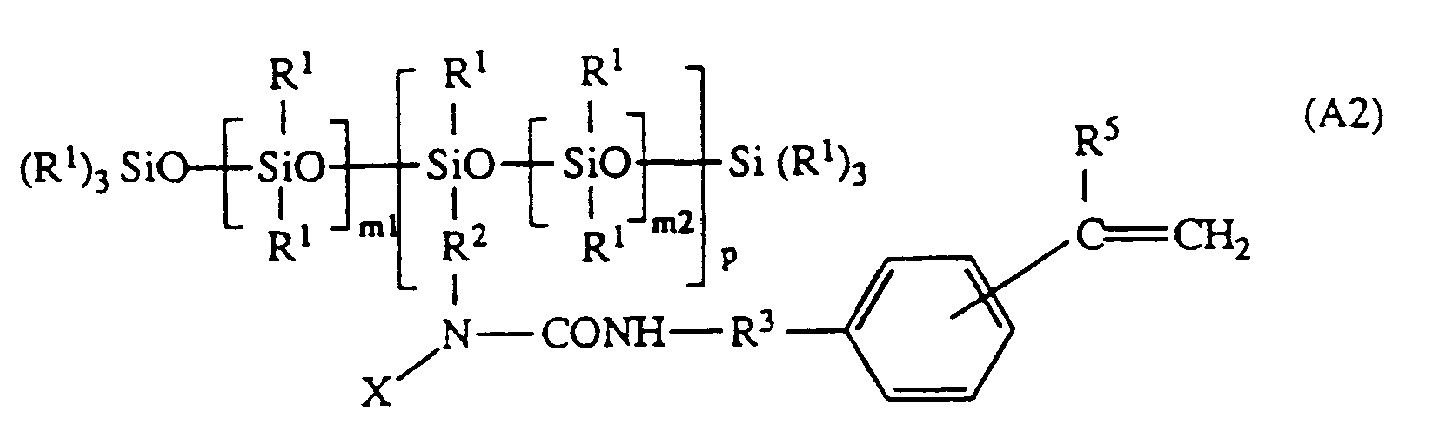
R¹ est un groupe méthyle, phényle ou 3,3,3-trifluoropropyle,
R² est un radical hydrocarboné linéaire ou ramifié saturé divalent ayant 1 à 6 atomes de carbone,
R³ est une liaison directe ou possède la même définition que R²,
R⁵ est un atome d'hydrogène ou un groupe méthyle,
R⁶ est le résidu divalent d'un diisocyanate aliphatique, cycloaliphatique ou aromatique de structure
OCN-R⁶-NCO
n1 et n2 sont des nombres entiers de 2 à 250, à condition que la somme n1 + n2 ne dépasse pas 250,
m1 et m2 sont des nombres entiers de 2 à 200, à condition que la somme m1 + m2 ne dépasse pas 250,
y vaut de 0 à 2,
p vaut de 1 à 10, X est un atome d'hydrogène ou possède la structure E:
- Macromère selon la revendication 1 de structure A1, dans lequel
R¹ est un groupe méthyle,
R² est un triméthylène,
R³ est un groupe -C(CH₃)₂-
R⁵ est un groupe méthyle,
y vaut zéro, et
n1 vaut de 5 à 100. - Macromère selon la revendication 1 de structure A1, dans lequel
R¹ est un groupe méthyle,
R² est un triméthylène,
R³ est un groupe -C(CH₃)₂-
R⁵ est un groupe méthyle,
y vaut 1
n1 + n2 vaut de 10 à 20, et R⁶ est un résidu divalent aromatique ou aliphatique avec 6 à 12 atomes de carbone. - Macromère selon la revendication 1 de structure A2, dans lequel
R¹ est un groupe méthyle,
R² est un triméthylène,
R³ est un groupe -C(CH₃)₂-
R⁵ est un groupe méthyle,
X est de structure E,
R⁴ est un éthylène,
m1 et m2 valent de 5 à 100, la somme m1 + m2 ne dépassant pas 150,
et p vaut de 1 à 3. - Macromère selon la revendication 2 de structure A1, dans lequel n1 vaut de 10 à 50.
- Macromère selon la revendication 1, dans lequel R³ est une liaison directe et R⁵ est un atome d'hydrogène, le groupe -CR⁵=CH₂ étant dans la position para par rapport à R³; ou dans lequel R³ est un groupe -C(CH₃)₂- et R⁵ est un groupe méthyle, le groupe -CR⁵=CH₂ étant dans la position méta par rapport à R³.
- Macromère selon la revendication 1, dans lequel R⁶ est dérivé d'un diisocyanate de formule OCN-R⁶-NCO, qui est choisi dans le groupe formé par le diisocyanate d'éthylène, le 1,2-diisocyanatopropane, le 1,3-diisocyanatopropane, le 1,6-diisocyanatohexane, le 1,2-diisocyanatocyclohexane, le 1,3-diisocyanatocyclohexane, le 1,4-diisocyanatobenzène; le bis-(4-isocyanatophényl)méthane, le diisocyanate de 1,2- et 1,4-toluène; le 3,3'-dichloro-4,4'-diisocyanatobiphényle; le 1,5-diisocyanatonaphtalène, le diisocyanate de toluène hydrogéné; le 1-isocyanatométhyl-5-isocyanato-1,3,3-triméthylcyclohexane (= diisocyanate d'isophorone); le 1,6-diisocyanato-2,2,4-(2,4,4)-triméthylhexane, le fumarate de 2,2'-diisocyanatodiéthyle; le 1,5-diisocyanato-1-carboxypentane; le 1,2-, 1,3-, 1,6-, 1,7-, 1,8-, 2,7- et 2,3-diisocyanatonaphtalène; le 2,4- et 2,7-diisocyanato-1-méthylnaphtalène; le 1,4-diisocyanato-méthyl-cyclohexane; le 1,3-diisocyanato-6(7)-méthylnaphtalène; le 4,4'-diisocyanatobiphényle; le 4,4'-diisocyanato-3,3'-diméthoxy-biphényle; le 3,3'- et 4,4'-diisocyanato-2,2'-diméthyl-biphényle; le bis(4-isocyanatophényl )éthane; le bis(4-isocyanato-phényl)éther.
- Macromère selon la revendication 7, dans lequel le diisocyanate est le diisocyanate d'isophorone, le 2,2,4-(2,4,4)-triméthylhexane-1,6-diisocyanate ou le diisocyanate de 1,2- ou 1,4-toluène.
- Polymère, approprié comme polymère perméable à l'oxygène, biocompatible, utile pour préparer des lentilles de contact, qui comprend le produit réticulé de la copolymérisation(A) de 10 à 100% en poids dudit polymère d'un macromère polysiloxane de formule A1 ou A2 selon la revendication 1, ayant une masse moléculaire d'environ 400 à environ 10 000, ledit macromère contenant au moins deux groupes oléfiniques polymérisables terminaux, lesdits groupes étant liés au polysiloxane par l'intermédiaire d'une liaison urée, et(B) de 90% à 0% en poids dudit polymère d'un ou plusieurs monomères de vinyle mono-, di- ou trifonctionnels polymérisables par polymérisation radicalaire.
- Polymère selon la revendication 9, qui comprend le produit réticulé de la copolymérisation(A) de 15 à 90% en poids dudit polymère d'un macromère polysiloxane ayant une masse moléculaire d'environ 800 à environ 10 000, ledit macromère contenant deux groupes oléfiniques polymérisables terminaux, ledit macromère ayant la structure de formule A1 ou A2, et(B) de 85 à 10% en poids dudit polymère de monomères insolubles dans l'eau ou hydrosolubles ou leurs mélanges, lesdits monomères étant monooléfiniques, dioléfiniques ou un mélange de monomères monooléfiniques et dioléfiniques.
- Polymère selon la revendication 9 pour préparer des lentilles de contact dures, qui comprend le produit réticulé de la copolymérisation (A) de 15 à 80% d'un macromère polysiloxane de formule A1 ou A2, et (B) de 85 à 20% en poids d'un mélange de comonomères dont, par rapport au poids total des comonomères, (B₁) 100 à 65% en poids sont des monomères monooléfiniques insolubles dans l'eau ou leurs mélanges, (B₂) 0 à 35% en poids sont un monomère monooléfinique hydrosoluble ou un de ses mélanges, et (B₃) 0 à 35% en poids sont un monomère dioléfinique.
- Polymère selon la revendication 11, dans lequel B₁ est le méthacrylate de méthyle, le méthacrylate de cyclohexyle, le méthacrylate de tris(triméthylsiloxanyl)silylpropyle, le méthacrylate de 2,2,2-trifluoroéthyle, le méthacrylate d'hexafluoroisopropyle, le méthacrylate de 1,1-dihydroheptafluorobutyle, le méthacrylate de triméthylcyclohexyle, le méthacrylate d'isobornyle, le méthacrylate de tert-butyle, le tertbutylstyrène ou leurs mélanges; B₂ est le méthacrylate de 2-hydroxyéthyle, le N,N-diméthylacrylamide, l'acide acrylique, l'acide méthacrylique, l'anhydride maléique ou la N-vinyl-2-pyrrolidone ou leurs mélanges; et B₃ est le diméthacrylate d'éthylèneglycol, le diacrylate ou le méthacrylate de néopentylglycol, et le bis-(3-méthacryloxypropyl)tétraméthyldisiloxane ou le bis(3-méthacryloxypropyl)tétra-(triméthylsiloxy)disiloxane.
- Polymère selon la revendication 11, qui comprend le produit de la copolymérisation(A) de 20 à 75% en poids d'un polysiloxane de formule A1, où R¹ et R⁵ sont un groupe méthyle, R² est un groupe triméthylène, R³ est un groupe -C(CH₃)₂-, et n1 vaut de 10 à 50, et(B) de 80 à 25% en poids d'un mélange de comonomères dont, par rapport au poids total des comonomères,(B₁) 95 à 65% en poids sont un monomère monoléfinique insoluble dans l'eau ou un de ses mélanges, et(B₂) 5 à 35% en poids sont un monomère monooléfinique hydrosoluble ou un de ses mélanges.
- Polymère selon la revendication 11, qui comprend le produit de la copolymérisation(A) de 20 à 75% en poids d'un polysiloxane de formule A1, où R¹ et R⁵ sont un groupe méthyle, R² est un groupe triméthylène, R³ est un groupe -C(CH₃)₂-, n1 vaut de 10 à 50, y vaut 1, et R⁶ est le résidu divalent du diisocyanate d'isophorone; du 2,2,4-(2,4,4)-triméthylhexane-1,6-diisocyanate ou du diisocyanate de toluène; et(B) de 80 à 25% en poids de comonomères dont, par rapport au poids total des comonomères,(B₁) 95 à 65% en poids sont un monomère monoléfinique insoluble dans l'eau ou un de ses mélanges,(B₂) 5 à 35% en poids sont un monomère monooléfinique hydrosoluble ou un de ses mélanges, et(B₃) 0 à 20% en poids sont un monomère dioléfinique.
- Polymère selon la revendication 11, qui comprend le produit de la copolymérisation(A) 20 à 75% en poids d'un polysiloxane de formule A1, où R¹ est un groupe méthyle, et(B) 80 à 25% en poids d'un mélange de comonomères dont, par rapport au poids total des comonomères,(B₁) 95 à 65% en poids sont un monomère choisi dans le groupe constitué du méthacrylate de méthyle, du méthacrylate de cyclohexyle, du méthacrylate de triméthylcyclohexyle, du méthacrylate d'isobornyle, du méthacrylate de 2,2,2-trifluoroéthyle, du méthacrylate d'hexafluoroisopropyle, du méthacrylate de 1,1-dihydroheptafluorobutyle, du méthacrylate de tris(triméthylsiloxysilyl)propyle, du méthacrylate de tert-butyle, du styrène et du tert-butylstyrène,(B₂) 5 à 35% en poids sont un monomère choisi dans le groupe constitué de l'acide acrylique, de l'acide méthacrylique, du N,N-diméthylacrylamide, et de l'anhydride maléique,(B₃) 0 à 20% en poids sont le diméthacrylate d'éthylèneglycol, de diacrylate de néopentylglycol, ou le bis-(3-méthacryloxypropyl)-tétraméthyldisiloxane.
- Polymère selon la revendication 11, qui comprend le produit de la copolymérisation(A) 20 à 75% en poids d'un polysiloxane de formule A2, où R¹ et R⁵ sont un groupe méthyle, R² est un groupe triméthylène, R³ est un groupe -C(CH₃)₂-, X et de structure (E), R⁴ est l'éthylène, n1 vaut de 10 à 50, p vaut de 1 à 3, et(B) 80 à 25% en poids d'un mélange de comonomères dont, par rapport au poids total des comonomères,(B₁) 95 à 65% en poids sont un monomère choisi dans le groupe constitué du méthacrylate de méthyle, du méthacrylate de cyclohexyle, du méthacrylate de triméthylcyclohexyle, du méthacrylate d'isobornyle, du méthacrylate de 2,2,2-trifluoroéthyle, du méthacrylate d'hexafluoroisopropyle, du méthacrylate de 1,1-dihydroheptafluorobutyle, du méthacrylate de tert-butyle, du styrène, du tertbutylstyrène, et du 3-méthacryloxypropyl-tris(triméthylsiloxy)silane,(B₂) 5 à 35% en poids sont un monomère choisi dans le groupe constitué de l'acide acrylique, de l'acide méthacrylique, du N,N-diméthylacrylamide, et de l'anhydride maléique, et(B₃) 0 à 20% en poids sont le diméthacrylate d'éthylèneglycol, ou le diacrylate de néopentylglycol, ou le bis-(3-méthacryloxypropyl)-tétraméthyldisiloxane.
- Polymère selon la revendication 9, pour des lentilles de contact souples avec une absorption d'eau faible, qui comprend le produit réticulé de la copolymérisation(A) 30 à 80% en poids d'un macromère polysiloxane de formule A1, et(B) 70 à 20% en poids d'un mélange de comonomères dont, par rapport au poids total des comonomères,(B₁) 100 à 89% en poids sont un monomère monooléfinique insoluble dans l'eau ou un de ses mélanges,(B₂) 0 à 10% en poids sont un monomère monooléfinique hydrosoluble ou un de ses mélanges, et(B₃) 0 à 1% en poids est un monomère dioléfinique.
- Polymère selon la revendication 17, dans lequel B₁ est choisi dans le groupe formé de l'acrylate de méthyle, de l'acrylate ou du méthacrylate d'éthyle, de l'acrylate ou du méthacrylate de n-butyle, de l'acrylate ou du méthacrylate de n-hexyle, de l'acrylate ou du méthacrylate de 2-éthylhexyle, de l'acrylate ou du méthacrylate de n-octyle, de l'acrylate de n-décyle, de l'acrylate et du méthacrylate de 2-méthoxyéthyl-2-éthoxyéthyle, de l'acrylate et méthacrylate de 2-méthoxyéthyle et de 2-éthoxyéthyle, des méthacrylates d'oligosiloxanylalkyle ayant 3 à 8 atomes de silicium, et des acrylates et méthacrylates alkylène-Rf, où Rf est un groupe perfluoroalkyle avec 1 à 10 atomes de carbone et l'alkylène est un groupe alkylene avec 1 à 5 atomes de carbone, et leurs mélanges.
- Polymère selon la revendication 9, dans lequel le polymère comprend le produit réticulé de la copolymérisation (A) 20 à 60% en poids d'un macromère polysiloxane de formule A1 ou A2, et (B) 80 à 40% en poids d'un mélange de comonomères dont, par rapport au poids total des comonomères, (B₁) 0 à 30% en poids sont un monomère monooléfinique insoluble dans l'eau ou un de ses mélanges, (B₂) 100 à 69% en poids sont un monomère monooléfinique hydrosoluble ou un de ses mélanges, et (B₃) 0 à 1% en poids est un monomère dioléfinique.
- Polymère selon la revendication 19, dans lequel le composant B₂ est le N,N-diméthylacrylamide, la N-vinyl-2-pyrrolidone, le méthacrylate de 2-hydroxyéthyle, l'acrylamide ou leurs mélanges.
- Polymère selon la revendication 9, en forme d'une lentille de contact.
- Polymère selon la revendication 11, en forme d'une lentille de contact.
- Polymère selon l'une quelconque des revendications 9 à 20, en forme d'une lentille de contact.
- Lentille de contact comprenant un polymère selon l'une quelconque des revendications 9 à 20.
- Lentille de contact constituée essentiellement d'un polymère selon l'une quelconque des revendications 9 à 20.
- Procédé pour la fabrication d'un macromère selon la revendication 1, comprenant la réaction de façon classique d'un composé de formule C1 ou C2


- Procédé pour la fabrication d'un polymère selon la revendication 9, en copolymérisant de façon classique un macromère de formule A1 ou A2 tel que défini dans la revendication 1 avec les monomères vinyliques B, tels que définis dans la revendication 9.
- Utilisation d'un polymère de la revendication 9 pour la fabrication d'une lentille de contact.
Applications Claiming Priority (2)
| Application Number | Priority Date | Filing Date | Title |
|---|---|---|---|
| US51489390A | 1990-04-26 | 1990-04-26 | |
| US514893 | 1990-04-26 |
Publications (2)
| Publication Number | Publication Date |
|---|---|
| EP0455585A1 EP0455585A1 (fr) | 1991-11-06 |
| EP0455585B1 true EP0455585B1 (fr) | 1994-03-23 |
Family
ID=24049128
Family Applications (1)
| Application Number | Title | Priority Date | Filing Date |
|---|---|---|---|
| EP91810291A Expired - Lifetime EP0455585B1 (fr) | 1990-04-26 | 1991-04-17 | Polysiloxanes urée insaturés |
Country Status (12)
| Country | Link |
|---|---|
| EP (1) | EP0455585B1 (fr) |
| JP (1) | JPH0570546A (fr) |
| KR (1) | KR910018446A (fr) |
| AT (1) | ATE103307T1 (fr) |
| AU (1) | AU646033B2 (fr) |
| CA (1) | CA2041136A1 (fr) |
| DE (1) | DE69101464T2 (fr) |
| DK (1) | DK0455585T3 (fr) |
| ES (1) | ES2063478T3 (fr) |
| HK (1) | HK192496A (fr) |
| IE (1) | IE64275B1 (fr) |
| PT (1) | PT97474B (fr) |
Cited By (3)
| Publication number | Priority date | Publication date | Assignee | Title |
|---|---|---|---|---|
| US6765083B2 (en) | 2000-11-03 | 2004-07-20 | Johnson & Johnson Vision Care, Inc. | Solvents useful in the preparation of polymers containing hydrophilic and hydrophobic monomers |
| US7368127B2 (en) | 2002-12-19 | 2008-05-06 | Johnson & Johnson Vision Care, Inc. | Biomedical devices with peptide containing coatings |
| US8993651B2 (en) | 2010-10-06 | 2015-03-31 | Novartis Ag | Polymerizable chain-extended polysiloxanes with pendant hydrophilic groups |
Families Citing this family (21)
| Publication number | Priority date | Publication date | Assignee | Title |
|---|---|---|---|---|
| US5194556A (en) * | 1991-01-09 | 1993-03-16 | Ciba-Geigy Corporation | Rigid contact lenses with improved oxygen permeability |
| JP2674636B2 (ja) * | 1991-12-19 | 1997-11-12 | 信越化学工業株式会社 | オルガノポリシロキサンゴム組成物 |
| WO1996034028A1 (fr) * | 1995-04-25 | 1996-10-31 | Minnesota Mining And Manufacturing Company | Copolymeres segmentes de polydiorganosiloxanes et d'oligo-uree rendus collants, et procede de fabrication |
| MX9708142A (es) * | 1995-04-25 | 1997-12-31 | Minnesota Mining & Mfg | Copolimeros de oligourea polidiorganosiloxano, segmentados, y proceso para su fabricacion. |
| US6441118B2 (en) | 1996-04-25 | 2002-08-27 | 3M Innovative Properties Company | Polydiorganosiloxane oligourea segmented copolymers and a process for making same |
| US6407195B2 (en) | 1996-04-25 | 2002-06-18 | 3M Innovative Properties Company | Tackified polydiorganosiloxane oligourea segmented copolymers and a process for making same |
| US6846893B1 (en) | 1996-10-23 | 2005-01-25 | Minnesota Mining And Manufacturing Company | Polymer mixtures containing polydiorganosiloxane urea-containing components |
| AUPQ197899A0 (en) * | 1999-08-02 | 1999-08-26 | Commonwealth Scientific And Industrial Research Organisation | Biomedical compositions |
| ATE266668T1 (de) * | 2000-02-07 | 2004-05-15 | Biocompatibles Uk Ltd | Silizium enthaltende verbindungen hergestellt durch michael addition als monomere und macromere |
| JP2003522227A (ja) | 2000-02-07 | 2003-07-22 | バイオコンパティブルズ リミテッド | シリコン含有化合物 |
| US6733950B2 (en) * | 2001-03-14 | 2004-05-11 | General Electric Company | Limited play data storage media and method for limiting access to data thereon |
| DE10242415A1 (de) * | 2002-09-12 | 2004-03-25 | Wacker-Chemie Gmbh | Organopolysiloxane und deren Einsatz in bei Raumtemperatur vernetzbaren Massen |
| US20040087692A1 (en) | 2002-10-30 | 2004-05-06 | Dixit Arun Nandkishor | Method for preparation of an anthraquinone colorant composition |
| DE10313936A1 (de) * | 2003-03-27 | 2004-10-14 | Consortium für elektrochemische Industrie GmbH | Organopolysiloxan/Polyharnstoff/Polyurethan-Blockcopolymere |
| US7202292B2 (en) | 2003-07-15 | 2007-04-10 | General Electric Company | Colored polymeric resin composition with 1,8-diaminoanthraquinone derivative, article made therefrom, and method for making the same |
| US7087282B2 (en) | 2003-07-15 | 2006-08-08 | General Electric Company | Limited play optical storage medium, method for making the same |
| US20110240065A1 (en) | 2010-04-01 | 2011-10-06 | Rajan Keshav Panandiker | Care polymers |
| WO2012047964A1 (fr) * | 2010-10-06 | 2012-04-12 | Novartis Ag | Agents de réticulation de polysiloxane à chaîne étendue avec des chaînes de polymère hydrophile pendantes |
| CN106661184B (zh) * | 2014-07-31 | 2021-10-15 | 3M创新有限公司 | 热塑性聚氨酯组合物、制品及其方法 |
| JP6451165B2 (ja) * | 2014-09-12 | 2019-01-16 | 信越化学工業株式会社 | 紫外線硬化型オルガノポリシロキサン組成物及びシリコーンゲル硬化物並びに圧力センサー |
| WO2025041708A1 (fr) * | 2023-08-21 | 2025-02-27 | 日産化学株式会社 | Procédé de fabrication de substrat à film antireflet, et substrat à film antireflet |
Family Cites Families (4)
| Publication number | Priority date | Publication date | Assignee | Title |
|---|---|---|---|---|
| JPS60142324A (ja) * | 1983-12-28 | 1985-07-27 | Toyo Contact Lens Co Ltd | 酸素透過性硬質コンタクトレンズ |
| US4605712A (en) * | 1984-09-24 | 1986-08-12 | Ciba-Geigy Corporation | Unsaturated polysiloxanes and polymers thereof |
| US4563539A (en) * | 1984-12-18 | 1986-01-07 | Dow Corning Corporation | Acrylofunctional silicones |
| US4762887A (en) * | 1987-01-15 | 1988-08-09 | Wacker Silicones Corporation | Process for preparing acrylate-functional organopolysiloxane-urethane copolymers |
-
1991
- 1991-04-17 DE DE69101464T patent/DE69101464T2/de not_active Expired - Fee Related
- 1991-04-17 DK DK91810291.4T patent/DK0455585T3/da active
- 1991-04-17 EP EP91810291A patent/EP0455585B1/fr not_active Expired - Lifetime
- 1991-04-17 ES ES91810291T patent/ES2063478T3/es not_active Expired - Lifetime
- 1991-04-17 AT AT91810291T patent/ATE103307T1/de not_active IP Right Cessation
- 1991-04-23 AU AU75335/91A patent/AU646033B2/en not_active Ceased
- 1991-04-24 CA CA002041136A patent/CA2041136A1/fr not_active Abandoned
- 1991-04-24 PT PT97474A patent/PT97474B/pt not_active IP Right Cessation
- 1991-04-25 KR KR1019910006634A patent/KR910018446A/ko not_active Abandoned
- 1991-04-25 IE IE140191A patent/IE64275B1/en not_active IP Right Cessation
- 1991-04-26 JP JP3122802A patent/JPH0570546A/ja active Pending
-
1996
- 1996-10-17 HK HK192496A patent/HK192496A/en not_active IP Right Cessation
Cited By (5)
| Publication number | Priority date | Publication date | Assignee | Title |
|---|---|---|---|---|
| US6765083B2 (en) | 2000-11-03 | 2004-07-20 | Johnson & Johnson Vision Care, Inc. | Solvents useful in the preparation of polymers containing hydrophilic and hydrophobic monomers |
| US7112652B2 (en) | 2000-11-03 | 2006-09-26 | Johnson & Johnson Vision Care, Inc. | Solvents useful in the preparation of polymers containing hydrophilic and hydrophobic monomers |
| US7368127B2 (en) | 2002-12-19 | 2008-05-06 | Johnson & Johnson Vision Care, Inc. | Biomedical devices with peptide containing coatings |
| US8993651B2 (en) | 2010-10-06 | 2015-03-31 | Novartis Ag | Polymerizable chain-extended polysiloxanes with pendant hydrophilic groups |
| US9109091B2 (en) | 2010-10-06 | 2015-08-18 | Novartis Ag | Polymerizable chain-extended polysiloxanes with pendant hydrophilic groups |
Also Published As
| Publication number | Publication date |
|---|---|
| KR910018446A (ko) | 1991-11-30 |
| DE69101464D1 (de) | 1994-04-28 |
| HK192496A (en) | 1996-10-25 |
| JPH0570546A (ja) | 1993-03-23 |
| PT97474A (pt) | 1992-01-31 |
| ES2063478T3 (es) | 1995-01-01 |
| PT97474B (pt) | 1998-08-31 |
| CA2041136A1 (fr) | 1991-10-27 |
| IE911401A1 (en) | 1991-11-06 |
| AU646033B2 (en) | 1994-02-03 |
| ATE103307T1 (de) | 1994-04-15 |
| AU7533591A (en) | 1991-11-07 |
| EP0455585A1 (fr) | 1991-11-06 |
| IE64275B1 (en) | 1995-07-26 |
| DK0455585T3 (da) | 1994-05-02 |
| DE69101464T2 (de) | 1994-07-14 |
Similar Documents
| Publication | Publication Date | Title |
|---|---|---|
| US4837289A (en) | UV- and heat curable terminal polyvinyl functional macromers and polymers thereof | |
| HK192496A (en) | Unsaturated urea polysiloxanes | |
| US4605712A (en) | Unsaturated polysiloxanes and polymers thereof | |
| US4923906A (en) | Rigid, gas-permeable polysiloxane contact lenses | |
| US4486577A (en) | Strong, silicone containing polymers with high oxygen permeability | |
| EP0425436B1 (fr) | Prépolymères hydrophiles réactifs contenant du silicone et/ou du fluor et polymères obtenus | |
| US5480946A (en) | Unsaturated urea polysiloxanes | |
| US5194556A (en) | Rigid contact lenses with improved oxygen permeability | |
| US5079319A (en) | Reactive silicone and/or fluorine containing hydrophilic prepolymers and polymers thereof | |
| JP2744276B2 (ja) | ポリシロキサン−ポリオキシアルキレンブロックコポリマー骨格単位を有する、湿潤性、可撓性で酸素透過性のコンタクトレンズ | |
| EP0291452B1 (fr) | Macromères ayant des groupes vinyliques terminaux, polymères à base de ces macromères et lentilles de contact | |
| US6218503B1 (en) | Silicone-containing prepolymers |
Legal Events
| Date | Code | Title | Description |
|---|---|---|---|
| PUAI | Public reference made under article 153(3) epc to a published international application that has entered the european phase |
Free format text: ORIGINAL CODE: 0009012 |
|
| 17P | Request for examination filed |
Effective date: 19910419 |
|
| AK | Designated contracting states |
Kind code of ref document: A1 Designated state(s): AT BE CH DE DK ES FR GB GR IT LI LU NL SE |
|
| 17Q | First examination report despatched |
Effective date: 19930330 |
|
| GRAA | (expected) grant |
Free format text: ORIGINAL CODE: 0009210 |
|
| AK | Designated contracting states |
Kind code of ref document: B1 Designated state(s): AT BE CH DE DK ES FR GB GR IT LI LU NL SE |
|
| REF | Corresponds to: |
Ref document number: 103307 Country of ref document: AT Date of ref document: 19940415 Kind code of ref document: T |
|
| PG25 | Lapsed in a contracting state [announced via postgrant information from national office to epo] |
Ref country code: SE Effective date: 19940418 |
|
| ITF | It: translation for a ep patent filed | ||
| REF | Corresponds to: |
Ref document number: 69101464 Country of ref document: DE Date of ref document: 19940428 |
|
| ITTA | It: last paid annual fee | ||
| REG | Reference to a national code |
Ref country code: DK Ref legal event code: T3 |
|
| EPTA | Lu: last paid annual fee | ||
| ET | Fr: translation filed | ||
| REG | Reference to a national code |
Ref country code: GR Ref legal event code: FG4A Free format text: 3012056 |
|
| REG | Reference to a national code |
Ref country code: ES Ref legal event code: FG2A Ref document number: 2063478 Country of ref document: ES Kind code of ref document: T3 |
|
| PLBE | No opposition filed within time limit |
Free format text: ORIGINAL CODE: 0009261 |
|
| EUG | Se: european patent has lapsed |
Ref document number: 91810291.4 Effective date: 19941210 |
|
| EUG | Se: european patent has lapsed |
Ref document number: 91810291.4 |
|
| 26N | No opposition filed | ||
| REG | Reference to a national code |
Ref country code: CH Ref legal event code: PFA Free format text: CIBA-GEIGY AG TRANSFER- NOVARTIS AG |
|
| REG | Reference to a national code |
Ref country code: GB Ref legal event code: 732E |
|
| NLS | Nl: assignments of ep-patents |
Owner name: NOVARTIS AG |
|
| REG | Reference to a national code |
Ref country code: ES Ref legal event code: PC2A |
|
| REG | Reference to a national code |
Ref country code: FR Ref legal event code: TP |
|
| PGFP | Annual fee paid to national office [announced via postgrant information from national office to epo] |
Ref country code: NL Payment date: 19980312 Year of fee payment: 8 |
|
| PGFP | Annual fee paid to national office [announced via postgrant information from national office to epo] |
Ref country code: BE Payment date: 19980313 Year of fee payment: 8 |
|
| PGFP | Annual fee paid to national office [announced via postgrant information from national office to epo] |
Ref country code: GR Payment date: 19980318 Year of fee payment: 8 |
|
| PGFP | Annual fee paid to national office [announced via postgrant information from national office to epo] |
Ref country code: CH Payment date: 19980323 Year of fee payment: 8 |
|
| PGFP | Annual fee paid to national office [announced via postgrant information from national office to epo] |
Ref country code: DK Payment date: 19980324 Year of fee payment: 8 |
|
| PGFP | Annual fee paid to national office [announced via postgrant information from national office to epo] |
Ref country code: AT Payment date: 19980326 Year of fee payment: 8 |
|
| PGFP | Annual fee paid to national office [announced via postgrant information from national office to epo] |
Ref country code: ES Payment date: 19980408 Year of fee payment: 8 |
|
| PGFP | Annual fee paid to national office [announced via postgrant information from national office to epo] |
Ref country code: LU Payment date: 19980416 Year of fee payment: 8 |
|
| PGFP | Annual fee paid to national office [announced via postgrant information from national office to epo] |
Ref country code: GB Payment date: 19990315 Year of fee payment: 9 Ref country code: FR Payment date: 19990315 Year of fee payment: 9 |
|
| PGFP | Annual fee paid to national office [announced via postgrant information from national office to epo] |
Ref country code: DE Payment date: 19990325 Year of fee payment: 9 |
|
| PG25 | Lapsed in a contracting state [announced via postgrant information from national office to epo] |
Ref country code: LU Free format text: LAPSE BECAUSE OF NON-PAYMENT OF DUE FEES Effective date: 19990417 Ref country code: AT Free format text: LAPSE BECAUSE OF NON-PAYMENT OF DUE FEES Effective date: 19990417 |
|
| PG25 | Lapsed in a contracting state [announced via postgrant information from national office to epo] |
Ref country code: ES Free format text: THE PATENT HAS BEEN ANNULLED BY A DECISION OF A NATIONAL AUTHORITY Effective date: 19990419 |
|
| PG25 | Lapsed in a contracting state [announced via postgrant information from national office to epo] |
Ref country code: LI Free format text: LAPSE BECAUSE OF NON-PAYMENT OF DUE FEES Effective date: 19990430 Ref country code: GR Free format text: LAPSE BECAUSE OF NON-PAYMENT OF DUE FEES Effective date: 19990430 Ref country code: DK Free format text: LAPSE BECAUSE OF NON-PAYMENT OF DUE FEES Effective date: 19990430 Ref country code: CH Free format text: LAPSE BECAUSE OF NON-PAYMENT OF DUE FEES Effective date: 19990430 Ref country code: BE Free format text: LAPSE BECAUSE OF NON-PAYMENT OF DUE FEES Effective date: 19990430 |
|
| BERE | Be: lapsed |
Owner name: NOVARTIS A.G. Effective date: 19990430 |
|
| PG25 | Lapsed in a contracting state [announced via postgrant information from national office to epo] |
Ref country code: NL Free format text: LAPSE BECAUSE OF NON-PAYMENT OF DUE FEES Effective date: 19991101 |
|
| REG | Reference to a national code |
Ref country code: CH Ref legal event code: PL |
|
| NLV4 | Nl: lapsed or anulled due to non-payment of the annual fee |
Effective date: 19991101 |
|
| REG | Reference to a national code |
Ref country code: DK Ref legal event code: EBP |
|
| PG25 | Lapsed in a contracting state [announced via postgrant information from national office to epo] |
Ref country code: GB Free format text: LAPSE BECAUSE OF NON-PAYMENT OF DUE FEES Effective date: 20000417 |
|
| GBPC | Gb: european patent ceased through non-payment of renewal fee |
Effective date: 20000417 |
|
| PG25 | Lapsed in a contracting state [announced via postgrant information from national office to epo] |
Ref country code: FR Free format text: LAPSE BECAUSE OF NON-PAYMENT OF DUE FEES Effective date: 20001229 |
|
| PG25 | Lapsed in a contracting state [announced via postgrant information from national office to epo] |
Ref country code: DE Free format text: LAPSE BECAUSE OF NON-PAYMENT OF DUE FEES Effective date: 20010201 |
|
| REG | Reference to a national code |
Ref country code: FR Ref legal event code: ST |
|
| REG | Reference to a national code |
Ref country code: ES Ref legal event code: FD2A Effective date: 20020204 |
|
| PG25 | Lapsed in a contracting state [announced via postgrant information from national office to epo] |
Ref country code: IT Free format text: LAPSE BECAUSE OF NON-PAYMENT OF DUE FEES;WARNING: LAPSES OF ITALIAN PATENTS WITH EFFECTIVE DATE BEFORE 2007 MAY HAVE OCCURRED AT ANY TIME BEFORE 2007. THE CORRECT EFFECTIVE DATE MAY BE DIFFERENT FROM THE ONE RECORDED. Effective date: 20050417 |