EP0458128B1 - Faserverstärkter Gummi - Google Patents
Faserverstärkter Gummi Download PDFInfo
- Publication number
- EP0458128B1 EP0458128B1 EP91107427A EP91107427A EP0458128B1 EP 0458128 B1 EP0458128 B1 EP 0458128B1 EP 91107427 A EP91107427 A EP 91107427A EP 91107427 A EP91107427 A EP 91107427A EP 0458128 B1 EP0458128 B1 EP 0458128B1
- Authority
- EP
- European Patent Office
- Prior art keywords
- yarns
- fiber
- cord
- cords
- belt
- Prior art date
- Legal status (The legal status is an assumption and is not a legal conclusion. Google has not performed a legal analysis and makes no representation as to the accuracy of the status listed.)
- Expired - Lifetime
Links
- 229920001971 elastomer Polymers 0.000 title claims abstract description 32
- 239000005060 rubber Substances 0.000 title claims abstract description 32
- 230000002787 reinforcement Effects 0.000 claims abstract description 20
- 239000000835 fiber Substances 0.000 claims abstract description 8
- 229920000914 Metallic fiber Polymers 0.000 claims description 3
- 230000005540 biological transmission Effects 0.000 claims description 2
- 239000004760 aramid Substances 0.000 claims 1
- 229920006231 aramid fiber Polymers 0.000 claims 1
- 230000001360 synchronised effect Effects 0.000 description 18
- 239000000853 adhesive Substances 0.000 description 9
- 230000001070 adhesive effect Effects 0.000 description 9
- 238000000034 method Methods 0.000 description 8
- 238000012360 testing method Methods 0.000 description 4
- 229920000271 Kevlar® Polymers 0.000 description 3
- 238000010276 construction Methods 0.000 description 3
- -1 isocyanate compound Chemical class 0.000 description 3
- 239000004761 kevlar Substances 0.000 description 3
- 229920001084 poly(chloroprene) Polymers 0.000 description 3
- 230000003014 reinforcing effect Effects 0.000 description 3
- 238000005299 abrasion Methods 0.000 description 2
- 238000007598 dipping method Methods 0.000 description 2
- 239000012948 isocyanate Substances 0.000 description 2
- 239000004816 latex Substances 0.000 description 2
- 229920000126 latex Polymers 0.000 description 2
- 239000004677 Nylon Substances 0.000 description 1
- KVBYPTUGEKVEIJ-UHFFFAOYSA-N benzene-1,3-diol;formaldehyde Chemical compound O=C.OC1=CC=CC(O)=C1 KVBYPTUGEKVEIJ-UHFFFAOYSA-N 0.000 description 1
- 238000009954 braiding Methods 0.000 description 1
- 230000003247 decreasing effect Effects 0.000 description 1
- 239000003822 epoxy resin Substances 0.000 description 1
- 239000004744 fabric Substances 0.000 description 1
- 238000009661 fatigue test Methods 0.000 description 1
- 239000012784 inorganic fiber Substances 0.000 description 1
- 239000007788 liquid Substances 0.000 description 1
- 239000000463 material Substances 0.000 description 1
- 229920001778 nylon Polymers 0.000 description 1
- 229920000647 polyepoxide Polymers 0.000 description 1
- GHMLBKRAJCXXBS-UHFFFAOYSA-N resorcinol Chemical compound OC1=CC=CC(O)=C1 GHMLBKRAJCXXBS-UHFFFAOYSA-N 0.000 description 1
- 229960001755 resorcinol Drugs 0.000 description 1
Images
Classifications
-
- F—MECHANICAL ENGINEERING; LIGHTING; HEATING; WEAPONS; BLASTING
- F16—ENGINEERING ELEMENTS AND UNITS; GENERAL MEASURES FOR PRODUCING AND MAINTAINING EFFECTIVE FUNCTIONING OF MACHINES OR INSTALLATIONS; THERMAL INSULATION IN GENERAL
- F16G—BELTS, CABLES, OR ROPES, PREDOMINANTLY USED FOR DRIVING PURPOSES; CHAINS; FITTINGS PREDOMINANTLY USED THEREFOR
- F16G1/00—Driving-belts
- F16G1/06—Driving-belts made of rubber
- F16G1/08—Driving-belts made of rubber with reinforcement bonded by the rubber
- F16G1/10—Driving-belts made of rubber with reinforcement bonded by the rubber with textile reinforcement
-
- F—MECHANICAL ENGINEERING; LIGHTING; HEATING; WEAPONS; BLASTING
- F16—ENGINEERING ELEMENTS AND UNITS; GENERAL MEASURES FOR PRODUCING AND MAINTAINING EFFECTIVE FUNCTIONING OF MACHINES OR INSTALLATIONS; THERMAL INSULATION IN GENERAL
- F16G—BELTS, CABLES, OR ROPES, PREDOMINANTLY USED FOR DRIVING PURPOSES; CHAINS; FITTINGS PREDOMINANTLY USED THEREFOR
- F16G5/00—V-belts, i.e. belts of tapered cross-section
- F16G5/04—V-belts, i.e. belts of tapered cross-section made of rubber
- F16G5/06—V-belts, i.e. belts of tapered cross-section made of rubber with reinforcement bonded by the rubber
-
- D—TEXTILES; PAPER
- D04—BRAIDING; LACE-MAKING; KNITTING; TRIMMINGS; NON-WOVEN FABRICS
- D04C—BRAIDING OR MANUFACTURE OF LACE, INCLUDING BOBBIN-NET OR CARBONISED LACE; BRAIDING MACHINES; BRAID; LACE
- D04C1/00—Braid or lace, e.g. pillow-lace; Processes for the manufacture thereof
- D04C1/06—Braid or lace serving particular purposes
- D04C1/12—Cords, lines, or tows
-
- F—MECHANICAL ENGINEERING; LIGHTING; HEATING; WEAPONS; BLASTING
- F16—ENGINEERING ELEMENTS AND UNITS; GENERAL MEASURES FOR PRODUCING AND MAINTAINING EFFECTIVE FUNCTIONING OF MACHINES OR INSTALLATIONS; THERMAL INSULATION IN GENERAL
- F16G—BELTS, CABLES, OR ROPES, PREDOMINANTLY USED FOR DRIVING PURPOSES; CHAINS; FITTINGS PREDOMINANTLY USED THEREFOR
- F16G1/00—Driving-belts
- F16G1/06—Driving-belts made of rubber
- F16G1/08—Driving-belts made of rubber with reinforcement bonded by the rubber
-
- F—MECHANICAL ENGINEERING; LIGHTING; HEATING; WEAPONS; BLASTING
- F16—ENGINEERING ELEMENTS AND UNITS; GENERAL MEASURES FOR PRODUCING AND MAINTAINING EFFECTIVE FUNCTIONING OF MACHINES OR INSTALLATIONS; THERMAL INSULATION IN GENERAL
- F16G—BELTS, CABLES, OR ROPES, PREDOMINANTLY USED FOR DRIVING PURPOSES; CHAINS; FITTINGS PREDOMINANTLY USED THEREFOR
- F16G1/00—Driving-belts
- F16G1/28—Driving-belts with a contact surface of special shape, e.g. toothed
Definitions
- the present invention relates to a fiber-reinforced rubber and more particularly to a reinforcement embedded in a rubber of the kind as described in US-A-4,681,558.
- a reinforcing cord constructed by fibers or a reinforcing canvas is embedded in a rubber.
- cords of twisted yarns are used for the reinforcement.
- the cords are grouped into all-yarns-twisted cords, half-yarns-twisted cords, or lang lay. The all-yarns-twisted cords are most popular as a reinforcement for a rubber.
- Japanese Patent Application Laying Open Gazette No.59-19744 discloses a fiber-reinforced rubber, wherein the reinforcement is consisted of half-yarns-twisted cords or lang lay to solve the above problem (flex fatigue).
- Japanese Patent Application Laying Open Gazette No. 56-103008 discloses a conveyor belt, in which a reinforcement is consisted of half-yarns-twisted cords of S-twist and half-yarns-twisted cords of Z-twist alternately in order to prevent an uneven abrasion.
- a braided cord such as described in US-A-4,681,558 and being comprised of a metallic reinforcing member such as a cable discontinuous in length and a plurality of non-metallic carrier members braided about the same has been used for various purposes.
- a cylindrically braided cord of braided members is superior in flex fatigue due to its constructional characteristics. It is also superior to a twisted cord in dimensional stability. Therefore, a cylindrically braided cord will improve both the flex fatigue and dimensional stability if it is used as a reinforcement for a rubber.
- a cylindrically braided cord is superior in the processing since no loose by an inversion at an end of the cord, such as half-yarns-twisted cords or lang lay, is caused.
- a cylindrically braided cord may possess a relatively large inner hollow.
- the size of the hollow depends on the number of members used for forming the cord. In case that a large hollow is formed, the cord becomes flat when it stretches. Thus, the dimensional stability still doesn't satisfy the requirement, even it is better than the twisted cord.
- the object of the present invention is to use a cylindrically braided cord instead of a twisted cord for a reinforcement, and specify a number of yarns to use so as to provide a rubber with high flex fatigue, dimensional stability, and longer service life.
- the reinforcement embedded in a rubber is constructed by a cylindrically braided cord comprising yarns, of inorganic, organic or metallic fibers with an even number of the yarns in a range of four up to eight and forming no or only a small inner hollow.
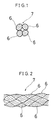
- Fig.1 is an enlarged vertical side section of a cylindrically braided cord.
- Fig.2 is an enlarged vertical front view of a cylindrically braided cord.
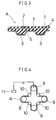
- Fig.3 is an enlarged vertical front section of a synchronous belt.
- Fig.4 is an explanatory drawing of the testing system for a flex fatigue.
- Fig.3 illustrates a synchronous belt A which is comprised of a fiber-reinforced rubber.
- the synchronous belt A comprises a belt base 4 having a stretching rubber layer 1 and a plurality of teeth 3 formed on one side thereof (only two teeth are shown in lower side of the belt in Fig. 3).
- the plurality of teeth 3 are made of the same material, a rubber, as the stretching rubber layer 1.
- a fiber reinforcement 2 is embedded in the stretching rubber layer 1 of the belt base 4.
- a canvas layer 5 is adhered to the surface of the teeth 3 of the belt base 4.
- the reinforcement 2 as enlargely shown in Figs.1 and 2, is constructed by cylindrically braided cords 7 braided by yarns 6, where the number of yarns is an even number in the range of four up to eight (four yarns in the present embodiment).
- the yarns 6 may be an inorganic fiber, an organic fiber, or a metallic fiber. Further, a short or long fiber spun yarn or combination of those can be used for the yarns 6 according to the required performance of the synchronous belt A. Also, the number of yarns 6 can be any even numbers if it is in the range of four up to eight. In order to make a cord of cylindrical configuration, yarns of an even number and no less than four yarns are required. That's because an industrial braiding machine cannot make a cord of a cylindrical configuration by using yarns of an odd number when yarns of the same denier number are used. The reason to set the upper limit for the number of yarns, which is eight, is to gain no hollow inside of the cord or gain a small hollow if it exists.
- the cylindrically braided cord 7 undergoes an adhesive process in which the cord is soaked into adhesive combined with epoxy resin, isocyanate compound, ethylene urea compound, and resorcin formalin latex (RFL), etc. and a stretching process before it is embedded in the stretching rubber layer 1. Dipping process is preferable for the adhesive process in order to soak adhesive evenly from surface to inside of it.
- Table 1 The result of a flex fatigue test is shown in Table 1, comparing the above constructed synchronous belt A with a comparable example.
- the numerals of Table 1 show a maintainability of Plessley tensile strength of a cylindrically braided cord.
- Kevlar product of Du Pont
- the cylindrically braided cord 7 is dipped into the isocyanate compound so as to form a sub-coat ply, then it is dipped into the adhesive combination liquid of resorcin formal in latex (RFL) so as to form a second-coat ply, further it is dipped into chloroprene rubber so as to form a top-coat ply, and finally it is processed with a stretching process with 1g/de tension.
- RTL resorcin formal in latex
- the synchronous belt A wherein the reinforcement 2 comprises a plurality of cylindrically braided cords 7 as embedded in the belt base 4, is obtained by the following steps: a plurality of cylindrically braided cords 7 finished with the stretching process is put spirally on the stretching rubber layer 1 of the chloroprene rubber, and the teeth 3 of the chloroprene rubber are formed on it so that the cylindrically braided cord 7 is embedded therein. Thereafter, the nylon cloth 5 is adhered to the surface of teeth 3 and the rubber is cured. The adhesive is soaked evenly from the surface to the inside of the cylindrically braided cord 7 during the adhesive process.
- Kevlar product of Din Pont
- Kevlar product of Du Pont
- the maintainability of plessley of the present embodiments I and II is more than 60%.
- the maintainability of Plessley tensile strength of the comparable example is less than 50%.
- the present embodiments I and II are superior to the comparable example in the pulling adhesive strength.
- the flattening of the hollow is hardly caused when the cord is stretched because no hollow or a very small hollow if it exists is formed in the cylindlically braided cord 7 in the present embodiments I and II.
- a relatively large hollow is formed in the cylindrically braided cord 7. Therefore, the flattening of the hollow is easily caused when the cord is stretched.
- the reinforcement 2 embedded in the belt base 4 is constructed by the cylindrically braided cords 7 which are braided by yarns 6, where the number of yarns is an even number in the range of four up to eight, the even stress is applied to the monofilaments, which construct yarns 6, as the constructional characteristic of the cylindrically braided cord 7. Accordingly, flex fatigue can be improved greatly. Also, the dimensional stability of the synchronous belt A can be improved by restricting flattening of the cords when the cords are stretched. The flattening of the cords is restricted by specifying the number of yarns to make no hollow or a very small hollow if it exists. Thus, the service life of the synchronous belt A becomes longer.
- the synchronous belt A is shown as a rubber.
- the belt is not limited to the synchronous belt A, but covers an industrial belt such as a conveyor belt and a transmission belt like a flat belt and a ribbed belt.
- the present invention also can be applied to rubbers other than belts, for example, tires and hoses.
Landscapes
- Engineering & Computer Science (AREA)
- General Engineering & Computer Science (AREA)
- Mechanical Engineering (AREA)
- Textile Engineering (AREA)
- Manufacturing & Machinery (AREA)
- Ropes Or Cables (AREA)
- Compositions Of Macromolecular Compounds (AREA)
- Springs (AREA)
- Moulding By Coating Moulds (AREA)
- Braiding, Manufacturing Of Bobbin-Net Or Lace, And Manufacturing Of Nets By Knotting (AREA)
Claims (6)
- Faserverstärkter Gummi (1, 3) mit einer Faserverstärkung (2) aus zylindrisch geflochtenen Schnüren (7), die darin eingebettet sind,
dadurch gekennzeichnet, daß die zylindrisch geflochtenen Schnüre (7) jeweils aus geflochteten Garnen (6) von anorganischen, organischen oder metallischen Fasern mit einer geraden Anzahl Garnen in einem Bereich von vier bis zu acht bestehen und keinen oder nur einen kleinen inneren Hohlraum ausbilden. - Faserverstärkter Gummi nach Anspruch 1, bei welchem die geflochtenen Garne (6) aus langen und/oder kurzen fasergesponnenen Garnen bestehen.
- Faserverstärkter Gummi nach Anspruch 1 oder Anspruch 2, bei welchem die geflochtenen Garne (6) aus organischen Fasern aus Aramid-Fasern bestehen.
- Faserverstärkter Gummi nach einem der Ansprüche 1 bis 3, bei welchem der Hohlraum jeder zylindrisch geflochtenen Schnur (7) eine Zentralschnur aufnimmt.
- Faserverstärkter Gummi nach einem der Ansprüche 1 bis 4 und in der Ausbildung eines Treibriemens (A) mit einer Riemenbasis, welche eine Streckgummilage (1) und eine Vielzahl von Zähnen (3) aufweist, die an einer Seite davon ausgebildet sind, wobei eine Vielzahl der zylindrisch geflochtenen Schnüre (7) in die Streckgummilage (1) eingebettet ist.
- Faserverstärkter Gummi nach einem der Ansprüche 1 bis 4 und in der Ausbildung eines Förderbandes, eines Reifens oder eines Schlauches.
Applications Claiming Priority (2)
| Application Number | Priority Date | Filing Date | Title |
|---|---|---|---|
| JP2126336A JPH0425643A (ja) | 1990-05-15 | 1990-05-15 | 繊維補強ゴム製品 |
| JP126336/90 | 1990-05-15 |
Publications (2)
| Publication Number | Publication Date |
|---|---|
| EP0458128A1 EP0458128A1 (de) | 1991-11-27 |
| EP0458128B1 true EP0458128B1 (de) | 1995-02-01 |
Family
ID=14932658
Family Applications (1)
| Application Number | Title | Priority Date | Filing Date |
|---|---|---|---|
| EP91107427A Expired - Lifetime EP0458128B1 (de) | 1990-05-15 | 1991-05-07 | Faserverstärkter Gummi |
Country Status (6)
| Country | Link |
|---|---|
| US (1) | US5160301A (de) |
| EP (1) | EP0458128B1 (de) |
| JP (1) | JPH0425643A (de) |
| KR (1) | KR0147806B1 (de) |
| AT (1) | ATE118073T1 (de) |
| DE (1) | DE69107120T2 (de) |
Families Citing this family (8)
| Publication number | Priority date | Publication date | Assignee | Title |
|---|---|---|---|---|
| JP3007371B2 (ja) * | 1990-02-23 | 2000-02-07 | バンドー化学株式会社 | 繊維補強ゴム製品 |
| US5268221A (en) * | 1990-02-23 | 1993-12-07 | Bando Chemical Industries, Ltd. | Fiber reinforced rubber articles |
| US5346731A (en) * | 1990-07-12 | 1994-09-13 | Bando Chemical Industries, Ltd. | Fiber-reinforced rubber |
| US5690828A (en) * | 1990-07-13 | 1997-11-25 | Isco, Inc. | Apparatus and method for supercritical fluid extraction |
| JP2872581B2 (ja) * | 1994-07-26 | 1999-03-17 | 三ツ星ベルト株式会社 | 歯付ベルト |
| KR100371602B1 (ko) * | 2000-10-30 | 2003-02-19 | 김우성 | 클로로플렌 합포물 |
| WO2015193934A1 (ja) * | 2014-06-20 | 2015-12-23 | バンドー化学株式会社 | 伝動ベルト及びそれを備えたベルト伝動装置 |
| EP4141286B1 (de) * | 2020-07-03 | 2024-10-09 | Bando Chemical Industries, Ltd. | Treibriemen |
Citations (1)
| Publication number | Priority date | Publication date | Assignee | Title |
|---|---|---|---|---|
| US4681558A (en) * | 1985-04-18 | 1987-07-21 | National Standard Company | Reinforced polymeric component and method of manufacture |
Family Cites Families (8)
| Publication number | Priority date | Publication date | Assignee | Title |
|---|---|---|---|---|
| DE244606C (de) * | ||||
| US1442924A (en) * | 1918-06-18 | 1923-01-23 | Goodyear Tire & Rubber | Flexible belt |
| US1400301A (en) * | 1919-12-24 | 1921-12-13 | Carlisle Tire Corp | Automobile-tire |
| US2257649A (en) * | 1939-11-18 | 1941-09-30 | Nat Standard Co | Reinforcing element |
| US2739090A (en) * | 1946-11-12 | 1956-03-20 | Dayton Rubber Company | Cord belts |
| US3538974A (en) * | 1965-05-07 | 1970-11-10 | Owens Corning Fiberglass Corp | Glass fiber elastomeric molding compound and products made therefrom |
| US3584516A (en) * | 1969-02-20 | 1971-06-15 | Du Pont | Endless belts reinforced with braided strands |
| US4701154A (en) * | 1985-04-18 | 1987-10-20 | National Standard Company | Reinforced belt assembly and method of manufacture |
-
1990
- 1990-05-15 JP JP2126336A patent/JPH0425643A/ja active Pending
-
1991
- 1991-05-07 AT AT91107427T patent/ATE118073T1/de not_active IP Right Cessation
- 1991-05-07 EP EP91107427A patent/EP0458128B1/de not_active Expired - Lifetime
- 1991-05-07 DE DE69107120T patent/DE69107120T2/de not_active Expired - Fee Related
- 1991-05-09 US US07/697,675 patent/US5160301A/en not_active Expired - Fee Related
- 1991-05-15 KR KR1019910007838A patent/KR0147806B1/ko not_active Expired - Fee Related
Patent Citations (1)
| Publication number | Priority date | Publication date | Assignee | Title |
|---|---|---|---|---|
| US4681558A (en) * | 1985-04-18 | 1987-07-21 | National Standard Company | Reinforced polymeric component and method of manufacture |
Also Published As
| Publication number | Publication date |
|---|---|
| EP0458128A1 (de) | 1991-11-27 |
| DE69107120D1 (de) | 1995-03-16 |
| ATE118073T1 (de) | 1995-02-15 |
| KR910020342A (ko) | 1991-12-20 |
| JPH0425643A (ja) | 1992-01-29 |
| DE69107120T2 (de) | 1995-09-07 |
| US5160301A (en) | 1992-11-03 |
| KR0147806B1 (ko) | 1998-08-17 |
Similar Documents
| Publication | Publication Date | Title |
|---|---|---|
| EP0466169B1 (de) | Faserverstärktes Gummi | |
| EP0447807B1 (de) | Faserverstärkter Gummi | |
| EP2787244B1 (de) | Gummiraupenkette | |
| US5268221A (en) | Fiber reinforced rubber articles | |
| EP1698720A1 (de) | Gummiarmierender kord und darauf basierendes gummiprodukt | |
| US3584516A (en) | Endless belts reinforced with braided strands | |
| US5160301A (en) | Fiber-reinforced rubber | |
| EP0443458B1 (de) | Faserverstärkter Gummi | |
| JP3982870B2 (ja) | コンベヤベルト | |
| EP0443459B1 (de) | Faserverstärkter Gummi | |
| JP2571526B2 (ja) | 動力伝動ベルト用心線およびこれを用いた動力伝動ベルト | |
| JP2000320616A (ja) | 伝動ベルト用心線及びこれを用いた伝動ベルト | |
| JPH08157609A (ja) | 繊維からなる補強用ゴム製品構成部材 | |
| JP2957314B2 (ja) | 工業用ベルト | |
| JPH0692488B2 (ja) | 繊維補強ゴム製品 | |
| JPH0565943A (ja) | 工業用ベルト | |
| JPH03211041A (ja) | 繊維補強ゴム製品 | |
| JP2002168297A (ja) | 歯付ベルト | |
| JPH03213747A (ja) | 工業用ベルト | |
| JP2002227051A (ja) | 伝動ベルト用心線及びこれを用いたvリブドベルト | |
| JP2001140988A (ja) | 動力伝動用ベルト | |
| JPH11159580A (ja) | 伝動ベルト用心線及びこれを用いた伝動ベルト | |
| JP2509773Y2 (ja) | コンベヤベルト | |
| JPH07127689A (ja) | 歯付ベルト | |
| JPH0526298A (ja) | 工業用ベルト |
Legal Events
| Date | Code | Title | Description |
|---|---|---|---|
| PUAI | Public reference made under article 153(3) epc to a published international application that has entered the european phase |
Free format text: ORIGINAL CODE: 0009012 |
|
| AK | Designated contracting states |
Kind code of ref document: A1 Designated state(s): AT DE FR GB IT |
|
| 17P | Request for examination filed |
Effective date: 19920331 |
|
| 17Q | First examination report despatched |
Effective date: 19931026 |
|
| GRAA | (expected) grant |
Free format text: ORIGINAL CODE: 0009210 |
|
| AK | Designated contracting states |
Kind code of ref document: B1 Designated state(s): AT DE FR GB IT |
|
| REF | Corresponds to: |
Ref document number: 118073 Country of ref document: AT Date of ref document: 19950215 Kind code of ref document: T |
|
| REF | Corresponds to: |
Ref document number: 69107120 Country of ref document: DE Date of ref document: 19950316 |
|
| ITF | It: translation for a ep patent filed | ||
| ET | Fr: translation filed | ||
| PLBE | No opposition filed within time limit |
Free format text: ORIGINAL CODE: 0009261 |
|
| STAA | Information on the status of an ep patent application or granted ep patent |
Free format text: STATUS: NO OPPOSITION FILED WITHIN TIME LIMIT |
|
| 26N | No opposition filed | ||
| PGFP | Annual fee paid to national office [announced via postgrant information from national office to epo] |
Ref country code: GB Payment date: 19970418 Year of fee payment: 7 |
|
| PGFP | Annual fee paid to national office [announced via postgrant information from national office to epo] |
Ref country code: AT Payment date: 19970521 Year of fee payment: 7 |
|
| PG25 | Lapsed in a contracting state [announced via postgrant information from national office to epo] |
Ref country code: GB Free format text: LAPSE BECAUSE OF NON-PAYMENT OF DUE FEES Effective date: 19980507 Ref country code: AT Free format text: LAPSE BECAUSE OF NON-PAYMENT OF DUE FEES Effective date: 19980507 |
|
| GBPC | Gb: european patent ceased through non-payment of renewal fee |
Effective date: 19980507 |
|
| PGFP | Annual fee paid to national office [announced via postgrant information from national office to epo] |
Ref country code: FR Payment date: 20000510 Year of fee payment: 10 |
|
| PGFP | Annual fee paid to national office [announced via postgrant information from national office to epo] |
Ref country code: DE Payment date: 20010430 Year of fee payment: 11 |
|
| PG25 | Lapsed in a contracting state [announced via postgrant information from national office to epo] |
Ref country code: FR Free format text: LAPSE BECAUSE OF NON-PAYMENT OF DUE FEES Effective date: 20020131 |
|
| PG25 | Lapsed in a contracting state [announced via postgrant information from national office to epo] |
Ref country code: DE Free format text: LAPSE BECAUSE OF NON-PAYMENT OF DUE FEES Effective date: 20021203 |
|
| PG25 | Lapsed in a contracting state [announced via postgrant information from national office to epo] |
Ref country code: IT Free format text: LAPSE BECAUSE OF NON-PAYMENT OF DUE FEES;WARNING: LAPSES OF ITALIAN PATENTS WITH EFFECTIVE DATE BEFORE 2007 MAY HAVE OCCURRED AT ANY TIME BEFORE 2007. THE CORRECT EFFECTIVE DATE MAY BE DIFFERENT FROM THE ONE RECORDED. Effective date: 20050507 |