EP0458224B1 - Dispositif d'étranglement en forme de segment commandé par flotteur - Google Patents
Dispositif d'étranglement en forme de segment commandé par flotteur Download PDFInfo
- Publication number
- EP0458224B1 EP0458224B1 EP91108071A EP91108071A EP0458224B1 EP 0458224 B1 EP0458224 B1 EP 0458224B1 EP 91108071 A EP91108071 A EP 91108071A EP 91108071 A EP91108071 A EP 91108071A EP 0458224 B1 EP0458224 B1 EP 0458224B1
- Authority
- EP
- European Patent Office
- Prior art keywords
- float
- downstream
- throttling member
- sluice valve
- outflow
- Prior art date
- Legal status (The legal status is an assumption and is not a legal conclusion. Google has not performed a legal analysis and makes no representation as to the accuracy of the status listed.)
- Expired - Lifetime
Links
Images


Classifications
-
- E—FIXED CONSTRUCTIONS
- E03—WATER SUPPLY; SEWERAGE
- E03F—SEWERS; CESSPOOLS
- E03F5/00—Sewerage structures
- E03F5/10—Collecting-tanks; Equalising-tanks for regulating the run-off; Laying-up basins
- E03F5/105—Accessories, e.g. flow regulators or cleaning devices
- E03F5/107—Active flow control devices, i.e. moving during flow regulation
-
- E—FIXED CONSTRUCTIONS
- E02—HYDRAULIC ENGINEERING; FOUNDATIONS; SOIL SHIFTING
- E02B—HYDRAULIC ENGINEERING
- E02B7/00—Barrages or weirs; Layout, construction, methods of, or devices for, making same
- E02B7/20—Movable barrages; Lock or dry-dock gates
- E02B7/205—Barrages controlled by the variations of the water level; automatically functioning barrages
-
- G—PHYSICS
- G05—CONTROLLING; REGULATING
- G05D—SYSTEMS FOR CONTROLLING OR REGULATING NON-ELECTRIC VARIABLES
- G05D7/00—Control of flow
- G05D7/01—Control of flow without auxiliary power
- G05D7/0166—Control of flow without auxiliary power the sensing element being a float or a ball placed outside the flow path to be controlled
Definitions
- the invention relates to a drain control for rainwater storage basins or the like storage container, with a drain line, an underwater throttle element which changes the cross-section of the drain line and a float chamber which is arranged in front of the UW throttle element and contains an underwater float, in which an artificial build-up is generated as soon as the Tank drain a predetermined value, e.g. Exceeds 2 x QTW, the UW float being provided as a drive for an emergency release device which is responsive to blockages in front of the UW throttle element and which opens via its actuating linkage.
- a predetermined value e.g. Exceeds 2 x QTW
- a float chamber referred to as a control chamber contains an inlet opening and an outlet opening, each of which is assigned a throttle orifice.
- a float arranged in the control room carries a positioning plate guided for executing vertical movements, on each side of which a slot-shaped control curve is arranged for a guide member.
- the guide members are each attached to one end of two rocker arms mounted in the control room, the other ends of which are connected to one of the throttle diaphragms via cables or articulated rods.
- the float and the setting plate have vertically moving control cams which are designed to adjust the two throttle diaphragms, by means of which throttle diaphragms are adjusted in the closing direction when the container outflow exceeds a predetermined value and then a build-up that causes the float to occur in the control room.
- the throttle diaphragm of the inlet is closed further than the throttle diaphragm of the outlet due to the different design of both control cams.
- control curve for the outlet orifice plate with a more curved lower end area means that, at a critical accumulation height in the control room, this orifice plate is first pulled up and returns to its control position due to the then flowing out build-up, so that a blockage in the control room can be eliminated.
- the invention has for its object to improve an external energy-free discharge control of the type mentioned and to create a control whereby the UW float largely follows the accumulation height varying in the float chamber unhindered and thereby constantly for a quick response of the its movements actuated regulating and control elements and for maintenance-free automatic flushing is available.
- the UW float performs an upward movement which, via the lever arms of the weighing linkage, results in a sensitive, counter-rotating, ie throttling lowering movement of the contactor is converted.
- the throttle follows by throttling the inlet to the float chamber to a value that maintains an average accumulation height in the float chamber UW float continues to build up as the tank flow changes.
- the adjustment movements of the contactor are transferred in the same direction, but corrected, to the UW throttle element with the aid of the outflow correction curve attached to the contactor and the swiveling actuating rod guided on it.
- the regulation of the UW throttle body is thus dependent on the adjustment movements of the contactor initiated by the UW float, which, through its throttling effect on the level of the build-up in the float chamber, enables pre-regulation in the sense that major changes in the container outflow very quickly result in minor changes of the build-up in the float chamber, whereby a constant control behavior is nevertheless achieved with high sensitivity or a short response time.
- This discharge control which is preferred for very small quantities e.g. of 3 l / s is used for this purpose, to actuate the UW throttle element, an upper water float that responds to changing fill levels in the storage container.
- UW throttle element an upper water float that responds to changing fill levels in the storage container.
- it is provided with a contactor arranged in the inlet channel between the tank outlet and the float chamber, and with a UW float that drives the contactor in opposite directions via a sensitive weighing rod, with the aid of which the desired freedom from maintenance is achieved, which is due to the low flow rates and / or low gradient, there is a high risk of constipation.
- Deposits in front of the UW throttle element leading to blockages are eliminated by actuating an emergency release device which opens the UW throttle element when the build-up height in the float chamber determined by the OW float is exceeded. Deposits in front of the contactor are also automatically washed away due to the then decreasing build-up of the float chamber and the resulting opening movement of the contactor via the weighing rod.
- a lever that directly controls the opening width of the UW throttle element is located on the correction curve that can be adjusted by the OW float in accordance with the changes in the container stowage height by means of an articulated lever connection and is guided on it.
- the discharge control according to the invention is further developed in that the weighing linkage moves the contactor in Closing direction is assigned in the case limiting stop curve that the build-up in the float chamber results from a blockage in front of the UW throttle element, the weighing linkage containing a freewheel which, when the weighing linkage is attached to the stop curve, causes independent movements of the contactor and the UW Enables swimmers.
- the stop curve thus ensures that in the event of a blockage in front of the UW throttle element, the contactor leaves the inlet opening to the float chamber sufficiently wide to ensure the flushing effect.
- the stop curve is preferably adjusted automatically in such a way that the opening size of the contactor does not fall below a value that maintains the intended build-up in the float chamber.
- the freewheel can be realized, for example, in that the weighing linkage consists of two partial cores which can be pivoted about a common fixed articulation axis, partially overlapping and held together in one pivoting direction by a stop, which in opposite directions when the UW float is relieved and the contactor is supported by the stop curve are pivotable or can be bent relative to one another and thereby actuate the emergency release device.
- the emergency release device can consist of an actuating member driven by the UW float and a coupling device connected to the drive linkage of the UW throttling member exist, which converts the rising movement of the UW float into an opening movement of the UW throttle body.
- the emergency release device can contain a wedge element that can be adjusted by the OW float to compensate for this, which is located between the drive linkage for the UW throttle element and the actuator driven by the UW float is arranged.
- UW throttle element is associated with a short-term positive opening system, which has a retractable servomotor, a retractable timing element determining the flushing pulse frequency for triggering the servomotor and an external energy-free pulling device, which consists of a in the float chamber arranged float and a tension member connecting the float to the servomotor and timing element and by which the forced opening of the UW throttle element and emptying of the float chamber, the lowering movement of the float can be actuated.
- a short-term positive opening system which has a retractable servomotor, a retractable timing element determining the flushing pulse frequency for triggering the servomotor and an external energy-free pulling device, which consists of a in the float chamber arranged float and a tension member connecting the float to the servomotor and timing element and by which the forced opening of the UW throttle element and emptying of the float chamber, the lowering movement of the float can be actuated.
- the adjustable contactor expediently consists of a segment contactor which can be pivoted about a horizontal axis.
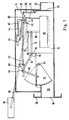
- a float 36 on the upper water level 12 of a storage container 10, which is connected via an actuating rod 38 to a pivot shaft 40 mounted in the side wall of the shaft housing 14. That e.g. Shaft housing 14 made of metal can be placed in a shaft (not shown) which is independent of the storage container or in accordance with FIG. 3 in a space-saving manner on the base of the storage container.
- the 1 has an inlet opening 18 on the left-hand side which is surrounded by an inlet flange 20 for connection to a drain line or to the outer wall of a storage container.
- An underwater throttle element in the form of a vertically guided throttle diaphragm 24 is arranged in front of the shaft outlet 22.
- the diaphragm is guided in parallel via a linkage 26 leading upwards and preferably via two parallel guide links 28, 30 (FIG. 2).
- the links 28, 30 have fixed pivot axes 32, 34.
- the upper link 28 has beyond its pivot axis 32 a free end 29 which is guided on a correction curve 46 which takes into account the outflow laws for the container stowage height.
- the type of correction curve shown and the connection to the underwater throttle element 24 can be replaced by other measures having the same effect.
- a crank 42 fastened on the pivot shaft 40 is used to regulate the diaphragm 24, by means of which a link 44 acting on the correction curve 46 is actuated.
- the curve 46 is not in Guides of the shaft housing 14 shown guided so that the free end 29 of the actuating lever 28 on the curve 46 with decreasing accumulation height in the container 10 to the right and thus to the steep area of the curve 46 to open the aperture 24.
- An inlet duct 50 adjoins the shaft inlet 18, in which a segment contactor 52 is mounted so as to be pivotable about a horizontal axis 54.
- the segment contactor 52 is attached to a weighing beam at point 58 by means of a handlebar or a bracket 56.
- the weighing beam consists of two normally rigid core 72 and 74, which are pivotable on a common pivot axis 84 of a fixed bearing support 76.
- the partial link 72 forming the right end of the weighing beam is pivotally connected to an upper extension 68 of a UW float 66, which is arranged in a float chamber 64 in front of the diaphragm 24.
- the float 66 is preferably guided parallel to itself by the parallel links 70, 72.
- the suspension of the segment contactor 52 includes a stop curve 60, on which it by means of a slide roller 58 of the handlebar 56 is held. If, in the event of a blockage in front of the screen 24, the build-up in the float chamber 64 increases, which causes the upward movement of the UW float to throttle the contactor 52, the contactor is prevented from further lowering movement when the sliding roller 58 is seated on the stop curve 60. In this way, even with small container outflows, the flow rate in the inlet channel 50 remains large enough to flush the blockage in front of the orifice 24 after an actuating element 78, indicated schematically on the upper side of the float 66 according to FIG. 1, abuts a wedge 80 which can be adjusted in the transverse direction and the aperture 24 opens via the actuating linkage 28.
- FIG. 2 shows, as a variant of this emergency release device, an actuating rod 100 which is articulated on the upper side of the UW float 66 and which has locking teeth and is guided in a sleeve 98 connected to the handlebar 28.
- the locking toothing is assigned a latching pawl 94 which is pivotally mounted with its upper end on a holder 96 extending from the sleeve 98 and is held in engagement with the locking toothing under the action of a biasing spring 102 supported on the holder 96.
- the pawl 94 is connected to the wire rope 92 of a Bowden cable 88.
- the upper parallel link 70 forms the right-hand partial link of the weighing beam, which can be pivoted about a fixed bearing 84 together with the left-hand partial link 74 and is connected to the segment contactor 52.
- Both partial links 70, 74 are located below the load of the attached segment contactor 52 in the stretched state, which is maintained by the stop 86 on the partial link 74. If the downward movement of the segment contactor 52 caused by the upward movement of the float 66 is limited by the sliding roller 58 resting against the stop curve 60, the partial links 70, 74 of the weighing beam according to FIG. 2a buckle, so that the driving bracket 110 differs from that on the partial link 74 fixed stop 104 removed.
- the driver bracket 110 is connected via an extension 106 to the wire rope 92 of the Bowden cable, which moves due to the bias spring 102 together with the latch 94 to the right in Fig. 2 and by the pawl engagement the upward movement of the float 66 via the on the operating rod 28 attached sleeve 98 converts into an upward movement of the diaphragm 24.
- the stop 104 causes the latch to come out of engagement with the actuating rod 100.
- the most important basic elements of the embodiment described in FIG. 1 are also used, namely the segment contactor 52 arranged in the inlet channel, the UW float 66 located in the float chamber 64 arranged in front of the UW throttle element 24 and the one with the Segment contactor 52 can be adjusted in opposite directions by means of a weighing beam, and a correction curve 120 which takes into account the outflow laws from the storage container and which is attached directly to the segment contactor 52 for sensitive control of the diaphragm 24.
- the correction curve 120 causes that with increasing Movement of the segment contactor 52 also moves the diaphragm 24 in the opening direction and vice versa.
- the build-up created in the float chamber 64 enables pre-regulation via the opposite movements of the segment contactor 52 generated by the float 66.
- the outflow orifice 24 is regulated in the same direction as the segment contactor 52 by the float 66, specifically via an actuating rod 126 which can be pivoted about a fixed bearing 124 and is guided at the opposite end by the correction curve 120.
- a damping element 130 is provided between the shaft housing and the segment contactor.
- the diaphragm 24 is briefly opened by the application of an assistant in the above-described exemplary embodiments, e.g. B. with the help of an electrically operated magnet or a hydraulic or pneumatic cylinder, the duration of keeping the aperture open is adjusted according to local needs. This also applies to the frequency of triggering such flushes, which are triggered by a timer, e.g. B. a timer is set.
- a float e.g. the float 66
- the aperture 24 is pulled up by a motor engaging the linkage 26, which, for. B. has a rope run over a roll with an attached drive weight. If the float 66 sinks while the float chamber 64 is emptying, it pulls the cable motor up again by means of a suitable connection and / or drive ratio.
- the segment contactor 52 goes up when the float 66 is lowered, so that a first flushing surge flowing through the throttle also pulls deposits in front of the throttle due to its drag force.
Landscapes
- Engineering & Computer Science (AREA)
- Structural Engineering (AREA)
- General Engineering & Computer Science (AREA)
- Health & Medical Sciences (AREA)
- Automation & Control Theory (AREA)
- General Physics & Mathematics (AREA)
- Mechanical Engineering (AREA)
- Civil Engineering (AREA)
- Physics & Mathematics (AREA)
- Life Sciences & Earth Sciences (AREA)
- Hydrology & Water Resources (AREA)
- Public Health (AREA)
- Water Supply & Treatment (AREA)
- Float Valves (AREA)
- Other Liquid Machine Or Engine Such As Wave Power Use (AREA)
- Barrages (AREA)
Claims (11)
- Dispositif de régulation de l'écoulement pour une citerne d'eau de pluie ou un réservoir d'accumulation similaire, avec une conduite d'écoulement (22), un organe d'étranglement situé sous l'eau (24) qui modifie la section de la conduite d'écoulement et une chambre de flotteur (64) disposée avant l'organe d'étranglement situé sous l'eau, contenant un flotteur situé sous l'eau (66), dans laquelle une accumulation artificielle est produite dès que l'écoulement du réservoir dépasse une valeur prédéterminé, par exemple 2 x QTW, le flotteur situé sous l'eau (66) étant prévu comme entraînement pour un dispositif de déclenchement de secours qui se déclenche lorsque l'organe d'étranglement situé sous l'eau (24) est bouché et ouvre celui-ci à l'aide de sa tige d'actionnement, caractérisé en ce que- il est prévu dans un canal d'admission (50) disposé entre l'écoulement du réservoir et la chambre du flotteur (64) une vanne (52) réglable,- en ce que le flotteur situé sous l'eau (66) et la vanne (52) sont reliés par une tige basculante (72, 74) pivotant autour d'un support fixe (84) pour réaliser des mouvements réciproques, de telle sorte que la vanne (52) soit déplacée dans le sens de la fermeture lorsque l'accumulation augmente dans la chambre du flotteur (64) et dans le sens de la fermeture lorsque l'accumulation diminue,- et en ce qu'un dispositif de liaison servant d'entraînement entre la vanne (52) et l'organe d'étranglement situé sous l'eau (24) déplacé présente une tige d'actionnement (126) pivotant autour d'un palier fixe (124), qui est guidée à son extrémité opposée à l'organe d'étranglement situé sous l'eau (24) par une courbe de correction (120) fixée à la vanne (52) et prenant en compte la formule d'écoulement pour les hauteurs d'accumulations changeantes.
- Dispositif de régulation de l'écoulement pour une citerne d'eau de pluie ou un réservoir d'accumulation similaire, avec une conduite d'écoulement (22), un organe d'étranglement situé sous l'eau (24) qui modifie la section de la conduite d'écoulement et une chambre de flotteur (64) disposée avant l'organe d'étranglement situé sous l'eau, contenant un flotteur situé sous l'eau (66), dans laquelle une accumulation artificielle est produite dès que l'écoulement du réservoir dépasse une valeur prédéterminé, par exemple 2 x QTW, le flotteur situé sous l'eau (66) étant prévu comme entraînement pour un dispositif de déclenchement de secours qui se déclenche lorsque l'organe d'étranglement situé sous l'eau (24) est bouché et ouvre celui-ci à l'aide de sa tige d'actionnement, caractérisé en ce que- une liaison d'entraînement entre un flotteur situé au-dessus de l'eau (36) qui suit la hauteur d'accumulation du réservoir et l'organe d'étranglement situé sous l'eau (24) comprend une courbe de correction (46) prenant en compte la formule d'écoulement pour des hauteurs d'accumulation variables dans le réservoir,- en ce qu'une vanne (52) réglable est prévue dans un canal d'admission (50) disposé entre l'écoulement du réservoir et la chambre du flotteur (64),- et en ce que le flotteur situé sous l'eau (66) et la vanne (52) sont reliés par une tige basculante (72, 74) pivotant autour d'un support fixe (84) pour réaliser des mouvements réciproques, de telle sorte que la vanne (52) soit déplacée vers la position de fermeture lorsque l'accumulation augmente dans la chambre du flotteur (64) et vers la position d'ouverture lorsque l'accumulation diminue.
- Dispositif de régulation de l'écoulement selon la revendication 2, caractérisé en ce qu'un levier (28) commandant directement la largeur d'ouverture de l'organe d'étranglement situé sous l'eau (24) repose sur la courbe de correction (46) pouvant être déplacée par le flotteur situé au-dessus de l'eau (36) en fonction des modifications de la hauteur d'accumulation dans le réservoir au moyen d'une liaison par levier articulé (38, 42, 44) et est guidé sur celle-ci.
- Dispositif de régulation de l'écoulement selon la revendication 2 ou 3, caractérisé en ce que la tige basculante (72, 74) est associée à une courbe de butée (60) limitant les mouvements de la vanne (52) dans le sens de la fermeture dans le cas où l'accumulation dans la chambre de flotteur (64) résulte d'une obstruction avant l'organe d'étranglement situé sous l'eau (24), la tige basculante (72, 74) comportant une course libre qui permet des mouvements indépendants l'un de l'autre de la vanne (52) et du flotteur situé sous l'eau (66) lorsque la tige basculante s'appuie sur la courbe de butée (60).
- Dispositif de régulation de l'écoulement selon la revendication 4, caractérisé en ce que la courbe de butée (60) est de préférence régulée automatiquement en fonction de la position du flotteur situé au-dessus de l'eau (36), de telle sorte que la grandeur d'ouverture de la vanne (52) ne soit pas inférieure à une valeur maintenant l'accumulation prévue dans la chambre de flotteur (64).
- Dispositif de régulation de l'écoulement selon l'une ou l'ensemble des revendications 2 à 5, caractérisé en ce que la tige basculante se compose de deux guides partiels (72, 74) pivotant autour d'un axe d'articulation fixe (84) commun, se recouvrant partiellement et retenus ensemble par une butée (86) dans un sens de pivotement, qui peuvent pivoter à contre-sens ou se replier l'un vers l'autre lors de la décharge du flotteur situé sous l'eau (66) et du soutien de la vanne (52) par la courbe de butée (60) et actionnent alors le dispositif de déclenchement de secours.
- Dispositif de régulation de l'écoulement selon l'une ou l'ensemble des revendications précédentes, caractérisé en ce que le dispositif de déclenchement de secours se compose d'un organe d'actionnement (78) entrainé par le flotteur situé sous l'eau (66) et d'un dispositif d'accouplement (80) relié à la tige d'entraînement de l'organe d'étranglement situé sous l'eau (24), qui convertit le mouvement d'ascension du flotteur situé sous l'eau (66) en un mouvement d'ouverture de l'organe d'étranglement situé sous l'eau (24).
- Dispositif de régulation de l'écoulement selon la revendication 7, caractérisé en ce que le dispositif de déclenchement de secours comporte un élément formant cale (80) qui peut être déplacé par le flotteur situé au-dessus de l'eau (36) et qui est disposé entre la tige d'entraînement pour l'organe d'entraînement situé sous l'eau (24) et l'organe d'actionnement (78) entraîné par le flotteur situé sous l'eau (66).
- Dispositif de régulation de l'écoulement selon l'une ou l'ensemble des revendications 2 à 8, caractérisé en ce que les courbes de correction et de butée (46, 60) associées à l'organe d'étranglement situé sous l'eau (24) et à la vanne (52) ainsi que l'élément formant cale (80) disposé au-dessus de l'organe d'actionnement (78) du flotteur situé sous l'eau (66) sont reliés ensemble pour effectuer des mouvements dans le même sens.
- Dispositif de régulation de l'écoulement selon l'une ou l'ensemble des revendications précédentes, caractérisé en ce que pour obtenir des coups de rinçage de courte durée aux moments où l'écoulement est réduit, l'organe d'entraînement situé sous l'eau (24) est associé à un système d'ouverture forcée de courte durée qui présente un moteur de commande pouvant être remonté, un élément temporisateur pouvant être remonté qui détermine la fréquence des coups de rinçage et qui est destiné à déclencher le moteur de commande et un dispositif de remontage sans énergie externe, qui se compose d'un flotteur disposé dans la chambre de flotteur (64) et d'un élément de traction reliant le flotteur au moteur de commande et à l'élément temporisateur et qui peut être actionné par l'abaissement du flotteur consécutif à l'ouverture forcée de l'organe d'étranglement situé sous l'eau (24) et à la vidange de la chambre du flotteur (64).
- Dispositif de régulation de l'écoulement selon l'une ou l'ensemble des revendications précédentes, caractérisé en ce que la vanne réglable se compose de manière appropriée d'une vanne à segment (52) basculant autour d'un axe horizontal.
Applications Claiming Priority (2)
| Application Number | Priority Date | Filing Date | Title |
|---|---|---|---|
| DE4016376 | 1990-05-21 | ||
| DE4016376A DE4016376C2 (de) | 1990-05-21 | 1990-05-21 | Abflußregelung für Regenspeicherbecken |
Publications (2)
| Publication Number | Publication Date |
|---|---|
| EP0458224A1 EP0458224A1 (fr) | 1991-11-27 |
| EP0458224B1 true EP0458224B1 (fr) | 1994-09-28 |
Family
ID=6406906
Family Applications (1)
| Application Number | Title | Priority Date | Filing Date |
|---|---|---|---|
| EP91108071A Expired - Lifetime EP0458224B1 (fr) | 1990-05-21 | 1991-05-18 | Dispositif d'étranglement en forme de segment commandé par flotteur |
Country Status (3)
| Country | Link |
|---|---|
| EP (1) | EP0458224B1 (fr) |
| AT (1) | ATE112350T1 (fr) |
| DE (1) | DE4016376C2 (fr) |
Cited By (1)
| Publication number | Priority date | Publication date | Assignee | Title |
|---|---|---|---|---|
| FR3121192A1 (fr) * | 2021-03-25 | 2022-09-30 | Bernard Sikora | Dispositif de régulation d’un flux d’effluent d’une canalisation |
Families Citing this family (11)
| Publication number | Priority date | Publication date | Assignee | Title |
|---|---|---|---|---|
| WO1994010398A1 (fr) * | 1992-11-04 | 1994-05-11 | Peter John Higgins | Regulateur d'ecoulement d'eau de pluie |
| DE4315693A1 (de) * | 1993-05-11 | 1994-11-17 | Bgu Bauges Umwelt | Abflußmengenregelung |
| EP1069252B1 (fr) | 1999-07-15 | 2003-12-17 | Bionik GmbH - Innovative Technik für die Umwelt | Dispoitif de contrôle de débit pour réservoir de retenue des eaux pluviales |
| DE10124325A1 (de) * | 2000-05-17 | 2002-03-21 | Guethler Renate | Verfahren zur Steuerung von Abflüssen und zur Reinigung von Kanälen |
| DE20021617U1 (de) * | 2000-12-21 | 2002-05-02 | BIONIK GmbH - Innovative Technik für die Umwelt, 65232 Taunusstein | Spülklappe an einer Spülkammer eines Flüssigkeitsspeicherraumes |
| US6663318B2 (en) | 2001-08-03 | 2003-12-16 | Trojan Technologies, Inc. | Fluid level control system |
| US6719491B2 (en) * | 2001-08-03 | 2004-04-13 | Trojan Technologies Inc. | Fluid level control system |
| FR2847603B1 (fr) * | 2002-11-22 | 2005-08-05 | S Saint Dizier Environnement S | Regulateur de debit a decolmatage automatique |
| DE202006006098U1 (de) * | 2006-04-15 | 2007-08-30 | Rehau Ag + Co | Schachtanordnung |
| CN112064589B (zh) * | 2020-09-18 | 2022-01-04 | 青海师范大学 | 一种用于水质净化的可透水生态透水溢流坝 |
| CN112281759A (zh) * | 2020-10-20 | 2021-01-29 | 重庆大学 | 一种用于地下及临水建筑的智能化自动控制防洪系统 |
Family Cites Families (6)
| Publication number | Priority date | Publication date | Assignee | Title |
|---|---|---|---|---|
| DE3038098A1 (de) * | 1980-10-09 | 1982-05-13 | Karl 7891 Ühlingen Kraus | Abflussregelung fuer fluessigkeitsbehaelter |
| DE3108440C2 (de) * | 1981-03-06 | 1986-07-17 | Karl-Heinz 7114 Windischenbach Göhre | Drosselschacht zur Steuerung des Abflusses aus einer Regenwasserrückhalteanlage |
| DE3418348C2 (de) * | 1984-05-17 | 1994-12-01 | Steinhardt Lothar | Abflußmengenregler |
| DE3418347A1 (de) * | 1984-05-17 | 1985-11-21 | Lothar Dipl.-Ing. 6204 Taunusstein Steinhardt | Abflussmengenregler |
| DE3822555A1 (de) * | 1988-01-25 | 1989-08-03 | Giehl Klaus Ulrich | Drosselvorrichtung fuer kanalisationsanlagen |
| DE3914702A1 (de) * | 1989-05-04 | 1990-11-08 | Steinhardt Lothar | Abflussmengenregler |
-
1990
- 1990-05-21 DE DE4016376A patent/DE4016376C2/de not_active Expired - Fee Related
-
1991
- 1991-05-18 AT AT91108071T patent/ATE112350T1/de not_active IP Right Cessation
- 1991-05-18 EP EP91108071A patent/EP0458224B1/fr not_active Expired - Lifetime
Cited By (1)
| Publication number | Priority date | Publication date | Assignee | Title |
|---|---|---|---|---|
| FR3121192A1 (fr) * | 2021-03-25 | 2022-09-30 | Bernard Sikora | Dispositif de régulation d’un flux d’effluent d’une canalisation |
Also Published As
| Publication number | Publication date |
|---|---|
| EP0458224A1 (fr) | 1991-11-27 |
| DE4016376A1 (de) | 1991-12-12 |
| DE4016376C2 (de) | 1994-01-27 |
| ATE112350T1 (de) | 1994-10-15 |
Similar Documents
| Publication | Publication Date | Title |
|---|---|---|
| EP0458224B1 (fr) | Dispositif d'étranglement en forme de segment commandé par flotteur | |
| DE3842744A1 (de) | Schwimmergesteuerte regelvorrichtung | |
| EP0529237B1 (fr) | Dispositif de chasse d'eau | |
| DE9215972U1 (de) | Spülkasten-Ablaufventil | |
| DE2944733C2 (fr) | ||
| DE3038098A1 (de) | Abflussregelung fuer fluessigkeitsbehaelter | |
| DE3403072C2 (de) | Regelvorrichtung für eine Abflußmenge | |
| DE8814781U1 (de) | Schwimmergesteuerte Regelvorrichtung zur Veränderung des Durchflußquerschnittes der Auslauföffnung eines Flüssigkeitsbehälters, insbesondere eines Regenrückhaltebeckens | |
| DE3718812A1 (de) | Verfahren zum betaetigen des schliessmechanismuses einer schwimmergesteuerten absperrklappe einer spuelkammer zum spuelen eines fluessigkeitsspeicherraumes sowie vorrichtung zur durchfuehrung des verfahrens | |
| AT396493B (de) | Abflussregelung für speicherbecken | |
| EP0799631B1 (fr) | Régulateur d'écoulement | |
| EP0658657A2 (fr) | Dispositif d'écoulement | |
| EP1069252B1 (fr) | Dispoitif de contrôle de débit pour réservoir de retenue des eaux pluviales | |
| DE60302619T2 (de) | Automatische Absperrvorrichtung eines Durchflusskanals | |
| DE3418347A1 (de) | Abflussmengenregler | |
| DE2627535B2 (de) | Beladerohr für Schüttgut | |
| DE2823614A1 (de) | Stroemungsanzeiger fuer eine rohrmelkanlage | |
| DE3051024C2 (fr) | ||
| EP0627530B1 (fr) | Dispositif de contrÔle de débit | |
| DE529992C (de) | Verbrennungsregler mit hydraulischem Motor zur Einstellung von Regelklappen | |
| DE19742594A1 (de) | Auslaufregler | |
| DE343521C (fr) | ||
| DE2508184A1 (de) | Zweifach gesteuertes fuellstandshoehen-regelventil | |
| AT44394B (de) | Heberspülvorrichtung mit gesteuertem Zuflußventil. | |
| DE3416386A1 (de) | Automatischer fluessigkeitsregler |
Legal Events
| Date | Code | Title | Description |
|---|---|---|---|
| PUAI | Public reference made under article 153(3) epc to a published international application that has entered the european phase |
Free format text: ORIGINAL CODE: 0009012 |
|
| AK | Designated contracting states |
Kind code of ref document: A1 Designated state(s): AT CH FR LI |
|
| 17P | Request for examination filed |
Effective date: 19920525 |
|
| 17Q | First examination report despatched |
Effective date: 19921123 |
|
| GRAA | (expected) grant |
Free format text: ORIGINAL CODE: 0009210 |
|
| AK | Designated contracting states |
Kind code of ref document: B1 Designated state(s): AT CH FR LI |
|
| REF | Corresponds to: |
Ref document number: 112350 Country of ref document: AT Date of ref document: 19941015 Kind code of ref document: T |
|
| ET | Fr: translation filed | ||
| PLBE | No opposition filed within time limit |
Free format text: ORIGINAL CODE: 0009261 |
|
| STAA | Information on the status of an ep patent application or granted ep patent |
Free format text: STATUS: NO OPPOSITION FILED WITHIN TIME LIMIT |
|
| 26N | No opposition filed | ||
| PGFP | Annual fee paid to national office [announced via postgrant information from national office to epo] |
Ref country code: CH Payment date: 19990629 Year of fee payment: 9 |
|
| PG25 | Lapsed in a contracting state [announced via postgrant information from national office to epo] |
Ref country code: LI Free format text: LAPSE BECAUSE OF NON-PAYMENT OF DUE FEES Effective date: 20000531 Ref country code: CH Free format text: LAPSE BECAUSE OF NON-PAYMENT OF DUE FEES Effective date: 20000531 |
|
| REG | Reference to a national code |
Ref country code: CH Ref legal event code: PL |
|
| PGFP | Annual fee paid to national office [announced via postgrant information from national office to epo] |
Ref country code: FR Payment date: 20030509 Year of fee payment: 13 |
|
| PG25 | Lapsed in a contracting state [announced via postgrant information from national office to epo] |
Ref country code: FR Free format text: LAPSE BECAUSE OF NON-PAYMENT OF DUE FEES Effective date: 20050131 |
|
| REG | Reference to a national code |
Ref country code: FR Ref legal event code: ST |
|
| PGFP | Annual fee paid to national office [announced via postgrant information from national office to epo] |
Ref country code: AT Payment date: 20050510 Year of fee payment: 15 |
|
| PG25 | Lapsed in a contracting state [announced via postgrant information from national office to epo] |
Ref country code: AT Free format text: LAPSE BECAUSE OF NON-PAYMENT OF DUE FEES Effective date: 20060518 |