EP0458310B1 - Produit pulvérulent pour préparer des boissons à la base du café, procédé et appareil pour sa mise en oeuvre - Google Patents
Produit pulvérulent pour préparer des boissons à la base du café, procédé et appareil pour sa mise en oeuvre Download PDFInfo
- Publication number
- EP0458310B1 EP0458310B1 EP91108293A EP91108293A EP0458310B1 EP 0458310 B1 EP0458310 B1 EP 0458310B1 EP 91108293 A EP91108293 A EP 91108293A EP 91108293 A EP91108293 A EP 91108293A EP 0458310 B1 EP0458310 B1 EP 0458310B1
- Authority
- EP
- European Patent Office
- Prior art keywords
- mixture
- weight
- nozzle
- spray
- bar
- Prior art date
- Legal status (The legal status is an assumption and is not a legal conclusion. Google has not performed a legal analysis and makes no representation as to the accuracy of the status listed.)
- Revoked
Links
Images

Classifications
-
- A—HUMAN NECESSITIES
- A23—FOODS OR FOODSTUFFS; TREATMENT THEREOF, NOT COVERED BY OTHER CLASSES
- A23C—DAIRY PRODUCTS, e.g. MILK, BUTTER OR CHEESE; MILK OR CHEESE SUBSTITUTES; PREPARATION THEREOF
- A23C11/00—Milk substitutes, e.g. coffee whitener compositions
- A23C11/02—Milk substitutes, e.g. coffee whitener compositions containing at least one non-milk component as source of fats or proteins
- A23C11/04—Milk substitutes, e.g. coffee whitener compositions containing at least one non-milk component as source of fats or proteins containing non-milk fats but no non-milk proteins
-
- A—HUMAN NECESSITIES
- A23—FOODS OR FOODSTUFFS; TREATMENT THEREOF, NOT COVERED BY OTHER CLASSES
- A23C—DAIRY PRODUCTS, e.g. MILK, BUTTER OR CHEESE; MILK OR CHEESE SUBSTITUTES; PREPARATION THEREOF
- A23C11/00—Milk substitutes, e.g. coffee whitener compositions
-
- A—HUMAN NECESSITIES
- A23—FOODS OR FOODSTUFFS; TREATMENT THEREOF, NOT COVERED BY OTHER CLASSES
- A23C—DAIRY PRODUCTS, e.g. MILK, BUTTER OR CHEESE; MILK OR CHEESE SUBSTITUTES; PREPARATION THEREOF
- A23C1/00—Concentration, evaporation or drying
- A23C1/04—Concentration, evaporation or drying by spraying into a gas stream
-
- A—HUMAN NECESSITIES
- A23—FOODS OR FOODSTUFFS; TREATMENT THEREOF, NOT COVERED BY OTHER CLASSES
- A23F—COFFEE; TEA; THEIR SUBSTITUTES; MANUFACTURE, PREPARATION, OR INFUSION THEREOF
- A23F5/00—Coffee; Coffee substitutes; Preparations thereof
- A23F5/24—Extraction of coffee; Coffee extracts; Making instant coffee
- A23F5/36—Further treatment of dried coffee extract; Preparations produced thereby, e.g. instant coffee
- A23F5/40—Further treatment of dried coffee extract; Preparations produced thereby, e.g. instant coffee using organic additives, e.g. milk, sugar
-
- A—HUMAN NECESSITIES
- A23—FOODS OR FOODSTUFFS; TREATMENT THEREOF, NOT COVERED BY OTHER CLASSES
- A23C—DAIRY PRODUCTS, e.g. MILK, BUTTER OR CHEESE; MILK OR CHEESE SUBSTITUTES; PREPARATION THEREOF
- A23C2260/00—Particular aspects or types of dairy products
- A23C2260/20—Dry foaming beverage creamer or whitener, e.g. gas injected or containing carbonation or foaming agents, for causing foaming when reconstituted
Definitions
- the invention relates to a powdery mixture using a foaming coffee creamer for producing coffee drinks of the cappuccino type. Furthermore, the invention relates to a foaming creamer in powder form, a method and an apparatus for its production and a liquid mixture as an intermediate product of the production process.
- Coffee creamer has been used as a milk substitute for some time. They are sold in liquid and powder form. After adding them to coffee drinks, they give them the appearance of a milk coffee. High-melting fats with melting points of 43 ° C - 46 ° C are used for powdered whiteners, the quality of which largely determines the whiteness of the powdered composition.
- a foaming coffee drink of the type cappuccino cannot be prepared with the usual whiteners.
- a powdery foaming creamer suitable for use in beverages and a method for its production are known from US Pat. No. 4,438,147.
- the creamer described there contains a proportion of dried skimmed milk between 0% and 50%.
- the above product has a high fat content, which is between 20% and 50%, preferably between 40% and 50%. Lactose is present solely because of the lactose contained in the dry skim milk.
- the invention is therefore based on the object of providing a powdery mixture for the preparation of a cappuccino drink using a foaming coffee creamer made from skim milk concentrate as the main component, and to provide a method and a device for producing the foaming coffee creamer.
- the components of the coffee creamer according to the invention are preferably mixed as an aqueous mixture in such a way that water at a temperature of 60 ° C. is initially introduced. Lactose, sodium caseinate and phosphate are then fed in via a mixing nozzle. Then skimmed milk concentrate is added. Finally, the melted (hardened) vegetable fat, in particular soy fat or palm fat or coconut fat, is added to the skim milk concentrate in the liquid state.
- Lactose is used for flavor formation, as a carrier material for other ingredients and optionally as a filler. It is preferably used in the mixture in an amount of 25% to 35%, based on the dry matter.
- coconut or soy fat can preferably be used as vegetable fats in an amount of 10% to 20%, based on the dry matter. They lead to an increased creaminess of the drink and, with a very fine distribution, to an increased whiteness of the foam.
- Sodium caseinate which prevents coalescence as a stabilizer during spray drying and when the beverage is infused, is preferably used in an amount of 1.5% to 2.0%, based on the dry matter.
- disodium orthophosphate is preferably used in an amount of 0.25% to 0.8%, based on the dry matter.
- the ready-mixed liquid mixture is adjusted to a dry matter content of 30% to 47%, preferably 41%, with the particular nozzle to be used for spray drying being adjusted.
- the mixture is preferably pasteurized at 75 ° C. to 80 ° C. for a period of 45 minutes to 90 minutes, in particular for a period of 60 minutes.
- the mixture is preferably homogenized in two or three stages under a pressure of 35 bar to 175 bar.
- a pressure of 120 bar to 175 bar preferably 150 bar in the first homogenization stage and a pressure of 35 bar to 45 bar, preferably 35 bar in the second stage.
- a pressure of about 25 bar to 35 bar would be preferred in the third stage.
- the purpose of homogenizing the mixture is to finely distribute the fat in the liquid. This results in an increased whiteness of the foam in the beverage, an increased stability of the liquid against coalescence before and during the later spraying process and an increased stability of the foam in the cup.
- the mixture is then preferably passed into a spray tower at a temperature of 70 ° C. to 80 ° C. It turned out to be particularly advantageous that uncooled product immediately after homogenization with a pressure of 45 bar and a volume flow of 1400 kg / hour. to lead to the spray tower. However, if spray drying is to take place later, it is preferred to cool the mixture. If the mixture is to be sprayed cold, cooling is essential. In this case a temperature of 10 ° C to 45 ° C or in a very special way 15 ° C to 40 ° C is preferred.
- the properties of the end product depend in a very special way on the type of spray drying and the introduction of a gas into the mixture.
- the gases used are preferably nitrogen or carbon dioxide, which are injected directly upstream of the spray nozzle into the pressure line with very fine distribution within the line or within the mixture. A very fine distribution is preferably achieved by a sintered metal body which is arranged in the mouth of the gas line.
- the pressure ratio of the injected mixture to that injected Gas is adjusted to 1 to 1.1 to 2, preferably to 1 to 1.1 to 1.6.
- the gas is pressed into the mixture flowing to the spray nozzle at an angle of 30 ° to 80 °, preferably 40 ° to 60 °.
- the foaming coffee creamer according to the invention are characterized by a high whiteness and a strong foaming.
- the strong foam formation is achieved by the finest distribution of the gas in the mixture flowing to the spray nozzle. Bulky agglomerations of bubble-like spheres can be seen under the microscope.
- Skim milk concentrate is also an inexpensive starting product for producing the foaming creamer according to the invention. It is not just a milk replacement product, which contributes significantly to the taste of the foaming beverage.
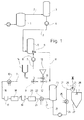
- an evaporator 1 in which skimmed milk or the like can be introduced by means of a conveying element in the form of a pump, is connected to a mixing tank 5 via a line 2, in which a concentrate tank 3 and a pump 4 are arranged.
- the skim milk concentrate obtained by the evaporator with a dry matter content of 37.5% is taken up from the concentrate tank 3 and quasi stored therein as a buffer.
- the mixing tank 5 itself is provided with a stirrer, stirrer 6 or the like, which ensures uniform mixing of the product.
- a branch in the form of a three-way valve 9 is provided in a line 7, which connects the mixing tank 5 to a heat exchanger 10.
- the mixed product conveyed from the mixing tank 5 by a pump 8 can be returned to the mixing tank 5 via the second line 11.
- the second line 11 is provided with a jet mixer 12, via which dry substances from a dry substance container 13 and / or flowable vegetable fat can be sucked in or introduced from a melt container 14.
- jet mixers 12, desiccant tanks 13 and melting tanks 14 are connected to one another via a three-way valve 15.
- the mixture produced in this way is then fed to the heat exchanger 10 for its pasteurization at a temperature of approximately 75 ° C. to 80 ° C. over a period of preferably 60 minutes with the three-way valve 9 in the appropriate position via the line 7.
- the mixture pasteurized in this way is fed to two successive homogenization stages 18, 20 which are arranged downstream of the heat exchanger 10 and which are provided for the homogenization of this mixture.
- a line 16 is provided between the heat exchanger 10 and the first homogenization stage 18.
- each of the two homogenization stages 18, 20 is also preceded by a flow tank 17, 19, which serve as a buffer. Otherwise, the second homogenization stage 20 can be followed by at least one further homogenization stage (not shown).
- a heat exchanger 22 is provided for cooling the homogenized mixture if it is to be sprayed cold in the spray drying column 27 or if it cannot be sprayed directly after the homogenization.
- the homogenized, ie liquid, Mixture provided for spray drying.
- the homogenized mixture drawn off from the flow tank 23 can optionally be heated up to a desired temperature, for example to inlet temperatures between 10 ° C. and 70 ° C., before the spray drying column 27.
- the pressure in line 21 between the feed tank 23 and the spray drying column 27 is approximately 30 bar to 50 bar, preferably approximately 45 bar.
- a nozzle 26 provided as a CO2 or N2 impregnation device is arranged, directly in front of the spray drying column 27, for example at a distance of 1 m.
- the selected gas either CO2 or N2 is introduced at a pressure of about 50 bar into the product stream or into the mixture flowing past the nozzle 26.
- the spray drying column 27 is coupled to the line 21, at the entrance of which a spray drying nozzle 28 is arranged which points inside.
- the spray drying is thus carried out in a direct current process at a pressure of 25 to 40 bar, the air inlet temperature being approximately 180 ° C. to 200 ° C., preferably 185 ° C., and the air outlet temperature being a maximum of approximately 100 ° C., preferably 95 ° C.
- the spray drying nozzle 28 is designed as a single-substance nozzle with a diameter of approximately 1 mm to 5 mm.
- nozzle 26 is shown according to the invention, which is arranged as a CO2 or N2 impregnation device for the mixture flowing past in the center 21, projecting from the side circumference.
- the line 21 has a slight in this area enlarged diameter to create approximately even flow conditions and thus suitable spray conditions.
- the nozzle 26 is designed here as a spray cone nozzle 29 with which a spray angle of approximately 30 ° C. to 80 ° C., preferably approximately 40 ° C. to 60 ° C., can be achieved.
- the spray cone nozzle 29 is aligned in the flow direction of the mixture, so that the gas introduced, ie the CO2 or N2, is also introduced essentially in the flow direction (arrow 33) of the mixture into line 21.
- the nozzle 26 is formed as a substantially in the direction of flow of the mixture feed line 30 for the CO2 or N2, with at the end 31 of the feed line 30 a distributor body 32 is attached, which in the flow path (arrow 33) of the homogenized mixture protrudes.
- the distributor body 32 consists, for example, of sintered metal, so that the CO2 or N2 in the mixture is distributed almost molecularly through its very small outlet openings.
- the distributor body 32 according to FIG. 3 made of sintered metal, it is also possible to provide the distributor body 32 with the finest pores which are generated by laser beams. This results in a flow through the distributor body 32 of CO2 or N2 in the dimensions of the respective molecular structure. This also leads to an extremely good distribution of the gas in the mixture.
- the vegetable fat was liquefied in a fat melting device.
- Disodium orthophosphate was premixed with lactose to ensure an even distribution after mixing into the liquid mixture.
- the skimmed milk which was concentrated to 32% dry matter and had a temperature of 50 ° C., was pumped into the circuit via pipes.
- the liquid, hot vegetable fat (temp. Approx. 70 ° C) was drawn into the circulating product stream using a jet mixer.
- the drying agents were then drawn in.
- the well-mixed mixture which now had a dry matter content of 51.35%, was pasteurized at 78 ° C for 20 minutes and then homogenized.
- the homogenization was carried out in three stages: - 1st stage: 50 bar - 2nd stage: 120 bar - 3rd stage: 30 bar
- the mixture which was then cooled to 15 ° C., was fed to the nozzle under a pressure of about 25 bar.
- the product was mixed with CO2, which was metered in at a pressure of 45 bar over a sintered metal.
- the mixing ratio was 0.45 kg CO2 to 1000 kg of dry matter in the liquid mixture.
- Example 1 a liquid mixture was produced here as in Example 1. The mixture was sprayed with a dry matter content of 32.78%. ingredients % Dry matter by weight Skim milk dry matter 68.35 Lactose 17.10 Vegetable fat 12.55 Sodium caseinate 1.57 Disodium orthophosphate 0.43
- Disodium orthophosphate and sodium caseinate were premixed with lactose, vegetable fat was melted.
- the skimmed milk concentrate with a dry matter content of 25% and a temperature of approx. 50 ° C was first the liquid vegetable fat and then the dry matter added via a jet mixer.
- the mixture was pasteurized at 75 ° C for 30 minutes and then homogenized.
- the homogenization was carried out in two stages: - 1st stage: 175 bar - 2nd stage: 35 bar
- the mix was pumped to the nozzle via a heat exchanger and tempered to 70 ° C. Nitrogen was injected at 50 bar through a nozzle into the product stream, which was fed at 40 bar to the spray nozzle. The amount of gas was 0.34 kg N2 per 1000 kg of dry matter in the mixture.
- Lactose and phosphate were dissolved in hot water and the skim milk concentrate with a dry matter content of 35% was added. The liquid was passed through a colloid mill and the caseinate was added. At the same time, fat was melted in a water bath and mixed with the liquid, which was then passed through a colloid mill.
- the mixture was then passed in a double-walled tank (heated by hot water) over a cable heat exchanger and returned to the tank. A temperature of 75 ° C. was reached within 30 minutes.
- the homogenization was carried out in two stages, in the first stage with a pressure of 135 bar and in the second stage with a pressure of 40 bar. Carbon dioxide was supplied via a laser-perforated metal. Was sprayed with a curled washer.
- the product temperature when entering the spray tower was 80 ° C, the air inlet temperature was 180 ° C and the air outlet temperature was 88 ° C.
- Three batches were prepared, with no CO2 for batch I. less than 1 l / min CO2 to Charge II and 2 l / min CO2 to Charge III were added. The subsequent pouring tests showed that no foam was formed in any of the three batches. Charge III showed a difficult agglomeration due to the very poor flow behavior.
- the spray product was readily wettable but did not give foam when poured on.
- the spray product from the disc drying showed no beads under the microscope and was a dusty, floury powder from shredded torn particles.
- the powdery product produced in the above manner is a component in the preparation of coffee beverages.
- this foaming creamer it is possible to use this foaming creamer to produce a finished product, which is suitable in portions for immediate consumption by adding hot water.
- the ready-to-use powdery mixture consists of the coffee creamer described above, soluble coffee powder, in particular coffee powder produced by freeze-drying and other ingredients.
- one of these further ingredients is lactose. It has surprisingly been found that the addition of lactose to the finished product - regardless of lactose constituents in the creamer - results in a significant improvement in taste of the finished "cappuccino" coffee beverage.
- a particularly advantageous mixture of the ready-to-use powder for the production of cappuccino beverages is composed as follows: Coffee creamer according to the invention 50.186% by weight Sucrose 23.838% by weight Instant coffee 17,000% by weight Lactose 8.493% by weight Aroma 0.483% by weight
- lactose is accordingly in the range from 5% to 10%, based on the total amount of the powder mixture.
- the proportion of lactose is preferably about 8.5%.
- the aroma used above is a caramel aroma in a commercial version.
- the above components of the powdery mixture are mixed with one another in the dry state.
- the components with the specified weight fractions are introduced into a suitable mixer, in particular a Nauta mixer, and mixed intensively with one another.
- the mixing time is preferably 10 minutes to 20 minutes.
Landscapes
- Life Sciences & Earth Sciences (AREA)
- Chemical & Material Sciences (AREA)
- Engineering & Computer Science (AREA)
- Food Science & Technology (AREA)
- Polymers & Plastics (AREA)
- Tea And Coffee (AREA)
- Dairy Products (AREA)
- Non-Alcoholic Beverages (AREA)
- Detergent Compositions (AREA)
- Medicines Containing Antibodies Or Antigens For Use As Internal Diagnostic Agents (AREA)
Claims (29)
- Mélange pulvérulent pour la préparation de boissons à base de café du type "cappuccino" par addition d'eau chaude, caractérisé par un mélange de café instantané soluble dans l'eau, de saccharose, de lactose et d'un agent blanchissant le café moussant à base d'une poudre qui est préparée par séchage par pulvérisation au moyen d'un ajutage d'un mélange aqueux, par agglomération et par amenée de gaz et qui présente la structure de sphérules vésiculaires et les constituants suivants :
Matière sèche de lait maigre 40 à 65 % en poids Lactose 25 à 35 % en poids Graisse 10 à 20 % en poids Caséinate 1,0 à 2,5 % en poids Phosphate de métal alcalin 0,2 à 1,0 % en poids. - Mélange pulvérulent pour la préparation de boissons à base de café du type "cappuccino" suivant la revendication 1, caractérisé en ce que le lactose est ajouté dans une mesure de 5 % en poids à 10 % en poids, en particulier de 8,5 % en poids, par rapport à la quantité globale du mélange pulvérulent.
- Mélange pulvérulent pour la préparation de boissons à base de café du type "cappuccino" suivant l'une des revendications 1 et 2, caractérisé par la composition suivante :
Agent blanchissant le café suivant l'invention 50,186 % en poids Saccharose 23,838 % en poids Café instantané 17,000 % en poids Lactose 8,493 % en poids Arôme 0,483 % en poids. - Procédé de préparation d'un agent blanchissant le café moussant à utiliser dans un mélange pulvérulent pour la préparation de boissons à base de café du type "cappuccino" suivant l'une des revendications 1 à 3, caractérisé par les mesures suivantes :- un mélange des constituants est préparé dans l'eau,- le mélange est pasteurisé à une température de 70 à 80°C,- après la pasteurisation, le mélange est homogénéisé en plusieurs étapes, puis- du CO₂ ou du N₂ est ajouté au mélange directement en amont d'un dispositif de séchage par pulvérisation, et enfin- le mélange est séché par pulvérisation au moyen d'un ajutage.
- Procédé suivant la revendication 4, caractérise en ce qu'on pasteurise le mélange à une température de 70 à 80°C, en particulier de 75 à 80°C, pendant un intervalle de temps de 45 minutes à 90 minutes, en particulier de 60 minutes.
- Procédé suivant l'une des revendications 4 et 5, caractérisé en ce qu'on homogénéise le mélange en deux étapes.
- Procédé suivant l'une des revendications 4 à 6, caractérisé en ce qu'on homogénéise le mélange dans la première étape à une pression de 120 bars à 175 bars et dans la deuxième étape à une pression de 35 bars à 45 bars.
- Procédé suivant l'une des revendications 4 à 7, caractérisé en ce qu'on homogénéise le mélange dans une troisième étape supplémentaire, de préférence à une pression d'environ 25 bars à 35 bars.
- Procédé suivant l'une des revendications 4 à 8, caractérisé en ce qu'on amène le mélange à une pression d'environ 30 bars à 50 bars, en particulier d'environ 45 bars, à un ajutage d'imprégnation fournissant du CO₂ ou du N₂.
- Procédé suivant l'une des revendications 4 à 9, caractérisé en ce qu'on injecte dans le mélange le CO₂ ou le N₂ sous pression, le rapport de pression entre le mélange et le CO₂ ou N₂ injecté étant ajusté à 1 pour 1,1 à 2.
- Procédé suivant la revendication 10, caractérisé en ce qu'on ajuste le rapport de pression entre le mélange et le CO₂ ou N₂ injecté à 1 pour 1,4 à 1,6.
- Procédé suivant l'une des revendications 10 et 11, caractérisé en ce qu'on injecte dans le mélange le CO₂ ou N₂ avec une pression d'environ 55 bars.
- Procédé suivant l'une des revendications 4 à 12, caractérisé en ce qu'on injecte le CO₂ ou N₂ dans le mélange qui s'écoule vers un ajutage de séchage par pulvérisation, sous un angle de 30° à 80°.
- Procédé suivant l'une des revendications 4 à 13, caractérisé en ce qu'on pulvérise le mélange avec le CO₂ ou N₂ ajouté, à une température de 10°C à 80°C.
- Procédé suivant l'une des revendications 4 à 14, caractérisé en ce qu'on effectue le séchage par pulvérisation du mélange avec le CO₂ ou N₂ ajouté dans un procédé à courants parallèles, la température d'entrée d'air étant de 150 à 250°C, en particulier de 185°C, et la température de sortie d'air étant au maximum d'environ 100°C, de préférence de 95°C.
- Procédé de préparation d'un mélange pulvérulent pour la réalisation de boissons à base de café du type "cappuccino" suivant une ou plusieurs des revendications 1, 2 et 3, caractérisé en ce que les composants du mélange, à savoir l'agent blanchissant le café suivant l'invention, le café soluble dans l'eau (café instantané) et le saccharose ainsi qu'éventuellement des substances aromatiques, sont mutuellement mélangés à sec, en particulier dans un mélangeur Nauta, pendant une durée de mélange de préférence de 10 minutes à 20 minutes.
- Utilisation d'un mélange aqueux ajusté à une teneur en matière sèche de 30 à 47 %, de préférence de 41 %, caractérisé par les éléments suivants :
Concentré de lait maigre 20 à 85 % en poids Lactose 20 à 50 % en poids Graisse végétale 5 à 35 % en poids Caséinate 0,5 à 2,5 % en poids Phosphate de métal alcalin 0,1 à 0,6 % en poids - Dispositif de préparation d'un agent blanchissant le café moussant à utiliser dans le mélange pulvérulent prévu pour la réalisation de boissons à base de café du type "cappuccino", en particulier suivant une des revendications 1 à 17, caractérisé par un réservoir de mélange (5), un échangeur de chaleur (10), qui est en communication avec le réservoir de mélange (5), est monté on aval de ce dernier et est prévu pour la pasteurisation du mélange obtenu, au moins deux étages d'homogénéisation (18, 20) qui sont montés l'un derrière l'autre, sont agencés en aval de l'échangeur de chaleur (10) et sont prévus pour l'homogénéisation du mélange pasteurisé, le premier étage d'homogénéisation (18) communiquant avec l'échangeur de chaleur (10), un dispositif d'imprégnation par du CO₂ ou du N₂ (ajutage 26) qui est en communication avec le dernier étage d'homogénéisation (20), est monté en aval de ce dernier et est prévu pour l'imprégnation du mélange homogénéisé, ainsi que par une colonne de séchage par pulvérisation (27) qui est directement raccordée à l'ajutage (26) et est prévue pour le séchage par pulvérisation du mélange additionné de CO₂ ou de N₂.
- Dispositif suivant la revendication 18, caractérisé en ce que le réservoir de mélange (5) est, par l'intermédiaire d'un conduit (2), relié à un évaporateur (1) pour le lait maigre qui est agencé en amont de ce réservoir.
- Dispositif suivant la revendication 19, caractérisé en ce que, dans le conduit (2) entre l'évaporataur (1) et le réservoir de mélange (5), est agencé un réservoir à concentré (3), en particulier avec une pompe (4) ou élément analogue qui refoule le concentré de lait maigre du réservoir à concentré (3) dans le réservoir de mélange (5).
- Dispositif suivant l'une des revendications 18 à 20, caractérisé en ce que, dans un conduit (7) situé entre le réservoir de mélange (5) et l'échangeur de chaleur (10), est prévu un embranchement (vanne à trois voies 9) qui communique avec le réservoir de mélange (5) par l'intermédiaire d'un deuxième conduit (11) qui recycle le mélange refoulé du réservoir de mélange (5) au moyen d'une pompe (8) ou d'un élément analogue dans ce réservoir de mélange.
- Dispositif suivant la revendication 21, caractérisé en ce que le deuxième conduit (11) est pourvu d'un mélangeur à jet (12) ou d'un élément analogue par l'intermédiaire duquel des matières sèches et/ou de la graisse capable de s'écouler, de la graisse végétale, peuvent être introduites dans le réservoir de mélange (5).
- Dispositif suivant la revendication 22, caractérisé en ce qu'un récipient à matière sèche (13) ainsi qu'un récipient à masse fondue (14) prévu pour la graisse végétale sont reliés au mélangeur à jet (12) par l'intermédiaire d'une vanne à trois voies (15).
- Dispositif suivant l'une des revendications 18 à 23, caractérisé en ce qu'en amont de chaque étage d'homogénéisation (18, 20) est monté un récipient d'entrée (17, 19), le récipient d'entrée (17) du premier étage d'homogénéisation (18) étant agencé dans un conduit (16) entre l'échangeur de chaleur (10) et le premier étage d'homogénéisation (18).
- Dispositif suivant l'une des revendications 18 à 24, caractérisé en ce qu'en aval du deuxième étage d'homogénéisation (20) est monté au moins un autre étage d'homogénéisation.
- Dispositif suivant l'une des revendications 18 à 25, caractérisé en ce que, dans un conduit (21) situé entre le dernier étage d'homogénéisation (20) et la colonne de séchage par pulvérisation (27), sont agencés un échangeur de chaleur (22) prévu pour refroidir le mélange homogénéisé, un réservoir de tête (23) muni d'une pompe (24) ou élément analogue qui se raccorde à ce réservoir ainsi qu'un échangeur de chaleur (25) prévu pour le chauffage du mélange à tenir prêt.
- Dispositif suivant l'une des revendications 18 à 26, caractérisé en ce que l'ajutage (26) prévu comme dispositif d'imprégnation par du CO₂ ou du N₂ est agencé directement en amont de la colonne de séchage par pulvérisation (27) dans le conduit (21) prévu entre le dernier étage d'homogénéisation (20) et la colonne de séchage par pulvérisation (27).
- Dispositif suivant la revendication 27, caractérisé en ce que l'ajutage (26) est réalisé sous la forme d'un ajutage à cône de projection (29) orienté dans le sens d'écoulement (flèche 23) du mélange.
- Dispositif suivant la revendication 27, caractérisé en ce que l'ajutage (26) est réalisé sous la forme d'un conduit d'amenée (30) pour le CO₂ ou le N₂ qui est orienté sensiblement dans le sens d'écoulement (flèche 23) du mélange et qui est pourvu d'un corps répartiteur (32) agencé à son extrémité (31).
Applications Claiming Priority (4)
| Application Number | Priority Date | Filing Date | Title |
|---|---|---|---|
| DE4016783 | 1990-05-25 | ||
| DE4016783 | 1990-05-25 | ||
| DE4032537A DE4032537A1 (de) | 1990-05-25 | 1990-10-13 | Schaeumender kaffeeweisser, verfahren und vorrichtung zu dessen herstellung sowie pulverfoermiges gemisch zum herstellen von kaffeegetraenken |
| DE4032537 | 1990-10-13 |
Publications (2)
| Publication Number | Publication Date |
|---|---|
| EP0458310A1 EP0458310A1 (fr) | 1991-11-27 |
| EP0458310B1 true EP0458310B1 (fr) | 1994-09-07 |
Family
ID=25893523
Family Applications (1)
| Application Number | Title | Priority Date | Filing Date |
|---|---|---|---|
| EP91108293A Revoked EP0458310B1 (fr) | 1990-05-25 | 1991-05-23 | Produit pulvérulent pour préparer des boissons à la base du café, procédé et appareil pour sa mise en oeuvre |
Country Status (12)
| Country | Link |
|---|---|
| EP (1) | EP0458310B1 (fr) |
| JP (1) | JPH05123103A (fr) |
| KR (1) | KR910019518A (fr) |
| CN (1) | CN1056800A (fr) |
| AT (1) | ATE110933T1 (fr) |
| AU (1) | AU645566B2 (fr) |
| CA (1) | CA2043232A1 (fr) |
| DE (2) | DE4032537A1 (fr) |
| DK (1) | DK0458310T3 (fr) |
| ES (1) | ES2063402T3 (fr) |
| FI (1) | FI912524A7 (fr) |
| NO (1) | NO911992L (fr) |
Cited By (1)
| Publication number | Priority date | Publication date | Assignee | Title |
|---|---|---|---|---|
| US10154675B2 (en) | 2008-07-09 | 2018-12-18 | Starbucks Corporation | Soluble coffee products for producing beverages with enhanced flavors and aromas |
Families Citing this family (46)
| Publication number | Priority date | Publication date | Assignee | Title |
|---|---|---|---|---|
| DE4128670A1 (de) * | 1991-08-29 | 1993-03-04 | Ike Inst Fuer Kerntechnik Und | Verfahren und vorrichtung zum zerstaeuben einer fluessigkeit |
| NL9201264A (nl) * | 1992-07-14 | 1994-02-01 | Dmv International Division Of | Poedervormige, schuimvormende creamer. |
| US5554400A (en) * | 1994-08-25 | 1996-09-10 | The Procter & Gamble Company | Infusion beverage product comprising co-agglomerated creamer and sweetener suitable for bag and filter pack brewing |
| US5433962A (en) * | 1994-08-25 | 1995-07-18 | The Procter & Gamble Company | Rapidly soluble flavored instant coffee product |
| CA2173780A1 (fr) * | 1995-06-01 | 1996-12-02 | Randy Grote | Methode d'alimentation a l'aide de compositions sous diverses formes |
| US5904948A (en) * | 1995-06-01 | 1999-05-18 | Nestec Ltd. | Method for manufacturing a balanced, nutritionally complete coffee composition |
| PT780055E (pt) * | 1995-10-27 | 2003-04-30 | Nestle Sa | Composicao nutricional de cafe |
| PL181303B1 (pl) * | 1996-01-16 | 2001-07-31 | Maspex Sp Z Oo | Zabielacz w proszku o wlasciwosciach spieniajacych PL |
| GB2301015B (en) * | 1996-03-12 | 1997-04-23 | Nestle Sa | Soluble coffee beverage product |
| US5721003A (en) * | 1996-03-18 | 1998-02-24 | Kraft Foods, Inc. | Foaming coffee creamer and instant hot cappuccino |
| CA2205773A1 (fr) * | 1996-06-21 | 1997-12-21 | Kraft Foods, Inc. | Boisson chaude mousseuse,cremeuse et epaisse |
| PT885566E (pt) * | 1997-06-19 | 2003-02-28 | Nestle Sa | Nata para bebida soluvel |
| DE29814822U1 (de) * | 1998-08-13 | 1998-10-08 | Immergut-Dauermilch GmbH, 17153 Stavenhagen | Geformte Festprodukte aus Milchpulver |
| ES2229808T3 (es) * | 1999-01-28 | 2005-04-16 | Societe Des Produits Nestle S.A. | Crema en polvo soluble aromatizada. |
| EP1074181A1 (fr) * | 1999-08-03 | 2001-02-07 | Societe Des Produits Nestle S.A. | Ingrédient pour blanchisseur à café moussant et poudres le contenant |
| EP1133932A1 (fr) * | 2000-03-15 | 2001-09-19 | Societe Des Produits Nestle S.A. | Procédé de fabrication d'un agent moussant pour la cuisine sous forme de poudre |
| EP1228694A1 (fr) * | 2001-02-02 | 2002-08-07 | Societe Des Produits Nestle S.A. | Agent d'aromatisation |
| US6777014B2 (en) | 2001-07-03 | 2004-08-17 | Harjit Singh | Agglomerated milk in coffee and tea |
| GB2381731A (en) * | 2001-11-12 | 2003-05-14 | Mars Inc | Beverage whitener formulations |
| US6838110B2 (en) | 2002-05-22 | 2005-01-04 | Kraft Foods Holdings, Inc. | Instant dry mix composition for providing a beverage having a two-toned foam on its surface |
| SI1538924T1 (sl) * | 2002-08-30 | 2008-02-29 | Campina Bv | Penilni dodatek in izdelki, ki vsebujejo ta dodatek |
| US7226631B2 (en) | 2004-08-12 | 2007-06-05 | Nestec S.A. | Method and apparatus for consumable powder reconstitution and frothing |
| US7736683B2 (en) | 2004-08-17 | 2010-06-15 | Kraft Food Global Brands Llc | Method to increase the foaming capacity of spray-dried powders |
| US7534461B2 (en) | 2004-08-17 | 2009-05-19 | Kraft Foods Holdings, Inc. | Non-protein foaming compositions and methods of making the same |
| US20060040033A1 (en) | 2004-08-17 | 2006-02-23 | Zeller Bary L | Non-carbohydrate foaming compositions and methods of making the same |
| US7713565B2 (en) | 2004-08-17 | 2010-05-11 | Kraft Foods Holdings, Inc. | Method of preparing a foaming soluble coffee powder |
| US20060115572A1 (en) * | 2004-11-30 | 2006-06-01 | Guerrero Arturo F | Method for delivering hot and cold beverages on demand in a variety of flavorings and nutritional additives |
| EP1731594A1 (fr) * | 2005-06-09 | 2006-12-13 | Fuji Oil Europe | Non-hydrogenée composition de graisse et son utilisation |
| FR2898516B1 (fr) | 2006-03-17 | 2008-05-30 | Innov Ia Sa | Procede de preparation d'une composition pulverulente et produit tel qu'obtenu |
| EP1917864A1 (fr) | 2006-11-01 | 2008-05-07 | Nestec S.A. | Poudre pour boisson moussante soluble |
| CN101204216B (zh) * | 2006-12-21 | 2011-10-26 | 天津科技大学 | 含有二十八烷醇的咖啡伴侣及其制备方法 |
| GB2452953B (en) | 2007-09-20 | 2010-03-10 | Kraft Foods R & D Inc | Coffee Composition |
| US20090162489A1 (en) * | 2007-12-19 | 2009-06-25 | Harjit Singh | Effervescent tablet for use as an additive in hot coffee or hot water and method of making same |
| JP5657200B2 (ja) * | 2008-09-05 | 2015-01-21 | サントリー食品インターナショナル株式会社 | 乳清タンパク質の含有量が低減された乳組成物及び乳入り飲料 |
| AU2010230379B2 (en) | 2009-04-01 | 2014-02-20 | Société des Produits Nestlé S.A. | Instant beverage product |
| ES2692744T3 (es) | 2010-02-12 | 2018-12-04 | Arla Foods Amba | Producto de leche reconstituida que comprende sólidos de suero de leche dulce |
| MX2012010180A (es) * | 2010-03-04 | 2012-10-03 | Ajinomoto Kk | Blanqueador de cafe, proceso para producir el mismo y proceso para producir la bebida. |
| KR20140061509A (ko) * | 2011-09-14 | 2014-05-21 | 네스텍 소시에테아노님 | 분말화 가용성 음료 믹스 |
| WO2013167452A1 (fr) | 2012-05-08 | 2013-11-14 | Nestec S.A. | Composition de préparation d'un produit alimentaire ou de boisson |
| KR101483245B1 (ko) * | 2013-09-17 | 2015-01-15 | 남양유업 주식회사 | 인산염을 첨가하지 않고 원유 또는 탈지유를 함유하면서 우유 풍미가 증진된 커피 크리머의 제조방법 |
| PH12016500550B1 (en) | 2013-10-08 | 2022-11-04 | Frieslandcampina Nederland Bv | Powder composition for an aerated food product |
| EP3102048B1 (fr) | 2013-10-08 | 2018-01-10 | Unilever N.V. | Mélange sec sous forme particulaire pour la préparation d'aliments liquides au moyen d'une dispersion de bulles de gaz |
| WO2015091026A1 (fr) * | 2013-12-20 | 2015-06-25 | Nestec S.A. | Procédé de préparation d'ingrédient laitier soluble à propriétés moussantes améliorées |
| DE102016007636B3 (de) * | 2016-06-23 | 2017-11-09 | Gea Tds Gmbh | Verfahren zum Erhitzen eines Konzentrats in einer Anlage zum Zerstäubungstrocknen und Anlage zur Durchführung des Verfahrens |
| CN106578145A (zh) * | 2016-12-14 | 2017-04-26 | 山东天骄生物技术有限公司 | 一种发泡植脂末的制备方法 |
| KR20230086665A (ko) * | 2020-10-12 | 2023-06-15 | 소시에떼 데 프로듀이 네슬레 소시에떼아노님 | 발포 성분 |
Family Cites Families (12)
| Publication number | Priority date | Publication date | Assignee | Title |
|---|---|---|---|---|
| IL28857A (en) * | 1966-12-30 | 1971-03-24 | Stauffer Chemical Co | Lactalbumin phosphate as protein ingredient in non-butterfat diary products |
| US3738412A (en) * | 1970-09-08 | 1973-06-12 | Kraftco Corp | Method for spray drying coffee whitener |
| BE789406A (fr) * | 1971-09-28 | 1973-03-28 | Unilever Nv | Composition sterilisee liquide contenant une graisse poly-insaturee pour blanchir le cafe |
| NL7212074A (fr) * | 1972-09-05 | 1974-03-07 | ||
| US4025659A (en) * | 1975-06-06 | 1977-05-24 | Ralston Purina Company | Soy protein/casein coffee whitener composition |
| FR2312962A1 (fr) * | 1975-06-06 | 1976-12-31 | Ralston Purina Co | Composition de proteines du soja et de caseine pour blanchir du cafe |
| DE7736490U1 (de) * | 1977-11-30 | 1981-03-19 | Walter Hofmann, Maschinenfabrik, 2084 Rellingen | Anordnung an spritzvorrichtungen fuer rieselfaehiges spritzgut |
| GB2030439B (en) * | 1978-08-25 | 1983-07-27 | Unilever Ltd | Milk substitutes |
| US4337278A (en) * | 1980-09-09 | 1982-06-29 | Brog Roy A | Imitation milk |
| US4438147A (en) * | 1982-06-25 | 1984-03-20 | Societe D'assistance Technique Pour Produits Nestle S.A. | Foaming creamer and method of making same |
| IN163753B (fr) * | 1984-02-20 | 1988-11-05 | Nestle Sa | |
| US4842884A (en) * | 1988-05-02 | 1989-06-27 | The United States Of America As Represented By The Secretary Of Agriculture | Formulated milk concentrate and beverage |
-
1990
- 1990-10-13 DE DE4032537A patent/DE4032537A1/de not_active Withdrawn
-
1991
- 1991-05-23 EP EP91108293A patent/EP0458310B1/fr not_active Revoked
- 1991-05-23 AT AT91108293T patent/ATE110933T1/de not_active IP Right Cessation
- 1991-05-23 ES ES91108293T patent/ES2063402T3/es not_active Expired - Lifetime
- 1991-05-23 DK DK91108293.1T patent/DK0458310T3/da active
- 1991-05-23 NO NO91911992A patent/NO911992L/no unknown
- 1991-05-23 AU AU77315/91A patent/AU645566B2/en not_active Ceased
- 1991-05-23 DE DE59102806T patent/DE59102806D1/de not_active Expired - Lifetime
- 1991-05-24 KR KR1019910008491A patent/KR910019518A/ko not_active Ceased
- 1991-05-24 FI FI912524A patent/FI912524A7/fi unknown
- 1991-05-24 CA CA002043232A patent/CA2043232A1/fr not_active Abandoned
- 1991-05-25 CN CN91103422A patent/CN1056800A/zh active Pending
- 1991-05-27 JP JP3121285A patent/JPH05123103A/ja active Pending
Cited By (3)
| Publication number | Priority date | Publication date | Assignee | Title |
|---|---|---|---|---|
| US10154675B2 (en) | 2008-07-09 | 2018-12-18 | Starbucks Corporation | Soluble coffee products for producing beverages with enhanced flavors and aromas |
| US11160291B2 (en) | 2008-07-09 | 2021-11-02 | Starbucks Corporation | Soluble coffee products for producing beverages with enhanced flavors and aromas |
| US12207667B2 (en) | 2008-07-09 | 2025-01-28 | Starbucks Corporation | Soluble coffee products for producing beverages with enhanced flavors and aromas |
Also Published As
| Publication number | Publication date |
|---|---|
| DE4032537A1 (de) | 1991-11-28 |
| AU645566B2 (en) | 1994-01-20 |
| FI912524A7 (fi) | 1991-11-26 |
| EP0458310A1 (fr) | 1991-11-27 |
| CN1056800A (zh) | 1991-12-11 |
| NO911992L (no) | 1991-11-26 |
| ATE110933T1 (de) | 1994-09-15 |
| ES2063402T3 (es) | 1995-01-01 |
| DK0458310T3 (da) | 1995-03-27 |
| AU7731591A (en) | 1991-11-28 |
| KR910019518A (ko) | 1991-12-19 |
| DE59102806D1 (de) | 1994-10-13 |
| FI912524A0 (fi) | 1991-05-24 |
| JPH05123103A (ja) | 1993-05-21 |
| NO911992D0 (no) | 1991-05-23 |
| CA2043232A1 (fr) | 1991-11-26 |
Similar Documents
| Publication | Publication Date | Title |
|---|---|---|
| EP0458310A1 (fr) | Produit pulvérulent pour préparer des boissons à la base du café, procédé et appareil pour sa mise en oeuvre | |
| DE69301287T2 (de) | Pulverförmige, schäumende Kaffeeaufheller | |
| DE69000523T2 (de) | Getraenkeherstellung. | |
| DE69926405T2 (de) | Topping für getränke | |
| DE69727300T2 (de) | Topping für Getränke | |
| DE69419404T2 (de) | Verfahren zur Herstellung einer Getränkezusammensetzung | |
| DE69707113T2 (de) | Lösliches kaffeegetränkepulver | |
| DE3686953T2 (de) | Lyophilisierter schaum. | |
| DE69721385T2 (de) | Heissgetränk mit kremigem dickem Schaum | |
| DE69608801T2 (de) | Milchaustauschprodukt und Verfahren zu dessen Herstellung | |
| DE2526597C3 (de) | Verfahren zur kontinuierlichen Herstellung von Schlagsahneersatz-Desserts | |
| DE69713421T2 (de) | Schäumender Kaffeeweiser und instant heisser Cappuccino | |
| DE69201060T2 (de) | Verfahren zur Herstellung von Kohlensäure enthaltenden gelierten Produkten. | |
| DE60123475T2 (de) | Pasteurisieren oder sterilisieren | |
| DE60211480T2 (de) | Milchprodukt, das durch schütteln aufgeschäumt werden kann | |
| EP0245301A1 (fr) | Procede pour la production d'une boisson au houblon/malt contenant du gaz carbonique, et dispositif de distribution. | |
| DE19713505A1 (de) | Speiseeis mit weichen Beigaben | |
| DD148491A1 (de) | Verfahren und anlage zur kontinuierlichen herstellung von schokoladenmassen | |
| DE69624222T2 (de) | Löslicher instantkaffee und verfahren zu dessen herstellung | |
| EP1249174B1 (fr) | Procédé et appareil de traitement continu pour le mise en oeuvre de masses grasses | |
| DE3145895C2 (fr) | ||
| DE69129461T3 (de) | Flüssiges Milchprodukt und Verfahren zu seiner Zubereitung | |
| DE69930526T2 (de) | Verfahren zur herstellung von einem ersatzstoff für kondensmilch | |
| DE2319461A1 (de) | Getraenkegemische, welche naturgummi enthalten | |
| DE60121409T2 (de) | Verfahren und Vorrichtung zum kontinuierlichen Herstellen von Schaumstoff zur Formung von Paneelen |
Legal Events
| Date | Code | Title | Description |
|---|---|---|---|
| PUAI | Public reference made under article 153(3) epc to a published international application that has entered the european phase |
Free format text: ORIGINAL CODE: 0009012 |
|
| AK | Designated contracting states |
Kind code of ref document: A1 Designated state(s): AT BE CH DE DK ES FR GB GR IT LI NL SE |
|
| 17P | Request for examination filed |
Effective date: 19920410 |
|
| 17Q | First examination report despatched |
Effective date: 19930211 |
|
| GRAA | (expected) grant |
Free format text: ORIGINAL CODE: 0009210 |
|
| AK | Designated contracting states |
Kind code of ref document: B1 Designated state(s): AT BE CH DE DK ES FR GB GR IT LI NL SE |
|
| REF | Corresponds to: |
Ref document number: 110933 Country of ref document: AT Date of ref document: 19940915 Kind code of ref document: T |
|
| GBT | Gb: translation of ep patent filed (gb section 77(6)(a)/1977) |
Effective date: 19940913 |
|
| REF | Corresponds to: |
Ref document number: 59102806 Country of ref document: DE Date of ref document: 19941013 |
|
| ITF | It: translation for a ep patent filed | ||
| REG | Reference to a national code |
Ref country code: ES Ref legal event code: FG2A Ref document number: 2063402 Country of ref document: ES Kind code of ref document: T3 |
|
| ET | Fr: translation filed | ||
| EAL | Se: european patent in force in sweden |
Ref document number: 91108293.1 |
|
| REG | Reference to a national code |
Ref country code: GR Ref legal event code: FG4A Free format text: 3013967 |
|
| REG | Reference to a national code |
Ref country code: DK Ref legal event code: T3 |
|
| PLBI | Opposition filed |
Free format text: ORIGINAL CODE: 0009260 |
|
| PLBI | Opposition filed |
Free format text: ORIGINAL CODE: 0009260 |
|
| 26 | Opposition filed |
Opponent name: SUEDMILCH AG Effective date: 19950607 Opponent name: KRUEGER GMBH & CO. KG Effective date: 19950607 Opponent name: SOCIETE DES PRODUITS NESTLE S.A., VEVEY Effective date: 19950602 |
|
| 26 | Opposition filed |
Opponent name: STICHTING BEHARTIGING OCTROOIBELANGEN Effective date: 19950607 Opponent name: SUEDMILCH AG Effective date: 19950607 Opponent name: KRUEGER GMBH & CO. KG Effective date: 19950607 Opponent name: SOCIETE DES PRODUITS NESTLE S.A., VEVEY Effective date: 19950602 |
|
| NLR1 | Nl: opposition has been filed with the epo |
Opponent name: STICHTING BEHARTIGING OCTROOIBELANGEN Opponent name: SUEDMILCH AG Opponent name: KRUEGER GMBH & CO. KG Opponent name: SOCIETE DES PRODUITS NESTLE S.A., VEVEY |
|
| PLBF | Reply of patent proprietor to notice(s) of opposition |
Free format text: ORIGINAL CODE: EPIDOS OBSO |
|
| PGFP | Annual fee paid to national office [announced via postgrant information from national office to epo] |
Ref country code: GR Payment date: 19970520 Year of fee payment: 7 |
|
| PGFP | Annual fee paid to national office [announced via postgrant information from national office to epo] |
Ref country code: FR Payment date: 19980511 Year of fee payment: 8 |
|
| PGFP | Annual fee paid to national office [announced via postgrant information from national office to epo] |
Ref country code: GB Payment date: 19980514 Year of fee payment: 8 Ref country code: DE Payment date: 19980514 Year of fee payment: 8 Ref country code: AT Payment date: 19980514 Year of fee payment: 8 |
|
| PGFP | Annual fee paid to national office [announced via postgrant information from national office to epo] |
Ref country code: SE Payment date: 19980515 Year of fee payment: 8 Ref country code: DK Payment date: 19980515 Year of fee payment: 8 |
|
| PGFP | Annual fee paid to national office [announced via postgrant information from national office to epo] |
Ref country code: ES Payment date: 19980529 Year of fee payment: 8 |
|
| PGFP | Annual fee paid to national office [announced via postgrant information from national office to epo] |
Ref country code: NL Payment date: 19980531 Year of fee payment: 8 |
|
| PGFP | Annual fee paid to national office [announced via postgrant information from national office to epo] |
Ref country code: CH Payment date: 19980610 Year of fee payment: 8 |
|
| PGFP | Annual fee paid to national office [announced via postgrant information from national office to epo] |
Ref country code: BE Payment date: 19980714 Year of fee payment: 8 |
|
| RDAH | Patent revoked |
Free format text: ORIGINAL CODE: EPIDOS REVO |
|
| APAC | Appeal dossier modified |
Free format text: ORIGINAL CODE: EPIDOS NOAPO |
|
| APAE | Appeal reference modified |
Free format text: ORIGINAL CODE: EPIDOS REFNO |
|
| APAC | Appeal dossier modified |
Free format text: ORIGINAL CODE: EPIDOS NOAPO |
|
| PG25 | Lapsed in a contracting state [announced via postgrant information from national office to epo] |
Ref country code: GB Free format text: LAPSE BECAUSE OF NON-PAYMENT OF DUE FEES Effective date: 19990523 Ref country code: AT Free format text: LAPSE BECAUSE OF NON-PAYMENT OF DUE FEES Effective date: 19990523 |
|
| PG25 | Lapsed in a contracting state [announced via postgrant information from national office to epo] |
Ref country code: SE Free format text: LAPSE BECAUSE OF NON-PAYMENT OF DUE FEES Effective date: 19990524 Ref country code: ES Free format text: THE PATENT HAS BEEN ANNULLED BY A DECISION OF A NATIONAL AUTHORITY Effective date: 19990524 |
|
| PG25 | Lapsed in a contracting state [announced via postgrant information from national office to epo] |
Ref country code: LI Free format text: LAPSE BECAUSE OF NON-PAYMENT OF DUE FEES Effective date: 19990531 Ref country code: GR Free format text: LAPSE BECAUSE OF NON-PAYMENT OF DUE FEES Effective date: 19990531 Ref country code: DK Free format text: LAPSE BECAUSE OF NON-PAYMENT OF DUE FEES Effective date: 19990531 Ref country code: CH Free format text: LAPSE BECAUSE OF NON-PAYMENT OF DUE FEES Effective date: 19990531 Ref country code: BE Free format text: LAPSE BECAUSE OF NON-PAYMENT OF DUE FEES Effective date: 19990531 |
|
| BERE | Be: lapsed |
Owner name: S.A. KRAFT JACOBS SUCHARD Effective date: 19990531 |
|
| PG25 | Lapsed in a contracting state [announced via postgrant information from national office to epo] |
Ref country code: NL Free format text: LAPSE BECAUSE OF NON-PAYMENT OF DUE FEES Effective date: 19991201 |
|
| PG25 | Lapsed in a contracting state [announced via postgrant information from national office to epo] |
Ref country code: DE Free format text: LAPSE BECAUSE OF THE APPLICANT RENOUNCES Effective date: 19991207 |
|
| REG | Reference to a national code |
Ref country code: CH Ref legal event code: PL |
|
| GBPC | Gb: european patent ceased through non-payment of renewal fee |
Effective date: 19990523 |
|
| EUG | Se: european patent has lapsed |
Ref document number: 91108293.1 |
|
| PG25 | Lapsed in a contracting state [announced via postgrant information from national office to epo] |
Ref country code: FR Free format text: LAPSE BECAUSE OF NON-PAYMENT OF DUE FEES Effective date: 20000131 |
|
| NLV4 | Nl: lapsed or anulled due to non-payment of the annual fee |
Effective date: 19991201 |
|
| REG | Reference to a national code |
Ref country code: FR Ref legal event code: ST |
|
| REG | Reference to a national code |
Ref country code: DK Ref legal event code: EBP |
|
| APAE | Appeal reference modified |
Free format text: ORIGINAL CODE: EPIDOS REFNO |
|
| REG | Reference to a national code |
Ref country code: ES Ref legal event code: FD2A Effective date: 20010604 |
|
| APAC | Appeal dossier modified |
Free format text: ORIGINAL CODE: EPIDOS NOAPO |
|
| APAC | Appeal dossier modified |
Free format text: ORIGINAL CODE: EPIDOS NOAPO |
|
| RDAG | Patent revoked |
Free format text: ORIGINAL CODE: 0009271 |
|
| STAA | Information on the status of an ep patent application or granted ep patent |
Free format text: STATUS: PATENT REVOKED |
|
| 27W | Patent revoked |
Effective date: 20020420 |
|
| APAH | Appeal reference modified |
Free format text: ORIGINAL CODE: EPIDOSCREFNO |