EP0461380A2 - Système de transmission de données radio, notamment système de radio mobile cellulaire - Google Patents
Système de transmission de données radio, notamment système de radio mobile cellulaire Download PDFInfo
- Publication number
- EP0461380A2 EP0461380A2 EP19910107082 EP91107082A EP0461380A2 EP 0461380 A2 EP0461380 A2 EP 0461380A2 EP 19910107082 EP19910107082 EP 19910107082 EP 91107082 A EP91107082 A EP 91107082A EP 0461380 A2 EP0461380 A2 EP 0461380A2
- Authority
- EP
- European Patent Office
- Prior art keywords
- optical
- radio
- signal
- carrier
- frequency
- Prior art date
- Legal status (The legal status is an assumption and is not a legal conclusion. Google has not performed a legal analysis and makes no representation as to the accuracy of the status listed.)
- Granted
Links
Images


Classifications
-
- H—ELECTRICITY
- H04—ELECTRIC COMMUNICATION TECHNIQUE
- H04B—TRANSMISSION
- H04B10/00—Transmission systems employing electromagnetic waves other than radio-waves, e.g. infrared, visible or ultraviolet light, or employing corpuscular radiation, e.g. quantum communication
- H04B10/25—Arrangements specific to fibre transmission
- H04B10/2575—Radio-over-fibre, e.g. radio frequency signal modulated onto an optical carrier
- H04B10/25752—Optical arrangements for wireless networks
- H04B10/25753—Distribution optical network, e.g. between a base station and a plurality of remote units
- H04B10/25754—Star network topology
Definitions
- the invention relates to a message transmission system according to the preamble of claim 1 and one according to the preamble of claim 7.
- a message transmission system is known from "Electrical communications", volume 63, No. 1/1989, pages 45 to 51 or from “telcom-report "12 (1989), No. 5, pages 142 to 145. It is the cellular mobile radio system standardized throughout Europe as the so-called GSM system.
- the source that supplies the message signal that the radio station is to transmit is the so-called "mobile communication exchange”, and the radio station spatially distant therefrom is the so-called fixed station.
- the message signal source since at the "mobile communication switching center", there is a transmission device which is connected to the base station via a line and which transmits the message signal originating from the message signal source to the base station.
- the Base station more precisely the base station's radio station, emits a microwave radio signal which has a specific carrier frequency and contains the message signal.
- the message signal from the message signal source is in the baseband, e.g. transmitted as PCM 30 signal to the base station.
- the base station has carrier frequency devices which convert the message signal to be transmitted from the baseband position into the radio signal so that it can be transmitted to the mobile subscribers via the radio connection.
- the base station For the radio signal that a base station receives from the mobile subscribers, the base station has known RF demodulation devices in the known systems, generally also referred to as "RF carrier frequency devices". These devices obtain the message signal contained therein from the received radio signal, e.g. a digital signal with a bit rate of about 8 Mbit / s, which is then transmitted in the baseband to the "mobile communication switching center".
- RF carrier frequency devices e.g. a digital signal with a bit rate of about 8 Mbit / s
- the radio traffic to be processed is so dense that the cells supplied by a base station are expediently chosen to be very small, that is to say so-called "microcells", a large number of cells and thus a large number of base stations are required to cover a specific geographical area. If the known system is used as a basis for this, this means a high cost, since a large number of base stations must be present and each of them is expensive mainly because of their HF carrier frequency devices.
- the invention offers the advantage that the radio stations are extremely simple and all the classic transmission devices are arranged in the central point and therefore for a large number of radio stations can be used together.
- the invention has the advantage that the radio station, for example the directional radio station, has a maximum simple and cheap technical facility is, and that the more expensive transmission facilities housed in one place which may be easier to access than the radio relay station and easier to secure against destruction.
- the solution according to claim 1 (and the developments) can be used in any case in which a message signal is present at a first location and a signal containing the message signal by modulation at a second location , in particular a high-frequency signal, must be generated.
- the solution according to claim 7 (and the further developments) can be used in any case in which a signal, in particular a high-frequency signal, has to be transmitted from a first location to a second location, without expensive facilities being necessary at the first location .
- the invention is based on the basic idea of shifting the effort required for the generation of the radio signal to be transmitted and the effort required for processing the received radio signal from the radio station to the switching center as far as possible. This is already the subject of the older German patent application DE-A1 40 08 165.
- the present invention uses the known technique of optical overlay reception. This has been described many times, for example in "FREQUENCY” 41 (1987) 8, pp. 201 to 208.
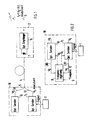
- a message signal source 1 at a first location, which supplies a message signal to be transmitted, for example a digital signal with a bit repetition frequency of approximately 8 Mbit / s.
- This can be, for example, the switching center of the known cellular mobile radio system mentioned at the beginning.
- a radio station 2 At a second location, which is spatially far away from the location of the message signal source 1, there is a radio station 2 which, as in the known system, has the task of transmitting a radio signal which contains the message signal originating from the source 1 by it is modulated with this.
- the radio station 2 can be one of the many fixed stations of a cellular mobile radio system which has the task of transmitting the message signal to the mobile subscribers who are in its radio area, the so-called cell, or it can be a directional radio station which serves to transmit the message signal to send another, far away radio relay station.
- a transmitting antenna 3 which emits the radio signal, the carrier frequency of which is denoted by f 1 in the example.
- a transmission device 10 which, according to the invention, is connected to the remote radio station 2 via an optical fiber 4.
- the transmission of the message signal from its source 1 to the radio station 2 now takes place as follows:
- the message signal modulates an optical transmitter T1 belonging to the transmission device 10, which contains a semiconductor laser as the light source, so that it outputs a modulated carrier oscillation with a certain optical frequency ⁇ 1 at its output.
- a second optical transmitter T0 generates an unmodulated optical carrier oscillation with an optical frequency ⁇ 0.
- the frequencies 0 and ⁇ 1 are chosen so that they differ exactly by the amount f1 that the radio signal to be transmitted by the radio station 2 should have.
- the carrier vibrations are called "carriers" in the following.
- the frequency control device required to comply with the predetermined frequency difference is omitted in FIG. 1. It is explained with reference to FIG. 2. From the outputs of the optical transmitters T1 and T0, the modulated carrier with the optical frequency ⁇ 1 and the unmodulated carrier with the optical frequency ⁇ 0 via an optical fiber L1 and L ,. and an optical fiber coupler 5 are coupled into the optical fiber 4 and via this to remote radio station.
- the transmitted light originating from the different light sources strikes an optical receiver 6, the photodiode 7 of which is shown separately.
- mixing the two light signals produces an electrical signal which contains a component with a frequency which is equal to the difference in the frequencies of the light signals superimposed on one another and which corresponds to the intermediate frequency signal in classic optical heterodyne reception.
- This signal contains the same modulation as the optical output signal of the optical transmitter T1 of the transmission device 10, which can be one of the types of modulation common in the technique of optical heterodyne reception.
- the optical receiver contains a suitable selective element for selecting the signal component with the frequency f 1 from the signal resulting from the mixture. This element can be either a frequency-selective amplifier or a filter tuned to f 1 with a subsequent amplifier.
- the optical waveguide 4 can be a standard single-mode optical waveguide, and with regard to the optical transmitters and optical receivers, no higher requirements are to be made than with any systems that work with optical superimposition reception.
- the two optical carrier vibrations can also be transmitted to the optical receiver via different optical fibers.
- the mixture described for the optical receiver does not take place in the optical waveguide 4 because, in contrast to the photodiode 7, it has linear optical properties.
- a major advantage of the system described is that the optical carrier with the carrier frequency ⁇ 1 is modulated with a signal in the baseband position, ie a signal with a comparatively very low bandwidth. Such modulation is easy to carry out with conventional laser diodes. If necessary, it is particularly advantageous if an optical amplifier can be inserted at a suitable point in the optical waveguide 4, which amplifies the two carrier vibrations without any problems because it has a large bandwidth of 3000 GHz.
- the carrier frequency ⁇ 0 can be equal to 200,000 GHz and the carrier frequency ⁇ 1 can be equal to 200 060 Select GHz.
- the two carrier vibrations then correspond to vacuum wavelengths in the range of 1500 nm.
- Such carrier frequencies can therefore be used advantageously for such a system, and the transmission system according to the invention with superimposed reception is particularly suitable for them, since it would be difficult to transmit a 60 GHz signal by means of direct laser modulation over an optical transmission path or over another transmission medium.
- the frequency control for the optical transmitters T0 and T1 of the transmission device 10 will now be described with reference to FIG. 2.
- the light input into the frequency control device 11 via the optical waveguide LR0 or LR1 can either the rear light of the laser contained in the optical transmitter or a light component that is branched off by the light emitted in the forward direction.
- the control signals pass through control lines S0 and S1 to the respective optical transmitter and influence its optical frequency in such a way that the frequency difference is regulated to the desired value.
- the modulation contained in the light signal with the carrier frequency ⁇ 1 can be suppressed in frequency control by simple low-pass filtering of the signal resulting from the mixing.
- a control signal S is entered.
- Devices for regulating optical signals are known per se, for example from DE-A1 39 07 851.
- a transmission system is now explained with reference to FIG. 3, with which a multiplicity of message signals are transmitted to a multiplicity of radio stations. Since not only a message signal as in FIG. 1 is to be transmitted in the system according to FIG. 3, there is not only one optical transmitter T Sender generating the optical carrier oscillation with the carrier frequency ⁇ 0 further optical transmitter T1, which delivers the modulated with the message signal carrier oscillation of the carrier frequency ⁇ 1, but other optical transmitters, which are consecutively numbered to T n . From a total of n message signals from sources E1 to E n each modulates a one of the optical transmitter T1 to T n, the carrier waves with different optical frequencies ⁇ n ⁇ 1 to produce.
- All of the optical carriers generated by the optical transmitters, the non-modulated carrier with the optical frequency ⁇ 0 and the modulated carrier with the frequencies ⁇ 1 to ⁇ n , are each transmitted via an optical waveguide to a star coupler 20, each having an optical waveguide LL1 to LL n is connected to a radio station R 1 to R n .
- a frequency control device 21 which, in accordance with the frequency control described with reference to FIG. 2, ensures that each of the carrier frequencies of the optical carriers differs from the carrier frequency ⁇ 0, which is to be understood as the reference frequency differs by a value that is equal to the frequency of the assigned radio station.
- each of the radio stations R1 to R n takes place, as is the case for the radio station 2 from FIG. 1 in relation to the Mixing of the two carriers with the frequencies ⁇ 0 and ⁇ 1 is described, a mixture of all carriers instead, so that optical signals with all possible difference frequencies
- an optical amplifier can be inserted at a suitable point in one of the optical waveguides shown.
- Such an amplifier is shown in the example shown between the output of the optical transmitter T0 and the star coupler 20 and is designated by the reference numeral 22.
- the radio stations are extremely simple and cheap, that all devices that determine the frequency of the respective radio signal are centralized in a single location and that components that are used for the transmission of different signals are usable, in particular the optical transmitter T0 delivering the unmodulated carrier oscillation can be used jointly for the transmission of all signals.
- Any frequency control e.g. a control using a frequency hopping method can be accomplished by a central control.
- the following different variants are possible to be selective:
- a second variant provides, as an optical receiver, an electrical microwave oscillator which is tuned to the desired differential frequency and which has a light-sensitive GaAs field-effect transistor or a so-called HEMT (High Electron Mobility Transistor), which is also light-sensitive.
- the latter oscillator is also known as a HEMT oscillator. Even with such an oscillator, there is a mixture of the two received carriers with the result that the oscillator receives the signal resulting from the mixing with the component of the Differential frequency contained modulation is impressed.
- the oscillator is therefore an optically injection-synchronized oscillator.
- This oscillator has a photo-BARITT diode, or a photo-Gunn diode, or a photo-IMPATT diode as the light-sensitive element.
- This oscillator also synchronizes to the difference frequency f i between two received optical carriers and therefore supplies at its output the radio signal of the desired frequency f i modulated with the message signals. It is particularly suitable for frequencies f i that correspond to the wavelength range of the millimeter waves.
- An electrical microwave oscillator with a light-sensitive delay component is also suitable.
- This second invention with the first invention relating to the generation of the radio signal containing a message signal and to be transmitted from a radio station, has the The basic idea in common is that as many transmission and processing devices as possible are moved from the radio station to the remote transmission device and that the transmission between the radio station and the remote transmission device is particularly favorable for high-frequency radio signals in the millimeter wavelength range.
- Fig. 4 shows a communication system with a radio receiving station 40
- the receiving antenna 41 receives a radio signal containing a message signal which corresponds to a carrier with a carrier frequency in the range of millimeter wavelengths, e.g. 61 GHz, is modulated.
- the carrier frequency of this radio signal is designated f1 '.
- the radio receiving station 40 contains a receiver amplifier which amplifies the received radio signal and gives it to the modulation input of an optical modulator 43.
- the message transmission system has a transmission device 44.
- the radio signal received by the radio receiving station 40 is not demodulated in the radio station, but rather is transmitted to the remote transmission device 44 as follows.
- the transmission device 44 contains an optical transmitter 47, which generates an optical carrier with an optical frequency ⁇ 0 '.
- This optical transmitter is connected via an optical waveguide 45 to the optical modulator 43 of the radio receiving station 40, so that the optical carrier is transmitted to the optical modulator at the frequency ⁇ 0 '.
- the optical modulator is a reflection modulator, which has the property that it reflects the light sent back to it via the optical waveguide 45 and modulates it by the signal applied to its modulation input, here the radio signal with the carrier frequency f 1.
- the radio signal with the carrier frequency f 1.
- these two carriers are decoupled from the optical waveguide 45 by means of a directional coupler 46 and transmitted via an optical waveguide piece 53 to the optical input of an optical receiver 48.
- the optical receiver has a photodiode 49 as the photosensitive element.
- the two optical carriers striking the photodiode of the optical receiver generate an electrical signal there by mixing, which contains a component with a frequency that is the same, using the known technique of optical superposition reception is the difference of the carrier frequencies of the superimposed carriers and which corresponds to the intermediate frequency signal in classic optical superposition reception.
- the intermediate frequency signal has the carrier frequency f 1 ', i.e. it is the radio signal.
- the message signal contained therein is finally recovered by a demodulator 50 and thus stands for further processing or, for example Transfer via an exchange ready.
- a demodulator 50 it is also possible for the demodulator 50 not to be present in the transmission device but elsewhere.
- the system is one which can generally be used in any application when the problem arises of transmitting a signal, in particular a high-frequency signal, from a location A to a remote location B without that complex transmission facilities are available at location A.
- a signal in particular a high-frequency signal
- the output of the receiving amplifier 42 it is nothing more than a simple passive optical modulator that must be present at location A. All other facilities required for transmission are located at location B.
- the system is therefore particularly suitable for applications in which location A is difficult to access or where existing facilities are at risk of being destroyed for various reasons.
- the system can also be used in connection with radio relay systems when it comes to building a radio relay station as simply as possible and the relocate expensive equipment to a remote location.
- the system is particularly suitable for use in cellular mobile radio systems for processing the radio signal received in the base stations, since it allows the optical transmitter to be used frequently for a large number of cells, so that overall an inexpensive transmission system is available.
- a fiber-optic amplifier can be used with particular advantage on the optical transmission path between the optical modulator 43 and the transmission device 44, since it has the property of amplifying light passing through it in both transmission directions.
- it is expediently inserted into the optical waveguide 45 in the vicinity of the optical modulator 43, which is omitted in the drawing for the sake of simplicity.
- optical modulator 51 which can be used instead of the optical modulator 43 shown in FIG. 4, which is a reflection modulator, will now be explained with reference to FIG. 5.
- the optical modulator 51 is a modulator which modulates the light passing through it with the signal present at its modulation input. It can therefore be called an optical transmission modulator.
- modulators are also known per se. These are mostly modulators based on lithium niobate.
- a carrier with the carrier frequency arises by modulation with a modulation signal of the frequency f 1' and the original carrier with the frequency ⁇ 0 '. These are coupled into the optical waveguide from the output of the modulator 51 via an optical waveguide and a directional coupler 52, transmitted from there to the remote transmission device 44 and processed as described above.
- the system according to FIG. 1, in which the message signal is to be transmitted from the transmission device 10 to the radio station, and the system according to FIG. 4, in which the message signal is to be transmitted from the radio station to the transmission device 44 can be combined in a bidirectional system.
- the radio transmitting station 2 from FIG. 1 can then advantageously be spatially combined with the radio receiving station 40 from FIG. 4, devices being able to be used multiple times.
- a single optical waveguide in the wavelength division multiplex can be used for both transmission directions by selecting the frequencies such that the frequencies ⁇ 0, ⁇ 1 (and possibly further) in a first wavelength range, for example around 1500 nm, and the frequencies ⁇ 0 'and ⁇ 1' in a second wavelength range, e.g. around 1300 nm.
- Fiber optic wavelength multiplexers / demultiplexers can then be used, as usual, to combine and separate the optical carriers which are thus considerably apart.
Landscapes
- Electromagnetism (AREA)
- Engineering & Computer Science (AREA)
- Computer Networks & Wireless Communication (AREA)
- Signal Processing (AREA)
- Physics & Mathematics (AREA)
- Optical Communication System (AREA)
- Mobile Radio Communication Systems (AREA)
- Radar Systems Or Details Thereof (AREA)
- Light Guides In General And Applications Therefor (AREA)
- Selective Calling Equipment (AREA)
- Investigating Or Analysing Biological Materials (AREA)
- Micro-Organisms Or Cultivation Processes Thereof (AREA)
- Prostheses (AREA)
- Radio Relay Systems (AREA)
Applications Claiming Priority (2)
| Application Number | Priority Date | Filing Date | Title |
|---|---|---|---|
| DE4019224A DE4019224A1 (de) | 1990-06-15 | 1990-06-15 | Funk-nachrichtenuebertragungssystem, insbesondere zellulares mobilfunksystem |
| DE4019224 | 1990-06-15 |
Publications (3)
| Publication Number | Publication Date |
|---|---|
| EP0461380A2 true EP0461380A2 (fr) | 1991-12-18 |
| EP0461380A3 EP0461380A3 (en) | 1993-10-06 |
| EP0461380B1 EP0461380B1 (fr) | 1999-09-08 |
Family
ID=6408505
Family Applications (1)
| Application Number | Title | Priority Date | Filing Date |
|---|---|---|---|
| EP91107082A Expired - Lifetime EP0461380B1 (fr) | 1990-06-15 | 1991-05-02 | Système de transmission de données radio, notamment système de radio mobile cellulaire |
Country Status (12)
| Country | Link |
|---|---|
| US (1) | US5251053A (fr) |
| EP (1) | EP0461380B1 (fr) |
| JP (1) | JP3115644B2 (fr) |
| CN (1) | CN1057556A (fr) |
| AT (1) | ATE184439T1 (fr) |
| AU (1) | AU644441B2 (fr) |
| CA (1) | CA2044670C (fr) |
| DE (2) | DE4019224A1 (fr) |
| ES (1) | ES2135382T3 (fr) |
| FI (1) | FI912785A7 (fr) |
| NO (1) | NO912117L (fr) |
| RU (1) | RU2099881C1 (fr) |
Cited By (2)
| Publication number | Priority date | Publication date | Assignee | Title |
|---|---|---|---|---|
| EP0607868A1 (fr) * | 1993-01-16 | 1994-07-27 | Alcatel SEL Aktiengesellschaft | Transmetteur optique et système de communication |
| WO1997014232A1 (fr) * | 1995-10-13 | 1997-04-17 | British Telecommunications Public Limited Company | Systeme de communication optique |
Families Citing this family (56)
| Publication number | Priority date | Publication date | Assignee | Title |
|---|---|---|---|---|
| US5809395A (en) * | 1991-01-15 | 1998-09-15 | Rogers Cable Systems Limited | Remote antenna driver for a radio telephony system |
| JP2897492B2 (ja) * | 1991-10-24 | 1999-05-31 | 日本電気株式会社 | 移動通信装置 |
| US5528665A (en) * | 1991-12-31 | 1996-06-18 | Peitz Gmbh | Telephone exchange apparatus for both mobile and stationary stations, in which all communication channel pairs are assignable for all stations |
| US5627879A (en) * | 1992-09-17 | 1997-05-06 | Adc Telecommunications, Inc. | Cellular communications system with centralized base stations and distributed antenna units |
| US5377035A (en) * | 1993-09-28 | 1994-12-27 | Hughes Aircraft Company | Wavelength division multiplexed fiber optic link for RF polarization diversity receiver |
| US5457557A (en) * | 1994-01-21 | 1995-10-10 | Ortel Corporation | Low cost optical fiber RF signal distribution system |
| DE4438942A1 (de) * | 1994-10-31 | 1996-05-02 | Sel Alcatel Ag | Optisches Nachrichtenübertragungssystem für Kabelfernsehsignale und für teilnehmerindividuelle Signale |
| DE4444218A1 (de) * | 1994-12-13 | 1996-06-27 | Sel Alcatel Ag | Optische Sendeeinrichtung für ein optisches Nachrichtenübertragungssystem in Verbindung mit einem Funksystem |
| US6043861A (en) * | 1995-06-05 | 2000-03-28 | Motorola, Inc. | Optical waveguide using cholesteric liquid crystal polymer |
| DE19531633A1 (de) * | 1995-08-28 | 1997-07-03 | Whitaker Corp | Optisches Datenkommunikationssystem |
| EP0762674A3 (fr) * | 1995-09-08 | 2001-03-21 | Siemens Aktiengesellschaft | Méthode et circuit pour la transmission de signaux reçus d'une antenne à une station de base d'un système radio |
| US5771452A (en) * | 1995-10-25 | 1998-06-23 | Northern Telecom Limited | System and method for providing cellular communication services using a transcoder |
| US5796506A (en) * | 1995-11-21 | 1998-08-18 | Tsai; Charles Su-Chang | Submillimeter indirect heterodyne receiver and mixer element |
| US5920415A (en) * | 1995-11-21 | 1999-07-06 | The University Of Rochester | Transmission of optical signals |
| JPH09162810A (ja) * | 1995-12-12 | 1997-06-20 | Tokin Corp | 光送受信アンテナ装置 |
| US5710651A (en) * | 1995-12-13 | 1998-01-20 | California Institute Of Technology | Remote millimeter-wave antenna fiber optic communication system using dual optical signal with millimeter-wave beat frequency |
| US5774789A (en) * | 1995-12-14 | 1998-06-30 | Allen Telecom Inc. | RF communication signal distribution system and method |
| US5847853A (en) * | 1995-12-29 | 1998-12-08 | Micron Technology, Inc. | Modulation and demodulation of light to facilitate transmission of information |
| DE19603295A1 (de) * | 1996-01-30 | 1997-07-31 | Siemens Ag | Optische Schnittstelle, insbesondere zur Diagnose einer optoelektronischen Kochstellensteuerung |
| US5880863A (en) * | 1996-02-13 | 1999-03-09 | Gte Laboratories Incorporated | Reconfigurable ring system for the transport of RF signals over optical fibers |
| WO1998004057A1 (fr) * | 1996-07-19 | 1998-01-29 | British Telecommunications Public Limited Company | Systeme de telecommunication capable de recevoir et de moduler simultanement un signal optique |
| US5898906A (en) * | 1996-10-29 | 1999-04-27 | Gec Plessey Semiconductors, Inc. | System and method for implementing a cellular radio transmitter device |
| US6049593A (en) * | 1997-01-17 | 2000-04-11 | Acampora; Anthony | Hybrid universal broadband telecommunications using small radio cells interconnected by free-space optical links |
| US6112086A (en) | 1997-02-25 | 2000-08-29 | Adc Telecommunications, Inc. | Scanning RSSI receiver system using inverse fast fourier transforms for a cellular communications system with centralized base stations and distributed antenna units |
| DE19716323A1 (de) * | 1997-04-18 | 1998-10-22 | Alsthom Cge Alcatel | Modulationseinrichtung zur Modulation digitaler Signale |
| DE19737482A1 (de) | 1997-08-28 | 1999-03-04 | Alsthom Cge Alcatel | Verfahren zur optischen Übertragung über ein Lichtwellenleiternetz, sowie optisches Übertragungsnetz |
| KR100257184B1 (ko) * | 1998-01-31 | 2000-05-15 | 정장호 | 서비스범위 확장을 위한 광중계 시스템 |
| KR100318940B1 (ko) * | 1998-04-17 | 2002-04-22 | 윤종용 | 이동통신시스템에서의호장애시재접속방법 |
| US6704545B1 (en) | 2000-07-19 | 2004-03-09 | Adc Telecommunications, Inc. | Point-to-multipoint digital radio frequency transport |
| US20020114038A1 (en) * | 2000-11-09 | 2002-08-22 | Shlomi Arnon | Optical communication system |
| US20020055371A1 (en) * | 2000-11-09 | 2002-05-09 | Shlomi Arnon | Cellular base station with remote antenna |
| GB2370170B (en) * | 2000-12-15 | 2003-01-29 | Ntl Group Ltd | Signal transmission systems |
| US20030078052A1 (en) * | 2001-05-23 | 2003-04-24 | Celerica, Inc. | Method and apparatus for sharing infrastructure between wireless network operators |
| EP1361683A1 (fr) * | 2002-02-08 | 2003-11-12 | Motorola, Inc. | Détecteur de fréquence radio à partir d'une fréquence optique |
| US7184728B2 (en) | 2002-02-25 | 2007-02-27 | Adc Telecommunications, Inc. | Distributed automatic gain control system |
| ES2198206B2 (es) * | 2002-04-12 | 2004-09-16 | Telefonica, S.A. | Sistema de conexion mediante fibra optica utilizando tecnicas hibridas dwdm/scm entre estaciones base y antenas remotas en un sistema de radiocomunicaciones, asi como metodo de acceso. |
| US8958789B2 (en) | 2002-12-03 | 2015-02-17 | Adc Telecommunications, Inc. | Distributed digital antenna system |
| KR100954263B1 (ko) * | 2003-02-28 | 2010-04-23 | 도쿠리쯔교세이호진 죠호쯔신겡큐기코 | 무선 통신 시스템 |
| RU2349040C2 (ru) * | 2003-05-23 | 2009-03-10 | Леонид Викторович Волков | Способ формирования изображений в миллиметровом и субмиллиметровом диапазоне волн (варианты), система формирования изображений в миллиметровом и субмиллиметровом диапазоне волн (варианты), диффузорный осветитель (варианты) и приемо-передатчик (варианты) |
| RU2320091C2 (ru) * | 2003-05-28 | 2008-03-20 | Леонид Викторович Волков | Система связи миллиметрового и субмиллиметрового диапазона волн (варианты) и приемо-передатчик для системы связи миллиметрового и субмиллиметрового диапазона волн и способ связи в субмиллиметровом диапазоне волн |
| JP4535423B2 (ja) * | 2003-12-25 | 2010-09-01 | 日本電信電話株式会社 | 光送信器及び光−無線融合通信システム |
| JP3841793B2 (ja) * | 2004-02-26 | 2006-11-01 | 独立行政法人情報通信研究機構 | 無線光融合通信システムにおける周波数変換方法及び基地局 |
| IL161869A (en) | 2004-05-06 | 2014-05-28 | Serconet Ltd | A system and method for carrying a signal originating is wired using wires |
| US7813451B2 (en) | 2006-01-11 | 2010-10-12 | Mobileaccess Networks Ltd. | Apparatus and method for frequency shifting of a wireless signal and systems using frequency shifting |
| US7599711B2 (en) * | 2006-04-12 | 2009-10-06 | Adc Telecommunications, Inc. | Systems and methods for analog transport of RF voice/data communications |
| US8737454B2 (en) | 2007-01-25 | 2014-05-27 | Adc Telecommunications, Inc. | Modular wireless communications platform |
| US8583100B2 (en) | 2007-01-25 | 2013-11-12 | Adc Telecommunications, Inc. | Distributed remote base station system |
| WO2009053910A2 (fr) | 2007-10-22 | 2009-04-30 | Mobileaccess Networks Ltd. | Système de communication utilisant des fils à faible bande passante |
| US8175649B2 (en) | 2008-06-20 | 2012-05-08 | Corning Mobileaccess Ltd | Method and system for real time control of an active antenna over a distributed antenna system |
| CN102232191B (zh) | 2009-02-08 | 2015-07-08 | 康宁移动接入有限公司 | 采用携带以太网信号的电缆的通信系统 |
| US9001811B2 (en) | 2009-05-19 | 2015-04-07 | Adc Telecommunications, Inc. | Method of inserting CDMA beacon pilots in output of distributed remote antenna nodes |
| WO2013142662A2 (fr) | 2012-03-23 | 2013-09-26 | Corning Mobile Access Ltd. | Puce(s) de circuit intégré à radiofréquence (rfic) servant à fournir des fonctionnalités de système d'antenne à répartition, et composants, systèmes, et procédés connexes |
| WO2015126828A1 (fr) | 2014-02-18 | 2015-08-27 | Commscope Technologiees Llc | Combinaison sélective de signaux en liaison montante dans des systèmes d'antennes distribués |
| US9184960B1 (en) | 2014-09-25 | 2015-11-10 | Corning Optical Communications Wireless Ltd | Frequency shifting a communications signal(s) in a multi-frequency distributed antenna system (DAS) to avoid or reduce frequency interference |
| FR3030954A1 (fr) * | 2014-12-17 | 2016-06-24 | Thales Sa | Composant optoelectronique pour generer et rayonner un signal hyperfrequence |
| US10499269B2 (en) | 2015-11-12 | 2019-12-03 | Commscope Technologies Llc | Systems and methods for assigning controlled nodes to channel interfaces of a controller |
Family Cites Families (14)
| Publication number | Priority date | Publication date | Assignee | Title |
|---|---|---|---|---|
| DE240475C (fr) * | ||||
| GB346925A (en) * | 1930-03-04 | 1931-04-23 | Burgess And Sons Ltd B | Improvements in striking plates for use in connection with locks and latches |
| US3513433A (en) * | 1968-01-15 | 1970-05-19 | Trw Inc | Electrical grounding bracket |
| US3546465A (en) * | 1968-05-13 | 1970-12-08 | Bell Telephone Labor Inc | Light communication system utilizing tandem broadband and pilot frequency amplification |
| US4553101A (en) * | 1983-09-21 | 1985-11-12 | General Dynamis Electronics Division | Fast frequency hopping demodulation system with serial accumulation of signal |
| US4658096A (en) * | 1984-09-18 | 1987-04-14 | Metrofone, Inc. | System for interfacing a standard telephone set with a radio transceiver |
| GB8709073D0 (en) * | 1987-04-15 | 1987-05-20 | British Telecomm | Coherent optical systems |
| DE3713340A1 (de) * | 1987-04-21 | 1988-11-10 | Deutsche Bundespost | Verfahren zur optischen nachrichtenuebertragung |
| US4916296A (en) * | 1987-10-29 | 1990-04-10 | Jerry R. Iggulden | Light modulating smart card |
| GB2214755B (en) * | 1988-01-29 | 1992-06-24 | Walmore Electronics Limited | Distributed antenna system |
| SE460807B (sv) * | 1988-03-11 | 1989-11-20 | Ericsson Telefon Ab L M | Anording foer att utsaenda en koherent frekvensmodulerad optisk signal |
| GB8826476D0 (en) * | 1988-11-11 | 1988-12-14 | British Telecomm | Communications system |
| USH850H (en) * | 1988-11-25 | 1990-11-06 | Single optical fiber slave/master transmision system | |
| DE4008165A1 (de) * | 1990-02-01 | 1991-08-08 | Standard Elektrik Lorenz Ag | Zellulares mobilfunksystem |
-
1990
- 1990-06-15 DE DE4019224A patent/DE4019224A1/de not_active Withdrawn
-
1991
- 1991-05-02 DE DE59109149T patent/DE59109149D1/de not_active Expired - Fee Related
- 1991-05-02 AT AT91107082T patent/ATE184439T1/de not_active IP Right Cessation
- 1991-05-02 EP EP91107082A patent/EP0461380B1/fr not_active Expired - Lifetime
- 1991-05-02 ES ES91107082T patent/ES2135382T3/es not_active Expired - Lifetime
- 1991-06-03 NO NO91912117A patent/NO912117L/no unknown
- 1991-06-04 US US07/710,158 patent/US5251053A/en not_active Expired - Fee Related
- 1991-06-07 AU AU78236/91A patent/AU644441B2/en not_active Ceased
- 1991-06-10 FI FI912785A patent/FI912785A7/fi unknown
- 1991-06-14 RU SU914895569A patent/RU2099881C1/ru active
- 1991-06-14 CA CA002044670A patent/CA2044670C/fr not_active Expired - Fee Related
- 1991-06-14 JP JP03143548A patent/JP3115644B2/ja not_active Expired - Fee Related
- 1991-06-15 CN CN91103971A patent/CN1057556A/zh active Pending
Cited By (2)
| Publication number | Priority date | Publication date | Assignee | Title |
|---|---|---|---|---|
| EP0607868A1 (fr) * | 1993-01-16 | 1994-07-27 | Alcatel SEL Aktiengesellschaft | Transmetteur optique et système de communication |
| WO1997014232A1 (fr) * | 1995-10-13 | 1997-04-17 | British Telecommunications Public Limited Company | Systeme de communication optique |
Also Published As
| Publication number | Publication date |
|---|---|
| JPH04233339A (ja) | 1992-08-21 |
| CN1057556A (zh) | 1992-01-01 |
| ES2135382T3 (es) | 1999-11-01 |
| RU2099881C1 (ru) | 1997-12-20 |
| DE59109149D1 (de) | 1999-10-14 |
| FI912785A0 (fi) | 1991-06-10 |
| CA2044670A1 (fr) | 1991-12-16 |
| DE4019224A1 (de) | 1991-12-19 |
| EP0461380B1 (fr) | 1999-09-08 |
| FI912785A7 (fi) | 1991-12-16 |
| ATE184439T1 (de) | 1999-09-15 |
| NO912117L (no) | 1991-12-16 |
| NO912117D0 (no) | 1991-06-03 |
| CA2044670C (fr) | 1998-10-06 |
| AU7823691A (en) | 1991-12-19 |
| EP0461380A3 (en) | 1993-10-06 |
| US5251053A (en) | 1993-10-05 |
| AU644441B2 (en) | 1993-12-09 |
| JP3115644B2 (ja) | 2000-12-11 |
Similar Documents
| Publication | Publication Date | Title |
|---|---|---|
| EP0461380B1 (fr) | Système de transmission de données radio, notamment système de radio mobile cellulaire | |
| DE69013662T2 (de) | Schmalbandige Laserquelle. | |
| DE69432850T2 (de) | Optischer Wellenlängenmultiplexer hoher Dichte | |
| EP0354567B1 (fr) | Ensemble émission-réception pour un système de communication bidirectionnel cohérent et optique | |
| DE69535053T2 (de) | Abstimmbare optische Einfüge-/Abzweigmethode und -apparat | |
| DE3782556T2 (de) | Lichtuebertragungssystem. | |
| DE69021678T2 (de) | Asynchrones optisches Zeitmultiplex-Kommunikationssystem. | |
| DE69705698T2 (de) | Drahlose Übertragungssysteme mit im freien Raum optischen Übertragungsstrecken | |
| DE69127215T2 (de) | Optisches Übertragungsverfahren und optisches Übertragungssystem | |
| DE69116949T2 (de) | Verfahren und Vorrichtung zur drahtlosen Kommunikation zwischen entfernten Lagen | |
| EP0077292A1 (fr) | Réseau de communication utilisant des fibres monomodes comme moyen de transmission pour les canaux optiques multiplexés dans le domaine de fréquences d'ondes optiques porteuses | |
| DE69600033T2 (de) | Verfahren zur Verwaltung eines optischen Ringes mit Wellenlängenmultiplex | |
| DE3871604T2 (de) | Sender und senderempfaenger fuer ein kohaerentes optisches system. | |
| EP0883253B1 (fr) | Procédé et dispositif d'optimisation de connexions optiques entre satellites | |
| DE3632047C2 (de) | Optisches Nachrichtenübertragungssystem für Schmalband- und Breitband-Nachrichtensignale | |
| DE2738624C2 (de) | System zur zweiseitigen Übertragung zwischen einer Hauptstation und n Nebenstationen | |
| EP0440081A2 (fr) | Système de radio mobile cellulaire | |
| DE69011701T2 (de) | Lichtwellenleiter-Übertragungsnetz mit Frequenzmultiplexierung. | |
| DE69023768T2 (de) | Optisches Übertragungsnetzwerk mit Frequenzverkopplungsmitteln. | |
| DE69431786T2 (de) | Übertragungsnetz mit Vielfachzugriff und Unterträger | |
| DE3140402C1 (en) | Information transmission system (telecommunications system) which consists of networks and uses a channel group by means of frequency jumps | |
| EP0288418B1 (fr) | Procédé pour la transmission optique d'informations à réception hétérodyne | |
| WO2021175969A1 (fr) | Système à distribution de porteuses optiques | |
| EP0717514A2 (fr) | Dispositif émetteur optique pour système de télécommunication optique associé à un système radio | |
| DE69323694T2 (de) | Übertragungsnetz mit Vielfachzugriff |
Legal Events
| Date | Code | Title | Description |
|---|---|---|---|
| PUAI | Public reference made under article 153(3) epc to a published international application that has entered the european phase |
Free format text: ORIGINAL CODE: 0009012 |
|
| AK | Designated contracting states |
Kind code of ref document: A2 Designated state(s): AT BE CH DE DK ES FR GB IT LI NL SE |
|
| RAP3 | Party data changed (applicant data changed or rights of an application transferred) |
Owner name: ALCATEL N.V. Owner name: ALCATEL SEL AKTIENGESELLSCHAFT |
|
| PUAL | Search report despatched |
Free format text: ORIGINAL CODE: 0009013 |
|
| AK | Designated contracting states |
Kind code of ref document: A3 Designated state(s): AT BE CH DE DK ES FR GB IT LI NL SE |
|
| 17P | Request for examination filed |
Effective date: 19940221 |
|
| 17Q | First examination report despatched |
Effective date: 19961104 |
|
| GRAG | Despatch of communication of intention to grant |
Free format text: ORIGINAL CODE: EPIDOS AGRA |
|
| GRAG | Despatch of communication of intention to grant |
Free format text: ORIGINAL CODE: EPIDOS AGRA |
|
| GRAG | Despatch of communication of intention to grant |
Free format text: ORIGINAL CODE: EPIDOS AGRA |
|
| GRAH | Despatch of communication of intention to grant a patent |
Free format text: ORIGINAL CODE: EPIDOS IGRA |
|
| GRAH | Despatch of communication of intention to grant a patent |
Free format text: ORIGINAL CODE: EPIDOS IGRA |
|
| GRAA | (expected) grant |
Free format text: ORIGINAL CODE: 0009210 |
|
| RAP1 | Party data changed (applicant data changed or rights of an application transferred) |
Owner name: ALCATEL |
|
| AK | Designated contracting states |
Kind code of ref document: B1 Designated state(s): AT BE CH DE DK ES FR GB IT LI NL SE |
|
| PG25 | Lapsed in a contracting state [announced via postgrant information from national office to epo] |
Ref country code: NL Free format text: LAPSE BECAUSE OF FAILURE TO SUBMIT A TRANSLATION OF THE DESCRIPTION OR TO PAY THE FEE WITHIN THE PRESCRIBED TIME-LIMIT Effective date: 19990908 |
|
| REF | Corresponds to: |
Ref document number: 184439 Country of ref document: AT Date of ref document: 19990915 Kind code of ref document: T |
|
| ITF | It: translation for a ep patent filed | ||
| REG | Reference to a national code |
Ref country code: CH Ref legal event code: EP |
|
| REF | Corresponds to: |
Ref document number: 59109149 Country of ref document: DE Date of ref document: 19991014 |
|
| REG | Reference to a national code |
Ref country code: ES Ref legal event code: FG2A Ref document number: 2135382 Country of ref document: ES Kind code of ref document: T3 |
|
| PG25 | Lapsed in a contracting state [announced via postgrant information from national office to epo] |
Ref country code: DK Free format text: LAPSE BECAUSE OF FAILURE TO SUBMIT A TRANSLATION OF THE DESCRIPTION OR TO PAY THE FEE WITHIN THE PRESCRIBED TIME-LIMIT Effective date: 19991208 |
|
| ET | Fr: translation filed | ||
| NLV1 | Nl: lapsed or annulled due to failure to fulfill the requirements of art. 29p and 29m of the patents act | ||
| PG25 | Lapsed in a contracting state [announced via postgrant information from national office to epo] |
Ref country code: AT Free format text: LAPSE BECAUSE OF NON-PAYMENT OF DUE FEES Effective date: 20000502 |
|
| PG25 | Lapsed in a contracting state [announced via postgrant information from national office to epo] |
Ref country code: LI Free format text: LAPSE BECAUSE OF NON-PAYMENT OF DUE FEES Effective date: 20000531 Ref country code: CH Free format text: LAPSE BECAUSE OF NON-PAYMENT OF DUE FEES Effective date: 20000531 Ref country code: BE Free format text: LAPSE BECAUSE OF NON-PAYMENT OF DUE FEES Effective date: 20000531 |
|
| PLBE | No opposition filed within time limit |
Free format text: ORIGINAL CODE: 0009261 |
|
| STAA | Information on the status of an ep patent application or granted ep patent |
Free format text: STATUS: NO OPPOSITION FILED WITHIN TIME LIMIT |
|
| 26N | No opposition filed | ||
| BERE | Be: lapsed |
Owner name: ALCATEL Effective date: 20000531 |
|
| REG | Reference to a national code |
Ref country code: CH Ref legal event code: PL |
|
| REG | Reference to a national code |
Ref country code: GB Ref legal event code: IF02 |
|
| PGFP | Annual fee paid to national office [announced via postgrant information from national office to epo] |
Ref country code: GB Payment date: 20030428 Year of fee payment: 13 |
|
| PGFP | Annual fee paid to national office [announced via postgrant information from national office to epo] |
Ref country code: SE Payment date: 20030505 Year of fee payment: 13 |
|
| PGFP | Annual fee paid to national office [announced via postgrant information from national office to epo] |
Ref country code: FR Payment date: 20030512 Year of fee payment: 13 |
|
| PGFP | Annual fee paid to national office [announced via postgrant information from national office to epo] |
Ref country code: DE Payment date: 20030514 Year of fee payment: 13 |
|
| PGFP | Annual fee paid to national office [announced via postgrant information from national office to epo] |
Ref country code: ES Payment date: 20030516 Year of fee payment: 13 |
|
| PG25 | Lapsed in a contracting state [announced via postgrant information from national office to epo] |
Ref country code: GB Free format text: LAPSE BECAUSE OF NON-PAYMENT OF DUE FEES Effective date: 20040502 |
|
| PG25 | Lapsed in a contracting state [announced via postgrant information from national office to epo] |
Ref country code: SE Free format text: LAPSE BECAUSE OF NON-PAYMENT OF DUE FEES Effective date: 20040503 Ref country code: ES Free format text: LAPSE BECAUSE OF NON-PAYMENT OF DUE FEES Effective date: 20040503 |
|
| PG25 | Lapsed in a contracting state [announced via postgrant information from national office to epo] |
Ref country code: DE Free format text: LAPSE BECAUSE OF NON-PAYMENT OF DUE FEES Effective date: 20041201 |
|
| GBPC | Gb: european patent ceased through non-payment of renewal fee |
Effective date: 20040502 |
|
| EUG | Se: european patent has lapsed | ||
| PG25 | Lapsed in a contracting state [announced via postgrant information from national office to epo] |
Ref country code: FR Free format text: LAPSE BECAUSE OF NON-PAYMENT OF DUE FEES Effective date: 20050131 |
|
| REG | Reference to a national code |
Ref country code: FR Ref legal event code: ST |
|
| PG25 | Lapsed in a contracting state [announced via postgrant information from national office to epo] |
Ref country code: IT Free format text: LAPSE BECAUSE OF NON-PAYMENT OF DUE FEES;WARNING: LAPSES OF ITALIAN PATENTS WITH EFFECTIVE DATE BEFORE 2007 MAY HAVE OCCURRED AT ANY TIME BEFORE 2007. THE CORRECT EFFECTIVE DATE MAY BE DIFFERENT FROM THE ONE RECORDED. Effective date: 20050502 |
|
| REG | Reference to a national code |
Ref country code: ES Ref legal event code: FD2A Effective date: 20040503 |