EP0463706B2 - Cloning and expression of xylanase genes from fungal origin - Google Patents
Cloning and expression of xylanase genes from fungal origin Download PDFInfo
- Publication number
- EP0463706B2 EP0463706B2 EP91201944A EP91201944A EP0463706B2 EP 0463706 B2 EP0463706 B2 EP 0463706B2 EP 91201944 A EP91201944 A EP 91201944A EP 91201944 A EP91201944 A EP 91201944A EP 0463706 B2 EP0463706 B2 EP 0463706B2
- Authority
- EP
- European Patent Office
- Prior art keywords
- xylanase
- dna
- gene
- polypeptide
- expression
- Prior art date
- Legal status (The legal status is an assumption and is not a legal conclusion. Google has not performed a legal analysis and makes no representation as to the accuracy of the status listed.)
- Expired - Lifetime
Links
- MGQCQGRVOKDRKC-UHFFFAOYSA-N CCC(CC1)CC1=C Chemical compound CCC(CC1)CC1=C MGQCQGRVOKDRKC-UHFFFAOYSA-N 0.000 description 1
Images








Classifications
-
- C—CHEMISTRY; METALLURGY
- C12—BIOCHEMISTRY; BEER; SPIRITS; WINE; VINEGAR; MICROBIOLOGY; ENZYMOLOGY; MUTATION OR GENETIC ENGINEERING
- C12N—MICROORGANISMS OR ENZYMES; COMPOSITIONS THEREOF; PROPAGATING, PRESERVING, OR MAINTAINING MICROORGANISMS; MUTATION OR GENETIC ENGINEERING; CULTURE MEDIA
- C12N15/00—Mutation or genetic engineering; DNA or RNA concerning genetic engineering, vectors, e.g. plasmids, or their isolation, preparation or purification; Use of hosts therefor
- C12N15/09—Recombinant DNA-technology
- C12N15/11—DNA or RNA fragments; Modified forms thereof; Non-coding nucleic acids having a biological activity
- C12N15/52—Genes encoding for enzymes or proenzymes
-
- A—HUMAN NECESSITIES
- A21—BAKING; EDIBLE DOUGHS
- A21D—TREATMENT OF FLOUR OR DOUGH FOR BAKING, e.g. BY ADDITION OF MATERIALS; BAKING; BAKERY PRODUCTS
- A21D8/00—Methods for preparing or baking dough
- A21D8/02—Methods for preparing dough; Treating dough prior to baking
- A21D8/04—Methods for preparing dough; Treating dough prior to baking treating dough with microorganisms or enzymes
- A21D8/042—Methods for preparing dough; Treating dough prior to baking treating dough with microorganisms or enzymes with enzymes
-
- A—HUMAN NECESSITIES
- A23—FOODS OR FOODSTUFFS; TREATMENT THEREOF, NOT COVERED BY OTHER CLASSES
- A23K—FODDER
- A23K10/00—Animal feeding-stuffs
- A23K10/10—Animal feeding-stuffs obtained by microbiological or biochemical processes
- A23K10/14—Pretreatment of feeding-stuffs with enzymes
-
- A—HUMAN NECESSITIES
- A23—FOODS OR FOODSTUFFS; TREATMENT THEREOF, NOT COVERED BY OTHER CLASSES
- A23K—FODDER
- A23K20/00—Accessory food factors for animal feeding-stuffs
- A23K20/10—Organic substances
- A23K20/189—Enzymes
-
- A—HUMAN NECESSITIES
- A23—FOODS OR FOODSTUFFS; TREATMENT THEREOF, NOT COVERED BY OTHER CLASSES
- A23K—FODDER
- A23K30/00—Processes specially adapted for preservation of materials in order to produce animal feeding-stuffs
- A23K30/10—Processes specially adapted for preservation of materials in order to produce animal feeding-stuffs of green fodder
- A23K30/15—Processes specially adapted for preservation of materials in order to produce animal feeding-stuffs of green fodder using chemicals or microorganisms for ensilaging
- A23K30/18—Processes specially adapted for preservation of materials in order to produce animal feeding-stuffs of green fodder using chemicals or microorganisms for ensilaging using microorganisms or enzymes
-
- C—CHEMISTRY; METALLURGY
- C12—BIOCHEMISTRY; BEER; SPIRITS; WINE; VINEGAR; MICROBIOLOGY; ENZYMOLOGY; MUTATION OR GENETIC ENGINEERING
- C12N—MICROORGANISMS OR ENZYMES; COMPOSITIONS THEREOF; PROPAGATING, PRESERVING, OR MAINTAINING MICROORGANISMS; MUTATION OR GENETIC ENGINEERING; CULTURE MEDIA
- C12N9/00—Enzymes; Proenzymes; Compositions thereof; Processes for preparing, activating, inhibiting, separating or purifying enzymes
- C12N9/14—Hydrolases (3)
- C12N9/24—Hydrolases (3) acting on glycosyl compounds (3.2)
- C12N9/2402—Hydrolases (3) acting on glycosyl compounds (3.2) hydrolysing O- and S- glycosyl compounds (3.2.1)
- C12N9/2477—Hemicellulases not provided in a preceding group
- C12N9/248—Xylanases
- C12N9/2482—Endo-1,4-beta-xylanase (3.2.1.8)
-
- C—CHEMISTRY; METALLURGY
- C12—BIOCHEMISTRY; BEER; SPIRITS; WINE; VINEGAR; MICROBIOLOGY; ENZYMOLOGY; MUTATION OR GENETIC ENGINEERING
- C12Y—ENZYMES
- C12Y302/00—Hydrolases acting on glycosyl compounds, i.e. glycosylases (3.2)
- C12Y302/01—Glycosidases, i.e. enzymes hydrolysing O- and S-glycosyl compounds (3.2.1)
- C12Y302/01008—Endo-1,4-beta-xylanase (3.2.1.8)
-
- C—CHEMISTRY; METALLURGY
- C12—BIOCHEMISTRY; BEER; SPIRITS; WINE; VINEGAR; MICROBIOLOGY; ENZYMOLOGY; MUTATION OR GENETIC ENGINEERING
- C12Y—ENZYMES
- C12Y302/00—Hydrolases acting on glycosyl compounds, i.e. glycosylases (3.2)
- C12Y302/01—Glycosidases, i.e. enzymes hydrolysing O- and S-glycosyl compounds (3.2.1)
- C12Y302/01032—Xylan endo-1,3-beta-xylosidase (3.2.1.32), i.e. endo-1-3-beta-xylanase
Definitions
- Monocotyledons e.g. cereals and grasses
- dicotyledons e.g. clover, rapeseed and soybean
- Monocotyledons are characterized by the presence of an arabinoxylan complex as the major hemicellulose backbone.
- the main structure of hemicellulose in dicotyledons is a xyloglucan complex.
- higher pectin concentrations are found in dicotyledons than in monocotyledons. Seeds are generally very high in pectic substances but relatively low in cellulosic material.
- the primary cell wall of mature, metabolically active plant cells e.g. mesophyll and epidermis
- mesophyll and epidermis are more susceptible to enzymatic hydrolysis than the secondary cell wall, which by this stage, has become highly lignified.
- Filamentous fungi are widely known for their capacity to secrete large amounts of a variety of hydrolytic enzymes such as ⁇ -amylases, proteases and amyloglucosidases and various plant cell wall degrading enzymes such as cellulases, hemicellulases, and pectinases.
- hydrolytic enzymes such as ⁇ -amylases, proteases and amyloglucosidases and various plant cell wall degrading enzymes such as cellulases, hemicellulases, and pectinases.
- xylan-degrading enzymes have been recognized, which have been shown to possess a variety of biochemical and physical properties. This heterogeneity in xylanase function allows for the selection of a xylanase of interest which is best suited for a desired application (see Wong et al . (1988), Woodward (1984) and Dekker and Richards (1977)).
- xylanases of various molecular weights are known to be produced by micro-organisms such as Aspergillus niger , Clostridium thermocellum , Trichoderma reesei , Penicillium janthinellum , as well as species of Bacillus and Streptomyces.
- microbial xylanases are always produced together with other enzymes having polysaccharide-degrading activities, such as exo-arabinanase, acetyl esterase and cellulases. For some applications, these enzyme activities are not needed or are unwanted.
- fungal xylanases have a pH optimum in the range of between pH 3.5 - 5.5 as compared to bacterial xylanases which generally have a pH optimum in the range of pH 5.0 - 7.0.
- Fungal xylanases also generally have a broader pH stability range (pH 3 - 10) than do their bacterial counterparts (pH 5.0 - 7.5).
- Fungal xylanases generally have a temperature optimum of about 50°C.
- Bacterial xylanases generally have a temperature optimum between 50°C and 70°C.
- bacterial xylanases are less suitable for use in, for example, processes requiring lower pH conditions. In other instances, bacterial xylanases are too thermostable for certain applications such as the lagering of beer (see European Patent No. 227.159 ).
- genes encoding xylan-degrading enzymes of fungal origin which may be brought to expression in other, high-producing microbial expression hosts.
- the present invention provides purified and isolated DNA sequences of fungal origin, as defined in claim 1, which encode a protein having xylan-degrading activity. These DNA sequences include the xylanase encoding sequence and preferably the adjacent 5' and 3' regulatory sequences as well.
- an industrial process requires xylanase activity at a lower pH than that at which xylanases of bacterial origin optimally function.
- the present invention describes purified and isolated DNA sequences of fungal origin which encode a xylanase and genetic variants thereof, as defined in claim 1.
- the DNA sequence preferably includes the xylanase-encoding sequence and adjacent 5' and 3' regulatory sequences.
- Genetic variants include hybrid DNA sequences containing the xylanase-encoding sequence coupled to regulatory regions, such as promoter, secretion and terminator signals, originating from homologous or heterologous organisms. Genetic variants also include degenerate DNA sequences wherein the xylan-degrading activity of the enzyme is retained.
- the present invention also provides DNA constructs vectors as defined in the claims for the expression of a xylanase of interest in a desired expression host.
- These include hybrid DNA sequences containing the xylanase-encoding region operably linked to regulatory regions, such as promoter, secretion and terminator signals originating from homologous or heterologous organisms, these regulatory regions being capable of directing the overexpression of the enzyme encoded by the xylanase-encoding DNA sequence in an appropriate host.
- the expression construct will be integrated into the genome of the selected expression host.
- homologous is understood to intend all that which is native to the DNA sequence encoding the xylanase of interest, including its regulatory regions.
- a homologous host is defined as the species from which such DNA sequence may be isolated.
- heterologous is thus defined as all that which is not native to the DNA sequence encoding the xylanase of interest itself, including regulatory regions.
- a “heterologous” host is defined as any microbial species other than that from which the xylanase-encoding gene has been isolated.
- the endo-xylanase may be identified via assay methods not critical to the present invention, such as a spot test assay.
- a filtrate obtained from the culturing of a microorganism induced (e.g. with oat spelt xylan) to produce an endo-xylanase may be tested for the presence of endo-xylanase activity.
- Drops of the elution fractions are placed individually onto an agar film containing a citrate-phosphate buffer (see Example 1.1, below) and oat spelt xylan. The film is then incubated. If endo-xylanase activity is present, the location of the individual drops on the agar film are visibly clear.
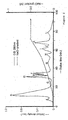
- the DNA sequence encoding such xylanase may be obtained from the filamentous fungus which naturally produces it by culturing the fungus in a xylan-containing medium, isolating the desired xylanase using known methods such, as column chromatography (e.g. HPLC - see Figure 2 ) and determining at least a portion of the amino acid sequence of the purified protein.
- column chromatography e.g. HPLC - see Figure 2
- DNA probes may thereafter be designed by synthesizing oligonucleotide sequences based on the partial amino acid sequence. Amino acid sequences may be determined from the N-terminus of the complete protein and/or from the N-termini of internal peptide fragments obtained via proteolytic or chemical digestion of the complete protein. Once obtained, the DNA probe(s) are then used to screen a genomic or cDNA library.
- the genomic library may be differentially screened with cDNA probes obtained from mRNA from non-induced and induced cells.
- Induced mRNA is prepared from cells grown on media containing xylan as a carbon source, while non-induced mRNA must be isolated from cells grown on a carbon source other than xylan, e.g. glucose.
- a clone containing the desired xylanase gene may be recovered.
- the xylanase gene may be identified by cross-hybridization with a related xylanase sequence.
- a genomic library may be prepared by partially digesting the fungal chromosomal DNA with a suitable restriction enzyme, e.g. Sau 3A, and cloning the resulting fragments in a suitable plasmid or lambda phage vector, e.g. lambda EMBL 3. Subsequently, after plating of a sufficient amount of colonies or plaques, the genomic or cDNA library may be screened with a suitable DNA probe.
- a suitable restriction enzyme e.g. Sau 3A
- a cDNA library may be prepared by cloning cDNA, synthesized from mRNA isolated from fungal cells induced for the synthesis of xylanase, into an appropriate phage vector, e.g. lambda gt 10 or lambda gt 11.
- the cDNA library may then be screened with a DNA probe, or alternatively using immunological means or via a plate assay.
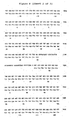
- the nucleotide sequence comprises a xylanase coding sequence of 681 bp (which is interrupted by one small intron of 49 bp from position 1179 to 1230), as well as sequences of 949 and 423 nucleotides of the 5' and 3' flanking regions, respectively.
- PCR polymerase chain reaction
- an uninterrupted (intronless) DNA sequence is used for the construction of a heterologous expression vector in order to avoid the possibility that splice signals residing on the genomic fragment are not recognized by the heterologous host.
- This uninterrupted DNA sequence may be obtained from a cDNA library constructed from mRNA isolated from cells, induced for the synthesis of xylanases. This library may be screened with an oligonucleotide or cDNA probe obtained as described before.
- an uninterrupted DNA sequence may be obtained by applying a polymerase chain reaction using appropriate 5' and 3' oligonucleotides on the first strand cDNA synthesized from the RNA of xylan-induced cells.
- overexpression is defined as the expression of the xylanase of interest at levels above that which are ordinarily encountered in the homologous wild-type organism.
- overexpression also intends the expression of the xylanase of interest in a heterologous organism which does not normally produce such xylanase except for the introduction of the DNA sequence encoding the xylanase of interest into the heterologous expression host. Progeny of these expression hosts are, of course, also to be understood to be embraced by the present invention.
- Overexpression of the xylanase of interest may also be achieved by the selection of heterologous regulatory regions, e.g promoter, secretion leader and terminator regions, which serve to increase expression and, if desired, secretion levels of the protein of interest from the chosen expression host and/or to provide for the inducible control of the expression of the xylanase of interest.
- heterologous regulatory regions e.g promoter, secretion leader and terminator regions
- promoters may be used to direct its expression.
- the promoter may be selected for its efficiency in directing the expression of the xylanase of interest in the desired expression host.
- a constitutive promoter may be selected to direct the expression of the desired xylanase, relatively free from other xylanases.
- Such an expression construct is furthermore advantageous since it circumvents the need to culture the expression hosts on a medium containing solid xylans as an inducing substrate.
- strong bacterial promoters are the ⁇ -amylase and Spo 2 promoters as well as promoters from extracellular protease genes.
- Hybrid promoters may also advantageously be used to improve inducible regulation of the expression construct.
- Preferred promoters according to the present invention are those originating from the amyloglucosidase (AG) gene and native xylanase promoters.
- the xylanase of interest it is often desirable for the xylanase of interest to be secreted from the expression host into the culture medium from where the xylanase may be more easily recovered.
- the secretion leader may be selected on the basis of the desired expression host.
- a heterologous secretion leader may be chosen which is homologous to the other regulatory regions of the expression construct.
- the leader of the highly secreted amyloglucosidase protein may be used in combination with the amyloglucosidase promoter itself, as well as in combination with other promoters.
- Hybrid signal sequences may also advantageously be used within the context of the present invention.
- Most preferred secretion leader sequences according to the present invention are the those originating from the amyloglucosidase (AG) gene and the native xylanase leader sequence.
- terminators are not considered to be critical elements for the overexpression of genes.
- a terminator may be selected from the same genes as the promoters, or alternatively, the homologous terminator may be employed.
- the transforming DNA may contain a selection marker to discriminate cells which have incorporated the desired gene from the bulk of untransformed cells.
- This selection marker provided with the appropriate 5' and 3' regulatory sequences, may reside on the same DNA molecule containing the desired gene or be present on a separate molecule. In the latter case, a co-transformation must be performed. The ratio of the expression vector/selection vector must be adjusted in such a manner that a high percentage of the selected transformants also have incorporated the vector containing the expression construct of the xylanase of interest.
- the desired expression construct is transformed into a suitable cloning host such as E. coli to propagate the construct. Afterwards, the expression construct is introduced into a suitable expression host wherein the expression construct is preferably integrated into the genome. Certain hosts such as Bacillus species may be used as both cloning and expression hosts, thus avoiding an extra transformation step.
- Factors such as the size (molecular weight), the possible need for glycosylation or the desirability of the extracellular secretion of the xylanase of interest play an important role in the selection of the expression host.
- E. coli The gram-negative bacterium E. coli is widely used as a host for heterologous gene expression, but mostly accumulates large amounts of heterologous protein inside the cell. Subsequent purification of the desired protein from the bulk of E. coli intracellular proteins can sometimes be difficult.
- bacteria from the genus Bacillus are very suitable as heterologous hosts because of their capability to secrete proteins into the culture medium.
- a heterologous host selected from the group of yeasts or fungi may be preferred.
- yeast cells are preferred over fungal cells because they are easier to manipulate.
- some proteins are either poorly secreted from the yeast cell, or in some cases are not processed properly (e.g. hyperglycosylation in yeast). In these instances, a fungal host organism should be selected.
- the overexpression of the xylanase of interest is effected by the culturing of the expression hosts, which have been transformed with the xylanase expression construct, in a conventional nutrient fermentation medium.
- the selection of the appropriate medium may be based on the choice of expression hosts and/or based on the regulatory requirements of the expression construct. Such media are well-known to those skilled in the art.
- the medium may, if desired, contain additional components favoring the transformed expression hosts over other potentially contaminating microorganisms.
- the fermentation is performed over a period of 0.5-20 days in a batch or fed-batch process at a temperature in the range of between 0 and 45 °C and a pH between 2 and 10.
- Preferred fermentation conditions are a temperature in the range of between 20 and 37 °C and a pH between 3 and 9. The appropriate conditions are selected based on the choice of the expression host.
- the cells are removed from the fermentation broth by means of centrifugation or filtration. After removal of the cells, The xylanase of interest may then be recovered and, if desired, purified and isolated by conventional means.
- the product is stably formulated either in liquid or dry form.
- immobilization of the enzyme on a solid matrix may be preferred.
- the xylanase produced by means of the present invention may be applied either alone, or together with other selected enzymes in a variety of processes requiring the action of a xylan-degrading enzyme.
- the fungal xylanase of the present invention which generally has lower pH optima than xylanases of bacterial origin, is particularly well suited for use in industrial processes which are performed at low pH.
- the xylanase produced via the present invention may be used in the baking of breads.
- the incorporation of small amounts of xylanase to the flour imparts favorable characteristics to the dough and thus to the bread itself such as increased loaf volume and better textural characteristics such as break and shred quality and crumb quality.
- the xylanase may also be added to animal feed compositions which are rich in arabinoxylans and glucoxylans.
- feeds including silage
- monogastric animals e.g. poultry or swine
- cereals such as barley, wheat, maize, rye or oats or cereal by-products such as wheat bran or maize bran
- the enzyme significantly improves the break-down of plant cell walls which leads to better utilization of the plant nutrients by the animal. As a consequence, growth rate and/or feed conversion are improved.
- the xylanase may be used to the reduce the viscosity of feeds containing xylans.
- the xylanase may be added beforehand to the feed or silage if pre-soaking or wet diets are preferred. More advantageously, however, the xylanase produced via the present invention when added to feed continue to hydrolyze xylans in the feed in vivo.
- Fungal xylanases which generally have lower pH optima, are capable of releasing important nutrients in such acidic environments as the stomach of the animal ingesting such xylanase-supplemented feed.
- the xylanase produced via the present invention is also effective in improving filtration and removing dissolved organic substances from the broth in processes wherein apple distillery waste is bioconverted into microbial biomass.
- the xylanase originating from filamentous fungi may be advantageously used in this process.
- glucose syrups having improved filterability and/or lower viscosity are produced from impure cereal starch by subjecting the impure starch first to the action of an ⁇ -amylase, then to the fungal xylanase produced via the present invention and finally to a hydrolysis.
- the xylanase of the present invention may be used in beer brewing to improve the filterability of the wort.
- the xylanase may also be used to remove lignins from kraft pulp and thus facilitate bleaching by reducing the amount of chlorine needed in the preparation of paper products.
- the xylanase produced via the present invention may be used in other processes such as to increase yield in the preparation of fruit or vegetable juices, the enzymatic hydrolysis of sugar beet pulp, the resulting hydrolyzed fraction being capable of use in microorganism culture medium; of agricultural residues such as corn cobs, wheat-straw and ground nutshell; and of certain recyclable materials such as waste paper.
- a culture filtrate was obtained by the culturing of Aspergillus niger DS16813 (CBS 323.90 - later reclassified as more likely belonging to the species A. tubigensis ; Kusters-van Someren et al . (1991)) in a medium containing (per liter): 30 g oat spelt xylan (Sigma); 7.5 g NH 4 NO 3 , 0.5 g KCl, 0.5 g MgSO 4 , 15 g KH 2 PO 4 , and 0.5 g yeast extract (pH 6.0).
- the culture filtrate was concentrated to a volume of approximately 35 ml which was then was ultrafiltered on a Diaflo PM 10 filter in a 50 ml Amicon module to remove salts.
- the supernatant was then concentrated to a volume of 10 ml and the retentate was washed twice with 25 ml 25 mM Tris-HCl buffer (pH 7.0). After washing, the retentate volume was brought to 25 ml.
- the fractions were tested for the presence of endoxylanase activity by a spot test.
- This spot test consists of adding 12 ml citrate-phosphate buffer (prepared by mixing 900 ml 0.2 M Na 2 HPO 4 and 125 ml 0.5 M citric acid, followed by an adjustment of the pH of the solution to pH 5.6 using 0.5 M citric acid or 0.2 M Na 2 HPO 4 ) containing 0.5% oat spelt xylan (Sigma) to 180 mg agar (Difco) and heating the mixture to 100 °C to dissolve the agar. After cooling to 60 °C, the agar mixture is poured evenly onto Agarose gel-bond film. Drops of the elution fractions are placed individually onto the film and incubated for 30 min. at 30 °C. If endo-xylanase activity is present, the location of the individual drops on the agar film is clear.
- Total xylanase activity in the collected fractions was quantitatively determined by measuring the amount of reducing sugars produced over a predetermined time period in the microassay as described by Leathers et al . (1984), using oat spelt xylan in 50 mM sodium acetate at pH 5.0 as a substrate. Activity units are also as defined by Leathers (supra).
- Exo-xylanase activity in the eluted fractions was determined by the method described by Poutanen and Puls (1988), using p-nitro-phenyl- ⁇ -D-xylopyranoside (0.3 mM, Sigma) as a substrate at pH 5.0 and 30 °C.
- the spot test revealed that the elution fractions corresponding to peaks B, F and K (see Figure 2 ) contain endo-xylanase activity.
- the total xylanase assay showed activity in the elution fractions of peaks B, F, H and K.
- the elution fractions of peaks B and H were determined to contain exo-xylanase activity.
- endo-xylanase purified as described in Example 1.1, was dissolved in 110 ⁇ l of a solution containing 50 mM ammonium bicarbonate buffer pH 7.5 and 2 mg/ml SDS. After heating the solution for three minutes at 100°C and cooling to room temperature, endo-proteinase Glu-C (Staphylococcus aureus protease V8) was added in an 18-fold molar excess. Protein digestion was performed for 20 minutes at room temperature, after which the reaction mixture was heated for three minutes at 100°C.
- endo-proteinase Glu-C Staphylococcus aureus protease V8
- the extraction buffer was prepared as follows: 1 ml tri-isopropylnaphtalene sulfonic acid (TNS) (20 mg/ml) was thoroughly mixed with 1 ml p-aminosalicylic acid (PAS) (120 mg/ml) and 0.5 ml 5 x RNB buffer (per 1000 ml: 121.10 g Tris; 73.04 g NaCl; 95.10 g EGTA; adjusted to pH 8.5 with HCl) was added. After the addition of 1.5 ml phenol, the extraction buffer was equilibrated for 10 minutes at 55 °C. The warm buffer was then added to the mycelial powder, and the suspension was thoroughly mixed for 1 minute using a vortex mixer.
- TSS tri-isopropylnaphtalene sulfonic acid
- PAS p-aminosalicylic acid
- DNA (30 ⁇ g), isolated from Aspergillus niger DS16813 (recently reclassified as A. tubigensis ) as described in Example 2.1, was partially digested by incubation of the DNA with 0.1 U Sau3A during 30 minutes at 37°C. The resulting fragments were size fractionated by electrophoresis on 0.4% agarose in TAE buffer containing 0.5 ⁇ g/ml ethidiumbromide. Fragments of 14 kb to 22 kb in size, compared to fragments of bacteriophage lambda DNA digested with Bgl II (22.0, 13.3, 9.7, 2.4, 0.65 and 0.44 kb) as size markers, were recovered from the gel by cutting the appropriate region from the gel.
- the fragments were electro-eluted at 100 V for a period of 2 hours. Afterwards, the cup was taken from the electro-elution apparatus and the buffer was removed from the large container, while the buffer was removed only from the upper part of the small container.. The remaining buffer (200 ⁇ l) containing the DNA fragments was dialyzed in the cup against distilled water for a period of 30 minutes. Finally, the DNA was precipitated by the addition of 0.1 volume 3 M NaAc, pH 5.6 and 2 volumes cold (-20°C) ethanol. The DNA was collected by centrifugation (Eppendorf) for 30 minutes at 14,000 x g. at 4°C. After removal of the supernatant, the DNA pellet was dried using a Savant Speedvac vacuum centrifuge.
- the DNA was dissolved in 10 ⁇ l TE buffer (10 mM Tris-HCl pH 8.0; 1 mM EDTA; pH 8.0) and the concentration was determined by agarose electrophoresis, using lambda DNA with a known concentration as a reference and ethidiumbromide staining to detect the DNA.
- the thus-obtained genomic library was amplified by plating 5 x 10 3 pfu per 85 mm diameter plate (total of five plates) on NZYCM medium as described by Maniatis et al . (1982, pp. 293-294). After incubation overnight at 37°C, the phages were eluted from the resulting confluent plates by adding 5 ml SM buffer. The plates were maintained at 4°C for 2 hours with intermittent shaking. After removal of the supernatant, the bacteria were removed from the solution by centrifugation at 4,000 g for 10 min. at 4°C. To the supernatant, 0.3% chloroform was added and the number of pfu was determined. This phage stock contained approximately 10 10 pfu/ml.
- This oligonucleotide mixture was labelled in a reaction mixture of the following composition: 37 pmol oligonucleotide mixture, 66 mM Tris-HCl pH 7.6, 1 mM ATP, 1 mM spermidine, 10 mM MgCl 2 , 15 mM dithiothreitol, 200 ⁇ g/ml BSA, 34 pmol gamma- 32 P ATP (NEN, 6000 Ci/mmol) and 30 U T 4 polynucleotide kinase (BRL) in a final volume of 50 ⁇ l.
- the reaction mixture was incubated for 60 min. at 37°C, after which the reaction was terminated by the addition of 4 ⁇ l 0.5 M EDTA; pH 8.0.
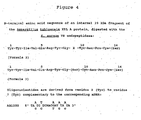
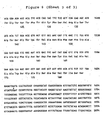
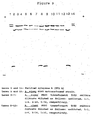
- Oligonucleotide mixture AB1255 derived from the amino acid sequence obtained in Example 1.3 (Formulas 2 and 3) ( Figure 4 ), was labelled via the same procedure as described above. The oligonucleotide mixtures were used in the screening of the genomic library (Example 3.2) and in Southern blot analysis (Example 3.4 and 3.5) without further purification.
- the filters were first washed in 2 x SSC, after which the filters were washed in prewarmed hybridization buffer at 38°C for the same period of time. Finally, the filters were washed for 30 minutes at 38°C in 6 x SSC, 0.05% sodium pyrophosphate. The air dried filters were taped onto a sheet of Whatman 3MM paper, keying marks were made with radioactive ink and the Whatman paper and filters were covered with Saran WrapTM. Hybridizing plaques were identified by exposure of Kodak XAR X-ray film for 72 hours at -70°C using an intensifying screen.
- oligonucleotide mixture hybridizing plaques appearing in duplicate on the replica filters, were identified and were designated lambda xln1 to lambda xln4 .
- Each positive plaque was removed from the plate using a Pasteur pipette and the phages were eluted from the agar plug in 1 ml of SM buffer containing 20 ⁇ l chloroform, as described by Maniatis et al . (1982, p. 64).
- the phages obtained were purified by repeating the procedure described above using filter replicas from plates containing 50-100 plaques of the isolated phages.
- the phages were propagated by plating 5 x 10 3 phages on NZYCM medium. After incubation overnight at 37°C, confluent plates were obtained, from which the phages were eluted by adding 5 ml SM buffer and storing the plate for 2 hours at 4°C with intermittent shaking. After removal of the supernatant, the bacteria were removed from the solution by centrifugation at 4,000 x g for 10 minutes at 4°C. Chloroform (0.3%) was added to the supernatent and the number of pfu was determined. These phage stocks contained approximately 10 10 pfu/ml.
- Each of the isolated phages lambda xln1 to lambda xln4 were propagated as described in Example 3.2 using five plates for each of the phages.
- the phages were precipitated from the thus-obtained supernatant (25 ml) by addition of an equal volume of a solution containing 20% PEG-6000 (w/v) and 2 M NaCl, followed by thorough mixing and incubation on ice for 60 minutes.
- the precipitated phages were collected by centrifugation at 14,000 x g at 4°C for 20 minutes.
- the supernatant was removed by aspiration, while the last traces of liquid were removed using a paper towel.
- the phages were carefully resuspended in 4 ml SM buffer and extracted once with chloroform.
- DNA and RNA originating from the lysed bacteria were removed by incubation of the phage suspension with DNase I and RNase A (both 100 ⁇ g/ml) for 30 minutes at 37°C.
- the phage DNA was subsequently released from the phages by the addition of SDS and EDTA to a final concentration of 0.1% and 20 mM respectively, followed by incubation at 65°C for 10 minutes.
- Protein was removed from the solution by extracting twice with an equal volume phenol/chloroform/isoamyl alcohol (25:24:1).
- the aqueous phase was extracted once with an equal volume chloroform/isoamylalcohol (24:1).
- the phases were separated by centrifugation (Eppendorf centrifuge, 14,000 x g, 10 minutes), after which the DNA was precipitated from the aqueous phase by the addition 0.1 volume 5 M sodium perchlorate and 0.1 volume isopropanol and incubation on ice for 30 min.
- the DNA was recovered by centrifugation for 10 minutes at 4°C (14,000 x g). The supernatant was removed by aspiration, after which the DNA was resuspended in 400 ⁇ l TE buffer.
- the DNA was once again precipitated with ethanol.
- the DNA was collected by centrifugation for 10 minutes at 4°C (14,000 x g).
- the supernatant was removed by aspiration, the remaining pellet was briefly dried under vacuum, after which the DNA was resuspended in 125 ⁇ l TE buffer containing 0.1 ⁇ g/ml RNase A. This purification procedure resulted in the isolation of approximately 40-50 ⁇ g DNA from each phage.
- the isolated DNA of phages lambda xln1 to lambda xln4 was analyzed by Southern analysis using the following restriction enzymes; Bam HI; Bgl II; Eco RI; Hin DIII; Kpn I; Sal I; Sst I; Xba I and Xho I.
- the DNA was digested for 3 hours at 37°C, in duplicate, in a reaction mixture composed of the following solutions; 3 ⁇ l DNA solution; 1 ⁇ l 0.5 M spermidine; 5 ⁇ l of the appropriate 10 x React buffer (BRL); 20 U Restriction enzyme (BRL) and sterile distilled water to give a final volume of 50 ⁇ l.
- the DNA was denatured and transferred to a nitrocellulose membrane as described by Maniatis et al . (1982, pp. 383-386), followed by subsequent prehybridization and hybridization using the labelled oligonucleotide mixes AB800 and AB1255 as described in Example 3.1 and hybridization conditions as described in Example 3.2.
- the hybridization pattern for each oligonucleotide mixture was obtained by exposure of Kodak XAR-5 X-ray film for 18 hours at -70°C using an intensifying screen.
- restriction fragment patterns and the hybridization patterns were used to construct an approximate restriction map of the genomic region where the xln A gene is located ( Figure 5 ).
- the 6.9 kb Sal I fragment was isolated from phage lambda xln3 as described in Example 2.2. This fragment was ligated in the vector pUC9 digested with Sal I and dephosphorylated with alkaline phosphatase prepared as follows: 1 ⁇ l (1 ⁇ g/ ⁇ l) pUC9 was mixed with 2 ⁇ l 10 x React 10 (BRL), 1 ⁇ l (1 U/ ⁇ l) Sal I and 16 ⁇ l sterile distilled water. The DNA was digested for 1 hour at 37°C, after which 0.5 ⁇ l alkaline phosphatase (1 U/ ⁇ l) (Pharmacia) was added, followed by further incubation at 37°C for an additional 30 minutes. The linearized vector was isolated from a 0.6% agarose gel as described in Example 2.2.
- the 6.9 kb Sal I fragment was ligated in the Sal I digested, dephosphorylated pUC vector via the following procedure: 100 ng pUC fragment was mixed with 100 ng 6.9 kb Sal I fragment and 4 ⁇ l 5 x ligation buffer (500 mM Tris-HCl, pH 7.6; 100 mM MgCl 2 ; 10 mM ATP; 10 mM dithiothreitol; 25% PEG-6000) and 1 ⁇ l (1.2 U/ ⁇ l) DNA ligase (BRL) was added to this mixture, resulting in a final volume of 20 ⁇ l.
- the resulting plasmid was designated pIM100.
- E. coli JM101 (Yanisch-Perron et al ., 1985) competent cells, prepared by the CM1, CM2 method as described in the Pharmacia Manual for the M13 cloning/sequencing system.
- E. coli JM101 containing plasmid pIM100 was deposited at the Centraal Bureau voor Schimmelcultures, Baarn, The Netherlands on July 19, 1990 and was assigned the designation CBS 322.90.
- Plasmid DNA was isolated from the cultures by the alkaline lysis method as described by Maniatis et al . (1982, pp. 368-369). This plasmid DNA was used in restriction analysis, as described in Example 3.4 to select a clone harboring the desired plasmid. Plasmid DNA was isolated on a large scale from 500 ml cultures E. coli JM101 containing the plasmid pIM100 grown in LB medium containing 100 ⁇ g/ml ampicillin (Maniatis et al ., 1982, p.86) The plasmid was purified by CsCl centrifugation, phenolized, ethanol precipitated and dissolved in 400 ⁇ l TE. The yield was approximately 500 ⁇ g.
- the plasmid pIM100 was further analyzed by restriction enzymes resulting in the restriction map shown in Figure 7 .
- the orientation of the gene, as indicated, was determined from hybridization experiments under conditions described in Example 3.2 using the oligonucleotide mixes AB800 and AB1255 as probes.
- the sequence of the Aspergillus tubigensis xln A gene which comprises its promoter/regulation region, the structural gene and the termination region, was determined by subcloning fragments from pIM100 in M13mp18/mp19, in combination with the use of specific oligonucleotides as primers in the sequencing reactions.
- restriction fragments were isolated as described in Example 2.2 and were then cloned in bacteriophage M13 mp18/19 RF DNA vectors (Messing, 1983; Norrander et al ., 1983), digested with the appropriate restriction enzymes.
- the nucleotide sequences were determined by the dideoxynucleotide chain-termination procedure (Sanger et al ., 1977) using the Pharmacia T 7 DNA polymerase sequencing kit.
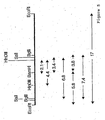
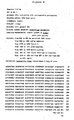
- the strategy employed to sequence the xln A gene is shown in Figure 6 . Computer analysis of the resulting data was performed using the PC/GENE program (Intelligenetics, Inc.; Madison WI). The sequence determined is given in Figure 8 .
- the sequence obtained comprises 2054 bp, 949 bp in the 5' non-coding region and 420 bp in the 3' non-coding region.
- a putative TATA box (TATAAAT) was found at position 848 to position 854, before the translation initiation site (position 950).
- a triplicate repeating sequence (5'GTCCATTTAGCCA3') was found in the region 190 to 350 bp from the translation initiation site (positions; 618 to 632; 636 to 650; 656 to 670).
- the structural section of the xln A gene is 681 bp long and is interrupted by a single putative intron 48 bp long.
- the polypeptide derived from the sequence is 211 AA in length.
- a 17 AA long hydrophobic signal sequence is found at the N-terminus of this polypeptide, which is followed by a pro-peptide which is 12 residues long.
- the mature protein is 184 AA in size with an predicted molecular weight of 19 kDa and has a theoretical IEP of 3.6.
- the plasmid pIM100, obtained in Example 3.5 was introduced in Aspergillus niger by co-transformation of Aspergillus niger N593 ( pyr mutant of A. niger N402; Goosen et al., 1987) using the Aspergillus niger pyr A gene as a selective marker on the plasmid pGW635 (Goosen et al ., 1989) and the plasmid pIM100 as the co-transforming plasmid.
- Protoplasts were prepared from mycelium by growing Aspergillus niger N593 on minimal medium supplemented with 0.5% yeast extract, 0.2% casamino acids, 50 mM glucose and 10 mM uridine for 20 hours at 30°C.
- the preparation of protoplasts of Aspergillus niger N593 and the transformation procedure was performed as described by Goosen et al . (1987).
- the resulting PYR + transformants were then analyzed for the expression of the xln A gene.
- the transformants obtained in Example 5.1 were analyzed for the formation of the xln A gene product, the XYL A protein. Twenty transformants were selected and grown for 72 hours on medium containing (per liter): 30 g oat spelt xylan (Sigma); 7.5 g NH 4 NO 3 , 0.5 g KCl, 0.5 g MgSO 4 , 15 g KH 2 PO 4 , and 0.5 g yeast extract (pH 6.0). After growth, the mycelium was removed by filtration and the culture filtrate was analyzed. by SDS-polyacrylamide gel electrophoresis, using a gel containing 12% acrylamide.
- the XYL A protein was detected on nitrocellulose after electroblotting and incubation with polyclonal antibodies raised against the XYL A protein, which was purified as described in Example 1.1.
- the antibody bound was detected after incubation with goat-anti-rabbit antibody conjugated to alkaline phosphatase, according to the Biorad instruction manual.
- transformant TrX9 was selected by I.E.F. analysis, using a pH gradient of pH 3 to 7 and subsequent staining of a dilution series of transformants TrX2 and TrX9, using the method as described by Biely et al . (1985 a and b).
- SDS-PAGE analysis was performed using 4 ⁇ l supernatant samples of individual transformants and the A. niger control strain, first adjusted to pH 7 with 3 N NaOH and subsequently brought to a final volume of 20 ⁇ l with 1 x SB buffer, as described by Laemmli (1970). After heating for 5 minutes at 100°C, total mixtures were subjected to a SDS/12.5% polyacrylamide gel electrophoresis and subsequently stained with coomassie brilliant blue.
- a protein band having an apparent molecular weight of 25 kDa (comparable with purified xylanase (lane 2) could be detected in transformants TrX2 (lane 4) and TrX9 (lane 5), which is absent from the supernatant of the control strain (lane 3).
- Molecular weight markers (lane 1) represent 92, 68, 46 and 30 kDa.
- the 4.5 kb Sal I/ Xba I fragment (Fig. 7 ) was isolated and ligated into the vector pEMBL18 as described in Example 3.5, resulting in the intermediate plasmid pIM101.
- the following fragments containing the xln A gene were ligated in pEMBL18; the 3.5 kb Hin dIII/ Xba I fragment (resulting in pIM102), the 2.0 kb Pst I fragment (resulting in pIM103), the 1.98 kb Xho I/ Xba I fragment (resulting in pIM104) and the 1.97 kb Nsi I/ Xba I fragment (resulting in pIM105).
- the plasmids pIM112, pIM113, pIM114, pIM116 and pIM117 were used to transform A. niger N593 as described in Example 5.1.
- the resulting PYR + transformants of each plasmid were cultivated and DNA was isolated as described in Example 2.1.
- the resulting DNA was digested with Hpa I and single copy integrations were selected by Southern analysis using a 32 P labelled 3.8 kb Xba I fragment (labelled as described in Example 7.2), which contained the pyr A gene as a probe.
- Transformants having a hybridizing Hpa I fragment (the size of which was increased by a unit plasmid length as compared to the size of the Hpa I fragment in A. niger N593) were selected as single copy integrations at the pyr A locus.
- the AG-promoter sequence, as well as the 18 amino acid (aa) leader sequence of the AG-gene were fused to the xln A gene fragment encoding solely the mature protein.
- the 2 kb Pst I fragment of pIM100 (described in Example 3.5) comprising the entire xln A gene including the 5'- and 3' flanking sequences, was subcloned into the Pst I site of pTZ18R (Promega).
- the plasmid containing the xln A gene in the proper orientation was designated pXYL1.
- Plasmid pAB6-1 contains the entire AG locus from A. niger , isolated from an A. niger plasmid library containing the 13-15 kb Hin dIII fragments, inserted into pUC19.
- pXYL1 containing the xln A gene
- pAB6-1 containing the entire AG genomic locus.
- PCR was performed as described by Saiki et al . (1988) and according to the supplier of TAQ-polymerase (Cetus). Twenty-five amplification cycles (each: 2 minutes at 55°C; 3 minutes at 72°C; 1 minute at 94°C) were carried out in a DNA-amplifier (Perkin-Elmer/Cetus).
- the two DNA fragments generated were purified by agarose gel electrophoresis and ethanol precipitation and subsequently used as templates in the third PCR with oligo nucleotides AB 1771 and 1984 as primers to generate the AG-xylanase fusion.
- the thus-obtained DNA fragment was digested with Eco RI and Bam HI and subcloned into the appropriate sites of pTZ18R.
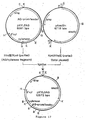
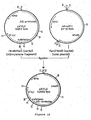
- the resultant fusion was sequenced and designated pXYLAG (see Figures 14 and 15 ).
- the remaining (3.5 kb) upstream region of the AG-promoter was obtained by digestion of pAB6-1 with Kpn I and partially with Eco RI and purified by agarose gel electrophoresis and ethanol precipitated.
- This 3.5 kb AG DNA promoter fragment was first ligated to the Eco RI/ Bam HI AG/xylanase fusion fragment of pXYLAG and subsequently molecular cloned in E.coli after ligation into the vector pXYL1, which was digested with Kpn I/ Bam HI and wherefrom the Kpn I/ Bam HI fragment, containing the 5'- and coding xln A sequences, was removed.
- the thus-obtained plasmid pXYL2AG is shown in Figure 15 .
- the two DNA fragments generated were purified by agarose gel electrophoresis and ethanol precipitation and subsequently used as templates in a third PCR with oligonucleotides AB 1771 and 1984 as primers to generate the AG-xylanase fusion.
- the thus-obtained DNA fragment was digested with Eco RI and Bam HI and subcloned into the appropriate sites of pTZ18R.
- the resultant fusion was sequenced and designated pXYL (see Figures 14 and 16 ).
- the remaining (3.5 kb) upstream region of the AG promoter was inserted into pXYL1 as described in part d), above.
- the thus-obtained plasmid was designated pXYL2.
- Both expression cassettes were created by insertion of the AG/xylanase fusions of pXYL2AG or pXYL2 into the basic A. niger vector pAmdSH.
- pAmdSH was digested with Kpn I and Hin dIII (partially) and pXYL2AG and pXYL2 with Hin dIII and partially with Kpn I. All fragments were isolated and purified by gel electrophoresis and ethanol precipitation.
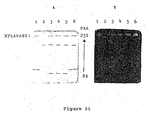
- Xylanase analyses of individual transformants were performed by measuring the xylanase activity; by SDS-polyacrylamide gel electrophoresis stained with Coomassie Brilliant Blue and by a zymogram stained with xylan-Remazol brilliant blue R.
- Xylanase activities were determined as described by Leathers et al . (1984), with some modification.
- the substrate concentration was increased from 1% to 5% oat xylan, dissolved in 100 mM NaAc at pH 3.5 and heated to 100°C for 10 minutes.
- enzyme reactions were carried out at 39°C instead of 30°C.
- Xylanase production levels were measured in the supernatant of 6 day-shake flask fermentations of several, randomly chosen transformants obtained from each expression cassette. The results are shown in Table 1.
- Table 1 Xylanase production of several A. niger CBS 513.88 strains transformed with plasmids containing the xlnA gene under the control of the A. niger AG-promoter in combination with different leaders.
- a protein band having an apparent molecular weight of 25 kDa (comparable with purified xylanase (lane 1) could be detected in transformants 10 (lane 4), 29 (lane 5) and 1.1 (lane 6). This protein band was absent from the supernatant of the control strain (lane 3).
- Molecular weight markers (lane 2) represent 94, 67, 43 30, 20 and 14.5 kDa.
- One-day old female chicks were housed in battery cages with wire floors and fed on a commercial starter diet until the start of the experimental period. At day 13, the birds were allocated at random to equal live-weight treatment groups. Three different experimental diets were assigned to 18 groups of birds with 8 birds per group. The diets were pelleted under very mild conditions and the chicks were fed ad libitum during days 13 to 34 (post-hatching).
- Table 3 Composition of the basal diet
- Pup-loaves were baked from 150 g dough pieces obtained by mixing 200 g wheat flour (100%), 106 ml water (53%), 1.2 g instant dry baker's yeast (0.6%: Gist-brocades N.V., Delft, The Netherlands), 4 g NaCl (2%), 400 mg CaCl 2 ⁇ 2H 2 O (0.2%), 10 mg fungal ⁇ -amylase P 200 (Gist-brocades, 2250 SKB/kg flour) and a variable number of units of endo-xylanase (xyl A) activity. After mixing for 6 minutes and 15 seconds at 52 r.p.m.
Landscapes
- Life Sciences & Earth Sciences (AREA)
- Chemical & Material Sciences (AREA)
- Engineering & Computer Science (AREA)
- Health & Medical Sciences (AREA)
- Zoology (AREA)
- Organic Chemistry (AREA)
- Microbiology (AREA)
- Genetics & Genomics (AREA)
- Polymers & Plastics (AREA)
- Bioinformatics & Cheminformatics (AREA)
- Wood Science & Technology (AREA)
- Biochemistry (AREA)
- General Engineering & Computer Science (AREA)
- Food Science & Technology (AREA)
- General Health & Medical Sciences (AREA)
- Biomedical Technology (AREA)
- Animal Husbandry (AREA)
- Molecular Biology (AREA)
- Biotechnology (AREA)
- Medicinal Chemistry (AREA)
- General Chemical & Material Sciences (AREA)
- Chemical Kinetics & Catalysis (AREA)
- Physiology (AREA)
- Physics & Mathematics (AREA)
- Biophysics (AREA)
- Plant Pathology (AREA)
- Enzymes And Modification Thereof (AREA)
- Micro-Organisms Or Cultivation Processes Thereof (AREA)
- Fodder In General (AREA)
- Detergent Compositions (AREA)
- Bakery Products And Manufacturing Methods Therefor (AREA)
- Preparation Of Compounds By Using Micro-Organisms (AREA)
- Food Preservation Except Freezing, Refrigeration, And Drying (AREA)
- Immobilizing And Processing Of Enzymes And Microorganisms (AREA)
- Treatment Of Sludge (AREA)
- Paper (AREA)
- Earth Drilling (AREA)
- Professional, Industrial, Or Sporting Protective Garments (AREA)
- Auxiliary Devices For And Details Of Packaging Control (AREA)
- Polysaccharides And Polysaccharide Derivatives (AREA)
Priority Applications (2)
| Application Number | Priority Date | Filing Date | Title |
|---|---|---|---|
| EP98114804A EP0892065A1 (en) | 1990-07-24 | 1991-07-24 | Clonong and expression of xylanase genes from fungal origin |
| EP91201944A EP0463706B2 (en) | 1990-07-24 | 1991-07-24 | Cloning and expression of xylanase genes from fungal origin |
Applications Claiming Priority (3)
| Application Number | Priority Date | Filing Date | Title |
|---|---|---|---|
| EP90202020 | 1990-07-24 | ||
| EP90202020 | 1990-07-24 | ||
| EP91201944A EP0463706B2 (en) | 1990-07-24 | 1991-07-24 | Cloning and expression of xylanase genes from fungal origin |
Related Child Applications (2)
| Application Number | Title | Priority Date | Filing Date |
|---|---|---|---|
| EP98114804A Division EP0892065A1 (en) | 1990-07-24 | 1991-07-24 | Clonong and expression of xylanase genes from fungal origin |
| EP98114804A Division-Into EP0892065A1 (en) | 1990-07-24 | 1991-07-24 | Clonong and expression of xylanase genes from fungal origin |
Publications (3)
| Publication Number | Publication Date |
|---|---|
| EP0463706A1 EP0463706A1 (en) | 1992-01-02 |
| EP0463706B1 EP0463706B1 (en) | 2003-03-05 |
| EP0463706B2 true EP0463706B2 (en) | 2010-01-27 |
Family
ID=8205086
Family Applications (3)
| Application Number | Title | Priority Date | Filing Date |
|---|---|---|---|
| EP91201944A Expired - Lifetime EP0463706B2 (en) | 1990-07-24 | 1991-07-24 | Cloning and expression of xylanase genes from fungal origin |
| EP98114804A Withdrawn EP0892065A1 (en) | 1990-07-24 | 1991-07-24 | Clonong and expression of xylanase genes from fungal origin |
| EP91201943A Expired - Lifetime EP0468596B1 (en) | 1990-07-24 | 1991-07-24 | Enzymatic treatment of silage |
Family Applications After (2)
| Application Number | Title | Priority Date | Filing Date |
|---|---|---|---|
| EP98114804A Withdrawn EP0892065A1 (en) | 1990-07-24 | 1991-07-24 | Clonong and expression of xylanase genes from fungal origin |
| EP91201943A Expired - Lifetime EP0468596B1 (en) | 1990-07-24 | 1991-07-24 | Enzymatic treatment of silage |
Country Status (19)
| Country | Link |
|---|---|
| US (1) | US5358864A (da) |
| EP (3) | EP0463706B2 (da) |
| JP (2) | JPH05500907A (da) |
| KR (1) | KR100212232B1 (da) |
| AT (2) | ATE124844T1 (da) |
| AU (2) | AU654147B2 (da) |
| CA (2) | CA2067329A1 (da) |
| DE (3) | DE69133201T2 (da) |
| DK (2) | DK0463706T3 (da) |
| ES (1) | ES2086267T3 (da) |
| FI (2) | FI921232A0 (da) |
| HU (2) | HU215234B (da) |
| IE (3) | IE20040144A1 (da) |
| IL (1) | IL98941A (da) |
| NO (2) | NO307347B1 (da) |
| NZ (2) | NZ239083A (da) |
| PL (2) | PL171271B1 (da) |
| PT (1) | PT98419B (da) |
| WO (2) | WO1992001793A1 (da) |
Families Citing this family (90)
| Publication number | Priority date | Publication date | Assignee | Title |
|---|---|---|---|---|
| US5837515A (en) * | 1990-05-16 | 1998-11-17 | Alko-Yhtiot Oy | Enzyme preparations and methods for their production |
| NL9001388A (nl) | 1990-06-19 | 1992-01-16 | Unilever Nv | Recombinant dna, cel die daarvan afgeleid dna bevat, enzym waarvoor het recombinant dna codeert en toepassingen daarvan. |
| PT98419B (pt) * | 1990-07-24 | 1999-01-29 | Gist Brocades Nv | Processo para a preparacao de sequencias de adn que codificam para xilanases, de construcoes de adn que contem essas sequencias, paraa transformacao de hospedeiros microbianos com essas construcoes, para a preparacao de xilanases por expressao nesses hospedeiros e para a degradacao de xilano por accao dessas xilanases |
| GB9027303D0 (en) * | 1990-12-17 | 1991-02-06 | Enzymatix Ltd | Enzyme formulation |
| US5863783A (en) * | 1991-03-27 | 1999-01-26 | Gist-Brocades, N.V. | Cloning and expression of DNA molecules encoding arabinan-degrading enzymes of fungal origin |
| AU664223B2 (en) * | 1991-12-09 | 1995-11-09 | Unilever Plc | Process for producing/secreting a protein by a transformed mould using expression/secretion regulating regions derived from an (aspergillus) endoxylanase II gene |
| EP0652961A1 (en) * | 1992-06-17 | 1995-05-17 | Biotechnology and Biological Sciences Research Council | Recombinant xylanases |
| BR9306576A (pt) * | 1992-06-17 | 1999-01-12 | Commw Scient Ind Res Org | Xilanase recombinante |
| IL108175A0 (en) * | 1992-12-24 | 1994-04-12 | Gist Brocades Nv | Cloning and expression of xylanase B |
| ATE258224T1 (de) * | 1993-03-10 | 2004-02-15 | Novozymes As | Enzyme mit xylanaseaktivität aus aspergillus aculeatus |
| GB2279955B (en) * | 1993-07-15 | 1998-02-18 | Solvay | Xylanase derived from a Bacillus species, expression vectors for such xylanase and other proteins, host organisms therefor and use thereof |
| FR2715802B1 (fr) * | 1994-02-04 | 1996-03-15 | Rhone Poulenc Nutrition Animal | Utilisation d'enzymes dans l'alimentation des animaux pour réduire les rejets azotés. |
| US5448645A (en) * | 1994-02-28 | 1995-09-05 | Raymond Guerci International, Inc. | Active fan blade noise cancellation system |
| WO1995023514A1 (en) * | 1994-03-02 | 1995-09-08 | Novo Nordisk A/S | Processing plant material with xylanase |
| AU1945395A (en) * | 1994-03-02 | 1995-09-18 | Novo Nordisk A/S | Use of xylanase in baking |
| GB9406317D0 (en) * | 1994-03-30 | 1994-05-25 | Finnfeeds Int Ltd | Use of an enzyme for assisting an animal to digest protein |
| US6051431A (en) * | 1994-07-22 | 2000-04-18 | Dsm N.V. | Selection marker gene free recombinant strains: a method for obtaining them and the use of these strains |
| US6300114B1 (en) | 1994-07-29 | 2001-10-09 | Rohm Enzyme Finland Oy | Sequences of xylanase and xylanase expression vectors |
| US5935836A (en) * | 1994-07-29 | 1999-08-10 | Rohm Enzyme Finland Oy | Actinomadura xylanase sequences and methods of use |
| US7816129B2 (en) | 1994-07-29 | 2010-10-19 | Ab Enzymes Gmbh | Production and secretion of proteins of bacterial origin in filamentous fungi |
| US5871730A (en) * | 1994-07-29 | 1999-02-16 | Universite De Sherbrooke | Thermostable xylanase DNA, protein and methods of use |
| GB9416841D0 (en) * | 1994-08-19 | 1994-10-12 | Finnfeeds Int Ltd | An enzyme feed additive and animal feed including it |
| SI9520013A (en) * | 1994-08-26 | 1996-10-31 | Gist Brocades Bv | Arabinoxylan degrading enzymes. |
| CN1165614C (zh) | 1995-01-26 | 2004-09-08 | 诺沃奇梅兹有限公司 | 含有木聚糖酶的动物饲料添加剂 |
| GB9505479D0 (en) * | 1995-03-17 | 1995-05-03 | Danisco | Enzyme |
| PL184411B1 (pl) * | 1995-06-23 | 2002-10-31 | Danisco Ingredients As | Nowa beta-ksylozydaza, kodująca ją sekwencja nukleotydowa i jej zastosowanie |
| US5720971A (en) * | 1995-07-05 | 1998-02-24 | Her Majesty The Queen In Right Of Canada, As Represented By The Department Of Agriculture And Agri-Food Canada | Enzyme additives for ruminant feeds |
| AU7294396A (en) * | 1995-10-13 | 1997-04-30 | Gist-Brocades B.V. | Protein detection |
| US5902581A (en) * | 1995-12-04 | 1999-05-11 | Genencor International, Inc. | Xylanase from acidothermus cellulolyticus |
| US6635464B1 (en) | 1995-12-18 | 2003-10-21 | Rohm Enzyme Finland Oy | Xylanases, genes encoding them, and uses thereof |
| AU1437597A (en) * | 1996-01-22 | 1997-08-20 | Novo Nordisk A/S | An enzyme with xylanase activity |
| ES2111495B1 (es) * | 1996-07-19 | 1998-11-01 | Consejo Superior Investigacion | Cepa de levadura de panaderia cect10868 y cepa de panaderia cect10869. su metodo de obtencion por tecnicas de adn recombinante y su aplicacion como levaduras de panaderia. |
| GB9704157D0 (en) | 1997-02-28 | 1997-04-16 | Danisco | Expression element |
| EP0913467B1 (en) * | 1997-03-04 | 2004-09-29 | Meiji Seika Kaisha Ltd. | Mesophilic xylanases |
| NZ502444A (en) | 1997-07-31 | 2001-11-30 | Dsm N | Polypeptides with cellobiohydrolase activity (CBH A and CBH B) from Aspergillus |
| US7220542B2 (en) | 2000-07-17 | 2007-05-22 | Van Den Brink Johannes Maarten | Expression cloning in filamentous fungi |
| JP4700812B2 (ja) * | 1998-12-23 | 2011-06-15 | ダニスコ エイ/エス | タンパク質 |
| AU7235901A (en) | 2000-07-06 | 2002-01-21 | Novozymes As | Method of preparing a dough or a baked product made from a dough, with addition of lipolytic enzymes |
| WO2002006504A1 (en) | 2000-07-13 | 2002-01-24 | Danisco Sweeteners Oy. | Method for the production of xylitol |
| US7514110B1 (en) | 2000-09-21 | 2009-04-07 | Basf Aktiengesellschaft | Talaromyces xylanases |
| WO2003015533A1 (en) | 2001-08-20 | 2003-02-27 | K.U. Leuven Research And Development | Non-starch-polysaccharides |
| US8022170B2 (en) | 2002-12-17 | 2011-09-20 | Ems-Chemie Ag | Copolyamides |
| CA2523400C (en) | 2003-05-09 | 2015-03-17 | Novozymes A/S | Variant lipolytic enzymes |
| EP1482050A1 (en) * | 2003-05-28 | 2004-12-01 | Facultés Universitaires Notre-Dame de la Paix | Enzyme with xylanase activity at acidic ph |
| WO2006078256A2 (en) | 2004-02-12 | 2006-07-27 | Novozymes, Inc. | Polypeptides having xylanase activity and polynucleotides encoding same |
| JP2006219767A (ja) * | 2005-02-08 | 2006-08-24 | Univ Of Tsukuba | 製紙用化学パルプ中の不飽和ウロン酸の除去方法 |
| WO2006124598A2 (en) | 2005-05-12 | 2006-11-23 | Martek Biosciences Corporation | Biomass hydrolysate and uses and production thereof |
| US8268956B2 (en) | 2006-12-08 | 2012-09-18 | Ems-Chemie Ag | Transparent mold made of a polyamide molding material |
| EP2106215B1 (en) | 2007-01-16 | 2020-09-02 | Puratos N.V. | Bread with increased arabinoxylo-oligosaccharide content |
| US7850382B2 (en) | 2007-01-18 | 2010-12-14 | Sanford, L.P. | Valve made from two materials and writing utensil with retractable tip incorporating same |
| US7488130B2 (en) | 2007-02-01 | 2009-02-10 | Sanford, L.P. | Seal assembly for retractable instrument |
| BRPI0808513A2 (pt) | 2007-03-09 | 2014-08-19 | Danisco Us Inc Genencor Div | Variantes de alfa-amilase de espécies de bacillus alcalifílico, composições compreendendo variantes de alfa-amilase e métodos de uso |
| US8916369B2 (en) | 2007-03-14 | 2014-12-23 | Danisco Us Inc. | Trichoderma reesei α-amylase is a maltogenic enzyme |
| EP2171085A4 (en) | 2007-06-01 | 2010-07-14 | Sapphire Energy | SCREENING OF GENETICALLY MODIFIED PHOTOSYNTHETIC ORGANISMS WITH HIGH THROUGHPUT |
| GB0718974D0 (en) | 2007-09-28 | 2007-11-07 | Univ Leuven Kath | oligosaccharides derived from arabinoxylan for prevention of gastrointestinal infection |
| EP2060607B2 (de) | 2007-11-16 | 2019-11-27 | Ems-Patent Ag | Gefüllte Polyamidformmassen |
| CN101918545A (zh) | 2008-01-02 | 2010-12-15 | 丹尼斯科美国公司 | 应用嗜糖假单胞菌g4-淀粉酶和其变体获得乙醇的无葡糖淀粉酶的方法 |
| GB0805360D0 (en) | 2008-03-25 | 2008-04-30 | Univ Leuven Kath | Arabinoxylan oligosaccharide preparation |
| US8226312B2 (en) | 2008-03-28 | 2012-07-24 | Sanford, L.P. | Valve door having a force directing component and retractable instruments comprising same |
| US20110097778A1 (en) | 2008-04-30 | 2011-04-28 | Power Scott D | Chimeric alpha-amylase variants |
| CA2726631A1 (en) | 2008-06-06 | 2009-12-10 | Danisco Us Inc. | Saccharification enzyme composition and method of saccharification thereof |
| BRPI0913378A2 (pt) | 2008-06-06 | 2015-09-01 | Danisco Us Inc | Produção de glicose a partir do amido usando alfa-amilase do bacillus subtilis |
| MX364987B (es) | 2008-06-06 | 2019-05-17 | Danisco Us Inc | Alfa-amilasas variantes de bacillus subtilis y metodos de uso de las mismas. |
| US8221012B2 (en) | 2008-11-07 | 2012-07-17 | Sanford, L.P. | Retractable instruments comprising a one-piece valve door actuating assembly |
| US20110274786A1 (en) | 2009-01-16 | 2011-11-10 | Danisco A/S | Enzymatic generation of oligasaccharides from cereals or cereal bi-streams |
| EP2387330B1 (en) | 2009-01-16 | 2017-11-15 | DuPont Nutrition Biosciences ApS | Enzymatic generaltion of functional lipids from cereal bran extract |
| US8393814B2 (en) | 2009-01-30 | 2013-03-12 | Sanford, L.P. | Retractable instrument having a two stage protraction/retraction sequence |
| JP5528535B2 (ja) | 2009-03-31 | 2014-06-25 | ダニスコ・アクティーゼルスカブ | 植物細胞壁材料の可溶化の際の抽出物の暗色化および悪臭形成の防止 |
| DK3133154T3 (da) | 2009-05-19 | 2019-01-28 | Dupont Nutrition Biosci Aps | Amylasepolypeptider |
| EP2365033B1 (de) | 2010-03-12 | 2013-07-10 | Ems-Patent Ag | Schlagzähmodifizierte Polyamidformmasse sowie hieraus gebildeter Behälter |
| FR2959515A1 (fr) | 2010-05-03 | 2011-11-04 | Puratos | Compositions riches en oligosaccharides d'arabinoxylane |
| EP2412757B1 (de) | 2010-07-30 | 2013-11-13 | Ems-Patent Ag | Polyamidformmasse zur Herstellung von Formkörpern mit einer Weichgriffoberfläche sowie entsprechende Formkörper |
| WO2012130969A1 (en) | 2011-03-29 | 2012-10-04 | Novozymes A/S | Process for production of a baked product |
| EP2535365B1 (de) | 2011-06-17 | 2013-09-25 | Ems-Patent Ag | Teilaromatische Formmassen und deren Verwendungen |
| EP2666803B1 (de) | 2012-05-23 | 2018-09-05 | Ems-Patent Ag | Kratzfeste, transparente und zähe Copolyamidformmassen, hieraus hergestellte Formkörper und deren Verwendung |
| EP2716716B1 (de) | 2012-10-02 | 2018-04-18 | Ems-Patent Ag | Polyamid-Formmassen und deren Verwendung bei der Herstellung von Formkörpern |
| ES2527403T3 (es) | 2012-12-18 | 2015-01-23 | Ems-Patent Ag | Masa para moldeo de poliamida y cuerpos moldeados producidos a partir de ella |
| US8759041B1 (en) * | 2013-02-12 | 2014-06-24 | Novozymes Inc. | Polypeptides having xylanase activity and polynucleotides encoding same |
| EP2778190B1 (de) | 2013-03-15 | 2015-07-15 | Ems-Patent Ag | Polyamidformmasse sowie hieraus hergestellter Formkörper |
| US20170121741A1 (en) | 2014-04-01 | 2017-05-04 | Dupont Nutrition Biosciences Aps | Method for increasing crude palm oil yields |
| BR112017013025A2 (pt) | 2014-12-19 | 2018-01-02 | Dupont Nutrition Biosci Aps | recuperação de óleo da lama de palma |
| CN107404915A (zh) | 2015-03-04 | 2017-11-28 | 杜邦营养生物科学有限公司 | 谷粒加工 |
| GB201522603D0 (en) | 2015-12-22 | 2016-02-03 | Dupont Nutrition Biosci Aps | Composition |
| JP7094652B2 (ja) * | 2016-03-31 | 2022-07-04 | 日油株式会社 | 製パン用油脂組成物および製パン用穀粉生地 |
| KR101898246B1 (ko) * | 2016-11-18 | 2018-09-13 | 전북대학교 산학협력단 | 케나프 사일리지의 제조방법 및 이에 따른 케나프 사일리지 |
| JP7491542B2 (ja) * | 2019-09-09 | 2024-05-28 | 株式会社フジワラテクノアート | 基質培養物の製造方法及び基質培養物 |
| JP7160071B2 (ja) * | 2020-08-17 | 2022-10-25 | 日油株式会社 | 製パン用油脂組成物および製パン用穀粉生地 |
| US20260021166A1 (en) * | 2022-07-20 | 2026-01-22 | Amano Enzyme Inc. | Agent for improving intestinal flora |
| EP4389906A1 (en) | 2022-12-21 | 2024-06-26 | Basf Se | Methods for the enzymatic treatment of whole stillage |
| US20250340959A1 (en) | 2024-05-03 | 2025-11-06 | Buckman Laboratories International, Inc. | Methods for dehairing animal skins and hides and formulations related to same |
Family Cites Families (11)
| Publication number | Priority date | Publication date | Assignee | Title |
|---|---|---|---|---|
| IT1109471B (it) * | 1976-08-17 | 1985-12-16 | Deral Sa | Procedimento e prodotto per la conservazione e la valorizzazione di vegetali a verde e dei sotto prodotti umidi delle industrie agro alimentari |
| US4212420A (en) * | 1979-06-18 | 1980-07-15 | International Business Machines Corporation | Ribbon storage device |
| CA1280704C (en) * | 1985-12-03 | 1991-02-26 | Paul Ducroo | Production of beer |
| FI84970C (fi) * | 1988-04-22 | 1992-02-25 | Suomen Sokeri Oy | Foerfarande foer foerbaettring av degens egenskaper och broedets kvalitet. |
| FI881962A7 (fi) * | 1988-04-26 | 1989-10-27 | Cultor Oy | Menetelmä rehun sulavuuden parantamiseksija menetelmän mukaan valmistettu rehu |
| CA1341226C (en) * | 1988-08-16 | 2001-05-01 | Wim Van Hartingsveldt | Gene replacement as a tool for the construction of aspergillus strains |
| FI884668L (fi) * | 1988-10-11 | 1990-04-12 | Suomen Sokeri Oy | Foerfarande foer foerbaettrande av framstaellningsprocessen hos torra saedesprodukter med hjaelp av enzymbehandling. |
| US5179021A (en) * | 1989-02-10 | 1993-01-12 | Gil Inc. (Now Ici Canada Inc.) | Pulp bleaching process comprising oxygen delignification and xylanase enzyme treatment |
| WO1991015966A1 (en) * | 1990-04-18 | 1991-10-31 | Ssv-Development Oy | Enzyme treated forage for silage |
| NL9001388A (nl) * | 1990-06-19 | 1992-01-16 | Unilever Nv | Recombinant dna, cel die daarvan afgeleid dna bevat, enzym waarvoor het recombinant dna codeert en toepassingen daarvan. |
| PT98419B (pt) * | 1990-07-24 | 1999-01-29 | Gist Brocades Nv | Processo para a preparacao de sequencias de adn que codificam para xilanases, de construcoes de adn que contem essas sequencias, paraa transformacao de hospedeiros microbianos com essas construcoes, para a preparacao de xilanases por expressao nesses hospedeiros e para a degradacao de xilano por accao dessas xilanases |
-
1991
- 1991-07-23 PT PT98419A patent/PT98419B/pt not_active IP Right Cessation
- 1991-07-23 IE IE20040144A patent/IE20040144A1/en not_active IP Right Cessation
- 1991-07-23 NZ NZ239083A patent/NZ239083A/xx unknown
- 1991-07-23 IE IE258291A patent/IE912582A1/en not_active IP Right Cessation
- 1991-07-23 IE IE258391A patent/IE68859B1/en not_active IP Right Cessation
- 1991-07-23 NZ NZ239085A patent/NZ239085A/xx not_active IP Right Cessation
- 1991-07-24 US US07/842,349 patent/US5358864A/en not_active Expired - Lifetime
- 1991-07-24 FI FI921232A patent/FI921232A0/fi not_active Application Discontinuation
- 1991-07-24 IL IL9894191A patent/IL98941A/xx not_active IP Right Cessation
- 1991-07-24 HU HU9200961A patent/HU215234B/hu not_active IP Right Cessation
- 1991-07-24 EP EP91201944A patent/EP0463706B2/en not_active Expired - Lifetime
- 1991-07-24 DK DK91201944T patent/DK0463706T3/da active
- 1991-07-24 CA CA002067329A patent/CA2067329A1/en not_active Abandoned
- 1991-07-24 DE DE69133201T patent/DE69133201T2/de not_active Expired - Lifetime
- 1991-07-24 PL PL91291226A patent/PL171271B1/pl not_active IP Right Cessation
- 1991-07-24 CA CA002066734A patent/CA2066734A1/en not_active Abandoned
- 1991-07-24 KR KR1019920700672A patent/KR100212232B1/ko not_active Expired - Fee Related
- 1991-07-24 AU AU83186/91A patent/AU654147B2/en not_active Ceased
- 1991-07-24 JP JP3513262A patent/JPH05500907A/ja active Pending
- 1991-07-24 AU AU83205/91A patent/AU647170B2/en not_active Ceased
- 1991-07-24 WO PCT/NL1991/000137 patent/WO1992001793A1/en not_active Ceased
- 1991-07-24 PL PL29122591A patent/PL291225A1/xx unknown
- 1991-07-24 AT AT91201943T patent/ATE124844T1/de not_active IP Right Cessation
- 1991-07-24 DE DE69111148T patent/DE69111148T2/de not_active Expired - Fee Related
- 1991-07-24 DK DK91201943.7T patent/DK0468596T3/da active
- 1991-07-24 HU HU92960A patent/HUT60606A/hu unknown
- 1991-07-24 JP JP3513261A patent/JPH05501657A/ja active Pending
- 1991-07-24 EP EP98114804A patent/EP0892065A1/en not_active Withdrawn
- 1991-07-24 DE DE0463706T patent/DE463706T1/de active Pending
- 1991-07-24 ES ES91201944T patent/ES2086267T3/es not_active Expired - Lifetime
- 1991-07-24 WO PCT/NL1991/000136 patent/WO1992001389A1/en not_active Ceased
- 1991-07-24 AT AT91201944T patent/ATE233818T1/de not_active IP Right Cessation
- 1991-07-24 EP EP91201943A patent/EP0468596B1/en not_active Expired - Lifetime
-
1992
- 1992-03-20 FI FI921231A patent/FI108944B/fi active IP Right Grant
- 1992-03-23 NO NO921134A patent/NO307347B1/no not_active IP Right Cessation
- 1992-03-23 NO NO92921133A patent/NO921133L/no unknown
Also Published As
Similar Documents
| Publication | Publication Date | Title |
|---|---|---|
| EP0463706B2 (en) | Cloning and expression of xylanase genes from fungal origin | |
| IE84033B1 (en) | Cloning and expression of xylanase genes from fungal origin | |
| AU692595B2 (en) | Arabinoxylan degrading enzymes | |
| US6080567A (en) | Enzymes with xylanase activity from Aspergillus aculeatus | |
| AU671710B2 (en) | Cloning And Expression Of Xylanase B | |
| JP2001512024A (ja) | アスペルギルスのセルロース分解酵素 | |
| US6558728B1 (en) | α-glucuronidases of aspergillus, production thereof and their uses | |
| WO1997043423A9 (en) | Alpha-glucuronidases of aspergillus, production thereof and their uses | |
| US6228629B1 (en) | Xylanases, genes encoding them, and uses thereof | |
| EP0870015B1 (en) | Novel xylanases, genes encoding them, and uses thereof | |
| US6635464B1 (en) | Xylanases, genes encoding them, and uses thereof | |
| EP1130102B1 (en) | Enzyme with xylanase activity | |
| EP1433843A2 (en) | Novel xylanases, genes encoding them, and uses thereof |
Legal Events
| Date | Code | Title | Description |
|---|---|---|---|
| PUAI | Public reference made under article 153(3) epc to a published international application that has entered the european phase |
Free format text: ORIGINAL CODE: 0009012 |
|
| AK | Designated contracting states |
Kind code of ref document: A1 Designated state(s): AT BE CH DE DK ES FR GB GR IT LI LU NL SE |
|
| 17P | Request for examination filed |
Effective date: 19911126 |
|
| 17Q | First examination report despatched |
Effective date: 19940713 |
|
| ITCL | It: translation for ep claims filed |
Representative=s name: JACOBACCI CASETTA & PERANI S.P.A. |
|
| EL | Fr: translation of claims filed | ||
| REG | Reference to a national code |
Ref country code: ES Ref legal event code: BA2A Ref document number: 2086267 Country of ref document: ES Kind code of ref document: T1 |
|
| DET | De: translation of patent claims | ||
| TPAD | Observations filed by third parties |
Free format text: ORIGINAL CODE: EPIDOS TIPA |
|
| TPAD | Observations filed by third parties |
Free format text: ORIGINAL CODE: EPIDOS TIPA |
|
| TPAD | Observations filed by third parties |
Free format text: ORIGINAL CODE: EPIDOS TIPA |
|
| TPAD | Observations filed by third parties |
Free format text: ORIGINAL CODE: EPIDOS TIPA |
|
| RIN1 | Information on inventor provided before grant (corrected) |
Inventor name: VAN OOYEN, ALBERT JOHANNES JOSEPH Inventor name: VAN DEN BROECK, HENRIETTE CATHARINA Inventor name: HARDER, ABRAHAM Inventor name: DE GRAAFF, LEENDERT HENDRIK Inventor name: VISSER, JACOB Inventor name: HILLE, JAN DIRK RENE |
|
| RAP1 | Party data changed (applicant data changed or rights of an application transferred) |
Owner name: DSM N.V. |
|
| TPAD | Observations filed by third parties |
Free format text: ORIGINAL CODE: EPIDOS TIPA |
|
| GRAH | Despatch of communication of intention to grant a patent |
Free format text: ORIGINAL CODE: EPIDOS IGRA |
|
| GRAH | Despatch of communication of intention to grant a patent |
Free format text: ORIGINAL CODE: EPIDOS IGRA |
|
| GRAA | (expected) grant |
Free format text: ORIGINAL CODE: 0009210 |
|
| AK | Designated contracting states |
Designated state(s): AT BE CH DE DK ES FR GB GR IT LI LU NL SE |
|
| REG | Reference to a national code |
Ref country code: GB Ref legal event code: FG4D |
|
| REG | Reference to a national code |
Ref country code: CH Ref legal event code: EP |
|
| REF | Corresponds to: |
Ref document number: 69133201 Country of ref document: DE Date of ref document: 20030410 Kind code of ref document: P |
|
| REG | Reference to a national code |
Ref country code: GR Ref legal event code: EP Ref document number: 20030401718 Country of ref document: GR |
|
| REG | Reference to a national code |
Ref country code: DK Ref legal event code: T3 |
|
| REG | Reference to a national code |
Ref country code: SE Ref legal event code: TRGR |
|
| REG | Reference to a national code |
Ref country code: CH Ref legal event code: NV Representative=s name: INVENTIO AG |
|
| RAP2 | Party data changed (patent owner data changed or rights of a patent transferred) |
Owner name: DSM IP ASSETS B.V. |
|
| NLT2 | Nl: modifications (of names), taken from the european patent patent bulletin |
Owner name: DSM IP ASSETS B.V. |
|
| REG | Reference to a national code |
Ref country code: ES Ref legal event code: FG2A Ref document number: 2086267 Country of ref document: ES Kind code of ref document: T3 |
|
| PLBQ | Unpublished change to opponent data |
Free format text: ORIGINAL CODE: EPIDOS OPPO |
|
| PLBI | Opposition filed |
Free format text: ORIGINAL CODE: 0009260 |
|
| ET | Fr: translation filed | ||
| PLBQ | Unpublished change to opponent data |
Free format text: ORIGINAL CODE: EPIDOS OPPO |
|
| PLBI | Opposition filed |
Free format text: ORIGINAL CODE: 0009260 |
|
| 26 | Opposition filed |
Opponent name: AB ENZYMES GMBH Effective date: 20031113 |
|
| PLBQ | Unpublished change to opponent data |
Free format text: ORIGINAL CODE: EPIDOS OPPO |
|
| PLAB | Opposition data, opponent's data or that of the opponent's representative modified |
Free format text: ORIGINAL CODE: 0009299OPPO |
|
| PLAX | Notice of opposition and request to file observation + time limit sent |
Free format text: ORIGINAL CODE: EPIDOSNOBS2 |
|
| 26 | Opposition filed |
Opponent name: AB ENZYMES GMBH Effective date: 20031113 Opponent name: GENENCOR INTERNATIONAL INC., Effective date: 20031205 Opponent name: DANISCO A/S Effective date: 20031202 Opponent name: LESAFFRE INTERNATIONAL Effective date: 20031205 Opponent name: NOVOZYMES A/S Effective date: 20031205 |
|
| PLAX | Notice of opposition and request to file observation + time limit sent |
Free format text: ORIGINAL CODE: EPIDOSNOBS2 |
|
| NLR1 | Nl: opposition has been filed with the epo |
Opponent name: AB ENZYMES GMBH |
|
| R26 | Opposition filed (corrected) |
Opponent name: GENENCOR INTERNATIONAL INC., Effective date: 20031205 Opponent name: AB ENZYMES GMBH Effective date: 20031113 Opponent name: NOVOZYMES A/S Effective date: 20031205 Opponent name: LESAFFRE INTERNATIONAL Effective date: 20031205 Opponent name: DANISCO A/S Effective date: 20031202 |
|
| NLR1 | Nl: opposition has been filed with the epo |
Opponent name: NOVOZYMES A/S Opponent name: LESAFFRE INTERNATIONAL Opponent name: GENENCOR INTERNATIONAL INC., Opponent name: AB ENZYMES GMBH Opponent name: DANISCO A/S |
|
| RAP2 | Party data changed (patent owner data changed or rights of a patent transferred) |
Owner name: BASF AKTIENGESELLSCHAFT |
|
| NLR1 | Nl: opposition has been filed with the epo |
Opponent name: GENENCOR INTERNATIONAL INC., Opponent name: DANISCO A/S Opponent name: LESAFFRE INTERNATIONAL Opponent name: NOVOZYMES A/S Opponent name: AB ENZYMES GMBH |
|
| REG | Reference to a national code |
Ref country code: CH Ref legal event code: PUE Owner name: BASF AKTIENGESELLSCHAFT Free format text: DSM N.V.#HET OVERLOON 1#6411 TE HEERLEN (NL) -TRANSFER TO- BASF AKTIENGESELLSCHAFT##67056 LUDWIGSHAFEN (DE) Ref country code: CH Ref legal event code: NV Representative=s name: A. BRAUN, BRAUN, HERITIER, ESCHMANN AG PATENTANWAE |
|
| NLT2 | Nl: modifications (of names), taken from the european patent patent bulletin |
Owner name: BASF AKTIENGESELLSCHAFT |
|
| REG | Reference to a national code |
Ref country code: GB Ref legal event code: 732E |
|
| PLAX | Notice of opposition and request to file observation + time limit sent |
Free format text: ORIGINAL CODE: EPIDOSNOBS2 |
|
| NLS | Nl: assignments of ep-patents |
Owner name: BASF AKTIENGESELLSCHAFT |
|
| PLAX | Notice of opposition and request to file observation + time limit sent |
Free format text: ORIGINAL CODE: EPIDOSNOBS2 |
|
| REG | Reference to a national code |
Ref country code: FR Ref legal event code: TP |
|
| PLAQ | Examination of admissibility of opposition: information related to despatch of communication + time limit deleted |
Free format text: ORIGINAL CODE: EPIDOSDOPE2 |
|
| PLAR | Examination of admissibility of opposition: information related to receipt of reply deleted |
Free format text: ORIGINAL CODE: EPIDOSDOPE4 |
|
| PLBB | Reply of patent proprietor to notice(s) of opposition received |
Free format text: ORIGINAL CODE: EPIDOSNOBS3 |
|
| PLBQ | Unpublished change to opponent data |
Free format text: ORIGINAL CODE: EPIDOS OPPO |
|
| PLAB | Opposition data, opponent's data or that of the opponent's representative modified |
Free format text: ORIGINAL CODE: 0009299OPPO |
|
| R26 | Opposition filed (corrected) |
Opponent name: AB ENZYMES GMBH Effective date: 20031113 Opponent name: NOVOZYMES A/S Effective date: 20031205 Opponent name: LESAFFRE INTERNATIONAL Effective date: 20031205 Opponent name: GENENCOR INTERNATIONAL INC., Effective date: 20031205 Opponent name: DANISCO A/S Effective date: 20031202 |
|
| PLAB | Opposition data, opponent's data or that of the opponent's representative modified |
Free format text: ORIGINAL CODE: 0009299OPPO |
|
| PLAB | Opposition data, opponent's data or that of the opponent's representative modified |
Free format text: ORIGINAL CODE: 0009299OPPO |
|
| NLR1 | Nl: opposition has been filed with the epo |
Opponent name: AB ENZYMES GMBH Opponent name: DANISCO A/S Opponent name: NOVOZYMES A/S Opponent name: GENENCOR INTERNATIONAL INC., Opponent name: LESAFFRE INTERNATIONAL |
|
| APBP | Date of receipt of notice of appeal recorded |
Free format text: ORIGINAL CODE: EPIDOSNNOA2O |
|
| APAH | Appeal reference modified |
Free format text: ORIGINAL CODE: EPIDOSCREFNO |
|
| APBQ | Date of receipt of statement of grounds of appeal recorded |
Free format text: ORIGINAL CODE: EPIDOSNNOA3O |
|
| PLBP | Opposition withdrawn |
Free format text: ORIGINAL CODE: 0009264 |
|
| RAP2 | Party data changed (patent owner data changed or rights of a patent transferred) |
Owner name: BASF SE |
|
| RAP2 | Party data changed (patent owner data changed or rights of a patent transferred) |
Owner name: DSM IP ASSETS B.V. |
|
| NLT2 | Nl: modifications (of names), taken from the european patent patent bulletin |
Owner name: BASF SE Effective date: 20080305 Owner name: DSM IP ASSETS B.V. Effective date: 20080312 |
|
| REG | Reference to a national code |
Ref country code: CH Ref legal event code: PFA Owner name: BASF AKTIENGESELLSCHAFT Free format text: BASF AKTIENGESELLSCHAFT# #67056 LUDWIGSHAFEN (DE) -TRANSFER TO- BASF AKTIENGESELLSCHAFT# #67056 LUDWIGSHAFEN (DE) |
|
| PLAB | Opposition data, opponent's data or that of the opponent's representative modified |
Free format text: ORIGINAL CODE: 0009299OPPO |
|
| PLAB | Opposition data, opponent's data or that of the opponent's representative modified |
Free format text: ORIGINAL CODE: 0009299OPPO |
|
| R26 | Opposition filed (corrected) |
Opponent name: DANISCO A/S Effective date: 20031202 Opponent name: AB ENZYMES GMBH Effective date: 20031113 Opponent name: NOVOZYMES A/S Effective date: 20031205 Opponent name: LESAFFRE INTERNATIONAL Effective date: 20031205 |
|
| NLR1 | Nl: opposition has been filed with the epo |
Opponent name: NOVOZYMES A/S Opponent name: LESAFFRE INTERNATIONAL Opponent name: AB ENZYMES GMBH Opponent name: DANISCO A/S |
|
| APBU | Appeal procedure closed |
Free format text: ORIGINAL CODE: EPIDOSNNOA9O |
|
| PLBP | Opposition withdrawn |
Free format text: ORIGINAL CODE: 0009264 |
|
| PGFP | Annual fee paid to national office [announced via postgrant information from national office to epo] |
Ref country code: ES Payment date: 20090727 Year of fee payment: 19 Ref country code: FR Payment date: 20090717 Year of fee payment: 19 Ref country code: DK Payment date: 20090728 Year of fee payment: 19 |
|
| PGFP | Annual fee paid to national office [announced via postgrant information from national office to epo] |
Ref country code: SE Payment date: 20090729 Year of fee payment: 19 Ref country code: CH Payment date: 20090728 Year of fee payment: 19 Ref country code: AT Payment date: 20090702 Year of fee payment: 19 Ref country code: DE Payment date: 20090729 Year of fee payment: 19 Ref country code: LU Payment date: 20090821 Year of fee payment: 19 Ref country code: NL Payment date: 20090724 Year of fee payment: 19 Ref country code: GB Payment date: 20090727 Year of fee payment: 19 |
|
| PUAH | Patent maintained in amended form |
Free format text: ORIGINAL CODE: 0009272 |
|
| STAA | Information on the status of an ep patent application or granted ep patent |
Free format text: STATUS: PATENT MAINTAINED AS AMENDED |
|
| 27A | Patent maintained in amended form |
Effective date: 20100127 |
|
| AK | Designated contracting states |
Kind code of ref document: B2 Designated state(s): AT BE CH DE DK ES FR GB GR IT LI LU NL SE |
|
| REG | Reference to a national code |
Ref country code: CH Ref legal event code: AEN Free format text: BREVET MAINTENU DANS UNE FORME MODIFIEE |
|
| PGFP | Annual fee paid to national office [announced via postgrant information from national office to epo] |
Ref country code: BE Payment date: 20090818 Year of fee payment: 19 |
|
| NLR2 | Nl: decision of opposition |
Effective date: 20100127 |
|
| PGFP | Annual fee paid to national office [announced via postgrant information from national office to epo] |
Ref country code: IT Payment date: 20090729 Year of fee payment: 19 |
|
| PGFP | Annual fee paid to national office [announced via postgrant information from national office to epo] |
Ref country code: GR Payment date: 20090730 Year of fee payment: 19 |
|
| REG | Reference to a national code |
Ref country code: NL Ref legal event code: VDEP Effective date: 20100127 |
|
| PG25 | Lapsed in a contracting state [announced via postgrant information from national office to epo] |
Ref country code: AT Free format text: LAPSE BECAUSE OF FAILURE TO SUBMIT A TRANSLATION OF THE DESCRIPTION OR TO PAY THE FEE WITHIN THE PRESCRIBED TIME-LIMIT Effective date: 20030305 |
|
| PG25 | Lapsed in a contracting state [announced via postgrant information from national office to epo] |
Ref country code: ES Free format text: LAPSE BECAUSE OF FAILURE TO SUBMIT A TRANSLATION OF THE DESCRIPTION OR TO PAY THE FEE WITHIN THE PRESCRIBED TIME-LIMIT Effective date: 20100508 Ref country code: NL Free format text: LAPSE BECAUSE OF FAILURE TO SUBMIT A TRANSLATION OF THE DESCRIPTION OR TO PAY THE FEE WITHIN THE PRESCRIBED TIME-LIMIT Effective date: 20100127 |
|
| PG25 | Lapsed in a contracting state [announced via postgrant information from national office to epo] |
Ref country code: GR Free format text: LAPSE BECAUSE OF FAILURE TO SUBMIT A TRANSLATION OF THE DESCRIPTION OR TO PAY THE FEE WITHIN THE PRESCRIBED TIME-LIMIT Effective date: 20100428 |
|
| PG25 | Lapsed in a contracting state [announced via postgrant information from national office to epo] |
Ref country code: DK Free format text: LAPSE BECAUSE OF FAILURE TO SUBMIT A TRANSLATION OF THE DESCRIPTION OR TO PAY THE FEE WITHIN THE PRESCRIBED TIME-LIMIT Effective date: 20100427 |
|
| PG25 | Lapsed in a contracting state [announced via postgrant information from national office to epo] |
Ref country code: DE Free format text: LAPSE BECAUSE OF FAILURE TO SUBMIT A TRANSLATION OF THE DESCRIPTION OR TO PAY THE FEE WITHIN THE PRESCRIBED TIME-LIMIT Effective date: 20100428 |
|
| REG | Reference to a national code |
Ref country code: CH Ref legal event code: PL |
|
| GBPC | Gb: european patent ceased through non-payment of renewal fee |
Effective date: 20100724 |
|
| REG | Reference to a national code |
Ref country code: FR Ref legal event code: ST Effective date: 20110331 |
|
| PG25 | Lapsed in a contracting state [announced via postgrant information from national office to epo] |
Ref country code: CH Free format text: LAPSE BECAUSE OF NON-PAYMENT OF DUE FEES Effective date: 20100731 Ref country code: LI Free format text: LAPSE BECAUSE OF NON-PAYMENT OF DUE FEES Effective date: 20100731 |
|
| PG25 | Lapsed in a contracting state [announced via postgrant information from national office to epo] |
Ref country code: IT Free format text: LAPSE BECAUSE OF NON-PAYMENT OF DUE FEES Effective date: 20100724 Ref country code: FR Free format text: LAPSE BECAUSE OF NON-PAYMENT OF DUE FEES Effective date: 20100802 |
|
| PG25 | Lapsed in a contracting state [announced via postgrant information from national office to epo] |
Ref country code: GB Free format text: LAPSE BECAUSE OF NON-PAYMENT OF DUE FEES Effective date: 20100724 |
|
| PG25 | Lapsed in a contracting state [announced via postgrant information from national office to epo] |
Ref country code: LU Free format text: LAPSE BECAUSE OF NON-PAYMENT OF DUE FEES Effective date: 20100724 |
|
| PG25 | Lapsed in a contracting state [announced via postgrant information from national office to epo] |
Ref country code: SE Free format text: LAPSE BECAUSE OF NON-PAYMENT OF DUE FEES Effective date: 20100603 |
|
| PG25 | Lapsed in a contracting state [announced via postgrant information from national office to epo] |
Ref country code: BE Free format text: LAPSE BECAUSE OF NON-PAYMENT OF DUE FEES Effective date: 20100731 |