EP0464372A2 - Verfahren zur Herstellung und Passivierung von Halbleiterbauelementen - Google Patents
Verfahren zur Herstellung und Passivierung von Halbleiterbauelementen Download PDFInfo
- Publication number
- EP0464372A2 EP0464372A2 EP19910108781 EP91108781A EP0464372A2 EP 0464372 A2 EP0464372 A2 EP 0464372A2 EP 19910108781 EP19910108781 EP 19910108781 EP 91108781 A EP91108781 A EP 91108781A EP 0464372 A2 EP0464372 A2 EP 0464372A2
- Authority
- EP
- European Patent Office
- Prior art keywords
- layer
- plasma
- halogen
- substrate
- passivation layer
- Prior art date
- Legal status (The legal status is an assumption and is not a legal conclusion. Google has not performed a legal analysis and makes no representation as to the accuracy of the status listed.)
- Granted
Links
Images


Classifications
-
- H—ELECTRICITY
- H10—SEMICONDUCTOR DEVICES; ELECTRIC SOLID-STATE DEVICES NOT OTHERWISE PROVIDED FOR
- H10P—GENERIC PROCESSES OR APPARATUS FOR THE MANUFACTURE OR TREATMENT OF DEVICES COVERED BY CLASS H10
- H10P14/00—Formation of materials, e.g. in the shape of layers or pillars
- H10P14/60—Formation of materials, e.g. in the shape of layers or pillars of insulating materials
- H10P14/65—Formation of materials, e.g. in the shape of layers or pillars of insulating materials characterised by treatments performed before or after the formation of the materials
- H10P14/6502—Formation of materials, e.g. in the shape of layers or pillars of insulating materials characterised by treatments performed before or after the formation of the materials of treatments performed before formation of the materials
- H10P14/6512—Formation of materials, e.g. in the shape of layers or pillars of insulating materials characterised by treatments performed before or after the formation of the materials of treatments performed before formation of the materials by exposure to a gas or vapour
- H10P14/6514—Formation of materials, e.g. in the shape of layers or pillars of insulating materials characterised by treatments performed before or after the formation of the materials of treatments performed before formation of the materials by exposure to a gas or vapour by exposure to a plasma
-
- H—ELECTRICITY
- H10—SEMICONDUCTOR DEVICES; ELECTRIC SOLID-STATE DEVICES NOT OTHERWISE PROVIDED FOR
- H10F—INORGANIC SEMICONDUCTOR DEVICES SENSITIVE TO INFRARED RADIATION, LIGHT, ELECTROMAGNETIC RADIATION OF SHORTER WAVELENGTH OR CORPUSCULAR RADIATION
- H10F71/00—Manufacture or treatment of devices covered by this subclass
- H10F71/127—The active layers comprising only Group III-V materials, e.g. GaAs or InP
-
- H—ELECTRICITY
- H10—SEMICONDUCTOR DEVICES; ELECTRIC SOLID-STATE DEVICES NOT OTHERWISE PROVIDED FOR
- H10F—INORGANIC SEMICONDUCTOR DEVICES SENSITIVE TO INFRARED RADIATION, LIGHT, ELECTROMAGNETIC RADIATION OF SHORTER WAVELENGTH OR CORPUSCULAR RADIATION
- H10F77/00—Constructional details of devices covered by this subclass
- H10F77/30—Coatings
- H10F77/306—Coatings for devices having potential barriers
-
- H—ELECTRICITY
- H10—SEMICONDUCTOR DEVICES; ELECTRIC SOLID-STATE DEVICES NOT OTHERWISE PROVIDED FOR
- H10P—GENERIC PROCESSES OR APPARATUS FOR THE MANUFACTURE OR TREATMENT OF DEVICES COVERED BY CLASS H10
- H10P14/00—Formation of materials, e.g. in the shape of layers or pillars
- H10P14/60—Formation of materials, e.g. in the shape of layers or pillars of insulating materials
- H10P14/63—Formation of materials, e.g. in the shape of layers or pillars of insulating materials characterised by the formation processes
- H10P14/6326—Deposition processes
- H10P14/6328—Deposition from the gas or vapour phase
- H10P14/6334—Deposition from the gas or vapour phase using decomposition or reaction of gaseous or vapour phase compounds, i.e. chemical vapour deposition
- H10P14/6336—Deposition from the gas or vapour phase using decomposition or reaction of gaseous or vapour phase compounds, i.e. chemical vapour deposition in the presence of a plasma [PECVD]
-
- H—ELECTRICITY
- H10—SEMICONDUCTOR DEVICES; ELECTRIC SOLID-STATE DEVICES NOT OTHERWISE PROVIDED FOR
- H10P—GENERIC PROCESSES OR APPARATUS FOR THE MANUFACTURE OR TREATMENT OF DEVICES COVERED BY CLASS H10
- H10P14/00—Formation of materials, e.g. in the shape of layers or pillars
- H10P14/60—Formation of materials, e.g. in the shape of layers or pillars of insulating materials
- H10P14/69—Inorganic materials
- H10P14/692—Inorganic materials composed of oxides, glassy oxides or oxide-based glasses
- H10P14/6921—Inorganic materials composed of oxides, glassy oxides or oxide-based glasses containing silicon
- H10P14/69215—Inorganic materials composed of oxides, glassy oxides or oxide-based glasses containing silicon the material being a silicon oxide, e.g. SiO2
-
- H—ELECTRICITY
- H10—SEMICONDUCTOR DEVICES; ELECTRIC SOLID-STATE DEVICES NOT OTHERWISE PROVIDED FOR
- H10P—GENERIC PROCESSES OR APPARATUS FOR THE MANUFACTURE OR TREATMENT OF DEVICES COVERED BY CLASS H10
- H10P14/00—Formation of materials, e.g. in the shape of layers or pillars
- H10P14/60—Formation of materials, e.g. in the shape of layers or pillars of insulating materials
- H10P14/69—Inorganic materials
- H10P14/692—Inorganic materials composed of oxides, glassy oxides or oxide-based glasses
- H10P14/6921—Inorganic materials composed of oxides, glassy oxides or oxide-based glasses containing silicon
- H10P14/6922—Inorganic materials composed of oxides, glassy oxides or oxide-based glasses containing silicon the material containing Si, O and at least one of H, N, C, F or other non-metal elements, e.g. SiOC, SiOC:H or SiONC
- H10P14/6927—Inorganic materials composed of oxides, glassy oxides or oxide-based glasses containing silicon the material containing Si, O and at least one of H, N, C, F or other non-metal elements, e.g. SiOC, SiOC:H or SiONC the material being a silicon oxynitride, e.g. SiON or SiON:H
-
- H—ELECTRICITY
- H10—SEMICONDUCTOR DEVICES; ELECTRIC SOLID-STATE DEVICES NOT OTHERWISE PROVIDED FOR
- H10P—GENERIC PROCESSES OR APPARATUS FOR THE MANUFACTURE OR TREATMENT OF DEVICES COVERED BY CLASS H10
- H10P14/00—Formation of materials, e.g. in the shape of layers or pillars
- H10P14/60—Formation of materials, e.g. in the shape of layers or pillars of insulating materials
- H10P14/69—Inorganic materials
- H10P14/694—Inorganic materials composed of nitrides
- H10P14/6943—Inorganic materials composed of nitrides containing silicon
- H10P14/69433—Inorganic materials composed of nitrides containing silicon the material being a silicon nitride not containing oxygen, e.g. SixNy or SixByNz
-
- H—ELECTRICITY
- H10—SEMICONDUCTOR DEVICES; ELECTRIC SOLID-STATE DEVICES NOT OTHERWISE PROVIDED FOR
- H10P—GENERIC PROCESSES OR APPARATUS FOR THE MANUFACTURE OR TREATMENT OF DEVICES COVERED BY CLASS H10
- H10P70/00—Cleaning of wafers, substrates or parts of devices
- H10P70/10—Cleaning before device manufacture, i.e. Begin-Of-Line process
- H10P70/12—Cleaning before device manufacture, i.e. Begin-Of-Line process by dry cleaning only
-
- Y—GENERAL TAGGING OF NEW TECHNOLOGICAL DEVELOPMENTS; GENERAL TAGGING OF CROSS-SECTIONAL TECHNOLOGIES SPANNING OVER SEVERAL SECTIONS OF THE IPC; TECHNICAL SUBJECTS COVERED BY FORMER USPC CROSS-REFERENCE ART COLLECTIONS [XRACs] AND DIGESTS
- Y02—TECHNOLOGIES OR APPLICATIONS FOR MITIGATION OR ADAPTATION AGAINST CLIMATE CHANGE
- Y02E—REDUCTION OF GREENHOUSE GAS [GHG] EMISSIONS, RELATED TO ENERGY GENERATION, TRANSMISSION OR DISTRIBUTION
- Y02E10/00—Energy generation through renewable energy sources
- Y02E10/50—Photovoltaic [PV] energy
- Y02E10/544—Solar cells from Group III-V materials
-
- Y—GENERAL TAGGING OF NEW TECHNOLOGICAL DEVELOPMENTS; GENERAL TAGGING OF CROSS-SECTIONAL TECHNOLOGIES SPANNING OVER SEVERAL SECTIONS OF THE IPC; TECHNICAL SUBJECTS COVERED BY FORMER USPC CROSS-REFERENCE ART COLLECTIONS [XRACs] AND DIGESTS
- Y02—TECHNOLOGIES OR APPLICATIONS FOR MITIGATION OR ADAPTATION AGAINST CLIMATE CHANGE
- Y02P—CLIMATE CHANGE MITIGATION TECHNOLOGIES IN THE PRODUCTION OR PROCESSING OF GOODS
- Y02P70/00—Climate change mitigation technologies in the production process for final industrial or consumer products
- Y02P70/50—Manufacturing or production processes characterised by the final manufactured product
-
- Y—GENERAL TAGGING OF NEW TECHNOLOGICAL DEVELOPMENTS; GENERAL TAGGING OF CROSS-SECTIONAL TECHNOLOGIES SPANNING OVER SEVERAL SECTIONS OF THE IPC; TECHNICAL SUBJECTS COVERED BY FORMER USPC CROSS-REFERENCE ART COLLECTIONS [XRACs] AND DIGESTS
- Y10—TECHNICAL SUBJECTS COVERED BY FORMER USPC
- Y10S—TECHNICAL SUBJECTS COVERED BY FORMER USPC CROSS-REFERENCE ART COLLECTIONS [XRACs] AND DIGESTS
- Y10S438/00—Semiconductor device manufacturing: process
- Y10S438/958—Passivation layer
Definitions
- the invention relates to a method according to the preamble of patent claim 1.
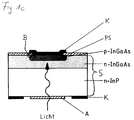
- Fig. 1 shows a known planar InGaAs / InP-pin photodiode in different phases of its formation.
- FIG. 1a shows a two-layer substrate S made of n-doped indium phosphide InP and also n-doped indium gallium arsenide (InGaAs) applied thereon. Since, for example, Zn or Cd is to be diffused into this substrate S to form a p-conducting region, it is covered with an insulating layer IS made of SiO x , SiN y or SiO x N y to delimit this region, which is photolithographically predetermined with an opening L. Form and surface was provided. The insulating layer thus represents a diffusion mask.
- 1b shows the substrate S with the p-doped region P produced by diffusion and the electrically active pn junction located at its boundary with the n-doped substrate.
- FIG. 1c finally, shows the finished pin photodiode with applied metallic contacts K, an antireflection layer A on a light entry surface and with a passivation layer PS which, after removing the diffusion mask, the n-doped and the p-doped region on the top of the substrate covered.
- the component shown in FIGS. 1a to 1c in different stages of construction can be manufactured in different ways.
- the structure of the individual semiconductor and insulator layers can e.g. by sputtering or by separating a chemical reaction product from the vapor phase (Chemical Vapor Deposition CVD).
- the latter method has become known as thermal CVD, plasma-assisted CVD (also PECVD) or photo-CVD, depending on whether heat, a plasma or short-wave light are used to stimulate the chemical reaction.
- the component shown in FIGS. 1a to 1c and manufactured in a conventional manner has inadequate electrical properties, in particular an excessively high reverse current (dark current).
- Various investigations which will not be dealt with in more detail here, found damage to the semiconductor surface in the region of the pn junction (region B in FIG. 1c) as the cause of this inadequacy, which apparently contributes to the action of an intrinsic oxide layer present on the semiconductor surface the application of diffusion masking or passivation layers.
- a plasma-assisted CVD process differs from conventional processes of this type in that a pre-treatment of the surface to be coated is carried out in a halogen-carbon plasma before applying an insulating layer or a passivation layer which serves for diffusion masking.
- a pre-treatment of the surface to be coated is carried out in a halogen-carbon plasma before applying an insulating layer or a passivation layer which serves for diffusion masking.
- the substrate surface to be coated is introduced into a commercially available PECVD parallel plate reactor and heated to a temperature of approximately 200 ° C.
- a CF4 atmosphere with a pressure of 0.8 mbar is then produced in the reactor via inlet and outlet ports and a plasma is generated by applying an HF voltage to the electrode plates of the reactor.
- the CF4 is replaced by other reaction gases (for example SiH4, N20, N2) required to build up the insulating or passivating layer and the substrate is coated for about 6 to 7 minutes.
- the resulting layer can consist of Si02, Si3N4 or Si0 x N y depending on the composition of the reaction gases.
- the electrical values of a photodiode produced by this method are extremely improved compared to those of such components produced by known methods.
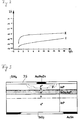
- 2 shows, for example, dark current characteristics, one each on InGaAs (II) and one on InP (I), according to the method described above, planar pin photodiode.
- the described method is suitable for avoiding damage to the semiconductor surface when applying insulating or passivating layers, both for InGaAs and InP substrates, and thus to enable the production of components with good and stable electrical values .
- the described method is not restricted to pin photodiodes and not to planar components.
- 3 shows, for example, the structure of a planar double hetero-APD, in which the passivation layer IS made of SiN x can be applied after pretreatment of the substrate surface in accordance with the described method.
- FIG 4 shows a MESA pin diode with a passivation layer PS applied by the described method.
Landscapes
- Light Receiving Elements (AREA)
- Formation Of Insulating Films (AREA)
- Crystals, And After-Treatments Of Crystals (AREA)
- Mechanical Treatment Of Semiconductor (AREA)
Abstract
Description
- Die Erfindung betrifft ein Verfahren gemäß dem Oberbegriff des Patentanspruchs 1.
- Es ist seit geraumer Zeit bekannt, daß bei III-V-Verbindungshalbleitern eine sich während des Herstellungsprozesses auf der Halbleiteroberfläche bildende Eigenoxidschicht dafür verantwortlich ist, daß die elektrischen Eigenschaften von aus solchen Halbleitern hergestellten Bauelementen nicht so gut sind, wie sie aufgrund theoretischer Überlegungen sein müßten und wie dies angestrebt wird.
- Beispielsweise ist, wie dies einem Aufsatz von M. Taillepied und S. Goussier in "Appl. Phys. Lett" 48(15), 1986, Seiten 978 bis 980 zu entnehmen ist, der Drain-Strom von aus III-V-Verbindungshalbleitermaterial hergestellten Feldeffekttransistoren nicht stabil. Auch wird bei aus solchem Halbleitermaterial hergestellten Photodioden ein zu hoher Dunkelstrom gemessen, der bei optoelektronischen Anwendungen eine unerwünschte Rauschquelle darstellt. Die Verminderung dieses Dunkelstromes ist Gegenstand der veröffentlichten Europäischen Patentanmeldung 128 724.
- Von verschiedenen Autoren wurden Verfahren angegeben, bei denen die unerwünschte Wirkung der Eigenoxidschicht bei der Herstellung von III-V-Verbindungshalbleiterbauelementen unterdrückt wird. Meist geschieht dies dadurch, daß die Ausbildung der Eigenoxidschicht verhindert oder zumindest verringert wird oder daß die entstandene Eigenoxidschicht vor Aufbringen einer Isolier- oder Passivierungsschicht gezielt entfernt wird.
- In einem Aufsatz von P. Boher et al, der auf der Konferenz INFOS 1987 in Leuven, 12. bis 14.03.1987 vorgetragen und anschließend auch als Druckschrift veröffentlicht wurde und der der Erfindung am nächsten kommt, ist das Entfernen der Eigenoxidschicht durch Einwirkung eines Wasserstoff-Plasmas beschrieben. Trotz sofort anschließender Beschichtung der Substratoberfläche mit Siliciummitrid Si₃N₄ läßt sich jedoch eine Neubildung einer dünneren Eigenoxidschicht vor der Si₃N₄ Beschichtung nicht verhindern.
- Das zuletzt erwähnte Verfahren führt zwar, wie zu erwarten, zur Verbesserung der elektrischen Werte der so hergestellten Halbleiterbauelemente. Diese erscheint jedoch noch nicht ausreichend.
- Es ist Aufgabe der Erfindung, ein Verfahren der eingangs genannten Art anzugeben, nach dem die zur Herstellung der Halbleiterbauelemente benötigten Diffusionsmaskier- und Passivierschichten ohne eine die elektrischen Eigenschaften der Bauelemente verschlechternde Beeinträchtigung der Halbleiteroberfläche aufgebracht werden können.
- Diese Aufgabe wird durch das im kennzeichnenden Teil des Patentanspruchs 1 angegebene Verfahrensmerkmal gelöst.
- Die Vorbehandlung der Halbleiteroberfläche mittels einer Halogen-Kohlenstoff-Verbindung unter Plasmaeinwirkung bewirkt eine erhebliche Verringerung der Sperrströme an den erzeugten p-n-übergängen. So weisen mit entsprechend der Erfindung vorbehandelten Oberflächen erzeugte pin-Dioden sehr niedrige Dunkelströme auf. Bei Avalanche-Photodioden (APD's) zu beobachtende, auf Oberflächendegradation zurückzuführende Randdurchbrüche treten nicht mehr auf.
- Diese Vorteile sind jedoch, im Gegensatz zum Stand der Technik, nicht auf ein Entfernen der Eigenoxidschicht zurückzuführen - diese bleibt im wesentlichen erhalten-, sondern gehen auf die Entstehung einer dünnen Schicht (möglicherweise einer Polymerschicht) zurück, welche den Halbleiter und seine Eigenoxidschicht während des nachfolgenden Schichtenauftrages vor direkter Einwirkung des Plasmas schützt.
- Eine Ausgestaltung des Verfahrens nach der Erfindung ist im Patentanspruch 2 wiedergegeben und sieht die Verwendung von CF₄ als Halogen-Kohlenstoff-Verbindung vor. Diese Verbindung hat gute Resultate ergeben und außerdem den Vorteil, dasselbe Halogen zu enthalten wie viele zur Oberflächenvorbereitung benutzte, flußsäurehaltige Ätzmittel.
- Weitere Ausgestaltungen der Erfindung betreffen die Plasmaerzeugung - vorzugsweise wird ein gewöhnlicher Parallelplattenreaktor verwendet - (Patentanspruch 3) und zur Anwendung des Verfahrens nach der Erfindung besonders geeignete Halbleiter-Isolierschicht-Kombinationen (Anspruch 4).
- Anhand von 4 Figuren soll nun das Verfahren nach der Erfindung ausführlich beschrieben werden.
- Fig. 1 zeigt eine bekannte planare InGaAs/InP-pin-Photodiode in verschiedenen Phasen ihrer Entstehung.
- In Fig. 1a ist ein zweischichtiges Substrat S aus n-dotiertem Indiumphosphid InP und auf diesem aufgebrachten, ebenfalls n-dotiertem Indium-Galliumarsenid (InGaAs) dargestellt. Da in dieses Subtrat S zur Bildung eines p-leitenden Bereichs z.B. Zn oder Cd eindiffundiert werden soll, ist es zur Abgrenzung dieses Bereichs mit einer Isolierschicht IS aus SiOx, SiNy oder SiOxNy überzogen, die photolithographisch mit einer Öffnung L vorgegebener Form und Fläche versehen wurde. Die Isolierschicht stellt damit eine Diffusionsmaske dar.
- Fig. 1b zeigt das Substrat S mit dem durch Diffusion erzeugten, p-dotierten Bereich P und dem an dessen Grenze zum n-dotierten Substrat befindlichen, elektrisch wirksamen p-n-Übergang.
- Fig. 1c, schließlich, zeigt die fertiggestellte pin-Photodiode mit aufgebrachten metallischen Kontakten K, einer Antireflexionsschicht A auf einer Lichteintrittsfläche und mit einer Passivierungschicht PS, die nach Entfernen der Diffusionsmaske den n-dotierten und den p-dotierten Bereich auf der Oberseite des Substrats bedeckt.
- Das in Fig. 1a bis 1c in unterschiedlichen Aufbaustadien wiedergegebene Bauelement kann auf verschiedene Arten hergestellt werden. Der Aufbau der einzelnen Halbleiter- und Isolatorschichten kann z.B. durch Sputtern oder durch Abscheiden eines chemischen Reaktionsproduktes aus der Dampfphase (Chemical Vapor-Deposition CVD) erfolgen. Das zuletzt genannte Verfahren ist, je nachdem, ob zur Anregung der chemischen Reaktion Wärme, ein Plasma oder kurzwelliges Licht verwendet werden, als thermisches CVD, plasmaunterstütztes CVD (auch PECVD) oder Photo-CVD bekanntgeworden.
- Das in Fig. 1a bis 1c dargestellte, auf herkömmliche Art und Weise hergestellte Bauelement weist unzureichende elektrische Eigenschaften, insbesondere einen zu hohen Sperrstrom (Dunkelstrom) auf. Durch verschiedene Untersuchungen, auf die hier nicht näher eingegangen werden soll, wurden als Ursache für diese Unzulänglichkeit Schädigungen der Halbleiteroberfläche im Bereich des p-n-Übergangs (Bereich B in Fig. 1c) festgestellt, die offenbar auf die Einwirkung einer auf der Halbleiteroberfläche vorhandenen Eigenoxidschicht bei der Aufbringung von Diffusionsmaskier- oder Passivierschichten zurückzuführen sind.
- Das Verfahren nach der Erfindung, ein plasmaunterstütztes CVD-Verfahren, unterscheidet sich von herkömmlichen derartigen Verfahren dadurch, daß vor Aufbringung einer der Diffusionsmaskierung dienenden Isolierschicht oder einer Passivierungsschicht eine Vorbehandlung der zu beschichtenden Oberfläche in einem Halogen-Kohlenstoff-Plasma erfolgt. Hierzu wird die zu beschichtende Substratoberfläche nach Reinigung mit gepufferter Flußsäure in einen handelsüblichen PECVD-Parallelplattenreaktor eingebracht und auf eine Temperatur von etwa 200°C erwärmt. Über Ein- und Auslaßstutzen wird im Reaktor anschließend eine CF₄-Atmosphäre mit einem Druck von 0,8 mbar hergestellt und durch Anlegen einer HF-Spannung an die Elektrodenplatten des Reaktors ein Plasma erzeugt.
- Nach einer Einwirkzeit des CF₄-Plasmas auf die Halbleiteroberfläche von z.B. 1 Minute wird das CF₄ durch andere, zum Aufbau der Isolier- oder Passivierschicht benötigte Reaktionsgase (z.B. SiH₄, N₂0, N₂) ersetzt und das Substrat für ca. 6 bis 7 Minuten beschichtet. Die entstehende Schicht kann dabei je nach Zusammensetzung der Reaktionsgase aus Si0₂, Si₃N₄ oder Si0xNy bestehen.
- Die elektrischen Werte einer nach diesem Verfahren hergestellten Photodiode zeigen sich gegenüber denen der nach bekannten Verfahren hergestellten derartigen Bauelemente außerordentlich verbessert. In Fig. 2 sind z.B. Dunkelstromkennlinien je einer auf InGaAs (II) und einer auf InP (I) nach dem vorstehend beschriebenen Verfahren hergestellten planaren pin-Photodiode wiedergegeben.
- Wie diese Kennlinien zeigen, ist das beschriebene Verfahren dazu geeignet, sowohl bei InGaAs- als auch bei InP-Substraten, Schädigungen der Halbleiteroberfläche bei der Aufbringung von Isolier- oder Passivierschichten zu vermeiden und damit die Herstellung von Bauelementen mit guten und stabilen elektrischen Werten zu ermöglichen.
- Das beschriebene Verfahren ist nicht auf pin-Photodioden und nicht auf planare Bauelemente beschränkt. Fig. 3 zeigt z.B. schematisch den Aufbau einer planaren Doppel-Hetero-APD, bei der die Passivierschicht IS aus SiNx nach Vorbehandlung der Substratoberfläche entsprechend dem beschriebenen Verfahren aufgebracht werden kann. Die Buchstaben n und p geben die Polarität der Dotierungen in den durch die chemische Zusammensetzung ihres Stoffes bezeichneten Halbleiterbereichen an, die zugefügten hochgestellten Vorzeichen + oder - geben ein Maß für den Grad der Dotierung (+ = stark, - = schwach, keine Vorzeichen = normal) an.
- Fig. 4 zeigt eine MESA pin-Diode mit einer nach dem beschriebenen Verfahren aufgebrachten Passivierschicht PS.
Claims (4)
- Verfahren zur Herstellung und Passivierung von Bauelement-Bereichen auf einem Verbindungshalbleiter-Substrat, in welches nach Aufbringen und photolithographischer Strukturierung einer Diffusionsmaskierschicht Fremdatome eindiffundiert und dadurch dotierte Bereiche geschaffen werden, deren Grenzflächen zum Substrat hin p-n-Übergänge bilden und bei dem vor Aufbringen der Diffusionsmaskierschicht oder einer Passivierungsschicht eine Vorbehandlung der Substratoberfläche durch Einwirkung eines Plasmas erfolgt,
dadurch gekennzeichnet, daß das Plasma in einer Atmosphäre angeregt wird, welche mindestens eine Halogen-Kohlenstoff-Verbindung enthält. - Verfahren nach Anspruch 1, dadurch gekennzeichnet, daß als Halogen-Kohlenstoff-Verbindung Tetrafluorkohlenstoff (CF₄) verwendet wird.
- Verfahren nach Anspruch 1 oder 2, dadurch gekennzeichnet, daß die Vorbehandlung der Substratoberfläche und die Aufbringung der Diffusionsmaskierschicht oder Passivierungsschicht (JS) unmittelbar aufeinanderfolgend in einem PECVD-Parallelplattenreaktor erfolgen.
- Verfahren nach einem der vorstehenden Ansprüche, dadurch gekennzeichnet, daß als Verbindungshalbleiter Indiumphosphid InP, Indium-Galliumarsenid InGaAs Indium-Galliumarsenidphosphid InGaAsP, Indium-Aluminiumarsenid InAlAs oder Indium-Gallium-Aluminiumarsenid InGaAlAs und als Diffusionsmaskierschicht oder Passivierungsschicht (JS) Siliziumdioxid SiO₂, Siliziumnitrid SixNy oder Siliziumoxynitrid SiOxNy verwendet werden.
Applications Claiming Priority (2)
| Application Number | Priority Date | Filing Date | Title |
|---|---|---|---|
| DE4017870 | 1990-06-02 | ||
| DE4017870A DE4017870A1 (de) | 1990-06-02 | 1990-06-02 | Verfahren zur herstellung und passivierung von halbleiterbauelementen |
Publications (3)
| Publication Number | Publication Date |
|---|---|
| EP0464372A2 true EP0464372A2 (de) | 1992-01-08 |
| EP0464372A3 EP0464372A3 (en) | 1992-05-27 |
| EP0464372B1 EP0464372B1 (de) | 1997-04-23 |
Family
ID=6407742
Family Applications (1)
| Application Number | Title | Priority Date | Filing Date |
|---|---|---|---|
| EP91108781A Expired - Lifetime EP0464372B1 (de) | 1990-06-02 | 1991-05-29 | Verfahren zur Herstellung und Passivierung von Halbleiterbauelementen |
Country Status (6)
| Country | Link |
|---|---|
| US (1) | US5248635A (de) |
| EP (1) | EP0464372B1 (de) |
| JP (1) | JP3207869B2 (de) |
| AT (1) | ATE152289T1 (de) |
| DE (2) | DE4017870A1 (de) |
| ES (1) | ES2103285T3 (de) |
Cited By (1)
| Publication number | Priority date | Publication date | Assignee | Title |
|---|---|---|---|---|
| US20210351037A1 (en) * | 2018-10-05 | 2021-11-11 | Osram Opto Semiconductors Gmbh | Method for producing a semiconductor component comprising performing a plasma treatment, and semiconductor component |
Families Citing this family (6)
| Publication number | Priority date | Publication date | Assignee | Title |
|---|---|---|---|---|
| US5593902A (en) * | 1994-05-23 | 1997-01-14 | Texas Instruments Incorporated | Method of making photodiodes for low dark current operation having geometric enhancement |
| US5888890A (en) * | 1994-08-12 | 1999-03-30 | Lg Semicon Co., Ltd. | Method of manufacturing field effect transistor |
| US20040241948A1 (en) * | 2003-05-29 | 2004-12-02 | Chun-Feng Nieh | Method of fabricating stacked gate dielectric layer |
| DE10359371A1 (de) * | 2003-12-18 | 2005-07-28 | Fraunhofer-Gesellschaft zur Förderung der angewandten Forschung e.V. | Passivierte Endoberflächen |
| US10020187B2 (en) | 2012-11-26 | 2018-07-10 | Applied Materials, Inc. | Apparatus and methods for backside passivation |
| US10666353B1 (en) | 2018-11-20 | 2020-05-26 | Juniper Networks, Inc. | Normal incidence photodetector with self-test functionality |
Family Cites Families (6)
| Publication number | Priority date | Publication date | Assignee | Title |
|---|---|---|---|---|
| US3969164A (en) * | 1974-09-16 | 1976-07-13 | Bell Telephone Laboratories, Incorporated | Native oxide technique for preparing clean substrate surfaces |
| US4246296A (en) * | 1979-02-14 | 1981-01-20 | Bell Telephone Laboratories, Incorporated | Controlling the properties of native films using selective growth chemistry |
| US4455351A (en) * | 1983-06-13 | 1984-06-19 | At&T Bell Laboratories | Preparation of photodiodes |
| US4987008A (en) * | 1985-07-02 | 1991-01-22 | Semiconductor Energy Laboratory Co., Ltd. | Thin film formation method |
| US4830705A (en) * | 1987-07-16 | 1989-05-16 | Texas Instruments Incorporated | Method for etch of GaAs |
| US5098851A (en) * | 1989-02-10 | 1992-03-24 | Hitachi, Ltd. | Fabricating a semiconductor photodetector by annealing to smooth the PN junction |
-
1990
- 1990-06-02 DE DE4017870A patent/DE4017870A1/de not_active Withdrawn
-
1991
- 1991-05-28 JP JP15247991A patent/JP3207869B2/ja not_active Expired - Fee Related
- 1991-05-29 ES ES91108781T patent/ES2103285T3/es not_active Expired - Lifetime
- 1991-05-29 AT AT91108781T patent/ATE152289T1/de not_active IP Right Cessation
- 1991-05-29 DE DE59108673T patent/DE59108673D1/de not_active Expired - Fee Related
- 1991-05-29 EP EP91108781A patent/EP0464372B1/de not_active Expired - Lifetime
- 1991-05-29 US US07/707,047 patent/US5248635A/en not_active Expired - Fee Related
Cited By (2)
| Publication number | Priority date | Publication date | Assignee | Title |
|---|---|---|---|---|
| US20210351037A1 (en) * | 2018-10-05 | 2021-11-11 | Osram Opto Semiconductors Gmbh | Method for producing a semiconductor component comprising performing a plasma treatment, and semiconductor component |
| US11915935B2 (en) * | 2018-10-05 | 2024-02-27 | Osram Opto Semiconductors Gmbh | Method for producing a semiconductor component comprising performing a plasma treatment, and semiconductor component |
Also Published As
| Publication number | Publication date |
|---|---|
| US5248635A (en) | 1993-09-28 |
| DE59108673D1 (de) | 1997-05-28 |
| EP0464372B1 (de) | 1997-04-23 |
| ATE152289T1 (de) | 1997-05-15 |
| ES2103285T3 (es) | 1997-09-16 |
| EP0464372A3 (en) | 1992-05-27 |
| DE4017870A1 (de) | 1991-12-05 |
| JP3207869B2 (ja) | 2001-09-10 |
| JPH04230033A (ja) | 1992-08-19 |
Similar Documents
| Publication | Publication Date | Title |
|---|---|---|
| EP0607180B1 (de) | Verfahren zur herstellung von halbleiterbauelementen | |
| DE69510583T2 (de) | Galliumoxid-Beschichtung für optoelektronische Bauelemente | |
| DE69615390T2 (de) | Verfahren zum reduzieren von defekten in oxiden schichten auf silikonkarbiden | |
| DE3650287T2 (de) | Halbleiter-Photodetektor mit einem zweistufigen Verunreinigungsprofil. | |
| DE19634617B4 (de) | Verfahren zur Herstellung einer Siliziumsolarzelle mit verringerter Rekombination nahe der Solarzellenoberfläche | |
| DE69421014T2 (de) | Widerstandsbestimmungsmethode von N-Typ-Siliziumepitaxieschichten | |
| DE69010298T2 (de) | Niederdruck/Niedertemperatur-Prozess für Deposition von Siliciumdioxyd. | |
| WO1999049521A1 (de) | Verfahren zur einseitigen dotierung eines halbleiterkörpers | |
| DE3700620A1 (de) | Halbleiterkoerper und verfahren zum herstellen desselben | |
| CH623685A5 (de) | ||
| DE2920444C2 (de) | Verfahren zur ohmschen Kontaktierung eines Halbleiterbauelements | |
| EP2338179B1 (de) | Verfahren zur behandlung von substraten und behandlungseinrichtung zur durchführung des verfahrens | |
| DE69623000T2 (de) | Elektrolumineszentes Bauelement, das poröses Silicium enthält | |
| DE102014205350B4 (de) | Photoaktives Halbleiterbauelement sowie Verfahren zum Herstellen eines photoaktiven Halbleiterbauelementes | |
| EP0464372B1 (de) | Verfahren zur Herstellung und Passivierung von Halbleiterbauelementen | |
| DE3340874A1 (de) | Verfahren zum herstellen einer solarzelle | |
| DE2735937C2 (de) | Flüssigphasenepitaxie-Verfahren zur Herstellung von Halbleiter-Heterostrukturen | |
| DE1489240B1 (de) | Verfahren zum Herstellen von Halbleiterbauelementen | |
| DE2554029C2 (de) | Verfahren zur Erzeugung optoelektronischer Anordnungen | |
| DE3015422A1 (de) | Verfahren zur herstellung einer elektrolumineszierenden halbleiteranordnung und durch dieses verfahren hergestellte elektrolumineszierende halbleiteranordnung | |
| DE19920871B4 (de) | Verfahren zum Aktivieren von Ladungsträgern durch strahlungsunterstützte Wärmebehandlung | |
| DE2114363A1 (de) | Spannungsvariabler Kondensator mit erweiterbarem pn-Übergangsbereich | |
| EP1086488A2 (de) | Verfahren zum herstellen von halbleiterbauelementen | |
| DE1964837B2 (de) | Verfahren zur Herstellung einer lichtemittierenden Halbleiterdiode | |
| DE2924388A1 (de) | Halbleiterfotoelement |
Legal Events
| Date | Code | Title | Description |
|---|---|---|---|
| PUAI | Public reference made under article 153(3) epc to a published international application that has entered the european phase |
Free format text: ORIGINAL CODE: 0009012 |
|
| AK | Designated contracting states |
Kind code of ref document: A2 Designated state(s): AT BE CH DE ES FR GB IT LI NL SE |
|
| PUAL | Search report despatched |
Free format text: ORIGINAL CODE: 0009013 |
|
| AK | Designated contracting states |
Kind code of ref document: A3 Designated state(s): AT BE CH DE ES FR GB IT LI NL SE |
|
| 17P | Request for examination filed |
Effective date: 19920626 |
|
| RAP3 | Party data changed (applicant data changed or rights of an application transferred) |
Owner name: ALCATEL N.V. Owner name: ALCATEL SEL AKTIENGESELLSCHAFT |
|
| 17Q | First examination report despatched |
Effective date: 19941004 |
|
| GRAG | Despatch of communication of intention to grant |
Free format text: ORIGINAL CODE: EPIDOS AGRA |
|
| GRAH | Despatch of communication of intention to grant a patent |
Free format text: ORIGINAL CODE: EPIDOS IGRA |
|
| GRAH | Despatch of communication of intention to grant a patent |
Free format text: ORIGINAL CODE: EPIDOS IGRA |
|
| GRAA | (expected) grant |
Free format text: ORIGINAL CODE: 0009210 |
|
| AK | Designated contracting states |
Kind code of ref document: B1 Designated state(s): AT BE CH DE ES FR GB IT LI NL SE |
|
| REF | Corresponds to: |
Ref document number: 152289 Country of ref document: AT Date of ref document: 19970515 Kind code of ref document: T |
|
| REG | Reference to a national code |
Ref country code: CH Ref legal event code: NV Representative=s name: JUERG ULRICH C/O ALCATEL STR AG Ref country code: CH Ref legal event code: EP |
|
| REF | Corresponds to: |
Ref document number: 59108673 Country of ref document: DE Date of ref document: 19970528 |
|
| ITF | It: translation for a ep patent filed | ||
| GBT | Gb: translation of ep patent filed (gb section 77(6)(a)/1977) |
Effective date: 19970508 |
|
| ET | Fr: translation filed | ||
| REG | Reference to a national code |
Ref country code: ES Ref legal event code: FG2A Ref document number: 2103285 Country of ref document: ES Kind code of ref document: T3 |
|
| PLBE | No opposition filed within time limit |
Free format text: ORIGINAL CODE: 0009261 |
|
| STAA | Information on the status of an ep patent application or granted ep patent |
Free format text: STATUS: NO OPPOSITION FILED WITHIN TIME LIMIT |
|
| 26N | No opposition filed | ||
| PGFP | Annual fee paid to national office [announced via postgrant information from national office to epo] |
Ref country code: CH Payment date: 20010418 Year of fee payment: 11 |
|
| PGFP | Annual fee paid to national office [announced via postgrant information from national office to epo] |
Ref country code: AT Payment date: 20010427 Year of fee payment: 11 |
|
| PGFP | Annual fee paid to national office [announced via postgrant information from national office to epo] |
Ref country code: ES Payment date: 20010514 Year of fee payment: 11 Ref country code: BE Payment date: 20010514 Year of fee payment: 11 |
|
| REG | Reference to a national code |
Ref country code: GB Ref legal event code: IF02 |
|
| PGFP | Annual fee paid to national office [announced via postgrant information from national office to epo] |
Ref country code: NL Payment date: 20020430 Year of fee payment: 12 |
|
| PGFP | Annual fee paid to national office [announced via postgrant information from national office to epo] |
Ref country code: SE Payment date: 20020502 Year of fee payment: 12 Ref country code: GB Payment date: 20020502 Year of fee payment: 12 |
|
| PGFP | Annual fee paid to national office [announced via postgrant information from national office to epo] |
Ref country code: DE Payment date: 20020511 Year of fee payment: 12 |
|
| PGFP | Annual fee paid to national office [announced via postgrant information from national office to epo] |
Ref country code: FR Payment date: 20020513 Year of fee payment: 12 |
|
| PG25 | Lapsed in a contracting state [announced via postgrant information from national office to epo] |
Ref country code: AT Free format text: LAPSE BECAUSE OF NON-PAYMENT OF DUE FEES Effective date: 20020529 |
|
| PG25 | Lapsed in a contracting state [announced via postgrant information from national office to epo] |
Ref country code: ES Free format text: LAPSE BECAUSE OF NON-PAYMENT OF DUE FEES Effective date: 20020530 |
|
| PG25 | Lapsed in a contracting state [announced via postgrant information from national office to epo] |
Ref country code: LI Free format text: LAPSE BECAUSE OF NON-PAYMENT OF DUE FEES Effective date: 20020531 Ref country code: CH Free format text: LAPSE BECAUSE OF NON-PAYMENT OF DUE FEES Effective date: 20020531 Ref country code: BE Free format text: LAPSE BECAUSE OF NON-PAYMENT OF DUE FEES Effective date: 20020531 |
|
| REG | Reference to a national code |
Ref country code: CH Ref legal event code: PL |
|
| PG25 | Lapsed in a contracting state [announced via postgrant information from national office to epo] |
Ref country code: GB Free format text: LAPSE BECAUSE OF NON-PAYMENT OF DUE FEES Effective date: 20030529 |
|
| PG25 | Lapsed in a contracting state [announced via postgrant information from national office to epo] |
Ref country code: SE Free format text: LAPSE BECAUSE OF NON-PAYMENT OF DUE FEES Effective date: 20030530 |
|
| PG25 | Lapsed in a contracting state [announced via postgrant information from national office to epo] |
Ref country code: NL Free format text: LAPSE BECAUSE OF NON-PAYMENT OF DUE FEES Effective date: 20031201 |
|
| PG25 | Lapsed in a contracting state [announced via postgrant information from national office to epo] |
Ref country code: DE Free format text: LAPSE BECAUSE OF NON-PAYMENT OF DUE FEES Effective date: 20031202 |
|
| EUG | Se: european patent has lapsed | ||
| GBPC | Gb: european patent ceased through non-payment of renewal fee |
Effective date: 20030529 |
|
| PG25 | Lapsed in a contracting state [announced via postgrant information from national office to epo] |
Ref country code: FR Free format text: LAPSE BECAUSE OF NON-PAYMENT OF DUE FEES Effective date: 20040130 |
|
| NLV4 | Nl: lapsed or anulled due to non-payment of the annual fee |
Effective date: 20031201 |
|
| REG | Reference to a national code |
Ref country code: FR Ref legal event code: ST |
|
| REG | Reference to a national code |
Ref country code: ES Ref legal event code: FD2A Effective date: 20030611 |
|
| PG25 | Lapsed in a contracting state [announced via postgrant information from national office to epo] |
Ref country code: IT Free format text: LAPSE BECAUSE OF NON-PAYMENT OF DUE FEES Effective date: 20050529 |