EP0464481A1 - Dispositif de commande d'un moteur hydraulique - Google Patents
Dispositif de commande d'un moteur hydraulique Download PDFInfo
- Publication number
- EP0464481A1 EP0464481A1 EP19910110125 EP91110125A EP0464481A1 EP 0464481 A1 EP0464481 A1 EP 0464481A1 EP 19910110125 EP19910110125 EP 19910110125 EP 91110125 A EP91110125 A EP 91110125A EP 0464481 A1 EP0464481 A1 EP 0464481A1
- Authority
- EP
- European Patent Office
- Prior art keywords
- valve
- cylinder
- line
- tank
- volume flow
- Prior art date
- Legal status (The legal status is an assumption and is not a legal conclusion. Google has not performed a legal analysis and makes no representation as to the accuracy of the status listed.)
- Granted
Links
Images

Classifications
-
- F—MECHANICAL ENGINEERING; LIGHTING; HEATING; WEAPONS; BLASTING
- F15—FLUID-PRESSURE ACTUATORS; HYDRAULICS OR PNEUMATICS IN GENERAL
- F15B—SYSTEMS ACTING BY MEANS OF FLUIDS IN GENERAL; FLUID-PRESSURE ACTUATORS, e.g. SERVOMOTORS; DETAILS OF FLUID-PRESSURE SYSTEMS, NOT OTHERWISE PROVIDED FOR
- F15B11/00—Servomotor systems without provision for follow-up action; Circuits therefor
- F15B11/08—Servomotor systems without provision for follow-up action; Circuits therefor with only one servomotor
-
- F—MECHANICAL ENGINEERING; LIGHTING; HEATING; WEAPONS; BLASTING
- F15—FLUID-PRESSURE ACTUATORS; HYDRAULICS OR PNEUMATICS IN GENERAL
- F15B—SYSTEMS ACTING BY MEANS OF FLUIDS IN GENERAL; FLUID-PRESSURE ACTUATORS, e.g. SERVOMOTORS; DETAILS OF FLUID-PRESSURE SYSTEMS, NOT OTHERWISE PROVIDED FOR
- F15B2211/00—Circuits for servomotor systems
- F15B2211/30—Directional control
- F15B2211/305—Directional control characterised by the type of valves
- F15B2211/3056—Assemblies of multiple valves
- F15B2211/30565—Assemblies of multiple valves having multiple valves for a single output member, e.g. for creating higher valve function by use of multiple valves like two 2/2-valves replacing a 5/3-valve
- F15B2211/3057—Assemblies of multiple valves having multiple valves for a single output member, e.g. for creating higher valve function by use of multiple valves like two 2/2-valves replacing a 5/3-valve having two valves, one for each port of a double-acting output member
-
- F—MECHANICAL ENGINEERING; LIGHTING; HEATING; WEAPONS; BLASTING
- F15—FLUID-PRESSURE ACTUATORS; HYDRAULICS OR PNEUMATICS IN GENERAL
- F15B—SYSTEMS ACTING BY MEANS OF FLUIDS IN GENERAL; FLUID-PRESSURE ACTUATORS, e.g. SERVOMOTORS; DETAILS OF FLUID-PRESSURE SYSTEMS, NOT OTHERWISE PROVIDED FOR
- F15B2211/00—Circuits for servomotor systems
- F15B2211/30—Directional control
- F15B2211/305—Directional control characterised by the type of valves
- F15B2211/3056—Assemblies of multiple valves
- F15B2211/30565—Assemblies of multiple valves having multiple valves for a single output member, e.g. for creating higher valve function by use of multiple valves like two 2/2-valves replacing a 5/3-valve
- F15B2211/3058—Assemblies of multiple valves having multiple valves for a single output member, e.g. for creating higher valve function by use of multiple valves like two 2/2-valves replacing a 5/3-valve having additional valves for interconnecting the fluid chambers of a double-acting actuator, e.g. for regeneration mode or for floating mode
-
- F—MECHANICAL ENGINEERING; LIGHTING; HEATING; WEAPONS; BLASTING
- F15—FLUID-PRESSURE ACTUATORS; HYDRAULICS OR PNEUMATICS IN GENERAL
- F15B—SYSTEMS ACTING BY MEANS OF FLUIDS IN GENERAL; FLUID-PRESSURE ACTUATORS, e.g. SERVOMOTORS; DETAILS OF FLUID-PRESSURE SYSTEMS, NOT OTHERWISE PROVIDED FOR
- F15B2211/00—Circuits for servomotor systems
- F15B2211/30—Directional control
- F15B2211/31—Directional control characterised by the positions of the valve element
- F15B2211/3144—Directional control characterised by the positions of the valve element the positions being continuously variable, e.g. as realised by proportional valves
-
- F—MECHANICAL ENGINEERING; LIGHTING; HEATING; WEAPONS; BLASTING
- F15—FLUID-PRESSURE ACTUATORS; HYDRAULICS OR PNEUMATICS IN GENERAL
- F15B—SYSTEMS ACTING BY MEANS OF FLUIDS IN GENERAL; FLUID-PRESSURE ACTUATORS, e.g. SERVOMOTORS; DETAILS OF FLUID-PRESSURE SYSTEMS, NOT OTHERWISE PROVIDED FOR
- F15B2211/00—Circuits for servomotor systems
- F15B2211/30—Directional control
- F15B2211/35—Directional control combined with flow control
-
- F—MECHANICAL ENGINEERING; LIGHTING; HEATING; WEAPONS; BLASTING
- F15—FLUID-PRESSURE ACTUATORS; HYDRAULICS OR PNEUMATICS IN GENERAL
- F15B—SYSTEMS ACTING BY MEANS OF FLUIDS IN GENERAL; FLUID-PRESSURE ACTUATORS, e.g. SERVOMOTORS; DETAILS OF FLUID-PRESSURE SYSTEMS, NOT OTHERWISE PROVIDED FOR
- F15B2211/00—Circuits for servomotor systems
- F15B2211/40—Flow control
- F15B2211/405—Flow control characterised by the type of flow control means or valve
- F15B2211/40507—Flow control characterised by the type of flow control means or valve with constant throttles or orifices
-
- F—MECHANICAL ENGINEERING; LIGHTING; HEATING; WEAPONS; BLASTING
- F15—FLUID-PRESSURE ACTUATORS; HYDRAULICS OR PNEUMATICS IN GENERAL
- F15B—SYSTEMS ACTING BY MEANS OF FLUIDS IN GENERAL; FLUID-PRESSURE ACTUATORS, e.g. SERVOMOTORS; DETAILS OF FLUID-PRESSURE SYSTEMS, NOT OTHERWISE PROVIDED FOR
- F15B2211/00—Circuits for servomotor systems
- F15B2211/40—Flow control
- F15B2211/405—Flow control characterised by the type of flow control means or valve
- F15B2211/40576—Assemblies of multiple valves
-
- F—MECHANICAL ENGINEERING; LIGHTING; HEATING; WEAPONS; BLASTING
- F15—FLUID-PRESSURE ACTUATORS; HYDRAULICS OR PNEUMATICS IN GENERAL
- F15B—SYSTEMS ACTING BY MEANS OF FLUIDS IN GENERAL; FLUID-PRESSURE ACTUATORS, e.g. SERVOMOTORS; DETAILS OF FLUID-PRESSURE SYSTEMS, NOT OTHERWISE PROVIDED FOR
- F15B2211/00—Circuits for servomotor systems
- F15B2211/40—Flow control
- F15B2211/415—Flow control characterised by the connections of the flow control means in the circuit
- F15B2211/41554—Flow control characterised by the connections of the flow control means in the circuit being connected to a return line and a directional control valve
-
- F—MECHANICAL ENGINEERING; LIGHTING; HEATING; WEAPONS; BLASTING
- F15—FLUID-PRESSURE ACTUATORS; HYDRAULICS OR PNEUMATICS IN GENERAL
- F15B—SYSTEMS ACTING BY MEANS OF FLUIDS IN GENERAL; FLUID-PRESSURE ACTUATORS, e.g. SERVOMOTORS; DETAILS OF FLUID-PRESSURE SYSTEMS, NOT OTHERWISE PROVIDED FOR
- F15B2211/00—Circuits for servomotor systems
- F15B2211/40—Flow control
- F15B2211/415—Flow control characterised by the connections of the flow control means in the circuit
- F15B2211/41581—Flow control characterised by the connections of the flow control means in the circuit being connected to an output member and a return line
-
- F—MECHANICAL ENGINEERING; LIGHTING; HEATING; WEAPONS; BLASTING
- F15—FLUID-PRESSURE ACTUATORS; HYDRAULICS OR PNEUMATICS IN GENERAL
- F15B—SYSTEMS ACTING BY MEANS OF FLUIDS IN GENERAL; FLUID-PRESSURE ACTUATORS, e.g. SERVOMOTORS; DETAILS OF FLUID-PRESSURE SYSTEMS, NOT OTHERWISE PROVIDED FOR
- F15B2211/00—Circuits for servomotor systems
- F15B2211/40—Flow control
- F15B2211/42—Flow control characterised by the type of actuation
- F15B2211/428—Flow control characterised by the type of actuation actuated by fluid pressure
-
- F—MECHANICAL ENGINEERING; LIGHTING; HEATING; WEAPONS; BLASTING
- F15—FLUID-PRESSURE ACTUATORS; HYDRAULICS OR PNEUMATICS IN GENERAL
- F15B—SYSTEMS ACTING BY MEANS OF FLUIDS IN GENERAL; FLUID-PRESSURE ACTUATORS, e.g. SERVOMOTORS; DETAILS OF FLUID-PRESSURE SYSTEMS, NOT OTHERWISE PROVIDED FOR
- F15B2211/00—Circuits for servomotor systems
- F15B2211/60—Circuit components or control therefor
- F15B2211/635—Circuits providing pilot pressure to pilot pressure-controlled fluid circuit elements
- F15B2211/6355—Circuits providing pilot pressure to pilot pressure-controlled fluid circuit elements having valve means
Definitions
- the invention relates to a device for controlling a hydraulic motor according to the preamble of the main claim.
- Such a device is already known from DE-OS 32 19 730, in which a hydraulic differential cylinder can be controlled via an electrohydraulic control valve, which cooperates with a proportional switching valve which is controlled as a function of the differential pressure and which can be controlled via a measuring throttle located in a volume flow controlled by the control valve is.
- a volume flow can be controlled analogously to the hydraulic motor, the size of which considerably exceeds the nominal size of the control valve itself.
- a plunger circuit is implemented when the piston rod is extended, the volume flow flowing out of the annular space being at least partially returned to the cylinder space.
- the device according to the invention for controlling a hydraulic motor with the characterizing features of the main claim has the advantage that it can be implemented with relatively little effort and with simple components and thereby enables low-loss operation while maintaining previous advantages. In this way, the losses of a measuring throttle in the volume flow flowing to the engine can be avoided when the differential cylinder is operated in a plunger circuit. Furthermore, when operating with a plunger circuit, no volume flow has to flow via the changeover valve which is controlled as a function of the differential pressure. Furthermore, the engine is well clamped hydraulically when the piston rod is extended, since the volume flow flowing out of the annular space is controlled by a single control edge in the control valve and its merging with a pump volume flow only takes place downstream of the control valve.
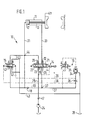
- 1 and 2 show a first and a second device for controlling a hydraulic motor, each in a simplified representation.
- FIG. 1 shows a device 10 for controlling a hydraulic motor, which is designed here as a differential cylinder 11, as is used, for example, as a locking cylinder in a plastic injection molding machine for actuating a mold.
- the differential cylinder 11 has a cylinder space 12 assigned to its large effective area and an annular space 13 assigned to the smaller effective area, the area ratio of which is 2: 1.
- the device 10 essentially has, as components, a proportional valve 14 designed as an electrohydraulic control valve, a changeover valve 15 controlled as a function of the differential pressure, a pilot operated check valve 16, and two check valves 17 and 18.
- the known proportional valve 14 is formed in two stages, switched into a control circuit (not shown) and, in addition to a spring-centered neutral position 19 with associated zero relief, has a first working position 21 and a second working position 22.
- An inlet connection 23, designated P is supplied with pressure medium by a pump 24 via an inlet line 25, the first check valve 17 being connected into the inlet line 25.
- a return connection designated T is connected to a tank 28 via a tank line 27, into which the shut-off valve 16 is connected.
- a first working line 31 leads from a first motor connection 29, designated A, into the cylinder space 12 of the differential cylinder 11.
- a second motor connection 32 designated B, is connected to the annular space 13 via a second working line 33.
- the check valve 16 connected into the tank line 27 consists of a 2/2 cartridge 34, which is hydraulically piloted by a solenoid valve 35.
- the check valve 16 is designed as a normally open valve.
- a measuring throttle 36 is connected in the tank line 27 upstream from the shut-off valve 16, which is located in the tank line 27 downstream from a branch point 37.
- the pressure drop caused by the measuring throttle 36 in the tank line 27 is tapped via two control lines 38, 39 and is used for the differential pressure-dependent control of the changeover valve 15.
- the changeover valve 15 which is controlled as a function of the differential pressure, is a known throttle valve with double flow for flow force compensation. It has a spring-centered blocking position 41 in which all connections are blocked off and can be deflected into a pressure-dependent working position 42 in which the size of the pressure medium flow flowing through is controlled in proportion to the size of the pressure difference present.
- the changeover valve 15 is connected to a return line 43, which connects the cylinder space 12 of the differential cylinder 11 directly to the tank 28, this return line 43 for connecting the changeover valve 15 being partially guided in parallel sections.
- This return line 43 with its section leading to the switching valve 15 port P and the first working line 31 have a common node 44 which is connected via a bypass line 45 to the branch point 37, so that in this way the return port 26 of the proportional valve 14 bypassing Changeover valve 15, check valve 16 and measuring throttle 36 is connected directly to the cylinder chamber 12.
- this bypass line 45 the second check valve 18 is switched so that it opens towards the cylinder chamber 12.
- the volume flow coming from the pump 24 flows via the control edge PA and the first working line 31 into the cylinder space 12.
- the pressure medium displaced from the annular space 13 flows via the second working line 33, the control edge BT to the branch point 37 and further Via the bypass line 45 with the check valve 18 to the node 44 and further into the cylinder space 12 of the differential cylinder 11.
- a plunger circuit is implemented, the volume flow coming from the pump 24 and the volume flow taken over from the annular space 13 being different unite at node 44 and flow together into cylinder chamber 12.
- the piston rod in the differential cylinder 11 is retracted, for which purpose the proportional valve 14 is controlled in its second working position 22.
- the volume flow coming from the pump 24 flows via the control edge PA into the annular space 13 of the cylinder 11.
- a volume flow that is twice as large flows out via the first working line 31.
- this volume flow is divided into a partial flow to the changeover valve 15 and another partial flow to the proportional valve 14.
- the partial flow to the proportional valve 14 flows via the control edge AT into the tank line 27, flowing through the measuring throttle 36 and the open shut-off valve 16.
- This partial flow causes a pressure difference at the measuring throttle 36, which acts on the changeover valve 15 via the control lines 38, 39 and adjusts this against its spring force from the blocking position 41 to its working position 42.
- the differential pressure-controlled changeover valve 15 controls a partial flow from the node 44 via the return line 43 directly to the tank 28, the size of this volume flow being proportional to the size of the pressure difference generated by the measuring throttle 36. Flow forces in the valve are balanced by the double flow through the changeover valve 15; furthermore, its nominal size can be kept correspondingly small.
- the device 10 can now be designed so that at a pressure drop of approximately 5 bar at the measuring throttle 36 at maximum opening speed, half the volume flow from the cylinder space 12 in the differential cylinder 11 is controlled via the changeover valve 15 to the tank 28.
- the functions of accelerating and braking when opening the mold are still guaranteed and are determined by the proportional valve 14 using its ramp technology.
- the second check valve 18 in the bypass line 45 prevents pressure medium from flowing out of the cylinder space 12 bypassing the proportional valve 14 into the tank line 27. This described division of the refluxing, double volume flow from the cylinder chamber 12 during the closing process prevents an undesirably strong return throttling on the proportional valve 14.
- the measuring throttle 36 is arranged in a device in the device 10, in which volume flows can only flow back to the tank in one direction.
- the proportional valve 14 In the device 10, only a simple volume flow is always passed through the proportional valve 14 both when the piston rod is extended and when it is retracted.
- the nominal size of this valve can accordingly be chosen to be small, which has a favorable effect, in particular on the costs, particularly in the case of large machines with large volume flows.
- the check valve 16 only has to be designed for a simple volume flow; can therefore have a correspondingly small nominal size. It is also advantageous if, in the device 10, the measuring throttle 36 with the cartridge 34 in the check valve 16 are structurally combined in a common housing.
- the proportional valve 14 is equipped with zero relief in the neutral position 19; this prevents the lock cylinder 11 from drifting, e.g. B. when he occupies a position with an open shape.
- FIG. 2 shows a second device 50, which differs from the first device 10 as follows, the same reference numerals being used for the same components.
- the second device 50 uses a single-flow 2-way switch valve 51, which is designed here as a cartridge for block installation.
- the changeover valve 51 works as a proportional throttle valve and, as before, lies in the return line 43 leading to the tank 28.
- the measuring throttle 36 is connected in the second working line 50 to the first working line 31 so that it lies between the node 44 and the proportional valve 14 is coming.
- a parallel branch line 52 is provided in the first working line 31, into which a third check valve 53 opening towards the node 44 is connected.
- the pressure difference caused by the measuring throttle 36 is passed via the control lines 38 and 39 to the changeover valve 51.
- control line 39 is controlled via an electromagnetically adjustable pressure control valve 54 which, together with the changeover valve 51 and the throttle 56, enables a pilot-controlled proportional pressure valve.
- the pressure in the annular space 13 is secured by a second pressure valve 55.
- the piston rod on the differential cylinder 11 When opening a mold, the piston rod on the differential cylinder 11 must be retracted, for which purpose the proportional valve 14 in its second working position 22 comes from the pump 24 leading volume flow into the annular space 13, the volume flow flowing out of the cylinder space 12 being divided again at the node 44.
- the measuring throttle 36 is now upstream of the proportional valve 14 in one of the partial flows and generates a pressure difference which actuates the changeover valve 51.
- the proportional valve 14 is always flowed through only with the simple volume flow, so that no excessive return throttling occurs with a relatively small nominal size.
- the throttle losses during the plunger switching when the piston rod is extended are low and at the same time the differential cylinder 11 is well clamped.
- superimposed pressure functions can be carried out with the changeover valve 51.
- the check valve 16 is actuated by a solenoid valve 35 with a changed circuit symbol; this circuit symbol enables a better drainage of leak oil compared to FIG. 1.
- This control of the cartridge 34 used in FIG. 2 can also be used with the first device 10 according to FIG.
- valve elements can also be installed in the devices for additional functions.
- a single-stage control valve can also be used.
- a single-flow valve type can also be used in the device 10. The advantages of the device are also present if a rotary drive is used as the hydraulic motor. The present device is particularly suitable for clamping units of injection and blow molding machines.
Landscapes
- Engineering & Computer Science (AREA)
- Physics & Mathematics (AREA)
- Fluid Mechanics (AREA)
- Mechanical Engineering (AREA)
- General Engineering & Computer Science (AREA)
- Fluid-Pressure Circuits (AREA)
- Injection Moulding Of Plastics Or The Like (AREA)
Applications Claiming Priority (2)
| Application Number | Priority Date | Filing Date | Title |
|---|---|---|---|
| DE4020451A DE4020451A1 (de) | 1990-06-27 | 1990-06-27 | Einrichtung zur steuerung eines hydraulischen motors |
| DE4020451 | 1990-06-27 |
Publications (2)
| Publication Number | Publication Date |
|---|---|
| EP0464481A1 true EP0464481A1 (fr) | 1992-01-08 |
| EP0464481B1 EP0464481B1 (fr) | 1995-02-01 |
Family
ID=6409182
Family Applications (1)
| Application Number | Title | Priority Date | Filing Date |
|---|---|---|---|
| EP91110125A Expired - Lifetime EP0464481B1 (fr) | 1990-06-27 | 1991-06-20 | Dispositif de commande d'un moteur hydraulique |
Country Status (3)
| Country | Link |
|---|---|
| EP (1) | EP0464481B1 (fr) |
| DE (2) | DE4020451A1 (fr) |
| ES (1) | ES2068435T3 (fr) |
Cited By (1)
| Publication number | Priority date | Publication date | Assignee | Title |
|---|---|---|---|---|
| RU2121395C1 (ru) * | 1992-12-03 | 1998-11-10 | Ека Нобель Актиеболаг | Хиральные оптические активные адсорбенты, способы их получения, сетчатый полимер, производные винной кислоты и способы их получения |
Families Citing this family (4)
| Publication number | Priority date | Publication date | Assignee | Title |
|---|---|---|---|---|
| DE19535677A1 (de) | 1995-09-26 | 1997-03-27 | Bosch Gmbh Robert | Einrichtung zur Steuerung eines hydraulischen Motors |
| AT524160B1 (de) | 2020-08-19 | 2022-06-15 | Engel Austria Gmbh | Hydraulische Antriebsvorrichtung für eine Formgebungsmaschine |
| CN115324953A (zh) * | 2022-08-09 | 2022-11-11 | 克劳斯玛菲机械(中国)有限公司 | 一种特殊注塑成型工艺中液压缸的液压系统 |
| CN119163655A (zh) * | 2024-10-29 | 2024-12-20 | 广东赫尔德液压科技有限公司 | 一种用于液压油杆的增压系统及其快速制动方法 |
Citations (4)
| Publication number | Priority date | Publication date | Assignee | Title |
|---|---|---|---|---|
| US3071926A (en) * | 1960-04-12 | 1963-01-08 | Hyster Co | Hydraulic lift cylinder circuit |
| EP0056770A2 (fr) * | 1981-01-19 | 1982-07-28 | Bendix Automation Company | Système hydraulique à mouvement rapide et anti-cavitation pour un excavateur |
| DE3219730A1 (de) * | 1982-05-26 | 1983-12-01 | Robert Bosch Gmbh, 7000 Stuttgart | Einrichtung zur steuerung eines hydraulischen servomotors |
| DE3816958A1 (de) * | 1988-05-18 | 1989-11-23 | Rexroth Mannesmann Gmbh | Ventilanordnung zum absenken einer an einem hydraulichen zylinder angreifenden last |
-
1990
- 1990-06-27 DE DE4020451A patent/DE4020451A1/de not_active Withdrawn
-
1991
- 1991-06-20 ES ES91110125T patent/ES2068435T3/es not_active Expired - Lifetime
- 1991-06-20 EP EP91110125A patent/EP0464481B1/fr not_active Expired - Lifetime
- 1991-06-20 DE DE59104462T patent/DE59104462D1/de not_active Expired - Lifetime
Patent Citations (4)
| Publication number | Priority date | Publication date | Assignee | Title |
|---|---|---|---|---|
| US3071926A (en) * | 1960-04-12 | 1963-01-08 | Hyster Co | Hydraulic lift cylinder circuit |
| EP0056770A2 (fr) * | 1981-01-19 | 1982-07-28 | Bendix Automation Company | Système hydraulique à mouvement rapide et anti-cavitation pour un excavateur |
| DE3219730A1 (de) * | 1982-05-26 | 1983-12-01 | Robert Bosch Gmbh, 7000 Stuttgart | Einrichtung zur steuerung eines hydraulischen servomotors |
| DE3816958A1 (de) * | 1988-05-18 | 1989-11-23 | Rexroth Mannesmann Gmbh | Ventilanordnung zum absenken einer an einem hydraulichen zylinder angreifenden last |
Cited By (1)
| Publication number | Priority date | Publication date | Assignee | Title |
|---|---|---|---|---|
| RU2121395C1 (ru) * | 1992-12-03 | 1998-11-10 | Ека Нобель Актиеболаг | Хиральные оптические активные адсорбенты, способы их получения, сетчатый полимер, производные винной кислоты и способы их получения |
Also Published As
| Publication number | Publication date |
|---|---|
| ES2068435T3 (es) | 1995-04-16 |
| EP0464481B1 (fr) | 1995-02-01 |
| DE4020451A1 (de) | 1992-01-02 |
| DE59104462D1 (de) | 1995-03-16 |
Similar Documents
| Publication | Publication Date | Title |
|---|---|---|
| EP1588077B1 (fr) | Dispositif de reglage d'une transmission hydrostatique | |
| DE1921977C3 (de) | Ventileinrichtung zur Steuerung der Druckmittelwege eines doppelwirkenden Servomotors | |
| DE10004905A1 (de) | Verfahren und Vorrichtung zur Steuerung eines Hubzylinders insbesondere von Arbeitsmaschinen | |
| DE2234313A1 (de) | Steuerventil | |
| DE2704326A1 (de) | Druckmittelstroemungssteuerung | |
| DE10059192C1 (de) | Hydraulische Antriebseinrichtung für ein Fahrzeug | |
| DE69803100T2 (de) | Druckbegrenzungsmechanismus und hydraulischer Schaltkreis mit Druckbegrenzungsmechanismus | |
| EP0179249A2 (fr) | Commande hydraulique | |
| DE2758234C2 (de) | Bremsventil | |
| DE3688346T2 (de) | Hydraulisches steuersystem. | |
| EP1451474B1 (fr) | Dispositif d'entrainement | |
| DE3734903C2 (de) | Blockiergeschützte hydraulische Kraftfahrzeugbremsanlage | |
| EP0656100A1 (fr) | Dispositif de commande hydraulique. | |
| EP0428581B1 (fr) | Systeme de transmission hydrostatique pour vehicules | |
| EP0464481B1 (fr) | Dispositif de commande d'un moteur hydraulique | |
| EP0198119B1 (fr) | Distributeur hydraulique pour commande indépendamment de la charge | |
| EP0111752B1 (fr) | Régulation d'un dispositif de commande pour une pompe hydrostatique à débit variable | |
| DE3422978C2 (de) | Vorrichtung zur Steuerung einer hydraulischen Stelleinrichtung | |
| EP0715698B1 (fr) | Transmission hydrostatique pourvue d'une soupape de frein | |
| DE2218472A1 (de) | Hydrostatisches getriebe | |
| EP0766009B1 (fr) | Système pour contrôler un moteur hydraulique | |
| DE3222106C2 (fr) | ||
| EP0347562A2 (fr) | Soupape de sûreté | |
| DE4235698C2 (de) | Hydrostatisches Antriebssystem | |
| DE10033757B4 (de) | Steuereinrichtung für einen hydraulischen Verbraucher |
Legal Events
| Date | Code | Title | Description |
|---|---|---|---|
| PUAI | Public reference made under article 153(3) epc to a published international application that has entered the european phase |
Free format text: ORIGINAL CODE: 0009012 |
|
| AK | Designated contracting states |
Kind code of ref document: A1 Designated state(s): DE ES FR IT |
|
| RAP3 | Party data changed (applicant data changed or rights of an application transferred) |
Owner name: ROBERT BOSCH GMBH |
|
| 17P | Request for examination filed |
Effective date: 19920624 |
|
| 17Q | First examination report despatched |
Effective date: 19940414 |
|
| GRAA | (expected) grant |
Free format text: ORIGINAL CODE: 0009210 |
|
| AK | Designated contracting states |
Kind code of ref document: B1 Designated state(s): DE ES FR IT |
|
| ET | Fr: translation filed | ||
| REF | Corresponds to: |
Ref document number: 59104462 Country of ref document: DE Date of ref document: 19950316 |
|
| REG | Reference to a national code |
Ref country code: ES Ref legal event code: FG2A Ref document number: 2068435 Country of ref document: ES Kind code of ref document: T3 |
|
| ITF | It: translation for a ep patent filed | ||
| PLBI | Opposition filed |
Free format text: ORIGINAL CODE: 0009260 |
|
| 26 | Opposition filed |
Opponent name: MANNESMANN REXROTH GMBH Effective date: 19951014 |
|
| PLBF | Reply of patent proprietor to notice(s) of opposition |
Free format text: ORIGINAL CODE: EPIDOS OBSO |
|
| PLBF | Reply of patent proprietor to notice(s) of opposition |
Free format text: ORIGINAL CODE: EPIDOS OBSO |
|
| PLBO | Opposition rejected |
Free format text: ORIGINAL CODE: EPIDOS REJO |
|
| PLBN | Opposition rejected |
Free format text: ORIGINAL CODE: 0009273 |
|
| STAA | Information on the status of an ep patent application or granted ep patent |
Free format text: STATUS: OPPOSITION REJECTED |
|
| 27O | Opposition rejected |
Effective date: 19960615 |
|
| PGFP | Annual fee paid to national office [announced via postgrant information from national office to epo] |
Ref country code: ES Payment date: 20020626 Year of fee payment: 12 |
|
| PG25 | Lapsed in a contracting state [announced via postgrant information from national office to epo] |
Ref country code: ES Free format text: LAPSE BECAUSE OF NON-PAYMENT OF DUE FEES Effective date: 20030621 |
|
| REG | Reference to a national code |
Ref country code: ES Ref legal event code: FD2A Effective date: 20030621 |
|
| PGFP | Annual fee paid to national office [announced via postgrant information from national office to epo] |
Ref country code: FR Payment date: 20050621 Year of fee payment: 15 |
|
| REG | Reference to a national code |
Ref country code: FR Ref legal event code: ST Effective date: 20070228 |
|
| PG25 | Lapsed in a contracting state [announced via postgrant information from national office to epo] |
Ref country code: FR Free format text: LAPSE BECAUSE OF NON-PAYMENT OF DUE FEES Effective date: 20060630 |
|
| PGFP | Annual fee paid to national office [announced via postgrant information from national office to epo] |
Ref country code: IT Payment date: 20100624 Year of fee payment: 20 |
|
| PGFP | Annual fee paid to national office [announced via postgrant information from national office to epo] |
Ref country code: DE Payment date: 20100824 Year of fee payment: 20 |
|
| REG | Reference to a national code |
Ref country code: DE Ref legal event code: R071 Ref document number: 59104462 Country of ref document: DE |
|
| REG | Reference to a national code |
Ref country code: DE Ref legal event code: R071 Ref document number: 59104462 Country of ref document: DE |
|
| PG25 | Lapsed in a contracting state [announced via postgrant information from national office to epo] |
Ref country code: DE Free format text: LAPSE BECAUSE OF EXPIRATION OF PROTECTION Effective date: 20110621 |