EP0467175A2 - Trousse pour la détermination d'une analyte dans un échantillon semi-solide, en particulier dans les selles - Google Patents
Trousse pour la détermination d'une analyte dans un échantillon semi-solide, en particulier dans les selles Download PDFInfo
- Publication number
- EP0467175A2 EP0467175A2 EP91111262A EP91111262A EP0467175A2 EP 0467175 A2 EP0467175 A2 EP 0467175A2 EP 91111262 A EP91111262 A EP 91111262A EP 91111262 A EP91111262 A EP 91111262A EP 0467175 A2 EP0467175 A2 EP 0467175A2
- Authority
- EP
- European Patent Office
- Prior art keywords
- sample
- test kit
- layer
- liquid transport
- eluate
- Prior art date
- Legal status (The legal status is an assumption and is not a legal conclusion. Google has not performed a legal analysis and makes no representation as to the accuracy of the status listed.)
- Granted
Links
Images

Classifications
-
- G—PHYSICS
- G01—MEASURING; TESTING
- G01N—INVESTIGATING OR ANALYSING MATERIALS BY DETERMINING THEIR CHEMICAL OR PHYSICAL PROPERTIES
- G01N33/00—Investigating or analysing materials by specific methods not covered by groups G01N1/00 - G01N31/00
- G01N33/48—Biological material, e.g. blood, urine; Haemocytometers
- G01N33/50—Chemical analysis of biological material, e.g. blood, urine; Testing involving biospecific ligand binding methods; Immunological testing
- G01N33/72—Chemical analysis of biological material, e.g. blood, urine; Testing involving biospecific ligand binding methods; Immunological testing involving blood pigments, e.g. haemoglobin, bilirubin or other porphyrins; involving occult blood
- G01N33/721—Haemoglobin
- G01N33/726—Devices
-
- G—PHYSICS
- G01—MEASURING; TESTING
- G01N—INVESTIGATING OR ANALYSING MATERIALS BY DETERMINING THEIR CHEMICAL OR PHYSICAL PROPERTIES
- G01N33/00—Investigating or analysing materials by specific methods not covered by groups G01N1/00 - G01N31/00
- G01N33/48—Biological material, e.g. blood, urine; Haemocytometers
- G01N33/50—Chemical analysis of biological material, e.g. blood, urine; Testing involving biospecific ligand binding methods; Immunological testing
- G01N33/52—Use of compounds or compositions for colorimetric, spectrophotometric or fluorometric investigation, e.g. use of reagent paper and including single- and multilayer analytical elements
- G01N33/528—Atypical element structures, e.g. gloves, rods, tampons, toilet paper
-
- Y—GENERAL TAGGING OF NEW TECHNOLOGICAL DEVELOPMENTS; GENERAL TAGGING OF CROSS-SECTIONAL TECHNOLOGIES SPANNING OVER SEVERAL SECTIONS OF THE IPC; TECHNICAL SUBJECTS COVERED BY FORMER USPC CROSS-REFERENCE ART COLLECTIONS [XRACs] AND DIGESTS
- Y10—TECHNICAL SUBJECTS COVERED BY FORMER USPC
- Y10S—TECHNICAL SUBJECTS COVERED BY FORMER USPC CROSS-REFERENCE ART COLLECTIONS [XRACs] AND DIGESTS
- Y10S435/00—Chemistry: molecular biology and microbiology
- Y10S435/805—Test papers
-
- Y—GENERAL TAGGING OF NEW TECHNOLOGICAL DEVELOPMENTS; GENERAL TAGGING OF CROSS-SECTIONAL TECHNOLOGIES SPANNING OVER SEVERAL SECTIONS OF THE IPC; TECHNICAL SUBJECTS COVERED BY FORMER USPC CROSS-REFERENCE ART COLLECTIONS [XRACs] AND DIGESTS
- Y10—TECHNICAL SUBJECTS COVERED BY FORMER USPC
- Y10S—TECHNICAL SUBJECTS COVERED BY FORMER USPC CROSS-REFERENCE ART COLLECTIONS [XRACs] AND DIGESTS
- Y10S435/00—Chemistry: molecular biology and microbiology
- Y10S435/81—Packaged device or kit
Definitions
- the invention relates to a test kit for determining an analyte in a pasty sample, in particular in stool, which has a liquid transport path consisting of capillary-active porous material, which leads from an eluent application area via a sample application area to an eluate receiving area, and analysis means with reagents which react with the analyte and one include a detection signal generating component.
- a sample layer with a sample field for applying the sample is provided in the sample application area.
- test kit is known from EP-A-0 291 843, to which reference is made here.
- the test kit described there is primarily used for the analysis of stool, but can also be used advantageously for other sample materials, in particular homogenates of animal and human tissue samples or galenic slurries in the context of pharmaceutical analysis.
- the invention relates to the analysis of pasty, spreadable samples which contain solid components, in particular for medical purposes. For the sake of simplicity, but without restricting the generality, only the analysis of stool is dealt with below.
- test kit Combinations of reagents and aids necessary for analysis are referred to as a test kit.
- a test kit usually consists of several units, but one-piece analysis elements are also offered for stool examinations, which are also to be regarded as a test kit in the sense of the present invention.
- the test kit described in the European patent application mentioned is particularly suitable for immunological analyzes of stool components (in particular HSA, human serum albumin). In relation to the previously known immunological stool examinations, it is characterized above all by simple handling.
- the stool sample is applied to the sample field, partially penetrating the porous sample layer.
- An elution liquid for example aqueous buffer solution
- analysis means which react with the analyte and generate a detection signal, which preferably consists in a color change.
- detection signals e.g. fluorescence
- the present invention has for its object to provide a test kit for the analysis of pasty samples, which has improved analysis properties.
- the object is achieved in a test kit of the type mentioned at the outset in that the liquid transport path between the eluate supply area and the sample field is designed as a delay path.
- the liquid transport speed in the sample layer is specifically reduced.
- the flow rate is primarily determined by the liquid transport properties of its material. These are dependent on the one hand on the capillary forces in the layer, which are determined by the surface properties of the layer material and the size of the capillary gaps, and on the other hand they are determined by the flow resistance in the layer. In practice, however, these parameters cannot be set and optimized independently of one another.
- the layer material should also be selected according to other influencing factors, such as, for example, strength, relatively low layer thickness (preferably less than 0.5 mm, particularly preferably less than 0.3 mm) and sufficient porosity for the penetration of the sample.
- the sample field (or in a preferred embodiment, the first of several sample fields) directly adjoins the eluent application area.
- the flow rate at which the eluent flows in the sample layer through the applied sample is practically only determined by its own properties.
- the liquid transport speed of the delay line is considerably lower. Since the entire liquid transport path of the test kit forms a closed flow path to a good approximation, the flow speed (expressed as mass transport, for example in ul / sec) is the same everywhere.
- the delay line thus allows the liquid transport speed within the sample layer in the area of the sample field to be set to an optimum value for the respective test, regardless of its own liquid transport properties.
- a delay line in the sense of the present invention has the property that, viewed in isolation, it has a lower liquid transport speed for the eluent than the sample layer in the region of the sample field (again viewed in isolation).
- the flow rate in the Delay distance be at least a factor 2, preferably at least a factor 5, smaller than the flow velocity in the area of a sample field of the isolated sample layer.
- the delay line can simply consist of an extended line section between the eluent application area and the sample field (or in the case of several sample fields, the first sample field). It is preferably longer than the longitudinal dimension of the sample field in the direction of flow, particularly preferably at least twice as long.
- the delay line can also consist of a capillary-active layer material which differs from the sample layer and which transports the liquid more slowly.
- a capillary-active layer material which differs from the sample layer and which transports the liquid more slowly.
- this is technically complex because several layer materials have to be positioned in the test kit along the liquid transport path and connected to one another so that the liquid can pass from one layer to the other ("fluid contact").
- the constriction can consist of one or more indentations perpendicular to the surface area of the layer material as well as one or more sections of reduced width of the layer material.
- the different implementations of the delay line can also be combined with one another.
- An improved quality of analysis is achieved by the invention.
- the reduced flow rate of the eluent in the sample layer leads to an increase in the analyte concentration.
- this is very advantageous for the analysis quality, although on the one hand highly sensitive reagent systems are available to detect the analytes in question with extremely high sensitivity, and on the other hand the delay line increases the time required for the analysis and requires more complicated design of the liquid transport route.
- the elution properties are improved and, at the same time, a relatively insensitive detection system is used, the number of false positive results is significantly reduced and nevertheless the necessary reliability of detection is guaranteed, that is to say, false negative results are largely eliminated.
- the invention leads to an improved separation of the colored constituents of the stool which are disturbing for the analysis.
- a particular advantage of the invention is that the analysis result is largely independent of the drying state of the sample. While the likelihood of false positive results increased with the previously known analytical elements with a relatively fresh sample, or (with reduced detection sensitivity of the analysis system) the likelihood of false negative results increased with heavily dried samples, according to the invention, in the case of largely fresh and stored samples for a long time, almost the same achieved the same results.
- relatively insensitive, non-immunological, in particular enzymatic, analyzes can also be carried out with high reliability.
- the laboratory sample of a test kit 10 shown in FIG. 1 has a liquid transport path symbolized by the arrow 11, which leads from an eluent application area 12 via a delay line 13 and a sample application area 14 to an eluate receiving area 15.
- the liquid transport path 11 is formed by a single continuous insert part 16 made of a porous, capillary layer material which is sandwiched between two cover parts 17 and 18.
- This embodiment is particularly easy to manufacture.
- different layer materials can also be used in the areas 12 to 16 which are in fluid contact with one another.
- the fluid contact can be produced not only by capillary-active porous layer materials, but also by capillary gaps or tubes.
- the individual sections of the layer material in the areas 12 to 15 are referred to as suction layer 16b, delay layer 16d, sample layer 16a and eluate receiving layer 16c.
- the first cover part 17 and the second cover part 18 each have a recess 19 or 20 through which the liquid transport path in the eluent application area 12 (suction layer 16b) or in the sample application area 14 (sample layer 16a) is accessible.
- the cover parts 17, 18 are made of a moisture-resistant layer material, for example coated cardboard or a stable plastic film. They can optionally also be designed as profile parts (for example as shown in EP-A-0 291 843).
- the delay layer 16d consists of the same capillary-active flat layer material (of the insert part 16) as the rest of the transport route. Its liquid transport cross section is narrowed by indentations 21, at which the layer material is compressed perpendicular to its surface dimension.
- the delay effect of the delay line 13 is based on the fact that it is relatively long. Their length is preferably at least 25% of the total liquid transport distance from the eluent application area 12 to the eluate receiving area 15.
- the indentations 21 are fixed to the cover parts 17, 18 by corresponding raised profiles 22. However, this is only necessary if the material from which the retardation layer is made is so elastic that the indentations 21 are not preserved without an appropriate fixation.
- test kit shown in FIG. 1 is held with the second cover part 18 upward (that is, vice versa as shown).
- the sample is applied to the sample field framed by the recess 20, it partially penetrating into the portion of the liquid transport path 11 (sample layer 16a) located underneath.
- the test kit is held with the first cover part 17 upward, so that an eluent (preferably an aqueous solution with auxiliary reagents, for example wetting agent and buffer) can be applied through the recess 19 to the suction layer 16b located underneath.
- an eluent preferably an aqueous solution with auxiliary reagents, for example wetting agent and buffer
- the eluent which is applied in sufficient quantity to fill the entire capillary-active liquid transport path 11, is transported by capillary forces along the delay path 13 to the sample application area 14 (sample layer 16a).
- the flow rate is slowed down in such a way that it is considerably reduced in the area of the sample layer 16a. A significantly improved elution in the sample application area 14 is thereby achieved.
- the analyte is detected using the eluate absorption layer 16c. It can be separated and analyzed using a reagent set belonging to the test kit. Alternatively, the eluate absorption layer 16c itself is equipped with the necessary reagents for generating a detection signal specific for the analysis, which is evaluated in a known manner (usually in the case of a color change by reflection photometry).
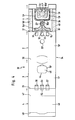
- Figures 2 to 6 show a preferred embodiment, which is characterized both by its function (accurate and reproducible analysis results) and by a simple and therefore inexpensive to manufacture.
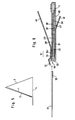
- the test kit comprises a sample collection unit 30 and test carriers 31 (FIG. 3) which are specifically matched thereto and which are expediently designed similar to a conventional test strip. They contain a reagent system for determining a specific analyte in one or more test layers arranged one above the other or next to one another. Only one test layer 32 is indicated in the figure.
- test carriers 31a, 31b are preferably used, which are used to determine different analytes (parameters) and thus enable a profile analysis of the chair in a very simple manner. This enables a much more precise diagnostic statement to be made about the presence of a certain disease. It is particularly advantageous that the profile is selective, i.e. that the doctor only has to determine the parameters that are necessary in connection with the suspected diagnosis. In addition, the analysis is practically just as easy as with the previously common stool blood tests, which are carried out in very large numbers as part of preventive health care.
- the sample collection unit 30 consists only of two parts, namely a blank made of waterproof coated, thin (maximum approx. 500 g / m 2 ) cardboard and one, known as a folding part 34 Insert 16 'made of a porous, capillary layer material (Fig. 4 and Fig. 6).
- a blank made of waterproof coated, thin (maximum approx. 500 g / m 2 ) cardboard and one, known as a folding part 34 Insert 16 'made of a porous, capillary layer material (Fig. 4 and Fig. 6).
- both natural materials and (preferably) hydrophilic plastics which are processed to produce the capillary-forming structures as papers, nonwovens, fabrics or correspondingly porous and structured foils, are suitable as the capillary layer material.
- a fleece made of hydrophilic synthetic fibers is particularly preferred.
- the folding part 34 has three main folding lines 35, 36 and 37, through which four sections 1 to 4 are divided, which are folded during the manufacture of the sample collection unit 30 in the manner shown in FIG. 5.
- Section 1 of the folding part 34 serves mainly as a supporting part 40 for the insert part 16 '.
- the insert part 16 ' is fastened to the support part 40 in such a way that its capillary-active properties are not impaired by the fastening.
- a point-by-point or strip-like gluing at the edge of the insert part 16 ' is suitable, for example.
- Sections 2 and 3 form the second cover part 18 'with the recess 20', which frames the sample field 23 ', or the first cover part 17' with the recess 19 ', which makes the eluate application field 24' accessible.
- the layer thicknesses can be seen most clearly in FIG. 6, the layer thicknesses being shown in an exaggerated thickness.
- the actual thickness of the layered material from which the folding part 34 is made is preferably less than 0.5 mm, so that an envelope with a thickness of less than about 2 mm can be folded therefrom.
- a preferred configuration of the liquid transport path 11 ', in particular the delay path 13', can be seen in FIG. 4.
- the eluate application field 24 'in the suction layer 16b' is relatively extended. From here, the liquid transport path 11 'leads over a two-part section 26 to the sample layer 16a' with the sample field 23 '(indicated by dots in FIG. 4) and from there to an eluate receiving layer 16c'. It is characteristic of the preferred embodiment shown that the width of the section 26 (sum of both branches) is smaller than the width of the liquid transport cross section in the region of the sample field 23 '. It is also very long (approx. 50% of the entire liquid transport route). In order to nevertheless enable the overall size of the sample collection unit 30 to be manageable, the liquid transport path 11 ′ has windings in which the liquid transport direction changes several times.
- the eluent application field 24 ' is accessible through the recess 19' in the first cover part 17 'and a further recess 41' in the support part 40 'from the doctor's side (FIG. 3) of the sample collection unit.
- the recess 19 ' can be closed with a flap 45 which can be pivoted about a folding line 44.
- the sample field 23 ' is accessible via the recess 20' in the second cover part 18 'from the patient side (FIG. 2). It can be closed with a flap 46 which can be pivoted about a folding line 47. In the unused state of the sample collection unit 30, it is closed at its front edge via a tear line 48.
- a total of 50 eluate transfer means are provided in the eluate receiving area 15 '.
- the eluate transfer means 50 and the test carrier 31 are matched to one another in such a way that eluate present in the eluate receiving area 15 'can be transferred to the at least one test layer 32 of the test carrier.
- the eluate transfer means 50 comprise the eluate receiving layer 16c ', a spacing recess 51 in the second cover layer 18' and a test carrier opening 53 which is closed with a flap 52 in the initial state of the sample collection unit 30.
- the dimensions are one on the other matched that a test carrier enclosed by the opening 53 in the spacing recess 51 is in fluid contact with its test field 32 to the eluate receiving layer 16c '.
- the analysis is very simple: the patient applies the stool sample with a spatula through the recess 20 'to the sample surface 23' and closes the flap 46.
- the sample collection unit 30 is designed in such a way that air reaches the sample to a small extent so that it dries out during storage.
- test carrier openings 53, 56 and 57 and the flap 45 closing the eluent application field 24 ' are opened.
- one or more test carriers are introduced into the eluate transfer devices 50, 54 and 55.
- a measured amount of eluent is metered onto the eluent application field 24 '.
- the test carrier 31 is removed at a predetermined point in time and the detection signal is evaluated visually or with a device.
Landscapes
- Health & Medical Sciences (AREA)
- Life Sciences & Earth Sciences (AREA)
- Hematology (AREA)
- Engineering & Computer Science (AREA)
- Immunology (AREA)
- Urology & Nephrology (AREA)
- Molecular Biology (AREA)
- Chemical & Material Sciences (AREA)
- Biomedical Technology (AREA)
- Physics & Mathematics (AREA)
- Microbiology (AREA)
- Cell Biology (AREA)
- Food Science & Technology (AREA)
- Medicinal Chemistry (AREA)
- Biotechnology (AREA)
- Analytical Chemistry (AREA)
- Biochemistry (AREA)
- General Health & Medical Sciences (AREA)
- General Physics & Mathematics (AREA)
- Pathology (AREA)
- Investigating Or Analysing Biological Materials (AREA)
- Sampling And Sample Adjustment (AREA)
Applications Claiming Priority (2)
| Application Number | Priority Date | Filing Date | Title |
|---|---|---|---|
| DE4022655 | 1990-07-17 | ||
| DE4022655A DE4022655A1 (de) | 1990-07-17 | 1990-07-17 | Testkit zur bestimmung eines analyten in einer pastoesen probe, insbesondere in stuhl |
Publications (3)
| Publication Number | Publication Date |
|---|---|
| EP0467175A2 true EP0467175A2 (fr) | 1992-01-22 |
| EP0467175A3 EP0467175A3 (en) | 1992-10-14 |
| EP0467175B1 EP0467175B1 (fr) | 1995-09-20 |
Family
ID=6410417
Family Applications (1)
| Application Number | Title | Priority Date | Filing Date |
|---|---|---|---|
| EP91111262A Expired - Lifetime EP0467175B1 (fr) | 1990-07-17 | 1991-07-06 | Trousse pour la détermination d'une analyte dans un échantillon semi-solide, en particulier dans les selles |
Country Status (6)
| Country | Link |
|---|---|
| US (1) | US5215713A (fr) |
| EP (1) | EP0467175B1 (fr) |
| JP (1) | JPH0774770B2 (fr) |
| AT (1) | ATE128231T1 (fr) |
| DE (2) | DE4022655A1 (fr) |
| ES (1) | ES2077726T3 (fr) |
Cited By (2)
| Publication number | Priority date | Publication date | Assignee | Title |
|---|---|---|---|---|
| WO1994024557A1 (fr) * | 1993-04-16 | 1994-10-27 | The United States Of America, As Represented By Th | Article et procede permettant de detecter la presence de germes pathogenes dans des matieres fecales |
| WO2013119729A1 (fr) * | 2012-02-10 | 2013-08-15 | Sekisui Diagnostics, Llc | Dispositifs, procédés et kits de collecte et de transport d'échantillons |
Families Citing this family (25)
| Publication number | Priority date | Publication date | Assignee | Title |
|---|---|---|---|---|
| DE4323672A1 (de) * | 1993-07-15 | 1995-01-19 | Boehringer Mannheim Gmbh | Vorrichtung zur gleichzeitigen Bestimmung von Analyten |
| US5840584A (en) * | 1995-06-07 | 1998-11-24 | Waldenburg; Ottfried | Blood in feces test device |
| US5863502A (en) * | 1996-01-24 | 1999-01-26 | Sarnoff Corporation | Parallel reaction cassette and associated devices |
| US5976895A (en) * | 1996-03-11 | 1999-11-02 | American Biomedica Corporation | Device for the collection, testing and shipment of body fluid samples |
| US5900379A (en) * | 1996-04-11 | 1999-05-04 | Mizuho Usa, Inc. | Analytical device |
| US5879951A (en) | 1997-01-29 | 1999-03-09 | Smithkline Diagnostics, Inc. | Opposable-element assay device employing unidirectional flow |
| US5939252A (en) | 1997-05-09 | 1999-08-17 | Lennon; Donald J. | Detachable-element assay device |
| DE19726268A1 (de) * | 1997-06-20 | 1999-01-21 | Connex Ges Zur Optimierung Von | Vorrichtung zur Aufnahme und Untersuchung von Proben |
| GB9800263D0 (en) * | 1998-01-08 | 1998-03-04 | Bio Diagnostics Ltd | A device for testing liquids |
| US6299842B1 (en) * | 1999-03-05 | 2001-10-09 | Meridian Bioscience, Inc. | Biological sampling and storage container utilizing a desiccant |
| US8592219B2 (en) * | 2005-01-17 | 2013-11-26 | Gyros Patent Ab | Protecting agent |
| US20080241940A1 (en) * | 2004-07-22 | 2008-10-02 | Lastella Vincent P | Fecal sampling device and method |
| USD596753S1 (en) | 2004-07-22 | 2009-07-21 | Lastella Vincent P | Testing device |
| EP1619502B1 (fr) | 2004-07-22 | 2009-07-22 | Immunostics, Inc. | Dispositif et procédé de détection du sang occulte fécal |
| US7427505B2 (en) * | 2004-07-22 | 2008-09-23 | Immunostics, Inc. | Fecal occult blood testing device and method |
| USD598121S1 (en) | 2004-07-22 | 2009-08-11 | Lastella Vincent | Sampling device |
| US8679420B2 (en) * | 2004-07-22 | 2014-03-25 | Immunostics, Inc. | Fecal sampling device and method |
| EP1849004A1 (fr) * | 2005-01-17 | 2007-10-31 | Gyros Patent Ab | Parcours d'ecoulement polyvalent |
| JP2008541009A (ja) * | 2005-04-30 | 2008-11-20 | オークビル・ホンコン・カンパニー・リミテツド | サンプルの採取および分析のための装置および方法 |
| WO2007049009A1 (fr) * | 2005-10-25 | 2007-05-03 | Inverness Medical Switzerland Gmbh | Procédé et équipement pour détecter une substance à analyser dans un échantillon |
| EP2167949B1 (fr) * | 2007-07-13 | 2014-06-25 | Louisville Solutions, Incorporated | Echatillonneur de surface |
| US8304596B2 (en) | 2008-04-11 | 2012-11-06 | Immunostics, Inc. | Fecal sampling device and method |
| US8466686B2 (en) * | 2010-02-05 | 2013-06-18 | Louisville Solutions Incorporated | Test patch system |
| AU2011236503B2 (en) * | 2010-04-07 | 2014-10-30 | Biosensia Patents Limited | Flow control device for assays |
| US9724689B2 (en) * | 2012-11-20 | 2017-08-08 | Detectachem Llc | Colorimetric test system designed to control flow of simultaneously released chemicals to a target area |
Family Cites Families (14)
| Publication number | Priority date | Publication date | Assignee | Title |
|---|---|---|---|---|
| NL286850A (fr) * | 1961-12-18 | 1900-01-01 | ||
| US3933594A (en) * | 1974-08-16 | 1976-01-20 | Polaroid Corporation | Method and device for determining the concentration of a substance in a fluid |
| US4365970A (en) * | 1981-05-01 | 1982-12-28 | Smithkline Instruments, Inc. | Specimen test slide and method for testing occult blood |
| US4742002A (en) * | 1984-01-16 | 1988-05-03 | Helena Laboratories Corporation | Test kit and method for determining the presence of blood in a specimen and for testing the effectiveness of peroxidase inactivating solution |
| US4789629A (en) * | 1986-11-24 | 1988-12-06 | Smithkline Beckman Corporation | Method and device for collecting and testing for fecal occult blood |
| DE3643516A1 (de) * | 1986-12-19 | 1988-06-30 | Boehringer Mannheim Gmbh | Testtraeger fuer die analytische bestimmung von bestandteilen von koerperfluessigkeiten |
| EP0279574B1 (fr) * | 1987-02-17 | 1992-08-19 | CMB Foodcan plc | Bandelette d'analyse |
| DE3716891A1 (de) * | 1987-05-20 | 1988-12-15 | Boehringer Mannheim Gmbh | Testkit zur bestimmung eines analyten im stuhl |
| AU1816888A (en) * | 1987-06-26 | 1989-01-05 | Gerrard Abdool Rayman | Device for testing fluids |
| US4981786A (en) * | 1987-09-04 | 1991-01-01 | Syntex (U.S.A.) Inc. | Multiple port assay device |
| US5051237A (en) * | 1988-06-23 | 1991-09-24 | P B Diagnostic Systems, Inc. | Liquid transport system |
| DE3826056A1 (de) * | 1988-07-30 | 1990-02-01 | Boehringer Mannheim Gmbh | Testtraeger zur analytischen bestimmung eines bestandteils einer fluessigen probe |
| DE3826055A1 (de) * | 1988-07-30 | 1990-02-01 | Boehringer Mannheim Gmbh | Mit reagenz abloesbar impraegnierte traegermatrix |
| FR2637687B1 (fr) * | 1988-10-11 | 1991-01-11 | Inst Textile De France | Dispositif a usage unique pour tests biologiques |
-
1990
- 1990-07-17 DE DE4022655A patent/DE4022655A1/de not_active Withdrawn
-
1991
- 1991-07-06 ES ES91111262T patent/ES2077726T3/es not_active Expired - Lifetime
- 1991-07-06 AT AT91111262T patent/ATE128231T1/de not_active IP Right Cessation
- 1991-07-06 EP EP91111262A patent/EP0467175B1/fr not_active Expired - Lifetime
- 1991-07-06 DE DE59106512T patent/DE59106512D1/de not_active Expired - Fee Related
- 1991-07-09 US US07/727,487 patent/US5215713A/en not_active Expired - Lifetime
- 1991-07-16 JP JP3175023A patent/JPH0774770B2/ja not_active Expired - Fee Related
Cited By (3)
| Publication number | Priority date | Publication date | Assignee | Title |
|---|---|---|---|---|
| WO1994024557A1 (fr) * | 1993-04-16 | 1994-10-27 | The United States Of America, As Represented By Th | Article et procede permettant de detecter la presence de germes pathogenes dans des matieres fecales |
| WO2013119729A1 (fr) * | 2012-02-10 | 2013-08-15 | Sekisui Diagnostics, Llc | Dispositifs, procédés et kits de collecte et de transport d'échantillons |
| US9297724B2 (en) | 2012-02-10 | 2016-03-29 | Sekisui Diagnostics Llc | Sample collection and transport devices, methods, and kits |
Also Published As
| Publication number | Publication date |
|---|---|
| EP0467175A3 (en) | 1992-10-14 |
| ATE128231T1 (de) | 1995-10-15 |
| US5215713A (en) | 1993-06-01 |
| EP0467175B1 (fr) | 1995-09-20 |
| DE4022655A1 (de) | 1992-01-23 |
| DE59106512D1 (de) | 1995-10-26 |
| JPH0774770B2 (ja) | 1995-08-09 |
| ES2077726T3 (es) | 1995-12-01 |
| JPH04232833A (ja) | 1992-08-21 |
Similar Documents
| Publication | Publication Date | Title |
|---|---|---|
| EP0467175B1 (fr) | Trousse pour la détermination d'une analyte dans un échantillon semi-solide, en particulier dans les selles | |
| EP0271854B1 (fr) | Bande-analyse pour la détermination analytique de composants dans les fluides corporels | |
| EP0208952B1 (fr) | Support pour essai | |
| EP1977225B1 (fr) | Système d analyse à biocapteur électrochimique | |
| DE69627182T2 (de) | Element zum sammeln und transportieren von zu analyserendem probenmaterial und verfahren zur bestimmung eines analyts | |
| DE69033569T2 (de) | Festphasen-analytische Vorrichtung | |
| DE3887771T3 (de) | Immunoassays und Vorrichtungen dafür. | |
| DE69125827T2 (de) | Probentestträger und verfahren zur prüfung von okkultem blut im stuhl | |
| DE69220871T2 (de) | Vorrichtung und Verfahren zur Auftrennung und Analyse von Vollblut | |
| EP0634215A1 (fr) | Dispositif pour la détermination simultanée d'analytes | |
| EP0064710B1 (fr) | Moyen d'essai à plusieurs couches pour le décèlement d'un composant d'un essai liquide | |
| DE3842702A1 (de) | Testtraeger zur analytischen untersuchung einer probenfluessigkeit mit hilfe einer spezifischen bindungsreaktion zweier bioaffiner bindungspartner und entsprechendes testverfahren | |
| EP1036330A1 (fr) | Element d'essai analytique a canal capillaire effile | |
| EP0443161B1 (fr) | Support d'essai pour l'analyse d'un échantillon fluide | |
| DE3733084A1 (de) | Testtraeger zur analytischen bestimmung eines bestandteils einer koerperfluessigkeit | |
| WO2002020141A1 (fr) | Dispositif et procedes pour separer des constituants non dissous contenus dans des liquides biologiques | |
| EP1141713A1 (fr) | Procede et dispositif pour determiner un analyte | |
| DE69719737T2 (de) | Immunoassay von vollblutproben | |
| EP0750185A2 (fr) | Elément et système pour collecter, transporter et garder échantillons pour analyse | |
| DE212006000062U1 (de) | Vorrichtung zum Erfassen eines Analyten in einer Probe | |
| EP0457123B1 (fr) | Support de test pour la détermination analytique d'un composant dans un liquide de prélèvement | |
| DE3738982C2 (fr) | ||
| EP1644735B1 (fr) | Dispositif pour tests sur membrane a ecoulement lateral (lateral flow) | |
| EP0340774A2 (fr) | Méthode et dispositif pour mesurer les reactions électrodermales | |
| DE3716891A1 (de) | Testkit zur bestimmung eines analyten im stuhl |
Legal Events
| Date | Code | Title | Description |
|---|---|---|---|
| PUAI | Public reference made under article 153(3) epc to a published international application that has entered the european phase |
Free format text: ORIGINAL CODE: 0009012 |
|
| 17P | Request for examination filed |
Effective date: 19910706 |
|
| AK | Designated contracting states |
Kind code of ref document: A2 Designated state(s): AT BE CH DE DK ES FR GB GR IT LI LU NL SE |
|
| PUAL | Search report despatched |
Free format text: ORIGINAL CODE: 0009013 |
|
| AK | Designated contracting states |
Kind code of ref document: A3 Designated state(s): AT BE CH DE DK ES FR GB GR IT LI LU NL SE |
|
| 17Q | First examination report despatched |
Effective date: 19940223 |
|
| GRAA | (expected) grant |
Free format text: ORIGINAL CODE: 0009210 |
|
| AK | Designated contracting states |
Kind code of ref document: B1 Designated state(s): AT BE CH DE DK ES FR GB GR IT LI LU NL SE |
|
| PG25 | Lapsed in a contracting state [announced via postgrant information from national office to epo] |
Ref country code: GR Free format text: LAPSE BECAUSE OF FAILURE TO SUBMIT A TRANSLATION OF THE DESCRIPTION OR TO PAY THE FEE WITHIN THE PRESCRIBED TIME-LIMIT Effective date: 19950920 Ref country code: DK Effective date: 19950920 Ref country code: BE Effective date: 19950920 |
|
| REF | Corresponds to: |
Ref document number: 128231 Country of ref document: AT Date of ref document: 19951015 Kind code of ref document: T |
|
| REF | Corresponds to: |
Ref document number: 59106512 Country of ref document: DE Date of ref document: 19951026 |
|
| ET | Fr: translation filed | ||
| GBT | Gb: translation of ep patent filed (gb section 77(6)(a)/1977) |
Effective date: 19951014 |
|
| ITF | It: translation for a ep patent filed | ||
| REG | Reference to a national code |
Ref country code: ES Ref legal event code: FG2A Ref document number: 2077726 Country of ref document: ES Kind code of ref document: T3 |
|
| PLBE | No opposition filed within time limit |
Free format text: ORIGINAL CODE: 0009261 |
|
| STAA | Information on the status of an ep patent application or granted ep patent |
Free format text: STATUS: NO OPPOSITION FILED WITHIN TIME LIMIT |
|
| 26N | No opposition filed | ||
| PGFP | Annual fee paid to national office [announced via postgrant information from national office to epo] |
Ref country code: SE Payment date: 20010704 Year of fee payment: 11 |
|
| PGFP | Annual fee paid to national office [announced via postgrant information from national office to epo] |
Ref country code: LU Payment date: 20010706 Year of fee payment: 11 |
|
| PGFP | Annual fee paid to national office [announced via postgrant information from national office to epo] |
Ref country code: AT Payment date: 20010711 Year of fee payment: 11 |
|
| PGFP | Annual fee paid to national office [announced via postgrant information from national office to epo] |
Ref country code: CH Payment date: 20010713 Year of fee payment: 11 |
|
| PGFP | Annual fee paid to national office [announced via postgrant information from national office to epo] |
Ref country code: NL Payment date: 20010730 Year of fee payment: 11 |
|
| REG | Reference to a national code |
Ref country code: GB Ref legal event code: IF02 |
|
| PG25 | Lapsed in a contracting state [announced via postgrant information from national office to epo] |
Ref country code: LU Free format text: LAPSE BECAUSE OF NON-PAYMENT OF DUE FEES Effective date: 20020706 Ref country code: AT Free format text: LAPSE BECAUSE OF NON-PAYMENT OF DUE FEES Effective date: 20020706 |
|
| PG25 | Lapsed in a contracting state [announced via postgrant information from national office to epo] |
Ref country code: SE Free format text: LAPSE BECAUSE OF NON-PAYMENT OF DUE FEES Effective date: 20020707 |
|
| PG25 | Lapsed in a contracting state [announced via postgrant information from national office to epo] |
Ref country code: LI Free format text: LAPSE BECAUSE OF NON-PAYMENT OF DUE FEES Effective date: 20020731 Ref country code: CH Free format text: LAPSE BECAUSE OF NON-PAYMENT OF DUE FEES Effective date: 20020731 |
|
| PG25 | Lapsed in a contracting state [announced via postgrant information from national office to epo] |
Ref country code: NL Free format text: LAPSE BECAUSE OF NON-PAYMENT OF DUE FEES Effective date: 20030201 |
|
| EUG | Se: european patent has lapsed | ||
| REG | Reference to a national code |
Ref country code: CH Ref legal event code: PL |
|
| NLV4 | Nl: lapsed or anulled due to non-payment of the annual fee |
Effective date: 20030201 |
|
| PGFP | Annual fee paid to national office [announced via postgrant information from national office to epo] |
Ref country code: ES Payment date: 20050712 Year of fee payment: 15 |
|
| PGFP | Annual fee paid to national office [announced via postgrant information from national office to epo] |
Ref country code: GB Payment date: 20060614 Year of fee payment: 16 |
|
| PGFP | Annual fee paid to national office [announced via postgrant information from national office to epo] |
Ref country code: FR Payment date: 20060705 Year of fee payment: 16 |
|
| PGFP | Annual fee paid to national office [announced via postgrant information from national office to epo] |
Ref country code: IT Payment date: 20060731 Year of fee payment: 16 Ref country code: DE Payment date: 20060731 Year of fee payment: 16 |
|
| GBPC | Gb: european patent ceased through non-payment of renewal fee |
Effective date: 20070706 |
|
| PG25 | Lapsed in a contracting state [announced via postgrant information from national office to epo] |
Ref country code: DE Free format text: LAPSE BECAUSE OF NON-PAYMENT OF DUE FEES Effective date: 20080201 |
|
| PG25 | Lapsed in a contracting state [announced via postgrant information from national office to epo] |
Ref country code: GB Free format text: LAPSE BECAUSE OF NON-PAYMENT OF DUE FEES Effective date: 20070706 |
|
| REG | Reference to a national code |
Ref country code: FR Ref legal event code: ST Effective date: 20080331 |
|
| PG25 | Lapsed in a contracting state [announced via postgrant information from national office to epo] |
Ref country code: FR Free format text: LAPSE BECAUSE OF NON-PAYMENT OF DUE FEES Effective date: 20070731 |
|
| REG | Reference to a national code |
Ref country code: ES Ref legal event code: FD2A Effective date: 20070707 |
|
| PG25 | Lapsed in a contracting state [announced via postgrant information from national office to epo] |
Ref country code: ES Free format text: LAPSE BECAUSE OF NON-PAYMENT OF DUE FEES Effective date: 20070707 |
|
| PG25 | Lapsed in a contracting state [announced via postgrant information from national office to epo] |
Ref country code: IT Free format text: LAPSE BECAUSE OF NON-PAYMENT OF DUE FEES Effective date: 20070706 |