EP0467287A2 - Copolymères d'anhydride maléique - Google Patents
Copolymères d'anhydride maléique Download PDFInfo
- Publication number
- EP0467287A2 EP0467287A2 EP91111838A EP91111838A EP0467287A2 EP 0467287 A2 EP0467287 A2 EP 0467287A2 EP 91111838 A EP91111838 A EP 91111838A EP 91111838 A EP91111838 A EP 91111838A EP 0467287 A2 EP0467287 A2 EP 0467287A2
- Authority
- EP
- European Patent Office
- Prior art keywords
- copolymer
- weight
- units
- unit
- formula
- Prior art date
- Legal status (The legal status is an assumption and is not a legal conclusion. Google has not performed a legal analysis and makes no representation as to the accuracy of the status listed.)
- Granted
Links
Images


Classifications
-
- C—CHEMISTRY; METALLURGY
- C02—TREATMENT OF WATER, WASTE WATER, SEWAGE, OR SLUDGE
- C02F—TREATMENT OF WATER, WASTE WATER, SEWAGE, OR SLUDGE
- C02F5/00—Softening water; Preventing scale; Adding scale preventatives or scale removers to water, e.g. adding sequestering agents
- C02F5/08—Treatment of water with complexing chemicals or other solubilising agents for softening, scale prevention or scale removal, e.g. adding sequestering agents
- C02F5/10—Treatment of water with complexing chemicals or other solubilising agents for softening, scale prevention or scale removal, e.g. adding sequestering agents using organic substances
-
- C—CHEMISTRY; METALLURGY
- C04—CEMENTS; CONCRETE; ARTIFICIAL STONE; CERAMICS; REFRACTORIES
- C04B—LIME, MAGNESIA; SLAG; CEMENTS; COMPOSITIONS THEREOF, e.g. MORTARS, CONCRETE OR LIKE BUILDING MATERIALS; ARTIFICIAL STONE; CERAMICS; REFRACTORIES; TREATMENT OF NATURAL STONE
- C04B24/00—Use of organic materials as active ingredients for mortars, concrete or artificial stone, e.g. plasticisers
- C04B24/24—Macromolecular compounds
- C04B24/26—Macromolecular compounds obtained by reactions only involving carbon-to-carbon unsaturated bonds
- C04B24/2664—Macromolecular compounds obtained by reactions only involving carbon-to-carbon unsaturated bonds of ethylenically unsaturated dicarboxylic acid polymers, e.g. maleic anhydride copolymers
-
- C—CHEMISTRY; METALLURGY
- C08—ORGANIC MACROMOLECULAR COMPOUNDS; THEIR PREPARATION OR CHEMICAL WORKING-UP; COMPOSITIONS BASED THEREON
- C08F—MACROMOLECULAR COMPOUNDS OBTAINED BY REACTIONS ONLY INVOLVING CARBON-TO-CARBON UNSATURATED BONDS
- C08F210/00—Copolymers of unsaturated aliphatic hydrocarbons having only one carbon-to-carbon double bond
-
- C—CHEMISTRY; METALLURGY
- C08—ORGANIC MACROMOLECULAR COMPOUNDS; THEIR PREPARATION OR CHEMICAL WORKING-UP; COMPOSITIONS BASED THEREON
- C08F—MACROMOLECULAR COMPOUNDS OBTAINED BY REACTIONS ONLY INVOLVING CARBON-TO-CARBON UNSATURATED BONDS
- C08F222/00—Copolymers of compounds having one or more unsaturated aliphatic radicals, each having only one carbon-to-carbon double bond, and at least one being terminated by a carboxyl radical and containing at least one other carboxyl radical in the molecule; Salts, anhydrides, esters, amides, imides, or nitriles thereof
- C08F222/04—Anhydrides, e.g. cyclic anhydrides
- C08F222/06—Maleic anhydride
-
- C—CHEMISTRY; METALLURGY
- C08—ORGANIC MACROMOLECULAR COMPOUNDS; THEIR PREPARATION OR CHEMICAL WORKING-UP; COMPOSITIONS BASED THEREON
- C08F—MACROMOLECULAR COMPOUNDS OBTAINED BY REACTIONS ONLY INVOLVING CARBON-TO-CARBON UNSATURATED BONDS
- C08F236/00—Copolymers of compounds having one or more unsaturated aliphatic radicals, at least one having two or more carbon-to-carbon double bonds
- C08F236/02—Copolymers of compounds having one or more unsaturated aliphatic radicals, at least one having two or more carbon-to-carbon double bonds the radical having only two carbon-to-carbon double bonds
- C08F236/04—Copolymers of compounds having one or more unsaturated aliphatic radicals, at least one having two or more carbon-to-carbon double bonds the radical having only two carbon-to-carbon double bonds conjugated
-
- C—CHEMISTRY; METALLURGY
- C08—ORGANIC MACROMOLECULAR COMPOUNDS; THEIR PREPARATION OR CHEMICAL WORKING-UP; COMPOSITIONS BASED THEREON
- C08F—MACROMOLECULAR COMPOUNDS OBTAINED BY REACTIONS ONLY INVOLVING CARBON-TO-CARBON UNSATURATED BONDS
- C08F8/00—Chemical modification by after-treatment
- C08F8/12—Hydrolysis
-
- C—CHEMISTRY; METALLURGY
- C08—ORGANIC MACROMOLECULAR COMPOUNDS; THEIR PREPARATION OR CHEMICAL WORKING-UP; COMPOSITIONS BASED THEREON
- C08F—MACROMOLECULAR COMPOUNDS OBTAINED BY REACTIONS ONLY INVOLVING CARBON-TO-CARBON UNSATURATED BONDS
- C08F210/00—Copolymers of unsaturated aliphatic hydrocarbons having only one carbon-to-carbon double bond
- C08F210/04—Monomers containing three or four carbon atoms
- C08F210/08—Butenes
-
- C—CHEMISTRY; METALLURGY
- C08—ORGANIC MACROMOLECULAR COMPOUNDS; THEIR PREPARATION OR CHEMICAL WORKING-UP; COMPOSITIONS BASED THEREON
- C08F—MACROMOLECULAR COMPOUNDS OBTAINED BY REACTIONS ONLY INVOLVING CARBON-TO-CARBON UNSATURATED BONDS
- C08F2800/00—Copolymer characterised by the proportions of the comonomers expressed
- C08F2800/20—Copolymer characterised by the proportions of the comonomers expressed as weight or mass percentages
-
- C—CHEMISTRY; METALLURGY
- C08—ORGANIC MACROMOLECULAR COMPOUNDS; THEIR PREPARATION OR CHEMICAL WORKING-UP; COMPOSITIONS BASED THEREON
- C08F—MACROMOLECULAR COMPOUNDS OBTAINED BY REACTIONS ONLY INVOLVING CARBON-TO-CARBON UNSATURATED BONDS
- C08F2810/00—Chemical modification of a polymer
- C08F2810/20—Chemical modification of a polymer leading to a crosslinking, either explicitly or inherently
Definitions
- the present invention relates to a maleic anhydride copolymer.
- this invention relates to a novel copolymer comprising maleic anhydride, (a) conjugated diene(s) and (an)aliphatic monoolefin(s), a process for preparing the copolymer, hydrolyzed products of the copolymer, and applications of the hydrolyzed products to scale inhibitors, dispersants for calcium carbonate and additives for cement and concrete.
- Copolymers of maleic anhydride and olefins have been well known.
- US Patent No. 3,491,068 discloses copolymers of maleic anhydride and a conjugated diene(s).
- US Patent Nos. 3,553,177, 3,560,455, 3,560,456 and 3,560,457 disclose copolymers of maleic anhydride and (an) a -olefin(s).
- the maleic anhydride-conjugated diene copolymers are known to be used as dye-assist agents, adhesives, fire-extinguishing agents, casting mold release agents and restaining inhibitors for detergent. However, they have not been utilized as scale inhibitors, dispersants for inorganic pigment and admixtures for cement and concrete.
- the maleic anhydride-a -olefin copolymers are known to be used as casting mold release agents, slip agents and floor polishes since the copolymer has good wax properties. Further hydrolyzed products of the copolymer are known to be used as adhesives, scale inhibitors, dispersants for inorganic pigment and admixtures for cement and conc rete.
- hydrolyzed maleic anhydride copolymers do sufficiently display the properties required for scale inhibitors, dispersants for inorganic pigment or additives for cement and concrete. What kind of properties are required in these applications is mentioned in detail below.
- Scale inhibitors are added to cooling water of heat exchangers, water of boilers and, evaporators in order to prevent scale formation.
- Water such as natural water, tap water and industrial water contains various impurities.
- the impurities are cations such as calcium, magnesium, iron and barium, and anions such as carbonate ions, hydrogen carbonate ions, sulfuric acid ions and silicate ions. Occasionally, zinc ions and phosphoric acid ions are contained as corrosion inhibitors.
- the above water is utilized as circulating water of equipments such as heat exchangers, boilers and evaporators.
- the water is often heated, cooled or concentrated, or the pH of the water is altered in the equipments.
- the ions contained in the water change to insoluble salts, and the salts deposit and adhere on the inner walls of the equipments to form scales.
- the adhered scales reduce heat transfer efficiency and cooling efficiency, increase flow resistance, or cause corrosion of equipments.
- scale inhibitors are used.
- Previously known inhibitors are lignin compounds, phosphorus compounds, polyacrylic acid compounds and polymaleic acid compounds.
- the polymaleic acid compounds such as hydrolyzed products of maleic anhydride homopolymers and maleic anhydride-monoolefin copolymers are known to be relatively good scale inhibitors (see Japanese Patent Publication (KOKOKU) Nos. 53-20475 and 54-29998, and Japanese Patent Application (KOKAI) Nos. 53-70089 and 60-71093)
- the hydrolyzed product of the maleic anhydride homopolymer shows relatively good properties as mentioned above.
- the production of the homopolymer requires a large amount of polymerization initiator.
- the polymerization initiator is relatively expensive and therefore, the homopolymer utilizing the initiator is also expensive.
- Dispersants for inorganic pigment are important in the paper and paint industry.
- the dispersants are added to inorganic pigments such as calcium carbonate, titanium oxide or clay to produce a high concentration aqueous slurry in order to reduce viscosity of the slurry (improvement in dispersibility) and suppress the rise of viscosity with time (improvement in stability of dispersibility).
- a high concentration aqueous slurry containing as little water as possible and having low viscosity is preferred. This is because when white pigments such as calcium carbonate is applied on a paper, drying energy can be saved, and good coating workablity and performance are obtainable. Further, from the viewpoint of transfer and storage, an aqueous slurry with improved stability of dispersibility is necessitated since the aqueous slurry often precipitates during transfer or storage to form a hard cake. Therefore it is desired that a dispersant is capable of providing a high concentration aqueous slurry even if it is utilized in a small amount.
- Condensed phosphorates such as pyrophosphorates and hexametaphosphorates, zinc salts and silicates are known as inorganic dipsersants.
- Salts of polycarboxylic acid such as polyacrylic acid and hydrolyzed products of maleic anhydride - isobutene coplymers are known as organic dipsersants (see Japanese Patent Disclosure (KOKAI) Nos. 60-99334 and 62-132730).
- inorganic dispersants are required to be added to an aqueous slurry because the stability of dispersibility is bad. As a result, the obtained slurry is expensive and the coating preformance is low.
- the organic dispersants have better properties than the inorganic ones. However, the organic ones cannot provide good dipsersibility to precipitated calcium carbonate with 1 /1.m or less of particle size and are required to be improved.
- Disperants which are suitable as additives for cement and concrete are usally added to cement mixtures to increase flowability and to improve placing workability.
- Cement mixtures comprise cement, water, sand and gravel. Strong cohesive force of cement particles impairs the placing workability.
- it is requried to increase the water content in the cement mixture and to make the flowability high.
- the increase of water content results in reduction of cement content in the cement mixture. This leads to lowering of strength of the hardened cement mixture.
- the flowability of kneaded cement mixtures is gradually decreased due to aggregation of cement particles with the lapse of time.
- the kneaded cement mixtures are placed at certain intervals after kneading.
- kneaded cement mixtures are transferred to a placing site (construction site) and the intervals from keading to placing may be widely varied due to transfer distance and traffic jam. Therefore, the flowability of cement mixtures at the placing site is altered each time and it is hard to obtain constant workability.
- additives for cement and concrete are used and formalin condensates of sodium naphthalene sulfonate are known as such additives (see Japanese Patent Disclosure (KOKOKU) No. 41-11737).
- the formalin condensates of sodium naphthalene sulfonate are not sufficiently suitable as additives. This is because good flowability provided by the condensate is not retained for a long period of time but is retained only temporarily.
- An object of the present invention is to provide a scale inhibitor which is capable of inhibiting deposition and adhesion of scales containing calcium and iron as main components even if the concentration of the inhibitor is relatively low at which the known maleic anhydride copolymers does not function sufficiently.
- An another object of the present invention is to provide a scale inhibitor which can be produced with a small amount of polymerization initiator and as a reslut, is not expensive.
- a still another object of the present invention is to provide a dispersant for inorganic pigments, in particular a dispersant for calucium carbonate, which offers excellent stability of dispersibility and which provides low viscosity to a high concentration slurry even if the amount added is small.
- An object of the present invention is to provide an additive for cement and concrete which is capable of improving dispersibility of cement mixtures by suppressing physical and chemical aggregation of cement particles contained in kneaded cement mixtures.
- Another object of the present invention is to provide an additive for cement and concrete which is capable of providing good flowability to cement mixtures and to prevent reduction of flowability with time (slump loss).
- the present invention relates to a maleic anhydride copolymer comprising units of maleic anhydride represented by formula (I): units of at least one conjugated diene represented by formula (II): wherein R 1 , R 2 , R 3 and R 4 respectively represents hydrogen or an alkyl group having 1 to 8 carbon atoms and units of at least one aliphatic monoolefin represented by formula (III): wherein R 5 , R 6 , R 7 and R 8 respectively represents hydrogen or an alkyl group having 1 to 6 carbon atoms, wherein the weight-average molecular weight of the copolymer ranges from 500 to 50000, the molar ratio of unit (I)/(unit (II) + unit (III)) ranges from 30/70 to 90/10 and the molar ratio of unit (II) / unit (III) ranges from 5/95 to 90/10.
- formula (I) units of at least one conjugated diene represented by formula (II): wherein R 1 , R 2
- the present invention further relates to a process for preparing the copolymer comprising polymerizing maleic anhydride, at least one conjugated diene and at least one aliphatic monoolefin in the presence of at least one radical initiator wherein the conjugated diene and the monoolefin are added respectively to a mixture of maleic anhydride and at least one aromatic hydrocarbon solvent to obtain the copolymer.
- the present invention also relates to hydrolyzed products of the copolymer. That is, the present invention relates to a water-soluble maleic acid copolymer comprising units of maleic acid represented by formula (VII):
- the present invention also relates to applications of the hydrolyzed products or the water-soluble maleic acid copolymers as scale inhibitors, dispersants for calcium carbonate and additives for cement and concrete.
- R 1 , R 2 , R 3 and R 4 respectively represents hydrogen or a methyl group.
- the unit of conjugated diene represented by formula (II) suitably has 4 to 12 carbon atoms, perferably 4 to 7 carbon atoms, more preferably 4 or 5 carbon atoms.
- Examples of the conjugated diene unit include butadiene, 1,3-pentadiene, isoprene, 1,3-hexadiene, 2,3-dimethyl-1,3-butadiene, 2-ethyl-1,3-butadiene and 1,3-heptadiene units.
- butadiene and isoprene units are preferred because they have high reactivity with maleic anhydride and are easily and industrially available and cheap.
- Either units of one conjugated diene are contained in the copolymer or units of two or more conjugated dienes are contained.
- R 5 , R 6 , R 7 and R 3 respectively represents hydrogen or an alkyl group with 1 to 3 carbon atoms.
- This unit suitably has 2 to 8 carbon atoms, perferably 2 to 5 carbon atoms.
- the units of aliphatic monoolefin represented by formula (III) are preferably a -monoolefin units. Examples of the aliphatic monoolefin unit include ethylene, propylene, 1-butene, isobutylene, 1-pentene, 1-hexene, 4-methyl-1-penetene, 1-heptene and 1-octene units.
- Either units of one liphatic monoolefin are contained in the copolymer or units of two or more aliphatic monoolefins are contained.
- a hydrocarbon fraction having 4 carbon atoms obtained from thermal cracking products of naphtha is preferrably used as a starting material of the chain monoolefin unit having 2 to 8 carbon atoms because it is industrially available.
- the hydrocarbon fraction having 4 carbon atoms contains butadiene, isobutene and 1-butene.
- the molar ratio of the unit (I)/(unit (II) + unit (III)) ranges from 30/70 to 90/10, preferably from 40/60 to 75/25.
- the molar ratio of unit (II) / unit (III) ranges from 5/95 to 90/10, preferably from 10/90 to 70/30.
- the weight-average molecular weight of the copolymer ranges from 500 to 50000, preferably from 700 to 20000.
- the copolymer used as scale inhibitor preferably has 700 to 5000 of weight-average molecular weight.
- the copolymer used as dispersant of calcium carbonate and additive for cement and concrete preferably has 2000 to 20000 of weight-average molecular weight.
- conjugated diene examples include butadiene, 1,3-pentadiene, isoprene, 1,3-hexadiene, 2,3-dimethyl-1,3-butadiene, 2-ethyl-1,3-butadiene and 1,3-heptadiene. Particularly, butadiene and isoprene are preferred.
- aliphatic monoolefin examples include ethylene, propylene, 1-butene, isobutylene, 1-pentene, 1-hexene, 4-methyl-1-penetene, 1-heptene and 1-octene.
- hydrocarbons fraction having 4 carbon atoms obtained from thermal cracking products of naphtha is preferred. This fraction primarily contains butadiene, isobutene and 1-butene.
- the conjugated diene is preferably added to a mixture of maleic anhydride and the solvent continuously. This is because if the conjugated diene is mixed with the mixture of maleic anhydride and solvent at once, Diels-Alder reaction occurs during heating or at the beginning of the polymerization reaction and the polymer yield tends to decrease.
- Diels-Alder reaction occurs during heating or at the beginning of the polymerization reaction and the polymer yield tends to decrease.
- Diels-Alder reaction occurs during heating or at the beginning of the polymerization reaction and the polymer yield tends to decrease.
- To progress the polymerization preferentially over Diels-Alder reaction is possible by continuously supplying the conjugated diene. Further it is preferred that the aliphatic monoolefin is continuously supplied similarly to the supply of the conjugated diene.
- the radical initiator may be added to the mixture of maleic anhydride and solvent in advance or may be continuously supplied to the mixture similarly to the supply of the conjugated diene.
- the solvent examples include hydrocarbons such as benzene, toluene, xylene and cyclohexane; ketones such as acetone, cyclohexanone and methylethylketone; esters such as ethyl acetate and isopropyl acetate; ethers such as dibutylether, tetrahydrofuran and dioxane; and dimethylsulfoxide, dimethylformamide and y -butyrolactone. These solvents are classified into two groups, one dissolving maleic anhydride but not dissolving the copolymer, and the other dissolving both of maleic anhydride and the copolymer.
- hydrocarbons such as benzene, toluene, xylene and cyclohexane
- ketones such as acetone, cyclohexanone and methylethylketone
- esters such as ethyl acetate and isopropyl
- the polymerization reaction is in the form of either precipitation polymerization or in the presence of a suitable dispersant, suspension polymerization.
- the polymerization is solution polymerization.
- a solvent such as amines and alcohols is unsuitable to the polymerization because maleic anhydride and the resulting copolymer react with the solvent.
- aromatic hydrocarbons are preferred because they are advantageous to the process as mentioned below.
- the aromatic hydrocarbons are bad solvents to the copolymer of the present invention. After the reaction, the copolymer is precipitated and obtained as a precipitate. Thus a large portion of the solvent is easily separated by removal of supernatant.
- the use of the aromatic hydrocarbons is also advantageous since unreacted maleic anhydride and by-products can be removed at the same time with removal of the solvent. A small amount of the solvent remaining in the product can be removed as azeotropic mixture with water, when a hydrolyzed product of the copolymer is prepared.
- the solvents utilized are, for example, benzene; alkyl substituted benzenes such as toluene, xylene, ethylbenzene and cumene; and halogen substituted benzenes such as chlorobenzene and bromobenzene.
- Benzene, toluene and xylene are preferred.
- the amount of solvent used can be chosen without any restriction. It is provided that it is suitable to use from 50 to 500 part by weight of the aromatic hydrocarbons against 100 part by weight of maleic anhydride from the standpoint that a local and rapid reaction can be supperssed.
- supplying rates of the conjugated diene, the aliphatic monoolefin and the radical initiator can be chosen without any limitation. It is provided that when precipitation polymerization is conducted by using the aromatic hydrocarbons, the supplying rate of the conjugated diene preferably satisfies the following equation from the viewpoint that Diels-Alder reaction and production of unsoluble three-dimentional cross-linked polymers can be suppressed: wherein Y represents the reaction temperature C ), and X represents the supplying rate of the conjugated diene (total moles of conjugated diene / total moles of maleic anhydride / supplying time of conjugated diene (hr)).
- the supplying rates of the conjugated diene, the aliphatic monoolefin and the radical initiator may be kept constant during the polymerization reaction, or increased or decreased to control a progress of the reaction.
- the supplying rate thereof is chosen without any limitation.
- a generation pace of radicals is better to be kept with the supply of the conjugated diene. Therefore, the supplying period of the initiator is preferably the same as that of the conjugated diene.
- the radical initiator is chosen by taking into considaration its half-life. For example, when the initiator is supplied continuously, the use of a radical initiator with one hour or less of half-life at the polymerization temperature is preferred. If the half-life is too long, the amount of radicals generated in a unit time is decreased. Diels-Alder reaction may precede the polymerization and the yield of the copolymer may be reduced.
- radical initiator examples include peroxyesters such as t-butylperoxy(2-ethylhexanoate) and t-butylperoxybenzoate; dialkylperoxides such as di-t-butylperoxide and dicumylperoxide; and peroxyketals such as 1,1-bis(t-butylperoxy)-3,3,5-trimethylcyclohexane.
- peroxyesters such as t-butylperoxy(2-ethylhexanoate) and t-butylperoxybenzoate
- dialkylperoxides such as di-t-butylperoxide and dicumylperoxide
- peroxyketals such as 1,1-bis(t-butylperoxy)-3,3,5-trimethylcyclohexane.
- radical initiator it is suitable to use from 0.05 to 15 weight %, preferably 0.5 to 10 weight % of the radical initiator to maleic anhydride.
- amount of the initiator is too small, the polymerization does not proceed effectively.
- amount is too much, the molecular weight of the copolymer tends to be small. From the viewpoint of safety and economy, the use of an excess amount of the radical initiator is not preferred.
- reaction temperature when the radical initiator is supplied continuously. If the temperature is less than 90 C, the weight-average molecular weight of the resulting copolymer would be higher than the desirable value or three-dimentional cross-linking easily occurs. The resulting copolymer cannot be a water soluble copolymer even if the copolymer is hydrolyzed. There is no upper limitation on the reaction temperature. It is provided that in order to control the weight-average molecular weight of the resulting copolymer to the prescribed value, a reaction temperature of 180 C or less is preferred. Taking into account the weight-average molecular weight of the copolymer and the duration of the reaction, the reaction temperature preferably ranges from 100 to 160 C.
- reaction pressure between normal pressure and 30kg/cm 2 G, preferably between normal pressure and 10kg/cm 2 G.
- the polymerization reaction can be finished when the supply of the conjugated diene and the radical initiator is completed. This is because the reaction is finished right after the completion of the supply. It is provided that it is preferred to keep the reaction mixture under the reaction condition for a certain additional period to facilitate the consumption of unreacted monomers and radical initiator.
- the precipitated copolymer obtained by the precipitation or suspension polymerization is recovered by filtration or decantation of the supernatant. If neccesary, the copolymer is washed with a bad solvent. On the other hand, in the case of solution polymerization, the reaction mixture is added to a large amount of bad solvent so that the copolymer is precipitated and recovered by filtration or decantation of supernatant.
- the present invention also relates to a partial or complete hydrolyzed product of the copolymer or a water-soluble maleic acid copolymer.
- the hydrolyzed product is water soluble and suitably used as scale inhibitor, dispersant for calcium carbonate and additive for cement and concrete.
- a hydrolyzed product includes both of partially hydrolyzed product and completely hydrolyzed product of the copolymer.
- the water-soluble maleic acid copolymer of the present invention contains the units of maleic acid represented by formula (VII), the units of at least one conjugated diene represented by formula (II) and the units of at least one aliphatic monoolefin represented by formula (III), and may further contain the units of maleic anhydride represented by formula (I).
- the molar ratio of unit (VII)/(unit (II) + unit (III)) ranges from 30/70 to 90/10, preferably 40/60 to 75/25. If the copolymer contains the units of maleic anhydride represented by formula (I), the molar ratio of (unit (I) + unit (VII))/(unit (II) + unit (III)) ranges from 30/70 to 90/10, preferably 40/60 to 75/25. The molar ratio of unit (VII)/unit (I) ranges from 10/90 to 100/0, preferably 30/70 to 100/0.
- the copolymer recovered by filtration or decantation of the supernatant is heated and refluxed with water or(an)aqueous alkaline compound(s) solution to obtain an aqueous solution of hydrolyzed product.
- alkaline compound include compounds of alkali metals such as sodium hydroxide and pottasium hydroxide, compounds of alkaline-earth metals such as calcium hydroxide and balium hydroxide, ammonia and alkylamines. Among them, sodium hydroxide and ammonia are preferred.
- aqueous solution of hydrolyzed product is introduced into the maleic anhydride copolymer after completion of the polymerization to remove the remaining solvent and hydrolyze the copolymer by steam distillation to obtain an aqueous solution of hydrolyzed product.
- the neutralization degree of the resulting aqueous solution can be changed with (an) alkaline compound(s) such as alkali metal compounds.
- the pH is adjusted to between neutral and weak alkaline.
- the components ratio of the copolmer is determined by H-NMR and 13 C-NMR or CHN elemental analysis.
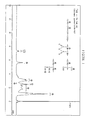
- the existance of 1,4-structure butadiene-maleic anhydride units, isobutene-maleic anhydride units and 1-butene-maleic anhydride units is identified from a spectrum of homonuclear shift corelation two dimensional NMR spectroscopy ('H-COSY). Further, the existance of maleic anhydride units is easily identified by observing absorption peaks of carbonyl arising from a cyclic acid anhydride in the vicinity of 1774 to 1780 and 1845 to 1857 cm - 1 of an IR spectrum.
- the existance of the hydrolyzed maleic anhydride units or the maleic acid units in the hydrolyzed product is also identified from the results of IR specturm.
- the absorption peaks of carbonyl arising from a cyclic acid anhydride observed in the spectrum of the copolymer are weak or disappear.
- a new absorption peak of carbonyl arising from a carboxyl group is observed in the vicinity of 1714 to 1722 cm 1.
- the copolymer contains aromatic radicals generated by a chain transfer reaction of solvent, the existance of the aromatic radicals is identified from an absorption peak in the vicinity of 7.2 to 7.4 ppm of the H-NMR spectrum.
- the present invention relates to the use of the hydrolyzed product to a scale inhibitor.
- the scale inhibitor of the present invention contains the hydrolyzed product of the copolymer of the present invention mentioned above.
- the amount of the hydrolyzed product to be added to water is altered according to the concentration of ions contained in the water to be treated. In order to suppress adhesion of scales effectively, the amount suitably ranges, for example from 0.1 to 100 ppm, preferably from 0.1 to 30 ppm, more preferably 1 to 20 ppm.
- the hydrolyzed product of the present invention is capable of preventing adhesion of scales mainly comprising calcium and iron.
- the hydrolyzed product makes it possible to prevent adhesion of scales comprising sulfates, carbonates, hydroxides, phosphates or silicates of various cations such as calcium, magnesium, barium or strontium. It is provided that the known water treatment agents may be used together with the scale inhibitors of the present invention.
- the present invention relates to the use of the hydrolyzed product as a dipsersant for calcium carbonate.
- the dipsersant for calcium carbonate of the present invention contains the hydrolyzed product of the present invention mentioned above.
- the amount of the hydrolyzed product to be added to calcium carbonate suitably ranges from 0.05 to 5 weight %, preferably from 0.1 to 2 weight %, more preferably 0.1 to 1 weight %. In the range above, an excellent dispersion effect is obtainable.
- An aqueous slurry of calcium carbonate can contain inorganic or organic pigments other than calcium carbonate, latexes and emulsions in addition to the hydrolyzed product.
- other dispersants or surfactants can be used together with the dispersant of the invention.
- the present invention relates to the use of the hydrolyzed product as an additive for cement and concrete.
- the additive for cement and concrete of the present invention contains the hydrolyzed product of the present invention mentioned above.
- the amount of the hydrolyzed product to be added to a cement ranges from 0.05 to 3 weight %, preferably from 0.1 to 2.0 weight %. In the range above, workability of the resulting cement mixture is extremely improved. As a result, high strength is obtained due to reduction of water content. In the cement using the hydrolyzed product, separation between aggregates such as sand and pebbles, and cement does not occur.
- the hydrolyzed product of the present invention can be used alone or together with agents such as the known admixtures for cement and concrete, air entraining agents, cure accelerators, aggregation accelerators and aggregation retardants.
- a high concentration calcium carbonate aqueous slurry is provided by adding a small amount of the dispersant of the present invention to a slurry.
- the resulting calcium carbonate aqueous slurry shows low viscosity and high flowability, and time course stability thereof is also excellent.
- the slurry can be applied in the field of papar, paint or the like advantegeously.
- the composition of the hydrocarbon fraction is listed in Table 1. Then the reaction solution was aged at 150 ° C for 1 hour and then the reaction was stopped. The resulting solution was cooled and the supernatant was removed to obtain a bulk copolymer. The yield of the copolymer was 34.7 parts by weight (yield: 65 %).
- the weight-average molecular weight of the resulting copolymer determined by GPC was 7500.
- the content of maleic anhydride units determined by CHN elemental analysis was about 59 mol%.
- absorption peaks of carbonyl arising from a cyclic acid anhydride were observed.
- the resulting copolymer was heated with a suitable amount of water in an autoclave equipped with a steam intruducing pipe and a condenser and steam was introduced into the autoclave. From around 86 C , an azeotropic mixture of toluene and water condensed at the condenser, and the temperature was rised to around 100°C , toulene did not appear any more. Introduction of steam and condensation were continued for another 2 hours to remove toluene completely. The resulting aqueous solution was cooled to room temperature to obtain 121 parts by weight of a homogeneous aqueous copolymer solution with 30 weight % of solid content. In the vicinity of 1714 to 1722 cm - 1 of IR spectrum of the hydrolyzated product, an absorption peak of carbonyl arising from a carboxyl group was observed.
- the weight-average molecular weight of the resulting copolymer determined by GPC was 2700.
- the content of maleic anhydride units determined by CHN elemental analysis was about 60 mol%.
- absorption peaks of carbonyl arising from a cyclic acid anhydride were observed.
- Example 2 the copolymer was hydrolyzed and steam distilled to obtain 122 parts by weight of a homogeneous aqueous copolymer solution with 30 weight % of solid content. In the vicinity of 1714 to 1722 cm - 1 of IR spectrum of the hydrolyzed product, an absorption peak of carbonyl arising from a carboxyl group was observed.
- the weight-average molecular weight of the resulting copolymer determined by GPC was 1400.
- the content of maleic anhydride units determined by CHN elemental analysis was about 68 mol%.
- absorption peaks of carbonyl arising from a cyclic acid anhydride were observed.
- Example 2 the copolymer was hydrolyzed and steam distilled to obtain 406 parts by weight of a homogeneous aqueous copolymer solution with 30 weight % of solid content. In the vicinity of 1714 to 1722 cm - 1 of IR spectrum of the hydrolyzed product, an absorption peak of carbonyl arising from a carboxyl group was observed.
- the weight-average molecular weight of the resulting copolymer determined by GPC was 5800.
- the content of maleic anhydride units determined by CHN elemental analysis was about 57 mol%.
- absorption peaks of carbonyl arising from a cyclic acid anhydride were observed.
- Example 2 the copolymer was hydrolyzed and steam distilled to obtain 522 parts by weight of a homogeneous aqueous copolymer solution with 30 weight % of solid content. In the vicinity of 1714 to 1722 cm 1 of IR spectrum of the hydrolyzed product, an absorption peak of carbonyl arising from a carboxyl group was observed.
- the weight-average molecular weight of the resulting copolymer determined by GPC was 4200.
- the content of maleic anhydride units determined by CHN elemental analysis was about 61 mol%.
- absorption peaks of carbonyl arising from a cyclic acid anhydride were observed.
- Example 2 the copolymer was hydrolyzed and steam distilled to obtain 115 parts by weight of a homogeneous aqueous copolymer solution with 30 weight % of solid content. In the vicinity of 1714 to 1722 cm -1 of IR spectrum of the hydrolyzed prodcut, an absorption peak of carbonyl arising from a carboxyl group was observed.
- the weight-average molecular weight of the resulting copolymer determined by GPC was 1000.
- the content of maleic anhydride units determined by CHN elemental analysis was about 56 mol%.
- Example 2 In accordance with the procedures of Example 1, the copolymer was hydrolyzed and steam distilled to obtain 8715 parts by weight of a homogeneous aqueous copolymer solution with 30 weight % of solid content.
- the weight-average molecular weight of the resulting copolymer determined by GPC was 4700.
- the content of maleic anhydride units determined by CHN elemental analysis was about 47 mol%.
- Example 2 In accordance with the procedures of Example 1, the copolymer was hydrolyzed and steam distilled to obtain 4000 parts by weight of a homogeneous aqueous copolymer solution with 30 weight % of solid content.
- Example 22 In accordance with the procedures of Example 22, except that the amount of the hydrocarbon fraction with 4 carbon atoms was changed to 915 parts by weight (393.5 parts by weight of butadiene, 228.8 parts by weight of isobutene, 128.1 parts by weight of 1-butene), a copolymer was prepared. The yield of the copolymer was 1124 parts by weight (yield: 64 %).
- the weight-average molecular weight of the resulting copolymer determined by GPC was 15700.
- the content of maleic anhydride units determined by CHN elemental analysis was about 48 mol%.
- Example 2 In accordance with the procedures of Example 1, the copolymer was hydrolyzed and steam distilled to obtain 3934 parts by weight of a homogeneous aqueous copolymer solution with 30 weight % of solid content.
- the reaction solution was poured into an excess amount of toluene to precipitate the copolymer.
- the precipitated copolymer is filtered, washed and dried to obtain 136 parts by weight of the copolymer (yield: 83 %).
- the resulting copolymer is hydrolyzed with an aqueous sodium hydroxide solution to obtain a homogeneous aqueous copolymer solution with 30 weight % of solid content.
- 900 ml of tap water was added to a beaker and then a hydrolyzed copolymer sample or a sample available on the market was added to the beaker so that the final solid concentration was 1.5 ppm or 20 ppm. Then 20 ml of an aqueous solution containing 5.88 weight % of calucium chloride 2 hydrate and 20 ml of an aqueous solution containing 0.70 weight % of Mohr's salt were added to the beaker. The pH of the resulting solution was adjusted to 8.5 with an aqueous sodium hydroxide solution and tap water was added so that the volume was 1 liter. The beaker was placed in a thermostat water bath at 40 C .
- the viscosity of the slurry was measured by a B-type viscometer (Tokyo Keiki Inc., Tokyo, Japan, DLV-B type) at 25 ° C at 60 rpm (rotor No. 4). Results are listed in Table 4. It is provided that the sodium salt of hydrolyzed copolymer was prepared by adjusting the pH of the aqueous hydrolyzed copolymer solution to 9 with sodium hydroxide.
- the sodium salt of hydrolyzed copolymer was prepared by adjusting the pH of aqueous solution containing a hydrolyzed copolymer to 7.3 with sodium hydroxide.
Landscapes
- Chemical & Material Sciences (AREA)
- Chemical Kinetics & Catalysis (AREA)
- Organic Chemistry (AREA)
- Health & Medical Sciences (AREA)
- Medicinal Chemistry (AREA)
- Polymers & Plastics (AREA)
- Engineering & Computer Science (AREA)
- Ceramic Engineering (AREA)
- General Chemical & Material Sciences (AREA)
- Hydrology & Water Resources (AREA)
- Life Sciences & Earth Sciences (AREA)
- Environmental & Geological Engineering (AREA)
- Water Supply & Treatment (AREA)
- Materials Engineering (AREA)
- Structural Engineering (AREA)
- Addition Polymer Or Copolymer, Post-Treatments, Or Chemical Modifications (AREA)
Applications Claiming Priority (4)
| Application Number | Priority Date | Filing Date | Title |
|---|---|---|---|
| JP18749590 | 1990-07-16 | ||
| JP187495/90 | 1990-07-16 | ||
| JP13356591A JP3177616B2 (ja) | 1991-05-09 | 1991-05-09 | 炭酸カルシウム用分散剤 |
| JP133565/91 | 1991-05-09 |
Publications (3)
| Publication Number | Publication Date |
|---|---|
| EP0467287A2 true EP0467287A2 (fr) | 1992-01-22 |
| EP0467287A3 EP0467287A3 (en) | 1992-02-12 |
| EP0467287B1 EP0467287B1 (fr) | 1995-05-03 |
Family
ID=26467891
Family Applications (1)
| Application Number | Title | Priority Date | Filing Date |
|---|---|---|---|
| EP91111838A Expired - Lifetime EP0467287B1 (fr) | 1990-07-16 | 1991-07-16 | Copolymères d'anhydride maléique |
Country Status (3)
| Country | Link |
|---|---|
| US (1) | US5336727A (fr) |
| EP (1) | EP0467287B1 (fr) |
| DE (1) | DE69109385T2 (fr) |
Cited By (4)
| Publication number | Priority date | Publication date | Assignee | Title |
|---|---|---|---|---|
| WO2015124845A1 (fr) | 2014-02-21 | 2015-08-27 | Coatex | Utilisation de copolymeres de styrene et d'anhydride maleique pour preparer des particules de matiere minerale |
| WO2017064425A1 (fr) * | 2015-10-16 | 2017-04-20 | Coatex | Production de carbonate de calcium precipite (ccp) |
| CN108367936A (zh) * | 2015-10-16 | 2018-08-03 | Omya国际股份公司 | 具有共聚添加剂的高固体pcc |
| US10189946B2 (en) | 2014-02-26 | 2019-01-29 | Basf Se | Process for preparing polyamines |
Families Citing this family (21)
| Publication number | Priority date | Publication date | Assignee | Title |
|---|---|---|---|---|
| FR2688788B1 (fr) * | 1992-03-17 | 1994-05-13 | Bio Merieux | Composes hydrosolubles derives d'un homopolymere ou copolymere de l'anhydride maleique, et applications desdits composes au support de molecules biologiques. |
| US5733993A (en) * | 1996-11-14 | 1998-03-31 | Ethyl Corporation | Polymeric dispersants via novel terpolymers |
| US6231665B1 (en) | 1999-09-22 | 2001-05-15 | W. R. Grace & Co.-Conn. | Efflorescence control in cementitious compositions and masonry units |
| US6472136B2 (en) | 2000-06-28 | 2002-10-29 | Eastman Kodak Company | Method of dispersing water insoluble photographically useful compounds |
| US7303794B2 (en) * | 2004-03-31 | 2007-12-04 | Specialty Minerals (Michigan) Inc. | Ink jet recording paper |
| US20060003117A1 (en) * | 2004-06-14 | 2006-01-05 | Specialty Minerals (Michigan) Inc. | Ink jet recording paper |
| DE102005030283A1 (de) * | 2005-06-29 | 2007-01-11 | Basf Ag | Verfahren zur Vermeidung von Ba-/Sr-Kesselstein |
| US8519075B2 (en) * | 2007-11-30 | 2013-08-27 | Joseph P. Laurino | Polycarbonate resin, and method of use of, poly (2-octadecyl-butanedioic acid) and the salts and esters thereof |
| US9145340B2 (en) | 2012-08-13 | 2015-09-29 | Verdesian Life Sciences, Llc | Method of reducing atmospheric ammonia in livestock and poultry containment facilities |
| US9961922B2 (en) | 2012-10-15 | 2018-05-08 | Verdesian Life Sciences, Llc | Animal feed and/or water amendments for lowering ammonia concentrations in animal excrement |
| US11254620B2 (en) | 2013-08-05 | 2022-02-22 | Verdesian Life Sciences U.S., Llc | Micronutrient-enhanced polymeric seed coatings |
| TW201522390A (zh) | 2013-08-27 | 2015-06-16 | 特級肥料產品公司 | 聚陰離子聚合物 |
| WO2015035031A1 (fr) | 2013-09-05 | 2015-03-12 | Verdesian Life Sciences, Llc | Compositions d'acide borique |
| PL2910610T3 (pl) | 2014-02-21 | 2017-12-29 | Omya Int Ag | Sposób wytwarzania produktu stanowiącego wypełniacz w postaci węglanu wapnia |
| CA2945823C (fr) | 2014-05-21 | 2022-04-26 | Verdesian Life Sciences, Llc | Compositions de traitement de sol polymeres comprenant des acides humiques |
| US10822487B2 (en) | 2014-05-22 | 2020-11-03 | Verdesian Life Sciences Llc | Polymeric compositions |
| CN104474967B (zh) * | 2014-12-04 | 2016-08-24 | 江苏苏博特新材料股份有限公司 | 一种分散剂、其制备方法及其在纳米碳酸钙分散中的应用 |
| JP7053603B2 (ja) | 2016-10-31 | 2022-04-12 | キャボット コーポレイション | インクジェットインク組成物のためのポリマー |
| US11549082B2 (en) * | 2018-09-20 | 2023-01-10 | Baker Hughes Holdings Llc | Cleaning agent comprising a polyacrylate terpolymer for removal of fouling deposits from metal surfaces |
| CN111285968A (zh) * | 2020-04-20 | 2020-06-16 | 扬州中天利新材料股份有限公司 | 一种高交替性可控分子量顺酐异丁烯共聚物的制备方法 |
| CN119119770B (zh) * | 2024-09-05 | 2025-07-01 | 重庆市化工研究院有限公司 | 一种还原染料分散剂及其应用和液体预还原还原染料的制备方法 |
Family Cites Families (16)
| Publication number | Priority date | Publication date | Assignee | Title |
|---|---|---|---|---|
| US3491068A (en) * | 1967-06-16 | 1970-01-20 | Borg Warner | Novel copolymers and their method of preparation |
| US3560456A (en) * | 1969-05-26 | 1971-02-02 | Gulf Research Development Co | Process of forming copolymers of maleic anhydride and an aliphatic olefin having from 16 to 18 carbon atoms |
| US3553177A (en) * | 1969-05-26 | 1971-01-05 | Gulf Research Development Co | Process of forming copolymers of maleic anhydride and an aliphatic olefin having at least 30 carbon atoms |
| US3560455A (en) * | 1969-05-26 | 1971-02-02 | Gulf Research Development Co | Process of forming copolymers of maleic anhydride and an aliphatic olefin having from 20 to 30 carbon atoms |
| US3560457A (en) * | 1969-05-26 | 1971-02-02 | Gulf Research Development Co | Process of forming copolymers of maleic anhydride and an aliphatic olefin having from 12 to 14 carbon atoms |
| GB1369429A (en) * | 1970-11-30 | 1974-10-09 | Ciba Geigy Ag | Treatment of water or aqueous systems |
| US3729451A (en) * | 1972-07-10 | 1973-04-24 | Gulf Research Development Co | Process for copolymerization of maleic anhydride with 1-olefins |
| US3972903A (en) * | 1972-12-21 | 1976-08-03 | The Dow Chemical Company | Molecular weight control in charge-transfer copolymerization |
| US4126549A (en) * | 1973-02-14 | 1978-11-21 | Ciba-Geigy (Uk) Limited | Treatment of water |
| JPS5320475A (en) * | 1976-08-09 | 1978-02-24 | Hitachi Ltd | Container for kneading machine |
| JPS5370089A (en) * | 1976-12-03 | 1978-06-22 | Kouriyuu Kougiyou Kk | Scale preventing method for circulating cooling water system |
| JPS6071093A (ja) * | 1983-09-27 | 1985-04-22 | Nippon Zeon Co Ltd | 水を処理する方法 |
| JPS6099334A (ja) * | 1983-11-04 | 1985-06-03 | Kuraray Co Ltd | 無機物分散剤 |
| JPS62132730A (ja) * | 1985-12-02 | 1987-06-16 | Kuraray Co Ltd | 炭酸カルシウム用分散剤 |
| DE3941765A1 (de) * | 1989-12-18 | 1991-06-20 | Schrem Werkzeugfab Albert | Hydraulisches spannelement |
| JP2732985B2 (ja) * | 1992-06-03 | 1998-03-30 | 帝人化成株式会社 | 屋外看板用プレート |
-
1991
- 1991-07-15 US US07/729,756 patent/US5336727A/en not_active Expired - Fee Related
- 1991-07-16 DE DE69109385T patent/DE69109385T2/de not_active Expired - Fee Related
- 1991-07-16 EP EP91111838A patent/EP0467287B1/fr not_active Expired - Lifetime
Cited By (6)
| Publication number | Priority date | Publication date | Assignee | Title |
|---|---|---|---|---|
| WO2015124845A1 (fr) | 2014-02-21 | 2015-08-27 | Coatex | Utilisation de copolymeres de styrene et d'anhydride maleique pour preparer des particules de matiere minerale |
| US10189946B2 (en) | 2014-02-26 | 2019-01-29 | Basf Se | Process for preparing polyamines |
| WO2017064425A1 (fr) * | 2015-10-16 | 2017-04-20 | Coatex | Production de carbonate de calcium precipite (ccp) |
| FR3042488A1 (fr) * | 2015-10-16 | 2017-04-21 | Coatex Sas | Production de carbonate de calcium precipite |
| CN108367936A (zh) * | 2015-10-16 | 2018-08-03 | Omya国际股份公司 | 具有共聚添加剂的高固体pcc |
| CN108367936B (zh) * | 2015-10-16 | 2020-03-10 | Omya国际股份公司 | 具有共聚添加剂的高固体pcc |
Also Published As
| Publication number | Publication date |
|---|---|
| US5336727A (en) | 1994-08-09 |
| DE69109385T2 (de) | 1995-10-05 |
| EP0467287A3 (en) | 1992-02-12 |
| EP0467287B1 (fr) | 1995-05-03 |
| DE69109385D1 (de) | 1995-06-08 |
Similar Documents
| Publication | Publication Date | Title |
|---|---|---|
| EP0467287B1 (fr) | Copolymères d'anhydride maléique | |
| JP3284318B2 (ja) | テロマー | |
| CA2230517C (fr) | Nouveaux derives phosphino | |
| EP0123052B1 (fr) | Méthode de préparation et usage d'un terpolymère agent inhibiteur d'incrustations | |
| US4147627A (en) | Process for scale control using mixtures of polycationic and polyanionic polymers | |
| JPH101512A (ja) | 低分子量ホスホネート末端ポリマーの製造方法 | |
| JPS59130598A (ja) | スケ−ル形成防止方法 | |
| JPH0275396A (ja) | アリルスルホナート/無水マレイン酸系重合体による水系統でのスケール沈積抑制法 | |
| GB2077278A (en) | New acrylic copolymers their preparation and their use as scale inhibitors | |
| JP3309401B2 (ja) | 無水マレイン酸共重合体及びそれを用いたスケール防止剤 | |
| JPS61159406A (ja) | 水溶性ポリマ−および該ポリマ−を含有する組成物 | |
| CN104176837B (zh) | 阻垢剂 | |
| EP0122229A1 (fr) | Composition pour le traitement de l'eau | |
| US3752761A (en) | Boiler water treatment | |
| CA1200457A (fr) | Acide polyitaconique, inhibiteur de la formation de depot | |
| JP2964154B2 (ja) | 無水マレイン酸の重合法 | |
| JPH0428708A (ja) | スケール防止用水処理剤 | |
| GB2218706A (en) | New polymers of unsaturated dicarboxylic or polycarboxylic acids | |
| US4446282A (en) | High green strength emulsion rubbers by the use of half-esters of unsaturated dicarboxylic acids | |
| JPH05287690A (ja) | クラフトパルプ製造工程における蒸解釜内のスケール付着防止方法 | |
| JP3232610B2 (ja) | スケール防止剤 | |
| US4929362A (en) | Calcium phosphate scale control methods | |
| CA2839978C (fr) | Produit de polymere et son utilisation comme agent de dispersion | |
| JPH08299777A (ja) | 分散剤 | |
| JPS63107800A (ja) | 水系用スケ−ル防止剤 |
Legal Events
| Date | Code | Title | Description |
|---|---|---|---|
| PUAI | Public reference made under article 153(3) epc to a published international application that has entered the european phase |
Free format text: ORIGINAL CODE: 0009012 |
|
| PUAL | Search report despatched |
Free format text: ORIGINAL CODE: 0009013 |
|
| AK | Designated contracting states |
Kind code of ref document: A2 Designated state(s): DE FR GB |
|
| AK | Designated contracting states |
Kind code of ref document: A3 Designated state(s): DE FR GB |
|
| 17P | Request for examination filed |
Effective date: 19920721 |
|
| 17Q | First examination report despatched |
Effective date: 19940307 |
|
| GRAA | (expected) grant |
Free format text: ORIGINAL CODE: 0009210 |
|
| AK | Designated contracting states |
Kind code of ref document: B1 Designated state(s): DE FR GB |
|
| REF | Corresponds to: |
Ref document number: 69109385 Country of ref document: DE Date of ref document: 19950608 |
|
| ET | Fr: translation filed | ||
| PLBE | No opposition filed within time limit |
Free format text: ORIGINAL CODE: 0009261 |
|
| STAA | Information on the status of an ep patent application or granted ep patent |
Free format text: STATUS: NO OPPOSITION FILED WITHIN TIME LIMIT |
|
| 26N | No opposition filed | ||
| REG | Reference to a national code |
Ref country code: GB Ref legal event code: IF02 |
|
| PGFP | Annual fee paid to national office [announced via postgrant information from national office to epo] |
Ref country code: FR Payment date: 20030711 Year of fee payment: 13 |
|
| PGFP | Annual fee paid to national office [announced via postgrant information from national office to epo] |
Ref country code: GB Payment date: 20030716 Year of fee payment: 13 |
|
| PGFP | Annual fee paid to national office [announced via postgrant information from national office to epo] |
Ref country code: DE Payment date: 20030724 Year of fee payment: 13 |
|
| PG25 | Lapsed in a contracting state [announced via postgrant information from national office to epo] |
Ref country code: GB Free format text: LAPSE BECAUSE OF NON-PAYMENT OF DUE FEES Effective date: 20040716 |
|
| PG25 | Lapsed in a contracting state [announced via postgrant information from national office to epo] |
Ref country code: DE Free format text: LAPSE BECAUSE OF NON-PAYMENT OF DUE FEES Effective date: 20050201 |
|
| GBPC | Gb: european patent ceased through non-payment of renewal fee |
Effective date: 20040716 |
|
| PG25 | Lapsed in a contracting state [announced via postgrant information from national office to epo] |
Ref country code: FR Free format text: LAPSE BECAUSE OF NON-PAYMENT OF DUE FEES Effective date: 20050331 |
|
| REG | Reference to a national code |
Ref country code: FR Ref legal event code: ST |