EP0468921B1 - Wässrige Dispersion schwerlöslicher UV-Absorber - Google Patents
Wässrige Dispersion schwerlöslicher UV-Absorber Download PDFInfo
- Publication number
- EP0468921B1 EP0468921B1 EP91810568A EP91810568A EP0468921B1 EP 0468921 B1 EP0468921 B1 EP 0468921B1 EP 91810568 A EP91810568 A EP 91810568A EP 91810568 A EP91810568 A EP 91810568A EP 0468921 B1 EP0468921 B1 EP 0468921B1
- Authority
- EP
- European Patent Office
- Prior art keywords
- component
- acid
- dispersion according
- alkyl
- formula
- Prior art date
- Legal status (The legal status is an assumption and is not a legal conclusion. Google has not performed a legal analysis and makes no representation as to the accuracy of the status listed.)
- Expired - Lifetime
Links
- 0 *c(cc1O)ccc1-c1nc(*)nc(*)n1 Chemical compound *c(cc1O)ccc1-c1nc(*)nc(*)n1 0.000 description 2
- ZPPLLLPKGQNJCE-DEQVHDEQSA-N CC(C/C=C\C=C\C)(CNC)ON Chemical compound CC(C/C=C\C=C\C)(CNC)ON ZPPLLLPKGQNJCE-DEQVHDEQSA-N 0.000 description 1
- RUUQNDPKAFJWBM-UHFFFAOYSA-N COc(cc1)ccc1Nc(c(C(c1ccccc11)=O)c2C1=O)ccc2O Chemical compound COc(cc1)ccc1Nc(c(C(c1ccccc11)=O)c2C1=O)ccc2O RUUQNDPKAFJWBM-UHFFFAOYSA-N 0.000 description 1
Classifications
-
- C—CHEMISTRY; METALLURGY
- C09—DYES; PAINTS; POLISHES; NATURAL RESINS; ADHESIVES; COMPOSITIONS NOT OTHERWISE PROVIDED FOR; APPLICATIONS OF MATERIALS NOT OTHERWISE PROVIDED FOR
- C09K—MATERIALS FOR MISCELLANEOUS APPLICATIONS, NOT PROVIDED FOR ELSEWHERE
- C09K3/00—Materials not provided for elsewhere
-
- D—TEXTILES; PAPER
- D06—TREATMENT OF TEXTILES OR THE LIKE; LAUNDERING; FLEXIBLE MATERIALS NOT OTHERWISE PROVIDED FOR
- D06P—DYEING OR PRINTING TEXTILES; DYEING LEATHER, FURS OR SOLID MACROMOLECULAR SUBSTANCES IN ANY FORM
- D06P3/00—Special processes of dyeing or printing textiles, or dyeing leather, furs, or solid macromolecular substances in any form, classified according to the material treated
- D06P3/34—Material containing ester groups
- D06P3/52—Polyesters
- D06P3/54—Polyesters using dispersed dyestuffs
-
- D—TEXTILES; PAPER
- D06—TREATMENT OF TEXTILES OR THE LIKE; LAUNDERING; FLEXIBLE MATERIALS NOT OTHERWISE PROVIDED FOR
- D06P—DYEING OR PRINTING TEXTILES; DYEING LEATHER, FURS OR SOLID MACROMOLECULAR SUBSTANCES IN ANY FORM
- D06P1/00—General processes of dyeing or printing textiles, or general processes of dyeing leather, furs, or solid macromolecular substances in any form, classified according to the dyes, pigments, or auxiliary substances employed
- D06P1/44—General processes of dyeing or printing textiles, or general processes of dyeing leather, furs, or solid macromolecular substances in any form, classified according to the dyes, pigments, or auxiliary substances employed using insoluble pigments or auxiliary substances, e.g. binders
- D06P1/64—General processes of dyeing or printing textiles, or general processes of dyeing leather, furs, or solid macromolecular substances in any form, classified according to the dyes, pigments, or auxiliary substances employed using insoluble pigments or auxiliary substances, e.g. binders using compositions containing low-molecular-weight organic compounds without sulfate or sulfonate groups
- D06P1/642—Compounds containing nitrogen
- D06P1/6426—Heterocyclic compounds
-
- D—TEXTILES; PAPER
- D06—TREATMENT OF TEXTILES OR THE LIKE; LAUNDERING; FLEXIBLE MATERIALS NOT OTHERWISE PROVIDED FOR
- D06P—DYEING OR PRINTING TEXTILES; DYEING LEATHER, FURS OR SOLID MACROMOLECULAR SUBSTANCES IN ANY FORM
- D06P1/00—General processes of dyeing or printing textiles, or general processes of dyeing leather, furs, or solid macromolecular substances in any form, classified according to the dyes, pigments, or auxiliary substances employed
- D06P1/44—General processes of dyeing or printing textiles, or general processes of dyeing leather, furs, or solid macromolecular substances in any form, classified according to the dyes, pigments, or auxiliary substances employed using insoluble pigments or auxiliary substances, e.g. binders
- D06P1/64—General processes of dyeing or printing textiles, or general processes of dyeing leather, furs, or solid macromolecular substances in any form, classified according to the dyes, pigments, or auxiliary substances employed using insoluble pigments or auxiliary substances, e.g. binders using compositions containing low-molecular-weight organic compounds without sulfate or sulfonate groups
- D06P1/651—Compounds without nitrogen
- D06P1/65106—Oxygen-containing compounds
- D06P1/65112—Compounds containing aldehyde or ketone groups
-
- D—TEXTILES; PAPER
- D06—TREATMENT OF TEXTILES OR THE LIKE; LAUNDERING; FLEXIBLE MATERIALS NOT OTHERWISE PROVIDED FOR
- D06P—DYEING OR PRINTING TEXTILES; DYEING LEATHER, FURS OR SOLID MACROMOLECULAR SUBSTANCES IN ANY FORM
- D06P3/00—Special processes of dyeing or printing textiles, or dyeing leather, furs, or solid macromolecular substances in any form, classified according to the material treated
- D06P3/34—Material containing ester groups
- D06P3/52—Polyesters
- D06P3/522—Polyesters using basic dyes
Definitions
- the present invention relates to an aqueous dispersion of poorly soluble UV absorbers and their use in dyeing synthetic fibers, in particular polyester fibers or acid-modified polyester fibers.
- the aqueous dispersion according to the invention advantageously contains 10 to 45 percent by weight of component (a) 0.5 to 15 percent by weight of component (b) and 0.5-15 percent by weight.
- component (c) expediently has a particle size below 5 ⁇ m.
- Both component (a) and components (b) and (c) can be present as a single compound or in the form of a mixture.
- substituents R 1 and R 2 represent an alkyl group, it can be straight-chain or branched.
- alkyl radicals are methyl, ethyl, n-propyl, isopropyl, n-butyl, isobutyl, sec-butyl, tert-butyl, amyl, isoamyl, tert-amyl, n-hexyl, 2-ethylhexyl, n-heptyl, n- Octyl, isooctyl, n-nonyl, isononyl, n-dodecyl, heptadecyl or octadecyl.
- R, R 1 and R 2 as lower alkyl, alkoxy or alkylthio represent a radical with 1 to 4 carbon atoms, such as methyl, ethyl, propyl, isopropyl, butyl, isobutyl, sec-butyl, tert-butyl, methoxy, Ethoxy, propoxy, isopropoxy, butoxy, isobutoxy, sec-butoxy, tert-butoxy, methylthio, ethylthio, propylthio, isopropylthio, butylthio, isobutylthio, sec-butylthio or tert-butylthio.
- Halogen means for example fluorine, bromine or preferably chlorine.
- the compounds of the formulas (1), (2) and (3), also known as UV absorbers, are known or can be prepared in a manner known per se, e.g. by heating an amidine and an o-hydroxybenzene carboxylic acid ester, preferably in an approximate molar ratio of 2: 1 in boiling organic solvents [cf. US-A-3,896,125 and Helv. Chim. Acta55, 1566-1595 (1972)].
- the acid residue X in formula (4) is derived, for example, from low molecular weight dicarboxylic acids, e.g. of maleic acid, succinic acid or sulfosuccinic acid, and is connected to the alkylene oxide part of the molecule via an ester bridge.
- X is derived from inorganic polybasic acids, such as sulfuric acid or in particular orthophosphoric acid.
- the acid residue X can be in the form of a free acid or in salt form, i.e. e.g. as an alkali metal, alkaline earth, ammonium, amine or fatty amine salt.
- alkali metal, alkaline earth, ammonium, amine or fatty amine salt examples of such salts are lithium, sodium, potassium, barium, magnesium, ammonium, trimethylamine, diethylamine, ethanolamine, diethanolamine or triethanolamine salts.
- Alkali metal salts or especially triethanolamine salts are preferred.
- the mono- or diethanolamine salts as well as amines and fatty amines can be further etherified with 1 to 25 oxalkylene units.
- substituent Y in formula (4) represents an alkyl group, it can be straight-chain or branched.
- alkyl radicals are methyl, ethyl, n-propyl, isopropyl, n-butyl, isobutyl, sec-butyl, tert-butyl, amyl, isoamyl, tert-amyl, n-hexyl, 2-ethylhexyl, n-heptyl, n- Octyl, isooctyl, n-nonyl, isononyl or n-dodecyl.
- Y in the meaning of aralkyl advantageously has a total of 7 to 9 carbon atoms and generally stands for benzyl, a-methylbenzyl, a, a-dimethylbenzyl, ⁇ -phenethyl, a-tolylethyl or phenisopropyl.
- the substituent Y in formula (4) is advantageously C 4 -C 1 -C 2 alkyl, benzyl, preferably C 4 -C 10 alkyl or especially a-methylbenzyl.
- the substituent Y can also assume various of the meanings given.
- n is preferably 6 to 30, while m is preferably 1 to 3. are preferred of the ethylene glycol, propylene ethylene glycol or ethylene propylene glycol type; the former is particularly preferred.
- Preferred acid esters as component (ba) correspond to the formula wherein Y 1 is C 4 -C 12 alkyl, phenyl, tolyl, tolyl-C1-C3-alkyl or phenyl-Ci-C3-alkyl, such as a-methyl or a, a-dimethylbenzyl, X 1 is an acid residue , which is derived from sulfuric acid or preferably o-phosphoric acid, and mi are 1 to 3 and ni 4 to 40.
- acidic esters are preferably in the form of sodium, potassium, ammonium, diethylamine, triethylamine, diethanolamine or triethanolamine salts.
- the acidic esters of formula (4) or (5) which are suitable as component (ba) are prepared by adding alkylene oxide (ethylene oxide or propylene oxide) to a phenol compound which is substituted by definition and the adduct with a polybasic oxygen acid or a functional derivative of this acid , such as Acid anhydrides, acid halides, acid esters or acid amides are converted into the acidic esters and, if appropriate, the acidic ester obtained into the abovementioned salts.
- these functional derivatives are phosphorus pentoxide, phosphorus oxytrichloride, chlorosulfonic acid or sulfamic acid. Both the alkylene oxide addition and the esterification can be carried out by known methods.
- Well-suited components (ba) are acidic esters or their salts of a polyadduct of 4 to 40 moles of ethylene oxide with 1 mole of a phenol which has at least one C 4 -C 12 alkyl group, a phenyl group, a tolyl group, an a-tolylethyl group, a benzyl group , has an a-methylbenzyl group or an a, a-dimethylbenzyl group, such as butylphenol, tributylphenol, octylphenol, nonylphenol, dinonylphenol, o-phenylphenol, benzylphenol, dibenzylphenol, a-tolylethylphenol, dibenzyl- (nonyl) -phenol, a- Methylbenzylphenol, bis (a-methylbenzyl) phenol or tris (a-methylbenzyl) phenol, these acidic esters can be used individually or in a mixture.
- the Phosphoric acid esters are expediently present as mixtures of the corresponding salts of a mono- or diester.
- the styrene addition products are preferably produced in a known manner in the presence of catalysts, such as sulfuric acid, p-toluenesulfonic acid or, above all, zinc chloride.
- catalysts such as sulfuric acid, p-toluenesulfonic acid or, above all, zinc chloride.
- Suitable styrenes are suitably styrene, ⁇ -methylstyrene or vinyltoluene (4-methylstyrene).
- the phenols are phenol, cresols or xylenols.
- Acidic phosphoric acid esters (mono- and diesters) or their salts of oxyalkylation products of the formula are very particularly preferred as component (ba) wherein m 2 is 1 to 3 and n 2 is 8 to 30, preferably 12 to 20.
- the acid residue of the anionic compounds is usually in salt form, i.e. as an alkali metal, ammonium or amine salt.
- salts are lithium, sodium, potassium, ammonium, trimethylamine, ethanolamine, diethanolamine or triethanolamine salts.
- Preferred dispersions according to the invention contain components (b) and (c) in a ratio (b) :( c) of 20: 1 to 1:20, preferably 5: 1 to 1: 5.
- Well-suited components are polyadducts of 4 to 40 moles of ethylene oxide with 1 mole of a phenol which has at least one C 4 -C 12 alkyl group, a phenyl group, a tolyl group, an a-tolylethyl group, a benzyl group, an a-methylbenzyl group or has an a, a-dimethylbenzyl group, such as butylphenol, tributylphenol, octylphenol, nonylphenol, dinonylphenol, o-phenylphenol, benzylphenol, dibenzylphenol, a-tolylethylphenol, dibenzyl- (nonyl) -phenol, a-methylbenzylphenol, bis- (a-methyl) ) phenol or tris (a-methylbenzyl) phenol, these adducts can be used individually or in a mixture.
- component (ca) Of particular interest as component (ca) are adducts of 6 to 30 moles of ethylene oxide with 1 mole of 4-nonylphenol, with 1 mole of dinonylphenol or especially with 1 mole of compounds which are prepared by the addition of 1 to 3 moles of styrenes to 1 mole of phenols become.
- the styrene addition products are preferably produced in a known manner in the presence of catalysts, such as sulfuric acid, p-toluenesulfonic acid or, above all, zinc chloride.
- catalysts such as sulfuric acid, p-toluenesulfonic acid or, above all, zinc chloride.
- Suitable styrenes are suitably styrene, ⁇ -methylstyrene or vinyltoluene (4-methylstyrene).
- the phenols are phenol, cresols or xylenols.
- Ethylene oxide adducts of the formula (11) are very particularly preferred wherein m 3 is 1 to 3 and n 3 is 8 to 30.
- Ethylene oxide adducts of the formula are also preferred wherein Y 2 is C 4 -C 12 alkyl, phenyl, tolyl, tolyl-C1-C3-alkyl or phenyl-C1-C3-alkyl, such as a-methyl or a, a-dimethylbenzyl, and m 2 1 to 3 and n 2 are 4 to 40.
- Preferred components (cc) are ethylene oxide adducts with polypropylene oxide (so-called EO-PO block polymers) and propylene oxide adducts with polyethylene oxide (so-called reverse EO-PO block polymers).
- Ethylene oxide-propylene oxide block polymers with molecular weights of the polypropylene oxide base of 1700 to 4000 and an ethylene oxide content in the total molecule of 30-80%, in particular 60-80%, are particularly preferred.
- the dispersion according to the invention can advantageously also contain a stabilizing or thickening agent as component (d).
- Polymers containing carboxyl groups are particularly suitable as component (d). These are used in the form of 0.5 to 10%, preferably 0.5 to 5%, aqueous solutions or dispersions, based on the solution or dispersion.
- These polymers advantageously represent polymerized ethylenically unsaturated mono- or dicarboxylic acids of 3 to 5 carbon atoms, e.g. Polyacrylic acid or polymers of methacrylic acid, crotonic acid, itaconic acid, teraconic acid, maleic acid or their anhydride, fumaric acid, citraconic acid or mesaconic acid, copolymers of olefins, e.g.
- the carboxyl-containing polymers which form thickeners can have a molecular weight of 0.5 to 6 million.
- solutions of polyacrylic acid or copolymers of acrylic acid and acrylamide have been shown to be particularly useful components (d), the corresponding molecular weight being able to vary from 0.5 to 6 million.
- the copolymers advantageously have a molar ratio of acrylic acid: acrylamide of 1: 0.8 to 1: 1.2.
- a partially hydrolyzed polymaleic anhydride can also be used as component (d). This is usually partly in the form of a water-soluble salt and has a molecular weight that is preferably between 300 and 5000.
- Further thickeners which can be used as component (d) are polysaccharides, such as, for example, carboxymethyl cellulose, methyl cellulose, methyl or ethyl hydroxyethyl cellulose, locust bean gum flour or starch ethers, and alginates, polyethylene glycols, polyvinylpyrrolidones, polyvinyl alcohols or else finely divided silica, preferably with a specific surface area of 50 to 380 m 2 and Layered silicates, such as bentonite, bentone, smectite, montmorillonite.
- Anionic heteropolysaccharis are also very suitable de, which are formed from the monosaccharides glucose and mannose and glucuronic acid.
- the amounts of these additional ingredients (d) are generally from 0.05 to 8 percent by weight, preferably 0.1 to 4 percent by weight, based on the total aqueous dispersion.
- the aqueous dispersion according to the invention can additionally contain antifoams, preservatives or antifreezes.
- the anionic and nonionic compounds can be used alone or in combination.
- Preferred anti-foaming agents are alkylene diamides. These suitably correspond to the formula in which V 1 and V 2 , independently of one another, each represent an aliphatic radical having 9 to 23 carbon atoms and Q is an alkylene radical having 1 to 8, preferably 1, 2 or 3, carbon atoms.
- the alkylenediamide can be present as a single compound or in the form of a mixture.
- the aliphatic radicals V 1 and V 2 can be straight-chain or branched. Together with the CO group, they advantageously represent the acid residue of an unsaturated or preferably saturated aliphatic carboxylic acid with 10 to 24 carbon atoms.
- aliphatic carboxylic acids are capric, lauric, coconut fatty, myristic, palm kernel fatty acid, palmitic, tallow fatty, Called oleic, ricinoleic, linoleic, linolenic, stearic, arachic, arachidonic, behenic, erucic or lignoceric acid. Behenic acid and especially stearic acid are preferred.
- Mixtures of these acids can also be used, such as those obtained from the cleavage of natural oils or fats.
- coconut fatty acid, palm kernel fatty acid, palmitic / stearic acid mixtures, tallow fatty acid and arachinic / behenic acid mixtures are particularly preferred mixtures.
- V 1 and V 2 each preferably represent an alkyl radical having 9 to 23 carbon atoms and in particular having 15 to 21 carbon atoms.
- Q represents in particular an alkylene group which contains 2 to 5 carbon atoms and can be straight-chain or branched. These are, for example, the -CH 2 CH 2 -, -CH 2 CH 2 CH 2 -,
- Typical representatives for alkylenediamides as anti-foaming agents are methylene-bis-stearic acid amide, ethylene-bis-stearic acid amide or ethylene-bis-behenic acid amide.
- the alkylene diamide is preferably present in the dispersion in an amount of 0.2 to 3 percent by weight.
- a preferred antifreeze is propylene glycol.
- Such mixtures as component (a) contain the compounds of the formulas (1), (14) and (15) in the weight ratios (1) :( 14) and (1) :( 15) from 99: 1 to 1:99, Mixtures of the compounds of the formulas (1), (14) and (15) are also suitable as component (a).
- the dispersion according to the invention is expediently prepared by mixing the s-triazine compounds of the formula (1) with a dispersant, e.g. pastes the acidic ester of formula (4) and water in a mixer and after any addition of the desired additional components such as nonionic surfactants (c), further anionic and / or nonionic compounds including the antifoam, preservative and antifreeze agent 1 to 30, preferably 1 to 10 Dispersed for hours.
- the dispersion is advantageously carried out by the action of high shear forces, e.g. by grinding in a ball, sand or pearl mill. After grinding, an aqueous solution of the stabilizing or thickening agent (component (d)) and, if desired, water can also be added, and the mixture is stirred until uniform.
- the dispersions according to the invention are notable for good transport and storage stability. In particular, they are very stable at higher temperatures up to 130 ° C when used in dye baths.
- the dispersion according to the invention is used in the dyeing of synthetic fibers.
- the dyeing process is carried out in the usual way.
- the dispersion according to the invention is slowly introduced into an aqueous bath with stirring, after which the liquor is ready for dyeing after the addition of the dye.
- the present invention accordingly also relates to a process for dyeing synthetic fiber material with cationic or disperse dyes.
- the process is characterized in that this material is dyed in the presence of the auxiliary dispersion according to the invention.
- the amounts used in which the auxiliary dispersion according to the invention is added to the dyebaths range from 0.5 to 10%, preferably 1 to 5%, of the weight of the goods.
- fiber material in particular textile material, which can be dyed in the presence of the new auxiliary mixture used as a light stabilizer, e.g. Cellulose ester fibers such as cellulose 2 1/2 acetate fibers and triacetate fibers; aromatic polyamide fibers, e.g. derived from poly- (metaphenylene-isophthalamide), mentioning acid-modified polyester fibers and especially linear polyester fibers.
- Cellulose ester and polyester fibers are preferably dyed with disperse dyes and acid-modified polyester fibers and aromatic polyamide fibers are preferred with cationic dyes.
- Linear polyester fibers are to be understood as synthetic fibers which e.g. can be obtained by condensation of terephthalic acid with ethylene glycol or of isophthalic acid or terephthalic acid with 1,4-bis (hydroxymethyl) cyclohexane, as well as copolymers of terephthalic and isophthalic acid and ethylene glycol.
- the linear polyester used almost exclusively in the textile industry so far consists of terephthalic acid and ethylene glycol.
- Acid-modified polyester fibers are, for example, polycondensation products of terephthalic acid or isophthalic acid, ethylene glycol and 1,2-dihydroxy-3- or 1,3-dihydroxy-2- (3-sodium sulfopropoxy) propane, 2,3-dimethylol-1- (sodium sulfopropoxy) - butane, 2,2-bis (3-sodium sulfopropoxyphenyl) propane or 3,5-dicarboxy-benzenesulfonic acid or sulfonated terephthalic acid, sulfonated 4-methoxybenzenecarboxylic acid or sulfonated diphenyl-4,4'-dicarboxylic acid.
- the fiber materials can also be used as a mixed fabric among themselves or with other fibers, e.g. Mixtures of polyacrylonitrile / polyester, polyamide / polyester, polyester / cotton, polyester / viscose, polyester / wool and polyester / polyacrylonitrile / polyamide can be used.
- the textile material to be dyed can be in various stages of processing. Examples include: loose material, piece goods, such as knitted or woven fabrics, yarn in the form of a wrap or muff.
- the latter can have winding densities of 200 to 600 g / dm 3 , in particular 400 to 450 g / dm 3 .
- the cationic dyes suitable for the process according to the invention can belong to different classes of dyes.
- these are the customary salts, for example chlorides, sulfates or metal halides, such as e.g. Zinc chloride double salts of cationic dyes, the cationic character of e.g. comes from a carbonium, oxonium, sulfonium or especially ammonium group.
- chromophoric systems examples include azo dyes, especially monoazo or hydrazone dyes, diphenylmethane, triphenylmethane, methine or azomethine dyes, coumarin, ketonimine, cyanine, azine, xanthene, oxazine or thiazine dyes.
- color salts of the phthalocyanine or anthraquinone series with an external onium group for example an alkylammonium or cycloammonium group, and benzo-1,2-pyran color salts which contain cycloammonium groups can also be used.
- the disperse dyes to be used which are only sparingly soluble in water and are largely present in the dye liquor in the form of a fine dispersion, can belong to a wide variety of dye classes, for example the acridone, azo, anthraquinone, coumarin, methine, Perinone, naphthoquinoneimine, quinophthalone, styryl or nitro dyes.
- Mixtures of cationic or disperse dyes can also be used according to the invention.
- the amount of dyes to be added to the liquor depends on the desired color strength; In general, amounts of 0.01 to 10, preferably 0.02 to 5 percent by weight, based on the textile material used, have proven successful.
- the auxiliaries to be used according to the invention can also be mixed with known diffusion accelerators based on e.g. Di- or trichlorobenzene, methyl- or ethylbenzene, o-phenylphenol, benzylphenol, diphenyl ether, chlorodiphenyl, methyldiphenyl, cyclohexanone, acetophenone, alkylphenoxyethanol, mono-, di- or trichlorophenoxyethanol or propanol, pentachlorophenoxyethene, diphenyl or diphenylbenzene, alkylphenylbenzene, alkylphenylbenzene, alkylphenylbenzene, alkylphenylbenzene, alkylphenylbenzene, alkylphenylbenzene, alkylphenylbenzene, alkylphenylbenzene, alkylphenylbenzene, alkylphenylbenzene,
- the diffusion accelerators are preferably used in an amount of 0.5 g to 5 g / l of liquor or 5 to 30 percent by weight, based on the auxiliary dispersion.
- the dye baths can contain, in addition to the dyes and the auxiliary mixture according to the invention, oligomer inhibitors, anti-foaming agents, wrinkle-free agents, retarders and preferably dispersants.
- the dispersants are used primarily to achieve a good fine distribution of the disperse dyes.
- the dispersants generally used for dyeing with disperse dyes are suitable.
- Preferred dispersants are sulfated or phosphated adducts of 15 to 100 moles of ethylene oxide or preferably propylene oxide with polyhydric aliphatic alcohols containing 2 to 6 carbon atoms, e.g. Ethylene glycol, glycerol or pentaerythritol or amines having 2 to 9 carbon atoms and having at least two amino groups or an amino group and a hydroxyl group as well as alkyl sulfonates with 10 to 20 carbon atoms in the alkyl chain, alkylbenzenesulfonates with straight-chain or branched alkyl chain with 8 to 20 carbon atoms in the alkyl chain, such as e.g.
- Nonyl- or dodecylbenzenesulfonate 1,3,5,7-tetramethyloctylbenzenesulfonate or octadecylbenzenesulfonate, as well as alkylnaphthalenesulfonates or sulfosuccinic acid esters, such as sodium dioctylsulfosuccinate.
- Lignin sulfonates polyphosphates and preferably formaldehyde condensation products of aromatic sulfonic acids, formaldehyde and optionally mono- or bifunctional phenols such as e.g. from cresol, ⁇ -naphtholsulfonic acid and formaldehyde, from benzenesulfonic acid, formaldehyde and naphthalenesulfonic acid, from naphthalenesulfonic acid and formaldehyde or from naphthalenesulfonic acid, dihydroxydiphenyl sulfone and formaldehyde.
- the disodium salt of di- or tri- (6-sulfonaphthyl-2-) methane is preferred.
- anionic dispersants can also be used.
- the anionic dispersants are normally in the form of their alkali metal salts, ammonium salts or amine salts. These dispersants are preferably used in an amount of 0.5 to 8 g / l of liquor.
- the dyebaths can also contain conventional additives, advantageously electrolytes such as salts, for example sodium sulfate, ammonium sulfate, sodium or ammonium phosphates or polyphosphates, metal chlorides or nitrates such as calcium chloride, magnesium chloride or calcium nitrates, ammonium acetate or sodium acetate and / or acids, for example mineral acids, such as sulfuric acid or phosphoric acid, or organic acids, suitably lower aliphatic carboxylic acids, such as formic, acetic or oxalic acid.
- the acids are used primarily to adjust the pH of the liquors used according to the invention, which is generally 4 to 6.5, preferably 4.5 to 6.
- the dyeings are advantageously carried out from an aqueous liquor using the exhaust process.
- the liquor ratio can accordingly be chosen within a wide range, e.g. 1: 3 to 1: 100, preferably 1: 7 to 1:50.
- the temperature at which dyeing or lightening is carried out is at least 70 ° C and as a rule it is not higher than 140 ° C. It is preferably in the range from 80 to 135 ° C.
- Linear polyester fibers and cellulose triacetate fibers are preferably dyed by the so-called high-temperature process in closed and expediently also pressure-resistant apparatus at temperatures above 100 ° C., preferably between 110 and 135 ° C., and optionally under pressure.
- Circulation devices such as cross-winding or tree dyeing machines, reel runners, nozzle or drum dyeing machines, muff dyeing machines, paddles or jiggers are suitable as closed vessels, for example.
- Cellulose-2 1/2 acetate fibers are preferably dyed at temperatures of 80-85 ° C.
- the dyeing of the aromatic polyamide fibers or acid-modified polyester fibers is preferably carried out at a temperature of 80 to 130 ° C.
- the dyeing process can be carried out by either briefly treating the material to be dyed first with the auxiliary mixture and then dyeing it, or preferably treating it simultaneously with the auxiliary mixture and the dye.
- the material to be dyed is preferably allowed to run for 5 minutes at 60-80 ° C. in a bath which contains the dye, the auxiliary mixture and, if appropriate, further additives and is adjusted to a pH of 4.5 to 5.5, the temperature increases within 15 to 35 minutes to 110 to 135 ° C, preferably 125-130 ° C and the dye liquor 15 to 90 minutes, preferably 30 to 60 minutes, at this temperature.
- the dyeings are completed by cooling the dye liquor to 60 to 80 ° C., rinsing the dyeings with water and, if appropriate, cleaning in a conventional manner in an alkaline medium under reductive conditions. The dyeings are then rinsed again and dried.
- the parts are parts by weight and the percentages are percentages by weight.
- the mixture is then ground with quartz sand until the particle size is ⁇ 5 ⁇ m, and then the dispersion is separated from the quartz sand.
- the mixture is then ground until the particle size is ⁇ 5 ⁇ m, and then the dispersion is separated from the quartz sand.
- the mixture is ground until the particle size is ⁇ 5 ⁇ m and then the dispersion is separated from the quartz sand.
- the mixture is ground with quartz sand until the particle size is less than 5 .mu.m, and then the dispersion is separated from the quartz sand.
- a storage-stable dispersion is obtained.
- the mixture is ground with quartz sand until the particle size is less than 5 .mu.m, and then the dispersion is separated from the quartz sand.
- a storage-stable dispersion is obtained.
- the mixture is ground with quartz sand until the particle size is less than 5 .mu.m, and then the dispersion is separated from the quartz sand.
- a storage-stable dispersion is obtained.
- the mixture is ground with quartz sand until the particle size is less than 5 .mu.m, and then the dispersion is separated from the quartz sand.
- a storage-stable dispersion is obtained.
- the mixture is ground with quartz sand until the particle size is less than 5 .mu.m, and then the dispersion is separated from the quartz sand.
- a storage-stable dispersion is obtained.
- the mixture is then ground with quartz sand until the particle size is ⁇ 5 ⁇ m, and then the dispersion is separated from the quartz sand.
- the mixture is then ground until the particle size is ⁇ 5 ⁇ m, and then the dispersion is separated from the quartz sand.
- the mixture is ground until the particle size is ⁇ 5 ⁇ m and then the dispersion is separated from the quartz sand.
- the mixture is ground with quartz sand until the particle size is less than 5 ⁇ m, and then the dispersion is separated from the quartz sand.
- a storage-stable dispersion is obtained.
- the mixture is then ground with quartz sand until the particle size is ⁇ 5 ⁇ m, and then the dispersion is separated from the quartz sand.
- the mixture is then ground until the particle size is ⁇ 5 ⁇ m, and then the dispersion is separated from the quartz sand.
- the mixture is then ground with quartz sand until the particle size is ⁇ 5 ⁇ m, and then the dispersion is separated from the quartz sand.
- the mixture is then ground until the particle size is ⁇ 5 ⁇ m, and then the dispersion is separated from the quartz sand.
- the mixture is ground with quartz sand until the particle size is less than 5 u.
- the dispersion is separated from the quartz sand.
- a storage-stable dispersion is obtained.
- the mixture is ground with quartz sand until the particle size is less than 5 u.
- the dispersion is separated from the quartz sand.
- a storage-stable dispersion is obtained.
- the mixture is ground with quartz sand until the particle size is less than 5 u.
- the dispersion is separated from the quartz sand.
- a storage-stable dispersion is obtained.
- the mixture is ground with quartz sand until the particle size is less than 5 ⁇ .
- the dispersion is separated from the quartz sand.
- a storage-stable dispersion is obtained.
- the mixture is ground with quartz sand until the particle size is less than 5 u.
- the dispersion is separated from the quartz sand.
- a storage-stable dispersion is obtained.
- the dyeing liquor shows no precipitates and deposits during the dyeing. This gives a uniform and lightfast red color.
- the dyeing liquor shows no precipitates and deposits during the dyeing. This gives a uniform and lightfast red color.
Landscapes
- Engineering & Computer Science (AREA)
- Textile Engineering (AREA)
- Chemical & Material Sciences (AREA)
- Dispersion Chemistry (AREA)
- Materials Engineering (AREA)
- Organic Chemistry (AREA)
- Compositions Of Macromolecular Compounds (AREA)
- Coloring (AREA)
- Colloid Chemistry (AREA)
- Cosmetics (AREA)
- Polyesters Or Polycarbonates (AREA)
- Agricultural Chemicals And Associated Chemicals (AREA)
- Treatments For Attaching Organic Compounds To Fibrous Goods (AREA)
Description
- Die vorliegende Erfindung betrifft eine wässrige Dispersion von schwerlöslichen UV-Absorbern und ihre Verwendung beim Färben von Synthesefasern, insbesondere Polyesterfasern oder säuremodifizierten Polyesterfasern.
- Die erfindungsgemässe wässrige Dispersion ist dadurch gekennzeichnet, dass sie
- (a) 5 bis 50 Gewichtsprozent einer s-Triazinverbindung der Formel
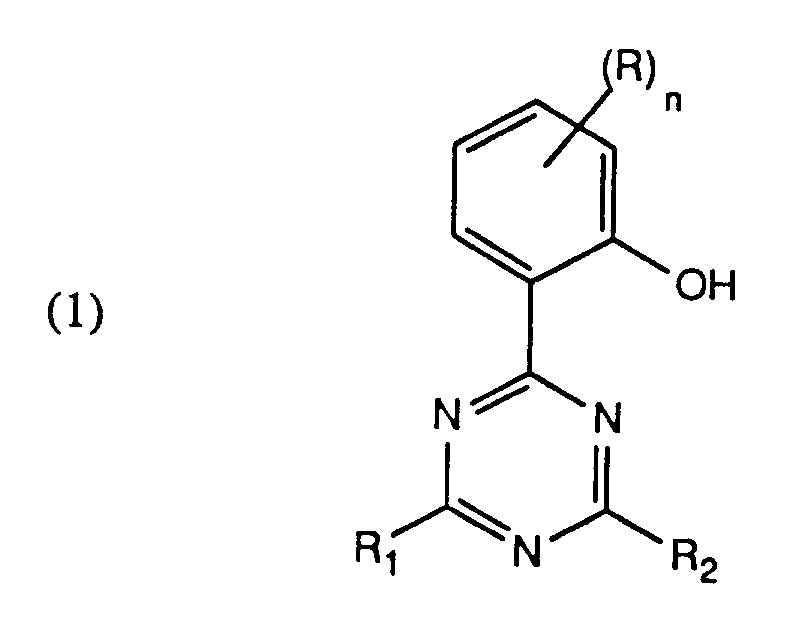
- R nieder Alkyl, nieder Alkoxy, Halogen oder Hydroxy,
- R1 und R2 unabhängig voneinander Ci-C,8-Alkyl, durch Hydroxy, nieder Alkoxy, nieder Alkylthio, Amino oder Mono- oder Di-alkylamino substituiertes Ci-C,8-Alkyl, Phenyl oder durch Chlor, Hydroxy, nieder Alkyl und/oder nieder Alkoxy substituiertes Phenyl und
- n 0, 1 oder 2 bedeuten,
- (b) 0 bis 18 Gewichtsprozent einer anionischen Verbindung und
- (c) 0 bis 18 Gewichtsprozent einer nichtionischen Verbindung enthält, mit der Massgabe, dass von den Komponenten (b) und (c) mindestens eine vorhanden sein muss, und mit der weiteren Maßgabe, daß, wenn Komponente (b) ein Kondensations produkt aus Naphthalinsulfonsäure und Formaldehyd ist, Komponente (c) ebenfalls vorhanden sein muß.
- Vorteilhafterweise enthält die erfindungsgemässe wässrige Dispersion 10 bis 45 Gewichtsprozent der Komponente (a) 0,5 bis 15 Gewichtsprozent der Komponente (b) und 0,5-15 Gew.proz. der Komponente (c). Komponente (a) hat zweckmässigerweise eine Partikelgrösse unter 5 um.
- Sowohl Komponente (a) als auch die Komponenten (b) und (c) können als Einzelverbindung oder in Form eines Gemisches vorhanden sein.
- Stellen die Substituenten R1 und R2 eine Alkylgruppe dar, so kann sie geradkettig oder verzweigt sein. Beispiele solcher Alkylreste sind Methyl, Ethyl, n-Propyl, Isopropyl, n-Butyl, Isobutyl, sek.Butyl, tert.Butyl, Amyl, Isoamyl, tert.Amyl, n-Hexyl, 2-Ethylhexyl, n-Heptyl, n-Octyl, Isooctyl, n-Nonyl, Isononyl, n-Dodecyl, Heptadecyl oder Octadecyl.
- R, R1 und R2 als nieder Alkyl, Alkoxy oder Alkylthio stellen einen Rest mit 1 bis 4 C-Atomen, wie Methyl, Ethyl, Propyl, Isopropyl, Butyl, Isobutyl, sek.-Butyl, tert.-Butyl, Methoxy, Ethoxy, Propoxy, Isopropoxy, Butoxy, Isobutoxy, sek.-Butoxy, tert.-Butoxy, Methylthio, Ethylthio, Propylthio, Isopropylthio, Butylthio, Isobutylthio, sek.-Butylthio oder tert.-Butylthio dar.
- Halogen bedeutet beispielsweise Fluor, Brom oder vorzugsweise Chlor.
- Praktisch wichtige Komponenten (a) entsprechen der Formel

- R die oben angegebene Bedeutung hat und
- R3 und R4 unabhängig voneinander Alkyl mit 1 bis 4 C-Atomen, Phenyl oder durch nieder Alkyl und/oder nieder Alkoxy substituiertes Phenyl bedeuten, und bevorzugt der Formel

- R5 nieder Alkyl oder nieder Alkoxy und
- R6 und R7 unabhängig voneinander Alkyl mit 1 bis 4 C-Atomen oder Phenyl bedeuten.
- Besonders bevorzugt sind Verbindungen der Formel (1), worin R nieder Alkoxy und R1 und R2 je Phenyl bedeuten.
- Die auch als UV-Absorber bekannten Verbindungen der Formeln (1), (2) und (3), sind bekannt oder können in an sich bekannter Weise hergestellt werden, so z.B. durch Erhitzen eines Amidins und eines o-Hydroxybenzolcarbonsäureesters, vorzugsweise im ungefähren molaren Mengenverhältnis von 2:1 in siedenden, organischen Lösungsmitteln [cf. US-A-3,896,125 und Helv. Chim. Acta55, 1566-1595 (1972)].
- Geeignete Verbindungen der Formeln (1), (2) und (3) sind z.B.
- 2-(2'-Hydroxy-5'-methylphenyl)-4,6-dimethyl-s-triazin; F. 131 °C:
- 2-(2'-Hydroxy-3',5'-dimethylphenyl)-4,6-dimethyl-s-triazin: F. 177 ° C:
- 2-(2'-Hydroxy-4',5'-dimethylphenyl)-4,6-dimethyl-s-triazin: X 349 um: T 48 %:
- 2-(2'-Hydroxy-4',5'-dimethylphenyl)-4,6-diethyl-s-triazin: F. 98 °C:
- 2-(2'-Hydroxy-5'-chlorphenyl)-4,6-dimethyl-s-triazin: F. 160°C:
- 2-(2'-Hydroxyphenyl)-4,6-dimethyl-s-triazin: F. 133°C:
- 2-(2'-Hydroxy-5'-tert.-butylphenyl)-4,6-dimethyl-s-triazin: λ 352 um: T 60 %:
- 2-(2'-Hydroxyphenyl)-4,6-didecyl-s-triazin: F. 53 °C: 2-(2'-Hydroxyphenyl)-4,6-dinonyl-s-triazin: F. 45 °C:
- 2-(2'-Hydroxyphenyl)-4,6-diheptadecyl-s-triazin: λ 338 um: T 80 %:
- 2-(2'-Hydroxyphenyl)-4,6-dipropyl-s-triazin: F. 18 bis 20 °C:
- 2-(2'-Hydroxyphenyl)-4,6-bis-(ß-methylmercaptoethyl)-s-triazin: λ 341 um: T 60 %:
- 2-(2'-Hydroxyphenyl)-4,6-bis-(ß-dimethylaminoethyl)-s-triazin: X 340 um: T 63 %:
- 2-(2'-Hydroxyphenyl)-4,6-bis-(ß-butylaminoethyl)-s-triazin: X 341 um: T 66 %:
- 2-(2'-Hydroxyphenyl)-4,6-di-tert.-butyl-s-triazin: X 338 um: T 68 %:
- 2-(2'-Hydroxyphenyl)-4,6-dioctyl-s-triazin: F. 40 °C:
- 2-(2'-Hydroxy-4'-methoxyphenyl)-4,6-diphenyl-s-triazin: F. 204-205 ° C
- 2-(2'-Hydroxy-4'-ethoxyphenyl)-4,6-diphenyl-s-triazin: F. 201-202 °C und
- 2-(2'-Hydroxy-4'-isopropyl)-4,6-diphenyl-s-triazin: F. 181-182°C.
- (T = prozentuale Transmission einer Lösung von 1 mg Substanz in 100 ml Chloroform bei 1 cm Schichtdicke)
- Als Komponente (b) kommen Verbindungen in Betracht, die aus der Gruppe der
- (ba) sauren Ester oder deren Salze von Alkylenoxidaddukten der Formel
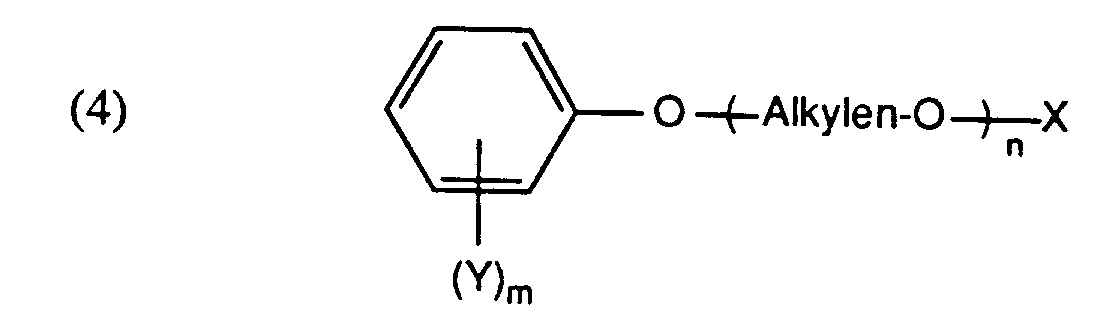
- Y C1-C12-Alkyl, Aryl oder Aralkyl bedeuten,
- "Alkylen" für den Ethylenrest oder Propylenrest steht, und
- m 1 bis 4 und n 4 bis 50 sind,
- (bb) Polystyrolsulfonate,
- (bc) Fettsäuretauride,
- (bd) alkylierten Diphenyloxid-mono- oder di-sulfonate,
- (be) Sulfonate von Polycarbonsäureestern, (bf) mit einer organischen Dicarbonsäure, oder einer anorganischen mehrbasischen Säure in einen sauren Ester übergeführte Anlagerungsprodukte von 1 bis 60, vorzugsweise 2 bis 30 Mol, Ethylenoxid und/oder Propylenoxid an Fettamine, Fettamide, Fettsäuren oder Fettalkohole je mit 8 bis 22 Kohlenstoffatomen oder an drei- bis sechswertige Alkanole mit 3 bis 6 Kohlenstoffatomen,
- (bg) Ligninsulfonate und
- (bh) Formaldehyd-Kondensationsprodukte ausgewählt sind.
- Der Säurerest X in Formel (4) leitet sich beispielsweise von niedermolekularen Dicarbonsäuren ab, wie z.B. von Maleinsäure, Bernsteinsäure oder Sulfobernsteinsäure, und ist über eine Esterbrücke mit dem Alkylenoxydteil des Moleküls verbunden. Insbesondere leitet sich X jedoch von anorganischen mehrbasischen Säuren, wie Schwefelsäure oder insbesondere Orthophosphorsäure ab.
- Der Säurerest X kann als freie Säure oder in Salzform, d.h. z.B. als Alkalimetall-, Erdalkali-, Ammonium- , Amin- oder Fettaminsalz, vorliegen. Beispiele für solche Salze sind Lithium-, Natrium-, Kalium-, Barium-, Magnesium-, Ammonium-, Trimethylamin-, Diethylamin-, Ethanolamin-, Diethanolamin- oder Triethanolaminsalze. Bevorzugt sind Alkalimetallsalze oder vor allem Triethanolaminsalze. Die Mono- bzw. Diethanolaminsalze sowie Amine und Fettamine können noch weiter mit 1 bis 25 Oxalkylen-Einheiten verethert sein.
- Stellt der Substituent Y in Formel (4) eine Alkylgruppe dar, so kann sie geradkettig oder verzweigt sein. Beispiele solcher Alkylreste sind Methyl, Ethyl, n-Propyl, Isopropyl, n-Butyl, Isobutyl, sek.Butyl, tert.Butyl, Amyl, Isoamyl, tert.Amyl, n-Hexyl, 2-Ethylhexyl, n-Heptyl, n-Octyl, Isooctyl, n-Nonyl, Isononyl oder n-Dodecyl.
- Y in der Bedeutung von Aralkyl weist vorteilhafterweise insgesamt 7 bis 9 Kohlenstoffatome auf und steht in der Regel für Benzyl, a-Methylbenzyl, a,a-Dimethylbenzyl, ß-Phenethyl, a-Tolylethyl oder Phenisopropyl.
- Der Substituent Y in Formel (4) ist vorteilhafterweise C4-C12-Alkyl, Benzyl, vorzugsweise C4-C10-Alkyl oder besonders a-Methylbenzyl.
- Der Substituent Y kann auch verschiedene der angegebenen Bedeutungen annehmen.
- n ist bevorzugt 6 bis 30, während m vorzugsweise 1 bis 3 ist.

- Bevorzugte saure Ester als Komponente (ba) entsprechen der Formel

- Diese sauren Ester liegen vorzugsweise als Natrium-, Kalium-, Ammonium-, Diethylamin-, Triethylamin-, Diethanolamin- oder Triethanolaminsalze vor.
- Die als Komponente (ba) in Frage kommenden sauren Ester der Formel (4) oder (5) werden hergestellt, indem man Alkylenoxid (Ethylenoxid oder Propylenoxid) an eine definitionsgemäss substituierte Phenolverbindung anlagert und das Anlagerungsprodukt mit einer mehrbasischen Sauerstoffsäure oder einem funktionellen Derivat dieser Säure, wie z.B. Säureanhydride, Säurehalogenide, Säureester oder Säureamide in die sauren Ester und gegebenenfalls den erhaltenen sauren Ester in die obengenannten Salze überführt. Als Beispiele dieser funktionellen Derivate seien Phosphorpentoxid, Phosphoroxytrichlorid, Chlorsulfonsäure oder Sulfaminsäure genannt. Sowohl die Alkylenoxidanlagerung als auch die Veresterung können nach bekannten Methoden durchgeführt werden.
- Gut geeignete Komponenten (ba) sind saure Ester oder deren Salze eines Polyadduktes von 4 bis 40 Mol Ethylenoxid an 1 Mol eines Phenols, das mindestens eine C4-C12-Alkylgruppe, eine Phenylgruppe, eine Tolylgruppe, eine a-Tolylethylgruppe, eine Benzylgruppe, eine a-Methylbenzylgruppe oder eine a,a-Dime- thylbenzylgruppe aufweist, wie z.B. Butylphenol, Tributylphenol, Octylphenol, Nonylphenol, Dinonylphenol, o-Phenylphenol, Benzylphenol, Dibenzylphenol, a-Tolylethylphenol, Dibenzyl-(nonyl)-phenol, a-Methylbenzylphenol, Bis-(a-Methylbenzyl)-phenol oder Tris-(a-methylbenzyl)-phenol, wobei diese sauren Ester einzeln oder in Mischung verwendet werden können.
- Von besonderem Interesse sind saure Phosphorsäureester der Addukte von 6 bis 30 Mol Ethylenoxid an 1 Mol 4-Nonylphenol 1 Mol Dinonylphenol oder besonders an 1 Mol von Verbindungen, die durch Anlagerung von 1 bis 3 Mol von Styrolen an 1 Mol Phenole hergestellt werden, wobei die Phosphorsäureester zweckmässigerweise als Gemische der entsprechenden Salze eines Mono- oder Diesters vorhanden sind.
- Die Herstellung der Styrolanlagerungsprodukte erfolgt in bekannter Weise vorzugsweise in Gegenwart von Katalysatoren, wie Schwefelsäure, p-Toluolsulfonsäure oder vor allem Zinkchlorid. Als Styrole kommen zweckmässigerweise Styrol, a-Methylstyrol oder Vinyltoluol (4-Methylstyrol) in Betracht. Beispiele für die Phenole sind Phenol, Kresole oder Xylenole.
- Ganz besonders bevorzugt als Komponente (ba) sind saure Phosphorsäureester (Mono- und Diester) oder deren Salze von Oxalkylierungsprodukten der Formel

- Als Beispiele für Oxalkylierungsprodukte der Formeln (5) und (6) seien im einzelnen genannt:
- - Oxalkylierungsprodukt mit 18 Ethylenoxideinheiten des Anlagerungsproduktes von 2 Mol Styrol an 1 Mol Phenol
- - Oxalkylierungsprodukt mit 18 Ethylenoxideinheiten des Anlagerungsproduktes von 3 Mol Styrol an 1 Mol Phenol
- - Oxalkylierungsprodukt mit 27 Ethylenoxideinheiten des Anlagerungsproduktes von 2 Mol 4-Methylstyrol an 1 Mol Phenol
- - Oxalkylierungsprodukt mit 17 Ethylenoxideinheiten des Anlagerungsproduktes von 3 Mol 4-Methylstyrol an 1 Mol Phenol
- - Oxalkylierungsprodukt mit 18 Ethylenoxideinheiten des Gemisches aus einem Anlagerungsprodukt von 2 Mol Styrol an 1 Mol Phenol und einem Anlagerungsprodukt von 3 Mol Styrol an 1 Mol Phenol
- - Oxalkylierungsprodukt mit 13 Ethylenoxideinheiten des Gemisches aus einem Anlagerungsprodukt von 2 Mol Styrol an 1 Mol Phenol und einem Anlagerungsprodukt von 3 Mol Styrol an 1 Mol Phenol. Als Beispiele für die unter (bc) bis (bh) erwähnten anionischen Verbindungen seien genannt:
- - als Komponente (bc) z.B. Verbindungen der Formel (7) R-CO-NH-CH2-CH2-SOa H worin R C11-C17-Alkyl ist (vgl. z.B. US-A-4 219 480)
- - als Komponente (bd) z.B. Verbindungen der Formel (8)

- - als Komponente (be) z.B. Dihexylsulfosuccinate, Di-2-ethylhexylsulfosuccinate, Dioctylsulfosuccinate, Sulfosuccinamide oder Verbindungen der Formel

- - als Komponente (bf) mit z.B. Maleinsäure, Malonsäure, Sulfobernsteinsäure und vorzugsweise o-Phosphorsäure oder insbesondere Schwefelsäure in einen sauren Ester überführten Anlagerungsprodukte von 2 bis 30 Mol Ethylenoxid an Fettamine, Fettamide, Fettsäuren oder Fettalkohole oder 3-6- wertige Alkanole;
- - als Komponente (bh) z.B. Kondensationsprodukte von Ligninsulfonaten und/oder Phenol und Formaldehyd, Kondensationsprodukte von Formaldehyd mit aromatischen Sulfonsäuren, wie Kondensationsprodukte von Ditolylethersulfonaten und Formaldehyd, Kondensationsprodukte von Naphthalinsulfonsäure und/oder Naphthol- oder Naphthylaminsulfonsäuren mit Formaldehyd, Kondensationsprodukte von Phenolsulfonsäuren und/oder sulfoniertem Dihydroxydiphenylsulfon und Phenolen bzw. Kresolen mit Formaldehyd und/oder Harnstoff sowie Kondensationsprodukte von Diphenyloxid-disulfonsäure-Derivaten mit Formaldehyd in Betracht.
- Als Komponente (bh) sind besonders bevorzugt
- - Kondensationsprodukte von Ditolylethersulfonaten und Formaldehyd wie sie z.B. in US-A-4386037 beschrieben sind,
- - Kondensationsprodukte von Phenol und Formaldehyd mit Ligninsulfonaten, wie sie z.B. in US-A-3931072 beschrieben sind,
- - Kondensationsprodukte von Naphthol-(2)-sulfonsäure-6, Kresol, Natriumbisulfit und Formaldehyd [vgl. FIAT-Report 1013 (1946)], und
- - Kondensationsprodukte aus Diphenylderivaten und Formaldehyd wie sie z.B. in US-A-4202838 beschrieben sind.
- Der Säurerest der anionischen Verbindungen liegt in der Regel in Salzform, d.h. als Alkalimetall-, Ammonium- oder Aminsalz vor. Beispiele für solche Salze sind Lithium-, Natrium-, Kalium-, Ammonium-, Trimethylamin-, Aethanolamin-, Diethanolamin- oder Triethanolaminsalze.
- Als Komponente (c) sind die Verbindungen zu nennen, welche aus der Gruppe der
- (ca) Alkylenoxidaddukte der Formel

- (cb) Alkylenoxiaddukte an
- (cba) gesättigte oder ungesättigte 1-6-wertige aliphatische Alkohole,
- (cbb) Fettsäuren,
- (cbc) Fettamine,
- (cbd) Fettamide,
- (cbe) Diamine,
- (cbf) Sorbitanester,
- (cc) Alkylenoxid-Kondensationsprodukte (Blockpolymerisate)
- (cd) Polymerisate von Vinylpyrrolidon, Vinylacetat oder Vinylalkohol und
- (ce) Co- oder Ter-polymere von Vinylpyrrolidon mit Vinylacetat und/oder Vinylalkohol, ausgewählt sind.
- Bevorzugte erfindungsgemässe Dispersionen enthalten die Komponenten (b) und (c) in einem Verhältnis (b):(c) von 20:1 bis 1:20, vorzugsweise 5:1 bis 1:5.
- Gut geeignete Komponenten (ca) sind Polyaddukte von 4 bis 40 Mol Ethylenoxid an 1 Mol eines Phenols, das mindestens eine C4-C12-Alkylgruppe, eine Phenylgruppe, eine Tolylgruppe, eine a-Tolylethylgruppe, eine Benzylgruppe, eine a-Methylbenzylgruppe oder eine a,a-Dimethylbenzylgruppe aufweist, wie z.B. Butylphenol, Tributylphenol, Octylphenol, Nonylphenol, Dinonylphenol, o-Phenylphenol, Benzylphenol, Dibenzylphenol, a-Tolylethylphenol, Dibenzyl-(nonyl)-phenol, a-Methylbenzylphenol, Bis-(a-Methylbenzyl)-phenol oder Tris-(a-methylbenzyl)-phenol, wobei diese Addukte einzeln oder in Mischung verwendet werden können.
- Von besonderem Interesse als Komponente (ca) sind Addukte von 6 bis 30 Mol Ethylenoxid an 1 Mol 4-Nonylphenol, an 1 Mol Dinonylphenol oder besonders an 1 Mol von Verbindungen, die durch Anlagerung von 1 bis 3 Mol von Styrolen an 1 Mol Phenole hergestellt werden.
- Die Herstellung der Styrolanlagerungsprodukte erfolgt in bekannter Weise vorzugsweise in Gegenwart von Katalysatoren, wie Schwefelsäure, p-Toluolsulfonsäure oder vor allem Zinkchlorid. Als Styrole kommen zweckmässigerweise Styrol, a-Methylstyrol oder Vinyltoluol (4-Methylstyrol) in Betracht. Beispiele für die Phenole sind Phenol, Kresole oder Xylenole.
- Ganz besonders bevorzugt sind Ethylenoxidaddukte der Formel (11)

- Beispiele für solche Addukte sind weiter oben angegeben. Ebenfalls bevorzugt sind Ethylenoxidaddukte der Formel

- Die nichtionogene Komponente (cb) ist vorteilhafterweise
- - ein Alkylenoxidanlagerungsprodukt von 1 bis 100 Mol Alkylenoxid, z.B. Ethylenoxid und/oder Propylenoxid, an 1 Mol eines aliphatischen Monoalkohols mit mindestens 4 Kohlenstoffatomen, eines 3- bis 6-wertigen aliphatischen Alkohols oder eines gegebenenfalls durch Alkyl, Phenyl, a-Tolylethyl, Benzyl, a-Methylbenzyl oder a,a-Dimethylbenzyl substituierten Phenols (cba);
- - ein Alkylenoxidanlagerungsprodukt von 1 bis 100, vorzugsweise 2 bis 80 Mol Ethylenoxid wobei einzelne Ethylenoxideinheiten durch substituierte Epoxide, wie Styroloxid und/oder Propylenoxid, ersetzt sein können, an höhere unbesättigte oder gesättigte Monoalkohole (cba), Fettsäuren (cbb), Fettamine (cbc) oder Fettamide (cbd) mit 8 bis 22 Kohlenstoffatomen;
- - ein Alkylenoxidanlagerungsprodukt, vorzugsweise ein Ethylenoxid-Propylenoxid-Addukt an Ethylendiamin (cbe);
- - ein ethoxyliertes Sorbitanester mit langkettigen Estergruppen, wie z.B. Polyoxiethylen-Sorbitanmonolaurat mit 4 bis 20 Ethylenoxideinheiten oder Polyoxiethylen-Sorbitantrioleat mit 4 bis 20 Ethylenoxideinheiten (cbf).
- Bevorzugte Komponenten (cc) sind Ethylenoxidaddukte an Polypropylenoxid (sogenannte EO-PO-Blockpolymere) und Propylenoxidaddukte an Polyethylenoxid (sogenannte umgekehrte EO-PO-Blockpolymere).
- Besonders bevorzugt sind Ethylenoxid-Propylenoxid-Blockpolymere mit Molekulargewichten der Polypropylenoxidbasis von 1700 bis 4000 und einem Ethylenoxidgehalt im Gesamtmolekül von 30-80 %, insbesondere 60-80 %.
- Ausser den Komponenten (a) (b) und (c) kann die erfindungsgemässe Dispersion zweckmässig zusätzlich als Komponente (d) ein Stabilisierungs- oder Verdickungsmittel enthalten.
- Als Komponente (d) eignen sich insbesondere Carboxylgruppen enthaltende Polymerisate. Diese werden in Form von 0,5 bis 10 %igen, vorzugsweise 0,5 bis 5 %igen wässrigen Lösungen oder Dispersionen, bezogen auf die Lösung oder Dispersion eingesetzt.
- Diese Polymerisate stellen vorteilhafterweise polymerisierte ethylenisch ungesättigte Mono- oder Dicarbonsäuren von 3 bis 5 Kohlenstoffatomen, wie z.B. Polyacrylsäure oder Polymerisate von Methacrylsäure, Crotonsäure, Itaconsäure, Teraconsäure, Maleinsäure bzw. deren Anhydrid, Fumarsäure, Citraconsäure oder Mesaconsäure, Copolymerisate aus Olefinen, z.B. Ethylen oder Propylen, Diketene, Acrylsäureestern, Methacrylsäureestern oder Acrylamiden und den vorgenannten Monomeren einschliesslich der Acrylsäure oder Copolymerisate der Acrylsäure mit Methacrylsäure, Methacrylnitril oder Vinylmonomeren, wie z.B. Vinylphosphonsäure, Copolymerisate aus Maleinsäure und Styrol, Maleinsäure und einem Vinylether oder Maleinsäure und einem Vinylester z.B. Vinylacetat oder Copolymere von Vinylpyrrolidon mit Vinylacetat oder Vinylpropionsäure dar.
- Die Verdickungsmittel bildenden carboxylgruppenhaltigen Polymerisate können ein Molekulargewicht von 0,5 bis 6 Millionen haben.
- Als besonders brauchbare Komponenten (d) haben sich Lösungen von Polyacrylsäure oder auch Copolymerisate aus Acrylsäure und Acrylamid gezeigt, wobei das entsprechende Molekulargewicht von 0,5 bis 6 Millionen schwanken kann. Die Copolymerisate weisen vorteilhafterweise ein Molverhältnis Acrylsäure:Acrylamid von 1:0,8 bis 1:1,2 auf. Als Komponente (d) kann ebenfalls ein teilweise hydrolysiertes Polymaleinsäureanhydrid verwendet werden. Dieses liegt in der Regel teilweise in Form eines wasserlöslichen Salzes vor und besitzt ein Molgewicht, das vorzugsweise zwischen 300 und 5000 liegt.
- Weitere als Komponente (d) brauchbare Verdickungsmittel sind Polysaccharide, wie z.B. Carboxymethylcellulose, Methylcellulose, Methyl- oder Ethylhydroxyethylcellulose, Johannisbrotkernmehlether oder Stärkeether sowie Alginate, Polyethylenglykole, Polyvinylpyrrolidone, Polyvinylalkohole oder auch feinverteilte Kieselsäure vorzugsweise mit spezifischer Oberfläche von 50 bis 380 m2/g und Schichtsilikate, wie z.B. Bentonite, Bentone, Smektite, Montmorillonite. Gut geeignet sind auch anionische Heteropolysaccharide, die aus den Monosacchariden Glukose und Mannose und Glucuronsäure gebildet sind.
- Die Mengen dieser Zusatzbestandteile (d) liegen im allgemeinen von 0,05 bis 8 Gewichtsprozent, vorzugsweise 0,1 bis 4 Gewichtsprozent, bezogen auf die gesamte wässrige Dispersion vor.
- Neben den Komponenten (a), (b) und (c) oder (a), (b), (c) und (d) kann die erfindungsgemässe wässrige Dispersion noch zusätzlich Antischaummittel, Konservierungsmittel oder Gefrierschutzmittel enthalten.
- Die anionischen und nichtionischen Verbindungen können allein oder untereinander kombiniert zur Anwendung kommen.
- Als Antischaummittel können die erfindungsgemässen Dispersionen Silikonöle sowie auch Entschäumer auf der Basis von Tributylphosphat, 2-Ethylhexanol oder Tetramethyl-5-decin-diolen (= Surfynol) enthalten.
- Bevorzugte Antischaummittel sind Alkylendiamide. Diese entsprechen zweckmässigerweise der Formel

- Das Alkylendiamid kann als Einzelverbindung oder in Form eines Gemisches vorhanden sein.
- Die aliphatischen Reste V1 und V2 können geradkettig oder verzweigt sein. Sie stellen zusammen mit der CO-Gruppe vorteilhafterweise den Säurerest einer ungesättigten oder vorzugsweise gesättigten aliphatischen Carbonsäure mit 10 bis 24 Kohlenstoffatomen dar. Als aliphatische Carbonsäuren seien beispielsweise Caprin-, Laurin-, Kokosfett-, Myristin-, Palmkernfettsäure, Palmitin-, Talgfett-, Oel-, Ricinolein-, Linol-, Linolen-, Stearin-, Arachin-, Arachidon-, Behen-, Eruca- oder Lignocerinsäure genannt. Behensäure und besonders Stearinsäure sind bevorzugt.
- Es können auch Gemische dieser Säuren verwendet werden, wie sie bei der Spaltung von natürlichen Oelen oder Fetten gewonnen werden. Kokosfettsäure, Palmkernfettsäure, Palmitin-/Stearinsäuregemische, Talgfettsäure und Arachin-/Behensäuregemische sind besonders bevorzugte Gemische.
- Vorzugsweise bedeuten V1 und V2 jeweils einen Alkylrest mit 9 bis 23 Kohlenstoffatomen und insbesondere mit 15 bis 21 Kohlenstoffatomen.
- Q stellt insbesondere eine Alkylengruppe dar, die 2 bis 5 Kohlenstoffatome enthält und geradkettig oder verzweigt sein kann. Es handelt sich beispielsweise um die -CH2CH2-, -CH2CH2CH2-,

- Typische Vertreter für Alkylendiamide als Antischaummittel sind Methylen-bis-stearinsäureamid, Ethylen-bis-stearinsäureamid oder Ethylen-bis-behensäureamid.
- Das Alkylendiamid ist vorzugsweise in einer Menge von 0,2 bis 3 Gewichtsprozent in der Dispersion vorhanden.
- Als Konservierungsmittel, die in den erfindungsgemässen Dispersionen enthalten sein können, können die verschiedensten handelsüblichen Produkte, wie wässrige Lösungen von Formaldehyd, 6-Acetoxy-2,4-dimethyldioxan, 1,2-Benzisothiazolin-3-on und besonders 2-Chloracetamid in Betracht kommen.
- Als Gefrierschutzmittel, die den erfindungsgemässen Dispersionen zur Erhaltung der Fliessfähigkeit bei tiefen Temperaturen und zur Verhinderung des Ausfrierens von Wasser zugesetzt werden können, seien Glykole oder Polyole, wie z.B. Ethylenglykol, Propylenglykol bzw. Glyzerin sowie Polyethylenglykole, wie z.B. Di-, Tri- oder Tetraethylenglykol genannt. Ein bevorzugtes Antifrostmittel ist Propylenglykol.
- Die Komponente (a) kann auch als Mischung der s-Triazinverbindungen der Formel (1) mit anderen UV-Absorbern aus den Klassen der schwerlöslichen Benzotriazole und Benzophenone eingesetzt werden. Solche UV-Absorber sind z.B. in den US-A-3,004,896, 3,074,910, 4,127,586 und 4,557,730 beschrieben. Als Benzotriazole kommen z.B. solche der Formel (14)

- R1 Wasserstoff, C1-C12-Alkyl, Chlor, Cs-C6-Cycloalkyl oder C7-C9 -Phenylalkyl,
- R2 Wasserstoff, C1-C4-Alkyl, C1-C4-Alkoxy, Chlor oder Hydroxy,
- R3 C1-C12-Alkyl, C1-C4-Alkoxy, Phenyl, (C1-C8-Alkyl)-phenyl, C5-C6-Cycloalkyl, C2-Cs-Alkoxycarbonyl, Chlor, Carboxyethyl oder C7-C9-Phenylalkyl,
- R4 Wasserstoff, Chlor, C1-C4-Alkyl, C1-C4-Alkoxy oder C2-C9-Alkoxycarbonyl, und
- R5 Wasserstoff oder Chlor bedeuten, und als Benzophenone solche der Formel (15)

- R6 Wasserstoff, Hydroxy, C1-C14-Alkoxy oder Phenoxy,
- R7 Wasserstoff, Halogen oder C1-C4-Alkyl
- R8 Wasserstoff, Hydroxy oder C1-C4-Alkoxy und
- R9 Wasserstoff oder Hydroxy bedeuten, in Betracht.
- Solche Gemische als Komponente (a) enthalten die Verbindungen der Formeln (1), (14) und (15) in den Gewichtsverhältnissen (1):(14) und (1):(15) von 99:1 bis 1:99, als Komponente (a) kommen auch Mischungen der Verbindungen der Formeln (1), (14) und (15) in Betracht.
- In den Formeln (14) und (15) bedeuten:
- C,-C4-Alkyl z.B. Methyl, Ethyl, Propyl, Isopropyl, n-Butyl, sec.-Butyl oder tert.-Butyl;
- C1-C4-Alkoxy z.B. Methoxy, Ethoxy, Propoxy oder n-Butoxy;
- C1-C14-Alkoxy z.B. Methoxy, Ethoxy, Propoxy, n-Butoxy, Octyloxy, Dodecyloxy oder Tetradecyloxy;
- C1-C12-Alkyl z.B. Ethyl, Amyl, tert.-Octyl, n-Dodecyl und vorzugsweise Methyl, sec.-Butyl oder tert.-Butyl;
- C2-Cs-Alkoxycarbonyl z.B. Ethoxycarbonyl, n-Octoxycarbonyl oder vorzugsweise Methoxycarbonyl;
- C5-C6-Cycloalkyl z.B. Cyclopentyl oder Cyclohexyl;
- (C1-C8-Alkyl)-phenyl z.B. Methylphenyl, tert.-Butylphenyl, tert.-Amylphenyl oder tert.-Octylphenyl und
- C7-C9-Phenylalkyl z.B. Benzyl, a-Methylbenzyl oder vorzugsweise a,a-Dimethylbenzyl,
- Die erfindungsgemässen wässrigen Dispersionen enthalten mit Vorteil, jeweils bezogen auf die gesamte Dispersion
- 5-50 Gewichtsprozent der Komponente (a),
- 0-18 vorzugsweise 0,5-15 Gewichtsprozent der Komponente (b),
- 0-18 vorzugsweise 0,5-15 Gewichtsprozent der Komponente (c),
- 0 - 5 vorzugsweise 0,1 bis 4 Gewichtsprozent der Komponente (d),
- 0 - 8 Gewichtsprozent der weiteren, von der Komponente (b) verschiedenen anionischen Komponente,
- 0 - 8 Gewichtsprozent der weiteren, von Komponente (c) verschiedenen nichtionischen Komponente,
- 0 - 7 vorzugsweise 0,1 bis 5 Gewichtsprozent Antischaummittel,
- 0 - 1 vorzugsweise 0,1 bis 0,5 Gewichtsprozent Konservierungsmittel und
- 0-20 Gewichtsprozent Gefrierschutzmittel.
- Bevorzugte erfindungsgemässe Dispersionen enthalten
- - als anionische Komponente (b) ein Kondensationsprodukt von Formaldehyd mit einer aromatischen Sulfonsäure;
- - ein Kondensationsprodukt von Formaldehyd mit Ditolylethersulfonat;
- - ein Gemisch aus den Komponenten (ba) bis (bh);
- - ein Gemisch aus einem Kondensationsprodukt von Formaldehyd mit Ditolylethersulfonat und einem sauren Phosphorsäureester oder dessen Salz des Oxalkylierungsproduktes der Formel (6) oder
- - ein Kondensationsprodukt von Formaldehyd mit einer aromatischen Sulfonsäure und als nichtionische Komponente (c) ein Alkylenoxidaddukt der Formel (10);
- - als nichtionische Komponente (c) eine Mischung aus einem Alkylenoxidaddukt der Formel (10) und einem Alkylenoxid-Kondensationsprodukt (cc) oder
- - ein Alkylenoxid-Kondensationsprodukt (cc) oder
- - als anionische Komponente (b) ein Kondensationsprodukt von Formaldehyd mit einer aromatischen Sulfonsäure und als nichtionische Komponente (c) ein Alkylenoxid-Addukt an Sorbitansäure oder
- - als anionische Komponente (b) einen sauren Phosphorsäureester oder dessen Salz des Oxalkylierungsproduktes der Formel (6) und als nichtionogene Komponente (c) ein Alkylenoxidaddukt der Formel (10).
- Die Herstellung der erfindungsgemässen Dispersion erfolgt zweckmässigerweise, indem man die s-Triazinverbindungen der Formel (1), mit einem Dispergiermittel z.B. dem sauren Ester der Formel (4) und Wasser in einem Mischer anteigt und nach allfälliger Zugabe der erwünschten Zusatzbestandteile wie nichtionische Tenside (c), weiterer anionische und/oder nichtionischer Verbindungen einschliesslich der Antischaummittel, Konservierungsmittel und Gefrierschutzmittel 1 bis 30, vorzugsweise 1 bis 10 Stunden lang dispergiert. Die Dispergierung wird vorteilhafterweise durch Einwirkung von hohen Scherkräften z.B. durch Mahlen in einer Kugel-, Sand- oder Perlmühle durchgeführt. Nach dem Mahlen kann eine wässrige Lösung des Stabilisierungs- oder Verdickungsmittels (Komponente (d)) und gewünschtenfalls noch Wasser zugesetzt werden, worauf bis zur gleichmässigen Verteilung gerührt wird.
- Die erfindungsgemässen Dispersionen zeichnen sich durch gute Transport- und Lagerstabilität aus. Sie sind insbesondere sehr stabil bei höheren Temperaturen bis zu 130°C, wenn sie in Färbebädern eingesetzt werden.
- Verwendung findet die erfindungsgemässe Dispersion je nach dem Farbstoff beim Färben von Synthesefasern. Das Färbeverfahren wird jeweils in üblicher Weise durchgeführt. Die erfindungsgemässe Dispersion wird in ein wässriges Bad langsam unter Rühren eingetragen, wonach die Flotte nach dem Zusatz vom Farbstoff zum Färben bereitgestellt ist.
- Gegenstand der vorliegenden Erfindung ist demnach auch ein Verfahren zum Färben von synthetischem Fasermaterial mit kationischen oder Dispersionsfarbstoffen Das Verfahren ist dadurch gekennzeichnet, dass man dieses Material in Gegenwart der erfindungsgemässen Hilfsmitteldispersion färbt.
- Die Einsatzmengen, in denen die erfindungsgemässe Hilfsmitteldispersion den Färbebädern zugesetzt wird, bewegen sich von 0,5 bis 10 %, vorzugsweise 1 bis 5 % vom Warengewicht.
- Als Fasermaterial, insbesondere Textilmaterial, das in Gegenwart des neuen als Lichtschutzmittel verwendeten Hilfsmittelgemisches gefärbt werden kann, sind z.B. Celluloseesterfasern, wie Cellulose-2 1/2-acetatfasern und -triacetatfasern; aromatische Polyamidfasern, die sich z.B. von Poly-(metaphenylen- isophthalamid) ableiten, sauer modifizierte Polyesterfasern und besonders lineare Polyesterfasern zu erwähnen. Dabei werden Celluloseester- und Polyesterfasern bevorzugt mit Dispersionsfarbstoffen und sauer modifizierte Polyesterfasern und aromatische Polyamidfasern bevorzugt mit kationischen Farbstoffen gefärbt.
- Unter linearen Polyesterfasern sind dabei Synthesefasern zu verstehen, die z.B. durch Kondensation von Terephthalsäure mit Ethylenglykol oder von Isophthalsäure oder Terephthalsäure mit 1,4-Bis-(hydroxymethyl)-cyclohexan erhalten werden, sowie Mischpolymere aus Terephthal- und Isophthalsäure und Ethylenglykol. Der in der Textilindustrie bisher fast ausschliesslich eingesetzte lineare Polyester besteht aus Terephthalsäure und Ethylenglykol. Sauer modifizierte Polyesterfasern sind beispielsweise Polykondensationsprodukte von Terephthalsäure oder Isophthalsäure, Ethylenglykol und 1,2-Dihydroxy-3-beziehungsweise 1,3-Dihydroxy-2-(3-natriumsulfopropoxy)-propan, 2,3-Dimethylol-1-(natriumsulfopropoxy)-butan, 2,2-Bis-(3-natriumsulfopropoxyphenyl)-propan oder 3,5-Dicarboxy-benzolsulfonsäure bzw. sulfonierter Terephthalsäure, sulfonierter 4-Methoxybenzolcarbonsäure oder sulfonierter Diphenyl-4,4'-dicarbonsäure.
- Die Fasermaterialien können auch als Mischgewebe unter sich oder mit anderen Fasern, z.B. Mischungen aus Polyacrylnitril/Polyester, Polyamid/Polyester, Polyester/Baumwolle, Polyester/Viskose, Polyester/Wolle und Polyester/Polyacrylnitril/Polyamid verwendet werden.
- Das zu färbende Textilmaterial kann sich in verschiedenen Verarbeitungsstadien befinden. Beispielsweise kommen in Betracht: loses Material, Stückware, wie Gewirke oder Gewebe, Garn in Wickel- oder Muff-Form. Letztere können Wickeldichten von 200 bis 600 g/dm3, insbesondere 400 bis 450 g/dm3, aufweisen.
- Die für das erfindungsgemässe Verfahren geeigneten kationischen Farbstoffe können verschiedenen Farbstoffklassen angehören. Insbesondere handelt es sich um die gebräuchlichen Salze, beispielsweise Chloride, Sulfate oder Metallhalogenide, wie z.B. Zinkchloriddoppelsalze von kationischen Farbstoffen, deren kationischer Charakter z.B. von einer Carbonium-, Oxonium-, Sulfonium- oder vor allem Ammoniumgruppe herrührt. Beispiele für solche chromophore Systeme sind Azofarbstoffe, vor allem Monoazo- oder Hydrazonfarbstoffe, Diphenylmethan-, Triphenylmethan-, Methin- oder Azomethinfarbstoffe, Cumarin-, Ketonimin-, Cyanin-, Azin-, Xanthen-, Oxazin- oder Thiazinfarbstoffe. Schliesslich können auch Farbsalze der Phthalocyanin- oder Anthrachinonreihe mit externer Oniumgruppe, beispielsweise einer Alkylammonium-oder Cycloammoniumgruppe sowie Benzo-1,2-pyranfarbsalze, die Cycloammoniumgruppen enthalten, verwendet werden.
- Die zu verwendenden Dispersionsfarbstoffe, die in Wasser nur sehr wenig löslich sind und in der Farbflotte zum grössten Teil in Form einer feinen Dispersion vorliegen, können den verschiedensten Farbstoffklassen angehören, beispielsweise den Acridon-, Azo-, Anthrachinon-, Cumarin-, Methin-, Perinon-, Naphthochinonimin-, Chinophthalon, Styryl- oder Nitrofarbstoffen.
- Es können auch Mischungen von kationischen oder Dispersionsfarbstoffen erfindungsgemäss eingesetzt werden.
- Die Menge der der Flotte zuzusetzenden Farbstoffe richtet sich nach der gewünschten Farbstärke; im allgemeinen haben sich Mengen von 0,01 bis 10, vorzugsweise 0,02 bis 5 Gewichtsprozent, bezogen auf das eingesetzte Textilmaterial, bewährt.
- Die erfindungsgemäss zu verwendenden Hilfsmittel können auch in Mischung mit bekannten Diffusionsbeschleunigern auf Basis von z.B. Di- oder Trichlorbenzol, Methyl- oder Ethylbenzol, o-Phenylphenol, Benzylphenol, Diphenylether, Chlordiphenyl, Methyldiphenyl, Cyclohexanon, Acetophenon, Alkylphenoxyethanol, Mono-, Di- oder Trichlorphenoxyethanol oder -propanol, Pentachlorphenoxyethanol, Alkylphenylbenzoate, oder insbesondere auf Basis von Diphenyl, Methyldiphenylether, Dibenzylether, Methylbenzoat, Butylbenzoat oder Phenylbenzoat eingesetzt werden.
- Die Diffusionsbeschleuniger werden vorzugsweise in einer Menge von 0,5 g bis 5 g/I Flotte oder 5 bis 30 Gewichtsprozent, bezogen auf die Hilfsmitteldispersion, verwendet.
- Die Farbbäder können je nach dem zu behandelnden Textilmaterial neben den Farbstoffen und dem erfindungsgemässen Hilfsmittelgemisch, Oligomereninhibitoren, Antischaummittel, Faltenfreimittel, Retarder und vorzugsweise Dispergiermittel enthalten.
- Die Dispergiermittel dienen vor allem zur Erzielung einer guten Feinverteilung der Dispersionsfarbstoffe. Es kommen die beim Färben mit Dispersionsfarbstoffen allgemein gebräuchlichen Dispergatoren in Frage.
- Als Dispergiermittel kommen vorzugsweise sulfatierte oder phosphatierte Anlagerungsprodukte von 15 bis 100 Mol Ethylenoxid oder vorzugsweise Propylenoxid an mehrwertige, 2 bis 6 Kohlenstoffatome aufweisende aliphatische Alkohole wie z.B. Ethylenglykol, Glycerin oder Pentaerythrit oder an mindestens zwei Aminogruppen oder eine Aminogruppe und eine Hydroxylgruppe aufweisende Amine mit 2 bis 9 Kohlenstoffatomen sowie Alkylsulfonate mit 10 bis 20 Kohlenstoffatomen in der Alkylkette, Alkylbenzolsulfonate mit geradkettiger oder verzweigter Alkylkette mit 8 bis 20 Kohlenstoffatomen in der Alkylkette, wie z.B. Nonyl- oder Dodecylbenzolsulfonat, 1,3,5,7-Tetramethyloctylbenzolsulfonat oder Octadecylbenzolsulfonat, sowie Alkylnaphthalinsulfonate oder Sulfobernsteinsäureester, wie Natriumdioctylsulfosuccinat, in Betracht.
- Besonders günstig haben sich als anionische Dispergiermittel Ligninsulfonate, Polyphosphate und vorzugsweise Formaldehyd-Kondensationsprodukte aus aromatischen Sulfonsäuren, Formaldehyd und gegebenenfalls mono- oder bifunktionellen Phenolen wie z.B. aus Kresol, β-Naphtholsulfonsäure und Formaldehyd, aus Benzolsulfonsäure, Formaldehyd und Naphthalinsulfonsäure, aus Naphthalinsulfonsäure und Formaldehyd oder aus Naphthalinsulfonsäure, Dihydroxydiphenylsulfon und Formaldehyd erwiesen. Bevorzugt ist das Dinatriumsalz des Di- oder Tri-(6-sulfonaphthyl-2-)methans.
- Es können auch Gemische von anionischen Dispergiermitteln zum Einsatz kommen. Normalerweise liegen die anionischen Dispergiermittel in Form ihrer Alkalimetallsalze, Ammoniumsalze oder Aminsalze vor. Diese Dispergiermittel werden vorzugsweise in einer Menge von 0,5 bis 8 g/I Flotte verwendet.
- Die Färbebäder können auch übliche Zusätze, zweckmässig Elektrolyte wie Salze, z.B. Natriumsulfat, Ammoniumsulfat, Natrium- oder Ammoniumphosphate oder -polyphosphate, Metallchloride oder -nitrate wie Calciumchlorid, Magnesiumchlorid bzw. Calciumnitrate, Ammoniumacetat oder Natriumacetat und/oder Säuren, z.B. Mineralsäuren, wie Schwefelsäure oder Phosphorsäure, oder organische Säuren, zweckmässig niedere aliphatische Carbonsäuren, wie Ameisen-, Essig- oder Oxalsäure enthalten. Die Säuren dienen vor allem der Einstellung des pH-Wertes der erfindungsgemäss verwendeten Flotten, der in der Regel 4 bis 6,5, vorzugsweise 4,5 bis 6, beträgt.
- Die Färbungen erfolgen mit Vorteil aus wässriger Flotte nach dem Ausziehverfahren. Das Flottenverhältnis kann dementsprechend innerhalb eines weiten Bereiches gewählt werden, z.B. 1:3 bis 1:100, vorzugsweise 1:7 bis 1:50. Die Temperatur, bei der gefärbt bzw. aufgehellt wird, beträgt mindestens 70 °C und in der Regel ist sie nicht höher als 140°C. Vorzugsweise liegt sie im Bereich von 80 bis 135°C.
- Lineare Polyesterfasern und Cellulosetriacetatfasern färbt man vorzugsweise nach dem sogenannten Hochtemperaturverfahren in geschlossenen und zweckmässigerweise auch druckbeständigen Apparaturen bei Temperaturen von über 100 ° C, bevorzugt zwischen 110 und 135°C, und gegebenenfalls unter Druck. Als geschlossene Gefässe eignen sich beispielsweise Zirkulationsapparaturen wie Kreuzspul- oder Baumfärbeapparate, Haspelkufen, Düsen- oder Trommelfärbemaschinen, Muff-Färbeapparate, Paddeln oder Jigger.
- Cellulose-2 1/2-acetatfasern färbt man vorzugsweise bei Temperaturen von 80-85°C. Die Färbung der aromatischen Polyamidfasern oder sauer modifizierten Polyesterfasern wird vorzugsweise bei einer Temperatur von 80 bis 130°C vorgenommen.
- Das Färbeverfahren kann so durchgeführt werden, dass man das Färbegut entweder zuerst mit dem Hilfsmittelgemisch kurz behandelt und anschliessend färbt oder vorzugsweise gleichzeitig mit dem Hilfsmittelgemisch und dem Farbstoff behandelt.
- Vorzugsweise lässt man das Färbegut während 5 Minuten bei 60-80 °C im Bad, das den Farbstoff, das Hilfsmittelgmisch und gegebenenfalls weitere Zusätze enthält und auf einen pH-Wert von 4,5 bis 5,5 eingestellt ist, vorlaufen, steigert die Temperatur innerhalb von 15 bis 35 Minuten auf 110 bis 135°C, vorzugsweise 125-130 °C und belässt die Färbeflotte 15 bis 90 Minuten, vorzugsweise 30 bis 60 Minuten, bei dieser Temperatur.
- Die Fertigstellung der Färbungen erfolgt durch Abkühlen der Färbeflotte auf 60 bis 80 °C, Spülen der Färbungen mit Wasser und gegebenenfalls durch Reinigung auf übliche Weise im alkalischen Medium unter reduktiven Bedingungen. Die Färbungen werden dann wiederum gespült und getrocknet.
- Man erhält auf synthetischem Fasermaterial, insbesondere auf linearen Polyesterfasern, gleichmässige und farbkräftige Ausfärbungen, die sich zudem durch gute Lichtechtheit und Reibechtheiten auszeichnen. Während des Färbens bleibt die Färbeflotte stabil und entstehen keine Ablagerungen im Inneren der Färbeapparaturen.
- In den folgenden Beispielen sind die Teile Gewichtsteile und die Prozente Gewichtsprozente.
- In einer Sandmühle werden
- 35 Teile 2-(2'-Hydroxy-4'-propoxyphenyl)-4,6-diphenyl-s-triazin
- 14 Teile des mit Triethanolamin neutralisierten Umsetzungsproduktes von Phosphorpentoxid mit einem Oxalkylierungsproduktes mit 18 Ethylenoxideinheiten des Anlagerungsproduktes von 2,5 bis 3 Mol Styrol an 1 Mol Phenol und
- 51 Teile Wasser gemischt.
- Hierauf wird die Mischung mit Quarzsand solange gemahlen, bis die Partikelgrösse < 5 um ist, und anschliessend die Dispersion vom Quarzsand abgetrennt.
- 71,4 Teile der erhaltenen Dispersion werden unter Rühren mit 25 Teilen einer 1 %igen wässrigen Lösung eines Biopolymeren auf Polysaccharidbasis und 3,6 Teilen Wasser homogenisiert. Man erhält eine lagerstabile Dispersion.
- In einer Sandmühle werden 17,5 Teile 2-(2'-Hydroxy-4'-propoxyphenyl)-4,6-diphenyl-s-triazin,
- 17,5 Teile 2-(2'-Hydroxy-3'-tert.butyl-5'-methylphenyl-)5-chlorobenzotriazol
- 14 Teile des mit Triethanolamin neutralisierten Umsetzungsproduktes von Phosphorpentoxid mit einem Oxalkylierungsproduktes mit 18 Ethylenoxideinheiten des Anlagerungsproduktes von 2,5 bis 3 Mol Styrol an 1 Mol Phenol und
- 51 Teile Wasser gemischt.
- Alsdann wird die Mischung solange gemahlen, bis die Partikelgrösse < 5 um ist, und anschliessend die Dispersion vom Quarzsand abgetrennt.
- 71,4 Teile der erhaltenen Dispersion werden unter Rühren mit 25,0 Teilen einer 1 %igen wässrigen Lösung eines Biopolymeren auf Polysaccharidbasis und 3,6 Teilen Wasser homogenisiert. Man erhält eine lagerstabile Dispersion.
- In einer Sandmühle werden
- 17,5 Teile 2-(2'-Hydroxy-4'-propoxyphenyl)-4,6-diphenyl-s-triazin,
- 17,5 Teile 2-Hydroxy-4-octyloxy-benzophenon
- 14 Teile des mit Triethanolamin neutralisierten Umsetzungsproduktes von Phosphorpentoxid mit einem Oxalkylierungsproduktes mit 18 Ethylenoxideinheiten des Anlagerungsproduktes von 2,5 bis 3 Mol Styrol an 1 Mol Phenol und
- 51 Teile Wasser gemischt.
- Die Mischung wird solange gemahlen, bis die Partikelgrösse < 5 um ist und, anschliessend die Dispersion vom Quarzsand abgetrennt.
- 71,4 Teile der erhaltenen Dispersion werden unter Rühren mit 25 Teilen einer 1 %igen wässrigen Lösung eines Biopolymeren auf Polysaccharidbasis und 3,6 Teilen Wasser homogenisiert. Man erhält eine lagerstabile Dispersion.
- In einer Sandmühle werden
- 35,0 Teile 2-(2'-Hydroxy-4'-methoxyphenyl)-4,6-diphenyl-s-triazin,
- 10,0 Teile eines salzfreien Kondensationsproduktes aus Na-Ditolylethersulfonat und Formaldehyd,
- 1,0 Teil eines Anlagerungsproduktes von 9 Mol Ethylenoxid an 1 Mol Nonylphenol,
- 1,0 Teil eines Anlagerungsprodukts von Ethylenoxid an das Anlagerungsprodukt von Propylenoxid an Propylenglykol mit einem mittleren Molekulargewicht des Polypropylenoxidanteils von ca. 2050 und einem Anteil des Polyethylenoxids im Molekül von ca. 50 % (EO-PO-Blockpolymer) und
- 53,0 Teile Wasser gemischt.
- Die Mischung wird mit Quarzsand solange gemahlen, bis die Partikelgrösse kleiner als 5 um ist, und anschliessend die Dispersion vom Quarzsand abgetrennt.
- 71,4 Teile der erhaltenen Dispersion werden unter Rühren mit 25,0 Teilen einer 1 %-igen wässrigen Lösung eines Biopolymeren auf Polysaccharid-Basis und 3,6 Teilen Wasser homogenisiert.
- Man erhält eine lagerstabile Dispersion.
- In einer Sandmühle werden
- 35,0 Teile 2-(2'-Hydroxy-4'-methoxyphenyl)-4,6-diphenyl-s-triazin,
- 10,0 Teile des Natriumsalzes eines Kondensationsproduktes von Phenol, Ligninsulfonat und Formaldehyd,
- 1,0 Teil eines Anlagerungsproduktes von 9 Mol Ethylenoxid an 1 Mol Nonylphenol,
- 1,0 Teil eines Anlagerungsprodukts von Ethylenoxid an das Anlagerungsprodukt von Propylenoxid an Propylenglykol mit einem mittleren Molekulargewicht des Polypropylenoxidanteils von ca. 2050 und einem Anteil des Polyethylenoxids im Molekül von ca. 50 % (EO-PO-Blockpolymer) und
- 53,0 Teile Wasser gemischt.
- Die Mischung wird mit Quarzsand solange gemahlen, bis die Partikelgrösse kleiner als 5 um ist, und anschliessend die Dispersion vom Quarzsand abgetrennt.
- 71,4 Teile der erhaltenen Dispersion werden unter Rühren mit 25,0 Teilen einer 1 %-igen wässrigen Lösung eines Biopolymeren auf Polysaccharid-Basis und 3,6 Teilen Wasser homogenisiert.
- Man erhält eine lagerstabile Dispersion.
- In einer Sandmühle werden
- 35,0 Teile 2-(2'-Hydroxy-4'-methoxyphenyl)-4,6-diphenyl-s-triazin,
- 10,0 Teile des Natriumsalzes eines Kondensationsproduktes eines Kresol-Isomeren-Gemisches mit Formaldehyd,
- 1,0 Teil eines Anlagerungsproduktes von 9 Mol Ethylenoxid an 1 Mol Nonylphenol,
- 1,0 Teil eines Anlagerungsprodukts von Ethylenoxid an das Anlagerungsprodukt von Propylenoxid an Propylenglykol mit einem mittleren Molekulargewicht des Polypropylenoxidanteils von ca. 2050 und einem Anteil des Polyethylenoxids im Molekül von ca. 50 % (EO-PO-Blockpolymer) und
- 53,0 Teile Wasser gemischt.
- Die Mischung wird mit Quarzsand solange gemahlen, bis die Partikelgrösse kleiner als 5 um ist, und anschliessend die Dispersion vom Quarzsand abgetrennt.
- 71,4 Teile der erhaltenen Dispersion werden unter Rühren mit 25,0 Teilen einer 1 %-igen wässrigen Lösung eines Biopolymeren auf Polysaccharid-Basis und 3,6 Teilen Wasser homogenisiert.
- Man erhält eine lagerstabile Dispersion.
- In einer Sandmühle werden
- 35,0 Teile 2-(2'-Hydroxy-4'-methoxyphenyl)-4,6-diphenyl-s-triazin,
- 3,0 Teile des Natriumsalzes eines Kondensationsproduktes aus Naphthalinsulfonsäure mit Formaldehyd,
- 10,0 Teile eines Anlagerungsprodukts von Ethylenoxid an das Anlagerungsprodukt von Propylenoxid an Propylenglykol mit einem mittleren Molekulargewicht des Polypropylenoxidanteils von ca. 3250 und einem Anteil des Polyethylenoxids im Molekül von ca. 20 % (EO-PO-Blockpolymer) und
- 52,0 Teile Wasser gemischt.
- Die Mischung wird mit Quarzsand solange gemahlen, bis die Partikelgrösse kleiner als 5 um ist, und anschliessend die Dispersion vom Quarzsand abgetrennt.
- 71,4 Teile der erhaltenen Dispersion werden unter Rühren mit 25,0 Teilen einer 1 %-igen wässrigen Lösung eines Biopolymeren auf Polysaccharid-Basis und 3,6 Teilen Wasser homogenisiert.
- Man erhält eine lagerstabile Dispersion.
- In einer Sandmühle werden
- 30,0 Teile 2-(2'-Hydroxy-4'-methoxyphenyl)-4,6-diphenyl-s-triazin,
- 2,5 Teile des Natriumsalzes eines Kondensationsproduktes aus Naphthalinsulfonsäure mit Formaldehyd,
- 6,0 Teil eines Anlagerungsproduktes von 17 Mol Ethylenoxid an Sorbitantrioleat, 6,0 Teil eines Anlagerungsproduktes von 4 Mol Ethylenoxid an Sorbitanmonolaurat,
- 2,5 Teile des Natriumsalzes des Umsetzungsprodukts von Phosphorpentoxid mit dem Anlagerungsprodukt von 9 Mol Ethylenoxid an 1 Mol Nonylphenol und
- 53,0 Teile Wasser gemischt.
- Die Mischung wird mit Quarzsand solange gemahlen, bis die Partikelgrösse kleiner als 5 um ist, und anschliessend die Dispersion vom Quarzsand abgetrennt.
- 83,3 Teile der erhaltenen Dispersion werden unter Rühren mit 12,5 Teilen einer 2 %-igen wässrigen Lösung eines Biopolymeren auf Polysaccharid-Basis und 4,2 Teilen Wasser homogenisiert.
- Man erhält eine lagerstabile Dispersion.
- In einer Sandmühle werden
- 35 Teile 2-(2'-Hydroxy-4'-methoxyphenyl)-4,6-diphenyl-s-triazin
- 14 Teile des mit Triethanolamin neutralisierten Umsetzungsproduktes von Phosphorpentoxid mit einem Oxalkylierungsproduktes mit 18 Ethylenoxideinheiten des Anlagerungsproduktes von 2,5 bis 3 Mol Styrol an 1 Mol Phenol und
- 51 Teile Wasser gemischt.
- Hierauf wird die Mischung mit Quarzsand solange gemahlen, bis die Partikelgrösse < 5 um ist, und anschliessend die Dispersion vom Quarzsand abgetrennt.
- 71,4 Teile der erhaltenen Dispersion werden unter Rühren mit 25 Teilen einer 1 %igen wässrigen Lösung eines Biopolymeren auf Polysaccharidbasis und 3,6 Teilen Wasser homogenisiert. Man erhält eine lagerstabile Dispersion.
- In einer Sandmühle werden
- 17,5 Teile 2-(2'-Hydroxy-4'-methoxyphenyl)-4,6-diphenyl-s-triazin,
- 17,5 Teile 2-(2'-Hydroxy-3'-tert.butyl-5'-methylphenyl-)5-chlorobenzotriazol
- 14 Teile des mit Triethanolamin neutralisierten Umsetzungsproduktes von Phosphorpentoxid mit einem Oxalkylierungsproduktes mit 18 Ethylenoxideinheiten des Anlagerungsproduktes von 2,5 bis 3 Mol Styrol an
- 1 Mol Phenol und
- 51 Teile Wasser gemischt.
- Alsdann wird die Mischung solange gemahlen, bis die Partikelgrösse < 5 um ist, und anschliessend die Dispersion vom Quarzsand abgetrennt.
- 71,4 Teile der erhaltenen Dispersion werden unter Rühren mit 25,0 Teilen einer 1 %igen wässrigen Lösung eines Biopolymeren auf Polysaccharidbasis und 3,6 Teilen Wasser homogenisiert. Man erhält eine lagerstabile Dispersion.
- In einer Sandmühle werden
- 17,5 Teile 2-(2'-Hydroxy-4'-methoxyphenyl)-4,6-diphenyl-s-triazin,
- 17,5 Teile 2-Hydroxy-4-octyloxy-benzophenon
- 14 Teile des mit Triethanolamin neutralisierten Umsetzungsproduktes von Phosphorpentoxid mit einem Oxalkylierungsproduktes mit 18 Ethylenoxideinheiten des Anlagerungsproduktes von 2,5 bis 3 Mol Styrol an 1 Mol Phenol und
- 51 Teile Wasser gemischt.
- Die Mischung wird solange gemahlen, bis die Partikelgrösse < 5 um ist und, anschliessend die Dispersion vom Quarzsand abgetrennt.
- 71,4 Teile der erhaltenen Dispersion werden unter Rühren mit 25 Teilen einer 1 %igen wässrigen Lösung eines Biopolymeren auf Polysaccharidbasis und 3,6 Teilen Wasser homogenisiert. Man erhält eine lagerstabile Dispersion.
- Man verfährt wie in den Beispielen 1 bis 7 und 9 bis 11 beschrieben und homogenisiert je 71,4 Teile der erhaltenen Dispersionen unter Rühren mit 25,0 Teilen einer 1%-igen wässrigen Lösung eines Biopolimeren auf Polysaccharid-Basis, 3,3 Teilen Wasser und 0,3 Teilen Chloracetamid. Die erhaltenen Dispersionen sind lagerstabil.
- In einer Sandmühle werden
- 30,0 Teile 2-(2'-Hydroxy-4'-methoxyphenyl)-4,6-diphenyl-s-triazin,
- 2,5 Teile des Natriumsalzes eines Kondensationsproduktes aus Naphthatinsulfonsäure mit Formaldehyd,
- 6,0 Teil eines Anlagerungsproduktes von 17 Mol Ethylenoxid an Sorbitantrioleat,
- 6,0 Teil eines Anlagerungsproduktes von 4 Mol Ethylenoxid an Sorbitanmonolaurat,
- 2,5 Teile des Natriumsalzes des Umsetzungsprodukts von Phosphorpentoxid mit dem Anlagerungsprodukt von 9 Mol Ethylenoxid an 1 Mol Nonylphenol und
- 53,0 Teile Wasser gemischt.
- Die Mischung wird mit Quarzsand solange gemahlen, bis die Partikelgrösse Kleiner als 5 um ist, und anschliessend die Dispersion vom Quarzsand abgetrennt.
- 83,3 Teile der erhaltenen Dispersion werden unter Rühren mit 12,5 Teilen einer 2 %-igen wässrigen Lösung eines Biopolymeren auf Polysaccharid-Basis, 3,9 Teilen Wasser und 0,3 Teilen Chloracetamid homogenisiert.
- Man erhält eine lagerstabile Dispersion.
- In einer Sandmühle werden
- 35 Teile 2-(2'-Hydroxy-4'-propoxyphenyl)-4,6-diphenyl-s-triazin
- 14 Teile des mit Triethanolamin neutralisierten Umsetzungsproduktes von Phosphorpentoxid mit einem Oxalkylierungsproduktes mit 18 Ethylenoxideinheiten des Anlagerungsproduktes von 2,5 bis 3 Mol Styrol an 1 Mol Phenol,
- 2,8 Teile N,N'-Ethylen-bis-(stearamid) und
- 48,2 Teile Wasser gemischt.
- Hierauf wird die Mischung mit Quarzsand solange gemahlen, bis die Partikelgrösse < 5 um ist, und anschliessend die Dispersion vom Quarzsand abgetrennt.
- 71,4 Teile der erhaltenen Dispersion werden unter Rühren mit 25 Teilen einer 1 %igen wässrigen Lösung eines Biopolymeren auf Polysaccharidbasis, 3,3 Teilen Wasser und 0,3 Teilen Chloracetamid homogenisiert. Man erhält eine lagerstabile Dispersion.
- In einer Sandmühle werden
- 17,5 Teile 2-(2'-Hydroxyd-4'-propoxyphenyl)-4,6-diphenyl-s-triazin,
- 17,5 Teile 2-(2'-Hydroxy-3'-tert.butyl-5'-methylphenyl-)5-chlorobenzotriazol
- 14 Teile des mit Triethanolamin neutralisierten Umsetzungsproduktes von Phosphorpentoxid mit einem Oxalkylierungsproduktes mit 18 Ethylenoxideinheiten des Anlagerungsproduktes von 2,5 bis 3 Mol Styrol an 1 Mol Phenol und
- 2,8 Teile N,N'-Ethylen-bis-(stearamid) und
- 48,2 Teile Wasser gemischt.
- Alsdann wird die Mischung solange gemahlen, bis die Partikelgrösse < 5 um ist, und anschliessend die Dispersion vom Quarzsand abgetrennt.
- 71,4 Teile der erhaltenen Dispersion werden unter Rühren mit 25,0 Teilen einer 1 %igen wässrigen Lösung eines Biopolymeren auf Polysaccharidbasis, 3,3 Teilen Wasser und 0,3 Teilen Chloracetamid homogenisiert. Man erhält eine lagerstabile Dispersion.
- In einer Sandmühle werden
- 35 Teile 2-(2'-Hydroxy-4'-methoxyphenyl)-4,6-diphenyl-s-triazin
- 14 Teile des mit Triethanolamin neutralisierten Umsetzungsproduktes von Phosphorpentoxid mit einem Oxalkylierungsproduktes mit 18 Ethylenoxideinheiten des Anlagerungsproduktes von 2,5 bis 3 Mol Styrol an 1 Mol Phenol,
- 2,8 Teile N'N'-Ethylen-bis-(stearamid) und
- 48,2 Teile Wasser gemischt.
- Hierauf wird die Mischung mit Quarzsand solange gemahlen, bis die Partikelgrösse < 5 um ist, und anschliessend die Dispersion vom Quarzsand abgetrennt.
- 71,4 Teile der erhaltenen Dispersion werden unter Rühren mit 25 Teilen einer 1 %igen wässrigen Lösung eines Biopolymeren auf Polysaccharidbasis, 3,3 Teilen Wasser und 0,3 Teilen Chloracetamid homogenisiert. Man erhält eine lagerstabile Dispersion.
- In einer Sandmühle werden
- 17,5 Teile 2-(2'-Hydroxy-4'-methoxyphenyl)-4,6-diphenyl-s-triazin,
- 17,5 Teile 2-(2'-Hydroxy-3'-tert.butyl-5'-methylphenyl-)5-chlorobenzotriazol
- 14 Teile des mit Triethanolamin neutralisierten Umsetzungsproduktes von Phosphorpentoxid mit einem Oxalkylierungsproduktes mit 18 Ethylenoxideinheiten des Anlagerungsproduktes von 2,5 bis 3 Mol Styrol an 1 Mol Phenol,
- 2,8 Teile N,N'-Ethylen-bis-(stearamid) und
- 48,2 Teile Wasser gemischt.
- Alsdann wird die Mischung solange gemahlen, bis die Partikelgrösse < 5 um ist, und anschliessend die Dispersion vom Quarzsand abgetrennt.
- 71,4 Teile der erhaltenen Dispersion werden unter Rühren mit 25,0 Teilen einer 1 %igen wässrigen Lösung eines Biopolymeren auf Polysaccharidbasis, 3,3 Teilen Wasser und 0,3 Teilen Chloracetamid homogenisiert. Man erhält eine lagerstabile Dispersion.
- In einer Sandmühle werden
- 17,5 Teile 2-(2'-Hydroxy-4'-methoxyphenyl)-4,6-diphenyl-s-triazin,
- 17,5 Teile 2-Hydroxy-4-octyloxy-benzophenon,
- 10,0 Teile eines salzfreien Kondensationsproduktes aus Ditolyethersulfonat und Formaldehyd und
- 55,0 Teile Wasser gemischt.
- Die Mischung wird mit Quarzsand solange gemahlen, bis die Partikelgrösse Kleiner als 5 u ist. Die Dispersion wird vom Quarzsand abgetrennt.
- 71,4 Teile der erhaltenen Dispersion werden unter Rühren mit 25,0 Teilen einer 1%-igen wässrigen Lösung eines Biopolymeren auf Polysaccharid-Basis, 0,3 Teilen Chloracetamid und 3,6 Teilen Wasser homogenisiert.
- Man erhält eine lagerstabile Dispersion.
- In einer Sandmühle werden
- 35,0 Teile 2-(2'-Hydroxy-4'-methoxyphenyl)-4,6-diphenyl-s-triazin,
- 9,1 Teile eines salzfreien Kondensationsproduktes aus Ditolyethersulfonat und Formaldehyd,
- 2,1 Teile des mit Triethanolamin neutralisierten Umsetzungsproduktes von Phosphorpentoxid mit einem Oxalkylierungsproduktes mit 18 Mol Ethylenoxideinheiten des Anlagerungsproduktes von 2,5 bis 3 Mol Styrol an 1 Mol Phenol
- 2,8 Teile N,N'-Ethylen-bis-(stearamid) und
- 51,0 Teile Wasser gemischt.
- Die Mischung wird mit Quarzsand solange gemahlen, bis die Partikelgrösse kleiner als 5 u ist. Die Dispersion wird vom Quarzsand abgetrennt.
- 71,4 Teile der erhaltenen Dispersion werden unter Rühren mit 20,0 Teilen einer 2%-igen wässrigen Lösung eines Biopolymeren auf Polysaccharid-Basis, 0,3 Teilen Chloracetamid und 8,3 Teilen Wasser homogenisiert.
- Man erhält eine lagerstabile Dispersion.
- In einer Sandmühle werden
- 35,0 Teile 2-(2'-Hydroxy-4'-methoxyphenyl)-4,6-diphenyl-s-triazin,
- 10,0 Teile eines Kondensationsproduktes eines C16-C18 Fettalkohols mit 25 Mol Ethylenoxid und
- 55,0 Teile Wasser gemischt.
- Die Mischung wird mit Quarzsand solange gemahlen, bis die Partikelgrösse Kleiner als 5 u ist. Die Dispersion wird vom Quarzsand abgetrennt.
- 71,4 Teile der erhaltenen Dispersion werden unter Rühren mit 25,0 Teilen einer 2%-igen wässrigen Lösung eines Biopolymeren auf Polysaccharid-Basis, 0,3 Teilen Chloracetamid und 3,3 Teilen Wasser homogenisiert.
- Man erhält eine lagerstabile Dispersion.
- In einer Sandmühle werden
- 35,0 Teile 2-(2'-Hydroxy-4'-methoxyphenyl)-4,6-diphenyl-s-triazin,
- 12,5 Teile eines Oxalkylierungsproduktes mit 18 Mol Ethylenoxideinheiten des Anlagerungsproduktes von 2,5 bis 3 Mol Styrol an 1 Mol Phenol und
- 53,0 Teile Wasser gemischt.
- Die Mischung wird mit Quarzsand solange gemahlen, bis die Partikelgrösse kleiner als 5 µ ist. Die Dispersion wird vom Quarzsand abgetrennt.
- 71,4 Teile der erhaltenen Dispersion werden unter Rühren mit 25,0 Teilen einer 2%-igen wässrigen Lösung eines Biopolymeren auf Polysaccharid-Basis, 0,3 Teilen Chloracetamid und 3,3 Teilen Wasser homogenisiert.
- Man erhält eine lagerstabile Dispersion.
- In einer Sandmühle werden
- 35,0 Teile 2-(2'-Hydroxy-4'-methoxyphenyl)-4,6-diphenyl-s-triazin,
- 21,0 Teile einer 33%-igen wässrigen Lösung des Natriumsalzes des Schwefelsäureesters eines Oxalkylierungsprodukts von Nonylphenol mit 25 Mol Ethylenoxideinheiten und
- 44,0 Teile Wasser gemischt.
- Die Mischung wird mit Quarzsand solange gemahlen, bis die Partikelgrösse Kleiner als 5 u ist. Die Dispersion wird vom Quarzsand abgetrennt.
- 71,4 Teile der erhaltenen Dispersion werden unter Rühren mit 25,0 Teilen einer 2%-igen wässrigen Lösung eines Biopolymeren auf Polysaccharid-Basis, 0,3 Teilen Chloracetamid und 3,3 Teilen Wasser homogenisiert.
- Man erhält eine lagerstabile Dispersion.
- 100 g eines Polyestergewirkes (Polyethylenglykolterephthalat) werden in einem HT-Zirkulationsapparat bei 60 ° C in 3 Liter Wasser eingebracht, welches
- 9 g Ammoniumsulfat
- 18 g Dinatriumsalz von Di-(6-sulfonaphthyl-2-)methan
- 5 g eines fein dispergierten Farbstoffes der Formel

- Gleichmässige lichtechte marineblaue Färbungen werden auch erhalten, wenn anstelle der Hilfsmittelformulierung gemäss Beispiel 1 die gemäss den Beispielen 2 bis 8 hergestellten Hilfsmittelformulierungen eingesetzt werden.
- In einen Hochtemperatur-Färbeapparat enthaltend 2 Liter einer wässrigen Flotte, die
- 2 g eines amphoteren sulfatierten Fettaminpolyethylenglykolethers,
- 12 g kalz. Natriumsulfat,
- 1,5 g eines Farbsalzes der Formel

- Die Färbeflotte zeigt während des Färbens keine Ausfällungen und Ablagerungen. Man erhält somit eine gleichmässige und lichtechte rote Färbung.
- Gleichmässige lichtechte rote Färbungen werden auch erhalten, wenn anstelle der Hilfsmittelformulierung gemäss Beispiel 2 die gemäss den Beispielen 1 oder 3 bis 8 hergestellten Hilfsmittelformulierungen eingesetzt werden.
- 100 g eines Polyestergewirkes (Polyethylenglykolterephthalat) werden in einem HT-Zirkulationsapparat bei 60 ° C in 3 Liter Wasser eingebracht, welches
- 9 g Ammoniumsulfat
- 18 g Dinatriumsalz von Di-(6-sulfonaphthyl-2-)methan
- 5 g eines fein dispergierten Farbstoffes der Formel

- Gleichmässige lichtechte marineblaue Färbungen werden auch erhalten, wenn anstelle der Hilfsmittelformulierung gemäss Beispiel 9 die gemäss den Beispielen 10 und 11 hergestellten Hilfsmittelformulierungen eingesetzt werden.
- In einen Hochtemperatur-Färbeapparat enthaltend 2 Liter einer wässrigen Flotte, die
- 2 g eines amphoteren sulfatierten Fettaminpolyethylenglykolethers,
- 12 g kalz. Natriumsulfat,
- 1,5 g eines Farbsalzes der Formel

- Die Färbeflotte zeigt wahrend des Färbens keine Ausfällungen und Ablagerungen. Man erhält somit eine gleichmässige und lichtechte rote Färbung.
- Gleichmässige lichtechte rote Färbungen werden auch erhalten, wenn anstelle der Hilfsmittelformulierung gemäss Beispiel 10 die gemäss den Beispielen 9 oder 11 hergestellten Hilfsmittelformulierungen eingesetzt werden.
Claims (33)


entspricht



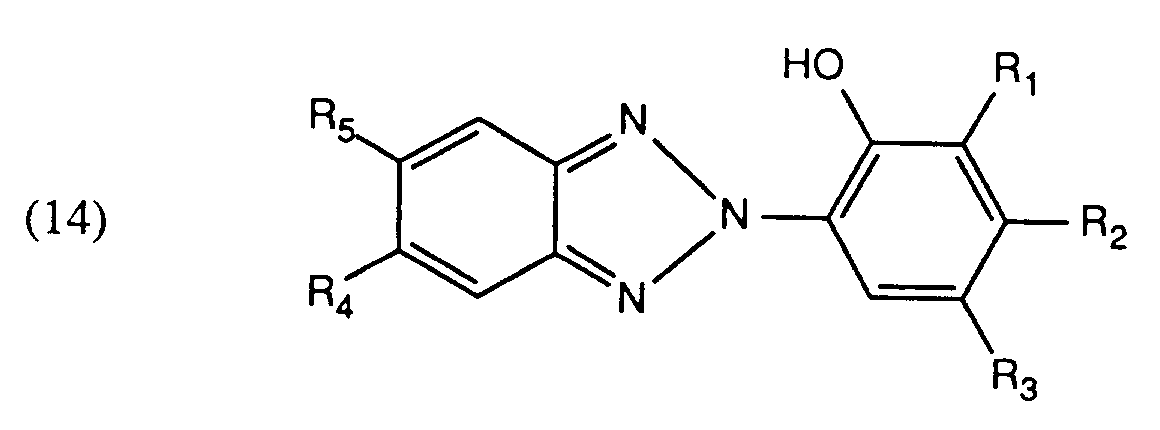

Applications Claiming Priority (2)
| Application Number | Priority Date | Filing Date | Title |
|---|---|---|---|
| CH2430/90 | 1990-07-23 | ||
| CH243090 | 1990-07-23 |
Publications (3)
| Publication Number | Publication Date |
|---|---|
| EP0468921A1 EP0468921A1 (de) | 1992-01-29 |
| EP0468921B1 true EP0468921B1 (de) | 1995-06-28 |
| EP0468921B2 EP0468921B2 (de) | 1998-07-22 |
Family
ID=4233627
Family Applications (1)
| Application Number | Title | Priority Date | Filing Date |
|---|---|---|---|
| EP91810568A Expired - Lifetime EP0468921B2 (de) | 1990-07-23 | 1991-07-15 | Wässrige Dispersion schwerlöslicher UV-Absorber |
Country Status (11)
| Country | Link |
|---|---|
| US (1) | US5575958A (de) |
| EP (1) | EP0468921B2 (de) |
| JP (1) | JP2951441B2 (de) |
| KR (1) | KR0178403B1 (de) |
| AT (1) | ATE124481T1 (de) |
| AU (1) | AU653350B2 (de) |
| BR (1) | BR9103123A (de) |
| DE (1) | DE59105836D1 (de) |
| ES (1) | ES2074688T5 (de) |
| MX (1) | MX9100286A (de) |
| ZA (1) | ZA915726B (de) |
Families Citing this family (24)
| Publication number | Priority date | Publication date | Assignee | Title |
|---|---|---|---|---|
| DK0523006T3 (da) * | 1991-07-12 | 1995-12-27 | Ciba Geigy Ag | Fremgangsmåde til trykning og fotokemisk stabilisering af polyesterfibermaterialer |
| GB2291658B (en) * | 1994-07-23 | 1998-08-12 | Ciba Geigy Ag | Aqueous textile treatment compositions containing an ultra-violet absorbing agent |
| US5556973A (en) * | 1994-07-27 | 1996-09-17 | Ciba-Geigy Corporation | Red-shifted tris-aryl-s-triazines and compositions stabilized therewith |
| US5585422A (en) * | 1995-09-20 | 1996-12-17 | Ciba-Geigy Corporation | Hybrid s-triazine light stabilizers substituted by benzotriazole or benzophenone moieties and compositions stabilized therewith |
| US6391065B1 (en) * | 1995-11-03 | 2002-05-21 | Boehme Filatex, Inc. | UV light absorber composition and method of improving the lightfastness of dyed textiles |
| US5726309A (en) * | 1996-08-27 | 1998-03-10 | Ciba Specialty Chemicals Corporation | Tris-aryls-triazines substituted with biphenylyl groups |
| EP0864687A3 (de) * | 1997-03-11 | 1999-11-24 | Ciba SC Holding AG | Verfahren zur Verbesserung der photochemischen Stabilität von Färbungen und Drucken auf Polyesterfasern |
| EP1115938B1 (de) * | 1998-08-25 | 2003-06-04 | Clariant Finance (BVI) Limited | Wässriges präparat eines uv-aktiven mittels und seine herstellung sowie seine verwendung |
| TWI259182B (en) | 1998-11-17 | 2006-08-01 | Cytec Tech Corp | Process for preparing triazines using a combination of Lewis acids with reaction promoters |
| US6900003B2 (en) * | 2002-04-12 | 2005-05-31 | Shipley Company, L.L.C. | Photoresist processing aid and method |
| EP1466956A1 (de) * | 2003-04-07 | 2004-10-13 | Clariant International Ltd. | Hochkonzentrierte, lagerstabile wässrige Dispersionen zur Stabilisierung von Lacken und Lasuren |
| JP4548820B2 (ja) * | 2003-12-04 | 2010-09-22 | 日本化薬株式会社 | 組成物、疎水性繊維用の耐光堅牢度向上剤、及びそれを用いる染色方法 |
| US20050155163A1 (en) * | 2004-01-21 | 2005-07-21 | Griffin Bruce O. | Dye mixtures |
| US7196125B2 (en) * | 2004-06-10 | 2007-03-27 | E. I. Du Pont De Nemours And Company | Poly(trimethylene terephthalate) fibers useful in high-UV exposure end uses |
| JP5084143B2 (ja) * | 2005-02-14 | 2012-11-28 | 株式会社Adeka | 光安定剤乳化組成物 |
| ITMI20051202A1 (it) * | 2005-06-24 | 2006-12-25 | Alcantara Spa | Tessuto non tessuto microfibroso scamosciato ad elevata solidita' alla luce e procedimento per la sua preparazione |
| EP1867780A1 (de) * | 2006-06-15 | 2007-12-19 | Clariant International Ltd. | Verfahren zur Verbesserung der Licht- und Wärmestabilität von Textilien |
| WO2008101833A1 (en) * | 2007-02-20 | 2008-08-28 | Huntsman Advanced Materials (Switzerland) Gmbh | Uva formulation |
| JP2009030214A (ja) * | 2007-07-27 | 2009-02-12 | Senka Kk | 繊維製品の耐光堅牢度向上剤及び耐光堅牢度向上方法 |
| KR101773621B1 (ko) | 2009-01-19 | 2017-08-31 | 바스프 에스이 | 유기 흑색 안료 및 이의 제조 방법 |
| KR101406880B1 (ko) * | 2013-12-04 | 2014-06-13 | 아이씨이아이우방(주) | 일광견뢰도 증진제 및 이를 포함하는 염색조제 |
| KR101693722B1 (ko) | 2016-06-29 | 2017-01-09 | 아이씨이아이우방(주) | 내일광성, 난연성 및 발수능이 우수한 염색섬유용 복합염색조제 조성물, 이를 이용한 염색섬유용 복합염색조제 및 이의 제조방법 |
| TWI835843B (zh) | 2018-10-03 | 2024-03-21 | 瑞士商亨斯邁紡織染化(瑞士)有限公司 | 新的經吡啶及經嘧啶取代之三uv吸收劑 |
| EP3863076B1 (de) | 2018-10-05 | 2025-08-06 | Samsung Display Co., Ltd. | Anzeigevorrichtung und lichtabsorber in einer anzeigevorrichtung |
Family Cites Families (5)
| Publication number | Priority date | Publication date | Assignee | Title |
|---|---|---|---|---|
| CH660828GA3 (de) * | 1980-03-28 | 1987-05-29 | ||
| DE3417782A1 (de) * | 1983-05-23 | 1984-11-29 | Sandoz-Patent-GmbH, 7850 Lörrach | Faerbereihilfsmittel |
| ES2032594T3 (es) * | 1987-02-27 | 1993-02-16 | Ciba-Geigy Ag | Procedimiento para mejorar la estabilidad fotoquimica de los colorantes sobre materiales de fibra de poliester. (reserva del art. 167.2 cpe). |
| US4831068A (en) * | 1987-02-27 | 1989-05-16 | Ciba-Geigy Corporation | Process for improving the photochemical stability of dyeings on polyester fibre materials |
| EP0345219B1 (de) * | 1988-05-31 | 1994-02-02 | Ciba-Geigy Ag | Wässrige Dispersion von 2-(2'-Hydroxyphenyl-)benzotriazolen |
-
1991
- 1991-07-15 AT AT91810568T patent/ATE124481T1/de active
- 1991-07-15 EP EP91810568A patent/EP0468921B2/de not_active Expired - Lifetime
- 1991-07-15 ES ES91810568T patent/ES2074688T5/es not_active Expired - Lifetime
- 1991-07-15 DE DE59105836T patent/DE59105836D1/de not_active Expired - Lifetime
- 1991-07-19 MX MX9100286A patent/MX9100286A/es unknown
- 1991-07-22 ZA ZA915726A patent/ZA915726B/xx unknown
- 1991-07-22 BR BR919103123A patent/BR9103123A/pt not_active IP Right Cessation
- 1991-07-22 AU AU81262/91A patent/AU653350B2/en not_active Ceased
- 1991-07-22 KR KR1019910012507A patent/KR0178403B1/ko not_active Expired - Lifetime
- 1991-07-23 JP JP3181380A patent/JP2951441B2/ja not_active Expired - Lifetime
-
1994
- 1994-08-17 US US08/292,159 patent/US5575958A/en not_active Expired - Lifetime
Also Published As
| Publication number | Publication date |
|---|---|
| EP0468921A1 (de) | 1992-01-29 |
| ZA915726B (en) | 1992-03-25 |
| JPH04239581A (ja) | 1992-08-27 |
| ATE124481T1 (de) | 1995-07-15 |
| AU8126291A (en) | 1992-01-30 |
| JP2951441B2 (ja) | 1999-09-20 |
| EP0468921B2 (de) | 1998-07-22 |
| BR9103123A (pt) | 1992-02-11 |
| AU653350B2 (en) | 1994-09-29 |
| KR0178403B1 (ko) | 1999-04-01 |
| ES2074688T3 (es) | 1995-09-16 |
| US5575958A (en) | 1996-11-19 |
| ES2074688T5 (es) | 1998-11-01 |
| MX9100286A (es) | 1992-02-28 |
| KR920002730A (ko) | 1992-02-28 |
| DE59105836D1 (de) | 1995-08-03 |
Similar Documents
| Publication | Publication Date | Title |
|---|---|---|
| EP0490819B1 (de) | Wässrige Dispersion schwerlöslicher UV-Absorber | |
| EP0468921B2 (de) | Wässrige Dispersion schwerlöslicher UV-Absorber | |
| EP0345219B1 (de) | Wässrige Dispersion von 2-(2'-Hydroxyphenyl-)benzotriazolen | |
| EP0613976B1 (de) | Verwendung von Acrylamidpolymeren als Faltenverhinderungsmittel | |
| EP0557247A1 (de) | Verfahren zur photochemischen und thermischen Stabilisierung von ungefärbten und gefärbten oder bedruckten Polyesterfasermaterialien | |
| EP0474595B1 (de) | Wässrige Dispersion schwerlöslicher UV-Absorber | |
| EP0506613A1 (de) | Gleitmittel enthaltende wässrige Zubereitungen von Mischpolymerisaten | |
| DE2520527B2 (de) | Wäßrige Präparate von in Wasser unlöslichen bis schwerlöslichen Farbstoffen oder optischen Aufhellern sowie deren Herstellung und Verwendung | |
| EP0382138B1 (de) | Hilfsmittelgemisch und seine Verwendung beim Färben von synthetischen Fasermaterialien | |
| DE2941763C2 (de) | ||
| DE69908619T2 (de) | Wässriges präparat eines uv-aktiven mittels und seine herstellung sowie seine verwendung | |
| DE4317075A1 (de) | Lithiumhaltige Färbereihilfsmittel für Färberei und Druckerei | |
| EP0657577A1 (de) | Verfahren zur photochemischen und thermischen Stabilisierung von ungefärbten und gefärbten oder bedruckten Polyesterfasermaterialien | |
| EP0523006B1 (de) | Verfahren zum Bedrucken und photochemischen Stabilisieren von Polyesterfasermaterialien | |
| EP0354174A1 (de) | Stabile, wässrige Zusammensetzung zur Verbesserung der Lichtechtheit | |
| CH637432A5 (en) | Dyeing assistant suitable for use in the dyeing of synthetic fibre materials | |
| EP0064030B1 (de) | Färbereihilfsmittelgemisch und seine Verwendung beim Färben von synthetischen Fasermaterialien | |
| EP0099111B1 (de) | Verfahren zum HT-Färben von Polyestermaterialien | |
| EP0414631A1 (de) | Hilfsmittelgemisch und seine Verwendung beim Färben von Polyesterfasermaterialien | |
| EP0064029B1 (de) | Hilfsmittelgemisch und seine Verwendung als Faltenfreimittel beim Färben oder optischen Aufhellen von Polyesterfasern enthaltenden Textilmaterialien | |
| DE2215717A1 (de) | Verfahren zum Farben oder Bedrucken von organischen, synthetischen, hydropho ben Fasern | |
| EP0033715A1 (de) | Hilfsmittel und seine Verwendung beim Färben oder optischen Aufhellen von Polyesterfasermaterialien | |
| DE2724644B2 (de) | Verfahren zum Farben von wollhaltigen Fasermaterialien | |
| DE2044647C3 (de) | Schaumarme wasserlösliche Färbereihilfsmittel | |
| DE2521106C3 (de) | Verfahren zum Färben von synthetische Fasern enthaltenden Materialien |
Legal Events
| Date | Code | Title | Description |
|---|---|---|---|
| PUAI | Public reference made under article 153(3) epc to a published international application that has entered the european phase |
Free format text: ORIGINAL CODE: 0009012 |
|
| 17P | Request for examination filed |
Effective date: 19910717 |
|
| AK | Designated contracting states |
Kind code of ref document: A1 Designated state(s): AT BE CH DE ES FR GB IT LI NL SE |
|
| 17Q | First examination report despatched |
Effective date: 19931118 |
|
| GRAA | (expected) grant |
Free format text: ORIGINAL CODE: 0009210 |
|
| AK | Designated contracting states |
Kind code of ref document: B1 Designated state(s): AT BE CH DE ES FR GB IT LI NL SE |
|
| REF | Corresponds to: |
Ref document number: 124481 Country of ref document: AT Date of ref document: 19950715 Kind code of ref document: T |
|
| ET | Fr: translation filed | ||
| REF | Corresponds to: |
Ref document number: 59105836 Country of ref document: DE Date of ref document: 19950803 |
|
| ITF | It: translation for a ep patent filed | ||
| REG | Reference to a national code |
Ref country code: ES Ref legal event code: FG2A Ref document number: 2074688 Country of ref document: ES Kind code of ref document: T3 |
|
| GBT | Gb: translation of ep patent filed (gb section 77(6)(a)/1977) |
Effective date: 19950913 |
|
| PLBQ | Unpublished change to opponent data |
Free format text: ORIGINAL CODE: EPIDOS OPPO |
|
| PLBI | Opposition filed |
Free format text: ORIGINAL CODE: 0009260 |
|
| PLBF | Reply of patent proprietor to notice(s) of opposition |
Free format text: ORIGINAL CODE: EPIDOS OBSO |
|
| 26 | Opposition filed |
Opponent name: CYTEC INDUSTRIES INC. Effective date: 19960328 |
|
| NLR1 | Nl: opposition has been filed with the epo |
Opponent name: CYTEC INDUSTRIES INC. |
|
| PLBF | Reply of patent proprietor to notice(s) of opposition |
Free format text: ORIGINAL CODE: EPIDOS OBSO |
|
| REG | Reference to a national code |
Ref country code: CH Ref legal event code: PUE Owner name: CIBA-GEIGY AG TRANSFER- CIBA SC HOLDING AG |
|
| PLBF | Reply of patent proprietor to notice(s) of opposition |
Free format text: ORIGINAL CODE: EPIDOS OBSO |
|
| PLBF | Reply of patent proprietor to notice(s) of opposition |
Free format text: ORIGINAL CODE: EPIDOS OBSO |
|
| BECN | Be: change of holder's name |
Effective date: 19961129 |
|
| NLS | Nl: assignments of ep-patents |
Owner name: CIBA SC HOLDING AG |
|
| REG | Reference to a national code |
Ref country code: FR Ref legal event code: TP Ref country code: CH Ref legal event code: PFA Free format text: CIBA SC HOLDING AG TRANSFER- CIBA SPECIALTY CHEMICALS HOLDING INC. |
|
| RAP2 | Party data changed (patent owner data changed or rights of a patent transferred) |
Owner name: CIBA SPECIALTY CHEMICALS HOLDING INC. |
|
| REG | Reference to a national code |
Ref country code: GB Ref legal event code: 732E |
|
| NLT1 | Nl: modifications of names registered in virtue of documents presented to the patent office pursuant to art. 16 a, paragraph 1 |
Owner name: CIBA SPECIALTY CHEMICALS HOLDING INC. |
|
| NLT2 | Nl: modifications (of names), taken from the european patent patent bulletin |
Owner name: CIBA SPECIALTY CHEMICALS HOLDING INC. |
|
| PLAW | Interlocutory decision in opposition |
Free format text: ORIGINAL CODE: EPIDOS IDOP |
|
| PLAW | Interlocutory decision in opposition |
Free format text: ORIGINAL CODE: EPIDOS IDOP |
|
| REG | Reference to a national code |
Ref country code: FR Ref legal event code: CD |
|
| REG | Reference to a national code |
Ref country code: ES Ref legal event code: PC2A |
|
| PUAH | Patent maintained in amended form |
Free format text: ORIGINAL CODE: 0009272 |
|
| STAA | Information on the status of an ep patent application or granted ep patent |
Free format text: STATUS: PATENT MAINTAINED AS AMENDED |
|
| 27A | Patent maintained in amended form |
Effective date: 19980722 |
|
| AK | Designated contracting states |
Kind code of ref document: B2 Designated state(s): AT BE CH DE ES FR GB IT LI NL SE |
|
| ET3 | Fr: translation filed ** decision concerning opposition | ||
| REG | Reference to a national code |
Ref country code: CH Ref legal event code: AEN Free format text: AUFRECHTERHALTUNG DES PATENTES IN GEAENDERTER FORM |
|
| GBTA | Gb: translation of amended ep patent filed (gb section 77(6)(b)/1977) | ||
| NLR2 | Nl: decision of opposition | ||
| REG | Reference to a national code |
Ref country code: ES Ref legal event code: DC2A Kind code of ref document: T5 Effective date: 19980922 |
|
| NLR3 | Nl: receipt of modified translations in the netherlands language after an opposition procedure | ||
| PGFP | Annual fee paid to national office [announced via postgrant information from national office to epo] |
Ref country code: CH Payment date: 20000606 Year of fee payment: 10 |
|
| PGFP | Annual fee paid to national office [announced via postgrant information from national office to epo] |
Ref country code: SE Payment date: 20000616 Year of fee payment: 10 |
|
| PGFP | Annual fee paid to national office [announced via postgrant information from national office to epo] |
Ref country code: NL Payment date: 20000627 Year of fee payment: 10 |
|
| PGFP | Annual fee paid to national office [announced via postgrant information from national office to epo] |
Ref country code: AT Payment date: 20000731 Year of fee payment: 10 |
|
| PG25 | Lapsed in a contracting state [announced via postgrant information from national office to epo] |
Ref country code: AT Free format text: LAPSE BECAUSE OF NON-PAYMENT OF DUE FEES Effective date: 20010715 |
|
| PG25 | Lapsed in a contracting state [announced via postgrant information from national office to epo] |
Ref country code: SE Free format text: LAPSE BECAUSE OF NON-PAYMENT OF DUE FEES Effective date: 20010716 |
|
| PG25 | Lapsed in a contracting state [announced via postgrant information from national office to epo] |
Ref country code: CH Free format text: LAPSE BECAUSE OF NON-PAYMENT OF DUE FEES Effective date: 20010731 Ref country code: LI Free format text: LAPSE BECAUSE OF NON-PAYMENT OF DUE FEES Effective date: 20010731 |
|
| PGFP | Annual fee paid to national office [announced via postgrant information from national office to epo] |
Ref country code: BE Payment date: 20010918 Year of fee payment: 11 |
|
| REG | Reference to a national code |
Ref country code: GB Ref legal event code: IF02 |
|
| PG25 | Lapsed in a contracting state [announced via postgrant information from national office to epo] |
Ref country code: NL Free format text: LAPSE BECAUSE OF NON-PAYMENT OF DUE FEES Effective date: 20020201 |
|
| EUG | Se: european patent has lapsed |
Ref document number: 91810568.5 |
|
| REG | Reference to a national code |
Ref country code: CH Ref legal event code: PL |
|
| NLV4 | Nl: lapsed or anulled due to non-payment of the annual fee |
Effective date: 20020201 |
|
| PG25 | Lapsed in a contracting state [announced via postgrant information from national office to epo] |
Ref country code: BE Free format text: LAPSE BECAUSE OF NON-PAYMENT OF DUE FEES Effective date: 20020731 |
|
| BERE | Be: lapsed |
Owner name: *CIBA SPECIALTY CHEMICALS HOLDING INC. Effective date: 20020731 |
|
| PGFP | Annual fee paid to national office [announced via postgrant information from national office to epo] |
Ref country code: FR Payment date: 20030624 Year of fee payment: 13 |
|
| PG25 | Lapsed in a contracting state [announced via postgrant information from national office to epo] |
Ref country code: FR Free format text: LAPSE BECAUSE OF NON-PAYMENT OF DUE FEES Effective date: 20050331 |
|
| REG | Reference to a national code |
Ref country code: FR Ref legal event code: ST |
|
| REG | Reference to a national code |
Ref country code: GB Ref legal event code: 732E |
|
| REG | Reference to a national code |
Ref country code: ES Ref legal event code: PC2A |
|
| PGFP | Annual fee paid to national office [announced via postgrant information from national office to epo] |
Ref country code: ES Payment date: 20100716 Year of fee payment: 20 |
|
| PGFP | Annual fee paid to national office [announced via postgrant information from national office to epo] |
Ref country code: GB Payment date: 20100616 Year of fee payment: 20 Ref country code: IT Payment date: 20100715 Year of fee payment: 20 Ref country code: DE Payment date: 20100730 Year of fee payment: 20 |
|
| REG | Reference to a national code |
Ref country code: DE Ref legal event code: R071 Ref document number: 59105836 Country of ref document: DE |
|
| REG | Reference to a national code |
Ref country code: DE Ref legal event code: R071 Ref document number: 59105836 Country of ref document: DE |
|
| REG | Reference to a national code |
Ref country code: GB Ref legal event code: PE20 Expiry date: 20110714 |
|
| PG25 | Lapsed in a contracting state [announced via postgrant information from national office to epo] |
Ref country code: GB Free format text: LAPSE BECAUSE OF EXPIRATION OF PROTECTION Effective date: 20110714 |
|
| REG | Reference to a national code |
Ref country code: ES Ref legal event code: FD2A Effective date: 20120511 |
|
| PG25 | Lapsed in a contracting state [announced via postgrant information from national office to epo] |
Ref country code: ES Free format text: LAPSE BECAUSE OF EXPIRATION OF PROTECTION Effective date: 20110716 |
|
| PG25 | Lapsed in a contracting state [announced via postgrant information from national office to epo] |
Ref country code: DE Free format text: LAPSE BECAUSE OF EXPIRATION OF PROTECTION Effective date: 20110716 |