EP0470462A2 - Verfahren zur Herstellung von Halogenmethylketonen, insbesondere von 1,1,1-Trifluoraceton - Google Patents
Verfahren zur Herstellung von Halogenmethylketonen, insbesondere von 1,1,1-Trifluoraceton Download PDFInfo
- Publication number
- EP0470462A2 EP0470462A2 EP91112635A EP91112635A EP0470462A2 EP 0470462 A2 EP0470462 A2 EP 0470462A2 EP 91112635 A EP91112635 A EP 91112635A EP 91112635 A EP91112635 A EP 91112635A EP 0470462 A2 EP0470462 A2 EP 0470462A2
- Authority
- EP
- European Patent Office
- Prior art keywords
- formula
- ozone
- process according
- groups
- reaction
- Prior art date
- Legal status (The legal status is an assumption and is not a legal conclusion. Google has not performed a legal analysis and makes no representation as to the accuracy of the status listed.)
- Withdrawn
Links
- 238000000034 method Methods 0.000 title claims abstract description 16
- FHUDAMLDXFJHJE-UHFFFAOYSA-N 1,1,1-trifluoropropan-2-one Chemical compound CC(=O)C(F)(F)F FHUDAMLDXFJHJE-UHFFFAOYSA-N 0.000 title claims abstract description 13
- 238000002360 preparation method Methods 0.000 title claims description 7
- CSCPPACGZOOCGX-UHFFFAOYSA-N Acetone Chemical class CC(C)=O CSCPPACGZOOCGX-UHFFFAOYSA-N 0.000 title claims description 4
- CBENFWSGALASAD-UHFFFAOYSA-N Ozone Chemical compound [O-][O+]=O CBENFWSGALASAD-UHFFFAOYSA-N 0.000 claims abstract description 22
- -1 Halogen methyl ketones Chemical class 0.000 claims abstract description 15
- DGAQECJNVWCQMB-PUAWFVPOSA-M Ilexoside XXIX Chemical compound C[C@@H]1CC[C@@]2(CC[C@@]3(C(=CC[C@H]4[C@]3(CC[C@@H]5[C@@]4(CC[C@@H](C5(C)C)OS(=O)(=O)[O-])C)C)[C@@H]2[C@]1(C)O)C)C(=O)O[C@H]6[C@@H]([C@H]([C@@H]([C@H](O6)CO)O)O)O.[Na+] DGAQECJNVWCQMB-PUAWFVPOSA-M 0.000 claims abstract description 10
- 239000011734 sodium Substances 0.000 claims abstract description 10
- 229910052708 sodium Inorganic materials 0.000 claims abstract description 10
- ZLMJMSJWJFRBEC-UHFFFAOYSA-N Potassium Chemical compound [K] ZLMJMSJWJFRBEC-UHFFFAOYSA-N 0.000 claims abstract description 9
- 239000011591 potassium Substances 0.000 claims abstract description 9
- 229910052700 potassium Inorganic materials 0.000 claims abstract description 9
- 229910052736 halogen Inorganic materials 0.000 claims abstract description 8
- 239000000203 mixture Substances 0.000 claims abstract description 7
- CHPPXJGZEBYNAW-UHFFFAOYSA-N 1,1,1-trifluoro-2-nitropropane Chemical compound [O-][N+](=O)C(C)C(F)(F)F CHPPXJGZEBYNAW-UHFFFAOYSA-N 0.000 claims abstract description 6
- 150000002828 nitro derivatives Chemical class 0.000 claims abstract description 6
- LFQSCWFLJHTTHZ-UHFFFAOYSA-N Ethanol Chemical compound CCO LFQSCWFLJHTTHZ-UHFFFAOYSA-N 0.000 claims description 11
- 238000006243 chemical reaction Methods 0.000 claims description 11
- 150000001875 compounds Chemical class 0.000 claims description 8
- QMMFVYPAHWMCMS-UHFFFAOYSA-N Dimethyl sulfide Chemical compound CSC QMMFVYPAHWMCMS-UHFFFAOYSA-N 0.000 claims description 6
- 150000002367 halogens Chemical class 0.000 claims description 6
- RTZKZFJDLAIYFH-UHFFFAOYSA-N Diethyl ether Chemical compound CCOCC RTZKZFJDLAIYFH-UHFFFAOYSA-N 0.000 claims description 4
- 150000001298 alcohols Chemical class 0.000 claims description 4
- 238000004821 distillation Methods 0.000 claims description 4
- 229910052731 fluorine Inorganic materials 0.000 claims description 4
- 239000011737 fluorine Substances 0.000 claims description 4
- XLYOFNOQVPJJNP-UHFFFAOYSA-N water Substances O XLYOFNOQVPJJNP-UHFFFAOYSA-N 0.000 claims description 4
- WKBOTKDWSSQWDR-UHFFFAOYSA-N Bromine atom Chemical compound [Br] WKBOTKDWSSQWDR-UHFFFAOYSA-N 0.000 claims description 3
- ZAMOUSCENKQFHK-UHFFFAOYSA-N Chlorine atom Chemical compound [Cl] ZAMOUSCENKQFHK-UHFFFAOYSA-N 0.000 claims description 3
- GDTBXPJZTBHREO-UHFFFAOYSA-N bromine Substances BrBr GDTBXPJZTBHREO-UHFFFAOYSA-N 0.000 claims description 3
- 229910052794 bromium Inorganic materials 0.000 claims description 3
- 125000004432 carbon atom Chemical group C* 0.000 claims description 3
- 239000000460 chlorine Substances 0.000 claims description 3
- 229910052801 chlorine Inorganic materials 0.000 claims description 3
- 125000004169 (C1-C6) alkyl group Chemical group 0.000 claims description 2
- PXGOKWXKJXAPGV-UHFFFAOYSA-N Fluorine Chemical compound FF PXGOKWXKJXAPGV-UHFFFAOYSA-N 0.000 claims description 2
- FAPWRFPIFSIZLT-UHFFFAOYSA-M Sodium chloride Chemical compound [Na+].[Cl-] FAPWRFPIFSIZLT-UHFFFAOYSA-M 0.000 claims description 2
- 125000004036 acetal group Chemical group 0.000 claims description 2
- 125000003118 aryl group Chemical group 0.000 claims description 2
- QVGXLLKOCUKJST-UHFFFAOYSA-N atomic oxygen Chemical compound [O] QVGXLLKOCUKJST-UHFFFAOYSA-N 0.000 claims description 2
- 239000000470 constituent Substances 0.000 claims description 2
- 238000002425 crystallisation Methods 0.000 claims description 2
- 230000008025 crystallization Effects 0.000 claims description 2
- 125000005843 halogen group Chemical group 0.000 claims description 2
- 239000001301 oxygen Substances 0.000 claims description 2
- 229910052760 oxygen Inorganic materials 0.000 claims description 2
- 125000000217 alkyl group Chemical group 0.000 claims 1
- 239000011780 sodium chloride Substances 0.000 claims 1
- 238000004519 manufacturing process Methods 0.000 abstract description 3
- 230000001476 alcoholic effect Effects 0.000 abstract description 2
- 238000001816 cooling Methods 0.000 abstract 1
- OKKJLVBELUTLKV-UHFFFAOYSA-N Methanol Chemical compound OC OKKJLVBELUTLKV-UHFFFAOYSA-N 0.000 description 27
- 239000000243 solution Substances 0.000 description 14
- IJGRMHOSHXDMSA-UHFFFAOYSA-N Atomic nitrogen Chemical compound N#N IJGRMHOSHXDMSA-UHFFFAOYSA-N 0.000 description 6
- XEKOWRVHYACXOJ-UHFFFAOYSA-N Ethyl acetate Chemical compound CCOC(C)=O XEKOWRVHYACXOJ-UHFFFAOYSA-N 0.000 description 6
- WQDUMFSSJAZKTM-UHFFFAOYSA-N Sodium methoxide Chemical compound [Na+].[O-]C WQDUMFSSJAZKTM-UHFFFAOYSA-N 0.000 description 6
- QAOWNCQODCNURD-UHFFFAOYSA-N Sulfuric acid Chemical compound OS(O)(=O)=O QAOWNCQODCNURD-UHFFFAOYSA-N 0.000 description 6
- 150000002373 hemiacetals Chemical class 0.000 description 4
- 239000011541 reaction mixture Substances 0.000 description 4
- WEVYAHXRMPXWCK-UHFFFAOYSA-N Acetonitrile Chemical compound CC#N WEVYAHXRMPXWCK-UHFFFAOYSA-N 0.000 description 3
- 244000309464 bull Species 0.000 description 3
- 239000012045 crude solution Substances 0.000 description 3
- 229910052757 nitrogen Inorganic materials 0.000 description 3
- 239000007787 solid Substances 0.000 description 3
- UNKYHDBKTMMJKY-UHFFFAOYSA-N 1,1-dichloro-1-fluoro-2-nitropropane Chemical compound [O-][N+](=O)C(C)C(F)(Cl)Cl UNKYHDBKTMMJKY-UHFFFAOYSA-N 0.000 description 2
- URZNXXFGXNRGIO-UHFFFAOYSA-N 1,1-dichloro-1-fluoropropan-2-one Chemical compound CC(=O)C(F)(Cl)Cl URZNXXFGXNRGIO-UHFFFAOYSA-N 0.000 description 2
- DURPTKYDGMDSBL-UHFFFAOYSA-N 1-butoxybutane Chemical compound CCCCOCCCC DURPTKYDGMDSBL-UHFFFAOYSA-N 0.000 description 2
- 238000004293 19F NMR spectroscopy Methods 0.000 description 2
- 238000005160 1H NMR spectroscopy Methods 0.000 description 2
- KFZMGEQAYNKOFK-UHFFFAOYSA-N Isopropanol Chemical compound CC(C)O KFZMGEQAYNKOFK-UHFFFAOYSA-N 0.000 description 2
- LRHPLDYGYMQRHN-UHFFFAOYSA-N N-Butanol Chemical compound CCCCO LRHPLDYGYMQRHN-UHFFFAOYSA-N 0.000 description 2
- AMQJEAYHLZJPGS-UHFFFAOYSA-N N-Pentanol Chemical compound CCCCCO AMQJEAYHLZJPGS-UHFFFAOYSA-N 0.000 description 2
- 238000001069 Raman spectroscopy Methods 0.000 description 2
- DKGAVHZHDRPRBM-UHFFFAOYSA-N Tert-Butanol Chemical compound CC(C)(C)O DKGAVHZHDRPRBM-UHFFFAOYSA-N 0.000 description 2
- 238000007664 blowing Methods 0.000 description 2
- 238000009835 boiling Methods 0.000 description 2
- BTANRVKWQNVYAZ-UHFFFAOYSA-N butan-2-ol Chemical compound CCC(C)O BTANRVKWQNVYAZ-UHFFFAOYSA-N 0.000 description 2
- 238000009833 condensation Methods 0.000 description 2
- YWEUIGNSBFLMFL-UHFFFAOYSA-N diphosphonate Chemical compound O=P(=O)OP(=O)=O YWEUIGNSBFLMFL-UHFFFAOYSA-N 0.000 description 2
- 125000001153 fluoro group Chemical group F* 0.000 description 2
- 150000007857 hydrazones Chemical class 0.000 description 2
- 239000000543 intermediate Substances 0.000 description 2
- PHTQWCKDNZKARW-UHFFFAOYSA-N isoamylol Chemical compound CC(C)CCO PHTQWCKDNZKARW-UHFFFAOYSA-N 0.000 description 2
- 238000002844 melting Methods 0.000 description 2
- 230000008018 melting Effects 0.000 description 2
- 125000002496 methyl group Chemical group [H]C([H])([H])* 0.000 description 2
- 125000001624 naphthyl group Chemical group 0.000 description 2
- 125000001997 phenyl group Chemical group [H]C1=C([H])C([H])=C(*)C([H])=C1[H] 0.000 description 2
- DLYUQMMRRRQYAE-UHFFFAOYSA-N phosphorus pentoxide Inorganic materials O1P(O2)(=O)OP3(=O)OP1(=O)OP2(=O)O3 DLYUQMMRRRQYAE-UHFFFAOYSA-N 0.000 description 2
- 239000000047 product Substances 0.000 description 2
- 229920006395 saturated elastomer Polymers 0.000 description 2
- 239000007858 starting material Substances 0.000 description 2
- 238000010792 warming Methods 0.000 description 2
- WEYCUBLCUXRXRQ-UHFFFAOYSA-N 1,1,3,3,3-pentafluoro-2-methylprop-1-ene Chemical compound FC(F)=C(C)C(F)(F)F WEYCUBLCUXRXRQ-UHFFFAOYSA-N 0.000 description 1
- HORQAOAYAYGIBM-UHFFFAOYSA-N 2,4-dinitrophenylhydrazine Chemical compound NNC1=CC=C([N+]([O-])=O)C=C1[N+]([O-])=O HORQAOAYAYGIBM-UHFFFAOYSA-N 0.000 description 1
- FDMFUZHCIRHGRG-UHFFFAOYSA-N 3,3,3-trifluoroprop-1-ene Chemical compound FC(F)(F)C=C FDMFUZHCIRHGRG-UHFFFAOYSA-N 0.000 description 1
- PRDFNJUWGIQQBW-UHFFFAOYSA-N 3,3,3-trifluoroprop-1-yne Chemical compound FC(F)(F)C#C PRDFNJUWGIQQBW-UHFFFAOYSA-N 0.000 description 1
- LIQBKSIZAXKCPA-UHFFFAOYSA-N 4,4,4-trifluoro-3-oxobutanoic acid Chemical compound OC(=O)CC(=O)C(F)(F)F LIQBKSIZAXKCPA-UHFFFAOYSA-N 0.000 description 1
- KRHYYFGTRYWZRS-UHFFFAOYSA-M Fluoride anion Chemical compound [F-] KRHYYFGTRYWZRS-UHFFFAOYSA-M 0.000 description 1
- 238000003747 Grignard reaction Methods 0.000 description 1
- PMZURENOXWZQFD-UHFFFAOYSA-L Sodium Sulfate Chemical compound [Na+].[Na+].[O-]S([O-])(=O)=O PMZURENOXWZQFD-UHFFFAOYSA-L 0.000 description 1
- KRZMEYBKHQPLPS-UHFFFAOYSA-M [I-].FC(F)(F)[Mg+] Chemical compound [I-].FC(F)(F)[Mg+] KRZMEYBKHQPLPS-UHFFFAOYSA-M 0.000 description 1
- DHKHKXVYLBGOIT-UHFFFAOYSA-N acetaldehyde Diethyl Acetal Natural products CCOC(C)OCC DHKHKXVYLBGOIT-UHFFFAOYSA-N 0.000 description 1
- 150000001241 acetals Chemical class 0.000 description 1
- WETWJCDKMRHUPV-UHFFFAOYSA-N acetyl chloride Chemical compound CC(Cl)=O WETWJCDKMRHUPV-UHFFFAOYSA-N 0.000 description 1
- 239000012346 acetyl chloride Substances 0.000 description 1
- 239000002253 acid Substances 0.000 description 1
- 230000002378 acidificating effect Effects 0.000 description 1
- 150000007513 acids Chemical class 0.000 description 1
- 239000007864 aqueous solution Substances 0.000 description 1
- 150000001649 bromium compounds Chemical class 0.000 description 1
- 125000000484 butyl group Chemical group [H]C([*])([H])C([H])([H])C([H])([H])C([H])([H])[H] 0.000 description 1
- 239000006227 byproduct Substances 0.000 description 1
- 238000006555 catalytic reaction Methods 0.000 description 1
- 238000003776 cleavage reaction Methods 0.000 description 1
- 230000005494 condensation Effects 0.000 description 1
- 230000008030 elimination Effects 0.000 description 1
- 238000003379 elimination reaction Methods 0.000 description 1
- 125000001495 ethyl group Chemical group [H]C([H])([H])C([H])([H])* 0.000 description 1
- 238000004817 gas chromatography Methods 0.000 description 1
- 239000011261 inert gas Substances 0.000 description 1
- 238000002955 isolation Methods 0.000 description 1
- 150000002576 ketones Chemical class 0.000 description 1
- 229910052753 mercury Inorganic materials 0.000 description 1
- BQPIGGFYSBELGY-UHFFFAOYSA-N mercury(2+) Chemical class [Hg+2] BQPIGGFYSBELGY-UHFFFAOYSA-N 0.000 description 1
- VMVNZNXAVJHNDJ-UHFFFAOYSA-N methyl 2,2,2-trifluoroacetate Chemical compound COC(=O)C(F)(F)F VMVNZNXAVJHNDJ-UHFFFAOYSA-N 0.000 description 1
- 230000003647 oxidation Effects 0.000 description 1
- 238000007254 oxidation reaction Methods 0.000 description 1
- 125000001147 pentyl group Chemical group C(CCCC)* 0.000 description 1
- 230000002085 persistent effect Effects 0.000 description 1
- BDAWXSQJJCIFIK-UHFFFAOYSA-N potassium methoxide Chemical compound [K+].[O-]C BDAWXSQJJCIFIK-UHFFFAOYSA-N 0.000 description 1
- 239000012286 potassium permanganate Substances 0.000 description 1
- BDERNNFJNOPAEC-UHFFFAOYSA-N propan-1-ol Chemical compound CCCO BDERNNFJNOPAEC-UHFFFAOYSA-N 0.000 description 1
- 125000001436 propyl group Chemical group [H]C([*])([H])C([H])([H])C([H])([H])[H] 0.000 description 1
- 230000035484 reaction time Effects 0.000 description 1
- 230000007017 scission Effects 0.000 description 1
- 229910052938 sodium sulfate Inorganic materials 0.000 description 1
- 235000011152 sodium sulphate Nutrition 0.000 description 1
- 239000002904 solvent Substances 0.000 description 1
- 238000003756 stirring Methods 0.000 description 1
- 125000001424 substituent group Chemical group 0.000 description 1
- 238000003786 synthesis reaction Methods 0.000 description 1
Classifications
-
- C—CHEMISTRY; METALLURGY
- C07—ORGANIC CHEMISTRY
- C07C—ACYCLIC OR CARBOCYCLIC COMPOUNDS
- C07C45/00—Preparation of compounds having >C = O groups bound only to carbon or hydrogen atoms; Preparation of chelates of such compounds
- C07C45/40—Preparation of compounds having >C = O groups bound only to carbon or hydrogen atoms; Preparation of chelates of such compounds by oxidation with ozone; by ozonolysis
-
- C—CHEMISTRY; METALLURGY
- C07—ORGANIC CHEMISTRY
- C07C—ACYCLIC OR CARBOCYCLIC COMPOUNDS
- C07C49/00—Ketones; Ketenes; Dimeric ketenes; Ketonic chelates
- C07C49/04—Saturated compounds containing keto groups bound to acyclic carbon atoms
- C07C49/16—Saturated compounds containing keto groups bound to acyclic carbon atoms containing halogen
-
- C—CHEMISTRY; METALLURGY
- C07—ORGANIC CHEMISTRY
- C07C—ACYCLIC OR CARBOCYCLIC COMPOUNDS
- C07C49/00—Ketones; Ketenes; Dimeric ketenes; Ketonic chelates
- C07C49/04—Saturated compounds containing keto groups bound to acyclic carbon atoms
- C07C49/16—Saturated compounds containing keto groups bound to acyclic carbon atoms containing halogen
- C07C49/167—Saturated compounds containing keto groups bound to acyclic carbon atoms containing halogen containing only fluorine as halogen
Definitions
- the present invention relates to a particularly advantageous process for the preparation of halomethyl ketones.
- Halogen methyl ketones in particular 1,1,1-trifluoroacetone, are important intermediates for the preparation of biologically active compounds (see, for example, J. Med. Chem. 1975 (18), 895, J. Med. Chem. 1983 (26), 950 and Bull Soc Chim France 1986, 933).
- suitable alcohols are methanol, ethanol, isopropanol, propanol, n-butanol, t-butanol, sec-butanol, pentanol and / or iso-amyl alcohol.
- Solutions of sodium or potassium alcoholates in any alcohol can be used as the alcoholate solution.
- Sodium or potassium alcoholates having 1 to 4 carbon atoms in combination with one of the abovementioned alcohols as a solvent are preferred.
- Solutions with sodium or potassium methylate in methanol are particularly preferred.
- X can represent, for example, fluorine, chlorine and / or bromine. It is preferably fluorine.
- n is preferably 2 or 3, particularly preferably 3.
- R is a substituted alkyl radical
- R preferably represents optionally substituted with fluorine, chlorine, bromine, phenyl, substituted phenyl, naphthyl and / or substituted naphthyl, substituted C i -C 6 alkyl.
- R particularly preferably represents methyl, ethyl, propyl, butyl or pentyl, very particularly preferably methyl. This means that, according to the invention, 1,1,1-trifluoro-2-nitro-propane is very particularly preferably prepared from 1,1,1-trifluoroacetone.
- the compounds of the formula (11) required as starting materials are obtainable, for example, according to EP-A 116 885 and according to EP-A 116 886 or in an analogous manner.
- the process according to the invention can be carried out by first dissolving the compound of the formula (11) in alcohol which is as anhydrous as possible and then adding sodium or potassium alcoholate in solid form or dissolved in an alcohol.
- Sodium or potassium alcoholate can be used, for example, in amounts of 0.8 to 1.2 moles per mole of compound of the formula (11). Preference is given to 0.9 to 1.1 mol of sodium or potassium alcoholate, in particular 1 mol of sodium methylate, in each case based on 1 mol of the compound of the formula (II).
- the alcoholate can be added, for example, at temperatures in the range from -80 to + 60 ° C., preferably at from -20 to + 40 ° C.
- the reaction mixture Before the addition of the ozone, the reaction mixture is cooled to -10 to -100 C, preferably -50 to -78 C and then reacted with ozone at a temperature in these areas.
- ozone can be gaseous, e.g. introduce into the reaction mixture in admixture with oxygen, or in dissolved form, e.g. dissolved in one of the alcohols listed above.
- ozone in at least an equimolar amount, based on the compound of the formula (II).
- 1 to 1.2 moles of ozone can be used, based on the compound of the formula (II), a slight excess of ozone being recognizable by the persistent blue coloration of the reaction mixture.
- the reaction mixture can then be worked up by letting it warm to room temperature and blowing off any excess ozone still present before, during and / or after warming to room temperature, e.g. with nitrogen or another inert gas.
- the halogen methyl ketone of the formula (I) which is then formed is generally present as a hydrate, acetal and / or hemiacetal.
- the halomethyl ketone of the formula (I) thus prepared can be used in the form of the mixture which remains after warming to room temperature and, if appropriate, blowing off excess ozone.
- Such mixtures can also be worked up to isolate the halomethyl ketone of the formula (I) formed.
- You can, e.g. evaporate volatile constituents, especially methanol, if necessary after adding dimethyl sulfide, take up the residue with ether, wash the ethereal solution with water and / or saline solution, then dry, e.g. with sodium sulfate, then concentrating and isolating the halogen methyl ketone of the formula (I) prepared by distillation and / or crystallization.
- volatile halomethyl ketones e.g. Of 1,1,1-trifluoroacetone with a boiling point of 20 to 22 C, which also easily forms the hydrate or the hemiacetal with the respective alcohol under the reaction conditions, after the reaction and removal of any ozone still present by adding phosphorus pentoxide and subsequent distillation in pure form or as an alcoholic solution, which can generally be used for subsequent reactions.
- the yields of halomethyl ketones in the preparation according to the invention are generally between 70 and 95%, based on the nitro compound of the formula (II) used.
- the purities of the isolated halomethyl ketones are generally between 82 and 98% (determined by gas chromatography).
- halomethyl ketones of the formula (I) can be prepared so well in the manner according to the invention, because it is known that e.g. Fluoride elimination takes place from 1,1,1-trifluoro-2-nitro-propane in a basic medium (see US Pat. No. 4,840,969).
Landscapes
- Chemical & Material Sciences (AREA)
- Organic Chemistry (AREA)
- Organic Low-Molecular-Weight Compounds And Preparation Thereof (AREA)
Abstract
Halogenmethylketone werden aus Nitroverbindungen hergestellt, in dem man diese in alkoholischer Lösung mit Natrium- oder Kaliumalkoholatlösung versetzt, auf eine Temperatur im Bereich -10 bis -100°C abkühlt und dann das Gemisch bei -10 bis -100°C mit Ozon reagieren läßt. Das Verfahren eignet sich insbesondere zur Herstellung von 1,1,1-Trifluoraceton aus 1,1,1-Trifluor-2-nitro-propan.
Description
- Die vorliegende Erfindung betrifft ein besonders vorteilhaftes Verfahren zur Herstellung von Halogenmethylketonen. Halogenmethylketone, insbesondere 1,1,1-Trifluoraceton, sind wichtige Zwischenprodukte zur Herstellung von biologisch aktiven Verbindungen (siehe z.B. J. Med. Chem. 1975 (18), 895, J. Med. Chem. 1983 (26), 950 und Bull. Soc. Chim. France 1986, 933).
- Es sind schon Verfahren zur Herstellung von Halogenmethylketonen, insbesondere von 1,1,1-Trifluoraceton, bekanntgeworden. So kann man ausgehend von Trifluoressigsäuremethylester durch Kondensation mit Essigester und anschließender säurekatalysierter Spaltung des als Zwischenprodukt gebildeten Trifluoracetessigsäureethylesters Trifluoraceton herstellen. Durch Selbstkondensation des Essigesters entstehen hohe Anteile an Nebenprodukten (Ausbeute an gewünschtem Produkt nur 54 %) und es werden darüber hinaus lange Reaktionszeiten benötigt. (siehe Bull. class. Sci. Acad. roy. Belg. [5]12, 692 (1926); Bull. Acad. Belg. [5]13, 175; J. Am. Chem. Soc. 69, 1819 (1947); J. Am. Chem. Soc. 74, 1426 (1952)).
- Bei der Behandlung von Trihalogenessigsäuren mit Alkylmagnesiumbromiden in Dibutylether werden Trihalogenmethyl-alkyl-ketone erhalten (siehe J Chem. Soc. 1956, 835). In ähnlicher Weise wird bei der Behandlung von Trifluormethylmagnesiumiodid mit Acetylchlorid oder Acetonitril in Dibutylether 1,1,1-Trifluoraceton erhalten (siehe J. Chem. Soc. 1954, 1273).
- Weitere bekannte Verfahren zur Herstell
ung von 1,1,1-Trifluoraceton sind die mit Quecksilber(II)-salzen katalysierte Umsetzung von 3,3,3-Trifluorpropin mit wäßrigem Methanol (siehe J. Am. Chem. Soc. 74, 650 (1952)) oder wäßriger Schwefelsäure (siehe J Chem. Soc. 1952, 3483) und die Oxidation von 1,1,3 ,3,3-Pentafluor-2-methyl-propen mit Kaliumpermanganat in saurer wäßriger Lösung (siehe J. Chem. Soc. 1953, 3565). - Nachteilig bei diesen Verfahren ist, daß die benötigten Ausgangsprodukte nur in aufwendigen Synthesen zugänglich und deshalb sehr teuer sind (z.B. 3,3,3-Trifluorpropin), technisch schwierig handhabbare Umsetzungen durchgeführt werden müssen (z.B. Grignard-Reaktionen), ökologisch besonderen Aufwand erfordernde Hilfsstoffe benötigt werden (z.B. Quecksilbersalze) und/oder niedrige Ausbeuten ergeben.
- Es wurde nun ein Verfahren zur Herstellung von Halogenmethylketonen der Formel (I) gefunden

- X für Halogen,
- n für 1, 2 oder 3 und
- R für gegebenenfalls substituiertes C,-C2o-Alkyl steht,
- X, n und R die bei Formel (I) angegebene Bedeutung haben,
- Als Alkohole kommen beispielsweise Methanol, Ethanol, Isopropanol, Propanol, n-Butanol, t-Butanol, sec.-Butanol, Pentanol und/oder iso-Amylalkohol infrage.
- Als Alkoholatlösung kommen Lösungen von Natrium- oder Kaliumalkoholaten in beliebigen Alkoholen infrage. Bevorzugt sind Natrium- oder Kaliumalkoholate mit 1 bis 4 C-Atomen in Verbindung mit einem der oben genannten Alkohole als Lösungsmittel. Besonders bevorzugt sind Lösungen mit Natrium- oder Kaliummethylat in Methanol.
- Bei den Formeln (I) und (11) kann X beispielsweise für Fluor, Chlor und/oder Brom stehen. Vorzugsweise steht es für Fluor. n steht vorzugsweise für 2 oder 3, besonders bevorzugt für 3.
- Soweit R einen substituierten Alkylrest bedeutet, kommen als Substituenten beispielsweise in Frage: Halogenatome, Arylgruppen mit 6 bis 10 C-Atomen, C=O-Gruppen, COOR'-Gruppen mit R' = C1-C6-Alkyl und Acetalgruppen der Formel (III)

- Vorzugsweise steht R für gegebenenfalls mit Fluor, Chlor, Brom, Phenyl, substituiertem Phenyl, Naphthyl und/oder substituiertem Naphthyl, substituiertes Ci-C6-Alkyl. Besonders bevorzugt steht R für Methyl, Ethyl, Propyl, Butyl oder Pentyl, ganz besonders bevorzugt für Methyl. Das bedeutet, ganz besonders bevorzugt wird erfindungsgemäß aus 1,1,1-Trifluor-2-nitro-propan 1,1,1-Trifluoraceton hergestellt.
- Die als Ausgangsmaterialien benötigten Verbindungen der Formel (11) sind beispielsweise gemäß EP-A 116 885 und gemäß EP-A 116 886 oder auf analoge Weise dazu erhältlich.
- Man kann das erfindungsgemäße Verfahren so durchführen, daß man zunächst die Verbindung der Formel (11) in möglichst wasserfreiem Alkohol löst und dann Natrium- oder Kaliumalkoholat in fester Form oder gelöst in einem Alkohol zugibt. Natrium- oder Kaliumalkoholat kann man beispielsweise in Mengen von 0,8 bis 1,2 Mol pro Mol Verbindung der Formel (11) einsetzen. Bevorzugt sind 0,9 bis 1,1 Mol Natrium- oder Kaliumalkoholat, insbesondere 1 Mol Natriummethylat, jeweils bezogen auf 1 Mol der Verbindung der Formel (II).
- Die Zugabe des Alkoholates kann beispielsweise bei Temperaturen im Bereich -80 bis +60°C, vorzugsweise bei -20 bis +40° C erfolgen.
- Vor der Zugabe des Ozons wird das Reaktionsgemisch auf -10 bis -100 C, vorzugsweise -50 bis -78 C abgekühlt und dann bei einer Temperatur in diesen Bereichen mit Ozon umgesetzt.
- Ozon kann man beispielsweise gasförmig, z.B. im Gemisch mit Sauerstoff in das Reaktionsgemisch einleiten, oder in gelöster Form, z.B. gelöst in einem der oben aufgeführten Alkohole, zufügen. Um einen vollständigen Umsatz sicherzustellen ist es vorteilhaft, Ozon in mindestens äquimolarer Menge, bezogen auf die Verbindung der Formel (II), einzusetzen. Beispielsweise kann man bezogen auf die Verbindung der Formel (II) 1 bis 1,2 Mole Ozon einsetzen, wobei man einen geringen Überschuß an Ozon an einer bestehenbleibenden Blaufärbung des Reaktionsgemisches erkennen kann.
- Das Reaktionsgemisch kann man dann aufarbeiten, indem man es sich auf Raumtemperatur erwärmen läßt und eventuell noch vorhandenes überschüssiges Ozon vor, während und/oder nach dem Erwärmen auf Raumtemperatur ausbläst, z.B. mit Stickstoff oder einem anderen inerten Gas. In dem dann verbleibenden Gemisch liegt das gebildete Halogenmethylketon der Formel (I) im allgemeinen als Hydrat, Acetal und/oder Halbacetal vor. Für viele weitere Umsetzungen kann man das so hergestellte Halogenmethylketon der Formel (I) in Form des nach dem Erwärmen auf Raumtemperatur und gegebenenfalls Ausblasen von überschüssigem Ozon verbleibenden Gemisches einsetzen.
- Man kann solche Gemische auch zur Isolierung des gebildeten Halogenmethylketons der Formel (I) aufarbeiten. Dabei kann man, z.B. gegebenenfalls nach Zusatz von Dimethylsulfid, leicht-flüchtige Bestandteile, insbesondere Methanol, abdampfen, den Rückstand mit Ether aufnehmen, die etherische Lösung mit Wasser und/oder Kochsalzlösung waschen, anschließend trocknen, z.B. mit Natriumsulfat, dann Einengen und durch Destillation und/oder Kristallisation das hergestellte Halogenmethylketon der Formel (I) isolieren.
- Im Falle der erfindungsgemäßen Herstellung niedrigsiedender, leicht flüchtiger Halogenmethylketone, z.B. von 1,1,1-Trifluoraceton mit einem Siedepunkt von 20 bis 22 C, das zudem unter den Reaktionsbedingungen noch leicht das Hydrat oder das Halbacetal mit dem jeweiligen Alkohol bildet, können nach der Umsetzung und Entfernung eventuell noch vorhandenen Ozons durch Zugabe von Phosphorpentoxid und anschließender Destillation in reiner Form oder als alkoholische Lösung, die in der Regel für nachfolgende Reaktionen eingesetzt werden kann, isoliert werden. Für einige Folgereaktionen ist es am zweckmäßigsten, direkt die Ozon-freie Rohlösung nach einer Bestimmung des Gehaltes an Halogenmethylketon einzusetzen. Die Ausbeuten an Halogenmethylketonen bei der erfindungsgemäßen Herstellung betragen im allgemeinen zwischen 70 und 95 %, bezogen auf die eingesetzte Nitroverbindung der Formel (II). Die Reinheiten der isolierten Halogenmethylketone liegen dabei im allgemeinen zwischen 82 und 98 % (gaschromatografisch bestimmt).
- Es ist ausgesprochen überraschend, daß auf die erfindungsgemäße Weise Halogenmethylketone der Formel (I) so gut hergestellt werden können, denn es ist bekannt, daß z.B. aus 1,1,1-Trifluor-2-nitro-propan in einem basischen Milieu eine Fluorid-Eliminierung stattfindet (siehe US-A 4 840 969).
- Eine Lösung von 10,1 g (70 mmol) 1,1,1-Trifluor-2-nitro-propan in 100 ml absolutem Methanol wurde mit 3,87 g (7,2 mol) festem Natriummethanolat versetzt und auf -78° C gekühlt. Anschließend wurden bei derselben Temperatur 900 ml einer gesättigten methanolischen Ozonlösung zugefügt und 1,5 Stunden bei -78° C belassen. Überschüssiges Ozon wurde dann mittels eines Stickstoffstroms bei -78° C ausgeblasen. In dieser Rohlösung lag nach spektroskopischer Untersuchung (IR, Raman-, 1H-NMR- und 19F-NMR-Spektroskopie) das 1,1,1-Trifluoraceton, sein Hydrat und das Halbacetal mit Methanol vor.
- Nach Zugabe von Phosphorpentoxid wurde anschließend bei Normaldruck das Produkt in Methanol bei einer Temperatur bis 66 C abdestilliert. Das so erhaltene Gemisch kann ohne weitere Isolierung des Trifluoracetons für weitere Umsetzungen eingesetzt werden.
- Zur weiteren Identifikation zur Bestimmung der Ausbeute wurde der oben beschriebene Ansatz wiederholt und die nach der Destillation erhaltene Lösung in eine Lösung von 29,7 g (150 mmol) 2,4-Dinitrophenylhydrazin in 400 ml 20 gew.-%iger wässriger Schwefelsäure bei 20 °C unter Rühren eingetropft (analog J. Am. Chem. Soc. 69, 1819 (1947)). Das ausgefallene 2,4-Dinitrophenylhydrazon des 1,1,1-Trifluoracetons wurde abgesaugt, mit Wasser nachgewaschen und getrocknet. Es wurden 17,1 g des Hydrazons mit einem Schmelzpunkt von 137 - 138° C erhalten. Das entspricht einer Ausbeute von 83 %, bezogen auf eingesetztes 1,1,1-Trifluor-2-nitropropan.
- Eine Lösung von 12,3 g (70 mmol) 1,1-Dichlor-1-fluor-2-nitropropan in 100 ml absolutem Methanol wurde mit 3,87 g (7,2 mol) festem Natriummethanolat versetzt und auf -78°C gekühlt. Anschließend wurden bei derselben Temperatur 900 ml einer gesättigten methanolischen Ozonlösung zugefügt und 1,5 Stunden bei -78° C belassen. Überschüssiges Ozon wurde dann mittels eines Stickstoffstroms bei -78° C ausgeblasen. In dieser Rohlösung lag nach spektroskopischer Untersuchung (IR, Raman-, 1H-NMR- und 19F-NMR-Spektroskopie) das 1,1-Dichlor-1-fluoraceton, sein Hydrat und das Halbacetal mit Methanol vor.
- Zur weiteren Identifikation und zur Bestimmung der Ausbeute wurde der oben beschriebene Ansatz wiederholt und die Rohlösung in eine Lösung von 29,7 g (150 mmol) 2,4-Dinitrophenylhydrazon in 400 ml 20 gew.-%iger wäßriger Schwefelsäure bei 20°C unter Rühren eingetropft. Das ausgefallene 2,4-Dinitrophenylhydrazon des 1,1-Dichlor-1-fluoracetons wurde abgesaugt, mit Wasser nachgewaschen und getrocknet. Es wurden 10,7 g des Hydrazons mit einem Schmelzpunkt von 145-146°C erhalten. Das entspricht einer Ausbeute von 83 %, bezogen auf eingesetztes 1,1-Dichlor-1-fluor-2-nitropropan.
das dadurch gekennzeichnet ist, daß man eine Nitroverbindung der Formel (11)
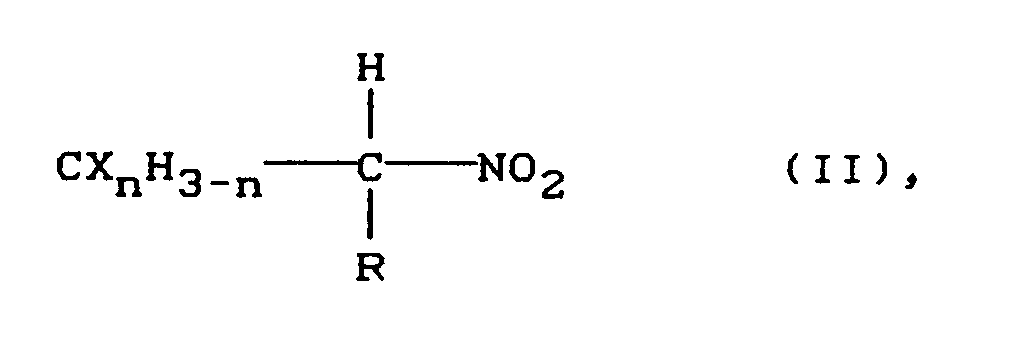
in Alkohol mit Natrium- oder Kaliumalkoholatlösung versetzt, auf eine Temperatur im Bereich -10 bis -100 C abkühlt und dann das Gemisch bei -10 bis -100 C mit Ozon reagieren läßt.
Claims (9)
1. Verfahren zur Herstellung von Halogenmethylketonen der Formel (I)

in der
dadurch gekennzeichnet, daß man eine Nitroverbindung der Formel (II) 
in der
X für Halogen,
n für 1, 2 oder 3 und
R für gegebenenfalls substituiertes C1-C20-Alkyl steht,
dadurch gekennzeichnet, daß man eine Nitroverbindung der Formel (II)
X, n und R die bei Formel (I) angegebene Bedeutung haben,
in Alkoholen mit Natrium- oder Kaliumalkoholatlösung versetzt, auf eine Temperatur im Bereich -10 bis -100 C abkühlt und dann das Gemisch bei -10 bis -100 C mit Ozon reagieren läßt.
2. Verfahren nach Anspruch 1, dadurch gekennzeichnet, daß in den Formel (I) und (II)

X für Fluor, Chlor und/oder Brom,
n für 2 oder 3, und
R für einen gegebenenfalls mit Halogenatomen, Arylgruppen mit 6 bis 10 C-Atomen, C=0-Gruppen, COOR'-Gruppen mit R' = C1-C6-Alkyl und/oder Acetalgruppen der Formel (III)
substituierten C1-C20-Alkylrest steht.
3. Verfahren nach Ansprüchen 1 und 2, dadurch gekennzeichnet, daß man als Verbindung der Formel (II) 1,1,1-Trifluor-2-nitro-propan einsetzt und als Halogenmethylketon der Formel (I) 1,1,1-Trifluoraceton erhält.
4. Verfahren nach Ansprüchen 1 bis 3, dadurch gekennzeichnet, daß man 0,8 bis 1,2 Mol Natrium- oder Kaliumalkoholat pro Mol Nitroverbindung der Formel (II) einsetzt und das Alkoholat bei Temperaturen im Bereich -80 bis + 60 C zugibt.
5. Verfahren nach Ansprüchen 1 bis 4, dadurch gekennzeichnet, daß man die Umsetzung mit Ozon bei Temperaturen im Bereich -50 bis -78°C durchführt.
6. Verfahren nach Ansprüchen 1 bis 5, dadurch gekennzeichnet, daß man Ozon gasförmig im Gemisch mit Sauerstoff oder gelöst in Alkohol zufügt.
7. Verfahren nach Ansprüchen 1 bis 6, dadurch gekennzeichnet, daß man 1 bis 1,2 Mole Ozon pro Mol der Nitroverbindung der Formel (II) einsetzt.
8. Verfahren nach Ansprüchen 1 bis 7, dadurch gekennzeichnet, daß man nach Beendigung der Reaktion überschüssigen Ozon ausbläst.
9. Verfahren nach Ansprüchen 1 bis 7, dadurch gekennzeichnet, daß man nach der Reaktion überschüssigen Ozon ausbläst, dann, gegebenenfalls nach Zusatz von Dimethylsulfid, leicht-flüchtige Bestandteile abdampft, den Rückstand mit Ether aufnimmt, die etherische Lösung mit Wasser und/oder Kochsalzlösung wäscht, anschließend trocknet, einengt und durch Destillation und/oder Kristallisation das hergestellte Halogenmethylketon der Formel (I) isoliert.
Applications Claiming Priority (2)
| Application Number | Priority Date | Filing Date | Title |
|---|---|---|---|
| DE4025188 | 1990-08-09 | ||
| DE4025188A DE4025188A1 (de) | 1990-08-09 | 1990-08-09 | Verfahren zur herstellung von halogenmethylketonen, insbesondere von 1,1,1-trifluoraceton |
Publications (2)
| Publication Number | Publication Date |
|---|---|
| EP0470462A2 true EP0470462A2 (de) | 1992-02-12 |
| EP0470462A3 EP0470462A3 (en) | 1992-06-17 |
Family
ID=6411889
Family Applications (1)
| Application Number | Title | Priority Date | Filing Date |
|---|---|---|---|
| EP19910112635 Withdrawn EP0470462A3 (en) | 1990-08-09 | 1991-07-27 | Process for the preparation of halogenated methylketones, especially 1,1,1-trifluoracetone |
Country Status (4)
| Country | Link |
|---|---|
| US (1) | US5093532A (de) |
| EP (1) | EP0470462A3 (de) |
| JP (1) | JPH04244041A (de) |
| DE (1) | DE4025188A1 (de) |
Cited By (1)
| Publication number | Priority date | Publication date | Assignee | Title |
|---|---|---|---|---|
| EP0754669A4 (de) * | 1995-02-03 | 1997-12-03 | Kaneka Corp | Verfahren zur herstellung von alpha-haloketonen, alpha-halohydrinen und epoxiden |
Families Citing this family (9)
| Publication number | Priority date | Publication date | Assignee | Title |
|---|---|---|---|---|
| EP0623575B1 (de) * | 1993-04-27 | 1998-11-11 | Solvay Fluor und Derivate GmbH | Verfahren zur Herstellung von Ketonen |
| DE19548416A1 (de) * | 1995-12-22 | 1997-06-26 | Bayer Ag | 3,3-Dioxy-4,4,4-trifluorbuttersäure-Derivate |
| GB2315268B (en) * | 1996-07-17 | 2000-05-10 | Rh Ne Poulenc Chemicals Ltd | Stabilization of perfluoroalkyl alkyl ketones |
| JP3523115B2 (ja) * | 1999-05-27 | 2004-04-26 | セントラル硝子株式会社 | 1,1,1−トリフルオロアセトンの製造方法 |
| US7842727B2 (en) * | 2001-03-27 | 2010-11-30 | Errant Gene Therapeutics, Llc | Histone deacetylase inhibitors |
| AU2003243285A1 (en) * | 2002-05-22 | 2003-12-12 | Errant Gene Therapeutics, Llc | Histone deacetylase inhibitors based on trihalomethylcarbonyl compounds |
| WO2003099272A1 (en) * | 2002-05-22 | 2003-12-04 | Errant Gene Therapeutics, Llc | Histone deacetylase inhibitors based on alpha-ketoepoxide compounds |
| MX382969B (es) * | 2013-10-23 | 2025-03-12 | Bayer Cropscience Ag | Método para producir halocetonas. |
| CN109876618A (zh) * | 2019-04-11 | 2019-06-14 | 大连海事大学 | 一种烟气污染物去除系统及方法 |
Family Cites Families (2)
| Publication number | Priority date | Publication date | Assignee | Title |
|---|---|---|---|---|
| FR1021801A (fr) * | 1947-07-11 | 1953-02-24 | Basf Ag | Procédé pour la préparation de cétones ou de composés cétoniques |
| US4172851A (en) * | 1977-12-01 | 1979-10-30 | Phillips Petroleum Company | Perfluoroalkyl alkyl ketones from alkanoic and perfluoroalkanoic anhydrides |
-
1990
- 1990-08-09 DE DE4025188A patent/DE4025188A1/de not_active Withdrawn
-
1991
- 1991-07-27 EP EP19910112635 patent/EP0470462A3/de not_active Withdrawn
- 1991-07-31 US US07/739,112 patent/US5093532A/en not_active Expired - Fee Related
- 1991-08-05 JP JP3218050A patent/JPH04244041A/ja active Pending
Cited By (1)
| Publication number | Priority date | Publication date | Assignee | Title |
|---|---|---|---|---|
| EP0754669A4 (de) * | 1995-02-03 | 1997-12-03 | Kaneka Corp | Verfahren zur herstellung von alpha-haloketonen, alpha-halohydrinen und epoxiden |
Also Published As
| Publication number | Publication date |
|---|---|
| DE4025188A1 (de) | 1992-02-13 |
| US5093532A (en) | 1992-03-03 |
| EP0470462A3 (en) | 1992-06-17 |
| JPH04244041A (ja) | 1992-09-01 |
Similar Documents
| Publication | Publication Date | Title |
|---|---|---|
| DE2337813B2 (de) | Verfahren zur herstellung von monoacetalen aromatischer 1,2-diketone | |
| DD290188A5 (de) | Chemische prozesse | |
| EP0040356B1 (de) | Verfahren zur Herstellung von Trimethylsilylcyanid | |
| EP0228701B1 (de) | 2-Iod-perfluor-2-methylalkane, Verfahren zu deren Herstellung und deren Verwendung | |
| DE69508599T2 (de) | Verfahren zur reinigung von 2,6-diisopropylphenol | |
| DE4025188A1 (de) | Verfahren zur herstellung von halogenmethylketonen, insbesondere von 1,1,1-trifluoraceton | |
| EP0415214B1 (de) | Verfahren zur Herstellung von alpha-Fluoracrylsäurederivaten | |
| EP0597329B1 (de) | Verfahren zur Herstellung von alpha-Fluor -beta-dicarbonylverbindungen | |
| DE69803909T2 (de) | Verfahren und Zwischenprodukte, die für die Herstellung von Antifolaten verwendbar sind | |
| DE2361058A1 (de) | 1.2.2.2-tetrafluoraethyl-chlorfluormethylaether und verfahren zu dessen herstellung | |
| EP0608713B1 (de) | 2,3-Difluor-6-nitrobenzonitril und 2-Chlor-5,6-difluorbenzonitril, Verfahren zu deren Herstellung und ihre Verwendung zur Herstellung von 2,3,6-Trifluorbenzoesäure | |
| EP0057844A1 (de) | Verfahren zur Herstellung von Polychlorbenzoylchloriden | |
| EP0079004B1 (de) | Verfahren zur Herstellung von Acylcyaniden | |
| EP0302331B1 (de) | Ester von Arylbisperfluoralkylcarbinolen, Verfahren zur Herstellung dieser Verbindungen und der zugrundeliegenden Arylbisperfluoralkylcarbinole | |
| DE2702088C2 (de) | Verfahren zur Autoxidation eines Cycloalkanons zu dem entsprechenden Cycloalkan-1,2-dion | |
| DE19532815A1 (de) | Verfahren zur Herstellung von 2-(4-Hydroxyphenoxy)-propionsäureestern | |
| EP0076985A1 (de) | Verfahren zur Herstellung von Alpha-Dicyano-trimethyl-silyloxy-Verbindungen (I) | |
| EP0046193B1 (de) | 1-Hydroxypyrazol und Verfahren zu seiner Herstellung | |
| EP0459196B1 (de) | Fluormethylierte Polycyanbenzole, deren Alkalicyanid-Addukte, Verfahren zu ihrer Herstellung und Verwendung der fluormethylierten Polycyanbenzole | |
| EP0596395A1 (de) | Fluorierte Benzile und Verfahren zu ihrer Herstellung | |
| EP0442431A1 (de) | Verfahren zur Herstellung von Quadratsäure | |
| DE2150146A1 (de) | Verfahren zur Herstellung von niederen Alkylestern von Flavon-7-oxyessigsaeure | |
| EP0365914A2 (de) | Neue Fluor enthaltende und an der CH3-Gruppe gegebenenfalls halogenierte Acetophenone und deren Herstellung aus neuen Fluor enthaltenden Benzonitrilen | |
| DE2619321C2 (de) | Oxalsäurederivate, ihre Herstellung und ihre Verwendung | |
| EP0317888B1 (de) | Neue fluorierte Nitroalkylverbindungen und ein Verfahren zur Herstellung von neuen und bekannten fluorierten Nitroalkylverbindungen |
Legal Events
| Date | Code | Title | Description |
|---|---|---|---|
| PUAI | Public reference made under article 153(3) epc to a published international application that has entered the european phase |
Free format text: ORIGINAL CODE: 0009012 |
|
| AK | Designated contracting states |
Kind code of ref document: A2 Designated state(s): DE FR GB |
|
| PUAL | Search report despatched |
Free format text: ORIGINAL CODE: 0009013 |
|
| AK | Designated contracting states |
Kind code of ref document: A3 Designated state(s): DE FR GB |
|
| 17P | Request for examination filed |
Effective date: 19920808 |
|
| STAA | Information on the status of an ep patent application or granted ep patent |
Free format text: STATUS: THE APPLICATION HAS BEEN WITHDRAWN |
|
| 18W | Application withdrawn |
Withdrawal date: 19930816 |