EP0470516B1 - Verfahren zur Herstellung eines Derivats von 3,5-Di(alpha-methylbenzyl)salicylsäure und Verwendung eines mit mehrwertigem Metall modifizierten Produktes davon als Farbentwickler - Google Patents
Verfahren zur Herstellung eines Derivats von 3,5-Di(alpha-methylbenzyl)salicylsäure und Verwendung eines mit mehrwertigem Metall modifizierten Produktes davon als Farbentwickler Download PDFInfo
- Publication number
- EP0470516B1 EP0470516B1 EP91113010A EP91113010A EP0470516B1 EP 0470516 B1 EP0470516 B1 EP 0470516B1 EP 91113010 A EP91113010 A EP 91113010A EP 91113010 A EP91113010 A EP 91113010A EP 0470516 B1 EP0470516 B1 EP 0470516B1
- Authority
- EP
- European Patent Office
- Prior art keywords
- salicylic acid
- methylbenzyl
- acid derivative
- polyvalent
- metal
- Prior art date
- Legal status (The legal status is an assumption and is not a legal conclusion. Google has not performed a legal analysis and makes no representation as to the accuracy of the status listed.)
- Expired - Lifetime
Links
- 0 *c(cccc1)c1O Chemical compound *c(cccc1)c1O 0.000 description 2
Images

Classifications
-
- C—CHEMISTRY; METALLURGY
- C07—ORGANIC CHEMISTRY
- C07C—ACYCLIC OR CARBOCYCLIC COMPOUNDS
- C07C65/00—Compounds having carboxyl groups bound to carbon atoms of six—membered aromatic rings and containing any of the groups OH, O—metal, —CHO, keto, ether, groups, groups, or groups
- C07C65/01—Compounds having carboxyl groups bound to carbon atoms of six—membered aromatic rings and containing any of the groups OH, O—metal, —CHO, keto, ether, groups, groups, or groups containing hydroxy or O-metal groups
- C07C65/03—Compounds having carboxyl groups bound to carbon atoms of six—membered aromatic rings and containing any of the groups OH, O—metal, —CHO, keto, ether, groups, groups, or groups containing hydroxy or O-metal groups monocyclic and having all hydroxy or O-metal groups bound to the ring
- C07C65/05—Compounds having carboxyl groups bound to carbon atoms of six—membered aromatic rings and containing any of the groups OH, O—metal, —CHO, keto, ether, groups, groups, or groups containing hydroxy or O-metal groups monocyclic and having all hydroxy or O-metal groups bound to the ring o-Hydroxy carboxylic acids
- C07C65/10—Salicylic acid
-
- C—CHEMISTRY; METALLURGY
- C07—ORGANIC CHEMISTRY
- C07C—ACYCLIC OR CARBOCYCLIC COMPOUNDS
- C07C69/00—Esters of carboxylic acids; Esters of carbonic or haloformic acids
- C07C69/76—Esters of carboxylic acids having a carboxyl group bound to a carbon atom of a six-membered aromatic ring
- C07C69/94—Esters of carboxylic acids having a carboxyl group bound to a carbon atom of a six-membered aromatic ring of polycyclic hydroxy carboxylic acids, the hydroxy groups and the carboxyl groups of which are bound to carbon atoms of six-membered aromatic rings
-
- B—PERFORMING OPERATIONS; TRANSPORTING
- B41—PRINTING; LINING MACHINES; TYPEWRITERS; STAMPS
- B41M—PRINTING, DUPLICATING, MARKING, OR COPYING PROCESSES; COLOUR PRINTING
- B41M5/00—Duplicating or marking methods; Sheet materials for use therein
- B41M5/124—Duplicating or marking methods; Sheet materials for use therein using pressure to make a masked colour visible, e.g. to make a coloured support visible, to create an opaque or transparent pattern, or to form colour by uniting colour-forming components
- B41M5/132—Chemical colour-forming components; Additives or binders therefor
- B41M5/155—Colour-developing components, e.g. acidic compounds; Additives or binders therefor; Layers containing such colour-developing components, additives or binders
-
- B—PERFORMING OPERATIONS; TRANSPORTING
- B41—PRINTING; LINING MACHINES; TYPEWRITERS; STAMPS
- B41M—PRINTING, DUPLICATING, MARKING, OR COPYING PROCESSES; COLOUR PRINTING
- B41M5/00—Duplicating or marking methods; Sheet materials for use therein
- B41M5/26—Thermography ; Marking by high energetic means, e.g. laser otherwise than by burning, and characterised by the material used
- B41M5/30—Thermography ; Marking by high energetic means, e.g. laser otherwise than by burning, and characterised by the material used using chemical colour formers
- B41M5/333—Colour developing components therefor, e.g. acidic compounds
- B41M5/3333—Non-macromolecular compounds
- B41M5/3335—Compounds containing phenolic or carboxylic acid groups or metal salts thereof
-
- C—CHEMISTRY; METALLURGY
- C07—ORGANIC CHEMISTRY
- C07C—ACYCLIC OR CARBOCYCLIC COMPOUNDS
- C07C51/00—Preparation of carboxylic acids or their salts, halides or anhydrides
- C07C51/347—Preparation of carboxylic acids or their salts, halides or anhydrides by reactions not involving formation of carboxyl groups
Definitions
- the present invention relates to a novel process for producing a 3,5-di( ⁇ -methylbenzyl)salicylic acid derivative useful as a color developer for pressure-sensitive copying paper or heat-sensitive paper, as well as to a color developer containing a polyvalent-metal-modified product of the 3,5-di( ⁇ -methylbenzyl)salicylic acid derivative.
- Salicylic acid type compounds when used as a color developer for pressure-sensitive paper or heat-sensitive paper, are generally excellent in clearness of developed color image, storage stability, etc.
- a salicylic acid type compound as a color developer
- problems of (a) slow color development due to the insufficient compatibility of said compound with a capsule oil used for dissolution of a color former and (b) insufficient water resistance of developed color image, i.e. disappearance of said image by dissolution in water.
- Various attempts have been made in order to alleviate these problems. For example, it has been proposed to introduce an aromatic substituent into the salicylic acid skeleton.
- a color-developing sheet coated with a color developer consisting of, in particular, a polyvalent-metal-modified product of a salicylic acid compound with a benzyl group having a methyl group at the ⁇ -position shows outstanding color developability and has excellent resistance to yellowing when exposed to sunlight, excellent stability of developed color image and excellent resistance to yellowing by nitrogen oxides in air; therefore, the sheet is very advantageous in handling and storage.
- the above color developer however, has drawbacks in that its slight solubility in water causes the disappearance of developed color image by water and its high melting point (190-220°C) makes slow the rate of its dissolution in a capsule oil containing a color precursor. This leads to inferior initial-stage color developability at low temperatures and limited use in cold districts.
- the objects of the present invention are to develop an economical process for producing a 3,5-di( ⁇ -methylbenzyl)salicylic acid derivative which can be used as a color developer having excellent color developability and giving a developed color image with excellent resistance to yellowing by light, and to provide a color developer using said derivative and a color developer composition significantly improved in color developability at low temperatures and in water resistance of developed color image.
- the present inventors made extensive study in order to achieve the above objects. As a result, the present inventors found a process comprising reacting a salicylic acid ester with an ⁇ -methylbenzyl halide in the presence of an acid catalyst to form a 3,5-di( ⁇ -methylbenzyl)salicylic acid ester and then hydrolyzing it to produce a 3,5-di( ⁇ -methylbenzyl)salicylic acid derivative.
- the 3,5-di( ⁇ -methylbenzyl)salicylic acid derivative when the reaction mixture is subjected, prior to being hydrolyzed, to vacuum distillation to isolate the 3,5-di( ⁇ -methylbenzyl)salicylic acid ester, the 3,5-di( ⁇ -methylbenzyl)salicylic acid derivative can be obtained at a purity of 99% or higher.
- the present inventors also found that the above objects can further be achieved by reacting a salicylic acid ester with an ⁇ -methylbenzyl halide in the presence of an acid catalyst, then hydrolyzing the reaction product to produce an ⁇ -methylbenzyl-substituted salicylic acid derivative composition containing 60-90% by weight of a 3,5-di( ⁇ -methylbenzyl)salicylic acid derivative, converting the composition to a polyvalent-metal-modified product, and using the polyvalent-metal-modified product as a color developer.
- the process of the present invention can produce a 3,5-di( ⁇ -methylbenzyl)salicylic acid derivative from inexpensive starting materials in a simple procedure and accordingly is preferable for industrial application.
- the color-developing sheet using a polyvalent-metal-modified product of an ⁇ -methylbenzyl-substituted salicylic acid derivative composition produced according to the present invention composed mainly of a 3,5-di( ⁇ -methylbenzyl)salicylic acid derivative, has excellent color developability at low temperatures and accordingly is preferably used at low temperatures (conventional color-developing sheets of similar technique have had insufficient color developability at low temperatures).
- the color-developing sheet is free from a problem of disappearance of developed color image by water. Therefore, the color-developing sheet can be used stably in the fields which have restricted the use of conventional color-developing sheets of similar technique.
- Fig. 1 shows an example of the analytical results when the 3,5-di( ⁇ -methylbenzyl)salicylic acid isolated according to the present process has been subjected to high-performance liquid chromatography.
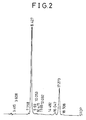
- Fig. 2 shows an example of the analytical results when the ⁇ -methylbenzyl-substituted salicylic acid derivative composition obtained according to the present process has been subjected to high-performance liquid chromatography.
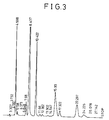
- Fig. 3 shows an example of the analytical results when the 3,5-di( ⁇ -methylbenzyl)salicylic acid-containing oily substance obtained according to a conventional process has been subjected to high-performance liquid chromatography.
- the present invention provides (1) a process for producing a 3,5-di( ⁇ -methylbenzyl)salicylic acid derivative, which comprises reacting a salicylic acid ester represented by the general formula (I) (R1 represents an alkyl group, an aralkyl group or a cycloalkyl group each having at most 12 carbon atoms) with an ⁇ -methylbenzyl halide represented by the general formula (II) (R2 and R3 each represent a hydrogen atom or an alkyl group of 1-4 carbon atoms, and X represents a halogen atom) in the presence of an acid catalyst and hydrolyzing the resulting 3,5-di( ⁇ -methylbenzyl)salicylic acid ester, (2) a polyvalent-metal-modified product of the ⁇ -methylbenzyl-substituted salicylic acid derivative composition containing 60-90% by weight of a 3,5-di( ⁇ -methylbenzyl)salicylic acid derivative, obtained by the above process, and (3) a
- the salicylic acid ester used in the present invention includes methyl salicylate, ethyl salicylate, n-propyl salicylate, isopropyl salicylate, isoamyl salicylate, tert-octyl salicylate, nonyl salicylate, dodecyl salicylate, cyclohexyl salicylate, benzyl salicylate, ⁇ -methylbenzyl salicylate, etc.
- the salicylic acid ester is not restricted to these compounds. Methyl salicylate and ethyl salicylate are preferable industrially.
- the type of halogen includes chlorine and bromine. Chlorine is preferable.
- the ⁇ -methylbenzyl halide includes ⁇ -methylbenzyl chloride, o-methyl- ⁇ -methylbenzyl chloride, p-methyl- ⁇ -methylbenzyl chloride, m-methyl- ⁇ -methyl-benzyl chloride, o-ethyl- ⁇ -methylbenzyl chloride, p-ethyl- ⁇ -methylbenzyl chloride, p-isopropyl- ⁇ -methylbenzyl chloride, 2,3-dimethyl- ⁇ -methylbenzyl chloride, 2,4-dimethyl- ⁇ -methylbenzyl chloride, 2,5-dimethyl- ⁇ -methylbenzyl chloride and 3,4-dimethyl- ⁇ -methylbenzyl chloride.
- the ⁇ -methylbenzyl halide is not restricted to these compounds. Of these compounds, ⁇ -methylbenzyl chloride and
- the amount of the ⁇ -methylbenzyl halide used in the process of the present invention is preferably 1.5-3 moles per mole of the salicylic acid ester represented by the general formula (I).
- the amount is less than 1.5 moles or more than 3 moles, the yield of a 3,5-di( ⁇ -methylbenzyl)salicylic acid ester as a main precursor is low.
- Lewis acids such as ferric chloride, zinc chloride, aluminum chloride, stannic chloride, titanium tetrachloride and boron trifluoride, and superacids such as perfluoroalkanesulfonic acid (e.g. trifluoromethanesulfonic acid) and perfluoroalkanesulfonic acid resin [e.g. Nafion H (trademark of Du Pont)].
- perfluoroalkanesulfonic acid e.g. trifluoromethanesulfonic acid
- perfluoroalkanesulfonic acid resin e.g. Nafion H (trademark of Du Pont)
- zinc chloride is particularly preferable.
- the amount of the catalyst used is 0.05-200 mole % and, in view of the economy, preferably 0.1-100 mole % based on the salicylic acid ester.
- the reaction temperature is 0-180 o C, preferably 5-80 o C, more preferably 10-40 o C.
- the reaction time is ordinarily 1-120 hours.
- a solvent may be used as necessary.
- the solvent there can be used those inactive to the reaction, for example, halogenated hydrocarbons such as 1,2-dichloroethane and 1,1,2-trichloroethane, and organic acids such as acetic acid and propionic acid.
- the amount of the solvent when used is desirably not more than 30 (volume/weight) times the total amount of the raw materials in view of the economy.
- the reaction of the salicylic acid ester with the ⁇ -methylbenzyl halide is generally carried out by feeding necessary amounts of the salicylic acid ester of the general formula (I), the ⁇ -methylbenzyl halide of the general formula (II) and the catalyst at one time and reacting them at a predetermined temperature, or by feeding the salicylic acid ester and the catalyst first and then adding the ⁇ -methylbenzyl halide dropwise to react them.
- the end point of the reaction can be determined by examining the decrease of the raw materials, i.e. the salicylic acid ester and the ⁇ -methylbenzyl halide by means of high-performance liquid chromatography.
- the hydrolysis is carried out according to an ordinary method using an aqueous acid or alkali solution.
- the hydrolysis using an aqueous acid solution is carried out by using water and an acid, i.e. a mineral acid (e.g. hydrochloric acid, sulfuric acid), a combination of sulfuric acid and acetic acid, an organic sulfonic acid (e.g. benzenesulfonic acid, p-toluenesulfonic acid, chlorobenzenesulfonic acid, methanesulfonic acid), a Lewis acid (e.g. aluminum chloride, zinc chloride, stannic chloride), or a superacid (e.g. trifluoromethanesulfonic acid, Nafion H).
- a mineral acid e.g. hydrochloric acid, sulfuric acid
- a combination of sulfuric acid and acetic acid e.g. benzenesulfonic acid, p-toluenesulfonic
- the hydrolysis using an aqueous alkali solution is generally carried out by using water and sodium hydroxide or potassium hydroxide.
- the ratio of the acid or alkali and water can be selected freely but is generally 1:100 to 99:1, preferably 5:95 to 95:5 by weight.
- the amount of the acid or alkali used in the hydrolysis can be any amount relative to the amount of the salicylic acid ester as a raw material.
- the amount of the acid is generally 0.05-30 moles per mole of the salicylic acid ester depending upon the intensity of the acid, and the amount of the alkali is an equivalent to 30 moles.
- the reaction temperature is 50-200 o C, preferably 80-160 o C.
- the reaction time is 1-50 hours.
- phase-transfer catalyst such as quaternary phosphonium salt, crown ether, cryptate or polyethylene glycol.
- the hydrolysis reaction is carried out ordinarilly by using no organic solvent, but may use an organic solvent.
- an organic solvent there may be used aprotic polar solvents such as N-methylformamide, N,N-dimethylformamide, N,N-dimethylacetamide, dimethyl sulfoxide, sulfolane, 1,3-dimethyl-2-imidazolidinone, N-methylpyrrolidone and hexamethylphosphoric triamide, and glycols such as ethylene glycol, polyethylene glycol dialkyl ether, 2-methoxyethanol and 2-ethoxyethanol.
- solvents having no miscibility with water such as toluene, xylene, monochlorobenzene, 1,2-dichloroethane and 1,1,2-trichloroethane.
- the amount of the solvent used is sufficiently 0.5-10 (volume/weight) times the total amount of the raw materials.
- the reaction mixture after the hydrolysis contains a reaction product composed of 60-90% by weight of a 3,5-di( ⁇ -methylbenzyl)salicylic acid derivative, 0-40% by weight of a 3-or 5-( ⁇ -methylbenzyl)salicylic acid derivative (hereinafter abbreviated to a monosubstituted salicylic acid derivative) and 0-40% by weight of a salicylic acid compound formed by the reaction of said 3,5-di( ⁇ -methylbenzyl)salicylic acid derivative with an ⁇ -methylbenzyl group (said salicylic acid compound is hereinafter abbreviated to a trisubstituted salicylic acid derivative), in which reaction product said three components occupy 95% by weight or more of the total and the remainder is occupied by aromatic salicylic acid resins and oligomers of ⁇ -methylbenzyl halide. Since the hydrolysis is carried out substantially quantitatively, the proportions of the corresponding components of ester form before the hydrolysis are thought to be about the same as
- the above reaction product which is composed mainly of a 3,5-di( ⁇ -methylbenzyl)salicylic acid derivative and which may further contain mono- and/or trisubstituted salicylic acid derivative, is referred, in the present invention, to an ⁇ -methylbenzyl-substituted salicylic acid derivative composition.
- the reaction product before hydrolysis is subjected to vacuum distillation to separate a 3,5-di( ⁇ -methylbenzyl)salicylic acid ester and the ester is hydrolyzed.
- This production process is inexpensive as compared with the conventionally known process using phenol as a raw material and has a high selectivity as compared with the process using a salicylic acid ester and a styrene compound; therefore, it is a very advantageous process in industrial application.
- reaction mixture In order to obtain a reaction product from the reaction mixture after hydrolysis, the reaction mixture is neutralized and, when the precipitation of crystals is already over, the crystals are isolated to obtain the reaction product.
- the reaction product When the reaction product is dissolved in the solvent used, the solvent is removed by distillation or the reaction mixture is added to water, to obtain the reaction product as crystals.
- salicylic acid derivative and the salicylic acid derivative composition are generically referred to simply as salicylic acid compound).
- the polyvalent-metal-modified product is produced by reacting an alkali metal salt of the salicylic acid compound with a water-soluble polyvalent metal salt in water or in a solvent in which the two metal salts are soluble.
- the salicylic acid compound is dispersed in an aqueous solution, an alcohol solution or an aqueous alcohol solution each containing a hydroxide, carbonate or alkoxide of an alkali metal in an amount at least equivalent to the carboxyl group of the salicylic acid compound, and is dissolved therein at 0-100 o C; to the resulting solution is added a water-soluble polyvalent metal salt as it is or in the form of an aqueous solution, an alcohol solution or an aqueous alcohol solution; a reaction is carried out at 0-100 o C to obtain a polyvalent metal salt of the salicylic acid compound as a precipitate. It is desirable to react the water soluble polyvalent metal salt of about 0.5-1 equivalent to the carboxyl group of the salicylic acid compound.
- the metal of the polyvalent-metal-modified product used in the present invention includes metals excluding alkali metals such as lithium, sodium and potassium.
- alkali metals such as lithium, sodium and potassium.
- polyvalent metals there can be mentioned calcium, magnesium, aluminum, copper, zinc, tin, barium, cobalt and nickel. Of these, zinc is particularly useful.
- the thus obtained polyvalent-metal-modified product of the salicylic acid compound exhibits excellent properties when used as a color developer.
- the polyvalent-metal-modified product is ground by a grinder, for example, a sand grinding mill so as to have an appropriate particle size.
- the ground polyvalent-metal-modified product is suspended or dissolved in a solvent to convert into a desired form.
- a known color developer such as inorganic solid acid (e.g. activated clay), organic polymer (e.g. phenol-formaldehyde resin) or other aromatic carboxylic acid metal salt.
- polyvalent-metal-modified product in combination with at least one oxide, hydroxide or carbonate of polyvalent metals selected from the group consisting of zinc, magnesium, aluminum, lead, titanium, calcium, cobalt, nickel, manganese and barium.
- the preparation of a color-developing sheet used for pressure-sensitive copying from the color developer of the present invention can be carried out, for example, by (1) a method wherein an aqueous coating is prepared by using an aqueous suspension of the polyvalent-metal-modified product and it is coated on a substrate such as paper or the like, (2) a method wherein a paper is manufactured in the presence of the polyvalent-metal-modified product, and (3) a method wherein a coating is prepared by using a solution or suspension of the polyvalent-metal-modified product in an organic solvent and it is coated on a substrate.
- the color developer layer In order to form, by coating, a color developer layer on a substrate such as paper or the like, it is desirable that the color developer have an appropriate viscosity and appropriate coatability. Therefore, the above aqueous suspension or the above solution or suspension in solvent is mixed with kaolin, clay, calcium carbonate, starch and synthetic or natural latex to prepare a coating of appropriate viscosity and coatability.
- the proportion of the color developer component is desirably 10-70% based on the total solid content. When the proportion is less than 10%, no sufficient color development is obtained. When the proportion is more than 70%, the resulting color-developing sheet has degraded surface properties.
- the amount of the coating applied is 0.5 g/m, preferably 1-10 g/m in terms of dry weight.
- color-developing sheets for pressure-sensitive copying were prepared as follows and these sheets were measured for properties according to the following methods: The results of the property measurements are shown in Table 1 and Table 2.
- suspensions having the following formulation were prepared.
- Suspension 10 parts by weight Light calcium carbonate 10 parts by weight Starch 0.8 part by weight Synthetic rubber latex 0.8 part by weight Water 32.5 parts by weight
- Each of the coatings was coated on a high-quality paper so that the coated amount as dried became 5.0-5.5 g/m, and dried to obtain color-developing sheets.
- a sample color-developing sheet coated with an aqueous coating was contacted with a blue-color-developing sheet on the market [NW-40T (trade name), a product of Jujo Paper Co., Ltd.] containing Crystal Violet Lactone (CVL) as a main pressure-sensitive color precursor, in such a way that the coated sides of the two sheets faced each other. They were typed by an electronic typewriter to develop a color.
- NW-40T trade name
- CVL Crystal Violet Lactone
- the developed color was measured for density one minute and 30 seconds after the typing and 24 hours after the typing, and the densities were each expressed as Y value.
- a sample color-developing sheet which had been subjected to color development in the manner described in the above 2, was exposed to light for 2 hours (and for 4 hours) in a carbon arc fade meter (manufactured by Suga Testing Machine Co., Ltd.). After the exposure, the reflectance of the developed color image was measured by ⁇ -80 Color Difference Meter, and expressed as Y value.
- a dioctyl phthalate (DOP) microcapsule coated paper sheet was prepared by forming microcapsules, which contained DOP as a core substance, had an average size of 5.0 ⁇ m, and were equipped with melamine-formaldehyde resin capsule walls, adding thereto a small amount of a starch-type liquid binder to obtain a coating solution, applying the coating solution onto a high-quality paper by an air-knife coater so that the coated amount as dried became 5 g/m, and then drying the thus-coated paper.
- the DOP microcapsule coated paper sheet was contacted with the color-developing sheet with a developed color image produced in the above 2, in such a way that the coated sides of the two sheets faced each other. They were allowed to pass through a super calender roll having a linear pressure of 100 kg/cm, whereby DOP was allowed to penetrate uniformly into the colored surface of the color-developing sheet.
- the reflectance of the color-developing sheet was measured by ⁇ -80 Color Difference meter and expressed as Y value.
- a sample color-developing sheet which had been subjected to color development in the same manner as in the above 2, was dipped in water for 2 hours. Change in density of the developed color image was observed visually.
- a sample color-developing sheet was stored for 1 hour in a closed vessel of an atmosphere of NO x gas generated by the reaction of NaNO2 (sodium sulfite) and H3PO4 (phosphoric acid), to examine the degree of its yellowing.
- NaNO2 sodium sulfite
- H3PO4 phosphoric acid
- the reflectance of the color-developing sheet was measured by ⁇ -80 Color Difference Meter, and expressed as WB value.
- WB value The greater the WB value and the smaller its difference from the WB value of a sheet not exposed to NO x gas (expressed as untested sheet in Table 2), the smaller the yellowing property in an NO x atmosphere.
- a sample color-developing sheet was exposed to light for 4 hours in a carbon arc fade meter (manufactured by Suga Testing Machine Co., Ltd.). After the exposure, the reflectance of the sample color-developing sheet was measured by ⁇ -80 Color Difference Meter and expressed as WB value. The greater the WB value and the smaller its difference from the WB value of an unexposed sheet (expressed as untested sheet in Table 2), the smaller the yellowing property upon exposure to light.
- the residue was subjected to high-performance liquid chromatography (HLC) and found to consist of 3% of methyl ester of monosubstituted salicylic acid, 89.5% of methyl ester of disubstituted salicylic acid and 7.5% of methyl ester of trisubstituted salicylic acid.
- the residue was then subjected to vacuum distillation at 1-3 mmHg to take out a distillate fraction of 213-218 o C to obtain 291 g (yield: 81%) of methyl ester of 3,5-di( ⁇ -methylbenzyl)salicylic acid.
- Example 2 69.2 g (0.2 mole) of the 3,5-di( ⁇ -methylbenzyl)-salicylic acid obtained in Example 1 was dissolved in an aqueous alkali solution obtained by dissolving 8.8 g of 95% sodium hydroxide (0.21 mole as NaOH) in 500 g of water. The resulting aqueous solution was dropwise added, in 1 hour, to an aqueous solution obtained by dissolving 31.6 g of zinc sulfate heptahydrate in 300 ml of water, and the mixture was aged for 1 hour. Then, the mixture was filtered. The filtrate was water-washed and dried to obtain 70 g of zinc salt of 3,5-di( ⁇ -methylbenzyl)salicylic acid.
- the lower aqueous layer was removed, and in the same manner as in Example 1, the organic layer was subjected to distillation to remove the solvent.
- the residue was found by HLC to consist of 6% of ethyl salicylate, 4.5% of ethyl ester of monosubstituted salicylic acid, 76.8% of ethyl ester of disubstituted salicylic acid and 12.7% of ethyl ester of trisubstituted salicylic acid.
- the residue was subjected to vacuuum distillation to obtain 26.2 g (yield: 70%) of ethyl ester of 3,5-di( ⁇ -methylbenzyl)salicylic acid.
- the ester was hydrolyzed with 40% sodium hydroxide to obtain 23.7 g (yield: 98%) of 3,5-di( ⁇ -methylbenzyl)salicylic acid of 99% purity.
- the hydrolyzate was found by HLC to consist of 2% of salicylic acid, 13% of monosubstituted salicylic acid, 67% of disubstituted salicylic acid, 17% of trisubstituted salicylic acid and 1% of others.
- 700 ml of water was added for dilution.
- the dilution product was adjusted to pH 9 with sulfuric acid.
- Thereto was dropwise added 180 g of a 43% aqueous zinc sulfate solution, at 30 o C in 1 hour.
- the mixture was aged for 1 hour and filtered.
- the filtrate was water-washed and dried to obtain 200 g of zinc salt of an ⁇ -methylbenzyl-substituted salicylic acid composition.
- the hydrolyzate was found by HLC to consist of 12% of monosubstituted salicylic acid, 68% of disubstituted salicylic acid , 18% of trisubstituted salicylic acid and 2% of others.
- 700 ml of water was added for dilution.
- the dilution product was adjusted to pH 9 with sulfuric acid.
- Thereto was dropwise added 180 g of a 43% aqueous zinc sulfate solution at 30 o C in 1 hour.
- the mixture was aged for 1 hour and filtered.
- the filtrate was water-washed and dried to obtain 200 g of zinc salt of an ⁇ -methylbenzyl-substituted salicylic acid composition.
- the mixture was aged at 98-100 o C for 5 hours to complete hydrolysis.
- the hydrolyzate was found by HLC to consist of 7% of monosubstituted salicylic acid, 80% of disubstituted salicylic acid and 13% of trisubstituted salicylic acid.
- 700 ml of water was added for dilution.
- the dilution product was adjusted to pH 9 with sulfuric acid.
- Thereto was dropwise added 180 g of a 43% aqueous zinc sulfate solution at 30 o C in 1 hour.
- the mixture was aged for 1 hour and filtered.
- the filtrate was water-washed and dried to obtain 200 g of zinc salt of an ⁇ -methylbenzyl-substituted salicylic acid composition.
- the hydrolyzate was found by HLC to consist of 88% of disubstituted salicylic acid, 11% of trisubstituted salicylic acid and 1% of others (Fig. 2).
- RT 8.427 indicates 3,5-di( ⁇ -methylbenzyl)salicylic acid.
- 700 ml of water was added for dilution.
- the dilution product was adjusted to pH 9 with sulfuric acid.
- Thereto was dropwise added 180 g of a 43% aqueous zinc sulfate solution at 30 o C in 1 hour.
- the mixture was aged for 1 hour and filtered.
- the filtrate was water-washed and dried to obtain 200 g of zinc salt of 3,5-di( ⁇ -methylbenzyl)salicylic acid.
Landscapes
- Chemical & Material Sciences (AREA)
- Organic Chemistry (AREA)
- Chemical Kinetics & Catalysis (AREA)
- General Chemical & Material Sciences (AREA)
- Engineering & Computer Science (AREA)
- Oil, Petroleum & Natural Gas (AREA)
- Physics & Mathematics (AREA)
- Optics & Photonics (AREA)
- Organic Low-Molecular-Weight Compounds And Preparation Thereof (AREA)
- Color Printing (AREA)
Claims (9)
- Verfahren zur Erzeugung eines 3,5-Di(alpha-methylbenzyl)salicylsäurederivats, welches die Reaktion eines Salicylsäureesters, der durch die allgemeine Formel (I)


- Verfahren nach Anspruch 1, worin der 3,5-Di(alpha-methylbenzyl)-salicylsäureester von der Reaktionsmischung durch Vakuumdestillation abgetrennt wird, bevor die Hydrolyse stattfindet.
- Eine alpha-Methylbenzyl-substituierte Salicylsäurederivat-Zusammensetzung, die 60 - 90 Gewichts-% eines 3,5-Di(alphamethylbenzyl)-salicylsäurederivats umfaßt und die erhalten worden ist durch Reaktion eines Salicylsäureesters, der durch die allgemeine Formel (I) repräsentiert wird,


- Eine alpha-Methylbenzyl-substituierte Salicylsäurederivat-Zusammensetzung nach Anspruch 3, die 0 - 40 Gewichts-% eines alpha-Methylbenzyl-monosubstituierten Salicylsäurederivats, 0 - 40 Gewichts-% eines alpha-Methylbenzyl-trisubstituierten Salicylsäurederivats und 60 - 90 Gewichts-% eines 3,5-Di(alphamethylbenzyl)-salicylsäurederivats enthält, und worin die drei Salicylsäurederivate 95 Gewichts-% oder mehr der Zusammensetzung ausmachen.
- Ein polyvalentes metallmodifiziertes Produkt einer alpha-Methylbenzyl-substituierten Salicylsäurederivat-Zusammensetzung, die 60 - 90 Gewichts-% eines polyvalenten metallmodifizierten Produktes eines 3,5-Di(alpha-methylbenzyl)salicylsäurederivats enthält, und welches erhalten wurde durch Reaktion der alpha-Methylbenzyl-substituierten Salicylsäurederivat-Zusammensetzung nach Anspruch 3 mit einem polyvalenten Metallsalz.
- Ein polyvalentes metallmodifiziertes Produkt aus einer alpha-Methylbenzyl-substituierten Salicylsäurederivat-Zusammensetzung, die 0 - 40 Gewichts-% eines polyvalenten metallmodifizierten Produktes eines alpha-Methylbenzyl-monosubstituierten Salicylsäurederivats, 0 - 40 Gewichts -% eines polyvalenten metallmodifizierten Produktes eines alpha-Methylbenzyl-trisubstituierten Salicylsäurederivats und 60 - 90 Gewichts-% eines polyvalenten metallmodifizierten Produktes eines 3,5-Di(alpha-methylbenzyl)-salicylsäurederivats umfaßt, worin die 3 metallmodifizierten Produkte wenigstens 95 Gewichts-% des Gesamten einnehmen und die erhalten worden sind durch Reaktion der alpha-Methylbenzyl-substituierten Salicylsäurederivat-Zusammensetzung nach Anspruch 4 mit einem polyvalenten Metallsalz.
- Verfahren nach Anspruch 2, welches weiterhin die Reaktion des 3,5-Di(alpha-methylbenzyl)-salicylsäurederivats mit einem polyvalenten Metallsalz umfaßt, zur Erzeugung eines polyvalenten metallmodifizierten Produktes eines 3,5-Di(alphamethylbenzyl) -salicylsäurederivats.
- Farbentwicklungsblatt, welches das polyvalente metallmodifizierte Produkt nach Anspruch 5 als Farbentwickler verwendet.
- Farbentwicklungsblatt, welches das polyvalente metallmodifizierte Produkt nach Anspruch 6 als Farbentwickler verwendet.
Applications Claiming Priority (2)
| Application Number | Priority Date | Filing Date | Title |
|---|---|---|---|
| JP20671190 | 1990-08-06 | ||
| JP206711/90 | 1990-08-06 |
Publications (3)
| Publication Number | Publication Date |
|---|---|
| EP0470516A2 EP0470516A2 (de) | 1992-02-12 |
| EP0470516A3 EP0470516A3 (en) | 1993-02-24 |
| EP0470516B1 true EP0470516B1 (de) | 1996-03-06 |
Family
ID=16527846
Family Applications (1)
| Application Number | Title | Priority Date | Filing Date |
|---|---|---|---|
| EP91113010A Expired - Lifetime EP0470516B1 (de) | 1990-08-06 | 1991-08-02 | Verfahren zur Herstellung eines Derivats von 3,5-Di(alpha-methylbenzyl)salicylsäure und Verwendung eines mit mehrwertigem Metall modifizierten Produktes davon als Farbentwickler |
Country Status (5)
| Country | Link |
|---|---|
| US (1) | US5274150A (de) |
| EP (1) | EP0470516B1 (de) |
| KR (1) | KR950000639B1 (de) |
| CA (1) | CA2048442C (de) |
| DE (1) | DE69117611T2 (de) |
Cited By (1)
| Publication number | Priority date | Publication date | Assignee | Title |
|---|---|---|---|---|
| US10718089B2 (en) | 2014-06-13 | 2020-07-21 | Papierfabrik August Koehler Se | CF paper |
Families Citing this family (1)
| Publication number | Priority date | Publication date | Assignee | Title |
|---|---|---|---|---|
| US5382560A (en) * | 1991-12-18 | 1995-01-17 | Sanyo Chemical Industries, Ltd. | Color developers and sheets thereof |
Family Cites Families (12)
| Publication number | Priority date | Publication date | Assignee | Title |
|---|---|---|---|---|
| DE269619C (de) * | ||||
| JPS5126152B2 (de) * | 1972-05-31 | 1976-08-04 | ||
| JPS6126772A (ja) * | 1984-07-16 | 1986-02-06 | Canon Inc | 堆積膜形成方法 |
| US4687869A (en) * | 1984-10-22 | 1987-08-18 | Ciba-Geigy Corporation | Metal salicylates, process for their preparation and use thereof as color developers in pressure-sensitive or heat-sensitive recording materials |
| US4748259A (en) * | 1985-10-03 | 1988-05-31 | Ciba-Geigy Corporation | Process for the preparation of mixtures of metal salts of ring-substituted salicylic acid compounds |
| US4745203A (en) * | 1985-10-03 | 1988-05-17 | Ciba-Geigy Corporation | Process for the preparation of mixtures of metal salts of ring-substituted salicylic acid compounds |
| DE3635311A1 (de) * | 1986-10-17 | 1988-04-21 | Bayer Ag | Hydroxycarbonsaeurederivate, verfahren zu ihrer herstellung und ihre verwendung in druck- oder waermeempfindlichen aufzeichnungsmaterialien |
| DD269619A1 (de) * | 1987-05-14 | 1989-07-05 | Akad Wissenschaften Ddr | Verfahren zur herstellung von 5-alkyl- und 3,5-dialkylsalicylsaeuren und deren derivaten |
| JPS63291042A (ja) * | 1987-05-23 | 1988-11-28 | Minolta Camera Co Ltd | 焦点検出用投影パタン |
| US4952648A (en) * | 1987-08-14 | 1990-08-28 | Mitsui Toatsu Chemicals, Incorporated | Production process of multivalent metal-modified salicylic acid/styrene resin, color-developing agent using the resin and suited for use in pressure-sensitive copying paper sheet and pressure-sensitive copying paper unit employing the agent |
| JP2633915B2 (ja) * | 1987-08-14 | 1997-07-23 | 三井東圧化学株式会社 | サリチル酸樹脂多価金属化物の製造方法 |
| JPH0291043A (ja) * | 1988-09-29 | 1990-03-30 | Yoshitomi Pharmaceut Ind Ltd | サリチル酸誘導体の製造方法 |
-
1991
- 1991-08-02 EP EP91113010A patent/EP0470516B1/de not_active Expired - Lifetime
- 1991-08-02 DE DE69117611T patent/DE69117611T2/de not_active Expired - Fee Related
- 1991-08-05 US US07/740,386 patent/US5274150A/en not_active Expired - Fee Related
- 1991-08-06 CA CA002048442A patent/CA2048442C/en not_active Expired - Fee Related
- 1991-08-06 KR KR1019910013568A patent/KR950000639B1/ko not_active Expired - Fee Related
Non-Patent Citations (1)
| Title |
|---|
| CHEMICAL ABSTRACTS, vol. 93, 1980, Columbus, Ohio, US; abstract no. 71304h; & JP-A-54 160 335 & JP-B-61 026 772 * |
Cited By (1)
| Publication number | Priority date | Publication date | Assignee | Title |
|---|---|---|---|---|
| US10718089B2 (en) | 2014-06-13 | 2020-07-21 | Papierfabrik August Koehler Se | CF paper |
Also Published As
| Publication number | Publication date |
|---|---|
| US5274150A (en) | 1993-12-28 |
| CA2048442A1 (en) | 1992-02-07 |
| EP0470516A2 (de) | 1992-02-12 |
| CA2048442C (en) | 1996-12-10 |
| DE69117611T2 (de) | 1996-10-10 |
| KR920004328A (ko) | 1992-03-27 |
| KR950000639B1 (ko) | 1995-01-26 |
| DE69117611D1 (de) | 1996-04-11 |
| EP0470516A3 (en) | 1993-02-24 |
Similar Documents
| Publication | Publication Date | Title |
|---|---|---|
| EP0303443B1 (de) | Durch polyvalente Metalle modifizierte Salizylsäureharze, Farbentwicklungsmittel und diese Harze enthaltendes Aufzeichnungspapier | |
| EP0268878B1 (de) | Salicylsäurecopolymere und die Metallsalze, Herstellungsverfahren, Farbeentwickler mit diesen Copolymer-Metallsalzen und Aufzeichnungsschichten damit | |
| EP0470516B1 (de) | Verfahren zur Herstellung eines Derivats von 3,5-Di(alpha-methylbenzyl)salicylsäure und Verwendung eines mit mehrwertigem Metall modifizierten Produktes davon als Farbentwickler | |
| US5326739A (en) | Process for producing 3,5-di(α-methylbenzyl)salicylic acid derivative, and use of polyvalent-metal-modified product thereof as color developer | |
| EP0176161A1 (de) | Fluoranverbindungen und Herstellung sowie deren Verwendung | |
| FI68069C (fi) | Tryck- eller vaermekaensligt uppteckningsmaterial | |
| JP3107854B2 (ja) | 3,5−ジ(α−メチルベンジル)サリチル酸誘導体の製造方法およびその多価金属化物の顕色剤としての使用 | |
| JP3328363B2 (ja) | サリチル酸誘導体混合物の製造方法およびその金属塩ならびに顕色剤としての使用 | |
| JP2633915B2 (ja) | サリチル酸樹脂多価金属化物の製造方法 | |
| KR920010077B1 (ko) | 플루오란화합물, 그 제조법 및 그 화합물을 함유한 기록재료 | |
| EP0411509B1 (de) | Fluoran-Verbindung, Verfahren zur ihrer Herstellung und diese enthaltende wärmeempflindliche Aufzeichnungsmaterialien | |
| JP3701690B2 (ja) | 3,5−ジ(α−メチルベンジル)サリチル酸の製造方法 | |
| JP2761561B2 (ja) | ジ[ビス―(インドリル)エチレニル]テトラハロフタリド | |
| KR940002829B1 (ko) | 플루오란 화합물의 결정, 이 화합물의 결정성 용매화물 및 이들의 제조방법과 이들을 함유하는 기록재료 | |
| JP3164916B2 (ja) | サリチル酸樹脂およびその多価金属化物の製造方法ならびにそれを用いた顕色シート | |
| EP0997315A1 (de) | Polycyclische Phenolen und wärmeempfindliche Aufzeichnungsmaterialien, die diese Verbindungen verwenden | |
| JPH0742347B2 (ja) | サリチル酸樹脂多価金属化物およびその製造方法ならびに感圧複写紙用顕色剤としてのその使用 | |
| JPS62176875A (ja) | 感圧複写紙用顕色シ−ト | |
| JPH03169883A (ja) | フルオラン化合物及び該化合物を含有する感熱記録材料 | |
| JPS60240765A (ja) | フルオラン化合物及びその製造法 | |
| JPH06227117A (ja) | サリチル酸誘導体組成物、その金属塩、それらの製造方法およびそれを用いた顕色シート | |
| JPH06234757A (ja) | スピロ(アントロン−フタリド)誘導体、その製造法及び該誘導体を含有する記録材料 | |
| JPH0218348B2 (de) | ||
| JPH0250910B2 (de) | ||
| JPS6245077B2 (de) |
Legal Events
| Date | Code | Title | Description |
|---|---|---|---|
| PUAI | Public reference made under article 153(3) epc to a published international application that has entered the european phase |
Free format text: ORIGINAL CODE: 0009012 |
|
| AK | Designated contracting states |
Kind code of ref document: A2 Designated state(s): BE CH DE ES FR GB IT LI |
|
| 17P | Request for examination filed |
Effective date: 19911220 |
|
| PUAL | Search report despatched |
Free format text: ORIGINAL CODE: 0009013 |
|
| AK | Designated contracting states |
Kind code of ref document: A3 Designated state(s): BE CH DE ES FR GB IT LI |
|
| 17Q | First examination report despatched |
Effective date: 19941005 |
|
| GRAA | (expected) grant |
Free format text: ORIGINAL CODE: 0009210 |
|
| AK | Designated contracting states |
Kind code of ref document: B1 Designated state(s): BE CH DE ES FR GB IT LI |
|
| PG25 | Lapsed in a contracting state [announced via postgrant information from national office to epo] |
Ref country code: IT Free format text: LAPSE BECAUSE OF FAILURE TO SUBMIT A TRANSLATION OF THE DESCRIPTION OR TO PAY THE FEE WITHIN THE PRE;WARNING: LAPSES OF ITALIAN PATENTS WITH EFFECTIVE DATE BEFORE 2007 MAY HAVE OCCURRED AT ANY TIME BEFORE 2007. THE CORRECT EFFECTIVE DATE MAY BE DIFFERENT FROM THE ONE RECORDED.SCRIBED TIME-LIMIT Effective date: 19960306 Ref country code: LI Effective date: 19960306 Ref country code: BE Effective date: 19960306 Ref country code: CH Effective date: 19960306 Ref country code: ES Free format text: THE PATENT HAS BEEN ANNULLED BY A DECISION OF A NATIONAL AUTHORITY Effective date: 19960306 Ref country code: FR Effective date: 19960306 |
|
| REF | Corresponds to: |
Ref document number: 69117611 Country of ref document: DE Date of ref document: 19960411 |
|
| EN | Fr: translation not filed | ||
| REG | Reference to a national code |
Ref country code: CH Ref legal event code: PL |
|
| PLBE | No opposition filed within time limit |
Free format text: ORIGINAL CODE: 0009261 |
|
| STAA | Information on the status of an ep patent application or granted ep patent |
Free format text: STATUS: NO OPPOSITION FILED WITHIN TIME LIMIT |
|
| 26N | No opposition filed | ||
| REG | Reference to a national code |
Ref country code: GB Ref legal event code: 732E |
|
| REG | Reference to a national code |
Ref country code: GB Ref legal event code: IF02 |
|
| PGFP | Annual fee paid to national office [announced via postgrant information from national office to epo] |
Ref country code: GB Payment date: 20030730 Year of fee payment: 13 |
|
| PGFP | Annual fee paid to national office [announced via postgrant information from national office to epo] |
Ref country code: DE Payment date: 20030814 Year of fee payment: 13 |
|
| PG25 | Lapsed in a contracting state [announced via postgrant information from national office to epo] |
Ref country code: GB Free format text: LAPSE BECAUSE OF NON-PAYMENT OF DUE FEES Effective date: 20040802 |
|
| PG25 | Lapsed in a contracting state [announced via postgrant information from national office to epo] |
Ref country code: DE Free format text: LAPSE BECAUSE OF NON-PAYMENT OF DUE FEES Effective date: 20050301 |
|
| GBPC | Gb: european patent ceased through non-payment of renewal fee |
Effective date: 20040802 |