EP0471097B1 - Procédé de production d'une viande cuite déshydratée - Google Patents
Procédé de production d'une viande cuite déshydratée Download PDFInfo
- Publication number
- EP0471097B1 EP0471097B1 EP90115514A EP90115514A EP0471097B1 EP 0471097 B1 EP0471097 B1 EP 0471097B1 EP 90115514 A EP90115514 A EP 90115514A EP 90115514 A EP90115514 A EP 90115514A EP 0471097 B1 EP0471097 B1 EP 0471097B1
- Authority
- EP
- European Patent Office
- Prior art keywords
- meat
- cooked
- fat
- carried out
- product
- Prior art date
- Legal status (The legal status is an assumption and is not a legal conclusion. Google has not performed a legal analysis and makes no representation as to the accuracy of the status listed.)
- Expired - Lifetime
Links
- 235000013372 meat Nutrition 0.000 title claims abstract description 25
- 238000000034 method Methods 0.000 title claims description 15
- 230000018044 dehydration Effects 0.000 claims abstract description 7
- 238000006297 dehydration reaction Methods 0.000 claims abstract description 7
- 235000019737 Animal fat Nutrition 0.000 claims abstract description 4
- 238000004519 manufacturing process Methods 0.000 claims abstract description 4
- 238000010411 cooking Methods 0.000 claims description 7
- 239000007787 solid Substances 0.000 abstract 1
- 239000000047 product Substances 0.000 description 18
- 238000001035 drying Methods 0.000 description 12
- 235000019197 fats Nutrition 0.000 description 11
- 238000005469 granulation Methods 0.000 description 11
- 230000003179 granulation Effects 0.000 description 11
- 241000287828 Gallus gallus Species 0.000 description 9
- 235000013330 chicken meat Nutrition 0.000 description 9
- 239000008187 granular material Substances 0.000 description 8
- QCVGEOXPDFCNHA-UHFFFAOYSA-N 5,5-dimethyl-2,4-dioxo-1,3-oxazolidine-3-carboxamide Chemical compound CC1(C)OC(=O)N(C(N)=O)C1=O QCVGEOXPDFCNHA-UHFFFAOYSA-N 0.000 description 5
- 102000002322 Egg Proteins Human genes 0.000 description 5
- 108010000912 Egg Proteins Proteins 0.000 description 5
- 239000011230 binding agent Substances 0.000 description 5
- 235000014541 cooking fats Nutrition 0.000 description 5
- 235000014103 egg white Nutrition 0.000 description 5
- 210000000969 egg white Anatomy 0.000 description 5
- 150000003839 salts Chemical class 0.000 description 5
- MRBKEAMVRSLQPH-UHFFFAOYSA-N 3-tert-butyl-4-hydroxyanisole Chemical compound COC1=CC=C(O)C(C(C)(C)C)=C1 MRBKEAMVRSLQPH-UHFFFAOYSA-N 0.000 description 4
- 241001529742 Rosmarinus Species 0.000 description 4
- 235000020996 boneless meat Nutrition 0.000 description 4
- 210000003739 neck Anatomy 0.000 description 4
- 239000000843 powder Substances 0.000 description 4
- 230000000721 bacterilogical effect Effects 0.000 description 3
- 239000000574 octyl gallate Substances 0.000 description 3
- NRPKURNSADTHLJ-UHFFFAOYSA-N octyl gallate Chemical compound CCCCCCCCOC(=O)C1=CC(O)=C(O)C(O)=C1 NRPKURNSADTHLJ-UHFFFAOYSA-N 0.000 description 3
- 235000010387 octyl gallate Nutrition 0.000 description 3
- 230000000052 comparative effect Effects 0.000 description 2
- 239000000203 mixture Substances 0.000 description 2
- 241001465754 Metazoa Species 0.000 description 1
- 239000000654 additive Substances 0.000 description 1
- 239000003963 antioxidant agent Substances 0.000 description 1
- 230000003078 antioxidant effect Effects 0.000 description 1
- 125000003118 aryl group Chemical group 0.000 description 1
- 235000015278 beef Nutrition 0.000 description 1
- 210000000988 bone and bone Anatomy 0.000 description 1
- 238000010438 heat treatment Methods 0.000 description 1
- 235000008216 herbs Nutrition 0.000 description 1
- 239000013067 intermediate product Substances 0.000 description 1
- 235000015277 pork Nutrition 0.000 description 1
- 235000013594 poultry meat Nutrition 0.000 description 1
- 239000002994 raw material Substances 0.000 description 1
- 241000894007 species Species 0.000 description 1
Classifications
-
- A—HUMAN NECESSITIES
- A23—FOODS OR FOODSTUFFS; TREATMENT THEREOF, NOT COVERED BY OTHER CLASSES
- A23B—PRESERVATION OF FOODS, FOODSTUFFS OR NON-ALCOHOLIC BEVERAGES; CHEMICAL RIPENING OF FRUIT OR VEGETABLES
- A23B4/00—Preservation of meat, sausages, fish or fish products
- A23B4/03—Drying; Subsequent reconstitution
-
- A—HUMAN NECESSITIES
- A23—FOODS OR FOODSTUFFS; TREATMENT THEREOF, NOT COVERED BY OTHER CLASSES
- A23B—PRESERVATION OF FOODS, FOODSTUFFS OR NON-ALCOHOLIC BEVERAGES; CHEMICAL RIPENING OF FRUIT OR VEGETABLES
- A23B4/00—Preservation of meat, sausages, fish or fish products
- A23B4/03—Drying; Subsequent reconstitution
- A23B4/033—Drying; Subsequent reconstitution with addition of chemicals
-
- A—HUMAN NECESSITIES
- A23—FOODS OR FOODSTUFFS; TREATMENT THEREOF, NOT COVERED BY OTHER CLASSES
- A23L—FOODS, FOODSTUFFS OR NON-ALCOHOLIC BEVERAGES, NOT OTHERWISE PROVIDED FOR; PREPARATION OR TREATMENT THEREOF
- A23L13/00—Meat products; Meat meal; Preparation or treatment thereof
- A23L13/10—Meat meal or powder; Granules, agglomerates or flakes
-
- A—HUMAN NECESSITIES
- A23—FOODS OR FOODSTUFFS; TREATMENT THEREOF, NOT COVERED BY OTHER CLASSES
- A23L—FOODS, FOODSTUFFS OR NON-ALCOHOLIC BEVERAGES, NOT OTHERWISE PROVIDED FOR; PREPARATION OR TREATMENT THEREOF
- A23L13/00—Meat products; Meat meal; Preparation or treatment thereof
- A23L13/50—Poultry products, e.g. poultry sausages
Definitions
- the present invention relates to a process for the production of dehydrated cooked meat.
- Processes are known in which a meat is cooked in an autoclave, the product obtained being optionally boned if necessary, then pre-dried in an oven under partial vacuum to then be granulated and completely dehydrated.
- the disadvantages of this type of process are mainly related to the fact that it is necessary to pre-cook the cooked meat for several hours, it is thus common to have to pre-dry the meat for 5 hours, moreover, in spite of this pre-drying, it is furthermore it is necessary to add a binder, which may consist of egg white, to the predried product, to then allow correct granulation before final drying.
- a binder which may consist of egg white
- the present invention therefore aims to provide a process for producing dehydrated cooked meat which allows on the one hand to substantially reduce the pre-drying time and, on the other hand, possibly to eliminate the use of a binder.
- the present invention thus relates to a process for the production of dehydrated cooked meat in which the meat is cooked in animal fat until it has a dry matter content greater than 60%, then this meat is pre-dried to be finally granulated and dehydrated.
- meat covers poultry meats, such as chickens or hens, beef meats, as well as pork or veal.
- the raw material used can be fresh or frozen.
- the meat is frozen, it can be thawed, for example continuously in a hot air or microwave tunnel.
- the meat may, before cooking, have been freed from all or part of its bones and skin.
- the meat may also have been cut, for example into pieces of a few hundred grams to a few kilograms, in order to speed up the cooking process.
- the meat, as well as the cooking fat, are placed in an autoclave without a double-jacket lid.
- the mixture can be cooked, for 40 to 120 minutes, at a temperature of 100 ° C to 120 ° C, under atmospheric pressure.
- the cooking fat can be stabilized with an antioxidant such as butyl hydroxy anisol (BHA) or octyl gallate.
- BHA butyl hydroxy anisol
- octyl gallate octyl gallate
- the product can then be ground, for example by a helical screw chopper with a grid which can have 9 mm holes.
- additives can be added such as fine salt or aromatic herbs, likewise a binder, such as egg white, can be incorporated into the mixture.
- the product can be predried in a vacuum oven with hot plates under a residual pressure of 30 mm Hg at 98 ° C, for a period of less than 2 h. Then the product is granulated, for example by a chopper to produce pieces of a few millimeters.
- the product undergoes final dehydration up to a dry matter content greater than 95% by weight, this final dehydration can be carried out in an oven with hot plates under partial vacuum for a few hours.
- This candied fat was refined by heating at 110 ° C for 30 minutes, giving 494 kg of refined fat.
- the 139 kg of meat were ground in a helical screw mincer fitted with a grid having holes 9 mm in diameter. The ground product was then mechanically boned, producing 85 kg of boneless meat.
- the 85 kg of boneless meat were separated into two batches of 42.5 kg each.
- the product was granulated by passage through a chopper of the type used to make the granulation test before pre-drying.
- the second batch of 42.5 kg obtained from the 85 kg produced in Example 1 was added with 5.800 kg of fine salt, 5 g of rosemary powder and 600 g of egg white powder.
- Example 2 On the other hand, after a pre-drying identical to that carried out in Example 1, the granulation proceeded without problem. The product was then subjected to a final dehydration identical to that of Example 1. 34 kg of granules were thus obtained at a dry matter content of 98.3%.
- This candied fat was refined at 110 ° C for 30 minutes, producing 560 kg of refined fat.
- the 137.5 kg of cooked meat was ground in a helical screw mincer fitted with a grid having holes 9 mm in diameter.
- the ground product was then mechanically boned, producing 103 kg of boneless meat.
- the granulation was carried out without problem.
- the product was then subjected to a final dehydration in an oven under partial vacuum of 5260 Pa, for 2 h 30 minutes, at 98 ° C.
- the second batch of 51.5 kg from the 103 kg produced in Example 2 was added with 7 kg of fine salt, 820 g of powdered egg white and 6 g of powdered rosemary.
- Example 3 shows that the pre-drying carried out alone is much more effective than the addition of a possible binder .
Landscapes
- Life Sciences & Earth Sciences (AREA)
- Engineering & Computer Science (AREA)
- Chemical & Material Sciences (AREA)
- Polymers & Plastics (AREA)
- Food Science & Technology (AREA)
- Zoology (AREA)
- Nutrition Science (AREA)
- Health & Medical Sciences (AREA)
- Wood Science & Technology (AREA)
- Chemical Kinetics & Catalysis (AREA)
- General Chemical & Material Sciences (AREA)
- Meat, Egg Or Seafood Products (AREA)
- Fodder In General (AREA)
- Freezing, Cooling And Drying Of Foods (AREA)
Description
- La présente invention est relative à un procédé de production d'une viande cuite déshydratée.
- On connaît des procédés dans lesquels une viande est cuite en autoclave, le produit obtenu étant éventuellement désossé si nécessaire, puis préséché dans une étuve sous vide partiel pour être ensuite granulé et déshydraté totalement.
- Les inconvénients de ce type de procédés sont principalement liés au fait qu'il est nécessaire de présécher la viande cuite pendant plusieurs heures, il est ainsi courant de devoir présécher la viande pendant 5 heures, de plus, malgré ce préséchage, il est en outre nécessaire d'ajouter au produit préséché un liant, qui peut être constitué de blanc d'oeuf, pour permettre ensuite une granulation correcte avant séchage définitif.
- La présente invention a donc pour but de fournir un procédé de production d'une viande cuite déshydratée qui permette d'une part de réduire substantiellement le temps de préséchage et, d'autre part, de supprimer éventuellement l'utilisation d'un liant.
- La présente invention a ainsi pour objet un procédé de production d'une viande cuite déshydratée dans lequel la viande est cuite dans de la graisse animale jusqu'à présenter un taux de matière sèche supérieur à 60%, puis cette viande est préséchée pour être enfin granulée et déshydratée.
- Grâce à la cuisson dans la graisse animale il est possible, avec des temps de cuisson comparables à ceux de l'art antérieur, d'obtenir un produit intermédiaire qui ne nécessite plus qu'un temps de préséchage beaucoup plus court pour permettre ensuite une granulation correcte.
- Par ailleurs, il est possible de supprimer totalement l'utilisation du liant.
- De plus, il est possible par le procédé selon l'invention d'obtenir une viande cuite séchée présentant des qualités bactériologiques exceptionnelles.
- Enfin, si on réalise la cuisson en autoclave sans couvercle dans une graisse provenant d'un animal de la même espèce que celui d'où provient la viande à cuire, il est possible d'obtenir une graisse confite qui, tout en présentant d'excellentes qualités de conservation, présente un léger goût de rôti qui est organoleptiquement tout à fait satisfaisant et remarquable.
- Les autres caractéristiques et avantages ressortiront au, cours de la description qui va suivre.
- Dans le procédé selon l'invention, le terme viande recouvre les viandes de volailles, telle que les poulets ou les poules, les viandes de boeuf, ainsi que le porc ou le veau.
- La matière première mise en oeuvre peut être fraîche ou congelée.
- Si la viande est congelée, elle peut être décongelée, par exemple en continu dans un tunnel à air chaud ou à microondes.
- Dans la mise en oeuvre du procédé selon l'invention la viande peut, préalablement à la cuisson, avoir été débarrassée de tout ou partie de ses os et de sa peau.
- La viande peut aussi avoir été découpée, par exemple en morceaux de quelques centaines de grammes à quelques kilogrammes, afin d'accélérer le processus de cuisson.
- La viande, ainsi que la graisse de cuisson, sont placées dans une autoclave sans couvercle à double enveloppe. Le mélange peut être cuit, pendant 40 à 120 minutes, à une température de 100°C à 120°C, sous une pression atmosphérique.
- Préférablement la graisse de cuisson peut être stabilisée avec un antioxydant tel que du butyl hydroxy anisol (BHA) ou de l'octyl gallate. Une fois la cuisson réalisée, la viande est séparée de la graisse de cuisson, par exemple par simple égouttage.
- Le produit peut ensuite être broyé, par exemple par un hachoir à vis hélicoïdale avec une grille qui peut présenter des trous de 9 mm.
- Si nécessaire, le produit est ensuite désossé. A ce stade des additifs peuvent être ajoutés tels que du sel fin ou des herbes aromatiques, de même un liant, tel que du blanc d'oeuf, peut être incorporé au mélange.
- Ensuite le produit peut être préséché en étuve sous vide à plaques chauffantes sous une pression résiduelle de 30 mm Hg à 98°C, pendant une durée inférieure à 2 h. Ensuite le produit est granulé, par exemple par un hachoir pour produire des morceaux de quelques millimètres.
- Enfin, le produit subit une déshydratation finale jusqu'à un taux de matières sèches supérieur à 95% en poids, cette déshydratation finale pouvant être réalisée dans une étuve à plaques chauffantes sous vide partiel pendant quelques heures.
- Les exemples ci-après illustrent l'invention. Dans ces exemples, les pourcentages sont exprimés en poids.
-
- Des cous de poule congelés ont été décongelés.
- 270 kg de cous de poule et 520 kg de graisse de poule, stabilisée avec du BHA et de l'octyl gallate, ont été cuits à 105°C pendant 75 minutes dans une autoclave sans couvercle à pression atmosphérique.
- Il a été ainsi obtenu 139 kg de viande, présentant un taux de matières sèches de 70%, et 499 kg de graisse non raffinée, une partie de la graisse de cuisson ayant migré dans les cous de poule.
- Cette graisse confite a été raffinée par chauffage à 110°C pendant 30 minutes en donnant ainsi 494 kg de graisse raffinée. Les 139 kg de viande ont été broyés dans un hachoir à vis hélicoïdale muni d'une grille présentant des trous de 9 mm de diamètre. Le produit broyé a été ensuite désossé mécaniquement en produisant 85 kg de viande désossée.
- Les 85 kg de viande désossée ont été séparés en deux lots de 42,5 kg chacun.
- A un premier lot de 42,5 kg ont été ajoutés 5,100 kg de sel fin et 5 g de romarin en poudre.
- Un test de granulation, par un hachoir à grille d'une épaisseur de 10 mm avec des trous de 3 mm de diamètre, a été réalisé, la tenue des granulés était médiocre.
- Après un préséchage en étuve sous vide à plaques chauffantes, pendant une heure à 98°C à une pression résiduelle de 5260 Pa, le produit a été granulé par passage dans un hachoir du type ayant servi à faire le test de granulation avant le préséchage.
- Cette fois-ci, la granulation s'est réalisée sans problème, plus particulièrement il n'est pas apparu de prise en masse des granulés obtenus. Le produit a ensuite été déshydraté dans une étuve sous vide partiel de 5260 Pa à 98°C pendant 2 h 30 minutes.
- Il a ainsi été obtenu 34 kg de granulés à un taux de matières sèches de 98,5%.
- Le deuxième lot de 42,5 kg obtenu à partir des 85 kg produits dans l'exemple 1 a été additionné de 5,800 kg de sel fin, de 5 g de romarin en poudre et de 600 g de blanc d'oeuf en poudre.
- Un test de granulation sur le produit obtenu a été réalisé, là encore la tenue des granulés était médiocre.
- En revanche, après un préséchage identique à celui réalisé dans l'exemple 1, la granulation s'est déroulée sans problème. Le produit a ensuite subi une déshydratation finale identique à celle de l'exemple 1. Il a été ainsi obtenu 34 kg de granulés à un taux de matières sèches de 98,3%.
- Des poules entières éviscérées sans les pattes ni le bout des ailerons ont été décongelées.
- 252 kg de poule et 550 kg de graisse de poule, stabilisée avec du BHA et de l'octyl gallate, ont été cuits à 110°C pendant 75 minutes dans une autoclave sans couvercle à pression atmosphérique.
- Il a été ainsi obtenu 133,5 kg de viande, présentant un taux de matières sèches de 64%, et 565 kg de graisse non raffinée, une partie de la graisse des poules cuites ayant migré dans la graisse de cuisson.
- Cette graisse confite a été raffinée à 110°C pendant 30 minutes en produisant 560 kg de graisse raffinée.
- Les 137,5 kg de viande cuite ont été broyés dans un hachoir à vis hélicoïdale muni d'une grille présentant des trous de 9 mm de diamètre.
- Le produit broyé a été ensuite désossé mécaniquement en produisant 103 kg de viande désossée.
- Ces 103 kg de viande désossée ont été séparés en deux lots de 51,500 kg chacun.
- A un premier lot de 51,5 kg ont été additionné 7,000 kg de sel fin et 6 g de romarin en poudre.
- Un test de granulation identique à celui réalisé aux exemples 1 et 2 a encore mis en évidence une tenue insuffisante.
- Après un préséchage en étuve sous vide à plaques chauffantes pendant une heure à une température de 98°C, à une pression résiduelle de 5260 Pa, le produit a été granulé par passage dans un hachoir identique à celui utilisé dans les exemples 1 et 2.
- La granulation s'est réalisée sans problème.
- Le produit a ensuite subi une dernière déshydratation dans une étuve sous vide partiel de 5260 Pa, pendant 2 h 30 minutes, à 98°C.
- Il a été ainsi obtenu 37 kg de granulés à un taux de matières sèches de 97,2%.
- Le deuxième lot de 51,5 kg issu des 103 kg produits dans l'exemple 2 a été additionné de 7 kg de sel fin, 820 g de blanc d'oeuf en poudre et 6 g de romarin en poudre.
- Un test de granulation sur le produit obtenu a été réalisé, là encore la tenue des granulés était insuffisante.
- En revanche, après un préséchage identique à celui réalisé dans les exemples 1,2 et 3, la granulation s'est déroulée sans problème.
- Le produit a ensuite subi une déshydratation finale identique à celle réalisée dans les exemples 1,2,3.
- Il a été ainsi obtenu 38 kg de granulés à un teneur en matières sèches de 97,55%.
- Par ailleurs, les études bactériologiques réalisées ont montré que les qualités des produits obtenus étaient excellentes.
- Ces études bactériologiques sont résumées dans le tableau ci-dessous.
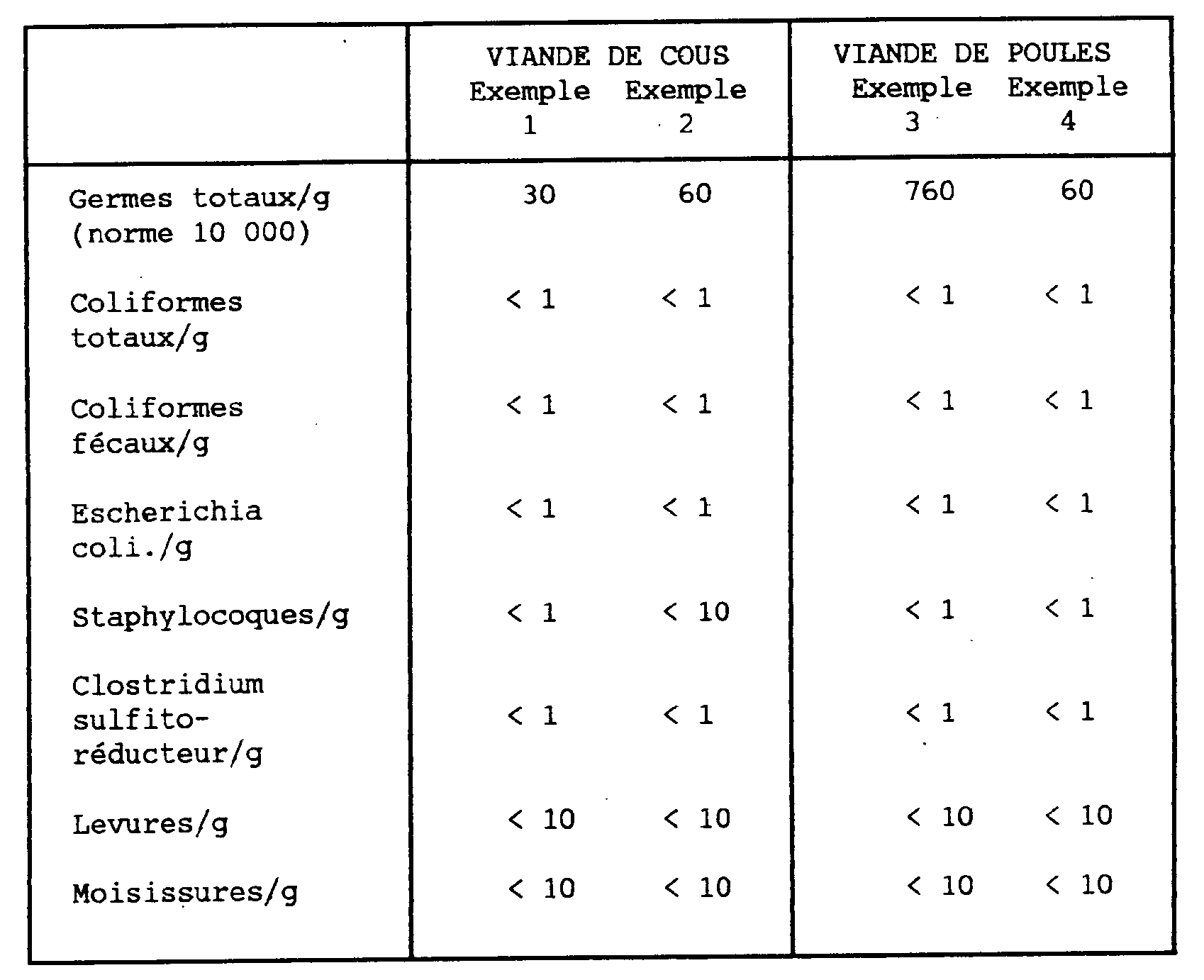
- Or outre la comparaison de l'exemple 1, respectivement l'exemple 3, avec l'exemple 2, respectivement l'exemple 4, montre bien que le préséchage réalisé est à lui seul beaucoup plus efficace que l'addition d'un liant éventuel.
- L'exemple comparatif suivant montre que le temps de préséchage nécessaire avec le procédé selon l'invention est bien inférieur à celui nécessaire dans l'art antérieur.
- Le tableau ci-dessous illustre le procédé de l'art antérieur appliqué, d'une part, à des cous de poulets, d'autre part à des poulets entiers.

- Il apparaît nettement que le temps de préséchage passe de 4,5 h à une heure et qu'il n'est plus nécessaire d'utiliser de blanc d'oeuf.
Claims (3)
- Procédé de production de viande cuite déshydratée dans lequel la viande est cuite dans de la graisse animale jusqu'à atteindre un taux de matières sèches d'au moins 60% en poids, puis est préséchée en étuve sous vide partielle avant d'être granulée et de subir une déshydratation finale.
- Procédé selon la revendication 1 caractérisé en ce que la cuisson est réalisée entre 100°C et 120°C à pression atmosphérique.
- Procédé selon la revendication 2 caractérisé en ce que la cuisson est réalisée pendant 40 à 120 minutes.
Priority Applications (7)
| Application Number | Priority Date | Filing Date | Title |
|---|---|---|---|
| DE90115514T DE69003678T2 (de) | 1990-08-13 | 1990-08-13 | Verfahren zur Herstellung von gekochtem dehydratisierten Fleisch. |
| EP90115514A EP0471097B1 (fr) | 1990-08-13 | 1990-08-13 | Procédé de production d'une viande cuite déshydratée |
| ES90115514T ES2045686T3 (es) | 1990-08-13 | 1990-08-13 | Procedimiento de produccion de carne cocida deshidratada. |
| DK90115514.3T DK0471097T3 (da) | 1990-08-13 | 1990-08-13 | Fremgangsmåde til fremstilling af dehydratiseret varmebehandlet kød |
| AT90115514T ATE95031T1 (de) | 1990-08-13 | 1990-08-13 | Verfahren zur herstellung von gekochtem dehydratisierten fleisch. |
| US07/738,599 US5158799A (en) | 1990-08-13 | 1991-07-31 | Process for the production of a dehydrated cooked meat |
| JP3201733A JPH06101978B2 (ja) | 1990-08-13 | 1991-08-12 | 脱水加熱肉の製造方法 |
Applications Claiming Priority (1)
| Application Number | Priority Date | Filing Date | Title |
|---|---|---|---|
| EP90115514A EP0471097B1 (fr) | 1990-08-13 | 1990-08-13 | Procédé de production d'une viande cuite déshydratée |
Publications (2)
| Publication Number | Publication Date |
|---|---|
| EP0471097A1 EP0471097A1 (fr) | 1992-02-19 |
| EP0471097B1 true EP0471097B1 (fr) | 1993-09-29 |
Family
ID=8204326
Family Applications (1)
| Application Number | Title | Priority Date | Filing Date |
|---|---|---|---|
| EP90115514A Expired - Lifetime EP0471097B1 (fr) | 1990-08-13 | 1990-08-13 | Procédé de production d'une viande cuite déshydratée |
Country Status (7)
| Country | Link |
|---|---|
| US (1) | US5158799A (fr) |
| EP (1) | EP0471097B1 (fr) |
| JP (1) | JPH06101978B2 (fr) |
| AT (1) | ATE95031T1 (fr) |
| DE (1) | DE69003678T2 (fr) |
| DK (1) | DK0471097T3 (fr) |
| ES (1) | ES2045686T3 (fr) |
Families Citing this family (2)
| Publication number | Priority date | Publication date | Assignee | Title |
|---|---|---|---|---|
| CN1307904C (zh) * | 2005-10-26 | 2007-04-04 | 山东师范大学 | 一种软肉干的生产方法 |
| US20190124963A1 (en) * | 2018-11-19 | 2019-05-02 | Darlene Fantel | Dehydrated Edible Meat Chip Snack for Humans and Pets |
Family Cites Families (8)
| Publication number | Priority date | Publication date | Assignee | Title |
|---|---|---|---|---|
| US2439180A (en) * | 1942-09-26 | 1948-04-06 | Ind Patents Corp | Method of producing dried meat |
| US3906115A (en) * | 1972-06-14 | 1975-09-16 | Morris R Jeppson | Method for the preparation of precooked meat products |
| JPS5840033A (ja) * | 1981-09-01 | 1983-03-08 | House Food Ind Co Ltd | 食肉の乾燥方法 |
| GB2116818A (en) * | 1982-03-15 | 1983-10-05 | Unilever Plc | A method of preparing a dry food product |
| US4645676A (en) * | 1985-05-30 | 1987-02-24 | Shuzo Nakazono | Method of producing filler added in foods |
| JPH0665286B2 (ja) * | 1985-07-16 | 1994-08-24 | 修三 中園 | 乾燥粉末食品の製造方法 |
| JPS6229941A (ja) * | 1985-07-30 | 1987-02-07 | Shuzo Nakazono | 動物・魚介類及び野菜・果実類の食品処理方法 |
| JPS63263063A (ja) * | 1987-04-21 | 1988-10-31 | Amano Jitsugyo Kk | 新規な乾燥肉製品の製造方法 |
-
1990
- 1990-08-13 ES ES90115514T patent/ES2045686T3/es not_active Expired - Lifetime
- 1990-08-13 DE DE90115514T patent/DE69003678T2/de not_active Expired - Fee Related
- 1990-08-13 EP EP90115514A patent/EP0471097B1/fr not_active Expired - Lifetime
- 1990-08-13 DK DK90115514.3T patent/DK0471097T3/da active
- 1990-08-13 AT AT90115514T patent/ATE95031T1/de not_active IP Right Cessation
-
1991
- 1991-07-31 US US07/738,599 patent/US5158799A/en not_active Expired - Fee Related
- 1991-08-12 JP JP3201733A patent/JPH06101978B2/ja not_active Expired - Fee Related
Also Published As
| Publication number | Publication date |
|---|---|
| DK0471097T3 (da) | 1994-02-21 |
| JPH04229136A (ja) | 1992-08-18 |
| DE69003678D1 (de) | 1993-11-04 |
| JPH06101978B2 (ja) | 1994-12-14 |
| US5158799A (en) | 1992-10-27 |
| ES2045686T3 (es) | 1994-01-16 |
| ATE95031T1 (de) | 1993-10-15 |
| EP0471097A1 (fr) | 1992-02-19 |
| DE69003678T2 (de) | 1994-01-27 |
Similar Documents
| Publication | Publication Date | Title |
|---|---|---|
| EP0419529B1 (fr) | Ameliorations relatives a des produits proteiques | |
| KR102433777B1 (ko) | 치킨염지제 및 이의 제조방법 | |
| US4786516A (en) | Method of drying meat | |
| Rumpold et al. | Insect processing | |
| JPS59166060A (ja) | 動物、魚介類、家きん類等のレバ−、内臓処理方法 | |
| US4405653A (en) | Dehydrated fish concentrate and process for same | |
| EP0471097A1 (fr) | Procédé de production d'une viande cuite déshydratée | |
| RU2756795C2 (ru) | Способ получения коллагенового материала в виде частиц и полученный этим способом коллагеновый материал | |
| US2524718A (en) | Processing of wastes | |
| US20020031599A1 (en) | Method for making crunchy bacon bits | |
| RU2706579C1 (ru) | Способ производства вареных колбасных изделий | |
| KR101586074B1 (ko) | 게살생산방법 및 게살 | |
| CN108902796A (zh) | 一种南极磷虾-南美白对虾虾滑及其制备方法 | |
| RU2554467C1 (ru) | Способ выделения белка и жира из коллагенсодержащего сырья | |
| GB2176986A (en) | Method of preparing fish | |
| JPS6247504B2 (fr) | ||
| KR20220160830A (ko) | 황태 부산물을 이용한 친환경 어분 제조방법 및 그 방법에 의하여 제조되는 어분 | |
| RU2183098C2 (ru) | Способ производства копченых сухих мясных продуктов из свиных ушей и хвостов | |
| JPS59220167A (ja) | 呈味性フエザ−ミ−ルの製造法 | |
| RU2197836C2 (ru) | Способ получения рыбной кормовой муки | |
| SU1212314A3 (ru) | Способ получени структурированных продуктов из м са водных животных | |
| JPS629286B2 (fr) | ||
| CN111096420A (zh) | 一种鸡胸肉干丝的制作方法 | |
| GB2257891A (en) | Pre-dusting of protein products with collagen fibres | |
| SU1171003A1 (ru) | Способ получени белкового пищевого продукта |
Legal Events
| Date | Code | Title | Description |
|---|---|---|---|
| PUAI | Public reference made under article 153(3) epc to a published international application that has entered the european phase |
Free format text: ORIGINAL CODE: 0009012 |
|
| AK | Designated contracting states |
Kind code of ref document: A1 Designated state(s): AT BE CH DE DK ES FR GB GR IT LI LU NL SE |
|
| 17P | Request for examination filed |
Effective date: 19920117 |
|
| 17Q | First examination report despatched |
Effective date: 19921218 |
|
| GRAA | (expected) grant |
Free format text: ORIGINAL CODE: 0009210 |
|
| AK | Designated contracting states |
Kind code of ref document: B1 Designated state(s): AT BE CH DE DK ES FR GB GR IT LI LU NL SE |
|
| REF | Corresponds to: |
Ref document number: 95031 Country of ref document: AT Date of ref document: 19931015 Kind code of ref document: T |
|
| REF | Corresponds to: |
Ref document number: 69003678 Country of ref document: DE Date of ref document: 19931104 |
|
| ITF | It: translation for a ep patent filed | ||
| REG | Reference to a national code |
Ref country code: ES Ref legal event code: FG2A Ref document number: 2045686 Country of ref document: ES Kind code of ref document: T3 |
|
| GBT | Gb: translation of ep patent filed (gb section 77(6)(a)/1977) |
Effective date: 19931229 |
|
| REG | Reference to a national code |
Ref country code: GR Ref legal event code: FG4A Free format text: 3009729 |
|
| REG | Reference to a national code |
Ref country code: DK Ref legal event code: T3 |
|
| EPTA | Lu: last paid annual fee | ||
| PLBE | No opposition filed within time limit |
Free format text: ORIGINAL CODE: 0009261 |
|
| STAA | Information on the status of an ep patent application or granted ep patent |
Free format text: STATUS: NO OPPOSITION FILED WITHIN TIME LIMIT |
|
| 26N | No opposition filed | ||
| EAL | Se: european patent in force in sweden |
Ref document number: 90115514.3 |
|
| ITTA | It: last paid annual fee | ||
| REG | Reference to a national code |
Ref country code: GB Ref legal event code: IF02 |
|
| PGFP | Annual fee paid to national office [announced via postgrant information from national office to epo] |
Ref country code: SE Payment date: 20020806 Year of fee payment: 13 |
|
| PGFP | Annual fee paid to national office [announced via postgrant information from national office to epo] |
Ref country code: GB Payment date: 20020807 Year of fee payment: 13 |
|
| PGFP | Annual fee paid to national office [announced via postgrant information from national office to epo] |
Ref country code: FR Payment date: 20020808 Year of fee payment: 13 |
|
| PGFP | Annual fee paid to national office [announced via postgrant information from national office to epo] |
Ref country code: AT Payment date: 20020813 Year of fee payment: 13 |
|
| PGFP | Annual fee paid to national office [announced via postgrant information from national office to epo] |
Ref country code: LU Payment date: 20020814 Year of fee payment: 13 Ref country code: DK Payment date: 20020814 Year of fee payment: 13 |
|
| PGFP | Annual fee paid to national office [announced via postgrant information from national office to epo] |
Ref country code: CH Payment date: 20020815 Year of fee payment: 13 |
|
| PGFP | Annual fee paid to national office [announced via postgrant information from national office to epo] |
Ref country code: DE Payment date: 20020821 Year of fee payment: 13 |
|
| PGFP | Annual fee paid to national office [announced via postgrant information from national office to epo] |
Ref country code: GR Payment date: 20020822 Year of fee payment: 13 |
|
| PGFP | Annual fee paid to national office [announced via postgrant information from national office to epo] |
Ref country code: ES Payment date: 20020826 Year of fee payment: 13 |
|
| PGFP | Annual fee paid to national office [announced via postgrant information from national office to epo] |
Ref country code: NL Payment date: 20020829 Year of fee payment: 13 |
|
| PGFP | Annual fee paid to national office [announced via postgrant information from national office to epo] |
Ref country code: BE Payment date: 20021017 Year of fee payment: 13 |
|
| PG25 | Lapsed in a contracting state [announced via postgrant information from national office to epo] |
Ref country code: LU Free format text: LAPSE BECAUSE OF NON-PAYMENT OF DUE FEES Effective date: 20030813 Ref country code: GB Free format text: LAPSE BECAUSE OF NON-PAYMENT OF DUE FEES Effective date: 20030813 Ref country code: AT Free format text: LAPSE BECAUSE OF NON-PAYMENT OF DUE FEES Effective date: 20030813 |
|
| PG25 | Lapsed in a contracting state [announced via postgrant information from national office to epo] |
Ref country code: SE Free format text: LAPSE BECAUSE OF NON-PAYMENT OF DUE FEES Effective date: 20030814 Ref country code: ES Free format text: LAPSE BECAUSE OF NON-PAYMENT OF DUE FEES Effective date: 20030814 |
|
| PG25 | Lapsed in a contracting state [announced via postgrant information from national office to epo] |
Ref country code: LI Free format text: LAPSE BECAUSE OF NON-PAYMENT OF DUE FEES Effective date: 20030831 Ref country code: CH Free format text: LAPSE BECAUSE OF NON-PAYMENT OF DUE FEES Effective date: 20030831 Ref country code: BE Free format text: LAPSE BECAUSE OF NON-PAYMENT OF DUE FEES Effective date: 20030831 |
|
| PG25 | Lapsed in a contracting state [announced via postgrant information from national office to epo] |
Ref country code: DK Free format text: LAPSE BECAUSE OF NON-PAYMENT OF DUE FEES Effective date: 20030901 |
|
| BERE | Be: lapsed |
Owner name: SOC. DES PRODUITS *NESTLE S.A. Effective date: 20030831 |
|
| PG25 | Lapsed in a contracting state [announced via postgrant information from national office to epo] |
Ref country code: NL Free format text: LAPSE BECAUSE OF NON-PAYMENT OF DUE FEES Effective date: 20040301 |
|
| PG25 | Lapsed in a contracting state [announced via postgrant information from national office to epo] |
Ref country code: DE Free format text: LAPSE BECAUSE OF NON-PAYMENT OF DUE FEES Effective date: 20040302 |
|
| PG25 | Lapsed in a contracting state [announced via postgrant information from national office to epo] |
Ref country code: GR Free format text: LAPSE BECAUSE OF NON-PAYMENT OF DUE FEES Effective date: 20040303 |
|
| REG | Reference to a national code |
Ref country code: DK Ref legal event code: EBP |
|
| EUG | Se: european patent has lapsed | ||
| GBPC | Gb: european patent ceased through non-payment of renewal fee |
Effective date: 20030813 |
|
| REG | Reference to a national code |
Ref country code: CH Ref legal event code: PL |
|
| PG25 | Lapsed in a contracting state [announced via postgrant information from national office to epo] |
Ref country code: FR Free format text: LAPSE BECAUSE OF NON-PAYMENT OF DUE FEES Effective date: 20040430 |
|
| NLV4 | Nl: lapsed or anulled due to non-payment of the annual fee |
Effective date: 20040301 |
|
| REG | Reference to a national code |
Ref country code: FR Ref legal event code: ST |
|
| REG | Reference to a national code |
Ref country code: ES Ref legal event code: FD2A Effective date: 20030814 |
|
| PG25 | Lapsed in a contracting state [announced via postgrant information from national office to epo] |
Ref country code: IT Free format text: LAPSE BECAUSE OF NON-PAYMENT OF DUE FEES Effective date: 20050813 |