EP0472175A2 - Détecteur de taux d'erreur de bits - Google Patents
Détecteur de taux d'erreur de bits Download PDFInfo
- Publication number
- EP0472175A2 EP0472175A2 EP91113985A EP91113985A EP0472175A2 EP 0472175 A2 EP0472175 A2 EP 0472175A2 EP 91113985 A EP91113985 A EP 91113985A EP 91113985 A EP91113985 A EP 91113985A EP 0472175 A2 EP0472175 A2 EP 0472175A2
- Authority
- EP
- European Patent Office
- Prior art keywords
- error
- syndrome
- generating means
- pulse
- block
- Prior art date
- Legal status (The legal status is an assumption and is not a legal conclusion. Google has not performed a legal analysis and makes no representation as to the accuracy of the status listed.)
- Granted
Links
Images

Classifications
-
- H—ELECTRICITY
- H04—ELECTRIC COMMUNICATION TECHNIQUE
- H04L—TRANSMISSION OF DIGITAL INFORMATION, e.g. TELEGRAPHIC COMMUNICATION
- H04L1/00—Arrangements for detecting or preventing errors in the information received
- H04L1/20—Arrangements for detecting or preventing errors in the information received using signal quality detector
Definitions
- the present invention relates to a bit error ratio detector, and more particularly to a bit error ratio detector for digital radio communication using error correction codes.
- bit error ratio detector which assess line quality by calculating the bit error ratio (BER).
- bit error ratio detectors use a syndrome.
- a bit error ratio detector using a syndrome subjects coded data from the transmitting side, error correction-coded block by block, to error correcting operation, and outputs the syndrome.
- the BER detector detects the presence or absence of any code error in each block responsive to the syndrome and calculates a code error ratio over a period of a plurality of blocks. By converting this code error ratio into a BER, the quality of the line is assessed.
- a extended block length means a correspondingly higher probability of syndrome occurrence, further resulting in a correspondingly higher probability of the occurrence of error pulses generated by the syndrome.
- the probability of error pulse occurrence rises with an increase in BER, eventually reaching 100%.
- the bit error ratio so much deteriorates as to surpass, far instance 10 ⁇ 3
- the probability of error pulse occurrence will no longer significantly vary with a change in BER. This means that a BER higher than a certain level makes it impossible for the quality of the line to be accurately assessed.
- An object of the present invention is to provide a bit error ratio detector capable of accurately detecting the BER even if the block length is extended.
- Another object of the invention is to provide a BER detector capable of improving the BER detecting capability even in a high BER region.
- a BER detector equipped with timing pulse generating means for generating a timing pulse in a predetermined part of each block of error correction-coded data, error pulse generating means for generating an error pulse if an error is found in said predetermined part, and error ratio detecting means for detecting the error ratio according to the number of said error pulses.
- the BER detector is further provided with syndrome generating means for generating a syndrome by entering said data, and error location signal generating means for generating from said syndrome an error location signal indicating the bit location where each bit error has occurred.
- the said error pulse generating means consists of an AND gate which undergoes the inputting of said timing pulse and said error location signal and outputs an error detection signal, and means for generating from said error detection signal an error pulse indicating the presence or absence of any error in each block.
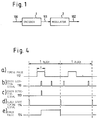
- FIG. 1 is a block diagram illustrating the configuration of the transmitting side used in an error correction transmission system.
- An encoder 1 converts data 100 of f0 bits/sec in transmission rate to data of f1 bits/sec in transmission rate by way of a block code (n, k).
- the data 100 supplemented with (n - k) redundant bits for every k bits to undergo error correction coding, are turned into coded data 101.
- the coded data 101 take on a block composition in which each block consists of n bits, including k bits of data and (n - k) redundant bits.
- a modulator 2 modulates a carrier with the coded data 101 to output a modulated signal 102.
- FIG. 2 is a block diagram illustrating the configuration of the receiving side used in the error correction transmission system.
- a demodulator 3 demodulates a modulated signal 102', sent from the transmitting side, and outputs regenerated coded data 103, which constitute a demodulated signal.
- a decoder comprises an error detector & error corrector 4 and a bit-rate converter 5.
- the error detector & error corrector 4 subjects the regenerated coded data 103 to error correcting operation to generate a syndrome, and outputs an error pulse 104 which is generated from this syndrome and indicates the presence or absence of any error in each block as will be described in further detail below.
- the error detector & error corrector 4 also outputs corrected data 105 of f1 bits/sec in transmission rate, having undergone error correction.
- the bit rate converter 5 removes redundant bits from the corrected data 105, and outputs data 106, whose transmission rate has been converted from f1 to f0 bits/sec.
- An error radio detector 6 counts the error pulses 104 for a period of i (i is 2 or a greater integer) blocks, calculates the code error ratio by dividing the error pulse count by i, and outputs a bit error ratio (BER) 107, converted from the code error ratio.
- FIG. 3 is a block diagram illustrating the internal configuration of the error detector & error corrector 4 according to the invention shown in FIG. 2.
- the coded data 103, outputted from the demodulator 3, are supplied to a syndrome generator 7 and a shift register 8.
- the syndrome generator 7 generates a syndrome 109 by dividing the coded data 103 by a predetermined generation polynomial at the timings of a clock supplied from a first timing pulse generator 9 and a block timing pulse 108 indicating the starting point of each block.
- the first timing pulse generator 9 supplies the clock and the block timing pulse 108 to the syndrome generator 7, the shift register 8 and an error location signal generator 10.
- the block timing pulse may be generated from the clock.
- the clock and the block timing pulse are represented together by a single line 108.
- the first timing pulse generator 9 judges whether or not the coded data 103 are in synchronism with both the clock and the block timing pulse 108 according to the presence or absence of the syndrome 109 and, in an asynchronization state, shifts the phases of the clock and the block timing pulse 108.
- the error location signal generator 10 detects the error location in the coded data 103 according to the syndrome 109, and outputs an error location signal 110 indicating the error location.
- error correction decoding by the syndrome generator and the error location signal generator reference may be made to, for instance, Chapter 6: "Error code Implementation" of a book entitled Elements of Digital Satellite Communication, vol. 2 by William W. Wu published by Computer Science Press, reprinted 1985, and accordingly its description is dispensed with here.
- the shift register 8 delays the coded data 103 by the time required for detecting the location of any error in the data 103, i.e. the processing time taken by the syndrome generator 7 and the error location signal generator 10, and outputs delayed coded data 111.
- An error correcting circuit 11 corrects errors in the delayed coded data with the error location signal 110, and outputs the corrected data 105, which are supplied to the bit-rate converter 5 of FIG. 2.
- the second timing pulse generator 12 outputs a timing pulse 112 (FIG. 4(a)) at one of two levels, for instance the high level, for a period T within one block.
- the period T is smaller than the block length n.
- An error detection signal 113 (FIG. 4(c)) will be outputted if the error location signal 110 (FIG. 4(b)) from the error location signal generator 10, indicating the location of any error, is within the period T of the timing pulse 112. If the error location signal 110 is not within the period T of the timing pulse 112, no error detection signal 113 will be outputted.
- the F/F 14 undergoes the inputting of the error detection signal 113 at its set terminal S and a block start timing signal 114 (FIG. 4(d)), supplied from the second timing pulse generator 12, at its reset terminal R, and outputs an error pulse 104 (FIG. 4(e)) from its output terminal Q.
- the block start timing signal 114 is a pulse indicating the starting point of each block, and is the same as the block timing pulse 108. Therefore the block timing pulse outputted from the first timing pulse generator 9 may as well be supplied to the reset terminal R of the F/F 14.
- the error pulse 104 is a pulse which falls to its low level at the beginning of each block and rises when the error detection signal 113 is supplied, and thereby indicates the presence or absence of any code error in the block. This error pulse 104 is supplied to the error ratio detector 6 shown in FIG. 2.
- the present invention by which an error pulse is generated from an error location signal occurring in a certain period within each block, serves to reduce the probability of error pulse occurrence and makes it possible to calculate the BER accurately even where it is rather high.
- a block code has k data bits and (n - k) redundant bits.
- This block code length is n bits
- the syndrome occurrence probabilities P S1 and P S2 where the block length n is 63 and 511, respectively, are: Since the BER P is greater than 0 and smaller than 1, (l - P) is also greater than 0 and smaller than 1, and (l - P)63 is greater than (l - P)511. Accordingly: P S1 ⁇ P S2 (2)
- Inequality (2) indicates that the greater the block length n, the higher the probability of syndrome occurrence. Since the probability of error pulse occurrence is usually equal to that of syndrome occurrence, the former rises with an increase in block length n.
- the BER P FEC after the error correction where three or more errors have arisen is: where i is the number of erroneous bits and P, the BER before the error correction.
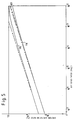
- solid lines 115 and 116 show the symulation value where n is 511 and 63, respectively.
- the one-point chained lines represent the linear extrapolations of high BER regions with the values at BER's of 10 ⁇ 7 and 10 ⁇ 6, respectively.
- the figure shows that, when n is 63, the BER can be accurately assessed from the syndrome occurrence probability even in a high BER region (for instance from 10 ⁇ 3 to 10 ⁇ 2 in BER) because the syndrome occurrence probability varies with a significant change in the BER, but, when n is 511, it is difficult to accurately estimate the BER from the syndrome occurrence probability because the latter does not significantly vary with a change in the former.
- the error pulse occurrence probability does not markedly vary in a high BER region if the block is longer than a certain extent, and accordingly it is impossible to calculate the BER from the syndrome occurrence probability. Therefore, by the prior art, it was impossible to calculate the BER in a high BER region as the BER was calculated by directly taking the presence or absence of a syndrome as the presence or absence of a code error. In view of this shortcoming, the present invention reduces the error pulse occurrence probability by taking as effective only those errors occurring in a predetermined period within each block.
- the syndrome occurrence probability as well varies with a change in BER even in a high BER region as where the block length n is 63, making it possible to accurately estimate the BER from the syndrome occurrence probability in such a region, too.
- the present invention makes it possible to accurately calculate the BER in a high BER region by generating an error pulse from an error location signal in a part of each block and thereby reducing the error pulse occurrence probability.
Landscapes
- Engineering & Computer Science (AREA)
- Quality & Reliability (AREA)
- Computer Networks & Wireless Communication (AREA)
- Signal Processing (AREA)
- Detection And Prevention Of Errors In Transmission (AREA)
- Error Detection And Correction (AREA)
Applications Claiming Priority (2)
| Application Number | Priority Date | Filing Date | Title |
|---|---|---|---|
| JP220515/90 | 1990-08-22 | ||
| JP2220515A JP2621614B2 (ja) | 1990-08-22 | 1990-08-22 | 符号誤り検出回路 |
Publications (3)
| Publication Number | Publication Date |
|---|---|
| EP0472175A2 true EP0472175A2 (fr) | 1992-02-26 |
| EP0472175A3 EP0472175A3 (en) | 1993-03-17 |
| EP0472175B1 EP0472175B1 (fr) | 1997-10-29 |
Family
ID=16752230
Family Applications (1)
| Application Number | Title | Priority Date | Filing Date |
|---|---|---|---|
| EP91113985A Expired - Lifetime EP0472175B1 (fr) | 1990-08-22 | 1991-08-21 | Détecteur de taux d'erreur de bits |
Country Status (6)
| Country | Link |
|---|---|
| US (1) | US5301197A (fr) |
| EP (1) | EP0472175B1 (fr) |
| JP (1) | JP2621614B2 (fr) |
| AU (1) | AU646484B2 (fr) |
| CA (1) | CA2049619C (fr) |
| DE (1) | DE69128057T2 (fr) |
Cited By (7)
| Publication number | Priority date | Publication date | Assignee | Title |
|---|---|---|---|---|
| US5214687A (en) * | 1991-06-05 | 1993-05-25 | Nokia Mobile Phones Ltd. | Method to determine transmission quality |
| EP0606682A1 (fr) * | 1993-01-15 | 1994-07-20 | SAT (Société Anonyme de Télécommunications) | Procédé de secours d'une liaison de réseau de télécommunications |
| EP0632613A1 (fr) * | 1993-06-29 | 1995-01-04 | Motorola, Inc. | Méthode et appareil de restitution de données dans un système de radio communication |
| FR2726715A1 (fr) * | 1994-11-08 | 1996-05-10 | Sanyo Electric Co | Appareil de mesure de taux d'erreur |
| US5557639A (en) * | 1993-10-11 | 1996-09-17 | Nokia Mobile Phones Ltd. | Enhanced decoder for a radio telephone |
| NL1000743C2 (nl) * | 1995-07-06 | 1997-01-08 | Nederland Ptt | Bit error rate monitoring in ontvanger met error correctie. |
| FR2765754A1 (fr) * | 1997-06-18 | 1999-01-08 | Motorola Inc | Determineur de structure de message ou de qualite de canal a base de syndrome |
Families Citing this family (15)
| Publication number | Priority date | Publication date | Assignee | Title |
|---|---|---|---|---|
| JPH06216655A (ja) * | 1993-01-13 | 1994-08-05 | Nec Corp | 復調回路 |
| US5497383A (en) * | 1993-01-22 | 1996-03-05 | Motorola, Inc. | Error detector circuit for receiver operative to receive discretely-encoded signals |
| JPH08335909A (ja) * | 1995-06-08 | 1996-12-17 | Advantest Corp | 高速光パルス列の信号誤り率測定装置 |
| KR100234504B1 (ko) * | 1995-09-18 | 1999-12-15 | 포만 제프리 엘 | 선택된 고장에 대한 고장정보를 포착하는 집적회로의 테스트 방법 및 내장된 자기 테스트 장치 |
| US6115416A (en) * | 1998-11-13 | 2000-09-05 | Vladimir Katzman | Pulse code sequence analyzer |
| US6807405B1 (en) | 1999-04-28 | 2004-10-19 | Isco International, Inc. | Method and a device for maintaining the performance quality of a code-division multiple access system in the presence of narrow band interference |
| TW490941B (en) * | 2000-10-02 | 2002-06-11 | Syncomm Technology Corp | Burst synchronization adjustment and error detection device and method making the same |
| US8385483B2 (en) | 2008-11-11 | 2013-02-26 | Isco International, Llc | Self-adaptive digital RF bandpass and bandstop filter architecture |
| US9319916B2 (en) | 2013-03-15 | 2016-04-19 | Isco International, Llc | Method and appartus for signal interference processing |
| US9775116B2 (en) | 2014-05-05 | 2017-09-26 | Isco International, Llc | Method and apparatus for increasing performance of communication links of cooperative communication nodes |
| FI3651386T3 (fi) | 2015-05-04 | 2023-11-15 | Isco Int Llc | Menetelmä ja laitteisto viestintäpolkujen suorituskyvyn lisäämiseksi viestintäsolmuille |
| MX2018014697A (es) | 2016-06-01 | 2019-09-13 | Isco Int Llc | Metodo y aparato para realizar acondicionamiento de señales para mitigar la interferencia detectada en un sistema de comunicacion. |
| US10298279B2 (en) | 2017-04-05 | 2019-05-21 | Isco International, Llc | Method and apparatus for increasing performance of communication paths for communication nodes |
| US10284313B2 (en) | 2017-08-09 | 2019-05-07 | Isco International, Llc | Method and apparatus for monitoring, detecting, testing, diagnosing and/or mitigating interference in a communication system |
| US10812121B2 (en) | 2017-08-09 | 2020-10-20 | Isco International, Llc | Method and apparatus for detecting and analyzing passive intermodulation interference in a communication system |
Family Cites Families (6)
| Publication number | Priority date | Publication date | Assignee | Title |
|---|---|---|---|---|
| JPS602812B2 (ja) * | 1976-10-25 | 1985-01-24 | 日本電気株式会社 | 誤まり訂正符号デ−タの復号器 |
| DE2845397A1 (de) * | 1978-10-18 | 1980-05-14 | Siemens Ag | Schaltungsanordnung zur einphasung eines codesicherungssystems |
| JPS61102841A (ja) * | 1984-10-24 | 1986-05-21 | Nec Corp | 回線品質監視装置 |
| JPS62281534A (ja) * | 1986-05-30 | 1987-12-07 | Kenwood Corp | フレ−ム同期パタ−ン相関検出回路 |
| US4920537A (en) * | 1988-07-05 | 1990-04-24 | Darling Andrew S | Method and apparatus for non-intrusive bit error rate testing |
| JPH02299324A (ja) * | 1989-05-15 | 1990-12-11 | Mitsubishi Electric Corp | 音声符号化装置 |
-
1990
- 1990-08-22 JP JP2220515A patent/JP2621614B2/ja not_active Expired - Lifetime
-
1991
- 1991-08-21 DE DE69128057T patent/DE69128057T2/de not_active Expired - Lifetime
- 1991-08-21 EP EP91113985A patent/EP0472175B1/fr not_active Expired - Lifetime
- 1991-08-21 CA CA002049619A patent/CA2049619C/fr not_active Expired - Lifetime
- 1991-08-21 AU AU82673/91A patent/AU646484B2/en not_active Ceased
- 1991-08-22 US US07/748,682 patent/US5301197A/en not_active Expired - Lifetime
Cited By (9)
| Publication number | Priority date | Publication date | Assignee | Title |
|---|---|---|---|---|
| US5214687A (en) * | 1991-06-05 | 1993-05-25 | Nokia Mobile Phones Ltd. | Method to determine transmission quality |
| EP0606682A1 (fr) * | 1993-01-15 | 1994-07-20 | SAT (Société Anonyme de Télécommunications) | Procédé de secours d'une liaison de réseau de télécommunications |
| FR2700650A1 (fr) * | 1993-01-15 | 1994-07-22 | Sat | Procédé de secours d'une liaison de réseau de télécommunications. |
| EP0632613A1 (fr) * | 1993-06-29 | 1995-01-04 | Motorola, Inc. | Méthode et appareil de restitution de données dans un système de radio communication |
| US5557639A (en) * | 1993-10-11 | 1996-09-17 | Nokia Mobile Phones Ltd. | Enhanced decoder for a radio telephone |
| FR2726715A1 (fr) * | 1994-11-08 | 1996-05-10 | Sanyo Electric Co | Appareil de mesure de taux d'erreur |
| NL1000743C2 (nl) * | 1995-07-06 | 1997-01-08 | Nederland Ptt | Bit error rate monitoring in ontvanger met error correctie. |
| EP0752769A1 (fr) * | 1995-07-06 | 1997-01-08 | Koninklijke KPN N.V. | Mesure du taux d'erreurs au récepteur avec correction d'erreurs |
| FR2765754A1 (fr) * | 1997-06-18 | 1999-01-08 | Motorola Inc | Determineur de structure de message ou de qualite de canal a base de syndrome |
Also Published As
| Publication number | Publication date |
|---|---|
| EP0472175B1 (fr) | 1997-10-29 |
| CA2049619C (fr) | 1995-05-30 |
| DE69128057T2 (de) | 1998-03-26 |
| JP2621614B2 (ja) | 1997-06-18 |
| DE69128057D1 (de) | 1997-12-04 |
| JPH04103224A (ja) | 1992-04-06 |
| AU646484B2 (en) | 1994-02-24 |
| AU8267391A (en) | 1992-02-27 |
| US5301197A (en) | 1994-04-05 |
| EP0472175A3 (en) | 1993-03-17 |
Similar Documents
| Publication | Publication Date | Title |
|---|---|---|
| US5301197A (en) | Bit error ratio detector | |
| US4967413A (en) | Burst signal detection apparatus | |
| US4720829A (en) | Error control encoding system | |
| Sellers | Bit loss and gain correction code | |
| EP0179465B1 (fr) | Appareil de surveillance de la qualité d'une liaison | |
| US5872791A (en) | Method and apparatus for data encoding and communication over noisy media | |
| EP1333585B1 (fr) | Emetteur de données entrelacées codées pour la correction d'erreurs dans une trame de transmission | |
| US4821270A (en) | Method for decoding data transmitted along a data channel and an apparatus for executing the method | |
| US7174502B2 (en) | Synchronization error detection circuit | |
| US4858235A (en) | Information storage apparatus | |
| US5852639A (en) | Resynchronization apparatus for error correction code decoder | |
| US4320511A (en) | Method and device for conversion between a cyclic and a general code sequence by the use of dummy zero bit series | |
| US5809042A (en) | Interleave type error correction method and apparatus | |
| US5541939A (en) | Error correction code decoder and a method thereof | |
| JPS59228440A (ja) | デ−タ伝送方式 | |
| JPH0666777B2 (ja) | デジタル情報信号の同期方法および同期装置 | |
| EP0752769A1 (fr) | Mesure du taux d'erreurs au récepteur avec correction d'erreurs | |
| EP0240921B1 (fr) | Système de correction du signal pour code BCH | |
| EP0746112A2 (fr) | Dispositif de correction d'erreurs | |
| US20020041647A1 (en) | Device and method for burst synchronization and error detection | |
| JPH0738626B2 (ja) | ワード同期検出回路 | |
| KR0166268B1 (ko) | 리드 솔로몬 복호기용 블록 동기신호 생성장치 | |
| CA2215380C (fr) | Procede et dispositif de codage et de transmission de donnees via un support bruyant | |
| JP2985173B2 (ja) | ディジタル情報受信装置 | |
| JPH08330978A (ja) | 誤り訂正方式 |
Legal Events
| Date | Code | Title | Description |
|---|---|---|---|
| PUAI | Public reference made under article 153(3) epc to a published international application that has entered the european phase |
Free format text: ORIGINAL CODE: 0009012 |
|
| 17P | Request for examination filed |
Effective date: 19910911 |
|
| AK | Designated contracting states |
Kind code of ref document: A2 Designated state(s): DE FR GB NL |
|
| PUAL | Search report despatched |
Free format text: ORIGINAL CODE: 0009013 |
|
| AK | Designated contracting states |
Kind code of ref document: A3 Designated state(s): DE FR GB NL |
|
| 17Q | First examination report despatched |
Effective date: 19951116 |
|
| GRAG | Despatch of communication of intention to grant |
Free format text: ORIGINAL CODE: EPIDOS AGRA |
|
| GRAH | Despatch of communication of intention to grant a patent |
Free format text: ORIGINAL CODE: EPIDOS IGRA |
|
| GRAH | Despatch of communication of intention to grant a patent |
Free format text: ORIGINAL CODE: EPIDOS IGRA |
|
| GRAA | (expected) grant |
Free format text: ORIGINAL CODE: 0009210 |
|
| AK | Designated contracting states |
Kind code of ref document: B1 Designated state(s): DE FR GB NL |
|
| REF | Corresponds to: |
Ref document number: 69128057 Country of ref document: DE Date of ref document: 19971204 |
|
| ET | Fr: translation filed | ||
| PLBE | No opposition filed within time limit |
Free format text: ORIGINAL CODE: 0009261 |
|
| STAA | Information on the status of an ep patent application or granted ep patent |
Free format text: STATUS: NO OPPOSITION FILED WITHIN TIME LIMIT |
|
| 26N | No opposition filed | ||
| REG | Reference to a national code |
Ref country code: GB Ref legal event code: IF02 |
|
| PGFP | Annual fee paid to national office [announced via postgrant information from national office to epo] |
Ref country code: FR Payment date: 20090814 Year of fee payment: 19 |
|
| PGFP | Annual fee paid to national office [announced via postgrant information from national office to epo] |
Ref country code: NL Payment date: 20090816 Year of fee payment: 19 Ref country code: GB Payment date: 20090818 Year of fee payment: 19 Ref country code: DE Payment date: 20090814 Year of fee payment: 19 |
|
| REG | Reference to a national code |
Ref country code: NL Ref legal event code: V1 Effective date: 20110301 |
|
| GBPC | Gb: european patent ceased through non-payment of renewal fee |
Effective date: 20100821 |
|
| REG | Reference to a national code |
Ref country code: FR Ref legal event code: ST Effective date: 20110502 |
|
| PG25 | Lapsed in a contracting state [announced via postgrant information from national office to epo] |
Ref country code: NL Free format text: LAPSE BECAUSE OF NON-PAYMENT OF DUE FEES Effective date: 20110301 |
|
| REG | Reference to a national code |
Ref country code: DE Ref legal event code: R119 Ref document number: 69128057 Country of ref document: DE Effective date: 20110301 |
|
| PG25 | Lapsed in a contracting state [announced via postgrant information from national office to epo] |
Ref country code: FR Free format text: LAPSE BECAUSE OF NON-PAYMENT OF DUE FEES Effective date: 20100831 Ref country code: DE Free format text: LAPSE BECAUSE OF NON-PAYMENT OF DUE FEES Effective date: 20110301 |
|
| PG25 | Lapsed in a contracting state [announced via postgrant information from national office to epo] |
Ref country code: GB Free format text: LAPSE BECAUSE OF NON-PAYMENT OF DUE FEES Effective date: 20100821 |