EP0472268A2 - Application d'un revêtement résistant à l'abrasion sur des substrats élastomériques - Google Patents
Application d'un revêtement résistant à l'abrasion sur des substrats élastomériques Download PDFInfo
- Publication number
- EP0472268A2 EP0472268A2 EP91304996A EP91304996A EP0472268A2 EP 0472268 A2 EP0472268 A2 EP 0472268A2 EP 91304996 A EP91304996 A EP 91304996A EP 91304996 A EP91304996 A EP 91304996A EP 0472268 A2 EP0472268 A2 EP 0472268A2
- Authority
- EP
- European Patent Office
- Prior art keywords
- polyethylene
- polypropylene
- polyolefin
- polyolefin compound
- compound
- Prior art date
- Legal status (The legal status is an assumption and is not a legal conclusion. Google has not performed a legal analysis and makes no representation as to the accuracy of the status listed.)
- Withdrawn
Links
Images
Classifications
-
- C—CHEMISTRY; METALLURGY
- C08—ORGANIC MACROMOLECULAR COMPOUNDS; THEIR PREPARATION OR CHEMICAL WORKING-UP; COMPOSITIONS BASED THEREON
- C08J—WORKING-UP; GENERAL PROCESSES OF COMPOUNDING; AFTER-TREATMENT NOT COVERED BY SUBCLASSES C08B, C08C, C08F, C08G or C08H
- C08J5/00—Manufacture of articles or shaped materials containing macromolecular substances
- C08J5/12—Bonding of a preformed macromolecular material to the same or other solid material such as metal, glass, leather, e.g. using adhesives
-
- B—PERFORMING OPERATIONS; TRANSPORTING
- B29—WORKING OF PLASTICS; WORKING OF SUBSTANCES IN A PLASTIC STATE IN GENERAL
- B29C—SHAPING OR JOINING OF PLASTICS; SHAPING OF MATERIAL IN A PLASTIC STATE, NOT OTHERWISE PROVIDED FOR; AFTER-TREATMENT OF THE SHAPED PRODUCTS, e.g. REPAIRING
- B29C48/00—Extrusion moulding, i.e. expressing the moulding material through a die or nozzle which imparts the desired form; Apparatus therefor
- B29C48/03—Extrusion moulding, i.e. expressing the moulding material through a die or nozzle which imparts the desired form; Apparatus therefor characterised by the shape of the extruded material at extrusion
- B29C48/12—Articles with an irregular circumference when viewed in cross-section, e.g. window profiles
-
- B—PERFORMING OPERATIONS; TRANSPORTING
- B29—WORKING OF PLASTICS; WORKING OF SUBSTANCES IN A PLASTIC STATE IN GENERAL
- B29C—SHAPING OR JOINING OF PLASTICS; SHAPING OF MATERIAL IN A PLASTIC STATE, NOT OTHERWISE PROVIDED FOR; AFTER-TREATMENT OF THE SHAPED PRODUCTS, e.g. REPAIRING
- B29C48/00—Extrusion moulding, i.e. expressing the moulding material through a die or nozzle which imparts the desired form; Apparatus therefor
- B29C48/16—Articles comprising two or more components, e.g. co-extruded layers
- B29C48/18—Articles comprising two or more components, e.g. co-extruded layers the components being layers
- B29C48/21—Articles comprising two or more components, e.g. co-extruded layers the components being layers the layers being joined at their surfaces
-
- B—PERFORMING OPERATIONS; TRANSPORTING
- B29—WORKING OF PLASTICS; WORKING OF SUBSTANCES IN A PLASTIC STATE IN GENERAL
- B29C—SHAPING OR JOINING OF PLASTICS; SHAPING OF MATERIAL IN A PLASTIC STATE, NOT OTHERWISE PROVIDED FOR; AFTER-TREATMENT OF THE SHAPED PRODUCTS, e.g. REPAIRING
- B29C48/00—Extrusion moulding, i.e. expressing the moulding material through a die or nozzle which imparts the desired form; Apparatus therefor
- B29C48/16—Articles comprising two or more components, e.g. co-extruded layers
- B29C48/18—Articles comprising two or more components, e.g. co-extruded layers the components being layers
- B29C48/22—Articles comprising two or more components, e.g. co-extruded layers the components being layers with means connecting the layers, e.g. tie layers or undercuts
-
- B—PERFORMING OPERATIONS; TRANSPORTING
- B60—VEHICLES IN GENERAL
- B60J—WINDOWS, WINDSCREENS, NON-FIXED ROOFS, DOORS, OR SIMILAR DEVICES FOR VEHICLES; REMOVABLE EXTERNAL PROTECTIVE COVERINGS SPECIALLY ADAPTED FOR VEHICLES
- B60J10/00—Sealing arrangements
- B60J10/15—Sealing arrangements characterised by the material
-
- B—PERFORMING OPERATIONS; TRANSPORTING
- B60—VEHICLES IN GENERAL
- B60J—WINDOWS, WINDSCREENS, NON-FIXED ROOFS, DOORS, OR SIMILAR DEVICES FOR VEHICLES; REMOVABLE EXTERNAL PROTECTIVE COVERINGS SPECIALLY ADAPTED FOR VEHICLES
- B60J10/00—Sealing arrangements
- B60J10/15—Sealing arrangements characterised by the material
- B60J10/17—Sealing arrangements characterised by the material provided with a low-friction material on the surface
-
- B—PERFORMING OPERATIONS; TRANSPORTING
- B60—VEHICLES IN GENERAL
- B60J—WINDOWS, WINDSCREENS, NON-FIXED ROOFS, DOORS, OR SIMILAR DEVICES FOR VEHICLES; REMOVABLE EXTERNAL PROTECTIVE COVERINGS SPECIALLY ADAPTED FOR VEHICLES
- B60J10/00—Sealing arrangements
- B60J10/70—Sealing arrangements specially adapted for windows or windscreens
- B60J10/74—Sealing arrangements specially adapted for windows or windscreens for sliding window panes, e.g. sash guides
-
- C—CHEMISTRY; METALLURGY
- C08—ORGANIC MACROMOLECULAR COMPOUNDS; THEIR PREPARATION OR CHEMICAL WORKING-UP; COMPOSITIONS BASED THEREON
- C08J—WORKING-UP; GENERAL PROCESSES OF COMPOUNDING; AFTER-TREATMENT NOT COVERED BY SUBCLASSES C08B, C08C, C08F, C08G or C08H
- C08J7/00—Chemical treatment or coating of shaped articles made of macromolecular substances
- C08J7/04—Coating
- C08J7/0427—Coating with only one layer of a composition containing a polymer binder
-
- C—CHEMISTRY; METALLURGY
- C08—ORGANIC MACROMOLECULAR COMPOUNDS; THEIR PREPARATION OR CHEMICAL WORKING-UP; COMPOSITIONS BASED THEREON
- C08J—WORKING-UP; GENERAL PROCESSES OF COMPOUNDING; AFTER-TREATMENT NOT COVERED BY SUBCLASSES C08B, C08C, C08F, C08G or C08H
- C08J7/00—Chemical treatment or coating of shaped articles made of macromolecular substances
- C08J7/04—Coating
- C08J7/043—Improving the adhesiveness of the coatings per se, e.g. forming primers
-
- C—CHEMISTRY; METALLURGY
- C08—ORGANIC MACROMOLECULAR COMPOUNDS; THEIR PREPARATION OR CHEMICAL WORKING-UP; COMPOSITIONS BASED THEREON
- C08J—WORKING-UP; GENERAL PROCESSES OF COMPOUNDING; AFTER-TREATMENT NOT COVERED BY SUBCLASSES C08B, C08C, C08F, C08G or C08H
- C08J7/00—Chemical treatment or coating of shaped articles made of macromolecular substances
- C08J7/04—Coating
- C08J7/046—Forming abrasion-resistant coatings; Forming surface-hardening coatings
-
- C—CHEMISTRY; METALLURGY
- C08—ORGANIC MACROMOLECULAR COMPOUNDS; THEIR PREPARATION OR CHEMICAL WORKING-UP; COMPOSITIONS BASED THEREON
- C08K—Use of inorganic or non-macromolecular organic substances as compounding ingredients
- C08K7/00—Use of ingredients characterised by shape
- C08K7/16—Solid spheres
- C08K7/18—Solid spheres inorganic
- C08K7/20—Glass
-
- C—CHEMISTRY; METALLURGY
- C08—ORGANIC MACROMOLECULAR COMPOUNDS; THEIR PREPARATION OR CHEMICAL WORKING-UP; COMPOSITIONS BASED THEREON
- C08L—COMPOSITIONS OF MACROMOLECULAR COMPOUNDS
- C08L21/00—Compositions of unspecified rubbers
-
- C—CHEMISTRY; METALLURGY
- C08—ORGANIC MACROMOLECULAR COMPOUNDS; THEIR PREPARATION OR CHEMICAL WORKING-UP; COMPOSITIONS BASED THEREON
- C08L—COMPOSITIONS OF MACROMOLECULAR COMPOUNDS
- C08L23/00—Compositions of homopolymers or copolymers of unsaturated aliphatic hydrocarbons having only one carbon-to-carbon double bond; Compositions of derivatives of such polymers
- C08L23/02—Compositions of homopolymers or copolymers of unsaturated aliphatic hydrocarbons having only one carbon-to-carbon double bond; Compositions of derivatives of such polymers not modified by chemical after-treatment
- C08L23/04—Homopolymers or copolymers of ethene
- C08L23/06—Polyethylene
-
- C—CHEMISTRY; METALLURGY
- C08—ORGANIC MACROMOLECULAR COMPOUNDS; THEIR PREPARATION OR CHEMICAL WORKING-UP; COMPOSITIONS BASED THEREON
- C08L—COMPOSITIONS OF MACROMOLECULAR COMPOUNDS
- C08L23/00—Compositions of homopolymers or copolymers of unsaturated aliphatic hydrocarbons having only one carbon-to-carbon double bond; Compositions of derivatives of such polymers
- C08L23/02—Compositions of homopolymers or copolymers of unsaturated aliphatic hydrocarbons having only one carbon-to-carbon double bond; Compositions of derivatives of such polymers not modified by chemical after-treatment
- C08L23/10—Homopolymers or copolymers of propene
- C08L23/12—Polypropene
-
- C—CHEMISTRY; METALLURGY
- C08—ORGANIC MACROMOLECULAR COMPOUNDS; THEIR PREPARATION OR CHEMICAL WORKING-UP; COMPOSITIONS BASED THEREON
- C08L—COMPOSITIONS OF MACROMOLECULAR COMPOUNDS
- C08L23/00—Compositions of homopolymers or copolymers of unsaturated aliphatic hydrocarbons having only one carbon-to-carbon double bond; Compositions of derivatives of such polymers
- C08L23/02—Compositions of homopolymers or copolymers of unsaturated aliphatic hydrocarbons having only one carbon-to-carbon double bond; Compositions of derivatives of such polymers not modified by chemical after-treatment
- C08L23/16—Ethylene-propylene or ethylene-propylene-diene copolymers
-
- C—CHEMISTRY; METALLURGY
- C08—ORGANIC MACROMOLECULAR COMPOUNDS; THEIR PREPARATION OR CHEMICAL WORKING-UP; COMPOSITIONS BASED THEREON
- C08J—WORKING-UP; GENERAL PROCESSES OF COMPOUNDING; AFTER-TREATMENT NOT COVERED BY SUBCLASSES C08B, C08C, C08F, C08G or C08H
- C08J2321/00—Characterised by the use of unspecified rubbers
-
- C—CHEMISTRY; METALLURGY
- C08—ORGANIC MACROMOLECULAR COMPOUNDS; THEIR PREPARATION OR CHEMICAL WORKING-UP; COMPOSITIONS BASED THEREON
- C08J—WORKING-UP; GENERAL PROCESSES OF COMPOUNDING; AFTER-TREATMENT NOT COVERED BY SUBCLASSES C08B, C08C, C08F, C08G or C08H
- C08J2423/00—Characterised by the use of homopolymers or copolymers of unsaturated aliphatic hydrocarbons having only one carbon-to-carbon double bond; Derivatives of such polymers
Definitions
- elastomers such as ethylene-propylenediene terpolymer (EPDM) and styrene-butadiene copolymer have been utilized for many years in applications requiring a sealing contact between the elastomer and another object, such as in glass run channels which are positioned in the window frames of automobile doors to provide a seal between the window frame and the glass.
- EPDM ethylene-propylenediene terpolymer
- styrene-butadiene copolymer have been utilized for many years in applications requiring a sealing contact between the elastomer and another object, such as in glass run channels which are positioned in the window frames of automobile doors to provide a seal between the window frame and the glass.
- the elastomer utilized in glass run channel applications generally is flexible to provide a good seal of the elastomer against the window glass without the application of excessive force, and must also display good weatherability properties.
- most suitable flexible elastomers typically lack the low-friction, abrasion or wear-resistant properties necessary for ease of travel of window glass within the glass run channel and long life of the glass run channel itself, respectively.
- low friction and abrasion resistance also are requirements for glass run channel coating materials.
- the base polymer in such coatings contributes much of the low-friction and abrasion-resistant properties.
- low-friction rubbers such as polyurethanes are generally regarded as good base polymers for coatings.
- polyurethanes must be applied to an EPDM elastomer which has been either surface treated or primer coated to achieve good adhesion therebetween.
- U.S. Patent No. 3,904,470 to Fukuki et al relates to a method for bonding rubber to plastics by contacting a vulcanized shaped structure of an ethylene/propylene copolymer rubber on an ethylene/propylene/diolefin copolymer rubber with a polyolefin plastic at a temperature above the softening point of said polyolefin plastic, said vulcanized shaped structure consisting of a blend of (i) 60 to 97 percent by weight of an ethylene/propylene copolymer rubber having an ethylene content of 40 to 85 mole percent or an ethylene/propylene/diolefin copolymer rubber having an ethylene content of 40 to 85 mole percent and 0 to 100 percent, based on the weight of the copolymer rubber, of a rubber component other than the above copolymer rubbers and a butyl rubber, and (ii) 3 to 40 percent by weight of specific crystalline polyethylene or polypropylene plastic.
- U.S. Patent No. 3,962,018 to Costemalle et al relates to a multilayer composition prepared by a process comprising applying an intimately mixed blend of a thermoplastic polyolefin and an elastomer to the surface of an elastomer and bonding said blend to said surface by heating and application of pressure.
- a film of the intimately mixed blend may be applied to the surface of the elastomer.
- a motor-car door seal can be produced by extruding to the desired profile the intimately mixed blend of thermoplastic polyolefin and elastomer so as to form the base foot and bonding the elastomer seal to the extruded section.
- U.S. Patent No. 4,076,891 to Yardley et al relates to a method of producing a molded plastic-rubber composite comprising injection or transfer molding a substantially linear crystalline low pressure solution olefin polymer so that it is brought, in a molten state, into contact with a prevulcanized rubber component containing up to 70 percent by volume of a rubbery olefin polymer.
- the plastic-rubber composite produced by this method may be used in applications in which hitherto rubber-metal composites have been used, for example valve diaphragms, tire valve bodies, shock absorbers, engine mountings, vibration dampers, compression springs, torsion bushes, flexible drive couplings, etc.
- the body After the body is cooled, it is advanced through a number of aligned milling cutters to machine aligned recesses in the sides of the body to produce a retention cutout. After being machined to depth, the trim strip is advanced through a pair of grinding wheels to accurately form and space the recesses.
- a coated wire may be embedded within the body in the conventional manner.
- U.S. Patent No. 4,169,180 to McDonagh relates to a laminate which is useful as a construction material. It comprises: (1) a base layer of a synthetic resin having inferior weather-proof characteristics; and (2) a protective layer of a crosslinked acrylate and/or methacrylate/crosslinked styrene-acrylonitrile/uncrosslinked styrene-acrylonitrile polymer composition attached to the base layer.
- the laminate can be used as a material for siding, gutter systems, downspouts, soffit and fascia systems, shutters, window casings and the like.
- U.S. Patent No. 4,184,000 to Denman relates to a coupling element comprising elongated thermoplastic strip material structured to provide that, on application thereto of heat in the range from about 300°F to about 500°F the outer portion thereof becomes fluidly adhesive, and is particularly adapted thereby to quickly form a ready bond and a clean seal between different materials, especially between glass and metal parts. While under the application of heat in the range specified, the outer portion of the element becomes fluidly adhesive, the inner or core portion of the element retains, as originally provided, an essentially stable form which accommodates and conforms to the contour of an applied load. On self cooling in place the strip coupling device provides a bond and seal between parts of unlike materials.
- the invention provides for an installation of a window, windshield or like unit.
- Elements of the invention are reversible. Once an element is in place and serving as a bond, if subjected to heat in the prescribed temperature range of 300°F to 500°F, the outer portion of the element becomes fluid while the stability of the core thereof is maintained. This enables that the element may be removed from between the parts for which it formerly served as a bond.
- U.S. Patent No. 4,198,983 to Becker et al relates to a catheter, preferably a balloon-type catheter, which is disclosed in which the catheter shaft is made of a thermoplastic material and thus may be extrudable, the shaft consisting essentially of (a) from 40 to 70 percent by weight of an elastic composition which comprises: from 50 to 99.5 percent by weight of a block copolymer having thermoplastic rubber characteristics with a central, rubber polyolefin block and terminal blocks of polystyrene, and optionally including up to about 45 percent by weight of polypropylene, plus from 0.5 to 10 percent by weight of a crosslinked organic silicone elastomer; and (b) from 30 to 60 percent by weight of a hydrophobic oil-type plasticizer to provide the desired degree of softness of said elastic composition.
- an elastic composition which comprises: from 50 to 99.5 percent by weight of a block copolymer having thermoplastic rubber characteristics with a central, rubber polyolefin block and terminal blocks of polystyrene,
- U.S. Patent No. 4,292,355 to Bonis relates to a moisture-impervious plastic container thermally formed from a coextruded sheet including a layer of polypropylene directly adhered to a layer of butadienestyrene polymer.
- U.S. Patent No. 4,467,061 to Yamamoto et al relates to a polyolefin composition with an improved weather resistance, which comprises a polyolefin blended with (1) a benzotriazole compound, (2) a heterocyclic hindered amine compound and (3) a phenyl benzoate compound or nickel complex compound.
- U.S. Patent No. 4,537,825 to Yardley relates to a method of making a bonded composite of (i) a thermoplastic elastomeric blend of vulcanized EPDM particles not more than 50 microns in size disposed in a thermoplastic linear crystalline polyolefin continuous phase, with (ii) a vulcanized EPDM or EPM rubber composition containing less than 50 percent (preferably 5 percent to less than 40 percent by volume of rubber), comprises fusing the thermoplastic elastomeric blend and solidifying it in contact with the vulcanized rubber composition in the absence of an adhesive interlayer.
- the blend is extruded onto the vulcanized rubber composition.
- the linear crystalline polyolefin in the thermoplastic blend has a melt flow index of at least 0.25 when measured according to the test conditions ASTM D1238-65T and is selected from polypropylene, propylene copolymers, high density polyethylene and high density ethylene copolymers.
- U.S. Patent No. 4,600,461 to Guy relates to an apparatus and process for producing an extruded plastic material product which consists of an inner foamed thermoplastic cellular core and an outer non-porous thermoplastic skin extending along at least one side of the core.
- a foamable thermoplastic material is extruded through a first die outlet to produce a foamed thermoplastic material.
- a film of non-porous thermoplastic material is applied along at least one side of extruded foamed material.
- the extruded foamed material and the non-porous film is fed through a forming die which shapes and seals the materials into the desired cross-section shape.
- U.S. Patent No. 4,676,856 to Shigeki et al relates to a weather strip for a vehicle which has a channel-shaped base portion having a U-shaped cross section and provided with retaining lips for retaining a flange of a vehicle body, a seal portion integrally projecting from an outer surface of the base portion, and a core member made of synthetic resin and having a U-shaped cross section, which is embedded in the channel-shaped base portion.
- U.S. Patent No. 4,698,193 to Bernitz et al relates to a method and apparatus for producing sealing strips and similar profiled strips of rubber and rubber-like elastomers.
- Rubber-like profiled sealing strips for window or door openings are frequently provided with overlay strips to facilitate installation, to enhance the relative movements, or for aesthetic-visual reasons.
- the material of these overlay strips generally differs considerably from the material of the base main strip.
- the manufacture of such two-material profiles can be undertaken in a single extrusion step by joining and directly combining a prefabricated overlay strip with the main strip in the extrusion head of an extrusion press, where the shape is provided for the profiled strip. By stretching the overlay strip, the adhesion of the latter to the main strip is improved.
- U.S. Patent No. 4,701,376 to Hermann et al relates to a profiled rubber strip seal for bordering window and door openings.
- such seals are provided with overlay strips of friction-reducing material, especially synthetic materials that contain fluorine.
- the elastomeric mixture of the main strip is altered by including therein silicic acid.
- U.S. Patent No. 4,833,194 to Kuan et al relates to blends of crystalline and amorphous polymers which are utilized to form uncured thermoplastic elastomer compositions which have good properties such as processability, tensile strength, tear strength, good weatherability, good friction, and especially low deformation at high temperatures as about 180°F.
- the thermoplastic elastomer composition contains amorphous ethylene-propylene type rubber, crystalline ethylene-propylene type rubber, and crystalline olefins such as polyethylene.
- the crystalline polymers generally impart the necessary thermoplasticity for melt processing, and the like.
- European Patent Application 0 325 573 relates to shaped articles, such as coatings for wire and cable which are prepared by crosslinking compositions which are mixtures of (A) a polyolefin containing hydrolyzable silane groups and (B) elastoplastic blends of particles of rubber compounds dispersed in a continuous phase of thermoplastic polymer compatible with (A), wherein the rubber compound is at least partially cured.
- the invention is directed to a glass run channel composite of the type utilized in automotive applications for sealing against window glass.
- the glass run channel composite includes a thermosetting elastomeric substrate having one or more sealing surfaces, and a polyolefin compound having a low melt index and a high density, and optionally containing a softening compound and other additives.
- the polyolefin compound is solventless and substantially melted when contacted with the sealing surfaces of the elastomeric substrate prior to cure thereof, and upon cure of the elastomeric substrate, the polyolefin compound is adhered to the substrate and provides a solid, low-friction, abrasion-resistant coating on the sealing surfaces of the substrate for sealing against a window introduced into the glass run channel.
- the substrate and polyolefin may be co-extruded.
- the method may be useful for forming thinner coatings on substrates.
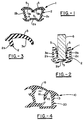
- FIG. 1 shows a first embodiment of a glass run channel having the coating of the present invention applied thereto, indicated generally at 1.
- Glass run channel 1 is an integrally formed one-piece member and includes a channel member or substrate 2 having a base 2a, sidewalls 2b and 2c, and a pair of similar, inwardly extending opposed lips 3a and 3b which extend generally horizontally across a channel 4 defined by base 2a and sidewalls 2b, and 2c.
- Substrate 2 is formed of any commercially available flexible elastomer of the type which are well known to the art and to the literature, and which provide good sealing against a glass window surface without the application of excessive pressure against the glass surface.
- the flexible elastomer of which substrate 2 is formed must also display good weatherability properties.
- the flexible elastomer-formed substrate 2 may also be highly extendible with conventional additives such as carbon black and the like to maintain a reasonable price of the substrate.
- Desirable elastomers of which substrate 2 can be formed generally include curable or thermosetting elastomers. More particularly, desirable elastomers include butadiene-based rubbers of styrene-butadiene rubber and nitrile rubber or acrylonitrile-butadiene rubber, and natural rubber or synthetic isoprene rubber.
- a preferred elastomer is ethylene-propylene terpolymer, also commonly referred to as EPDM.
- any of the commercially available, conventional styrene-butadiene rubbers containing less than about 30 percent of styrene monomer based upon the total weight of the rubber forming monomers therein can be utilized in forming substrate 2.
- Useful nitrile rubbers include conventional nitrile rubbers which are known to the art and to the literature, that is, rubbers generally made from one or more monomers of acrylonitrile or an alkyl derivative thereof with one or more conjugated dienes and optionally one or more monomers of acrylic acid, or an ester thereof, or a dicarboxylic acid.
- acrylonitrile monomers or alkyl derivatives thereof include acrylonitrile and alkyl derivatives thereof having from 1 to 4 carbon atoms such as methacrylonitrile, and the like.
- the amount of the acrylonitrile or alkyl derivative monomers is from about 0 percent to about 50 percent by weight, desirably from about 0 to about 40 percent by weight, and preferably from about 0 to about 30 percent by weight based upon the total weight of the nitrile rubber forming monomers. That is, although an acrylonitrile monomer or derivative thereof is generally utilized, it need not always be utilized as known to those skilled in the art.
- the conjugated diene monomers generally have from 4 to 10 carbon atoms with 4 to 6 carbon atoms being preferred. Examples of specific conjugated diene monomers include isoprene, hexadiene, and the like, with butadiene being most preferred.
- the amount of such conjugated dienes is generally from about 50 percent to about 100 percent; desirably from about 60 percent to about 100 percent; and preferably from about 70 percent to about 100 percent by weight based upon the total weight of the nitrile rubber forming monomers.
- nitrile rubbers can also contain optional comonomers as known to those skilled in the art as well as to the literature.
- optional comonomers generally include acrylic acid or various esters thereof, dicarboxylic acids, or combinations thereof.
- the acrylic acid or the esters thereof can generally be represented by the formula
- R1 is hydrogen or an alkyl having from 1 to 4 carbon atoms
- R2 is hydrogen, or (a) a nitrile-containing ester wherein the ester portion contains a total of from 1 to 8 carbon atoms, (b) a hydroxyl-containing ester wherein the ester portion contains a total of from 1 to 8 carbon atoms, (c) an unsaturated epoxy-containing monomer which contains a total of from 3 to 12 carbon atoms, or (d) or combinations thereof.
- suitable acids include acrylic acid, methacrylic acid, and the like.
- R2 is a nitrile containing ester
- suitable optional monomers include cyanoethyl acrylate, cyanoethyl methacrylate, cyanobutyl ether acrylates, and the like.
- suitable hydroxyl containing esters include hydroxy ethyl methacrylate, hydroxy propyl methacrylate, hydroxy ethyl acrylate, and the like.
- suitable epoxy containing monomers include glycidyl methacrylate, glycidyl acrylate, allyl glycidyl ether, and the like.
- the dicarboxylic acids generally contain from 3 to about 10 carbon atoms and specific examples include maleic acid, fumaric acid, itaconic acid, and the like.
- the amount of the above-noted optional monomers is generally from about 0.1 to about 25 percent by weight and preferably from about 4 to about 12 percent by weight based upon the total weight of the nitrile rubber forming monomers.
- an acrylonitrile monomer or an alkyl derivative thereof need not always be utilized in association with the conjugated diene monomers. In such an event, one or more of the above-noted optional monomers are utilized.
- EPDM rubber any suitable, commercially available conventional EPDM rubber, as are well known to the art and to the literature, can be utilized in the present invention.
- Most commercially available EPDM rubbers have an ethylene unit content of from about 25 percent by weight to about 80 percent by weight based upon the total weight of the ethylene units and the propylene units.
- the diene is a non-conjugated monomer having from about 5 to about 10 carbon atoms. Specific non-conjugated dienes include pentadiene, dicyclopentadiene (DCP), hexadiene, norbornene, methyl norbornene, ethylidene norbornene, heptadiene, and the like.
- the preferred EPDM rubber can be cured by any suitable conventional curing agent such as are well known to the art and to the literature, with a desirable curing agent being peroxide and a preferable curing agent being sulfur.
- a desirable curing agent being peroxide
- a preferable curing agent being sulfur.
- the amount of the diene monomer repeating unit is generally from about 1 to about 15 percent by weight of the terpolymer system with from about 6 to about 12 percent being desired and from about 8 to about 11 percent being preferred.
- the selected EPDM rubber must be flexible in order to achieve good sealing against the window glass without the application of excessive force against the glass.
- a thin, uniform, polyolefin coating 5 is adhered to the outer surface of lips 3a and 3b and the inner surface of base 2a of substrate 2 (FIGS. 1-3) in any conventional manner such as coextrusion methods in the presence of a sufficiently high processing temperature, such as during cure of substrate 2, wherein the polyolefin is substantially melted as the substrate is extruded and cured.
- substantially melted it is meant that the polyolefin used to form coating 5 is formable or thixotropic, so that polyolefin coating 5 will flow under shear applied by suitable processing equipment. Subsequent cooling to room temperature results in an unexpectedly excellent adhesive bond between polyolefin coating 5 and elastomeric substrate 2 without the use of solvents.
- the base polyolefin utilized in coating 5 preferably has a low melt index or high molecular weight to prevent running or pooling of the substantially melted coating during application to the uncured substrate. It is, of course, understood that coating 5 itself also has thixotropic low flow characteristics as discussed above, so that such running and pooling thereof is avoided, and the low melt index or high molecular weight of the base polyolefin utilized in coating 5 results in a coating 5 having such low flow characteristics.
- substantially melted it is meant that from about 50 percent to about 100 percent of coating 5 is in a melt phase, desirably between about 75 percent and 100 percent is in a melt phase, preferably from about 95 percent to about 100 percent is in a melt phase, and most preferably 100 percent or all of the coating 5 is melted.
- Coating 5 most preferably is completely melted for ease of processing, that is, to enable coating 5 to pass easily through an extruder as compared to a substantially unmelted coating which would be "lumpy" and have difficulty in passing through an extruder.
- the base polyolefins utilized in the coating 5 of the present invention generally should also display good adhesion to the substrate, adequate flexibility for the sealing function, good processability, be low-friction and abrasion-resistant, and be solvent-free.
- Other desirable properties of the polyolefin coating include weather-ability against sun, water, ozone, oxygen, fungus, etc., and a uniform surface having a specified smoothness and gloss level.
- Preferred polyolefins for use in the present invention include polypropylene, polyethylene, and ethylene-propylene copolymer wherein the percent of ethylene by weight of the ethylene and propylene monomers if the copolymer is non-block or random is from about 0 to about 20 percent or from about 80 percent to about 100 percent; desirably from about 0 percent to about 10 percent or from about 90 percent to about 100 percent; and preferably from about 0 percent to about 5 percent or from about 95 percent to about 100 percent.
- the percent of ethylene by weight of the ethylene and propylene monomers is from about 0 percent to about 30 percent or from about 70 percent to about 100 percent; and preferably from about 5 percent to about 25 percent or from about 75 percent to about 95 percent.
- the selected polymers should have a density of at least 0.91 gms./cc, desirably at least 0.94, and preferably at least 0.96.
- polyethylene should have a melt index of from about 0.1 to about 10; desirably from about 0.2 to about 5; and preferably from about 0.2 to about 1.
- polypropylene is the selected polyolefin coating 5, it should have a density of from about 0.89 to about 0.92; and preferably from about 0.91 to about 0.92. Also, polypropylene, if selected, should have a melt index of from about 0.1 to about 10; desirably from about 0.2 to about 5; and preferably from about 0.2 to about 1. If an ethylene-propylene block or random copolymer is the coating 5 of choice, it has a density of greater than about 0.9, desirably greater than about 0.91, and preferably greater than about 0.93, and further each have a melt index of from about 0.1 to about 10, desirably from about 0.2 to about 5, and preferably from about 0.2 to about 1.0.
- optional additives can be utilized to improve the various desired properties of polyolefin coating 5.
- One class of additives are various softening agents which can be blended with the polyolefin base polymer of coating 5 when it is necessary to retain flexibility in substrate 2, such as on lips 3a and 3b as shown in Figs. 1 and 2 to allow glass 6 to be introduced into channel 4 without encountering excessive resistance.
- softening agents are optional and not necessary in certain applications, such as when coating 5 is applied to base 2a of substrate 2 (FIGS. 1 and 2).
- Desirable softeners include any commercially available polyolefin-based thermoplastic elastomers which are well known to the art and to the literature.
- Such desirable softening agents contain cured, non-melt elastomers such as cured EPDM in an amount of up to about 50 percent by weight of the softening agent and polyolefin compound, and preferably from about 25 percent to about 35 percent by weight.
- cured EPDM preferably is cured so that the low-friction and abrasion-resistant properties of the polyolefin-based coating are not adversely affected.
- Santoprene® a lightly crosslinked blend of polypropylene and EPDM
- Santoprene ® is a dynamic vulcanizate of EPDM and polypropylene. Small dispersed EPDM rubber particles in the crosslinked blend result in softness of the coating 5 with little reduction in the low-friction or abrasion-resistant properties of the coating. The degree of softening can be adjusted by changing the amount of EPDM in the dynamic vulcanizate.
- a preferred softening agent, especially when the polyolefin base polymer is polyethylene is a lightly crosslinked blend of polyethylene and EPDM.
- Santoprene® or the polyethylene/EPDM blend is blended with the polyolefin coating 5 in an amount of up to about 80 percent by weight of the Santoprene® or polyethylene/EPDM blend and polyolefin coating; desirably from about 30 percent to about 70 percent; and preferably from about 40 percent to about 60 percent.
- Another class of additives are compounds which improve the abrasion-resistance of the polyolefin coating such as inert microspherical glass beads and the like.
- the addition of microspherical glass beads to the polyolefin coating results in further improvements in abrasion-resistance against a glass window without sacrificing other properties of the polyolefin coating. More particularly, microscopic examination of abraded surfaces containing glass beads reveals abrasion on the glass beads themselves. Thus, the abrasive load is borne by the glass beads rather than the polymeric components of the coating.
- the glass beads are used in an amount of from about 0 percent to about 40 percent based on the weight of the glass beads and the polyolefin coating; desirably from about 5 percent to about 25 percent; and preferably from about 10 percent to about 20 percent. Less preferably, non-fluxing crystalline fillers such as thermoplastic nylon or ultra-high molecular weight polyethylene in particulate form can be added to the polyolefin coating to improve abrasion-resistance.
- non-fluxing crystalline fillers such as thermoplastic nylon or ultra-high molecular weight polyethylene in particulate form can be added to the polyolefin coating to improve abrasion-resistance.
- thermoplastic nylon is selected, it is utilized in an amount of from about 0 percent to about 10 percent; desirably from about 2.5 percent to about 10 percent; and preferably from about 5 percent to about 10 percent; and if ultra-high molecular weight polyethylene is selected, it is used in an amount from about 0 percent to about 25 percent; desirably from about 2.5 percent to about 10 percent; and preferably from about 5 percent to about 10 percent based on the weight of the nylon or ultra-high molecular weight polyethylene particulate filler and the polyolefin compound.
- Still another class of optional additives are various lubricants which lower the friction and thereby increase the abrasion-resistance of the polyolefin coating.
- This class includes high-melting thermoplastics such as polytetrafluoroethylene,e.g. Teflon®, and the like, and oils such as silidone oil, for example, or other liquid lubricants as heretofore used in prior elastomer substrate coating materials.
- high-melting thermoplastics such as polytetrafluoroethylene,e.g. Teflon®, and the like
- oils such as silidone oil, for example, or other liquid lubricants as heretofore used in prior elastomer substrate coating materials.
- such lubricants may not be necessary inasmuch as coating 5 of the present invention displays low-friction and high abrasion-resistant properties without the addition of such lubricants.
- processing aids which are helpful in avoiding rough extrusion of coating 5 and in inhibiting shrinkage of the coating during cure of the substrate, include polyolefins having a different molecular weight than the base polyolefin of coating 5, hydrocarbon waxes, etc.
- Various stabilizers can be utilized to protect the polyolefin coating against ultraviolet radiation, ozone, oxygen, and the like.
- Typical stabilizers utilized for UV protection include carbon black and sterically-hindered amine light stabilizers such as Tinuvin 328 which is manufactured by Ciba-Geigy.
- Ozone protectants include amino phenols such as Suconox-4, -9, -12, and -18, manufactured by Miles Chemical.
- Oxygen protectants include amino phenols such as Ethanox 703 manufactured by Ethyl.
- Various fillers or extenders include carbon black and flatting or leveling agents which improve the appearance of coating 5 such as clay, silica, etc.
- the first embodiment 1 of the present invention is prepared in the following manner.
- Elastomer substrate and coating 5 are coextruded in any suitable extrusion apparatus in a conventional manner as is well known to the art and to the literature.
- Elastomeric substrate 2 generally is extruded at a temperature of from about 60°C to about 150°C.
- Coextruding coating 5 is brought into contact with the extruding uncured elastomeric substrate by passing the coating through a die adjacent to the area of the extruding apparatus where the elastomer substrate exits.
- coating 5 must be brought to and maintained at a certain processing temperature which generally is from about - 10°C to about 50°C; desirably from about 0°C to about 50°C; preferably from about 0°C to about 40°C; and most preferably from about 15°C to about 30°C above the melt temperature of the particular base polymer of which the coating is formed.
- the processing temperature must be maintained until the coating and elastomer substrate exit the die. In order to pass the low melt index or high molecular weight, substantially melted coating through the die, some pressure must be maintained on the coating to obtain optimum flow through the die. If coating 5 is polypropylene-based, this processing temperature generally is greater than about 200°C.
- coating 5 is polyethylene-based, the processing temperature is from about 160°C to about 170°C. If coating 5 is a block copolymer of polyethylene and polypropylene, the processing temperature is greater than about 200°C. If coating 5 is based on a random polyethylene-polypropylene copolymer which is polypropylene rich, the processing temperature is generally about 190°C, and if the random polyethylene-polypropylene copolymer is polyethylene rich, the processing temperature is from about 160°C to about 170°C. After the polyolefin coating 5 is brought in contact with uncured elastomeric substrate 2, glass run channel 1 is passed through a curing oven in a manner well known to those skilled in the art.
- Glass run channel 1 After passage through the curing oven, glass run channel 1 then is allowed to cool to the final product. It is important to note that the processing temperature of polyolefin coating 5 must be high enough within the above-discussed ranges to allow proper processing thereof, but cannot be too high or the elastomeric substrate could scorch and degrade. Glass run channel 1 desirably includes coating 5 having a thickness of from about 0.2 to about 0.4mm, and preferably from about 0.2 to about 0.3mm.
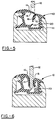
- FIGS. 4 through 6 A second embodiment of a glass run channel having the coating of the present invention applied thereto is indicated generally at 10 and is shown in FIGS. 4 through 6.
- Glass run channel 10 is similar to glass run channel 1 described above in most respects including its general composition and method of manufacture, which is hereby fully incorporated by reference, except that glass run channel 10 is larger and has a different configuration.
- Glass run channel 10 is an integrally formed one-piece member and includes a channel member or substrate 20 which is shown mounted in a window frame 11 of an automobile door in FIG. 5, which also shows window glass 12 just prior to introduction into a channel 13 defined by substrate 20.
- Substrate 20 includes a pair of similar, inwardly extending opposed lips 14 and 15 which extend generally horizontally across channel 13, and FIG. 6 shows glass 12 introduced into channel 13 and sealed against lips 14 and 15 thereof, which have a polyolefin coating 16 of the invention applied thereto.
- Samples 1 and 2 were pressed out in a 170°C mold into thin sheets which were subsequently cooled, removed from the press, and then applied to an uncured EPDM sheet which was then itself cured at 160°C.
- Samples 3 and 4 were mixed in a 2B Banbury mixer at 120°C and 116 rpm rotor speed. The temperature of the materials rose to 175°C during mixing. The materials then were sheeted off on a hot mill and the above procedure repeated. Samples 3 and 4 then were pressed out into thin sheets at 170°C, applied to uncured EPDM, which EPDM sheet was subsequently cured at 160°C for 10 minutes. Screening tests performed included the Crockmeter for abrasion, ASTM D-1894 for friction against glass, and 180° peel for adhesion. The results for the screening tests are set forth below in Table I.
- Samples 5 through 7 and 9 through 14 were prepared in the same manner as Samples 3 and 4 above in Table I.
- Sample 8 was prepared in the same manner as Samples 1 and 2 in Table I.
- Samples 5 through 14 illustrate that the polyolefin coatings embodying the invention resulted in only modest increases in specimen hardness above that of the EPDM substrate which has a Shore A hardness of 75.
- High levels of additives such as molybdenum disulfide as utilized in Sample 6 offered no improvement in friction coefficient or abrasion resistance as compared to Sample 5 which lacked such an additive.
- the greatest improvement in abrasion index was achieved with the addition of microspherical glass beads as illustrated by comparing Sample 5 with Sample 7 which had an abrasion index greater than 626 cycles per micrometer as compared to 211 cycles for sample 5.
- the glass beads used were microspherical glass beads manufactured by Potters Industries. The particle size was 44 micrometers and less.
- the glass beads had a coating recommended for use with polypropylene. Larger as well as smaller particles also are believed to give good results. However, larger particles would be undesirable if they caused difficulties in coating processes such as coextrusion or if they yielded an objectionally rough surface. For glass loadings greater than 15 phr in the polypropylene based coatings, objectionable noise resulted on the Crockmeter test. Levels of 10 phr and less gave no such problem. Samples 8 and 9 of Table II above are included as comparative examples of coatings prepared only with a commercial material, that is Santoprene 103-50. The santoprene 103-50 merely is a harder grade of Santoprene than Santoprene 101-55.
- the hardness of Santoprene 103-50 is near that of the coatings of the present invention.
- the use of Santoprene 103-50 alone as illustrated in Sample 8 resulted in poor abrasion resistance.
- the addition of microspherical glass beads as in Sample 9 resulted in poorer abrasion and higher friction than in sample 12 of Table III which is a Santoprene/polypropylene blend.
- Table III for 50/50 blends of polypropylene/Sanoprene, the best composition for high abrasion resistance and low friction was achieved in Sample 12.
- the polypropylene used in this sample included 25 phr of polytetrafluoroethylene (PTFE) particulates. Lower levels of PTFE had little effect on abrasion resistance.
- PTFE polytetrafluoroethylene
- Silicone oil addition did lower friction but also lowered abrasion resistance as shown by comparing Samples 11 and 13.
- the film material in Sample 11 was also successfully co-extruded as a smooth thin film onto an EPDM substrate. Subsequent curing in a circulating air oven gave a film with a smooth surface.
- the material of Sample 11 is compatible with EPDM processing conditions.
- Samples 2 through 14 of Tables I - III above demonstrate the class of materials usable in the invention which contain polypropylene and therefore require processing temperatures exceeding about 200°C.
- the following examples demonstrate another class of materials based on polyethylene which process at temperatures 30°C or more lower than for polypropylene-based materials. Both classes of coatings yield excellent adhesion with cohesive substrate failure without requiring surface treatments or primer layers containing undesirable solvents.
- Samples 15 through 20 each was mixed and prepared in the same manner as previously discussed samples 3 and 4 of Table I above.
- Samples 15 through 20 of Table IV above demonstrate the use of polyethylenes with a range of density and melt indexes.
- the samples each contained microspherical glass beads, a small amount of carbon black for ultraviolet protection, and were free of softening agents.
- Density is a convenient way to describe the degree of crystallinity of polyethylene
- melt index is a measure of how many grams of polymer will flow through a prescribed die at a specified load and temperature. A high melt index indicates a low molecular weight and vice versa.
- Samples 15 through 19 demonstrate the increase in abrasion resistance and reduction in friction for comparable density materials with decreasing melt index. Higher density materials as in Samples 15 through 17 have higher abrasion resistance and lower friction than lower density materials as in Samples 18 and 19.
- Sample 20 is a commercial polyethylene ionomer, Surlyn 9520, advertised by its manufacturer as having high abrasion resistance. However, this material has higher friction with adhesion failure upon tearing when compared with samples 15 through 17 which gave cohesive failure of the substrate upon tearing.
- a 2B Banbury mixer was heated to 90°C and operated at a rotor speed of 116 rpm. The non-curative ingredients then were added, and the curatives were added when the temperature reached 160°C. The samples were mixed until three minutes after the wattmeter leveled out, then dropped, cooled, and mixed two additional minutes in the Banbury. Preparation of the laminate was then carried out in the same manner as for samples 3 and 4 discussed above in Table I. Samples 28 and 29 were prepared in the same manner as Samples 3 and 4, and Sample 30 was prepared in the same manner as Samples 1 and 2. Samples 21 through 26 set forth in Table V above demonstrate the use of softening agents for this class of polyethylene-based materials.
- Samples 27 through 29 as set forth in Table VI above demonstrate the unexpectedly excellent adhesion when uncured EPDM, natural rubber, styrene-butadiene rubber and butadiene rubber were laminated with the polyolefin coatings embodying the invention and subsequently cured rather than applied to the precured rubber.
- the results in Table VI for Sample 29 also demonstrate less good adhesion of coatings to polyurethane rubber, high acrylonitrile content nitrile rubber, and silicone rubber, which have very different solubility parameters than the coating materials. This demonstrates the requirement that the solubility parameters of the substrate must be close to that of the coating for good adhesion if no chemical bonding enhancers or primers are used.
- Table VI further demonstrates the use of Dytron 7100, a commercially available dynamic vulcanizate of polyethylene with cured particles of EPDM.
- Sample 28 containing Dytron plus optional microspherical glass beads and carbon black shows improved abrasion resistance and low friction when compared with Sample 30 containing Dytron alone which demonstrates only marginal abrasion resistance and reduced friction.
- Preferred samples of the current invention are Samples 22 to 29 due to their good adhesion, abrasion resistance and friction, and also because they contain additives such as carbon black or carbon black and the UV protection aid (Tinuvin 328) for good weatherability.
- a glass run channel having the solventless, polyolefin coating embodying the invention applied thereto possesses good sealing properties, yet is abrasion-resistant and low friction to provide long life to the channel and ease of cranking for a vehicle window.
- the use of various polyolefins in the process of production for the glass run channel of the present invention allows for a range of melting points, such that the higher melt temperature of polypropylene may be desirable when applying to substrates destined for high temperature end use applications, and the lower melting temperature of polyethylene may be desirable during processing of certain substrates to avoid scorch of the selected elastomeric substrate.
- coextrusion of the coating of the present invention eliminates waste such as occurs when solvent sprays are used, due to overspray, etc., so that use of a solid polyolefin coating as in the present invention is more efficient and economical.
- a thinner coating can be formed than with e.g. cross-head extrusion.
Landscapes
- Chemical & Material Sciences (AREA)
- Organic Chemistry (AREA)
- Polymers & Plastics (AREA)
- Medicinal Chemistry (AREA)
- Chemical Kinetics & Catalysis (AREA)
- Health & Medical Sciences (AREA)
- Engineering & Computer Science (AREA)
- Mechanical Engineering (AREA)
- Materials Engineering (AREA)
- Manufacturing & Machinery (AREA)
- Compositions Of Macromolecular Compounds (AREA)
- Seal Device For Vehicle (AREA)
- Laminated Bodies (AREA)
- Window Of Vehicle (AREA)
- Coating Of Shaped Articles Made Of Macromolecular Substances (AREA)
Applications Claiming Priority (2)
| Application Number | Priority Date | Filing Date | Title |
|---|---|---|---|
| US57148590A | 1990-08-22 | 1990-08-22 | |
| US571485 | 1990-08-22 |
Publications (2)
| Publication Number | Publication Date |
|---|---|
| EP0472268A2 true EP0472268A2 (fr) | 1992-02-26 |
| EP0472268A3 EP0472268A3 (en) | 1992-09-02 |
Family
ID=24283900
Family Applications (1)
| Application Number | Title | Priority Date | Filing Date |
|---|---|---|---|
| EP19910304996 Withdrawn EP0472268A3 (en) | 1990-08-22 | 1991-06-03 | Forming abrasion-resistant coatings on elastomeric substrates |
Country Status (6)
| Country | Link |
|---|---|
| EP (1) | EP0472268A3 (fr) |
| JP (1) | JPH06340757A (fr) |
| KR (1) | KR940006477B1 (fr) |
| AU (1) | AU627653B2 (fr) |
| BR (1) | BR9102048A (fr) |
| CA (1) | CA2041759A1 (fr) |
Cited By (12)
| Publication number | Priority date | Publication date | Assignee | Title |
|---|---|---|---|---|
| FR2706144A1 (fr) * | 1993-06-07 | 1994-12-16 | Tokiwa Chemical Ind Co Lt | Procédé de fabrication d'une gouttière d'étanchéité pour automobiles. |
| US6017989A (en) * | 1997-04-01 | 2000-01-25 | The Standard Products Company | Exterior automotive component of an elastomeric modified polyolefin material having pleasing appearance |
| EP1080882A3 (fr) * | 1999-09-03 | 2002-04-03 | Mitsui Chemicals, Inc. | Matériau stratifié élastomère thermoplastique |
| EP1095764A3 (fr) * | 1999-11-01 | 2002-09-11 | Mitsui Chemicals, Inc. | Produits thermoplastiques oléfiniques élastomères laminés et joints les comprenant |
| EP1280676A4 (fr) * | 2000-05-10 | 2003-08-13 | Gencorp Inc | Procedes permettant d'enduire le caoutchouc de revetements de polyolefine cristalline sans solvant |
| WO2006041433A1 (fr) * | 2004-09-21 | 2006-04-20 | Advanced Elastomer System, L.P. | Extrudés d’isolation à partir de formulations de polyoléfines |
| WO2006041434A1 (fr) * | 2004-09-21 | 2006-04-20 | Advanced Elastomer System, L.P. | Vulcanisats thermoplastiques modifiés par des charges particulaires |
| US7193018B2 (en) | 2004-09-15 | 2007-03-20 | Advanced Elastomer Systems, Lp. | Slip-coat compositions and polymeric laminates |
| EP1809708A4 (fr) * | 2004-09-08 | 2012-03-14 | Nat Gummi Ab | Procede de traitement thermochimique et revetement non continu obtenu par ce procede |
| WO2020005442A1 (fr) * | 2018-06-29 | 2020-01-02 | Dow Global Technologies Llc | Polypropylène modifié par vulcanisats thermoplastiques pour isolation sous-marine |
| CN116535716A (zh) * | 2023-05-26 | 2023-08-04 | 广东粤港澳大湾区黄埔材料研究院 | 一种硫化橡胶的表面处理工艺及其应用 |
| WO2024126852A1 (fr) * | 2022-12-16 | 2024-06-20 | Valeo Systèmes d'Essuyage | Composition de revêtement pour lame d'essuyage de balai d'essuie-glace |
Families Citing this family (1)
| Publication number | Priority date | Publication date | Assignee | Title |
|---|---|---|---|---|
| US6660360B2 (en) * | 2000-01-04 | 2003-12-09 | Cooper Technology Services, Llc | Laminate of a substrate and an extruded high density polyethylene |
Family Cites Families (10)
| Publication number | Priority date | Publication date | Assignee | Title |
|---|---|---|---|---|
| GB1423541A (en) * | 1973-05-02 | 1976-02-04 | Mitsui Petrochemical Ind | Method of bonding rubber to plastics |
| JPS54117573A (en) * | 1978-03-06 | 1979-09-12 | Honshu Paper Co Ltd | Method of making antistatic and biaxially oriented polypropyrene composite film |
| US4289831A (en) * | 1978-08-18 | 1981-09-15 | Imperial Chemical Industries Limited | Polyolefin films |
| JPS56163182A (en) * | 1980-05-22 | 1981-12-15 | Toshiba Corp | Brake shoe composition for centrifugal dryer |
| GB2128899B (en) * | 1982-10-27 | 1985-11-20 | Dunlop Ltd | Bonded composites |
| ATE19890T1 (de) * | 1982-11-05 | 1986-06-15 | Exxon Research Engineering Co | Beschichtung mittels extrusion. |
| JPS6454038A (en) * | 1987-08-24 | 1989-03-01 | Mitsuboshi Belting Ltd | Production of polyamide molding containing lubricant |
| US4913976A (en) * | 1988-01-25 | 1990-04-03 | Gencorp Inc. | Cohesive bonding process for forming a laminate of a wear resistant thermoplastic and a weather resistant rubber |
| JPH01217049A (ja) * | 1988-02-25 | 1989-08-30 | Bridgestone Corp | ゴムの摩擦係数低下方法 |
| JPH0825225B2 (ja) * | 1989-08-11 | 1996-03-13 | 二三幸 椎名 | 複合プラスチック成形品の製造方法 |
-
1991
- 1991-04-29 AU AU76127/91A patent/AU627653B2/en not_active Ceased
- 1991-05-03 CA CA002041759A patent/CA2041759A1/fr not_active Abandoned
- 1991-05-17 BR BR919102048A patent/BR9102048A/pt not_active Application Discontinuation
- 1991-06-03 EP EP19910304996 patent/EP0472268A3/en not_active Withdrawn
- 1991-08-22 JP JP3233818A patent/JPH06340757A/ja active Pending
- 1991-08-22 KR KR1019910014561A patent/KR940006477B1/ko not_active Expired - Fee Related
Cited By (22)
| Publication number | Priority date | Publication date | Assignee | Title |
|---|---|---|---|---|
| FR2706144A1 (fr) * | 1993-06-07 | 1994-12-16 | Tokiwa Chemical Ind Co Lt | Procédé de fabrication d'une gouttière d'étanchéité pour automobiles. |
| US6017989A (en) * | 1997-04-01 | 2000-01-25 | The Standard Products Company | Exterior automotive component of an elastomeric modified polyolefin material having pleasing appearance |
| EP1080882A3 (fr) * | 1999-09-03 | 2002-04-03 | Mitsui Chemicals, Inc. | Matériau stratifié élastomère thermoplastique |
| US6866939B1 (en) | 1999-09-03 | 2005-03-15 | Mitsui Chemicals, Inc. | Thermoplastic elastomer laminated material |
| CN1296201C (zh) * | 1999-11-01 | 2007-01-24 | 三井化学株式会社 | 烯属热塑性弹性体的层压制品及建筑垫片 |
| EP1095764A3 (fr) * | 1999-11-01 | 2002-09-11 | Mitsui Chemicals, Inc. | Produits thermoplastiques oléfiniques élastomères laminés et joints les comprenant |
| US6589664B1 (en) | 1999-11-01 | 2003-07-08 | Mitsui Chemicals, Inc. | Laminated products of olefinic thermoplastic elastomer and constructional gaskets |
| EP1280676A4 (fr) * | 2000-05-10 | 2003-08-13 | Gencorp Inc | Procedes permettant d'enduire le caoutchouc de revetements de polyolefine cristalline sans solvant |
| US6982112B2 (en) | 2000-05-10 | 2006-01-03 | Gencorp, Inc. | Method of coating rubber with solventless crystalline polyolefin coatings |
| EP1809708A4 (fr) * | 2004-09-08 | 2012-03-14 | Nat Gummi Ab | Procede de traitement thermochimique et revetement non continu obtenu par ce procede |
| US7193018B2 (en) | 2004-09-15 | 2007-03-20 | Advanced Elastomer Systems, Lp. | Slip-coat compositions and polymeric laminates |
| WO2006041433A1 (fr) * | 2004-09-21 | 2006-04-20 | Advanced Elastomer System, L.P. | Extrudés d’isolation à partir de formulations de polyoléfines |
| WO2006041434A1 (fr) * | 2004-09-21 | 2006-04-20 | Advanced Elastomer System, L.P. | Vulcanisats thermoplastiques modifiés par des charges particulaires |
| CN112384563A (zh) * | 2018-06-29 | 2021-02-19 | 陶氏环球技术有限责任公司 | 用于海底保温的热塑性硫化橡胶改性的聚丙烯 |
| WO2020005442A1 (fr) * | 2018-06-29 | 2020-01-02 | Dow Global Technologies Llc | Polypropylène modifié par vulcanisats thermoplastiques pour isolation sous-marine |
| CN112384563B (zh) * | 2018-06-29 | 2024-01-05 | 陶氏环球技术有限责任公司 | 用于海底保温的热塑性硫化橡胶改性的聚丙烯 |
| US12018166B2 (en) | 2018-06-29 | 2024-06-25 | Dow Global Technologies Llc | Thermoplastic vulcanizates modified polypropylene for subsea insulation |
| AU2019292055B2 (en) * | 2018-06-29 | 2024-10-24 | Dow Global Technologies Llc | Thermoplastic vulcanizates modified polypropylene for subsea insulation |
| WO2024126852A1 (fr) * | 2022-12-16 | 2024-06-20 | Valeo Systèmes d'Essuyage | Composition de revêtement pour lame d'essuyage de balai d'essuie-glace |
| FR3143619A1 (fr) * | 2022-12-16 | 2024-06-21 | Valeo Systèmes d'Essuyage | Composition de revêtement pour lame d'essuyage de balai d'essuie-glace |
| CN116535716A (zh) * | 2023-05-26 | 2023-08-04 | 广东粤港澳大湾区黄埔材料研究院 | 一种硫化橡胶的表面处理工艺及其应用 |
| CN116535716B (zh) * | 2023-05-26 | 2024-07-23 | 广东粤港澳大湾区黄埔材料研究院 | 一种硫化橡胶的表面处理工艺及其应用 |
Also Published As
| Publication number | Publication date |
|---|---|
| BR9102048A (pt) | 1992-04-28 |
| CA2041759A1 (fr) | 1992-02-23 |
| JPH06340757A (ja) | 1994-12-13 |
| KR920004153A (ko) | 1992-03-27 |
| EP0472268A3 (en) | 1992-09-02 |
| KR940006477B1 (ko) | 1994-07-20 |
| AU627653B2 (en) | 1992-08-27 |
| AU7612791A (en) | 1992-02-27 |
Similar Documents
| Publication | Publication Date | Title |
|---|---|---|
| US5183613A (en) | Process for the preparation of solventless, low friction, abrasion-resistant coatings for elastomeric substrates | |
| EP0472268A2 (fr) | Application d'un revêtement résistant à l'abrasion sur des substrats élastomériques | |
| US4751121A (en) | Multi-ply self-adhesive and deep-drawable protective sheet, especially for automotive vehicles | |
| DE60012215T2 (de) | Olefinische gleitbeschichtung für fahrzeug wetter dichtungen | |
| US5482766A (en) | Deep-drawable film | |
| US7744988B2 (en) | Composites containing crosslinkable thermoplastic and TPV show layer | |
| US6660360B2 (en) | Laminate of a substrate and an extruded high density polyethylene | |
| CN101784589A (zh) | 粘结热塑性弹性体部件至玻璃板的方法 | |
| US5264270A (en) | Squeak resistant panel/window assembly with elastomeric coating | |
| US5766703A (en) | Automobile weather strip | |
| JPH10324200A (ja) | 自動車用ウェザストリップ | |
| KR20160083324A (ko) | 글라스 런용 열가소성 탄성체 조성물 및 이의 제조방법 | |
| KR20060068493A (ko) | 자동차 웨더스트립용 코팅 조성물 | |
| EP1793998B1 (fr) | Compositions de revêtement antidérapant et produits stratifiés polymères | |
| JPH09176408A (ja) | 表皮部材用ポリオレフィン樹脂組成物及びその積層物 | |
| US5548012A (en) | Automotive weather strip | |
| FR2847259A1 (fr) | Nouvelles compositions de peinture pour elastomeres | |
| WO2003008174A1 (fr) | Fabrication d'extrusions composites resistant a l'abrasion | |
| EP1192219A1 (fr) | Utilisation de polymeres elastomeres chimiquement modifies pour ameliorer les proprietes d'adherence de composants polymeres elastomeres thermodurcis | |
| US10946734B2 (en) | Profile strip for a motor vehicle and profile strip production method | |
| US20030065102A1 (en) | Use of chemically modified elastomeric polymers to improve adhesion properties of thermoset elastomeric polymers components | |
| US20040214958A1 (en) | Use of chemically modified elastomeric polymers to improve adhesion properties of thermoset elastomeric polymers components | |
| JP2000095906A (ja) | 表皮部材用樹脂組成物及びその積層体 | |
| JP3487211B2 (ja) | オレフィン系熱可塑性エラストマー成形品 | |
| JP2000178439A (ja) | 熱可塑性エラストマー組成物およびウェザーストリップ |
Legal Events
| Date | Code | Title | Description |
|---|---|---|---|
| PUAI | Public reference made under article 153(3) epc to a published international application that has entered the european phase |
Free format text: ORIGINAL CODE: 0009012 |
|
| AK | Designated contracting states |
Kind code of ref document: A2 Designated state(s): AT DE FR GB IT |
|
| PUAL | Search report despatched |
Free format text: ORIGINAL CODE: 0009013 |
|
| AK | Designated contracting states |
Kind code of ref document: A3 Designated state(s): AT DE FR GB IT |
|
| 17P | Request for examination filed |
Effective date: 19921029 |
|
| 17Q | First examination report despatched |
Effective date: 19940920 |
|
| STAA | Information on the status of an ep patent application or granted ep patent |
Free format text: STATUS: THE APPLICATION IS DEEMED TO BE WITHDRAWN |
|
| 18D | Application deemed to be withdrawn |
Effective date: 19950331 |