EP0474097B1 - Chariot d'achats pour les magasins à libre service - Google Patents
Chariot d'achats pour les magasins à libre service Download PDFInfo
- Publication number
- EP0474097B1 EP0474097B1 EP91114362A EP91114362A EP0474097B1 EP 0474097 B1 EP0474097 B1 EP 0474097B1 EP 91114362 A EP91114362 A EP 91114362A EP 91114362 A EP91114362 A EP 91114362A EP 0474097 B1 EP0474097 B1 EP 0474097B1
- Authority
- EP
- European Patent Office
- Prior art keywords
- basket
- rear wall
- child seat
- seat flap
- child
- Prior art date
- Legal status (The legal status is an assumption and is not a legal conclusion. Google has not performed a legal analysis and makes no representation as to the accuracy of the status listed.)
- Expired - Lifetime
Links
- 235000004443 Ricinus communis Nutrition 0.000 claims description 4
- 240000000528 Ricinus communis Species 0.000 claims description 4
- 238000006073 displacement reaction Methods 0.000 claims 1
- 230000005484 gravity Effects 0.000 abstract 1
- 238000000034 method Methods 0.000 abstract 1
- 238000010276 construction Methods 0.000 description 7
- 230000003993 interaction Effects 0.000 description 1
- 239000000463 material Substances 0.000 description 1
- 230000007246 mechanism Effects 0.000 description 1
Images

Classifications
-
- B—PERFORMING OPERATIONS; TRANSPORTING
- B62—LAND VEHICLES FOR TRAVELLING OTHERWISE THAN ON RAILS
- B62B—HAND-PROPELLED VEHICLES, e.g. HAND CARTS OR PERAMBULATORS; SLEDGES
- B62B3/00—Hand carts having more than one axis carrying transport wheels; Steering devices therefor; Equipment therefor
- B62B3/14—Hand carts having more than one axis carrying transport wheels; Steering devices therefor; Equipment therefor characterised by provisions for nesting or stacking, e.g. shopping trolleys
- B62B3/144—Adaptations for transporting children; Mounting of toys for the children
-
- B—PERFORMING OPERATIONS; TRANSPORTING
- B62—LAND VEHICLES FOR TRAVELLING OTHERWISE THAN ON RAILS
- B62B—HAND-PROPELLED VEHICLES, e.g. HAND CARTS OR PERAMBULATORS; SLEDGES
- B62B2202/00—Indexing codes relating to type or characteristics of transported articles
- B62B2202/70—Flowers; Pots; Plants
Definitions
- the invention relates to a shopping cart for self-service shops, which has a shopping cart above a chassis frame supported by swivel castors, the basket rear wall of which can be pivoted inwards and upwards for stacking similar shopping carts, provided in this basket rear wall, lying next to one another, reaching up to or near the lower edge of the basket rear wall Openings for pushing through the legs of a child and with a child seat flap articulated near the lower edge of these openings in the position of use, which can be pivoted out of the level of the rear wall of the basket into the interior of the shopping cart for use.
- Such shopping carts are known from DE-A-3 111 616.
- the openings for pushing through the legs of the child extend approximately from the upper edge of the rear wall of the basket to, for example, half the height of this basket wall.
- the child seat flap is hinged here, which in the stowed position is folded into a position parallel to the level of the pivoting rear wall of the basket and is folded out of this level in the use position in order to provide a seat for the child.
- the child seat flap of this known shopping cart is held by a handlebar arrangement articulated on the lower edge of the pivotable rear wall of the basket, which also serves as the backrest of the child seat.
- Certain shopping carts for example for self-service garden centers, are equipped with baskets of shallow depth, such that a child seat construction of conventional design and the associated mechanisms for returning the child seat to the stowed position in the plane of the pivoting basket rear wall cannot be used.
- the object of the invention is accordingly to design a shopping cart of the type described at the outset for self-service shops in such a way that a safe seat for carrying a child is created at a low shopping cart depth and the stacking of similar shopping carts is not hindered by the child seat construction.
- the child seat flap itself is articulated somewhat above the continuous lower edge of the rear wall of the basket itself, with reference to the position of use of the basket rear wall, the basket rear wall and the child seat flap then arrive when from the rear a similar shopping cart is inserted to produce the stowed position, in an extended position relative to each other and, when this position is reached, finally together in the Basket interior pivoted upwards without the child seat flap falling into the basket interior of the inserted shopping cart.
- the child seat flap also does not get into the interior of the shopping cart of the inserted shopping cart, which otherwise could no longer be separated from the preceding shopping cart. Rather, the nested shopping carts remain separable from each other after the driver bracket or the free, transverse edge of the child seat flap has such a width that it always rests on the upper side edges of the inserted shopping cart.
- a major advantage of the construction of a shopping cart with a shopping cart of shallow depth is that the child seat flap can be folded up from the position of use, in which it rests essentially on the floor of the shopping cart, into the level of the pivoting basket rear wall and then by a simple handle closes the openings in the rear wall of the basket for inserting the legs of a child in such a way that when the shopping trolley is used without the child seat construction, small objects, for example small flower pots, packs and the like, are prevented from falling out through the openings in the rear wall of the basket.
- the grate bars here expediently run in the longitudinal direction on the inside of the basket. These grate bars then enable trouble-free sliding of the transverse free edge of the child seat flap or the crossbar of the carrier bracket.
- a stackable shopping cart for self-service shops is shown schematically in the detail and in dash-dotted lines in FIG.
- a U-shaped chassis frame 2 supported by swivel castors 1 and tapering in the direction of travel, carries on the spars 3 a cart 4, which also tapers in the direction of travel, in a substantially customary form.
- the shopping cart has a relatively small depth.
- the basket rear wall 5 is pivotally mounted on a pivot axis 6 running along its upper edge between the basket side walls in such a way that the basket rear wall 5 can pivot upwards and inwards when a similar shopping trolley is inserted into the basket interior to produce the stowed position, as indicated by the arrow P 1 is indicated.
- two adjacent openings 7 and 8 are provided for pushing through the legs of a child to be carried when shopping, which can take place on a child seat flap 9 lying essentially on the floor of the shopping cart 4.
- the child seat flap 9 has a width approximately corresponding to the distance between the outer edges of the openings 7 and 8. If the child seat flap is folded up around its pivoting bearing near the lower edge of the basket rear wall 5, it can handle the openings 7 and 8 cover so that small items from falling out of the shopping cart are avoided if the shopping cart in question is used without a child being carried.
- Parallel to the lower, continuous lattice bar 10 of the basket rear wall 5 runs at a relatively small distance from this a lattice rod 11 which is bent inwards in the area of the openings 7 and 8 with respect to the position of use of the basket rear wall 5 in the direction of the basket interior and in one Distance d from the plane of the basket rear wall 5 runs parallel to it offset.
- the distance d corresponds approximately to the thickness of the child seat flap 9, so that it can be pivoted without being substantially prevented from pivoting by the bars of the basket rear wall 5 running between the openings 7 and 8.
- the brackets 12, 13 and 14 form a driving bracket arrangement which, when the basket rear wall 5 is pivoted inwards and upwards in the basket interior, abuts the lower bracket 10 of the basket rear wall 5 with the respective bracket leg sections closest to the pivot bearing and then in the extended position relative to it Basket rear wall 5 is carried along with it when the basket rear wall 5 continues its upward pivoting movement.
- the crossbar of the C-bracket 14 in turn takes the child seat flap 9 upwards.
- the basket rear wall 5 When producing the stowed position and pushing together similar shopping trolleys, the basket rear wall 5 first pushes the free transverse edge of the child seat flap 9 and the vertex of the brackets 12 and 13 on the bottom of the shopping cart 4 during its upward pivoting movement and then lifts the entire arrangement out of the brackets 12 to 14 and the child seat flap 9 in the continuation of the pivoting movement on, the basket rear wall 5 and the child seat flap and the carrier bracket arrangement being pivoted substantially in a common plane.
- the sliding of the free edge of the child seat flap or the crossbars on the shopping cart floor is favored by the fact that the grating longitudinal bars 15 are arranged running on the inside of the shopping cart.
- the free transverse edge of the child seat flap 9 is designed as a strip 16 which, as shown at 17, is extended laterally beyond the child seat surface in such a way that the projections 17 against the lateral boundaries of the openings 7 and 8 of the basket rear wall 5 protrude and are supported against the vertical bars located here. In this way, a stop for the child seat flap is created on its sides in the covering position relative to the openings 7 and 8.
- the width of the traverse of the carrier bracket arrangement formed from the brackets 12, 13 and 14 is selected so that it is somewhat smaller than the shopping basket width D at a distance from the rear basket end corresponding to the sum of the basket rear wall height H and the child seat depth T.
- the importance of this dimensioning is that the free transverse edge of the child seat flap and the effective traverse of the carrier bracket arrangement can in no way sink into the basket interior of an inserted shopping cart, so that stacked shopping carts according to the construction according to FIG. 1 remain securely separable.
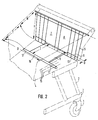
- the embodiment according to FIG. 2 is simplified compared to the construction according to FIG. 1.
- the shopping cart according to FIG. 2 contains a child seat flap 9, in which the side lugs 17 are of a similar design Edge strip 16 are extended so far in the direction of the basket side walls that the edge strip 16 acts overall as a driver, the width of which transversely to the longitudinal direction of the basket is somewhat less than the width of the shopping basket at a distance from the rear end of the basket corresponding to the sum of the basket rear wall height H and child seat flap depth T.
- This dimensioning rule has already been stated in the description of the exemplary embodiment according to FIG. 1.
- the child seat flap 9 is mounted on the basket rear wall 5 at a certain vertical distance with respect to the position of use from the lower rail 10 to the rail 11.
- an offset of the lattice rod 11 can in turn be provided in the direction of the basket interior in order to be able to pivot the child seat flap past the lattice bars of the basket rear wall between the openings 7 and 8.
- the basket rear wall 5 is pivoted upwards, then from a certain pivoting position the lower lattice bar 10 takes it upwards against the underside of the child seat flap 9, the child seat flap 9 being moved essentially lying in the plane of the basket rear wall.
- the lateral projections 17 of the child seat flap 9 are supported on the side edges of the basket and prevent the child seat flap from sinking into the basket interior of the inserted shopping trolley.
- the construction specified here allows the use of plastic child seat flaps that do not extend over the entire width of the basket rear wall, so that plastic material is saved.
- the carrier bracket arrangement comprising the brackets 12, 13 and 14 (see exemplary embodiment according to FIG. 1) can be dispensed with, since the lateral projections 17 of the child seat flap 9 and the interaction of the underside of the child seat flap with the lower lattice bar 10 of the basket rear wall perform the carrier function fulfill.
Landscapes
- Engineering & Computer Science (AREA)
- Chemical & Material Sciences (AREA)
- Combustion & Propulsion (AREA)
- Transportation (AREA)
- Mechanical Engineering (AREA)
- Handcart (AREA)
Claims (6)
- Chariot d'achats pour magasins à libre service, lequel présente au-dessus d'un cadre porteur (2) supporté par des roulettes (1) un panier à marchandises dont le fond arrière (5) est basculable vers l'intérieur et vers le haut pour permettre l'empilement des chariots du même type, comportant dans ledit fond arrière des ouvertures (7, 8) disposées l'une à côté de l'autre et s'étendant jusqu'au ou à proximité du bord inférieur du fond arrière (5) du panier pour passer les jambes d'un enfant, et comportant un abattant de siège enfant (9) fixé à proximité du bord inférieur desdites ouvertures en position de service, lequel est basculable du plan du fond arrière du panier vers l'intérieur du panier à marchandises, caractérisé en ce qu'au-dessus du bord inférieur continu (10) du fond arrière du panier, de part et d'autre du support pivotant de l'abattant de siège enfant (9) et essentiellement à la même hauteur, est articulé sur le fond arrière (5) du panier un dispositif d'entraînement en étrier (12, 13, 14) dont la traverse d'étrier orientée perpendiculairement par rapport au sens longitudinal du panier est d'une part plus large que l'abattant de siège enfant (9) et d'autre part moins large que le panier à marchandises à une distance calculée à partir de l'extrémité arrière du panier, qui correspond à la somme de la hauteur (H) du fond arrière du panier et de la profondeur (T) de l'abattant de siège enfant, et passe sous l'abattant de siège enfant.
- Chariot d'achats pour magasins à libre service, lequel présente au-dessus d'un cadre porteur (2) supporté par des roulettes (1) un panier à marchandises (4) dont le fond arrière (5) est basculable vers l'intérieur et vers le haut pour permettre l'empilement des chariots du même type, comportant dans ledit fond arrière des ouvertures (7, 8) placées l'une à côté de l'autre et s'étendant jusqu'au ou à proximité du bord inférieur du fond arrière (5) du panier pour passer les jambes d'un enfant, et comportant un abattant de siège enfant (9) articulé à proximité du bord inférieur desdites ouvertures en position de service, lequel est basculable du plan du fond arrière du panier vers l'intérieur du panier à marchandises lorsque l'on veut l'utiliser, et est articulé au fond arrière (5) du panier, sensiblement au-dessus du bord inférieur continu (10) de celui-ci caractérisé en ce que le bord de l'abattant de siège enfant, qui est opposé au bord articulé, se présente sous forme de bord libre et est conçu en particulier comme dispositif d'entraînement (16, 17) et présente une largeur qui est inférieure à la largeur du panier à marchandises (4) à une distance calculée à partir de l'extrémité arrière du panier, qui correspond à la somme de la hauteur (H) du fond arrière du panier et de la profondeur (T) de l'abattant de siège enfant.
- Chariot d'achats selon la revendication 1 ou 2, caractérisé en ce que l'abattant de siège enfant (9) est en matière plastique.
- Chariot d'achats selon l'une des revendications 1 à 3, caractérisé en ce que l'abattant de siège enfant (9) est fixé sur une barre de treillis (11) du fond arrière (5) du panier, laquelle s'étend de manière parallèle par rapport au bord inférieur (10) du fond arrière, à faible distance de celui-ci, et est coudée vers l'intérieur du panier au niveau de l'articulation de l'abattant de siège enfant et des ouvertures (7, 8) du fond arrière du panier et est essentiellement décalée vers l'intérieur en fonction de l'épaisseur (d) de l'abattant de siège enfant (9).
- Chariots d'achats selon l'une des revendications 1 à 4, caractérisé en ce que le bord inférieur (10) du fond arrière (5) du panier est formé par une barre de treillis qui, lors du basculement du fond arrière du panier vers le haut, est destinée à se mettre par en-dessous contre le dispositif d'entraînement en étrier ou l'abattant de siège enfant et à éviter un pivotement de ces éléments lors du basculement du fond arrière du panier vers le haut au-delà d'une position allongée par rapport audit fond arrière.
- Chariot d'achats selon l'une des revendications 1 à 5, caractérisé en ce que les barres de treillis (15) du treillis de fond du panier à marchandises (4) s'étendent sur le côté intérieur du panier dans le sens longitudinal.
Applications Claiming Priority (2)
| Application Number | Priority Date | Filing Date | Title |
|---|---|---|---|
| DE9012289U DE9012289U1 (de) | 1990-08-27 | 1990-08-27 | Einkaufswagen für Selbstbedienungsgeschäfte |
| DE9012289U | 1990-08-27 |
Publications (2)
| Publication Number | Publication Date |
|---|---|
| EP0474097A1 EP0474097A1 (fr) | 1992-03-11 |
| EP0474097B1 true EP0474097B1 (fr) | 1995-10-25 |
Family
ID=6856895
Family Applications (1)
| Application Number | Title | Priority Date | Filing Date |
|---|---|---|---|
| EP91114362A Expired - Lifetime EP0474097B1 (fr) | 1990-08-27 | 1991-08-27 | Chariot d'achats pour les magasins à libre service |
Country Status (3)
| Country | Link |
|---|---|
| EP (1) | EP0474097B1 (fr) |
| AT (1) | ATE129468T1 (fr) |
| DE (2) | DE9012289U1 (fr) |
Family Cites Families (3)
| Publication number | Priority date | Publication date | Assignee | Title |
|---|---|---|---|---|
| US3645554A (en) * | 1970-05-04 | 1972-02-29 | Unarco Industries | Shopping cart |
| US4116456A (en) * | 1977-05-19 | 1978-09-26 | Unarco Industries, Inc. | Shopping cart |
| DE3111616A1 (de) * | 1980-12-23 | 1982-10-28 | Rudolf Wanzl Kg, 8874 Leipheim | Ineinanderschiebbarer einkaufswagen mit kindersitzanordnung |
-
1990
- 1990-08-27 DE DE9012289U patent/DE9012289U1/de not_active Expired - Lifetime
-
1991
- 1991-08-27 EP EP91114362A patent/EP0474097B1/fr not_active Expired - Lifetime
- 1991-08-27 DE DE59106760T patent/DE59106760D1/de not_active Expired - Fee Related
- 1991-08-27 AT AT91114362T patent/ATE129468T1/de not_active IP Right Cessation
Also Published As
| Publication number | Publication date |
|---|---|
| ATE129468T1 (de) | 1995-11-15 |
| EP0474097A1 (fr) | 1992-03-11 |
| DE59106760D1 (de) | 1995-11-30 |
| DE9012289U1 (de) | 1991-02-07 |
Similar Documents
| Publication | Publication Date | Title |
|---|---|---|
| DE8812023U1 (de) | Einkaufswagen mit einem an seinem oberen Teil angeordneten Transportkorb | |
| DE2924658A1 (de) | Rollwagen | |
| DE3448335C3 (de) | Stapelbarer Einkaufswagen | |
| EP0141398A2 (fr) | Chariot à provisions encastrable | |
| DE8500639U1 (de) | Einkaufswagen für Selbstbedienungsläden mit einer Abstellvorrichtung für Kisten oder dgl. | |
| DE4337917C2 (de) | Stapelbarer Einkaufswagen | |
| DE8508238U1 (de) | Stapelbarer Einkaufswagen | |
| EP0254210B2 (fr) | Chariot d'achats emboîtable | |
| EP0569988A2 (fr) | Chariot de transport pour objets de type palette | |
| DE3208691A1 (de) | Einkaufswagen mit warenablage | |
| EP0683083A2 (fr) | Chariot d'achat | |
| DE8136236U1 (de) | Stapelbarer einkaufswagen | |
| EP0609663B1 (fr) | Chariot d'achats | |
| EP0672569B1 (fr) | Chariot d'achat | |
| EP0751057B1 (fr) | Chariot d'achat emboítable | |
| EP0474097A1 (fr) | Chariot d'achats pour les magasins à libre service | |
| EP0620146B1 (fr) | Chariot d'achat | |
| DE8331746U1 (de) | Stapelbarer einkaufswagen | |
| WO1988000148A1 (fr) | Caddie a panier pivotable | |
| DE2505910A1 (de) | Fahrbarer transportbehaelter | |
| DE3233291C2 (fr) | ||
| DE3043599C2 (fr) | ||
| EP0734933B1 (fr) | Chariot d'achats emboítables | |
| EP0731011B1 (fr) | Chariot d'achat | |
| DE3016282A1 (de) | Klappe fuer koerbe ineinanderzuschachtelnder einkaufwagen fuer selbstbedienungslaeden |
Legal Events
| Date | Code | Title | Description |
|---|---|---|---|
| PUAI | Public reference made under article 153(3) epc to a published international application that has entered the european phase |
Free format text: ORIGINAL CODE: 0009012 |
|
| AK | Designated contracting states |
Kind code of ref document: A1 Designated state(s): AT BE CH DE IT LI LU |
|
| RBV | Designated contracting states (corrected) |
Designated state(s): AT BE CH DE IT LI |
|
| 17P | Request for examination filed |
Effective date: 19920524 |
|
| 17Q | First examination report despatched |
Effective date: 19940429 |
|
| GRAA | (expected) grant |
Free format text: ORIGINAL CODE: 0009210 |
|
| AK | Designated contracting states |
Kind code of ref document: B1 Designated state(s): AT BE CH DE IT LI |
|
| REF | Corresponds to: |
Ref document number: 129468 Country of ref document: AT Date of ref document: 19951115 Kind code of ref document: T |
|
| REF | Corresponds to: |
Ref document number: 59106760 Country of ref document: DE Date of ref document: 19951130 |
|
| REG | Reference to a national code |
Ref country code: CH Ref legal event code: NV Representative=s name: KELLER & PARTNER PATENTANWAELTE AG |
|
| ITF | It: translation for a ep patent filed | ||
| PLBE | No opposition filed within time limit |
Free format text: ORIGINAL CODE: 0009261 |
|
| STAA | Information on the status of an ep patent application or granted ep patent |
Free format text: STATUS: NO OPPOSITION FILED WITHIN TIME LIMIT |
|
| 26N | No opposition filed | ||
| PGFP | Annual fee paid to national office [announced via postgrant information from national office to epo] |
Ref country code: DE Payment date: 20010813 Year of fee payment: 11 |
|
| PGFP | Annual fee paid to national office [announced via postgrant information from national office to epo] |
Ref country code: CH Payment date: 20010824 Year of fee payment: 11 Ref country code: AT Payment date: 20010824 Year of fee payment: 11 |
|
| PGFP | Annual fee paid to national office [announced via postgrant information from national office to epo] |
Ref country code: BE Payment date: 20010912 Year of fee payment: 11 |
|
| PG25 | Lapsed in a contracting state [announced via postgrant information from national office to epo] |
Ref country code: AT Free format text: LAPSE BECAUSE OF NON-PAYMENT OF DUE FEES Effective date: 20020827 |
|
| PG25 | Lapsed in a contracting state [announced via postgrant information from national office to epo] |
Ref country code: LI Free format text: LAPSE BECAUSE OF NON-PAYMENT OF DUE FEES Effective date: 20020831 Ref country code: CH Free format text: LAPSE BECAUSE OF NON-PAYMENT OF DUE FEES Effective date: 20020831 Ref country code: BE Free format text: LAPSE BECAUSE OF NON-PAYMENT OF DUE FEES Effective date: 20020831 |
|
| BERE | Be: lapsed |
Owner name: *BRUDER SIEGEL G.M.B.H. + CO. K.G. DRAHT- UND META Effective date: 20020831 |
|
| PG25 | Lapsed in a contracting state [announced via postgrant information from national office to epo] |
Ref country code: DE Free format text: LAPSE BECAUSE OF NON-PAYMENT OF DUE FEES Effective date: 20030301 |
|
| REG | Reference to a national code |
Ref country code: CH Ref legal event code: PL |
|
| PG25 | Lapsed in a contracting state [announced via postgrant information from national office to epo] |
Ref country code: IT Free format text: LAPSE BECAUSE OF NON-PAYMENT OF DUE FEES;WARNING: LAPSES OF ITALIAN PATENTS WITH EFFECTIVE DATE BEFORE 2007 MAY HAVE OCCURRED AT ANY TIME BEFORE 2007. THE CORRECT EFFECTIVE DATE MAY BE DIFFERENT FROM THE ONE RECORDED. Effective date: 20050827 |