EP0474884A1 - Tissu de base pour ruban-encreur et production d'un tel tissu - Google Patents
Tissu de base pour ruban-encreur et production d'un tel tissu Download PDFInfo
- Publication number
- EP0474884A1 EP0474884A1 EP91906428A EP91906428A EP0474884A1 EP 0474884 A1 EP0474884 A1 EP 0474884A1 EP 91906428 A EP91906428 A EP 91906428A EP 91906428 A EP91906428 A EP 91906428A EP 0474884 A1 EP0474884 A1 EP 0474884A1
- Authority
- EP
- European Patent Office
- Prior art keywords
- fabric
- inked ribbon
- warp
- high pressure
- set forth
- Prior art date
- Legal status (The legal status is an assumption and is not a legal conclusion. Google has not performed a legal analysis and makes no representation as to the accuracy of the status listed.)
- Granted
Links
- 239000004744 fabric Substances 0.000 title claims abstract description 55
- 238000004519 manufacturing process Methods 0.000 title claims description 9
- 239000000835 fiber Substances 0.000 claims abstract description 16
- 238000011282 treatment Methods 0.000 claims abstract description 15
- 239000012530 fluid Substances 0.000 claims abstract 5
- XLYOFNOQVPJJNP-UHFFFAOYSA-N water Substances O XLYOFNOQVPJJNP-UHFFFAOYSA-N 0.000 claims description 17
- 239000007788 liquid Substances 0.000 claims description 14
- 229920002302 Nylon 6,6 Polymers 0.000 claims description 2
- 239000004677 Nylon Substances 0.000 claims 1
- 229920001778 nylon Polymers 0.000 claims 1
- 239000002759 woven fabric Substances 0.000 abstract 1
- 238000010521 absorption reaction Methods 0.000 description 11
- 238000012360 testing method Methods 0.000 description 5
- 238000000034 method Methods 0.000 description 4
- 238000001035 drying Methods 0.000 description 3
- 238000011156 evaluation Methods 0.000 description 3
- 239000007787 solid Substances 0.000 description 3
- 239000004952 Polyamide Substances 0.000 description 2
- 238000007796 conventional method Methods 0.000 description 2
- 238000013461 design Methods 0.000 description 2
- 230000000694 effects Effects 0.000 description 2
- 239000000463 material Substances 0.000 description 2
- 229920002647 polyamide Polymers 0.000 description 2
- 229920000728 polyester Polymers 0.000 description 2
- 238000009991 scouring Methods 0.000 description 2
- 238000009941 weaving Methods 0.000 description 2
- 229920002292 Nylon 6 Polymers 0.000 description 1
- 239000000654 additive Substances 0.000 description 1
- 230000000996 additive effect Effects 0.000 description 1
- 230000003247 decreasing effect Effects 0.000 description 1
- 230000007547 defect Effects 0.000 description 1
- 238000005516 engineering process Methods 0.000 description 1
- 238000009998 heat setting Methods 0.000 description 1
- 238000005259 measurement Methods 0.000 description 1
- 239000003960 organic solvent Substances 0.000 description 1
- 239000002245 particle Substances 0.000 description 1
- 238000012545 processing Methods 0.000 description 1
- 239000004094 surface-active agent Substances 0.000 description 1
- 239000004753 textile Substances 0.000 description 1
- 229920002554 vinyl polymer Polymers 0.000 description 1
Images
Classifications
-
- B—PERFORMING OPERATIONS; TRANSPORTING
- B41—PRINTING; LINING MACHINES; TYPEWRITERS; STAMPS
- B41J—TYPEWRITERS; SELECTIVE PRINTING MECHANISMS, i.e. MECHANISMS PRINTING OTHERWISE THAN FROM A FORME; CORRECTION OF TYPOGRAPHICAL ERRORS
- B41J31/00—Ink ribbons; Renovating or testing ink ribbons
- B41J31/02—Ink ribbons characterised by the material from which they are woven
- B41J31/04—Ink ribbons characterised by the material from which they are woven woven from synthetic material
-
- D—TEXTILES; PAPER
- D06—TREATMENT OF TEXTILES OR THE LIKE; LAUNDERING; FLEXIBLE MATERIALS NOT OTHERWISE PROVIDED FOR
- D06C—FINISHING, DRESSING, TENTERING OR STRETCHING TEXTILE FABRICS
- D06C29/00—Finishing or dressing, of textile fabrics, not provided for in the preceding groups
-
- B—PERFORMING OPERATIONS; TRANSPORTING
- B41—PRINTING; LINING MACHINES; TYPEWRITERS; STAMPS
- B41J—TYPEWRITERS; SELECTIVE PRINTING MECHANISMS, i.e. MECHANISMS PRINTING OTHERWISE THAN FROM A FORME; CORRECTION OF TYPOGRAPHICAL ERRORS
- B41J31/00—Ink ribbons; Renovating or testing ink ribbons
- B41J31/02—Ink ribbons characterised by the material from which they are woven
-
- Y—GENERAL TAGGING OF NEW TECHNOLOGICAL DEVELOPMENTS; GENERAL TAGGING OF CROSS-SECTIONAL TECHNOLOGIES SPANNING OVER SEVERAL SECTIONS OF THE IPC; TECHNICAL SUBJECTS COVERED BY FORMER USPC CROSS-REFERENCE ART COLLECTIONS [XRACs] AND DIGESTS
- Y10—TECHNICAL SUBJECTS COVERED BY FORMER USPC
- Y10T—TECHNICAL SUBJECTS COVERED BY FORMER US CLASSIFICATION
- Y10T442/00—Fabric [woven, knitted, or nonwoven textile or cloth, etc.]
- Y10T442/30—Woven fabric [i.e., woven strand or strip material]
Definitions
- This invention relates to a method of manufacturing a fabric for the inked ribbon used in the printers such as impact type serial dot and line printers.
- the inked ribbon used in the impact type printers the conventional spool type is decreasing, and the cassette type having the inked ribbon in the form of a long tape folded and housed in a cassette has become the main.
- the inked ribbon of the cassette type had a shortcoming to produce print spots, or hot spots as generally called, at the folded parts of the ribbon.
- a cloth composed of warps having a twist of 100 T/m or more and wefts of a twist of 0 to 300 T/m has been used. That is, to reduce the processing cost, the so-called non-twisting is being realized with the twisting process omitted for the wefts and the original twist of 30 T/m or less of the material yarn utilized for weaving. But, here, if such non-twisting is applied to the warps, the hot spots are generally produced, and so the inked ribbon is applicable only to limited uses such as spool type having hot spots scarcely produced.
- Patent Publication No. SHO 61-24487 it is described to disturb the fiber orientation of the cloth for inked ribbon with a high pressure water stream in order to dissolve the reel marks and improve the absorption of ink, but nothing is described of the method of dissolving the hot spots with the twist of the warp reduced.
- the fabric for inked ribbon of the present invention has the following composition.
- the fabric for inked ribbon according to the present invention is composed of a cloth having multifilaments of a twist of 30 T/m or less used for the warp, and it is characterized in that the fiber orientation in said multifilament is disturbed through high pressure liquid treatment.
- the method of manufacturing the fabric for inked ribbon according to the present invention is characterized by treating a cloth composed of warps of multifilaments of a twist of 30 T/m or less with a flow of high pressure liquid.
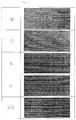
- Fig. 1 shows the standard for evaluation of hot spots. That is the conditions of hot spots of various ranks of ribbons in solid printing.
- a fabric for inked ribbon scarcely producing hot spots by treating a cloth composed of multifilaments of a low twist of warps with a high pressure liquid.
- the fabric for inked ribbon of the present invention has the orientation of fibers in the filaments disturbed by the high pressure liquid treatment and thus has the voids in the fabric increased, and so it is distinguished in absorption of ink.
- the effect of improving the hot spots is readily obtainable, and the ink absorption is increased.
- the fabric shrinks more or less, and here by taking such shrinkage into account and weaving to a rather low fiber density, it is possible to provide a product of a desired fiber density and thickness.
- the material for the multifilament under the present invention there may be listed the polyamide fiber, polyester fiber, polyacryl fiber and polyvinyl fiber. But, form the durability of the fabric, the polyamide fiber and polyester fiber are preferable, and nylon 66 and nylon 6 are particularly preferable.
- the fabric constituting the inked ribbon is composed of a cloth having the foregoing fiber used for the warp as well as weft.
- the total denier of these yarns is preferably 20 to 100D or, more preferably, 40 to 70D, and the single yarn denier of the fiber constituting the yarn is preferably 1d to 3d.
- the textile density of the fabric is preferably 150 to 220 yarns/in. for the warp and 100 to 140 yarns/in. for the weft but is not limited thereto.
- plain weave For the texture of the fabric, plain weave, derivative plain weave, twill and saten are preferably used but are not limited thereto.
- the inventors examined the contribution of the warp and found that the warp would contribute to increasing the ink absorption but not so much as the weft for improvement of the hot spots.
- the high pressure liquid treatment under the present invention refers to a method of spouting a liquid through a small hole under a high pressure to have it hit the fabric.
- the liquid may contain an additive such as solid particles, an organic solvent or a surface active agent.
- the diameter of the nozzle spouting water is preferably 0.1 to 0.4 mm or, more preferably, 0.2 to 0.35 mm.
- the fabric treatment speed is preferably 5 to 100 m/min or, more preferably, 20 to 80 m/min.
- the high pressure liquid treatment may be made in any of the scouring, drying and heat setting processes of the fabric but is efficiently made after scouring.
- the fabric thus obtained has hot spots scarcely produced, equally to, or much more than, the conventional fabric composed of yarns of a twist of about 100 to 300 T/m through additional twisting and is thus distinguished as a fabric for inked ribbon.
- An inked ribbon (10 m long) prepared as above is set in a cassette for 9-pin dot printer (product of Tokyo Denki, model M-1550), and the cassette is set on the printer for solid printing, and any hot spots are observed with naked eye.
- the standard of evaluation is shown in Fig. 1, viz.
- the fabric to be tested is melt cut into a size of 10 cm x 10 cm to form a test specimen, then its weight (A) is measured.
- the test specimen is soaked in an oil ink, and defoaming by vacuuming, the ink is well permeated into the test specimen.
- the test specimen is held between filter papers to remove excessive ink through a mangle. Then, changing the filter papers, the test specimen is allowed to pass through the mangle twice to completely remove the excessive ink, and the weight (B) of the ink containing ribbon is measured.
- Two kinds of yarns were prepared: a 40 denier/34 filament yarn of an original twist of 13 T/m, and a yarn having an additional twist of 273 T/m made to the first yarn to a total twist of 283 T/m together with the original twist of 13 T/m.
- plain fabrics were woven in a water jet room, and they were scoured and dried according to the conventional method. Thereafter, Examples 1 through 5 had the high pressure water jet treatments shown in Table 1 rendered and, after drying, finish setting made. References 1 and 2 were directly subjected to finish setting without high pressure water flow treatment.
- Example 5 had the hot spot greatly improved and were good in ink absorption, provided Example 5 had the texture slightly deviated, as compared with the others, probably on account of the higher water pressure.
- Reference 1 is of the same fabric design to the inked ribbons generally used for the 9-pin dot printer, but the hot spot is of ⁇ level.
- Reference 2 is worse than Reference 1 in the level of hot spot.
- Examples 6 through 10 had the high pressure water jet treatments shown in Table 2 and, after drying, finish setting given respectively.
- References 3 and 4 were directly subjected to finish setting without high pressure water jet treatment.
- Reference 3 is of the same fabric design to the inked ribbons generally used for the 24-pin dot printer, but the hot spot is of X level.
- Reference 4 is a fabric for inked ribbon comprising warps of multifilament yarns of a twist of 30 T/m or less and has no high pressure water jet treatment rendered. It will be seen that the level of the hot spot is worse than that of Reference 3.
- the inked ribbon comprised of the fabric of the present invention is very suitable and advantageous for the printers using the cassette type ribbon which is the main of the form of the inked ribbon in recent years. It scarcely produces hot spots and is distinguished in ink absorption. Furthermore, it uses the warp of a very low twist of 30 T/m or less and is thus economically produced.
Landscapes
- Engineering & Computer Science (AREA)
- Textile Engineering (AREA)
- Impression-Transfer Materials And Handling Thereof (AREA)
- Treatment Of Fiber Materials (AREA)
- Woven Fabrics (AREA)
Abstract
Applications Claiming Priority (3)
| Application Number | Priority Date | Filing Date | Title |
|---|---|---|---|
| JP2083987A JPH0737167B2 (ja) | 1990-03-29 | 1990-03-29 | インパクトプリンタのインクリボン用基布およびその製造方法 |
| JP83987/90 | 1990-03-29 | ||
| PCT/JP1991/000403 WO1991014580A1 (fr) | 1990-03-29 | 1991-03-27 | Tissu de base pour ruban-encreur et production d'un tel tissu |
Publications (3)
| Publication Number | Publication Date |
|---|---|
| EP0474884A1 true EP0474884A1 (fr) | 1992-03-18 |
| EP0474884A4 EP0474884A4 (en) | 1993-07-07 |
| EP0474884B1 EP0474884B1 (fr) | 1997-08-27 |
Family
ID=13817891
Family Applications (1)
| Application Number | Title | Priority Date | Filing Date |
|---|---|---|---|
| EP91906428A Expired - Lifetime EP0474884B1 (fr) | 1990-03-29 | 1991-03-27 | Procede de fabrication d'un ruban encreur pour utilisation dans une cassette |
Country Status (6)
| Country | Link |
|---|---|
| US (1) | US5173360A (fr) |
| EP (1) | EP0474884B1 (fr) |
| JP (1) | JPH0737167B2 (fr) |
| KR (1) | KR920700929A (fr) |
| CA (1) | CA2051381A1 (fr) |
| WO (1) | WO1991014580A1 (fr) |
Cited By (1)
| Publication number | Priority date | Publication date | Assignee | Title |
|---|---|---|---|---|
| EP0679526A4 (fr) * | 1993-11-10 | 1996-02-28 | Toray Industries | Textile de base de ruban encreur et son procede de realisation. |
Families Citing this family (8)
| Publication number | Priority date | Publication date | Assignee | Title |
|---|---|---|---|---|
| USRE40362E1 (en) | 1987-04-23 | 2008-06-10 | Polymer Group, Inc. | Apparatus and method for hydroenhancing fabric |
| US5632072A (en) | 1988-04-14 | 1997-05-27 | International Paper Company | Method for hydropatterning napped fabric |
| US5737813A (en) | 1988-04-14 | 1998-04-14 | International Paper Company | Method and apparatus for striped patterning of dyed fabric by hydrojet treatment |
| JPH0692002A (ja) * | 1992-09-10 | 1994-04-05 | Toray Ind Inc | インクリボン用基布 |
| US5806155A (en) * | 1995-06-07 | 1998-09-15 | International Paper Company | Apparatus and method for hydraulic finishing of continuous filament fabrics |
| US5870807A (en) * | 1995-11-17 | 1999-02-16 | Bba Nonwovens Simpsonville, Inc. | Uniformity and product improvement in lyocell garments with hydraulic fluid treatment |
| US6442809B1 (en) | 1997-12-05 | 2002-09-03 | Polymer Group, Inc. | Fabric hydroenhancement method and equipment for improved efficiency |
| EP1694893A4 (fr) * | 2003-12-15 | 2007-11-28 | Univ North Carolina State | Amelioration des caracteristiques physiques et mecaniques de tissus par hydroliage |
Family Cites Families (4)
| Publication number | Priority date | Publication date | Assignee | Title |
|---|---|---|---|---|
| JPS59164177A (ja) * | 1983-03-09 | 1984-09-17 | Takamatsu Yushi Kk | インクリボン |
| JP2576084B2 (ja) * | 1984-07-13 | 1997-01-29 | 東レ株式会社 | インクリボンの製造方法 |
| JPS6347186A (ja) * | 1986-08-18 | 1988-02-27 | Asahi Chem Ind Co Ltd | 多色インクリボン用基布 |
| JPH0311912A (ja) * | 1989-06-06 | 1991-01-21 | Naka Tech Lab | フロアパネル開口部の塞ぎ板 |
-
1990
- 1990-03-29 JP JP2083987A patent/JPH0737167B2/ja not_active Expired - Lifetime
-
1991
- 1991-03-27 US US07/768,326 patent/US5173360A/en not_active Expired - Fee Related
- 1991-03-27 WO PCT/JP1991/000403 patent/WO1991014580A1/fr not_active Ceased
- 1991-03-27 EP EP91906428A patent/EP0474884B1/fr not_active Expired - Lifetime
- 1991-03-27 KR KR1019910701716A patent/KR920700929A/ko not_active Withdrawn
- 1991-03-27 CA CA002051381A patent/CA2051381A1/fr not_active Abandoned
Non-Patent Citations (1)
| Title |
|---|
| See references of WO9114580A1 * |
Cited By (1)
| Publication number | Priority date | Publication date | Assignee | Title |
|---|---|---|---|---|
| EP0679526A4 (fr) * | 1993-11-10 | 1996-02-28 | Toray Industries | Textile de base de ruban encreur et son procede de realisation. |
Also Published As
| Publication number | Publication date |
|---|---|
| JPH03281277A (ja) | 1991-12-11 |
| CA2051381A1 (fr) | 1991-09-30 |
| EP0474884A4 (en) | 1993-07-07 |
| US5173360A (en) | 1992-12-22 |
| KR920700929A (ko) | 1992-08-10 |
| JPH0737167B2 (ja) | 1995-04-26 |
| EP0474884B1 (fr) | 1997-08-27 |
| WO1991014580A1 (fr) | 1991-10-03 |
Similar Documents
| Publication | Publication Date | Title |
|---|---|---|
| EP0474884A1 (fr) | Tissu de base pour ruban-encreur et production d'un tel tissu | |
| EP0679526B1 (fr) | Textile de base de ruban encreur et son procede de realisation | |
| JP2910522B2 (ja) | インクリボン基布およびその製造方法 | |
| JP2512082B2 (ja) | 嵩高糸の捲取方法 | |
| JP2576084B2 (ja) | インクリボンの製造方法 | |
| CA2107338C (fr) | Substrat pour un ruban encreur | |
| KR100614624B1 (ko) | 데님조 투습방수성 원단 | |
| JPH10183444A (ja) | インパクトプリンター用インクリボン用基布およびその製造方法 | |
| JPH04357071A (ja) | インクリボン用織物 | |
| JP3166778B2 (ja) | 再生セルロース系繊維布帛の染色方法 | |
| KR100569682B1 (ko) | 울팩용 포지 및 그의 제조방법 | |
| JP2003064552A (ja) | ワイピングハンカチ及びその製造方法 | |
| EP0615851B1 (fr) | Etoffe pour rubans encreurs | |
| JPS59127789A (ja) | インクリボン | |
| JPS6342587B2 (fr) | ||
| JPH0126349B2 (fr) | ||
| JPH0811425A (ja) | インクリボン用基布の製造方法 | |
| JPS62286784A (ja) | コンピユ−タ−印字リボン用織物 | |
| JPH082073A (ja) | インクリボン用基布の製造方法 | |
| JPH04211978A (ja) | インクリボン用基布 | |
| JPH082072A (ja) | インクリボン用基布 | |
| JPH05311530A (ja) | 易染性ポリエステルループヤーン | |
| JPH05301432A (ja) | シームレスインクリボン | |
| JPS62273876A (ja) | インクリボン用基布 | |
| JPH10183445A (ja) | インクリボン用基布 |
Legal Events
| Date | Code | Title | Description |
|---|---|---|---|
| PUAI | Public reference made under article 153(3) epc to a published international application that has entered the european phase |
Free format text: ORIGINAL CODE: 0009012 |
|
| 17P | Request for examination filed |
Effective date: 19911218 |
|
| AK | Designated contracting states |
Kind code of ref document: A1 Designated state(s): AT BE CH DE DK ES FR GB GR IT LI NL SE |
|
| A4 | Supplementary search report drawn up and despatched |
Effective date: 19930521 |
|
| AK | Designated contracting states |
Kind code of ref document: A4 Designated state(s): AT BE CH DE DK ES FR GB GR IT LI NL SE |
|
| 17Q | First examination report despatched |
Effective date: 19940211 |
|
| GRAG | Despatch of communication of intention to grant |
Free format text: ORIGINAL CODE: EPIDOS AGRA |
|
| GRAH | Despatch of communication of intention to grant a patent |
Free format text: ORIGINAL CODE: EPIDOS IGRA |
|
| GRAH | Despatch of communication of intention to grant a patent |
Free format text: ORIGINAL CODE: EPIDOS IGRA |
|
| RBV | Designated contracting states (corrected) |
Designated state(s): GB |
|
| GRAA | (expected) grant |
Free format text: ORIGINAL CODE: 0009210 |
|
| REG | Reference to a national code |
Ref country code: DE Ref legal event code: 8566 |
|
| AK | Designated contracting states |
Kind code of ref document: B1 Designated state(s): GB |
|
| PGFP | Annual fee paid to national office [announced via postgrant information from national office to epo] |
Ref country code: GB Payment date: 19980317 Year of fee payment: 8 |
|
| PLBE | No opposition filed within time limit |
Free format text: ORIGINAL CODE: 0009261 |
|
| STAA | Information on the status of an ep patent application or granted ep patent |
Free format text: STATUS: NO OPPOSITION FILED WITHIN TIME LIMIT |
|
| 26N | No opposition filed | ||
| PG25 | Lapsed in a contracting state [announced via postgrant information from national office to epo] |
Ref country code: GB Free format text: LAPSE BECAUSE OF NON-PAYMENT OF DUE FEES Effective date: 19990327 |
|
| GBPC | Gb: european patent ceased through non-payment of renewal fee |
Effective date: 19990327 |