EP0480400A2 - Procédé et appareil pour améliorer le transfert de masse dans un bioréacteur à membrane et pour fournir un environnement de culture plus homogène - Google Patents
Procédé et appareil pour améliorer le transfert de masse dans un bioréacteur à membrane et pour fournir un environnement de culture plus homogène Download PDFInfo
- Publication number
- EP0480400A2 EP0480400A2 EP91117211A EP91117211A EP0480400A2 EP 0480400 A2 EP0480400 A2 EP 0480400A2 EP 91117211 A EP91117211 A EP 91117211A EP 91117211 A EP91117211 A EP 91117211A EP 0480400 A2 EP0480400 A2 EP 0480400A2
- Authority
- EP
- European Patent Office
- Prior art keywords
- media
- bioreactor
- circuit
- cells
- flow
- Prior art date
- Legal status (The legal status is an assumption and is not a legal conclusion. Google has not performed a legal analysis and makes no representation as to the accuracy of the status listed.)
- Withdrawn
Links
- 239000012528 membrane Substances 0.000 title claims abstract description 31
- 238000000034 method Methods 0.000 title claims description 16
- 230000008569 process Effects 0.000 title claims description 12
- 238000012546 transfer Methods 0.000 title claims description 8
- 238000004113 cell culture Methods 0.000 claims abstract description 22
- 239000012510 hollow fiber Substances 0.000 claims description 24
- 230000010354 integration Effects 0.000 claims description 24
- 239000000523 sample Substances 0.000 claims description 15
- 239000012895 dilution Substances 0.000 claims description 7
- 238000010790 dilution Methods 0.000 claims description 7
- 238000012258 culturing Methods 0.000 claims description 6
- 238000000338 in vitro Methods 0.000 claims description 4
- 239000012530 fluid Substances 0.000 abstract description 6
- 235000015097 nutrients Nutrition 0.000 abstract description 6
- 210000004027 cell Anatomy 0.000 description 72
- 239000000835 fiber Substances 0.000 description 23
- 102000000588 Interleukin-2 Human genes 0.000 description 12
- 108010002350 Interleukin-2 Proteins 0.000 description 12
- 239000002609 medium Substances 0.000 description 12
- WQZGKKKJIJFFOK-GASJEMHNSA-N Glucose Natural products OC[C@H]1OC(O)[C@H](O)[C@@H](O)[C@@H]1O WQZGKKKJIJFFOK-GASJEMHNSA-N 0.000 description 11
- 239000008103 glucose Substances 0.000 description 11
- 238000011081 inoculation Methods 0.000 description 8
- 239000000047 product Substances 0.000 description 7
- QVGXLLKOCUKJST-UHFFFAOYSA-N atomic oxygen Chemical compound [O] QVGXLLKOCUKJST-UHFFFAOYSA-N 0.000 description 6
- 229910052760 oxygen Inorganic materials 0.000 description 6
- 239000001301 oxygen Substances 0.000 description 6
- 210000002966 serum Anatomy 0.000 description 6
- 230000001351 cycling effect Effects 0.000 description 5
- 238000010586 diagram Methods 0.000 description 5
- 239000007789 gas Substances 0.000 description 5
- 210000003810 lymphokine-activated killer cell Anatomy 0.000 description 5
- 230000035899 viability Effects 0.000 description 5
- 239000002699 waste material Substances 0.000 description 5
- 239000000427 antigen Substances 0.000 description 4
- 102000036639 antigens Human genes 0.000 description 4
- 108091007433 antigens Proteins 0.000 description 4
- 238000003306 harvesting Methods 0.000 description 4
- 230000006872 improvement Effects 0.000 description 4
- 238000004519 manufacturing process Methods 0.000 description 4
- 230000015572 biosynthetic process Effects 0.000 description 3
- 238000004891 communication Methods 0.000 description 3
- 239000002054 inoculum Substances 0.000 description 3
- 210000004698 lymphocyte Anatomy 0.000 description 3
- 239000011148 porous material Substances 0.000 description 3
- 238000011282 treatment Methods 0.000 description 3
- CURLTUGMZLYLDI-UHFFFAOYSA-N Carbon dioxide Chemical compound O=C=O CURLTUGMZLYLDI-UHFFFAOYSA-N 0.000 description 2
- ZDXPYRJPNDTMRX-VKHMYHEASA-N L-glutamine Chemical compound OC(=O)[C@@H](N)CCC(N)=O ZDXPYRJPNDTMRX-VKHMYHEASA-N 0.000 description 2
- JVTAAEKCZFNVCJ-UHFFFAOYSA-M Lactate Chemical compound CC(O)C([O-])=O JVTAAEKCZFNVCJ-UHFFFAOYSA-M 0.000 description 2
- 241001529936 Murinae Species 0.000 description 2
- 210000001744 T-lymphocyte Anatomy 0.000 description 2
- 238000003556 assay Methods 0.000 description 2
- 239000007640 basal medium Substances 0.000 description 2
- 239000006227 byproduct Substances 0.000 description 2
- 230000004663 cell proliferation Effects 0.000 description 2
- 230000001413 cellular effect Effects 0.000 description 2
- 239000011248 coating agent Substances 0.000 description 2
- 238000000576 coating method Methods 0.000 description 2
- 239000012141 concentrate Substances 0.000 description 2
- 239000003636 conditioned culture medium Substances 0.000 description 2
- 125000004122 cyclic group Chemical group 0.000 description 2
- 239000012737 fresh medium Substances 0.000 description 2
- 210000000822 natural killer cell Anatomy 0.000 description 2
- 230000002572 peristaltic effect Effects 0.000 description 2
- 238000005086 pumping Methods 0.000 description 2
- 230000002829 reductive effect Effects 0.000 description 2
- 230000001105 regulatory effect Effects 0.000 description 2
- 230000003068 static effect Effects 0.000 description 2
- 239000000126 substance Substances 0.000 description 2
- 239000013589 supplement Substances 0.000 description 2
- RDEIXVOBVLKYNT-VQBXQJRRSA-N (2r,3r,4r,5r)-2-[(1s,2s,3r,4s,6r)-4,6-diamino-3-[(2r,3r,6s)-3-amino-6-(1-aminoethyl)oxan-2-yl]oxy-2-hydroxycyclohexyl]oxy-5-methyl-4-(methylamino)oxane-3,5-diol;(2r,3r,4r,5r)-2-[(1s,2s,3r,4s,6r)-4,6-diamino-3-[(2r,3r,6s)-3-amino-6-(aminomethyl)oxan-2-yl]o Chemical compound OS(O)(=O)=O.O1C[C@@](O)(C)[C@H](NC)[C@@H](O)[C@H]1O[C@@H]1[C@@H](O)[C@H](O[C@@H]2[C@@H](CC[C@@H](CN)O2)N)[C@@H](N)C[C@H]1N.O1C[C@@](O)(C)[C@H](NC)[C@@H](O)[C@H]1O[C@@H]1[C@@H](O)[C@H](O[C@@H]2[C@@H](CC[C@H](O2)C(C)N)N)[C@@H](N)C[C@H]1N.O1[C@H](C(C)NC)CC[C@@H](N)[C@H]1O[C@H]1[C@H](O)[C@@H](O[C@@H]2[C@@H]([C@@H](NC)[C@@](C)(O)CO2)O)[C@H](N)C[C@@H]1N RDEIXVOBVLKYNT-VQBXQJRRSA-N 0.000 description 1
- 108091003079 Bovine Serum Albumin Proteins 0.000 description 1
- 208000031637 Erythroblastic Acute Leukemia Diseases 0.000 description 1
- 208000036566 Erythroleukaemia Diseases 0.000 description 1
- 101001057504 Homo sapiens Interferon-stimulated gene 20 kDa protein Proteins 0.000 description 1
- 101001055144 Homo sapiens Interleukin-2 receptor subunit alpha Proteins 0.000 description 1
- 241000598436 Human T-cell lymphotropic virus Species 0.000 description 1
- 102100026878 Interleukin-2 receptor subunit alpha Human genes 0.000 description 1
- BKAYIFDRRZZKNF-VIFPVBQESA-N N-acetylcarnosine Chemical compound CC(=O)NCCC(=O)N[C@H](C(O)=O)CC1=CN=CN1 BKAYIFDRRZZKNF-VIFPVBQESA-N 0.000 description 1
- 239000012980 RPMI-1640 medium Substances 0.000 description 1
- 241000287181 Sturnus vulgaris Species 0.000 description 1
- 230000004913 activation Effects 0.000 description 1
- 208000021841 acute erythroid leukemia Diseases 0.000 description 1
- 230000006978 adaptation Effects 0.000 description 1
- WQZGKKKJIJFFOK-VFUOTHLCSA-N beta-D-glucose Chemical compound OC[C@H]1O[C@@H](O)[C@H](O)[C@@H](O)[C@@H]1O WQZGKKKJIJFFOK-VFUOTHLCSA-N 0.000 description 1
- 229910002092 carbon dioxide Inorganic materials 0.000 description 1
- 239000001569 carbon dioxide Substances 0.000 description 1
- 230000020411 cell activation Effects 0.000 description 1
- 230000010261 cell growth Effects 0.000 description 1
- 230000001276 controlling effect Effects 0.000 description 1
- 230000001461 cytolytic effect Effects 0.000 description 1
- 231100000433 cytotoxic Toxicity 0.000 description 1
- 230000001472 cytotoxic effect Effects 0.000 description 1
- 230000003013 cytotoxicity Effects 0.000 description 1
- 231100000135 cytotoxicity Toxicity 0.000 description 1
- 238000009826 distribution Methods 0.000 description 1
- 230000000694 effects Effects 0.000 description 1
- 238000002474 experimental method Methods 0.000 description 1
- 239000012526 feed medium Substances 0.000 description 1
- 239000012091 fetal bovine serum Substances 0.000 description 1
- 238000000684 flow cytometry Methods 0.000 description 1
- 238000011010 flushing procedure Methods 0.000 description 1
- ZDXPYRJPNDTMRX-UHFFFAOYSA-N glutamine Natural products OC(=O)C(N)CCC(N)=O ZDXPYRJPNDTMRX-UHFFFAOYSA-N 0.000 description 1
- 230000012010 growth Effects 0.000 description 1
- 230000007773 growth pattern Effects 0.000 description 1
- 208000002672 hepatitis B Diseases 0.000 description 1
- 210000004408 hybridoma Anatomy 0.000 description 1
- 230000016784 immunoglobulin production Effects 0.000 description 1
- 238000002347 injection Methods 0.000 description 1
- 239000007924 injection Substances 0.000 description 1
- 230000000670 limiting effect Effects 0.000 description 1
- 239000007788 liquid Substances 0.000 description 1
- 230000002934 lysing effect Effects 0.000 description 1
- 230000002101 lytic effect Effects 0.000 description 1
- 238000012423 maintenance Methods 0.000 description 1
- 230000007246 mechanism Effects 0.000 description 1
- 239000012092 media component Substances 0.000 description 1
- 239000002207 metabolite Substances 0.000 description 1
- 239000000203 mixture Substances 0.000 description 1
- 238000012544 monitoring process Methods 0.000 description 1
- 210000005087 mononuclear cell Anatomy 0.000 description 1
- 238000011017 operating method Methods 0.000 description 1
- 230000001706 oxygenating effect Effects 0.000 description 1
- 210000005105 peripheral blood lymphocyte Anatomy 0.000 description 1
- 102000004169 proteins and genes Human genes 0.000 description 1
- 108090000623 proteins and genes Proteins 0.000 description 1
- 230000003134 recirculating effect Effects 0.000 description 1
- 238000011084 recovery Methods 0.000 description 1
- 230000000717 retained effect Effects 0.000 description 1
- 230000002441 reversible effect Effects 0.000 description 1
- 238000009738 saturating Methods 0.000 description 1
- 239000004017 serum-free culture medium Substances 0.000 description 1
- 230000035939 shock Effects 0.000 description 1
- 239000000243 solution Substances 0.000 description 1
- 238000013190 sterility testing Methods 0.000 description 1
- 230000001225 therapeutic effect Effects 0.000 description 1
- 210000004881 tumor cell Anatomy 0.000 description 1
- 238000009827 uniform distribution Methods 0.000 description 1
- XLYOFNOQVPJJNP-UHFFFAOYSA-N water Substances O XLYOFNOQVPJJNP-UHFFFAOYSA-N 0.000 description 1
Images


Classifications
-
- C—CHEMISTRY; METALLURGY
- C12—BIOCHEMISTRY; BEER; SPIRITS; WINE; VINEGAR; MICROBIOLOGY; ENZYMOLOGY; MUTATION OR GENETIC ENGINEERING
- C12M—APPARATUS FOR ENZYMOLOGY OR MICROBIOLOGY; APPARATUS FOR CULTURING MICROORGANISMS FOR PRODUCING BIOMASS, FOR GROWING CELLS OR FOR OBTAINING FERMENTATION OR METABOLIC PRODUCTS, i.e. BIOREACTORS OR FERMENTERS
- C12M29/00—Means for introduction, extraction or recirculation of materials, e.g. pumps
- C12M29/16—Hollow fibers
-
- C—CHEMISTRY; METALLURGY
- C12—BIOCHEMISTRY; BEER; SPIRITS; WINE; VINEGAR; MICROBIOLOGY; ENZYMOLOGY; MUTATION OR GENETIC ENGINEERING
- C12M—APPARATUS FOR ENZYMOLOGY OR MICROBIOLOGY; APPARATUS FOR CULTURING MICROORGANISMS FOR PRODUCING BIOMASS, FOR GROWING CELLS OR FOR OBTAINING FERMENTATION OR METABOLIC PRODUCTS, i.e. BIOREACTORS OR FERMENTERS
- C12M23/00—Constructional details, e.g. recesses, hinges
- C12M23/58—Reaction vessels connected in series or in parallel
-
- C—CHEMISTRY; METALLURGY
- C12—BIOCHEMISTRY; BEER; SPIRITS; WINE; VINEGAR; MICROBIOLOGY; ENZYMOLOGY; MUTATION OR GENETIC ENGINEERING
- C12M—APPARATUS FOR ENZYMOLOGY OR MICROBIOLOGY; APPARATUS FOR CULTURING MICROORGANISMS FOR PRODUCING BIOMASS, FOR GROWING CELLS OR FOR OBTAINING FERMENTATION OR METABOLIC PRODUCTS, i.e. BIOREACTORS OR FERMENTERS
- C12M25/00—Means for supporting, enclosing or fixing the microorganisms, e.g. immunocoatings
- C12M25/10—Hollow fibers or tubes
-
- C—CHEMISTRY; METALLURGY
- C12—BIOCHEMISTRY; BEER; SPIRITS; WINE; VINEGAR; MICROBIOLOGY; ENZYMOLOGY; MUTATION OR GENETIC ENGINEERING
- C12M—APPARATUS FOR ENZYMOLOGY OR MICROBIOLOGY; APPARATUS FOR CULTURING MICROORGANISMS FOR PRODUCING BIOMASS, FOR GROWING CELLS OR FOR OBTAINING FERMENTATION OR METABOLIC PRODUCTS, i.e. BIOREACTORS OR FERMENTERS
- C12M29/00—Means for introduction, extraction or recirculation of materials, e.g. pumps
- C12M29/10—Perfusion
-
- C—CHEMISTRY; METALLURGY
- C12—BIOCHEMISTRY; BEER; SPIRITS; WINE; VINEGAR; MICROBIOLOGY; ENZYMOLOGY; MUTATION OR GENETIC ENGINEERING
- C12M—APPARATUS FOR ENZYMOLOGY OR MICROBIOLOGY; APPARATUS FOR CULTURING MICROORGANISMS FOR PRODUCING BIOMASS, FOR GROWING CELLS OR FOR OBTAINING FERMENTATION OR METABOLIC PRODUCTS, i.e. BIOREACTORS OR FERMENTERS
- C12M41/00—Means for regulation, monitoring, measurement or control, e.g. flow regulation
Definitions
- the present invention is directed to a process and apparatus for culturing cells in a bioreactor having semi-permeable membranes and more specifically, to a process and apparatus involving the provision of circulation means on the cell side of the membranes to improve mixing and reduce boundary layers and concentration gradients along the membranes and in and/or around the cell mass to improve mass transfer.
- Cell culture devices for culturing cells in vitro having a shell with a plurality of hollow fiber membranes have been known for quite some time.
- Media containing oxygen, nutrients and other chemical stimuli is transported through the lumen of the hollow fiber membranes and undergoes a pressure drop resulting in an outward radial convective flow at the entry port of the device and an inward flow at the exit port of the device.
- Cells are grown in the fluid space between the fibers and the shell wall.
- Cell culture devices using sheet membrane bioreactors are also well known and work as well as hollow fiber membranes.
- Hollow fiber culture devices have been proven to be ideal for the maintenance of many types of cells at high densities in vitro.
- the mass transfer characteristics of hollow fiber culture devices provide an efficient means for delivering nutrients and removing waste products from a culture.
- the semi-porous, hollow fiber membranes can be selected with various pore sizes. With proper pore size selection, the cellular product can be maintained on the outside of the fibers while waste products and contaminating proteins will pass through the membrane pores into the lumen of the hollow fibers where they can be subsequently removed from the culture.
- the extracapillary space is capped or dead-ended at both ends. This creates a Starling effect and a heterogeneous environment. Cells generally grow only toward the proximal end of the bioreactor. Also, large molecular weight components trapped in the extracapillary space concentrate at the distal end.
- Prior art hollow fiber culture devices have many limitations that prevent their use in the economical production of cell-derived products in commercial quantities. These limitations include:
- the purpose of the present invention is to overcome these limitations, making it possible to utilize a hollow fiber culture device or other conventional sheet membrane devices for the economical production of cell-derived products.
- the hollow fiber cartridge included a plurality of capillaries extending through a shell with each capillary including a lumen through which media containing oxygen, nutrients and other chemical components are transported.
- a delivery system or integration circuit delivers a primary media supply through the lumens of the capillaries of the bioreactor as shown in the prior art schematic diagram in Figure 2.
- the integration circuit includes a pump for circulating the media through the integration circuit.
- a gas exchange cartridge, a DO probe, a pH probe, and an integration chamber may also be included in the integration circuit.
- the extracapillary circuit containing the expansion chamber may be provided with valves between the expansion chamber and the extracapillary space.
- a cyclic flow of media is generated across the hollow fiber membranes and through the extracapillary space of the bioreactor shown in Figure 2.
- media is pushed from the lumens of the fibers across the fiber membranes into the extracapillary space along the full length of the bioreactor. This bathes the cells in nutrient and oxygen rich media.
- oxygen depleted media and waste by-products are moved from the expansion circuit, through the cell bed and finer membrane into the integration circuit.
- the present invention provides a new and improved culturing device for culturing cells in vitro which overcomes all of the aforementioned prior art limitations.
- the present invention provides a new and improved process and apparatus for improving mass transfer in a membrane bioreactor providing a more homogeneous culture environment by using an extracapillary circulation loop which provides a more homogeneous environment while eliminating the loss of cells in the expansion chamber of the above described pressure cycling system.
- the present invention provides a new and improved process and apparatus for growing cells in a bioreactor, thus improving productivity of the apparatus which is exactly proportional to the mass transfer improvement.
- the present invention provides a new and improved apparatus for cell culture comprising at least one bioreactor of the type having a plurality of capillary tubes located within a shell with the opposite ends of the lumens of the capillary tubes being connected to a first circulation loop including a pump for circulating media, a device for oxygenating the media and adjustment of the small pH, a pH probe for monitoring and controlling pH and reservoir means for adding fresh media and factors and waste/effluent removal, and a second loop connected to opposite ends of the extracapillary space of said bioreactor including a pump for recirculating media through the extracapillary space, a device for assuring even flow through the extracapillary space of each bioreactor and media addition means with dilution means for gradient dilution or addition of extracapillary media components.
- the new and improved method according to the present invention includes the circulation of media through the lumens of capillary fibers in at least one bioreactor while simultaneously circulating a second media through the extracapillary space of the bioreactor.
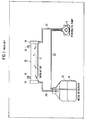
- Figure 1 is a schematic diagram of a conventional, prior art hollow fiber system for cell culture.
- Figure 2 is a schematic diagram of a prior art cycling system for cell culture.
- Figure 3 is a schematic diagram of a cell culture system according to the present invention with an extracapillary circulation loop.
- Figure 4 is a schematic view of a first modified extracapillary recirculation loop according to the present invention.
- Figure 5 is a schematic diagram of a second modified extracapillary recirculation loop according to the present invention.
- the conventional prior art system shown in Figure 1 is comprised of a bioreactor 10 of the type having a plurality of hollow, capillary fibers 12, one of which is shown by dashed lines in Figure 1, disposed parallel to each other with the opposite ends in communication with plenums 14.
- the extracapillary space within the reactor 10 is only accessible through at least closeable ports 16 located at at least one end thereof for the introduction of the cells to be cultured suspended in a cell growing media into the bioreactor.
- Media 18 from a suitable reservoir 20 is supplied to the capillary fibers 12 through tubing 22 by means of a peristaltic pump 24 and media is returned to the reservoir 20 through the tubing 26. While the media is passed through the lumens of the fibers, the extracapillary space within the bioreactor 10 is capped by closing the ports 16 so as to create a sealed environment.
- the prior art cycling system presented an improvement over the hollow fiber technique disclosed in Figure 1 since two fluid circuits are provided.
- the first fluid circuit is an integration circuit IC 30 which includes a bellows pump 32, a pH probe 34, an integration chamber 36, a gas exchange cartridge 38 and a DO probe 40 connected in series with opposite ends of the bioreactor 44 in communication with the hollow fiber membranes extending between the ends.
- the second fluid circuit is the expansion circuit EC 48 which connects the extracapillary space within the bioreactor 44 with an expansion chamber 46 containing additional media.
- the integration circuit chamber 36 As the integration circuit chamber 36 is pressurized above the expansion chamber 46, media is pushed from the lumen of the fiber across the fiber membrane and into the extracapillary space along the full length of the bioreactor. This bathes the cells in nutrient and oxygen rich media. As the expansion chamber 46 is pressurized above the pressure of the integration chamber 36, oxygen depleted media and waste by-products are moved out of the cell bed, through the fiber membrane and into the integration chamber circulation. This process is continuously repeated during the cell culture period and results in a homogeneous environment. However, as the media moves across the fibers from the integration chamber to the expansion chamber, cells are pushed from the bioreactor 44 into the expansion chamber 46 where the cells settle out, become trapped and die.
- the tubing set according to the present invention as shown in Figure 3 utilizes two bioreactors 50 which are connected in parallel with each other, both for the flow of media through the lumens of the capillary fibers and the flow of media through the extracapillary spaces. While two bioreactors have been shown in the example of Figure 3, it is obvious that one bioreactor could be utilized or a greater number of bioreactors could be utilized.
- the plenum chambers 52 of the bioreactors 50 which are in communication with the lumens of the capillary fibers (not shown) are connected in series in an integration chamber circuit 54 with a gas exchanger 56, the integration chamber 58 an integration chamber sample port 60, a pH probe 62 and a circulation pump 64.
- Additional pumps 66 and 68 are provided for integration circuit media inlet and an outflow respectively.
- a chamber vent trap 70 is connected to the free space above the media in the integration chamber 58.
- the extracapillary space (not shown) in the bioreactors 50 are connected in series in an extracapillary recirculation circuit 72 with post-extracapillary sample port 74, a recirculation pump 76, a media inlet 78 and a preextracapillary sample port 80.
- the media inlet 78 provides for the introduction of extracapillary space media from a source 82 connected in series with a dilution vessel 84, a pump 86 and the media inlet port 78.
- the cultureware set is sterilized and operated using normal hollow fiber growth techniques.
- Media is circulated through the integration chamber circuit 54 continuously.
- Cells lymphocytes
- the extracapillary recirculation pump 76 is stopped for a time (for example, two days) to allow the cells to settle onto the fibers.
- the factor pump 86 is also started to add fresh supplements such as serum free media and IL 2.
- the dilution vessel 84 attached to the extracapillary factor line assures a gradual introduction of the supplements so as not to shock the cells. Glucose and lactate are monitored off-line and media rates adjusted accordingly. When the cells reach confluence, the bioreactor can be removed and the cells harvested.
- the recirculation pump 76 is only operable to pump the media in the direction of the arrows 90 and pinch valves 92 may be provided in the circuit to balance the flow of media through the two bioreactors.
- An alternative means for balancing the flow of media to multiple bioreactors is the use of dedicated peristaltic pumps for each bioreactor between each bioreactor and the pre-EC sample port 80.
- a modified circuit arrangement for pumping the media through the bioreactors is schematically shown in Figure 4.
- a bioreactor 100, a pump 102 and the connecting circuit 104 are illustrated for the sake of simplicity.
- the pump 102 is reversible so that the flow of media through the extracapillary space within the bioreactor 100 may be in either direction since the process works equally well with the flow in either direction. In fact, an improvement has been found if the flow of media through the extracapillary space of the bioreactor is periodically reversed, as will be discussed in greater detail hereinafter.
- a still further modified form of extracapillary recirculation circuit is illustrated schematically wherein the bioreactor 110 is connected to a pump 112 which is only operable to pump the media in a single direction.
- a switching circuit 114 is provided between the inlet and outlet ports 116 and 118 of the extracapillary space in the bioreactor 110 and the pump 112.
- the switching circuit 114 includes a diamond-shaped network having four valves 120, 122, 124 and 126 located in each branch. Since the pump 112 is always pumping the media in the direction of the arrow 128, the closing of the valves 120 and 124 and the opening of valves 122 and 126 will render the port 116 an inlet port and the port 118 an outlet port.
- the port 118 Upon closing the valves 126 and 122 and opening the valves 120 and 124, the port 118 will be the inlet port and the port 116 will be the outlet port.
- the opening and closing of the valves and the timing thereof can be controlled automatically so that the flow of media through the extracapillary space within the bioreactor 110 can be automatically controlled in the desired sequence to promote cell growth.
- bioreactor in the foregoing embodiments has been des ribed as having a plurality of hollow, capillary fibers, it is obvious that bioreactors comprised of sheet membranes could also be used with equal facility.
- a hollow fiber bioreactor (ACUCELL 1100 Endotronics, Inc. Minneapolis, MN) was operated according to the schematic in Figure 4. Pure water was delivered to the inlet means (101) at a rate of 600 ml/hr and samples were taken from the outlet means (103) at five minute intervals. A glucose concentrate solution of 4000mg% was introduced via a "T" connection in one of the conduit means (104) at a rate of 4 ml/hr and an equal amount was withdrawn from a "T" connection in the other conduit means (104'). Each circulation rate (4, 100, 200, 300, 400 ml/hr) was maintained for 135 minutes.
- the samples taken from the outlet means (103) were assayed for glucose concentration on an Abbott VP Chemistry Analyzer (Chicago, IL). Glucose removal rates and total glucose removed was calculated based on the lumenal flow rate and the glucose concentration of the sample. Clearance of glucose improved 1.38 fold from a 4 ml/hr circulation rate (22.5 mg) to 400 ml/hr circulation rate (31 mg). However, flow rates greater than 100 ml/hr provided minimal improvements of glucose clearance.
- a preferred embodiment is the one in which the cell culture space circulation direction is reversed regularly.
- An optimum period for this particular bioreactor is about 10-15 minutes in each direction.
- LAK Lymphokine activated killer
- IL-2 stimulated lymphocytes were cultivated in a hollow fiber bioreactor (hereinafter HFBRX) flowpaths that cycled or circulated and in static culture.
- HFBRX hollow fiber bioreactor
- the day of inoculation was day 0 and day 1 was 24 hours later, etc.
- the media for these cultures was:
- LAK cell cultures were performed simultaneously. The cultures were initiated from a split inoculum obtained from a single donor. The operating procedure for the HFBRX flowpaths and static culture controls are described below:
- the HBFRX cultureware Prior to inoculation, the HBFRX cultureware was flushed and filled with 5 liters of basal media. Next, ECS circulation was initiated for each HFBRX and continued 24 hours prior to inoculation. This step allowed temperature and pH of the media to stabilize.
- the ECS fiber coating medium was added 4 hours prior to inoculation. This medium, which contained serum and IL-2, displaced the basal medium in the ECS. The 10,000 MW cutoff of the hollow fibers retained the larger human serum components and IL-2 (approximately 14,000 MW) in the ECS of the HFBRX. Continued ECS circulation ensured uniform distribution of 1,000 units/ml IL-2 throughout the ECS.
- ECS circulation was stopped to allow the cells to settle into the fiber bed.
- Medium flow in the ECS was not initiated until two days later, which allowed cells to adapt to their new environment. After that time, each system was operated in accordance with specific cultureware adaptations.
- ECS medium containing 1000 IU/ml IL-2
- IL-2 concentrations in the bioreactors were not determined.
- Post bioreactor medium samples were withdrawn daily to determine glucose utilization and lactate production rates.
- the basal medium feed rate was adjusted accordingly to maintain predetermined metabolite levels.
- the cultures were maintained at pH 7.15 by computer-controlled regulation of carbon dioxide delivery to the gas exchange cartridge.
- Cells were harvested 14 and 24 days after inoculation by flushing cells from the bioreactor manually. After harvest, cell number, phenotype, viability and lytic activity were determined. The cytolytic activity was determined by a standard 51Cr release assay.
- the target cells were the NK sensitive erythroleukemia tumor cell line K562, and the LAK sensitive B-lymphoblastoid cell line, Daudi.
- one liter gas permeable bags (PL732, Baxter Fenwal) were established at day 0 to serve as controls for LAK cell proliferation and activation.
- Two bags were inoculated at a cell density of 3.0 x 10⁶/ml in the same media used in the ECS of the bioreactors (described above).
- the bags were filled to a volume of 400 mls/bag (1.2 x 10⁹ mononuclear cells/bag). Serum was maintained for the duration of these cultures.
- the bags were then harvested and fed on days 7 and 17, and finally harvested on day 24.
- the rationale for beginning the cultures in the bags at 3.0 x 10⁶/ml was to insure activation of the cells before they enter the expansion phase (between days 7-10).
- the HFBRX flowpath modified to contain an ECS circulation loop generated the greatest cell proliferation.
- a lower cell recovery was observed in the control flowpath which incorporated an expansion chamber and ECS cycling.
- the data indicate that, for LAK cell culture, ECS homogeneity can be adequately maintained by simple mechanisms other than ECS cycling.
- a standard 4 hour 51Cr release assay (Yannelli et al. (1988) Canc Res 48:5696) was used on days 14 and 21 to determine the functional state of the expanded LAK cells.
- the targets used were K562, Daudi and A375 cells, which are available from the ATCC in Rockville, MD. Cells from the three treatments were competent in lysing each of the target cells.
- composition of the cell populations was determined by flow cytometric analysis using antibodies directed to cell surface antigens.
- the distribution of the cell surface antigens is characteristic of the different cell types.
- the labelled antibodies used were purchased from Coulter Immunology, Hialeah, FL and were specific for the antigens CD4, CD8, TA2, NKH1, Leu11 and CD25.
- the cells were adjusted to a concentration of 1 x 10⁶/ml and incubated with the antibodies at saturating dilutions for 30 minutes at 4°C. The cells were washed and analyzed on an cytofluorograph (Ortho Diagnostics). The relative properties of cytotoxic (CD3+/CD8+) and helper (CD3+/CD4+) T cells, NK cells (total and activated) and total activated T cells and NK cells were similar among the three treatments over a period of 24 days.
- the cultureware was installed according to Figure 3 and flushed with 5L of Gibco McCoy's 5A then maintained for three days at a feed rate of 30 ml/hr and circulation rate of 100 ml/min.
- Fresh McCoy's containing 4mM l-glutamine was fed to the system one day prior to inoculation at a rate of 50 ml/hr.
- a 50 ml IC and 20 ml EC sample were obtained and used for cytotoxicity and sterility testing. The samples revealed that the system was sterile.
- Cells were removed from a bioreactor with a simple flush of medium through the EC using a masterflex pump.
- the bioreactor was inoculated with 1.584 x 10⁸ cells. After 9 days, 2.65 x 10¹⁰ cells were removed at 54% viability. That represents a 167-fold increase in cell number.
Landscapes
- Health & Medical Sciences (AREA)
- Chemical & Material Sciences (AREA)
- Organic Chemistry (AREA)
- Wood Science & Technology (AREA)
- Life Sciences & Earth Sciences (AREA)
- Engineering & Computer Science (AREA)
- Zoology (AREA)
- Bioinformatics & Cheminformatics (AREA)
- Sustainable Development (AREA)
- Microbiology (AREA)
- Biotechnology (AREA)
- Biochemistry (AREA)
- General Engineering & Computer Science (AREA)
- General Health & Medical Sciences (AREA)
- Genetics & Genomics (AREA)
- Biomedical Technology (AREA)
- Immunology (AREA)
- Clinical Laboratory Science (AREA)
- Analytical Chemistry (AREA)
- Apparatus Associated With Microorganisms And Enzymes (AREA)
Applications Claiming Priority (2)
| Application Number | Priority Date | Filing Date | Title |
|---|---|---|---|
| US07/595,939 US5202254A (en) | 1990-10-11 | 1990-10-11 | Process for improving mass transfer in a membrane bioreactor and providing a more homogeneous culture environment |
| US595939 | 1990-10-11 |
Publications (2)
| Publication Number | Publication Date |
|---|---|
| EP0480400A2 true EP0480400A2 (fr) | 1992-04-15 |
| EP0480400A3 EP0480400A3 (en) | 1992-04-29 |
Family
ID=24385336
Family Applications (1)
| Application Number | Title | Priority Date | Filing Date |
|---|---|---|---|
| EP19910117211 Withdrawn EP0480400A3 (en) | 1990-10-11 | 1991-10-09 | Process and apparatus for improving mass transfer in a membrane bioreactor and providing a more homogeneous culture environment |
Country Status (3)
| Country | Link |
|---|---|
| US (1) | US5202254A (fr) |
| EP (1) | EP0480400A3 (fr) |
| JP (1) | JPH078274A (fr) |
Cited By (9)
| Publication number | Priority date | Publication date | Assignee | Title |
|---|---|---|---|---|
| WO1995004813A1 (fr) * | 1993-08-06 | 1995-02-16 | Unisyn Technologies, Inc. | Systeme de bioreacteur a fibres creuses presentant une amelioration de l'oxygenation du milieu nutritif |
| US5627070A (en) * | 1995-07-26 | 1997-05-06 | Celltherapy, Inc. | Cell growing device for in vitro cell population expansion |
| US5728581A (en) * | 1995-06-07 | 1998-03-17 | Systemix, Inc. | Method of expanding hematopoietic stem cells, reagents and bioreactors for use therein |
| US6008049A (en) * | 1996-04-23 | 1999-12-28 | Advanced Tissue Sciences, Inc. | Diffusion gradient bioreactor and extracorporeal liver device |
| WO2007116266A1 (fr) * | 2006-04-12 | 2007-10-18 | Synexa Life Sciences (Pty) Ltd | Appareil de biotransformation à haute capacité |
| CN102173509A (zh) * | 2011-03-16 | 2011-09-07 | 华东理工大学 | 板框式固定化细胞膜生物反应器及其应用 |
| WO2012158809A3 (fr) * | 2011-05-17 | 2013-01-10 | Terumo Bct, Inc. | Systèmes et procédés d'expansion de cellules non adhésives haute densité |
| CN107109338A (zh) * | 2014-12-25 | 2017-08-29 | 奥林巴斯株式会社 | 细胞培养装置和细胞培养袋 |
| EP3372668A1 (fr) * | 2009-10-09 | 2018-09-12 | Purpose Co., Ltd. | Système de culture de circulation et de pression |
Families Citing this family (50)
| Publication number | Priority date | Publication date | Assignee | Title |
|---|---|---|---|---|
| US5656421A (en) * | 1990-02-15 | 1997-08-12 | Unisyn Technologies, Inc. | Multi-bioreactor hollow fiber cell propagation system and method |
| US20020182730A1 (en) * | 1995-07-26 | 2002-12-05 | Micheal L. Gruenberg | Autologous immune cell therapy: cell compositions, methods and applications to treatment of human disease |
| KR100873690B1 (ko) * | 1999-01-19 | 2008-12-12 | 유니버시티 오브 노스캐롤라이나 앳 채플 힐 | 인간 간 전구세포 |
| US6168714B1 (en) * | 1999-05-17 | 2001-01-02 | North Carolina A&T University | Flux-enhanced cross-flow membrane filter |
| US20070122904A1 (en) * | 2000-09-29 | 2007-05-31 | Unisearch Limited | Method and apparatus for culturing cells |
| AU2001294922A1 (en) * | 2000-10-02 | 2002-04-15 | Thomas F. Cannon | Automated bioculture and bioculture experiments system |
| US20020146817A1 (en) * | 2000-10-02 | 2002-10-10 | Cannon Thomas F. | Automated bioculture and bioculture experiments system |
| FR2821947B1 (fr) * | 2001-03-12 | 2003-05-16 | Canon Kk | Procede et dispositif de validation de parametres definissant une image |
| US20030134415A1 (en) * | 2001-09-19 | 2003-07-17 | Gruenberg Micheal L. | Th1 cell adoptive immunotherapy |
| US20030134341A1 (en) * | 2001-09-19 | 2003-07-17 | Medcell Biologics, Llc. | Th1 cell adoptive immunotherapy |
| US20030175272A1 (en) * | 2002-03-07 | 2003-09-18 | Medcell Biologics, Inc. | Re-activated T-cells for adoptive immunotherapy |
| US7160719B2 (en) * | 2002-06-07 | 2007-01-09 | Mayo Foundation For Medical Education And Research | Bioartificial liver system |
| JP4771123B2 (ja) * | 2005-08-26 | 2011-09-14 | 独立行政法人物質・材料研究機構 | 二層バイオリアクター |
| EP2129764B1 (fr) | 2007-03-05 | 2018-10-10 | Terumo BCT, Inc. | Système d'expansion cellulaire et procédés d'utilisation |
| EP2115116B1 (fr) * | 2007-03-05 | 2018-01-24 | Terumo BCT, Inc. | Procédé de commande de déplacement de cellules dans des bioréacteurs à fibres creuses |
| EP2152851B1 (fr) * | 2007-04-06 | 2018-04-25 | Terumo BCT, Inc. | Surfaces de bioréacteurs améliorées |
| US8906688B2 (en) * | 2007-04-13 | 2014-12-09 | Terumo Bct, Inc. | Cell expansion system and methods of use |
| WO2010019439A2 (fr) | 2008-08-12 | 2010-02-18 | Caridianbct, Inc. | Prédicteur du moment de récolte de cellules cultivées dans un bioréacteur |
| US9284523B2 (en) * | 2008-10-27 | 2016-03-15 | Terumo Bct, Inc. | Premounted fluid conveyance assembly for cell expansion system and method of use associated therewith |
| CN102421467B (zh) | 2009-03-13 | 2015-04-22 | 梅约医学教育与研究基金会 | 生物人工肝 |
| US8778669B2 (en) * | 2009-07-22 | 2014-07-15 | Corning Incorporated | Multilayer tissue culture vessel |
| WO2011090605A2 (fr) * | 2009-12-29 | 2011-07-28 | Caridianbct, Inc. | Procédé de chargement et de distribution de cellules dans un bioréacteur d'un système d'expansion cellulaire |
| CN101862482B (zh) * | 2010-03-19 | 2012-10-03 | 南方医科大学珠江医院 | 多房分隔式生物反应器控制系统和方法 |
| WO2011126650A1 (fr) * | 2010-04-09 | 2011-10-13 | Caridianbct, Inc. | Compartiment d'élimination de l'air pour un système de multiplication de cellules et procédé d'utilisation associé |
| EP2566951B1 (fr) | 2010-05-05 | 2020-03-04 | Terumo BCT, Inc. | Procédé de réensemencement de cellules adhérentes cultivées dans un système de bioréacteur à fibres creuses |
| US8895291B2 (en) | 2010-10-08 | 2014-11-25 | Terumo Bct, Inc. | Methods and systems of growing and harvesting cells in a hollow fiber bioreactor system with control conditions |
| DE102012200938B4 (de) * | 2012-01-23 | 2016-08-18 | Alpha Plan Gmbh | Bio- und medizintechnisches Baukastensystem |
| DE102012200939B4 (de) * | 2012-01-23 | 2016-05-12 | Alpha Plan Gmbh | Bioreaktor zur Kultivierung von Zellen und Gewebekulturen sowie Hefen und Bakterien als Objekte |
| ES2435092B1 (es) * | 2012-06-14 | 2014-09-09 | Aglaris Cell S.L. | Método y sistema de cultivo celular |
| US9175259B2 (en) | 2012-08-20 | 2015-11-03 | Terumo Bct, Inc. | Method of loading and distributing cells in a bioreactor of a cell expansion system |
| US9005550B2 (en) | 2012-10-29 | 2015-04-14 | Corning Incorporated | Multi-layered cell culture vessel with manifold grips |
| JP6612227B2 (ja) | 2013-11-16 | 2019-11-27 | テルモ ビーシーティー、インコーポレーテッド | バイオリアクターにおける細胞増殖 |
| US11008547B2 (en) | 2014-03-25 | 2021-05-18 | Terumo Bct, Inc. | Passive replacement of media |
| US10077421B2 (en) | 2014-04-24 | 2018-09-18 | Terumo Bct, Inc. | Measuring flow rate |
| WO2016049421A1 (fr) | 2014-09-26 | 2016-03-31 | Terumo Bct, Inc. | Alimentation programmée |
| US10617070B2 (en) | 2014-10-06 | 2020-04-14 | Life Technologies Corporation | Methods and systems for culturing microbial and cellular seed cultures |
| WO2017004592A1 (fr) | 2015-07-02 | 2017-01-05 | Terumo Bct, Inc. | Croissance cellulaire à l'aide de stimuli mécaniques |
| CN105087380A (zh) * | 2015-07-31 | 2015-11-25 | 南方医科大学珠江医院 | 大规模培养动物细胞的系统 |
| CN105176818A (zh) * | 2015-09-14 | 2015-12-23 | 南方医科大学珠江医院 | 微重力悬浮培养动物细胞的系统 |
| WO2017205667A1 (fr) | 2016-05-25 | 2017-11-30 | Terumo Bct, Inc. | Expansion cellulaire |
| US11104874B2 (en) | 2016-06-07 | 2021-08-31 | Terumo Bct, Inc. | Coating a bioreactor |
| US11685883B2 (en) | 2016-06-07 | 2023-06-27 | Terumo Bct, Inc. | Methods and systems for coating a cell growth surface |
| EP3504315A4 (fr) | 2016-08-27 | 2020-04-15 | 3D Biotek, LLC | Bioréacteur |
| US12234441B2 (en) | 2017-03-31 | 2025-02-25 | Terumo Bct, Inc. | Cell expansion |
| WO2018184028A2 (fr) | 2017-03-31 | 2018-10-04 | Terumo Bct, Inc. | Expansion cellulaire |
| US11624046B2 (en) | 2017-03-31 | 2023-04-11 | Terumo Bct, Inc. | Cell expansion |
| JP7325221B2 (ja) * | 2019-05-22 | 2023-08-14 | 株式会社レゾナック・ガスプロダクツ | 生物の育成装置 |
| GB2619893A (en) | 2021-03-23 | 2023-12-20 | Terumo Bct Inc | Cell capture and expansion |
| US12209689B2 (en) | 2022-02-28 | 2025-01-28 | Terumo Kabushiki Kaisha | Multiple-tube pinch valve assembly |
| USD1099116S1 (en) | 2022-09-01 | 2025-10-21 | Terumo Bct, Inc. | Display screen or portion thereof with a graphical user interface for displaying cell culture process steps and measurements of an associated bioreactor device |
Family Cites Families (7)
| Publication number | Priority date | Publication date | Assignee | Title |
|---|---|---|---|---|
| ZA839242B (en) * | 1982-12-15 | 1984-09-26 | Bio Response Inc | A method and system for culturing and treating substances disposed in a flowing culture fluid |
| US4680267A (en) * | 1985-03-01 | 1987-07-14 | New Brunswick Scientific Company, Inc. | Fermentor control system |
| EP0220650A3 (fr) * | 1985-10-21 | 1988-08-24 | Endotronics Inc. | Méthode et appareil pour la culture de cellules |
| US4889812A (en) * | 1986-05-12 | 1989-12-26 | C. D. Medical, Inc. | Bioreactor apparatus |
| US4937194A (en) * | 1986-05-12 | 1990-06-26 | Baxter International Inc. | Method for metering nutrient media to cell culture containers |
| DE3641824A1 (de) * | 1986-12-06 | 1988-06-16 | Bayer Ag | Verfahren und vorrichtung zur kultivierung immobilisierter oder adhaerierter saeugerzellen sowie dessen verwendung bei der herstellung von proteinen |
| US4973558A (en) * | 1988-04-28 | 1990-11-27 | Endotronics, Inc. | Method of culturing cells using highly gas saturated media |
-
1990
- 1990-10-11 US US07/595,939 patent/US5202254A/en not_active Expired - Fee Related
-
1991
- 1991-10-09 JP JP3262189A patent/JPH078274A/ja active Pending
- 1991-10-09 EP EP19910117211 patent/EP0480400A3/en not_active Withdrawn
Cited By (15)
| Publication number | Priority date | Publication date | Assignee | Title |
|---|---|---|---|---|
| WO1995004813A1 (fr) * | 1993-08-06 | 1995-02-16 | Unisyn Technologies, Inc. | Systeme de bioreacteur a fibres creuses presentant une amelioration de l'oxygenation du milieu nutritif |
| US5728581A (en) * | 1995-06-07 | 1998-03-17 | Systemix, Inc. | Method of expanding hematopoietic stem cells, reagents and bioreactors for use therein |
| US5627070A (en) * | 1995-07-26 | 1997-05-06 | Celltherapy, Inc. | Cell growing device for in vitro cell population expansion |
| US5763261A (en) * | 1995-07-26 | 1998-06-09 | Celltherapy, Inc. | Cell growing device for in vitro cell population expansion |
| EP0952769A4 (fr) * | 1996-04-23 | 2006-04-05 | Smith & Nephew | Bioreacteur a gradient de diffusion et dispositif hepatique extracorporel |
| US6218182B1 (en) | 1996-04-23 | 2001-04-17 | Advanced Tissue Sciences | Method for culturing three-dimensional tissue in diffusion gradient bioreactor and use thereof |
| US6008049A (en) * | 1996-04-23 | 1999-12-28 | Advanced Tissue Sciences, Inc. | Diffusion gradient bioreactor and extracorporeal liver device |
| WO2007116266A1 (fr) * | 2006-04-12 | 2007-10-18 | Synexa Life Sciences (Pty) Ltd | Appareil de biotransformation à haute capacité |
| EP3372668A1 (fr) * | 2009-10-09 | 2018-09-12 | Purpose Co., Ltd. | Système de culture de circulation et de pression |
| US10829726B2 (en) | 2009-10-09 | 2020-11-10 | Purpose Co., Ltd. | Pressure and circulation culture apparatus and pressure and circulation culture system |
| CN102173509A (zh) * | 2011-03-16 | 2011-09-07 | 华东理工大学 | 板框式固定化细胞膜生物反应器及其应用 |
| CN102173509B (zh) * | 2011-03-16 | 2012-09-26 | 华东理工大学 | 板框式固定化细胞膜生物反应器及其应用 |
| WO2012158809A3 (fr) * | 2011-05-17 | 2013-01-10 | Terumo Bct, Inc. | Systèmes et procédés d'expansion de cellules non adhésives haute densité |
| US8841122B2 (en) | 2011-05-17 | 2014-09-23 | Terumo Bct, Inc. | Systems and methods for expanding high density non-adherent cells |
| CN107109338A (zh) * | 2014-12-25 | 2017-08-29 | 奥林巴斯株式会社 | 细胞培养装置和细胞培养袋 |
Also Published As
| Publication number | Publication date |
|---|---|
| EP0480400A3 (en) | 1992-04-29 |
| JPH078274A (ja) | 1995-01-13 |
| US5202254A (en) | 1993-04-13 |
Similar Documents
| Publication | Publication Date | Title |
|---|---|---|
| US5202254A (en) | Process for improving mass transfer in a membrane bioreactor and providing a more homogeneous culture environment | |
| EP0629236B1 (fr) | Methodes, compositions et dispositifs pour conserver et developper les cellules souches et/ou hematopoietiques humaines | |
| US5888807A (en) | Devices for maintaining and growing human stem and/or hematopoietics cells | |
| US20070122904A1 (en) | Method and apparatus for culturing cells | |
| EP2004809B1 (fr) | Systeme tissulaire produit ex vivo | |
| US5728581A (en) | Method of expanding hematopoietic stem cells, reagents and bioreactors for use therein | |
| EP2115116B1 (fr) | Procédé de commande de déplacement de cellules dans des bioréacteurs à fibres creuses | |
| JP2020528284A5 (fr) | ||
| US20040132175A1 (en) | Cell culture chamber and bioreactor for extracorporeal culture of animal cells | |
| US20210062147A1 (en) | Method of manufacturing or differentiating mammalian pluripotent stem cellsor progenitor cells using a hollow fiber bioreactor | |
| US20020022216A1 (en) | Selective expansion of target cell populations | |
| JP2012506257A (ja) | 細胞および細胞由来生成物の産生のための、灌流バイオリアクター、細胞培養システム、および方法 | |
| CA2386001A1 (fr) | Technique et appareil permettant de cultiver des cellules | |
| EP0302894A1 (fr) | Procede de culture de leucocytes. | |
| EP0198032A4 (fr) | Procede et dispositif a fibres creuses pour la culture de cellules. | |
| JPH08511173A (ja) | バイオリアクターのための培養培地添加物 | |
| ES2228517T3 (es) | Procedimiento y dispositivo de cultivo celular con multiples aplicaciones. | |
| Strand et al. | A modified matrix perfusion–microcarrier bead cell culture system. I. Adaptation of the matrix perfusion system for growth of human foreskin fibroblasts | |
| JPH0375154B2 (fr) | ||
| JPH1175821A (ja) | 複数種の細胞を培養する生化学反応装置及び生化学反応方法 | |
| AU781265B2 (en) | Method and apparatus for culturing cells | |
| JPH04148676A (ja) | 灌流培養方法 | |
| JPS63160579A (ja) | 懸濁培養における哺乳動物の細胞の培養方法、前記方法を実施する装置、および蛋白質の調製のための使用 | |
| Bond et al. | An Automated System for Hollow Fiber Cell Culture | |
| Murata et al. | A new culture system for the cultivation of mammalian cells for the production of several biologically active substances |
Legal Events
| Date | Code | Title | Description |
|---|---|---|---|
| PUAI | Public reference made under article 153(3) epc to a published international application that has entered the european phase |
Free format text: ORIGINAL CODE: 0009012 |
|
| PUAL | Search report despatched |
Free format text: ORIGINAL CODE: 0009013 |
|
| 17P | Request for examination filed |
Effective date: 19911107 |
|
| AK | Designated contracting states |
Kind code of ref document: A2 Designated state(s): AT BE CH DE DK ES FR GB GR IT LI LU NL SE |
|
| AK | Designated contracting states |
Kind code of ref document: A3 Designated state(s): AT BE CH DE DK ES FR GB GR IT LI LU NL SE |
|
| 17Q | First examination report despatched |
Effective date: 19950328 |
|
| STAA | Information on the status of an ep patent application or granted ep patent |
Free format text: STATUS: THE APPLICATION IS DEEMED TO BE WITHDRAWN |
|
| 18D | Application deemed to be withdrawn |
Effective date: 19951010 |