EP0480708B1 - Hydroxyalkylquinoline ether acide comme antagoniste leukotriènes - Google Patents
Hydroxyalkylquinoline ether acide comme antagoniste leukotriènes Download PDFInfo
- Publication number
- EP0480708B1 EP0480708B1 EP91309289A EP91309289A EP0480708B1 EP 0480708 B1 EP0480708 B1 EP 0480708B1 EP 91309289 A EP91309289 A EP 91309289A EP 91309289 A EP91309289 A EP 91309289A EP 0480708 B1 EP0480708 B1 EP 0480708B1
- Authority
- EP
- European Patent Office
- Prior art keywords
- compound
- mmol
- phenyl
- alkyl
- added
- Prior art date
- Legal status (The legal status is an assumption and is not a legal conclusion. Google has not performed a legal analysis and makes no representation as to the accuracy of the status listed.)
- Expired - Lifetime
Links
- 0 CCCC=C(C(C)=C(C)C=C1)C1=C* Chemical compound CCCC=C(C(C)=C(C)C=C1)C1=C* 0.000 description 2
Classifications
-
- C—CHEMISTRY; METALLURGY
- C07—ORGANIC CHEMISTRY
- C07D—HETEROCYCLIC COMPOUNDS
- C07D215/00—Heterocyclic compounds containing quinoline or hydrogenated quinoline ring systems
- C07D215/02—Heterocyclic compounds containing quinoline or hydrogenated quinoline ring systems having no bond between the ring nitrogen atom and a non-ring member or having only hydrogen atoms or carbon atoms directly attached to the ring nitrogen atom
- C07D215/12—Heterocyclic compounds containing quinoline or hydrogenated quinoline ring systems having no bond between the ring nitrogen atom and a non-ring member or having only hydrogen atoms or carbon atoms directly attached to the ring nitrogen atom with substituted hydrocarbon radicals attached to ring carbon atoms
- C07D215/14—Radicals substituted by oxygen atoms
-
- C—CHEMISTRY; METALLURGY
- C07—ORGANIC CHEMISTRY
- C07D—HETEROCYCLIC COMPOUNDS
- C07D215/00—Heterocyclic compounds containing quinoline or hydrogenated quinoline ring systems
- C07D215/02—Heterocyclic compounds containing quinoline or hydrogenated quinoline ring systems having no bond between the ring nitrogen atom and a non-ring member or having only hydrogen atoms or carbon atoms directly attached to the ring nitrogen atom
- C07D215/16—Heterocyclic compounds containing quinoline or hydrogenated quinoline ring systems having no bond between the ring nitrogen atom and a non-ring member or having only hydrogen atoms or carbon atoms directly attached to the ring nitrogen atom with hetero atoms or with carbon atoms having three bonds to hetero atoms with at the most one bond to halogen, e.g. ester or nitrile radicals, directly attached to ring carbon atoms
- C07D215/20—Oxygen atoms
- C07D215/22—Oxygen atoms attached in position 2 or 4
-
- A—HUMAN NECESSITIES
- A61—MEDICAL OR VETERINARY SCIENCE; HYGIENE
- A61P—SPECIFIC THERAPEUTIC ACTIVITY OF CHEMICAL COMPOUNDS OR MEDICINAL PREPARATIONS
- A61P11/00—Drugs for disorders of the respiratory system
-
- A—HUMAN NECESSITIES
- A61—MEDICAL OR VETERINARY SCIENCE; HYGIENE
- A61P—SPECIFIC THERAPEUTIC ACTIVITY OF CHEMICAL COMPOUNDS OR MEDICINAL PREPARATIONS
- A61P13/00—Drugs for disorders of the urinary system
- A61P13/02—Drugs for disorders of the urinary system of urine or of the urinary tract, e.g. urine acidifiers
-
- A—HUMAN NECESSITIES
- A61—MEDICAL OR VETERINARY SCIENCE; HYGIENE
- A61P—SPECIFIC THERAPEUTIC ACTIVITY OF CHEMICAL COMPOUNDS OR MEDICINAL PREPARATIONS
- A61P15/00—Drugs for genital or sexual disorders; Contraceptives
-
- A—HUMAN NECESSITIES
- A61—MEDICAL OR VETERINARY SCIENCE; HYGIENE
- A61P—SPECIFIC THERAPEUTIC ACTIVITY OF CHEMICAL COMPOUNDS OR MEDICINAL PREPARATIONS
- A61P27/00—Drugs for disorders of the senses
- A61P27/02—Ophthalmic agents
-
- A—HUMAN NECESSITIES
- A61—MEDICAL OR VETERINARY SCIENCE; HYGIENE
- A61P—SPECIFIC THERAPEUTIC ACTIVITY OF CHEMICAL COMPOUNDS OR MEDICINAL PREPARATIONS
- A61P27/00—Drugs for disorders of the senses
- A61P27/02—Ophthalmic agents
- A61P27/14—Decongestants or antiallergics
-
- A—HUMAN NECESSITIES
- A61—MEDICAL OR VETERINARY SCIENCE; HYGIENE
- A61P—SPECIFIC THERAPEUTIC ACTIVITY OF CHEMICAL COMPOUNDS OR MEDICINAL PREPARATIONS
- A61P27/00—Drugs for disorders of the senses
- A61P27/16—Otologicals
-
- A—HUMAN NECESSITIES
- A61—MEDICAL OR VETERINARY SCIENCE; HYGIENE
- A61P—SPECIFIC THERAPEUTIC ACTIVITY OF CHEMICAL COMPOUNDS OR MEDICINAL PREPARATIONS
- A61P29/00—Non-central analgesic, antipyretic or antiinflammatory agents, e.g. antirheumatic agents; Non-steroidal antiinflammatory drugs [NSAID]
-
- A—HUMAN NECESSITIES
- A61—MEDICAL OR VETERINARY SCIENCE; HYGIENE
- A61P—SPECIFIC THERAPEUTIC ACTIVITY OF CHEMICAL COMPOUNDS OR MEDICINAL PREPARATIONS
- A61P37/00—Drugs for immunological or allergic disorders
- A61P37/08—Antiallergic agents
-
- A—HUMAN NECESSITIES
- A61—MEDICAL OR VETERINARY SCIENCE; HYGIENE
- A61P—SPECIFIC THERAPEUTIC ACTIVITY OF CHEMICAL COMPOUNDS OR MEDICINAL PREPARATIONS
- A61P43/00—Drugs for specific purposes, not provided for in groups A61P1/00-A61P41/00
-
- A—HUMAN NECESSITIES
- A61—MEDICAL OR VETERINARY SCIENCE; HYGIENE
- A61P—SPECIFIC THERAPEUTIC ACTIVITY OF CHEMICAL COMPOUNDS OR MEDICINAL PREPARATIONS
- A61P9/00—Drugs for disorders of the cardiovascular system
-
- C—CHEMISTRY; METALLURGY
- C07—ORGANIC CHEMISTRY
- C07D—HETEROCYCLIC COMPOUNDS
- C07D215/00—Heterocyclic compounds containing quinoline or hydrogenated quinoline ring systems
- C07D215/02—Heterocyclic compounds containing quinoline or hydrogenated quinoline ring systems having no bond between the ring nitrogen atom and a non-ring member or having only hydrogen atoms or carbon atoms directly attached to the ring nitrogen atom
- C07D215/16—Heterocyclic compounds containing quinoline or hydrogenated quinoline ring systems having no bond between the ring nitrogen atom and a non-ring member or having only hydrogen atoms or carbon atoms directly attached to the ring nitrogen atom with hetero atoms or with carbon atoms having three bonds to hetero atoms with at the most one bond to halogen, e.g. ester or nitrile radicals, directly attached to ring carbon atoms
- C07D215/18—Halogen atoms or nitro radicals
Definitions
- the leukotrienes constitute a group of locally acting hormones, produced in living systems from arachidonic acid.
- the major leukotrienes are Leukotriene B 4 (LTB 4 ), LTC 4 , L TD4 and LTE 4 .
- the biosynthesis of these leukotrienes begins with the action of the enzyme 5-lipoxygenase on arachidonic acid to produce the epoxide known as Leukotriene A4 (LTA 4 ), which is converted to the other leukotrienes by subsequent enzymatic steps. Further details of the biosynthesis as well as the metabolism of the leukotrienes are to be found in Leukotrienes and Lipoxygenases, ed. J. Rokach, Elsevier, Amsterdam (1989). The actions of the leukotrienes in living systems and their contribution to various diseases states are also discussed in the book by Rokach.
- EP 318,093 describes compounds of structure A.
- Structure B is disclosed in EP 315,399 (Rorer).
- Structures C and D are described in EP 348,155 (Rorer) and WO 89/04303 (Rorer).
- EP 349,062 describes compounds of structure E.
- Structure F is disclosed in EP 399,818 (Merck) and structure G is described in EP 233,763 (Merck) and EP 271,287 (Merck).
- the present invention relates to hydroxyalkylquinoline ether acids having activity as leukotriene antagonists, to methods for their preparation, and to methods and pharmaceutical formulations for using these compounds in mammals (especially humans).
- the compounds of the present invention are useful as anti-asthmatic, anti-allergic, anti-inflammatory, and cytoprotective agents. They are also useful in treating angina, cerebral spasm, glomerular nephritis, hepatitis, endotoxemia, uveities, and allograft rejection.
- Alkyl, alkenyl, and alkynyl are intended to include linear, branched, and cyclic structures and combinations thereof.
- Alkyl includes “lower alkyl” and extends to cover carbon fragments having up to 20 carbon atoms.
- alkyl groups include octyl, nonyl, norbornyl, undecyl, dodecyl, tridecyl, tetradecyl, pentadecyl, eicosyl, 3,7-diethyl-2,2-dimethyl-4 -propylnonyl, 2-(cyclododecyl)ethyl, adamantyl, and the like.
- Lower alkyl means alkyl groups of from 1 to 7 carbon atoms. Examples of lower alkyl groups include methyl, ethyl, propyl, isopropyl, butyl, sec-and tert-butyl, pentyl, hexyl, heptyl, cyclopropyl, cyclobutyl, cyclopentyl, cyclohexyl, cycloheptyl, 2-methylcyclopropyl, cyclopropylmethyl, and the like.
- Lower alkenyl groups means alkenyl groups of 2 to 7 carbon atoms.
- Examples of lower alkenyl groups include vinyl, allyl, isopropenyl, pentenyl, hexenyl, heptenyl, cyclopropenyl, cyclobutenyl, cyclopentenyl, cyclohexenyl, 1-propenyl, 2-butenyl, 2-methyl-2-butenyl, and the like.
- Lower alkynyl means alkynyl groups of 2 to 7 carbon atoms. Examples of lower alkynyl groups include ethynyl, propargyl, 3-methyl-1-pentynyl, 2-heptynyl, and the like.
- Alkylcarbonyl means alkylcarbonyl groups of 1 to 20 carbon atoms of a straight, branched or cyclic configuration. Examples of alkylcarbonyl groups are 2-methylbutanoyl, octadecanoyl, 11-cyclohexylundecanoyl and the like. Thus, the 11-cyclohexylundecanoyl group is c-Hex-(CH 2 ),o-C(O)-.
- Substituted phenyl, benzyl, 2-phenethyl and pyridinyl means structures with 1 or 2 substituents on the aromatic ring selected from lower alkyl, R 10 , N0 2 , SCF 3 , halogen, -C(0)R 7 , -C(0)R 10 , CN, CF 3 , and CN4 H.
- Halogen means F, Cl, Br and I.
- the prodrug esters of Q are intended to mean the esters such as are described by Saari et al., J. Med. Chem., 21, No. 8, 746-753 (1978), Sakamoto et al., Chem. Pharm. Bull., 32, No. 6, 2241-2248 (1984) and Bundgaard et al., J. Med. Chem., 30, No. 3, 451-454 (1987).
- R 8 some representative monocyclic or bicyclic heterocyclic radicals are:
- the rings thus formed include lactones, lactams, and thiolactones.
- -NR 3 R 3 represents -NHH, -NHCH 3 , -NHC 6 H 5 , etc.
- the heterocycles formed when two R 3 , R 12 , or R 20 groups join through N include pyrrolidine, piperidine, morpholine, thiamorpholine, piperazine, and N-methylpiperazine.
- R 22 a to Q 1 is C 1 -C 7 alkyl, CF 3 or substituted or unsubstituted phenyl.
- the most preferred compound of Formulas la and Ib are those wherein X 1 is 0.
- the most preferred compounds of Formula la also have a lower alkyl on the carbon a to the group Q 1.
- compositions of the present invention comprise a compound of Formula I as an active ingredient or a pharmaceutically acceptable salt, thereof, and may also contain a pharmaceutically acceptable carrier and optionally other therapeutic ingredients.
- pharmaceutically acceptable salts refers to salts prepared from pharmaceutically acceptable non-toxic bases including inorganic bases and organic bases. Salts derived from inorganic bases include aluminum, ammonium, calcium, copper, ferric, ferrous, lithium, magnesium, manganic salts, manganous, potassium, sodium, zinc and the like. Particularly preferred are the ammonium, calcium, magnesium, potassium and sodium salts.
- Salts derived from pharmaceutically acceptable organic non-toxic bases include salts of primary, secondary, and tertiary amines, substituted amines including naturally occurring substituted amines, cyclic amines and basic ion exchange resins, such as arginine, betaine, caffeine, choline, N,N'-dibenzylethylenediamine, diethylamine, 2-diethylaminoethanol, 2-dimethylaminoethanol, ethanolamine, ethylenediamine, N-ethylmorpholine, N-ethylpiperidine, glucamine, glucosamine, histidine, hydrabamine, isopropylamine, lysine, methylglucamine, morpholine, piperazine, piperidine, polyamine resins, procaine, purines, theobromine, triethylamine, trimethylamine, tripropylamine, tromethamine and the like.
- basic ion exchange resins such as argin
- salts may be prepared from pharmaceutically acceptable non-toxic acids, including inorganic and organic acids.
- acids include acetic, benzenesulfonic, benzoic, camphorsulfonic, citric, ethanesulfonic, fumaric, gluconic, glutamic, hydrobromic, hydrochloric, isethionic, lactic, maleic, malic, mandelic, methanesulfonic, mucic, nitric, pamoic, pantothenic, phosphoric, succinic, sulfuric, tartaric, p-toluenesulfonic acid and the like.
- Particularly preferred are citric, hydrobromic, hydrochloric, maleic, phosphoric, sulfuric and tartaric acids.
- the compounds of the present invention have modest activity as inhibitors of leukotriene biosynthesis, and are of utility principally because of their excellent activity as antagonists of the actions of the leukotrienes.
- the ability of the compounds of Formula I to antagonize the actions of the leukotrienes makes them useful for preventing or reversing the symptoms induced by the leukotrienes in a human subject.
- This antagonism of the actions of leukotrienes indicates that the compounds and pharmaceutical compositions thereof are useful to treat, prevent, or ameliorate in mammals and especially in humans: 1) pulmonary disorders including diseases such as asthma, chronic bronchitis, and related obstructive airway diseases, 2) allergies and allergic reactions such as allergic rhinitis, contact dermatitis, allergic conjunctivitis, and the like, 3) inflammation such as arthritis or inflammatory bowel disease, 4) pain, 5) skin disorders such as psoriasis, atopic eczema, and the like, 6) cardiovascular disorders such as angina, myocardial ischemia, hypertension, platelet aggregation and the like, 7) renal insufficiency arising from ischaemia induced by immunological or chemical (cyclo
- the compounds of the present invention may also be used to treat or prevent mammalian (especially, human) disease states such as erosive gastritis; erosive esophagitis; diarrhea; cerebral spasm; premature labor; spontaneous abortion; dysmenorrhea; ischemia; noxious agent-induced damage or necrosis of hepatic, pancreatic, renal, or myocardial tissue; liver parenchymal damage caused by hepatoxic agents such as CC1 4 and D-galactosamine; ischemic renal failure; disease-induced hepatic damage; bile salt induced pancreatic or gastric damage; trauma- or stress-induced cell damage; and glycerol-induced renal failure.
- the compounds also exhibit cytoprotective action.
- the cytoprotective activity of a compound may be observed in both animals and man by noting the increased resistance of the gastrointestinal mucosa to the noxious effects of strong irritants, for example, the ulcerogeniceffects of aspirin or indomethacin.
- strong irritants for example, the ulcerogeniceffects of aspirin or indomethacin.
- animal studies show that cytoprotective compounds will prevent gastric lesions induced by oral administration of strong acids, strong bases, ethanol, hypertonic saline solutions and the like.
- Two assays can be used to measure cytoprotective ability. These assays are; (A) an ethanol-induced lesion assay and (B) an indomethacin-induced ulcer assay and are described in EP 140,684.
- prophylactic or therapeutic dose of a compound of Formula I will, of course, vary with the nature of the severity of the condition to be treated and with the particular compound of Formula I and its route of administration. It will also vary according to the age, weight and response of the individual patient.
- the daily dose range for anti-asthmatic, anti-allergic or anti-inflammatory use and generally, uses other than cytoprotection lie within the range of from about 0.001 mg to about 100 mg per kg body weight of a mammal, preferably 0.01 mg to about 10 mg per kg, and most preferably 0.1 to 1 mg per kg, in single or divided doses. On the other hand, it may be necessary to use dosages outside these limits in some cases.
- a suitable dosage range for anti-asthmatic, anti-inflammatory or anti-allergic use is from about 0.001 mg to about 25 mg (preferably from 0.01 mg to about 1 mg) of a compound of Formula I per kg of body weight per day and for cytoprotective use from about 0.1 mg to about 100 mg (preferably from about 1 mg to about 100 mg and more preferably from about 1 mg to about 10 mg) of a compound of Formula I per kg of body weight per day.
- a suitable dosage range for anti-asthmatic, anti-inflammatory or anti-allergic use is, e.g. from about 0.01 mg to about 100 mg of a compound of Formula I per kg of body weight per day, preferably from about 0.1 mg to about 10 mg per kg and for cytoprotectjve use from 0.1 mg to about 100 mg (preferably from about 1 mg to about 100 mg and more preferably from about 10 mg to about 100 mg) of a compound of Formula I per kg of body weight per day.
- ophthalmic preparations for ocular administration comprising 0.001-1% by weight solutions or suspensions of the compounds of Formula I in an acceptable ophthalmic formulation may be used.
- a compound of the Formula I to be used as a cytoprotective agent will depend on, inter alia, whether it is being administered to heal damaged cells or to avoid future damage, on the nature of the damaged cells (e.g., gastrointestinal ulcerations vs. nephrotic necrosis), and on the nature of the causative agent.
- An example of the use of a compound of the Formula I in avoiding future damage would be co-administration of a compound of the Formula I with a non-steroidal anti-inflammatory drug that might otherwise cause such damage (for example, indomethacin).
- the compound of Formula I is administered from 30 minutes prior up to 30 minutes after administration of the NSAID. Preferably it is administered prior to or simultaneously with the NSAID, (for example, in a combination dosage form).
- Any suitable route of administration may be employed for providing a mammal, especially a human with an effective dosage of a compound of the present invention.
- oral, rectal, topical, parenteral, ocular, pulmonary, nasal, and the like may be employed.
- Dosage forms include tablets, troches, dispersions, suspensions, solutions, capsules, creams, ointments, aerosols, and the like.
- compositions of the present invention comprise a compound of Formula I as an active ingredient or a pharmaceutically acceptable salt thereof, and may also contain a pharmaceutically acceptable carrier and optionally other therapeutic ingredients.
- pharmaceutically acceptable salts refers to salts prepared from pharmaceutically acceptable non-toxic bases or acids including inorganic bases or acids and organic bases or acids.
- the compounds of the present invention are conveniently delivered in the form of an aerosol spray presentation from pressurized packs or nebulisers.
- the compounds may also be delivered as powders which may be formulated and the powder composition may be inhaled with the aid of an insufflation powder inhaler device.
- the preferred delivery system for inhalation is a metered dose inhalation (MDI) aerosol, which may be formulated as a suspension or solution of compound I in suitable propellants, such as fluorocarbons or hydrocarbons.
- MDI metered dose inhalation
- Suitable topical formulations of Compound I include transdermal devices, aerosols, creams, ointments, lotions, dusting powders, and the like.
- the compounds of Formula I can be combined as the active ingredient in intimate admixture with a pharmaceutical carrier according to conventional pharmaceutical compounding techniques.
- the carrier may take a wide variety of forms depending on the form of preparation desired for administration, e.g., oral or parenteral (including intravenous).
- any of the usual pharmaceutical media may be employed, such as, for example, water, glycols, oils, alcohols, flavoring agents, preservatives, coloring agents and the like in the case of oral liquid preparations, such as, for example, suspensions, elixirs and solutions; or carriers such as starches, sugars, microcrystalline cellulose, diluents, granulating agents, lubricants, binders, disintegrating agents and the like in the case of oral solid preparations such as, for example, powders, capsules and tablets, with the solid oral preparations being preferred over the liquid preparations. Because of their ease of administration, tablets and capsules represent the most advantageous oral dosage unit form in which case solid pharmaceutical carriers are obviously employed. If desired, tablets may be coated by standard aqueous or nonaqueous techniques.
- the compounds of Formula I may also be administered by controlled release means and/or delivery devices such as those described in U.S. Patent Nos. 3,845,770; 3,916,899; 3,536,809; 3,598,123; 3,630,200 and 4,008,719, the disclosures of which are hereby incorporated herein by reference.
- compositions of the present invention suitable for oral administration may be presented as discrete units such as capsules, cachets or tablets each containing a predetermined amount of the active ingredient, as a powder or granules or as a solution or a suspension in an aqueous liquid, a non-aqueous liquid, an oil-in-water emulsion or a water-in-oil liquid emulsion.
- Such compositions may be prepared by any of the methods of pharmacy but all methods include the step of bringing into association the active ingredient with the carrier which constitutes one or more necessary ingredients.
- the compositions are prepared by uniformly and intimately admixing the active ingredient with liquid carriers or finely divided solid carriers or both, and then, if necessary, shaping the product into the desired presentation.
- a tablet may be prepared by compression or molding, optionally with one or more accessory ingredients.
- Compressed tablets may be prepared by compressing in a suitable machine, the active ingredient in a free-flowing form such as power or granules, optionally mixed with a binder, lubricant, inert diluent, surface active or dispersing agent.
- Molded tablets may be made by molding in a suitable machine, a mixture of the powdered compound moistened with an inert liquid diluent.
- each tablet contains from about 2.5 mg to about 500 mg of the active ingredient and each cachet or capsule contains from about 2.5 to about 500 mg of the active ingredient.
- the pharmaceutical compositions of the present invention can also contain other active ingredients, such as cyclooxygenase inhibitors, non-steroidal anti-inflammatory drugs (NSAIDs), peripheral analgesic agents such as zomepirac diflunisal and the like.
- active ingredients such as cyclooxygenase inhibitors, non-steroidal anti-inflammatory drugs (NSAIDs), peripheral analgesic agents such as zomepirac diflunisal and the like.
- NSAIDs non-steroidal anti-inflammatory drugs
- peripheral analgesic agents such as zomepirac diflunisal and the like.
- the weight ratio of the compound of the Formula I to the second active ingredient may be varied and will depend upon the effective dose of each ingredient. Generally, an effective dose of each will be used. Thus, for example, when a compound of the Formula I is combined with an NSAID the weight ratio of the compound of the Formula I to the NSAID will generally range from about 1000:1 to about 1:1000, preferably about 200:1 to
- the propionic acid derivatives which may be used comprise: alminoprofen, benoxaprofen, bucloxic acid, carprofen, fenbufen, fenoprofen, fluprofen, flurbiprofen, ibuprofen, indoprofen, ketoprofen, miroprofen, naproxen, oxaprozin, pirprofen, prano-profen, suprofen, tiaprofenic acid, and tioxaprofen.
- Structurally related propionic acid derivatives having similar analgesic and anti-inflammatory properties are also intended to be included in this group.
- ⁇ are non-narcotic analgesics/non-steroidal anti-inflammatory drugs having a free -CH(CH 3 )COOH or -CH 2 CH 2 COOH group (which optionally can be in the form of a pharmaceutically acceptable salt group, e.g., -CH(CH 3 )COO-Na + or -CH 2 CH 2 COO-Na + ), typically attached directly or via a carbonyl function to a ring system, preferably to an aromatic ring system.
- a pharmaceutically acceptable salt group e.g., -CH(CH 3 )COO-Na + or -CH 2 CH 2 COO-Na +
- the acetic acid derivatives which may be used comprise: indomethacin, which is a preferred NSAID, acemetacin, alclofenac, clidanac, diclofenac, fenclofenac, fenclozic acid, fentiazac, furofenac, ibufenac, isoxepac, oxpinac, sulindac, tiopinac, tolmetin, zidometacin and zomepirac.
- Structually related acetic acid derivatives having similar analgesic and anti-inflammatory properties are also intended to be encompassed by this group.
- acetic acid derivatives as defined herein are non-narcotic analgesics/non-steroidal anti-inflammatory drugs having a free -CH 2 COOH group (which optionally can be in the form of a pharmaceutically acceptable salt group, e.g. -CH 2 COO-Na + ), typically attached directly to a ring system, preferably to an aromatic or heteroaromatic ring system.
- a free -CH 2 COOH group which optionally can be in the form of a pharmaceutically acceptable salt group, e.g. -CH 2 COO-Na +
- fenamic acid derivatives which may be used comprise: flufenamic acid, meclofenamic acid, mefenamic acid, niflumic acid and tolfenamic acid. Structurally related fenamic acid derivatives having similar analgesic and anti-inflammatory properties are also intended to be encompassed by this group.
- “fenamic acid derivatives” as defined herein are non-narcotic analgesics/non-steroidal anti-inflammatory drugs which contain the basic structure: which can bear a variety of substituents and in which the free -COOH group can be in the form of a pharmaceutically acceptable salt group, e.g., -COO-Na +.
- the biphenylcarboxylic acid derivatives which can be used comprise: diflunisal and flufenisal. Structurally related biphenylcarboxylic acid derivatives having similar analgesic and anti-inflammatory properties are also intended to be encompassed by this group.
- biphenylcarboxylic acid derivatives as defined herein are non-narcotic analgesics/non-steroidal anti-inflammatory drugs which contain the basic structure: which can bear a variety of substituents and in which the free -COOH group can be in the form of a pharmaceutically acceptable salt group, e.g., -COO-Na +.
- the oxicams which can be used in the present invention comprise: isoxicam, piroxicam, sudoxicam and tenoxican. Structurally related oxicams having similar analgesic and anti-inflammatory properties are also intended to be encompassed by this group.
- oxicams as defined herein are non narcotic analgesics/non-steroidal anti-inflammatory drugs which have the general formula: wherein R is an aryl or heteroaryl ring system.
- NSAIDs may also be used: amfenac sodium, aminoprofen, anitrazafen, antrafenine, auranofin, bendazac lysinate, benzydanine, beprozin, broperamole, bufezolac, cinmetacin, ciproquazone, cloximate, dazidamine, deboxamet, delmetacin, detomidine, dexindoprofen, diacerein, di-fisalamine, difen- pyramide, emorfazone, enfenamic acid, enolicam, epirizole, etersalate, etodolac, etofenamate, fanetizole mesylate, fenclorac, fendosal, fenflumizole, feprazone, floctafenine, flunixin, flunoxaprofen, fluproquazone, fopirtoline, fosf
- NSAIDs designated by company code number (see e.g., Pharmaprojects), may also be used:
- NSAIDs which may also be used include the salicylates, specifically acetyl salicylic acid and the phenylbutazones, and pharmaceutically acceptable salts thereof.
- NSAIDS are acetyl salicylic acid, diclofenac, fenbufen, fenoprofen, flurbiprofen, ibuprofen, ketoprofen, naproxen, phenylbutazone, piroxicam, sulindac and tolmetin.
- compositions comprising the Formula I compounds may also contain inhibitors of the biosynthesis of the leukotrienes such as are disclosed in EP 138,481 (April 24,1985), EP 115,394 (August 8, 1984), EP 136,893 (April 10, 1985), and EP 140,709 (May 8, 1985), which are hereby incorporated herein by reference.
- the compounds of the Formula I may also be used in combination with leukotriene antagonists such as those disclosed in EP 106,565 (April 25, 1984) and EP 104,885 (April 4, 1984) which are hereby incorporated herein by reference and others known in the art such as those disclosed in EP Application Nos. 56,172 (July 21, 1982) and 61,800 (June 10, 1982); and in U.K. Patent Specification No. 2,058,785 (April 15, 1981), which are hereby incorporated herein by reference.
- leukotriene antagonists such as those disclosed in EP 106,565 (April 25, 1984) and EP 104,885 (April 4, 1984) which are hereby incorporated herein by reference and others known in the art such as those disclosed in EP Application Nos. 56,172 (July 21, 1982) and 61,800 (June 10, 1982); and in U.K. Patent Specification No. 2,058,785 (April 15, 1981), which are hereby incorporated herein by reference.
- compositions comprising the Formula I compounds may also contain as the second active ingredient, prostaglandin antagonists such as those disclosed in EP 11,067 (May 28, 1980) or thromboxane antagonists such as those disclosed in U.S. Pat. 4,237,160. They may also contain histidine decarboxylase inhibitors such as a-fluoromethyl-histidine, described in U.S. Pat. 4,325,961.
- the compounds of the Formula I may also be advantageously combined with an H 1 or H 2 -receptor antagonist, such as for instance acetamazole, aminothiadiazoles disclosed in EP 40,696 (December 2, 1981), benadryl, cimetidine, famotidine, framamine, histadyl, phenergan, ranitidine, terfenadine and like compounds, such as those disclosed in U.S. Patent Nos. 4,283,408; 4,362,736; and 4,394,508.
- the pharmaceutical compositions may also contain a K + /H + ATPase inhibitor such as omeprazole, disclosed in U.S. Pat. 4,255,431, and the like.
- Compounds of Formula I may also be usefully combined with most cell stabilizing agents, such as 1,3-bis-(2-carboxychromon-5-yloxy)-2-hydroxypropane and related compounds described in British Patent Specifications 1,144,905 and 1,144,906.
- Another useful pharmaceutical composition comprises the Formula I compounds in combination with serotonin antagonists such as methysergide, the serotonin antagonists described in Nature, Vol. 316, pages 126-131, 1985, and the like.
- serotonin antagonists such as methysergide, the serotonin antagonists described in Nature, Vol. 316, pages 126-131, 1985, and the like.
- compositions comprise the Formula I compounds in combination with anti-cholinergics such as ipratropium bromide, bronchodilators such as the beta agonist salbutamol, metaproterenol, terbutaline, fenoterol and the like, and the anti-asthmatic drugs theophylline, choline theophyllinate and enprofylline, the calcium antagonists nifedipine, diltiazem, nitrendipine, verapamil, nimodipine, felodipine, etc. and the corticosteroids, hydrocortisone, methylprednisolone, betamethasone, dexamethasone, beclomethasone, and the like.
- anti-cholinergics such as ipratropium bromide, bronchodilators such as the beta agonist salbutamol, metaproterenol, terbutaline, fenoterol and the like
- Table I illustrates compounds representative of the present invention.
- Table II provides elemental analyses for compounds of Table I.
- Compounds of the present invention can be prepared according to the following methods. Temperatures are in degrees Celsius.
- Bromoacid II is treated with 2 equivalents of a base such as n-butyllithium in a suitable solvent such as THF at -100°C, then at -78 °C to afford III, which is reacted with IV (see EP 318,093, May 31, 1989 and U.S.P. 4,851,409, July 25, 1989) to yield the hydroxyacid V.
- V is then esterified using conditions such as methanol/HCI, CH 2 N 2 or Mel/K 2 CO 3 and an organometallic reagent is then added to give the diol VI.
- the benzylic alcohol of VI is then reacted with the thiol IX by: (1) making the chloride by reaction with methanesulfonyl chloride in the presence of triethylamine, and (2) substituting the chloride by the thiol IX in the presence of a base such as sodium hydride or cesium carbonate to afford VII.
- a base such as sodium hydride or cesium carbonate
- hydrolysis with a base such as NaOH, LiOH or K 2 C0 3 (followed by acidification) affords the acid VIII.
- VII and VIII are both representatives of structure I.
- the ketone IV is reduced to the benzylic alcohol using a reagent such as NaBH 4 .
- This benzylic alcohol is converted to the benzylic bromide, using conditions such as carbon tetrabromide/1,2-bis-(diphenyl- phosphino)ethane, and treatment with triphenylphosphine affords the phosphonium salt X.
- a base such as potassium hexamethyldisilazide
- the ylid of X is formed and is added to a lactol. Oxidation of the benzylic alcohol so obtained using conditions such as (1) Mn0 2 in EtOAc and (2) Mn0 2 /HCN/MeOH affords the ester XI.
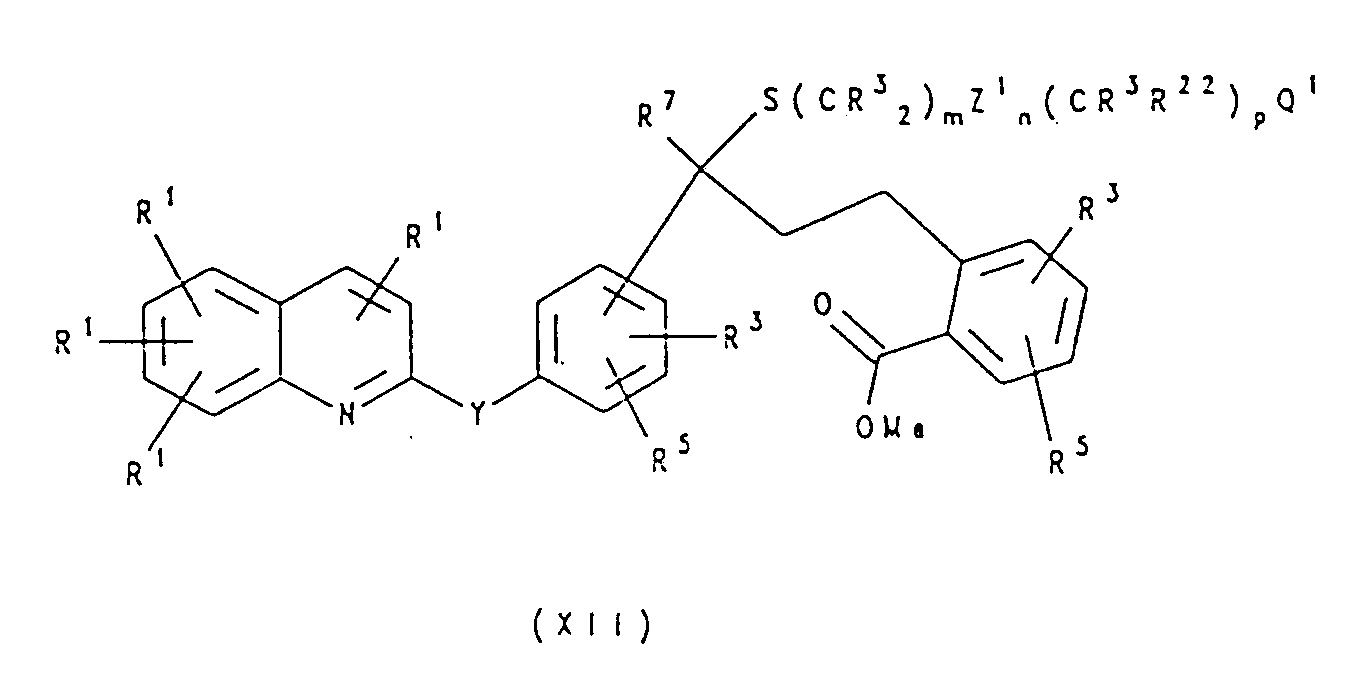
- the thiol IX is then added to XI using a Lewis acid such as AlC1 3 or TiCI 4 to give the thioether XII.
- a Lewis acid such as AlC1 3 or TiCI 4
- Reaction of XII with an organometallic compound such as a lithium or a magnesium salt, yield, in the cases where Q 1 is stable in these conditions, the tertiary alcohol XIII, which is a representative of structure I.
- the enol acetate of XIV is obtained from the heating of XIV in isopropenyl acetate in the presence of an acid. Ozolysis of this enol ester yields the aldehyde XV.
- a reagent such as butyllithium, lithium or magnesium afford the organometallic XVI, which is reacted with XV to give the hydroxyacid XVII.
- XVII is reacted with another organometallic and the reaction mixture is quenched with chlorotrimethylsilane.
- Deprotection of the phenol is done by using a reagent such as tetrabutylammonium fluoride in the case of silyl ether or pyridinium p-toluenesulfonate when P is a 2-tetrahydropyranyl group. Reaction of that phenol with a 2-(bromomethyl)quinoline derivative in the presence of K 2 C0 3 yields the hydroxyketone XVIII. The benzylic alcohol is then reacted with methanesulfonyl chloride in the presence of a base such as triethylamine. The mesylate so obtained is substituted by the thiolate derivative of IX to afford XIX.
- a reagent such as tetrabutylammonium fluoride in the case of silyl ether or pyridinium p-toluenesulfonate when P is a 2-tetrahydropyranyl group.
- the hydroxyacid XVII is cyclized to the lactone using a reagent such as 2-chloro-N-methylpyridinium iodide. Deprotection of the phenol and coupling to the (bromomethyl)quinoline derivative as in Method C afford the lactone XXI. An organometallic reagent is then added to XXI to give the diol XXII. Finally, the secondary alcohol is substituted by the thiol IX as in Method C to yield the thioether XX.
- a reagent such as 2-chloro-N-methylpyridinium iodide.
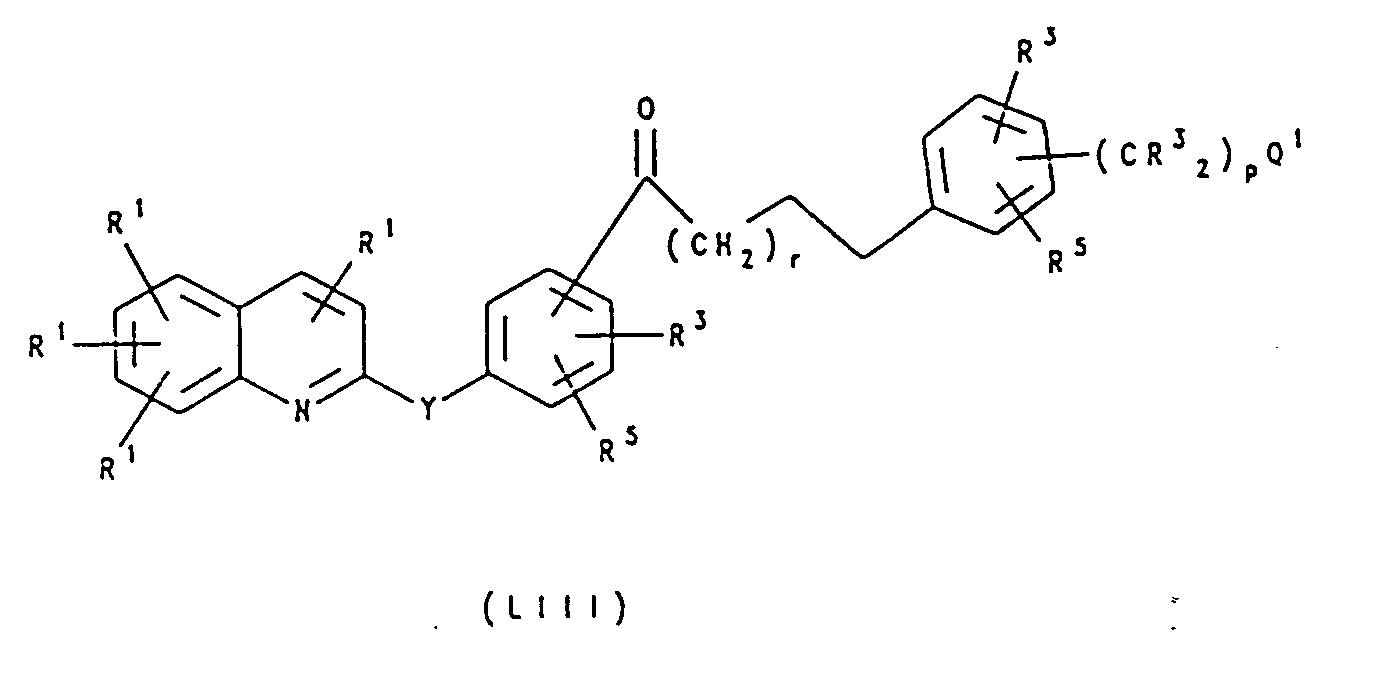
- the aldehyde XXIII a derivative of IV, is reacted with an organometallic reagent and the benzylic alcohol so obtained is oxidized to XXIV with an oxidant like activated manganese dioxide.
- XXIV is then reacted with the iodide XXV in the presence of a base such as lithium diisopropylamide to yield the alkylation product XXVI.
- Reduction with sodium borohydride or addition of an organometallic reagent afford the hydroxyester XXVII, which is then treated as the lactone XXI in Method D to give the thioether XXVIII.
- XXIX The enolate of the ketone XXIX, obtained by treatment of XXIX with a base such as KH or NaH, is reacted with dimethylcarbonate to yield the ketoester XXX.
- XXX is enolized with a base such as NaH and treated with the iodide XXXI, the methyl ester of XXV.
- the adduct so obtained is then decarboxylated using conditions such as heating with HCI in acetic acid to afford a mixture of the ester XXXII and the corresponding acid. Esterification of the mixture, using a reagent such as diazomethane, yields XXXII, which is then converted to XXXIII as described in Method G.
- the hydroxyester XVII is esterified using conditions such as heating with Mel and K 2 C0 3 or reacting with diazomethane. Treatment of this hydroxyester with an oxidant such as pyridinium chlorochromate or activated manganese dioxide affords the ketoester XXXIV. The ketone is then reduced using the chiral oxazaborolidine XXXV in the presence of borane/THF complex. Reaction of the ester with an organometallic, deprotection of the phenol and reaction with a (bromomethyl)quinoline derivative as in Method C gave the diol XXXVI, which is chiral XXII.
- XXXVII Protection of the secondary alcohol with tert-butylchlorodiphenylsilane in the presence of a base such as 4-(dimethylamino)pyridine, protection of the tertiary alcohol as the 2-tetrahydropyranyl ether and removal of the silyl ether afford XXXVII.
- the chiral center of XXXVII can be inverted to give XXXVIII using conditions such as: (1) treatment with triphenylphosphine, diethyl azodicarboxylate and an acid such as R-(-)a-methoxyphenylacetic acid (chiral acid improves the resolution), and (2) hydrolysis of the ester so obtained with a base such as NaOH.
- the phenylacetic acid XL is reduced to the alcohol XLI using a reagent such as borane in tetrahydrofuran. Formation of the alcoholate with one equivalent of a Grignard reagent, followed by treatment with magnesium afford the dimagnesium salt of XLI. It is added to a ketone or an aldehyde to yield the alcohol XLII.
- the bromide XLIII is then formed using conditions such as (1) formation of the mesylate with methanesulfonyl chloride and triethylamine and (2) substitution of the mesylate by sodium bromide in N,N-dimethyl formamide.
- the dimagnesium salt of XLIII is then formed as previously described and added to the ketone IV. The adduct XLIV is then reacted with the thiol IX as in Method C to yield XLV.
- the ketoester XXX is treated with the iodide XLVI and decarboxylated as in Method F. Reduction of the ketone with a reagent such as NaBH 4 yields the alcohol XLVII. By reaction with an organometallic in toluene, the nitrile XLVII is converted to the amine XLVIII. The thiol IX is then added as in Method C to afford XLIX. Reaction of an iodide with the amine XLIX gives a secondary or tertiary amine L. Both XLIX and L are representatives of structure I.
- Compounds of Formula I can be tested using the following assays to determine their mammalian leukotriene antagonist activity and their ability to inhibit leukotriene biosynthesis.
- the leukotriene antagonist properties of compounds of the present invention were evaluated using the following assays.
- the activity of 5-lipoxygenase was measured from the conversion of [ 14 C]-arachidonic acid to 5-HETE and 5,12-diHETEs catalyzed by the 10,000 x g supernatant fraction from rat PMN leukocytes, using the procedure of Riendeau and Leblanc (Biochem. Biophys. Res. Commun., 141, 534-540, (1986)) with minor modifications.
- the incubation mixture contained 25 mM Na + /K + phosphate buffer, pH 7.3, 1 mM ATP, 0.5 mM CaCI 2 , 0.5 mM mercaptoethanol and an aliquot of the enzyme preparation in a final volume of 0.2 ml.
- the enzyme was pre-incubated with the inhibitor for 2 min at 37 ° C before initiation of the reaction with the addition of 2 ml of [14C]-arachidonic acid (25,000 DPM) in ethanol to obtain a final concentration of 10 mM.
- Inhibitors were added as 500-fold concentrated solutions in DMSO. After incubation for 10 min at 37 °C, the reaction was stopped by adding 0.8 mL of diethyl ether/methanol/1 M citric acid (30:4:1).
- the samples were centrifuged at 1,000 x g for 5 min and the organic phases analyzed by TLC on Baker Si250F-PA or Whatman silica gel 60A LKGF plates using diethyl ether/petroleum ether/acetic acid (50:50:1) as solvent.
- the amount of radioactivity migrating at the positions of arachidonic acid, 5-HETE and 5,12-diHETEs was determined using a Berthold TLC analyzer LB 2842.
- the activity of 5-lipoxygenase was calculated from the percentage of conversion of arachidonic acid to 5-HETE and 5,12-diHETEs after the 10 min incubation.
- Contaminating erythrocytes were removed by lysis following exposure to ammonium chloride (0.16 M) in Tris buffer (pH 7.65), and the PMNs resuspended at 5 x 10 5 cells/mL in HEPES (15 mM)-buffered Hanks balanced salt solution containing Ca2+ (1.4 mM) and Mg 2+ (0.7 mM), pH 7.4. Viability was assessed by Trypan blue exclusion and was typically greater than 98%.
- Rats are obtained from an inbred line of asthmatic rats. Both female (190-250 g) and male (260-400 g) rats are used.
- EA Egg albumin
- grade V crystallized and lyophilized
- Aluminum hydroxide is obtained from the Regis Chemical Company, Chicago.
- Methysergide bimaleate was supplied by Sandoz Ltd., Basel.
- the challenge and subsequent respiratory recordings are carried out in a clear plastic box with internal dimensions 10 x 6 x 4 inches.
- the top of the box is removable; in use, it is held firmly in place by four clamps and an airtight seal is maintained by a soft rubber gasket.
- a Devilbiss nebulizer No. 40
- a Fleisch No. 0000 pneumotachograph is inserted into one end of the box and coupled to a Grass volumetric pressure transducer (PT5-A) which is then connected to a Beckman Type R Dynograph through appropriate couplers.
- the outlets While aerosolizing the antigen, the outlets are open and the pneumotachograph is isolated from the chamber. The outlets are closed and the pneumotachograph and the chamber are connected during the recording of the respiratory patterns.
- 2 mL of a 3% solution of antigen in saline is placed into each nebulizer and the aerosol is generated with air from a small Potter diaphragm pump operating at 10 psi and a flow of 8 liters/minute.
- Rats are sensitized by injecting (subcutaneously) 1 mL of a suspension containing 1 mg EA and 200 mg aluminum hydroxide in saline. They are used between days 12 and 24 postsensitization. In order to eliminate the serotonin component of the response, rats are pretreated intravenously 5 minutes prior to aerosol challenge with 3.0 mgm/kg of methysergide. Rats are then exposed to an aerosol of 3% EA in saline for exactly 1 minute, then their respiratory profiles are recorded for a further 30 minutes. The duration of continuous dyspnea is measured from the respiratory recordings.
- Compounds are generally administered either orally 1-4 hours prior to challenge or intravenously 2 minutes prior to challenge. They are either dissolved in saline or 1% methocel or suspended in 1% methocel. The volume injected is 1 mL/kg (intravenously) or 10 mL/kg (orally). Prior to oral treatment rats are starved overnight. Their activity is determined in terms of their ability to decrease the duration of symptoms of dyspnea in comparison with a group of vehicle-treated controls. Usually, a compound is evaluated at a series of doses and an ED 50 is determined. This is defined as the dose (mg/kg) which would inhibit the duration of symptoms by 50%.
- the test procedure involves placing trained squirrel monkeys in chairs in aerosol exposure chambers.
- pulmonary mechanics measurements of respiratory parameters are recorded for a period of about 30 minutes to establish each monkey's normal control values for that day.
- compounds are dissolved or suspended in a 1% methocel solution (methylcellulose, 65HG,400 cps) and given in a volume of 1 ml/kg body weight.
- methocel solution methylcellulose, 65HG,400 cps
- a DeVilbiss ultrasonic nebulizer is utilized. Pretreatment periods vary from 5 minutes to 4 hours before the monkeys are challenged with aerosol doses of either leukotriene D 4 (LTD 4 ) or Ascaris antigen.
- each minute of data is calculated by computer as a percent change from control values for each respiratory parameter including airway resistance (R L ) and dynamic compliance (C d y n ).
- the results for each test compound are subsequently obtained for a minimum period of 60 minutes post challenge which are then compared to previously obtained historical baseline control values for that monkey.
- the overall values for 60 minutes post-challenge for each monkey are averaged separately and are used to calculate the overall percent inhibition of L TD4 or Ascaris antigen response by the test compound. For statistical analysis, paired t-test is used.
- Lateral pressure in the trachea is measured with a sidehole catheter (inner dimensions, 2.5 mm) advanced through and positioned distal to the tip of the nasotracheal tube.
- Transpulmonary pressure the difference between tracheal pressure and pleural pressure, is measured with a differential pressure transducer (DP45; Validyne Corp., Northridge, CA). Testing of the pressure transducer catheter system reveals no phase shift between pressure and flow to a frequency of 9 Hz.
- pulmonary resistance (R L ) the maximal end of the nasotracheal tube is connected to a pneumotachograph (Fleisch, Dyna Sciences, Blue Bell, PA).
- the signals of flow and transpulmonary pressure are recorded on an oscilloscope (Model DR-12; Electronics for Medicine, White Plains, NY) which is linked to a PDP-11 Digital computer (Digital Equipment Corp., Maynard, MA) for on-line calculation of R L from transpulmonary pressure, respiratory volume obtained by integration and flow. Analysis of 10-15 breaths is used for the determination of R L .
- Aerosols of Ascaris suum extract (1:20) are generated using a disposable medical nebulizer (Raindrop@, Puritan Bennett), which produces an aerosol with a mass median aerodynamic diameter of 6.2 /1 .M (geometric standard deviation, 2.1) as determined by an electric size analyzer (Model 3030; Thermal Systems, St. Paul, MN).
- the output from the nebulizer is directed into a plastic t-piece, one end of which is attached to the nasotracheal tube, the other end of which is connected to the inspiratory part of a Harvard respirator.
- the aerosol is delivered at a tidal volume of 500 ml of a rate of 20 per minute.
- each sheep receives an equivalent dose of antigen in both placebo and drug trials.
- the aldehyde of Step 1 (46.64 g, 156.6 mmol) was dissolved in 300 mL of THF. At 0°C, 800 mL of EtOH was added, followed by NaBH 4 (5.93 g, 157 mmol). The mixture was then stirred at r.t. (room temperature) for 1 h and poured into cold 25% aq (aqueous) NH 4 0Ac. The organic solvents were evaporated and the title alcohol was extracted with toluene:THF 1:1, dried over Na 2 S0 4 and filtered through silica to yield 47.9 g of the title compound.
- Step 4 ((3-((7-chloro-2-quinolinyl)methoxy)phenyl)methyl)triphenylphosphoniumbromide
- Step 6 2-(3-(3-((7-chloro-2-quinolinyl)methoxy)phenyl-2-propenyl)benzaldehyde
- Step 7 Methyl 2-(3-(3-((7-chloro-2-quinolinyl)methoxy)phenyl)-2-propenyl)benzoate
- Step 8 3-((1-(3-((7-chloro-2-quinolinyl)methoxy)phenyl)-3-(2-(methoxycarbonyl)phenyl)propyl)thio)-2-methylpropanoic acid
- Step 9 3-((1-(3-((7-chloro-2-quinolinyl)methoxy)phenyl)-3-(2-(2-hydroxy-2-propyl)phenyl)propyl)thio)-2-methylpropanoic acid
- Step 9 To the acid of Step 9 (243 mg, 431 ⁇ mol) in 10 mL of EtOH was added 1.0 N NaOH (430 ⁇ l). The solvents were evaporated and the product was freeze-dried to give 250 mg of the title compound as a yellowish solid.
- Step 3 2-(3-hydroxy-3-(3-(2-tetrahydropyranyloxy)phenyl)propyl)benzoic acid
- Step 5 3-(2-acetylphenyl)-1-(3-((7-chloro-2-quinolinyl)methoxy)phenyl)propanol
- Step 7 Ethyl 3-((3-(2-acetylphenyl)-1-(3-((7-chloro-2-quinolinyl)methoxy)phenyl)propyl)thio)-2-methylpropanoate
- Step 8 3-((3-(2-acetylphenyl)-1-(3-((7-chloro-2-quinolinyl)methoxy)phenyl)propyl)thio)-2-methylpropanoic acid
- Step 1 2-(3-(3-(diphenyl(2-methyl-2-propyl)siloxy)phenyl)-3-hydroxypropyl) benzoic acid
- Step 2 4,5-dihydro-3-(3-(diphenyl(2-methyl-2-propyl)siloxy)phenyl-2-benzoxepin-1 (3H)-one
- Step 4 3-(3-((7-chloro-2-quinolinyl)methoxy)phenyl)-4,5-dihydro-2-benzoxepin-1(3H)-one
- Step 5 1-(2-(3-(3-((7-chloro-2-quinolinyl)methoxy)phenyl)-3-hydroxypropyl)phenyl)cyclopentanol
- Step 1 2-(3-(3-((7-chloro-2-quinolinyl)methoxy)phenyl)-3-hydroxypropyl)-a,a-dimethylbenzenemethanol
- the mesylate of the diol of Step 1 (729 mg, 1.58 mmol) was prepared using the procedure of Example 1, Method B, Step 7.
- Step 1 Methyl 2-(3-(3-(diphenyl(2-methyl-2-propyl)siloxy)phenyl)-3-hydroxyprophyl)benzoate
- Step 1 To the product of Example 2, Step 1 (95 g, 0.187 mol) in acetone (1 L) was added K 2 C0 3 (55 g, 0.374 mol) and Mel (128 mL, 1.31 mol). After refluxing for 1.5 h, the reaction mixture was cooled to r.t. EtOAc (1 L) was then added to the reaction mixture and the K 2 C0 3 was removed by filtration. The filtrate was evaporated to dryness to provide 93 g (98%) of the title ester.
- Step 2 Methyl 2-(3-(3-(diphenyl(2-methyl-2-propyl)siloxy)phenyl)-3-oxopropyl)benzoate
- Step 3 Methyl 2-(3-(3-(diphenyl(2-methyl-2-propyl)siloxy)phenyl)-3-(R)-hydroxy-propyl)benzoate
- Step 4 a,a-dimethyl-2-(3-(3-(diphenyl(2-methyl-2-propyl)siloxy)phenyl)-3-(R)-hydroxypropyl)-benzenemethanol
- Step 5 2-(3-(3-((7-chloro-2-quinolinyl)methoxy)phenyl)-3-(R)-hydroxypropyl)-a,a-dimethylbenzenemethanol
- Step 6 2-(3-(3-((7-chloro-2-quinolinyl)methoxy)phenyl)-3-(R)-(diphenyl(2-methyl-2-propyl)siloxy)propyl)-a,a-dimethylbenzenemethanol
- Step 7 7-chloro-2-((3-(3-(2-(2-(2-(2-(2-(2-(2-(2-(2-tetrahydropyranyloxy)-2-propyl)phenyl)-1-(R)-diphenyl(2-methyl-2-propyl)-siloxy)propyl)phenoxy)methyl)quinoline
- Step 8 1-(R)-(3-((7-chloro-2-quinolinyl)methoxy)phenyl)-3-(2-(2-(2-tetrahydropyranyloxy)-2-propyl)phenyl)-propanol
- Step 9 1-(S)-(3-((7-chloro-2-quinolinyl)methoxy)phenyl)-3-(2-(2-(2-tetrahydropyranyloxy)-2-propyl)phenyl)-propanol
- diethyl azodicarboxylate (7.6 mL, 48.3 mmol) was added dropwise to a solution of the alcohol of Step 8 (17.47 g, 31.97 mmol), triphenylphosphine (12.60 g, 48.04 mmol) and R-(-)-a-methoxyphenylacetic acid (8.07 g, 48.6 mmol) in 320 mL of anhydrous THF.
- the mixture was stirred at 0°C for 30 min and the solvents were evaporated.
- Step 10 3-((1-(R)-(3-((7-chloro-2-quinolinyl)methoxy)phenyl)-3-(2-(2-(2-tetrahydropyranyloxy)-2-propyl)-phenyl)propyl)thio)-2-(S)-methylpropanoic acid
- Step 5 3-((1-(R)-(3-((7-chloro-2-quinolinyl)methoxy)phenyl)-3-(2-(2-(2-tetrahydropyranyloxy)-2-propyl)-phenyl)propyl)thio)-2-(R)-methylpropanoic acid
- Step 1 3-((1-(S)-(3-((7-chloro-2-quinolinyl)methoxy)phenyl)-3-(2-(2-(2-tetrahydropyranyloxy)-2-propyl)-phenyl)propyl)thio-2-(S)-methylpropanoic acid
- Step 1 3-((1-(S)-(3-((7-chloro-2-quinolinyl)methoxy)phenyl)-3-(2-(2-(2-tetrahydropyranyloxy)-2-propyl)-phenyl)propyl)thio-2-(R)-methylpropanoic acid
- Step 3 Ethyl3-((1-(3-((7-chloro-2-quinolinyl)methoxy)phenyl)-3-(2-(2-hydroxy-2-propyl)phenyl)propyl)thio)-2-ethylpropanoate
Landscapes
- Health & Medical Sciences (AREA)
- Chemical & Material Sciences (AREA)
- Organic Chemistry (AREA)
- Veterinary Medicine (AREA)
- Public Health (AREA)
- Chemical Kinetics & Catalysis (AREA)
- General Chemical & Material Sciences (AREA)
- Medicinal Chemistry (AREA)
- Nuclear Medicine, Radiotherapy & Molecular Imaging (AREA)
- Pharmacology & Pharmacy (AREA)
- Life Sciences & Earth Sciences (AREA)
- Animal Behavior & Ethology (AREA)
- General Health & Medical Sciences (AREA)
- Bioinformatics & Cheminformatics (AREA)
- Engineering & Computer Science (AREA)
- Ophthalmology & Optometry (AREA)
- Pulmonology (AREA)
- Reproductive Health (AREA)
- Cardiology (AREA)
- Immunology (AREA)
- Pain & Pain Management (AREA)
- Rheumatology (AREA)
- Urology & Nephrology (AREA)
- Endocrinology (AREA)
- Heart & Thoracic Surgery (AREA)
- Pharmaceuticals Containing Other Organic And Inorganic Compounds (AREA)
- Acyclic And Carbocyclic Compounds In Medicinal Compositions (AREA)
- Medicines That Contain Protein Lipid Enzymes And Other Medicines (AREA)
- Plural Heterocyclic Compounds (AREA)
- Organic Low-Molecular-Weight Compounds And Preparation Thereof (AREA)
- Quinoline Compounds (AREA)
- Agricultural Chemicals And Associated Chemicals (AREA)
- Medicines Containing Plant Substances (AREA)
Claims (16)





et ses sels acceptables en pharmacie.

et ses sels acceptables en pharmacie.


Applications Claiming Priority (2)
| Application Number | Priority Date | Filing Date | Title |
|---|---|---|---|
| US59688590A | 1990-10-12 | 1990-10-12 | |
| US596885 | 1990-10-12 |
Publications (3)
| Publication Number | Publication Date |
|---|---|
| EP0480708A2 EP0480708A2 (fr) | 1992-04-15 |
| EP0480708A3 EP0480708A3 (en) | 1992-05-20 |
| EP0480708B1 true EP0480708B1 (fr) | 1995-10-11 |
Family
ID=24389130
Family Applications (1)
| Application Number | Title | Priority Date | Filing Date |
|---|---|---|---|
| EP91309289A Expired - Lifetime EP0480708B1 (fr) | 1990-10-12 | 1991-10-09 | Hydroxyalkylquinoline ether acide comme antagoniste leukotriènes |
Country Status (18)
| Country | Link |
|---|---|
| EP (1) | EP0480708B1 (fr) |
| JP (1) | JP2538154B2 (fr) |
| KR (1) | KR920008005A (fr) |
| CN (1) | CN1061594A (fr) |
| AT (1) | ATE128969T1 (fr) |
| AU (1) | AU639612B2 (fr) |
| CA (1) | CA2053208C (fr) |
| CS (1) | CS309491A3 (fr) |
| DE (1) | DE69113735T2 (fr) |
| ES (1) | ES2079586T3 (fr) |
| FI (1) | FI914795L (fr) |
| HU (1) | HUT61982A (fr) |
| IE (1) | IE913610A1 (fr) |
| IL (1) | IL99683A0 (fr) |
| MX (1) | MX9101556A (fr) |
| NO (1) | NO914003L (fr) |
| PT (1) | PT99211B (fr) |
| ZA (1) | ZA918115B (fr) |
Families Citing this family (8)
| Publication number | Priority date | Publication date | Assignee | Title |
|---|---|---|---|---|
| US5506227A (en) * | 1992-04-13 | 1996-04-09 | Merck Frosst Canada, Inc. | Pyridine-substituted benzyl alcohols as leukotriene antagonists |
| US5358955A (en) * | 1992-10-30 | 1994-10-25 | Abbott Laboratories | Aryl and heteroarylmethoxyphenyl inhibitors of leukotriene biosynthesis |
| US5438141A (en) * | 1993-05-21 | 1995-08-01 | Merck Frosst Canada, Inc. | Heteroaryl and haloaryl quinoline derivatives of cyclopropaneacetic acid as leukotriene antagonists |
| JPH09278653A (ja) * | 1996-04-05 | 1997-10-28 | Santen Pharmaceut Co Ltd | 網膜疾患治療剤 |
| AU3868497A (en) * | 1996-08-26 | 1998-03-19 | Yamanouchi Pharmaceutical Co., Ltd. | Benzenesulfone compounds and salts thereof |
| GB2356139A (en) * | 1999-11-15 | 2001-05-16 | Bayer Ag | Use of substituted (quinolin-2-yl-methoxy)phenyl-acyl-sulphonamides and cyanamides for the treatment of diseases |
| EP1958936A1 (fr) * | 2007-02-14 | 2008-08-20 | Inke, S.A. | Procédé pour l'obtention de montelukast |
| RU2605929C2 (ru) * | 2011-07-26 | 2016-12-27 | Сан Фарма Адвансед Ресёрч Компани Лтд. | Производные хинолина и хиноксалина, полезные в качестве антагонистов цистеинил-лейкотриена |
Citations (2)
| Publication number | Priority date | Publication date | Assignee | Title |
|---|---|---|---|---|
| EP0233763A2 (fr) * | 1986-02-14 | 1987-08-26 | Merck Frosst Canada Inc. | Acides quinoléine-2-dioiques |
| EP0271287A2 (fr) * | 1986-12-11 | 1988-06-15 | Merck Frosst Canada Inc. | Acides quinoléine dicarboxyliques et leurs amides |
Family Cites Families (5)
| Publication number | Priority date | Publication date | Assignee | Title |
|---|---|---|---|---|
| JPS62120365A (ja) * | 1985-11-16 | 1987-06-01 | バイエル・アクチエンゲゼルシヤフト | 置換ベンジルエ−テル類、その製造法および用途 |
| JPS62258369A (ja) * | 1986-05-02 | 1987-11-10 | Nippon Soda Co Ltd | キナゾリノン誘導体及びその製造方法 |
| IL88433A0 (en) * | 1987-11-25 | 1989-06-30 | Merck Frosst Canada Inc | Diarylstyrylquinoline diacids and pharmaceutical compositions containing them |
| EP0349062A1 (fr) * | 1988-06-27 | 1990-01-03 | Merck Frosst Canada Inc. | Acides quinolineétheralkanoiques |
| NZ233752A (en) * | 1989-05-24 | 1993-05-26 | Merck Frosst Canada Inc | Substituted quinoline derivatives, preparation and pharmaceutical compositions thereof |
-
1991
- 1991-10-09 AT AT91309289T patent/ATE128969T1/de not_active IP Right Cessation
- 1991-10-09 EP EP91309289A patent/EP0480708B1/fr not_active Expired - Lifetime
- 1991-10-09 IL IL99683A patent/IL99683A0/xx unknown
- 1991-10-09 DE DE69113735T patent/DE69113735T2/de not_active Expired - Fee Related
- 1991-10-09 ES ES91309289T patent/ES2079586T3/es not_active Expired - Lifetime
- 1991-10-10 HU HU913218A patent/HUT61982A/hu unknown
- 1991-10-10 CA CA002053208A patent/CA2053208C/fr not_active Expired - Fee Related
- 1991-10-11 CS CS913094A patent/CS309491A3/cs unknown
- 1991-10-11 FI FI914795A patent/FI914795L/fi not_active Application Discontinuation
- 1991-10-11 PT PT99211A patent/PT99211B/pt not_active IP Right Cessation
- 1991-10-11 AU AU85797/91A patent/AU639612B2/en not_active Ceased
- 1991-10-11 ZA ZA918115A patent/ZA918115B/xx unknown
- 1991-10-11 MX MX9101556A patent/MX9101556A/es unknown
- 1991-10-11 CN CN91111074A patent/CN1061594A/zh active Pending
- 1991-10-11 NO NO91914003A patent/NO914003L/no unknown
- 1991-10-12 KR KR1019910017952A patent/KR920008005A/ko not_active Withdrawn
- 1991-10-14 JP JP3331108A patent/JP2538154B2/ja not_active Expired - Lifetime
- 1991-10-16 IE IE361091A patent/IE913610A1/en not_active Application Discontinuation
Patent Citations (2)
| Publication number | Priority date | Publication date | Assignee | Title |
|---|---|---|---|---|
| EP0233763A2 (fr) * | 1986-02-14 | 1987-08-26 | Merck Frosst Canada Inc. | Acides quinoléine-2-dioiques |
| EP0271287A2 (fr) * | 1986-12-11 | 1988-06-15 | Merck Frosst Canada Inc. | Acides quinoléine dicarboxyliques et leurs amides |
Also Published As
| Publication number | Publication date |
|---|---|
| NO914003L (no) | 1992-04-13 |
| HUT61982A (en) | 1993-03-29 |
| HU913218D0 (en) | 1992-01-28 |
| CA2053208A1 (fr) | 1992-04-13 |
| FI914795A7 (fi) | 1992-04-13 |
| ATE128969T1 (de) | 1995-10-15 |
| DE69113735D1 (de) | 1995-11-16 |
| JPH05105664A (ja) | 1993-04-27 |
| JP2538154B2 (ja) | 1996-09-25 |
| AU639612B2 (en) | 1993-07-29 |
| ZA918115B (en) | 1992-08-26 |
| IE913610A1 (en) | 1992-04-22 |
| CS309491A3 (en) | 1992-04-15 |
| CA2053208C (fr) | 2003-04-15 |
| ES2079586T3 (es) | 1996-01-16 |
| MX9101556A (es) | 1994-01-31 |
| FI914795A0 (fi) | 1991-10-11 |
| EP0480708A3 (en) | 1992-05-20 |
| PT99211B (pt) | 1999-04-30 |
| AU8579791A (en) | 1992-04-16 |
| PT99211A (pt) | 1992-09-30 |
| FI914795L (fi) | 1992-04-13 |
| EP0480708A2 (fr) | 1992-04-15 |
| DE69113735T2 (de) | 1996-06-13 |
| CN1061594A (zh) | 1992-06-03 |
| NO914003D0 (no) | 1991-10-11 |
| KR920008005A (ko) | 1992-05-27 |
| IL99683A0 (en) | 1992-08-18 |
Similar Documents
| Publication | Publication Date | Title |
|---|---|---|
| US5565473A (en) | Unsaturated hydroxyalkylquinoline acids as leukotriene antagonists | |
| EP0480717B1 (fr) | Acides hydroxyalkylquinoliniques insaturés comme antagonistes de leukotriène | |
| US5270324A (en) | Fluorinated hydroxyalkylquinoline acids as leukotriene antagonists | |
| US5428033A (en) | Saturated hydroxyalkylquinoline acids as leukotriene antagonists | |
| US5856322A (en) | Unsaturated hydroxyalkylquinoline acids as leukotriene antagonists | |
| US5266568A (en) | Hydroxyalkylquinoline ether acids as leukotriene antagonists | |
| CA2061675C (fr) | Cetoacides renfermant de la quinoleine, antagonistes de la leucotriene | |
| US5132319A (en) | 1-(hydroxylaminoalkyl) indole derivatives as inhibitors of leukotriene biosynthesis | |
| WO1993021168A1 (fr) | Alcools benzyliques a substitution thiazole utilises comme antagonistes de leucotrienes | |
| CA2053208C (fr) | Derives acides d'oxydes d'hydroxyalkylquinoline comme antagonistes des leucotrienes | |
| US5438141A (en) | Heteroaryl and haloaryl quinoline derivatives of cyclopropaneacetic acid as leukotriene antagonists | |
| AU708126B2 (en) | Heteroaryl diol acids as leukotriene antagonists | |
| US5149703A (en) | Quinoline-substituted chromans and related compounds as leukotriene antagonists | |
| US5212180A (en) | Quinoline-containing ketoacids as leukotriene antagonists | |
| CA2223414C (fr) | Acides d'heteroaryle diol antagonistes des leucotrienes | |
| HK1027473B (en) | Unsaturated hydroxyalkylquinoline acids as leukotriene antagonists | |
| NO180086B (no) | Umettede hydroxyalkylkinolinsyrer som leukotrienantagonister |
Legal Events
| Date | Code | Title | Description |
|---|---|---|---|
| PUAI | Public reference made under article 153(3) epc to a published international application that has entered the european phase |
Free format text: ORIGINAL CODE: 0009012 |
|
| PUAL | Search report despatched |
Free format text: ORIGINAL CODE: 0009013 |
|
| AK | Designated contracting states |
Kind code of ref document: A2 Designated state(s): AT BE CH DE DK ES FR GB GR IT LI LU NL SE |
|
| AK | Designated contracting states |
Kind code of ref document: A3 Designated state(s): AT BE CH DE DK ES FR GB GR IT LI LU NL SE |
|
| 17P | Request for examination filed |
Effective date: 19921014 |
|
| 17Q | First examination report despatched |
Effective date: 19930518 |
|
| GRAA | (expected) grant |
Free format text: ORIGINAL CODE: 0009210 |
|
| AK | Designated contracting states |
Kind code of ref document: B1 Designated state(s): AT BE CH DE DK ES FR GB GR IT LI LU NL SE |
|
| PG25 | Lapsed in a contracting state [announced via postgrant information from national office to epo] |
Ref country code: NL Free format text: LAPSE BECAUSE OF FAILURE TO SUBMIT A TRANSLATION OF THE DESCRIPTION OR TO PAY THE FEE WITHIN THE PRESCRIBED TIME-LIMIT Effective date: 19951011 Ref country code: LI Effective date: 19951011 Ref country code: GR Free format text: LAPSE BECAUSE OF FAILURE TO SUBMIT A TRANSLATION OF THE DESCRIPTION OR TO PAY THE FEE WITHIN THE PRESCRIBED TIME-LIMIT Effective date: 19951011 Ref country code: DK Effective date: 19951011 Ref country code: CH Effective date: 19951011 Ref country code: BE Effective date: 19951011 Ref country code: AT Effective date: 19951011 |
|
| REF | Corresponds to: |
Ref document number: 128969 Country of ref document: AT Date of ref document: 19951015 Kind code of ref document: T |
|
| REF | Corresponds to: |
Ref document number: 69113735 Country of ref document: DE Date of ref document: 19951116 |
|
| ITF | It: translation for a ep patent filed | ||
| ET | Fr: translation filed | ||
| PG25 | Lapsed in a contracting state [announced via postgrant information from national office to epo] |
Ref country code: SE Effective date: 19960111 |
|
| REG | Reference to a national code |
Ref country code: ES Ref legal event code: FG2A Ref document number: 2079586 Country of ref document: ES Kind code of ref document: T3 |
|
| NLV1 | Nl: lapsed or annulled due to failure to fulfill the requirements of art. 29p and 29m of the patents act | ||
| REG | Reference to a national code |
Ref country code: CH Ref legal event code: PL |
|
| PLBE | No opposition filed within time limit |
Free format text: ORIGINAL CODE: 0009261 |
|
| STAA | Information on the status of an ep patent application or granted ep patent |
Free format text: STATUS: NO OPPOSITION FILED WITHIN TIME LIMIT |
|
| 26N | No opposition filed | ||
| PG25 | Lapsed in a contracting state [announced via postgrant information from national office to epo] |
Ref country code: LU Free format text: LAPSE BECAUSE OF NON-PAYMENT OF DUE FEES Effective date: 19961031 |
|
| REG | Reference to a national code |
Ref country code: FR Ref legal event code: CD Ref country code: FR Ref legal event code: CA |
|
| REG | Reference to a national code |
Ref country code: GB Ref legal event code: 732E |
|
| PGFP | Annual fee paid to national office [announced via postgrant information from national office to epo] |
Ref country code: GB Payment date: 20000928 Year of fee payment: 10 Ref country code: FR Payment date: 20000928 Year of fee payment: 10 |
|
| PGFP | Annual fee paid to national office [announced via postgrant information from national office to epo] |
Ref country code: ES Payment date: 20001018 Year of fee payment: 10 |
|
| PGFP | Annual fee paid to national office [announced via postgrant information from national office to epo] |
Ref country code: DE Payment date: 20001127 Year of fee payment: 10 |
|
| PG25 | Lapsed in a contracting state [announced via postgrant information from national office to epo] |
Ref country code: GB Free format text: LAPSE BECAUSE OF NON-PAYMENT OF DUE FEES Effective date: 20011009 |
|
| PG25 | Lapsed in a contracting state [announced via postgrant information from national office to epo] |
Ref country code: ES Free format text: LAPSE BECAUSE OF NON-PAYMENT OF DUE FEES Effective date: 20011010 |
|
| REG | Reference to a national code |
Ref country code: GB Ref legal event code: IF02 |
|
| GBPC | Gb: european patent ceased through non-payment of renewal fee |
Effective date: 20011009 |
|
| PG25 | Lapsed in a contracting state [announced via postgrant information from national office to epo] |
Ref country code: FR Free format text: LAPSE BECAUSE OF NON-PAYMENT OF DUE FEES Effective date: 20020628 |
|
| PG25 | Lapsed in a contracting state [announced via postgrant information from national office to epo] |
Ref country code: DE Free format text: LAPSE BECAUSE OF NON-PAYMENT OF DUE FEES Effective date: 20020702 |
|
| REG | Reference to a national code |
Ref country code: FR Ref legal event code: ST |
|
| REG | Reference to a national code |
Ref country code: ES Ref legal event code: FD2A Effective date: 20021113 |
|
| PG25 | Lapsed in a contracting state [announced via postgrant information from national office to epo] |
Ref country code: IT Free format text: LAPSE BECAUSE OF NON-PAYMENT OF DUE FEES;WARNING: LAPSES OF ITALIAN PATENTS WITH EFFECTIVE DATE BEFORE 2007 MAY HAVE OCCURRED AT ANY TIME BEFORE 2007. THE CORRECT EFFECTIVE DATE MAY BE DIFFERENT FROM THE ONE RECORDED. Effective date: 20051009 |