EP0480868B1 - Tissu pour transporter une bande de papier - Google Patents
Tissu pour transporter une bande de papier Download PDFInfo
- Publication number
- EP0480868B1 EP0480868B1 EP19910630081 EP91630081A EP0480868B1 EP 0480868 B1 EP0480868 B1 EP 0480868B1 EP 19910630081 EP19910630081 EP 19910630081 EP 91630081 A EP91630081 A EP 91630081A EP 0480868 B1 EP0480868 B1 EP 0480868B1
- Authority
- EP
- European Patent Office
- Prior art keywords
- fabric
- base
- fibers
- web
- layers
- Prior art date
- Legal status (The legal status is an assumption and is not a legal conclusion. Google has not performed a legal analysis and makes no representation as to the accuracy of the status listed.)
- Expired - Lifetime
Links
Images

Classifications
-
- D—TEXTILES; PAPER
- D21—PAPER-MAKING; PRODUCTION OF CELLULOSE
- D21F—PAPER-MAKING MACHINES; METHODS OF PRODUCING PAPER THEREON
- D21F3/00—Press section of machines for making continuous webs of paper
- D21F3/02—Wet presses
- D21F3/04—Arrangements thereof
- D21F3/045—Arrangements thereof including at least one extended press nip
-
- D—TEXTILES; PAPER
- D21—PAPER-MAKING; PRODUCTION OF CELLULOSE
- D21F—PAPER-MAKING MACHINES; METHODS OF PRODUCING PAPER THEREON
- D21F7/00—Other details of machines for making continuous webs of paper
- D21F7/08—Felts
- D21F7/083—Multi-layer felts
Definitions
- the present invention relates to a fabric and a process for making such fabric for supporting a web in a papermaking machine.
- a formed web is guided through a press section for removing as much water as possible from the formed web before guiding the pressed web into a drying section.
- a long-standing problem has been experienced in transferring a pressed web from a press section to a dryer section.
- a press felt for supporting he web during passage through a pressing nip of the press section would thereafter convey the web towards and around at least an initial portion of the dryer section.
- the aforementioned ideal arrangement has not proved practical because the press felt normally absorbs a large quantity of water from the web during passage of the web and press felt through the press nip, and unless the web and press felt are caused to diverge relative to each other immediately downstream relative to the press nip, the web becomes rewetted by the water laden press felt.
- the press felt is guided around at least one guide roll such that the press felt diverges relative to the web immediately downstream relative to the press nip. Subsequently, a press-to-dryer transfer felt is led into guiding relationship with the web downstream relative to the press nip for guiding and supporting the web into and around the dryer section.
- a dryer felt will be extended into proximity with the press section such that the web is supported by the dryer felt and conveyed thereby to the dryer section.
- the web at some point between the press nip and the dryer section, is unsupported by either the press felt, a press-to-dryer transfer felt, or a dryer felt. Accordingly, such "open draw" of the web has necessitated relatively complex threading techniques in order to thread a tail of the web from the press section into a downstream dryer section.
- the aforementioned non-porous blanket which supports the web, necessitates one-sided removal of the water pressed from the web during passage through the extended nip.
- one-sidedness of the resultant web is acceptable, if "two-sidedness" or uniformity in surface characteristics of the resultant web is required, the web must in some way be reversed in order to achieve the desired two-sidedness of the web.
- AT-B-301 325 teaches the use of woof yarn providing a woven base and fiber bundles inserted through the base, for the production of a press felt.
- US-A-4 529 643 there is described a fabric for supporting a web according to the preamble of claim 1. More specifically US-A-4 529 643 discloses a press felt comprising a support fabric made of hydrophobic filaments and fiber bat layers applied onto each side of the support fabric.
- a process for making a fabric according to the preamble of claim 11 is also known from US-A-4 529 643.
- Another object of the present invention is the provision of a fabric having a relatively low permeability which permits water to be absorbed thereby while inhibiting rewetting of the web.
- the fabric of the invention is characterized by the features claimed in the characterizing portion of claim 1 and the invention provides a method for making a fabric according to the characterizing portion of claim 11.
- At least one of the layers fo the fibers applied onto each side of the base includes a mixture of TEFLON and fiberglass fibers.
- the layers and the base are at least partially fused together by the application of pressure and heat so that the fabric has a low permeability which permits water to be absorbed thereby while inhibiting rewetting of the web.
- the present invention was made and the unexpected results were obtained therefrom by passing a particular sample felt patch through a heated extended nip press of the type described in US-A-4,738,752.
- the resultant fabric had a caliper in the range of 1.7 microns (1/15 thousandth of an inch)and displayed a relatively smooth web supporting surface.
- the unexpected discovery was made that water had been absorbed by the fabric, but the web had not been appreciably rewetted by the fabric during passage of the fabric supported web downstream relative to the press nip.
- a feature of the present invention is the provision of a fabric having a relatively smooth surface towards the web such that the web predictably follows the fabric when a felt and the fabric diverge relative to each other downstream of a double felted press arrangement.
- the base includes a first plurality of the filaments which are disposed in a machine direction and a second plurality of the filaments disposed in a cross-machine direction with the machine and cross-machine directional filaments being woven together.
- the hydrophobic filaments are of TEFLON, and the layers are needled into the first and the second sides respectively of the base. Furthermore, the mixture is of TEFLON and fiberglass fibers with the first and second layers of fibers having a denier which is less than the denier of the filaments.
- both layers of fibers include a mixture of TEFLON and fiberglass fibers.
- the mixture of TEFLON and fiberglass fibers is in a ratio within the range 9:1 to 2:1.
- the layers and the base are at least partially fused together by the application of pressure and heat.
- the fabric has an application particularly as a press fabric or as a press-to-dryer transfer fabric.
- the present invention also includes a process for making a fabric for supporting a web in a papermaking machine.
- the process includes the steps of weaving a base from a first plurality of machine directional TEFLON filaments and a second plurality of cross-machine directional TEFLON filaments such that the woven base defines a first and a second side.
- a first layer of fibers is needled into the first side of the base and a second layer of fibers is needled into the second side of the base.
- the first and the second layers of fibers are a mixture of TEFLON and fiberglass fibers such that the base and the layers of fibers form an uncompressed mat.
- the mat is then pressed at an elevated temperature such that the layers and the base are at least partially fused together so that the resultant fabric attains a relatively smooth surface while retaining water-absorbing capabilities and inhibiting rewetting of the web.
- the uncompressed mat is passed through a heated nip of a press such that the layers and the base at least partially fuse together so that the resultant felt includes at least one relatively smooth surface while maintaining water- absorbing capabilities and inhibiting release of water to the web supported thereon.
- the fabric of the present invention is used in a papermaking apparatus for pressing and drying a web.
- the apparatus includes a press and a drying section disposed downstream relative to the press.
- the press further includes a press member and a backing roll which cooperates with the press member for defining therebetween a press nip for pressing the web.
- the fabric is disposed contiguously relative to the web and extending through the nip for supporting and guiding the web through the nip. Furthermore, a felt extends through the nip, the felt being disposed on the opposite side of the web relative to the fabric.
- the fabric defines a relatively smooth surface towards the web such that when the web exits the nip and the fabric and felt diverge relative to each other, the web follows the smooth surface of the fabric without being rewetted thereby.
- the dryer section includes an upstream dryer and a guide roll which cooperates with the upstream dryer.
- the fabric extends from the nip to and around a portion of a heated outer surface of the upstream dryer, the fabric thereafter being guided away from the upstream dryer by the guide roll such that the web is guided without open draw from the nip to the dryer section without rewetting thereof by the fabric.
- the fabric has a caliper within the range 1.27 to 2.54 microns (1/20 thousandth of an inch to 1 /10 thousandth of an inch).
- the press also includes a backing felt which is disposed contiguously relative to the fabric for backing the fabric such that water from the web passes through the fabric into the backing felt.
- the fabric also inhibits flow of water from the backing felt that would otherwise cause rewetting of the web.
- Figure 1 is a sectional view of a fabric generally designated 10 for supporting a web in a papermaking machine.
- the fabric 10 includes a base generally designated 14 which defines a first and a second side 16 and 18 respectively.
- the base 14 also includes a plurality of hydrophobic filaments generally designated 20 and 22 respectively.
- a first layer of fibers 24 is disposed contiguously relative to the first side 16 with the first layer 24 of fibers being applied onto the first side 16 of the base 14 .
- a second layer of fibers 26 is disposed contiguously relative to the second side 18 of the base 14 .
- the second layer of fibers 26 is applied onto the second side 18 of the base 14 .
- At least one of the layers of fibers 24 , 26 includes a mixture of hydrophobic and hydrophilic fibers, and the layers 24 and 26 and the base 14 are combined such that the fabric 10 has a low permeability permitting water to be absorbed thereby while inhibiting rewetting of the web.
- the base 14 also includes a first plurality of filaments 28 which are disposed in a machine direction as indicated by the arrow MD .
- a second plurality of the filaments 30 , 31 , 32 , 33 , 34 and 35 are disposed in a cross-machine direction as indicated by the arrow CD with the machine and cross-machine directional filaments 28 and 30-35 being woven together.
- the hydrophobic filaments 28 and 30-35 are of TEFLON, and the layers 24 and 26 are needled into the first and the second sides 16 and 18 respectively of the base 14 .
- TEFLON is a registered trademark of E. I. DuPont De Nemours & Company.
- the second layer of fibers 26 is a mixture of fibers.
- the mixture of fibers includes TEFLON and fiberglass fibers, and the individual fibers of the first and second layers 24 and 26 have a denier which is less than the denier of the filaments 28 and 30 - 35 .
- both layers of fibers 24 and 26 include a mixture of TEFLON and fiberglass fibers 36 and 37 respectively.
- the mixture of TEFLON and fiberglass fibers is in a ratio within the range 9:1 to 2:1.
- Figure 2 shows a process for making the aforementioned fabric 10 and shows the layers 24 and 26 and the base 14 as being at least partially fused together by the application of pressure and heat.
- the fabric 10 is a press fabric which extends through either a conventional roll couple defining a press nip or a press fabric extending through an extended nip press defined between an elongate press member and a cooperating backing roll for defining an extended nip.
- the fabric 10 is also a press-to-dryer transfer fabric for fully supporting the web from a press nip to a downstream dryer section.
- Figure 2 shows a process for making the fabric 10 for supporting a web 12 in a papermaking machine.
- the process comprises the steps of weaving a base 14 from a first plurality of machine directional TEFLON filaments 28 and a second plurality of cross-machine directional TEFLON filaments 30-35 such that the woven base 14 defines a first and a second side 16 and 18 respectively.
- a first layer of fibers 24 is needled by a needling means 25 into the first side 16 of the base 14
- a second layer of fibers 26 is needled by a needling means 27 into the second side 18 of the base 14 .
- the first and the second layers of fibers 24 and 26 respectively are a mixture of TEFLON and fiberglass fibers 36 and 37 such that the base 14 and the layers 24 and 26 form an uncompressed mat 38.
- the mat 38 is then pressed at an elevated temperature by a roll press 39 such that the layers 24 and 26 and the base 14 are at least partially fused together so that the resultant fabric 10 attains a relatively smooth surface 40 while retaining water-absorbing capabilities and inhibiting rewetting of the web.
- the mat 38 is passed through a nip 42 of the press 39 , which is heated by induction heaters 44 , such that the layers 24 and 26 and the base 14 at least partially fuse together.
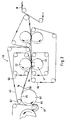
- FIG 3 is a side-elevational view of a papermaking apparatus generally designated 46 for pressing and drying a web W shown by the dashed line.
- the apparatus 46 includes an extended nip press generally designated 47 and a drying section generally designated 48 disposed downstream relative to the press 47 .
- the press 47 further includes a press member 50 and a backing roll 52 cooperating with the press member 50 for defining therebetween a press nip 54 for pressing the web W .
- the fabric 10 is disposed contiguously relative to the web W and extends through the nip 54 for supporting and guiding the web W through the nip 54 .
- a felt 56 extends through the nip 54 with the felt 56 being disposed on the opposite side 58 of the web W relative to the fabric 10 .
- the fabric 10 defines a relatively smooth surface 40 towards the web W such that when the web W exits the nip 54 , and the fabric 10 and felt 56 diverge relative to each other, the web W follows the smooth surface 40 of the fabric 10 without being rewetted thereby.
- the drying section 48 includes an upstream dryer 60 .
- a guide roll 62 cooperates with the upstream dryer 60 , and the fabric 10 extends from the nip 54 to and around a portion 64 of a heated outer surface 66 of the upstream dryer 60 .
- the fabric 10 thereafter is guided away from the upstream dryer 60 by the guide roll 62 such that the web W is guided without open draw from the nip 54 to the drying section 48 without rewetting thereof by the fabric 10 .
- the fabric 10 has a caliper within the range 1.27 to 2.54 microns (1/20 thousandth of an inch to 1/10 thousandth of an inch).
- the press 47 also includes a backing felt 68 which is disposed contiguously relative to the fabric 10 for backing the fabric 10 such that water from the web W passes through the fabric 10 into the backing felt 68 .
- the fabric 10 inhibits flow of water from the backing felt 68 that would otherwise cause rewetting of the web W .
- the present invention provides a unique fabric which permits absorption thereby of water from a web supported on the fabric whiout inhibiting rewetting of the supported web. Additionally, the present invention enables the fabric of the present invention to support the web from the press nip to the dryer without rewetting the web while assuring predictable transfer of the web to the fabric in the case of a double felted pressing configuration.
Landscapes
- Paper (AREA)
- Laminated Bodies (AREA)
- Woven Fabrics (AREA)
Claims (12)
- Un tissu (10) pour supporter une bande dans une machine à fabriquer du papier, ledit tissu (10) comprenant:une base (14) définissant un premier coté (16) et un second côté (18),ladite base (14) comprenant une pluralité de filaments hydrophobes (28,30-35),une première couche de fibres (24) disposée de façon contiguë par rapport audit premier côté (16), ladite première couche de fibres (24) étant appliquée sur ledit premier côté (16) de ladite base (14),une seconde couche de fibres (26) disposée de façon contiguë par rapport audit second côté (18) de ladite base (14), ladite seconde couche de fibres (26) étant appliquée sur ledit second côté (18) de ladite base (14),caractérisé en ce que au moins une desdites couches de fibres (24,26) comprend un mélange de TEFLON (36) et de fibres de verre (37), et
en ce que lesdites couches (24,26) et ladite base (14) sont au moins partiellement fusionnées ensemble par l'application de pression et de chaleur de sorte que le tissu (10) a une perméabilité faible permettant à l'eau d'être absorbée de ce fait tout en empêchant un remouillage de la bande. - Un tissu tel qu'exposé à la revendication 1, caractérisé en ce que ladite base (14) comprend en outre:une première pluralité desdits filaments (28) disposée dans une direction machine (MD), etune seconde pluralité desdits filaments (30-35) disposée dans une direction transversale à la machine (CD),lesdits filaments dans des directions machine et transversale à la machine (28,30-35) étant tissés ensemble.
- Un tissu tel qu'exposé à la revendication 1, caractérisé en ce que lesdits filaments hydrophobes (28,30-35) sont en TEFLON.
- Un tissu tel qu'exposé à la revendication 1, caractérisé en ce que lesdites couches (24,26) sont aiguilletées dans lesdits premier et second côtés (16,18) respectivement de ladite base (14).
- Un tissu tel qu'exposé à la revendication 1, caractérisé en ce que lesdites fibres desdites première et seconde couches de fibres (24,26) ont un denier qui est inférieur au denier desdits filaments (28,30-35).
- Un tissu tel qu'exposé à la revendication 1, caractérisé en ce que les deux couches de fibres (24,26) comprennent un mélange de TEFLON (36) et de fibres de verre (37).
- Un tissu tel qu'exposé à la revendication 1, caractérisé en ce que ledit mélange comprend du TEFLON (36) et des fibres de verre (37) en un rapport compris dans la gamme 9:1 à 2:1.
- Un tissu tel qu'exposé à la revendication 1, caractérisé en ce que ladite base (14) comprend une pluralité de filaments de TEFLON (28,30-35).
- Un tissu tel qu'exposé à la revendication 8, caractérisé en ce que ledit tissu (10) est un tissu de transfert de la presse jusqu'au sécheur (10) pour la machine à fabriquer du papier.
- Un tissu tel qu'exposé à la revendication 1, caractérisé en ce que ledit tissu (10) a une épaisseur dans la gamme de 1,27 à 2,54 microns (1/20 millièmes de pouce à 1/10 millième de pouce).
- Un procédé pour fabriquer un tissu (10) pour supporter une bande dans une machine à fabriquer du papier, ledit procédé comprenant les étapes de:tisser une base (14) à partir d'une première pluralité de filaments hydrophobes dans une direction machine (28) et une seconde pluralité de filaments hydrophobes dans une direction transversale à la machine (30-35) de sorte que la base tissée (14) définit un premier (16) et un second (18) côtés,aiguilleter une première couche de fibres (24) dans le premier côté (16) de la base (14),aiguilleter une seconde couche de fibres (26) dans le second côté (18) de la base (14),caractérisé en ce que les première et seconde pluralités de filaments (28,30-35) sont en TEFLON,les première et seconde couches de fibres (24,26) comprennent un mélange de TEFLON et de fibres de verre (36,37) de sorte que la base (14) et les couches de fibres (36,37) forment un matelas non comprimé (38), eten ce qu'il comprend l'étape de presser le matelas (38) à une température élevée de sorte que les couches (24,26) et la base (14) sont au moins partiellement fusionnées ensemble de sorte que le tissu résultant (10) acquiert une surface relativement lisse tout en maintenant les capacités d'absorption de l'eau et en empêchant un remouillage de la bande.
- Un procédé tel qu'exposé à la revendication 11, caractérisé en ce qu'il comprend l'étape de:
passer le matelas (38) à travers un pincement chauffé d'une presse de sorte que les couches (24,26) et la base (14) fusionnent au moins partiellement ensemble de sorte que le feutre résultant comprend au moins une surface relativement lisse tout en maintenant les capacités d'absorption de l'eau et en empêchant la libération de l'eau vers la bande supportée sur ce dernier.
Priority Applications (1)
| Application Number | Priority Date | Filing Date | Title |
|---|---|---|---|
| EP95200680A EP0665328B1 (fr) | 1990-10-11 | 1991-10-10 | Machine à papier pour presser et essorer une matière fibreuse |
Applications Claiming Priority (2)
| Application Number | Priority Date | Filing Date | Title |
|---|---|---|---|
| US59591090A | 1990-10-11 | 1990-10-11 | |
| US595910 | 1990-10-11 |
Related Child Applications (2)
| Application Number | Title | Priority Date | Filing Date |
|---|---|---|---|
| EP95200680A Division EP0665328B1 (fr) | 1990-10-11 | 1991-10-10 | Machine à papier pour presser et essorer une matière fibreuse |
| EP95200680.7 Division-Into | 1991-10-10 |
Publications (2)
| Publication Number | Publication Date |
|---|---|
| EP0480868A1 EP0480868A1 (fr) | 1992-04-15 |
| EP0480868B1 true EP0480868B1 (fr) | 1997-04-23 |
Family
ID=24385220
Family Applications (2)
| Application Number | Title | Priority Date | Filing Date |
|---|---|---|---|
| EP95200680A Expired - Lifetime EP0665328B1 (fr) | 1990-10-11 | 1991-10-10 | Machine à papier pour presser et essorer une matière fibreuse |
| EP19910630081 Expired - Lifetime EP0480868B1 (fr) | 1990-10-11 | 1991-10-10 | Tissu pour transporter une bande de papier |
Family Applications Before (1)
| Application Number | Title | Priority Date | Filing Date |
|---|---|---|---|
| EP95200680A Expired - Lifetime EP0665328B1 (fr) | 1990-10-11 | 1991-10-10 | Machine à papier pour presser et essorer une matière fibreuse |
Country Status (4)
| Country | Link |
|---|---|
| EP (2) | EP0665328B1 (fr) |
| JP (1) | JPH07113197B2 (fr) |
| CA (1) | CA2053088C (fr) |
| DE (2) | DE69125781T2 (fr) |
Cited By (2)
| Publication number | Priority date | Publication date | Assignee | Title |
|---|---|---|---|---|
| WO2025021550A1 (fr) | 2023-07-27 | 2025-01-30 | Voith Patent Gmbh | Procédé et appareil de production de feutre |
| DE102023119892A1 (de) | 2023-07-27 | 2025-01-30 | Voith Patent Gmbh | Verfahren und Filz |
Families Citing this family (11)
| Publication number | Priority date | Publication date | Assignee | Title |
|---|---|---|---|---|
| GB9220351D0 (en) * | 1992-09-25 | 1992-11-11 | Albany Research Uk | Improvements in and relating to paper machine felts |
| SE504975C2 (sv) * | 1995-09-08 | 1997-06-02 | Albany Int Corp | Torkvira |
| JP3488403B2 (ja) * | 1999-09-20 | 2004-01-19 | 市川毛織株式会社 | 湿紙搬送ベルト及びその製造方法 |
| FI111471B (fi) * | 1999-10-13 | 2003-07-31 | Tamfelt Oyj Abp | Siirtohihna paperikonetta varten |
| DE10158456A1 (de) * | 2001-11-28 | 2003-06-18 | Voith Paper Patent Gmbh | Pressfilz |
| US20050136763A1 (en) * | 2003-12-17 | 2005-06-23 | Dana Eagles | Industrial fabric having a layer of a fluoropolymer and method of manufacture |
| JP4883629B2 (ja) | 2007-03-13 | 2012-02-22 | イチカワ株式会社 | 湿紙搬送用ベルト |
| DE102008002373A1 (de) * | 2008-06-11 | 2009-12-17 | Voith Patent Gmbh | Pressanordnung |
| FI20085668L (fi) * | 2008-06-27 | 2009-12-28 | Metso Paper Inc | Selluloosan kuivauskone ja menetelmä massarainan kuivaamiseksi |
| WO2015089022A1 (fr) * | 2013-12-10 | 2015-06-18 | Huyck Licensco, Inc. | Feutre à fibres de cellulose pour former des articles en fibrociment |
| CN113638257B (zh) * | 2021-10-15 | 2021-12-31 | 潍坊华港包装材料有限公司 | 一种造纸机的定边及切边引纸水针装置 |
Family Cites Families (9)
| Publication number | Priority date | Publication date | Assignee | Title |
|---|---|---|---|---|
| DE1635472A1 (de) * | 1966-05-27 | 1972-02-24 | Breveteam Sa | Verfahren zur Herstellung eines aus wenigstens einer Oberschicht und einer Grundschicht bestehenden textilen Flaechengebildes durch Vernadelung der Schichten sowie nach dem Verfahren hergestelltes textiles Flaechengebilde |
| US3401467A (en) * | 1967-06-05 | 1968-09-17 | Orr Felt & Blanket Company | Paper makers' felt |
| JPS50145603A (fr) * | 1974-05-10 | 1975-11-22 | ||
| US4483745A (en) * | 1982-09-29 | 1984-11-20 | Beloit Corporation | Method and apparatus of sheet transfer using a nonporous smooth surfaced belt |
| FI64959C (fi) * | 1982-10-08 | 1984-02-10 | Tamfelt Oy Ab | Pressfilt foer transport av en fiberbana genom presspartiet i n pappersmaskin och foerfarande foer pressfiltens tillver knng |
| JPS59106595A (ja) * | 1982-12-13 | 1984-06-20 | 市川毛織株式会社 | 製紙用ニ−ドルフエルト及びその製造法 |
| SE455316B (sv) * | 1985-12-09 | 1988-07-04 | Nordiskafilt Ab | Forfarande och anordning vid pressnyp i presspartiet till pappersmaskiner |
| JPS6344877A (ja) * | 1986-04-02 | 1988-02-25 | Ain Eng Kk | 皮革様シ−ト |
| US4738752A (en) * | 1986-08-12 | 1988-04-19 | Beloit Corporation | Heated extended nip press apparatus |
-
1991
- 1991-10-08 JP JP3259985A patent/JPH07113197B2/ja not_active Expired - Fee Related
- 1991-10-09 CA CA 2053088 patent/CA2053088C/fr not_active Expired - Fee Related
- 1991-10-10 EP EP95200680A patent/EP0665328B1/fr not_active Expired - Lifetime
- 1991-10-10 EP EP19910630081 patent/EP0480868B1/fr not_active Expired - Lifetime
- 1991-10-10 DE DE1991625781 patent/DE69125781T2/de not_active Expired - Fee Related
- 1991-10-10 DE DE1991631077 patent/DE69131077T2/de not_active Expired - Fee Related
Cited By (4)
| Publication number | Priority date | Publication date | Assignee | Title |
|---|---|---|---|---|
| WO2025021550A1 (fr) | 2023-07-27 | 2025-01-30 | Voith Patent Gmbh | Procédé et appareil de production de feutre |
| DE102023119894A1 (de) | 2023-07-27 | 2025-01-30 | Voith Patent Gmbh | Verfahren und Vorrichtung |
| DE102023119892A1 (de) | 2023-07-27 | 2025-01-30 | Voith Patent Gmbh | Verfahren und Filz |
| WO2025021636A1 (fr) | 2023-07-27 | 2025-01-30 | Voith Patent Gmbh | Procédé et feutre |
Also Published As
| Publication number | Publication date |
|---|---|
| CA2053088C (fr) | 1997-10-14 |
| EP0665328A1 (fr) | 1995-08-02 |
| DE69125781D1 (de) | 1997-05-28 |
| EP0665328B1 (fr) | 1999-03-31 |
| DE69125781T2 (de) | 1997-09-04 |
| DE69131077D1 (de) | 1999-05-06 |
| JPH07113197B2 (ja) | 1995-12-06 |
| CA2053088A1 (fr) | 1992-04-12 |
| DE69131077T2 (de) | 1999-09-30 |
| EP0480868A1 (fr) | 1992-04-15 |
| JPH04281092A (ja) | 1992-10-06 |
Similar Documents
| Publication | Publication Date | Title |
|---|---|---|
| JP3184927B2 (ja) | 増大した接触面を有する製紙用ファブリック | |
| EP0480868B1 (fr) | Tissu pour transporter une bande de papier | |
| JP3869858B2 (ja) | 相互に結合されたバイコンポーネント繊維からなる製紙機用布 | |
| FI70738C (fi) | Filt foer presspartiet i en pappersmaskin samt foerfarande foer dess framstaellning. | |
| US5023132A (en) | Press felt for use in papermaking machine | |
| US4973512A (en) | Press felt for use in papermaking machine | |
| US7662260B2 (en) | Method for the manufacture of a fiber web provided with a three-dimensional surface structure | |
| US3214326A (en) | Paper pressing method, felt and apparatus | |
| EP0187967B1 (fr) | Feutre pour presse humide d'une machine à papier et son procédé de fabrication | |
| US7428786B2 (en) | Method and an apparatus for manufacturing a fiber web provided with a three-dimensional surface structure | |
| EP0123431A2 (fr) | Feutre de papeterie avec tissu-base à plusieurs couches et méthode de fabrication | |
| CN1318692C (zh) | 造纸压榨毛毯及用于造纸机的压榨装置 | |
| EP0541583A1 (fr) | Blanchet pour une presse a ligne de contact etendue a couches de base tissees anisotropes. | |
| WO2005075731A2 (fr) | Appareil de deshydratation de machine a papier | |
| CA2574141C (fr) | Toiles semi-permeables pour les applications de bandes de transfert et de toiles de presse | |
| EP0342171A2 (fr) | Procédé d'application de particules et d'un liant sur un tissu de base | |
| US6986830B2 (en) | Method and a machine for the manufacture of a fiber web | |
| EP1085126B1 (fr) | Bande de transfert pour une bande humide | |
| CA2250308A1 (fr) | Tissu d'impression a surface molle | |
| AU660632B2 (en) | Improvements in and relating to paper machine clothing | |
| US4922627A (en) | Press drying concept | |
| US5926971A (en) | Machine for producing a material web | |
| CA1251124A (fr) | Methode de liaisonnement entre une couche permeable et un tissu-dossier fait de fibres entrelacees, et toiles de machine a papier ou autres couches filtrantes ainsi obtenues | |
| KR20060129265A (ko) | 불소중합체의 층을 갖는 산업용 직물 및 그 제조방법 | |
| GB2289482A (en) | Papermachine clothing with helical fibres |
Legal Events
| Date | Code | Title | Description |
|---|---|---|---|
| PUAI | Public reference made under article 153(3) epc to a published international application that has entered the european phase |
Free format text: ORIGINAL CODE: 0009012 |
|
| AK | Designated contracting states |
Kind code of ref document: A1 Designated state(s): DE FR GB IT SE |
|
| 17P | Request for examination filed |
Effective date: 19920826 |
|
| 17Q | First examination report despatched |
Effective date: 19940913 |
|
| RAP1 | Party data changed (applicant data changed or rights of an application transferred) |
Owner name: BELOIT TECHNOLOGIES, INC. |
|
| GRAG | Despatch of communication of intention to grant |
Free format text: ORIGINAL CODE: EPIDOS AGRA |
|
| GRAH | Despatch of communication of intention to grant a patent |
Free format text: ORIGINAL CODE: EPIDOS IGRA |
|
| GRAH | Despatch of communication of intention to grant a patent |
Free format text: ORIGINAL CODE: EPIDOS IGRA |
|
| GRAA | (expected) grant |
Free format text: ORIGINAL CODE: 0009210 |
|
| DX | Miscellaneous (deleted) | ||
| AK | Designated contracting states |
Kind code of ref document: B1 Designated state(s): DE FR GB IT SE |
|
| REF | Corresponds to: |
Ref document number: 69125781 Country of ref document: DE Date of ref document: 19970528 |
|
| ET | Fr: translation filed | ||
| PLBE | No opposition filed within time limit |
Free format text: ORIGINAL CODE: 0009261 |
|
| 26N | No opposition filed | ||
| REG | Reference to a national code |
Ref country code: GB Ref legal event code: IF02 |
|
| PGFP | Annual fee paid to national office [announced via postgrant information from national office to epo] |
Ref country code: DE Payment date: 20081022 Year of fee payment: 18 |
|
| PGFP | Annual fee paid to national office [announced via postgrant information from national office to epo] |
Ref country code: SE Payment date: 20081014 Year of fee payment: 18 Ref country code: IT Payment date: 20081025 Year of fee payment: 18 |
|
| PGFP | Annual fee paid to national office [announced via postgrant information from national office to epo] |
Ref country code: FR Payment date: 20081014 Year of fee payment: 18 |
|
| PGFP | Annual fee paid to national office [announced via postgrant information from national office to epo] |
Ref country code: GB Payment date: 20081021 Year of fee payment: 18 |
|
| EUG | Se: european patent has lapsed | ||
| REG | Reference to a national code |
Ref country code: FR Ref legal event code: ST Effective date: 20100630 |
|
| PG25 | Lapsed in a contracting state [announced via postgrant information from national office to epo] |
Ref country code: FR Free format text: LAPSE BECAUSE OF NON-PAYMENT OF DUE FEES Effective date: 20091102 Ref country code: DE Free format text: LAPSE BECAUSE OF NON-PAYMENT OF DUE FEES Effective date: 20100501 |
|
| PG25 | Lapsed in a contracting state [announced via postgrant information from national office to epo] |
Ref country code: GB Free format text: LAPSE BECAUSE OF NON-PAYMENT OF DUE FEES Effective date: 20091010 |
|
| PG25 | Lapsed in a contracting state [announced via postgrant information from national office to epo] |
Ref country code: IT Free format text: LAPSE BECAUSE OF NON-PAYMENT OF DUE FEES Effective date: 20091010 |
|
| PG25 | Lapsed in a contracting state [announced via postgrant information from national office to epo] |
Ref country code: SE Free format text: LAPSE BECAUSE OF NON-PAYMENT OF DUE FEES Effective date: 20091011 |