EP0481211A2 - Gradiomètre ayant un magnétomètre pour la compensation de fond du champ magnétique des autres magnétomètres - Google Patents
Gradiomètre ayant un magnétomètre pour la compensation de fond du champ magnétique des autres magnétomètres Download PDFInfo
- Publication number
- EP0481211A2 EP0481211A2 EP91115244A EP91115244A EP0481211A2 EP 0481211 A2 EP0481211 A2 EP 0481211A2 EP 91115244 A EP91115244 A EP 91115244A EP 91115244 A EP91115244 A EP 91115244A EP 0481211 A2 EP0481211 A2 EP 0481211A2
- Authority
- EP
- European Patent Office
- Prior art keywords
- magnetometer
- gradiometer
- difference
- magnetometers
- average
- Prior art date
- Legal status (The legal status is an assumption and is not a legal conclusion. Google has not performed a legal analysis and makes no representation as to the accuracy of the status listed.)
- Withdrawn
Links
Images



Classifications
-
- G—PHYSICS
- G01—MEASURING; TESTING
- G01R—MEASURING ELECTRIC VARIABLES; MEASURING MAGNETIC VARIABLES
- G01R33/00—Arrangements or instruments for measuring magnetic variables
- G01R33/02—Measuring direction or magnitude of magnetic fields or magnetic flux
- G01R33/022—Measuring gradient
-
- Y—GENERAL TAGGING OF NEW TECHNOLOGICAL DEVELOPMENTS; GENERAL TAGGING OF CROSS-SECTIONAL TECHNOLOGIES SPANNING OVER SEVERAL SECTIONS OF THE IPC; TECHNICAL SUBJECTS COVERED BY FORMER USPC CROSS-REFERENCE ART COLLECTIONS [XRACs] AND DIGESTS
- Y10—TECHNICAL SUBJECTS COVERED BY FORMER USPC
- Y10S—TECHNICAL SUBJECTS COVERED BY FORMER USPC CROSS-REFERENCE ART COLLECTIONS [XRACs] AND DIGESTS
- Y10S505/00—Superconductor technology: apparatus, material, process
- Y10S505/825—Apparatus per se, device per se, or process of making or operating same
- Y10S505/842—Measuring and testing
- Y10S505/843—Electrical
- Y10S505/845—Magnetometer
- Y10S505/846—Magnetometer using superconductive quantum interference device, i.e. squid
Definitions
- the present invention relates to a gradiometer sensor which employs at least three vector magnetometers to measure a magnetic field gradient. More particularly, the present invention relates to a three SQUID (i.e., Superconducting Quantum Interference Device) gradiometer.
- SQUID Superconducting Quantum Interference Device
- SQUID 1 comprises a superconducting loop 2 having at least one weak link (e.g., Josephson device J) which can exhibit a Josephson current.
- SQUID 1 is located near a SQUID input coil 3 which is electrically connected to a pick-up coil 4.
- pick-up coil 4 When a change in the magnetic field to be detected occurs through pick-up coil 4, a circulating current ⁇ i will be induced in the SQUID input coil 3. Circulating current ⁇ i produces a magnetic field which couples to the SQUID loop 2 and is detected.
- Pick-up coil 4 has an inductance L u which is approximately equal to an inductance L i of input coil 3.
- the inductance L p of the connecting line between input coil 3 and pick-up coil 4 i.e., the parasitic inductance
- Fig. 1 The SQUID device shown in Fig. 1 is referred to as an unlocked SQUID because there is no feedback to cancel out the background field.
- SQUIDs have been "locked up” by providing feedback in order to prevent hysteresis. This is accomplished by providing feedback so that the value of the magnetic field which the SQUID sees is kept constant (i.e., the SQUID never sees a change in the magnetic field). A change in magnetic field produces a correction current which in turn produces an equal and opposite field.
- Such an arrangement of "locking up” SQUIDs is illustrated in Fig. 4.
- a magnetic field gradient may be measured by a device which uses the output of two magnetometers separated at a distance d apart from each other.
- Fig. 4 illustrates such a magnetic field gradient measuring device (i.e., gradiometer).
- the gradiometer illustrated in Fig. 4 is a two SQUID gradiometer (known in the art as a Bare SQUID Gradiometer).
- Each SQUID 6a and 6b measures the magnetic field at its respective location.
- Amplifiers 9a, 9b, feedback coils 7a, 7b and resistors 8a, 8b (each having the same resistance R F ) are used to provide a correction current producing a field equal to and opposite that of the magnetic field.
- Such a two SQUID gradiometer is easy to make, has good balance and low hysteresis.
- this type of gradiometer is seldom used because the large common mode signal of the two magnetometers (from the non-gradient terms in the magnetic field) requires an almost impossible degree of common mode rejection (1 part in 109) of an amplifier taking the difference in the outputs between the two SQUIDs. That is, the gradiometer of Fig. 4 is virtually impossible to operate due to the difficulty of electrically detecting a small gradient in the presence of a very large background magnetic field due to the earth's magnetic field.
- the gradiometer of Fig. 4 attempts to subtract two very large numbers to provide a relatively very small number as the gradient, for example, a ratio of the gradient to the background field of approximately 1:109.
- the electronics associated with such a gradiometer must detect the difference between two magnetic fields where the average background field is very large. This requires the electronics to detect an extremely small signal difference in the presence of a very large signal, which is very difficult and very costly.
- Fig. 5 illustrates a single SQUID thin film gradiometer.
- Reference numbers 111 and 112 each represent thin film pick-up coils.
- Reference numeral 113 represents the input coil and reference numeral 114 represents a washer-type SQUID.
- the thin film pick-up coils 111 and 112 each intercept the magnetic field at their respective locations to determine the gradient ⁇ H ⁇ X .
- SQUID 114 operates as a null detector. That is, when the SQUID 114 output is equal to zero, there is no gradient. The SQUID 114 output is therefore proportional to the gradient ⁇ H ⁇ X .
- a thin film gradiometer such as the one illustrated in Fig. 5 is easy to make and has a very well known design when fabricated from low T c superconductive materials.
- the Fig. 5 gradiometer exhibits excessive hysteresis and is very hard to make due to the difficulties associated with high T c thin film crossover and planar input coil 113. Therefore, it is not advantageous to use the thin film gradiometer of Fig. 5 when fabrication is made using high T c superconductive materials.
- an object of the present invention is to provide a gradiometer which does not exhibit hysteresis, which can be fabricated easily and inexpensively with both high T c and low T c superconductive materials, and which provides a high sensitivity.
- An "average" magnetometer is rigidly mounted to the difference magnetometers.
- the average magnetometer provides a signal via feedback coils to cancel background magnetic fields from outputs of the difference magnetometers. Thus, it is not necessary to subtract large voltages to provide a small gradient. Two gradient field signals which do not include the large background magnetic field are subtracted from each other. Thus, a high sensitivity may be obtained by a system which is very inexpensive.
- the gradiometer is particularly advantageous when high T c superconductive materials are used for fabrication. Higher order gradiometers can be built using an average magnetometer cube and a plurality of difference magnetometer cubes.
- Fig. 6 illustrates a three SQUID gradiometer in one axis according to one aspect of the present invention.
- the gradiometer includes three SQUIDs 11, 12, 13, three feedback coils 21, 22, 23, two gradient coils 31, 32, three amplifiers 41, 42, 43 and a resistor 50.
- SQUIDs 11 and 12 are difference SQUIDs used to measure the magnetic field at different locations and SQUID 13 is an average SQUID used to cancel out the background magnetic field (e.g., from the earth's magnetic field) in difference SQUIDs 11 and 12. The background magnetic field is cancelled out before the subtraction of the measurements of the difference SQUIDs 11 and 12 is performed.
- Average SQUID magnetometer 13 is rigidly mounted to the two difference SQUIDs 11 and 12.
- Each of SQUIDs 11 and 12 has two coils associated therewith.
- SQUID 11 has an associated feedback coil 21 and a gradient coil 31 while SQUID 12 has an associated feedback coil 22 and a gradient coil 32.
- Average SQUID magnetometer 13 is operated similarly to magnetometers (SQUIDs) 11 and 12. However, the DC portion of the modulation field for SQUID 13 is applied to all three SQUIDs 11, 12 and 13 via feedback coils 21, 22 and 23. Amplifier 43 is used to apply a magnetic field opposite that of the background magnetic field measured by SQUID 13. Therefore, coils 21, 22 and 23 are used to subtract the background magnetic field from SQUID 11, 12 and 13, respectively.
- Difference SQUIDs 11 and 12 are also operated in the usual feedback loop arrangement. However, each of their outputs is equal to the difference between the magnetic field at that difference SQUID 11 or 12 and the magnetic field at average SQUID 13. This is due to the cancellation of the uniform field variations each of the difference SQUIDs 11 and 12 experiences by the feedback signal provided through feedback coils 21, 22 and 23 from average SQUID 13.
- the field gradient measured by the gradiometer of Fig. 6 is obtained by simply subtracting the two difference SQUID 11 and 12 outputs. These subtracted outputs will be much smaller than the simple magnetometer output signals 'B R ' and 'B L ' subtracted when using the gradiometer of Fig. 4 and will generally have lower high-frequency components.
- the common mode signal (i.e., the degree of imbalance) of this gradiometer is determined only by the mechanical irregularities in the substrates and the superconducting lines making up the system.
- a degree of imbalance usual for thin film gradiometers could be obtained by this system (for example, one part in 10,000). Additionally, the usual techniques of adaptive balancing could be used to achieve a balance of one part per billion. If single level SQUIDs utilizing weak links for the Josephson elements are used, the intrinsic balance in all directions would be excellent since no cross-overs are necessary in this system. This system would be very advantageous using high T c superconductive elements since single level SQUIDs utilizing weak links for the Josephson elements are very common with high T c superconductive materials.
- Fig. 6 locks up the feedback coils, the gradient coils and the SQUIDs so that no hysteresis is exhibited in the system. Also, an inexpensive gradiometer may be fabricated using either low T c or high T c superconductors.
- the burden on the associated electronics is less and the sensitivity of the gradiometer is much greater.
- the accuracy of the subtraction only depends on the particular geometry used and could be one part in 106, or better.
- the sensitivity is much less (e.g., one part in 105).
- a major advantage of the Fig. 6 design is that excellent gradient sensitivity may be achieved without hysteresis induced error from using the SQUID and coils.
- Three SQUID gradiometers such as the one shown in Fig. 6 will not only be useful in geological operations such as those used to locate oil, but will also be useful in medical applications since the only physical constraint on the relative locations of the SQUIDs is that they be rigidly mounted together and that the planes of each SQUID loop are parallel. Thus, almost any gradient may be measured with a compact sensor design. Additionally, an array of SQUIDs may be fed with an average magnetometer according to the present invention.
- Average SQUID magnetometer 13 may be a SQUID but is not required to be so.
- the present invention may be practiced using any kind of vector magnetometer in place of average SQUID magnetometer 13.
- SQUIDs 11, 12 and 13 must necessarily be a SQUID.
- Any vector magnetometer may be used to replace any of the SQUIDs used to describe the preferred embodiment of the present invention.
- Difference SQUIDs 11 and 12 may be SQUIDs while average SQUID 13 may be any kind of vector magnetometer (e.g., a flux gate magnetometer).
- the coils shown in Fig. 6 need not be superconductive.
- each of difference SQUIDs 11 and 12 has two feedback coils and the average SQUID 13 has one coil.
- each of the SQUIDs 11, 12, 13 could be similar so that the average SQUID 13 would also have two coils, with one of the coils not being used.
- Each of the coils used could be a Helmholz pair consisting of two loops wired in series or of a single loop of wire.
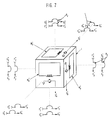
- Fig. 7 illustrates a magnetometer cube which could be used to practice the present invention.
- Three magnetometers M i x , M i y and M i z include SQUIDs S i x , S i y and S i z , respectively.
- Three Helmholtz pairs P x , P y and P z are shown which include F x and G x , F y and G y , and F z and G z , respectively.
- the SQUID outputs O i x , O i y and O i z are calculated based on F i x and G i x , F i y and G i y , and F i z and G i z , respectively.
- Fig. 8 illustrates a single axis gradiometer using magnetometer cubes similar to the one shown in Fig. 7.
- the single axis gradiometer illustrated in Fig. 8 includes three magnetometer cubes K, L and M. Each of the magnetometer cubes K, L and M are arranged in a common line.
- Magnetometer cube K includes three magnetometers which each have an associated feedback coil. No gradient coil is associated with any of these three magnetometers, since the magnetometers of magnetometer cube K are average magnetometers.
- Magnetometer cubes L and M include three magnetometers each having an associated feedback coil. However, only the x-magnetometers of each of cubes L and M have an associated gradient coil, since Fig. 8 illustrates only a single-axis gradiometer. Therefore, the gradient may be calculated as follows: where O L X and O M x are the outputs of the X SQUIDs of magnetometers L and M, respectively, and d is the distance between magnetometers L and M.
- a gradiometer which is at least a five axis gradiometer.
- a five axis gradiometer is one which measures at least five of the nine gradients for a magnetic field with respect to an x, y, and z axis as described below. The reasoning for this is as follows: In determining a gradient for a magnetic field with respect to an x, y and z axis (i.e., in three dimensions), nine gradients are involved. These nine gradients are: This is equivalent to: respectively.
- Fig. 9 illustrates a five axis gradiometer according to the present invention.
- the five axis gradiometer includes four magnetometer cubes A, B, C and D arranged in a common plane.
- the Fig. 9 embodiment uses a higher order gradiometer while practicing the present invention by taking the differences between multiple pairs of difference SQUIDs.
- Magnetometer cube A is an average magnetometer cube having three average magnetometers and magnetometer cubes B, C and D are the same as magnetometer cube i shown in Fig. 7.
- the SQUID outputs O A x , O A y and O A z of magnetometer cube A are provided to the associated feedback coils since no gradient coils are connected for the average magnetometers of cube A.
- d is the distance between magnetometer cubes B and D and (d/2) is the vertical distance (i.e., in the Z direction) from the midpoint of the line connecting magnetometer cubes B and D to magnetometer cube C.
- the gradiometer of Fig. 9 provides six of the nine terms of the gradient. The other three terms can easily be calculated.
- vector magnetometers such as, for example, flux gate magnetometers, SQUIDs, etc. It is preferred that SQUIDs be used to practice the present invention since they have a very high sensitivity. However, any type of vector magnetometer may be used to practice the present invention.
Landscapes
- Physics & Mathematics (AREA)
- Condensed Matter Physics & Semiconductors (AREA)
- General Physics & Mathematics (AREA)
- Measuring Magnetic Variables (AREA)
- Geophysics And Detection Of Objects (AREA)
- Superconductor Devices And Manufacturing Methods Thereof (AREA)
Applications Claiming Priority (2)
| Application Number | Priority Date | Filing Date | Title |
|---|---|---|---|
| US07/594,810 US5122744A (en) | 1990-10-09 | 1990-10-09 | Gradiometer having a magnetometer which cancels background magnetic field from other magnetometers |
| US594810 | 1990-10-09 |
Publications (2)
| Publication Number | Publication Date |
|---|---|
| EP0481211A2 true EP0481211A2 (fr) | 1992-04-22 |
| EP0481211A3 EP0481211A3 (en) | 1993-01-20 |
Family
ID=24380502
Family Applications (1)
| Application Number | Title | Priority Date | Filing Date |
|---|---|---|---|
| EP19910115244 Withdrawn EP0481211A3 (en) | 1990-10-09 | 1991-09-10 | Gradiometer having a magnetometer which cancels background magnetic field from other magnetometers |
Country Status (3)
| Country | Link |
|---|---|
| US (1) | US5122744A (fr) |
| EP (1) | EP0481211A3 (fr) |
| JP (1) | JPH0711563B2 (fr) |
Cited By (17)
| Publication number | Priority date | Publication date | Assignee | Title |
|---|---|---|---|---|
| EP0560621A3 (en) * | 1992-03-13 | 1994-08-10 | Gen Electric | System and method for noiseless measurement of a biomagnetic field |
| GB2283823A (en) * | 1993-11-10 | 1995-05-17 | Ultra Electronics Ltd | Measurement of alternating magnetic fields in presence of steady magnetic field e.g. earth's field |
| WO1996032655A1 (fr) * | 1995-04-13 | 1996-10-17 | Forschungszentrum Jülich GmbH | Gradiometre a anneau de commutation haute frequence avec structure de focalisation de flux a resonance |
| WO1997008564A1 (fr) * | 1995-08-28 | 1997-03-06 | Josef Constantin Szeles | Procede et dispositif de formation d'images par resonance magnetique nucleaire |
| DE19733920A1 (de) * | 1997-08-06 | 1999-02-25 | Forschungszentrum Juelich Gmbh | Vorrichtung zur Störsignalunterdrückung mit frequenzabhängiger adaptiver Kompensation sowie eine solche Vorrichtung enthaltendes Gradiometer |
| EP0917441A4 (fr) * | 1996-06-25 | 1999-09-01 | Quantum Magnetics Inc | Methode et appareil destines au depistage d'un corps etranger ferromagnetique |
| US6337567B1 (en) * | 1999-04-22 | 2002-01-08 | Lg Electronics Inc. | Apparatus and method for measuring second-order gradient of magnetic field using super conductor quantum interference device |
| US6496713B2 (en) | 1996-06-25 | 2002-12-17 | Mednovus, Inc. | Ferromagnetic foreign body detection with background canceling |
| US6538436B1 (en) | 1998-08-28 | 2003-03-25 | Neuromag Oy | Method and apparatus for eliminating background interference signals from multichannel signal measurements |
| WO2005078467A1 (fr) * | 2004-02-13 | 2005-08-25 | Elekta Ab (Publ) | Procede de suppression de parasites dans un dispositif de mesure |
| US6965792B2 (en) | 1996-06-25 | 2005-11-15 | Mednovus, Inc. | Susceptometers for foreign body detection |
| US7047059B2 (en) | 1998-08-18 | 2006-05-16 | Quantum Magnetics, Inc | Simplified water-bag technique for magnetic susceptibility measurements on the human body and other specimens |
| US7466132B2 (en) | 2002-02-06 | 2008-12-16 | The Regents Of The University Of California | Squid detected NMR and MRI at ultralow fields |
| US7672707B2 (en) * | 2003-06-11 | 2010-03-02 | Japan Science And Technology Agency | Sensor for magnetoencephalography meter and supermultichannel magnetoencephalography meter system using the same |
| RU2384856C1 (ru) * | 2008-11-28 | 2010-03-20 | Учреждение Российской академии наук Институт радиотехники и электроники им. В.А. Котельникова РАН | Магнитометр-градиентометр на основе сквидов постоянного тока из высокотемпературных сверхпроводников |
| WO2012172435A3 (fr) * | 2011-05-13 | 2013-04-25 | Rampart Detection Systems Ltd. | Gradiomètre électromagnétique transversal |
| CN109839666A (zh) * | 2019-03-05 | 2019-06-04 | 中国科学院遥感与数字地球研究所 | 基于NI cRIO的航空超导全张量磁梯度数据采集系统及方法 |
Families Citing this family (39)
| Publication number | Priority date | Publication date | Assignee | Title |
|---|---|---|---|---|
| DE4227876A1 (de) * | 1992-08-22 | 1994-02-24 | Philips Patentverwaltung | Schaltungsanordnung zum Betrieb eines SQUID's, insbesondere eines DC-SQUID's |
| US5469057A (en) * | 1994-03-08 | 1995-11-21 | University Of New Mexico | Method and apparatus for extending the dynamic range of DC-squid measurements using a flux tracking loop |
| US5786690A (en) | 1994-08-18 | 1998-07-28 | International Business Machines Corporation | High resolution three-axis scanning squid microscope having planar solenoids |
| US5657756A (en) * | 1995-06-07 | 1997-08-19 | Ctf Systems Inc. | Method and systems for obtaining higher order gradiometer measurements with lower order gradiometers |
| US5642045A (en) * | 1995-08-18 | 1997-06-24 | International Business Machines Corporation | Magnetic field gradiometer with improved correction circuits |
| EP0890117B1 (fr) * | 1996-03-27 | 2002-01-02 | MedNetix AG | Dispositif et procede de determinaton de position |
| KR100198534B1 (ko) * | 1996-05-02 | 1999-06-15 | 구자홍 | 두개의 초전도양자간섭소자를 이용한 자장측정장치 |
| GB9704911D0 (en) * | 1997-03-10 | 1997-04-30 | Secr Defence | A magnetic gradiometer |
| GB2337128B (en) * | 1997-03-10 | 2001-12-05 | Secr Defence | Magnetic gradiometer |
| US5990679A (en) * | 1997-10-22 | 1999-11-23 | The United States Of America As Represented By The Secretary Of The Navy | Method using corrective factors for determining a magnetic gradient |
| US6008641A (en) * | 1997-10-22 | 1999-12-28 | The United States Of America As Represented By The Secretary Of The Navy | Method using corrective factors for aligning a magnetic gradiometer |
| GB9813889D0 (en) * | 1998-06-27 | 1998-08-26 | Secr Defence | Apparatus for detecting metals |
| KR100400755B1 (ko) * | 2001-11-08 | 2003-10-08 | 엘지전자 주식회사 | 보조센서에 의한 squid 센서 |
| US7002341B2 (en) * | 2002-08-28 | 2006-02-21 | Vanderbilt University | Superconducting quantum interference apparatus and method for high resolution imaging of samples |
| JP4263544B2 (ja) * | 2003-06-23 | 2009-05-13 | 株式会社日立ハイテクノロジーズ | 磁場計測装置 |
| US20060197523A1 (en) * | 2005-03-04 | 2006-09-07 | Assurance Technology Corporation | Magnetic screening system |
| US20120041297A1 (en) * | 2009-02-06 | 2012-02-16 | Baylor College Of Medicine | Real-time magnetic dipole detection and tracking |
| US8378667B2 (en) * | 2009-05-22 | 2013-02-19 | Tdw Delaware Inc. | System and method for detecting the passage of an object in pipeline including shielded magnetometer and a microcontroller with adaptive thresholding detection means |
| US8314608B2 (en) | 2010-06-30 | 2012-11-20 | Hall David R | Method of determining distance to a ferrous material |
| UA102163C2 (ru) | 2012-02-02 | 2013-06-10 | Владимир Николаевич Сосницкий | Устройство для компенсации электромагнитных помех при измерениях биомагнитных сигналов |
| JP6255902B2 (ja) * | 2013-10-30 | 2018-01-10 | Tdk株式会社 | 磁界検出装置 |
| CN104880680B (zh) * | 2014-02-28 | 2017-12-05 | 中国科学院上海微系统与信息技术研究所 | 超导量子干涉器磁传感系统 |
| US10228398B2 (en) | 2015-04-02 | 2019-03-12 | Rosemount Aerospace Inc. | System and method for minimizing magnetic field effect on an isolated magnetometer |
| US9955912B2 (en) | 2015-07-14 | 2018-05-01 | Getchell Technologies Llc | Magnet-based monitoring system |
| US10338261B2 (en) | 2015-09-16 | 2019-07-02 | Raytheon Company | Measurement of magnetic field gradients |
| JP2017062122A (ja) * | 2015-09-23 | 2017-03-30 | 国立大学法人名古屋大学 | 磁界検出装置 |
| JP7393947B2 (ja) | 2017-05-22 | 2023-12-07 | ジェネテシス エルエルシー | 生体電磁界における異常の機械識別 |
| US11134877B2 (en) * | 2017-08-09 | 2021-10-05 | Genetesis, Inc. | Biomagnetic detection |
| US12642469B2 (en) | 2017-08-09 | 2026-06-02 | SB Technology, Inc. | Biomagnetic detection |
| US12262997B2 (en) | 2017-08-09 | 2025-04-01 | Genetesis, Inc. | Biomagnetic detection |
| US10514429B2 (en) | 2018-05-03 | 2019-12-24 | United States Of America As Represented By The Secretary Of The Navy | SQUID array planar and axial gradiometer |
| US11585869B2 (en) | 2019-02-08 | 2023-02-21 | Genetesis, Inc. | Biomagnetic field sensor systems and methods for diagnostic evaluation of cardiac conditions |
| EP4041066A4 (fr) * | 2019-10-09 | 2023-10-11 | University of Washington | Systèmes, dispositifs et procédés d'annulation de référence servant à déterminer des caractéristiques de tissu in vitro |
| US11776736B2 (en) * | 2019-12-18 | 2023-10-03 | United States Of America As Represented By The Secretary Of The Navy | Electronic package for an electrically small device with integrated magnetic field bias |
| EP3882646A1 (fr) * | 2020-03-18 | 2021-09-22 | TE Connectivity Germany GmbH | Magnétomètre intégré et procédé de détection d'un champ magnétique |
| CN122537018A (zh) | 2020-05-27 | 2026-08-11 | Sb科技公司 | 使用磁场图检测冠状动脉疾病的系统和设备 |
| CN114114092B (zh) | 2020-08-31 | 2026-04-14 | 巴德阿克塞斯系统股份有限公司 | 磁场方向检测 |
| DE102021203128A1 (de) * | 2021-03-29 | 2022-09-29 | Robert Bosch Gesellschaft mit beschränkter Haftung | Sensoreinheit zum Erfassen eines Magnetfeldes |
| GB202213839D0 (en) | 2022-09-22 | 2022-11-09 | Univ Court Univ Of Glasgow | Biomagnetidm measurement system and method for sensing biomagnetic signals |
Family Cites Families (15)
| Publication number | Priority date | Publication date | Assignee | Title |
|---|---|---|---|---|
| US2620381A (en) * | 1947-05-27 | 1952-12-02 | Fred M Mayes | Magnetometer gradiometer apparatus and method |
| US3110282A (en) * | 1960-08-24 | 1963-11-12 | Friedrich M O Foerster | Degaussing control |
| US3311821A (en) * | 1962-12-11 | 1967-03-28 | Canadair Ltd | Apparatus for automatically compensating the output of a magnetic field sensing device for the effects of interfering magnetic fields |
| CA1140214A (fr) * | 1980-01-29 | 1983-01-25 | Malcolm E. Bell | Magnetometre multisenseur |
| FR2560388B1 (fr) * | 1980-03-17 | 1986-08-01 | Commissariat Energie Atomique | Gradientmetre a couche magnetique mince |
| US4386318A (en) * | 1980-09-26 | 1983-05-31 | Her Majesty The Queen In Right Of Canada, As Represented By The Minister Of National Defence | Method and apparatus to compensate a gradiometer having first and second unwanted terms |
| US4489274A (en) * | 1980-12-10 | 1984-12-18 | The United States Of America As Represented By The Secretary Of The Navy | Rotating SQUID magnetometers and gradiometers |
| US4394831A (en) * | 1981-02-12 | 1983-07-26 | Honeywell Inc. | Helmet metal mass compensation for helmet-mounted sighting system |
| JPS58154615A (ja) * | 1982-03-10 | 1983-09-14 | Copal Co Ltd | 磁気検出装置 |
| CA1208292A (fr) * | 1982-08-27 | 1986-07-22 | Malcolm E. Bell | Magnetometre a sondes alignees de precision |
| US4528506A (en) * | 1982-11-23 | 1985-07-09 | The United States Of America As Represented By The Secretary Of The Air Force | Ferromagnetic resonance probe liftoff suppression apparatus |
| FR2553520B1 (fr) * | 1983-10-14 | 1986-04-11 | Thomson Csf | Systeme de goniotelemetrie |
| FR2558599B1 (fr) * | 1984-01-24 | 1986-08-01 | Thomson Csf | Procede et dispositif de compensation automatique des erreurs mecaniques d'un gradientmetre magnetique |
| US4801883A (en) * | 1986-06-02 | 1989-01-31 | The Regents Of The University Of California | Integrated-circuit one-way isolation coupler incorporating one or several carrier-domain magnetometers |
| JP4532309B2 (ja) | 2005-02-23 | 2010-08-25 | 東亜ディーケーケー株式会社 | 隔膜部材及び隔膜式電極 |
-
1990
- 1990-10-09 US US07/594,810 patent/US5122744A/en not_active Expired - Lifetime
-
1991
- 1991-09-10 EP EP19910115244 patent/EP0481211A3/en not_active Withdrawn
- 1991-10-03 JP JP28196091A patent/JPH0711563B2/ja not_active Expired - Fee Related
Cited By (24)
| Publication number | Priority date | Publication date | Assignee | Title |
|---|---|---|---|---|
| EP0560621A3 (en) * | 1992-03-13 | 1994-08-10 | Gen Electric | System and method for noiseless measurement of a biomagnetic field |
| GB2283823A (en) * | 1993-11-10 | 1995-05-17 | Ultra Electronics Ltd | Measurement of alternating magnetic fields in presence of steady magnetic field e.g. earth's field |
| GB2283823B (en) * | 1993-11-10 | 1997-04-02 | Ultra Electronics Ltd | Measurement of alternating magnetic fields |
| WO1996032655A1 (fr) * | 1995-04-13 | 1996-10-17 | Forschungszentrum Jülich GmbH | Gradiometre a anneau de commutation haute frequence avec structure de focalisation de flux a resonance |
| AT406092B (de) * | 1995-08-28 | 2000-02-25 | Szeles Josef Constantin Dr | Verfahren und vorrichtung zur bildung einer abbildung mit kernspinresonanz |
| WO1997008564A1 (fr) * | 1995-08-28 | 1997-03-06 | Josef Constantin Szeles | Procede et dispositif de formation d'images par resonance magnetique nucleaire |
| US6031373A (en) * | 1995-08-28 | 2000-02-29 | Josef Constantin Szeles | Nuclear magnetic resonance imaging process and device |
| EP0917441A4 (fr) * | 1996-06-25 | 1999-09-01 | Quantum Magnetics Inc | Methode et appareil destines au depistage d'un corps etranger ferromagnetique |
| US6965792B2 (en) | 1996-06-25 | 2005-11-15 | Mednovus, Inc. | Susceptometers for foreign body detection |
| US6418335B2 (en) | 1996-06-25 | 2002-07-09 | Mednovus, Inc. | Ferromagnetic foreign body detection using magnetics |
| US6496713B2 (en) | 1996-06-25 | 2002-12-17 | Mednovus, Inc. | Ferromagnetic foreign body detection with background canceling |
| DE19733920A1 (de) * | 1997-08-06 | 1999-02-25 | Forschungszentrum Juelich Gmbh | Vorrichtung zur Störsignalunterdrückung mit frequenzabhängiger adaptiver Kompensation sowie eine solche Vorrichtung enthaltendes Gradiometer |
| US7047059B2 (en) | 1998-08-18 | 2006-05-16 | Quantum Magnetics, Inc | Simplified water-bag technique for magnetic susceptibility measurements on the human body and other specimens |
| US6538436B1 (en) | 1998-08-28 | 2003-03-25 | Neuromag Oy | Method and apparatus for eliminating background interference signals from multichannel signal measurements |
| EP0982597A3 (fr) * | 1998-08-28 | 2009-01-28 | ELEKTA AB (publ.) | Procédé et dispositif pour éliminer des signaux d'interférence de fond d'un réseau de transducteurs à plusieurs canaux |
| US6337567B1 (en) * | 1999-04-22 | 2002-01-08 | Lg Electronics Inc. | Apparatus and method for measuring second-order gradient of magnetic field using super conductor quantum interference device |
| US7466132B2 (en) | 2002-02-06 | 2008-12-16 | The Regents Of The University Of California | Squid detected NMR and MRI at ultralow fields |
| US7672707B2 (en) * | 2003-06-11 | 2010-03-02 | Japan Science And Technology Agency | Sensor for magnetoencephalography meter and supermultichannel magnetoencephalography meter system using the same |
| WO2005078467A1 (fr) * | 2004-02-13 | 2005-08-25 | Elekta Ab (Publ) | Procede de suppression de parasites dans un dispositif de mesure |
| US7649351B2 (en) | 2004-02-13 | 2010-01-19 | Elekta Ab (Publ) | Method for interference suppression in a measuring device |
| RU2384856C1 (ru) * | 2008-11-28 | 2010-03-20 | Учреждение Российской академии наук Институт радиотехники и электроники им. В.А. Котельникова РАН | Магнитометр-градиентометр на основе сквидов постоянного тока из высокотемпературных сверхпроводников |
| WO2012172435A3 (fr) * | 2011-05-13 | 2013-04-25 | Rampart Detection Systems Ltd. | Gradiomètre électromagnétique transversal |
| CN109839666A (zh) * | 2019-03-05 | 2019-06-04 | 中国科学院遥感与数字地球研究所 | 基于NI cRIO的航空超导全张量磁梯度数据采集系统及方法 |
| CN109839666B (zh) * | 2019-03-05 | 2020-12-04 | 中国科学院遥感与数字地球研究所 | 基于NI cRIO的航空超导全张量磁梯度数据采集系统及方法 |
Also Published As
| Publication number | Publication date |
|---|---|
| US5122744A (en) | 1992-06-16 |
| JPH0711563B2 (ja) | 1995-02-08 |
| JPH04264281A (ja) | 1992-09-21 |
| EP0481211A3 (en) | 1993-01-20 |
Similar Documents
| Publication | Publication Date | Title |
|---|---|---|
| US5122744A (en) | Gradiometer having a magnetometer which cancels background magnetic field from other magnetometers | |
| US6690162B1 (en) | Device for high-resolution measurement of magnetic fields | |
| Wynn et al. | Advanced superconducting gradiometer/magnetometer arrays and a novel signal processing technique | |
| US6339328B1 (en) | Magnetic gradiometer incorporating global feedback | |
| US4591787A (en) | Multi-channel device with SQUIDS and superconducting gradiometers for the measurement of weak magnetic fields produced by various field sources | |
| JP3204542B2 (ja) | 磁場源測定装置 | |
| US4613817A (en) | Superconducting gradiometer coil system for an apparatus for the multi-channel measurement of weak nonstationary magnetic fields | |
| US5642045A (en) | Magnetic field gradiometer with improved correction circuits | |
| US7508202B2 (en) | Method and apparatus for magnetic field detection | |
| US4320341A (en) | Method and apparatus for balancing the magnetic field detecting loops of a cryogenic gradiometer using trimming coils and superconducting disks | |
| US6665552B2 (en) | Gradiometer integrating pickup coils and magnetic field measurement system | |
| US6154026A (en) | Asymmetric planar gradiometer for rejection of uniform ambient magnetic noise | |
| AU4756800A (en) | Measurement of magnetic fields using a string fixed at both ends | |
| EP0492261B1 (fr) | Bobine capteur pour mesurer des champs magnétiques | |
| US5053706A (en) | Compact low-distortion squid magnetometer | |
| US5252921A (en) | Noise canceling high-sensitive magnetometer | |
| Kittel et al. | High T c superconducting second-order gradiometer | |
| JPH05232202A (ja) | ソフトウェアグラディオメータ | |
| Eulenburg et al. | Highly balanced long-baseline single-layer high-T c superconducting quantum interference device gradiometer | |
| Lee et al. | Direct-coupled second-order superconducting quantum interference device gradiometer from single layer of high temperature superconductor | |
| EP2810091B1 (fr) | Dispositif de compensation d'interférences électromagnétiques pendant des mesures biomagnétiques | |
| JP3156396B2 (ja) | 差動型squid磁束計及びこれを用いた生体磁場計測装置 | |
| Fagaly | A SQUID-based method to measure drift and maintain stability in superconducting magnets | |
| Kouznetsov et al. | High T c superconducting asymmetric gradiometer for biomagnetic applications | |
| Kang et al. | Simple simulation method for investigating the performance of a SQUID gradiometer corresponding to a baseline length |
Legal Events
| Date | Code | Title | Description |
|---|---|---|---|
| PUAI | Public reference made under article 153(3) epc to a published international application that has entered the european phase |
Free format text: ORIGINAL CODE: 0009012 |
|
| AK | Designated contracting states |
Kind code of ref document: A2 Designated state(s): DE FR GB |
|
| PUAL | Search report despatched |
Free format text: ORIGINAL CODE: 0009013 |
|
| AK | Designated contracting states |
Kind code of ref document: A3 Designated state(s): DE FR GB |
|
| 17P | Request for examination filed |
Effective date: 19930918 |
|
| 17Q | First examination report despatched |
Effective date: 19950712 |
|
| STAA | Information on the status of an ep patent application or granted ep patent |
Free format text: STATUS: THE APPLICATION IS DEEMED TO BE WITHDRAWN |
|
| 18D | Application deemed to be withdrawn |
Effective date: 19960123 |