EP0482743A2 - Spritzgiessmaschine mit Hilfsdruckdüse - Google Patents
Spritzgiessmaschine mit Hilfsdruckdüse Download PDFInfo
- Publication number
- EP0482743A2 EP0482743A2 EP91306770A EP91306770A EP0482743A2 EP 0482743 A2 EP0482743 A2 EP 0482743A2 EP 91306770 A EP91306770 A EP 91306770A EP 91306770 A EP91306770 A EP 91306770A EP 0482743 A2 EP0482743 A2 EP 0482743A2
- Authority
- EP
- European Patent Office
- Prior art keywords
- annular sleeve
- extruder
- plunger
- bore
- fluidic
- Prior art date
- Legal status (The legal status is an assumption and is not a legal conclusion. Google has not performed a legal analysis and makes no representation as to the accuracy of the status listed.)
- Ceased
Links
Images


Classifications
-
- B—PERFORMING OPERATIONS; TRANSPORTING
- B29—WORKING OF PLASTICS; WORKING OF SUBSTANCES IN A PLASTIC STATE IN GENERAL
- B29C—SHAPING OR JOINING OF PLASTICS; SHAPING OF MATERIAL IN A PLASTIC STATE, NOT OTHERWISE PROVIDED FOR; AFTER-TREATMENT OF THE SHAPED PRODUCTS, e.g. REPAIRING
- B29C45/00—Injection moulding, i.e. forcing the required volume of moulding material through a nozzle into a closed mould; Apparatus therefor
- B29C45/17—Component parts, details or accessories; Auxiliary operations
- B29C45/46—Means for plasticising or homogenising the moulding material or forcing it into the mould
- B29C45/57—Exerting after-pressure on the moulding material
Definitions
- the present invention generally relates to injection molding machines for forming plastic products. More specifically, this invention relates to an injection molding machine having a pressure assist nozzle which operates to compress the molten plastic within the mold and shut off the flow of molten plastic to the injection mold.
- Injection molding machines are widely used to produce plastic products having geometries with varying degrees of complexity.
- Injection molding machines are typically composed of an extruder, an injection manifold which is provided with molten plastic by the extruder and one or more injection molds which are fed the molten plastic, or melt, by the injection manifold.
- the extruder is typically provided with solid plastic shot or pellets through a gravity-fed hopper or the like.
- the plastic shot is plasticized within the extruder by way of heating elements within the extruder's walls.
- the extruder through a plunging action or a rotating screw thread action or a combination of both, then operates to provide the injection manifold with a desired quantity of the melt.
- U. S. Patent No. 3,335,457 typifies a common form of extruder which uses a reciprocating screw to deliver the melt to the manifold.
- the three way valve closes a passage between the extruder and the mold to stop the flow of melt, and then subsequently puts the mold in communication with an accumulator which pressurizes the melt within the mold.
- Farrell A disadvantage of the device taught by Farrell is the requirement for two separate mechanisms to accomplish the shut off and pressurization operations, resulting in more parts and a less compact injection molding machine.
- a device for stopping the flow from the extruder to the mold is typically used to allow a predetermined quantity of melt to flow from the extruder.
- the quantity of melt is metered to avoid excessive melt from being injected into the mold and, accordingly, mold flash that accounts for waste is minimized.
- the prior art does not disclose an injection molding machine which provides the advantages of both the shut off operation and the pressurizing operation all within one mechanism.
- the prior art does not provide a valve mechanism that acts to close the flow of the melt to the mold while also, by means of its operation, acts to maintain pressure within the mold to prevent voids from forming.
- an injection molding machine that is adapted to inject a predetermined quantity of melt into a mold, maintain pressure in the mold in a manner that prevents voids from forming within the melt, while also reducing extruder cycle time.
- a machine which provides both operations within one valve body to reduce the number of components required to perform the operation and to simplify manufacture and assembly of such an injection molding machine.
- an injection apparatus for use in injection molding plastic products.
- the apparatus has an extruder device which operates to plasticize plastic shot received from a storage device, such as a hopper.
- the extruder then transfers the melt to a nozzle which feeds one or more molds.
- the extruder is in fluidic communication with the nozzle via a fluidic passage.
- a bore extends into the passage to define a portion of the passage between the extruder and the nozzle.
- the bore has an aperture within a side wall which acts as a valve opening within the passage which, when closed, interrupts flow between the extruder and the nozzle.
- An annular sleeve is reciprocated within the bore by an actuating device. The annular sleeve is actuated between a retract position, in which the annular sleeve is withdrawn from the passage, and an extend position, in which the annular sleeve is projected into the passage in a direction toward the nozzle. When actuated from the retract position to an intermediate position between the retract and extend position, the annular sleeve closes the aperture in the bore, thereby blocking communication between the extruder and the nozzle.
- a plunger piston reciprocally resides within the annular sleeve.
- the plunger piston is held in a retracted position by the annular sleeve while the annular sleeve is in its retract position.
- the plunger piston becomes coupled with the annular sleeve and accompanies the annular sleeve as it continues toward the extend position.
- the plunger piston acts to reduce the internal volume of the passage between the aperture and the nozzle, thereby compressing the melt within the molds.
- the annular sleeve operates to close the aperture once the extruder displaces a predetermined volume of melt, thereby preventing further displacement of melt from the extruder.
- the volume of melt necessary to fill the mold or molds can be delivered accurately. Once the necessary volume of melt is delivered, the annular sleeve closes the aperture to stop the flow of melt, avoiding the waste associated with excess melt being delivered to the mold.
- a significant advantage of the present invention is that following the closure of the aperture, the plunger piston acts to compress and pressurize the melt within the nozzle and the mold to prevent the formation of voids within the mold.
- an object of the present invention to provide an injection molding machine which is capable of accurately delivering a predetermined quantity of melt to a mold through the use of an annular sleeve operating as a shut off valve.
- such an injection molding machine be capable of preventing voids from forming in the melt injected into the mold through use of a plunger piston operating as a pressurizing device.
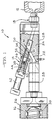
- an injection molding machine 10 shown in Figure 1 which injects molten plastic, or melt, into a mold 12 for forming plastic products.
- the machine 10 provides a sequential two step shut off and compression action through the use of a pressure assist nozzle 14 incorporating a unique combination shut off sleeve and plunger.
- the injection molding machine 10 includes an extruder 16 which receives plastic shot from any convenient storage device, such as a hopper (not shown).
- the extruder 16 operates to plasticize the shot into melt and deliver the melt to an extruder nozzle 18 which is suitable for further delivering the melt to one or more molds 12.
- the extruder 16 can be of any suitable form, such as the screw thread 20 illustrated in Figure 1.
- the extruder is provided with heating elements 26, generally shown as heating bands in Figure 1.
- the extruder nozzle 18 is in fluidic communication with the extruder 16 via a fluidic passage 22.
- the fluidic passage 22 resides within a housing 24 which is mounted between the extruder 16 and the extruder nozzle 18.
- the housing 24 contains the pressure assist nozzle 14 which constitutes the preferred embodiment of the present invention. Similar to the extruder 16, the housing 24 is provided with heating elements 28 to maintain the melt in a fluid state.
- a fitted sleeve 48 defines a valve bore 30 as a portion of the fluidic passage 22 within the housing 24.
- an aperture 32 which provides fluidic communication between the extruder 16 and the extruder nozzle 18.
- the valve bore 30, as defined by the fitted sleeve 48 extends outside the flow path of the fluidic passage 22 to the exterior of the housing 24 to form a plunger bore 34. Accordingly, as seen in Figure 1, the plunger bore 34 constitutes that portion of the valve bore 30 between the aperture 32 and the exterior surface of the housing 24.
- the fluidic passage 22 and the portion of the valve bore 30 which resides within the flow path of the fluidic passage define a finite internal volume between the extruder 16 and the extruder nozzle 18.
- Attached to the housing 24 is an actuator support 38 located coaxial with the plunger bore 34 and the valve bore 30.
- a plunger 44 is reciprocated by way of a hydraulic actuating cylinder 42 mounted to the actuator support 38.
- the plunger 44 reciprocates between an extend position and a retract position.
- Figures 1 and 2 illustrate the retracted position of the plunger 44
- Figure 4 illustrates the extend position of the plunger 44.
- the plunger 44 is threaded into a sleeve end 46 extending toward the plunger bore 34 and the valve bore 30.
- annular sleeve 36 is attached to the sleeve end 46 so that it is reciprocable between the plunger bore 34 and the valve bore 30 when the plunger 44 is stroked between the retract and extend positions.
- the length of the annular sleeve 36 is such that, when in the retract position, the annular sleeve 36 does not extend beyond the aperture 32, as seen in Figures 1 and 2.
- the length of the annular sleeve 36 must be sufficient such that, when in an intermediate position between the retract and extend positions, the annular sleeve 36 closes the aperture 32, as seen in Figure 3.
- a plunger piston 50 reciprocally resides within an annular sleeve bore 40 of the annular sleeve 36.
- the travel of the plunger piston 50 is determined by a radially fixed pin 52 which traverses a pair of corresponding slots 54 and 56 in the annular sleeve 36 and fitted sleeve 48, respectively.
- the slot 56 within the fitted sleeve 48 acts to keep the plunger piston 50 within the valve bore 30 of the housing 24 at all times.
- the slot 54 is positioned longitudinally within the annular sleeve 36 such that the end of the slot 54 acts as an abutment 58, urging the plunger piston 50 into the flow path of the fluidic passage 22 when the annular sleeve 36 is between its intermediate position, as shown in Figure 3, and its extend position, as shown in Figure 4.
- the plunger piston 50 As the plunger piston 50 enters the flow path of the fluidic passage 22, the plunger piston 50 displaces a corresponding portion of the internal volume of the fluidic passage 22. In effect, the plunger piston 50 acts to reduce the original internal volume of the fluidic passage 22, compressing the melt between the aperture 32 and the molds 12.
- the extruder 16 In operation, at the start of a cycle the extruder 16 is provided with a quantity of plastic shot (not shown). The extruder 16 plasticizes the plastic shot to form melt (not shown). The extruder 16 simultaneously rotates and plunges to transport the melt to the fluidic passage 22. At this time, the plunger 44 is in its retract position within the plunger bore 34, as best seen in Figure 2. Consequently, the annular sleeve 36 resides partially in that portion of the valve bore designated as the plunger bore 34. The plunger piston 50 resides entirely within the annular sleeve bore 40 of the annular sleeve 36, which in turn resides within the plunger bore 34.
- a significant advantage of the injection molding machine 10 described above is that the pressure assist nozzle 14, comprised of the annular sleeve 36 and the plunger piston 50, performs a two step shut off and compression action.
- the annular sleeve 36 provides the shut off action to interrupt flow between the extruder 16 and the molds 12 when it closes the aperture 32, while the plunger piston 50 provides the compression action upon the melt when it is stroked into the flow path of the fluidic passage 22 so as to reduce the internal volume of the fluidic passage 22.
- the design of the pressure assist nozzle 14 also provides a more compact apparatus with fewer parts than similar injection molding machines heretofore known in the prior art which provides similar shut off and compression operations.
- a significant advantage of the present invention is that the plunger piston 50 acts to compress and pressurize the melt within the injection manifold 18 and the molds 12 when the plunger piston 50 is traversed from the intermediate position to the extend position.
- the pin 52 of the plunger piston 50 is positioned with respect to the abutment 58 of the annular sleeve 36 so that the plunger piston 50 begins to compress the melt immediately following the closing of the aperture 32 by the annular sleeve 36.
Landscapes
- Engineering & Computer Science (AREA)
- Manufacturing & Machinery (AREA)
- Mechanical Engineering (AREA)
- Injection Moulding Of Plastics Or The Like (AREA)
Applications Claiming Priority (2)
| Application Number | Priority Date | Filing Date | Title |
|---|---|---|---|
| US07/605,078 US5071341A (en) | 1990-10-24 | 1990-10-24 | Injection molding machine with pressure assist nozzle |
| US605078 | 1990-10-24 |
Publications (2)
| Publication Number | Publication Date |
|---|---|
| EP0482743A2 true EP0482743A2 (de) | 1992-04-29 |
| EP0482743A3 EP0482743A3 (en) | 1992-06-17 |
Family
ID=24422169
Family Applications (1)
| Application Number | Title | Priority Date | Filing Date |
|---|---|---|---|
| EP19910306770 Ceased EP0482743A3 (en) | 1990-10-24 | 1991-07-25 | Injection molding machine with pressure assist nozzle |
Country Status (3)
| Country | Link |
|---|---|
| US (1) | US5071341A (de) |
| EP (1) | EP0482743A3 (de) |
| CA (1) | CA2048106A1 (de) |
Cited By (2)
| Publication number | Priority date | Publication date | Assignee | Title |
|---|---|---|---|---|
| EP0583857A1 (de) * | 1992-07-17 | 1994-02-23 | MANNESMANN Aktiengesellschaft | Verfahren und Vorrichtung zum Nachdrücken von Spritzgiessmassen |
| DE10346877A1 (de) * | 2003-10-09 | 2005-05-19 | Krauss-Maffei Kunststofftechnik Gmbh | Vorrichtung und Verfahren zum Spritzgießen |
Families Citing this family (9)
| Publication number | Priority date | Publication date | Assignee | Title |
|---|---|---|---|---|
| DE4022530C2 (de) * | 1990-07-16 | 1993-10-21 | Kloeckner Ferromatik Desma | Düse für Spritzgießmaschinen |
| DE4221423C2 (de) * | 1992-06-30 | 2002-06-20 | Sig Corpoplast Gmbh & Co Kg | Verfahren und Vorrichtung zum Herstellen von Gegenständen aus thermoplastischem Kunststoff durch Spritzgießen |
| FR2695345B1 (fr) * | 1992-09-09 | 1994-11-25 | Metals Process Systems | Presse à injecter et utilisation de celle-ci. |
| US5509797A (en) * | 1993-09-30 | 1996-04-23 | Nissei Plastic Industrial Co., Ltd. | Injection apparatus possessing pressure holding device |
| JP2928750B2 (ja) * | 1995-09-27 | 1999-08-03 | 日精樹脂工業株式会社 | 射出成形における保圧方法 |
| US6739862B2 (en) * | 2001-03-15 | 2004-05-25 | Robert Franklin Dray | Dual cylinder injection molding apparatus |
| US6527539B1 (en) * | 2000-10-25 | 2003-03-04 | Husky Injection Molding Systems, Ltd. | Injection unit of an injection system |
| JP5535595B2 (ja) | 2009-11-25 | 2014-07-02 | 日精エー・エス・ビー機械株式会社 | 射出装置及び樹脂の射出方法 |
| CN109177048B (zh) * | 2018-09-29 | 2024-03-22 | 苏州松之叶精密机械配件有限公司 | 一种高精密度全自动立式橡胶射出成型机 |
Family Cites Families (10)
| Publication number | Priority date | Publication date | Assignee | Title |
|---|---|---|---|---|
| SE126759C1 (de) * | 1947-09-09 | 1949-11-22 | ||
| US2862241A (en) * | 1956-11-30 | 1958-12-02 | Mattia Machine & Tool Co De | Apparatus for the automatic controlled feeding of plastic material |
| GB888448A (en) * | 1960-02-08 | 1962-01-31 | R H Windsor Ltd | Improvements in injection moulding machines |
| US3335457A (en) * | 1964-10-19 | 1967-08-15 | Hoover Ball & Bearing Co | Blow molding machine with continuously rotating reciprocating extruder screw |
| USRE28721E (en) * | 1970-11-25 | 1976-02-24 | Farrell Patent Company | Time saver plastic draw-back valve assembly |
| DE2061267A1 (de) * | 1970-12-12 | 1972-06-22 | Vox Anton J | Spritzgiessmaschine,insbesondere fuer Kunststoffe |
| US4067673A (en) * | 1975-09-02 | 1978-01-10 | Ex-Cell-O Corporation | Apparatus for injection foam molding |
| DE2614213A1 (de) * | 1976-04-02 | 1977-10-20 | Ver Foerderung Inst Kunststoff | Verfahren und vorrichtung zum spritzgiessen von dickwandigen grossvolumigen kunststoff-formteilen in formwerkzeugen |
| US4412807A (en) * | 1982-01-28 | 1983-11-01 | The Continental Group, Inc. | Offset flow injection nozzle |
| DE3336080A1 (de) * | 1983-10-04 | 1985-04-18 | Maschinenfabrik J. Dieffenbacher Gmbh & Co, 7519 Eppingen | Spritzpresse |
-
1990
- 1990-10-24 US US07/605,078 patent/US5071341A/en not_active Expired - Fee Related
-
1991
- 1991-07-25 EP EP19910306770 patent/EP0482743A3/en not_active Ceased
- 1991-07-30 CA CA002048106A patent/CA2048106A1/en not_active Abandoned
Cited By (3)
| Publication number | Priority date | Publication date | Assignee | Title |
|---|---|---|---|---|
| EP0583857A1 (de) * | 1992-07-17 | 1994-02-23 | MANNESMANN Aktiengesellschaft | Verfahren und Vorrichtung zum Nachdrücken von Spritzgiessmassen |
| DE10346877A1 (de) * | 2003-10-09 | 2005-05-19 | Krauss-Maffei Kunststofftechnik Gmbh | Vorrichtung und Verfahren zum Spritzgießen |
| DE10346877B4 (de) * | 2003-10-09 | 2007-02-08 | Krauss-Maffei Kunststofftechnik Gmbh | Vorrichtung und Verfahren zum Spritzgießen |
Also Published As
| Publication number | Publication date |
|---|---|
| EP0482743A3 (en) | 1992-06-17 |
| US5071341A (en) | 1991-12-10 |
| CA2048106A1 (en) | 1992-04-25 |
Similar Documents
| Publication | Publication Date | Title |
|---|---|---|
| US5071341A (en) | Injection molding machine with pressure assist nozzle | |
| US6824374B1 (en) | Thermoplastic resin injection molding machine | |
| US6017210A (en) | Apparatus for dwelling in injection molding | |
| US4342717A (en) | Injection moulding method and apparatus with mould runner reservoir and shot extension | |
| US6488490B1 (en) | Thermoplastic resin injection molding machine with the injecting unit including a rotary pump and torque limiter | |
| JPH0790578B2 (ja) | 射出成形機用の射出ユニット | |
| US4256689A (en) | Injection moulding method and apparatus with mould runner reservoir and shot extension | |
| US4752201A (en) | Apparatus for injection molding fiber-reinforced thermoset plastic articles | |
| US3401426A (en) | Plastic injection molding machine | |
| US3611503A (en) | Injection molding apparatus for plastic materials | |
| CA2063924C (en) | Improvements in plasticising units for screw injection moulding machines | |
| US3436793A (en) | Injection molding machine | |
| JP2923220B2 (ja) | ガラス長繊維入り樹脂材料の成形方法及び装置 | |
| US20030039718A1 (en) | Dual cylinder injection molding apparatus | |
| JPH0445867Y2 (de) | ||
| JPH0397517A (ja) | プリプラ式射出成形機 | |
| US6645405B2 (en) | Weighing method in prepla type injection molding machine | |
| JPS5848114Y2 (ja) | 射出成形機 | |
| JPH07214618A (ja) | 射出成形機におけるチェックリングの開閉装置 | |
| WO2002060671A1 (en) | Injection nozzle | |
| JP3248758B2 (ja) | 射出成形機における滞留樹脂の排出方法 | |
| JPS608209B2 (ja) | 二液型混合硬化樹脂用射出成形機 | |
| JPH0375107A (ja) | 樹脂供給装置 | |
| JPH0711321U (ja) | 射出装置 | |
| JPH08207097A (ja) | 可塑化・射出方法及びスクリュープリプラ式可塑化・射出装置 |
Legal Events
| Date | Code | Title | Description |
|---|---|---|---|
| PUAI | Public reference made under article 153(3) epc to a published international application that has entered the european phase |
Free format text: ORIGINAL CODE: 0009012 |
|
| PUAL | Search report despatched |
Free format text: ORIGINAL CODE: 0009013 |
|
| AK | Designated contracting states |
Kind code of ref document: A2 Designated state(s): DE FR GB IT |
|
| AK | Designated contracting states |
Kind code of ref document: A3 Designated state(s): DE FR GB IT |
|
| 17P | Request for examination filed |
Effective date: 19920623 |
|
| 17Q | First examination report despatched |
Effective date: 19940425 |
|
| STAA | Information on the status of an ep patent application or granted ep patent |
Free format text: STATUS: THE APPLICATION HAS BEEN REFUSED |
|
| 18R | Application refused |
Effective date: 19950514 |