EP0483053A1 - Moyen de décontamination et procédé de dissolution des surfaces radioactivement contaminées de composants métalliques - Google Patents
Moyen de décontamination et procédé de dissolution des surfaces radioactivement contaminées de composants métalliques Download PDFInfo
- Publication number
- EP0483053A1 EP0483053A1 EP91810731A EP91810731A EP0483053A1 EP 0483053 A1 EP0483053 A1 EP 0483053A1 EP 91810731 A EP91810731 A EP 91810731A EP 91810731 A EP91810731 A EP 91810731A EP 0483053 A1 EP0483053 A1 EP 0483053A1
- Authority
- EP
- European Patent Office
- Prior art keywords
- contaminated
- lead
- oxidizing agent
- decontamination
- hydrogen peroxide
- Prior art date
- Legal status (The legal status is an assumption and is not a legal conclusion. Google has not performed a legal analysis and makes no representation as to the accuracy of the status listed.)
- Granted
Links
- 238000000034 method Methods 0.000 title claims abstract description 44
- MHAJPDPJQMAIIY-UHFFFAOYSA-N Hydrogen peroxide Chemical compound OO MHAJPDPJQMAIIY-UHFFFAOYSA-N 0.000 claims abstract description 56
- 229910004039 HBF4 Inorganic materials 0.000 claims abstract description 36
- 239000002253 acid Substances 0.000 claims abstract description 30
- 229910052751 metal Inorganic materials 0.000 claims abstract description 28
- 239000002184 metal Substances 0.000 claims abstract description 28
- 239000007800 oxidant agent Substances 0.000 claims abstract description 21
- 239000003153 chemical reaction reagent Substances 0.000 claims abstract description 18
- 239000000203 mixture Substances 0.000 claims abstract description 13
- 238000005202 decontamination Methods 0.000 claims description 22
- 239000000243 solution Substances 0.000 claims description 21
- 230000003588 decontaminative effect Effects 0.000 claims description 20
- 230000002285 radioactive effect Effects 0.000 claims description 19
- 238000005868 electrolysis reaction Methods 0.000 claims description 18
- RILZRCJGXSFXNE-UHFFFAOYSA-N 2-[4-(trifluoromethoxy)phenyl]ethanol Chemical compound OCCC1=CC=C(OC(F)(F)F)C=C1 RILZRCJGXSFXNE-UHFFFAOYSA-N 0.000 claims description 17
- 239000003795 chemical substances by application Substances 0.000 claims description 14
- XLYOFNOQVPJJNP-UHFFFAOYSA-N water Substances O XLYOFNOQVPJJNP-UHFFFAOYSA-N 0.000 claims description 6
- 238000011161 development Methods 0.000 claims description 4
- 239000012286 potassium permanganate Substances 0.000 claims description 4
- 239000002244 precipitate Substances 0.000 claims description 4
- QVGXLLKOCUKJST-UHFFFAOYSA-N atomic oxygen Chemical compound [O] QVGXLLKOCUKJST-UHFFFAOYSA-N 0.000 claims description 3
- 150000002500 ions Chemical class 0.000 claims description 3
- 239000000463 material Substances 0.000 claims description 3
- 239000001301 oxygen Substances 0.000 claims description 3
- 229910052760 oxygen Inorganic materials 0.000 claims description 3
- 230000001172 regenerating effect Effects 0.000 claims description 3
- AXCZMVOFGPJBDE-UHFFFAOYSA-L calcium dihydroxide Chemical compound [OH-].[OH-].[Ca+2] AXCZMVOFGPJBDE-UHFFFAOYSA-L 0.000 claims description 2
- 229910001861 calcium hydroxide Inorganic materials 0.000 claims description 2
- 239000000920 calcium hydroxide Substances 0.000 claims description 2
- 239000012065 filter cake Substances 0.000 claims description 2
- 239000000706 filtrate Substances 0.000 claims description 2
- 239000002351 wastewater Substances 0.000 claims description 2
- 239000007864 aqueous solution Substances 0.000 claims 2
- 239000011575 calcium Substances 0.000 claims 1
- PXHVJJICTQNCMI-UHFFFAOYSA-N Nickel Chemical compound [Ni] PXHVJJICTQNCMI-UHFFFAOYSA-N 0.000 abstract description 9
- 229910045601 alloy Inorganic materials 0.000 abstract description 6
- 239000000956 alloy Substances 0.000 abstract description 6
- 229910052759 nickel Inorganic materials 0.000 abstract description 6
- 239000002699 waste material Substances 0.000 abstract description 5
- 229910000831 Steel Inorganic materials 0.000 abstract description 4
- 229910052802 copper Inorganic materials 0.000 abstract description 4
- 239000003792 electrolyte Substances 0.000 abstract description 4
- 239000010959 steel Substances 0.000 abstract description 4
- YEXPOXQUZXUXJW-UHFFFAOYSA-N oxolead Chemical compound [Pb]=O YEXPOXQUZXUXJW-UHFFFAOYSA-N 0.000 abstract description 3
- 229910000464 lead oxide Inorganic materials 0.000 abstract description 2
- RYGMFSIKBFXOCR-UHFFFAOYSA-N Copper Chemical compound [Cu] RYGMFSIKBFXOCR-UHFFFAOYSA-N 0.000 abstract 1
- 238000007792 addition Methods 0.000 abstract 1
- 239000010949 copper Substances 0.000 abstract 1
- QSHDDOUJBYECFT-UHFFFAOYSA-N mercury Chemical compound [Hg] QSHDDOUJBYECFT-UHFFFAOYSA-N 0.000 abstract 1
- 229910052753 mercury Inorganic materials 0.000 abstract 1
- 229910052709 silver Inorganic materials 0.000 abstract 1
- 239000004332 silver Substances 0.000 abstract 1
- 238000002474 experimental method Methods 0.000 description 11
- 238000004090 dissolution Methods 0.000 description 10
- YADSGOSSYOOKMP-UHFFFAOYSA-N dioxolead Chemical compound O=[Pb]=O YADSGOSSYOOKMP-UHFFFAOYSA-N 0.000 description 7
- 150000002739 metals Chemical class 0.000 description 7
- NUJOXMJBOLGQSY-UHFFFAOYSA-N manganese dioxide Chemical compound O=[Mn]=O NUJOXMJBOLGQSY-UHFFFAOYSA-N 0.000 description 6
- 230000004580 weight loss Effects 0.000 description 6
- 238000012360 testing method Methods 0.000 description 5
- CSCPPACGZOOCGX-UHFFFAOYSA-N Acetone Chemical compound CC(C)=O CSCPPACGZOOCGX-UHFFFAOYSA-N 0.000 description 2
- OKTJSMMVPCPJKN-UHFFFAOYSA-N Carbon Chemical compound [C] OKTJSMMVPCPJKN-UHFFFAOYSA-N 0.000 description 2
- 229910000978 Pb alloy Inorganic materials 0.000 description 2
- 229910002804 graphite Inorganic materials 0.000 description 2
- 239000010439 graphite Substances 0.000 description 2
- 238000004519 manufacturing process Methods 0.000 description 2
- 229910044991 metal oxide Inorganic materials 0.000 description 2
- 150000004706 metal oxides Chemical class 0.000 description 2
- 230000005855 radiation Effects 0.000 description 2
- SIWNEELMSUHJGO-UHFFFAOYSA-N 2-(4-bromophenyl)-4,5,6,7-tetrahydro-[1,3]oxazolo[4,5-c]pyridine Chemical compound C1=CC(Br)=CC=C1C(O1)=NC2=C1CCNC2 SIWNEELMSUHJGO-UHFFFAOYSA-N 0.000 description 1
- 229910000881 Cu alloy Inorganic materials 0.000 description 1
- UFHFLCQGNIYNRP-UHFFFAOYSA-N Hydrogen Chemical compound [H][H] UFHFLCQGNIYNRP-UHFFFAOYSA-N 0.000 description 1
- ZLMJMSJWJFRBEC-UHFFFAOYSA-N Potassium Chemical compound [K] ZLMJMSJWJFRBEC-UHFFFAOYSA-N 0.000 description 1
- 230000015572 biosynthetic process Effects 0.000 description 1
- -1 cationic ion Chemical class 0.000 description 1
- 238000006243 chemical reaction Methods 0.000 description 1
- 238000004140 cleaning Methods 0.000 description 1
- 230000003247 decreasing effect Effects 0.000 description 1
- 239000008367 deionised water Substances 0.000 description 1
- 229910021641 deionized water Inorganic materials 0.000 description 1
- 230000006866 deterioration Effects 0.000 description 1
- 238000010790 dilution Methods 0.000 description 1
- 239000012895 dilution Substances 0.000 description 1
- 230000000694 effects Effects 0.000 description 1
- 238000005516 engineering process Methods 0.000 description 1
- 239000004519 grease Substances 0.000 description 1
- XLYOFNOQVPJJNP-ZSJDYOACSA-N heavy water Substances [2H]O[2H] XLYOFNOQVPJJNP-ZSJDYOACSA-N 0.000 description 1
- 239000001257 hydrogen Substances 0.000 description 1
- 229910052739 hydrogen Inorganic materials 0.000 description 1
- WABPQHHGFIMREM-UHFFFAOYSA-N lead(0) Chemical compound [Pb] WABPQHHGFIMREM-UHFFFAOYSA-N 0.000 description 1
- 238000005259 measurement Methods 0.000 description 1
- 239000007769 metal material Substances 0.000 description 1
- 238000012986 modification Methods 0.000 description 1
- 230000004048 modification Effects 0.000 description 1
- 230000003472 neutralizing effect Effects 0.000 description 1
- 150000002815 nickel Chemical class 0.000 description 1
- 230000003647 oxidation Effects 0.000 description 1
- 238000007254 oxidation reaction Methods 0.000 description 1
- 229910052700 potassium Inorganic materials 0.000 description 1
- 239000011591 potassium Substances 0.000 description 1
- 230000001681 protective effect Effects 0.000 description 1
- 238000011084 recovery Methods 0.000 description 1
- 238000004064 recycling Methods 0.000 description 1
- 238000000926 separation method Methods 0.000 description 1
- 239000010935 stainless steel Substances 0.000 description 1
- 229910001220 stainless steel Inorganic materials 0.000 description 1
Images


Classifications
-
- C—CHEMISTRY; METALLURGY
- C23—COATING METALLIC MATERIAL; COATING MATERIAL WITH METALLIC MATERIAL; CHEMICAL SURFACE TREATMENT; DIFFUSION TREATMENT OF METALLIC MATERIAL; COATING BY VACUUM EVAPORATION, BY SPUTTERING, BY ION IMPLANTATION OR BY CHEMICAL VAPOUR DEPOSITION, IN GENERAL; INHIBITING CORROSION OF METALLIC MATERIAL OR INCRUSTATION IN GENERAL
- C23G—CLEANING OR DE-GREASING OF METALLIC MATERIAL BY CHEMICAL METHODS OTHER THAN ELECTROLYSIS
- C23G1/00—Cleaning or pickling metallic material with solutions or molten salts
- C23G1/02—Cleaning or pickling metallic material with solutions or molten salts with acid solutions
- C23G1/10—Other heavy metals
-
- G—PHYSICS
- G21—NUCLEAR PHYSICS; NUCLEAR ENGINEERING
- G21F—PROTECTION AGAINST X-RADIATION, GAMMA RADIATION, CORPUSCULAR RADIATION OR PARTICLE BOMBARDMENT; TREATING RADIOACTIVELY CONTAMINATED MATERIAL; DECONTAMINATION ARRANGEMENTS THEREFOR
- G21F9/00—Treating radioactively contaminated material; Decontamination arrangements therefor
- G21F9/001—Decontamination of contaminated objects, apparatus, clothes, food; Preventing contamination thereof
- G21F9/002—Decontamination of the surface of objects with chemical or electrochemical processes
- G21F9/004—Decontamination of the surface of objects with chemical or electrochemical processes of metallic surfaces
Definitions
- the present invention relates to a method and a decontamination agent for dissolving oxidized or non-oxidized, radioactive contaminated surfaces of objects made of metal.
- shielding stones are formed from lead or lead alloys, which are used to create entire walls around highly radioactive components. Heavily radioactive tubes are also covered with lead mats. Of course, these shielding stones, lead mats or lead plates can also be radioactively contaminated. They must therefore be decontaminated from time to time. So far, this has been unsatisfactory.
- the lead or lead-containing elements were scraped off on the surface or brushed manually, the contaminated scraped material was radioactively disposed of and the remaining, still slightly contaminated components were melted down.
- a second variant was to provide the lead shielding stones or plates with a plastic covering that is renewed from time to time. The contaminated plastic cover was always disposed of by nuclear waste. Both variants led to a relatively large amount of nuclear waste to be disposed of.
- Lead components are used in various nuclear applications. For example in nuclear weapons, where lead components are used, among other things, as reflector shields. From time to time, these lead components must be renewed to maintain the functionality of the nuclear weapons and the lead waste must be decontaminated.
- the radioactive contaminated metallic components are placed in a fluoroboric acid bath and this is electrochemically regenerated and the metals are recovered while the regenerated fluoroboric acid is fed back into the process.
- this method has proven to be too time-consuming that it can also only be used at elevated temperature and concentration.
- the solubility of lead and other metals such as Ni, Cu, Hg, Ag or steel is also an extremely slow process in HBF4 acid at room temperature, which also takes place with the development of hydrogen H2.
- This object is achieved by a method having the features of claim 1, or a decontamination agent having the features of claim 22.
- a lead plate with a thickness of 0.25 mm and a surface area of 2 ⁇ 88 cm 2 was used in the experiments described below. To prevent the lead plate from being coated with a protective grease film, it was degreased with acetone before being introduced into the solution.
- This information relates to a reagent of 5% HBF4 with 0.5% H2O2 at a temperature of 25 ° C.
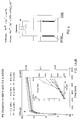
- the solubility rate of lead in 5% HBF4 acid has now been determined as a function of the concentration of the hydrogen peroxide present therein. The result is shown in FIGS. 2A and B. With increasing H2O2 concentration, a constant increase in the dissolution rate of the lead was found, namely within the range from 0 to 2 vol%.
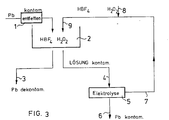
- the now decontaminated lead plates are removed from the solution bath (2).
- the solution, which is now contaminated, is led (4) to an electrolysis bath by performing the electrolysis (5).
- the contaminated lead or lead dioxide is now deposited on the anode or cathode.
- the concentrated radioactive contaminated material (6) is now in a highly concentrated form and can now be disposed of in a nuclear manner in a known manner.
- the remaining HBF4 acid is removed from the electrolysis cell (7). Now the return (9) of the HBF4 acid can take place in the solution bath (2). This is done with addition (8) of H2O2 until the desired concentration is reached again.
- the process can be terminated by neutralizing the acid after the electrolysis has been carried out by adding calcium hydroxide or regenerating it on a cationic ion exchanger to the pure, uncontaminated acid. As is known, this produces a precipitate that can be filtered out or sedimented. The remaining, contaminated filter cake can solidify and be disposed of by nuclear waste. The remaining filtrate is free of activity and also no longer contains lead. It can therefore be disposed of without additional precautionary measures, for example by disposing it to the wastewater disposal system.
- the experiments were carried out at room temperature and using stainless steel on the cathode and a graphite anode.
- the electrolyte consisted of a 5% HBF4 acid with a content of about 30 grams per liter of Pb2 +.
- the electrolyte was produced by the solution of lead in a 5% HBF4 acid with a content of 0.5% H2O2.
- the initial pH was around 0.
- Lead electrolysis was started at a potential of approximately 2.0 volts. Initially, bubbles formed on the anode surface. These disappeared as soon as lead dioxide had formed.
- FIG. 5A shows two examples of lead electrolysis. In both cases the current was kept at a fixed value.
- this reagent can also be pumped directly into a closed pipe system, for example a heat exchanger in a nuclear power plant, and can be circulated therein for a few hours, and then the radioactive reagent can be pumped out and electrolytically regenerated. Because the solution is completely water-soluble, the pipe system can then be rinsed with water.
- An alternative is to leave the reagent in the pipe system, but after a while pass it through an ion exchanger, which can be used to remove all radioactive components and the dissolved metals from the system.
- the cleaning by means of ion exchangers is in itself a known technology that does not need to be discussed further here.
- a possible alternative is that the parts to be decontaminated are first exposed to an oxidizing agent and only then placed in a pure HBF4 acid bath or sprayed with HBF4 acid. This procedure can be repeated several times until the metal surface to be decontaminated has radioactivity below the free measurement limit.
Landscapes
- Chemical & Material Sciences (AREA)
- Engineering & Computer Science (AREA)
- Chemical Kinetics & Catalysis (AREA)
- General Chemical & Material Sciences (AREA)
- General Engineering & Computer Science (AREA)
- Mechanical Engineering (AREA)
- Food Science & Technology (AREA)
- Physics & Mathematics (AREA)
- Electrochemistry (AREA)
- High Energy & Nuclear Physics (AREA)
- Materials Engineering (AREA)
- Life Sciences & Earth Sciences (AREA)
- Metallurgy (AREA)
- Organic Chemistry (AREA)
- Electrolytic Production Of Metals (AREA)
- Cleaning And De-Greasing Of Metallic Materials By Chemical Methods (AREA)
- Detergent Compositions (AREA)
- Apparatus For Disinfection Or Sterilisation (AREA)
Applications Claiming Priority (2)
| Application Number | Priority Date | Filing Date | Title |
|---|---|---|---|
| CH3429/90A CH682023A5 (fr) | 1990-10-26 | 1990-10-26 | |
| CH3429/90 | 1990-10-26 |
Publications (2)
| Publication Number | Publication Date |
|---|---|
| EP0483053A1 true EP0483053A1 (fr) | 1992-04-29 |
| EP0483053B1 EP0483053B1 (fr) | 1995-03-01 |
Family
ID=4255784
Family Applications (1)
| Application Number | Title | Priority Date | Filing Date |
|---|---|---|---|
| EP91810731A Expired - Lifetime EP0483053B1 (fr) | 1990-10-26 | 1991-09-16 | Moyen de décontamination et procédé de dissolution des surfaces radioactivement contaminées de composants métalliques |
Country Status (12)
| Country | Link |
|---|---|
| US (1) | US5340505A (fr) |
| EP (1) | EP0483053B1 (fr) |
| JP (1) | JPH04285898A (fr) |
| BG (1) | BG95366A (fr) |
| CA (2) | CA2054236A1 (fr) |
| CH (1) | CH682023A5 (fr) |
| CS (1) | CS325391A3 (fr) |
| DE (1) | DE59104768D1 (fr) |
| ES (1) | ES2071278T3 (fr) |
| FI (1) | FI914870A7 (fr) |
| HU (1) | HU212234B (fr) |
| RU (1) | RU2029400C1 (fr) |
Cited By (6)
| Publication number | Priority date | Publication date | Assignee | Title |
|---|---|---|---|---|
| WO1996014640A1 (fr) * | 1994-11-04 | 1996-05-17 | British Nuclear Fuels Plc | Procedes de decontamination |
| US5805654A (en) * | 1997-04-08 | 1998-09-08 | Wood; Christopher J. | Regenerative LOMI decontamination process |
| US5901368A (en) * | 1997-06-04 | 1999-05-04 | Electric Power Research Institute | Radiolysis-assisted decontamination process |
| US6320675B1 (en) | 1997-07-15 | 2001-11-20 | Canon Kabushiki Kaisha | Image processing apparatus and method and storage medium |
| RU2397558C1 (ru) * | 2009-07-27 | 2010-08-20 | Федеральное государственное унитарное предприятие "Научно-исследовательский технологический институт имени А.П. Александрова" | Способ очистки и дезактивации оборудования атомных электрических станций (варианты) |
| CN112176393A (zh) * | 2020-09-28 | 2021-01-05 | 中核四川环保工程有限责任公司 | 一种电化学去污电解液及其制备方法和应用 |
Families Citing this family (11)
| Publication number | Priority date | Publication date | Assignee | Title |
|---|---|---|---|---|
| US5458745A (en) * | 1995-01-23 | 1995-10-17 | Covofinish Co., Inc. | Method for removal of technetium from radio-contaminated metal |
| US5724668A (en) * | 1995-11-07 | 1998-03-03 | Electronic Power Research Institute | Method for decontamination of nuclear plant components |
| US6147274A (en) * | 1996-11-05 | 2000-11-14 | Electric Power Research Insitute | Method for decontamination of nuclear plant components |
| US7384529B1 (en) | 2000-09-29 | 2008-06-10 | The United States Of America As Represented By The United States Department Of Energy | Method for electrochemical decontamination of radioactive metal |
| RU2195728C2 (ru) * | 2000-11-22 | 2002-12-27 | Государственное предприятие "Курская атомная станция" | Способ малореагентной дезактивации |
| FR2873848B1 (fr) * | 2004-08-02 | 2006-11-17 | Tech En Milieu Ionisant Stmi S | Procede de decontamination d'objets en plomb |
| US20100010285A1 (en) * | 2008-06-26 | 2010-01-14 | Lumimove, Inc., D/B/A Crosslink | Decontamination system |
| JP6220114B2 (ja) * | 2011-11-30 | 2017-10-25 | 荏原工業洗浄株式会社 | 放射性セシウム固体状被汚染物の除染方法及び装置 |
| RU2502567C1 (ru) * | 2012-07-27 | 2013-12-27 | Федеральное государственное унитарное предприятие "Российский Федеральный ядерный центр - Всероссийский научно-исследовательский институт экспериментальной физики" - ФГУП "РФЯЦ-ВНИИЭФ" | Способ удаления металлических покрытий с поверхности деталей из радиоактивного химически активного металла |
| JP6403517B2 (ja) * | 2014-09-25 | 2018-10-10 | 三菱重工業株式会社 | 放射性廃棄物除染方法 |
| RU2646535C1 (ru) * | 2017-04-12 | 2018-03-06 | Федеральное государственное унитарное предприятие "Научно-исследовательский институт Научно-производственное объединение "ЛУЧ" (ФГУП "НИИ НПО "ЛУЧ") | Способ переработки отходов ядерного производства |
Citations (4)
| Publication number | Priority date | Publication date | Assignee | Title |
|---|---|---|---|---|
| GB891670A (en) * | 1957-09-04 | 1962-03-14 | English Electric Co Ltd | Improvements in and relating to the removing of scale from silicon iron and other metals |
| US3565707A (en) * | 1969-03-03 | 1971-02-23 | Fmc Corp | Metal dissolution |
| US3873362A (en) * | 1973-05-29 | 1975-03-25 | Halliburton Co | Process for cleaning radioactively contaminated metal surfaces |
| WO1986007184A1 (fr) * | 1985-05-28 | 1986-12-04 | Jozef Hanulik | Moyen pour la decontamination de materiaux contamines metalliques ou renfermant du ciment, son procede de fabrication et son utilisation |
Family Cites Families (30)
| Publication number | Priority date | Publication date | Assignee | Title |
|---|---|---|---|---|
| US1899734A (en) * | 1930-01-18 | 1933-02-28 | American Sheet & Tin Plate | Removal of oxids from ferrous metal |
| US2154451A (en) * | 1934-12-17 | 1939-04-18 | Du Pont | Bright dip |
| GB891760A (en) * | 1957-07-08 | 1962-03-21 | Derek Richard Stuckey | Improvements in or relating to sleeved garments |
| US3080323A (en) * | 1959-04-07 | 1963-03-05 | Purex Corp Ltd | Composition for radioactive decontamination and descaling of cobalt alloys |
| BE670521A (fr) * | 1964-10-05 | 1900-01-01 | ||
| US3341304A (en) * | 1966-04-08 | 1967-09-12 | Billie J Newby | Separation of uranium from uranium dioxide-zirconium dioxide mixtures |
| US3409413A (en) * | 1967-08-11 | 1968-11-05 | Atomic Energy Commission Usa | Method of dissolving aluminum-clad thoria target elements |
| US3668131A (en) * | 1968-08-09 | 1972-06-06 | Allied Chem | Dissolution of metal with acidified hydrogen peroxide solutions |
| SU398702A1 (ru) * | 1970-04-29 | 1973-09-27 | Раствор для стравливания гальванических покрытий сплавами олово—свинец | |
| DE2058766A1 (de) * | 1970-11-30 | 1972-05-31 | Siemens Ag | Verfahren zur Reinigung von metallischen Oberflaechen,insbesondere radioaktiv verseuchten Oberflaechen |
| US3891741A (en) * | 1972-11-24 | 1975-06-24 | Ppg Industries Inc | Recovery of fission products from acidic waste solutions thereof |
| GB1446816A (en) * | 1973-05-02 | 1976-08-18 | Furukawa Electric Co Ltd | Chemical dissolution treatment of tin or alloys thereof |
| US3965237A (en) * | 1975-04-11 | 1976-06-22 | The United States Of America As Repesented By The United States Energy Research And Development Administration | Dissolution process for ZrO2 -UO2 -CaO fuels |
| DE2553569C2 (de) * | 1975-11-28 | 1985-09-12 | Kernforschungszentrum Karlsruhe Gmbh, 7500 Karlsruhe | Verfahren zur Verfestigung von radioaktiven wäßrigen Abfallstoffen durch Sprühkalzinierung und anschließende Einbettung in eine Matrix aus Glas oder Glaskeramik |
| BE838533A (fr) * | 1976-02-13 | 1976-05-28 | Procede de sechage des solutions contenant de l'acide borique | |
| CH619807A5 (fr) * | 1976-04-07 | 1980-10-15 | Foerderung Forschung Gmbh | |
| DE2910677C2 (de) * | 1979-03-19 | 1983-12-22 | Kraftwerk Union AG, 4330 Mülheim | Verfahren zur Behandlung von borhaltigen radioaktiven Konzentraten aus Abwässern von Druckwasserreaktoren |
| US4217192A (en) * | 1979-06-11 | 1980-08-12 | The United States Of America As Represented By The United States Department Of Energy | Decontamination of metals using chemical etching |
| US4443269A (en) * | 1979-10-01 | 1984-04-17 | Health Physics Systems, Inc. | Tool decontamination method |
| JPS57164984A (en) * | 1981-04-06 | 1982-10-09 | Metsuku Kk | Exfoliating solution for tin or tin alloy |
| CH653466A5 (de) * | 1981-09-01 | 1985-12-31 | Industrieorientierte Forsch | Verfahren zur dekontamination von stahloberflaechen und entsorgung der radioaktiven stoffe. |
| US4686019A (en) * | 1982-03-11 | 1987-08-11 | Exxon Research And Engineering Company | Dissolution of PuO2 or NpO2 using electrolytically regenerated reagents |
| US4530723A (en) * | 1983-03-07 | 1985-07-23 | Westinghouse Electric Corp. | Encapsulation of ion exchange resins |
| US4620947A (en) * | 1983-10-17 | 1986-11-04 | Chem-Nuclear Systems, Inc. | Solidification of aqueous radioactive waste using insoluble compounds of magnesium oxide |
| US4537666A (en) * | 1984-03-01 | 1985-08-27 | Westinghouse Electric Corp. | Decontamination using electrolysis |
| US4701246A (en) * | 1985-03-07 | 1987-10-20 | Kabushiki Kaisha Toshiba | Method for production of decontaminating liquid |
| JPS6267500A (ja) * | 1985-09-20 | 1987-03-27 | 日立プラント建設株式会社 | 放射能汚染物の化学的除染方法及び装置 |
| CH679158A5 (fr) * | 1989-07-20 | 1991-12-31 | Recytec S A C O Orfigest S A | |
| JPH0375386A (ja) * | 1989-08-18 | 1991-03-29 | Metsuku Kk | 錫又は錫‐鉛合金の剥離方法 |
| US5084253A (en) * | 1989-11-13 | 1992-01-28 | Nuclear Metals, Inc. | Method of removing niobium from uranium-niobium alloy |
-
1990
- 1990-10-26 CH CH3429/90A patent/CH682023A5/de not_active IP Right Cessation
-
1991
- 1991-08-16 US US07/746,027 patent/US5340505A/en not_active Expired - Fee Related
- 1991-09-16 EP EP91810731A patent/EP0483053B1/fr not_active Expired - Lifetime
- 1991-09-16 ES ES91810731T patent/ES2071278T3/es not_active Expired - Lifetime
- 1991-09-16 DE DE59104768T patent/DE59104768D1/de not_active Expired - Fee Related
- 1991-10-16 FI FI914870A patent/FI914870A7/fi not_active Application Discontinuation
- 1991-10-17 JP JP3298544A patent/JPH04285898A/ja active Pending
- 1991-10-25 RU SU915001980A patent/RU2029400C1/ru active
- 1991-10-25 CA CA002054236A patent/CA2054236A1/fr not_active Abandoned
- 1991-10-25 BG BG095366A patent/BG95366A/bg unknown
- 1991-10-25 CA CA002054234A patent/CA2054234A1/fr not_active Abandoned
- 1991-10-25 HU HU913363A patent/HU212234B/hu not_active IP Right Cessation
- 1991-10-25 CS CS913253A patent/CS325391A3/cs unknown
Patent Citations (4)
| Publication number | Priority date | Publication date | Assignee | Title |
|---|---|---|---|---|
| GB891670A (en) * | 1957-09-04 | 1962-03-14 | English Electric Co Ltd | Improvements in and relating to the removing of scale from silicon iron and other metals |
| US3565707A (en) * | 1969-03-03 | 1971-02-23 | Fmc Corp | Metal dissolution |
| US3873362A (en) * | 1973-05-29 | 1975-03-25 | Halliburton Co | Process for cleaning radioactively contaminated metal surfaces |
| WO1986007184A1 (fr) * | 1985-05-28 | 1986-12-04 | Jozef Hanulik | Moyen pour la decontamination de materiaux contamines metalliques ou renfermant du ciment, son procede de fabrication et son utilisation |
Cited By (9)
| Publication number | Priority date | Publication date | Assignee | Title |
|---|---|---|---|---|
| WO1996014640A1 (fr) * | 1994-11-04 | 1996-05-17 | British Nuclear Fuels Plc | Procedes de decontamination |
| US5805654A (en) * | 1997-04-08 | 1998-09-08 | Wood; Christopher J. | Regenerative LOMI decontamination process |
| US5901368A (en) * | 1997-06-04 | 1999-05-04 | Electric Power Research Institute | Radiolysis-assisted decontamination process |
| US6320675B1 (en) | 1997-07-15 | 2001-11-20 | Canon Kabushiki Kaisha | Image processing apparatus and method and storage medium |
| US6721067B2 (en) | 1997-07-15 | 2004-04-13 | Canon Kabushiki Kaisha | Processing apparatus and method and storage medium |
| RU2397558C1 (ru) * | 2009-07-27 | 2010-08-20 | Федеральное государственное унитарное предприятие "Научно-исследовательский технологический институт имени А.П. Александрова" | Способ очистки и дезактивации оборудования атомных электрических станций (варианты) |
| CN112176393A (zh) * | 2020-09-28 | 2021-01-05 | 中核四川环保工程有限责任公司 | 一种电化学去污电解液及其制备方法和应用 |
| CN112176393B (zh) * | 2020-09-28 | 2021-09-21 | 中核四川环保工程有限责任公司 | 一种电化学去污电解液及其制备方法和应用 |
| US11342092B2 (en) | 2020-09-28 | 2022-05-24 | China Nuclear Sichuan Environmental Protection Engineering Co., Ltd. | Electrolyte for electrochemical decontamination and preparation method and application thereof |
Also Published As
| Publication number | Publication date |
|---|---|
| ES2071278T3 (es) | 1995-06-16 |
| US5340505A (en) | 1994-08-23 |
| HU913363D0 (en) | 1992-01-28 |
| CA2054234A1 (fr) | 1992-04-27 |
| CS325391A3 (en) | 1992-06-17 |
| BG95366A (bg) | 1993-12-24 |
| HUT69460A (en) | 1995-09-28 |
| CA2054236A1 (fr) | 1992-04-27 |
| JPH04285898A (ja) | 1992-10-09 |
| HU212234B (en) | 1996-04-29 |
| EP0483053B1 (fr) | 1995-03-01 |
| CH682023A5 (fr) | 1993-06-30 |
| RU2029400C1 (ru) | 1995-02-20 |
| DE59104768D1 (de) | 1995-04-06 |
| FI914870A7 (fi) | 1992-04-27 |
| FI914870A0 (fi) | 1991-10-16 |
Similar Documents
| Publication | Publication Date | Title |
|---|---|---|
| EP0483053B1 (fr) | Moyen de décontamination et procédé de dissolution des surfaces radioactivement contaminées de composants métalliques | |
| EP0073366B1 (fr) | Procédé pour décontaminer des surfaces d'acier et éliminer des déchets radioactifs | |
| DE2714245B2 (de) | Verfahren zur Dekontamination von Metalloberflächen | |
| EP0224510A1 (fr) | Procede pour la decontamination de materiaux metalliques ou renfermant du ciment, contamines radioactivement. | |
| DE69417018T2 (de) | Verfahren zur behandlung von teilchenmaterial | |
| DE69507709T2 (de) | Dekontaminierungsverfahren | |
| EP0313843B1 (fr) | Procédé pour décontaminer des surfaces | |
| DE102010028457A1 (de) | Verfahren zur Oberflächen-Dekontamination | |
| DE3507334A1 (de) | Vorrichtung zum entseuchen strahlungsverseuchter metallischer gegenstaende | |
| DE1496907B2 (de) | Verfahren zum kontinuierlichen elektrolytischen entzundern von nickel und chrom enthaltenden staehlen | |
| DE1196048B (de) | Verfahren und Vorrichtung zum chemischen Ent-oxydieren von Metallen | |
| DE3607608A1 (de) | Verfahren zur herstellung einer dekontaminierungsfluessigkeit | |
| EP2828205B1 (fr) | Procédé pour éliminer des polluants radioactifs d'eaux résiduaires | |
| DE3852095T2 (de) | Wiederaufbereitungsanlage für kernbrennstoff. | |
| EP2188814B1 (fr) | Procédé de décontamination de surfaces d'installations nucléaires contaminées par des rayons alpha | |
| EP0610153A1 (fr) | Procédé de décontamination de surfaces métalliques radioactives | |
| DE2635033A1 (de) | Behandlung von fluorborat enthaltenden loesungen | |
| DE2600084A1 (de) | Verfahren und vorrichtung zur behandlung von verduennten metallcyanidloesungen | |
| DE69012677T2 (de) | Verfahren zur Auflösung von auf einem Substrat deponierten Oxiden und Verwendung zur Dekontaminierung. | |
| EP1141445B1 (fr) | Procede de decontamination d'une surface d'un element | |
| CH647001A5 (de) | Verfahren zur selektiven entfernung von kupferverunreinigungen aus palladium und zinn enthaltenden waessrigen aktivatorloesungen. | |
| DE2710459C2 (de) | Verfahren zum elektrolytischen Entzundern eines metallischen Körpers und seine Anwendung auf legierten Stahl | |
| CH631745A5 (en) | Process for cleaning objects after surface treatment by electroplating and/or chemical means | |
| DE2728650C2 (de) | Verfahren zur Vorbehandlung von Stahloberflächen für das nachfolgende Überziehen | |
| DE1496906A1 (de) | Verfahren zum elektrolytischen Entzundern von Eisen und Stahl |
Legal Events
| Date | Code | Title | Description |
|---|---|---|---|
| PUAI | Public reference made under article 153(3) epc to a published international application that has entered the european phase |
Free format text: ORIGINAL CODE: 0009012 |
|
| AK | Designated contracting states |
Kind code of ref document: A1 Designated state(s): BE CH DE ES FR GB LI SE |
|
| 17P | Request for examination filed |
Effective date: 19920611 |
|
| 17Q | First examination report despatched |
Effective date: 19940314 |
|
| RAP1 | Party data changed (applicant data changed or rights of an application transferred) |
Owner name: RECYTEC S.A. |
|
| GRAA | (expected) grant |
Free format text: ORIGINAL CODE: 0009210 |
|
| AK | Designated contracting states |
Kind code of ref document: B1 Designated state(s): BE CH DE ES FR GB LI SE |
|
| REF | Corresponds to: |
Ref document number: 59104768 Country of ref document: DE Date of ref document: 19950406 |
|
| GBT | Gb: translation of ep patent filed (gb section 77(6)(a)/1977) |
Effective date: 19950310 |
|
| ET | Fr: translation filed | ||
| REG | Reference to a national code |
Ref country code: ES Ref legal event code: FG2A Ref document number: 2071278 Country of ref document: ES Kind code of ref document: T3 |
|
| PLBE | No opposition filed within time limit |
Free format text: ORIGINAL CODE: 0009261 |
|
| STAA | Information on the status of an ep patent application or granted ep patent |
Free format text: STATUS: NO OPPOSITION FILED WITHIN TIME LIMIT |
|
| 26N | No opposition filed | ||
| PGFP | Annual fee paid to national office [announced via postgrant information from national office to epo] |
Ref country code: GB Payment date: 19960830 Year of fee payment: 6 Ref country code: FR Payment date: 19960830 Year of fee payment: 6 |
|
| PGFP | Annual fee paid to national office [announced via postgrant information from national office to epo] |
Ref country code: BE Payment date: 19960913 Year of fee payment: 6 |
|
| PGFP | Annual fee paid to national office [announced via postgrant information from national office to epo] |
Ref country code: SE Payment date: 19960917 Year of fee payment: 6 |
|
| PGFP | Annual fee paid to national office [announced via postgrant information from national office to epo] |
Ref country code: ES Payment date: 19960919 Year of fee payment: 6 |
|
| PGFP | Annual fee paid to national office [announced via postgrant information from national office to epo] |
Ref country code: DE Payment date: 19960930 Year of fee payment: 6 |
|
| PGFP | Annual fee paid to national office [announced via postgrant information from national office to epo] |
Ref country code: CH Payment date: 19961223 Year of fee payment: 6 |
|
| PG25 | Lapsed in a contracting state [announced via postgrant information from national office to epo] |
Ref country code: GB Free format text: LAPSE BECAUSE OF NON-PAYMENT OF DUE FEES Effective date: 19970916 |
|
| PG25 | Lapsed in a contracting state [announced via postgrant information from national office to epo] |
Ref country code: SE Free format text: LAPSE BECAUSE OF NON-PAYMENT OF DUE FEES Effective date: 19970917 Ref country code: ES Free format text: LAPSE BECAUSE OF THE APPLICANT RENOUNCES Effective date: 19970917 |
|
| PG25 | Lapsed in a contracting state [announced via postgrant information from national office to epo] |
Ref country code: LI Free format text: LAPSE BECAUSE OF NON-PAYMENT OF DUE FEES Effective date: 19970930 Ref country code: FR Free format text: THE PATENT HAS BEEN ANNULLED BY A DECISION OF A NATIONAL AUTHORITY Effective date: 19970930 Ref country code: CH Free format text: LAPSE BECAUSE OF NON-PAYMENT OF DUE FEES Effective date: 19970930 Ref country code: BE Free format text: LAPSE BECAUSE OF NON-PAYMENT OF DUE FEES Effective date: 19970930 |
|
| BERE | Be: lapsed |
Owner name: S.A. RECYTEC Effective date: 19970930 |
|
| GBPC | Gb: european patent ceased through non-payment of renewal fee |
Effective date: 19970916 |
|
| REG | Reference to a national code |
Ref country code: CH Ref legal event code: PL |
|
| PG25 | Lapsed in a contracting state [announced via postgrant information from national office to epo] |
Ref country code: DE Free format text: LAPSE BECAUSE OF NON-PAYMENT OF DUE FEES Effective date: 19980603 |
|
| EUG | Se: european patent has lapsed |
Ref document number: 91810731.9 |
|
| REG | Reference to a national code |
Ref country code: FR Ref legal event code: ST |
|
| REG | Reference to a national code |
Ref country code: ES Ref legal event code: FD2A Effective date: 20001102 |