EP0483098B1 - Procédé de préparation de N-phosphonométhylglycine - Google Patents
Procédé de préparation de N-phosphonométhylglycine Download PDFInfo
- Publication number
- EP0483098B1 EP0483098B1 EP91870166A EP91870166A EP0483098B1 EP 0483098 B1 EP0483098 B1 EP 0483098B1 EP 91870166 A EP91870166 A EP 91870166A EP 91870166 A EP91870166 A EP 91870166A EP 0483098 B1 EP0483098 B1 EP 0483098B1
- Authority
- EP
- European Patent Office
- Prior art keywords
- catalyst
- carbon atoms
- salt
- phosphonomethylglycine
- molar
- Prior art date
- Legal status (The legal status is an assumption and is not a legal conclusion. Google has not performed a legal analysis and makes no representation as to the accuracy of the status listed.)
- Expired - Lifetime
Links
- 0 *N1CCCCC1 Chemical compound *N1CCCCC1 0.000 description 1
- WOLFCKKMHUVEPN-UHFFFAOYSA-N CCCCN(C)CC Chemical compound CCCCN(C)CC WOLFCKKMHUVEPN-UHFFFAOYSA-N 0.000 description 1
Classifications
-
- C—CHEMISTRY; METALLURGY
- C07—ORGANIC CHEMISTRY
- C07F—ACYCLIC, CARBOCYCLIC OR HETEROCYCLIC COMPOUNDS CONTAINING ELEMENTS OTHER THAN CARBON, HYDROGEN, HALOGEN, OXYGEN, NITROGEN, SULFUR, SELENIUM OR TELLURIUM
- C07F9/00—Compounds containing elements of Groups 5 or 15 of the Periodic Table
- C07F9/02—Phosphorus compounds
- C07F9/28—Phosphorus compounds with one or more P—C bonds
- C07F9/38—Phosphonic acids [RP(=O)(OH)2]; Thiophosphonic acids ; [RP(=X1)(X2H)2(X1, X2 are each independently O, S or Se)]
- C07F9/3804—Phosphonic acids [RP(=O)(OH)2]; Thiophosphonic acids ; [RP(=X1)(X2H)2(X1, X2 are each independently O, S or Se)] not used, see subgroups
- C07F9/3808—Acyclic saturated acids which can have further substituents on alkyl
- C07F9/3813—N-Phosphonomethylglycine; Salts or complexes thereof
Definitions
- This invention relates to a process for preparing N-phosphonomethylglycine by the oxidation of N-phosphonomethyliminodiacetic acid using a peroxide and a homogeneous catalyst system. More particularly, this invention relates to a process for producing N-phosphonomethylglycine by the peroxide oxidation of N-phosphonomethyliminodiacetic acid using a salt of a selected metal in the presence of a dipyridyl compound.
- N-Phosphonomethylglycine known in the agricultural chemical art as glyphosate, is a highly effective and commercially important phytotoxicant useful in controlling the growth of germinating seeds, emerging seedlings, maturing and established woody and herbaceous vegetation, and aquatic plants.
- N-Phosphonomethylglycine and its salts are conveniently applied in an aqueous formulation as a postemergent phytotoxicant for the control of numerous plant species.
- N-Phosphonomethylglycine and its salts are characterized by broad spectrum activity, i.e., the controlled growth of a wide variety of plants.
- U.S. Patent 4,952,723 to Fields, et al. discloses a process for the production of N-phosphonomethylglycine by contacting N-phosphonomethyliminodiacetic acid with a molecular oxygen-containing gas in the presence of a catalyst selected from the group consisting of the salts and salt complexes of manganese, cobalt, iron, nickel, chromium, ruthenium, aluminum, molybdenum, vanadium and cerium, and an effective amount of a dipyridyl compound.
- a catalyst selected from the group consisting of the salts and salt complexes of manganese, cobalt, iron, nickel, chromium, ruthenium, aluminum, molybdenum, vanadium and cerium, and an effective amount of a dipyridyl compound.
- Hungarian Patent Application No. 187,347 discloses a process for the preparation of N-phosphonomethylglycine by the oxidation of N-phosphonomethyliminodiacetic acid with peroxides using a catalytic amount of a metal compound selected from compounds of silver, iron, tin, lead, manganese or molybdenum. Molybdates are preferred. At temperatures lower than 80°C, usually a contaminated end product is obtained. Typically, the reaction is carried out at a temperature of above 80°C and preferably about 100°C at pressure exceeding atmospheric. It is further disclosed that at least two mole equivalents of peroxide should be used for each mole equivalent of N-phosphonomethyliminodiacetic acid.
- the process of the present invention involves contacting N-phosphonomethyliminodiacetic acid with a salt or a salt complex of selected metals in a mixture or solution.
- the mixture or solution is contacted with a peroxide while heating the reaction mass to a temperature sufficiently high to initiate and sustain the oxidation reaction of N-phosphonomethyliminodiacetic acid to produce N-phosphonomethylglycine.
- the catalyst in the present invention can be any one or more of the salt and salt complexes of cobalt or vanadium.
- Suitable salts include cobalt sulfate, cobalt(II or III) acetylacetonate, cobalt chloride, cobalt bromide, cobalt nitrate, cobalt acetate, vanadium sulfate, vanadium bromide, vanadium chloride, and the like.
- the catalyst can be added to the N-phosphonomethyliminodiacetic acid in the salt form, or the salt may be generated in situ by the addition of a source of the metal ion, such as vanadium pentoxide which dissolves in the reaction mixture.
- a source of the metal ion such as vanadium pentoxide which dissolves in the reaction mixture.
- the concentration of the catalyst in the process of the present invention can vary within wide limits.
- the concentration can vary between 1 molar to 0.0001 molar total metal ion concentration.
- the reaction appears to have a first order dependency on the catalyst concentration, i.e., the reaction rate increases linearly as a catalyst concentration increases.
- the preferred concentration for the catalyst metal ion is in the range of 0.1 molar to 0.001 molar which gives a suitably fast rate of reaction that can be easily controlled and favors selectivity to N-phosphonomethylglycine.
- the salt and salt complexes of cobalt or vanadium can be used, and especially beneficial are the bromide and sulfate salts of cobalt and vanadium.
- Vanadium salts are especially preferred, and of these, vanadyl sulfate is the most preferred.
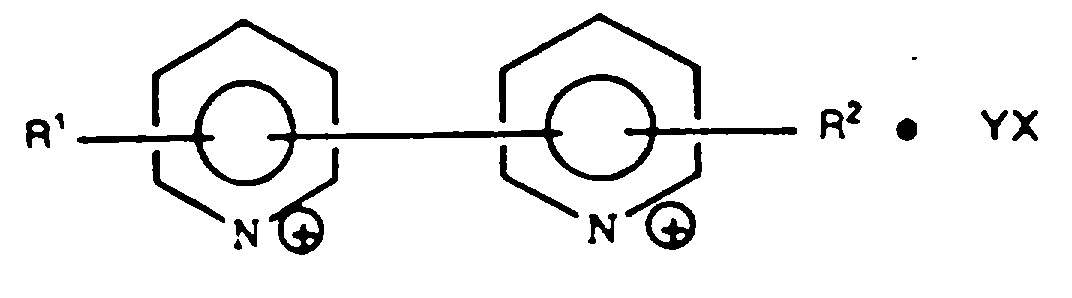
- dipyridyl compounds of the present invention are known to the art, and can be represented by the formula wherein R1 and R are independently selected from the group consisting of hydrogen, alkyl having from one to 18 carbon atoms, ortho-phenylene, oxygen, sulfur, SO x , N-R5 wherein R5 is alkyl having from one to six carbon atoms, and R1 and R together can form a bridge with groups selected from alkylene having from one to six carbon atoms, wherein the alkylene bridge can contain branching or double bonds.
- the salts of the dipyridyl compounds can be used and can be represented by the formula: wherein R1 and R are as defined above, Y is one or two depending on whether X is a dianion or a monoanion and X is selected from the group consisting of halide, sulfate and nitrate, phosphate, perchlorate, and the like; and R3 and R4 are individually selected from the group consisting of hydrogen or alkyl having from one to about 18 carbon atoms, and R3 and R4 together can form a bridge with groups selected from alkylene having from one to six carbon atoms wherein the alkylene bridge can contain branching or double bonds.
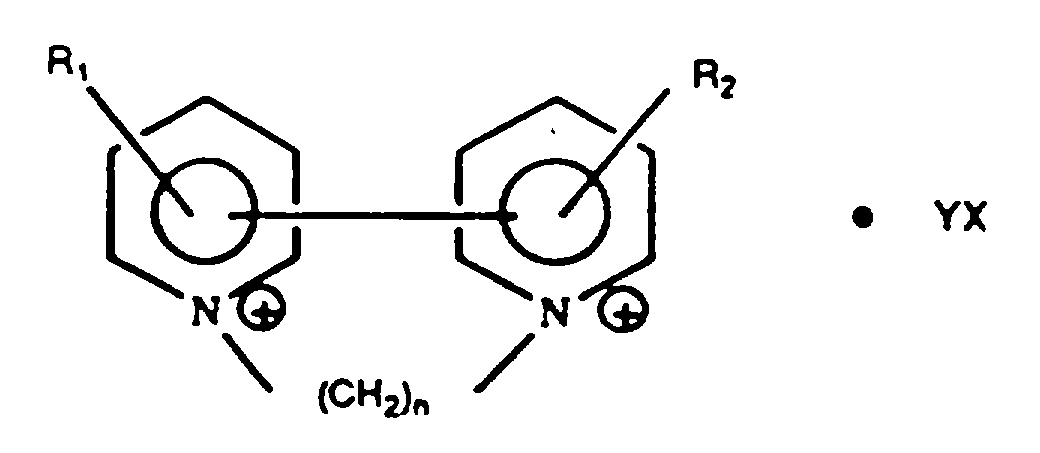
- the dipyridyl compounds can be represented by the formula: where n is from one to 18. It should be noted, however, that the free bases of the 2,2-dipyridyl compounds are not as effective as the other isomers in the process of the present invention due to its rate inhibiting effects.
- the concentration of the dipyridyl compound in the process of the present invention can vary within wide limits, depending upon the catalyst salt that is used and the particular dipyridyl compound that is selected. In general, it has been found that the concentration of the dipyridyl compound can vary from 0.01 molar in the reaction solution to 0.5 molar, and higher concentrations of the dipyridyl compound can be used, although such higher concentrations do not seem to have a significant effect on the oxidation rate of N-phosphonomethyliminodiacetic acid to N-phosphonomethylglycine. It has been found that concentrations of the dipyridyl compound between 0.1 molar to 0.5 molar provides satisfactory results, and this is the concentration that is preferred.
- the temperature of the process to prepare the N-phosphonomethylglycine CAN vary from as low as 20°C to 100°C. Although temperatures below about 20°C can be used, such temperatures would require the use of cooling, and no advantages are obtained. At temperatures above 100°C, degradation is observed, which affects the final yield of the desire N-phosphonomethylglycine. Temperatures between 20°C and 85°C are preferred.
- a peroxide Any number of peroxides known to those skilled in the art can be used in the process of the present invention. Suitable peroxides include hydrogen peroxide, performic acid, peracetic acid, perbenzoic acid, peroxytrifluoroacetic acid, benzoyl peroxide, benzenepersulfonic acid, and the like. Hydrogen peroxide is preferred, and it is advantageous to use hydrogen peroxide in the form of a concentrated solution, say between about 30% and 60%.
- the amount of peroxide should be twice the stoichiometric amount required to convert the N-phosphonomethyliminodiacetic acid to N-phosphonomethylglycine.
- the yield of the desired N-phosphonomethylglycine is lower.
- a slight excess of peroxide can be used to insure a quantitative conversion of the N-phosphonomethyliminodiacetic acid, but there is no advantage to using large excesses of peroxide, and excesses of peroxide may be deleterious.
- the manner in which the solution or mixture of N-phosphonomethyliminodiacetic acid is contacted with the peroxide in the presence of the metal salt catalyst and the dipyridyl compound can vary greatly.
- the N-phosphonomethyliminodiacetic acid solution can be contacted with the peroxide with agitation, such as bubbling, stirring, shaking, and the like.
- the process of the present invention only requires actively contacting the peroxide with the aqueous solution or mixture of N-phosphonomethyliminodiacetic acid containing the metal catalyst salt and the dipyridyl compound.
Landscapes
- Chemical & Material Sciences (AREA)
- Organic Chemistry (AREA)
- Health & Medical Sciences (AREA)
- Life Sciences & Earth Sciences (AREA)
- Biochemistry (AREA)
- General Health & Medical Sciences (AREA)
- Molecular Biology (AREA)
- Pharmaceuticals Containing Other Organic And Inorganic Compounds (AREA)
- Low-Molecular Organic Synthesis Reactions Using Catalysts (AREA)
Claims (17)
- Procédé de production de la N-phosphonométhylglycine, comprenant la mise en contact à une température inférieure à 100 °C et sous pression atmosphérique, de l'acide N-phosphonométhylimino-diacétique avec deux fois la quantité stoechiométrique de peroxyde nécessaire à convertir l'acide N-phosphonométhyliminodiacétique en N-phosphonométhylglycine, en présence d'un catalyseur sélectionné parmi le groupe constitué des sels et des sels complexes du cobalt et du vanadium, et une quantité suffisante pour être efficace d'un composé de dipyridyle représenté par la formule (I)


- Procédé selon la revendication 1 dans lequel la concentration du composé de dipyridyle est au moins 0,0002 molaire.
- Procédé selon la revendication 2 dans lequel la concentration du sel catalytique est comprise entre 0,1 molaire et 0,001 molaire en concentration ionique totale du métal.
- Procédé selon la revendication 1 dans lequel X est un bromure.
- Procédé selon la revendication 1 dans lequel le peroxyde est l'eau oxygénée.
- Procédé selon la revendication 1 dans lequel le composé de dipyridyle est un composé 4,4'-dipyridyle représenté par la formule :
- Procédé selon la revendication 6 dans lequel R¹ et R sont chacun un radical méthyle.
- Procédé selon la revendication 6 dans lequel X est une bromure et Y vaut 2.
- Procédé selon la revendication 6 dans lequel le catalyseur est un sel de vanadium.
- Procédé selon la revendication 6 dans lequel le catalyseur est un sel de cobalt.
- Procédé selon la revendication 6 dans lequel R³ et R⁴ sont tous deux sélectionnés parmi les chaînes alkylènes possédant de un à 6 atomes de carbone pour donner un composé de dipyridyle représenté par la formule :
- Procédé selon la revendication 11 dans lequel n vaut 2.
- Procédé selon la revendication 11 dans lequel X est un bromure.
- Procédé selon la revendication 11 dans lequel la concentration en composé de dipyridyle est au moins 0,01 molaire.
- Procédé selon la revendication 14 dans lequel la concentration en sel catalytique est comprise entre 0,1 molaire et 0,5 molaire en concentration totale du métal.
- Procédé selon la revendication 15 dans lequel le catalyseur est un sel de cobalt.
- Procédé selon la revendication 15 dans lequel le catalyseur est un sel de vanadium.
Applications Claiming Priority (2)
| Application Number | Priority Date | Filing Date | Title |
|---|---|---|---|
| US600954 | 1990-10-22 | ||
| US07/600,954 US5061820A (en) | 1990-10-22 | 1990-10-22 | Process for producing N-phosphonomethylgylcine |
Publications (2)
| Publication Number | Publication Date |
|---|---|
| EP0483098A1 EP0483098A1 (fr) | 1992-04-29 |
| EP0483098B1 true EP0483098B1 (fr) | 1996-01-31 |
Family
ID=24405748
Family Applications (1)
| Application Number | Title | Priority Date | Filing Date |
|---|---|---|---|
| EP91870166A Expired - Lifetime EP0483098B1 (fr) | 1990-10-22 | 1991-10-21 | Procédé de préparation de N-phosphonométhylglycine |
Country Status (13)
| Country | Link |
|---|---|
| US (1) | US5061820A (fr) |
| EP (1) | EP0483098B1 (fr) |
| JP (1) | JPH0725779B2 (fr) |
| AT (1) | ATE133676T1 (fr) |
| AU (1) | AU639838B2 (fr) |
| CA (1) | CA2053836C (fr) |
| DE (1) | DE69116796T2 (fr) |
| DK (1) | DK0483098T3 (fr) |
| ES (1) | ES2042434T3 (fr) |
| GR (1) | GR3019607T3 (fr) |
| HK (1) | HK1007144A1 (fr) |
| MY (1) | MY106890A (fr) |
| NZ (1) | NZ240291A (fr) |
Families Citing this family (1)
| Publication number | Priority date | Publication date | Assignee | Title |
|---|---|---|---|---|
| ES2050624B1 (es) * | 1992-11-06 | 1994-12-16 | Aragonesas Agro S A | Procedimiento de obtencion de n-fosfonometilglicina. |
Family Cites Families (5)
| Publication number | Priority date | Publication date | Assignee | Title |
|---|---|---|---|---|
| US3950402A (en) * | 1972-05-31 | 1976-04-13 | Monsanto Company | Process for producing N-phosphonomethyl glycine |
| US3954848A (en) * | 1972-05-31 | 1976-05-04 | Monsanto Company | Process for producing N-phosphonomethyl glycine |
| HU184168B (en) * | 1979-05-11 | 1984-07-30 | Mta Koezponti Kemiai Kutato In | Process for producing n-bracket-phosphono-methyl-bracket closed-glycine |
| HU204533B (en) * | 1988-11-02 | 1992-01-28 | Nitrokemia Ipartelepek | Process for producing n-phosphono-methyl-glycine |
| US4952723A (en) * | 1989-07-31 | 1990-08-28 | Monsanto Company | Process for producing N-phosphonomethylglycine |
-
1990
- 1990-10-22 US US07/600,954 patent/US5061820A/en not_active Expired - Fee Related
-
1991
- 1991-10-21 JP JP3272194A patent/JPH0725779B2/ja not_active Expired - Lifetime
- 1991-10-21 AU AU86000/91A patent/AU639838B2/en not_active Ceased
- 1991-10-21 CA CA002053836A patent/CA2053836C/fr not_active Expired - Fee Related
- 1991-10-21 AT AT91870166T patent/ATE133676T1/de not_active IP Right Cessation
- 1991-10-21 DE DE69116796T patent/DE69116796T2/de not_active Expired - Fee Related
- 1991-10-21 EP EP91870166A patent/EP0483098B1/fr not_active Expired - Lifetime
- 1991-10-21 MY MYPI91001937A patent/MY106890A/en unknown
- 1991-10-21 NZ NZ240291A patent/NZ240291A/en unknown
- 1991-10-21 DK DK91870166.5T patent/DK0483098T3/da active
- 1991-10-21 ES ES91870166T patent/ES2042434T3/es not_active Expired - Lifetime
-
1996
- 1996-04-09 GR GR960401002T patent/GR3019607T3/el unknown
-
1998
- 1998-06-24 HK HK98106375A patent/HK1007144A1/en not_active IP Right Cessation
Also Published As
| Publication number | Publication date |
|---|---|
| GR3019607T3 (en) | 1996-07-31 |
| DE69116796T2 (de) | 1996-10-02 |
| ES2042434T3 (es) | 1996-03-16 |
| EP0483098A1 (fr) | 1992-04-29 |
| ATE133676T1 (de) | 1996-02-15 |
| DK0483098T3 (da) | 1996-03-04 |
| JPH0725779B2 (ja) | 1995-03-22 |
| ES2042434T1 (es) | 1993-12-16 |
| JPH04273885A (ja) | 1992-09-30 |
| AU639838B2 (en) | 1993-08-05 |
| HK1007144A1 (en) | 1999-04-01 |
| AU8600091A (en) | 1992-04-30 |
| MY106890A (en) | 1995-08-30 |
| CA2053836C (fr) | 1996-07-02 |
| NZ240291A (en) | 1995-02-24 |
| US5061820A (en) | 1991-10-29 |
| CA2053836A1 (fr) | 1992-04-23 |
| DE69116796D1 (de) | 1996-03-14 |
Similar Documents
| Publication | Publication Date | Title |
|---|---|---|
| KR940005340B1 (ko) | N-포스포노메틸글리신의 제조방법 | |
| JPH04224593A (ja) | N−ホスホノメチルグリシンを製造するための過酸化物法 | |
| EP0412074B1 (fr) | Procédé pour produire la N-phosphonométhylglycine | |
| EP0483098B1 (fr) | Procédé de préparation de N-phosphonométhylglycine | |
| IL91772A (en) | Process for the production of N-phosphono-methylglycine | |
| HK1007144B (en) | Process for producing n-phosphonomethylglycine | |
| EP0490862B1 (fr) | Procédé de préparation de la N-phosphonométhylglycine | |
| EP0399985B1 (fr) | Procédé pour produire la N-phosphonométhyl glycine | |
| JPH0692425B2 (ja) | N−ホスホノメチルグリシンの製造方法 | |
| US5047579A (en) | Process for producing n-phosphonomethylglycine |
Legal Events
| Date | Code | Title | Description |
|---|---|---|---|
| PUAI | Public reference made under article 153(3) epc to a published international application that has entered the european phase |
Free format text: ORIGINAL CODE: 0009012 |
|
| AK | Designated contracting states |
Kind code of ref document: A1 Designated state(s): AT BE CH DE DK ES FR GB GR IT LI LU NL SE |
|
| 17P | Request for examination filed |
Effective date: 19920925 |
|
| 17Q | First examination report despatched |
Effective date: 19940301 |
|
| GRAA | (expected) grant |
Free format text: ORIGINAL CODE: 0009210 |
|
| AK | Designated contracting states |
Kind code of ref document: B1 Designated state(s): AT BE CH DE DK ES FR GB GR IT LI LU NL SE |
|
| REF | Corresponds to: |
Ref document number: 133676 Country of ref document: AT Date of ref document: 19960215 Kind code of ref document: T |
|
| REG | Reference to a national code |
Ref country code: DK Ref legal event code: T3 |
|
| REF | Corresponds to: |
Ref document number: 69116796 Country of ref document: DE Date of ref document: 19960314 |
|
| REG | Reference to a national code |
Ref country code: ES Ref legal event code: FG2A Ref document number: 2042434 Country of ref document: ES Kind code of ref document: T3 |
|
| REG | Reference to a national code |
Ref country code: CH Ref legal event code: NV Representative=s name: A. BRAUN, BRAUN, HERITIER, ESCHMANN AG PATENTANWAE |
|
| ET | Fr: translation filed | ||
| ITF | It: translation for a ep patent filed | ||
| REG | Reference to a national code |
Ref country code: GR Ref legal event code: FG4A Free format text: 3019607 |
|
| PLBE | No opposition filed within time limit |
Free format text: ORIGINAL CODE: 0009261 |
|
| STAA | Information on the status of an ep patent application or granted ep patent |
Free format text: STATUS: NO OPPOSITION FILED WITHIN TIME LIMIT |
|
| 26N | No opposition filed | ||
| PGFP | Annual fee paid to national office [announced via postgrant information from national office to epo] |
Ref country code: NL Payment date: 19970918 Year of fee payment: 7 Ref country code: FR Payment date: 19970918 Year of fee payment: 7 |
|
| PGFP | Annual fee paid to national office [announced via postgrant information from national office to epo] |
Ref country code: SE Payment date: 19970919 Year of fee payment: 7 |
|
| PGFP | Annual fee paid to national office [announced via postgrant information from national office to epo] |
Ref country code: DK Payment date: 19970922 Year of fee payment: 7 |
|
| PGFP | Annual fee paid to national office [announced via postgrant information from national office to epo] |
Ref country code: AT Payment date: 19970923 Year of fee payment: 7 |
|
| PGFP | Annual fee paid to national office [announced via postgrant information from national office to epo] |
Ref country code: DE Payment date: 19970925 Year of fee payment: 7 |
|
| PGFP | Annual fee paid to national office [announced via postgrant information from national office to epo] |
Ref country code: GB Payment date: 19970926 Year of fee payment: 7 |
|
| PGFP | Annual fee paid to national office [announced via postgrant information from national office to epo] |
Ref country code: GR Payment date: 19970930 Year of fee payment: 7 |
|
| PGFP | Annual fee paid to national office [announced via postgrant information from national office to epo] |
Ref country code: CH Payment date: 19971007 Year of fee payment: 7 |
|
| PGFP | Annual fee paid to national office [announced via postgrant information from national office to epo] |
Ref country code: BE Payment date: 19971010 Year of fee payment: 7 |
|
| PGFP | Annual fee paid to national office [announced via postgrant information from national office to epo] |
Ref country code: ES Payment date: 19971015 Year of fee payment: 7 |
|
| PGFP | Annual fee paid to national office [announced via postgrant information from national office to epo] |
Ref country code: LU Payment date: 19971211 Year of fee payment: 7 |
|
| PG25 | Lapsed in a contracting state [announced via postgrant information from national office to epo] |
Ref country code: LU Free format text: LAPSE BECAUSE OF NON-PAYMENT OF DUE FEES Effective date: 19981021 Ref country code: GB Free format text: LAPSE BECAUSE OF NON-PAYMENT OF DUE FEES Effective date: 19981021 Ref country code: DK Free format text: LAPSE BECAUSE OF NON-PAYMENT OF DUE FEES Effective date: 19981021 Ref country code: AT Free format text: LAPSE BECAUSE OF NON-PAYMENT OF DUE FEES Effective date: 19981021 |
|
| PG25 | Lapsed in a contracting state [announced via postgrant information from national office to epo] |
Ref country code: SE Free format text: LAPSE BECAUSE OF NON-PAYMENT OF DUE FEES Effective date: 19981022 Ref country code: ES Free format text: LAPSE BECAUSE OF NON-PAYMENT OF DUE FEES Effective date: 19981022 |
|
| PG25 | Lapsed in a contracting state [announced via postgrant information from national office to epo] |
Ref country code: LI Free format text: LAPSE BECAUSE OF NON-PAYMENT OF DUE FEES Effective date: 19981031 Ref country code: GR Free format text: LAPSE BECAUSE OF NON-PAYMENT OF DUE FEES Effective date: 19981031 Ref country code: CH Free format text: LAPSE BECAUSE OF NON-PAYMENT OF DUE FEES Effective date: 19981031 Ref country code: BE Free format text: LAPSE BECAUSE OF NON-PAYMENT OF DUE FEES Effective date: 19981031 |
|
| BERE | Be: lapsed |
Owner name: MONSANTO CY Effective date: 19981031 |
|
| PG25 | Lapsed in a contracting state [announced via postgrant information from national office to epo] |
Ref country code: NL Free format text: LAPSE BECAUSE OF NON-PAYMENT OF DUE FEES Effective date: 19990501 |
|
| GBPC | Gb: european patent ceased through non-payment of renewal fee |
Effective date: 19981021 |
|
| REG | Reference to a national code |
Ref country code: CH Ref legal event code: PL |
|
| EUG | Se: european patent has lapsed |
Ref document number: 91870166.5 |
|
| PG25 | Lapsed in a contracting state [announced via postgrant information from national office to epo] |
Ref country code: FR Free format text: LAPSE BECAUSE OF NON-PAYMENT OF DUE FEES Effective date: 19990630 |
|
| NLV4 | Nl: lapsed or anulled due to non-payment of the annual fee |
Effective date: 19990501 |
|
| REG | Reference to a national code |
Ref country code: FR Ref legal event code: ST |
|
| PG25 | Lapsed in a contracting state [announced via postgrant information from national office to epo] |
Ref country code: DE Free format text: LAPSE BECAUSE OF NON-PAYMENT OF DUE FEES Effective date: 19990803 |
|
| REG | Reference to a national code |
Ref country code: DK Ref legal event code: EBP |
|
| REG | Reference to a national code |
Ref country code: ES Ref legal event code: FD2A Effective date: 19991113 |
|
| PG25 | Lapsed in a contracting state [announced via postgrant information from national office to epo] |
Ref country code: IT Free format text: LAPSE BECAUSE OF NON-PAYMENT OF DUE FEES;WARNING: LAPSES OF ITALIAN PATENTS WITH EFFECTIVE DATE BEFORE 2007 MAY HAVE OCCURRED AT ANY TIME BEFORE 2007. THE CORRECT EFFECTIVE DATE MAY BE DIFFERENT FROM THE ONE RECORDED. Effective date: 20051021 |