EP0483468B1 - Consolidation de produits d'extrusion par énergie d'ondes radio - Google Patents
Consolidation de produits d'extrusion par énergie d'ondes radio Download PDFInfo
- Publication number
- EP0483468B1 EP0483468B1 EP91113538A EP91113538A EP0483468B1 EP 0483468 B1 EP0483468 B1 EP 0483468B1 EP 91113538 A EP91113538 A EP 91113538A EP 91113538 A EP91113538 A EP 91113538A EP 0483468 B1 EP0483468 B1 EP 0483468B1
- Authority
- EP
- European Patent Office
- Prior art keywords
- forming
- plastically deformable
- stiffening
- forming member
- honeycomb
- Prior art date
- Legal status (The legal status is an assumption and is not a legal conclusion. Google has not performed a legal analysis and makes no representation as to the accuracy of the status listed.)
- Expired - Lifetime
Links
- 239000000463 material Substances 0.000 claims description 98
- 238000000034 method Methods 0.000 claims description 29
- 239000000919 ceramic Substances 0.000 claims description 16
- 239000003795 chemical substances by application Substances 0.000 claims description 13
- XLYOFNOQVPJJNP-UHFFFAOYSA-N water Substances O XLYOFNOQVPJJNP-UHFFFAOYSA-N 0.000 claims description 8
- 230000005670 electromagnetic radiation Effects 0.000 claims description 4
- 229920003086 cellulose ether Polymers 0.000 claims description 3
- 150000004676 glycans Chemical class 0.000 claims description 3
- 229920001282 polysaccharide Polymers 0.000 claims description 3
- 239000005017 polysaccharide Substances 0.000 claims description 3
- 229920000609 methyl cellulose Polymers 0.000 claims description 2
- 239000001923 methylcellulose Substances 0.000 claims description 2
- 235000010981 methylcellulose Nutrition 0.000 claims description 2
- 239000013618 particulate matter Substances 0.000 claims description 2
- 238000001125 extrusion Methods 0.000 description 21
- 239000007788 liquid Substances 0.000 description 13
- 239000002562 thickening agent Substances 0.000 description 11
- 238000001035 drying Methods 0.000 description 10
- 238000002474 experimental method Methods 0.000 description 10
- 230000015572 biosynthetic process Effects 0.000 description 9
- 210000004027 cell Anatomy 0.000 description 9
- 238000010438 heat treatment Methods 0.000 description 8
- 230000007547 defect Effects 0.000 description 7
- 230000008569 process Effects 0.000 description 6
- 229910010293 ceramic material Inorganic materials 0.000 description 5
- 238000001704 evaporation Methods 0.000 description 5
- 230000008020 evaporation Effects 0.000 description 5
- 230000001965 increasing effect Effects 0.000 description 5
- 230000008901 benefit Effects 0.000 description 4
- 238000009529 body temperature measurement Methods 0.000 description 4
- 238000005259 measurement Methods 0.000 description 4
- 230000000694 effects Effects 0.000 description 3
- 230000005684 electric field Effects 0.000 description 3
- 239000011236 particulate material Substances 0.000 description 3
- 230000035515 penetration Effects 0.000 description 3
- 239000004033 plastic Substances 0.000 description 3
- 230000005855 radiation Effects 0.000 description 3
- 238000007665 sagging Methods 0.000 description 3
- 239000000523 sample Substances 0.000 description 3
- 230000009974 thixotropic effect Effects 0.000 description 3
- RYGMFSIKBFXOCR-UHFFFAOYSA-N Copper Chemical compound [Cu] RYGMFSIKBFXOCR-UHFFFAOYSA-N 0.000 description 2
- 238000005299 abrasion Methods 0.000 description 2
- 238000009835 boiling Methods 0.000 description 2
- 238000001816 cooling Methods 0.000 description 2
- 229910052802 copper Inorganic materials 0.000 description 2
- 239000010949 copper Substances 0.000 description 2
- 230000007423 decrease Effects 0.000 description 2
- 230000005284 excitation Effects 0.000 description 2
- 230000007246 mechanism Effects 0.000 description 2
- 238000012545 processing Methods 0.000 description 2
- 230000009467 reduction Effects 0.000 description 2
- 238000000926 separation method Methods 0.000 description 2
- 238000005245 sintering Methods 0.000 description 2
- 150000005846 sugar alcohols Polymers 0.000 description 2
- 238000012360 testing method Methods 0.000 description 2
- 229920001187 thermosetting polymer Polymers 0.000 description 2
- LFQSCWFLJHTTHZ-UHFFFAOYSA-N Ethanol Chemical compound CCO LFQSCWFLJHTTHZ-UHFFFAOYSA-N 0.000 description 1
- 229920002472 Starch Polymers 0.000 description 1
- 230000009471 action Effects 0.000 description 1
- XAGFODPZIPBFFR-UHFFFAOYSA-N aluminium Chemical compound [Al] XAGFODPZIPBFFR-UHFFFAOYSA-N 0.000 description 1
- 229910052782 aluminium Inorganic materials 0.000 description 1
- 238000013459 approach Methods 0.000 description 1
- 239000012298 atmosphere Substances 0.000 description 1
- 230000004888 barrier function Effects 0.000 description 1
- 239000003054 catalyst Substances 0.000 description 1
- 210000002421 cell wall Anatomy 0.000 description 1
- 210000003850 cellular structure Anatomy 0.000 description 1
- 229920002678 cellulose Polymers 0.000 description 1
- 239000001913 cellulose Substances 0.000 description 1
- 230000006835 compression Effects 0.000 description 1
- 238000007906 compression Methods 0.000 description 1
- 239000012809 cooling fluid Substances 0.000 description 1
- 229910052878 cordierite Inorganic materials 0.000 description 1
- 230000008878 coupling Effects 0.000 description 1
- 230000001808 coupling effect Effects 0.000 description 1
- 238000010168 coupling process Methods 0.000 description 1
- 238000005859 coupling reaction Methods 0.000 description 1
- 238000004132 cross linking Methods 0.000 description 1
- 239000003431 cross linking reagent Substances 0.000 description 1
- JSKIRARMQDRGJZ-UHFFFAOYSA-N dimagnesium dioxido-bis[(1-oxido-3-oxo-2,4,6,8,9-pentaoxa-1,3-disila-5,7-dialuminabicyclo[3.3.1]nonan-7-yl)oxy]silane Chemical compound [Mg++].[Mg++].[O-][Si]([O-])(O[Al]1O[Al]2O[Si](=O)O[Si]([O-])(O1)O2)O[Al]1O[Al]2O[Si](=O)O[Si]([O-])(O1)O2 JSKIRARMQDRGJZ-UHFFFAOYSA-N 0.000 description 1
- 230000003028 elevating effect Effects 0.000 description 1
- 238000005516 engineering process Methods 0.000 description 1
- 230000002708 enhancing effect Effects 0.000 description 1
- 239000004744 fabric Substances 0.000 description 1
- 239000012065 filter cake Substances 0.000 description 1
- 238000001914 filtration Methods 0.000 description 1
- 239000011521 glass Substances 0.000 description 1
- 229910010272 inorganic material Inorganic materials 0.000 description 1
- 239000011147 inorganic material Substances 0.000 description 1
- 238000004519 manufacturing process Methods 0.000 description 1
- 238000002156 mixing Methods 0.000 description 1
- 238000000465 moulding Methods 0.000 description 1
- 239000004014 plasticizer Substances 0.000 description 1
- 239000000843 powder Substances 0.000 description 1
- 238000003825 pressing Methods 0.000 description 1
- 238000003672 processing method Methods 0.000 description 1
- 239000000047 product Substances 0.000 description 1
- 238000009877 rendering Methods 0.000 description 1
- 229920005989 resin Polymers 0.000 description 1
- 239000011347 resin Substances 0.000 description 1
- 238000010008 shearing Methods 0.000 description 1
- RYYKJJJTJZKILX-UHFFFAOYSA-M sodium octadecanoate Chemical compound [Na+].CCCCCCCCCCCCCCCCCC([O-])=O RYYKJJJTJZKILX-UHFFFAOYSA-M 0.000 description 1
- 239000002904 solvent Substances 0.000 description 1
- 235000019698 starch Nutrition 0.000 description 1
- 239000007858 starting material Substances 0.000 description 1
- 239000000758 substrate Substances 0.000 description 1
- 229920001169 thermoplastic Polymers 0.000 description 1
- 239000012815 thermoplastic material Substances 0.000 description 1
- 229920005992 thermoplastic resin Polymers 0.000 description 1
- 239000004416 thermosoftening plastic Substances 0.000 description 1
Images
Classifications
-
- F—MECHANICAL ENGINEERING; LIGHTING; HEATING; WEAPONS; BLASTING
- F26—DRYING
- F26B—DRYING SOLID MATERIALS OR OBJECTS BY REMOVING LIQUID THEREFROM
- F26B3/00—Drying solid materials or objects by processes involving the application of heat
- F26B3/32—Drying solid materials or objects by processes involving the application of heat by development of heat within the materials or objects to be dried, e.g. by fermentation or other microbiological action
- F26B3/34—Drying solid materials or objects by processes involving the application of heat by development of heat within the materials or objects to be dried, e.g. by fermentation or other microbiological action by using electrical effects
- F26B3/347—Electromagnetic heating, e.g. induction heating or heating using microwave energy
-
- B—PERFORMING OPERATIONS; TRANSPORTING
- B28—WORKING CEMENT, CLAY, OR STONE
- B28B—SHAPING CLAY OR OTHER CERAMIC COMPOSITIONS; SHAPING SLAG; SHAPING MIXTURES CONTAINING CEMENTITIOUS MATERIAL, e.g. PLASTER
- B28B11/00—Apparatus or processes for treating or working the shaped or preshaped articles
- B28B11/24—Apparatus or processes for treating or working the shaped or preshaped articles for curing, setting or hardening
-
- C—CHEMISTRY; METALLURGY
- C04—CEMENTS; CONCRETE; ARTIFICIAL STONE; CERAMICS; REFRACTORIES
- C04B—LIME, MAGNESIA; SLAG; CEMENTS; COMPOSITIONS THEREOF, e.g. MORTARS, CONCRETE OR LIKE BUILDING MATERIALS; ARTIFICIAL STONE; CERAMICS; REFRACTORIES; TREATMENT OF NATURAL STONE
- C04B33/00—Clay-wares
- C04B33/30—Drying methods
-
- C—CHEMISTRY; METALLURGY
- C04—CEMENTS; CONCRETE; ARTIFICIAL STONE; CERAMICS; REFRACTORIES
- C04B—LIME, MAGNESIA; SLAG; CEMENTS; COMPOSITIONS THEREOF, e.g. MORTARS, CONCRETE OR LIKE BUILDING MATERIALS; ARTIFICIAL STONE; CERAMICS; REFRACTORIES; TREATMENT OF NATURAL STONE
- C04B35/00—Shaped ceramic products characterised by their composition; Ceramics compositions; Processing powders of inorganic compounds preparatory to the manufacturing of ceramic products
- C04B35/622—Forming processes; Processing powders of inorganic compounds preparatory to the manufacturing of ceramic products
- C04B35/626—Preparing or treating the powders individually or as batches ; preparing or treating macroscopic reinforcing agents for ceramic products, e.g. fibres; mechanical aspects section B
- C04B35/63—Preparing or treating the powders individually or as batches ; preparing or treating macroscopic reinforcing agents for ceramic products, e.g. fibres; mechanical aspects section B using additives specially adapted for forming the products, e.g.. binder binders
- C04B35/632—Organic additives
- C04B35/636—Polysaccharides or derivatives thereof
-
- C—CHEMISTRY; METALLURGY
- C04—CEMENTS; CONCRETE; ARTIFICIAL STONE; CERAMICS; REFRACTORIES
- C04B—LIME, MAGNESIA; SLAG; CEMENTS; COMPOSITIONS THEREOF, e.g. MORTARS, CONCRETE OR LIKE BUILDING MATERIALS; ARTIFICIAL STONE; CERAMICS; REFRACTORIES; TREATMENT OF NATURAL STONE
- C04B35/00—Shaped ceramic products characterised by their composition; Ceramics compositions; Processing powders of inorganic compounds preparatory to the manufacturing of ceramic products
- C04B35/622—Forming processes; Processing powders of inorganic compounds preparatory to the manufacturing of ceramic products
- C04B35/626—Preparing or treating the powders individually or as batches ; preparing or treating macroscopic reinforcing agents for ceramic products, e.g. fibres; mechanical aspects section B
- C04B35/63—Preparing or treating the powders individually or as batches ; preparing or treating macroscopic reinforcing agents for ceramic products, e.g. fibres; mechanical aspects section B using additives specially adapted for forming the products, e.g.. binder binders
- C04B35/632—Organic additives
- C04B35/636—Polysaccharides or derivatives thereof
- C04B35/6365—Cellulose or derivatives thereof
-
- C—CHEMISTRY; METALLURGY
- C04—CEMENTS; CONCRETE; ARTIFICIAL STONE; CERAMICS; REFRACTORIES
- C04B—LIME, MAGNESIA; SLAG; CEMENTS; COMPOSITIONS THEREOF, e.g. MORTARS, CONCRETE OR LIKE BUILDING MATERIALS; ARTIFICIAL STONE; CERAMICS; REFRACTORIES; TREATMENT OF NATURAL STONE
- C04B38/00—Porous mortars, concrete, artificial stone or ceramic ware; Preparation thereof
- C04B38/0006—Honeycomb structures
Definitions
- This invention relates to a method for stiffening newly formed material, which is plastically deformable, comprising application of radio frequency energy to said material.
- radio frequency energy is directed toward, or applied to, an extruded plastically deformable ceramic material at the face of the forming member of an extruder to form a substantially, firmly self-supporting ceramic body but, more particularly, this invention relates to a method for stiffening material as it is formed into a honeycomb type structure.
- the viscosity of the plastically deformable material As the viscosity of the plastically deformable material is lowered, the wet, formed structure or article tends to collapse since it is not completely self-supporting. Conversely as the viscosity of the plastically deformable material is increased to create a self-supporting final extruded body, forming of the material tends to require significantly higher forming pressures which in turn means that it becomes necessary to use heavier equipment, more substantial forming members, and abrasion resistant parts.
- Forming systems have been used which depend on radiant or convective application of heat to a wet, formed article or body to evaporate liquids from the plastically deformable material forming the body.
- liquid commonly water
- the strength of the formed body tends to increase and the body becomes more capable of self-support.
- surface defects such as cracks, checks and fissures, tend to develop when heat is applied. While not wishing to be bound by theory, these defects may arise through several mechanisms. Two likely reasons include: 1) Heat tends to dry the immediate surface which is nearest the heat source causing the formation of a "skin". Formation of said skin is generally undesirable in that the surface skin tends to retard further evaporative drying of the body.
- U.S. Patent No. 4,439,929 issued to Kitagawa et al. April 3, 1984 teaches an apparatus for drying ceramic green honeycomb bodies.
- the apparatus described includes two facing electrodes having a space between them through which said green ceramic honeycomb bodies may be passed while a dielectric heating energy source is connected to the electrodes and activated.
- An electric field, which encompasses the green ceramic honeycomb body is created within the space between the electrodes.
- the electric field then causes the creation of heat energy within the green ceramic body by excitation of the polar water molecules included within the body.
- the heat energy generated within the body raises the temperature of the body to the evaporation point of the liquids, thereby causing drying of the body.
- Hurwitt's method involves the use of high frequency energy, preferably in the microwave range, to uniformly raise the temperature of ceramic slip which has been cast on a belt to evaporate volatile solvents from the interior of the tape without forming a barrier skin on the surface of the thin layer of slip.
- U.S. Patent No. 3,372,445 issued to Maurer et al. March 12, 1968 describes a press for drying ceramic and other materials in the plastic state which involves predrying the extruded ceramic material prior to its separation from the press.
- Maurer's press includes a minimum of three axially elongated electrodes connected to a source of polyphase electric current and arranged such that extruded material, particularly ceramic material in the plastic state, is passed through the space in the center of said electrodes for the purpose of predrying the material prior to its separation from the press.
- Maurer et al. teach that extruded ceramic material, which passes through the space surrounded by the mentioned electrodes connected to a polyphase current source, is heated and dried by the electric field created by the electrodes.
- plastically deformable materials contain a thickener, generally a polymeric agent, which is employed to increase and control the viscosity of said material.
- a thickener generally a polymeric agent, which is employed to increase and control the viscosity of said material.
- polymeric thickening agents particularly polysaccharides including starches and cellulose derived thickeners such as cellulose ethers have a thermal gel point. Said polymeric thickeners having such a gel point generally display a decrease in viscosity with an increase in temperature. Therefore, plastically deformable material containing such a polymeric thickeners having a gel point will display fairly typical behavior in that as temperature is increased toward the gel point, viscosity decreases but when the gel point is reached there is a very rapid increase in viscosity with increasing temperature.
- Plastically deformable materials containing a polymeric thickener having a gel point tend to be worked and formed at temperatures just below the gel point of the polymeric thickener. This allows forming to occur at a relatively low viscosity, that viscosity being reached by elevating the material temperature to very near the gel point, thereby gaining the benefits of extrusion at a fairly low viscosity. Problems arise in that material temperature, and therefore viscosity, are both very difficult to control in this area because a slight rise in temperature either by application of heat to the forming equipment, by gain of heat through frictional forces within the equipment, or through shearing action of the extruding material within the forming member.
- Plastically deformable material containing a polymeric agent having a thermal gel point will be difficult to form above said agent's gel point since the viscosity of said material will be extremely high, causing severe difficulty in working the material. If material which is formed at temperatures below the gel point is heated to remove liquids or to reach the gel point, it runs the risk of sagging or deforming through the simple mechanism of crossing through the reduced viscosity region inherent in the plastically deformable material, which contains a polymeric agent having a thermal gel point, as the temperature is increased just prior to the gel point.
- the present invention provides for a method of stiffening plastically deformable material newly formed into a shaped article or body
- the material comprises body-forming matter or material, polar molecules, and a polymeric agent having a thermal gel point.
- RF or radio frequency energy electromagnetic radiation or energy within the frequency range 107 to 1013 Hertz (hereinafter referred to as RF or radio frequency energy) while the material passes through or as it emerges from a forming member as a shaped body.
- RF or radio frequency energy electromagnetic radiation or energy within the frequency range 107 to 1013 Hertz
- the stiffening prevents the sagging or handling deformation of the formed body which is likely to occur when the batch has a low wet strength and is not wholly self-supporting.
- the stiffening is accomplished by application of electromagnetic energy or radiation, preferably in the radio frequency range but use of infrared energy will yield a similar effect, as the material, which is usually pseudoplastic or thixotropic, is formed and for a time sufficient to cause the formed green or unfired body to have firmly self-sustaining shape.
- This stiffening process is effective when polar molecules are included in the formable batch materials. This takes advantage of the coupling effect displayed by polar molecules on exposure to said electromagnetic energy.
- the stiffening process further appears to be particularly effective when polymeric agents having a gel point are present in the plastically deformable material with the polar molecules.
- the body-forming matter is usually a particulate matter or material which is sinterable such as, for example, ceramic, glass, and/or organic powders.
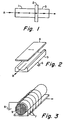
- Fig. 1 is a schematic representation of the material flow through a delivery means, through a forming member, and through a radio frequency means.
- Fig. 2 is a view of a radio frequency heating means comprising a planar and a concave electrode.
- Fig. 3 is a view of a honeycomb structure within a coil-type electrode of a radio frequency heating means.
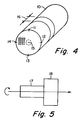
- Fig. 4 is a perspective view of a formed honeycomb structure demonstrating the approximate location of temperature measurements as taken with a probe plunged from the proximal end of the structure during experiments described below.
- Fig. 5 is a schematic representation of material flow through a delivery means and through a forming member combined with an integral radio frequency heating means.
- a radio frequency generating means is placed at the exit of the forming member of an extrusion apparatus.
- Plastically deformable material is placed in the extrusion apparatus and processed according to typical extrusion processing methods.
- the inventive aspect here is that as the plastically deformable material, comprising polar molecules and a polymeric agent having a thermal gel point, is contained in or exits the forming member, radio frequency energy or radiation is applied to it.
- the radio frequency energy is applied to the extrudate either within the forming member or upon its exiting the forming member, the extrudate is stiffened.
- Radio frequency energy or radiation in the manner described causes stiffening of the extrudate to the point that it becomes firmly self supporting and is therefore not easily deformed as is an extrudate when formed without the benefit of the application of the radio frequency energy to the material as it is formed.
- the plastically deformable material which is usually pseudoplastic or thixotropic, is formed by a forming member and radio frequency energy is applied to it upon its formation either while the material is within the forming member or upon the material's exiting the forming member, as represented schematically in Fig. 1.
- a radio frequency energy source (3) immediately on the exit side of the forming member (2) of a forming system so that material moves in direction (A) through a feed means (1), such as an extruder, into a forming member (2), such as an extrusion die, and exits immediately into a radio frequency energy source (3) in which source (3) the stiffening of the formed material begins immediately after forming.
- radio frequency energy is impinged upon it as it exits the forming member of the extrusion system.
- Substantial stiffening is attained in this manner and the fresh extrudate, after having traversed the space wherein the radio frequency energy is applied, becomes firmly self supporting and much less subject to handling damage and may therefore be treated in a much less delicate fashion.
- plastically deformable material comprising water, a polymeric thickener having a thermal gel point, and cordierite-forming particulate material.
- plastically deformable material upon final sintering, forms a cordierite material which is particularly suitable for use as a catalyst substrate.
- processing the plastically deformable material its components are mixed to form a pseudoplastic material which can be deformed by application of shear stress. Said material is then processed by typical extrusion processing means, such as is described in U.S. Patent 3,790,654, which is incorporated herein by reference, and is eventually forced through a forming member which forms the material into a "honeycomb" type structure.
- the honeycomb is defined by intersecting walls surrounding open, elongated cells extending longitudinally through the formed body.
- the present invention is particularly suited to the process of extruding honeycomb type ceramic products.
- the as-extruded honeycomb body has a generally low wet strength, particularly when extremely thin, for example, less than about 0.008 inch (about 0.20 mm), internal walls are formed, and is not generally firmly self supporting. This latter characteristic makes it subject to damage through deformation of the extruded body.
- Such deformation of the extruded wet honeycomb structure is particularly likely when the walls of the honeycomb structure are very thin, generally 0.008 inch (0.20 mm) or less, and particularly when less than 0.005 inch (about 0.13 mm) thick.
- the advantages of the present invention which serves to uniformly stiffen a plastically deformable batch upon its formation into a desired shape, include: (1) reduction of sagging or handling deformation through lack of adequate wet green strength, (2) reduction of surface defects which, by past practices, appear to be generally caused by nonuniform drying through the application of heat, and (3) the ability to produce bodies, particularly honeycomb type structures, with much thinner walls which become self supporting through the immediate stiffening step provided by the inventive method.
- the inventive method was tested on extruded cordierite-forming material formed into the previously described honeycomb type structure.
- the plastically deformable material contained the following materials:
- the above described plastically deformable material was extruded into a honeycomb structure with a transverse cross section of substantially an oval with major and minor axes of about 6.25 inches (15.9 cm) and 3.5 inches (8.9 cm) respectively, and having 400 cells per square inch (about 62 per cm2) and approximately 0.0055 inch (0.14 mm) thick walls defining the cells.
- the plastically deformable material was extruded, in the form described, from the exit face of a die, into a space in which radio frequency energy was being generated by an 8 KW dielectric dryer.
- the particular dryer being used was supplied by Thermex Thermatron and was a model CP-30. Radio frequency energy was applied as the plastically deformable material exited the extrusion die and passed through the space between the electrodes connected with the RF dryer.
- the electrodes were either:
- Exposure times to the radio frequency energy varied with the extrusion rate and were approximately 45 to 118 seconds for the planar/air bearing electrode system, with the 20 inch (51 cm) electrodes, or were somewhere between about 14 and 40 seconds for the coil electrode system, with an overall length of about 7.25 inch (about 18.4 cm). It is apparent, particularly from the temperature measurements and penetration data in the table, that the application of radio frequency energy indeed enhanced stiffening of the extruded body as desired. It is further apparent that the coil electrode system provided more consistent stiffening than did the planar system in this particular instance.
- Exposure times to the RF energy varied from about 80 to 96 seconds for the 400 pound (182 kg.) per hour extrusion and from about 53 to about 64 seconds for the 600 pound (273 kg.) per hour extrusion rate.
- the data gathered from this set of experiments is presented in the table below:
- a further set of experiments were conducted using a 20 KW RF generator provided by Thermex Thermatron Corporation.
- a racetrack shaped honeycomb with transverse cross-sectional axes of about 3.5 inches X 7.4 inches (8.9 cm X 18.8 cm) having 300 cells per square inch (about 46 per cm2) with 0.006 inch (0.015 mm) thick internal walls was formed.
- sodium stearate levels were reduced to 0.75% of the weight of the dry inorganic materials and the type of methyl cellulose was altered.
- the forming member can be combined with the radio frequency source such that the stiffening process may be initiated as the material is just being formed.
- This concept is schematically presented in Fig. 5 in which the material moves in direction (C) through a delivery means (17), such as an extruder, and through a combined forming member and radio frequency application means (18), such as, for example, an extrusion die assembly containing an RF coil electrode surrounding that portion of the die containing the outlet slots, wherein stiffening of the material is initiated just as it is being formed.
Landscapes
- Engineering & Computer Science (AREA)
- Chemical & Material Sciences (AREA)
- Ceramic Engineering (AREA)
- Structural Engineering (AREA)
- Manufacturing & Machinery (AREA)
- Organic Chemistry (AREA)
- Materials Engineering (AREA)
- Inorganic Chemistry (AREA)
- Life Sciences & Earth Sciences (AREA)
- Microbiology (AREA)
- Mechanical Engineering (AREA)
- Biomedical Technology (AREA)
- General Engineering & Computer Science (AREA)
- Molecular Biology (AREA)
- Dispersion Chemistry (AREA)
- Biotechnology (AREA)
- Physics & Mathematics (AREA)
- Health & Medical Sciences (AREA)
- Electromagnetism (AREA)
- Press-Shaping Or Shaping Using Conveyers (AREA)
- Devices For Post-Treatments, Processing, Supply, Discharge, And Other Processes (AREA)
- Catalysts (AREA)
Claims (10)
- Procédé de consolidation d'un matériau plastiquement déformable qui vient d'être façonné ou est façonné en un corps profilé comprenant une exposition dudit matériau contenant une matière formant le corps, des molécules polaires et un agent polymère ayant un point de gélification thermique, à rayonnement électromagnétique situé dans la gamme de fréquence de 10⁷ à 10¹³ Hertz alors qu'il est contenu dans ou qu'il sort d'un élément de façonnage sous la forme d'un corps.
- Procédé selon la revendication 1, dans lequel lesdites molécules polaires sont de l'eau.
- Procédé selon la revendication 1 ou 2, dans lequel ledit agent polymère ayant un point de gélification thermique est un polysaccharide.
- Procédé selon la revendication 3, dans lequel ledit polysaccharide est un éther cellulosique.
- Procédé selon la revendication 4, dans lequel ledit éther cellulosique est une méthylcellulose.
- Procédé selon la revendication 1, 2, 3, 4 ou 5, dans lequel le matériau formant le corps est une matière frittable en particules.
- Procédé selon la revendication 1, 2, 3, 4 ou 5, dans lequel le matériau formant le corps est une céramique ou un matériau formant une céramique.
- Procédé selon l'une quelconque des revendications 1 à 7, dans lequel ledit matériau plastiquement déformable est mis en forme dans une structure en type de nid d'abeilles par ledit élément de façonnage.
- Procédé selon la revendication 8, dans lequel ladite structure en nid d'abeilles est constituée de parois internes sécantes ayant une épaisseur inférieure à 0,2 mm (0,08") et qui définissent les cellules de ladite structure.
- Procédé selon l'une quelconque des revendications 1 à 9, dans lequel le matériau est exposé au rayonnement électromagnétique pendant une durée suffisante pour provoquer la sortie du matériau de l'élément de façonnage avec une forme rigidement autoportante.
Applications Claiming Priority (2)
| Application Number | Priority Date | Filing Date | Title |
|---|---|---|---|
| US60410790A | 1990-10-29 | 1990-10-29 | |
| US604107 | 1990-10-29 |
Publications (2)
| Publication Number | Publication Date |
|---|---|
| EP0483468A1 EP0483468A1 (fr) | 1992-05-06 |
| EP0483468B1 true EP0483468B1 (fr) | 1994-07-27 |
Family
ID=24418206
Family Applications (1)
| Application Number | Title | Priority Date | Filing Date |
|---|---|---|---|
| EP91113538A Expired - Lifetime EP0483468B1 (fr) | 1990-10-29 | 1991-08-13 | Consolidation de produits d'extrusion par énergie d'ondes radio |
Country Status (3)
| Country | Link |
|---|---|
| EP (1) | EP0483468B1 (fr) |
| JP (1) | JPH04272806A (fr) |
| DE (1) | DE69103121T2 (fr) |
Families Citing this family (1)
| Publication number | Priority date | Publication date | Assignee | Title |
|---|---|---|---|---|
| EP1212575B1 (fr) * | 1999-07-07 | 2006-08-09 | Corning Incorporated | Appareil et procédé de séchage de céramique par micro-ondes, en continu |
Family Cites Families (2)
| Publication number | Priority date | Publication date | Assignee | Title |
|---|---|---|---|---|
| GB2137552B (en) * | 1983-04-08 | 1987-04-23 | Asahi Chemical Ind | Reducing residual strain in extruded and rolled ceramic plates |
| JPH064502B2 (ja) * | 1988-12-23 | 1994-01-19 | 日本碍子株式会社 | セラミックスの製造方法 |
-
1991
- 1991-08-13 EP EP91113538A patent/EP0483468B1/fr not_active Expired - Lifetime
- 1991-08-13 DE DE69103121T patent/DE69103121T2/de not_active Expired - Fee Related
- 1991-10-21 JP JP27222491A patent/JPH04272806A/ja not_active Withdrawn
Non-Patent Citations (1)
| Title |
|---|
| Ltd., London, GB; AN 84-167885 & JP-A-59 091 111 (MATSUSHIKA ELEC WORKS) 25 May 1984 * |
Also Published As
| Publication number | Publication date |
|---|---|
| JPH04272806A (ja) | 1992-09-29 |
| DE69103121T2 (de) | 1995-04-06 |
| DE69103121D1 (de) | 1994-09-01 |
| EP0483468A1 (fr) | 1992-05-06 |
Similar Documents
| Publication | Publication Date | Title |
|---|---|---|
| US5223188A (en) | Stiffening of extrudates with RF energy | |
| DE10201300B4 (de) | System zum Trocknen eines Wabenkörpers | |
| EP1835249A1 (fr) | Appareil de séchage, procédé de séchage d'élément moulé en céramique et procédé de fabrication d'un élément structuré en nid d'abeille | |
| US3379543A (en) | Composition and method for making ceramic articles | |
| JP4069613B2 (ja) | セラミックハニカム構造体の製造方法及び乾燥装置 | |
| US5388345A (en) | Dielectric drying of metal structures | |
| US5296510A (en) | Method for treating the surface of a thin porous film material of tetrafluoroethylene resin | |
| DE69604867T2 (de) | Verfahren zum Verschliessen der Endfläche einer keramischen Wabenstruktur | |
| DE1629283A1 (de) | Verfahren zur Bildung eines geformten Schaumartikels | |
| CN101422963A (zh) | 一种三维工件的制造方法与设备 | |
| EP0483468B1 (fr) | Consolidation de produits d'extrusion par énergie d'ondes radio | |
| JP4131103B2 (ja) | ハニカム成形体の製造方法及び乾燥装置 | |
| US20060159795A1 (en) | Microwave stiffening system for ceramic extrudates | |
| EP0507286B1 (fr) | Procédé de moulage pour préparer des articles poreux à base de polytétrafluoréthylène | |
| AU716316B2 (en) | Method of drying a porous body | |
| JPH04342983A (ja) | 可塑的に変形可能な材料の誘導加熱方法 | |
| DE69802985T2 (de) | Verfahren zum Trocknen keramischer Formkörper | |
| EP0842025B1 (fr) | Procede et dispositif de fabrication d'objets en ceramique extrudee et frittee | |
| JPH01294003A (ja) | 竹板の製造方法および製造装置 | |
| US20150004354A1 (en) | Method for manufacturing aluminum-titanate-based ceramic honeycomb structure | |
| JPH02147202A (ja) | 非可塑性材料の成形方法 | |
| US6932993B2 (en) | Method for producing filled foodstuff hollow bodies | |
| DE1936411C3 (de) | Verfahren zur Herstellung poröser Formkörper aus Polytetrafluorethylen | |
| CN114983507B (zh) | 一种蚕丝复合止血气囊的加工工艺方法 | |
| JPH03193671A (ja) | セラミックス製品の製造方法 |
Legal Events
| Date | Code | Title | Description |
|---|---|---|---|
| PUAI | Public reference made under article 153(3) epc to a published international application that has entered the european phase |
Free format text: ORIGINAL CODE: 0009012 |
|
| AK | Designated contracting states |
Kind code of ref document: A1 Designated state(s): BE DE |
|
| 17P | Request for examination filed |
Effective date: 19921006 |
|
| 17Q | First examination report despatched |
Effective date: 19930921 |
|
| GRAA | (expected) grant |
Free format text: ORIGINAL CODE: 0009210 |
|
| AK | Designated contracting states |
Kind code of ref document: B1 Designated state(s): BE DE |
|
| REF | Corresponds to: |
Ref document number: 69103121 Country of ref document: DE Date of ref document: 19940901 |
|
| PLBE | No opposition filed within time limit |
Free format text: ORIGINAL CODE: 0009261 |
|
| STAA | Information on the status of an ep patent application or granted ep patent |
Free format text: STATUS: NO OPPOSITION FILED WITHIN TIME LIMIT |
|
| 26N | No opposition filed | ||
| PGFP | Annual fee paid to national office [announced via postgrant information from national office to epo] |
Ref country code: DE Payment date: 20020830 Year of fee payment: 12 |
|
| PG25 | Lapsed in a contracting state [announced via postgrant information from national office to epo] |
Ref country code: DE Free format text: LAPSE BECAUSE OF NON-PAYMENT OF DUE FEES Effective date: 20040302 |
|
| PGFP | Annual fee paid to national office [announced via postgrant information from national office to epo] |
Ref country code: BE Payment date: 20080922 Year of fee payment: 18 |
|
| BERE | Be: lapsed |
Owner name: *CORNING INC. Effective date: 20090831 |
|
| PG25 | Lapsed in a contracting state [announced via postgrant information from national office to epo] |
Ref country code: BE Free format text: LAPSE BECAUSE OF NON-PAYMENT OF DUE FEES Effective date: 20090831 |