EP0483579A2 - Nanometer Bereichssonde für ein auf atomaren Kräften beruhendes Mikroskop, und Verfahren zu dessen Herstellung - Google Patents
Nanometer Bereichssonde für ein auf atomaren Kräften beruhendes Mikroskop, und Verfahren zu dessen Herstellung Download PDFInfo
- Publication number
- EP0483579A2 EP0483579A2 EP91117499A EP91117499A EP0483579A2 EP 0483579 A2 EP0483579 A2 EP 0483579A2 EP 91117499 A EP91117499 A EP 91117499A EP 91117499 A EP91117499 A EP 91117499A EP 0483579 A2 EP0483579 A2 EP 0483579A2
- Authority
- EP
- European Patent Office
- Prior art keywords
- needle
- probe
- substrate
- recited
- magnetic
- Prior art date
- Legal status (The legal status is an assumption and is not a legal conclusion. Google has not performed a legal analysis and makes no representation as to the accuracy of the status listed.)
- Granted
Links
Images


Classifications
-
- G—PHYSICS
- G01—MEASURING; TESTING
- G01Q—SCANNING-PROBE TECHNIQUES OR APPARATUS; APPLICATIONS OF SCANNING-PROBE TECHNIQUES, e.g. SCANNING PROBE MICROSCOPY [SPM]
- G01Q70/00—General aspects of SPM probes, their manufacture or their related instrumentation, insofar as they are not specially adapted to a single SPM technique covered by group G01Q60/00
- G01Q70/08—Probe characteristics
- G01Q70/10—Shape or taper
- G01Q70/12—Nanotube tips
-
- G—PHYSICS
- G01—MEASURING; TESTING
- G01Q—SCANNING-PROBE TECHNIQUES OR APPARATUS; APPLICATIONS OF SCANNING-PROBE TECHNIQUES, e.g. SCANNING PROBE MICROSCOPY [SPM]
- G01Q60/00—Particular types of SPM [Scanning Probe Microscopy] or microscopes; Essential components thereof
- G01Q60/50—MFM [Magnetic Force Microscopy] or apparatus therefor, e.g. MFM probes
- G01Q60/54—Probes, their manufacture, or their related instrumentation, e.g. holders
-
- G—PHYSICS
- G01—MEASURING; TESTING
- G01R—MEASURING ELECTRIC VARIABLES; MEASURING MAGNETIC VARIABLES
- G01R1/00—Details of instruments or arrangements of the types included in groups G01R5/00 - G01R13/00 and G01R31/00
- G01R1/02—General constructional details
- G01R1/06—Measuring leads; Measuring probes
- G01R1/067—Measuring probes
- G01R1/07—Non contact-making probes
Definitions
- This invention relates to atomic force microscopy, and more particularly, to a nanometer scale probe for use with an atomic force microscope.
- Scanned probe microscopy saw its commencement at the atomic level with the invention by Binnig et al. of the scanning tunnelling microscope in the mid-1980's.
- STM scanning tunnelling microscope
- a tiny tungsten probe is maneuvered to within a nanometer above the surface of a conducting specimen, sufficiently close so that there is an overlap between the electron clouds of the atom at the probe tip and of the nearest atom of the specimen.
- When a small voltage is applied to the tip electrons "tunnel” across the gap generating a small tunnelling current. The strength of that current is very sensitive to the width of the gap.
- Piezoelectric controls are used to control the motion of the probe and move it back and forth across the specimen while maintaining a constant gap between its tip and the specimen surface. The variations in voltage applied to maintain the probe properly positioned over the surface are electronically translated into an image of the surface topography.
- the invention of STM has led to the development of a family of new scanned-probe microscopes, one of which is the atomic force microscope (AFM) which negates the need for a conducting specimen.
- the AFM relied upon the repulsive forces generated by the overlap of the electron cloud at the tip's surface with electron clouds of surface atoms within the specimen.
- the tip is mounted on a flexible beam which maintains the tip pressed against the specimen surface with constant force as it is moved across the surface.
- AFM that is based on the detection of an attractive force between a surface and a probe by its effect on the dynamics of a vibrating probe/beam arrangement.
- a tapered tungsten wire is driven by a piezoelectric transducer mounted at its base to vibrate at close to the wire's resonant frequency.
- amplitude changes occur in the vibration as a result of the attractive forces.
- the changes in the vibration amplitude are sensed by an interferometric laser arrangement.
- FIG. 1 A block diagram of an AFM using interferometric laser detection is shown in Fig. 1, with a probe arrangement 10 being emplaced over the surface of specimen 12. Changes in oscillation amplitude of probe arrangement 10 are sensed by a laser heterodyne interferometer 14 that provides an output signal to a feedback generator 16. As an output signal changes with respect to an applied reference signal, feedback generator 16 provides position control signals to a piezoelectric position control unit 18. Those control signals cause a piezoelectric unit within position control element 18 to move the specimen so that the vibration amplitude is stabilized and, hence the the force gradient. The fluctuations in the feedback potential are converted into a profile of the surface being investigated.
- AFM electrostatic-force microscope
- the vibrating probe bears an electric charge and its vibration amplitude is effected by electrostatic forces resulting from charges in the sample.
- AFM Magnetic-force microscope
- MFM magnetic-force microscope
- a magnetized nickel or iron probe is substituted for the tungsten or silicon needles used with other AFM's.
- the tip feels a magnetic force that changes its resonance frequency and hence its vibration amplitude.
- the MFM traces magnetic-field patterns emanating from the specimen.
- the magnetic force components sensed by an MFM probe result from the interaction of the total magnetic dipole moments at the tip of the probe and the specimen. They are further dependent upon the influence of tip-related magnetic fields on the local magnetic moments of the specimen.
- the lateral resolution of the probe depends critically on the interaction volume constituted by the sample and the tip. For planar magnetic media, this interaction volume is determined primarily by geometric and magnetic properties of the probe tip. Thus, in order to obtain lateral resolutions below 100,0 nm, current tip sizes in the range of 100,0 nm are too large.
- magnetic sensor probe tips are fabricated by an electrochemical etching technique using a ferromagnetic wire material (such as nickel, iron, or cobalt). Essentially the method comprises etching the tip of the wire until it approximates a point. This method does not provide control over the geometric shape of the tip below a 100,0 nm radius. Such probe tips, further, have an unnecessarily large amount of magnetic material with a complicated domain structure. In essence, subtractive processes for creating MFM and other AFM probe tips, do not today, provide the desired atomic-level resolution capability.
- a ferromagnetic wire material such as nickel, iron, or cobalt
- a film is deposited on a semiconductor substrate by passing a gas containing an element over the substrate and then irradiating a determined portion thereof with an electron beam. The gas decomposes and the element is precipitated onto the substrate so as to form a desired pattern. Chromium, molybdenum, aluminum, and tungsten containing organometallics are disclosed. In Japanese Patent 87-295,886/42 the use of organometallic compounds is described for producing a film of VIII metals on a substrate. Electron beams have also been used to enable surface analysis of substrates (e.g., see Kuptsis, IBM Technical Disclosure Bulletin, Vol. 13, No. 9, February 1971, pp. 2497-2498).
- a probe tip for a scanned probe microscope is configured as a needle extending from a surface, the needle further comprising a carbonized matrix of a decomposed organic reactant.
- the needle exhibits a substantial stiffness along its elongated dimension and has a nanometer scale tip dimension.
- a method is described for producing such a needle probe tip wherein a substrate is positioned in an evacuated environment; a volatile organic compound is introduced into the environment and an energy beam, for example a laser beam, an electron beam and an x-ray beam from a synchrotron and the like, is directed at the substrate's surface, which energy beam is maintained stably focussed thereon for a preset time period.
- the beam causes a selective decomposition of the organic compound at the focal point on the substrate surface and causes succeeding layers of decomposition product of the organic compound to grow directly up the beam, to thus produce a substantially rigid nanometer-scale needle-like form.
- a magnetic layer is then deposited on the top of the structure, such layer having a dimension which restricts the tip to exhibit a single magnetic domain.
- FIG. 2 the structure of an AFM nanometer scale needle probe will be described, including the process for producing such a probe.
- a substrate 20 is placed in an evacuated chamber within an electron beam unit.
- substrate 20 is a silicon cone.
- a volatile, organometallic compound gas stream is then introduced into the subchamber 64, while at the same time, an electron beam 22 is turned on. Beam 22 impinges upon an upper surface 24 of substrate 20 and causes decomposition and preferential deposition of the decomposed products of the organometallic gas onto surface 24. Such deposition occurs within the region irradiated by electron beam 22 and also out therefrom by a radial distance determined by electron scatter from surface 24. If it is assumed that electron beam 22 has a diameter of 6 nanometers, the diameter of the initial deposit is approximately 100 nanometers. As the process continues, additional layers of deposited, decomposed components of the organometallic gas continue to build up, thereby creating a needle-like shape 26.
- a conical tip shape for needle 26 and its shank diameter are achieved by control of the primary beam voltage and also the beam's gaussian profile.
- the needle diameter and the respective cone apex angle decrease with increasing beam voltage ( ⁇ 10% for a 10 kV increase).
- Such a needle shape is shown in Fig. 3(a).
- the apparent diameter of pointed end 28 of needle 26 can be made approximately 10 nanometers.
- the process employed to deposit needle probe 26 onto a substrate is an electron beam chemical vapor deposition (CVD) process.
- CVD electron beam chemical vapor deposition
- Such processes, per se, are known in the prior art, e.g., see Japanese Patent 87-295,886/42. Nevertheless, to Applicants' knowledge, such processes have not heretofore been employed to produce nanometer scale, needle-like structures having a high aspect ratio.
- the E-beam CVD process produces a needle probe which exhibits substantial stiffness along its elongated dimension. It is believed that this rigidity results from the CVD process producing a needle with a carbon matrix structure in which metal particles are dispersed. In other words, the included carbon toughens the structure and makes it usable as an AFM probe. Without such structural stiffness, needle probe 26 would be useless as an AFM probe.
- metal carbonyls or metal alkyls can be employed as organometallic source compounds for the CVD process, it is preferred that metallocenes be employed due to the non-thermal, decomposition process occuring under e-beam irradiation.
- metallocenes be employed due to the non-thermal, decomposition process occuring under e-beam irradiation.
- cobaltocene, nickelocene, and/or ferrocene are preferred.
- a needle structure such as shown in Fig. 3(a) is grown and exhibits intrinsic, but weak, magnetic capabilities.
- Such needle structure comprises a carbon matrix with nickel, cobalt or iron particles, as the case may be, dispersed therein.
- a seeding step followed by a plate-up of a magnetic material.
- a seeding material e.g., allycyclopentadienylpalladium
- a seeding material is used to grow needle 26 (see Fig. 3(b)). This results in a non-magnetic needle structure having palladium seed particles interspersed.
- the entire surface of needle 26 is then covered, in a subsequent electroless plating process, by a magnetic metal layer 30.
- the needle 26 is grown without an included metal component. Then a seeding material 32 is deposited only on the apex of needle 26. This is accomplished by introduction of a gaseous metallorganic containing the seed metal, followed by electron beam exposure of the tip area. A subsequent plating (e.g. selective CVD in a gaseous or liquid environment) of a magnetic metal 30 will therefore be confined to the seeded area at the apex and will yield a single domain magnetic sensor region for needle probe 26.
- a seeding material 32 is deposited only on the apex of needle 26. This is accomplished by introduction of a gaseous metallorganic containing the seed metal, followed by electron beam exposure of the tip area.
- a subsequent plating (e.g. selective CVD in a gaseous or liquid environment) of a magnetic metal 30 will therefore be confined to the seeded area at the apex and will yield a single domain magnetic sensor region for needle probe 26.
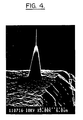
- Fig. 4 a perspective view taken from an SEM photograph is shown wherein a 3 micron long needle probe with a 100 nanometer shank diameter was produced using the method of this invention.
- the substrate is a silicon pedestal produced via selective etching.
- Silicon probe tips such as tip 20 shown in Fig. 2 or the one shown in Fig. 4, are produced by microfabrication techniques that are known in the art. For instance, see Albrecht et al., "Microfabrication of Cantilever Styli for the Atomic Force Microscope", Journal of Vacuum Science Technology, A8(4), July/August 1990, pp. 3386-3396. In that reference and in the references cited therein, techniques are described for selective etching of silicon substrates to enable the creation of an AFM cantilever with an integral pointed silicon probe tip. The procedures used to provide such integral cantilever/probe structures employ selective etching and mask undercutting to enable production of the probe tips. The Albrecht et al. article also describes methods for fabricating thin film SiO2 and Si3N4 microcantilevers having integral probe tips. Such procedures do not form a part of this invention, although they do provide the methods and procedures whereby an appropriate support surface for the needle probe of this invention can be produced.
- a direct E-beam deposition system comprises a modified scanning electron microscope.
- the column portion of the microscope includes a filament 40 which is preferably a lanthanum boride electron source.
- a movable anode structure 42 is provided to enable the beam brightness to be optimized.
- the beam passes through a pair of condenser lenses 44, 46, double deflection coils 48 and a final lens 50. From there, the beam enters a lower chamber 52, passes through a backscatter electron detector 54 and then passes into and through a retractable shutter arrangement 56.
- a linear drive mechanism 59 controls the position of the retractable shutter.
- the shutter is closed and the beam passes through a pin hole therein (not shown).
- a pin hole therein not shown.
- Substrate 58 is positioned in subchamber 64 and on a Peltier effect heater/cooler 60 which maintains constant its temperature.
- a vapor source 62 provides a vapor of an organometallic containing gas into subchamber 64.
- a capacitance manometer 66 maintains the pressure within subchamber 64 within desired limits.
- Various detection systems are included, including a secondary electron detector 66 and a STEM detector 68.
- the position of substrate 58 is controlled by an XYZ stage 70 and controls that enable the discrete positioning of stage 70 (not shown).
- the deposition system is interfaced to a pattern generating unit 72 which is controlled by a personal computer 74 to vector position the electron beam onto the substrate.
- Electron beam on-time is controlled by an electrostatic blanking unit 76.
- the exposure time per pixel ranges from 1 microsecond to greater than 100 seconds. For a 50X50 micron field, a beam step size of approximately 5 nanometers can be obtained with 14 bit digital to analog conversion.
- Such control is exerted by field size control unit 78 through scan control amplifiers 80.
- a source gas is introduced from vapor source 62 through a metering needle valve 63 into subchamber 64 within lower chamber 52.
- Subchamber 64 is differentially pumped to an operating pressure range of 10-100 m Torr.
- Such pressures are compatible with the available beam current densities, and enable optimum growth in the E-beams CVD process.
- Typical pressure in SEM chamber 52 is approximately 10 ⁇ 4 Torr and the pressure in the gun area which encompasses source 40 is approximately 10 ⁇ 7 Torr.
- a weak magnetic probe needle comprised of nickel embedded in a carbon matrix, having a shank diameter of approximately 100 nanometers and length of two microns was deposited on a silicon substrate.
- the organometallic gas used for this example was a nickelocene complex at a vapor pressure of 5 mTorr in subchamber 64.
- the substrate temperature was 20 o C
- the beam voltage was 30 kV
- the beam size diameter was approximately 6 nanometers.
- the exposure time was between 5 and 10 minutes.
- a strong magnetic needle sensor was produced under the following experimental conditions: A needle was first grown under same beam conditions and temperature as described above, using allycyclopentadienylpalladium complex as the vapor source material. Subsequently, the needle surface was plated in an electroless NiSO4 solution at 65 o C yielding ⁇ 10nm nickel coverage in 5 seconds.
- the above-described E-beam deposition process when applied to the deposition of a three-dimensional needle-like structure, has the unique characteristic of enabling monolayer film thickness control, high resolution, and the production of a high aspect ratio structure (i.e., more than 31). For most applications, it will probably be advantageous to produce an elongated magnetic tip shape, which would guarantee that the tip be magnetized along its long axis. Given the nanometer scale tip dimension, a single domain probe tip is achieved, enabling imaging of magnetic structures in the sample surface with atomic level resolution.
Landscapes
- Physics & Mathematics (AREA)
- General Physics & Mathematics (AREA)
- Health & Medical Sciences (AREA)
- General Health & Medical Sciences (AREA)
- Nuclear Medicine, Radiotherapy & Molecular Imaging (AREA)
- Radiology & Medical Imaging (AREA)
- Chemical & Material Sciences (AREA)
- Engineering & Computer Science (AREA)
- Nanotechnology (AREA)
- Measurement Of Length, Angles, Or The Like Using Electric Or Magnetic Means (AREA)
- Length Measuring Devices With Unspecified Measuring Means (AREA)
- Measuring Magnetic Variables (AREA)
Applications Claiming Priority (2)
| Application Number | Priority Date | Filing Date | Title |
|---|---|---|---|
| US60804390A | 1990-10-31 | 1990-10-31 | |
| US608043 | 1990-10-31 |
Publications (3)
| Publication Number | Publication Date |
|---|---|
| EP0483579A2 true EP0483579A2 (de) | 1992-05-06 |
| EP0483579A3 EP0483579A3 (de) | 1992-12-30 |
| EP0483579B1 EP0483579B1 (de) | 1995-12-27 |
Family
ID=24434783
Family Applications (1)
| Application Number | Title | Priority Date | Filing Date |
|---|---|---|---|
| EP91117499A Expired - Lifetime EP0483579B1 (de) | 1990-10-31 | 1991-10-14 | Nanometer Bereichssonde für ein auf atomaren Kräften beruhendes Mikroskop, und Verfahren zu dessen Herstellung |
Country Status (3)
| Country | Link |
|---|---|
| EP (1) | EP0483579B1 (de) |
| JP (1) | JPH081382B2 (de) |
| DE (1) | DE69115847T2 (de) |
Cited By (15)
| Publication number | Priority date | Publication date | Assignee | Title |
|---|---|---|---|---|
| DE4239532C1 (de) * | 1992-11-25 | 1994-02-10 | Kernforschungsz Karlsruhe | Verwendung von Mikro-Carbonfasern |
| EP0608655A1 (de) * | 1992-12-31 | 1994-08-03 | International Business Machines Corporation | In Sondenspitze integrierte Dehnungssensor für einachsiges Atomkraftmikroskop |
| EP0622608A1 (de) * | 1993-04-30 | 1994-11-02 | INSTITUT FÜR MIKROTECHNIK MAINZ GmbH | Abtastvorrichtung zur Untersuchung von Oberflächenstrukturen mit Auflösung im submicron-Bereich und Verfahren zu deren Herstellung |
| WO1996037788A1 (de) * | 1995-05-27 | 1996-11-28 | Forschungszentrum Jülich GmbH | Herstellungsverfahren für sonde mit beschichteter spitze |
| WO1998005920A1 (en) * | 1996-08-08 | 1998-02-12 | William Marsh Rice University | Macroscopically manipulable nanoscale devices made from nanotube assemblies |
| DE19718478A1 (de) * | 1997-04-30 | 1998-11-05 | Allice Mestechnik Gmbh | Prüfspitze für Hochimpedanzsonden mit extrem kleiner Eingangskapazität |
| EP0839383A4 (de) * | 1995-04-30 | 2000-03-01 | Aaron Lewis | Kegelförmige struktur für mikrothermoelement-mikroelektroden,feldemissionsspitzen und zur kraftmessung geeigneter,mikromagnetischer fühler |
| WO2006002153A1 (en) * | 2004-06-21 | 2006-01-05 | Veeco Instruments, Inc. | Probes for use in scanning probe microscopes and methods of fabricating such probes |
| EP1642300A2 (de) * | 2003-07-08 | 2006-04-05 | Qunamo AB | Sondenstrukturen mit nanoschnurrhaaren, herstellungsverfahren dafür und verfahren zur bildung von nanoschnurrhaaren |
| EP1557843A3 (de) * | 2004-01-22 | 2006-07-05 | FEI Company | Direktes Aufwachsen von Nanoröhrchen auf einem Katalysator |
| WO2007079975A1 (de) * | 2005-12-30 | 2007-07-19 | Universität Hamburg | Mikro- und nanospitzen sowie verfahren zu deren herstellung |
| EP1830367A3 (de) * | 2006-03-03 | 2008-02-13 | Olympus Corporation | Kohlenstoffnanorohrsonde |
| DE102006008858B4 (de) * | 2006-02-25 | 2016-10-20 | Nanotools Gmbh | Sondeneinrichtung |
| CN106597035A (zh) * | 2016-11-18 | 2017-04-26 | 武汉新芯集成电路制造有限公司 | 一种纳米探针及纳米探针测试仪 |
| CN112723306A (zh) * | 2020-12-17 | 2021-04-30 | 武汉光谷航天三江激光产业技术研究院有限公司 | 用于碱金属直充的原子气室制作一体化键合装置及方法 |
Families Citing this family (9)
| Publication number | Priority date | Publication date | Assignee | Title |
|---|---|---|---|---|
| WO2000003252A2 (en) * | 1998-07-08 | 2000-01-20 | Capres Aps | Multi-point probe |
| DE69931778T2 (de) * | 1999-09-15 | 2007-06-14 | Capres A/S | Mehrpunktesonde |
| JP4858924B2 (ja) * | 2001-12-04 | 2012-01-18 | エスアイアイ・ナノテクノロジー株式会社 | 走査型プローブ顕微鏡用探針の作成方法 |
| JP4688400B2 (ja) * | 2001-12-04 | 2011-05-25 | エスアイアイ・ナノテクノロジー株式会社 | 走査型プローブ顕微鏡用探針 |
| CN1829654B (zh) | 2003-04-04 | 2013-04-17 | 库纳诺公司 | 精确定位的纳米晶须和纳米晶须阵列及其制备方法 |
| DE10342644A1 (de) * | 2003-09-16 | 2005-04-07 | Nanotools Gesellschaft für Spezialanwendungen in der Rastersondenmikroskopie mbH | Sondeneinrichtung für die Rastersondentechnologie sowie Verfahren zu deren Herstellung |
| EP1744143A1 (de) | 2004-04-23 | 2007-01-17 | Japan Science and Technology Agency | Rastersondenmikroskopsonde und herstellungsverfahren dafür sowie rastersondenmikroskop und anwendungsverfahren dafür sowie nadelähnliches element und herstellungsverfahren dafür sowie elektronenelement und herstellungsverfahren dafür sowie ladungsdichtewellenquantum-phasenmikroskop und ladungsdichtewellenquantum-interferometer |
| JP2005308652A (ja) * | 2004-04-23 | 2005-11-04 | Japan Science & Technology Agency | プローブ顕微鏡探針及びその製造方法並びにプローブ顕微鏡並びに針状体及びその製造方法並びに電子素子及びその製造方法 |
| JP2006125984A (ja) | 2004-10-28 | 2006-05-18 | Japan Science & Technology Agency | デイジー型カンチレバーホイールを有する計測装置 |
Family Cites Families (2)
| Publication number | Priority date | Publication date | Assignee | Title |
|---|---|---|---|---|
| US4605566A (en) * | 1983-08-22 | 1986-08-12 | Nec Corporation | Method for forming thin films by absorption |
| DE69127379T2 (de) * | 1990-01-11 | 1998-03-19 | Canon K.K., Tokio/Tokyo | Mikrosonde, Herstellungsverfahren zur Herstellung derselben und Informations-Eingabe- und/oder Ausgabe-Gerät welches dieselbe verwendet |
-
1991
- 1991-08-27 JP JP3238905A patent/JPH081382B2/ja not_active Expired - Fee Related
- 1991-10-14 EP EP91117499A patent/EP0483579B1/de not_active Expired - Lifetime
- 1991-10-14 DE DE69115847T patent/DE69115847T2/de not_active Expired - Fee Related
Cited By (22)
| Publication number | Priority date | Publication date | Assignee | Title |
|---|---|---|---|---|
| EP0599049A3 (en) * | 1992-11-25 | 1995-08-16 | Kernforschungsz Karlsruhe | Use of carbon microfibres. |
| DE4239532C1 (de) * | 1992-11-25 | 1994-02-10 | Kernforschungsz Karlsruhe | Verwendung von Mikro-Carbonfasern |
| EP0608655A1 (de) * | 1992-12-31 | 1994-08-03 | International Business Machines Corporation | In Sondenspitze integrierte Dehnungssensor für einachsiges Atomkraftmikroskop |
| EP0622608A1 (de) * | 1993-04-30 | 1994-11-02 | INSTITUT FÜR MIKROTECHNIK MAINZ GmbH | Abtastvorrichtung zur Untersuchung von Oberflächenstrukturen mit Auflösung im submicron-Bereich und Verfahren zu deren Herstellung |
| EP0839383A4 (de) * | 1995-04-30 | 2000-03-01 | Aaron Lewis | Kegelförmige struktur für mikrothermoelement-mikroelektroden,feldemissionsspitzen und zur kraftmessung geeigneter,mikromagnetischer fühler |
| WO1996037788A1 (de) * | 1995-05-27 | 1996-11-28 | Forschungszentrum Jülich GmbH | Herstellungsverfahren für sonde mit beschichteter spitze |
| US7357906B2 (en) | 1996-08-08 | 2008-04-15 | William Marsh Rice University | Method for fractionating single-wall carbon nanotubes |
| WO1998005920A1 (en) * | 1996-08-08 | 1998-02-12 | William Marsh Rice University | Macroscopically manipulable nanoscale devices made from nanotube assemblies |
| US7959779B2 (en) | 1996-08-08 | 2011-06-14 | William Marsh Rice University | Macroscopically manipulable nanoscale devices made from nanotube assemblies |
| DE19718478A1 (de) * | 1997-04-30 | 1998-11-05 | Allice Mestechnik Gmbh | Prüfspitze für Hochimpedanzsonden mit extrem kleiner Eingangskapazität |
| DE19718478C2 (de) * | 1997-04-30 | 2003-05-28 | Allice Mestechnik Gmbh | Hochimpedanzsonde mit extrem kleiner Eingangskapazität |
| EP1642300A2 (de) * | 2003-07-08 | 2006-04-05 | Qunamo AB | Sondenstrukturen mit nanoschnurrhaaren, herstellungsverfahren dafür und verfahren zur bildung von nanoschnurrhaaren |
| EP1557843A3 (de) * | 2004-01-22 | 2006-07-05 | FEI Company | Direktes Aufwachsen von Nanoröhrchen auf einem Katalysator |
| US7370515B2 (en) | 2004-06-21 | 2008-05-13 | Veeco Instruments Inc. | Probes for use in scanning probe microscopes and methods of fabricating such probes |
| WO2006002153A1 (en) * | 2004-06-21 | 2006-01-05 | Veeco Instruments, Inc. | Probes for use in scanning probe microscopes and methods of fabricating such probes |
| WO2007079975A1 (de) * | 2005-12-30 | 2007-07-19 | Universität Hamburg | Mikro- und nanospitzen sowie verfahren zu deren herstellung |
| DE102006008858B4 (de) * | 2006-02-25 | 2016-10-20 | Nanotools Gmbh | Sondeneinrichtung |
| EP1830367A3 (de) * | 2006-03-03 | 2008-02-13 | Olympus Corporation | Kohlenstoffnanorohrsonde |
| US7543482B2 (en) | 2006-03-03 | 2009-06-09 | Olympus Corporation | Carbon thin line probe |
| CN106597035A (zh) * | 2016-11-18 | 2017-04-26 | 武汉新芯集成电路制造有限公司 | 一种纳米探针及纳米探针测试仪 |
| CN112723306A (zh) * | 2020-12-17 | 2021-04-30 | 武汉光谷航天三江激光产业技术研究院有限公司 | 用于碱金属直充的原子气室制作一体化键合装置及方法 |
| CN112723306B (zh) * | 2020-12-17 | 2023-08-18 | 武汉光谷航天三江激光产业技术研究院有限公司 | 用于碱金属直充的原子气室制作一体化键合装置及方法 |
Also Published As
| Publication number | Publication date |
|---|---|
| EP0483579A3 (de) | 1992-12-30 |
| EP0483579B1 (de) | 1995-12-27 |
| DE69115847D1 (de) | 1996-02-08 |
| JPH04233406A (ja) | 1992-08-21 |
| DE69115847T2 (de) | 1996-07-11 |
| JPH081382B2 (ja) | 1996-01-10 |
Similar Documents
| Publication | Publication Date | Title |
|---|---|---|
| US5171992A (en) | Nanometer scale probe for an atomic force microscope, and method for making same | |
| EP0483579B1 (de) | Nanometer Bereichssonde für ein auf atomaren Kräften beruhendes Mikroskop, und Verfahren zu dessen Herstellung | |
| Utke et al. | High-resolution magnetic Co supertips grown by a focused electron beam | |
| US7735147B2 (en) | Probe system comprising an electric-field-aligned probe tip and method for fabricating the same | |
| Friedbacher et al. | Classification of scanning probe microscopies | |
| Arie et al. | Carbon-nanotube probe equipped magnetic force microscope | |
| Wiesendanger | Fabrication of nanometer structures using STM | |
| US20100229265A1 (en) | Probe system comprising an electric-field-aligned probe tip and method for fabricating the same | |
| US8020216B2 (en) | Tapered probe structures and fabrication | |
| Wolny et al. | Iron-filled carbon nanotubes as probes for magnetic force microscopy | |
| Gacka et al. | Fabrication of focused ion beam-deposited nanowire probes for conductive atomic force microscopy | |
| US20120132534A1 (en) | Growth of nanotubes from patterned and ordered nanoparticles | |
| Friedbacher et al. | Surface analysis with atomic force microscopy through measurement in air and under liquids | |
| Temiryazev et al. | Fabrication of sharp atomic force microscope probes using in situ local electric field induced deposition under ambient conditions | |
| Polonski et al. | Vacuum shear force microscopy application to high resolution work | |
| McCord et al. | A scanning tunneling microscope for surface modification | |
| Hartmann | An elementary introduction to atomic force microscopy and related methods | |
| Utke et al. | Tensile Strengths of Metal‐Containing Joints Fabricated by Focused Electron Beam Induced Deposition | |
| JPH0611335A (ja) | 走査型顕微鏡のマイクロチップ付きカンチレバー及びマイクロチップの製造方法 | |
| US11454648B2 (en) | Multifunctional nanoprobes for scanning probe microscopy | |
| US7170055B1 (en) | Nanotube arrangements and methods therefor | |
| Escalante-Quiceno et al. | Focused electron beam induced deposition of magnetic tips for improved magnetic force microscopy | |
| US20180136253A1 (en) | Cantilever | |
| Butt | Imaging surfaces with scanning tunnelling and scanning force microscopes | |
| Whitman | Tunneling microscopy and spectroscopy |
Legal Events
| Date | Code | Title | Description |
|---|---|---|---|
| PUAI | Public reference made under article 153(3) epc to a published international application that has entered the european phase |
Free format text: ORIGINAL CODE: 0009012 |
|
| AK | Designated contracting states |
Kind code of ref document: A2 Designated state(s): DE FR GB |
|
| 17P | Request for examination filed |
Effective date: 19920817 |
|
| PUAL | Search report despatched |
Free format text: ORIGINAL CODE: 0009013 |
|
| AK | Designated contracting states |
Kind code of ref document: A3 Designated state(s): DE FR GB |
|
| 17Q | First examination report despatched |
Effective date: 19940711 |
|
| GRAA | (expected) grant |
Free format text: ORIGINAL CODE: 0009210 |
|
| AK | Designated contracting states |
Kind code of ref document: B1 Designated state(s): DE FR GB |
|
| REF | Corresponds to: |
Ref document number: 69115847 Country of ref document: DE Date of ref document: 19960208 |
|
| ET | Fr: translation filed | ||
| PGFP | Annual fee paid to national office [announced via postgrant information from national office to epo] |
Ref country code: GB Payment date: 19960925 Year of fee payment: 6 |
|
| PLBE | No opposition filed within time limit |
Free format text: ORIGINAL CODE: 0009261 |
|
| STAA | Information on the status of an ep patent application or granted ep patent |
Free format text: STATUS: NO OPPOSITION FILED WITHIN TIME LIMIT |
|
| 26N | No opposition filed | ||
| PG25 | Lapsed in a contracting state [announced via postgrant information from national office to epo] |
Ref country code: FR Effective date: 19970630 |
|
| REG | Reference to a national code |
Ref country code: FR Ref legal event code: ST |
|
| PG25 | Lapsed in a contracting state [announced via postgrant information from national office to epo] |
Ref country code: GB Free format text: LAPSE BECAUSE OF NON-PAYMENT OF DUE FEES Effective date: 19971014 |
|
| GBPC | Gb: european patent ceased through non-payment of renewal fee |
Effective date: 19971014 |
|
| PGFP | Annual fee paid to national office [announced via postgrant information from national office to epo] |
Ref country code: DE Payment date: 19991006 Year of fee payment: 9 |
|
| PG25 | Lapsed in a contracting state [announced via postgrant information from national office to epo] |
Ref country code: DE Free format text: LAPSE BECAUSE OF NON-PAYMENT OF DUE FEES Effective date: 20010703 |