EP0483666A2 - Verfahren und Gerät zur Programmausführung und Gerät - Google Patents
Verfahren und Gerät zur Programmausführung und Gerät Download PDFInfo
- Publication number
- EP0483666A2 EP0483666A2 EP91118139A EP91118139A EP0483666A2 EP 0483666 A2 EP0483666 A2 EP 0483666A2 EP 91118139 A EP91118139 A EP 91118139A EP 91118139 A EP91118139 A EP 91118139A EP 0483666 A2 EP0483666 A2 EP 0483666A2
- Authority
- EP
- European Patent Office
- Prior art keywords
- mode
- command
- commands
- program
- storing
- Prior art date
- Legal status (The legal status is an assumption and is not a legal conclusion. Google has not performed a legal analysis and makes no representation as to the accuracy of the status listed.)
- Withdrawn
Links
Images



Classifications
-
- G—PHYSICS
- G05—CONTROLLING; REGULATING
- G05B—CONTROL OR REGULATING SYSTEMS IN GENERAL; FUNCTIONAL ELEMENTS OF SUCH SYSTEMS; MONITORING OR TESTING ARRANGEMENTS FOR SUCH SYSTEMS OR ELEMENTS
- G05B19/00—Program-control systems
- G05B19/02—Program-control systems electric
- G05B19/18—Numerical control [NC], i.e. automatically operating machines, in particular machine tools, e.g. in a manufacturing environment, so as to execute positioning, movement or co-ordinated operations by means of program data in numerical form
-
- G—PHYSICS
- G05—CONTROLLING; REGULATING
- G05B—CONTROL OR REGULATING SYSTEMS IN GENERAL; FUNCTIONAL ELEMENTS OF SUCH SYSTEMS; MONITORING OR TESTING ARRANGEMENTS FOR SUCH SYSTEMS OR ELEMENTS
- G05B19/00—Program-control systems
- G05B19/02—Program-control systems electric
- G05B19/18—Numerical control [NC], i.e. automatically operating machines, in particular machine tools, e.g. in a manufacturing environment, so as to execute positioning, movement or co-ordinated operations by means of program data in numerical form
- G05B19/408—Numerical control [NC], i.e. automatically operating machines, in particular machine tools, e.g. in a manufacturing environment, so as to execute positioning, movement or co-ordinated operations by means of program data in numerical form characterised by data handling or data format, e.g. reading, buffering or conversion of data
-
- G—PHYSICS
- G05—CONTROLLING; REGULATING
- G05B—CONTROL OR REGULATING SYSTEMS IN GENERAL; FUNCTIONAL ELEMENTS OF SUCH SYSTEMS; MONITORING OR TESTING ARRANGEMENTS FOR SUCH SYSTEMS OR ELEMENTS
- G05B2219/00—Program-control systems
- G05B2219/30—Nc systems
- G05B2219/36—Nc in input of data, input key till input tape
- G05B2219/36233—Convert program so that it can be executed in reverse order
-
- G—PHYSICS
- G05—CONTROLLING; REGULATING
- G05B—CONTROL OR REGULATING SYSTEMS IN GENERAL; FUNCTIONAL ELEMENTS OF SUCH SYSTEMS; MONITORING OR TESTING ARRANGEMENTS FOR SUCH SYSTEMS OR ELEMENTS
- G05B2219/00—Program-control systems
- G05B2219/30—Nc systems
- G05B2219/36—Nc in input of data, input key till input tape
- G05B2219/36558—Forward and backward reading of tape, reverse execution program
Definitions
- the present invention relates to a numerical control unit (hereinafter referred to as the "NC unit") and more particularly to a unit for controlling the reciprocative machining or the like of a workpiece.
- NC unit numerical control unit
- the present invention also can be used with programmable controllers and the like.
- a known NC unit which performs reciprocative machining on a workpiece is described in Japanese Patent Disclosure Publication No. 23305 of 1989.
- This known NC unit is designed to read a program in the forward and reverse directions, which reduces the program size in half, since previous systems required separate forward and backward operating programs. This enables the NC unit to also reduce the program writing time and the program storage capacity in half.
- NC unit fails during reverse direction execution of a program (initially read in the forward direction), when the program includes commands that remain valid during subsequent machining steps after the command is specified.
- commands which will also be referred to as instructions or program steps
- mode or “modal” commands
- modal include speed commands, taper angle commands, machining condition commands, diameter compensation commands, modal movement commands,etc.
- the present invention also uses during reverse execution, a command switching unit which inverts any on/off switch commands encountered, in order to eliminate the need to store the switching commands in a buffer.
- Fig. 1 is a block diagram illustrating one embodiment of the present invention.
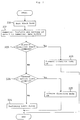
- Fig. 2 is a flowchart showing a sequence of an ordinary machining operation.
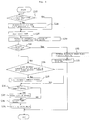
- Fig. 3 is a flowchart showing a sequence of a forward-direction machining operation.
- Fig. 4 is a flowchart illustrating a sequence of a reverse-direction machining operation.
- Figs. 5a-5d provide examples of an NC program, modal command storing buffer data, and modal movement command buffer data.
- Fig. 1 illustrates one embodiment of the present invention, which includes an NC program 1 (set forth in more detail in Figs. 5a and 5b), a forward-direction reader 2 for reading the NC program 1 in the forward direction, a reverse-direction reader 3 for reading the NC program 1 in the reverse direction, a numerical analyzer 4 for analyzing and converting each block (i.e., each command in the programs in Figs. 5a and 5b) read from the NC program 1 into numerical data.
- the NC unit also includes a reverse-execution start/end position recorder 5 which stores the forward-direction execution start and end positions within the NC program 1, and a numerical data buffer 6 for storing numerical data for each block/command provided by the numerical analyzer 4.
- a modal movement command storing controller 7 (Fig. 1) identifies mode movement commands in the program by testing each current and preceding command during forward operation.
- controller 7 stores the necessary information (the preceding command) in the mode movement command storage buffer 8 (as illustrated in Fig. 5d).
- Mode movement command storage buffer 8 stores information representative of the mode movement commands in the order of issuance.
- Mode command storing controller 9 stores the types and values for each mode command in the order of issuance during forward processing in mode command storage buffer 10 (see Fig. 5c).
- each mode command 63-69 (Fig. 5b) is stored in storage buffer 10 (Fig. 5c).
- the command type storing controller 11 records which mode command or mode movement command exists in the appropriate block of the NC program 1 in order to determine during forward and reverse processing which type of command resides in the next and preceding blocks.
- a preceding block command type storage buffer 12 stores the command types, and a drive controller 13 controls a drive motor 14 in accordance with the data from the numerical data buffer 6.
- Mode movement command reverse execution unit 15 reads the type storage buffer 12, the analyzer 4 and the data buffer 6 and the mode movement command storage buffer 8. When the current command within the data buffer 6 does not constitute a mode movement command, and the preceding command (read from the type storage buffer 12) does represent a mode movement command, the reverse execution unit 15 adjusts the mode movement command data in the numerical data buffer 6 accordingly (which will be explained in more detail below).
- Mode command reverse execution unit 16 reads the mode command storage buffer 10, the type storage buffer 12 and the data buffer 6, and adds a mode command from the storage buffer 10 with the contents of the numerical data buffer 6, when the preceding block command type storing buffer 12 indicates that a preceding command represents a mode command.
- Mode command converter 17 converts the data from storage buffer 10, which requires conversion when this data is to be written into the data buffer 6.
- Switch command inverter 18 inverts an on/off command and sets the result in the numerical data buffer 6 when there is a switch command, and coordinate value convertor 19 changes the axis data and the circular arc rotating direction of the numerical data buffer 6 so that the axial movement direction can be reversed.
- the program 55 and subprogram 60 are initially processed (in the forward direction) in order to set up the necessary buffers 8, 10 and 12.
- each command is written into the numerical data buffer 6 prior to being executed by driving controller 13.
- the present invention alters this data (via reverse execution units 15 and 16, switching inverter 18 and coordinate value convertor 19) in order ensure that the reverse operations match the forward operation.
- the following discussion will better illustrate how the system of Fig. 1 updates each command in data buffer 6 during reverse operation.
- the above described NC unit includes three possible patterns of operation, normal machining, machining in a defined forward direction, and machining in a reverse direction.
- Fig. 2 illustrates a first pattern (normal machining), wherein the forward-direction reader 2 reads each block/command from the NC program 1 (S20), and numerical analyzer 4 analyzes numerical values therefrom and sends the result to the numerical data buffer 6 (S21). If the numerical analyzer 4 indicates that a forward-direction machining command code exists in the NC program 1 (S22), a forward direction mode is switched on (S23), and if a reverse-direction machining command code exists (S24), a reverse direction mode is switched on (S25). If neither the forward- nor the reverse-direction machining command codes exist, the drive controller 13 drives the machining table in accordance with the data in the numerical data buffer 6 (S26).
- the second pattern (illustrated in Fig. 3) represents the operation of forward-direction machining once the forward direction mode has been switched on during normal machining.
- the block at which forward-direction machining starts (S27), also represents the end block for reverse execution.
- the position of the starting block for forward execution is stored in the reverse execution start/end block position recorder 5 (S28).
- the forward-direction reader 2 reads the next block from the NC program 1 (S29), and the numerical analyzer 4 analyzes the numerical values and writes the result to the numerical data buffer 6 (S30).
- the mode movement command storing controller 7 tests the numerical data buffer 6 to determine if a mode movement command exists in the current block and the preceding block command type storage buffer 12 to determine if a mode movement command exists in a preceding block (S34).
- the command storing controller 7 writes the mode movement command in the preceding block into the mode movement command storing buffer 8 (S35) as illustrated in Fig. 5d.
- the mode command storing controller 9 determines whether a mode command exists (S36) in the current block, and if so the mode command storing controller 9 records the type and value of this command in the mode command storage buffer 10 (S37) as illustrated in Fig. 5c.
- the command type storing controller 11 records the presence or absence of the mode movement command in the preceding block command type storage buffer 12 (S38).
- the drive controller 13 drives the machining table in accordance with the data of the numerical data buffer 6 (S39).
- the third pattern (illustrated in Fig. 4) represents reverse-direction machining when the reverse direction mode has been switched on during a normal machining operation.
- the reverse direction mode is switched off and processing is terminated (S41).
- the reverse execution start block position is recorded (S43) in the reverse execution start/end block position storage buffer 5.
- reverse-direction reader 3 reads the next block in the reverse direction from the NC program 1 (S44). This command is analyzed and the results are recorded in numerical data buffer 6 (S45).
- the mode movement command reverse execution unit 15 first determines whether the numerical data buffer 6 includes a mode movement command. If not, reverse execution unit 15 searches the preceding block command type storage buffer 12 to determine if a mode movement command precedes this command held in the data buffer 6 (S46).
- the reverse execution unit 15 reads the appropriate mode movement command from the mode movement command storage buffer 8 and updates numerical data buffer 6 (S47) to ensure that the present command is performed in accordance with the correct mode movement command.
- the reverse execution unit 15 would identify this to not be a mode movement command, and would search the type storage buffer 12 to determine whether a mode movement command precedes this current command.
- Command 75 would be identified in type storage buffer 12 as the mode movement command which precedes the current command (this mode movement command (75) would have been applicable at instruction 79 if the program were proceeding in the forward direction).
- reverse execution unit 15 would read the command from storage buffer 8, which corresponds to instruction 75 (i.e., "G00") and would add this information to the instruction in data buffer 6.
- reverse execution unit 15 effectively rewrites the command "Y10.0" in its long form "G00 Y10.0".
- the mode command reverse execution unit 16 checks the preceding block command type storage buffer 12. If a mode command is recorded in one of the blocks preceding the current command (S48), the reverse execution unit 16 reads this mode command from the mode command storing buffer 10 and adds its value to the command in data buffer 6. Prior to this addition, if the mode command requires conversion, the mode command conversion unit 17 converts the mode command and sends the results to the numerical data buffer 6 (S49).
- the reverse execution unit 16 would search storage buffer 12 for a mode command which precedes command 79.
- Command 67 would be identified in storage buffer 12 as the preceding mode command and thus, reverse execution unit 16 would access storage buffer 10 and add the value "F100.0" to the command 79 to obtain "F100.0 Y10.0".
- command 62 represented the current command
- the execution unit 16 would attempt to obtain the mode command 65 from the storage buffer 10.
- command 65 represents a mode command which requires conversion (command 65 represents a "diameter compensation cancel" command).
- conversion unit 17 would search the storage buffer 10 for the next preceding mode command having the same type (i.e., type "1").
- Conversion unit 17 would convert command "G42", which represents "rightward diameter compensation,” into a "leftward diameter compensation” command (i.e., "G41”) and send the converted command to data buffer 6.
- the switch command inverter 18 checks whether a current command in the numerical data buffer 6 (S50) represents a switch command, and if so inverts the switch within numerical data buffer 6 (S51).
- the coordinate value converting means 19 reads the data of the numerical data buffer 6, and converts the axis data and the circular arc rotating direction so that the machining direction is reversed, and sets the results in the numerical data buffer 6 (S52).
- the command type storing controller 11 sets the presence or absence of the mode movement command and mode command to the preceding block command type storing buffer 12 (S53).
- the drive controller 13 drives the machining table in accordance with the data of the numerical data buffer 6 (S54).
- Figs. 5a-5d illustrate an exemplary main program 56, subprogram 60, and the contents of the mode command and mode movement command storage buffers 71 and 73 (which correspond to buffers 10 and 8 in Fig. 1) based upon the operations stored in the subprogram 60.
- Fig. 5a illustrates the forward and reverse direction machining commands 56 and 57 in the main NC program.
- the main program also includes a diameter compensation value setting 58 for forward direction machining and a like setting 59 for reverse direction machining.
- the subprogram 60 labelled L100 called from the main program 55 includes a symmetrical machining ON command 61 for the X axis and a symmetrical machining OFF command 62 for the same.
- the subprogram also includes a "leftward diameter compensation" command 63 with respect to an advancing direction of the workpiece, a "rightward diameter compensation" command 64 with respect to the advancing direction of the workpiece and a "diameter compensation cancel" command 65.
- Speed commands 66 and 67, taper angle setting commands 68 and 69, a subprogram end command 70, and switch commands 61 and 62 are also illustrated.
- Commands 63-69 represent mode commands and commands 74-76 represent mode movement commands.
- the mode commands therefrom are stored in buffer 71 as illustrated in Fig. 5c, such as command type diameter compensation data 72, 78 and 77 from blocks 63, 64 and 65 respectively in the order of processing in the forward direction.
- the mode movement command storing buffer 73 stores data as illustrated in Fig. 5d, from which is seen that commands 74-76 represent the movement commands not followed (in the forward direction) by another movement command.
- Reverse execution starts at block 70, such that block 62 is converted into a symmetrical machining ON command for the X axis during step S51 (Fig. 4) by the switch conversion unit 18.
- mode command 65 is detected, the mode command storage buffer 71 is referenced, in which a buffer pointer is currently pointing at its diameter compensation stop command value 77.
- buffer 71 is searched by execution unit 16, in order to identify the previous data having the same type (which is located at 78, from program step 64).
- command "G42" is fetched from storage buffer 10 and converted (by converter unit 17) into “G41". This conversion changes the current command 65 "G40" to a leftward diameter compensator "G41" in order to retrace the workpiece's forward direction operation in the reverse direction.
- the mode movement command storing buffer 73 is referred to.
- the buffer pointer points to data 81.
- data 82, "00" (from G00 found in step 75) preceding data 81 is selected as the value which is valid for block 79.
- Reverse execution is thusly performed upon each instruction up to the beginning of the subprogram 60.
- paired commands e.g., machining on and off
- commands such as an axis change command
- a machining condition command may be employed as a mode command.
Landscapes
- Engineering & Computer Science (AREA)
- Human Computer Interaction (AREA)
- Manufacturing & Machinery (AREA)
- Physics & Mathematics (AREA)
- General Physics & Mathematics (AREA)
- Automation & Control Theory (AREA)
- Numerical Control (AREA)
Applications Claiming Priority (2)
| Application Number | Priority Date | Filing Date | Title |
|---|---|---|---|
| JP294505/90 | 1990-10-31 | ||
| JP2294505A JPH04167103A (ja) | 1990-10-31 | 1990-10-31 | プログラムの実行方法および装置 |
Publications (1)
| Publication Number | Publication Date |
|---|---|
| EP0483666A2 true EP0483666A2 (de) | 1992-05-06 |
Family
ID=17808648
Family Applications (1)
| Application Number | Title | Priority Date | Filing Date |
|---|---|---|---|
| EP91118139A Withdrawn EP0483666A2 (de) | 1990-10-31 | 1991-10-24 | Verfahren und Gerät zur Programmausführung und Gerät |
Country Status (3)
| Country | Link |
|---|---|
| EP (1) | EP0483666A2 (de) |
| JP (1) | JPH04167103A (de) |
| KR (1) | KR920008566A (de) |
Families Citing this family (1)
| Publication number | Priority date | Publication date | Assignee | Title |
|---|---|---|---|---|
| JPH1011124A (ja) * | 1996-06-20 | 1998-01-16 | Fanuc Ltd | ロボットの後退実行機能を備えたロボット制御装置 |
-
1990
- 1990-10-31 JP JP2294505A patent/JPH04167103A/ja active Pending
-
1991
- 1991-10-23 KR KR1019910018671A patent/KR920008566A/ko not_active Withdrawn
- 1991-10-24 EP EP91118139A patent/EP0483666A2/de not_active Withdrawn
Also Published As
| Publication number | Publication date |
|---|---|
| KR920008566A (ko) | 1992-05-28 |
| JPH04167103A (ja) | 1992-06-15 |
Similar Documents
| Publication | Publication Date | Title |
|---|---|---|
| US20080294877A1 (en) | Numerical controller having function of resuming look-ahead of block | |
| US5528506A (en) | Feed rate control method and apparatus in numerical control system | |
| JP4374045B2 (ja) | プログラム再開機能を備えた数値制御装置 | |
| US20080103625A1 (en) | Numerical controller with machining resume function | |
| US20060173572A1 (en) | Numerical control system | |
| US20040236462A1 (en) | Numerical control apparatus for machine tool | |
| US20050024003A1 (en) | Numerical control device | |
| US5386499A (en) | Controller and process for effecting a shorter path trajectory in robot movement | |
| US5930141A (en) | Method of controlling access to storage means in numerical-control system, and numerical-control system | |
| US5291389A (en) | Sequential function chart (SFC) controller for controlling a machine in reverse operation | |
| JPH01146642A (ja) | 切削工具の停止制御装置 | |
| US5274562A (en) | Numerical control unit for facilitating tool change | |
| EP0483666A2 (de) | Verfahren und Gerät zur Programmausführung und Gerät | |
| KR920004080B1 (ko) | 수치 제어 장치 | |
| US5229950A (en) | Numerical control unit | |
| HK1006043A1 (en) | Sequence controller including error correction and method therefor | |
| EP0236502B1 (de) | Numerische regelvorrichtung | |
| JPS59216207A (ja) | 数値制御装置 | |
| EP1467271A2 (de) | Steuerung für Maschinen | |
| CN118159920B (zh) | 加工程序创建装置及加工程序创建方法 | |
| JP2823630B2 (ja) | 任意角度面取自動加工機能を備えた数値制御装置 | |
| JPH02150907A (ja) | サーボモータの制御方法 | |
| JP2001014014A (ja) | 数値制御方法及びその装置 | |
| JP2505383B2 (ja) | 数値制御における送り速度制御方法および装置 | |
| KR19980083294A (ko) | 수치제어기의 그래픽 지-코드 편집방법 |
Legal Events
| Date | Code | Title | Description |
|---|---|---|---|
| PUAI | Public reference made under article 153(3) epc to a published international application that has entered the european phase |
Free format text: ORIGINAL CODE: 0009012 |
|
| AK | Designated contracting states |
Kind code of ref document: A2 Designated state(s): CH DE LI |
|
| STAA | Information on the status of an ep patent application or granted ep patent |
Free format text: STATUS: THE APPLICATION HAS BEEN WITHDRAWN |
|
| 18W | Application withdrawn |
Withdrawal date: 19930818 |
|
| R18W | Application withdrawn (corrected) |
Effective date: 19930818 |