EP0483807A2 - Barre d'alésage - Google Patents
Barre d'alésage Download PDFInfo
- Publication number
- EP0483807A2 EP0483807A2 EP91118529A EP91118529A EP0483807A2 EP 0483807 A2 EP0483807 A2 EP 0483807A2 EP 91118529 A EP91118529 A EP 91118529A EP 91118529 A EP91118529 A EP 91118529A EP 0483807 A2 EP0483807 A2 EP 0483807A2
- Authority
- EP
- European Patent Office
- Prior art keywords
- cut
- apart portions
- boring
- adjusting
- inserts
- Prior art date
- Legal status (The legal status is an assumption and is not a legal conclusion. Google has not performed a legal analysis and makes no representation as to the accuracy of the status listed.)
- Withdrawn
Links
Images




Classifications
-
- B—PERFORMING OPERATIONS; TRANSPORTING
- B23—MACHINE TOOLS; METAL-WORKING NOT OTHERWISE PROVIDED FOR
- B23B—TURNING; BORING
- B23B29/00—Holders for non-rotary cutting tools; Boring bars or boring heads; Accessories for tool holders
- B23B29/03—Boring heads
- B23B29/034—Boring heads with tools moving radially, e.g. for making chamfers or undercuttings
- B23B29/03403—Boring heads with tools moving radially, e.g. for making chamfers or undercuttings radially adjustable before starting manufacturing
- B23B29/03421—Boring heads with tools moving radially, e.g. for making chamfers or undercuttings radially adjustable before starting manufacturing by pivoting the tool carriers or by elastic deformation
-
- Y—GENERAL TAGGING OF NEW TECHNOLOGICAL DEVELOPMENTS; GENERAL TAGGING OF CROSS-SECTIONAL TECHNOLOGIES SPANNING OVER SEVERAL SECTIONS OF THE IPC; TECHNICAL SUBJECTS COVERED BY FORMER USPC CROSS-REFERENCE ART COLLECTIONS [XRACs] AND DIGESTS
- Y10—TECHNICAL SUBJECTS COVERED BY FORMER USPC
- Y10T—TECHNICAL SUBJECTS COVERED BY FORMER US CLASSIFICATION
- Y10T408/00—Cutting by use of rotating axially moving tool
- Y10T408/83—Tool-support with means to move Tool relative to tool-support
- Y10T408/85—Tool-support with means to move Tool relative to tool-support to move radially
- Y10T408/858—Moving means including wedge, screw or cam
- Y10T408/8583—Moving means including wedge, screw or cam with resiliently urged Tool
- Y10T408/85843—Resilient Tool or tool-support
-
- Y—GENERAL TAGGING OF NEW TECHNOLOGICAL DEVELOPMENTS; GENERAL TAGGING OF CROSS-SECTIONAL TECHNOLOGIES SPANNING OVER SEVERAL SECTIONS OF THE IPC; TECHNICAL SUBJECTS COVERED BY FORMER USPC CROSS-REFERENCE ART COLLECTIONS [XRACs] AND DIGESTS
- Y10—TECHNICAL SUBJECTS COVERED BY FORMER USPC
- Y10T—TECHNICAL SUBJECTS COVERED BY FORMER US CLASSIFICATION
- Y10T408/00—Cutting by use of rotating axially moving tool
- Y10T408/83—Tool-support with means to move Tool relative to tool-support
- Y10T408/85—Tool-support with means to move Tool relative to tool-support to move radially
- Y10T408/858—Moving means including wedge, screw or cam
- Y10T408/8598—Screw extending perpendicular to tool-axis
Definitions
- This invention relates to a boring bar for boring holes in metals and more specifically a boring bar in which the boring diameter is adjustable.
- Conventional boring bars adapted to be mounted on milling machines for boring come in two different types, one for precision machining in which a single cutter is mounted on the tip of a boring bar body and the other for rough machining in which two cutters are mounted thereon.
- the boring bar for precision machining has problems in that it is difficult to adjust the dimensions because relief tends to appear during cutting and in that high-speed rotation is impossible because of difficulty in keeping the balance and thus the working efficiency is bad.
- the boring bar for rough machining can be rotated at high speed because it has two cutters. But it has a problem in that since the adjustments of dimensions and run-out have to be carried out by moving the two cutters individually, such adjustments require a lot of trouble and time. This also lowers the accuracy.
- a boring bar comprising a bar body formed with an axial cut at a portion near its tip to define a pair of cut-apart portions, the cut-apart portions having insert mounting portions provided on mutually opposite ends thereof, a dimension adjusting means provided at an intermediate portion of the cut-apart portions for changing a boring diameter between the tips of cutting edges of inserts mounted on the insert mounting portions by moving the cut-apart portions along surfaces of the cut, and a fixing screw provided between the tips of the cut-apart portions and the dimension adjusting means for fixing the cut-apart portions together after adjusting dimensions.
- the dimension adjusting mechanism is operated with the fixing screw loosened to forcibly move the cut-apart portions along the surfaces of the cut. By moving them in such a direction that the tips of the inserts are moved away from each other, the boring diameter can be increased.
- the fixing screw is tightened to fix the cut-apart portions in position.
- one of the adjusting screws which is located on the side toward which the tips of the inserts are desired to be moved is threaded in. By threading the screw, it presses against the outer peripheral portion of the bar body facing the cut, so that the tip of the bar body is bent toward the adjusting screw being pressed due to the effect of the cut formed in the bar body.
- the vibration can be reduced or the boring diameter can be changed by changing the amount of this bending.
- inserts are mounted on mutually opposed ends of the cut-apart portions defined by the cut at the tip of the cut surfaces.
- a dimension adjusting mechanism is provided to move the cut-apart portions in the direction of the cut surfaces.
- the inserts are mounted at both sides, the parallelism of cutting is high with no relief. Also, since the boring diameter and run-out can be measured and the balance can be maintained, high-speed rotation is possible. This makes possible boring with high roundness. Thus, precision milling operation can be carried out at double the feed speed. This increases the efficiency of operation.
- the boring bar body is integrally formed, its rigidity is high.
- the inserts can be opened and closed uniformly with respect to each other and adjustment can be made with high precision. Any run-out can be corrected reliably.
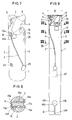
- a boring bar body. 1 has an axial cut 2 passing its axis and is provided with a pair of cut-apart portions 3 at both sides of the cut 2.
- the cut-apart portions 3 are provided on the tips thereof with inclined cutouts 4 at opposite sides from each other.
- Recesses 6 for mounting inserts 5 are formed in the end of the cut surfaces so as to be located opposite to the cutouts 4.
- the inserts 5 are mounted in the recessed mounting portions 6 and fixed in position with screws 7.
- the inserts 5 are fixed to the cut-apart portions 3 at their ends remote from each other and have their cutting edges protruding outwardly from the outer periphery of the boring bar body 1.
- the distance between the tips of the cutting edges of the inserts 5 corresponds to the boring diameter D.
- a dimension adjusting mechanism 8 is mounted in an intermediate portion of the cut-apart portions 3 change the boring diameter between the tips of the insert edges.
- a fixing screw 9 is provided at the side near the tip and a locking screw 10 at the side remote from the tip, with the adjusting mechanism 8 disposed therebetween.
- Fig. 4 shows a first example of the dimension adjusting mechanism 8.
- the cut-apart portions 3 are formed in the opposed surfaces thereof with a lateral hole 11 which overlaps with the cut 2 and with an oblique hole 12 extending therethrough and crossing the lateral hole 11 at the center.
- a pair of adjusting members 13 are inserted into the lateral hole 11 at both ends thereof.
- One of the adjusting members 13 is provided with an engaging claw 14 protruding from the outer surface thereof and engaged in the oblique hole 12 formed in one of the cut-apart portions 3.
- the other adjusting member 13 also has an engaging claw 14 protruding from the outer surface thereof and engaged in the oblique hole 12 formed in the other cut-apart portion 3.
- An adjusting screw 16 is threaded in a threaded hole 15 formed in one of the adjusting members 13 and has its tip in abutment with the end face of the other adjusting member 13.
- the cut-apart portions 3 are pushed apart along the surfaces of the cut 2 through the adjusting members 13.
- the distance between the tips of the cutting edges of the inserts 5 and thus the boring diameter D can be changed.
- a lateral hole 11a is formed to extend over the opposed surfaces of the cut-apart portions 3 and to overlap with the cut 2.
- a pair of adjusting sheaths 13a and 13b are inserted in the lateral hole 11a at both ends thereof.
- One of the adjusting sheaths 13a is provided with an engaging claw 14a protruding from the outer end thereof and engaging the outer surface of one of the cut-apart portions 3.
- the other adjusting sheath 13a also has an engaging claw 14a protruding from the outer end thereof and engaging the outer surface of the other cut-apart portion 3.
- the adjusting sheaths 13a are coupled together through an adjusting screw 16 threaded into both members.
- the adjusting screw 16 has male threads 17a having a small pitch and male threads 17b having a large pitch.
- One of the adjusting sheaths 13a is in threaded engagement with the male threads 17a having a small pitch while the other adjusting sheath 13a is threaded on the male threads 17b having a large pitch.
- the adjusting sheaths 13a move in the same direction but at different rates due to the difference in pitch between the male threads 17a and 17b.
- the fixing screw 9 extends through a stepped elongated hole 18 formed in one of the cut-apart portions 3 and is threaded in a threaded hole 19 formed in the other cut-apart portion 3.
- the cut-apart portions 3 are tightened together by tightening the fixing screw 9 so that the surfaces of the cut 2 overlap.
- the locking screw 10 extends at an angle of 45 degrees with respect to the cut 2 through an elongated hole 20 formed in one of the cut-apart portions 3 and are threaded in a threaded hole 21 formed in the other cut-apart portion 3, thereby tightening the cut-apart portions 3 so as not to be movable along the surfaces of the cut 2.
- the cut-apart portions 3 are formed in the rear ends thereof with threaded holes 23 extending perpendicular to the cut 2.
- a run-out adjusting screw 24 is threaded into one of the threaded holes 23.
- a round shaft 25 extends through the boring bar body 1 along the surfaces of the cut 2 crossing the threaded holes 23.
- the run-out adjusting screw 24 has its tip abutting the round shaft 25.
- the boring bar 1 Since the boring bar 1 has its cut-apart portions 3 twisted by 90 degrees, they can move smoothly in the direction of adjustment of the boring diameter and the dimension adjusting screw 16 can be controlled easily. Further, since the cut-apart portions 3 are twisted in such a direction that the inserts are located rearward of the bottom end of the cut 2 with respect to the direction of rotation of the boring bar during cutting, the mass of repulsion is small. This serves to reduce vibration.
- the boring diameter D between the tips of the cutting edges of the inserts 5 is minimum when the adjusting members 13 of the dimension adjusting mechanism 8 are the nearest to each other, i.e. when the cut-apart portions 3 are at rest and not subjected to such a force as to push them apart.
- the adjusting screw 16 is turned in such a direction that the adjusting members 13 move away from each other, with the fixing screw 9 and the locking screw 10 loosened.
- the distance between the tips of the insert 5 is measured with a micrometer and when a predetermined boring diameter D is reached, the fixing screw 9 and the locking screw 10 are tightened to secure the cut-apart portions 3 together. Thus, a hole having a predetermined diameter can be bored.
- the run-out adjusting screw 24 is threaded into the threaded hole 23 provided at the root of the cut-apart portion 3 located opposite to the direction of run-out until its tapered tip abuts the round shaft 25.
- a cylindrical bar body 1 is formed with an axial cut 2 crossing the axis of the shank and extending from its tip end to its intermediate portion.
- a pair of cut-apart portions 3 are defined at both sides of the cut 2.
- the cut-apart portions 3 are provided with tapered cutouts 4 in their tip ends at locations remote from each other.
- Recesses 6 for mounting inserts 5 are formed in the ends of the cut-apart portions 3 at locations opposite the cutouts 4. The inserts 5 set in the recessed mounting portions 6 are secured in position by screws 7.
- the distance between the tips of the edges of the inserts 5 corresponds to the boring diameter D.
- a dimension adjusting mechanism 8 (Fig. 13) is provided at an intermediate portion of the cut-apart portions 3. It serves to change the boring diameter between the tips of the insert edges.
- a fixing screw 9 and a locking screw 10 are provided on both sides of the adjusting mechanism 8, the former being near to the tip and the latter remote from the tip.
- the dimension adjusting mechanism 8 has a threaded hole 31 formed in one of the cut-apart portions 3 to extend obliquely with respect to the cut 2 from its outer periphery toward the center of the cut 2, and a bottom-closed hole 32 formed in the other cut-apart portion 3 which extends at the same angle of inclinations as the hole 31 and opens to the center of the cut 2.
- An adjusting screw 33 is threaded in the threaded hole 31. It is integrally provided with a shaft 34 which is inserted in the hole 32. By threading the screw 33 in, the tip of the shaft 34 abuts the bottom of the hole 32, imparting the cut-apart portions 3 a force to separate them from each other. This causes change in phase between the cut-apart portions 3, which in turn changes the distance between the tips of the edges of the inserts 5 and thus the boring diameter D.
- the fixing screw 9 extends through an elongated stepped hole 35 formed in one of the cut-apart portions 3 and is threaded in a threaded hole 36 formed in the other cut-apart portion 3. It is tightened up after adjusting the boring diameter D until the opposed surfaces of the cut 2 overlap each other.
- the locking screw 10 extends, at a right angle with respect to the cut 2, through a hole 37 formed in one of the cut-apart portions 3 and is threaded in a threaded hole 38 formed in the other cut-apart portion 3. It is tightened up to prevent the cut-apart portions 3 from moving along the surfaces of the cut 2.
- the boring bar of this embodiment has its cut-apart portions 3 twisted by 90 in the same manner as in the first embodiment.
- the shank 1 is formed in its root end portion with a cut 41 (Fig. 17) which extends at a right angle with respect to the direction of movement of the inserts 5.
- a holder 42 (Fig. 19) as a covering member has its cylindrical portion 43 fitted on the shank 1 at its root portion.
- the cylindrical portion 43 carries adjusting screws 44 on both sides of the cut 41 and a fixing screw 45 provided at the top end of the holder 42 and adapted to press and hold the shank 1 in position from the direction perpendicular to the direction of the adjusting screws 44.
- the portions of the shank 1 where the adjusting screws 44 and the fixing screw 45 abut are formed flat as at 46 and 47.
- the cut 41 formed in the bar body 1 comprises a straight portion 41a and a circular hole 41b formed at the inner end of the straight portion 41a.
- the circular hole 41b is located offset toward the root of the bar body 1 with respect to the line that connects the axes of the adjusting screws 44 to maintain a sufficient rigidity of the bar body 1.
- the cylindrical portion 43 of the holder 42 holds the shank 1 at the tip and the inner end of the inner periphery thereof. At the intermediate portion, a gap is formed between the inner periphery of the portion 43 and the bar body 1.
- the holder 42 has the cylindrical portion 43 and a tapered portion 48 and is held by a chuck of a milling machine.
- the covering member may be a mere cylindrical member.
- the boring diameter D between the tips of the edges of the inserts 5 is minimum when the dimension adjusting screw 33 of the dimension adjusting mechanism 8 is kept out of the hole 32, i.e. when the cut-apart portions 3 are at rest and not subjected to a force to push them apart.
- the screw 33 is threaded in with the fixing screw 9 and the locking screw 10 loosened to push open the cut-apart portions 3 along the cut 2 as shown in Fig. 13.
- the distance between the tips of the inserts 5 is measured with a micrometer and when a predetermined boring diameter D is reached, the fixing screw 9 and the locking screw 10 are tightened up to tighten the cut-apart portions 3 together. Thus, a hole having a predetermined diameter can be bored.
- the bar body 1 Since the bar body 1 is pressed at its outer upper portion opposite the cut 41, the cylindrical portion 43 is pressed at its intermediate portion, with its tip and inner end as support points. As a result, due to the presence of the cut 41, the bar body 1 yields so that the tip of the bar body 1 moves about an urging-fixing point at the tip of the cylindrical portion 43 in the direction opposite to the direction of run-out. Thus, the run-out can be corrected.
- the boring bar carries two inserts and the boring diameter of both inserts is adjusted by adjusting the distance between the inserts.
- the boring bar may carry a single insert.
- the adjusting screws 44 threaded in the holder 42 are used to adjust the boring diameter.
Landscapes
- Engineering & Computer Science (AREA)
- Mechanical Engineering (AREA)
- Cutting Tools, Boring Holders, And Turrets (AREA)
Applications Claiming Priority (4)
| Application Number | Priority Date | Filing Date | Title |
|---|---|---|---|
| JP29835990A JPH04171103A (ja) | 1990-11-02 | 1990-11-02 | ボーリングバー |
| JP298359/90 | 1990-11-02 | ||
| JP188637/91 | 1991-07-29 | ||
| JP18863791A JPH0538605A (ja) | 1991-07-29 | 1991-07-29 | ボーリングバー |
Publications (2)
| Publication Number | Publication Date |
|---|---|
| EP0483807A2 true EP0483807A2 (fr) | 1992-05-06 |
| EP0483807A3 EP0483807A3 (en) | 1992-09-02 |
Family
ID=26505050
Family Applications (1)
| Application Number | Title | Priority Date | Filing Date |
|---|---|---|---|
| EP19910118529 Withdrawn EP0483807A3 (en) | 1990-11-02 | 1991-10-30 | Boring bar |
Country Status (2)
| Country | Link |
|---|---|
| US (1) | US5125773A (fr) |
| EP (1) | EP0483807A3 (fr) |
Cited By (2)
| Publication number | Priority date | Publication date | Assignee | Title |
|---|---|---|---|---|
| CN103121116A (zh) * | 2013-03-18 | 2013-05-29 | 山东普利森集团有限公司 | 减振镗杆 |
| KR101685687B1 (ko) * | 2016-03-24 | 2016-12-12 | (주)우남기공 | 마이크로 보링 바 |
Families Citing this family (5)
| Publication number | Priority date | Publication date | Assignee | Title |
|---|---|---|---|---|
| DE4447558C5 (de) * | 1994-08-25 | 2004-04-29 | Gühring, Jörg, Dr. | Rundlaufendes Werkzeug |
| KR100548964B1 (ko) * | 2003-09-23 | 2006-02-03 | 비젼이노텍(주) | 바이트 결합을 위한 복합재료 공구용 바 |
| CN102448644A (zh) * | 2009-05-26 | 2012-05-09 | 沃尔沃航空公司 | 用于切削刀具的夹持器、切削刀具和切削刀片 |
| DE102010002557A1 (de) * | 2010-03-03 | 2011-09-08 | Sandvik Intellectual Property Ab | Zerspanungswerkzeug mit spielfreier Feinstverstellung |
| CN106735356B (zh) * | 2016-12-28 | 2019-01-08 | 基准精密工业(惠州)有限公司 | 镗刀及使用该镗刀加工孔的方法 |
Family Cites Families (8)
| Publication number | Priority date | Publication date | Assignee | Title |
|---|---|---|---|---|
| US2266339A (en) * | 1940-12-23 | 1941-12-16 | John A Shutz | Boring bar |
| US2355965A (en) * | 1943-07-21 | 1944-08-15 | Frishette Stanton | Reamer |
| NL132061C (fr) * | 1964-09-16 | |||
| SE351147B (fr) * | 1971-05-06 | 1972-11-20 | Sandvik Ab | |
| DE2411394C3 (de) * | 1974-03-09 | 1980-09-11 | Grueko Konstruktionen Gmbh, 7926 Boehmenkirch | Bohrkopf |
| DE7904992U1 (de) * | 1979-02-22 | 1980-07-31 | Komet Stahlhalter- Und Werkzeugfabrik Robert Breuning Gmbh, 7122 Besigheim | Aufbohrwerkzeug |
| DE3234238A1 (de) * | 1982-09-15 | 1984-03-15 | August Beck GmbH & Co, 7472 Winterlingen | Aufbohrer mit wendeplatte |
| DE3824462A1 (de) * | 1988-07-19 | 1990-01-25 | Bauer Eberhard Gmbh | Einstellvorrichtung, insbesondere fuer werkzeuge |
-
1991
- 1991-10-30 EP EP19910118529 patent/EP0483807A3/en not_active Withdrawn
- 1991-10-31 US US07/785,753 patent/US5125773A/en not_active Expired - Fee Related
Cited By (3)
| Publication number | Priority date | Publication date | Assignee | Title |
|---|---|---|---|---|
| CN103121116A (zh) * | 2013-03-18 | 2013-05-29 | 山东普利森集团有限公司 | 减振镗杆 |
| CN103121116B (zh) * | 2013-03-18 | 2015-08-12 | 山东普利森集团有限公司 | 减振镗杆 |
| KR101685687B1 (ko) * | 2016-03-24 | 2016-12-12 | (주)우남기공 | 마이크로 보링 바 |
Also Published As
| Publication number | Publication date |
|---|---|
| US5125773A (en) | 1992-06-30 |
| EP0483807A3 (en) | 1992-09-02 |
Similar Documents
| Publication | Publication Date | Title |
|---|---|---|
| US6280122B1 (en) | Milling tool with precisely positionable inserts | |
| EP0835709B1 (fr) | Dispositif d'ajustement pour outils de machine-outil | |
| EP1113895B1 (fr) | Ensemble trepan | |
| US5709510A (en) | Tool holder for inserts | |
| EP1872887B1 (fr) | Outil avec plaquette de coupe indexable | |
| US5330297A (en) | Boring tool | |
| US4101239A (en) | Boring tool provided with a pair of separately adjustable cutters | |
| RU2365472C2 (ru) | Регулируемый инструмент для удаления заусенцев | |
| JP2006528079A (ja) | 回転切削工具用切削ヘッド | |
| US6558087B1 (en) | Machining tool for high-speed machining | |
| KR950001810B1 (ko) | 트리밍 장치가 부착된 드릴 | |
| US3276101A (en) | Adjustable cutting tool | |
| US5125773A (en) | Boring bar | |
| EP2676751B1 (fr) | Outil de coupe | |
| CN113710445B (zh) | 将材料线切粒的线切粒机以及调节其切割间隙的方法 | |
| PL96415B1 (pl) | Noz do obrobki skrawaniem zwlaszcza do odcinania i podtaczania | |
| JP6411349B2 (ja) | 被加工材の切削加工のための工具 | |
| JP4610824B2 (ja) | チップ直接搭載切削工具 | |
| US5368079A (en) | Adjustable dado | |
| US4328723A (en) | Adjustable tool compensating arm | |
| JP2592189B2 (ja) | 正面フライスカッタのチップクランプ機構 | |
| JPS5839603B2 (ja) | 穴明け工具 | |
| JP4115700B2 (ja) | 切削工具 | |
| JPH0288108A (ja) | マイクロボーリングヘッド | |
| JPH0538605A (ja) | ボーリングバー |
Legal Events
| Date | Code | Title | Description |
|---|---|---|---|
| PUAI | Public reference made under article 153(3) epc to a published international application that has entered the european phase |
Free format text: ORIGINAL CODE: 0009012 |
|
| AK | Designated contracting states |
Kind code of ref document: A2 Designated state(s): DE FR GB IT SE |
|
| PUAL | Search report despatched |
Free format text: ORIGINAL CODE: 0009013 |
|
| AK | Designated contracting states |
Kind code of ref document: A3 Designated state(s): DE FR GB IT SE |
|
| STAA | Information on the status of an ep patent application or granted ep patent |
Free format text: STATUS: THE APPLICATION IS DEEMED TO BE WITHDRAWN |
|
| 18D | Application deemed to be withdrawn |
Effective date: 19930303 |