EP0484027B1 - Phthalocyanines polysubstituées - Google Patents
Phthalocyanines polysubstituées Download PDFInfo
- Publication number
- EP0484027B1 EP0484027B1 EP91309700A EP91309700A EP0484027B1 EP 0484027 B1 EP0484027 B1 EP 0484027B1 EP 91309700 A EP91309700 A EP 91309700A EP 91309700 A EP91309700 A EP 91309700A EP 0484027 B1 EP0484027 B1 EP 0484027B1
- Authority
- EP
- European Patent Office
- Prior art keywords
- formula
- parts
- substituted
- phthalocyanine
- metal
- Prior art date
- Legal status (The legal status is an assumption and is not a legal conclusion. Google has not performed a legal analysis and makes no representation as to the accuracy of the status listed.)
- Expired - Lifetime
Links
Classifications
-
- C—CHEMISTRY; METALLURGY
- C07—ORGANIC CHEMISTRY
- C07D—HETEROCYCLIC COMPOUNDS
- C07D487/00—Heterocyclic compounds containing nitrogen atoms as the only ring hetero atoms in the condensed system, not provided for by groups C07D451/00 - C07D477/00
- C07D487/22—Heterocyclic compounds containing nitrogen atoms as the only ring hetero atoms in the condensed system, not provided for by groups C07D451/00 - C07D477/00 in which the condensed system contains four or more hetero rings
-
- A—HUMAN NECESSITIES
- A61—MEDICAL OR VETERINARY SCIENCE; HYGIENE
- A61K—PREPARATIONS FOR MEDICAL, DENTAL OR TOILETRY PURPOSES
- A61K31/00—Medicinal preparations containing organic active ingredients
- A61K31/33—Heterocyclic compounds
- A61K31/395—Heterocyclic compounds having nitrogen as a ring hetero atom, e.g. guanethidine or rifamycins
- A61K31/40—Heterocyclic compounds having nitrogen as a ring hetero atom, e.g. guanethidine or rifamycins having five-membered rings with one nitrogen as the only ring hetero atom, e.g. sulpiride, succinimide, tolmetin, buflomedil
-
- A—HUMAN NECESSITIES
- A61—MEDICAL OR VETERINARY SCIENCE; HYGIENE
- A61P—SPECIFIC THERAPEUTIC ACTIVITY OF CHEMICAL COMPOUNDS OR MEDICINAL PREPARATIONS
- A61P35/00—Antineoplastic agents
-
- C—CHEMISTRY; METALLURGY
- C09—DYES; PAINTS; POLISHES; NATURAL RESINS; ADHESIVES; COMPOSITIONS NOT OTHERWISE PROVIDED FOR; APPLICATIONS OF MATERIALS NOT OTHERWISE PROVIDED FOR
- C09B—ORGANIC DYES OR CLOSELY-RELATED COMPOUNDS FOR PRODUCING DYES, e.g. PIGMENTS; MORDANTS; LAKES
- C09B47/00—Porphines; Azaporphines
- C09B47/04—Phthalocyanines abbreviation: Pc
- C09B47/045—Special non-pigmentary uses, e.g. catalyst, photosensitisers of phthalocyanine dyes or pigments
-
- C—CHEMISTRY; METALLURGY
- C09—DYES; PAINTS; POLISHES; NATURAL RESINS; ADHESIVES; COMPOSITIONS NOT OTHERWISE PROVIDED FOR; APPLICATIONS OF MATERIALS NOT OTHERWISE PROVIDED FOR
- C09B—ORGANIC DYES OR CLOSELY-RELATED COMPOUNDS FOR PRODUCING DYES, e.g. PIGMENTS; MORDANTS; LAKES
- C09B47/00—Porphines; Azaporphines
- C09B47/04—Phthalocyanines abbreviation: Pc
- C09B47/06—Preparation from carboxylic acids or derivatives thereof, e.g. anhydrides, amides, mononitriles, phthalimide, o-cyanobenzamide
- C09B47/067—Preparation from carboxylic acids or derivatives thereof, e.g. anhydrides, amides, mononitriles, phthalimide, o-cyanobenzamide from phthalodinitriles naphthalenedinitriles, aromatic dinitriles prepared in situ, hydrogenated phthalodinitrile
- C09B47/0675—Preparation from carboxylic acids or derivatives thereof, e.g. anhydrides, amides, mononitriles, phthalimide, o-cyanobenzamide from phthalodinitriles naphthalenedinitriles, aromatic dinitriles prepared in situ, hydrogenated phthalodinitrile having oxygen or sulfur linked directly to the skeleton
-
- C—CHEMISTRY; METALLURGY
- C09—DYES; PAINTS; POLISHES; NATURAL RESINS; ADHESIVES; COMPOSITIONS NOT OTHERWISE PROVIDED FOR; APPLICATIONS OF MATERIALS NOT OTHERWISE PROVIDED FOR
- C09B—ORGANIC DYES OR CLOSELY-RELATED COMPOUNDS FOR PRODUCING DYES, e.g. PIGMENTS; MORDANTS; LAKES
- C09B47/00—Porphines; Azaporphines
- C09B47/04—Phthalocyanines abbreviation: Pc
- C09B47/08—Preparation from other phthalocyanine compounds, e.g. cobaltphthalocyanineamine complex
- C09B47/18—Obtaining compounds having oxygen atoms directly bound to the phthalocyanine skeleton
-
- C—CHEMISTRY; METALLURGY
- C11—ANIMAL OR VEGETABLE OILS, FATS, FATTY SUBSTANCES OR WAXES; FATTY ACIDS THEREFROM; DETERGENTS; CANDLES
- C11D—DETERGENT COMPOSITIONS; USE OF SINGLE SUBSTANCES AS DETERGENTS; SOAP OR SOAP-MAKING; RESIN SOAPS; RECOVERY OF GLYCEROL
- C11D3/00—Other compounding ingredients of detergent compositions covered in group C11D1/00
- C11D3/0005—Other compounding ingredients characterised by their effect
- C11D3/0063—Photo- activating compounds
-
- C—CHEMISTRY; METALLURGY
- C11—ANIMAL OR VEGETABLE OILS, FATS, FATTY SUBSTANCES OR WAXES; FATTY ACIDS THEREFROM; DETERGENTS; CANDLES
- C11D—DETERGENT COMPOSITIONS; USE OF SINGLE SUBSTANCES AS DETERGENTS; SOAP OR SOAP-MAKING; RESIN SOAPS; RECOVERY OF GLYCEROL
- C11D3/00—Other compounding ingredients of detergent compositions covered in group C11D1/00
- C11D3/16—Organic compounds
- C11D3/168—Organometallic compounds or orgometallic complexes
-
- C—CHEMISTRY; METALLURGY
- C11—ANIMAL OR VEGETABLE OILS, FATS, FATTY SUBSTANCES OR WAXES; FATTY ACIDS THEREFROM; DETERGENTS; CANDLES
- C11D—DETERGENT COMPOSITIONS; USE OF SINGLE SUBSTANCES AS DETERGENTS; SOAP OR SOAP-MAKING; RESIN SOAPS; RECOVERY OF GLYCEROL
- C11D3/00—Other compounding ingredients of detergent compositions covered in group C11D1/00
- C11D3/39—Organic or inorganic per-compounds
- C11D3/3902—Organic or inorganic per-compounds combined with specific additives
- C11D3/3905—Bleach activators or bleach catalysts
- C11D3/3932—Inorganic compounds or complexes
-
- C—CHEMISTRY; METALLURGY
- C11—ANIMAL OR VEGETABLE OILS, FATS, FATTY SUBSTANCES OR WAXES; FATTY ACIDS THEREFROM; DETERGENTS; CANDLES
- C11D—DETERGENT COMPOSITIONS; USE OF SINGLE SUBSTANCES AS DETERGENTS; SOAP OR SOAP-MAKING; RESIN SOAPS; RECOVERY OF GLYCEROL
- C11D2111/00—Cleaning compositions characterised by the objects to be cleaned; Cleaning compositions characterised by non-standard cleaning or washing processes
- C11D2111/10—Objects to be cleaned
- C11D2111/12—Soft surfaces, e.g. textile
Definitions
- This invention relates to the use of certain poly-substituted phthalocyanine compounds and certain sulphonated derivatives thereof to generate singlet oxygen, to the methods of preparing such compounds and to certain novel substituted phthalocyanines.
- FR-A-866309 describes certain phthalocyanines having four O-alkyl or O-aryl. and four sulphonic acid substituents, a method for their preparation and their use as colorants.
- US-H-477 describes certain phthalocyanines having up to four aryloxy or arylthio or alkylthio substituents and their incorporation into semi-conducting thin films.
- EP-A-0272565 describes certain mono or disubstituted phthalocyanines and their use in laser optical recording materials.
- EP-A-0232427 describes certain tetrasubstituted phthalocyanines and naphthalocyanines and their use in optical recording media.
- EP-A-0153278 describes certain phthalocyanines and naphthalocyanines carrying up to eight water solubilising groups such as sulphonic acids and their uses as photosensitisers and producers of singlet oxygen in applications such as textile bleaching and control of micro organisms.
- JP-A-01075489 describes certain tetra(alkoxyphenoxy)- and tetra (alkenyloxyphenoxy) phthalocyanines and their uses as photoelectric transducers, electrophotographic photoreceptors, organic semiconductors, photorecording materials, gas sensor elements, catalysts and decolouring agents.
- the present invention relates to the use of substituted phthalocyanines for the generation of singlet oxygen, in which at least one of the peripheral carbon atoms in the 1-16 positions of the phthalocyanine nucleus (M k Pc), as shown in Formula (1): wherein:
- the phthalocyanine nucleus may be metal free or it may be complexed with a metal, an oxymetal group, a hydroxy metal group or a halometal group represented by M i.e. it may carry two hydrogen atoms at the centre of the nucleus or it may carry one or two metal atoms or oxymetal groups or hydroxy metal groups or halometal groups complexed within the centre of the nucleus.
- Preferred metals represented by M are those of Groups IA, IIA, IIIB, IVB, 1st, 2nd and 3rd transition rows and the lanthanide series of the Periodic Table.
- suitable metals, halometal groups, hydroxy metal groups and oxymetal groups represented by M are Li, Na, K, Mg, ClAl, OHAl, Ca, ClSc, OHSc, Ni, Cu, Zn, ClGa, HOGa, OHRh, ClRh, ClIn, BrIn, OHIn, Sn, Ba, Ir, SiCl 2 , SiO, Si(OH) 2 , Pt, Pd, ClRu, OHRu, Cl 2 Ge, (OH) 2 Ge, P(V)Cl 3 , P(III)Cl, FOCI, R 4 Al, R 4 Sc, R 4 Cr, R 4 Ga, R 4 OAl, R 4 OSc, R 4 OCr, R 4 OGa, R 4 ORh, R 4 Rh, R 4 In, R 4 OIn, R 4 OSm, SiR 4 2 , Si(OR 4 2 ), R 4 Ru, R 4 ORu, R 4 2 Ge, (R 4 O) 2 Ge, P(V)OR 4
- R 4 is alkyl it is preferably C 1-6 -alkyl; where R 4 is aryl it is preferably selected from phenyl, benzyl, toluyl and 2-naphthyl and where R 4 is heteroaryl it is preferably pyridazyl or pyridyl.
- M is Zn, ClAl, OHAl, ClRh, OHRh, ClIn, BrIn, OHIn, ClGa, OHGa, Pt, Pd, Li, Na, K, Ca, Ba, Mg, ClSc or OHSc, it is especially preferred that M is Zn, ClAl, OHAl, ClRh, OHRh, ClIn, BrIn, OHIn, ClGa, OHGa, Pt and Pd.
- each of the pendant organic radicals linked via oxygen to the phthalocyanine nucleus is independently selected from aromatic, heteroaromatic, aliphatic and alicyclic radicals, such that any one phthalocyanine nucleus may carry two or more different organic radicals.
- each pendant organic radical is independently selected from mono- and bi-cyclic aromatic and heteroaromatic radicals.
- Suitable mono- and bi-cyclic aromatic and heteroaromatic radicals are phenyl, naphthyl, especially naphth-2-yl, pyridyl, thiophenyl, furanyl, quinolinyl, thiazolyl, benzothiazolyl and pyrimidyl each of which may be substituted.
- the pendant organic radical is an aliphatic or alicyclic radical it is preferred that it is selected from C 1-20 -alkyl especially C 1-10 -alkyl; C 2-20 -alkenyl especially C 3-10 -alkenyl and C 4-8 -cycloalkyl especially cyclohexyl, each of which may be substituted.
- suitable atoms or groups which can be attached to any of the remaining peripheral carbon atoms of the phthalocyanine nucleus are hydrogen, halogen, sulphonate groups -SO 3 A in which A is H, or a metal or ammonium ion or a substituted ammonium ion, and any of the pendant organic radicals described above and hereinafter represented by R. It is preferred that the atoms or groups attached to the remaining peripheral carbon atoms are selected from -H, -F, -Cl, -Br, -I, -SO 3 H, -SO 3 Na, -SO 3 K, -SO 3 Li, and -SO 3 NH 4 or any combination thereof. It is especially preferred that these atoms or groups are -H, -Cl, -Br, -SO 3 H, -SO 3 Na or -SO 3 NH 4 .
- the sulphonated derivatives of the phthalocyanines used in the present invention carrying up to 30 SO 3 A groups, which are attached directly to the phthalocyanine nucleus and/or to the pendant organic radicals are a preferred group of compounds for the present invention.
- the average number of SO 3 A groups is 16 to 30. It is also preferred that for each pendant organic radical there is at least one SO 3 A group, although each organic radical may carry none, one or more than one SO 3 A group.
- A is a metal ion it is preferably an alkali or alkaline earth metal ion, especially an alkali metal ion such as a sodium, potassium or lithium ion.
- A is an ammonium ion it is preferably + NH 4 or a substituted ammonium ion which enhances the water-solubility of the compound or a substituted ammonium ion of the formula + NQ 4 which enhances the alcohol solubility of the compound.
- Suitable substituted ammonium ions which enhance the water solubility of the compound are mono, di, tri and tetra alkyl and hydroxyalkyl ammonium ions in which the alkyl groups preferably contain from 1 to 4 carbon atoms such as + N(CH 3 ) 4 ; + N(C 2 H 5 ) 4 ; + N(C 2 H 4 OH) 4 ; + NH 3 CH 3 ; + NH 2 (CH 3 ) 2 and + NH(CH 3 ) 3 .
- any remaining Q groups are C 1-4 -alkyl or H.
- the fatty aliphatic group represented by Q preferably contains from 4 to 16, more preferably from 7 to 12 and especially preferably 7 to 9 carbon atoms.
- Preferred fatty aliphatic groups are alkyl and alkenyl groups which have straight- or branched-chains.
- Preferred alkyl groups, represented by Q, containing 8 or 9 carbon atoms are, 3,5,5-trimethyl- hexyl, 1,1,3,3-tetramethylbutyl and 2-ethylhexyl.
- Examples of other aliphatic chains are 1-ethyl-3-methylpentyl, 1,5-dimethylhexyl, 1-methylheptyl, 1,4-dimethylheptyl, 1,2,2-trimethylpropyl, 2-ethylbutyl, 1-propylbutyl, 1,2-dimethylbutyl, 2-methylpentyl, 1-ethylpentyl, 1,4-dimethylpentyl, 1-methylhexyl, 3-methylhexyl, 1,3,3-trimethylbutyl, 1-methylnonyl.
- the substituted ammonium ion represented by A preferably has one fatty alkyl group as described above, the remaining groups being preferably H or C 1-4 -alkyl, especially H or methyl.
- Suitable ammonium ions include 2-ethylhexylammonium, 1,1,3,3-tetramethylbutylammonium and 3,5,5-trimethylhexylammonium.
- each of the peripheral carbon atoms in the 1 to 16 positions of the phthalocyanine nucleus are attached to a group Y and each Y is independently selected from -H, halogen, -SO 3 A in which A is as hereinbefore defined, and OR in which R is a pendant organic radical as hereinbefore defined.
- phthalocyanine compounds of the Formula (2) M k Pc (O-R) a X b (SO 3 A) d Formula (2) wherein:
- M is any of the metals, halometal groups, hydroxymetal groups or oxymetal groups described above for M.
- M is Ba, Li, Na, K, Mg, ClAl, OHAl, Ca, Zn, ClGa, H, Pt, Pd, OHRh and it is especially preferred that M is Zn, H, ClAl, OHAl, Pt, Pd, ClGa, OHRh and BrIn.
- each of the radicals denoted by R may be selected from any of the pendant organic radicals hereinbefore defined in relation to Formula (1) above.
- a is from 4 to 16 and more preferably from 5 to 16. It is especially preferred that a is 16.
- each halogen denoted by X is preferably independently selected from -F, -Cl, -Br and -I and it is especially preferred that each halogen denoted by X is independently -Cl or -Br.
- b is from 0 to 12, and more preferably from 0 to 11.
- a+b When a+b is ⁇ 16 the remainder of the 16 peripheral carbon atoms, not carrying a group O-R or X, may carry a sulphonate group, -SO 3 A or a group represented by R. It is however preferred that the sum of a+b is 16. It is also preferred that a is 4, 8, 12 or 16 and especially 8, 12 or 16.
- the metal ion denoted by A is preferably an alkali or alkaline earth metal ion and more preferably is selected from lithium, sodium and potassium ion. It is especially preferred that A is a sodium, an ammonium ion or hydrogen.
- a preferred sub-group of compounds of Formula (2) are those in which M is Zn, ClAl, OHAl, R is phenyl, 2-, 3- or 4-methylphenyl or naphth-2-yl, a is from 1 to 16, X is halogen, b is from 0 to 15, a+b is equal to 16, A is as hereinbefore defined and d is an average value from 16 to 30.
- An especially preferred sub-group of compounds of Formula (2) are those in which M is Zn, R is phenyl, 2-, 3- or 4-methylphenyl or naphth-2-yl, a is 4, 12 or 16, b is 12, 4 or 0, a+b is equal to 16, A is as hereinbefore defined and d is an average value from 16 to 30.
- phthalocyanine compounds of the Formula (3) free from sulphonic acid groups: M k Pc (O-R 1 ) a X b Formula (3) wherein:
- each of the radicals denoted by R 1 is independently selected from mono- or bi-cyclic aromatic or heteroaromatic radicals.
- suitable aromatic and heteroaromatic radicals are those described above for R.
- the radicals denoted by R 1 are more preferably phenyl or naphthyl, especially 2-naphthyl. Preferred substituents for the R 1 group are as described for R.
- a phthalocyanine of Formula (3) it is preferred that the metal denoted by M is Zn, ClAl, OHAl, ClRh, OHRh, ClIn, BrIn, OHIn, ClGa, OHGa, Pt, Pd, Li, Na, K, Ca, Ba, Mg, ClSc or OHSc.
- M is Zn, ClAl, OHAl, ClRh, OHRh, BrIn, OHIn, ClGa, OHGa, Pt or Pd
- R 1 is phenyl or 2-naphthyl, a is 16.
- a preferred sub-group of compounds of Formula (3) are those in which M is Zn or Mg, R 1 is phenyl, 2-, 3- or 4-methylphenyl or naphth-2-yl and a is 16.
- a further preferred sub-group of compounds of Formula (3) are those in which M is Zn or Mg, R 1 is phenyl, 2-, 3- or 4-methylphenyl or naphth-2-yl, a is 8, X is H or halogen and b is 8.
- the phthalocyanines of Formula (1), Formula (2) and Formula (3) can be prepared by the following methods:-
- reaction (b) is more fully described in our co-pending patent application number EP-A-0 484 018.
- the acid binder is preferably selected from alkali metal hydroxides and carbonates. It is preferred that the acid binder is lithium, sodium or potassium hydroxide, it is especially preferred that the acid binder is potassium hydroxide.
- the sulphonated phthalocyanines of Formula (2) can be prepared by sulphonating a precursor of a phthalocyanine of Formula (2) in which d is 0, using sulphuric acid which may contain excess SO 3 (oleum).
- the strength of acid may vary within wide limits from 1% sulphuric acid up to 30% oleum. It is preferred that the strength of acid is from 50% sulphuric acid up to 30% oleum, it is especially preferred that the strength of acid is from 98% sulphuric to 30% oleum.
- the reaction temperature may vary from -10°C to 60°C depending on the extent of sulphonation required. Sulphonation may be performed in an inert liquid.
- a preferred acid is 10% oleum and a preferred reaction temperature is from -10°C to 40°C, especially from 10°C to 25°C.
- the phthalocyanines can be sulphonated directly on the Pc nucleus, particularly when any of the 1-16 positions is unsubstituted (i.e. the 1-16 peripheral carbon atoms carry a hydrogen atom) or on any of the pendant organic groups R or R 1 , or on both the Pc nucleus and the pendant organic groups.
- the phthalocyanines of particular interest are those which promote the generation of singlet oxygen when exposed to radiation from the 650nm to 800nm region, especially the 680 to 770nm region of the electromagnetic spectrum.
- Singlet oxygen has a greater energy than ground-state, triplet oxygen.
- the singlet and triplet states of oxygen are distinguished by the singlet state having two electrons of anti-parallel spins and the triplet state having an uncoupled pair of electrons with parallel spins.
- the singlet oxygen is also distinguished from triplet oxygen because it is a highly reactive species with a lifetime from a few microseconds to several hundred microseconds. During its lifetime singlet oxygen has the potential to react before being deactivated.
- the reactivity of the singlet oxygen may be utilised in a wide range of applications which include photobleaching, photodeodorising, photodynamic therapy (PDT), treatment of visible stains on a range of material surfaces, surfaces include fabric, cement, stone, brick, glass, etc., biocidal, degradation of plastics, paper and pulp bleaching, environmental clean-up, anti-microbial action on fibres, incorporation into various products for example in fabrics as deodorisers, into paints or film treatments to destroy micro-organisms or contaminants, into cement products, glass products and paints to confer self-cleaning properties, sterilising swimming pools and as a surface treatment to prevent yellowing/discoloration of paper.
- the present phthalocyanine can be incorporated into detergent formulations which are used in a wide range of cleaning applications.
- a process for removing stains from fabrics which comprises treating the stained fabrics with an aqueous composition comprising at least one compound of Formula (1), Formula (2) or Formula (3) the fabrics being exposed to daylight during or following the treatment.
- the aqueous composition may also comprise detergents such as soap or synthetic detergents, other detergent additives such as soil suspending agents, optical brightening agents, sud or foam control agents, perfume, surfactants such as alkyl sulphonates, paraffin sulphonates and alkylbenzene sulphonates, ethoxylated alcohols or betaines, and alkaline detergency builders such as sodium carbonate, silicate, orthophosphates and polyphosphates.
- detergents such as soap or synthetic detergents, other detergent additives such as soil suspending agents, optical brightening agents, sud or foam control agents, perfume, surfactants such as alkyl sulphonates, paraffin sulphonates and alkylbenzene sulphonates, ethoxylated alcohols or betaines, and alkaline detergency builders such as sodium carbonate, silicate, orthophosphates and polyphosphates.
- the process for removing stains is preferably carried out at temperatures from 10°C to 80°C, more preferably from 20°C to 60°C and especially from 35°C to 45°C. Suitable process times for stain removal are typically from 5 minutes to 5 hours, preferably from 10 minutes to 1 hour.
- the preferred compounds of Formula (2) and Formula (3) are those where M k is Zn, Ca, DA, ClAl, and H 2 ; R or R 1 is phenyl and 2-naphthyl; a is 16; and d is from 16 to 30.
- compounds of Formula (1a) as defined in claim 13, Formula (2) or Formula (3) are used for the manufacture of a medicament for use in the treatment of skin and subcutaneous cancers by photodynamic therapy.
- the compound of Formula (1a), Formula (2) or Formula (3) is introduced into the affected tissue and then irradiated with electromagnetic radiation in the region from 650-800nm, preferably 680-770nm in order to generate singlet oxygen which destroys the affected cells.
- the phthalocyanine compounds of the present invention promote the formation of singlet oxygen under the influence of electromagnetic radiation, particularly in the 680-770nm region and are capable of promoting singlet oxygen formation in localised areas.
- the solid was washed with aqueous ammonia (2 mol.dm -3 , 100 parts), water (200 parts) and ethanol (74 OP, 300 parts). The solid was slurried in hot ethanol (74 OP, 2 x 200 parts), collected and dried to give hexadeca(phenoxy) chloroaluminium phthalocyanine (1.17 parts) m.p. 152-154°C.
- Example 3 The procedure of Example 3 was used except that magnesium chloride hexahydrate (0.56 parts) was used in place of the anhydrous aluminium chloride. Hexadeca(phenoxy) magnesium phthalocyanine (1.57 parts) was obtained as a green solid, m.p. >250°C.
- Example 3 The procedure of Example 3 was used except that copper (II) chloride (0.34 parts) was used in place of the anhydrous aluminium chloride. Hexadeca(phenoxy) copper (II) phthalocyanine (3.6 parts) was obtained as a green solid, m.p.>250°C.
- Example 3 The procedure of Example 3 was used except that nickel (II) chloride (0.36 parts) was used in place of the anhydrous aluminium chloride. Hexadeca(phenoxy) nickel (II) phthalocyanine (1.1 parts) was obtained as a green solid, m.p.>250°C.
- 1,2-Dicyano-3,4,5,6-tetrachlorobenzene (30.5 parts), potassium carbonate (62.8 parts) and 2-naphthol (98.1 parts) were stirred in dimethylformamide (140 parts) at 70°C for 3 hours.
- the mixture was poured into water (300 parts) and extracted with chloroform (3 x 300 parts).
- the combined chloroform extracts were washed with dilute aqueous sodium hydroxide solution (500 parts) and then with water (500 parts).
- the chloroform was dried over anhydrous magnesium sulphate before evaporating under reduced pressure to leave a brown liquid which crystallised on adding butan-1-ol, cooling and standing for 2 hours.
- Example 1(ii) The procedure of Example 1(ii) was used except that 1,2-dicyano- 3,4,5,6-tetra(2-naphthoxy)benzene (10 parts) was used in place of the 1,2-dicyano-3,4,5,6-tetra(phenoxy)benzene and 0.3 parts instead of 0.42 parts of lithium were used.
- Hexadeca(2-naphthoxy) dilithium phthalocyanine (5.71 parts) was obtained as a green solid, m.p. 185-190°C.
- Example 2 The procedure of Example 2 was used except that 1,2-dicyano-3,4,5,6-tetra(2-naphthoxy)benzene (20 parts) was used in place of the 1,2-dicyano-3,4,5,6-tetra(phenoxy)benzene and 1.29 parts instead of 1.81 parts of zinc chloride and 0.57 parts instead of 0.8 parts of urea were used. Hexadeca(2-naphthoxy) zinc phthalocyanine (15.4 parts) was obtained as a green solid, m.p. 230-235°C.
- Hexadeca(phenoxy)dihydrophthalocyanine (1.0 parts) was added to 10% oleum (2.3 parts) at 0°C over 15 minutes. The mixture was allowed to warm to 20°C and was stirred for 3 hours before pouring into a mixture of ice and water (100 parts). The resultant solution was neutralised to pH 7 using 48% aqueous sodium hydroxide. The product was purified by dialysing the neutralised solution in Visking tubing (obtainable from The Scientific Instrument Centre, Eastleigh, Hampshire) over 24 hours. The dialysed solution was evaporated to leave hexadeca (phenoxy)dihydrophthalocyanine eicosa (sulphonic acid) sodium salt (2.0 parts) as a black solid, m.p.230-235°C.
- Example 9 The procedure of Example 9 was used except that 2.6 parts instead of 2.3 parts of 10% oleum was used. Hexadeca(phenoxy)dihydro phthalocyanine triaconta (sulphonic acid) sodium salt was obtained as a black solid, m.p.>250°C.
- Example 9 The procedure of Example 9 was used except that hexadeca(phenoxy) zinc phthalocyanine (1.4 parts) was used in place of the hexadeca(phenoxy) dihydro phthalocyanine and 3.5 parts of 10% oleum was used instead of 2.3 parts. Hexadeca(phenoxy) zinc phthalocyanine hexadeca(sulphonic acid) sodium salt (1.32 parts) was obtained as a green solid, m.p.>250°C.
- Example 9 The procedure of Example 9 was used except that hexadeca(2-naphthoxy) zinc phthalocyanine (1.0 parts) was used in place of the hexadeca(phenoxy) dihydro phthalocyanine and 3.0 parts of 10% oleum was used instead of 2.3 parts. Hexadeca(2-naphthoxy) zinc phthalocyanine triaconta(sulphonic acid) sodium salt (1.7 parts) was obtained as a green solid, m.p.>250°C.
- Example 3 The procedure of Example 3 was used except that 1,2-dicyano-3,4,5,6-tetra(2-naphthoxy)benzene (3.0 parts) was used in place of the 1,2-dicyano-3,4,5,6-tetra(phenoxy)benzene, 0.20 parts instead of 0.37 parts of anhydrous aluminium chloride and 0.09 parts instead of 0.17 parts of urea were used. Hexadeca(2-naphthoxy) chloroaluminium phthalocyanine (2.43 parts) was obtained as a brown-green solid, m.p.208-210°C.
- Example 9 The procedure of Example 9 was used except that hexadeca(2-naphthoxy) chloroaluminium phthalocyanine (1.0 parts) was used in place of the hexadeca(phenoxy) dihydro phthalocyanine. Hexadeca(2-naphthoxy) zinc phthalocyanine triaconta(sulphonic acid) sodium salt (1.7 parts) was obtained as a green solid,m.p.>250°C.
- Example 9 The procedure of Example 9 was used except that hexadeca(phenoxy) chloroaluminium phthalocyanine (0.4 parts) was used in place of the hexadeca(phenoxy) dihydro phthalocyanine, 3.0 parts instead of 2.3 parts of 10% oleum was used. Hexadeca(phenoxy) hydroxyaluminium phthalocyanine hexadeca(sulphonic acid) sodium salt (0.63 parts) was obtained as a green solid, m.p. >250°C.
- Example 1(iii) The procedure of Example 1(iii) was used except that hexadeca(2-naphthoxy) dilithium phthalocyanine (3.0 parts) was used in place of the hexadeca(phenoxy) dilithium phthalocyanine and 0.82 parts instead of 1.14 parts of p-toluene sulphonic acid were used. Hexadeca(2-naphthoxy) dihydro phthalocyanine (0.75 parts) was obtained as a black solid, m.p. 220-225°C.
- Example 9 The procedure of Example 9 was used except that hexadeca(2-naphthoxy) dihydro phthalocyanine (1.0 parts) was used in place of the hexadeca(phenoxy) dihydro phthalocyanine, 3.0 parts instead of 2.3 parts of 10% oleum was used. Hexadeca(2-naphthoxy) dihydro phthalocyanine triconta(sulphonic acid) sodium salt (1.5 parts) was obtained as a green solid, m.p. >250°C.
- Example 2 The procedure of Example 2 was used except that palladium (II) chloride (2.4 parts) was used in place of the zinc chloride. Hexadeca (phenoxy) palladium phthalocyanine was obtained as a green solid, m.p. >250°C.
- Example 9 The procedure of Example 9 was used except that hexadeca(phenoxy) palladium phthalocyanine was used in place of the hexadeca(phenoxy) dihydro phthalocyanine. Hexadeca(phenoxy) palladium phthalocyanine hexadeca(sulphonic acid) sodium salt was obtained as a green solid, m.p. >250°C.
- Example 2 The procedure of Example 2 was used except that platinum (II) bromide (4.7 parts) was used in place of the zinc chloride. Hexadeca (phenoxy) platinum phthalocyanine was obtained as a green solid, m.p. >250°C.
- Example 2 The procedure of Example 2 was used except that ruthenium (III) chloride (2.8 parts) was used in place of the zinc chloride. Hexadeca (phenoxy) chlororuthenium phthalocyanine was obtained as a green solid, m.p. >250°C.
- the 1,2-dicyanobenzenes of Examples 24-36 are not a feature of the present invention but are used as intermediates in the preparation of phthalocyanines described below.
- Example 1i The procedure of Example 1i) was followed except that 4-methyl phenol (121.8 parts) was used in place of the phenol. 4-Chloro-1,2-dicyano-3,5,6-tri(4-methylphenoxy)benzene (43.7 parts) was obtained as a pale green solid, m.p. 142-145°C.
- 1,2-dicyanobenzenes in accordance with Formula (6) were prepared by the method of Example 21 using equimolar amounts of the appropriate phenol in place of the phenol described in Example 31.
- Example Starting Phenol Product 1,2-dicyanobenzene 32 4-methoxyphenol 4-chloro-3,5,6-tri(4-methoxyphenoxy) 33 4-nitrophenol 4-chloro-3,5,6-tri(4-nitrophenoxy)
- Example 35 The procedure of Example 35 was followed except that 1,2-dicyano-4-nitrobenzene (1.0 part) was used in place of the 1,2-dicyano-3-nitrobenzene, 1.0 parts instead of 2.79 parts of sodium phenoxide and 20 parts instead of 50 parts of dimethylformamide were used. 1,2-Dicyano-4-phenoxybenzene (0.6 parts, 49%) was obtained as a white solid, m.p.98-100°C.
- Example 62 The method of Example 62 was used except that 1,2-dicyano-3,5,6-trichloro-4-phenoxybenzene (3.2 parts) was used in place of the 1,2-dicyano-3,4,5,6-tetra(2-naphthoxy)benzene to give dodecachlorotetra(phenoxy) zinc phthalocyanine (20%), m.p.>250°C.
- Example Phthalocyanine of Formula (3) used Sulphonated Product M R 1 a x b 69 Ca Ph 16 - - (SO 3 Na) 16 70 Mg Ph 16 - - (SO 3 Na) 16 71 Zn 2-MePh 16 - - (SO 3 Na) 16 72 Zn 3-MePh 16 - - (SO 3 Na) 16 73 Zn 4-MePh 16 - - (SO 3 Na) 16 74 OHAl 4-MePh 16 - - (SO 3 Na) 16
- the ultraviolet, visible and infra red spectra were measured in solvents such as chloroform and dichloromethane and H 2 O.
- the singlet oxygen generating efficiencies S ⁇ of non-sulphonated phthalocyanines were measured in benzene, or acetonitrile and of sulphonated phthalocyanines in water.
- Cotton cloth was cut into 7.5cm x 10cm pieces and the pieces were stained by allowing them to soak for 2 hours in a tea solution prepared from 2 tea bags and 1 litre of water. The cloth pieces were dried in a tumbler dryer and stored in the dark until needed.
- the wash tests were carried out in a stirred metal bath at 40°C using (i) 9g of a commercially available biological washing liquid (Ariel Ariel is registered trade mark) per litre of water or (ii) 3g of a commercially available non-aqueous biological washing liquid (from Marks and Spencer PLC) per litre of water.
- 0.003g of a compound of Formula (2) or 0.003g of a compound of Formula (3) was added per litre of water to provide a wash solution.
- Three cloth pieces were added to each wash solution and these were stirred at 40°C for 10 minutes. The cloth pieces were rinsed well with water and dried in direct sunlight.
- Table 2 (a) Biological washing liquid Example Compound added to wash solution A 76 None 0.8 77 ZnPc(2-naphthyl-O) 16 (e.g. 8) 25.7 78 OHAlPc(Ph-O) 16 (SO 3 H) 16 (e.g. 14) 14.1 79 OHAlPc(2-naphthyl-O) 16 (SO 3 H) 30 (e.g. 13) 16.2 80 H 2 Pc(naphthyl-O) 16 (SO 3 H) 30 (e.g. 15) 21.9 81 ZnPc(Ph-O) 16 (SO 3 H) 16 (e.g.
Landscapes
- Chemical & Material Sciences (AREA)
- Organic Chemistry (AREA)
- Life Sciences & Earth Sciences (AREA)
- Chemical Kinetics & Catalysis (AREA)
- Health & Medical Sciences (AREA)
- Engineering & Computer Science (AREA)
- Oil, Petroleum & Natural Gas (AREA)
- Wood Science & Technology (AREA)
- Inorganic Chemistry (AREA)
- Medicinal Chemistry (AREA)
- Veterinary Medicine (AREA)
- Public Health (AREA)
- Pharmacology & Pharmacy (AREA)
- Animal Behavior & Ethology (AREA)
- General Health & Medical Sciences (AREA)
- Epidemiology (AREA)
- Nuclear Medicine, Radiotherapy & Molecular Imaging (AREA)
- General Chemical & Material Sciences (AREA)
- Nitrogen Condensed Heterocyclic Rings (AREA)
- Medicines That Contain Protein Lipid Enzymes And Other Medicines (AREA)
- Pharmaceuticals Containing Other Organic And Inorganic Compounds (AREA)
- Cosmetics (AREA)
- Detergent Compositions (AREA)
Claims (13)
- Utilisation de phtalocyanines substituées pour la production d'oxygène à liaison à singulet, dans lesquelles au moins un des atomes de carbone périphériques en les positions 1 à 16 du noyau phtalocyanine (MkPc) de formule (1) :
 M est choisi entre H, un métal, un groupe halogénométallique, un groupe oxymétallique et un groupe hydroxymétallique ; etk est l'inverse de 1/2 de la valence de M ;est lié par un atome d'oxygène à un radical aromatique et les atomes de carbone périphériques restants sont non substitués ou substitués par n'importe quelle association d'atomes ou de groupes et de leurs dérivés sulfonés portant 16 à 30 groupes SO3A dans lesquels A représente H, un métal, un ion ammonium ou un ion ammonium substitué, sous réserve que la phtalocyanine absorbe un rayonnement électromagnétique à une longueur d'onde de 650 nm à 800 nm.
 - Utilisation de phtalocyanines substituées pour la production d'oxygène à liaison à singulet dans lesquelles 4 à 16 des atomes de carbone périphériques du noyau phtalocyanine (MkPc) de formule (1) :
 M est choisi entre H, un métal, un groupe halogénométallique, un groupe oxymétallique et un groupe hydroxymétallique ; etk est l'inverse de 1/2 de la valence de M ;sont liés par un atome d'oxygène à un radical aromatique et les atomes de carbone périphériques restants sont non substitués ou substitués par n'importe quelle association d'atomes ou de groupes et de leurs dérivés sulfonés portant 16 à 30 groupes SO3A dans lesquels A représente H, un métal, un ion ammonium ou un ion ammonium substitué, sous réserve que la phtalocyanine absorbe un rayonnement électromagnétique à une longueur d'onde de 650 nm à 800 nm.
 - Utilisation de phtalocyanines substituées par la production d'oxygène à liaison à singulet, dans lesquelles l'ensemble des 16 atomes de carbone périphériques du noyau phtalocyanine (MkPc) de formule (1) :
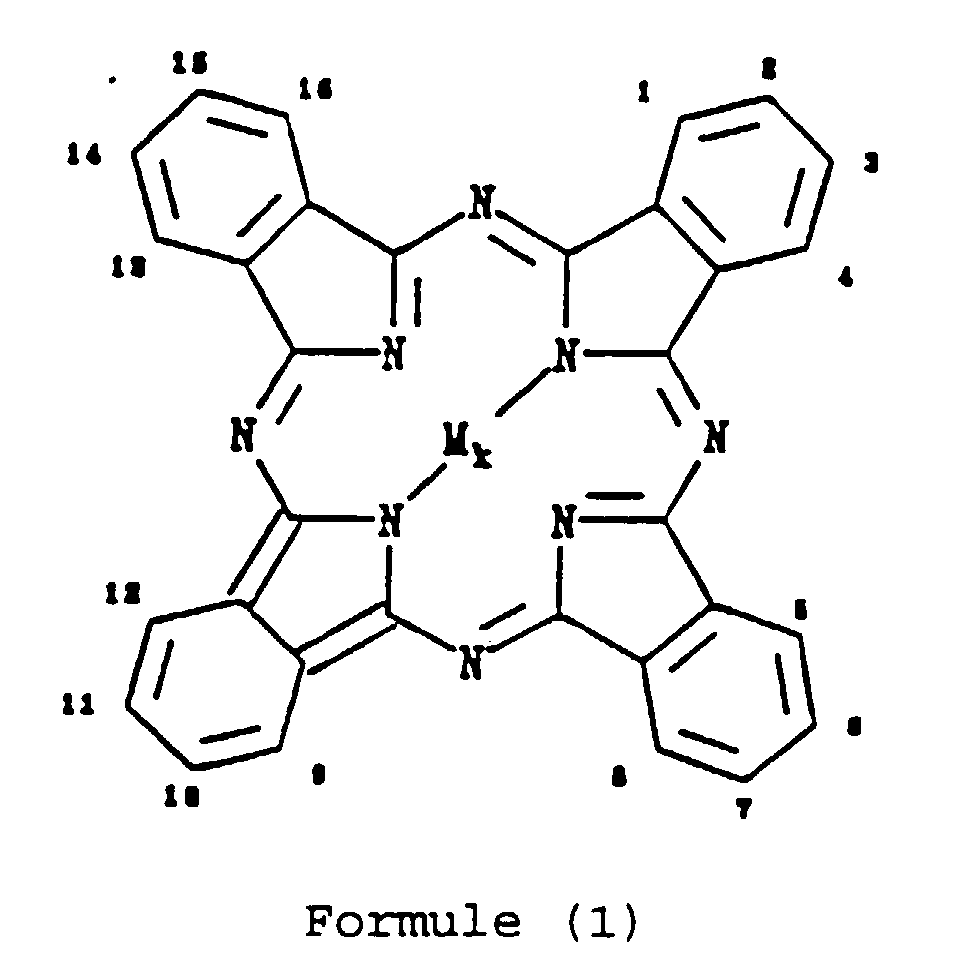 M est choisi entre H, un métal, un groupe halogénométallique, un groupe oxymétallique et un groupe hydroxymétallique ; etk est l'inverse de 1/2 de la valence de M ;est lié par un atome d'oxygène à un radical aromatique et ses dérivés sulfonés comprenant 16 à 30 groupes SO3A dans lesquels A représente H, un métal, un ion ammonium ou un ion ammonium substitué, sous réserve que la phtalocyanine absorbe un rayonnement électromagnétique à une longueur d'onde de 650 nm à 800 nm.
 - Utilisation de phtalocyanines substituées suivant l'une quelconque des revendications 1, 2 et 3, dans laquelle M est choisi dans le groupe comprenant Zn, ClAl, OHAl, ClRh, OHRh, ClIn, BrIn, OHIn, ClGa, OHGa, Pt, Pd, Li, Na, K, Ca, Ba, Mg, ClSc et OHSc.
- Utilisation de phtalocyanines substituées suivant l'une quelconque des revendications 1 à 4, dans laquelle le radical aromatique est un radical phényle ou naphtyle facultativement substitué.
- Utilisation de phtalocyanines substituées suivant la revendication 5, dans laquelle le radical naphtyle facultativement substitué est le radical 2-naphtyle.
- Utilisation de phtalocyanines substituées suivant l'une quelconque des revendications 1 à 6, dans laquelle le radical aromatique est substitué avec un groupe choisi entre des groupes alkyle en C1 à C4, alkoxy en C1 à C4, -NO2 et -SO3A dans lesquels A représente H, un métal ou un ion ammonium.
- Utilisation de phtalocyanines pour la production d'oxygène à liaison à singulet suivant les revendications 1 et 2, dans laquelle les atomes de carbone périphériques restants sont substitués avec un groupe choisi entre H, un halogène et un groupe -SO3A dans lequel A représente H, un métal ou un ion ammonium.
- Utilisation de composés de formule (2) :
Mk Pc (O-R)a Xb (SO3A)d Formule (2)
dans laquelle :MkPc représente un noyau phtalocyanine répondant à la définition en rapport avec la formule (1)chaque groupe R représente indépendamment un radical organique ;chaque groupe X représente, indépendamment, un halogène ou l'hydrogène ;A est choisi entre H, un métal, un ion ammonium ou un ion ammonium substitué répondant à la définition précitée ;a a une valeur de 1 à 16 ;b a une valeur de 0 à 15 ;d a une valeur moyenne entre 16 à 30 ;la somme a+b a une valeur de 1 à 16,pour la production d'oxygène à singulet. - Utilisation de composés de formule (3) :
Mk Pc (O-R1)a Xb Formule (3)
dans laquelle :MkPc répond à la définition mentionnée en rapport avec la formule (1) ;R1 est choisi entre un groupe aryle facultativement substitué et un groupe hétéroaryle facultativement substitué ;X représente un halogène ou H ;a est égal à 8, 12 ou 16 ;b est égal à 8, 4 ou 0 ; etla somme a+b est égale à 16 ;M est choisi entre Zn, ClAl, OHAl, ClRh, OHRh, ClIn, BrIn, OHIn, ClGa, OHGa, Pt, Pd, Li, Na, K, Ca, Ba, Mg, ClSc et OHSc ;à l'exception des composés :ClAlPc(2-naphtyle-O)8H8Li2Pc(2-naphtyle-O)8H8ClGaPc(Ph-O)8H8CIGaPc(Ph-O)8Cl8ClAlPc(2-naphtyle-O)8H8ClGaPc(Ph-O)16ClInPc(2-naphtyle-O)16,pour la production d'oxygène à singulet. - Procédé pour éliminer les taches d'étoffes, qui comprend le traitement des étoffes tachées avec une composition aqueuse comprenant au moins un composé de formule (1), de formule (2) ou de formule (3) répondant à la définition, respectivement, suivant la revendication 1, 9 ou 10, les étoffes étant exposées à la lumière du jour pendant ou après le traitement.
Applications Claiming Priority (4)
| Application Number | Priority Date | Filing Date | Title |
|---|---|---|---|
| GB9023894 | 1990-11-02 | ||
| GB909023894A GB9023894D0 (en) | 1990-11-02 | 1990-11-02 | Poly-substituted phthalocyanines |
| GB9025280 | 1990-11-21 | ||
| GB909025280A GB9025280D0 (en) | 1990-11-21 | 1990-11-21 | Polysubstituted phthalocyanines |
Publications (2)
| Publication Number | Publication Date |
|---|---|
| EP0484027A1 EP0484027A1 (fr) | 1992-05-06 |
| EP0484027B1 true EP0484027B1 (fr) | 1996-12-18 |
Family
ID=26297890
Family Applications (1)
| Application Number | Title | Priority Date | Filing Date |
|---|---|---|---|
| EP91309700A Expired - Lifetime EP0484027B1 (fr) | 1990-11-02 | 1991-10-21 | Phthalocyanines polysubstituées |
Country Status (9)
| Country | Link |
|---|---|
| US (4) | US5486274A (fr) |
| EP (1) | EP0484027B1 (fr) |
| JP (2) | JPH06107662A (fr) |
| AT (1) | ATE146508T1 (fr) |
| AU (1) | AU652962B2 (fr) |
| DE (1) | DE69123704T2 (fr) |
| ES (1) | ES2094795T3 (fr) |
| HK (1) | HK1005191A1 (fr) |
| MY (1) | MY108320A (fr) |
Cited By (6)
| Publication number | Priority date | Publication date | Assignee | Title |
|---|---|---|---|---|
| US8198031B2 (en) | 2003-08-11 | 2012-06-12 | Monogram Biosciences, Inc. | Detecting and profiling molecular complexes |
| US8247180B2 (en) | 2003-07-17 | 2012-08-21 | Monogram Biosciences, Inc. | Measuring receptor homodimerization |
| US8349574B2 (en) | 2009-01-15 | 2013-01-08 | Laboratory Corporation Of America Holdings | Methods of determining patient response by measurement of Her-3 |
| US8470542B2 (en) | 2008-12-01 | 2013-06-25 | Laboratory Corporation Of America Holdings | Methods and assays for measuring p95 and/or p95 complexes in a sample and antibodies specific for p95 |
| USRE44437E1 (en) | 2003-04-01 | 2013-08-13 | Monogram Biosciences, Inc. | Methods for detecting receptor complexes comprising PI3K |
| US9110075B2 (en) | 2001-05-21 | 2015-08-18 | Monogram Biosciences, Inc. | Compositions for analyzing proteins |
Families Citing this family (77)
| Publication number | Priority date | Publication date | Assignee | Title |
|---|---|---|---|---|
| EP0484027B1 (fr) * | 1990-11-02 | 1996-12-18 | Zeneca Limited | Phthalocyanines polysubstituées |
| GB9122798D0 (en) * | 1991-10-28 | 1991-12-11 | Ici Plc | Substituted phthalocyanines |
| JP3208942B2 (ja) * | 1992-11-10 | 2001-09-17 | 日立化成工業株式会社 | 水溶性テトラアザポルフィン、蛍光標識用色素、標識された生物由来物質、これらを含有する試薬及びこれらを用いた蛍光分析法 |
| US5292855A (en) * | 1993-02-18 | 1994-03-08 | Eastman Kodak Company | Water-dissipatable polyesters and amides containing near infrared fluorescent compounds copolymerized therein |
| DE4336512C2 (de) * | 1993-04-23 | 2002-12-12 | Mitsubishi Electric Corp | Verfahren zur Reaktionskontrolle und ein Apparat, wobei Kohlenstoff-Rußmoleküle und organometallische Komplexe in angeregtem Zustand verwendet werden |
| EP0633024A1 (fr) * | 1993-07-09 | 1995-01-11 | Ciba-Geigy Ag | Compositions à base de zinc phtalocyanine pour l'administration topique |
| GB2279657B (en) * | 1993-07-09 | 1998-05-06 | Zeneca Ltd | Phthalocyanine compounds |
| GB9314251D0 (en) * | 1993-07-09 | 1993-08-18 | Zeneca Ltd | Phthalocyanines |
| GB9316820D0 (en) * | 1993-08-12 | 1993-09-29 | Zeneca Ltd | Phthalocyanines |
| GB9317881D0 (en) * | 1993-08-27 | 1993-10-13 | Secr Defence | Photosensitizers |
| US5423432A (en) * | 1993-12-30 | 1995-06-13 | Eastman Chemical Company | Water-dissipatable polyesters and amides containing near infrared fluorescent compounds copolymerized therein |
| JPH07278152A (ja) * | 1994-04-04 | 1995-10-24 | Sun Co Inc R & M | アルカンの酸化及び有機ヒドロペルオキシド類の分解用の金属リガンド触媒 |
| US5908821A (en) * | 1994-05-11 | 1999-06-01 | Procter & Gamble Company | Dye transfer inhibiting compositions with specifically selected metallo catalysts |
| PL317192A1 (en) * | 1994-05-13 | 1997-03-17 | Monsanto Co | Methods of using pernitrite decomposition catalyst and their pharmaceutic compositions |
| US6245758B1 (en) | 1994-05-13 | 2001-06-12 | Michael K. Stern | Methods of use for peroxynitrite decomposition catalysts, pharmaceutical compositions therefor |
| CH690649A5 (de) * | 1995-06-07 | 2000-11-30 | Clariant Finance Bvi Ltd | Phthalocyanin-Reaktivfarbstoffe für Fasern. |
| RU2106146C1 (ru) * | 1995-07-17 | 1998-03-10 | Институт элементоорганических соединений РАН | Средство для подавления опухолевого роста |
| US5916481A (en) * | 1995-07-25 | 1999-06-29 | The Procter & Gamble Company | Low hue photobleaches |
| US5679661A (en) * | 1995-07-25 | 1997-10-21 | The Procter & Gamble Company | Low hue photodisinfectants |
| DE19529853A1 (de) * | 1995-08-14 | 1997-02-20 | Bayer Ag | Aluminium-Phthalocyanin-Reaktivfarbstoffe |
| JP3744981B2 (ja) * | 1995-09-14 | 2006-02-15 | オリヱント化学工業株式会社 | 新規フタロシアニン又はナフタロシアニン誘導体 |
| GB9602095D0 (en) | 1996-02-02 | 1996-04-03 | Zeneca Ltd | Phthalocyanines |
| WO1998016588A1 (fr) * | 1996-10-14 | 1998-04-23 | Nippon Shokubai Co., Ltd. | Composes de phtalocyanine, procede de preparation desdits composes et support d'enregistrement optique les comprenant |
| US5998609A (en) * | 1996-10-14 | 1999-12-07 | Nippon Shokubai Co., Ltd. | Phthalocyanine compounds, process for preparing the same, and optical recording medium made using the same |
| US5990197A (en) * | 1996-10-28 | 1999-11-23 | Eastman Chemical Company | Organic solvent based ink for invisible marking/identification |
| CA2277819A1 (fr) | 1997-01-24 | 1998-07-30 | The Procter & Gamble Company | Generateurs d'oxygene singulet dotes d'un effet renforce d'atome lourd |
| CN1250472A (zh) | 1997-01-24 | 2000-04-12 | 普罗格特-甘布尔公司 | 光化学超氧化物发生剂 |
| JP2001511197A (ja) | 1997-01-24 | 2001-08-07 | ザ、プロクター、エンド、ギャンブル、カンパニー | 向上した一重項酸素収率を有する光化学一重項酸素発生剤 |
| CA2277820A1 (fr) | 1997-01-24 | 1998-07-30 | The Procter & Gamble Company | Generateurs d'oxygene singulet photochimique, comportant des modificateurs d'affinite cationiques |
| DE69815064D1 (de) | 1997-01-24 | 2003-07-03 | Univ Case Western Reserve | Photobleichzusammensetzungen mit wirkung auf angeschmutzte gewebe |
| WO1998032832A1 (fr) * | 1997-01-24 | 1998-07-30 | The Procter & Gamble Company | Agents de blanchiment a faible teinte |
| US6413924B2 (en) | 1997-01-24 | 2002-07-02 | Case Western Reserve University | Photobleaching compositions comprising mixed metallocyanines |
| NZ331196A (en) * | 1997-08-15 | 2000-01-28 | Ciba Sc Holding Ag | Water soluble fabric softener compositions comprising phthalocyanine, a quaternary ammonium compound and a photobleaching agent |
| US6138913A (en) * | 1997-11-05 | 2000-10-31 | Isotag Technology, Inc. | Security document and method using invisible coded markings |
| US6432715B1 (en) | 1998-02-24 | 2002-08-13 | Isotag Technology, Inc. | Method for marking items for identification |
| EP0959123B1 (fr) * | 1998-05-18 | 2004-07-28 | Ciba SC Holding AG | Granules de composés de phthalocyanine solubles dans l'eau |
| ATE272104T1 (de) | 1998-05-18 | 2004-08-15 | Ciba Sc Holding Ag | Wasserlösliche granulate von phthalocyaninverbindungen |
| US6217794B1 (en) | 1998-06-01 | 2001-04-17 | Isotag Technology, Inc. | Fiber coating composition having an invisible marker and process for making same |
| AU765509B2 (en) | 1998-08-28 | 2003-09-18 | Destiny Pharma Limited | Porphyrin derivatives, their use in photodynamic therapy and medical devices containing them |
| US7771929B2 (en) | 2000-04-28 | 2010-08-10 | Monogram Biosciences, Inc. | Tag library compounds, compositions, kits and methods of use |
| US7537938B2 (en) | 2000-04-28 | 2009-05-26 | Monogram Biosciences, Inc. | Biomarker detection in circulating cells |
| US7160735B2 (en) | 2000-04-28 | 2007-01-09 | Monogram Biosciences, Inc. | Tagged microparticle compositions and methods |
| RU2188200C2 (ru) * | 2000-10-04 | 2002-08-27 | Государственный научный центр Российской Федерации "НИОПИК" | β, β, β′, β′-ТЕТРАМЕТИЛТРИАРЕНОТЕТРААЗАХЛОРИНЫ И СПОСОБЫ ИХ ПОЛУЧЕНИЯ |
| HUP0501021A3 (en) | 2001-05-21 | 2006-06-28 | Aclara Biosciences Inc Mountai | Methods and compositions for analyzing proteins |
| US7358052B2 (en) | 2001-05-26 | 2008-04-15 | Monogram Biosciences, Inc. | Catalytic amplification of multiplexed assay signals |
| US6726755B2 (en) | 2002-02-08 | 2004-04-27 | Xerox Corporation | Ink compositions containing phthalocyanines |
| US6476219B1 (en) | 2002-02-08 | 2002-11-05 | Xerox Corporation | Methods for preparing phthalocyanine compositions |
| US6472523B1 (en) | 2002-02-08 | 2002-10-29 | Xerox Corporation | Phthalocyanine compositions |
| AU2003207086A1 (en) * | 2002-02-22 | 2003-09-09 | Konishi Chemical Ind. Co., Ltd. | Color developer and thermal recording material containing the same |
| US7402397B2 (en) | 2002-05-21 | 2008-07-22 | Monogram Biosciences, Inc. | Detecting and profiling molecular complexes |
| JP4443407B2 (ja) | 2002-07-25 | 2010-03-31 | アクララ バイオサイエンシーズ, インコーポレイテッド | レセプターオリゴマー形成の検出 |
| GB2397067B (en) | 2002-12-23 | 2005-05-11 | Destiny Pharma Ltd | Porphin & azaporphin derivatives with at least one cationic-nitrogen-containing meso-substituent for use in photodynamic therapy & in vitro sterilisation |
| WO2004106436A1 (fr) * | 2003-05-30 | 2004-12-09 | York University | Composes de phtalocyanine |
| JP4648637B2 (ja) * | 2004-02-04 | 2011-03-09 | 株式会社日本触媒 | カルボキシル基および/またはスルホン酸基を有するフタロシアニン化合物ならびにその製造方法 |
| JP5204945B2 (ja) * | 2004-06-28 | 2013-06-05 | 三菱化学株式会社 | フタロシアニン化合物の製造方法、並びに電子写真感光体、電子写真感光体カートリッジ及び画像形成装置 |
| US7939267B2 (en) | 2004-11-04 | 2011-05-10 | Laboratory Corporation Of America Holdings | Detection of activation of endothelial cells as surrogate marker for angiogenesis |
| EP2235536A4 (fr) | 2007-12-20 | 2011-05-04 | Lab Corp America Holdings | Procédés de diagnostic du her-2 |
| US20120295259A1 (en) | 2011-05-19 | 2012-11-22 | Laboratory Corporation Of America Holdings | Methods for Determining the Likelihood of Survival and for Predicting Likelihood of Metastasis in Cancer Patients |
| US8206502B2 (en) * | 2008-12-15 | 2012-06-26 | Eastman Kodak Company | Titanyl phthalocyanine with improved milling properties |
| CA2753269C (fr) | 2009-02-20 | 2017-04-25 | Perkinelmer Biosignal, Inc. | Procede d'essai multiplex et composition |
| ES2964574T3 (es) * | 2009-07-21 | 2024-04-08 | Udo Bogner | Sistema de materiales que contiene endoperóxido con adaptación de la desintegración y aplicaciones |
| US8226757B2 (en) * | 2009-10-22 | 2012-07-24 | Hewlett-Packard Development Company, L.P. | Phthalocyanine dye and ink containing the same |
| US20110272273A1 (en) * | 2010-05-07 | 2011-11-10 | Molycorp Minerals, Llc | Lanthanide-mediated photochemical water splitting process for hydrogen and oxygen generation |
| RU2479586C1 (ru) * | 2012-03-13 | 2013-04-20 | Федеральное государственное унитарное предприятие "Государственный научный центр "Научно-исследовательский институт органических полупродуктов и красителей" (ФГУП "ГНЦ "НИОПИК") | Способ получения безметальных тетраазахлоринов |
| JP6016507B2 (ja) * | 2012-08-02 | 2016-10-26 | 株式会社日本触媒 | フタロシアニン化合物およびこれを含む赤外線カットフィルター |
| CA2908515A1 (fr) | 2013-04-05 | 2014-10-09 | Laboratory Corporation Of America Holdings | Systemes et procedes pour faciliter le diagnostic, le pronostic et le traitement d'un cancer sur la base de la detection de l'activation de her3 |
| EP3126455A4 (fr) * | 2014-04-03 | 2017-12-13 | Porter Scientific, Inc. | Revêtements protecteurs auto-nettoyants |
| WO2017161030A1 (fr) | 2016-03-15 | 2017-09-21 | Laboratory Corporation Of America Holdings | Procédés d'évaluation d'interactions de protéines entre des cellules |
| KR102242545B1 (ko) * | 2017-09-27 | 2021-04-19 | 주식회사 엘지화학 | 항균성 고분자 코팅 조성물 및 항균성 고분자 필름 |
| EP3553062A1 (fr) | 2018-04-09 | 2019-10-16 | Chemical Intelligence Limited | Composés antimicrobiens et agents anticancéreux a base de phthalocyanines cationiques |
| US10723694B2 (en) | 2018-10-02 | 2020-07-28 | Kuwait University | Propargyl-functionalized macrocyclic compounds |
| WO2021001442A1 (fr) | 2019-07-01 | 2021-01-07 | Chemical Intelligence Limited | Procédé d'impression de gant médical antimicrobien |
| EP3994216A1 (fr) * | 2019-07-01 | 2022-05-11 | Chemical Intelligence Limited | Colorants antimicrobiens pour masques faciaux |
| CA3145595A1 (fr) | 2019-07-01 | 2021-01-07 | Chemical Intelligence Limited | Colorants antimicrobiens pour vetements de soins de sante |
| WO2021056086A1 (fr) | 2019-09-27 | 2021-04-01 | Mmf&T Desenvolvimento Tecnológico E Inovação Ltda. | Composition pour la santé buccale et procédé d'élaboration d'une composition pour la santé buccale |
| CN113755023B (zh) * | 2021-10-13 | 2023-10-17 | 山东凯瑞尔光电科技有限公司 | 一种颜料衍生物及其制备方法、包含其的颜料组合物及其应用 |
| WO2025263594A1 (fr) * | 2024-06-19 | 2025-12-26 | 三井化学株式会社 | Composé et matériau pour produire de l'oxygène singulet |
Family Cites Families (33)
| Publication number | Priority date | Publication date | Assignee | Title |
|---|---|---|---|---|
| US1489394A (en) * | 1921-09-01 | 1924-04-08 | Charles H Moore | Bucket |
| NL51989C (fr) * | 1938-07-14 | |||
| US2414374A (en) * | 1943-09-20 | 1947-01-14 | Ici Ltd | Metal phthalocyanines having amino- or nitro-phenyl groups attached to their aromatic nuclei by>o, >co, or>so2 |
| DE812261C (de) * | 1950-04-20 | 1951-08-27 | Normalzeit G M B H | Leistungsverstaerker |
| GB1408144A (en) * | 1972-06-02 | 1975-10-01 | Procter & Gamble Ltd | Bleaching process |
| CA1030959A (fr) * | 1973-11-27 | 1978-05-09 | Jost Von Der Crone | Phtalocyanines halogenees et methode de fabrication |
| US4033718A (en) * | 1973-11-27 | 1977-07-05 | The Procter & Gamble Company | Photoactivated bleaching process |
| FR2387658A1 (fr) * | 1977-03-25 | 1978-11-17 | Ciba Geigy Ag | Procede pour combattre les microorganismes |
| GR66580B (fr) * | 1978-01-11 | 1981-03-27 | Procter & Gamble | |
| CA1128258A (fr) * | 1978-01-11 | 1982-07-27 | Nabil Y. Sakkab | Composition de lessive et de blanchiment simultanes des tissus |
| US4256598A (en) * | 1978-01-11 | 1981-03-17 | The Procter & Gamble Company | Composition for combined washing and bleaching of fabrics |
| CA1104451A (fr) * | 1978-02-28 | 1981-07-07 | Manuel Juan De Luque | Traduction non-disponible |
| GB2051855B (en) * | 1979-06-18 | 1983-09-14 | Sasol One Ltd | Converting coal into liquid products |
| MX155643A (es) * | 1980-02-29 | 1988-04-11 | Ciba Geigy Ag | Composicion blanqueadora de telas |
| IN155696B (fr) * | 1980-09-09 | 1985-02-23 | Ciba Geigy Ag | |
| ATE12254T1 (de) * | 1980-12-22 | 1985-04-15 | Unilever Nv | Einen photoaktivator enthaltende zusammensetzung mit verbesserter bleichwirkung. |
| CH657864A5 (de) * | 1984-02-17 | 1986-09-30 | Ciba Geigy Ag | Wasserloesliche phthalocyaninverbindungen und deren verwendung als photoaktivatoren. |
| CH658771A5 (de) * | 1984-05-28 | 1986-12-15 | Ciba Geigy Ag | Azaphthalocyanine und deren verwendung als photoaktivatoren. |
| JPS61198241A (ja) * | 1985-02-28 | 1986-09-02 | Tdk Corp | 電子写真感光体 |
| JPH0749231B2 (ja) * | 1985-08-13 | 1995-05-31 | 三菱化学株式会社 | 光学記録体 |
| USH477H (en) * | 1985-08-21 | 1988-06-07 | United States Of America | Monolayer-forming substituted phthalocyanine compounds and method of preparation thereof |
| JPH0768544B2 (ja) * | 1986-11-28 | 1995-07-26 | ライオン株式会社 | 着色高嵩密度粒状洗剤組成物 |
| DE3643770A1 (de) * | 1986-12-20 | 1988-06-30 | Basf Ag | Mono- und disubstituierte phthalocyanine |
| GB8806016D0 (en) * | 1988-03-14 | 1988-04-13 | Danochemo As | Encapsulated photoactivator dyes for detergent use |
| US5109016A (en) * | 1988-05-23 | 1992-04-28 | Georgia State University Foundation, Inc. | Method for inhibiting infection or replication of human immunodeficiency virus with porphyrin and phthalocyanine antiviral compositions |
| CA2005520A1 (fr) * | 1988-12-15 | 1990-06-15 | Hisato Itoh | Absorbant d'infrarouge proche et materiaux d'affichage ou d'enregistrement fabriques avec cet absorbant |
| US4935498A (en) * | 1989-03-06 | 1990-06-19 | Board Of Regents, The University Of Texas System | Expanded porphyrins: large porphyrin-like tripyrroledimethine-derived macrocycles |
| US5162509A (en) * | 1989-03-06 | 1992-11-10 | Board Of Regents, The University Of Texas System | Process for preparing expanded porphyrins: large porphyrin-like tripyrroledimethine-derived macrocycles |
| EP0390743A1 (fr) * | 1989-03-31 | 1990-10-03 | Ciba-Geigy Ag | Pesticides à activité modifiée |
| US5149800A (en) * | 1989-06-26 | 1992-09-22 | Milliken Research Corporation | Poly(oxyalkylene) modified phthalocyanine colorants |
| US5120411A (en) * | 1989-12-21 | 1992-06-09 | Board Of Regents, The University Of Texas System | Photodynamic activity of sapphyrins |
| EP0484027B1 (fr) * | 1990-11-02 | 1996-12-18 | Zeneca Limited | Phthalocyanines polysubstituées |
| GB9314251D0 (en) * | 1993-07-09 | 1993-08-18 | Zeneca Ltd | Phthalocyanines |
-
1991
- 1991-10-21 EP EP91309700A patent/EP0484027B1/fr not_active Expired - Lifetime
- 1991-10-21 DE DE69123704T patent/DE69123704T2/de not_active Expired - Fee Related
- 1991-10-21 AT AT91309700T patent/ATE146508T1/de not_active IP Right Cessation
- 1991-10-21 ES ES91309700T patent/ES2094795T3/es not_active Expired - Lifetime
- 1991-10-24 AU AU86080/91A patent/AU652962B2/en not_active Ceased
- 1991-10-31 JP JP3285946A patent/JPH06107662A/ja active Pending
- 1991-11-01 MY MYPI91002020A patent/MY108320A/en unknown
-
1994
- 1994-11-17 US US08/344,682 patent/US5486274A/en not_active Expired - Fee Related
-
1995
- 1995-10-25 US US08/548,175 patent/US5608053A/en not_active Expired - Fee Related
- 1995-10-25 US US08/548,171 patent/US5730759A/en not_active Expired - Fee Related
- 1995-10-25 US US08/548,173 patent/US5847114A/en not_active Expired - Fee Related
-
1998
- 1998-05-20 HK HK98104376A patent/HK1005191A1/en not_active IP Right Cessation
-
2000
- 2000-07-25 JP JP2000223985A patent/JP2001064284A/ja active Pending
Cited By (9)
| Publication number | Priority date | Publication date | Assignee | Title |
|---|---|---|---|---|
| US9110075B2 (en) | 2001-05-21 | 2015-08-18 | Monogram Biosciences, Inc. | Compositions for analyzing proteins |
| USRE44437E1 (en) | 2003-04-01 | 2013-08-13 | Monogram Biosciences, Inc. | Methods for detecting receptor complexes comprising PI3K |
| US8247180B2 (en) | 2003-07-17 | 2012-08-21 | Monogram Biosciences, Inc. | Measuring receptor homodimerization |
| US8198031B2 (en) | 2003-08-11 | 2012-06-12 | Monogram Biosciences, Inc. | Detecting and profiling molecular complexes |
| US8470542B2 (en) | 2008-12-01 | 2013-06-25 | Laboratory Corporation Of America Holdings | Methods and assays for measuring p95 and/or p95 complexes in a sample and antibodies specific for p95 |
| US9081019B2 (en) | 2008-12-01 | 2015-07-14 | Laboratory Corporation Of America Holdings | Methods and assays for measuring p95 and/or p95 complexes in a sample and antibodies specific for p95 |
| US10273308B2 (en) | 2008-12-01 | 2019-04-30 | Laboratory Corporation Of America Holdings | Methods of producing antibodies specific for p95 |
| US8349574B2 (en) | 2009-01-15 | 2013-01-08 | Laboratory Corporation Of America Holdings | Methods of determining patient response by measurement of Her-3 |
| US9110066B2 (en) | 2009-01-15 | 2015-08-18 | Laboratory Corporation Of America Holdings | HER-3 antibodies and methods of use |
Also Published As
| Publication number | Publication date |
|---|---|
| US5730759A (en) | 1998-03-24 |
| US5486274A (en) | 1996-01-23 |
| JP2001064284A (ja) | 2001-03-13 |
| US5847114A (en) | 1998-12-08 |
| JPH06107662A (ja) | 1994-04-19 |
| ATE146508T1 (de) | 1997-01-15 |
| HK1005191A1 (en) | 1998-12-24 |
| DE69123704D1 (de) | 1997-01-30 |
| EP0484027A1 (fr) | 1992-05-06 |
| AU8608091A (en) | 1992-05-07 |
| AU652962B2 (en) | 1994-09-15 |
| DE69123704T2 (de) | 1997-04-30 |
| MY108320A (en) | 1996-09-30 |
| US5608053A (en) | 1997-03-04 |
| ES2094795T3 (es) | 1997-02-01 |
Similar Documents
| Publication | Publication Date | Title |
|---|---|---|
| US5608053A (en) | Poly-substituted phthalocyanines | |
| HK1005191B (en) | Polysubstituted phthalocyanines | |
| KR100262995B1 (ko) | 저색조 광표백제 | |
| EP0054992B1 (fr) | Composition contenant un activateur de photo ayant un blanchiment amélioré | |
| CA1128258A (fr) | Composition de lessive et de blanchiment simultanes des tissus | |
| KR100262996B1 (ko) | 저색조 광살균제를 사용하여 살균하는 방법 | |
| US4166718A (en) | Process for bleaching textiles | |
| US4657554A (en) | Water-soluble azaphthalocyanines and their use as photoactivators in bleaching | |
| JPH0446922B2 (fr) | ||
| JPH0517485A (ja) | 水溶性の亜鉛−又はアルミニウム−フタロシアニンを含む洗剤又は浸漬剤組成物 | |
| CA1125957A (fr) | Compose pour le lessivage et la decoloration des tissus | |
| JP2001509192A (ja) | 低色相のフォトブリーチ | |
| JP2001509193A (ja) | 黒ずんだ布帛に有効な光漂白組成物 | |
| US6297207B1 (en) | Photochemical singlet oxygen generations having enhanced singlet oxygen yields | |
| US5484915A (en) | Sulphonated manganese phthalocyanines and compositions thereof | |
| GB2260996A (en) | Singlet oxygen generation by substituted phthalocyanines | |
| GB2279657A (en) | Phthalocyanines | |
| Saka et al. | Synthesis, characterization, photophysical and photochemical properties of tetra-2-[2-(benzothiazolylthio)] ethoxy substituted phthalocyanine derivatives | |
| KR100265395B1 (ko) | 저색조 광표백제 | |
| MXPA99006897A (en) | Photochemical singlet oxygen generators having enhanced singlet oxygen yields | |
| PL148975B1 (en) | Method for manufacturing new nucleoside derivatives | |
| JP3579719B2 (ja) | 布帛の漂白方法 |
Legal Events
| Date | Code | Title | Description |
|---|---|---|---|
| PUAI | Public reference made under article 153(3) epc to a published international application that has entered the european phase |
Free format text: ORIGINAL CODE: 0009012 |
|
| AK | Designated contracting states |
Kind code of ref document: A1 Designated state(s): AT BE CH DE DK ES FR GB GR IT LI LU NL SE |
|
| 17P | Request for examination filed |
Effective date: 19920929 |
|
| RAP1 | Party data changed (applicant data changed or rights of an application transferred) |
Owner name: ZENECA LIMITED |
|
| 17Q | First examination report despatched |
Effective date: 19940110 |
|
| GRAH | Despatch of communication of intention to grant a patent |
Free format text: ORIGINAL CODE: EPIDOS IGRA |
|
| GRAH | Despatch of communication of intention to grant a patent |
Free format text: ORIGINAL CODE: EPIDOS IGRA |
|
| GRAA | (expected) grant |
Free format text: ORIGINAL CODE: 0009210 |
|
| RAP1 | Party data changed (applicant data changed or rights of an application transferred) |
Owner name: IMPERIAL CHEMICAL INDUSTRIES PLC Owner name: ZENECA LIMITED |
|
| AK | Designated contracting states |
Kind code of ref document: B1 Designated state(s): AT BE CH DE DK ES FR GB GR IT LI LU NL SE |
|
| PG25 | Lapsed in a contracting state [announced via postgrant information from national office to epo] |
Ref country code: NL Free format text: LAPSE BECAUSE OF FAILURE TO SUBMIT A TRANSLATION OF THE DESCRIPTION OR TO PAY THE FEE WITHIN THE PRESCRIBED TIME-LIMIT Effective date: 19961218 Ref country code: GR Free format text: LAPSE BECAUSE OF FAILURE TO SUBMIT A TRANSLATION OF THE DESCRIPTION OR TO PAY THE FEE WITHIN THE PRESCRIBED TIME-LIMIT Effective date: 19961218 Ref country code: DK Effective date: 19961218 Ref country code: AT Effective date: 19961218 |
|
| REF | Corresponds to: |
Ref document number: 146508 Country of ref document: AT Date of ref document: 19970115 Kind code of ref document: T |
|
| REG | Reference to a national code |
Ref country code: CH Ref legal event code: NV Representative=s name: A. BRAUN, BRAUN, HERITIER, ESCHMANN AG PATENTANWAE |
|
| REF | Corresponds to: |
Ref document number: 69123704 Country of ref document: DE Date of ref document: 19970130 |
|
| REG | Reference to a national code |
Ref country code: ES Ref legal event code: FG2A Ref document number: 2094795 Country of ref document: ES Kind code of ref document: T3 |
|
| ET | Fr: translation filed | ||
| ITF | It: translation for a ep patent filed | ||
| PG25 | Lapsed in a contracting state [announced via postgrant information from national office to epo] |
Ref country code: SE Effective date: 19970318 |
|
| NLV1 | Nl: lapsed or annulled due to failure to fulfill the requirements of art. 29p and 29m of the patents act | ||
| PLBE | No opposition filed within time limit |
Free format text: ORIGINAL CODE: 0009261 |
|
| STAA | Information on the status of an ep patent application or granted ep patent |
Free format text: STATUS: NO OPPOSITION FILED WITHIN TIME LIMIT |
|
| PG25 | Lapsed in a contracting state [announced via postgrant information from national office to epo] |
Ref country code: LU Free format text: LAPSE BECAUSE OF NON-PAYMENT OF DUE FEES Effective date: 19971031 |
|
| 26N | No opposition filed | ||
| PGFP | Annual fee paid to national office [announced via postgrant information from national office to epo] |
Ref country code: GB Payment date: 20010914 Year of fee payment: 11 |
|
| REG | Reference to a national code |
Ref country code: CH Ref legal event code: PUE Owner name: SYNGENTA LIMITED TRANSFER- AVECIA LIMITED Ref country code: CH Ref legal event code: PFA Free format text: ZENECA LIMITED TRANSFER- SYNGENTA LIMITED |
|
| PGFP | Annual fee paid to national office [announced via postgrant information from national office to epo] |
Ref country code: BE Payment date: 20011004 Year of fee payment: 11 |
|
| PGFP | Annual fee paid to national office [announced via postgrant information from national office to epo] |
Ref country code: ES Payment date: 20011009 Year of fee payment: 11 |
|
| PGFP | Annual fee paid to national office [announced via postgrant information from national office to epo] |
Ref country code: FR Payment date: 20011010 Year of fee payment: 11 |
|
| PGFP | Annual fee paid to national office [announced via postgrant information from national office to epo] |
Ref country code: DE Payment date: 20011105 Year of fee payment: 11 |
|
| PGFP | Annual fee paid to national office [announced via postgrant information from national office to epo] |
Ref country code: CH Payment date: 20011114 Year of fee payment: 11 |
|
| REG | Reference to a national code |
Ref country code: GB Ref legal event code: IF02 |
|
| REG | Reference to a national code |
Ref country code: FR Ref legal event code: TP |
|
| PG25 | Lapsed in a contracting state [announced via postgrant information from national office to epo] |
Ref country code: GB Free format text: LAPSE BECAUSE OF NON-PAYMENT OF DUE FEES Effective date: 20021021 |
|
| PG25 | Lapsed in a contracting state [announced via postgrant information from national office to epo] |
Ref country code: ES Free format text: LAPSE BECAUSE OF NON-PAYMENT OF DUE FEES Effective date: 20021022 |
|
| PG25 | Lapsed in a contracting state [announced via postgrant information from national office to epo] |
Ref country code: LI Free format text: LAPSE BECAUSE OF NON-PAYMENT OF DUE FEES Effective date: 20021031 Ref country code: CH Free format text: LAPSE BECAUSE OF NON-PAYMENT OF DUE FEES Effective date: 20021031 Ref country code: BE Free format text: LAPSE BECAUSE OF NON-PAYMENT OF DUE FEES Effective date: 20021031 |
|
| BERE | Be: lapsed |
Owner name: *IMPERIAL CHEMICAL INDUSTRIES P.L.C. Effective date: 20021031 |
|
| PG25 | Lapsed in a contracting state [announced via postgrant information from national office to epo] |
Ref country code: DE Free format text: LAPSE BECAUSE OF NON-PAYMENT OF DUE FEES Effective date: 20030501 |
|
| GBPC | Gb: european patent ceased through non-payment of renewal fee |
Effective date: 20021021 |
|
| REG | Reference to a national code |
Ref country code: CH Ref legal event code: PL |
|
| PG25 | Lapsed in a contracting state [announced via postgrant information from national office to epo] |
Ref country code: FR Free format text: LAPSE BECAUSE OF NON-PAYMENT OF DUE FEES Effective date: 20030630 |
|
| REG | Reference to a national code |
Ref country code: FR Ref legal event code: ST |
|
| REG | Reference to a national code |
Ref country code: ES Ref legal event code: FD2A Effective date: 20031112 |
|
| PG25 | Lapsed in a contracting state [announced via postgrant information from national office to epo] |
Ref country code: IT Free format text: LAPSE BECAUSE OF NON-PAYMENT OF DUE FEES;WARNING: LAPSES OF ITALIAN PATENTS WITH EFFECTIVE DATE BEFORE 2007 MAY HAVE OCCURRED AT ANY TIME BEFORE 2007. THE CORRECT EFFECTIVE DATE MAY BE DIFFERENT FROM THE ONE RECORDED. Effective date: 20051021 |