EP0484865B1 - Glasfasersensor für Kaliumionen - Google Patents
Glasfasersensor für Kaliumionen Download PDFInfo
- Publication number
- EP0484865B1 EP0484865B1 EP91118793A EP91118793A EP0484865B1 EP 0484865 B1 EP0484865 B1 EP 0484865B1 EP 91118793 A EP91118793 A EP 91118793A EP 91118793 A EP91118793 A EP 91118793A EP 0484865 B1 EP0484865 B1 EP 0484865B1
- Authority
- EP
- European Patent Office
- Prior art keywords
- sensor
- detector
- radiation
- rhodamine
- molecule
- Prior art date
- Legal status (The legal status is an assumption and is not a legal conclusion. Google has not performed a legal analysis and makes no representation as to the accuracy of the status listed.)
- Expired - Lifetime
Links
Images

Classifications
-
- G—PHYSICS
- G01—MEASURING; TESTING
- G01N—INVESTIGATING OR ANALYSING MATERIALS BY DETERMINING THEIR CHEMICAL OR PHYSICAL PROPERTIES
- G01N21/00—Investigating or analysing materials by the use of optical means, i.e. using sub-millimetre waves, infrared, visible or ultraviolet light
- G01N21/62—Systems in which the material investigated is excited whereby it emits light or causes a change in wavelength of the incident light
- G01N21/63—Systems in which the material investigated is excited whereby it emits light or causes a change in wavelength of the incident light optically excited
- G01N21/64—Fluorescence; Phosphorescence
- G01N21/6428—Measuring fluorescence of fluorescent products of reactions or of fluorochrome labelled reactive substances, e.g. measuring quenching effects, using measuring "optrodes"
- G01N21/643—Measuring fluorescence of fluorescent products of reactions or of fluorochrome labelled reactive substances, e.g. measuring quenching effects, using measuring "optrodes" non-biological material
-
- C—CHEMISTRY; METALLURGY
- C09—DYES; PAINTS; POLISHES; NATURAL RESINS; ADHESIVES; COMPOSITIONS NOT OTHERWISE PROVIDED FOR; APPLICATIONS OF MATERIALS NOT OTHERWISE PROVIDED FOR
- C09K—MATERIALS FOR MISCELLANEOUS APPLICATIONS, NOT PROVIDED FOR ELSEWHERE
- C09K11/00—Luminescent materials, e.g. electroluminescent or chemiluminescent
- C09K11/06—Luminescent materials, e.g. electroluminescent or chemiluminescent containing organic luminescent materials
-
- G—PHYSICS
- G01—MEASURING; TESTING
- G01N—INVESTIGATING OR ANALYSING MATERIALS BY DETERMINING THEIR CHEMICAL OR PHYSICAL PROPERTIES
- G01N31/00—Investigating or analysing non-biological materials by the use of the chemical methods specified in the subgroup; Apparatus specially adapted for such methods
- G01N31/22—Investigating or analysing non-biological materials by the use of the chemical methods specified in the subgroup; Apparatus specially adapted for such methods using chemical indicators
-
- G—PHYSICS
- G01—MEASURING; TESTING
- G01N—INVESTIGATING OR ANALYSING MATERIALS BY DETERMINING THEIR CHEMICAL OR PHYSICAL PROPERTIES
- G01N33/00—Investigating or analysing materials by specific methods not covered by groups G01N1/00 - G01N31/00
- G01N33/48—Biological material, e.g. blood, urine; Haemocytometers
- G01N33/50—Chemical analysis of biological material, e.g. blood, urine; Testing involving biospecific ligand binding methods; Immunological testing
- G01N33/84—Chemical analysis of biological material, e.g. blood, urine; Testing involving biospecific ligand binding methods; Immunological testing involving inorganic compounds or pH
-
- G—PHYSICS
- G01—MEASURING; TESTING
- G01N—INVESTIGATING OR ANALYSING MATERIALS BY DETERMINING THEIR CHEMICAL OR PHYSICAL PROPERTIES
- G01N21/00—Investigating or analysing materials by the use of optical means, i.e. using sub-millimetre waves, infrared, visible or ultraviolet light
- G01N21/62—Systems in which the material investigated is excited whereby it emits light or causes a change in wavelength of the incident light
- G01N21/63—Systems in which the material investigated is excited whereby it emits light or causes a change in wavelength of the incident light optically excited
- G01N21/64—Fluorescence; Phosphorescence
- G01N21/645—Specially adapted constructive features of fluorimeters
- G01N2021/6484—Optical fibres
-
- G—PHYSICS
- G01—MEASURING; TESTING
- G01N—INVESTIGATING OR ANALYSING MATERIALS BY DETERMINING THEIR CHEMICAL OR PHYSICAL PROPERTIES
- G01N21/00—Investigating or analysing materials by the use of optical means, i.e. using sub-millimetre waves, infrared, visible or ultraviolet light
- G01N21/75—Systems in which material is subjected to a chemical reaction, the progress or the result of the reaction being investigated
- G01N21/77—Systems in which material is subjected to a chemical reaction, the progress or the result of the reaction being investigated by observing the effect on a chemical indicator
- G01N21/7703—Systems in which material is subjected to a chemical reaction, the progress or the result of the reaction being investigated by observing the effect on a chemical indicator using reagent-clad optical fibres or optical waveguides
- G01N2021/7706—Reagent provision
- G01N2021/772—Tip coated light guide
-
- G—PHYSICS
- G01—MEASURING; TESTING
- G01N—INVESTIGATING OR ANALYSING MATERIALS BY DETERMINING THEIR CHEMICAL OR PHYSICAL PROPERTIES
- G01N21/00—Investigating or analysing materials by the use of optical means, i.e. using sub-millimetre waves, infrared, visible or ultraviolet light
- G01N21/75—Systems in which material is subjected to a chemical reaction, the progress or the result of the reaction being investigated
- G01N21/77—Systems in which material is subjected to a chemical reaction, the progress or the result of the reaction being investigated by observing the effect on a chemical indicator
- G01N2021/7769—Measurement method of reaction-produced change in sensor
- G01N2021/7786—Fluorescence
-
- Y—GENERAL TAGGING OF NEW TECHNOLOGICAL DEVELOPMENTS; GENERAL TAGGING OF CROSS-SECTIONAL TECHNOLOGIES SPANNING OVER SEVERAL SECTIONS OF THE IPC; TECHNICAL SUBJECTS COVERED BY FORMER USPC CROSS-REFERENCE ART COLLECTIONS [XRACs] AND DIGESTS
- Y10—TECHNICAL SUBJECTS COVERED BY FORMER USPC
- Y10S—TECHNICAL SUBJECTS COVERED BY FORMER USPC CROSS-REFERENCE ART COLLECTIONS [XRACs] AND DIGESTS
- Y10S436/00—Chemistry: analytical and immunological testing
- Y10S436/805—Optical property
Definitions
- the present invention relates to sensors, and more particularly, to a sensor that can selectively recognize and transduce the change in potassium ion concentration into a measurable optical signal, as well as to a detector employing such sensor.
- fiber-optic sensors have been developed for in vivo measurement of pH, pCO 2 and pO 2 .
- Important advantages of the optical approach are stability with respect to calibration, absence of electrical hazard and the relative ease of miniaturization. Accordingly, attempts have been made to develop fiber-optic sensors for in vivo measurement of alkali metal ions. Fluorescent probes made by fusing ion selective cryptands with 4-methyl-coumarin dyes are known. However, this scheme is not reversible and therefore not useful for continuous measurements.
- alkali metal ions e.g. potassium and lithium ions
- ionophores and fluorescent counterions e.g. phenolic chromoionohores with umbelliferone units show Li + and K + affinity.
- Tsien et al., in EP-A-0 369 733, have described fluorescent chelator compounds for measuring alkali metal cations.
- the compounds described by Tsien are comprised of crown eithers with at least one core nitrogen and that are linked via the core nitrogen to at least one fluorophore.
- a sensor having the features of claim 1 for detecting the concentration of potassium ions.
- the sensor permits transducing the changes in the potassium ion concentration into a corresponding changes in the fluorescent signal emitted by a fluorophore immobilized in a ion permeable polymer matrix containing an ion-selective ionophore.
- the components of the sensor described herein are chosen so as to allow easy miniaturization and adoption in the existing modality for real time in vivo measurement of blood parameters such as pH, pCO 2 , pO 2 , and arterial pressure. However, the technique is applicable for any application of ion measurements.
- a detector employing the sensor of the invention comprises the features of claim 5.
- the sensor of the invention avoids the problems associated with earlier potassium probes, and is not affected by the corrosive nature of blood, nor is it of an unsuitably large size. Finally, the sensor of the invention avoids any electrical hazard.
- the mechanism of potassium ion sensing can be explained as a two-step process.
- the first step involves selectively recognizing potassium ions.
- the second step involves changing the fluorescence of a fluorophore in a one-to-one correspondence with the concentration of potassium ions in a solution to which the sensor is exposed.
- the two steps are combined in a novel way.
- the selectivity to potassium ion is achieved by using an ionophore which has excellent selectivity to potassium ions.
- the preferred ionophore is 2,2-bis(3,4-(15-crown-5)-2-nitrophenylcarboxymethyl]tetradecane (BME-44):
- the bis-crown ether causes a local charge separation (of the potassium cation and its counterion). This disturbs the local electrical potential.
- this change in electrical potential is sensed optically by a potential sensitive fluorophore, Rhodamine-B:
- suitable fluorophores employed in the practice of the invention include Rhodamine-110, Fluorescein, 2,7'-dichlorfluorescein, and the like.
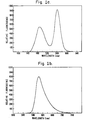
- Rhodamine-B has an excitation maximum in the green part of the visible spectrum and a fluorescence maximum in the red part (see FIGS. 1A and 1B). Changes in the electronic ambient of this fluorophore changes the amount of fluorescence emitted.
- Rhodamine-B is bound to BME-44 and immobilized in a hydrophilic polymer.
- the lyophilic group linking the two 15-crown-5 groups folds such that a hydrogen bond is formed between O of NO, near one crown group and H of NH group near the other crown group.
- the folding of the two 15-crown-5 groups has been described by J. Tarkali et al, in Analytica Chemica Acta , Vol. 178, pp. 231-237 (1985).
- the two crown groups then align over each other in such a way as to form a sandwich complex with the potassium ion.
- the conformational changes and the bond distances in the complex are such that these are possible only in the presence of a potassium ion, other ions being either too large or unable to form the required number of bonds for the complex formation.
- the potential changes near the Rhodamine-B molecules are exclusively due to the binding of potassium ions. This leads to changes in fluorescence of Rhodamine-B that are specifically due to potassium ions.
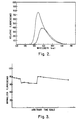
- FIG. 2 shows a typical change in the fluorescence spectrum of Rhodamine-B which is trapped in an organic phase along with BME-44 and then exposed to aqueous solutions.
- FIG. 3 shows the changes in the fluorescence emitted by Rhodamine-B trapped in a polyvinyl chloride membrane along with BME-44 and a plasticizer when this membrane is exposed to different potassium ion concentrations.
- Step 1 Synthesis of 4-nitro(15-crown-5)-3-phenylisocyanate.
- the starting material was a benzo-15-crown-5 compound (Aldrich 28,279-0) (I) which was nitrated according to the procedure by R. Ungaro et al., Journal of the American Chemical Society , Vol. 98, pp. 5198-5202 (1976): To the benzo-15-crown-5 (I) dissolved in a mixture of chloroform and acetic acid was added 70% nitric acid. The mixture was stirred for 24 hours at room temperature, then neutralized with aqueous sodium carbonate and the chloroform layer separated. The aqueous layer is extracted with chloroform and the combined chloroform extracts are dried over magnesium sulfate. After evaporation of the solvent and recrystallization from ethanol, a pure compound (II) was obtained (yield: 85%).
- This nitrobenzo-15-crown-5 (II) was reduced and nitrated by catalytic hydrogenation according to L. Toke et al., Liebigs Annalen der Chemie , 349-353 (1988): A methanol/water solution of 4-nitrobenzo-15-crown-5 (II) was hydrogenated at 50 atm. hydrogen pressure in the presence of Raney Ni. After filtering off the catalyst, the mother liquor was evaporated to dryness, the oily residue (III) was mixed with glacial acetic acid and acetic anhydride and nitrated with nitric acid (70%) below 60°C.
- Step 2 Preparation of the bi-urethane derivative.
- 1-bromododecanol-12 (Aldrich 22,467-7) (VII) was converted to an ester using a procedure similar to the one described by Shigley et al., Journal of the American Oil Chemists Society , Vol. 32, p. 213 (1955): 1-bromo-dodecanol-12 (VII) was dissolved in benzene and refluxed with acetanhydride to get 1-bromo-12-dodecylacetate (VIII). After washing with aqueous sodium carbonate solution, drying, and removing the solvent, this product was used for the following reaction.
- Step 3 Formation of Hydroxy-BME-44 (XII).
- FIG. 4 depicts a device in accordance with the invention, incorporating the sensor 10 of the invention.
- the device consists of an optical fiber 12, such as a multi-mode, step index silica fiber commonly used in communication cables.
- One end of the fiber 12a is connected to the optoelectronic front end (described below in reference to FIG. 5).
- the other end 12b of the fiber is suitably polished and inserted in a hydrophilic tubular membrane 14, such as a dialysis tubing.
- the tubing prevents the gel from getting into the blood and also provides support for the device.
- polyacrylamide gel 16 which is synthesized as described above.
- the length of the gel is adjusted to be about 100 ⁇ m, although other lengths may also be used, and a stainless steel wire 18 polished at one end is inserted in the tubing so as to act as a reflector of light coming from the optical fiber 12 and passing through the gel 16.
- Other metals may be used as a reflector, so long as they are biocompatible with blood.
- the membrane tubing 14 is sealed to the fiber 12 at one end and to the wire 18 at the other end with an epoxy 20. Any of the well-known medical grade epoxies may be used.
- the optoelectronics is shown in FIG. 5 and consists of a source 22 of radiation, such as a light emitting diode emitting radiation at about 510 nm.
- This radiation is coupled from an optical fiber 12' into the optical fiber 12 by a wavelength division multiplexer.
- the multiplexer consists of lenses 24 and 26 and a combination of a dichroic mirror 28 and a red pass filter 30.
- the radiation emerging from the source 22 is collimated by the lens 24 and reflected by the dichroic mirror 28.
- the dichroic mirror is selected such that it reflects the radiation of wavelengths lower than 540 nm and transmits the rest.
- the reflected beam is focussed by the lens 24 into the sensor 10.
- the fluorescent radiation emitted by Rhodamine-B in the gel 16 after being excited by incoming radiation is collimated by the lens 24 onto the red pass filter 30.
- the filter is so chosen that it allows only the radiation of wavelengths higher than 540 nm to pass through.
- This radiation is collected by the lens 26 and is focussed ontc a detector 32 through an optical fiber 12".
- the detector 32 generates a current in proportion to the intensity of the incident radiation. The magnitude of this current increases with increasing concentration of potassium in a solution to which the sensor is exposed.
- the sensor of the invention is immersed in the arterial stream of the patient.
- the porous membrane 14 prevents large proteins and blood cells from getting into the gel 16.
- Most gases and all the inorganic ions (hydrated or not) easily pass through the membrane and into the gel.
- the optical fiber 12 is sufficiently long and goes all the way from the sensor to the optoelectronics front-end (about 3 meters), passing through the arterial catheter.
- the invention is suitably employed in the detection and determination of potassium concentration, particularly in bodily fluids.
Landscapes
- Health & Medical Sciences (AREA)
- Life Sciences & Earth Sciences (AREA)
- Chemical & Material Sciences (AREA)
- Immunology (AREA)
- Molecular Biology (AREA)
- Engineering & Computer Science (AREA)
- Physics & Mathematics (AREA)
- Pathology (AREA)
- Analytical Chemistry (AREA)
- Biochemistry (AREA)
- General Health & Medical Sciences (AREA)
- General Physics & Mathematics (AREA)
- Biomedical Technology (AREA)
- Urology & Nephrology (AREA)
- Hematology (AREA)
- Cell Biology (AREA)
- Food Science & Technology (AREA)
- Biotechnology (AREA)
- Biophysics (AREA)
- Materials Engineering (AREA)
- Microbiology (AREA)
- Organic Chemistry (AREA)
- Inorganic Chemistry (AREA)
- Medicinal Chemistry (AREA)
- Chemical Kinetics & Catalysis (AREA)
- Optics & Photonics (AREA)
- Nuclear Medicine, Radiotherapy & Molecular Imaging (AREA)
- Investigating Or Analysing Materials By The Use Of Chemical Reactions (AREA)
- Luminescent Compositions (AREA)
- Investigating Or Analyzing Non-Biological Materials By The Use Of Chemical Means (AREA)
- Measurement Of The Respiration, Hearing Ability, Form, And Blood Characteristics Of Living Organisms (AREA)
Claims (11)
- Sensor (10) zum Erfassen der Konzentration von Kaliumionen mit einem Molekül, welches aus 2,2-bis[3,4-([15]Krone-5)-2-Nitrophenylcarboximethyl]-Tetradecan besteht, wobei das Molekül wenigstens eine Bindungsstelle aufweist und eine Fluorophor-Gruppe bei dieser Stelle hat und auf einem hydrophilen Polymer immobilisiert ist.
- Sensor nach Anspruch 1, bei dem die Bindungsstelle das 14. Kohlenstoffatom der Tetradecanhälfte umfaßt, an welcher die Fluorophor -Gruppe befestigt ist.
- Sensor nach Anspruch 1 oder 2, bei dem die Fluorophor-Gruppe aus einer Gruppe ausgewählt wird, die aus Rhodamin-B, Rhodamin-110, Fluoreszin und 2,7'-Dichlorfluoreszin besteht.
- Sensor nach Anspruch 1, bei dem das Molekül einen Alkylteil mit einem freien Ende hat und die Bindungsstelle bei diesem freien Ende liegt.
- Detektor zum Erfassen der Konzentration von Kaliumionen, mit folgenden Merkmalen:(a) einer Quelle (22) für elektromagnetische Strahlung;(b) einem Sensor (10) mit einem Molekül, welches aus 2,2-bis[3,4-([15]Krone-5)-2-Nitrophenylcarboximethil]-Tetradecan besteht, wobei das Molekül wenigstens eine Bindungsstelle aufweist und eine Fluorophor-Gruppe bei einer Stelle hat und auf einem hydrophilen Polymer immobilisiert ist;(c) Mittel (32) zum Messen einer Veränderung der Intensität der Strahlung, welche durch den Sensor geht; und(d) einen optischen Wellenlängenteilungs-Multiplexer (24, 26, 28, 30) zum Richten der elektromagnetischen Strahlung von der Quelle auf den Sensor und zum Richten der Strahlung von dem Sensor auf die Meßmittel.
- Detektor nach Anspruch 5, bei dem die Quelle für elektromagnetische Strahlung eine lichtemittierende Diode (LED) aufweist.
- Detektor nach Anspruch 5, bei dem die Fluorophor-Gruppe im wesentlichen aus Rhodamin-B besteht.
- Detektor nach Anspruch 5, bei dem das Molekül einen Alkylteil mit einem freien Ende hat und das Fluorophor bei diesem freien Ende liegt.
- Detektor nach Anspruch 5, bei dem die Meßmittel einen Strom im Verhältnis zu der Intensität der Strahlung erzeugen, wobei die Größe dieses Stroms direkt proportional zu der Konzentration von Kaliumionen ist, denen der Sensor ausgesetzt ist.
- Detektor nach Anspruch 5, bei dem der Multiplexer einen dichroitischen Spiegel (28) zum Reflektieren von Strahlung einer ausgewählten Wellenlänge und darunter und zum Durchlassen von Wellenlängen über der ausgewählten Wellenlänge, einen optischen Filter (30) zum Durchlassen von Wellen über der ausgewählten Wellenlänge und einen Satz plankonvexer Linsen (24, 26) zum Kollimieren und zum Fokussieren der Strahlung auf den Sensor und auf den Detektor aufweist.
- Detektor nach Anspruch 10, bei dem die Quelle Strahlung bei etwa 510 nm aussendet und die ausgewählte Wellenlänge etwa 540 nm beträgt.
Applications Claiming Priority (2)
| Application Number | Priority Date | Filing Date | Title |
|---|---|---|---|
| US610289 | 1990-11-07 | ||
| US07/610,289 US5154890A (en) | 1990-11-07 | 1990-11-07 | Fiber optic potassium ion sensor |
Publications (3)
| Publication Number | Publication Date |
|---|---|
| EP0484865A2 EP0484865A2 (de) | 1992-05-13 |
| EP0484865A3 EP0484865A3 (en) | 1993-06-16 |
| EP0484865B1 true EP0484865B1 (de) | 1996-09-25 |
Family
ID=24444442
Family Applications (1)
| Application Number | Title | Priority Date | Filing Date |
|---|---|---|---|
| EP91118793A Expired - Lifetime EP0484865B1 (de) | 1990-11-07 | 1991-11-04 | Glasfasersensor für Kaliumionen |
Country Status (4)
| Country | Link |
|---|---|
| US (2) | US5154890A (de) |
| EP (1) | EP0484865B1 (de) |
| JP (1) | JPH04314429A (de) |
| DE (1) | DE69122351T2 (de) |
Families Citing this family (32)
| Publication number | Priority date | Publication date | Assignee | Title |
|---|---|---|---|---|
| US5405975A (en) * | 1993-03-29 | 1995-04-11 | Molecular Probes, Inc. | Fluorescent ion-selective diaryldiaza crown ether conjugates |
| US5641684A (en) * | 1991-12-18 | 1997-06-24 | Johnson & Johnson Clinical Diagnostics, Inc. | Ion-sensitive dyes |
| EP0623599A1 (de) * | 1993-03-26 | 1994-11-09 | Ciba-Geigy Ag | Optischer Sensor zur Bestimmung von Kationen |
| AT399595B (de) * | 1993-06-09 | 1995-06-26 | Avl Verbrennungskraft Messtech | Lumineszenzoptischer indikator zur bestimmung der aktivität von alkalimetallionen in einer probenlösung |
| AT401823B (de) * | 1993-09-30 | 1996-12-27 | Avl Verbrennungskraft Messtech | Optischer indikator zur bestimmung der aktivität eines ions in einer probe |
| US5474743A (en) * | 1993-10-21 | 1995-12-12 | Minnesota Mining And Manufacturing Company | Cation-sensing composite structure and compounds for use therein |
| US5958782A (en) * | 1993-10-21 | 1999-09-28 | Minnesota Mining And Manufacturing Company | Cation-sensing composite structure and compounds for use therein |
| US5496522A (en) * | 1994-02-07 | 1996-03-05 | Martin Marietta Energy Systems, Inc. | Biosensor and chemical sensor probes for calcium and other metal ions |
| NZ281315A (en) * | 1994-03-25 | 1997-10-24 | Novartis Ag Substituted From C | Sensor for the optical determination of ions |
| US5577137A (en) * | 1995-02-22 | 1996-11-19 | American Research Corporation Of Virginia | Optical chemical sensor and method using same employing a multiplicity of fluorophores contained in the free volume of a polymeric optical waveguide or in pores of a ceramic waveguide |
| US5628311A (en) * | 1995-08-29 | 1997-05-13 | Hewlett-Packard Company | Chemical sensor with variable volume sensor cell and method |
| AU2636697A (en) | 1996-04-16 | 1997-11-07 | Novartis Ag | Covalently immobilized fluoroionophores as optical ion sensors |
| US6284544B1 (en) | 1997-05-01 | 2001-09-04 | University Of Pennsylvania | Determination of metal ions in solution by photoluminescence anisotropy |
| US6009339A (en) * | 1997-02-27 | 1999-12-28 | Terumo Cardiovascular Systems Corporation | Blood parameter measurement device |
| ATE290211T1 (de) * | 1997-04-11 | 2005-03-15 | Univ New Mexico | Modulare anordnung zur reagenzlosen affinitätsseparation und detektion von analyten |
| US7842491B2 (en) * | 1997-05-01 | 2010-11-30 | Richard B. Thompson | Determination of metal ions in solution by photoluminescence anisotropy |
| WO1999001737A2 (en) * | 1997-06-10 | 1999-01-14 | Calspan Corporation | Detection of chemical agent materials using a sorbent polymer and fluorescent probe |
| US6245574B1 (en) * | 1997-07-03 | 2001-06-12 | Novartis Ag | Sensors |
| AT410719B (de) * | 1998-06-30 | 2003-07-25 | Hoffmann La Roche | Ionensensor |
| US6300638B1 (en) | 1998-11-12 | 2001-10-09 | Calspan Srl Corporation | Modular probe for total internal reflection fluorescence spectroscopy |
| US6379969B1 (en) | 2000-03-02 | 2002-04-30 | Agilent Technologies, Inc. | Optical sensor for sensing multiple analytes |
| GB0111118D0 (en) * | 2001-05-05 | 2001-06-27 | Univ Durham | Sensor and sensing method for detection and process control |
| WO2003104787A1 (en) * | 2002-05-03 | 2003-12-18 | University Of Durham | Sensor and sensing method for detection and process control |
| DE10315864B4 (de) * | 2003-04-08 | 2006-01-12 | Dräger Medical AG & Co. KGaA | Vorrichtung und Verfahren zur Konzentrationsbestimmung mindestens einer Gaskomponente in einem Atemgasgemisch |
| US7496392B2 (en) | 2003-11-26 | 2009-02-24 | Becton, Dickinson And Company | Fiber optic device for sensing analytes |
| US7787923B2 (en) * | 2003-11-26 | 2010-08-31 | Becton, Dickinson And Company | Fiber optic device for sensing analytes and method of making same |
| US8062221B2 (en) * | 2005-09-30 | 2011-11-22 | Nellcor Puritan Bennett Llc | Sensor for tissue gas detection and technique for using the same |
| CN100502778C (zh) * | 2005-11-24 | 2009-06-24 | 复旦大学附属中山医院 | 在体实时光敏感血液钠离子传感器及其制备方法 |
| KR101346660B1 (ko) * | 2011-05-20 | 2014-01-02 | 주식회사 씨맥 | 칼륨이온 농도 검출 방법 및 검출 키트 |
| CN103076315A (zh) * | 2013-01-04 | 2013-05-01 | 南京大学 | 一种用于血钾荧光检测的上转换光学传感膜及其制备方法和应用 |
| CN103234965B (zh) * | 2013-04-15 | 2016-07-06 | 中联煤层气国家工程研究中心有限责任公司 | 活性水压裂液中氯化钾含量的检测方法 |
| CN110407675B (zh) * | 2019-08-10 | 2022-09-02 | 常州大学 | 一种蒽基二乙二醇单甲醚的制备及其对钾离子的识别 |
Family Cites Families (18)
| Publication number | Priority date | Publication date | Assignee | Title |
|---|---|---|---|---|
| DE2842862A1 (de) * | 1978-10-02 | 1980-04-10 | Boehringer Mannheim Gmbh | Verfahren zur bestimmung von ionen, polaren und/oder lipophilen substanzen in fluessigkeiten |
| HU186777B (en) * | 1981-07-09 | 1985-09-30 | Magyar Tudomanyos Akademia | Process for producing complex-forming agents of crown-ether base and ionoselective membranelektrodes containing them |
| US4582809A (en) * | 1982-06-14 | 1986-04-15 | Myron J. Block | Apparatus including optical fiber for fluorescence immunoassay |
| JPS595180A (ja) * | 1982-06-30 | 1984-01-12 | Toshiyuki Shono | ビスクラウンエ−テル誘導体とその用途 |
| US4499052A (en) * | 1982-08-30 | 1985-02-12 | Becton, Dickinson And Company | Apparatus for distinguishing multiple subpopulations of cells |
| CA1222438A (en) * | 1983-05-12 | 1987-06-02 | Steven C. Charlton | Unified test means for ion determination |
| US4649123A (en) * | 1983-05-12 | 1987-03-10 | Miles Laboratories, Inc. | Ion test means having a hydrophilic carrier matrix |
| US4603209A (en) * | 1984-09-07 | 1986-07-29 | The Regents Of The University Of California | Fluorescent indicator dyes for calcium ions |
| AT384677B (de) * | 1985-04-16 | 1987-12-28 | Avl Verbrennungskraft Messtech | Sensor zur bestimmung von elektrolytkonzentrationen |
| US4762799A (en) * | 1985-09-13 | 1988-08-09 | Fisher Scientific Company | Method and device for fluorescence determination of alkali metal cations |
| US5019350A (en) * | 1986-02-13 | 1991-05-28 | Pfizer Hospital Products, Inc. | Fluorescent polymers |
| US4900933A (en) * | 1986-09-08 | 1990-02-13 | C. R. Bard, Inc. | Excitation and detection apparatus for remote sensor connected by optical fiber |
| US5049373A (en) * | 1986-09-11 | 1991-09-17 | University Of Pittsburgh | Method for selection of primate tumor-associated antigens suitable as in vivo targets for antibodies |
| US5162525A (en) * | 1987-07-31 | 1992-11-10 | Allied-Signal Inc. | Fluorogenic and chromogenic three-dimensional ionophores as selective reagents for detecting ions in biological fluids |
| US5037615A (en) * | 1987-10-30 | 1991-08-06 | Cordis Corporation | Tethered pair fluorescence energy transfer indicators, chemical sensors, and method of making such sensors |
| EP0329297A3 (de) * | 1988-02-16 | 1990-12-05 | Medex, Inc. | Verfahren Vorrichtung zur Messung des Sauerstoff-Partialdrucks in einer Flüssigkeit |
| US4925268A (en) * | 1988-07-25 | 1990-05-15 | Abbott Laboratories | Fiber-optic physiological probes |
| ATE134369T1 (de) * | 1988-11-14 | 1996-03-15 | Univ California | Fluoreszierende indikatorfarbstoffe für alkalimetall-kationen, ihre herstellung und verwendung |
-
1990
- 1990-11-07 US US07/610,289 patent/US5154890A/en not_active Expired - Lifetime
-
1991
- 1991-11-04 DE DE69122351T patent/DE69122351T2/de not_active Expired - Fee Related
- 1991-11-04 EP EP91118793A patent/EP0484865B1/de not_active Expired - Lifetime
- 1991-11-07 JP JP3319856A patent/JPH04314429A/ja active Pending
-
1992
- 1992-07-22 US US07/918,486 patent/US5462989A/en not_active Expired - Lifetime
Also Published As
| Publication number | Publication date |
|---|---|
| EP0484865A3 (en) | 1993-06-16 |
| US5154890A (en) | 1992-10-13 |
| DE69122351T2 (de) | 1997-04-24 |
| US5462989A (en) | 1995-10-31 |
| DE69122351D1 (de) | 1996-10-31 |
| EP0484865A2 (de) | 1992-05-13 |
| JPH04314429A (ja) | 1992-11-05 |
Similar Documents
| Publication | Publication Date | Title |
|---|---|---|
| EP0484865B1 (de) | Glasfasersensor für Kaliumionen | |
| US5037615A (en) | Tethered pair fluorescence energy transfer indicators, chemical sensors, and method of making such sensors | |
| CA1329017C (en) | Fiber-optic physiological probes | |
| JP3764482B2 (ja) | pHおよびpCO▲下2▼についての同時二重励起/一重発光蛍光感知方法 | |
| US5000901A (en) | Fiber-optic physiological probes | |
| US5378432A (en) | Optical fiber pH microsensor and method of manufacture | |
| US7450980B2 (en) | Intracorporeal substance measuring assembly | |
| US4846548A (en) | Fiber optic which is an inherent chemical sensor | |
| US7060503B2 (en) | Detection of Analytes in aqueous environments | |
| EP0457292A2 (de) | Fiberoptisches Bündel mit verbesserter Konfiguration zur Blutgasmessung und Verfahren zur Herstellung | |
| EP0477501A2 (de) | Vorrichtung zur kontinuierlichen Überwachung einer Mehrzahl von chemischen Analyten mittels einer einzigen optischen Faser und Herstellungsverfahren | |
| JPS63196853A (ja) | センサーシステム | |
| JP2000501499A (ja) | 光ファイバーセンサの製造方法およびそれによって提供される新規センサ | |
| CN101710074A (zh) | 用于检测生物体内一氧化氮浓度的微型光纤生物传感器 | |
| US4771006A (en) | Optrode for sensing hydrocarbons | |
| JP3665074B2 (ja) | イオンセンサーおよびイオンセンサーを製造する方法 | |
| US5496522A (en) | Biosensor and chemical sensor probes for calcium and other metal ions | |
| US7214538B2 (en) | Device and method for the determination of lithium ion concentration in a biological fluid | |
| JP2986712B2 (ja) | 化学センサ、それを用いた塩化物イオン濃度の測定装置及び測定方法 | |
| US20260033757A1 (en) | Transcutaneous co2 sensor and uses thereof | |
| JP3069021B2 (ja) | 塩化物イオン濃度の測定方法、および塩化物イオン濃度の測定装置 | |
| EP0247261A1 (de) | pH-empfindliche Optrode | |
| Roe | Optically based potassium sensor | |
| Gupta et al. | Fiber optical sensors and instruments for bio-science | |
| Northrup et al. | Stability studies of a pH-sensitive polymer matrix: applications to fiber optic pH sensors |
Legal Events
| Date | Code | Title | Description |
|---|---|---|---|
| PUAI | Public reference made under article 153(3) epc to a published international application that has entered the european phase |
Free format text: ORIGINAL CODE: 0009012 |
|
| AK | Designated contracting states |
Kind code of ref document: A2 Designated state(s): DE FR GB |
|
| PUAL | Search report despatched |
Free format text: ORIGINAL CODE: 0009013 |
|
| AK | Designated contracting states |
Kind code of ref document: A3 Designated state(s): DE FR GB |
|
| 17P | Request for examination filed |
Effective date: 19931206 |
|
| 17Q | First examination report despatched |
Effective date: 19941206 |
|
| GRAH | Despatch of communication of intention to grant a patent |
Free format text: ORIGINAL CODE: EPIDOS IGRA |
|
| GRAH | Despatch of communication of intention to grant a patent |
Free format text: ORIGINAL CODE: EPIDOS IGRA |
|
| GRAA | (expected) grant |
Free format text: ORIGINAL CODE: 0009210 |
|
| AK | Designated contracting states |
Kind code of ref document: B1 Designated state(s): DE FR GB |
|
| PG25 | Lapsed in a contracting state [announced via postgrant information from national office to epo] |
Ref country code: FR Effective date: 19960925 |
|
| REF | Corresponds to: |
Ref document number: 69122351 Country of ref document: DE Date of ref document: 19961031 |
|
| PG25 | Lapsed in a contracting state [announced via postgrant information from national office to epo] |
Ref country code: GB Effective date: 19961225 |
|
| EN | Fr: translation not filed | ||
| PLBE | No opposition filed within time limit |
Free format text: ORIGINAL CODE: 0009261 |
|
| STAA | Information on the status of an ep patent application or granted ep patent |
Free format text: STATUS: NO OPPOSITION FILED WITHIN TIME LIMIT |
|
| GBPC | Gb: european patent ceased through non-payment of renewal fee |
Effective date: 19961225 |
|
| 26N | No opposition filed | ||
| PGFP | Annual fee paid to national office [announced via postgrant information from national office to epo] |
Ref country code: DE Payment date: 19971029 Year of fee payment: 7 |
|
| PG25 | Lapsed in a contracting state [announced via postgrant information from national office to epo] |
Ref country code: DE Free format text: LAPSE BECAUSE OF NON-PAYMENT OF DUE FEES Effective date: 19990901 |