EP0484959B1 - Katalysierte Äquilibrierung von Polyorganosiloxanen und Verfahren zur Herstellung von Cyclosiloxanen - Google Patents
Katalysierte Äquilibrierung von Polyorganosiloxanen und Verfahren zur Herstellung von Cyclosiloxanen Download PDFInfo
- Publication number
- EP0484959B1 EP0484959B1 EP91119057A EP91119057A EP0484959B1 EP 0484959 B1 EP0484959 B1 EP 0484959B1 EP 91119057 A EP91119057 A EP 91119057A EP 91119057 A EP91119057 A EP 91119057A EP 0484959 B1 EP0484959 B1 EP 0484959B1
- Authority
- EP
- European Patent Office
- Prior art keywords
- sir
- chlorosiloxanes
- mixture
- formula
- redistribution
- Prior art date
- Legal status (The legal status is an assumption and is not a legal conclusion. Google has not performed a legal analysis and makes no representation as to the accuracy of the status listed.)
- Expired - Lifetime
Links
- -1 cyclic siloxanes Chemical class 0.000 title claims description 135
- 238000004519 manufacturing process Methods 0.000 title claims description 8
- 239000000203 mixture Substances 0.000 claims description 67
- 238000000034 method Methods 0.000 claims description 57
- 239000003054 catalyst Substances 0.000 claims description 43
- VEXZGXHMUGYJMC-UHFFFAOYSA-M Chloride anion Chemical compound [Cl-] VEXZGXHMUGYJMC-UHFFFAOYSA-M 0.000 claims description 38
- PNEYBMLMFCGWSK-UHFFFAOYSA-N aluminium oxide Inorganic materials [O-2].[O-2].[O-2].[Al+3].[Al+3] PNEYBMLMFCGWSK-UHFFFAOYSA-N 0.000 claims description 30
- VYPSYNLAJGMNEJ-UHFFFAOYSA-N Silicium dioxide Chemical compound O=[Si]=O VYPSYNLAJGMNEJ-UHFFFAOYSA-N 0.000 claims description 22
- OKTJSMMVPCPJKN-UHFFFAOYSA-N Carbon Chemical compound [C] OKTJSMMVPCPJKN-UHFFFAOYSA-N 0.000 claims description 14
- 239000010457 zeolite Substances 0.000 claims description 14
- 239000005046 Chlorosilane Substances 0.000 claims description 12
- 229910021536 Zeolite Inorganic materials 0.000 claims description 12
- KOPOQZFJUQMUML-UHFFFAOYSA-N chlorosilane Chemical class Cl[SiH3] KOPOQZFJUQMUML-UHFFFAOYSA-N 0.000 claims description 12
- HNPSIPDUKPIQMN-UHFFFAOYSA-N dioxosilane;oxo(oxoalumanyloxy)alumane Chemical compound O=[Si]=O.O=[Al]O[Al]=O HNPSIPDUKPIQMN-UHFFFAOYSA-N 0.000 claims description 11
- 239000000377 silicon dioxide Substances 0.000 claims description 11
- 239000000413 hydrolysate Substances 0.000 claims description 8
- 125000000217 alkyl group Chemical group 0.000 claims description 6
- 125000004432 carbon atom Chemical group C* 0.000 claims description 6
- 125000004435 hydrogen atom Chemical class [H]* 0.000 claims description 6
- 229910052739 hydrogen Inorganic materials 0.000 claims description 3
- 239000001257 hydrogen Substances 0.000 claims description 3
- 230000003301 hydrolyzing effect Effects 0.000 claims description 2
- 238000004064 recycling Methods 0.000 claims description 2
- 125000004122 cyclic group Chemical group 0.000 description 33
- 235000013870 dimethyl polysiloxane Nutrition 0.000 description 27
- 229920000435 poly(dimethylsiloxane) Polymers 0.000 description 27
- LIKFHECYJZWXFJ-UHFFFAOYSA-N dimethyldichlorosilane Chemical compound C[Si](C)(Cl)Cl LIKFHECYJZWXFJ-UHFFFAOYSA-N 0.000 description 25
- 230000009021 linear effect Effects 0.000 description 25
- VEXZGXHMUGYJMC-UHFFFAOYSA-N Hydrochloric acid Chemical compound Cl VEXZGXHMUGYJMC-UHFFFAOYSA-N 0.000 description 21
- 239000000047 product Substances 0.000 description 20
- 238000006460 hydrolysis reaction Methods 0.000 description 18
- 230000007062 hydrolysis Effects 0.000 description 16
- KPUWHANPEXNPJT-UHFFFAOYSA-N disiloxane Chemical class [SiH3]O[SiH3] KPUWHANPEXNPJT-UHFFFAOYSA-N 0.000 description 14
- 239000000463 material Substances 0.000 description 13
- 239000004205 dimethyl polysiloxane Substances 0.000 description 10
- 229920000642 polymer Polymers 0.000 description 9
- XLYOFNOQVPJJNP-UHFFFAOYSA-N water Substances O XLYOFNOQVPJJNP-UHFFFAOYSA-N 0.000 description 9
- IXCSERBJSXMMFS-UHFFFAOYSA-N hydrogen chloride Substances Cl.Cl IXCSERBJSXMMFS-UHFFFAOYSA-N 0.000 description 8
- 229910000041 hydrogen chloride Inorganic materials 0.000 description 8
- 238000006243 chemical reaction Methods 0.000 description 7
- 238000007701 flash-distillation Methods 0.000 description 7
- 125000002496 methyl group Chemical group [H]C([H])([H])* 0.000 description 7
- 229920001296 polysiloxane Polymers 0.000 description 7
- 239000007788 liquid Substances 0.000 description 6
- 239000002253 acid Substances 0.000 description 5
- 150000001875 compounds Chemical class 0.000 description 5
- 125000002887 hydroxy group Chemical group [H]O* 0.000 description 5
- 239000007789 gas Substances 0.000 description 4
- 238000011084 recovery Methods 0.000 description 4
- XUIMIQQOPSSXEZ-UHFFFAOYSA-N Silicon Chemical compound [Si] XUIMIQQOPSSXEZ-UHFFFAOYSA-N 0.000 description 3
- 238000003776 cleavage reaction Methods 0.000 description 3
- 238000004821 distillation Methods 0.000 description 3
- 230000000694 effects Effects 0.000 description 3
- 229910052736 halogen Inorganic materials 0.000 description 3
- 150000002367 halogens Chemical group 0.000 description 3
- 238000010438 heat treatment Methods 0.000 description 3
- 230000007017 scission Effects 0.000 description 3
- GCLGEJMYGQKIIW-UHFFFAOYSA-H sodium hexametaphosphate Chemical compound [Na]OP1(=O)OP(=O)(O[Na])OP(=O)(O[Na])OP(=O)(O[Na])OP(=O)(O[Na])OP(=O)(O[Na])O1 GCLGEJMYGQKIIW-UHFFFAOYSA-H 0.000 description 3
- 238000003756 stirring Methods 0.000 description 3
- 230000003197 catalytic effect Effects 0.000 description 2
- 239000004927 clay Substances 0.000 description 2
- 229910052681 coesite Inorganic materials 0.000 description 2
- 229910052906 cristobalite Inorganic materials 0.000 description 2
- 238000013461 design Methods 0.000 description 2
- 238000009826 distribution Methods 0.000 description 2
- 230000002708 enhancing effect Effects 0.000 description 2
- 239000012530 fluid Substances 0.000 description 2
- 239000003921 oil Substances 0.000 description 2
- 125000005375 organosiloxane group Chemical group 0.000 description 2
- 238000005191 phase separation Methods 0.000 description 2
- 238000006116 polymerization reaction Methods 0.000 description 2
- 238000000926 separation method Methods 0.000 description 2
- 229910052710 silicon Inorganic materials 0.000 description 2
- 239000010703 silicon Substances 0.000 description 2
- 239000002904 solvent Substances 0.000 description 2
- 229910052682 stishovite Inorganic materials 0.000 description 2
- 239000004094 surface-active agent Substances 0.000 description 2
- 229910052905 tridymite Inorganic materials 0.000 description 2
- OYPRJOBELJOOCE-UHFFFAOYSA-N Calcium Chemical compound [Ca] OYPRJOBELJOOCE-UHFFFAOYSA-N 0.000 description 1
- PXGOKWXKJXAPGV-UHFFFAOYSA-N Fluorine Chemical compound FF PXGOKWXKJXAPGV-UHFFFAOYSA-N 0.000 description 1
- UFHFLCQGNIYNRP-UHFFFAOYSA-N Hydrogen Chemical compound [H][H] UFHFLCQGNIYNRP-UHFFFAOYSA-N 0.000 description 1
- DGAQECJNVWCQMB-PUAWFVPOSA-M Ilexoside XXIX Chemical compound C[C@@H]1CC[C@@]2(CC[C@@]3(C(=CC[C@H]4[C@]3(CC[C@@H]5[C@@]4(CC[C@@H](C5(C)C)OS(=O)(=O)[O-])C)C)[C@@H]2[C@]1(C)O)C)C(=O)O[C@H]6[C@@H]([C@H]([C@@H]([C@H](O6)CO)O)O)O.[Na+] DGAQECJNVWCQMB-PUAWFVPOSA-M 0.000 description 1
- FYYHWMGAXLPEAU-UHFFFAOYSA-N Magnesium Chemical compound [Mg] FYYHWMGAXLPEAU-UHFFFAOYSA-N 0.000 description 1
- ZLMJMSJWJFRBEC-UHFFFAOYSA-N Potassium Chemical compound [K] ZLMJMSJWJFRBEC-UHFFFAOYSA-N 0.000 description 1
- 230000002378 acidificating effect Effects 0.000 description 1
- 238000013019 agitation Methods 0.000 description 1
- 229910000323 aluminium silicate Inorganic materials 0.000 description 1
- 238000004458 analytical method Methods 0.000 description 1
- 238000013459 approach Methods 0.000 description 1
- 239000011260 aqueous acid Substances 0.000 description 1
- 238000010923 batch production Methods 0.000 description 1
- 230000005587 bubbling Effects 0.000 description 1
- 125000000484 butyl group Chemical group [H]C([*])([H])C([H])([H])C([H])([H])C([H])([H])[H] 0.000 description 1
- 239000011575 calcium Substances 0.000 description 1
- 229910052791 calcium Inorganic materials 0.000 description 1
- 229910052799 carbon Inorganic materials 0.000 description 1
- 238000006555 catalytic reaction Methods 0.000 description 1
- 238000005119 centrifugation Methods 0.000 description 1
- 238000005112 continuous flow technique Methods 0.000 description 1
- 238000005336 cracking Methods 0.000 description 1
- 229920001971 elastomer Polymers 0.000 description 1
- 238000005516 engineering process Methods 0.000 description 1
- 229910052675 erionite Inorganic materials 0.000 description 1
- 125000001495 ethyl group Chemical group [H]C([H])([H])C([H])([H])* 0.000 description 1
- 238000001704 evaporation Methods 0.000 description 1
- 230000008020 evaporation Effects 0.000 description 1
- 239000011552 falling film Substances 0.000 description 1
- 229910052731 fluorine Inorganic materials 0.000 description 1
- 239000011737 fluorine Substances 0.000 description 1
- 230000005484 gravity Effects 0.000 description 1
- 125000004051 hexyl group Chemical group [H]C([H])([H])C([H])([H])C([H])([H])C([H])([H])C([H])([H])C([H])([H])* 0.000 description 1
- 125000000959 isobutyl group Chemical group [H]C([H])([H])C([H])(C([H])([H])[H])C([H])([H])* 0.000 description 1
- 125000001449 isopropyl group Chemical group [H]C([H])([H])C([H])(*)C([H])([H])[H] 0.000 description 1
- 239000011777 magnesium Substances 0.000 description 1
- 229910052749 magnesium Inorganic materials 0.000 description 1
- 229910052680 mordenite Inorganic materials 0.000 description 1
- 150000001367 organochlorosilanes Chemical class 0.000 description 1
- 125000001147 pentyl group Chemical group C(CCCC)* 0.000 description 1
- 239000011591 potassium Substances 0.000 description 1
- 229910052700 potassium Inorganic materials 0.000 description 1
- 125000001436 propyl group Chemical group [H]C([*])([H])C([H])([H])C([H])([H])[H] 0.000 description 1
- 239000011541 reaction mixture Substances 0.000 description 1
- 239000011347 resin Substances 0.000 description 1
- 229920005989 resin Polymers 0.000 description 1
- 239000005060 rubber Substances 0.000 description 1
- 238000005070 sampling Methods 0.000 description 1
- 238000012216 screening Methods 0.000 description 1
- 125000002914 sec-butyl group Chemical group [H]C([H])([H])C([H])([H])C([H])(*)C([H])([H])[H] 0.000 description 1
- 238000004904 shortening Methods 0.000 description 1
- 235000012239 silicon dioxide Nutrition 0.000 description 1
- LIVNPJMFVYWSIS-UHFFFAOYSA-N silicon monoxide Chemical class [Si-]#[O+] LIVNPJMFVYWSIS-UHFFFAOYSA-N 0.000 description 1
- 229910052814 silicon oxide Inorganic materials 0.000 description 1
- 239000011734 sodium Substances 0.000 description 1
- 229910052708 sodium Inorganic materials 0.000 description 1
- 239000007787 solid Substances 0.000 description 1
- 238000010561 standard procedure Methods 0.000 description 1
- 239000007858 starting material Substances 0.000 description 1
- 239000000126 substance Substances 0.000 description 1
- 125000000999 tert-butyl group Chemical group [H]C([H])([H])C(*)(C([H])([H])[H])C([H])([H])[H] 0.000 description 1
- 238000012360 testing method Methods 0.000 description 1
Images
Classifications
-
- C—CHEMISTRY; METALLURGY
- C07—ORGANIC CHEMISTRY
- C07F—ACYCLIC, CARBOCYCLIC OR HETEROCYCLIC COMPOUNDS CONTAINING ELEMENTS OTHER THAN CARBON, HYDROGEN, HALOGEN, OXYGEN, NITROGEN, SULFUR, SELENIUM OR TELLURIUM
- C07F7/00—Compounds containing elements of Groups 4 or 14 of the Periodic Table
- C07F7/02—Silicon compounds
- C07F7/21—Cyclic compounds having at least one ring containing silicon, but no carbon in the ring
-
- C—CHEMISTRY; METALLURGY
- C07—ORGANIC CHEMISTRY
- C07F—ACYCLIC, CARBOCYCLIC OR HETEROCYCLIC COMPOUNDS CONTAINING ELEMENTS OTHER THAN CARBON, HYDROGEN, HALOGEN, OXYGEN, NITROGEN, SULFUR, SELENIUM OR TELLURIUM
- C07F7/00—Compounds containing elements of Groups 4 or 14 of the Periodic Table
- C07F7/02—Silicon compounds
- C07F7/08—Compounds having one or more C—Si linkages
- C07F7/0834—Compounds having one or more O-Si linkage
- C07F7/0838—Compounds with one or more Si-O-Si sequences
- C07F7/0872—Preparation and treatment thereof
- C07F7/0874—Reactions involving a bond of the Si-O-Si linkage
-
- C—CHEMISTRY; METALLURGY
- C08—ORGANIC MACROMOLECULAR COMPOUNDS; THEIR PREPARATION OR CHEMICAL WORKING-UP; COMPOSITIONS BASED THEREON
- C08G—MACROMOLECULAR COMPOUNDS OBTAINED OTHERWISE THAN BY REACTIONS ONLY INVOLVING UNSATURATED CARBON-TO-CARBON BONDS
- C08G77/00—Macromolecular compounds obtained by reactions forming a linkage containing silicon with or without sulfur, nitrogen, oxygen or carbon in the main chain of the macromolecule
- C08G77/04—Polysiloxanes
- C08G77/06—Preparatory processes
- C08G77/08—Preparatory processes characterised by the catalysts used
-
- C—CHEMISTRY; METALLURGY
- C08—ORGANIC MACROMOLECULAR COMPOUNDS; THEIR PREPARATION OR CHEMICAL WORKING-UP; COMPOSITIONS BASED THEREON
- C08G—MACROMOLECULAR COMPOUNDS OBTAINED OTHERWISE THAN BY REACTIONS ONLY INVOLVING UNSATURATED CARBON-TO-CARBON BONDS
- C08G77/00—Macromolecular compounds obtained by reactions forming a linkage containing silicon with or without sulfur, nitrogen, oxygen or carbon in the main chain of the macromolecule
- C08G77/04—Polysiloxanes
- C08G77/06—Preparatory processes
- C08G77/10—Equilibration processes
Definitions
- the instant invention is a catalyzed process for the redistribution of linear, chloride or hydroxy end-terminated polyorganosiloxanes or cyclic polyorganosiloxanes as defined below.
- the catalyzed redistribution process is part of a three-stage process for producing high yields of cyclic polyorganosiloxanes as defined below.
- Effective catalysts for the described processes are alumina, silica-alumina, and zeolite.
- Known methods for enhancing the production of cyclic polyorganosiloxanes include cracking of the polyorganosiloxanes, which is capital intensive; vacuum hydrolysis, which has poor enhancement capabilities; and aqueous hydrolysis, which tends to sacrifice chloride recovery.
- Other methods for enhancing the production of cyclic polyorganosiloxanes require the addition of solvents or surfactants, which makes recovery of the product more difficult and can compromise product purity.
- US-A 4 113 760 (corresponding to FR-A 2 357 570) is concerned with a process for redistribution of cyclic polyorganosiloxane by the reaction of chlorosilanes with organosiloxanes. The reaction yields linear organosiloxanes.
- EP-A 0 361 274 teaches a method for making cyclic polysiloxanes by feeding linear polyorganosiloxanes to a fixed catalyst bed to produce volatile cyclic polysiloxanes and by condensing and recovering the volatile cyclic polysiloxanes.
- the catalyst is an acidic catalyst, for example acid treated clay.
- the present processes offer advantages over previously described processes.
- the present processes can be used not only to enhance the production of cyclic polyorganosiloxanes, but also to control the cyclic content from about zero to greater than 90 weight percent of the product.
- the described catalysts improve the rate of redistribution while minimizing organic cleavage. Cyclic polyorganosiloxanes as well as linear, chloride or hydroxy end-terminated polyorganosiloxanes can easily be redistributed to more desirable chloride-end terminated polyorganosiloxanes of 2 to 5 siloxane units.
- no solvents or surfactants are required and the catalyst are readily available and easily separated from polyorganosiloxane products.
- the instant invention is a catalyzed process for the redistribution of linear, chloride or hydroxy end-terminated polyorganosiloxanes and cyclic polyorganosiloxanes.
- a polydispersed mixture of linear, chloride or hydroxy end-terminated polyorganosiloxanes is redistributed with an organochlorosilane or a linear, chloride end-terminated polyorganosiloxane of a lower degree of polymerization.
- the catalyzed redistribution process is part of a three-stage process which provides for controlled yields of cyclic polyorganosiloxanes.
- Effective catalysts for the described processes are alumina, silica-alumina, and zeolite and additionally activated carbon for the latter process.
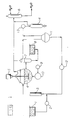
- FIG. 1 of the drawing illustrates the three-stage process described herein.
- a column 3 is packed with a redistribution catalyst.
- the column 3 is connected to a reservoir 1 for feeding chlorosiloxanes to the column through a flow control device 2 .
- Redistributed products from the column 3 are passed to a hydrolysis reactor 4 , of a stirred-tank design, equipped with a stirring apparatus 5 .
- Hydrogen chloride gas evolved in the hydrolysis reactor 4 is passed to a hydrogen chloride scrubber 6 .
- Aqueous 36 weight percent hydrogen chloride is fed to the hydrolysis reactor 4 from a reservoir 8 through a metering device 9 and a hot oil bath 10 , to provide make-up acid.
- the hot oil bath 10 heats the aqueous acid solution to compensate for heat lost from the evolution of hydrogen chloride gas.
- a portion of the reaction mixture is continuously withdrawn from the hydrolysis reactor 4 and passed to a phase separator 7 .
- the hydrolysis mixture separates by gravity into an upper siloxane layer and a lower aqueous hydrogen chloride layer.
- the lower aqueous hydrogen chloride layer is withdrawn and recycled back to the hydrolysis reactor 4 along with aqueous make-up hydrogen chloride from reservoir 8 to maintain the interface level in the phase separator 7 .
- the siloxane mixture is removed from the top of the phase separator 7 and passed to a flash distillation apparatus 11 .
- the flash distillation apparatus is run under temperature and pressure conditions which cause cyclic polyorganosiloxanes and short- chain chloride end-terminated polyorganosiloxanes to be distilled out from higher molecular weight polyorganosiloxanes.
- the higher molecular weight materials are withdrawn from the bottom of the flash distillation apparatus 11 and recycled through flow regulator 12 to column 3 .
- the distilled cyclic polyorganosiloxanes and short-chain, chloride end-terminated polyorganosiloxanes are withdrawn through regulator 13 , condensed in water cooled condenser 14 and collected in a suitable container.
- the present invention provides a process for the redistribution of chloride or hydroxyl-terminated polyorganosiloxanes, the process comprising:
- chlorosiloxanes and hydroxysiloxanes have an average value for x in the range of 7 to 1000. Preferred is when all the R radicals are methyl.
- the first polydispersed mixture of siloxanes can be formed, for example, by hydrolysis of diorganodichlorosilane.
- the second mixture comprises chlorosilanes, chlorosiloxanes or a mixture thereof of the formula: Cl(SiR 2 O) y SiR 2 Cl where R is as previously described, y is a mean value of zero to less than x .
- the first mixture comprises a combination of chlorosiloxanes and hydroxysiloxanes or any combination thereof, an average value for the number of siloxane units in all siloxanes present, A v , can be determined and y chosen to fall in a range from 0 to less than A v .
- the preferred value for y is zero.
- the second mixture comprises chlorosilanes and chlorosiloxanes on which all R radicals are methyl.
- the redistributed mixture comprises chlorosiloxanes of the formula Cl(SiR 2 O) z SiR 2 Cl where R is as previously described; z is a mean value greater than y and less than x , when the first mixture is chlorosiloxanes; z is a mean value greater than y and less than x+2y when the first mixture is hydroxysiloxanes; and z is a mean value greater than y and less than A v ', when the first mixture comprises a combination of chlorosiloxanes and hydroxysiloxanes or any combination thereof.
- the value A v ' is a mean value equal to A v plus the mole fraction of the hydroxysiloxane times 2y.
- the first polydispersed mixture and the second mixture are contacted in the presence of a catalyst.
- the catalyst which facilitates redistribution is selected from a group consisting of alumina, silica alumina, and zeolite.
- Silica-alumina refers to an amorphorus compound containing both silicon oxides and aluminum oxides. In general, the more silicon dioxide present the lower the catalytic activity of the silica-alumina. Preferred, is when the silica is less than about 30 weight percent of the silica alumina compound.
- zeolite refers to crystalline aluminosilicates of Group IA and Group IIA elements such as sodium, potassium, magnesium and calcium.
- the zeolites effective in the process of the instant invention can be both synthetic and natural occurring zeolites, for example, as described in the Concise Encyclopedia of Chemical Technology, John Wiley and Sons, NY, 1985, pp. 772-774.
- a preferred zeolite is zeolite Y.
- the catalyst be free of water prior to contact with the chlorosiloxane.
- Water can be removed from the catalyst by, for example, a vacuum, heating, treating with gaseous hydrogen chloride or treating with a chlorosilane.
- the preferred catalyst is alumina.
- the first and second mixtures may be combined and then fed to a reactor containing the catalyst or may be individually fed to a reactor containing the catalyst.
- Contact of the catalyst with the chlorosiloxanes can be effected by standard means for contacting liquids with solids, for example, a batch process or a continuous-flow process.
- the process can be conducted, for example, in a fixed-bed, a stirred-bed or a fluid-bed reactor.
- the required contact time for the chlorosiloxanes with the catalyst, to effect redistribution will depend upon such factors as temperature, type of chlorosiloxanes and type of catalyst. In general, contact times between about one to 60 minutes have been found useful. Longer contact times may be employed, however, undesirable levels of organic cleavage from silicon may occur. Shorter contact times may result in inadequate redistribution of the chlorosiloxanes. A preferred contact time is about five to 15 minutes.
- the process can be run at a temperature between about 0°C. and 200°C. Higher temperatures may be run, but these can result in unacceptable levels of organic cleavage from silicon atoms.
- a preferred temperature range is about 25°C. to 60°C.
- a preferred contact method is a continuous flow fixed-bed reactor.
- the volume ratio of the second mixture to the first mixture can be varied to affect the value z of the redistributed chlorosilane mixture. As the ratio increases z approaches y. A preferred range for this ratio is about 0.1 to 30.
- the described process forms a redistributed mixture comprising chlorosiloxanes of the general formula Cl(SiR 2 O) m SiR 2 Cl, as previously described, with a mean value for the number of siloxane units of z .
- the value z is greater than y and less than x , x+2y, or A v ', depending upon the composition of the first mixture.
- a second embodiement of the instant invention is a three-stage process for preparing cyclic siloxanes, the process comprising:
- the process comprises contacting a first mixture comprising chlorosiloxanes of formula Cl(SiR 2 O) x SiR 2 Cl and hydroxysiloxanes of the formula HO(SiR 2 O) x SiR 2 OH, or any mixture thereof; as previously described, with a second mixture comprising chlorosilanes and chlorosiloxanes of formula Cl(SiR 2 O) p SiR 2 Cl, where R is as previously described and p is an average value within a range of 0 to 7, in the presence of a catalyst which facilitates redistribution of chlorosiloxanes.
- a catalyst which facilitates redistribution of chlorosiloxanes.
- the latter catalyst can be carbon activated by treatment with anhydrous acid or chlorosilane.
- the catalytic activity of the activated carbon can be improved by bubbling gaseous hydrogen chloride through the carbon bed while conducting the redistribution processes described herein.
- a preferred value for x in the three-stage process is in the range of one to 100.
- a redistributed mixture comprising chlorosiloxanes of the formula Cl(SiR 2 O) o SiR 2 Cl is formed, where R is as previously described and o is an average value within the range of 0 to 7.
- the catalysts, process temperature and contact times are as previously described.
- the method of contacting the first and second mixtures and the catalyst are as previously described.
- the redistributed mixture of chlorosiloxanes is fed to a hydrolysis process where a hydrolysate is formed comprising cyclic siloxanes of the formula (R 2 SiO) q , where q is an average value in a range of 3 to 25, chlorosiloxanes of the formula Cl(SiR 2 O) m SiR 2 Cl and hydroxysiloxanes of the formula HO(SiR 2 O) x SiR 2 OH, as previously described.
- the hydrolysis reaction is run in the presence of stoichiometric or excess water in relation to the moles of chloride in the chlorosiloxanes to be redistributed.
- the amount of excess water will be dictated by the method of chloride recovery, whether anhydrous or aqueous.
- the hydrolysis reaction can be run by standard methods, for example, in a continuous stirred tank reactor (CSTR), plug-flow reactor, fixed-bed reactor or a fluidized-bed reactor.
- CSTR continuous stirred tank reactor
- plug-flow reactor plug-flow reactor
- fixed-bed reactor fixed-bed reactor
- fluidized-bed reactor a fluidized-bed reactor.
- the cyclic siloxanes are separated from the chlorosiloxanes and hydroxysiloxanes.
- This separation can be effected by first causing a phase separation of the hydrolysate into an aqueous hydrogen chloride phase and a siloxane phase. Phase separation may be accomplished by gravitational methods such as settling or centrifugation. The recovered aqueous hydrogen chloride phase can be recycled to the hydrolysis reactor. The siloxane phase can then be separated into a desired cyclic siloxanes fraction and a chlorosiloxane/hydroxysiloxane fraction by standard means such as flash or column distillation or falling film evaporation.
- the chlorosiloxanes and hydroxysiloxanes are recycled to the redistribution reactor for redistribution to low molecular weight chlorosiloxanes capable of under going hydrolysis to cyclic polysiloxanes.
- the chlorosiloxanes and hydroxysiloxanes may be recycled on a continuous or batch basis.
- a volume ratio of the second chlorosilane or chlorosiloxane mixture to the recycled chlorosiloxanes and hydroxysiloxanes in the range of 1:1 to 100:1 has been found useful. The preferred ratio will depend upon the molecular weight of the recycled material, the composition of the second mixture and the desired product.
- a preferred process is where p is zero, R is methyl and the volume ratio of the second mixture to the recycled chlorosiloxanes is in the range of 1:1 to 30:1.
- Table 2 lists the type materials tested and the source of each material. Tested compounds, as listed in Table 2, were purchase from United Catalyst, Inc., Louisville, KY; Alfa Products, Danvers, MA; Norton, Akron, OH; Calgon, Pittsburg, PA; and Harshaw, Cleveland, OH.
- the percent of linear chloride end-terminated polydimethylsiloxanes in the redistributed mixture less than 6 siloxane units in length is presented under the heading "%Linear ⁇ 6.” The value is calculated as a percent of all linear polydimethylsiloxanes in the redistributed mixture.
- Table 2 Screening of Compounds as Catalysts For Redistribution of Chloride End-terminated Polydimethylsiloxanes Type Material %Linears ⁇ 6 Source Alumina 96.3 United Catalyst Inc. (CS331-1) Silica-Alumina (8.4% SiO 2 ) 93.3 United Catalyst Inc.
- Table 2 demonstrate the ability of various materials to function as catalysts for the redistribution of a mixture of chloride end-terminated polydimethylsiloxanes and dimethyldichlorosilanes.
- a continuous stirred-tank reactor was used.
- the reactor consisted of a 500 ml 3-neck flask equipped with a stirring paddle.
- the reactor contained a side nozzle from which hydrolysate was continuously removed.
- the hydrolysate was gravitationally phase separated in a separate vessel to a top siloxane phase and a bottom aqueous hydrogen chloride phase.
- the aqueous hydrogen chloride phase was recycled to the CSTR.
- Samples of the siloxane phase were collected for analysis by gas chromotography (GC) and SFC. The required heat for the reaction was provided by heating the recycled aqueous hydrogen chloride prior to returning to the CSTR.
- GC gas chromotography
- CEB s monodispersed chloride end- terminated polydimethylsiloxane polymers
- This series of runs was conducted at 35°C., with a mixing speed of 1100 rpm, a CEB s feed rate of 5 ml per minute, a DMDCS feed rate of 12 ml per minute and with added 42% weight percent aqueous hydrogen chloride.
- the CEB s s and DMDCS where fed separately into the bottom of the reactor.
- the siloxane products from the reactor were analyzed by GC.
- the percent conversion of feed, DMDCS or CEB s , to product was calculated using the following formula:
- the percent cyclics of a particular degree of polymerization (%D s , where s is the number of silicon atoms in the ring) was calculated as:
- feed refers to the DMDCS or chloride end-terminated polydimethylsiloxane (CEB s ).
- CEB s chloride end-terminated polydimethylsiloxane
- a hydrolysate containing high molecular weight (HMW) chloride end-terminated polydimethylsiloxanes with an average number of about 4000 siloxane units per polymer chain were redistributed with DMDCS.
- the hydrolysate was mixed with DMDCS at a volume ratio of 0.6:1 and passed through a column of alumina (United Catalysis, CS331-1) held at a temperature of 40°C.
- the resident time within the alumina bed was about 11.7 minutes.
- the product from the alumina column was collected and analyzed by SFC for size distribution of the siloxanes. The results are presented in Table 4.
- %HMWP refers to the percent of chloride end-terminated polydimethylsiloxane in the feed or product mixture with an average number of siloxane units of about 4000.
- %Linears ⁇ 6 refers to the percent of chloride end-terminated linears less than six siloxane units in length, as a percent of all linear polydimethylsiloxanes in the product or feed mixture. Table 4 Redistribution of HMW Chloride End-terminated Polydimethylsiloxanes %HMWP %Linears ⁇ 6 Feed 1.2 0.6 Product ⁇ 0.1 68.1
- the data demonstrates the ability of alumina to effect redistribution of HMW chloride end-terminated polydimethylsiloxanes with dimethyldichlorosilane.
- a three-stage process was run.
- a mixture of chloride end-terminated polydimethylsiloxane polymers and DMDCS was redistributed in a plug-flow reactor.
- the redistributed siloxane mixture was hydrolyzed in a CSTR reactor similar to that described in Example 3.
- the hydrolysis mixture of stage 2 was separated into a cyclic siloxane portion and a linear siloxane portion by flash distillation. The linear siloxane portion was recycled back to the first stage of the process for further redistribution and conversion to cyclic siloxanes.
- a plug-flow reactor of conventional design, with a packed bed of alumina (United Catalyst, Inc., CS331-1), was used to redistribute chloride end-terminated polydimethylsiloxanes with DMDCS to produce short chain, chloride end-terminated polydimethylsiloxanes.
- the alumina catalyst was initially soaked with DMDCS to remove water. After removal of residual water, additional DMDCS was continuously metered to the redistribution reactor at a rate of 6.5 to 7.0 ml per minute. Prior to entering the redistribution reactor, the DMDCS was combined with recycled bottom material from the stage 3 flash distillation procedure. The volume ratio of DMDCS to bottom material was maintained within the range of 2:1 to 3.1:1. Residence time of the feed materials within the packed bed of the redistribution reactor was approximately 8 minutes. Samples of the redistributed product were taken and analyzed using SFC.
- the short-chain chloride end-terminated polydimethylsiloxanes produced in the redistribution stage were hydrolyzed by continuous feeding to a CSTR similar to that described in Example 3.
- a co-feed of recycled 42% weight percent aqueous hydrogen chloride was fed to the CSTR along with the redistribution product.
- a volumetric ratio of approximate 4:1 acid to redistribution product was used.
- the liquid level in the CSTR was controlled at about 250 ml by withdrawing liquid from a side nozzle.
- the residence time of feed materials in the CSTR was about 5 minutes. Agitation of the mixture within the CSTR was provided by a stirring paddle rotated at 600 rpm.
- the CSTR reactor was held at 60°C. by heating the recycled aqueous hydrogen chloride prior to returning to the reactor.
- the hydrogen chloride gas generated by the reaction was vented at near atmospheric pressure directly to a standard vent scrubber.
- the liquid hydrolysis products were continuously taken off the side nozzle of the CSTR and allowed to phase separate in a separate vessel.
- the bottom phase consisting of aqueous hydrogen chloride, was recycled to the CSTR.
- the top phase containing a mixture of siloxanes, was fed directly to a flash stripper.
- the interface level in the phase separator was maintained by feeding 36% weight percent aqueous hydrogen chloride to the separator to replenish the water used in the reaction.
- Samples of the siloxane product were taken and analyzed by GC and SFC.
- the siloxane mixture separated from the CSTR process, was fed directly into a 3 liter flash distillation vessel.
- the distillation vessel was a single-stage flash distillation apparatus operating at a temperature between 230°C. and 250°C. and at near atmospheric pressure.
- the cyclic siloxanes were distilled off, condensed and collected.
- the liquid level in the distillation vessel was maintained by adjusting a bottoms take-off pump rate to give a liquid hold up time of approximate 30 minutes.
- the entire bottoms stream was recycled back to the stage 1 redistribution reactor for chain shortening. Samples of the distillate and the bottom products were taken and analyzed by SFC.
- the three-stage process was run continuously over a two day period.
- the averaged results for samples collected over this time period are presented in Table 4.
- the data under the heading "%CEB1-5" is a summation of DMDCS and chloride end-terminated polydimethylsiloxane polymers of 1 to 4 siloxane units in length, present in the sample, as a weight percent of the total sample.
- the headings "%Cyclics” and “%Conv” are as previously described.
- the heading “%Cyclic Yield” is calculated as: The results are presented in Table 5.
Landscapes
- Chemical & Material Sciences (AREA)
- Organic Chemistry (AREA)
- Chemical Kinetics & Catalysis (AREA)
- Health & Medical Sciences (AREA)
- Medicinal Chemistry (AREA)
- Polymers & Plastics (AREA)
- Silicon Polymers (AREA)
Claims (2)
- Verfahren zur Umverteilung von Polyorganosiloxanen mit Chlorid- oder Hydroxylendgruppen, wobei das Verfahren umfaßt, daß man:(A) eine erste polydisperse Mischung aus Siloxanen der Formel
R1(SiR2O)xSiR2R1 ,
worin jeder Rest R unabhängig ausgewählt ist aus einer Gruppe bestehend aus Wasserstoff, Alkyl- und substituierten Alkylresten mit 1 bis 6 Kohlenstoffatomen, R1 entweder Cl oder OH ist, x ein Mittelwert von 1 bis 5.000 ist, mit einer zweiten Mischung aus Chlorsilanen oder Chlorsiloxanen der Formel
Cl(SiR2O)ySiR2Cl ,
worin R wie vorher beschrieben ist und y ein Mittelwert von 0 bis weniger als x ist, in Gegenwart eines Katalysators, der die Umverteilung von Chlorsiloxanen erleichtert, 1 bis 60 Minuten lang in Kontakt bringt, wobei der Katalysator ausgewählt ist aus einer Gruppe bestehend aus Aluminiumoxid Siliciumdioxid-Aluminiumoxid und Zeolith, und(B) eine umverteilte Mischung aus Chlorsiloxanen der Formel
Cl(SiR2O)zSiR2Cl
bildet, worin R wie vorher beschrieben ist und z ein Mittelwert größer y und kleiner x ist, wenn R1 Cl ist, oder kleiner x + 2y ist, wenn R1 OH ist. - Dreistufiges Verfahren zur Herstellung von cyclischen Siloxanen, wobei das Verfahren umfaßt, daß man:(A) eine erste Mischung aus Chlorsiloxanen der Formel
Cl(SiR2O)xSiR2Cl ,
worin jeder Rest R unabhängig ausgewählt ist aus einer Gruppe bestehend aus Wasserstoffatomen und Alkyl- und substituierten Alkylresten mit 1 bis 6 Kohlenstoffatomen, und x ein Mittelwert von 1 bis 5000 ist; mit einer zweiten Mischung aus Chlorsilanen und Chlorsiloxanen der Formel
Cl(SiR2O)pSiR2Cl ,
worin R wie vorher beschrieben ist und p ein Mittelwert von 0 bis 7 ist; in Gegenwart eines Katalysators, der die Umverteilung von Chlorsiloxanen erleichtert, ausgewählt aus einer Gruppe bestehend aus Aluminiumoxid, Siliciumdioxid-Aluminiumoxid, Zeolith und Aktivkohle, in Kontakt bringt;(B) eine umverteilte Mischung mit Chlorsiloxanen der Formel
Cl(SiR2O)oSiR2Cl ,
worin R wie vorher beschrieben ist und o ein Mittelwert in einem Bereich von größer 0 und kleiner 7 ist; bildet;(C) die umverteilte Mischung aus Chlorsiloxanen hydrolysiert unter Bildung eines Hydrolysats, das cyclische Siloxane der Formel
(R2SiO)q ,
worin R wie vorher beschrieben ist und q ein Mittelwert von 3 bis 25 ist; und Chlorsiloxane umfaßt;(D) die cyclischen Siloxane von den Chlorsiloxanen abtrennt und(E) die Chlorsiloxane als Beschickung in Stufe (A) zurückführt.
Applications Claiming Priority (2)
| Application Number | Priority Date | Filing Date | Title |
|---|---|---|---|
| US07/611,216 US5068383A (en) | 1990-11-09 | 1990-11-09 | Catalyzed redistribution of polyorganosiloxanes |
| US611216 | 1990-11-09 |
Publications (3)
| Publication Number | Publication Date |
|---|---|
| EP0484959A2 EP0484959A2 (de) | 1992-05-13 |
| EP0484959A3 EP0484959A3 (en) | 1992-10-28 |
| EP0484959B1 true EP0484959B1 (de) | 1997-08-20 |
Family
ID=24448096
Family Applications (1)
| Application Number | Title | Priority Date | Filing Date |
|---|---|---|---|
| EP91119057A Expired - Lifetime EP0484959B1 (de) | 1990-11-09 | 1991-11-08 | Katalysierte Äquilibrierung von Polyorganosiloxanen und Verfahren zur Herstellung von Cyclosiloxanen |
Country Status (5)
| Country | Link |
|---|---|
| US (1) | US5068383A (de) |
| EP (1) | EP0484959B1 (de) |
| JP (1) | JP3222511B2 (de) |
| CA (1) | CA2054357C (de) |
| DE (1) | DE69127344T2 (de) |
Families Citing this family (16)
| Publication number | Priority date | Publication date | Assignee | Title |
|---|---|---|---|---|
| US5196559A (en) * | 1992-01-23 | 1993-03-23 | Dow Corning Corporation | Equilibration of cyclic siloxanes with novel catalysts |
| US5247116A (en) * | 1992-07-10 | 1993-09-21 | Temple University Of The Commonwealth System Of Higher Education | Acid-catalyzed process for the production of cyclosiloxanes |
| US5239101A (en) * | 1992-12-21 | 1993-08-24 | Dow Corning Corporation | Anhydrous process for preparation of polyorganosiloxanes |
| US5233070A (en) * | 1992-12-23 | 1993-08-03 | Dow Corning Corporation | Process for converting chlorine end-terminated polyorganosiloxanes to polyorganocyclosiloxanes |
| US5856567A (en) * | 1995-06-07 | 1999-01-05 | Novus International, Inc. | Continuous hydrolysis process for preparing 2-hydroxy-4-methylthiobutanioc acid or salts thereof |
| DE69615183T2 (de) | 1995-06-07 | 2002-05-29 | Novus International, Inc. | Kontinuerliches hydrolyse-verfahren zur herstellung von 2-hydroxy-4-methylthiobutansäure oder salze davon |
| DE19654556A1 (de) | 1996-12-27 | 1998-07-02 | Wacker Chemie Gmbh | Harnstoffgruppen aufweisende Organosiliciumverbindungen, deren Herstellung sowie deren Verwendung |
| US6180811B1 (en) * | 1998-12-22 | 2001-01-30 | Dow Corning Corporation | Reducing low molecular weight cyclic organosiloxanes in a recirculating process stream |
| US6316655B1 (en) | 2001-02-20 | 2001-11-13 | Dow Corning Corporation | Method of making hydroxy end-terminated linear siloxanes |
| FR2850660B1 (fr) * | 2003-02-05 | 2006-08-04 | Rhodia Chimie Sa | Procede de preparation des resines polymethylvinylsiloxanes avec recyclage des oligoorgano siloxanes volatils |
| US7368589B2 (en) | 2003-10-31 | 2008-05-06 | Johnson & Johnson Vision Care, Inc. | Purification of silicone containing compounds by supercritical fluid extraction |
| JPWO2006051663A1 (ja) * | 2004-11-09 | 2008-05-29 | 住友ベークライト株式会社 | 分解反応装置、再生樹脂組成物原料製造システム、再生樹脂組成物原料製造方法、再生樹脂組成物原料、および成形体 |
| CN101160343A (zh) * | 2005-05-16 | 2008-04-09 | 陶氏康宁公司 | 再分布聚有机基硅氧烷的方法 |
| DE102012212007A1 (de) * | 2012-07-10 | 2014-01-16 | Wacker Chemie Ag | Verfahren zur Herstellung von Organopolysiloxanen |
| PL404691A1 (pl) | 2013-07-15 | 2015-01-19 | Dow Corning Corporation | Telomeryzacja cyklicznych poliorganosiloksanów |
| EP4549488A1 (de) | 2023-10-31 | 2025-05-07 | Evonik Operations GmbH | Verfahren zur herstellung von wasserstoffsiloxanen |
Citations (2)
| Publication number | Priority date | Publication date | Assignee | Title |
|---|---|---|---|---|
| GB1325627A (en) * | 1970-06-23 | 1973-08-08 | Wacker Chemie Gmbh | Process for the manufacture of organopolysiloxane oils |
| US4831174A (en) * | 1987-12-31 | 1989-05-16 | Dow Corning Corporation | Production of polydiorganosiloxane fluids with low silanol content |
Family Cites Families (16)
| Publication number | Priority date | Publication date | Assignee | Title |
|---|---|---|---|---|
| US2421653A (en) * | 1944-07-01 | 1947-06-03 | Gen Electric | Preparation of polyorganohalogenopolysiloxanes |
| US2911427A (en) * | 1957-12-11 | 1959-11-03 | Dow Corning | Chlorosiloxanes |
| US3169942A (en) * | 1959-12-08 | 1965-02-16 | Union Carbide Corp | Zeolite catalyzed condensation of hydroxyl and/or alkoxy containing silicon compositions |
| US3065252A (en) * | 1960-12-06 | 1962-11-20 | Dow Corning | Catalytic preparation of chlorosiloxanes |
| US3101361A (en) * | 1961-01-05 | 1963-08-20 | Dow Corning | Catalytic preparation of chlorosiloxanes in polar solvents |
| US3162662A (en) * | 1961-04-19 | 1964-12-22 | Dow Corning | Preparation of linear chlorosiloxanes from cyclotrisiloxanes |
| US3398177A (en) * | 1965-05-10 | 1968-08-20 | Dow Corning | Redistribution of sih bonds |
| DE1279019B (de) * | 1967-01-04 | 1968-10-03 | Wacker Chemie Gmbh | Verfahren zur Herstellung von Organohalogensiliciumverbindungen |
| US3642851A (en) * | 1968-12-27 | 1972-02-15 | Union Carbide Corp | Preparation of linear halosiloxanes and compounds derived therefrom |
| BE759495A (fr) * | 1969-11-27 | 1971-05-26 | Rhone Poulenc Sa | Preparation de siloxanes par redistribution |
| US3853934A (en) * | 1974-01-14 | 1974-12-10 | Gen Electric | Continuous process for producing polysiloxane oils |
| DE2453482B2 (de) * | 1974-11-12 | 1980-04-30 | Bayer Ag, 5090 Leverkusen | Verfahren zur Herstellung von endständig chlorsubstituierten, linearen oder verzweigten Organosiloxanen |
| DE2630744C3 (de) * | 1976-07-08 | 1979-05-23 | Wacker-Chemie Gmbh, 8000 Muenchen | Verfahren zur Umwandlung von Organosiloxanen |
| US4329482A (en) * | 1981-07-10 | 1982-05-11 | Dow Corning Corporation | Preparation of mixed cyclotetrasiloxanes and aliphatic chlorides and/or acyl chlorides |
| US4329483A (en) * | 1981-07-10 | 1982-05-11 | Dow Corning Corporation | Preparation of cyclotetrasiloxanes aliphatic chlorides and acyl chlorides |
| US4895967A (en) * | 1988-09-26 | 1990-01-23 | General Electric Company | Method for making cyclic poly(siloxane)s |
-
1990
- 1990-11-09 US US07/611,216 patent/US5068383A/en not_active Expired - Lifetime
-
1991
- 1991-10-28 CA CA002054357A patent/CA2054357C/en not_active Expired - Fee Related
- 1991-11-08 DE DE69127344T patent/DE69127344T2/de not_active Expired - Fee Related
- 1991-11-08 JP JP29263291A patent/JP3222511B2/ja not_active Expired - Fee Related
- 1991-11-08 EP EP91119057A patent/EP0484959B1/de not_active Expired - Lifetime
Patent Citations (2)
| Publication number | Priority date | Publication date | Assignee | Title |
|---|---|---|---|---|
| GB1325627A (en) * | 1970-06-23 | 1973-08-08 | Wacker Chemie Gmbh | Process for the manufacture of organopolysiloxane oils |
| US4831174A (en) * | 1987-12-31 | 1989-05-16 | Dow Corning Corporation | Production of polydiorganosiloxane fluids with low silanol content |
Non-Patent Citations (1)
| Title |
|---|
| W. Noll, "Chemistry and Technology of Silicones", Academic Press Inc., 1968, pp 192-6 * |
Also Published As
| Publication number | Publication date |
|---|---|
| EP0484959A2 (de) | 1992-05-13 |
| JP3222511B2 (ja) | 2001-10-29 |
| US5068383A (en) | 1991-11-26 |
| JPH04332733A (ja) | 1992-11-19 |
| CA2054357C (en) | 2001-05-01 |
| DE69127344D1 (de) | 1997-09-25 |
| EP0484959A3 (en) | 1992-10-28 |
| DE69127344T2 (de) | 1998-01-08 |
| CA2054357A1 (en) | 1992-05-10 |
Similar Documents
| Publication | Publication Date | Title |
|---|---|---|
| EP0484959A2 (de) | Katalysierte Äquilibrierung von Polyorganosiloxanen | |
| EP0738732B1 (de) | Verfahren zur Herstellung von zyklischen Polysiloxanen | |
| JPH05140316A (ja) | シロキサン類の精製方法 | |
| EP0694554B1 (de) | Verfahren zur Herstellung von cyclischen Organohydrogensiloxanen | |
| EP0515082B1 (de) | Einstufiges Verfahren zur Herstellung von Siloxanen, wobei wasserfreie Chlorwasserstoff freigesetzt wird | |
| WO1994001439A1 (en) | Acid-catalyzed process for production of cyclosiloxanes | |
| CA1300165C (en) | Process for preparation of cyclopolydiorganosiloxanes | |
| EP0739926B1 (de) | Verfahren zur zurückgewinnung von organoalkoxysilan aus polyorganosiloxan | |
| JP3294225B2 (ja) | 線状オルガノポリシロキサン混合物の製造法 | |
| US5252767A (en) | Process for the preparation of organosiloxanes | |
| JP2002060393A (ja) | 鎖状低分子シロキサンの製造方法 | |
| EP1247811B1 (de) | Verfahren zur Herstellung linearer Organohydrosiloxanen | |
| EP0604112B1 (de) | Verfahren zur Umwandlung von Chlorendgruppen enthaltenden Polyorganosiloxanen zu Polyorganocyclosiloxanen | |
| JP4150020B2 (ja) | Si−H基を有する直鎖状のオルガノポリシロキサンの製造方法 | |
| JP3616660B2 (ja) | 環状4量体シロキサンの製造方法 | |
| US5723561A (en) | Process for the continuous preparation of organopolysiloxanes | |
| US20150166732A1 (en) | Method for producing organopolysiloxanes | |
| EP0644221B1 (de) | Herstellung und Verarbeitung von Polydiorganosiloxanen | |
| EP1013698B1 (de) | Reduzierung von cyclischen Polyorganosiloxanen in einem rückgeführten Produktstrom | |
| US3595896A (en) | Method for the hydrolysis of organohalogenosilanes | |
| US4348532A (en) | Monoorganosiloxy containing siloxane fluids | |
| US5616673A (en) | Process for production of low viscosity low silanol content silicone fluids | |
| US7655811B2 (en) | Method for producing OH-terminal organo hydrogen polysiloxanes | |
| US5239101A (en) | Anhydrous process for preparation of polyorganosiloxanes | |
| JP4472033B2 (ja) | 直鎖状オルガノハイドロジェンシロキサンオリゴマーの製造方法 |
Legal Events
| Date | Code | Title | Description |
|---|---|---|---|
| PUAI | Public reference made under article 153(3) epc to a published international application that has entered the european phase |
Free format text: ORIGINAL CODE: 0009012 |
|
| AK | Designated contracting states |
Kind code of ref document: A2 Designated state(s): DE FR GB |
|
| PUAL | Search report despatched |
Free format text: ORIGINAL CODE: 0009013 |
|
| AK | Designated contracting states |
Kind code of ref document: A3 Designated state(s): DE FR GB |
|
| 17P | Request for examination filed |
Effective date: 19921230 |
|
| 17Q | First examination report despatched |
Effective date: 19950123 |
|
| GRAG | Despatch of communication of intention to grant |
Free format text: ORIGINAL CODE: EPIDOS AGRA |
|
| GRAH | Despatch of communication of intention to grant a patent |
Free format text: ORIGINAL CODE: EPIDOS IGRA |
|
| GRAH | Despatch of communication of intention to grant a patent |
Free format text: ORIGINAL CODE: EPIDOS IGRA |
|
| GRAA | (expected) grant |
Free format text: ORIGINAL CODE: 0009210 |
|
| AK | Designated contracting states |
Kind code of ref document: B1 Designated state(s): DE FR GB |
|
| REF | Corresponds to: |
Ref document number: 69127344 Country of ref document: DE Date of ref document: 19970925 |
|
| ET | Fr: translation filed | ||
| PLBE | No opposition filed within time limit |
Free format text: ORIGINAL CODE: 0009261 |
|
| STAA | Information on the status of an ep patent application or granted ep patent |
Free format text: STATUS: NO OPPOSITION FILED WITHIN TIME LIMIT |
|
| 26N | No opposition filed | ||
| PGFP | Annual fee paid to national office [announced via postgrant information from national office to epo] |
Ref country code: GB Payment date: 20011011 Year of fee payment: 11 |
|
| REG | Reference to a national code |
Ref country code: GB Ref legal event code: IF02 |
|
| PG25 | Lapsed in a contracting state [announced via postgrant information from national office to epo] |
Ref country code: GB Free format text: LAPSE BECAUSE OF NON-PAYMENT OF DUE FEES Effective date: 20021108 |
|
| GBPC | Gb: european patent ceased through non-payment of renewal fee | ||
| PGFP | Annual fee paid to national office [announced via postgrant information from national office to epo] |
Ref country code: DE Payment date: 20081107 Year of fee payment: 18 |
|
| PGFP | Annual fee paid to national office [announced via postgrant information from national office to epo] |
Ref country code: FR Payment date: 20081112 Year of fee payment: 18 |
|
| REG | Reference to a national code |
Ref country code: FR Ref legal event code: ST Effective date: 20100730 |
|
| PG25 | Lapsed in a contracting state [announced via postgrant information from national office to epo] |
Ref country code: FR Free format text: LAPSE BECAUSE OF NON-PAYMENT OF DUE FEES Effective date: 20091130 |
|
| PG25 | Lapsed in a contracting state [announced via postgrant information from national office to epo] |
Ref country code: DE Free format text: LAPSE BECAUSE OF NON-PAYMENT OF DUE FEES Effective date: 20100601 |